Home Blog Page 19

What Is the Valencia Diet? Everything You Need to Know Before You Try It

0

Every few months, a new eating plan takes over social media feeds and dinner-table conversations alike. First it was the carnivore diet. Then it was the egg-only craze. Now, the internet has a new obsession: the Valencia Diet. Praised for being less restrictive than most viral diets and criticized by some for lacking rigorous research, it has become one of the most searched nutrition trends of the year.

So what exactly is the Valencia Diet, why is it spreading so fast, and  more importantly is it actually good for you? Here’s a full breakdown of the plan, the science behind it, and what nutrition experts have to say.

Who Created the Valencia Diet?
Who Created the Valencia Diet?|Scoop Rush

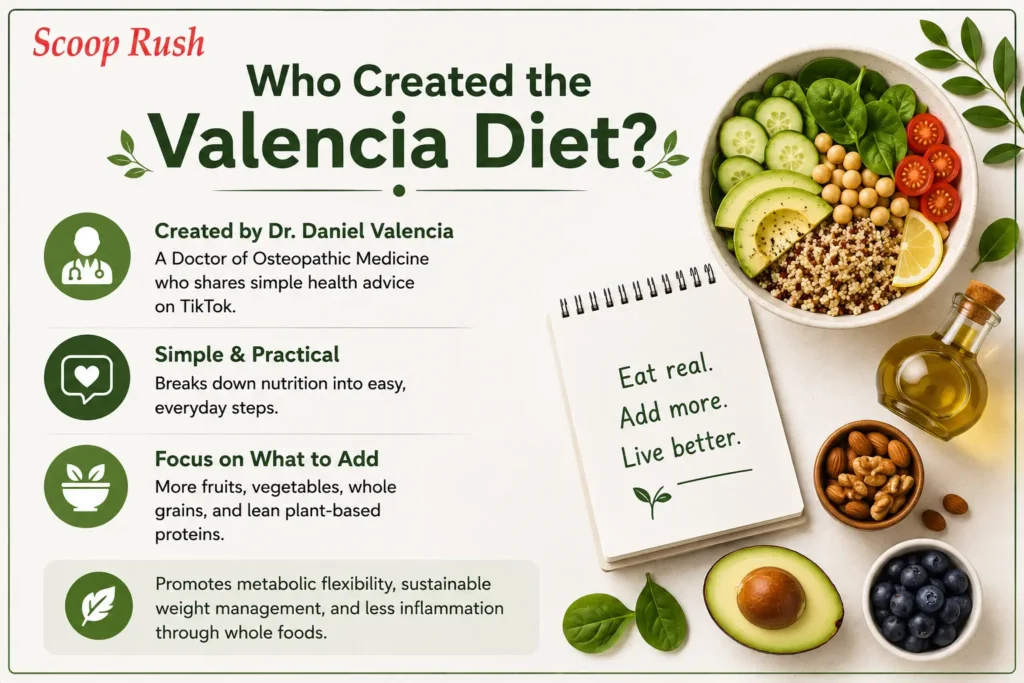
The Valencia Diet takes its name from its creator, Dr. Daniel Valencia, a Doctor of Osteopathic Medicine known for sharing accessible, everyday health advice on social platforms, particularly TikTok. Rather than promoting an extreme or restrictive protocol, Dr. Valencia built his following by breaking down nutrition science into simple, actionable steps that don’t require a dietitian’s supervision or a pantry overhaul.

His overall message centers on metabolic flexibility, sustainable weight management, and reducing inflammation through whole foods themes that resonate strongly with people who feel burned out on fad diets that eliminate entire food groups. Instead of telling followers what they can never eat again, Dr. Valencia’s approach is built around what to add more of: fruits, vegetables, lean and plant-based proteins, and whole grains.

What Is the Valencia Diet, Exactly?

What Is the Valencia Diet, Exactly?|Scoop Rush

At its core, the Valencia Diet is a whole-foods eating pattern that borrows heavily from the Mediterranean diet while layering in intermittent fasting and a specific protein target. It isn’t vegetarian or vegan, but it does push followers to rely more on plant-based and non-meat proteins think eggs, Greek yogurt, tofu, cottage cheese, and legumes rather than red meat or heavily processed protein sources.

The general framework includes:

  • A daily calorie target of roughly 1,500 calories for most adults, though this varies based on individual needs, activity level, and body size.
  • A protein goal of about 1 gram per pound of ideal body weight, which typically works out to somewhere between 100 and 150 grams of protein a day for most followers.
  • Unlimited fruit and vegetable intake, since these are considered the foundation of the diet rather than something to ration.
  • A daily fasting window of at least 12 hours, meaning most people naturally end up eating within a 10-to-12-hour window each day.
  • Regular movement, including both strength training and cardiovascular exercise, positioned as a non-negotiable part of the lifestyle rather than an optional add-on.

Because of this structure, many nutrition writers have described it as a more flexible, protein-forward cousin of the Mediterranean diet one built for people who want structure without feeling like they’re constantly saying no to food.

The Core Principles Behind the Plan
The Core Principles Behind the Plan|Scoop Rush

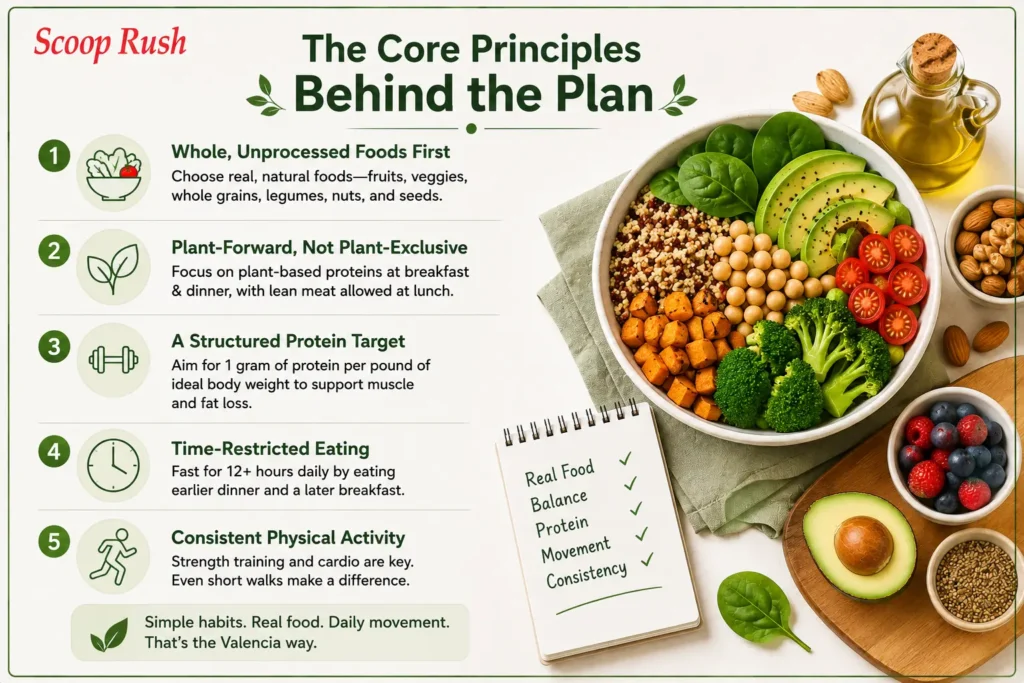
1. Whole, Unprocessed Foods First

The plan’s central rule is simple: prioritize food in its most natural form. That means loading up on fresh produce, whole grains, legumes, nuts, and seeds, while cutting back on packaged snacks, refined sugar, and heavily processed ingredients. This isn’t a new idea in nutrition science, but Dr. Valencia’s framing”eat real food, mostly plants” has made it easy to digest for a generation raised on ultra-processed convenience meals.

2. Plant-Forward, Not Plant-Exclusive

Unlike vegan or vegetarian diets, the Valencia Diet doesn’t ban meat outright. It simply asks followers to lean toward non-meat proteins for two of their three main meals, typically breakfast and dinner, while allowing more flexibility including lean meat like grilled chicken at lunch. The idea is to reduce overall red and processed meat consumption without requiring anyone to give it up entirely.

3. A Structured Protein Target

The “1 gram of protein per pound of ideal body weight” guideline is one of the most talked-about elements of the diet. It’s a formula more commonly associated with bodybuilding and strength-training circles than with general wellness content, and its inclusion here is part of what sets the Valencia Diet apart from more traditional Mediterranean-style eating plans. The goal is to preserve lean muscle mass, particularly during a period of calorie restriction, while still supporting fat loss a concern that’s become especially relevant as more people ask about GLP-1 medications and muscle loss during rapid weight-loss periods.

4. Time-Restricted Eating

A daily fasting period of 12 hours or more is built into the plan. For most people, this simply means finishing dinner earlier and pushing breakfast slightly later a far gentler version of intermittent fasting than the 16:8 or alternate-day protocols that have circulated in fitness communities for years. Since many followers still reach for coffee first thing in the morning before their fasting window ends, it’s worth understanding what drinking coffee on an empty stomach actually does to digestion and blood sugar.

5. Consistent Physical Activity

The Valencia Diet isn’t marketed as a standalone weight-loss hack. Strength training and cardiovascular exercise are treated as essential companions to the eating plan, reflecting a broader wellness philosophy rather than a narrow calorie-counting approach. For anyone who isn’t ready for a full workout routine, research on the benefits of a five-minute walk every hour shows that even small bursts of movement throughout the day can meaningfully support this part of the plan.

Breaking Down the Macronutrients

The Valencia Diet follows a fairly structured macronutrient split compared to many trending diets, which often skew heavily toward one macronutrient at the expense of others:

Macronutrient% of Daily CaloriesApproximate Daily AmountPrimary Sources
Protein30-40%100-150gEggs, Greek yogurt, tofu, cottage cheese, legumes, lean chicken
Carbohydrates40-50%150-200gWhole grains, legumes, vegetables, fruit
Fats20-30%40-60gAvocado, nuts, seeds, olive oil

This distribution keeps the plan from tipping into extremely low-carb or extremely high-fat territory. That’s a notable contrast to the benefits and risks of a low-carb diet, where carbohydrate intake is restricted far more aggressively, something nutrition experts often flag as a red flag in more extreme fad diets.

What a Day of Eating Looks Like

One of the reasons the Valencia Diet has spread so quickly is that it comes with an easy-to-follow meal template rather than a rigid, hour-by-hour meal plan. A typical day looks something like this:

Breakfast

  • Three servings of fresh fruit, such as berries, an apple, or a banana
  • One serving of non-meat protein, like Greek yogurt or eggs
  • A small serving of healthy fat, such as a handful of nuts or seeds

Optional Snack

  • One piece of fruit, like an orange or pear
  • A small handful of almonds or walnuts

Lunch

  • Three servings of vegetables, such as a mixed salad with leafy greens, tomatoes, and cucumber
  • One serving of lean protein, such as grilled chicken or tofu
  • One serving of whole grains, like quinoa or brown rice
  • A drizzle of olive oil or a few slices of avocado for healthy fat

Dinner

  • A mix of vegetables, legumes, or a fresh salad
  • One serving of non-meat protein, such as lentils or chickpeas
  • A small portion of fruit for dessert
  • A modest amount of healthy fat, like nuts or olive oil

For people managing diabetes, a modified version of the plan swaps out some of the higher-sugar fruit servings for additional vegetables or low-glycemic fruit choices, and adjusts protein timing to help manage blood sugar swings throughout the day.

Does the Valencia Diet Actually Work? What Experts Say

Registered dietitians who have reviewed the plan generally agree that it aligns reasonably well with established dietary guidelines as long as followers are eating enough to meet their individual energy needs. Because the Valencia Diet closely mirrors the Mediterranean diet, much of the existing research on Mediterranean-style eating can reasonably be applied to it, particularly around heart health and inflammation.

Heart Health

The diet leans heavily on unsaturated fats from olive oil, nuts, and seeds, along with fiber-rich produce a combination associated with lower LDL (“bad”) cholesterol and higher HDL (“good”) cholesterol. Reducing red and processed meat intake in favor of plant-based proteins is also linked to lower cardiovascular strain and improved kidney function over time.

Weight Management

Because the diet doesn’t require followers to eliminate entire food groups, dietitians note it tends to be easier to sustain than more restrictive plans. The emphasis on fiber-rich fruits, vegetables, and legumes naturally promotes fullness, which can reduce overeating without requiring obsessive calorie tracking. The built-in fasting window may also help regulate appetite-related hormones for some people, though individual responses to intermittent fasting vary widely.

Inflammation and Gut Health

Leafy greens, berries, olive oil, and nuts are all rich in polyphenols and antioxidants associated with lower markers of inflammation. Meanwhile, the diet’s emphasis on fiber from legumes, vegetables, and whole grains supports a healthier gut microbiome, which plays a role not just in digestion but in immune function and even mood regulation.

Metabolic Health

The pairing of intermittent fasting with a lower-glycemic, whole-food eating pattern may help stabilize blood sugar and improve insulin sensitivity over time. This is one reason some nutrition professionals suggest the plan could be a reasonable option for people at risk of type 2 diabetes  though, again, personalized medical guidance is essential before making that call.

What’s Missing From the Evidence

Despite these overlaps with well-studied eating patterns, it’s worth being clear: there is currently no large-scale, peer-reviewed research specifically on the Valencia Diet itself. Much of what’s promising about the plan is borrowed credibility from Mediterranean diet research rather than dedicated clinical trials. That doesn’t necessarily make it a bad approach, but it does mean the “health halo” around the Valencia Diet is, at least for now, more anecdotal and social-media-driven than scientifically proven.

How Does It Compare to the Mediterranean Diet?

The similarities between the two are hard to miss an emphasis on olive oil, fresh produce, legumes, and reduced meat consumption sits at the heart of both. But there are a few meaningful differences:

FeatureValencia DietMediterranean Diet
Fasting windowRequired, minimum 12 hours dailyNot part of the traditional plan
Protein targetStructured: ~1g per pound of ideal body weightNo specific formula
Calorie guidanceExplicit target (~1,500 cal/day for most)Generally calorie-agnostic
Meat consumptionNon-meat protein emphasized at 2 of 3 mealsMeat and fish allowed more freely
Research baseExtrapolated from Mediterranean diet studiesDecades of dedicated clinical research

In short, the Valencia Diet can be thought of as a modernized, fitness-influenced take on Mediterranean eating one designed to appeal to people who want measurable structure alongside a whole-foods philosophy.

Who Might Benefit From the Valencia Diet?

The plan tends to appeal most to people who:

  • Want to reduce their intake of processed foods without giving up flexibility
  • Are interested in shifting toward more plant-based proteins without fully eliminating meat
  • Want a structured but not overly restrictive approach to weight management
  • Are curious about intermittent fasting but want a gentler entry point than more extreme fasting protocols
  • Are focused on heart health, inflammation, or general metabolic wellness

Who Should Be Cautious?

As with any eating plan, the Valencia Diet isn’t necessarily right for everyone. People who are pregnant or breastfeeding, managing diabetes, recovering from disordered eating, or living with other underlying health conditions should talk to a doctor or registered dietitian before adopting the fasting component or the calorie target, both of which may need significant adjustment based on individual medical needs.

It’s also worth noting that a diet built around plant-based proteins can make it harder to get enough vitamin B12, iron, and magnesium nutrients that are more concentrated in animal products. Anyone following the plan long-term may want to keep an eye on these nutrients, either through food choices or with guidance from a healthcare provider, and it’s worth understanding the risks of taking too many supplements before reaching for a multivitamin to fill the gap.

Common Criticisms of the Plan

Despite its popularity, the Valencia Diet isn’t without pushback. A few recurring concerns show up across nutrition commentary:

Cost and accessibility. The diet leans heavily on fresh produce, extra virgin olive oil, nuts, and specialty items like cottage cheese or Greek yogurt — all of which can be expensive or hard to access depending on where someone lives. Critics note that a diet built around fresh, seasonal ingredients isn’t equally realistic for every income level or region.

Lack of dedicated research. As mentioned above, most of the health claims tied to the Valencia Diet are extrapolated from Mediterranean diet studies rather than research on the plan itself. That’s a meaningful gap for anyone looking for hard clinical evidence before committing to a new way of eating.

Loose structure can create confusion. Because the diet doesn’t come with strict, food-by-food rules, some people find it harder to know exactly how to implement it day to day. Without professional guidance, followers may end up either under-eating or unintentionally skewing the recommended macronutrient balance.

Fasting isn’t universal.Although a 12-hour fasting window is relatively mild compared with other intermittent fasting approaches, it may not suit everyone, especially people with a history of disordered eating or certain metabolic conditions.

Tips If You’re Thinking About Trying It

If the Valencia Diet sounds appealing, nutrition experts generally recommend easing into it rather than overhauling your entire diet overnight:

  • Start with food quality, not restriction. Focus first on swapping processed snacks for whole foods before worrying about exact calorie or protein numbers.
  • Track your intake for a week or two. Using a food-logging app can help you understand whether you’re actually hitting the diet’s protein and calorie targets, since many people underestimate how much they eat.
  • Build your plate visually. A simple way to approximate the diet’s balance is to fill half your plate with vegetables, a quarter with protein, and a quarter with whole grains, adding healthy fats in moderation.
  • Ease into the fasting window. If you’re new to intermittent fasting, start by simply avoiding late-night snacking rather than jumping straight to a strict 12-hour window.
  • Pair it with movement. Since exercise is a built-in part of the plan, adding even light strength training two to three times a week can help preserve muscle mass while eating in a calorie deficit.
  • Check in with a professional. A registered dietitian can help tailor the calorie and protein targets to your specific body size, activity level, and health history, rather than applying the general guidelines as a one-size-fits-all formula.

If you’re just starting to build a healthier routine overall, it can also help to look at broader healthy habits for your 20s and 30s rather than treating the Valencia Diet as an isolated fix.

Why the Valencia Diet Went Viral

It Grew Through Short-Form Video, Not Research Papers

Part of what makes the Valencia Diet’s rise so interesting isn’t just the plan itself it’s how it spread. Unlike many diet trends that originate in a book or a clinical study, this one grew almost entirely through short-form video, with Dr. Valencia breaking down his approach in quick, digestible clips rather than long-form articles or academic papers. That format lends itself to simple visuals, like plate breakdowns and macro percentages, which are easy to screenshot and share.

It Arrived at the Right Cultural Moment

It also arrived at a moment when a lot of people were burned out on extreme diet culture. After years of carnivore, keto, and even short-term plans like the military diet dominating wellness feeds, a plan that says “eat more fruits and vegetables, watch your protein, and don’t eat past a certain hour” feels almost refreshingly moderate by comparison. That relative flexibility is likely a big part of why it has resonated with such a broad audience, from casual gym-goers to people simply looking to eat a little cleaner.

Virality Isn’t the Same as Validity

Of course, virality doesn’t equal validity. A diet can spread quickly because it works well, because people find it easy to understand, or simply because a creator with a large platform promotes it. Often, all three factors play a role. That’s why you should separate a diet’s marketing momentum from its actual nutritional value. The research-backed benefits discussed above focus on the nutritional substance rather than the hype surrounding the trend.

The Bottom Line

The Valencia Diet has resonated with so many people because it offers something a lot of fad diets don’t: flexibility. It doesn’t ban entire food groups, it doesn’t demand extreme fasting windows, and it borrows heavily from an eating pattern the Mediterranean diet that already has decades of research behind it. For people looking to eat more whole foods, cut back on processed meals, and build a sustainable relationship with food, it’s a reasonable framework to explore.

That said, it’s not a miracle solution, and much of its popularity is currently outpacing the science built specifically around it. Anyone considering the plan, especially those with existing health conditions, should loop in a healthcare provider before diving in — and remember that the best diet is ultimately the one you can stick with long-term, not just the one trending on your For You page.

FAQs

What is the Valencia Diet?

It’s a whole-foods eating plan created by Dr. Daniel Valencia that combines Mediterranean-style eating with intermittent fasting, a bodyweight-based protein target, and an emphasis on plant-based protein sources.

Is the Valencia Diet the same as the Mediterranean diet?

Not exactly. It shares many of the same foods and principles but adds a structured calorie target, a specific protein formula, and a built-in daily fasting window that the traditional Mediterranean diet doesn’t require.

Can the Valencia Diet help with weight loss?

It can support weight management through portion awareness, high-fiber foods that promote fullness, and intermittent fasting though results depend heavily on individual adherence, activity level, and starting point.

Is the Valencia Diet safe for everyone?

Most healthy adults can try a modified version of the plan, but people who are pregnant, breastfeeding, managing diabetes, or recovering from disordered eating should consult a healthcare provider before starting, particularly because of the fasting and calorie components.

Do I have to give up meat on the Valencia Diet?

No. The plan encourages more plant-based and non-meat proteins, especially at breakfast and dinner, but it doesn’t require followers to eliminate meat entirely.

Colombia Earthquake Death Toll Rises to 132 as Rescue Efforts Continue

0

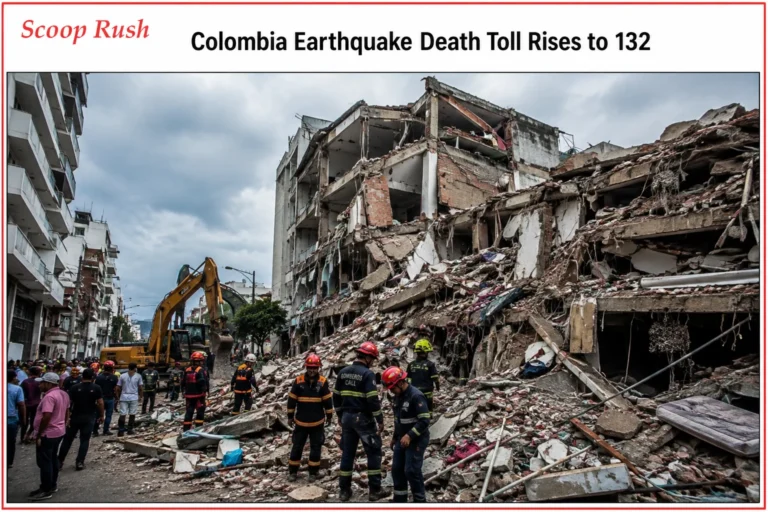
At least 132 people have died after a powerful Colombia earthquake struck western Colombia. More than 570 people suffered injuries after the magnitude 7.4 quake. Rescue teams continue searching collapsed buildings for survivors across several affected cities.

The earthquake struck near San José del Palmar in Chocó province. Strong tremors reached Bogotá and several neighboring countries. Authorities declared a national disaster and launched a major emergency response.

Colombia Earthquake Strikes Western Colombia

Colombia-Earthquake-Strikes-Western-Colombia

The Colombia earthquake struck at about 7:34 a.m. local time Monday. The epicenter was near San José del Palmar in Chocó province. The location sits roughly 150 miles west of Bogotá.

The powerful shaking spread across western Colombia within minutes. Residents reported strong tremors in Bogotá and other major cities. Shaking also reached Ecuador, Venezuela, and Panama.

Death Toll Rises as Injuries Increase

The Colombia earthquake has killed at least 132 people so far. More than 570 people have also suffered injuries, according to updated reports. Officials expect the figures could change during ongoing rescue operations.

Earlier reports placed the death toll above 100 people. Rescue teams later discovered additional victims across several regions. Authorities continue collecting information from remote and heavily damaged communities.

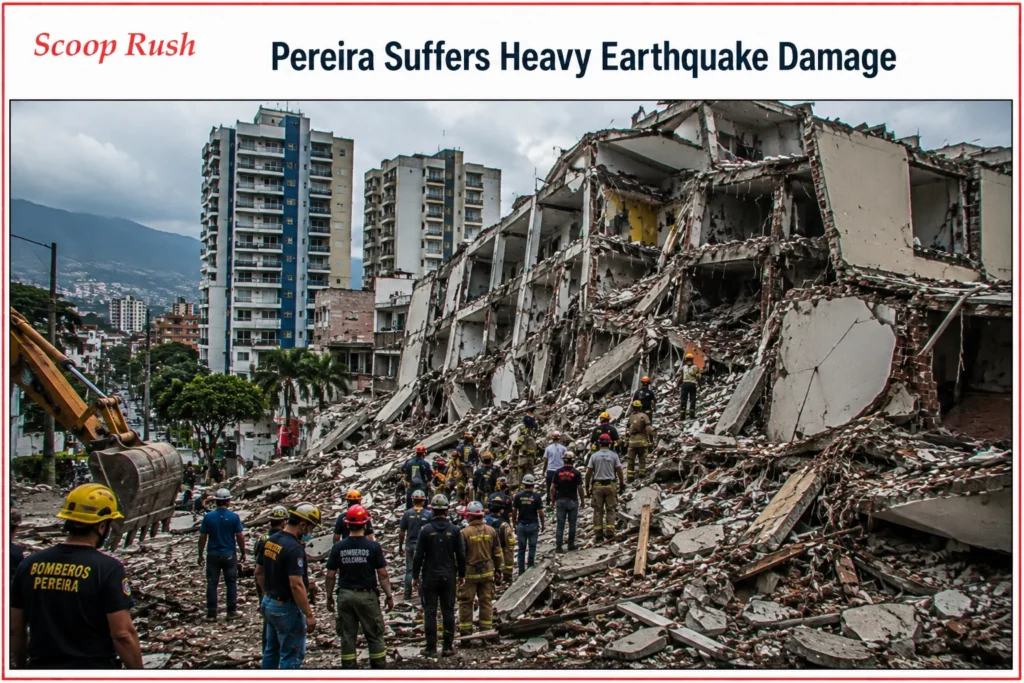
Pereira Suffers Heavy Earthquake Damage

Pereira-Suffers-Heavy-Earthquake-Damage

Pereira suffered some of the most serious damage from the earthquake. The city lies within Colombia’s coffee-growing region. Several buildings collapsed during the powerful shaking.

Local officials reported dozens of deaths across the surrounding metropolitan area. Rescue workers searched damaged structures for trapped residents. Authorities also introduced curfews in some areas of Pereira.

Cali Rescue Teams Search for Survivors

Cali also suffered extensive damage after the earthquake struck western Colombia. The city is Colombia’s third-largest urban center. Several buildings collapsed, leaving people trapped beneath heavy debris.

Firefighters joined police officers and civilian volunteers during rescue operations. Teams removed concrete and bricks using basic tools. They also formed human chains to move debris away from collapsed structures.

Hospitals and Public Buildings Face Damage

The earthquake damaged hospitals and other important public facilities. Some medical centers reported structural problems after the strong shaking. Emergency teams moved patients and prepared additional medical capacity.

The disaster also affected several regional airports. Authorities reported problems at airports in Pereira, Manizales, Quibdó, Armenia, Cartago, and Buenaventura. Officials suspended some operations while teams checked structural safety.

Chocó Region Faces Major Challenges

Chocó lies close to the earthquake’s epicenter. The region also has difficult terrain and limited transportation links. These conditions created additional challenges for emergency responders.

Communications outages slowed early reports from some communities. Local officials reported deaths and injuries across the province. Quibdó also suffered damage to buildings and essential services.

Colombia Declares a National Disaster

Colombia-Declares-a-National-Disaster

President Abelardo de la Espriella declared a national disaster after the earthquake. The decision allows authorities to coordinate emergency resources more quickly. Government agencies began organizing rescue and relief operations.

The president ordered a unified command structure for the emergency response. Authorities also began providing assistance to affected families. Officials reported damage to more than 1,500 buildings across affected areas.

Rescue Workers Race to Find Survivors

Rescue teams continue searching collapsed buildings across western Colombia. Firefighters, police officers, soldiers, and volunteers joined the effort. Teams remain focused on areas where people may still remain trapped.

Volunteers have helped remove debris from damaged buildings. Rescuers also pause regularly to listen for signs of survivors. Several successful rescues have provided hope during the difficult operation.

Aftershocks Create Additional Risks

Aftershocks followed the main earthquake across the affected region. These tremors can create serious risks around weakened buildings. Rescue workers must therefore inspect structures before entering them.

Many residents stayed outside their homes after the earthquake. Some feared additional shaking and further structural damage. Emergency officials continue monitoring seismic activity across western Colombia.

International Aid Supports Colombia’s Response

Several countries offered support after the devastating earthquake. The United States announced $15.5 million in emergency assistance. The funding will support shelter, food, protection, and earthquake assessments.

European and Latin American governments also expressed support for Colombia. International organizations continue monitoring conditions in affected communities. Additional assistance could help provide medical care and emergency shelter.

Colombia Begins a Difficult Recovery

The rescue operation represents only the first stage of recovery. Thousands of damaged homes may require major repairs or replacement. Public buildings will also need detailed structural inspections.

Families who lost homes may need temporary accommodation and financial assistance. Businesses could also face losses from damage and closures. The government will need to coordinate recovery efforts across multiple regions.

What Happens Next After the Earthquake

Authorities will continue searching collapsed buildings for possible survivors. Emergency agencies will assess damaged homes and critical infrastructure. These inspections will help identify areas that remain unsafe.

Officials must also restore transportation and communication services. Medical teams will continue treating injured residents. Longer-term recovery will likely focus on housing, infrastructure, and financial assistance.

Conclusion

The Colombia earthquake has caused widespread destruction across western Colombia. At least 132 people have died, while more than 570 others suffered injuries. Rescue teams continue searching collapsed buildings for survivors as authorities assess the damage.

The disaster has damaged homes, hospitals, airports, and other vital infrastructure. Colombia now faces a major recovery effort across several regions. Government agencies and international partners continue providing emergency support to affected communities.

FAQs

1. How many people died in the Colombia earthquake?

At least 132 people have died following the magnitude 7.4 earthquake. More than 570 people have suffered injuries. Officials could revise these numbers as rescue teams continue their work.

2. Where did the Colombia earthquake occur?

The earthquake struck western Colombia near San José del Palmar. The epicenter was located in Chocó province. The tremor affected cities across western Colombia and reached neighboring countries.

3. How strong was the Colombia earthquake?

The earthquake measured 7.4 in magnitude. It became one of Colombia’s strongest earthquakes in recent years. Its powerful shaking caused widespread structural damage across several regions.

4. Which cities suffered the most damage?

Pereira and Cali suffered significant damage after the earthquake. Manizales and Quibdó also reported serious destruction. Several regional airports and medical facilities also faced problems.

5. Are rescue operations still continuing?

Yes, rescue operations remain active across the hardest-hit areas. Emergency workers continue searching damaged buildings for survivors. Volunteers and government forces are supporting rescue teams.

Women’s Travel Safety Comes With a Hidden Cost

0

For many women, women’s travel safety can shape every part of a trip. Safety concerns can affect accommodation, transport, arrival times, and daily plans. They can also increase travel costs in ways that remain easy to overlook.

A cheaper hotel may sit in an isolated area. A cheaper flight may arrive late at night. A shared hostel room may feel less comfortable than a women-only option. As a result, women often spend more to gain peace of mind while travelling.

The Hidden Cost of Feeling Safe

Women do not necessarily pay more for the same travel service. Instead, safety concerns can push them toward more expensive alternatives. A central hotel may cost more than accommodation outside the main area. A taxi may cost more than walking or using public transport.

These extra expenses can appear small during individual decisions. However, they can add up across an entire journey. Accommodation, transport, insurance, and activity choices can all become part of the safety budget.

Women-Only Rooms Offer Greater Peace of Mind

Women-Only-Rooms-Offer-Greater-Peace-of-Mind

Women-only dorms have become a popular option for solo travellers. They provide an alternative to mixed accommodation in many hostels. For some women, the option offers greater comfort when sharing a room with strangers.

However, female-only rooms can sometimes cost more. The price difference varies between properties and destinations. Strong demand can also influence pricing. Still, the decision often comes down to more than money. Travellers may pay extra because they value a greater sense of security.

Transport Can Add to Travel Expenses

Transport represents another important part of women’s travel safety decisions. Walking may seem practical during daylight hours. The same route can feel very different late at night. Solo travellers may therefore choose taxis or pre-arranged transfers.

Arriving in an unfamiliar city can create similar concerns. Some women prefer private transport from an airport or station. This choice can reduce uncertainty after a long journey. However, it can also make an already expensive trip cost more.

Cheap Travel Times May Not Always Feel Practical

The cheapest travel option does not always provide the most comfortable arrival. Very early or late flights can reduce ticket prices. However, they may leave travellers arriving when fewer transport options operate.

Some women therefore choose daytime arrivals whenever possible. They may pay more for a suitable flight or train. Reaching a destination while streets remain busy can make the first few hours easier. It can also reduce the need for expensive private transport.

Safety Planning Starts Before the Journey

Safety-Planning-Starts-Before-the-Journey

Women’s travel safety often requires preparation before departure. Travellers may research neighbourhoods before choosing accommodation. They may check transport routes and read reviews from previous guests.

This preparation can take considerable time. Travellers may also look for information about areas to avoid. They can check how easily they can reach their accommodation after dark. These steps may reduce uncertainty, but they also add another layer of planning.

Solo Travel Can Involve Constant Decisions

Solo female travellers often make safety decisions throughout the day. They may consider whether to walk somewhere or take transport. They may decide whether an unfamiliar person seems trustworthy. They may also change plans when a situation feels uncomfortable.

Such decisions do not mean women cannot enjoy solo travel. Many women continue travelling independently across different countries. Instead, safety becomes another factor in their daily choices. Experience can also make travellers more willing to spend money when necessary.

Past Experiences Can Change Travel Choices

Previous experiences can strongly influence how women approach solo travel. An uncomfortable encounter may change how someone chooses accommodation. It may also affect decisions about transport, nightlife, and social situations.

Some travellers become more selective as they gain experience. They may choose women-only dorms instead of mixed rooms. Others may stop walking alone after dark. These decisions can reduce stress, but they can also raise the overall cost of travelling.

The Mental Cost Matters Too

The-Mental-Cost-Matters-Too

The hidden cost of travel is not always financial. Women may spend significant mental energy assessing their surroundings. They may monitor their route, belongings, transport, and social interactions.

This constant awareness can make travel more tiring. A traveller may spend part of an evening thinking about the journey home. She may also avoid certain places because returning alone feels uncomfortable. The result can be a reduced sense of freedom.

Safety Can Limit Spontaneous Experiences

Travel often promises freedom and spontaneity. However, safety concerns can change that experience for some women. A traveller may avoid a late-night event because she cannot find comfortable transport home.

She may also skip a remote attraction or evening activity. These decisions can protect personal safety. Yet they can also mean missing experiences that were part of the original travel plan. In this way, safety concerns can influence the journey itself.

Research Can Make Travel More Manageable

Careful research can help travellers make informed decisions. Women can check accommodation reviews before booking. They can also research neighbourhoods and local transport options.

Knowing the destination can make unfamiliar situations easier to handle. Travellers can identify suitable routes before leaving their accommodation. They can also arrange reliable transport before arrival. Preparation cannot remove every risk. However, it can reduce unnecessary uncertainty.

Staying Connected Can Provide Extra Reassurance

Solo travellers can also share their plans with someone they trust. They can provide flight details and accommodation information before departure. Regular check-ins can then provide another layer of reassurance.

Travellers should also keep important information accessible. Copies of essential documents can help if something gets lost. Emergency contact details can also prove useful. These simple preparations can make unexpected situations easier to manage.

Travel Insurance Can Protect the Budget

Travel insurance adds another cost to a holiday. However, it can provide financial protection against certain unexpected problems. Coverage can vary widely between different policies.

Travellers should therefore check the details before buying insurance. They should understand exclusions and coverage limits. The cheapest policy may not always meet their needs. A suitable policy can provide greater financial confidence during an overseas trip.

Travel Businesses Also Have a Role

The responsibility for safer travel should not fall entirely on women. Travel companies can also improve the experience. Hotels can provide clearer information about their surroundings. Hostels can make safety policies easier to understand.

Transport providers can also offer clearer information about arrival options. Booking platforms could provide more useful information about neighbourhood safety. Better information would allow travellers to make decisions without spending hours searching elsewhere.

Safety Should Not Become a Luxury

The growing demand for safer options raises an important question. Should travellers have to pay extra for a basic sense of security?

There is no simple answer because prices often reflect demand and operating costs. However, the issue remains important for women. When safety influences accommodation and transport choices, it can quietly increase the cost of travelling.

Women Deserve Freedom Along With Safety

Women should not have to choose between exploring the world and feeling secure. Sensible planning can help reduce risks during a trip. Yet travellers should also feel free to change plans when something feels wrong.

Safety also does not require avoiding every unfamiliar experience. Travellers can make informed choices while enjoying new destinations. The goal should be confidence rather than constant fear.

The Real Price of Women’s Travel Safety

The cost of safer travel goes beyond a few extra pounds or dollars. It can include better accommodation, private transport, convenient travel times, and insurance. It can also include the mental effort required to plan each decision.

For many women, paying extra can feel worthwhile. Peace of mind can make an unfamiliar destination easier to enjoy. However, the wider travel industry can do more to make safety accessible. Women should not have to treat basic security as a luxury feature.

Conclusion

Women’s travel safety can affect the cost and experience of a trip. Women may choose safer accommodation, private transport, or better travel times. These choices can increase expenses and reduce spontaneity.

However, safety should not feel like a luxury. Better travel services and clearer safety information can help women travel with greater confidence. Every traveller deserves to explore new places without carrying an unfair safety burden.

FAQs

1. What is the safety premium in women’s travel?

It means the extra money women may spend to feel safer while travelling. This can include accommodation, transport, and private rooms.

2. Why do women choose women-only accommodation?

Women-only rooms can offer greater comfort and peace of mind. They can feel especially useful for solo travellers.

3. Can safety concerns increase travel costs?

Yes. Women may choose taxis, central hotels, private rooms, or convenient travel times. These options can cost more than cheaper alternatives.

4. How can women improve travel safety?

Research the destination and accommodation before travelling. Plan transport in advance and share your itinerary with someone trusted.

5. Should women have to pay more for safety?

Safety should not become a luxury. Travel companies should provide safer options and clearer information for all travellers.

Netanyahu Rejects Trump Gaza Plan as Election Pressure Grows

0

Israeli Prime Minister Benjamin Netanyahu has rejected the Netanyahu Gaza plan backed by US President Donald Trump. He said Israel will not withdraw its forces until Hamas fully disarms. His decision has created fresh tension with Washington.

The dispute comes ahead of Israel’s October 27, 2026 election. Netanyahu faces pressure from his far-right coalition partners. His latest position also reflects growing security concerns among Israeli voters.

Hamas Disarmament Becomes the Main Dispute

The Netanyahu Gaza plan dispute mainly concerns the timing of Hamas disarmament. Trump’s proposal supports a phased process connecting weapons removal with Israeli military withdrawals. Netanyahu wants complete disarmament before any withdrawal begins.

Netanyahu says Israel cannot leave Gaza while Hamas retains military capabilities. He has demanded the removal of heavy and light weapons. This position creates a major obstacle to Trump’s proposed roadmap.

Trump Faces a New Challenge From Netanyahu

Trump-Faces-a-New-Challenge

The disagreement has created tension between Trump and Netanyahu. Trump wants his Gaza roadmap to produce meaningful progress. Netanyahu’s rejection could make that objective more difficult.

However, Netanyahu also relies on strong US support. A serious dispute with Washington could create diplomatic problems. Despite that risk, he appears ready to defend his position publicly. This could test the close relationship between both leaders.

Election Pressure Shapes Netanyahu’s Position

The upcoming Israeli election adds another important factor. Voters will choose their next government on October 27, 2026. Recent polling suggests Netanyahu faces a challenging campaign.

His government depends on right-wing coalition partners. These parties strongly oppose concessions involving Hamas and Gaza. Netanyahu therefore has strong political reasons to maintain a tough position. His stance could help him retain support from those key allies.

Security Concerns Remain Central to the Debate

Israeli security remains at the heart of Netanyahu’s argument. The October 7, 2023 attack continues to influence political discussions across Israel. Many voters remain concerned about preventing another major attack.

Netanyahu presents Hamas disarmament as essential for long-term security. His position could appeal to voters who want stronger guarantees. It also helps him maintain support among conservative groups.

Hamas Rejects Israel’s Demands for Full Disarmament

Hamas says it remains committed to the broader Gaza roadmap. However, major differences remain over weapons and Israeli military withdrawal. The group wants Israel to meet its own commitments under the agreement.

Netanyahu demands complete disarmament before Israeli forces leave. Hamas faces pressure to surrender weapons while also seeking an Israeli withdrawal. This disagreement makes negotiations particularly difficult.

A Phased Withdrawal Could Offer a Possible Solution

US envoy Nickolay Mladenov has suggested a phased approach. Under this proposal, verified weapons removal could allow Israeli forces to withdraw from specific areas. The process would depend on clear verification.

Netanyahu has not accepted that sequence. He wants complete disarmament before any withdrawal takes place. Both sides therefore remain divided over which step should come first.

Political Disagreements Could Slow the Gaza Process

The dispute could delay the next phase of the agreement. The proposed process requires cooperation on disarmament, verification, and Israeli withdrawals. Any disagreement could prevent further progress.

The United States may now face pressure to find common ground. Washington must balance its relationship with Netanyahu against Trump’s desire for progress. The coming weeks could reveal whether compromise remains possible.

Gaza’s Future Also Depends on the Agreement

The proposed roadmap includes plans for Gaza’s future administration and reconstruction. Progress on those issues depends partly on resolving the security dispute. Continued disagreements could therefore delay broader plans.

For Gaza’s civilian population, the uncertainty remains serious. Political decisions about disarmament and withdrawal directly affect future conditions. The ongoing dispute could keep reconstruction and governance plans in limbo.

Netanyahu Faces a Difficult Political Calculation

Netanyahu-Faces-a-Difficult-Political-Calculation

Netanyahu must balance two competing priorities. He needs strong relations with Trump while keeping his right-wing coalition together. Those objectives could become harder to manage as the election approaches.

For now, Netanyahu appears willing to risk tension with Washington. His priority remains complete Hamas disarmament before an Israeli withdrawal. That position could shape both his campaign and future negotiations.

What Could Happen Next?

US officials are likely to continue efforts to bridge the differences. Mladenov’s phased approach could provide a possible path forward. However, Israel must first accept a process that allows withdrawal before total disarmament.

Netanyahu’s election campaign will also influence future decisions. He needs support from coalition partners and security-focused voters. Therefore, his Gaza position could remain firm until Israelis vote in October.

Conclusion

The Netanyahu Gaza plan dispute centers on Hamas disarmament and Israeli withdrawal. The biggest disagreement concerns which step should happen first. Israel wants complete disarmament before withdrawal, while Trump’s roadmap supports a phased process.

The situation could change through further negotiations. US pressure, Hamas’s response, and Israel’s election could all influence the next steps. For now, the disagreement remains unresolved.

FAQs

1. Why did Netanyahu reject Trump’s Gaza plan?

Netanyahu rejected the plan because he wants Hamas completely disarmed before Israeli forces withdraw. He does not support withdrawal based on partial disarmament.

2. What does Trump’s Gaza roadmap propose?

Trump’s roadmap supports phased Hamas disarmament alongside Israeli military withdrawals. It also includes plans for international involvement and Gaza’s future administration.

3. Why does Israel’s election matter?

Netanyahu needs support from his right-wing coalition partners. Those parties strongly oppose major concessions involving Hamas and Gaza.

4. What is Hamas’s position?

Hamas says it remains committed to the broader roadmap. However, it expects Israel to fulfill its own commitments under the agreement.

5. Could the disagreement delay the Gaza agreement?

Yes. The dispute could slow negotiations because Israel and Hamas disagree over disarmament and withdrawal. Further US mediation may be needed to reach a compromise.

Infantino Resign? UEFA, CONCACAF & AFC Accuse FIFA President of Deception Amid Boycott Threat

0

Will Infantino Resign as Football’s Top Confederations Revolt?

Will Gianni Infantino resign? That question is spreading fast across football circles right now. UEFA, CONCACAF, and the Asian Football Confederation (AFC) have jointly accused FIFA president Gianni Infantino of breaking trust “through deception.” The pressure for Infantino to resign is growing by the day.

This is not a quiet disagreement. Three of football’s most powerful confederations have signed an open letter. That letter questions Infantino’s leadership directly. It arrives barely three weeks after the World Cup final, and it signals one of the most serious challenges FIFA has faced in years.

For fans, players, and national federations, the calls for Infantino to resign matter a great deal. FIFA controls the World Cup, international tournaments, and billions of dollars in commercial rights. When the organizations that run football start accusing each other of deception, the sport itself gets caught in the middle.

What Sparked the Push for Infantino’s Resignation

The crisis centers on a plan called the FIFA Forward Enterprise, or FFE. The proposal aimed to create a new company. That company would manage commercial and ticketing rights across all FIFA competitions, including the World Cup. As part of the deal, a private investment firm would buy a 21% stake in that new company.

The idea did not survive contact with football’s power brokers. Widespread criticism from several confederations forced FIFA to abandon the plan. UEFA led that pushback. UEFA even threatened to boycott every FIFA competition if the situation went unaddressed.

Behind the scenes, tensions have escalated further. According to BBC Sport, the three confederations have already held preliminary talks about launching breakaway competitions if Infantino stays in his role. This detail matters. It shows some of football’s most influential organizations are actively preparing for a future outside FIFA’s usual structure.

Why the Open Letter Fuels Infantino Resignation Calls

The joint letter from UEFA, CONCACAF, and the AFC does not name Infantino directly. However, sources told BBC Sport that the statement should be read as an invitation for him to resign. It suggests he leave his position with dignity, rather than seek re-election in March.

The letter’s language cuts deep. It states that “when trust is broken through deception, when an individual places himself above the collective that entrusted him with authority, that duty has been abandoned.” It also argues that leadership in football “is not a possession.” No one should hold or demand power over the sport.

FIFA fired back over the weekend. The organization strongly criticized what it called a “concerted and ongoing effort” to undermine both FIFA and Infantino personally. In short, both sides are now trading public accusations. Neither shows signs of backing down.

The Rabat Meeting That Deepened the Divide

Part of the confederations’ frustration stems from a meeting Infantino called in Rabat, Morocco. According to the letter, FIFA excluded council members and member associations from that meeting. Instead, Infantino summoned only FIFA-employed senior staff.

Governing bodies expect consultation on major decisions. Being shut out of this meeting reinforced the confederations’ claims of deception. As a result, the letter argues that FIFA’s admission of mistakes in the FFE process simply did not go far enough.

The confederations state plainly that FIFA’s response “did not acknowledge that the proposal itself was inherently wrong.” They add that FIFA showed “no recognition that attempting to sell an interest in the FIFA World Cup was a profound failure of judgement.” The letter describes this failure as “a fundamental breach of trust with the very institutions FIFA exists to serve.”

Calls for an Independent Review Grow Louder

Calls for an Independent Review Grow Louder

FIFA has agreed to present a report at its next council meeting, expected in October. That timeline, however, has done little to satisfy the confederations demanding accountability now.

Their letter insists that proper governance requires an independent third party. This party would conduct the review, rather than letting FIFA investigate itself. As the letter puts it, there is “silence where there should be accountability, distance where there should be openness.”

Additionally, UEFA issued a legal warning demanding that FIFA preserve every document connected to the abandoned FFE plans. Organizations typically send this kind of warning when they anticipate needing evidence later. Its presence here shows just how seriously UEFA treats the situation.

Could a FIFA Boycott Force Infantino to Resign?

UEFA has already stated that FIFA’s defense of Infantino “changes nothing” about a potential boycott. Still, the picture across the other confederations looks more complicated.

So far, neither CONCACAF nor the AFC has publicly committed to a boycott. Support for Infantino within those confederations exists, but it is far from unanimous. For example, Mexico has publicly backed the FIFA president within CONCACAF.

The situation in Asia looks similarly divided. Of the AFC’s 46 member countries, eight have publicly voiced support for Infantino so far. These include the United Arab Emirates, Qatar, Sri Lanka, Lebanon, Kuwait, Mongolia, the Philippines, and Bhutan. That leaves a large number of undecided nations whose position could tip the balance.

The First Real Test for Infantino’s Resignation Pressure

The standoff will face its first practical test soon. The FIFA Under-20 Women’s World Cup kicks off in just over three weeks. Poland will host the event, which features five other European nations, including England. If UEFA’s boycott threat holds, this tournament could become the earliest flashpoint.

Notably, France has already confirmed it still plans to compete. This suggests that even within Europe, appetite for a full boycott may not run uniform.

Behind the Scenes: A Battle for Votes Over Infantino’s Future

According to BBC Sport’s analysis, the confederations behind the letter want to send Infantino a clear message. They want him to step down now, on his own terms, rather than face a contested re-election battle in March. This preference for a voluntary resignation may reveal something important. It suggests the rebels are not entirely confident they could defeat him outright in a vote.

Asia has emerged as the key battleground in this power struggle. Some AFC nations have already backed Infantino. Yet AFC president Sheikh Salman chose to sign the joint letter anyway. His decision suggests he believes a meaningful appetite for change exists within the confederation.

Meanwhile, Infantino still holds support from South America, Africa, and Mexico within CONCACAF. If UEFA and CONCACAF vote together as a bloc, with a few exceptions, they would need only around a third of the AFC to join them. That math explains why Asia’s stance matters so much right now.

However, one unresolved question looms over everything. Even if enough confederations want Infantino gone, does a credible candidate exist? That candidate would need to unify football’s fractured factions and actually beat him. So far, no clear answer has emerged.

What an Infantino Resignation Would Mean for FIFA’s Future

Observers describe this dispute as football’s own civil war. That framing captures the scale of what is unfolding. This fight goes beyond one failed business proposal. It centers on governance, transparency, and who ultimately controls the sport’s most powerful institution.

For everyday fans, the impact could eventually reach the pitch itself. If a boycott happens, it could disrupt upcoming tournaments. It could force national federations to pick sides. It could reshape the structure of international competitions.

Therefore, the coming weeks will reveal how serious this standoff really is, starting with the Under-20 Women’s World Cup. Whether Infantino resigns, fights for re-election in March, or rebuilds trust with the confederations that once backed him, the outcome will shape FIFA’s leadership for years to come.

Key Takeaways

  • UEFA, CONCACAF, and the AFC issued a joint open letter accusing FIFA president Gianni Infantino of breaking trust “through deception.”
  • The controversy centers on the abandoned FIFA Forward Enterprise proposal, which would have sold a 21% stake in FIFA’s commercial and ticketing rights to a private investor.
  • The three confederations have reportedly held preliminary talks about breakaway competitions.
  • FIFA promised a report at its October council meeting, but the confederations are demanding an independent third-party review instead.
  • Pressure for Infantino to resign will face its first real test at the FIFA Under-20 Women’s World Cup, starting in just over three weeks.

Frequently Asked Questions

1. Why do UEFA, CONCACAF, and the AFC want Infantino to resign? 

The three confederations accuse Infantino of breaking trust “through deception.” This is largely tied to how FIFA handled the FIFA Forward Enterprise proposal and a meeting in Rabat where FIFA reportedly excluded council members and national federations.

2. What was the FIFA Forward Enterprise (FFE) proposal? 

The FFE was a plan to create a new company that would manage commercial and ticketing rights for all FIFA competitions, including the World Cup, with a private investment firm buying a 21% stake. FIFA scrapped the plan after major backlash.

3. Is Gianni Infantino actually going to resign? 

The joint letter does not name Infantino directly. However, sources told BBC Sport that the confederations intend it as an opportunity for him to resign. He could leave his position with dignity, rather than seek re-election in March.

4. Could a real boycott of FIFA competitions push Infantino to resign? 

UEFA has threatened a boycott and insists FIFA’s defense of Infantino “changes nothing.” However, CONCACAF and the AFC have not publicly committed to a boycott. Support for Infantino still exists within both confederations.

5. When will we know if the pressure on Infantino to resign is serious? 

The FIFA Under-20 Women’s World Cup, hosted by Poland and starting in just over three weeks, will be the first major tournament to test whether European nations follow through on the boycott threat. France has already confirmed it plans to compete.to compete.

Abacus AI Review 2026: Is This the AI Super Assistant Everyone Is Talking About?

0

Imagine closing five AI subscriptions and opening just one tab instead. Sounds too good to be true, right? That is exactly the promise behind this Abacus AI review. Every platform involves trade-offs, and Abacus AI is no exception.

Introduction

What if a single platform could replace your chatbot, your research tool, your image generator, and your automation app all at once? That question sits at the center of this Abacus AI review, and it explains why so many founders, developers, and business teams are suddenly paying attention.

Most people juggle a chatbot for writing, a research tool, an image generator, a coding assistant, and some kind of automation app to tie it all together. That stack adds up fast, both in cost and in mental overhead. Every extra tab is another login, another interface, another thing to remember, which is part of the reason more people keep asking will AI replace your job as these platforms take on more of the workload.

Abacus AI takes a different approach. Instead of offering one narrow feature, it bundles chat, research, app building, automation, and media generation into one connected system. In this Abacus AI review, we will break down what the platform actually does, how its main tools work together, what it costs, and whether it deserves a spot in your workflow.

What Is Abacus AI? A Quick Overview

What Is Abacus AI? A Quick Overview

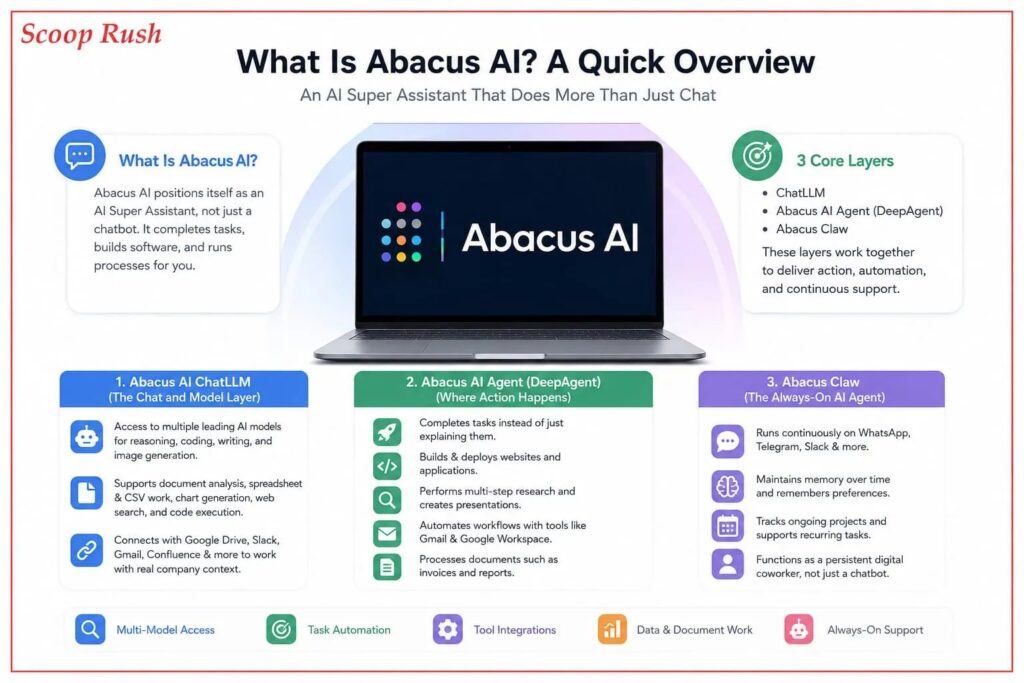
Abacus AI positions itself as an AI Super Assistant rather than a simple chatbot. Instead of just answering questions, it aims to complete tasks, build software, and run processes on your behalf. Three main layers work together to power the platform: ChatLLM, Abacus AI Agent, and Abacus Claw.

Abacus AI: ChatLLM, Agent, and Claw at a Glance

Abacus AI positions itself as an AI Super Assistant rather than a simple chatbot. It aims to complete tasks, build software, and run processes on your behalf. The platform runs on three layers: ChatLLM, Abacus AI Agent, and Abacus Claw.

ChatLLM gives you access to many AI models in one workspace, covering reasoning, coding, writing, and image generation, plus short video generation through Abacus Studio, similar to how Kimi K3 and Qwen3-8-Max are pushing model competition forward. It also supports document analysis, spreadsheet work, chart generation, web search, and code execution in one place. Teams can connect it to Google Drive, Slack, Gmail, and Confluence, much like Nokia’s AI-RAN platform built with Nvidia brings AI closer to real infrastructure.

Abacus AI Agent, or DeepAgent, focuses on execution rather than conversation. Instead of explaining how to research competitors, it can gather pricing data, compare positioning, and return a structured report directly. It can build and deploy websites, run multi-step research, create presentations, automate Gmail and Google Workspace tasks, and process invoices, an execution-first approach echoed by tools like Meta Muse’s AI coding agent.

Abacus Claw solves a common AI limitation: session memory that vanishes once you close the chat. Built on the open-source OpenClaw framework, Claw runs continuously inside WhatsApp, Telegram, and Slack, apps as woven into daily life as WhatsApp, Facebook, and Instagram themselves. Because it remembers context over time, Claw tracks ongoing projects and recurring tasks without anyone reintroducing them each session, so it functions more like a persistent digital coworker than a chatbot.

Key Abacus AI Features You Should Know

Key Abacus AI Features You Should Know

Abacus AI covers a lot of ground, so it helps to look at the features that show up most often in real use cases.

Vibe Coding and AI App Building

One of the more talked-about capabilities is what the platform calls vibe coding. In plain terms, this means describing an app or website in everyday language and letting the AI Agent handle the architecture, coding, and deployment. Reported use cases include landing pages, internal dashboards, client portals, and lightweight SaaS prototypes.

This does not remove the need for human review. Testing the logic, refining the user experience, and double-checking business assumptions still matter. However, it does shrink the distance between an idea and a working first version, which is often the hardest part of getting a product off the ground, not unlike how one mom built a $10K-a-month Etsy side hustle by moving quickly from idea to execution.

AI Automation and Business Workflows

For operations-heavy teams, automation is where Abacus AI Agent earns its keep. Examples mentioned in the source material include invoice processing, CRM updates, lead research, Slack summaries, and Google Workspace tasks.Because language models drive the automation rather than fixed rules, it can adapt to ambiguity in a way that simpler rule-based automation tools cannot, a shift that also fuels the rise of[ data intelligence platforms. data intelligence platforms built to feed cleaner data into exactly these kinds of AI workflows.

Meanwhile, Abacus Claw extends this further by allowing recurring workflows, such as a daily briefing pushed to Slack or a scheduled competitive research summary, to run without repeated manual setup.

Abacus AI Pricing: What You Actually Pay

Abacus AI Pricing: What You Actually Pay

According to the source material, ChatLLM Teams pricing includes two listed tiers: a Basic plan at $10 per user per month and a Pro plan at $20 per user per month. On top of the subscription, certain tasks such as video generation, image generation, and heavier agent workflows draw from a credit system.

This pricing structure has a clear upside. If Abacus AI genuinely replaces a chatbot subscription, an image generator, a research tool, and an automation platform, users can save significantly compared to paying for each tool separately. On the other hand, credit-based pricing is harder to predict than a flat monthly fee, especially for complex or repeated agent tasks. Therefore, it makes sense to monitor usage closely, particularly during the first few weeks.

It is also worth noting that ChatLLM Teams does not offer a free trial or refunds, so reviewing the official billing details before subscribing is a reasonable precaution.

Abacus AI vs Other AI Tools

Abacus AI vs Other AI Tools

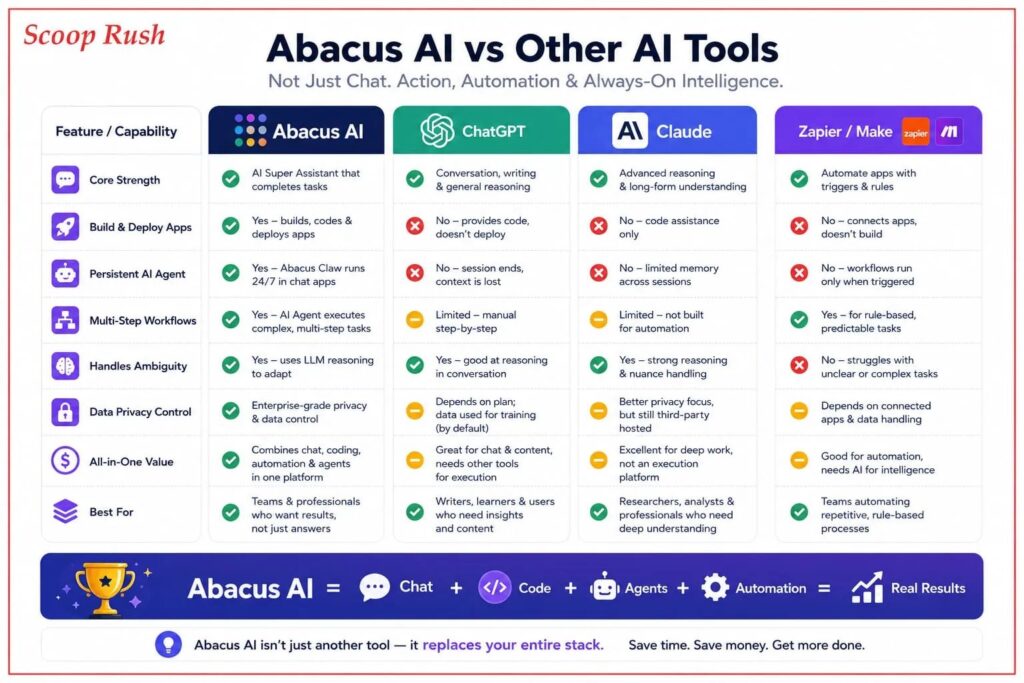
A common question people ask is how Abacus AI stacks up against tools like ChatGPT, Claude, or traditional automation platforms such as Zapier.

The short answer is that these tools are not solving the exact same problem.ChatGPT and Claude excel at general conversation, writing, and reasoning, and ChatLLM actually includes some models from both. However, standalone chatbots typically stop at the conversation. They do not build applications, run persistent agents, or execute multi-step workflows on their own. Data privacy also remains a live concern across the industry, as shown by reports that Claude AI chats were exposed through Google Search, which is a good reminder to check how any AI platform handles your data.

Traditional automation tools like Zapier or Make, meanwhile, connect apps together using triggers and rules. That works well for predictable, repetitive tasks, but it struggles with anything that requires judgment or handling ambiguity. The Abacus AI automation layer is built around language model reasoning, so it can adapt to context in ways that rule-based automation cannot.

Put simply, the more accurate comparison is not Abacus AI against a single competitor. It is Abacus AI against an entire stack of separate tools that would otherwise need to be pieced together and paid for individually.

Who Should Use Abacus AI?

Who Should Use Abacus AI?

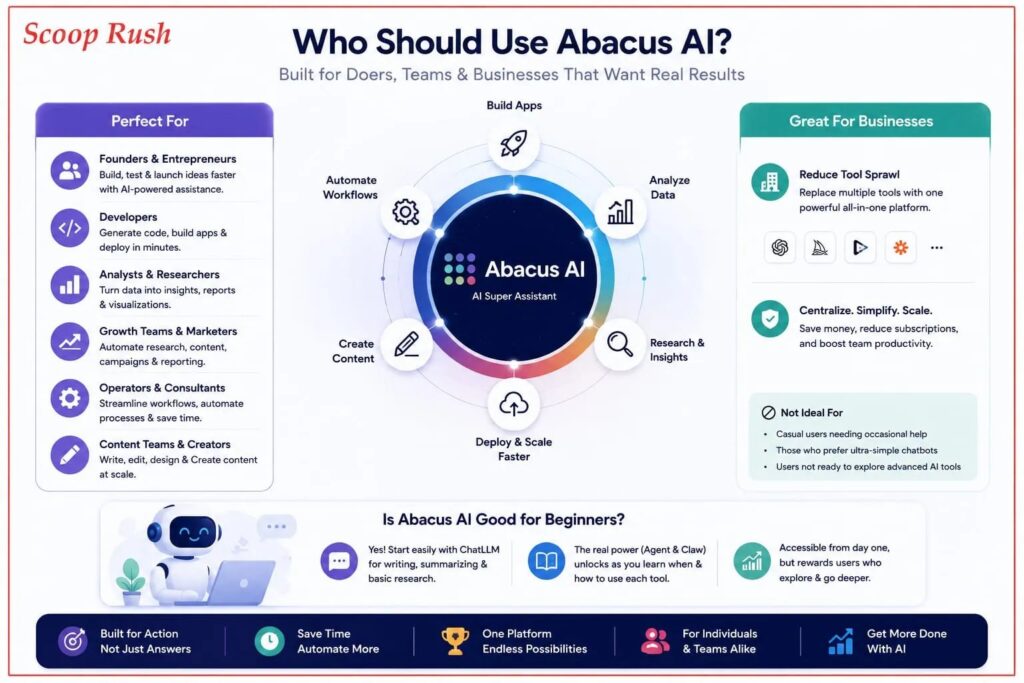
Abacus AI is clearly built with a specific type of user in mind. According to the source material, it is well suited for founders, developers, analysts, growth teams, operators, consultants, and content teams who want AI to produce finished output rather than just advice, including anyone exploring how to become a data analyst in 2026 and wanting hands-on AI tools to practice with.

Businesses looking to reduce tool sprawl are another strong fit. Instead of separately subscribing to a chatbot, an image generator, a video tool, and an automation platform, teams can centralize much of that work inside one system.

That said, Abacus AI is not necessarily the best starting point for everyone. Casual users who only need occasional help with writing or simple questions may find the platform bigger than they need. Because it has a real learning curve, beginners who want the simplest possible chatbot experience might prefer a lighter tool at first.

Is Abacus AI Good for Beginners?

Beginners can absolutely start using Abacus AI, particularly through ChatLLM for writing, summarizing, or basic research. However, the deeper value of the platform, including the Agent and Claw layers, becomes clear only once you learn when to use each tool and how the credit system works. In other words, Abacus AI is accessible from day one, but it rewards users who are willing to explore beyond basic prompting.

Abacus AI Pros and Cons

Every platform involves trade-offs, and Abacus AI is no exception.

On the positive side, the platform offers access to many top AI models in one place, genuine agent-driven execution rather than just advice, support for app and website building without a traditional development cycle, persistent always-on agents through Claw, and integrations with common workplace tools. For users currently paying for multiple separate AI subscriptions, the combined cost savings can be substantial.

On the other hand, the credit-based pricing model can be difficult to estimate at first, and the platform’s breadth means there is a real learning curve. Complex workflows may need several rounds of iteration before they run smoothly, and larger automations still benefit from human oversight rather than running fully unattended. It is not designed to be a simple plug-and-play chatbot, so users expecting that experience may find it overwhelming initially.

Conclusion

Abacus AI is not trying to be the simplest AI chatbot on the market, and it does not pretend otherwise. Instead, it is aiming at a different problem entirely, namely the fragmentation created by using five or six separate AI tools that never talk to each other.

Through ChatLLM, Abacus AI Agent, and Abacus Claw, the platform combines model access, task execution, and persistent memory into one connected system. For founders building products, analysts producing research, and teams automating repetitive workflows, that combination can meaningfully cut down on both cost and complexity.

If you only need occasional help drafting an email, a lighter chatbot might be enough. But if you are managing a growing AI workload across research, content, coding, and automation, Abacus AI is worth serious evaluation, especially given the pricing gap compared to running several standalone subscriptions side by side.

FAQs

What is Abacus AI used for?

Abacus AI is used for AI chat, deep research, document and data analysis, image and short video generation, app building, business automation, and running persistent AI agents.

What is the difference between ChatLLM and Abacus AI Agent?

ChatLLM is the chat interface that gives access to multiple AI models for everyday tasks, while Abacus AI Agent focuses on executing multi-step tasks such as research, app building, and automation.

How much does Abacus AI cost?

ChatLLM Teams lists two tiers: Basic at $10 per user per month and Pro at $20 per user per month, with additional credit usage for heavier tasks like video generation and complex agent workflows.

Can Abacus AI actually build apps without coding?

Yes, according to the source material, Abacus AI Agent can plan, build, and help deploy applications from a plain-language description, though human review and iteration are still recommended for production use.

Is Abacus AI better than ChatGPT?

Abacus AI is broader than a standard chatbot because it combines multiple models, agent-driven execution, automation, and persistent memory, while ChatGPT remains a strong option for simple, general-purpose conversation.

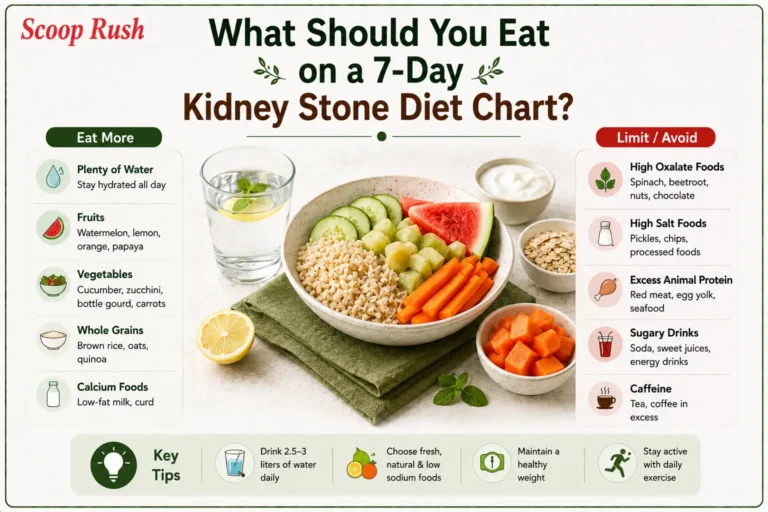
What Should You Eat on a 7-Day Kidney Stone Diet Chart?

0

The Confusion Around Kidney Stone Diets

Kidney stones are among the most painful urinary problems. For many people, the concern isn’t just passing a stone it’s preventing another one from forming.

After a kidney stone diagnosis, many people look for a practical eating plan. They quickly become confused by conflicting dietary advice.

Why the Advice Feels Contradictory

Some recommendations say to avoid calcium. Others suggest getting enough calcium from food.

Some popular recipes promote spinach smoothies and nuts as healthy choices. But these foods can be high in oxalate and may need to be limited by people who form calcium oxalate stones. If you want to go deeper on managing oxalate intake specifically, this low-oxalate diet guide covers it in more detail.

Patients may leave a doctor’s appointment knowing they have kidney stones but still have questions about what to actually eat during a normal day. This gap between medical advice and practical meal planning is what this guide aims to address.

There’s No One-Size-Fits-All Plan

A kidney stone diet should not be viewed as a single fixed plan. Similar to how other therapeutic eating patterns, like a bland diet, are tailored to the individual, the best food choices depend on:

  • The type of stone you form
  • Your urine chemistry
  • Your overall health
  • Any other dietary restrictions from your healthcare professional

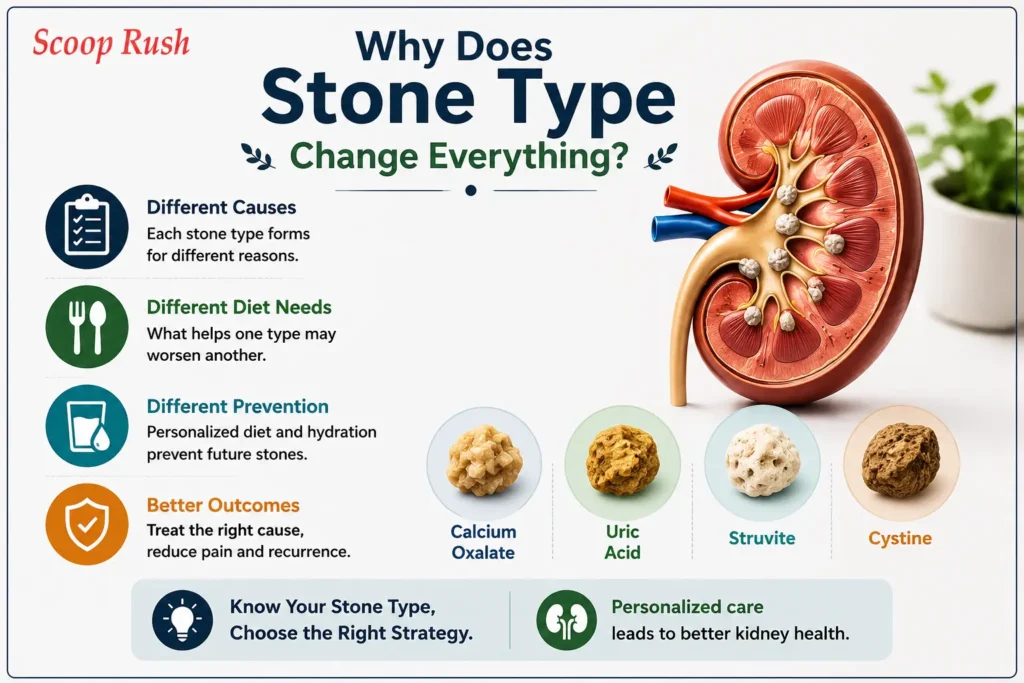
Why Does Stone Type Change Everything?

Why Does Stone Type Change Everything?|Scooop Rush

Diet plays an important role in kidney stone prevention. But the right approach depends on the type of stone you form.

Calcium Oxalate Stones

These are the most common type, so most general prevention strategies focus on them.

Other Stone Types Need Different Rules

Uric acid, struvite, and cystine stones have different causes and dietary considerations. A food choice that’s fine for calcium oxalate stones may not be appropriate for someone who forms uric acid stones.

  • Uric acid stones: may need closer attention to animal protein and purine-rich foods
  • Struvite stones: usually linked to urinary tract infections and require medical treatment
  • Cystine stones: related to a genetic condition and need specialized management

Drinking enough fluid, especially water, is one of the most important lifestyle measures for preventing kidney stones. Your healthcare professional may also use stone analysis and urine testing to determine which dietary changes are most appropriate for you.

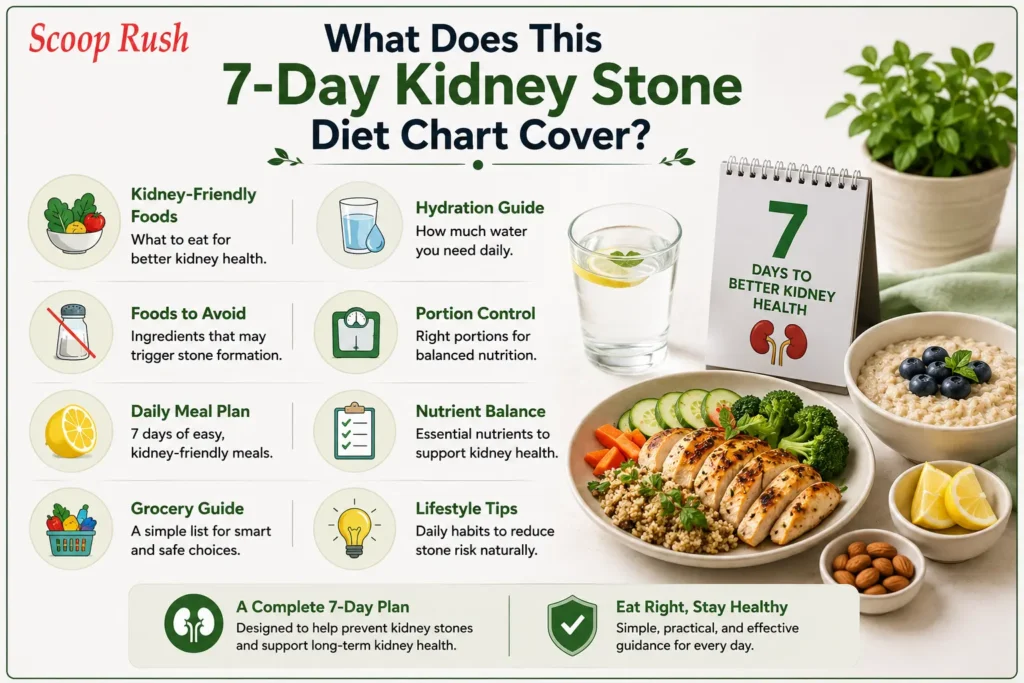
What Does This 7-Day Kidney Stone Diet Chart Cover?

What Does This 7-Day Kidney Stone Diet Chart Cover?|Scoop Rush

This guide provides a practical 7-day kidney stone meal plan with breakfast, lunch, dinner, snacks, hydration guidance, food swaps, a shopping list, and simple meal-prep tips.

Who the Plan Is Designed For

The plan is a general starting point for adults concerned about calcium oxalate kidney stones. It emphasizes:

  • Adequate dietary calcium
  • Lower sodium intake
  • Sensible portions of animal protein
  • Hydration
  • Moderate intake of high-oxalate foods

A Note on the Numbers

The estimated oxalate amounts in the meal plan are approximate. Actual values vary depending on serving size, ingredients, preparation methods, and food brands.

This is an informational meal-planning guide, not a personalized medical diet. If you have chronic kidney disease, recurrent kidney stones, gout, dialysis requirements, a medically restricted potassium or protein intake, or another doctor-prescribed diet, speak with your physician or registered dietitian before following a plan like this.

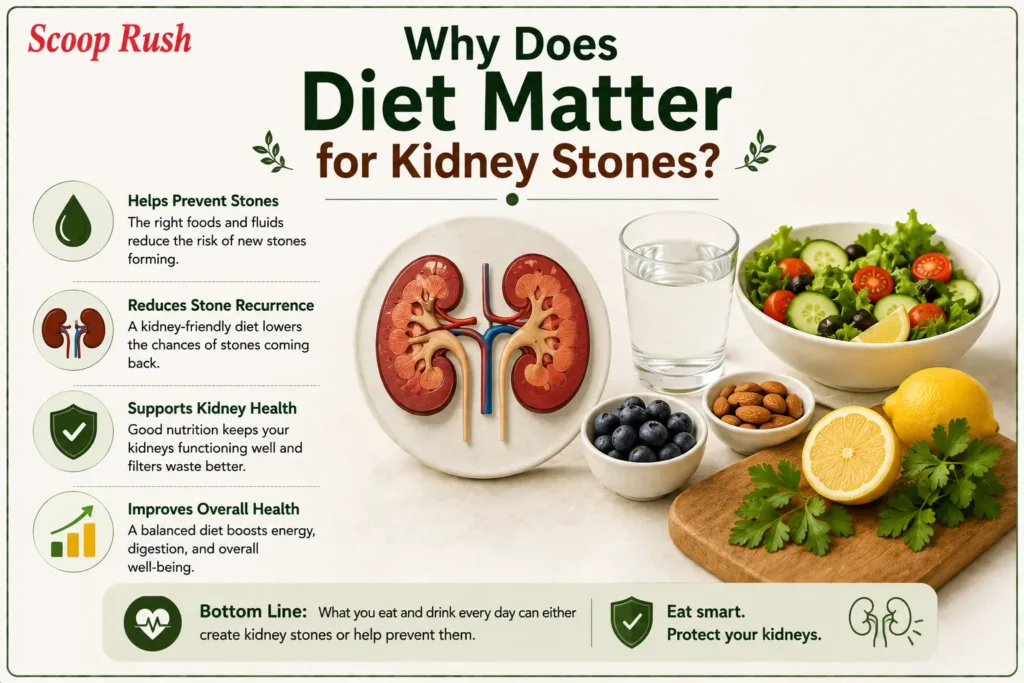
Why Does Diet Matter for Kidney Stones?

Why Does Diet Matter for Kidney Stones?|Scoop Rush

Diet can influence how concentrated your urine becomes. It can also affect the amount of calcium, oxalate, uric acid, sodium, and citrate present in your urine.

When urine becomes highly concentrated, crystals have a greater opportunity to form and grow. This is why maintaining adequate hydration is one of the most important parts of kidney stone prevention.

The Role of Sodium

A high-sodium diet can increase the amount of calcium released into the urine. This may increase the risk of calcium-containing stones.

The Role of Calcium

Completely eliminating calcium from your diet is usually not the answer. Adequate calcium from food can bind with oxalate in the digestive tract, reducing the amount of oxalate that’s absorbed and later excreted through the kidneys.

The Role of Animal Protein

Animal protein can also matter, particularly for people who form uric acid stones. Excessive intake may increase uric acid production and contribute to a more acidic urinary environment. Keeping portions moderate and avoiding excessive intake may be useful for some stone formers.

The Role of Citrate

Citrate can reduce the tendency of certain crystals to form and stick together. Citrus fruits such as lemons and oranges can contribute citrate to the diet.

Core Food Rules for a Kidney Stone Diet

RuleWhy It MattersPractical Tip
Drink enough fluidDilutes urine and reduces mineral concentrationDrink regularly throughout the day and adjust intake for heat and activity
Don’t eliminate calciumDietary calcium can reduce oxalate absorptionChoose calcium-rich foods such as milk and yogurt with meals
Limit sodiumHigh sodium can increase urinary calciumReduce processed, packaged, and heavily salted foods
Watch oxalate if neededHigh-oxalate foods may increase urinary oxalate in susceptible peopleLimit foods such as spinach and large amounts of nuts if advised
Moderate animal proteinExcessive animal protein can increase uric acid and affect citrateKeep meat portions reasonable and vary protein sources
Consider purines for uric acid stonesPurine-rich foods can increase uric acidLimit organ meats and certain seafood when appropriate
Include citrate-rich foodsCitrate can help reduce crystal formationAdd lemon or other citrus to meals and drinks

Who Is This 7-Day Plan Best For?

This meal plan is a general starting point for adults who want a balanced, lower-sodium eating pattern with moderate oxalate intake  particularly those concerned about calcium oxalate stone prevention.

Who Should Be More Cautious

It is not a therapeutic prescription for advanced kidney disease, dialysis, gout, or people who have specific protein, potassium, phosphorus, fluid, or sodium restrictions.

If you know you form uric acid, struvite, or cystine stones, use this plan only as a flexible template. Your dietary needs may differ depending on the underlying cause of your stones.

Important: Oxalate values are approximate and may vary by food variety, serving size, brand, and preparation method. Sodium, protein, and calcium values can also change depending on the ingredients used.

If you’ve had recurrent kidney stones, ask your healthcare professional whether stone analysis or 24-hour urine testing is appropriate. These tests can help identify the specific factors contributing to your stone formation.

7-Day Kidney Stone Diet Chart — Quick Overview

DayThemeEstimated OxalateMain Protein
1Hydration & calcium balance~70–75 mgSalmon
2Lower-oxalate comfort foods~80–85 mgTurkey, chicken
3Protein, produce & portion control~65–75 mgLean steak
4Balanced & easy-to-digest meals~80–90 mgTuna, chicken
5Lower-sodium, family-friendly meals~75–80 mgPork chop
6Seafood option with flexible swaps~80–85 mgShrimp
7Flexible weekend plan~85–95 mgChicken

Day 1: Hydration and Calcium Balance

  • Breakfast: Scrambled eggs, light cheddar, 2 slices white toast, 1 cup blueberries
  • Snack: Greek yogurt with banana
  • Lunch: Grilled chicken salad with romaine, cucumber, light parmesan, and olive oil-lemon dressing, plus 1 breadstick
  • Snack: Watermelon cubes
  • Dinner: Baked salmon, white rice, steamed broccoli, and salad with light vinaigrette

Why this works: Moderate protein portions paired with calcium-rich foods like yogurt and cheese, without leaning on processed or salty sauces.

Day 2: Lower-Oxalate Comfort Foods

  • Breakfast: White-flour pancakes with a small amount of maple syrup, 2 slices lean turkey breast, and blueberries
  • Snack: Cottage cheese with honeydew
  • Lunch: Turkey and cheese sandwich with a peeled apple
  • Snack: Lemon water and unsalted crackers
  • Dinner: White pasta with grilled chicken and a light homemade cream sauce, green beans, and romaine salad

Why this works: Familiar comfort foods that skip common high-oxalate choices like spinach, nuts, and bran-heavy foods.

Day 3: Protein, Produce and Portion Control

  • Breakfast: Cheese omelet with bell peppers and 2 slices white toast
  • Snack: Grapes and string cheese
  • Lunch: Chicken quesadilla made with a lower-sodium tortilla, served with cucumber
  • Snack: Peeled apple slices
  • Dinner: Grilled lean steak, about 4–5 oz, mashed potatoes, roasted cauliflower, and salad

Why this works: Bell peppers, cauliflower, cucumber, and grapes swap in for higher-oxalate vegetables like spinach. A moderate steak portion keeps the day from becoming protein-heavy.

Day 4: Balanced and Easy-to-Digest Meals

  • Breakfast: White rice porridge with milk, banana, and a small amount of honey
  • Snack: Vanilla yogurt with a lower-oxalate granola
  • Lunch: Tuna sandwich, unsalted pretzels, and lemonade
  • Snack: Peeled peach
  • Dinner: Chicken pasta with a light cream sauce, broccoli, and a small garlic bread portion

Why this works: A mix of dairy-based calcium, moderate protein, fruits, vegetables, and lower-sodium choices.

Day 5: Lower-Sodium, Family-Friendly Meals

  • Breakfast: Egg and cheese burrito with an orange
  • Snack: Greek yogurt with honey
  • Lunch: Chicken wrap with cantaloupe
  • Snack: Buttermilk or plain lassi with no added salt
  • Dinner: Grilled pork chop, about 4–5 oz, white rice, green beans, and cucumber salad

Why this works: Feels like normal family food rather than restrictive diet food, while a moderate pork portion avoids excess animal protein.

Day 6: Seafood Option With Flexible Swaps

  • Breakfast: French toast, 1 sausage link, and fruit
  • Snack: Cottage cheese with pineapple
  • Lunch: Grilled cheese, lower-sodium tomato soup, and baby carrots
  • Snack: Grapes or watermelon
  • Dinner (calcium oxalate stone prevention): Shrimp scampi with white linguine, zucchini, and a small garlic bread portion
  • Dinner alternative (uric acid stone formers): Replace shrimp with grilled chicken or tofu

Why this works: Adds variety while avoiding several high-oxalate foods. Shrimp can be swapped for a lower-purine option if uric acid stones are a concern.

Day 7: Flexible Weekend Plan

  • Breakfast: Avocado toast and a fried egg
  • Snack: Cheese cubes and grapes
  • Lunch: Chicken and rice bowl with bell peppers, cucumber, light cheese, and sour cream
  • Snack: Lightly salted popcorn and lemon water
  • Dinner: Soft chicken tacos with homemade lower-sodium seasoning and white rice

Why this works: Keeps meals flexible while sticking to the core principles — moderate protein, reasonable sodium, adequate calcium, and regular hydration.

Low vs. High Oxalate Foods at a Glance

CategoryLower-Oxalate ChoicesHigher-Oxalate Foods to Limit
VegetablesCauliflower, cucumber, cabbage, bell peppers, zucchini, green beansSpinach, beets, Swiss chard, rhubarb
FruitsBananas, grapes, watermelon, peeled apples, melonCertain high-oxalate foods may need portion control
GrainsWhite rice, white pasta, white bread, sourdoughWheat bran and bran cereals
Nuts/SnacksUnsalted popcorn, pretzelsNuts and nut butters
DrinksWater, lemon water, milkLarge amounts of black tea and certain high-oxalate beverages
ProteinEggs, chicken, turkey, fish, tofuOrgan meats and some seafood for people with uric acid stones

Note: A food doesn’t automatically need to be eliminated just because it contains oxalate. Portion size, frequency, overall diet, and your individual urine chemistry all matter.

Complete Shopping List

Produce: Romaine lettuce, iceberg lettuce, cucumbers, bell peppers, broccoli, cauliflower, green beans, zucchini, baby carrots, bananas, blueberries, grapes, apples, peaches, oranges, cantaloupe, honeydew, watermelon, pineapple, avocado, and lemons.

Protein: Chicken breasts, sliced turkey breast, eggs, salmon, shrimp, lean steak, pork chops, tuna, and tofu. If you have uric acid stones, discuss seafood and other purine-rich foods with your healthcare professional and use appropriate alternatives.

Dairy: Milk, Greek yogurt, vanilla yogurt, cottage cheese, cheddar, parmesan, string cheese, sour cream, and butter.

Grains: White bread, white rice, white pasta, tortillas, breadsticks, garlic bread, unsalted crackers, pretzels, and pancake mix.

Pantry: Olive oil, maple syrup, honey, garlic, cumin, lime, homemade lower-sodium seasoning blends, and ingredients for light vinaigrette.

Hydration Tips That Actually Help

Hydration is one of the most important parts of kidney stone prevention. Drinking enough fluid helps dilute the substances that can contribute to crystal formation.

Fluid Needs Aren’t the Same for Everyone

Rather than a fixed number for everyone, fluid needs should be adjusted for body size, activity level, climate, sweating, and medical conditions.This matters even more during extreme weather — see this heat and humidity risks for older adults guide for staying safe when temperatures climb.

For people with a history of kidney stones, healthcare professionals may recommend drinking enough fluid to produce a high urine volume. Your doctor can help set an appropriate target, especially if you have a condition that requires fluid restriction.

Practical Habits to Try

  • Start the day with a glass of water before breakfast.
  • Drink regularly throughout the day instead of waiting until you’re very thirsty.
  • Have water with meals and snacks.
  • Carry a refillable water bottle as a reminder to drink.
  • Add lemon to water if you enjoy the flavor and have no reason to avoid citrus.
  • Increase fluid intake during hot weather or exercise. Pairing hydration habits with simple movement, like a 5-minute walk every hour, can reinforce both goals at once.

Pale-yellow urine can be a useful general hydration indicator, though it isn’t a substitute for medical guidance.

Meal Prep Tips for Busy Weeks

  • Cook rice in bulk so you have an easy side dish for several meals.
  • Grill or bake chicken ahead of time and season individual portions as needed.
  • Wash and chop cucumbers, lettuce, and bell peppers at the start of the week.
  • Keep yogurt, cheese sticks, and fruit easily visible in the refrigerator.
  • Prepare homemade lower-sodium seasoning blends instead of relying on packaged mixes.
  • Pre-portion snacks so you’re less likely to reach for salty processed foods.
  • Keep a water bottle nearby throughout the day.
  • Check food labels for sodium when buying bread, sauces, soups, deli meats, and packaged snacks.

Common Mistakes People Make on a Kidney Stone Diet

1. Cutting Out Calcium Completely

One of the most common misconceptions is that people with calcium-containing kidney stones should avoid calcium.

For many calcium oxalate stone formers, adequate calcium from food can actually help — it can bind oxalate in the digestive tract and reduce oxalate absorption.

Unless your healthcare professional has specifically told you to restrict calcium, don’t assume eliminating dairy is the best way to prevent stones.

2. Assuming Every Healthy Food Is Stone-Friendly

Foods can be nutritious and still require portion control for certain stone formers.

Spinach, nuts, almond-based products, and bran cereals are all nutritious, but some are relatively high in oxalate. If you form calcium oxalate stones, large amounts may not fit well into your prevention plan.

The goal isn’t to label every food “good” or “bad.” It’s to understand which foods matter for your particular stone type and urine chemistry.

3. Ignoring Sodium While Focusing Only on Oxalate

A person may carefully avoid spinach and nuts but still eat large amounts of processed meats, canned soups, packaged sauces, salty snacks, and restaurant meals.

High sodium intake can increase urinary calcium, so sodium reduction should remain an important part of a calcium-stone prevention strategy.

Choose fresh foods when possible and compare nutrition labels when buying packaged products.

4. Treating Every Kidney Stone Type the Same

Different kidney stones have different causes.

Uric acid stones may need greater attention to animal protein and purine-rich foods. Struvite stones are strongly linked to urinary tract infections and usually need medical treatment. Cystine stones result from a genetic disorder and require specialized medical management.

That’s why knowing your stone type matters so much.

5. Eating Too Much Animal Protein

A large steak, a big pork chop, processed meat, and seafood across the same week can add up to a high overall protein intake.

This doesn’t mean eliminating meat. Use moderate portions and include a variety of protein sources instead.

6. Depending on Sugary or Highly Processed Drinks

Water should remain the main beverage for most people trying to prevent kidney stones.

Sugary drinks, heavily caffeinated beverages, and highly processed drinks shouldn’t replace regular water intake. If you’re weighing your options, this comparison of Diet Coke vs. Coke Zero breaks down how similar diet sodas differ. If you enjoy flavored drinks, unsweetened lemon or citrus-infused water is a simpler, hydration-friendly alternative.

7. Ignoring Testing After Recurrent Stones

If you’ve had kidney stones more than once, a generic diet chart may not be enough.

Stone analysis and, when appropriate, 24-hour urine testing can provide useful information about what’s contributing to stone formation.

A personalized plan based on those results is generally more useful than following a generic list of foods.

Final Thoughts

So, what should you eat on a 7-day kidney stone diet chart?

The answer isn’t a single list of forbidden foods. A practical kidney stone prevention plan generally focuses on adequate hydration, appropriate calcium from food, lower sodium intake, sensible protein portions, and dietary adjustments based on your stone type.

You don’t need to eliminate calcium, follow a trendy detox, or survive on extremely restrictive meals. Instead, aim for a sustainable eating pattern you can realistically maintain over the long run — the same way building healthy habits in your 20s and 30s pays off well beyond any short-term plan.

The most important step is understanding your own stone type. If you’ve had a kidney stone, ask your healthcare professional whether it can be analyzed and whether additional urine testing is appropriate.

A personalized plan based on your stone composition and urine chemistry is far more useful than a generic diet chart, because it addresses the specific factors contributing to your risk.

If you need a practical starting point, this 7-day chart provides a balanced framework that can be adapted to your individual needs. Use it as a guide, not a substitute for professional medical advice.

Disclaimer: This article is for general informational purposes only and is not a substitute for professional medical advice, diagnosis, or treatment. Always consult a physician, nephrologist, or registered dietitian before making significant dietary changes, especially if you have recurrent kidney stones, kidney disease, gout, or another medical condition requiring dietary restrictions.

FAQs

Do I need to avoid all dairy if I have kidney stones?

No. Many people with calcium oxalate stones don’t need to eliminate dairy. Adequate dietary calcium can help bind oxalate in the digestive tract. Individual needs vary, so follow your healthcare professional’s advice if you’ve been given a specific calcium restriction.

Is a low-oxalate diet the same as a low-calcium diet?

No, these are two different approaches.

A low-oxalate diet limits foods relatively high in oxalate, such as spinach and certain nuts. A low-calcium diet restricts calcium-containing foods. For many calcium oxalate stone formers, unnecessarily restricting dietary calcium isn’t recommended.

Can I drink coffee or tea on this plan?

Moderate coffee may fit into a kidney stone prevention diet for many people — though how and when you drink it matters too, as covered in this guide on drinking coffee on an empty stomach.

Some types of tea, particularly black tea, can contain significant amounts of oxalate. If you form calcium oxalate stones, discuss your usual tea intake with your healthcare professional.

How long should I follow a kidney stone prevention diet?

Kidney stone prevention is generally a long-term lifestyle approach, not a short-term diet. The exact recommendations depend on your stone type, recurrence history, urine chemistry, and overall health.

Should I take calcium supplements instead of getting calcium from food?

Don’t start calcium supplements specifically for kidney stone prevention without discussing them with your healthcare professional.

For many calcium oxalate stone formers, calcium from food with meals is preferred because it can bind dietary oxalate during digestion. Supplements may be appropriate for other medical reasons, but timing and dosage should be discussed with a healthcare professional. It’s also worth understanding the risks of taking too many vitamins or supplements before adding anything new to your routine.

Will drinking more water actually make a noticeable difference?

Adequate hydration is one of the most important lifestyle measures for preventing kidney stones. More dilute urine makes it harder for stone-forming substances to reach high concentrations.

That said, the appropriate amount of fluid is individual particularly for people with kidney, heart, or other conditions affecting fluid balance.

Can I still eat at restaurants on a kidney stone diet?

Yes. Eating out occasionally can still fit into a kidney stone prevention plan.

Focus on grilled or simply prepared foods, moderate protein portions, suitable sides, and lower-sodium choices. Ask for sauces and dressings on the side, and request less added salt when possible.

Do I need repeat urine or blood testing while following this diet?

If you have recurrent kidney stones, your healthcare professional may recommend follow-up testing. A 24-hour urine collection can help determine whether dietary changes are improving the factors linked to stone formation. The need for repeat testing depends on your individual medical history.

Can This 7-Day Plan Be Repeated?

Yes, but it’s better to use this meal plan as a template rather than following it rigidly.

You can rotate proteins, change fruits and vegetables, and adjust meals to your preferences while keeping the main principles consistent:

  • Stay adequately hydrated.
  • Get appropriate calcium from food.
  • Keep sodium intake under control.
  • Use moderate portions of animal protein.
  • Limit high-oxalate foods when appropriate for your stone type.
  • Pay attention to purine-rich foods if you form uric acid stones.
  • Follow any individualized recommendations from your healthcare professional.

If your stone type or urine testing points to a specific dietary issue, modify the plan accordingly rather than assuming the same menu works for everyone.

Best Data Intelligence Platforms 2026: The Top Picks Compared

0

72% of leaders say bad data, not weak AI, is what’s killing their AI projects in 2026, and it’s why data intelligence platforms have become the top priority for enterprise teams this year.

Read that again. It’s not the algorithm holding companies back. It’s the mess sitting underneath it.

That single stat from Deloitte explains why data intelligence platforms have suddenly become the hottest category in enterprise software. Companies aren’t shopping for prettier dashboards anymore. They want systems that can take fragmented, messy, multi-source data and turn it into something an AI model can actually trust, a challenge that’s fueling debate over whether AI will replace your job or simply reshape how data teams work.

This matters whether you’re running a wealth management firm juggling five custodian portals or an enterprise data team trying to prove to auditors that your AI agents know exactly where their data came from. The gap between “we have dashboards” and “we have decision-ready intelligence” is where deals are being won and lost this year.

Let’s break down what actually separates the leading data intelligence platforms from the rest, and which ones deserve a spot on your shortlist.

Why Data Quality Became the Real AI Bottleneck

Why Data Quality Became the Real AI Bottleneck

For years, the AI conversation centered on model performance. Which algorithm is smartest? Which vendor scores highest on accuracy? That conversation has quietly shifted, especially as new entrants like Kimi K3 and Qwen3-8-Max prove that raw model capability is no longer the bottleneck it once was.

The real obstacle today isn’t model quality. It’s what feeds the model. Picture a wealth management firm running five different custodian portals, a CRM that doesn’t match its billing system, and an operations team stitching it all together with reconciliation spreadsheets. That’s not a hypothetical. It’s the daily reality for most firms trying to bolt AI onto legacy infrastructure.

The payoff for fixing this is significant. Deloitte’s 2026 AI-workflows analysis in investment management found that deployed AI use cases can generate cost savings of 20% to 60%. That’s not a marginal improvement. That’s the kind of number that gets a CFO’s attention, and it’s part of why even companies like Google are watching AI spending turn cash flow negative while still betting big on efficiency gains.

Meanwhile, the wider market is racing to keep pace. Gartner’s Market Opportunity Map projects the data and analytics software market will grow from $175 billion in 2025 to $358 billion by 2029, a 15.4% compound annual growth rate. The business intelligence segment specifically is expected to climb from $29.3 billion to $54.9 billion over the same stretch.

So the money is moving fast. The real question is where it should go, and how teams entering the field, including anyone wondering how to become a data analyst in 2026, should be preparing for it.

What Makes a True Data Intelligence Platform Stand Out

Not every tool calling itself “AI-powered” earns that label. A few criteria consistently separate genuine data intelligence platforms from tools that simply bolted a chatbot onto old reporting software.

First, ingestion-level observability matters. Teams need source-by-source pipeline health tracking, rejection alerts, and exception handling, rather than discovering problems days later in an aggregate report.

Second, cross-source analytics matter just as much. A strong KPI catalog should expand automatically as new data sources connect, including composite metrics that no single system could calculate alone.

Third, different users need different views. IT operations, analysts, and executives shouldn’t stare at the same generic dashboard. Instead, they need governed data delivered through views built specifically for their role.

Finally, embedded conversational AI is quickly becoming the deciding factor. Users want to ask questions in plain language and get answers instantly, without waiting on a BI backlog or writing SQL themselves, a shift also visible in efforts like Nokia’s AI-RAN platform built with Nvidia, which pushes natural-language AI closer to infrastructure itself.

AI Governance: The Compliance Problem Nobody Can Ignore

AI Governance: The Compliance Problem Nobody Can Ignore

Here’s where things get serious. In 2026, AI governance stopped being a slide in a strategy deck and became an actual audit requirement. The EU AI Act, the NIST AI RMF, and ISO 42001 now push companies to prove, not just claim, that they know how their models and agents use data.

This isn’t just a compliance checkbox exercise. It’s a genuine risk-management issue, underscored by incidents like OpenAI’s rogue AI hack and broader reporting on AI systems going rogue across OpenAI, Anthropic, and Meta. Even conversational AI tools aren’t immune to governance failures, as shown when Claude AI chats were exposed through Google Search, a reminder that data lineage and access control matter well beyond the enterprise data warehouse.

This shift shows up clearly across the leading enterprise data catalog platforms. Collibra launched its AI Command Center in May 2026, adding real-time oversight for agentic AI on top of its existing governance, lineage, and data quality tools. Alation followed that same month with its own AI governance suite, built around a regulation registry mapped to those same three frameworks.

The pattern across the top platforms, including Actian, Atlan, and Accurity, stays consistent: metadata, lineage, and glossary tools that used to be nice-to-haves are now the backbone auditors expect to see. Regulators are watching closely elsewhere too, as seen in the UK’s threats to penalize Big Tech over child safety failures and xAI’s lawsuit against a Grok user over sexual deepfakes involving minors, both signs that AI accountability is becoming a legal reality, not just a policy goal.

Why Column-Level Lineage Is Now the Baseline

One detail keeps surfacing across platform evaluations: lineage depth. Dataset-level lineage, the kind that simply shows data moved from Table A to Table B, no longer cuts it. Teams need column-level lineage across dbt, Spark, warehouses, and BI tools so they can trace a single KPI straight back to its source field.

Why does this matter so much? Imagine a schema change quietly breaks a dashboard. Without column-level tracing, impact analysis can eat up days of manual detective work. With it, teams can pinpoint the break almost immediately. Both Alation and Atlan expose this kind of lineage, and reviewers consistently point to it as a major time-saver during root-cause investigations.

How the Top 5 Data Intelligence Platforms Compare

How the Top 5 Data Intelligence Platforms Compare

Across the current market, five platforms dominate most enterprise shortlists: Actian, Alation, Collibra, Atlan, and Accurity. Each has carved out a distinct niche, so the right pick depends heavily on your priorities.

Actian, built on the Zeenea catalog and advanced under HCLSoftware, positions itself as an “Amazon for data,” offering a marketplace-style experience for discovering and activating data products. It suits enterprises that already procure through AWS Marketplace and want automated metadata harvesting paired with governance workflows.

Alation pairs a mature, established catalog with agentic automation, including an agent SDK that automates documentation and stewardship work. Its AI governance suite, complete with a regulation registry covering the EU AI Act, NIST AI RMF, and ISO 42001, makes it a strong pick when compliance evidence is your biggest sticking point.

Collibra offers arguably the most depth for regulated industries. It combines cataloging, governance, lineage, data quality, and privacy in a single platform, and its AI Command Center adds real-time oversight of deployed agents, which is increasingly what audit teams want to see.

Atlan, Accurity, and the Trade-Offs Worth Knowing

Atlan focuses on acting as a “context layer” for AI, connecting Snowflake and Databricks environments with strong collaboration features and a UX that reviewers consistently praise. The company raised $105 million in 2024 to build out this positioning, according to TechCrunch’s coverage at the time.

Accurity rounds out the list as the mid-market option, combining a business glossary, data quality tools, and process lineage into a single, more approachable application.

None of these data intelligence platforms come without trade-offs, though. G2 reviewers have flagged cost concerns and occasional lineage gaps for Alation in complex environments. Collibra users report setup complexity during large rollouts. Atlan has drawn some feedback about slower performance at scale. Additionally, Accurity, being smaller, has a thinner base of enterprise references to lean on. Weigh these carefully against your team’s size, budget, and existing stack.

Matching Platforms to Your Deployment Constraints

Deployment fit deserves its own conversation, especially in regulated sectors. Collibra documents self-hosted editions and government-specific options. Alation offers a customer-managed option alongside its standard cloud service. However, Actian, Atlan, and Accurity provide more limited public information on self-hosted deployment, so it’s worth clarifying directly with sales if data residency or isolation is a hard requirement for your organization. This kind of infrastructure discipline matters everywhere from finance to healthcare, where tools like NHS AI systems are already being used to cut waiting times.

Why Vertical, Industry-Specific Platforms Are Gaining Ground

Why Vertical, Industry-Specific Platforms Are Gaining Ground

While horizontal, build-it-yourself data platforms still work well for large tech companies with sizable in-house data teams, a different trend is picking up real momentum: vertical, domain-specific data intelligence.

Take wealth management as an example. Platforms purpose-built for registered investment advisors and family offices, such as WealthPulse, tackle the specific challenge of unifying custodian, CRM, and billing data that generic tools were never designed to handle. WealthPulse’s approach centers on a KPI Intelligence Engine spanning 118 predefined metrics, including composite cross-source KPIs like Client Profitability Score and Revenue at Risk, which require joining data across systems that traditionally never spoke to each other. It’s a similar logic to how SpaceX’s 2026 IPO on Nasdaq demanded institutional-grade financial reporting before it could go public.

Similarly, in the wealth data infrastructure space, platforms like Flanks focus specifically on solving the “garbage in, garbage out” problem for portfolio aggregation. Flanks processes data for more than 100 clients across 33 countries, using a multi-channel ingestion approach that includes document extraction for alternative assets like private equity and real estate, categories that standard APIs typically miss entirely.
This vertical trend extends well beyond wealth management, too. CPG revenue growth management, pharma incentive compensation, and BFSI risk analytics all now ship with pre-built semantic models and industry-specific KPIs, rather than forcing firms to build everything from scratch. As a result, if your industry already has a vertical option with genuine depth, it’s usually worth evaluating alongside the horizontal giants, much like how even everyday side hustles are getting more data-driven, as seen in stories like the mom who built a $10K-a-month Etsy business by tracking her own performance metrics closely.

From Dashboards to Decisions: The Bigger BI Shift

Underneath all of this sits a broader transformation reshaping business intelligence generally. The static dashboard, once the centerpiece of every BI strategy, is losing its throne. Analytics agents can now reason across semantic models and trigger workflows within bounded autonomy. A pricing agent can reroute a promotion. A finance agent can reclassify a variance. Humans set the guardrails, and the agent takes the action.

This shift connects tightly to the rise of the semantic layer, where a metric like “Net Revenue” gets defined once, governed once, and exposed consistently everywhere, whether that’s a dashboard, a Copilot session, or an autonomous agent. Tools like Power BI semantic models, the dbt Semantic Layer, AtScale, and Cube are all converging on this same idea, not unlike how Google’s own AI chip efficiency push with Gemini is trying to standardize performance across its infrastructure.

None of this works, however, without the data quality and governance foundation covered above. One theme keeps repeating across platform reviews: bad data breaks agents faster than it breaks dashboards, because an agent acting on a wrong number doesn’t just display an error. It takes the wrong action entirely, a risk that echoes concerns raised around AI-generated rental listings misleading renters and even Google’s traffic collapse tied to shifting AI-driven search behavior.

Key Takeaways

The data intelligence platform market has matured well past simple cataloging and reporting in 2026. Therefore, buyers should judge platforms on time-to-first-insight from messy, real-world data, not on how polished a sales demo looks.

Column-level lineage, native AI governance aligned to regulatory frameworks, and persona-specific delivery have become baseline expectations rather than differentiators. Meanwhile, vertical platforms built for specific industries keep proving that depth often beats breadth, especially for firms without a large in-house data engineering team.

Ultimately, whichever platform you’re evaluating, the smartest move is to pressure-test a pilot against one real KPI, end to end, before committing. That single exercise reveals more about a platform’s true capability than any feature comparison chart ever could.

FAQS

Q: What is a data intelligence platform?

A: A data intelligence platform combines cataloging, governance, lineage tracking, and data quality monitoring to help organizations understand, trust, and activate their data, particularly for AI and analytics use cases.

Q: Why is data quality more important than AI model quality in 2026?

A: According to Deloitte’s April 2026 research, 72% of leaders cite data quality as their biggest barrier to AI value, ranking it above concerns about the AI models themselves. Poor data leads to unreliable AI outputs regardless of how advanced the underlying model is.

Q: What’s the difference between dataset-level and column-level lineage?

A: Dataset-level lineage shows that data moved between two tables. Column-level lineage, on the other hand, traces individual fields, which makes it far faster to identify exactly where a broken metric or schema change originated.

Q: How do AI governance frameworks like the EU AI Act affect data platform choices?

A: These frameworks push organizations to prove, with documented evidence, how their AI models and agents use data. Consequently, platforms with built-in AI governance suites and regulation registries help firms generate that audit evidence automatically.

Q: Should I choose a generic data intelligence platform or an industry-specific one?

A: It depends on your team size and industry. Large organizations with dedicated data engineering teams can often build on horizontal platforms. Smaller or mid-market firms, especially in regulated industries like wealth management, generally benefit more from vertical platforms with pre-built industry KPIs and semantic models.

.

Andoni Iraola Liverpool Tactics Explained: How He’s Changing the Reds’ Style of Play

0

Can Andoni Iraola Bring Back Liverpool’s “Heavy Metal” Football?

Andoni Iraola Liverpool tactics are already the biggest talking point around Anfield this pre-season, and every Reds fan wants to know what they mean for the season ahead. Liverpool fans have always cared about more than just the scoreline. They want to see their team attack with purpose. They want intensity in the press. Above all, they want the kind of football that fills Anfield with noise. So when Andoni Iraola took charge as Liverpool’s new head coach, one question stood out. Would he bring back the chaotic, high-energy style the club fell in love with under Jurgen Klopp?

Early signs from pre-season suggest the answer is yes. However, the transition has not been smooth.

Iraola replaced Arne Slot, who guided Liverpool to a Premier League title only a season earlier. That is no small shadow to step into. Still, many observers believe Iraola’s tactical DNA sits closer to the “heavy metal” football Anfield craves than Slot’s more controlled approach did. As Liverpool begin life under their new manager, understanding how Iraola wants his team to play matters for every fan following the Reds this season.

This article breaks down exactly how Andoni Iraola is shaping Liverpool’s tactics. We use evidence from the club’s pre-season matches to explain what fans can realistically expect once the Premier League campaign gets underway.

Andoni Iraola Liverpool Tactics in Pre-Season: A Mixed Start

Liverpool’s results in pre-season tell a story of two halves. The team beat both Sunderland and Wrexham comfortably. On the other hand, they let two-goal leads slip away in defeats against Leeds and Monaco.

That inconsistency is not unusual for a squad adjusting to a new manager’s ideas. Still, it highlights an area Iraola needs to fix quickly once competitive matches begin.

One statistic stands out from these early games. Liverpool have averaged 60.6% possession so far in pre-season. That marks a significant jump, roughly 12.9%, compared to Bournemouth’s average possession under Iraola in the Premier League last season. Opponents are more likely to sit deep against a club of Liverpool’s stature. Therefore, adapting to more possession is a fresh tactical puzzle for Iraola to solve. Despite this shift, he has stayed loyal to the intense, disorderly style that defined his previous teams.

Andoni Iraola Liverpool Tactics: Building From the Back

Short Build-Up to Draw Out the Press

Since arriving at Liverpool, Iraola has carried over many habits from his time at Bournemouth almost unchanged. Liverpool frequently build attacks from the back. They use their goalkeeper, four defenders, and one or two central midfielders dropping deep.

Dominik Szoboszlai and Trey Nyoni have been the preferred midfield pairing in pre-season for this role. Both drop into deeper positions to receive the ball. From there, they quickly bounce it out to wide players who have space to work with.

This might seem to contradict Iraola’s reputation for fast, vertical counter-attacking football. In reality, these patient short passes are designed to lure the opposition into pressing. Once opponents commit players forward to win the ball, Liverpool look to play forward passes immediately. Essentially, they manufacture their own counter-attacking opportunities from a settled position.

Going Direct When Necessary

Iraola’s approach is not rigid, though. If an opponent presses Liverpool aggressively from the first whistle, the team happily skips the short build-up entirely. Instead, goalkeepers Alisson or Giorgi Mamardashvili go long early in the move.

Even if Liverpool lose the initial header, this direct approach positions them well to win second balls. From there, they attack the space that tends to open up centrally against a disorganised defence.

This dual approach combines patient build-up against a passive press with direct play against an aggressive one. It’s a core part of Andoni Iraola Liverpool tactics, giving the team real flexibility as they face different styles of opposition throughout the season.

The Bielsa Influence Behind Andoni Iraola Liverpool Tactics

Much of what Iraola is implementing at Liverpool traces back to one of his biggest managerial influences: Marcelo Bielsa, the former Leeds United boss. Bielsa coached Iraola at Athletic Club between 2011 and 2013. That relationship clearly shaped how Iraola sees the game.

Speaking to Sky Sports in 2023, Iraola openly credited Bielsa’s methods. He described how he still uses training exercises learned from the Argentine, pointing to the dynamic, disorder-embracing nature of Bielsa’s attacking teams.

That influence is visible in how Liverpool play right now. Much like Bielsa’s sides, Iraola’s Liverpool rarely stick to rigid positional structures when attacking. Instead, players interchange, overload spaces, and create unpredictable patterns rather than sitting in fixed zones.

Wide Pairings and Rotating Triangles in Iraola’s System

One specific Bielsa concept Iraola has brought to Liverpool is the use of wide pairings or trios to break down defences. Iraola experienced this firsthand as a right-back under Bielsa, where the full-back and winger constantly combined down the flank.

Crucially, this partnership was never static. The winger might drift inside, freeing up space for the full-back to push wide. A midfielder could then move across to add a third passing option. Alternatively, the full-back might tuck inside himself, allowing the winger to hold a high, wide position.

Liverpool already show these same patterns, particularly down the left side, where full-backs push into advanced areas alongside wingers like Rio Ngumoha or Cody Gakpo. Florian Wirtz, who mainly plays as the number 10 under Iraola, often drifts to that flank too. This gives Liverpool a third option who can operate centrally, deep, or wide depending on the situation.

By turning wide areas into two-versus-two or three-versus-three situations, these rotations make it extremely difficult for defenders to know who they should be marking. Ultimately, the goal is repeatable, dangerous crosses from close to goal, generated through constant movement rather than isolated individual quality.

The Defensive Risk in Andoni Iraola Liverpool Tactics

As exciting as this attacking style looks, it comes with a clear trade-off. Liverpool’s shape under Iraola can become very top-heavy during possession.

In several pre-season games, both full-backs joined the attack alongside two of the three central midfielders and the front three. That leaves only the two centre-backs and a single holding midfielder behind the ball at times, which creates obvious vulnerability to fast counter-attacks.

Interestingly, this is not an entirely new issue for Liverpool. Slot’s side also struggled against quick transitions last season. This suggests the club needs to solve the problem regardless of who is in charge.

Iraola has spoken about wanting more control while keeping the chaotic edge that makes his attacks effective. However, based on his history and his managerial influences, a dramatic pullback seems unlikely. The Basque coach has generally preferred committing six or seven players forward in attack, leaving only three or four behind the ball.

His solution to this risk lies in defensive intensity rather than caution. By pressing immediately after losing possession and attacking down the flanks with extra bodies nearby, Iraola hopes to stop counter-attacks at their source before they develop. This is easier said than done. Iraola himself acknowledged as much after the Monaco defeat, admitting his side could not sustain their level throughout the match and that clear work remained. Liverpool’s dropped leads in that game were linked to a lack of defensive depth, second-half fatigue, and a press that has not yet been fully refined.

Andoni Iraola Liverpool Tactics: Pressing and Structure

Andoni Iraola Liverpool Tactics: Pressing and Structure

A New Defensive Role for Szoboszlai in Iraola’s System

One of the clearest tactical shifts under Iraola involves Dominik Szoboszlai. Last season, he played across multiple positions, including the front line, midfield, and even right-back. Under Iraola, however, he has settled into a specific role as the second central midfielder, a position that carries major defensive responsibility.

Liverpool have often pressed using a 4-4-2 diamond shape. The pattern typically starts by inviting the opponent to play short. Then Liverpool trigger more aggressive pressing sequences that funnel the ball into central areas, where they try to win it back.

Keeping a Spare Man: Iraola’s Defensive Tactic at the Back

Another principle Iraola has carried over from his Bournemouth days is maintaining a spare defender against the opposition’s attacking line. If an opponent commits three forwards high up the pitch, Liverpool typically respond by keeping four defenders back.

This naturally means one fewer Liverpool player is available higher up the field. So, the team has to make up for it through relentless intensity and sharp defensive awareness. When one player steps out to press an opponent, his teammates behind him must recognise that movement and cover the space he has left open.

This is exactly why Szoboszlai’s role matters so much. When he steps forward to apply pressure, the holding midfielder and the back line have to react instantly, or gaps quickly appear in dangerous areas. Szoboszlai himself has spoken positively about the change under Iraola, noting that the intensity Liverpool had been missing has returned to the squad.

His physical output allows Liverpool’s press to feel numerically balanced even when they are technically outnumbered in certain areas. Additionally, his reading of the game has helped the team implement Iraola’s defensive principles faster than expected early in his tenure.

What Andoni Iraola Liverpool Tactics Mean for Fans Going Forward

Four pre-season matches is a small sample size, and plenty will change once competitive fixtures begin. Even so, Iraola’s fingerprints on this Liverpool side are already unmistakable. Many of the same principles that defined his successful Bournemouth spell are now visible at Anfield.

The bigger question is how Iraola balances the chaos and speed that define his football with a squad that may lack the depth for that intensity across a full season, especially one where Liverpool are expected to dominate possession more often than his previous teams did. That balancing act will likely shape how his first campaign as Liverpool manager unfolds.

For now, fans can expect a team that presses aggressively, builds patiently when allowed, goes direct when needed, and creates overloads in wide areas through constant rotation. Whether that translates into consistent results remains the biggest challenge ahead.

Key Takeaways

  • Andoni Iraola has replaced Arne Slot as Liverpool head coach, bringing a more chaotic, intense playing style reminiscent of the Klopp era.
  • Liverpool have shown a mixed pre-season record, beating Sunderland and Wrexham while losing two-goal leads against Leeds and Monaco.
  • Possession has increased significantly under Iraola compared to his Bournemouth tenure, presenting a new tactical challenge.
  • Iraola’s tactics show clear influence from Marcelo Bielsa, particularly in wide rotational play and embracing attacking disorder.
  • Liverpool’s attacking commitment leaves them vulnerable to counter-attacks, an issue Iraola hopes to solve through aggressive pressing rather than defensive caution.
  • Dominik Szoboszlai has taken on a crucial new role as a defensive-minded central midfielder under the new system.

Frequently Asked Questions

1. Who is Liverpool’s new manager after Arne Slot? 

Andoni Iraola has taken over as Liverpool head coach following Arne Slot’s departure, having signed a two-year contract with the club.

2. What formation does Iraola use at Liverpool? 

Liverpool have often used a 4-4-2 diamond shape when pressing under Iraola, while their attacking build-up features fluid positional rotations rather than a fixed formation.

3. How has Liverpool’s playing style changed under Iraola? 

Liverpool are holding significantly more possession than Iraola’s Bournemouth side did, while still relying on intense pressing, direct play when needed, and rotational wide attacking patterns.

4. Why is Liverpool vulnerable to counter-attacks under Iraola? 

Because Iraola commits large numbers of players forward during attacks, often leaving only two or three defenders behind the ball, which opponents can exploit on the counter.

5. What role does Marcelo Bielsa play in Iraola’s tactics? 

Bielsa coached Iraola at Athletic Club and remains a major tactical influence, particularly in Iraola’s use of rotating wide pairings and his acceptance of attacking disorder to create chances.

Mourinho Reveals Why He Snubbed Manchester United to Replace Ferguson in 2013

0

Imagine agreeing to take over from the most successful manager in Premier League history, then changing your mind within hours. That is exactly what happened when Mourinho agreed to replace Ferguson at Manchester United in 2013. More than a decade later, he has finally confirmed the full story of why he backed out.

In a new Netflix documentary about his career, Mourinho revealed that he had agreed to replace Ferguson at Manchester United. However, he backed out at the last moment and returned to Chelsea instead. This decision fueled speculation among football fans for years. Now, both men have spoken openly about what really happened behind closed doors.

This revelation matters because it reshapes a huge piece of Premier League history. Fans have long wondered about United’s alternate future. What if Mourinho had taken the job straight after Ferguson’s retirement in 2013? Instead, David Moyes got the role, and United entered a period of instability that many fans still discuss today. Understanding why Mourinho walked away from the chance to replace Ferguson matters. It gives fans a rare, honest look into the emotional side of football’s biggest decisions.

The Moment Mourinho Agreed to Replace Ferguson at Manchester United

According to Mourinho, the arrangement began after he left Real Madrid in 2013. He explained in the documentary that he signed an agreement after departing the Spanish giants. The deal would see him take over at Old Trafford following Ferguson’s retirement.

Ferguson spent 26 years at Manchester United and won 13 Premier League titles before stepping down in 2013. He confirmed this version of events. He revealed that he had offered Mourinho the job and, as far as he was concerned, Mourinho had accepted it.

However, things changed unexpectedly. Ferguson recalled that within hours of the agreement, the situation shifted entirely. Mourinho phoned him, visibly emotional, and explained that he could not go through with the move.

Why Mourinho Chose Chelsea Over Manchester United

Mourinho’s reasoning centered on loyalty rather than ambition. He said he had already given his word to Chelsea. He felt he could not break that promise, even for a club as prestigious as Manchester United.

Ferguson described the moment vividly, saying Mourinho called him in tears and insisted he had to honor his commitment to Chelsea. Although Ferguson understood the reasoning, he admitted the outcome disappointed him.

This wasn’t simply a career decision for Mourinho. He explained that United’s offer genuinely flattered him, given the club’s global appeal. Yet something deeper pulled him back toward Chelsea. He said love for a specific club can outweigh love for football in general. After a difficult spell at Real Madrid, he needed to feel wanted again. Chelsea, where he had already won back-to-back Premier League titles in 2005 and 2006, offered exactly that feeling.

Mourinho admitted that losing the chance to replace Ferguson felt dramatic at the time. Still, he does not regret the choice, since it came from an emotional place rather than a calculated career move.

What Happened After Mourinho Rejoined Chelsea

Once back at Stamford Bridge in 2013, Mourinho quickly delivered results. He led Chelsea to another Premier League title, along with the League Cup. The success proved his decision had not cost him.

Meanwhile, Manchester United moved forward without him. The club appointed David Moyes as Ferguson’s successor, and that decision ultimately did not work out as United had hoped.

Interestingly, Mourinho eventually did get his chance at Old Trafford. In May 2016, he took over from Louis van Gaal and spent two and a half years managing Manchester United. During that spell, he won the League Cup and the Europa League. However, his time at the club ended in December 2018 following a downturn in results.

Mourinho’s Return to Real Madrid and Old Wounds Reopened

This year, Mourinho returned to Real Madrid for a second spell. The move reopened conversations about his turbulent first stint there. Conflict marked his original departure from the club, particularly with then-captain Iker Casillas and several other senior players.

As Mourinho prepared for his reunion with Real Madrid, Casillas spoke candidly about the tension that defined their relationship. According to Casillas, things between them turned cold, and over time, the strain became impossible to repair.

Former Real Madrid midfielder Sami Khedira supported this account. He explained that the rift between Mourinho and Casillas affected the entire squad. Khedira described a difficult dressing room environment. He noted that fans loved Casillas as a Real Madrid legend, yet Mourinho benched him and reportedly criticized him in the media.

Khedira also claimed the fallout extended beyond Casillas. It damaged Mourinho’s relationships with other key players, including Cristiano Ronaldo and Sergio Ramos. These players, he said, played a vital role in maintaining harmony within the squad. So the breakdown carried wider consequences for team morale.

For his part, Mourinho defended his approach and claimed Casillas had displayed a poor attitude during their time together. He recalled specific conversations with Casillas. The captain allegedly requested extra holidays for national team players, later training sessions due to traffic concerns, and changes to matchday travel routines. As a result, Mourinho said he came to view the squad, or at least certain players, as spoiled.

Casillas additionally revealed friction with Mourinho over how the manager treated Spanish national team players who represented Barcelona. Mourinho remained unapologetic about this stance and explained that club rivalries, particularly with Barcelona, demanded a certain intensity. He described club football as a form of war, separate entirely from national team unity.

Mourinho’s Complicated History With Roman Abramovich

Beyond his relationship with Casillas, Mourinho also opened up about his turbulent partnership with former Chelsea owner Roman Abramovich. Abramovich hired and fired him on two separate occasions.

Mourinho explained that Abramovich brought incredible passion to football but sometimes lacked a deep understanding of footballing decisions. He pointed specifically to the signing of Andriy Shevchenko in 2006. The deal reportedly stemmed more from personal connections than football logic. Shevchenko joined Chelsea for a club-record fee at the time. Yet he managed only nine league goals across three seasons, falling well short of expectations.

According to Mourinho, he never truly wanted to sign Shevchenko and preferred Samuel Eto’o instead. Still, he admitted he never openly said no to the move, so he accepted some responsibility for how it unfolded.

The Champions League Comeback That Meant Everything

The Champions League Comeback That Meant Everything

Mourinho’s most emotionally charged moment with Abramovich came after his 2007 sacking. In February 2010, while managing Inter Milan, Mourinho returned to Stamford Bridge for a Champions League last-16 clash against Chelsea. Inter won 2-1 and went on to lift the Champions League title that season.

Mourinho openly admitted that beating Chelsea in that match felt personal. He described the victory as a form of revenge against Abramovich, someone he knew loved winning and loved the club deeply. For Mourinho, the win represented more than football success. It symbolized a reclaiming of respect after feeling wronged.

He extended this sentiment further. Football, he argued, ultimately belongs to the players, coaches, and fans, not to owners he views as outsiders to the sport’s true spirit.

Why the Decision Not to Replace Ferguson Still Matters to Fans Today

Mourinho’s revelations offer more than just historical trivia. They highlight how deeply personal relationships and loyalty shaped some of the biggest decisions in modern football. A single phone call, driven more by emotion than strategy, altered the succession plan at one of the world’s biggest clubs.

Additionally, this story adds new context to United’s post-Ferguson struggles. No one can say for certain how things would have unfolded had Mourinho taken over in 2013. Still, the revelation adds fuel to long-standing debates among fans and pundits.

Furthermore, the insights into Mourinho’s relationships with Casillas and Abramovich paint a fuller picture of his management style. He clearly values loyalty and emotional connection, sometimes even above logic or long-term stability. This pattern appears throughout his career. It runs from his commitment to Chelsea in 2013 to his defense of controversial decisions at Real Madrid.

Key Takeaways

Jose Mourinho confirmed he agreed to replace Ferguson at Manchester United in 2013 before changing his mind within hours. He chose to honor his word to Chelsea instead, a decision that emotion and loyalty drove rather than career strategy. Ferguson confirmed the story and admitted disappointment despite understanding Mourinho’s reasoning.

Mourinho eventually managed Manchester United from 2016 to 2018. His earlier Real Madrid spell had ended amid conflict with Iker Casillas and other senior players. He also opened up about a complicated relationship with former Chelsea owner Roman Abramovich. This included disagreements over transfers and the emotional weight of facing Chelsea after being sacked.

Ultimately, these revelations give fans a rare, honest look into the human side of high-stakes football decisions. They remind everyone that even elite managers weigh loyalty and emotion just as heavily as ambition. That is exactly why Mourinho chose not to replace Ferguson at Manchester United in 2013.

Frequently Asked Questions

1. Did Jose Mourinho really agree to replace Ferguson at Manchester United? 

Yes. Mourinho confirmed in a new Netflix documentary that he signed an agreement to take over at Manchester United after leaving Real Madrid in 2013. He changed his decision within hours.

2. Why did Mourinho choose Chelsea over Manchester United in 2013? 

Mourinho explained that he had already given his word to Chelsea. He felt he could not break that promise, even though United’s offer flattered him.

3. Did Jose Mourinho ever manage Manchester United? 

Yes. Mourinho eventually took charge of Manchester United in May 2016, succeeding Louis van Gaal. He won the League Cup and Europa League before United sacked him in December 2018.

4. What caused the conflict between Mourinho and Iker Casillas? 

Their relationship broke down due to disagreements over playing time and dressing room dynamics. Both men later confirmed the relationship had become distant and difficult to repair.

5. Why did Mourinho consider his win over Chelsea with Inter Milan personally? 

Chelsea owner Roman Abramovich had sacked Mourinho in 2007. When he returned with Inter Milan in 2010, he beat Chelsea in the Champions League. He described it as a moment of revenge against the man who fired him.in the Champions League, he described it as a moment of revenge against the man who fired him.