
A Bombshell That Shook World Football
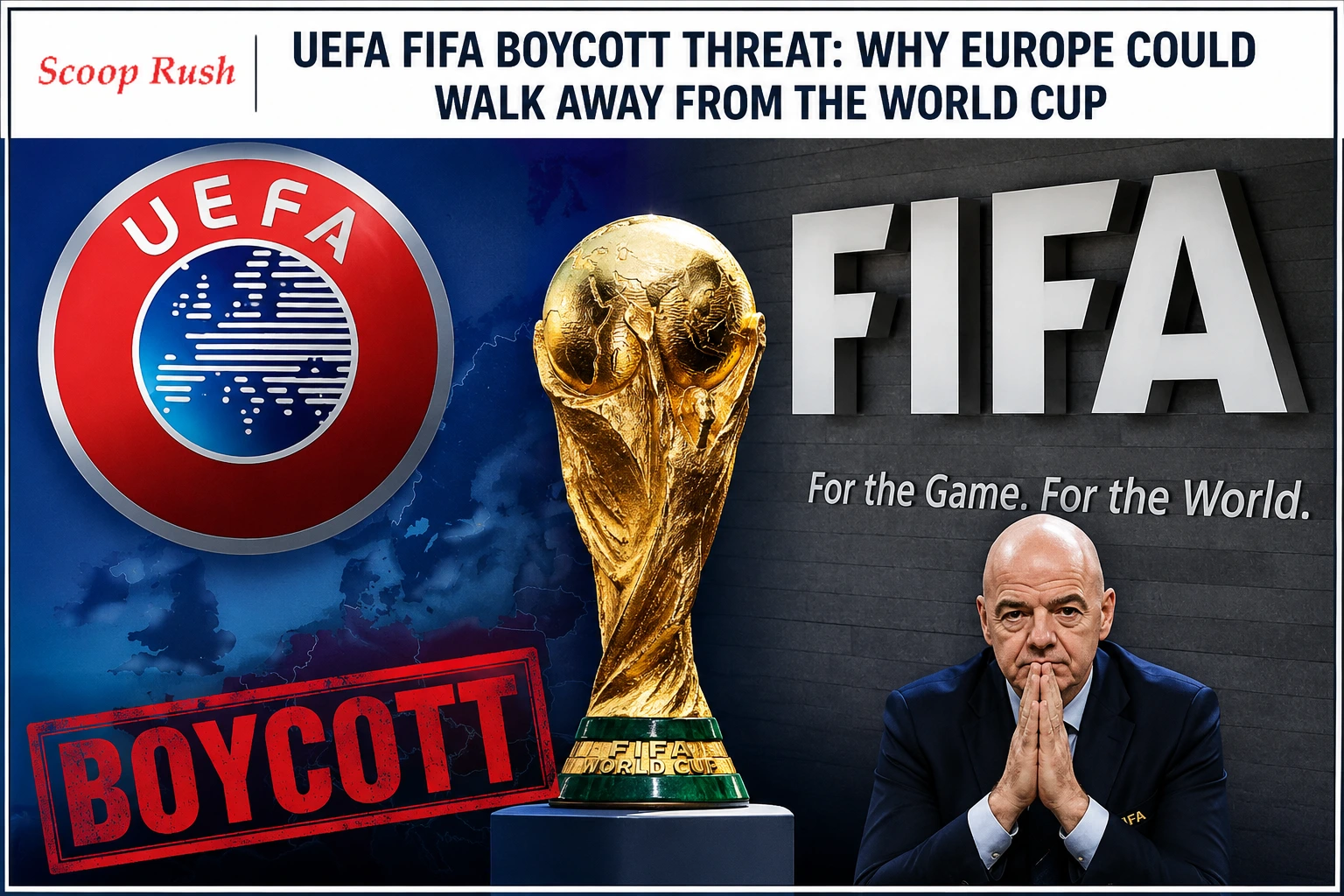
At exactly 4pm on Thursday, 30 July, European football’s governing body dropped a statement that sparked the biggest UEFA FIFA Boycott Threat in modern football history. Eleven words changed everything: “UEFA and its national associations will not participate in FIFA competitions.”
That single line is now the center of a standoff unlike anything football has seen in years. It is not a rumor. It is not an exaggeration. Instead, it is Europe’s direct response to FIFA president Gianni Infantino’s plan. Infantino wants to sell a 20% stake in a new subsidiary company. That company would run FIFA competitions, including the World Cup itself.
If this standoff isn’t resolved, it could reshape international football as fans know it. So why does this matter to you, the fan who just wants to watch great football? Because a UEFA Fifa Boycott Threat like this would strip major tournaments of their biggest stars. It would also remove the strongest teams and much of the drama that makes the World Cup special.
Let’s break down what happened, why it happened, and what could come next.
What Triggered The Uefa Fifa Boycott Threat
The root of this crisis is money. More specifically, it’s about who controls it.
Gianni Infantino wants to sell a 20% stake in a FIFA subsidiary company. That company would run FIFA flagship competitions, including the World Cup. On paper, FIFA would still run the business. In reality, private investors would gain a direct financial stake in how the World Cup operates.
One of those investors is Joshua Kushner, brother of Jared Kushner, who is the son-in-law of US President Donald Trump. This connection has raised eyebrows across the football world. After all, it ties a private American investment figure to the commercial future of the sport’s biggest tournament.
Fifa has reportedly offered $40m to national associations that back the plan. Countries have until 19 September to accept the deal. If they do, they will bank $20m (£15m) starting 1 January.
For Uefa, this isn’t just a financial disagreement. It’s a matter of principle. The organization believes the deal was pushed through without proper consultation. There was no real dialogue, and there was no genuine buy-in from the people who actually run football around the world.
Why Uefa Feels Blindsided
According to sources close to the situation, the dominant emotion inside Uefa’s emergency meeting was anger. Not concerned. Not disappointment. Anger.
Uefa vice-president and former Wales international Laura McAllister didn’t hold back when speaking to BBC Radio 5 Live. She made it clear that Uefa did not create this problem. Fifa did.
“We’ve been pushed into this corner and that’s Fifa’s responsibility,” she said.
That sentiment appears to be shared widely. The Football Association, led by chair Debbie Hewitt, also serves as a FIFA vice president. Hewitt has said England stands “shoulder to shoulder” with its European colleagues. Meanwhile, the Scottish FA, whose president Mike Mulraney chairs FIFA finance committee, has said it “agrees unequivocally” with UEFA position.
This is not a small pocket of resistance. Rather, its senior leadership across multiple major football nations rejected Infantino’s approach almost in unison, which is exactly why the UEFA Fifa Boycott Threat has escalated so quickly.
Which Tournaments Could Actually Be Affected
Here’s where things get complicated, and honestly, a little messy.
A senior European football source admitted that the finer details weren’t fully thought through before the policy was announced. One immediate concern is the U20 Women’s World Cup, hosted by Poland. It starts on 5 September and features several European nations.
Since the deadline for FIFA funding deal is 19 September, countries could, in theory, withdraw from that tournament somewhere between the quarter-finals and the semi-finals. That’s an unusual and disruptive scenario for any competition, let alone a World Cup event.
After that tournament, the next major matches at stake are the Women’s World Cup play-offs in October. These play-offs involve England, Scotland, Wales, and Northern Ireland, among other nations.
For Wales, the stakes are personal. As McAllister pointed out, these play-offs represent a shot at Wales’ first-ever Women’s World Cup qualification. Nobody wants players to miss out on a moment like that simply because of a boardroom dispute they have no control over.
Concacaf Adds Pressure On Fifa
Uefa isn’t standing alone in this fight. Shortly after Uefa’s statement, Concacaf released its own response. Concacaf is the governing body for football across North and Central America, and it hosted this year’s World Cup.
Concacaf confirmed that its 41 members rejected Fifa’s proposals. That’s a significant development, because it shows this isn’t purely a European objection. In fact, it’s becoming a broader rebellion against how Infantino is running Fifa’s business decisions.
As of now, Fifa has not issued a formal response to Uefa’s statement.
Is Gianni Infantino’s Position At Risk
This is the question everyone in football wants answered. Right now, though, nobody has a confident response.
Infantino became Fifa president back in 2016. He defeated Asian Football Confederation president Sheikh Salman al-Khalifa by a vote of 115 to 88. He is due to stand for a fourth term in March. Before this controversy, most expected him to be re-elected unopposed, with FAs from around the world, including several in Europe, already signaling support.
However, that picture has shifted. Sources indicate that most of Concacaf’s members are either losing confidence in Infantino’s leadership or have already lost it entirely. There’s now genuine discussion about finding a candidate to run against him. This hasn’t happened in a meaningful way for decades.
Historically, sitting Fifa presidents don’t get challenged. The last one to actually lose an election was England’s Sir Stanley Rous, defeated by Brazil’s Joao Havelange back in 1974.
Could Nasser Al-Khelaifi Challenge Infantino
One name being floated as a potential challenger is Nasser Al-Khelaifi. It makes sense on paper. Al-Khelaifi is already one of football’s most influential figures. He’s president of Paris St-Germain, back-to-back Champions League winners. He also leads European Football Clubs, previously known as the European Clubs’ Association.
Al-Khelaifi took charge of that organization after the European Super League collapse in 2021. That crisis nearly tore the club football landscape apart. Since then, he has expanded the group to more than 800 members, with only Real Madrid remaining outside its ranks.
Despite his influence, sources close to Al-Khelaifi say he genuinely doesn’t want the Fifa presidency. So for now, there’s no confirmed rival to Infantino, even as pressure builds.
Former FA chairman David Bernstein offered a blunt take when asked whether Infantino could survive this. In a “normal organisation,” he explained, backing down from something this significant would likely cost a leader their job. But Fifa, he added, isn’t a normal organization. If Infantino retains enough support from national associations, he will continue in his role regardless of the backlash.
Former Uefa chief executive Lars Christer Olsson went a step further, suggesting Infantino may have overplayed his hand. Olsson proposed a structural reform where the Fifa presidency rotates between confederations. This, he argued, would be better than concentrating power the way it has with Infantino and his predecessors, Sepp Blatter and Joao Havelange. When asked directly if Infantino should be removed, Olsson said it “should be a new start for football.”
Why This Uefa Fifa Boycott Threat Carries So Much Weight
Numbers matter here, and they matter a lot.
Uefa represents just 55 of Fifa’s 211 national associations. On paper, that seems small. However, in terms of actual playing strength, Uefa is the most dominant confederation in world football by a wide margin.
Consider this: in the most recent editions of the World Cup, the Women’s World Cup, and the Club World Cup, UEFA provided three of the four semi-finalists across those tournaments. That’s not a minor contribution. It’s the backbone of FIFA biggest events.
If European nations genuinely pulled out of Fifa competitions, the commercial fallout would be massive. Infantino has promised a $40bn (£30bn) product in a letter sent to national associations. Without European participation, though, reaching anywhere near that figure becomes almost impossible.
David Bernstein doesn’t believe a full split will happen long-term. He calls it a “lose-lose for everybody.” As he put it, Fifa can’t afford to lose European nations from its competitions, and Europe can’t afford to be excluded from Fifa’s biggest stage either.
His view is straightforward: Infantino needs to back down. He described the current proposal as a “friends deal” that isn’t right. If Fifa wants to raise capital, he added, there are better, more transparent ways to do it.
What Happens Next In The UEFA Fifa Boycott Threat
Right now, everything hinges on 19 September, the deadline for national associations to accept or reject Fifa’s funding proposal.
If enough countries accept the deal UEFA boycott threat becomes active. That would put tournaments like the U20 Women’s World Cup and the Women’s World Cup play-offs directly in the firing line.
Meanwhile, the football world is watching closely. Will Fifa respond publicly to Uefa’s statement? Will Infantino adjust his plan to ease tensions before things escalate further?
For now, one thing is clear. This dispute is no longer just about a business deal. Ultimately, it’s about who truly controls the direction of world football, and whether FIFA biggest stakeholder, European football, is willing to walk away to prove a point.
Key Takeaways: UEFA Fifa Boycott Threat
- The UEFA FIFA Boycott Threat became real when UEFA vowed to boycott FIFA competitions if Infantino’s 20% stake sale plan is approved.
- The deal involves private investors, including Joshua Kushner, gaining a financial stake in Fifa’s competition business.
- National associations have until 19 September to accept FIFA offer, with payouts starting 1 January.
- The U20 Women’s World Cup in Poland and the Women’s World Cup play-offs in October are the tournaments most immediately at risk.
- Concacaf’s 41 members have also rejected Fifa’s proposal, adding pressure beyond Europe.
- Infantino’s re-election in March, once expected to be unopposed, is now facing real uncertainty.
- Experts believe a full Fifa-Uefa split is unlikely long-term, but Infantino may need to reconsider the deal to avoid deeper damage.
Frequently Asked Questions
1. Why is Uefa threatening to boycott Fifa competitions?
Uefa is opposing Fifa president Gianni Infantino’s plan to sell a 20% stake in a subsidiary company that would run Fifa’s competitions, including the World Cup. According to Uefa, the plan was pushed through without proper consultation with national associations.
2. Which tournaments could be affected by the UEFA Fifa Boycott Threat?
The U20 Women’s World Cup in Poland, starting 5 September, and the Women’s World Cup play-offs in October are most at risk. Those play-offs involve England, Scotland, Wales, and Northern Ireland.
3. Who is investing in Fifa’s new subsidiary company?
Reports confirm that Joshua Kushner, brother of Jared Kushner and brother-in-law of Ivanka Trump, is among the private investors involved in the proposed deal.
4. Could Gianni Infantino lose his position as Fifa president?
It’s uncertain. Infantino is set to stand for a fourth term in March. While some Concacaf members are reportedly losing confidence in his leadership, Fifa presidents historically retain their positions if they hold enough support from national associations.
5. Will Uefa and Fifa actually split permanently?
Most experts, including former FA chairman David Bernstein, believe a permanent split is unlikely, since it would be damaging for both sides. However, Infantino may need to revise or withdraw his current proposal to prevent the boycott from becoming reality.

