
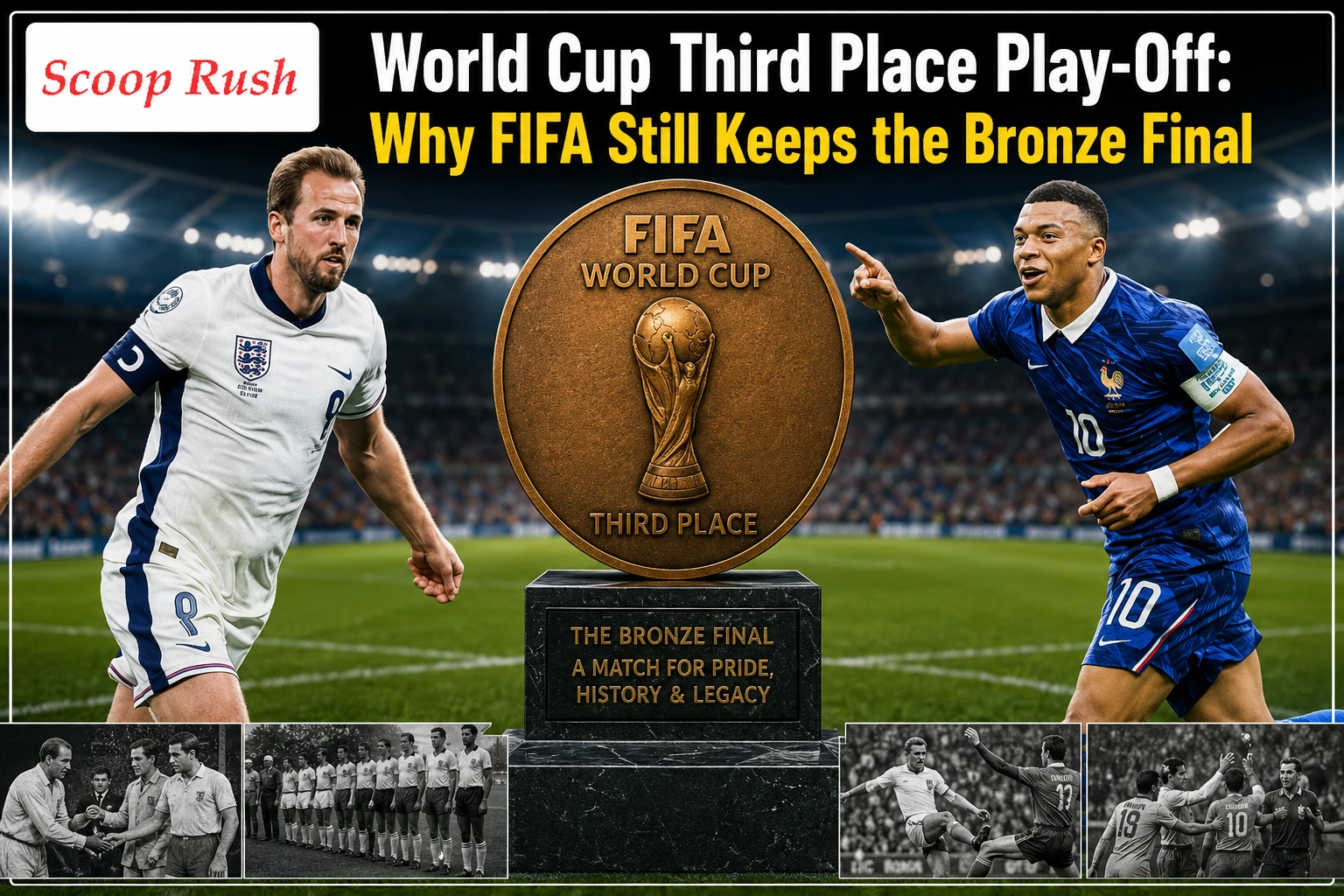
The FIFA World Cup final attracts global attention, but one match often divides opinion more than any other. The World Cup Third Place Play-Off, also known as the Bronze Final, has existed for decades. Yet many players, coaches, and fans continue to question whether it should remain part of football’s biggest tournament.
As England and France prepare to meet in the Bronze Final of the FIFA World Cup 2026, the debate has returned. Is it an unwanted fixture that nobody wants to play, or does winning a bronze medal still carry real value?
Why the World Cup Third Place Play-Off Matters
The World Cup Third Place Play-Off is one of the longest-running traditions in World Cup history. While the tournament’s main focus is always the final, FIFA continues to stage this match to determine who finishes third and who finishes fourth.
This year’s game features England and France after both nations suffered painful semi-final defeats. England lost to Argentina, while France missed out on a place in the final as well.
Many players would rather be preparing for the final than playing one more match. However, the fixture remains important for several reasons, including official rankings, prize money, player records, and the awarding of bronze medals.
As a result, the match continues to spark debate every time a World Cup reaches its final weekend.
The Mixed Feelings Surrounding the Bronze Final
Players and Coaches Often Struggle to Embrace It
The emotional challenge of the third-place match is obvious.
France coach Didier Deschamps openly admitted that both teams would probably prefer the game not to exist. England manager Thomas Tuchel expressed similar thoughts immediately after England’s semi-final defeat.
According to Tuchel, neither England’s players nor France’s players truly wanted to play the match.
That reaction is understandable. After coming so close to reaching the World Cup final, teams must quickly recover from disappointment and prepare for another high-pressure game. However, Tuchel later highlighted a more positive perspective.
He pointed out that victory would give England their best World Cup result in 60 years. Therefore, despite the disappointment of missing the final, there is still something meaningful to achieve.
A Chance for Squad Players
Another reason the fixture remains useful is the opportunity it creates for players who have not featured heavily during the tournament. Managers often rotate their squads for the Bronze Final. As a result, younger players and substitutes can gain valuable World Cup experience.
For England, players such as Kobbie Mainoo could receive their first World Cup minutes. Goalkeeper James Trafford could also get an opportunity on football’s biggest stage.
Similarly, France may choose to give playing time to squad members who have spent most of the tournament on the bench. Therefore, the match can become an important development opportunity for future international stars.
Not Everyone Enjoys the Occasion
Despite those opportunities, many players still find it difficult to embrace the game.
France defender Ibrahima Konate summed up the feeling when he admitted that none of the players wanted to participate in a third-place match. However, he also acknowledged that the teams have no choice.
That honesty reflects a common view among footballers. After dreaming of lifting the World Cup trophy, competing for third place can feel like a consolation prize rather than a reward.
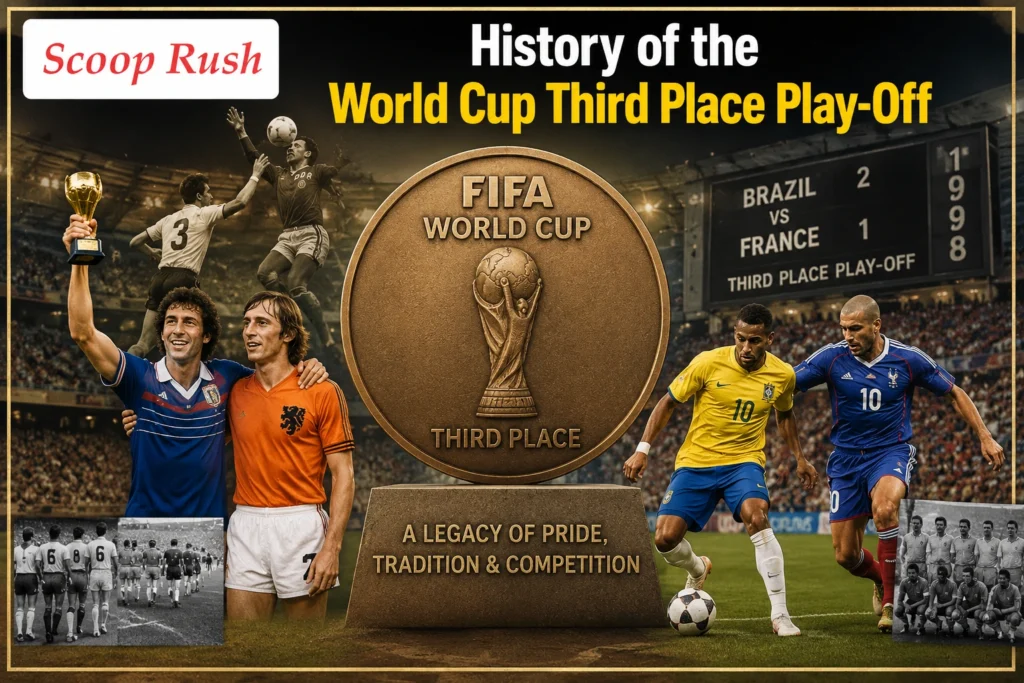
History of the World Cup Third Place Play-Off
When Did It Begin?
The World Cup Third Place Play-Off first appeared at the 1934 FIFA World Cup. Later, it became a permanent feature of the tournament from 1954 onward. Since then, it has been played at every World Cup.
Over the decades, the fixture has produced memorable moments, dramatic goals, and emotional celebrations. However, it has also generated criticism from players and coaches who believe the match lacks significance.
England’s Previous Experiences
England have played in the third-place match twice since winning the World Cup in 1966.
Their first appearance came in 1990, when they lost to Italy. The second occurred at the 2018 World Cup in Russia, where Belgium defeated them.
Now England have another opportunity to claim a bronze medal and achieve one of their strongest World Cup finishes in modern history.
Why FIFA Continues to Keep the Bronze Final
Official Rankings and Historical Records
One of FIFA’s main reasons for maintaining the fixture is the need to determine final tournament positions. Without the match, two teams would finish as losing semi-finalists without a clear distinction between third and fourth place.
The result also became part of World Cup history. Furthermore, it affects player records, team statistics, and tournament archives. For an event with such a rich history, FIFA places significant importance on maintaining a definitive final ranking.
Prize Money Matters
The game also has a financial impact.
According to the information surrounding the tournament, there is approximately a $2 million difference in prize money between third and fourth place.
While that amount may not be the primary motivation for players, it remains significant for national football associations. Consequently, there is a practical incentive to win the match.
Value for Broadcasters and Fans
FIFA also benefits from an additional high-profile fixture.
The Bronze Final provides another World Cup event for broadcasters, sponsors, and supporters. Fans who travel long distances and purchase tickets still get the chance to watch elite international football.
Meanwhile, television audiences around the world continue to follow the tournament until its final weekend. For FIFA and its commercial partners, the match remains an attractive part of the competition schedule.
The Sporting Case for the World Cup Third Place Play-Off
A Match That Often Produces Goals
One argument in favor of the fixture is entertainment.
Historically, third-place matches have often produced open and attacking football. Since 1974, only one such match has failed to produce at least two goals. Additionally, most of those games have featured more than three goals.
The reason is simple. Teams usually play with less pressure than in knockout rounds. As a result, matches often become more open and enjoyable for spectators.
The Golden Boot Connection
The World Cup Third Place Play-Off has also played a role in determining Golden Boot winners. Several players scored crucial goals in these matches on their way to becoming the tournament’s top scorer.
Notable examples include:
Thomas Muller of Germany in 2010 Davor Suker of Croatia in 1998 Salvatore Schillaci of Italy in 1990 Leonidas of Brazil in 1938 Grzegorz Lato of Poland in 1974 Eusebio of Portugal in 1966 Just Fontaine of France in 1958
In several cases, the goals scored in the third-place match directly helped secure the Golden Boot award. Therefore, the fixture can still influence individual achievements even after a team’s title hopes have ended.
Croatia’s Bronze Medal and the ‘Golden Layer’
A Different Perspective
Not every nation views the Bronze Final negatively. Croatia provided one of the best recent examples at the 2022 FIFA World Cup. After finishing runners-up in 2018, Croatia defeated Morocco 2-1 in the third-place match to claim the bronze medal.
Coach Zlatko Dalic described the achievement in memorable terms.
He said the bronze medal carried a “golden layer” and felt almost as meaningful as winning gold. For Croatia, the result represented another remarkable achievement on the world stage.
A Career-Defining Moment
The winning goal against Morocco came from Mislav Orsic. After the match, Orsic described it as the most important goal of his career. His reaction highlighted something often overlooked in discussions about the Bronze Final.
For players from smaller football nations, winning a World Cup medal can become one of the greatest moments of their lives. Therefore, the value of the match often depends on perspective.
Why Critics Want the Match Removed
The Emotional Cost
Despite its history, criticism of the fixture remains strong. Former Netherlands manager Louis van Gaal has been one of its most vocal opponents.
Before the Netherlands faced Brazil in the 2014 third-place match, he argued that the game should not exist.
His main concern centered on fairness. Teams already suffer the disappointment of losing a semi-final. According to Van Gaal, forcing them to play another match creates the possibility of ending the tournament with two consecutive defeats.
As a result, a team that performed brilliantly throughout the competition may leave feeling like a loser.
A Similar View from England
Former England manager Gareth Southgate shared a comparable opinion before England’s third-place match in 2018. Southgate acknowledged that no team truly wants to participate in the fixture.
His comments reflected the emotional reality faced by players who come within one match of the World Cup final. Therefore, opponents argue that the Bronze Final adds unnecessary disappointment to an already painful situation.
England vs France: Another Chapter in the Debate
The latest edition of the World Cup Third Place Play-Off will feature two football powers with ambitions of lifting the trophy.
Both England and France entered the tournament hoping to reach the final. Instead, they now face each other in a match that many participants would prefer not to play.
However, there is still plenty at stake.
A bronze medal remains an achievement. Young players may receive opportunities. National associations can earn additional prize money. Furthermore, fans will have one more chance to watch world-class football.
For England, victory would secure their strongest World Cup finish in six decades. For France, it would provide a positive ending to a tournament that fell just short of the ultimate goal.
Will the World Cup Third Place Play-Off Survive in the Future?
The debate is unlikely to disappear.
As the World Cup continues to expand, questions about tournament scheduling will only become louder. The 2026 edition already features a record number of matches.
Some critics wonder whether future tournaments should continue dedicating space to a game that many players dislike. However, FIFA currently shows no sign of removing the fixture.
The match provides a clear final ranking, determines medal positions, affects prize money, and remains part of World Cup tradition. As long as those factors remain important, the Bronze Final is likely to survive.
Conclusion
The World Cup Third Place Play-Off remains one of football’s most debated fixtures. Critics see it as an unnecessary consolation match played by disappointed teams. Supporters view it as an opportunity to win a World Cup medal, improve tournament rankings, and create lasting memories.
England and France may have preferred to be playing in the final, but their Bronze Final still carries significance. Whether fans consider it a “booby prize” or a medal with a “golden layer,” the match continues to occupy a unique place in World Cup history.
For now, FIFA remains committed to the tradition. As a result, the debate over the value of third place is likely to continue long after the final whistle.
FAQs
1. What is the World Cup Third Place Play-Off?
The World Cup Third Place Play-Off is a match between the two losing semi-finalists to determine who finishes third and who finishes fourth in the tournament.
2. Why does FIFA still organize the Bronze Final?
FIFA uses the match to determine final rankings, award bronze medals, separate prize money payments, and complete official tournament records.
3. Does the third-place match count for the Golden Boot race?
Yes. Goals scored in the third-place match count toward the Golden Boot competition and can influence the final top-scorer standings.
4. Has England won a World Cup third-place match before?
England have played in third-place matches before but lost to Italy in 1990 and Belgium in 2018.
5. Why do some coaches want the match removed?
Many coaches believe the fixture forces disappointed teams to play another game immediately after losing a semi-final and missing the chance to compete for the World Cup title.

