
Can a Chinese startup really build an AI model big enough to rattle Silicon Valley in a single day? That is exactly what happened this week. Moonshot AI released Kimi K3, and the tech world has not stopped talking about it since.
The Beijing-based company says its new model closes the gap with the world’s leading AI systems. Kimi K3 still trails behind Anthropic’s Claude Fable 5 and OpenAI’s GPT 5.6 Sol on overall performance. However, it beat several other major models, including Claude Opus 4.8 and GPT 5.5, on key benchmarks like coding and general agent tasks. This matters because it signals a shift in how fast Chinese AI tools are catching up, despite ongoing hardware restrictions from the United States.
For anyone following the AI industry, whether you are a developer, investor, or casual tech reader, this release raises real questions. How did a company work around chip export controls to build something this massive? What does it mean for the future of open-source AI? Furthermore, should American AI companies be worried?
What Is Kimi K3 and Why the Kimi K3 Model Matters
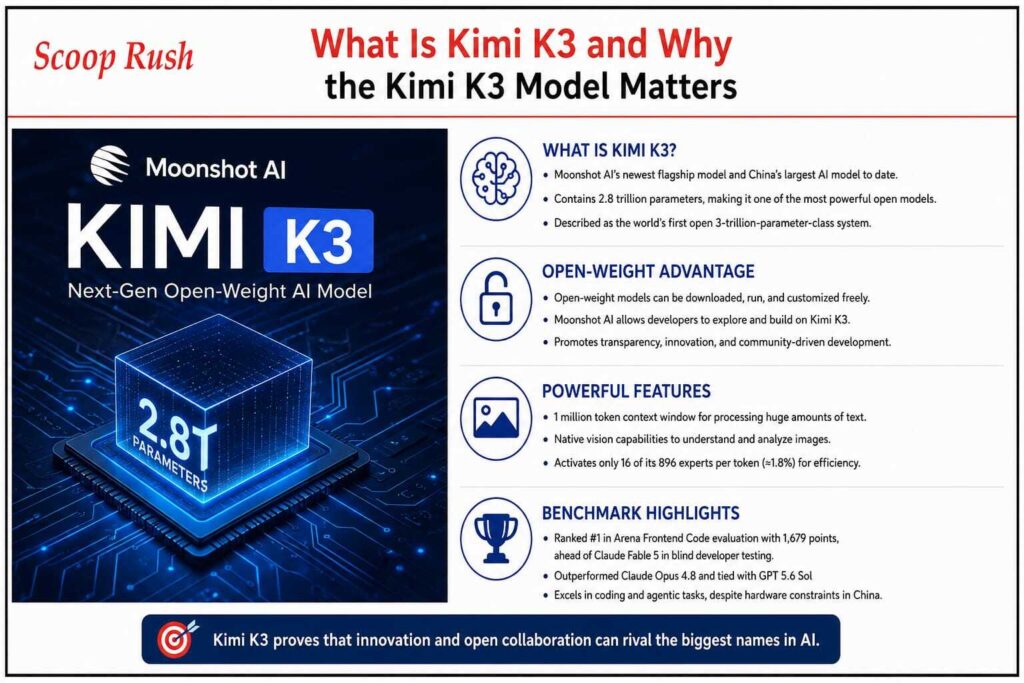
Kimi K3 is Moonshot AI’s newest flagship model, and it is being called China’s largest AI model to date. It contains 2.8 trillion parameters, which refers to the size of its neural network. This roughly indicates how much information the model can process and learn from. Moonshot describes Kimi K3 as the world’s first open 3-trillion-parameter-class system and the largest open-weight AI model ever released.
Open-weight models differ from proprietary ones like ChatGPT or Claude. Developers can download, run, and customize open-weight models freely. This openness is a big part of why the Kimi K3 model is generating so much buzz. Instead of keeping its technology locked away, Moonshot lets outside developers dig into the system directly, similar to how Meta’s Muse Image feature opened up new creative tools for everyday users.
The model also comes with a 1 million token context window and native vision capabilities. In simpler terms, Kimi K3 can process huge amounts of text at once and work with images too. According to Moonshot, the system activates only 16 of its 896 experts per token, roughly 1.8% of the total pool. This selective activation helps the model run efficiently despite its enormous size.
Kimi K3 Benchmark Results That Turned Heads
Independent testing is where things get interesting. Arena ranked Kimi K3 first in its Frontend Code evaluation, scoring 1,679 points and landing ahead of Claude Fable 5 in blind developer testing. Meanwhile, Arena’s broader text ranking showed K3 outperforming the standard version of Claude Opus 4.8 and tying with GPT 5.6 Sol.
These results do not mean Kimi K3 is the best model overall. Moonshot itself admits that Fable 5 and Sol still lead on general performance. Still, beating Opus 4.8 and GPT 5.5 across coding and agentic tasks is a meaningful achievement. Bank of America analysts, led by Alex Liu, noted that despite persistent hardware and compute constraints in China, K3 demonstrates that large-scale pretraining paired with architectural innovation can still deliver major gains for flagship Chinese models.
How Moonshot Built the Kimi K3 Model Under Export Restrictions
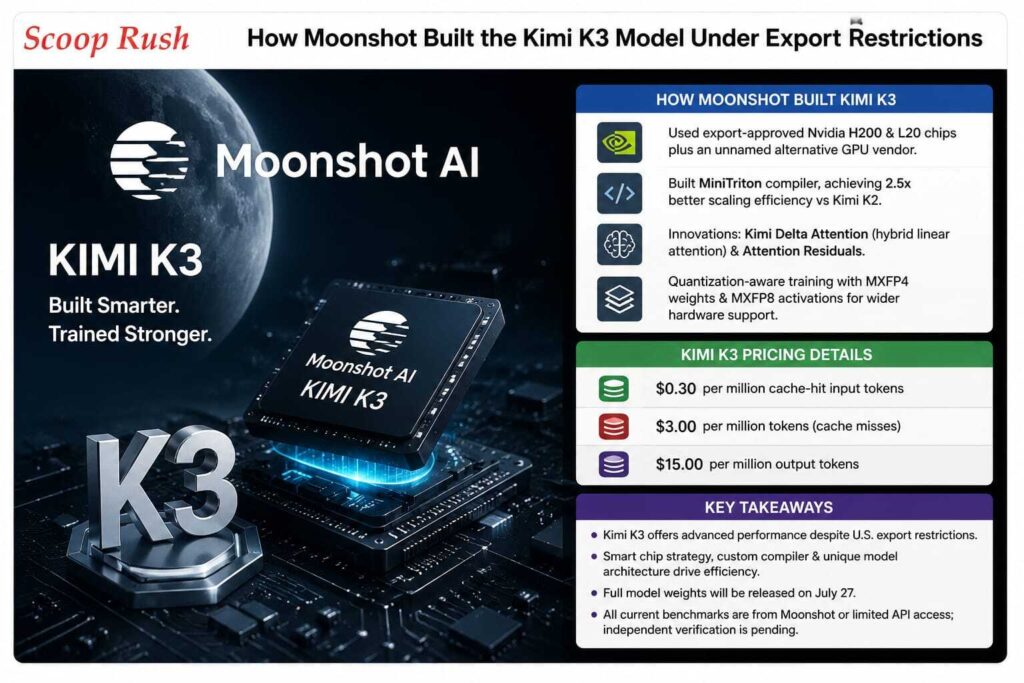
One of the biggest questions surrounding Kimi K3 is how Moonshot managed to train such a large model while facing U.S. export controls on advanced AI chips. The company’s technical disclosures point to a mix of export-approved Nvidia hardware and an unnamed alternative GPU vendor, a workaround not unlike the chip strategies discussed around Nokia’s AI-RAN platform with Nvidia.
Moonshot’s kernel optimization benchmarks ran on Nvidia’s H200 chips, as well as what its blog only describes as a “GPGPU from an alternative vendor.” The company did not name this second supplier. Additionally, Moonshot built its own compiler called MiniTriton, which it tested against the standard Triton compiler using Nvidia’s L20 chip, a scaled-down card sold specifically into the Chinese market under U.S. export rules.
Moonshot claims roughly a 2.5x improvement in scaling efficiency compared to its earlier Kimi K2 model. The company attributes this to two architectural innovations: Kimi Delta Attention, a hybrid linear attention system, and Attention Residuals, which change how information flows between layers of the model. Quantization-aware training was also used starting at the supervised fine-tuning stage, relying on MXFP4 weights and MXFP8 activations for broader hardware compatibility.
Kimi K3 Pricing and Access Details
Kimi K3’s API pricing sits at $0.30 per million cache-hit input tokens, $3 per million tokens on cache misses, and $15 per million output tokens. For comparison, Kimi K2 launched about a year ago at $0.60 per million input tokens. Therefore, uncached input costs for K3 are five times higher than its predecessor.
Full model weights are expected to be released publicly on July 27. Until then, every benchmark and performance claim comes either from Moonshot itself or from limited API access, so independent verification is still pending.
Market Reaction to the Kimi K3 Release
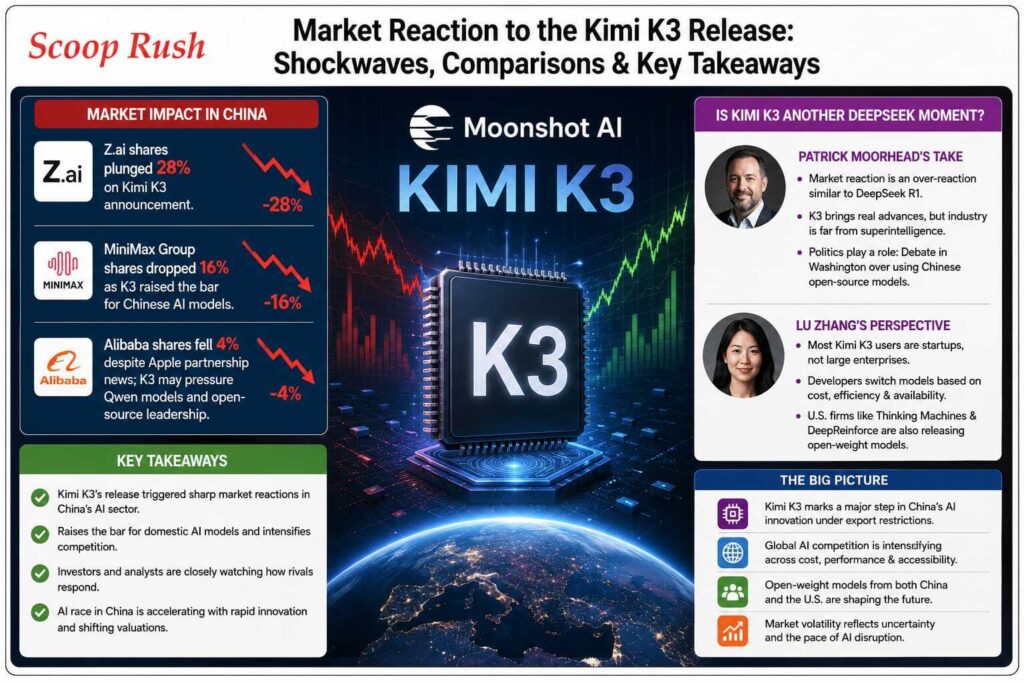
The Kimi K3 release sent shockwaves through Chinese AI stocks almost immediately. Z.ai, which released its own model to considerable attention in June, saw its shares plummet 28% on the day of the announcement. MiniMax Group, another Chinese AI competitor, dropped 16%. Analysts pointed out that K3 raises the bar for Chinese AI models overall, shifting pressure onto other domestic labs to prove they can keep up. This kind of sudden market swing echoes how SpaceX’s Nasdaq debut reshaped valuations overnight in a different sector.
Alibaba, which backs Moonshot alongside Tencent, also felt ripple effects. The company’s stock had recently climbed on news of a partnership with Apple in China, but shares fell 4% following the Kimi K3 announcement. Analysts noted that while Alibaba benefits broadly from AI-driven demand for its cloud services, the release could pressure Alibaba’s own Qwen models and its positioning as an open-source leader.
Is Kimi K3 Another DeepSeek Moment?
Comparisons to DeepSeek’s R1 model release in 2025 have come up frequently. That earlier release generated massive attention for being unusually cost-efficient compared to proprietary alternatives. Similarly, Patrick Moorhead, CEO and chief analyst at Moor Insights and Strategy, described the market’s reaction to Kimi K3 as an over-reaction resembling the DeepSeek panic. He argued that despite genuine technical advances, the industry remains far from anything resembling superintelligence.
Moorhead also pointed to politics as part of the story. He noted there is an ongoing debate in Washington about whether U.S. companies should use Chinese open-source models, and whether American firms should even help Chinese developers improve their own systems.
Meanwhile, Lu Zhang, founder and managing partner of Fusion Fund, offered a more grounded perspective. She said that most developers using models like Kimi K3 come from the startup ecosystem rather than large corporations. These developers often swap AI models in and out depending on cost, efficiency, and availability, rather than sticking loyally to one system. Additionally, Zhang pointed out that U.S. companies like Thinking Machines and DeepReinforce are increasingly releasing their own open-weight models, showing that this is not purely a U.S. versus China story.
The Bigger Picture for AI Development
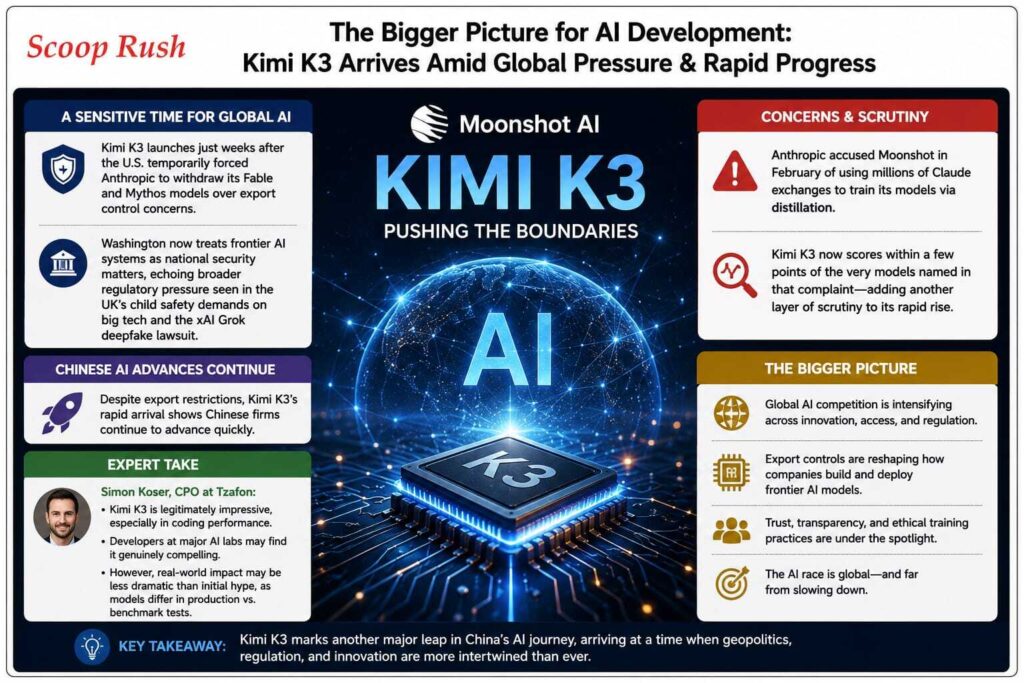
This release arrives at a particularly sensitive moment for the global AI industry. It comes just weeks after the U.S. government temporarily forced Anthropic to withdraw its Fable and Mythos models due to export control concerns, before restoring access once those controls were lifted. That episode highlighted how seriously Washington now treats frontier AI systems as matters of national security, a concern that mirrors broader regulatory pressure seen in cases like the UK’s child safety demands on big tech and the xAI Grok deepfake lawsuit.
Despite these restrictions, Kimi K3’s rapid arrival suggests Chinese firms continue to advance quickly. Simon Koser, chief product officer at AI startup Tzafon, said Kimi K3 is legitimately impressive, particularly in coding performance, and that developers at major AI Anthropic has also raised concerns about how some Chinese AI companies train their systems. The company accused Moonshot in February of using millions of Claude exchanges to train its models through a technique known as distillation. Notably, K3 now scores within a few points of the very models named in that complaint, adding another layer of scrutiny to its rapid riselabs could find it genuinely compelling. At the same time, he cautioned that shifts in developer preference may not be as dramatic in practice as the initial hype suggests, since models often behave differently in production settings compared to benchmark tests.
.
Conclusion
Kimi K3 represents a significant moment in the ongoing competition between American and Chinese AI development. Moonshot AI built a 2.8 trillion parameter model that, while not surpassing the very best systems from Anthropic and OpenAI, outperformed several other leading models on important benchmarks. The company managed this despite ongoing hardware restrictions, using architectural innovations and alternative hardware sourcing to close the gap.
However, questions remain. The full weights will not be public until July 27, so independent verification of Moonshot’s claims is still pending. Additionally, market reactions have varied widely, from panic among Chinese competitors to measured skepticism from industry analysts who caution against overreacting to any single model release. As a result, the true impact of Kimi K3 on the broader AI landscape will likely become clearer in the weeks ahead.
FAQs
What is Kimi K3?
Kimi K3 is a 2.8 trillion parameter open-weight AI model released by Chinese startup Moonshot AI. It is described as the largest open-weight AI model released so far, with capabilities in coding, reasoning, and general agent tasks.
Does Kimi K3 outperform Claude and GPT models?
Kimi K3 trails Anthropic’s Claude Fable 5 and OpenAI’s GPT 5.6 Sol on overall performance. However, it outperformed other tested models, including Claude Opus 4.8 and GPT 5.5, on certain benchmarks like coding and agentic tasks.
When will Kimi K3’s full weights be released?
Moonshot AI plans to release the full model weights on July 27. This will allow independent developers to inspect and verify its performance claims directly.
How much does Kimi K3 cost to use?
API pricing is $0.30 per million cache-hit input tokens, $3 per million tokens on cache misses, and $15 per million output tokens. This is higher than its predecessor Kimi K2.
Why did Chinese AI stocks drop after the Kimi K3 release?
Competitors like Z.ai and MiniMax saw sharp stock declines because Kimi K3 raised the performance bar for Chinese AI models. As a result, rival companies now face pressure to prove they can match its capabilities.

