

Meta Just Launched Muse Image, and It Can Put Your Face in Photos You Never Posed For
Imagine finding an AI-made picture of yourself online that you never agreed to be in. That is not a far-off worry anymore. It is already happening on Instagram, thanks to a new tool from Meta called Muse Image.
Meta rolled out Muse Image this week, and within days it had people talking for reasons the company probably did not plan for. The tool lets anyone create AI images, but one feature in particular has sparked real concern: it allows users to pull another person’s public Instagram photos into AI-generated images, without asking that person first.
“Pulling real users into generated photos without explicit consent is a privacy landmine waiting to detonate.” An X user reacting to the news, as reported by The Verge
Table of Contents
What Is Muse Image?
Muse Image is Meta’s new AI image generator, built by Meta Superintelligence Labs, the company’s dedicated AI research group. Inside Meta, the project was known by the code name Mango before it launched under its public name this week.
The tool is free to use through the Meta AI app, and it is also built directly into Instagram Stories and WhatsApp. That means you do not need to download a separate app or sign up somewhere new. If you already use Instagram or WhatsApp, Muse is sitting right there waiting for you.
Meta says everyday use of Muse is free. If you go beyond a certain number of image generations, though, you will need to move to a paid subscription plan to keep using it.
What You Can Actually Do With Muse
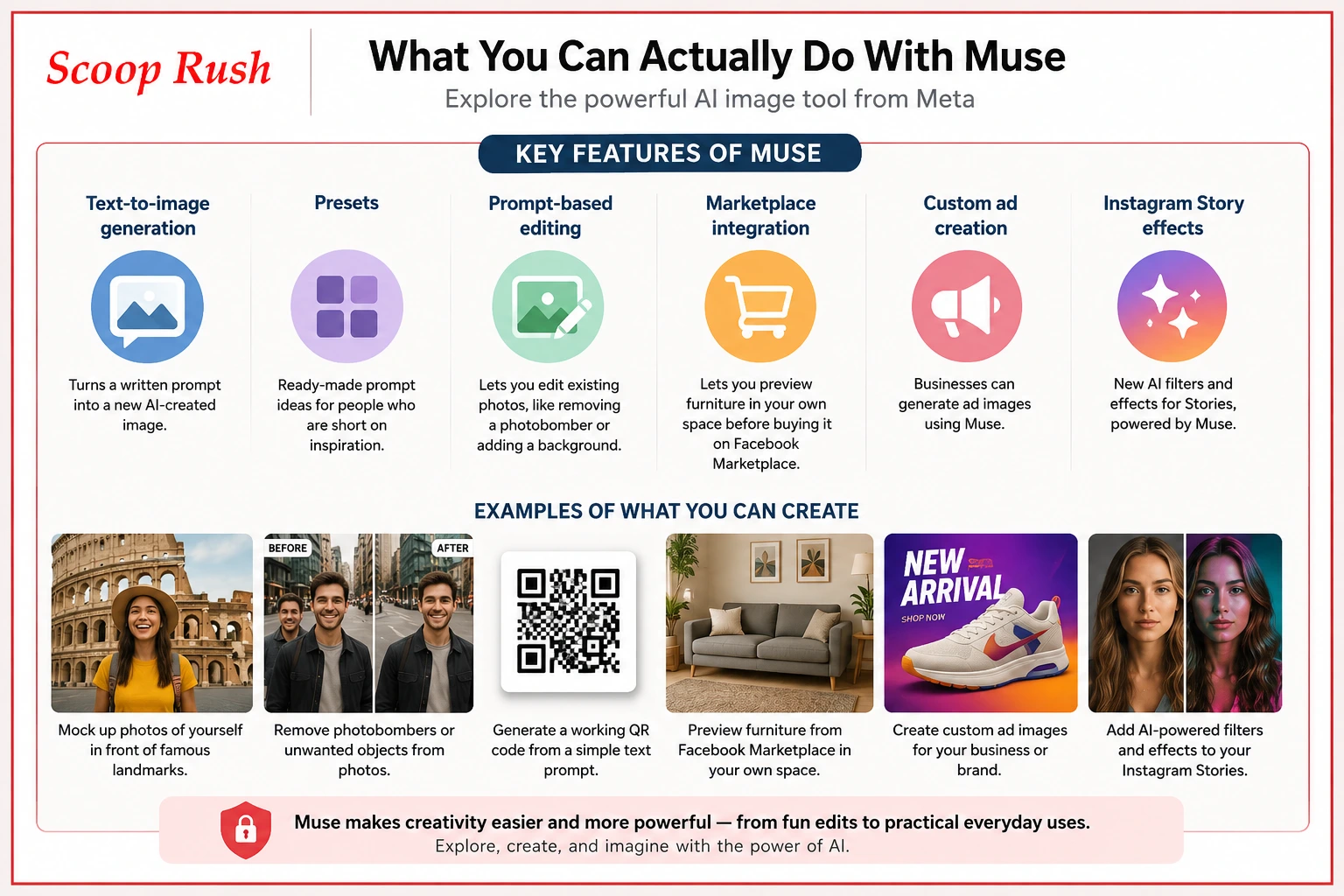
At its core, Muse works like most other AI image tools on the market right now. You type a prompt, and it generates an image based on your words. If you are not sure what to type, Meta has added ready-made “presets,” which are pre-written prompts designed to give you a starting point.
Here is a quick breakdown of what the tool is built to do:
| Feature | What It Does |
|---|---|
| Text-to-image generation | Turns a written prompt into a new AI-created image |
| Presets | Ready-made prompt ideas for people who are short on inspiration |
| Prompt-based editing | Lets you edit existing photos, like removing a photobomber or adding a background |
| Marketplace integration | Lets you preview furniture in your own space before buying it on Facebook Marketplace |
| Custom ad creation | Businesses can generate ad images using Muse |
| Instagram Story effects | New AI filters and effects for Stories, powered by Muse |
Some of these features are genuinely handy. Meta gave an example of using Muse to mock up a photo of yourself standing in front of a famous landmark, cleaning up a photobomber from an old picture, or even generating a working QR code from a simple text prompt. There is also a home decorating angle, where you can drop a secondhand couch from Facebook Marketplace into a photo of your own living room to see how it looks before you buy it.
The Tagging Feature That’s Raising Alarms
Now for the part that has people worried. Muse includes a feature that lets you tag another Instagram user and pull their public photos into your own AI-generated image. As long as that person’s account is public, you can use their picture to create something new, and you do not need their permission first.
The Verge was the first to point out how invasive this could be, and reactions online followed quickly. People are uneasy about a stranger being able to take their face and photos and turn them into new content they never agreed to and may never see.
Meta’s own policy spells this out plainly. According to the company, other people may be able to create content using your Instagram photos through Meta’s AI features, and you will not be told when that happens.
The key detail people are missing
This feature is opt-out, not opt-in. That means it is switched on for every public account by default. If you want to stop your photos from being used this way, you have to go find the setting and turn it off yourself.
Why Meta’s Privacy History Makes This Worse
Context matters here, and Meta’s track record on privacy is part of why people are reacting so strongly. This is not the company’s first run-in with concerns about how it handles personal data and images.
| Year | Incident | Outcome |
|---|---|---|
| 2016 to 2018 | Cambridge Analytica harvested data from tens of millions of Facebook users without their knowledge to build political ad targeting profiles | Facebook had known about the misuse for years before it became public |
| 2019 | FTC investigation into the Cambridge Analytica scandal | Meta paid a then-record 5 billion dollar fine to the FTC |
| 2021 | Facebook’s facial recognition system, which automatically identified people in photos and videos, faced lawsuits and regulatory pressure over biometric data collection | Facebook shut the system down |
| 2026 | Muse Image launches with an opt-out photo tagging feature | Users and privacy watchers point out the same pattern: your data is used unless you actively turn it off |
That last row is really the heart of the issue. Whether it is data collection, facial recognition, or now AI image generation, the pattern keeps repeating. The feature is on unless you go looking for the switch to turn it off.
How to Turn Off Photo Tagging
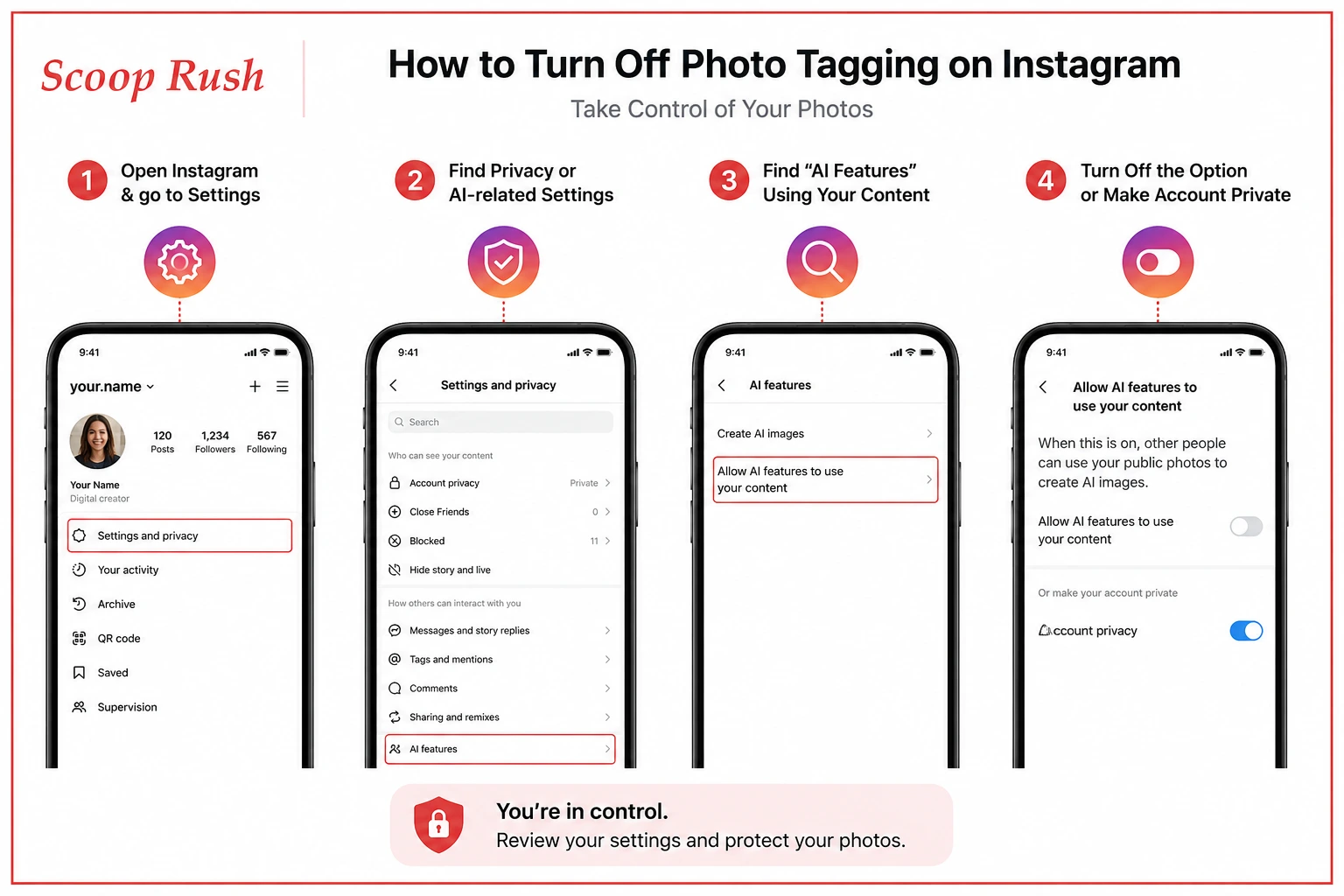
If you would rather not have your public Instagram photos used in other people’s AI creations, Meta says you have the ability to disable this. Here is how to go about it.
- Open the Instagram app and go to your profile settings.
- Look for privacy or AI-related settings, since Meta has placed controls for this feature there.
- Find the option related to AI features using your content, and switch it off.
- Alternatively, setting your account to private will limit who can access your photos for this purpose in the first place.
Meta has stated that users have control over this setting, but the burden currently falls on individual users to find it and turn it off rather than being asked upfront.
What’s Coming Next: Muse Video
Image generation might just be the beginning. Meta has confirmed that a video version, called Muse Video, is already in development. Details are thin for now, but given how Muse Image works, it is reasonable to expect similar prompt-based tools, and possibly similar questions about consent and control once it launches.
This launch also fits into a bigger pattern for Meta. Over the past year, the company has released several AI products, including an assistant called Creator and an app called Pocket that lets people build simple video games using AI prompts. Meta has faced criticism for having a scattered AI strategy, but it continues to pour significant money into AI infrastructure this year.
Final Thoughts
Muse Image is a capable tool, and plenty of its features are genuinely useful, from cleaning up old photos to previewing furniture before you buy it. But the photo-tagging feature has pulled the spotlight toward a bigger question that keeps following Meta around: who really controls your data, and how easy is it to protect it if the default setting works against you.
If you use Instagram, WhatsApp, or the Meta AI app, it is worth taking a few minutes to check your privacy settings now rather than finding out later that your photos were used in ways you did not expect. A small setting change today can save you a much bigger headache down the road.
For more updates like this, check out our full technology news section, where we cover the latest AI launches, privacy stories, and product releases as they happen.
Frequently Asked Questions
Muse Image is Meta’s new AI image generator, built by Meta Superintelligence Labs. It is available for free through the Meta AI app, Instagram Stories, and WhatsApp, and it lets users generate and edit images using text prompts.
Yes, if your Instagram account is public. Muse allows users to tag another person and use that person’s public photos to generate a new AI image, and this feature is turned on by default unless you switch it off.
You can check your Instagram privacy or AI settings and turn off the option that allows AI features to use your content. Setting your account to private also limits who can access your photos for this purpose.
Yes, Meta says everyday use of Muse is free. If you go beyond a certain usage limit, you will need a paid subscription to keep generating images.
No, not yet. Meta has confirmed that Muse Video is currently in development, but the company has not shared a release date or full details on how it will work.
Source: Reporting based on TechCrunch, “Meta rolls out Muse, a new AI image generator” (July 7, 2026).

