

Somewhere online, right now, someone is talking about your brand. Are you actually listening, or just hoping they tag you? Finding out means using the best AI social listening tools, and that gap between hoping and knowing is exactly why they’ve become essential in 2026.
That gap between hoping and knowing is exactly why the best AI social listening tools have become essential in 2026. With millions of posts published every hour across Reddit, X, LinkedIn, TikTok, and countless forums, manual tracking simply cannot keep up anymore.
Businesses that skip this shift risk missing early complaints, missing rising trends, and missing the exact moment a customer needed a reply. This matters more than ever this year because AI has pushed social listening far beyond basic mention-counting. Today’s tools detect sentiment, understand intent, and even predict which trends are worth acting on before they peak. For marketers and founders, picking the right AI social listening tool can mean the difference between reacting to a crisis and preventing one entirely.
What Are AI Social Listening Tools?
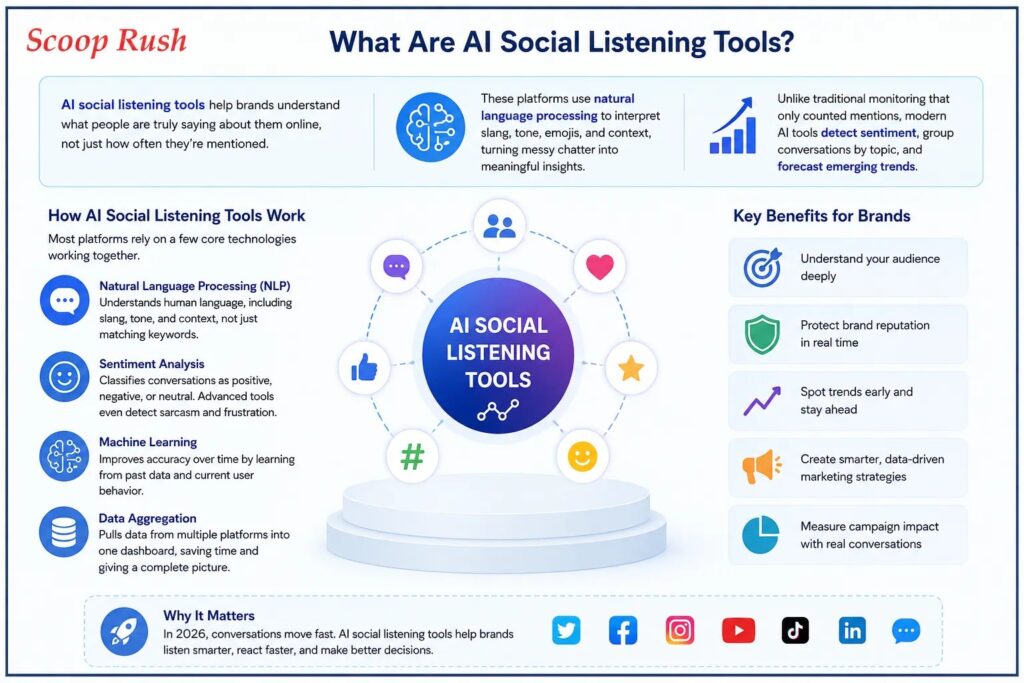
AI social listening tools help brands understand what people are truly saying about them online, not just how often they’re mentioned. These platforms rely on natural language processing to interpret slang, tone, emojis, and context, turning messy online chatter into insights a marketing team can actually use.
Traditional monitoring only counted mentions. However, modern AI-powered tools go much further. They detect sentiment, group conversations by topic, and increasingly forecast which trends deserve attention before they explode.
How AI Social Listening Tools Actually Work
Most platforms in this space rely on a few core technologies working together.
Natural language processing allows software to understand human language, including slang and emotional tone, instead of just matching keywords. Sentiment analysis then classifies conversations as positive, negative, or neutral, and stronger tools can even detect nuances like sarcasm or frustration, much like the reasoning improvements seen in models such as Kimi K3 and Qwen3.
Machine learning improves accuracy over time by learning from past data and current user behavior. Meanwhile, data aggregation pulls everything into one dashboard, so teams don’t waste time jumping between platforms just to see the full picture.
Top AI Social Listening Tools to Consider in 2026
Based on platform coverage, pricing transparency, AI quality, and real user feedback, here are some standout options worth exploring.
Best Picks for B2B, Enterprise, and Small Business Needs
Octolens is built for teams that want social data flowing into their existing stack rather than another dashboard to babysit. It tracks more than 15 platforms, including Reddit, GitHub, and Hacker News, and includes API and webhook access on every plan starting at $159/month. It works especially well for B2B and tech companies, though it skips consumer platforms like Instagram.
Brandwatch sits at the enterprise end of the market. With access to over 100 million sources and advanced image recognition, it suits large brands with dedicated analysts and bigger budgets. Pricing is custom, and onboarding can take weeks.
Brand24 remains popular among small and mid-sized businesses. It covers social media, blogs, and forums starting around $249/month, with an AI Brand Assistant that automatically summarizes mentions. Brand24 became part of Adobe following Semrush’s acquisition in April 2026.
Sprout Social blends publishing, engagement, and listening in a single tool, monitoring more than 30 billion daily messages. Its AI Assist feature summarizes sentiment trends using real customer quotes. However, listening functions as a premium add-on, and coverage leans heavily toward mainstream platforms.
Talkwalker, now part of Hootsuite Insights, stands out for multilingual coverage across 187 languages and its Blue Silk AI sentiment engine. Its Virality Map visualizes how content spreads, which is genuinely useful for global campaigns.
YouScan specializes in visual listening, using AI to recognize brand logos and objects inside images. This makes it valuable for consumer brands in fashion, food, and CPG, where products often show up in photos rather than text posts.
BrandMentions offers real-time tracking with strong sentiment analysis at a more affordable price starting around $99/month, making it a solid pick for smaller businesses focused on reputation monitoring.
Choosing the Right Tool Based on Business Size
Your ideal choice largely depends on scale. Startups usually do well with lightweight, affordable tools that need minimal setup, similar to how one mom built a $10K-a-month Etsy side hustle by starting lean. Growing businesses typically need broader platform coverage and deeper analytics. Large enterprises, meanwhile, generally require dedicated support and the ability to process massive volumes of global data, the kind of scale companies like SpaceX now operate at.
Why AI Social Listening Matters for Modern Brands
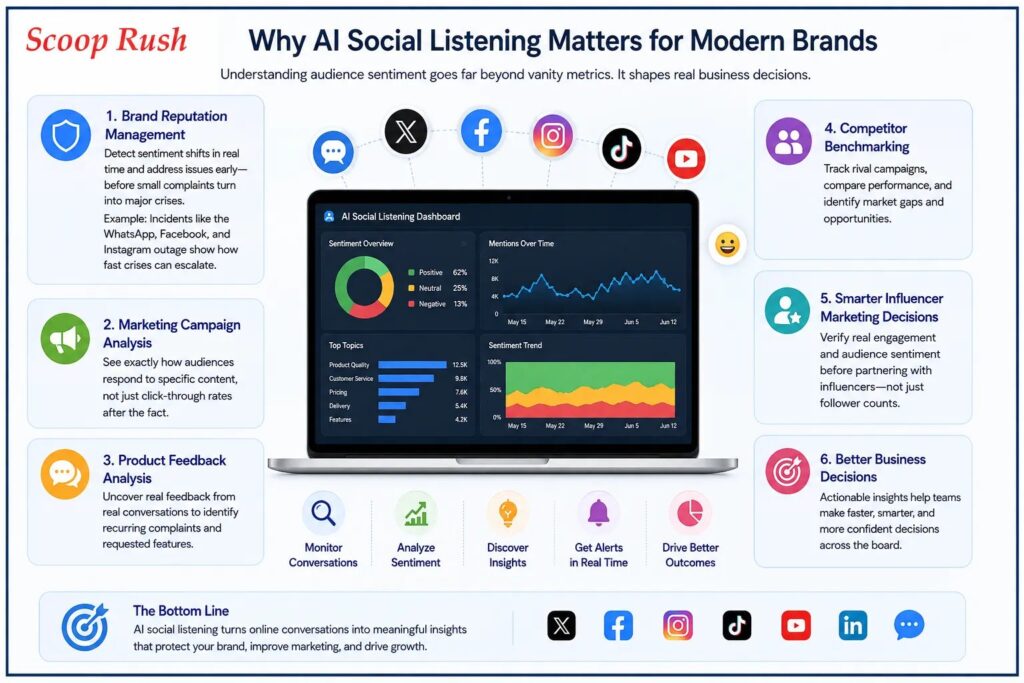
Understanding audience sentiment goes far beyond flattering vanity metrics. It shapes real business decisions.
Brand reputation management benefits enormously from early detection. Tools that flag sentiment shifts in real time let teams step in before a handful of complaints snowballs into a full crisis, the kind of fallout brands like Meta have faced during incidents such as the WhatsApp, Facebook, and Instagram outage.
Marketing campaign analysis becomes more precise when brands can see exactly how audiences respond to specific content, not just click-through rates after the fact.
Product feedback analysis surfaces recurring complaints and requested features directly from real conversations, which is often more honest than formal surveys.
Competitor benchmarking allows businesses to track rival campaigns and identify openings in the market. Similarly, influencer marketing decisions improve when brands can verify an influencer’s actual engagement rather than relying on follower counts alone.
How to Choose the Best AI Social Listening Tool for Your Business
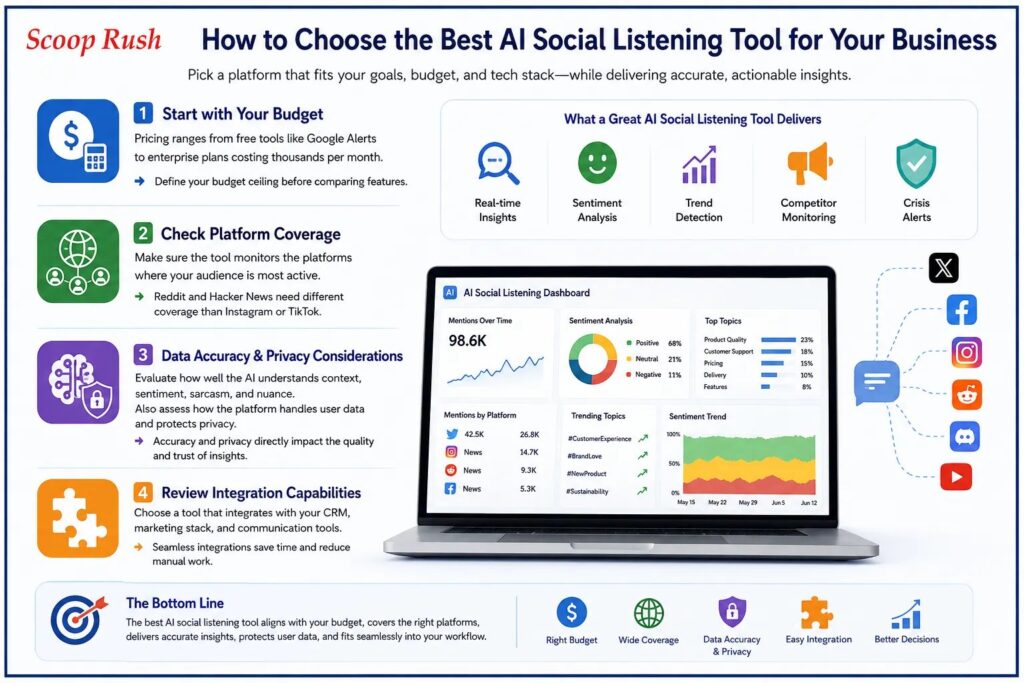
Selecting a social listening platform starts with budget. Pricing across this category varies enormously, from free tools like Google Alerts to enterprise contracts running into thousands of dollars monthly. Therefore, it’s worth defining your budget ceiling before comparing features.
Platform coverage matters just as much. If your audience is active on Reddit and Hacker News, a tool built primarily for Instagram won’t serve you well, regardless of how polished its dashboard looks.
Data Accuracy and Privacy Considerations
Consider how well a tool’s AI actually understands context and sentiment, and how carefully it handles user data, an issue that has become a bigger concern following reports on Claude AI chats being exposed via Google Search and growing scrutiny of period tracker app privacy. Some platforms interpret sarcasm and nuance far better than others, and this accuracy directly affects the quality of insights your team receives.
Finally, check integration capabilities. A tool that connects with your CRM or existing marketing stack will save your team significant manual work down the line.
The Future of AI Social Listening Tools
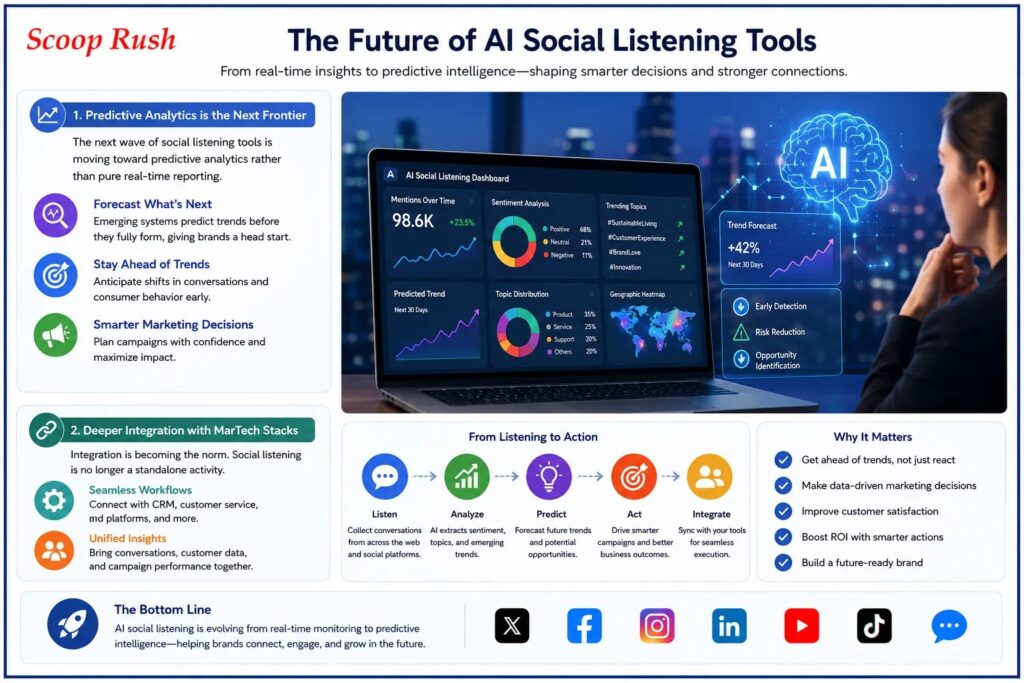
The next wave of social listening tools is moving toward predictive analytics rather than pure real-time reporting. Instead of only telling brands what’s happening now, emerging systems aim to forecast what’s likely to happen next, giving marketing teams a head start on trends before they fully form, much like how Nokia’s AI RAN platform with Nvidia is reshaping infrastructure ahead of demand.
As a result, tighter integration between listening platforms and broader marketing tech stacks is becoming the norm. Consequently, businesses that treat social listening as a standalone activity may fall behind those weaving it directly into campaign planning and customer service workflows, a shift already visible in fields like data analyst careers.
Final Thoughts
Choosing the best AI social listening tools ultimately comes down to knowing where your audience actually talks and what your team plans to do with the insights. There’s no single best option for every business. However, the right fit can transform scattered online chatter into a genuine competitive advantage, helping brands catch problems early, spot opportunities faster, and build stronger connections with the people already talking about them.
FAQs
What is the best AI social listening tool for small businesses?
Budget-friendly options like Brand24 and BrandMentions are popular among small and mid-sized businesses because they cover essential platforms without requiring enterprise-level spending.
How does AI improve social listening compared to manual tracking?
AI processes massive volumes of unstructured data quickly, detecting sentiment, patterns, and trends that would be nearly impossible for a human team to catch manually.
Can social listening tools track competitors as well as my own brand?
Yes. Most platforms, including Brand24, BrandMentions, and Brandwatch, include competitor tracking features that let you benchmark performance and monitor rival campaigns.
Do AI social listening tools work across all social media platforms?
Coverage varies by tool. Some, like Octolens, focus on niche platforms such as Reddit and Hacker News, while others like Sprout Social lean toward mainstream networks like Instagram and Facebook.
Is social listening the same as social media monitoring?
Not exactly. Monitoring typically tracks direct mentions and metrics, while listening goes deeper into sentiment, context, and emerging conversation trends to inform strategy.

