
A private chat with an AI should stay private. Instead, hundreds of Claude AI chats exposed personal medical records, kids’ phone numbers, and company secrets to anyone with a Google search bar.
Introduction
What if a chat you thought was private turned out to be sitting in Google search results, right next to medical records and children’s phone numbers? That is exactly what hundreds of Anthropic Claude users discovered this past weekend, and the details are far stranger and more sensitive than most people expected.
Reports from the BBC and Futurism revealed that hundreds of Claude AI chats exposed conversations, along with interactive Artifacts built inside the chatbot, had become searchable through Google and other search engines. Some of these chats included personal health information. Others contained internal company documents. A few were simply bizarre, including one user asking Claude how to transform into a nine-tailed fox.
This matters because millions of people rely on Claude for work, research, and everyday questions. Many assume a “share” link stays between them and whoever receives it. However, this incident shows that assumption does not always hold true. If you have ever shared a Claude conversation, here is exactly what happened and what it means for you.
How Claude AI Chats Exposed Themselves to Google Search
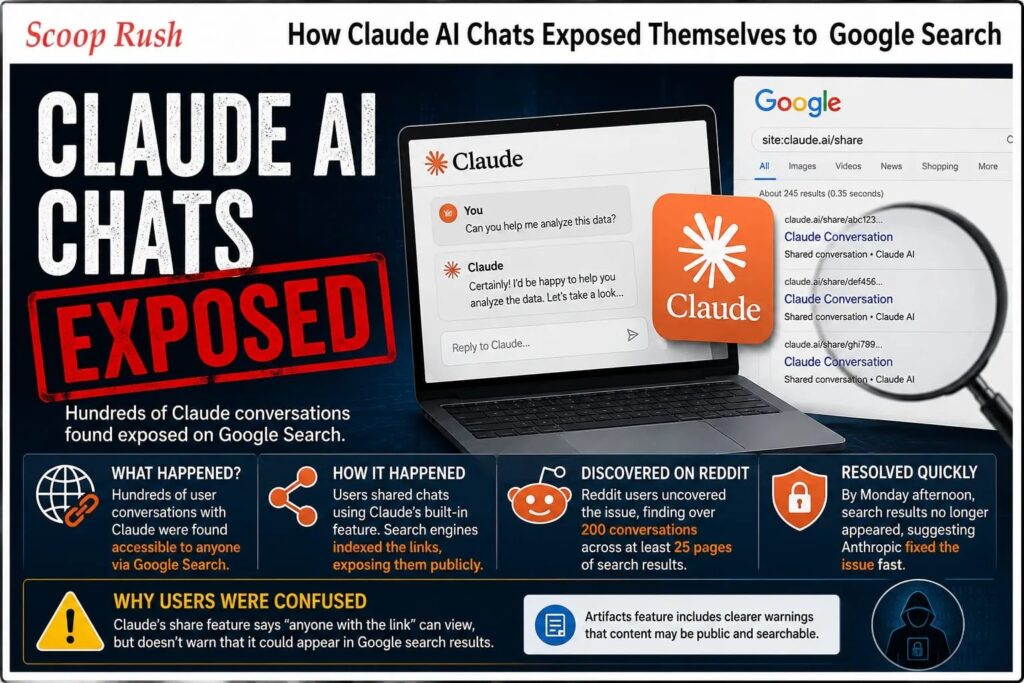
According to BBC technology reporter Kali Hays, hundreds of user conversations with Claude were found accessible to essentially anyone browsing Google or other search engines. Links to these chats appeared whenever someone used a specific site-based search term.
The exposed pages were chats that users had personally chosen to “share” using Claude’s built-in feature. Once shared, search engines like Google saved those links, making them accessible to the broader public rather than just the intended recipient.
Reddit users initially discovered the issue, and their findings covered more than 200 conversations spread across at least 25 pages of search results. Some of these chats had taken place just weeks before being discovered. Meanwhile, Futurism, in a piece bluntly titled “Fool Me Twice,” reported that the exposed chats remained searchable even after the story broke.
By the following Monday afternoon, follow-up searches using the same method no longer returned results. This suggests the team addressed the issue fairly quickly, even though Anthropic has not detailed exactly how.
Why the Claude Share Feature Confused Users
Part of the problem comes down to wording. When a Claude user clicks share, the interface tells them that “anyone with the link” can view the conversation. However, it does not explicitly warn that the link could later show up in Google search results.
This distinction matters. Many users treat “anyone with the link” the same way they treat an unlisted YouTube video or a private Google Doc, assuming it stays hidden unless someone actively shares the URL. Unfortunately, once a share link appears anywhere search engines can crawl, such as a forum post or social media share, it becomes fair game for indexing.
Claude Artifacts, the platform’s tool for building interactive apps and dashboards, actually includes clearer language. It warns users that publishing an Artifact will make it accessible to anyone on the internet and potentially visible in search results. Even so, Futurism noted that much of the exposed content appeared intended only for internal or small-group use, not public consumption.
Claude AI Chats Exposed: The Strangest and Most Sensitive Examples
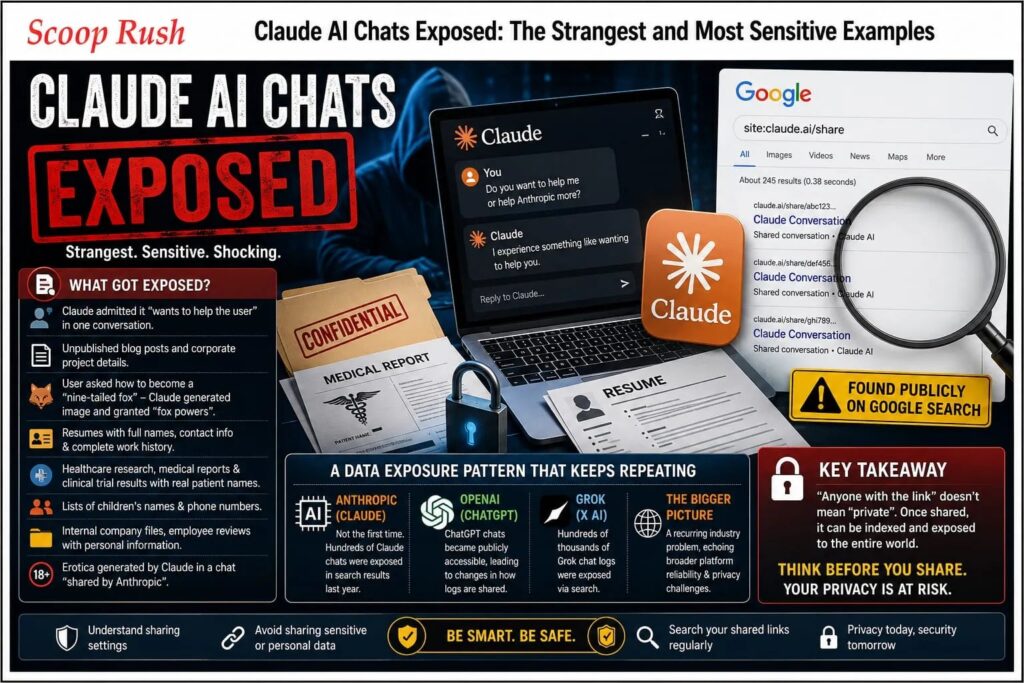
The exposed conversations covered an enormous range of topics, and some of them are hard to believe. According to the BBC, one chat log showed a user asking Claude directly whether it wanted to help the user or help Anthropic more. Claude responded that it experiences something like wanting to help the user.
In another conversation from April, a user asked Claude to draft an unpublished blog post about cloud security, and the exchange included specific details about a corporate project. In a chat from just last month, a user asked Claude how to become a “nine-tailed fox,” later clarifying they meant literally transforming from human to creature. Claude reportedly responded by generating an image and claiming the user had been granted “fully functional fox powers.”
Beyond the unusual requests, plenty of exposed chats involved everyday tasks that suddenly became public privacy risks.
- Resumes containing full names, contact details, and complete work history
- Proprietary healthcare research, including transcripts of what appeared to be private conversations
- Detailed medical reports tied to a real patient, according to Futurism
- Clinical trial results that included actual patient names
- Documents listing the names and phone numbers of primary school-aged children, the kind of exposure regulators have been pushing tech companies to prevent
- Internal company files marked for staff use only, plus employee reviews containing personal worker information
Futurism also noted a case where a chat labeled “shared by Anthropic” appeared to show Claude generating erotica, which directly conflicts with the company’s stated usage policy against sexually explicit content.
A Data Exposure Pattern That Keeps Repeating
This is not the first time Anthropic has dealt with this exact issue. Forbes reported last year that hundreds of Claude chat transcripts had already appeared in search engine results, prompting the company to scrub the chats from the web at the time. Notably, Futurism pointed out that during that earlier investigation, Forbes tracked down a user whose Claude material appeared in search results despite the user denying they had ever shared it.
Other AI companies have faced similar problems. OpenAI dealt with an almost identical situation involving ChatGPT chat logs becoming publicly accessible, which eventually led the company to change how easily those logs could be discovered. Separately, a researcher managed to scrape around 100,000 publicly shared ChatGPT conversations, according to earlier reporting from 404 Media.
Grok, the AI chatbot built into Elon Musk’s X platform, saw hundreds of thousands of chat logs become publicly available through online search last year as well. Together, these repeated incidents across Claude, ChatGPT, and Grok point to a broader industry pattern rather than a one-time mistake. It is a pattern that echoes other recent Meta platform reliability issues, where users were reminded how much of their daily communication depends on a handful of tech platforms working as expected.
How Anthropic and Google Responded to the Claude Privacy Exposure
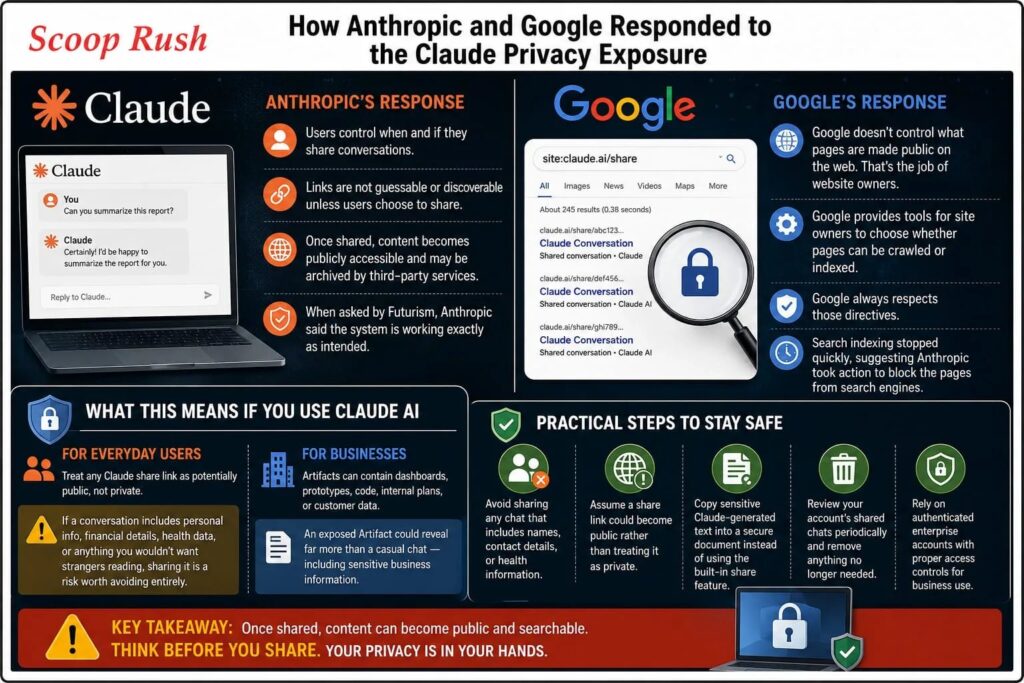
Anthropic’s response to the exposure was direct. A company spokeswoman said Claude users maintain control over if and when they share conversations with the chatbot. She explained that links to conversations are not guessable or discoverable unless people choose to share them themselves.
She added that once someone shares a conversation, they are making that content publicly accessible, and like other public web content, third-party services may archive it. When Futurism reached out separately, Anthropic reportedly said the system was working exactly as intended.
Google offered a comparable explanation. A spokesperson told the BBC that Google does not control what pages are made public on the web, since that responsibility belongs to website owners. The spokesperson noted that Google gives site owners clear tools to decide whether pages can be crawled or indexed, and that Google always respects those directives.
Even so, the fact that search indexing of the chat logs stopped fairly quickly suggests Anthropic did take action behind the scenes. Blocking a page from search engines is a relatively simple technical step, though the website owner, not the search engine, must initiate it.
What This Means If You Use Claude AI
For everyday users, the biggest takeaway is simple. Treat any Claude share link as potentially public, not private. If a conversation includes personal information, financial details, health data, or anything you would not want strangers reading, sharing it is a risk worth avoiding entirely.
For businesses, the stakes are even higher. Anthropic has positioned Claude Artifacts as a collaborative workspace for building dashboards, prototypes, and documents. As a result, an exposed Artifact could reveal far more than a casual conversation ever could, including working code, internal planning documents, or customer data.
A few practical steps can help reduce risk going forward.
- Avoid sharing any chat that includes names, contact details, or health information
- Assume a share link could become public rather than treating it as private
- Copy sensitive Claude-generated text into a secure document instead of using the built-in share feature
- Review your account’s shared chats periodically and remove anything no longer needed
- Rely on authenticated enterprise accounts with proper access controls for business use, instead of public share links
Conclusion
The Claude AI chats exposed on Google search reveal just how easily private-feeling conversations can end up in front of a global audience. From medical records and children’s contact information to bizarre roleplay requests about turning into a nine-tailed fox, the range of exposed content shows how varied and personal these chats really are.
Anthropic maintains that users control what becomes public, and technically, that claim holds up. However, the confusing wording around what “sharing a link” actually means has clearly caught many users off guard, not just once but repeatedly. As AI chatbots continue becoming everyday tools for work and personal tasks, understanding exactly how sharing features work is no longer optional.
Until platforms make these warnings clearer, the safest habit is straightforward. Assume anything you share through an AI chatbot could eventually become searchable, and act accordingly. As AI tools take on a bigger role in daily life, from job security concerns to how much personal data these systems handle, incidents like this one are a reminder that convenience and privacy do not always move together.
FAQs
1. Why were Claude AI chats exposed on Google search?
Users shared conversations using Claude’s built-in share feature. When those links appeared somewhere search engines could crawl, such as forums or social media, Google and other engines indexed and displayed them publicly.
2. Did hackers break into Claude accounts to access these chats?
No. Nothing in the reporting suggests any accounts were hacked. The exposed content came from conversations and Artifacts that users had already chosen to share publicly through Claude’s own tools.
3. What types of sensitive information were found in exposed Claude chats?
Reporters found medical records, clinical trial data with patient names, internal company documents, employee reviews, resumes with personal contact details, and files listing children’s names and phone numbers.
4. Has this happened to Claude before?
Yes. Forbes reported a similar exposure involving hundreds of Claude chats last year. OpenAI’s ChatGPT and X’s Grok chatbot have also experienced comparable incidents involving publicly searchable chat logs.
5. How can I stop my Claude chats from becoming public?
Avoid using the share feature for conversations containing sensitive information. Instead, copy the text into a secure document. You can also review and remove existing shared chats through your account’s privacy settings.

