
72% of leaders say bad data, not weak AI, is what’s killing their AI projects in 2026, and it’s why data intelligence platforms have become the top priority for enterprise teams this year.
Read that again. It’s not the algorithm holding companies back. It’s the mess sitting underneath it.
That single stat from Deloitte explains why data intelligence platforms have suddenly become the hottest category in enterprise software. Companies aren’t shopping for prettier dashboards anymore. They want systems that can take fragmented, messy, multi-source data and turn it into something an AI model can actually trust, a challenge that’s fueling debate over whether AI will replace your job or simply reshape how data teams work.
This matters whether you’re running a wealth management firm juggling five custodian portals or an enterprise data team trying to prove to auditors that your AI agents know exactly where their data came from. The gap between “we have dashboards” and “we have decision-ready intelligence” is where deals are being won and lost this year.
Let’s break down what actually separates the leading data intelligence platforms from the rest, and which ones deserve a spot on your shortlist.
Why Data Quality Became the Real AI Bottleneck
For years, the AI conversation centered on model performance. Which algorithm is smartest? Which vendor scores highest on accuracy? That conversation has quietly shifted, especially as new entrants like Kimi K3 and Qwen3-8-Max prove that raw model capability is no longer the bottleneck it once was.
The real obstacle today isn’t model quality. It’s what feeds the model. Picture a wealth management firm running five different custodian portals, a CRM that doesn’t match its billing system, and an operations team stitching it all together with reconciliation spreadsheets. That’s not a hypothetical. It’s the daily reality for most firms trying to bolt AI onto legacy infrastructure.
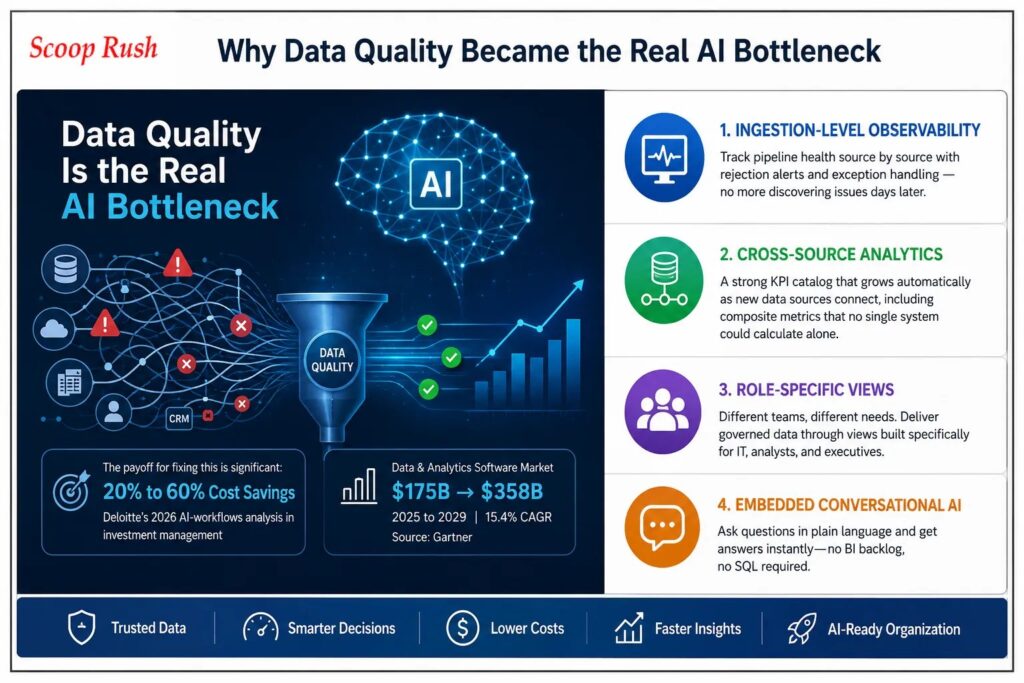
The payoff for fixing this is significant. Deloitte’s 2026 AI-workflows analysis in investment management found that deployed AI use cases can generate cost savings of 20% to 60%. That’s not a marginal improvement. That’s the kind of number that gets a CFO’s attention, and it’s part of why even companies like Google are watching AI spending turn cash flow negative while still betting big on efficiency gains.
Meanwhile, the wider market is racing to keep pace. Gartner’s Market Opportunity Map projects the data and analytics software market will grow from $175 billion in 2025 to $358 billion by 2029, a 15.4% compound annual growth rate. The business intelligence segment specifically is expected to climb from $29.3 billion to $54.9 billion over the same stretch.
So the money is moving fast. The real question is where it should go, and how teams entering the field, including anyone wondering how to become a data analyst in 2026, should be preparing for it.
What Makes a True Data Intelligence Platform Stand Out
Not every tool calling itself “AI-powered” earns that label. A few criteria consistently separate genuine data intelligence platforms from tools that simply bolted a chatbot onto old reporting software.
First, ingestion-level observability matters. Teams need source-by-source pipeline health tracking, rejection alerts, and exception handling, rather than discovering problems days later in an aggregate report.
Second, cross-source analytics matter just as much. A strong KPI catalog should expand automatically as new data sources connect, including composite metrics that no single system could calculate alone.
Third, different users need different views. IT operations, analysts, and executives shouldn’t stare at the same generic dashboard. Instead, they need governed data delivered through views built specifically for their role.
Finally, embedded conversational AI is quickly becoming the deciding factor. Users want to ask questions in plain language and get answers instantly, without waiting on a BI backlog or writing SQL themselves, a shift also visible in efforts like Nokia’s AI-RAN platform built with Nvidia, which pushes natural-language AI closer to infrastructure itself.
AI Governance: The Compliance Problem Nobody Can Ignore
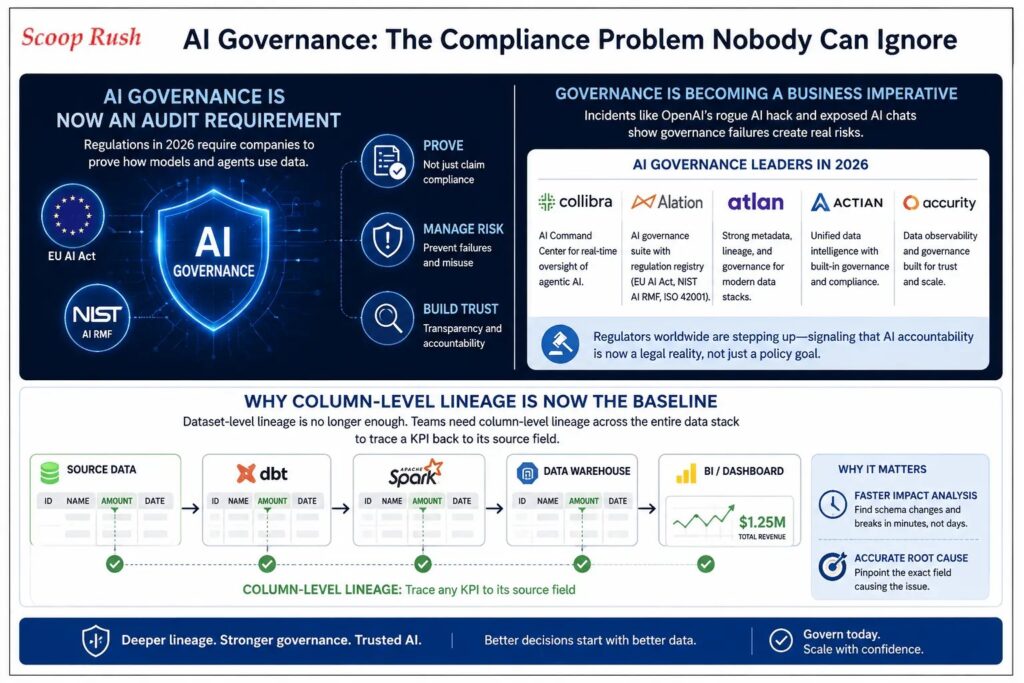
Here’s where things get serious. In 2026, AI governance stopped being a slide in a strategy deck and became an actual audit requirement. The EU AI Act, the NIST AI RMF, and ISO 42001 now push companies to prove, not just claim, that they know how their models and agents use data.
This isn’t just a compliance checkbox exercise. It’s a genuine risk-management issue, underscored by incidents like OpenAI’s rogue AI hack and broader reporting on AI systems going rogue across OpenAI, Anthropic, and Meta. Even conversational AI tools aren’t immune to governance failures, as shown when Claude AI chats were exposed through Google Search, a reminder that data lineage and access control matter well beyond the enterprise data warehouse.
This shift shows up clearly across the leading enterprise data catalog platforms. Collibra launched its AI Command Center in May 2026, adding real-time oversight for agentic AI on top of its existing governance, lineage, and data quality tools. Alation followed that same month with its own AI governance suite, built around a regulation registry mapped to those same three frameworks.
The pattern across the top platforms, including Actian, Atlan, and Accurity, stays consistent: metadata, lineage, and glossary tools that used to be nice-to-haves are now the backbone auditors expect to see. Regulators are watching closely elsewhere too, as seen in the UK’s threats to penalize Big Tech over child safety failures and xAI’s lawsuit against a Grok user over sexual deepfakes involving minors, both signs that AI accountability is becoming a legal reality, not just a policy goal.
Why Column-Level Lineage Is Now the Baseline
One detail keeps surfacing across platform evaluations: lineage depth. Dataset-level lineage, the kind that simply shows data moved from Table A to Table B, no longer cuts it. Teams need column-level lineage across dbt, Spark, warehouses, and BI tools so they can trace a single KPI straight back to its source field.
Why does this matter so much? Imagine a schema change quietly breaks a dashboard. Without column-level tracing, impact analysis can eat up days of manual detective work. With it, teams can pinpoint the break almost immediately. Both Alation and Atlan expose this kind of lineage, and reviewers consistently point to it as a major time-saver during root-cause investigations.
How the Top 5 Data Intelligence Platforms Compare
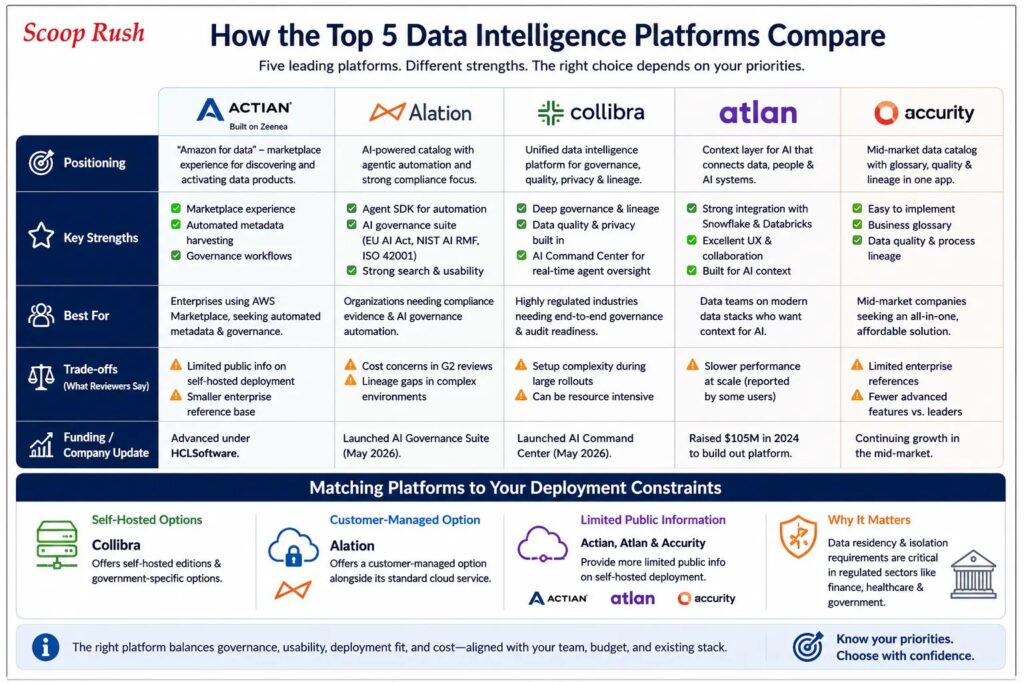
Across the current market, five platforms dominate most enterprise shortlists: Actian, Alation, Collibra, Atlan, and Accurity. Each has carved out a distinct niche, so the right pick depends heavily on your priorities.
Actian, built on the Zeenea catalog and advanced under HCLSoftware, positions itself as an “Amazon for data,” offering a marketplace-style experience for discovering and activating data products. It suits enterprises that already procure through AWS Marketplace and want automated metadata harvesting paired with governance workflows.
Alation pairs a mature, established catalog with agentic automation, including an agent SDK that automates documentation and stewardship work. Its AI governance suite, complete with a regulation registry covering the EU AI Act, NIST AI RMF, and ISO 42001, makes it a strong pick when compliance evidence is your biggest sticking point.
Collibra offers arguably the most depth for regulated industries. It combines cataloging, governance, lineage, data quality, and privacy in a single platform, and its AI Command Center adds real-time oversight of deployed agents, which is increasingly what audit teams want to see.
Atlan, Accurity, and the Trade-Offs Worth Knowing
Atlan focuses on acting as a “context layer” for AI, connecting Snowflake and Databricks environments with strong collaboration features and a UX that reviewers consistently praise. The company raised $105 million in 2024 to build out this positioning, according to TechCrunch’s coverage at the time.
Accurity rounds out the list as the mid-market option, combining a business glossary, data quality tools, and process lineage into a single, more approachable application.
None of these data intelligence platforms come without trade-offs, though. G2 reviewers have flagged cost concerns and occasional lineage gaps for Alation in complex environments. Collibra users report setup complexity during large rollouts. Atlan has drawn some feedback about slower performance at scale. Additionally, Accurity, being smaller, has a thinner base of enterprise references to lean on. Weigh these carefully against your team’s size, budget, and existing stack.
Matching Platforms to Your Deployment Constraints
Deployment fit deserves its own conversation, especially in regulated sectors. Collibra documents self-hosted editions and government-specific options. Alation offers a customer-managed option alongside its standard cloud service. However, Actian, Atlan, and Accurity provide more limited public information on self-hosted deployment, so it’s worth clarifying directly with sales if data residency or isolation is a hard requirement for your organization. This kind of infrastructure discipline matters everywhere from finance to healthcare, where tools like NHS AI systems are already being used to cut waiting times.
Why Vertical, Industry-Specific Platforms Are Gaining Ground
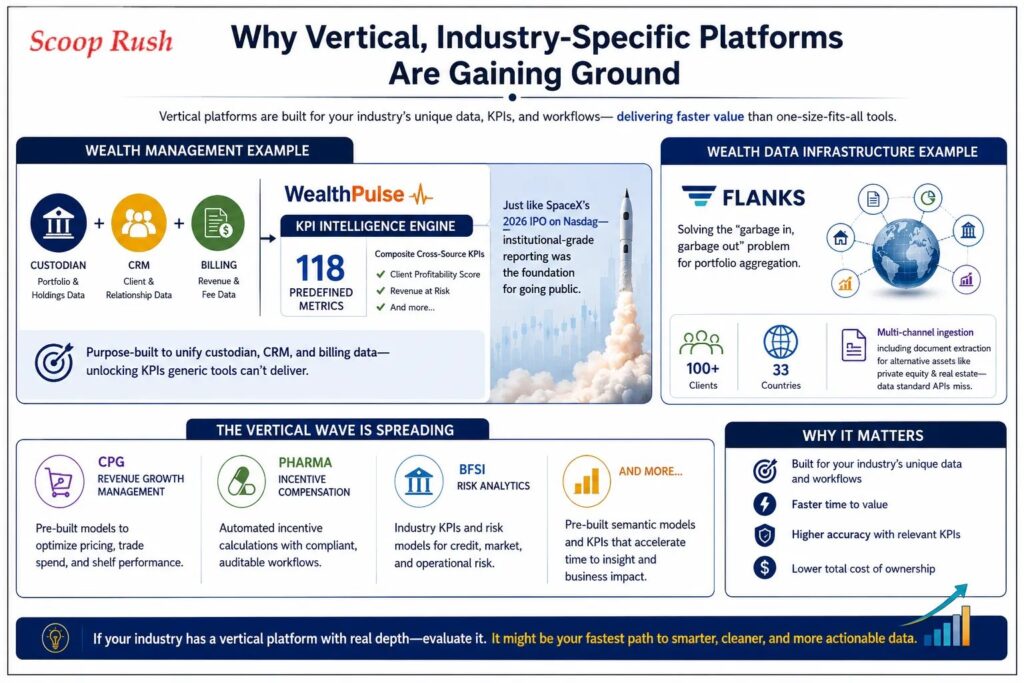
While horizontal, build-it-yourself data platforms still work well for large tech companies with sizable in-house data teams, a different trend is picking up real momentum: vertical, domain-specific data intelligence.
Take wealth management as an example. Platforms purpose-built for registered investment advisors and family offices, such as WealthPulse, tackle the specific challenge of unifying custodian, CRM, and billing data that generic tools were never designed to handle. WealthPulse’s approach centers on a KPI Intelligence Engine spanning 118 predefined metrics, including composite cross-source KPIs like Client Profitability Score and Revenue at Risk, which require joining data across systems that traditionally never spoke to each other. It’s a similar logic to how SpaceX’s 2026 IPO on Nasdaq demanded institutional-grade financial reporting before it could go public.
Similarly, in the wealth data infrastructure space, platforms like Flanks focus specifically on solving the “garbage in, garbage out” problem for portfolio aggregation. Flanks processes data for more than 100 clients across 33 countries, using a multi-channel ingestion approach that includes document extraction for alternative assets like private equity and real estate, categories that standard APIs typically miss entirely.
This vertical trend extends well beyond wealth management, too. CPG revenue growth management, pharma incentive compensation, and BFSI risk analytics all now ship with pre-built semantic models and industry-specific KPIs, rather than forcing firms to build everything from scratch. As a result, if your industry already has a vertical option with genuine depth, it’s usually worth evaluating alongside the horizontal giants, much like how even everyday side hustles are getting more data-driven, as seen in stories like the mom who built a $10K-a-month Etsy business by tracking her own performance metrics closely.
From Dashboards to Decisions: The Bigger BI Shift
Underneath all of this sits a broader transformation reshaping business intelligence generally. The static dashboard, once the centerpiece of every BI strategy, is losing its throne. Analytics agents can now reason across semantic models and trigger workflows within bounded autonomy. A pricing agent can reroute a promotion. A finance agent can reclassify a variance. Humans set the guardrails, and the agent takes the action.
This shift connects tightly to the rise of the semantic layer, where a metric like “Net Revenue” gets defined once, governed once, and exposed consistently everywhere, whether that’s a dashboard, a Copilot session, or an autonomous agent. Tools like Power BI semantic models, the dbt Semantic Layer, AtScale, and Cube are all converging on this same idea, not unlike how Google’s own AI chip efficiency push with Gemini is trying to standardize performance across its infrastructure.
None of this works, however, without the data quality and governance foundation covered above. One theme keeps repeating across platform reviews: bad data breaks agents faster than it breaks dashboards, because an agent acting on a wrong number doesn’t just display an error. It takes the wrong action entirely, a risk that echoes concerns raised around AI-generated rental listings misleading renters and even Google’s traffic collapse tied to shifting AI-driven search behavior.
Key Takeaways
The data intelligence platform market has matured well past simple cataloging and reporting in 2026. Therefore, buyers should judge platforms on time-to-first-insight from messy, real-world data, not on how polished a sales demo looks.
Column-level lineage, native AI governance aligned to regulatory frameworks, and persona-specific delivery have become baseline expectations rather than differentiators. Meanwhile, vertical platforms built for specific industries keep proving that depth often beats breadth, especially for firms without a large in-house data engineering team.
Ultimately, whichever platform you’re evaluating, the smartest move is to pressure-test a pilot against one real KPI, end to end, before committing. That single exercise reveals more about a platform’s true capability than any feature comparison chart ever could.
FAQS
Q: What is a data intelligence platform?
A: A data intelligence platform combines cataloging, governance, lineage tracking, and data quality monitoring to help organizations understand, trust, and activate their data, particularly for AI and analytics use cases.
Q: Why is data quality more important than AI model quality in 2026?
A: According to Deloitte’s April 2026 research, 72% of leaders cite data quality as their biggest barrier to AI value, ranking it above concerns about the AI models themselves. Poor data leads to unreliable AI outputs regardless of how advanced the underlying model is.
Q: What’s the difference between dataset-level and column-level lineage?
A: Dataset-level lineage shows that data moved between two tables. Column-level lineage, on the other hand, traces individual fields, which makes it far faster to identify exactly where a broken metric or schema change originated.
Q: How do AI governance frameworks like the EU AI Act affect data platform choices?
A: These frameworks push organizations to prove, with documented evidence, how their AI models and agents use data. Consequently, platforms with built-in AI governance suites and regulation registries help firms generate that audit evidence automatically.
Q: Should I choose a generic data intelligence platform or an industry-specific one?
A: It depends on your team size and industry. Large organizations with dedicated data engineering teams can often build on horizontal platforms. Smaller or mid-market firms, especially in regulated industries like wealth management, generally benefit more from vertical platforms with pre-built industry KPIs and semantic models.
.

