

Introduction
What if the biggest AI news of the week had nothing to do with a flashy new chatbot feature? Instead, it came from a Google AI chip most people will never see. That is exactly what happened when reports revealed this new hardware, and investors reacted within hours.
Google is developing a new AI chip designed to make its Gemini models faster and dramatically cheaper to run.Internally called “Frozen v2,” this processor could reshape how Google handles the massive computing demands of generative AI. According to a report from The Information, the Google AI chip could be six to ten times more efficient than Google’s current AI hardware.hat single detail was enough to send Alphabet’s stock climbing 3% within hours of the news breaking.
For everyday readers, chip design might sound like a niche engineering story. However, this development actually says a lot about where the AI industry is headed. It also explains why tech giants are racing to build their own silicon, and what it could mean for the cost and speed of AI tools millions of people use every day, from Gemini to Kimi K3.
What Is Google’s New Frozen v2 AI Chip?
Frozen v2 is a new server chip Alphabet is reportedly building specifically to support its Gemini AI models. Unlike a typical processor upgrade, this chip appears to weave elements of the Gemini model directly into the hardware itself. That approach is meant to help the system generate responses more efficiently, using less power for the same amount of AI output.
The Information’s report is based on anonymous sources familiar with the project. It indicates the chip is not expected to launch until sometime in 2028. Engineers are still working out key details, including exactly how much of the model’s information gets built directly into the chip’s design.
Google hasn’t confirmed the project by name. However, the company also hasn’t denied it.In a statement to TechCrunch, Google said its teams are constantly researching new innovations. The goal is maximum performance and efficiency for users and customers. The company added that not every experimental project reaches production. Still, this kind of exploration is central to its full stack approach, where hardware and software get designed together from the ground up.
How Much More Efficient Could the Google AI Chip Be?
The headline number here is striking. According to the report, Frozen v2 could be between six and ten times more efficient than Google’s existing AI chips. That efficiency gets measured in tokens generated per unit of power. This is essentially a measure of how much AI output a chip can produce for the electricity it consumes.
This matters more than it might initially seem. AI models like Gemini require enormous computing power to process requests and generate text, images, or code. Consequently, the electricity bill behind running these systems at scale is staggering. A chip that produces the same output using a fraction of the energy could translate into real savings for Google, and potentially for the customers who rely on its cloud infrastructure.
Frozen v2 Won’t Replace Google’s TPUs
Frozen v2 isn’t meant to replace Google’s existing Tensor Processing Units, or TPUs. These chips have powered much of the company’s AI work for years. Instead, the Frozen project aims to create a separate line of homegrown chips. These will work alongside the TPUs rather than swapping them out. This suggests Google is building a broader hardware ecosystem rather than starting from scratch, much like Nokia’s AI-RAN platform built with Nvidia expands existing network hardware instead of replacing it.
Why Tech Giants Are Racing to Build Their Own AI Chips
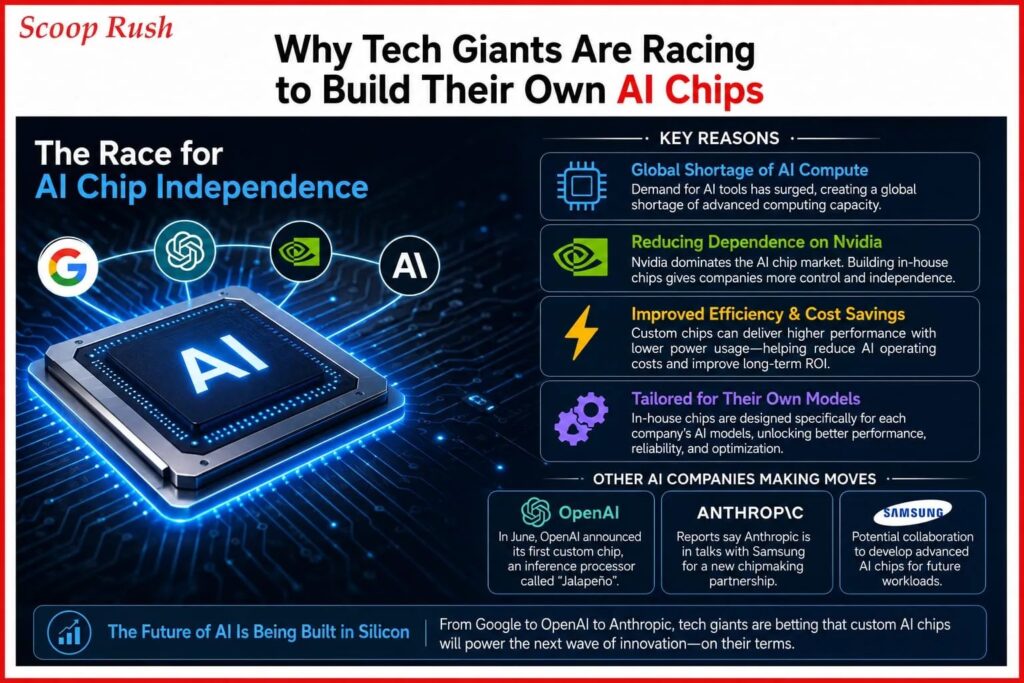
Google isn’t alone in this pursuit. Across the AI industry, major players are investing heavily in custom silicon, and the reasons behind this trend are becoming clearer by the month.
For one, there’s a global shortage of AI computing capacity. As demand for AI tools has exploded, companies have struggled to get enough specialized hardware to keep up. Building in-house chips gives companies more control over their own supply, rather than depending entirely on outside vendors.
That leads to the second factor: reducing dependence on Nvidia. Nvidia has dominated the AI chip market for years. This has left major AI companies reliant on its hardware. Developing proprietary chips helps companies like Google loosen that grip.
Efficiency has also become a critical selling point in its own right. Concerns about ballooning AI spending have cooled the industry’s earlier enthusiasm. Therefore, tech companies need to prove their investments are paying off. A more efficient chip shows AI operations can grow leaner over time. This same logic reassured investors during SpaceX’s IPO, where scale and long-term payoff mattered more than short-term cost.
Other AI Companies Making Similar Moves
Google isn’t the only major AI player chasing custom hardware. In June, OpenAI announced its first custom chip, an inference processor called Jalapeño. Meanwhile, earlier this month, reports surfaced that Anthropic was in discussions with Samsung about a new chipmaking partnership.
This pattern suggests a broader shift is underway. The biggest names in AI no longer want to simply buy chips off the shelf. Instead, they’re aiming to design hardware tailored specifically to their own models, betting that this level of customization will give them an edge in performance, cost, and reliability.
Why This Google AI Chip News Is Landing Right Now
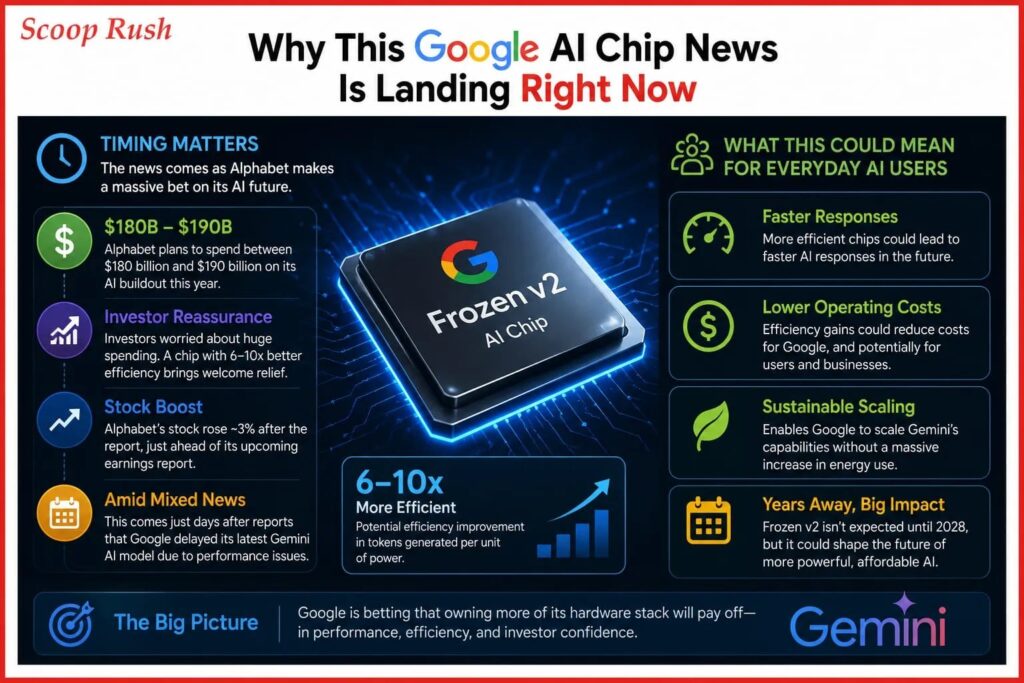
Timing matters here.Alphabet has committed to massive spending on its AI buildout. The company plans to spend between $180 billion and $190 billion this year alone. Investors have previously worried that Alphabet might be overcommitting without a clear path to returns.
Against that backdrop, news of a chip that could deliver six to ten times better efficiency landed as welcome reassurance. Following the report’s publication, Alphabet’s stock rose roughly 3% on Monday morning, giving the company a boost right before its upcoming earnings report later this week.
Interestingly, this news arrives just days after Bloomberg reported a delay to Google’s latest Gemini model. It fell short of internal goals, particularly around coding. The Frozen v2 report may have shifted investor attention toward a more optimistic story, even as the company works to address those earlier setbacks.
What This Could Mean for Everyday AI Users
So how does a server chip built for 2028 affect someone using Gemini today? The short answer is not immediately, but potentially in meaningful ways down the road.
If Frozen v2 delivers on its promised gains, it could mean faster response times. It could also mean lower operating costs for Google. That could lead to more affordable AI services for everyone. Additionally, efficient hardware could let Google scale Gemini without a matching jump in energy use. This matters financially and environmentally, much like the cost concerns around AI tools used in the NHS.
Of course, all of this remains years away, and the specific technical details are still being finalized. Nevertheless, the direction is clear. Google is betting that owning more of its hardware stack will pay off in the long run, both in performance and in investor confidence.
Conclusion
Google’s reported work on the Frozen v2 chip shows how central efficient hardware has become to AI’s future. With plans to launch as early as 2028, this Google AI chip could make Gemini models six to ten times more efficient. Google hasn’t officially confirmed every detail. Still, its response suggests this hardware sits at the core of its long-term strategy.
This move also reflects a broader industry pattern. OpenAI, Anthropic, and now Google are pushing deeper into custom chip development. As a result, the AI landscape is shifting away from Nvidia and toward self-sufficiency. Ultimately, this race for in-house silicon could shape the speed, cost, and reach of AI tools people use daily.
FAQs
What is Google’s Frozen v2 chip?
Frozen v2 is a new server chip Google is reportedly developing to run its Gemini AI models more efficiently. It is designed to incorporate elements of the Gemini model directly into the hardware.
When will the Frozen v2 chip be released?
According to reports citing sources familiar with the project, Google plans to deploy the chip as soon as 2028, though the design details are still being finalized.
How much more efficient is the Google AI chip compared to current chips?
The chip could be six to ten times more efficient than Google’s existing AI chips, based on the number of AI tokens generated per unit of power.
Will Frozen v2 replace Google’s TPUs?
No. Frozen v2 is intended to be a separate line of chips that works alongside Google’s Tensor Processing Units, not a replacement for them.
Why are companies like Google, OpenAI, and Anthropic building their own AI chips?
These companies are developing custom silicon to address AI computing shortages, reduce dependence on Nvidia, and improve efficiency as investors scrutinize rising AI spending.

