

England were only minutes away from reaching their first men’s World Cup final since 1966. Instead, a late collapse against Argentina turned hope into heartbreak and reignited a familiar debate: do England lack all-round quality when facing the world’s best teams?
That question has become one of the biggest talking points following England’s 2-1 semi-final defeat to Argentina at the FIFA World Cup 2026. Despite showing determination, resilience, and character throughout the tournament, England once again fell short at the decisive moment.
The result matters because it extends a long run of near misses in major tournaments. England have now added another painful chapter to a list that already includes the 2018 World Cup semi-final defeat and consecutive European Championship final losses.
While effort and spirit remain strengths of this team, the latest defeat has raised serious questions about whether those qualities alone are enough to win the biggest prizes in international football.
England Lack All-Round Quality: The Debate After Argentina Defeat
The discussion gained momentum after head coach Thomas Tuchel openly praised England’s mentality while questioning aspects of their overall quality.
Tuchel had already expressed concerns following the quarter-final victory against Norway. Although England won that match 2-1, he was not fully satisfied with the performance.
After the defeat to Argentina, those concerns appeared even more significant.
England reached the semi-finals, which many would consider a respectable achievement. However, the manner of the defeat highlighted problems that had appeared throughout the tournament.
The team often relied on individual brilliance rather than sustained control of matches. As a result, England struggled to impose themselves against stronger opponents.
That issue became especially clear during the semi-final.
England’s Tournament Was Driven by Two World-Class Stars
Much of England’s success at the World Cup came from two exceptional players: captain Harry Kane and Jude Bellingham. The pair carried a huge attacking burden.
Between them, Kane and Bellingham scored 12 of England’s 14 goals during the tournament. Kane scored six goals, while Bellingham matched that total with six of his own.
Only Marcus Rashford and Anthony Gordon contributed the other goals. Those numbers reveal how heavily England depended on their two biggest stars.
When England needed a rescue act against DR Congo in the Round of 32, Kane delivered with a late double. Later, when Norway threatened to eliminate England in the quarter-finals, Bellingham scored twice to keep their World Cup dream alive.
Therefore, England’s progress often came through decisive moments from elite individuals rather than complete team performances.
Injuries and Illness Created Additional Challenges
England also faced setbacks away from the spotlight. Arsenal teammates Declan Rice and Bukayo Saka dealt with illness and injury concerns during the tournament.
Both players were expected to play major roles in Tuchel’s plans.
Their reduced effectiveness affected England’s balance and consistency. Consequently, the team struggled to perform at its highest level during key stages of the competition.
Even so, injuries alone cannot explain the defeat to Argentina. The broader concerns about England’s style and quality remain.
Why England Struggled to Control Big Matches
One of the strongest criticisms of England’s campaign involved their inability to dominate possession against elite opponents.
According to Tuchel, controlling the ball plays a crucial role in modern international football. However, England often found themselves reacting rather than dictating.
The manager suggested England do not naturally possess the same possession-based identity associated with countries such as Argentina, Spain, or Brazil.
That difference became increasingly noticeable as the tournament progressed.
A Lack of Control in Crucial Moments
England frequently survived difficult periods rather than controlling games from start to finish.
For example, they were close to elimination against DR Congo before Kane’s intervention changed the outcome.
Similarly, they needed Bellingham’s brilliance to overcome Norway. These moments demonstrated England’s resilience. However, they also highlighted a recurring weakness.
The team struggled to manage matches through sustained possession and control. Against the strongest opponents, that limitation can become decisive.
The Semi-Final Against Argentina Exposed England’s Biggest Weakness
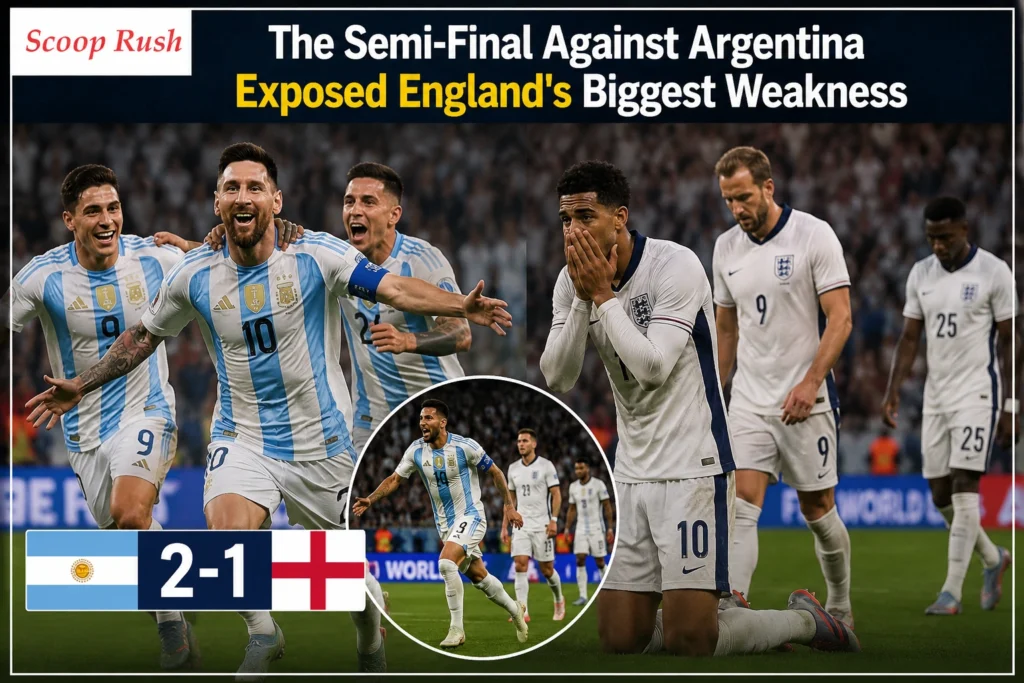
The defeat to Argentina may ultimately define England’s World Cup campaign. England took the lead through Anthony Gordon after 55 minutes and appeared to be in a strong position.
Yet the game gradually shifted. Argentina gained momentum while England retreated deeper and deeper.
One statistic from the match has attracted particular attention. England reportedly had only 12% possession between Gordon’s goal and Argentina’s winning goal in stoppage time.
That figure illustrates how difficult England found it to retain control once they moved ahead.
Rather than managing possession and reducing pressure, England spent long periods defending. Eventually, Argentina punished them.
The Influence of Lionel Messi and Argentina’s Winning Mentality
Argentina’s success was not based solely on tactics. The team also possessed experience, belief, and elite quality.
Furthermore, they continued to benefit from the influence of Lionel Messi. The article points to Argentina’s determination and refusal to accept defeat as major strengths.
When combined with world-class talent, those qualities helped them overturn England’s lead and secure a place in the final. England showed courage. Argentina showed quality and control when it mattered most.
How England Compare With the World’s Best Teams
Another important theme emerging from the tournament is the comparison between England and the other leading football nations.
England possess talented players throughout the squad. However, the argument is that they lack the same level of elite quality across every position.
The article specifically compares England with Spain and France. European champions Spain are known for their technical excellence and ability to dominate possession.
Meanwhile, France possesses an outstanding collection of attacking talent.
England has excellent individuals. Yet they may not have the same concentration of world-class players throughout the entire team.
That difference becomes increasingly important in World Cup semi-finals and finals. Margins are small at that level. Often, one moment of brilliance decides everything.
Tuchel’s Tactical Approach Under Scrutiny
When Tuchel became England manager, many believed he would provide the final piece needed to win a major tournament.
He arrived with a reputation as an elite coach capable of making difficult tactical decisions under pressure. The expectation was that he would take England beyond the achievements of his predecessor, Gareth Southgate.
Instead, questions are now being asked about Tuchel’s own approach.
Did England Become Too Defensive?
Critics argue England became too cautious after taking the lead against Argentina. Rather than continuing to attack, they gradually retreated.
As a result, Argentina controlled more of the game during the closing stages. This criticism is particularly notable because Tuchel was expected to introduce a more adventurous style.
Many supporters believed he would move England away from conservative football. However, the semi-final saw England adopt a defensive posture that invited pressure. Ultimately, Argentina took advantage.
Squad Selection Questions Have Re-Emerged
Another talking point concerns the players who were not part of Tuchel’s plans. The manager chose a pragmatic squad rather than selecting every available creative talent.
Several notable names remained outside the picture.
Players Who Could Have Offered Something Different
Trent Alexander-Arnold was no longer in contention before the squad announcement. Meanwhile, Cole Palmer and Phil Foden were left out after difficult club seasons.
Additionally, Morgan Gibbs-White was overlooked despite strong performances for Nottingham Forest.
The article also highlights Adam Wharton as a player capable of helping England retain possession and control matches. Wharton had only four international caps but impressed with his maturity and passing ability.
Whether those players would have changed England’s fate is impossible to know. Nevertheless, their absence has become part of the debate surrounding the team’s shortcomings.
The Midfield Conundrum England Must Solve
England’s midfield remains one of the most complex issues facing Tuchel. Rice and Elliot Anderson provide energy, defensive security, and work rate.
Bellingham offers creativity, leadership, and goal-scoring ability. On paper, it appears to be a strong combination. Yet England still struggles to dictate matches consistently against top-level opponents. This creates a difficult challenge for the coaching staff.
The current structure provides balance and physicality. However, it may not provide enough control against the very best teams. Finding that missing element could become a priority before England’s next major tournament.
What England Did Well at the World Cup
Despite the disappointment, England’s campaign should not be viewed entirely negatively. Reaching the semi-finals remains a significant achievement.
The team demonstrated resilience on multiple occasions. They fought back from difficult situations.
They won high-pressure knockout matches. They also produced one of their most memorable World Cup victories by defeating Mexico in Mexico City.
Furthermore, Kane and Bellingham confirmed their status among the world’s leading players. England’s mentality, determination, and competitive spirit were evident throughout the tournament.
Those qualities remain valuable foundations for future success. The problem is that mentality alone rarely wins World Cups.
What Comes Next for England?
The Football Association now faces important questions. England have experimented with different managers, different tactical approaches, and different player combinations.
Southgate guided the team to major finals and a World Cup semi-final. Tuchel was expected to push them over the line. Instead, England suffered another painful elimination.
The challenge now is finding a way to combine mentality, talent, and tactical control. England already possesses the spirit. They already possess world-class individuals.
However, the latest World Cup suggests they still need more balance, creativity, and control if they are to defeat the strongest nations consistently.
Conclusion
The debate over whether England lacks all-round quality is unlikely to disappear anytime soon.
England’s run to the World Cup semi-finals demonstrated courage, resilience, and determination. However, the defeat to Argentina exposed concerns that appeared throughout the tournament.
Too often, England relied on Kane and Bellingham to rescue difficult situations. Too often, they struggled to control possession against quality opponents.
Tuchel’s side showed heart, but major tournaments are usually decided by more than heart alone.
As a result, England must find a way to add greater control, creativity, and depth to their game. Until they do, the painful label of a team that comes close but falls short may continue to follow them.
FAQs
1. Why are people saying England lacks all-round quality?
Many critics believe England rely too heavily on a few star players and struggle to control matches against elite opponents.
2. Who were England’s best players at the World Cup 2026?
Harry Kane and Jude Bellingham were England’s standout performers, scoring 12 of the team’s 14 tournament goals.
3. What did Thomas Tuchel say about England’s style of play?
Tuchel suggested England do not naturally possess the same ball-control identity associated with teams such as Argentina, Spain, and Brazil.
4. Why was the Argentina defeat so disappointing for England?
England led the semi-final before conceding late goals, missing the chance to reach their first men’s World Cup final since 1966.
5. What is England’s biggest challenge moving forward?
England must improve their ability to control possession and dictate matches against top-level international opponents while maintaining their strong mentality.

