
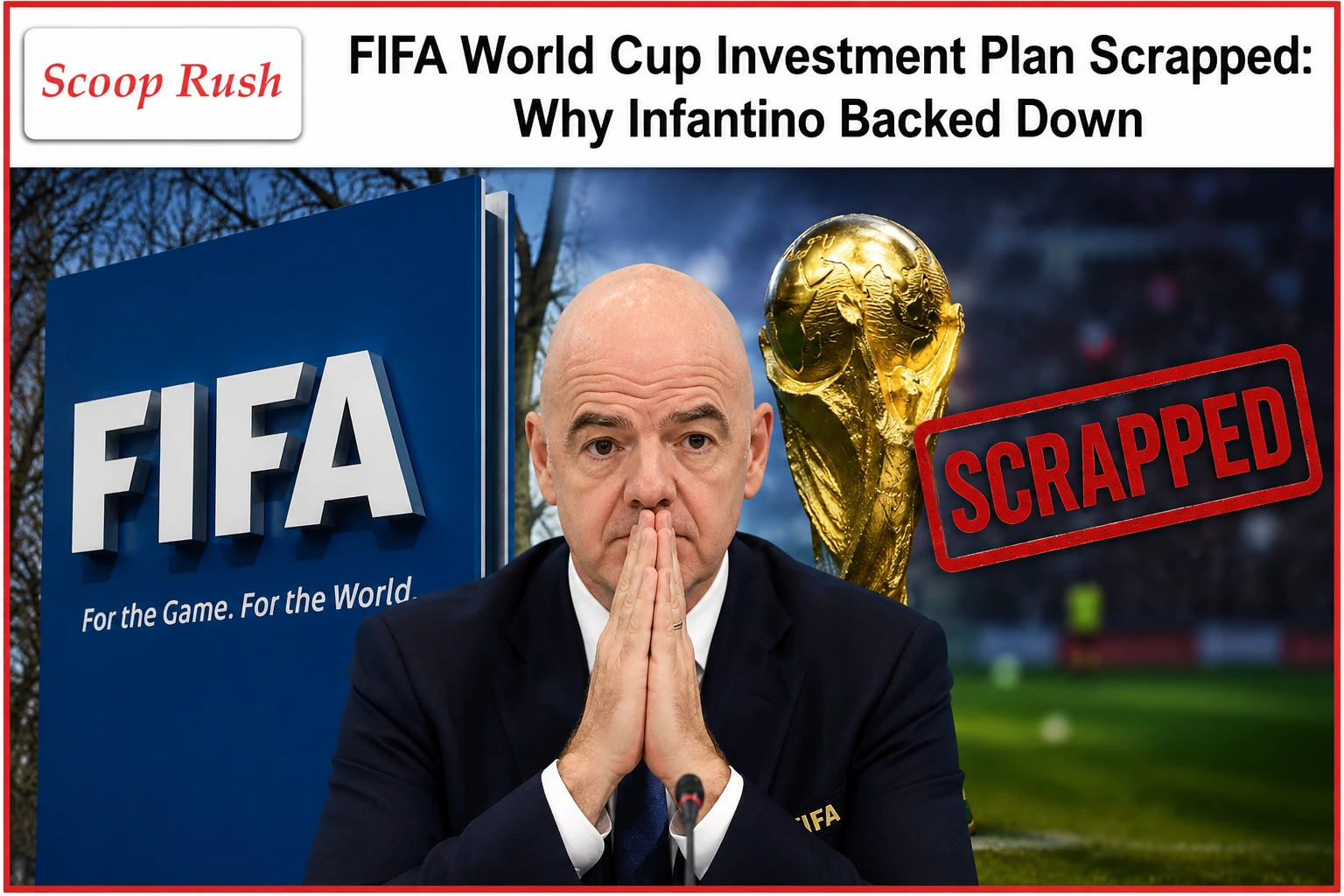
The Investment Plan Collapses in Just Five Days
What happens when the most powerful man in football tries to sell a piece of the World Cup? Almost the entire sport says no. That is exactly what unfolded this week. The FIFA World Cup investment plan, once pushed hard by FIFA president Gianni Infantino, has officially been scrapped. It took less than a week of backlash to bring it down.
This story matters far beyond boardrooms and financial spreadsheets. It touches the future of the world’s most watched sporting event. It also touches the trust between football’s governing body and its 211 member nations. Additionally, it puts the leadership of a man who once looked set for an unopposed fourth term under real pressure. If you follow football, or simply care about how major tournaments are run, this development is one you’ll want to understand fully.
Let’s break down what happened, why the World Cup stake sale collapsed so fast, and what it means going forward.
What Was the FIFA World Cup Investment Plan?
At its core, the plan involved creating a new commercial subsidiary called FIFA Forward Enterprise, or FFE. The idea was simple on paper. FIFA would invite outside investors to buy minority, non-controlling stakes in this new entity. That entity would then run FIFA’s major competitions, including the men’s and women’s World Cups.
To sweeten the deal, Infantino offered every one of FIFA’s 211 member associations $40 million, roughly £30 million, if they backed the proposal. There was a catch, though. Associations needed to accept the terms by 19 September to unlock an initial $20 million, about £15 million.
A 25-page document prepared by investment bank JP Morgan outlined ambitious numbers. It projected that FIFA’s tournaments could expand enough to deliver an estimated 24 million euros, around £20.5 million, per member association during the 2035-2039 cycle. The document described the World Cup as the most widely viewed sporting event in the world. Yet, it also claimed FIFA itself remained under-monetised. Interestingly, the women’s game was not mentioned anywhere in the FIFA stake sale proposal.
According to FIFA, the American venture capital firm Thrive Eternal was expected to lead the investor group behind FFE. Thrive was founded by Joshua Kushner, brother of Jared Kushner, who is married to Donald Trump’s daughter. That connection added another layer of scrutiny, especially given the close relationship Trump and Infantino have built since Trump returned to office in 2025. Trump addressed the plan publicly for the first time on Friday and said he had not personally discussed it with Infantino.
Why the Proposal Sparked Immediate Backlash
Football’s governing bodies did not stay quiet for long. Within days, opposition grew from a whisper into a roar against FIFA’s private investment plan.
UEFA Fires the First Shot at FIFA’s Stake Sale Plan
UEFA, representing 55 European member associations, was the first major body to speak out. Their message was blunt. Football was “not FIFA’s to sell.” As the week progressed, UEFA sharpened its tone even further. It accused FIFA of trying to enrich itself and its friends at the sport’s expense.
Then came the decisive move. On Thursday, all 55 UEFA member associations voted to boycott future World Cups if Infantino’s plan went ahead. That is not a symbolic gesture. It is a direct threat to the tournament’s global credibility, since Europe has consistently produced some of the strongest teams and biggest fan bases in the competition.
Concacaf and the AFC Join the Resistance to the World Cup Stake Sale
UEFA was not alone for long. Concacaf, which governs football across North America, Central America, and the Caribbean, announced that its 41 member associations had rejected the proposal outright. This carried extra weight given that Concacaf co-hosted this summer’s World Cup. As a result, the region has direct, recent experience with how FIFA’s flagship tournament actually operates.
Sources indicated that a majority of Concacaf’s member associations were losing faith, or had already lost faith, in Infantino’s leadership altogether.
The Asian Football Confederation added even more pressure by declaring solidarity with UEFA and Concacaf. While the AFC stopped short of a full rejection, its stance still signaled deep unease among Asian football nations regarding the FIFA investment proposal.
Meanwhile, South America’s governing body, Conmebol, did not reject the plan outright. Instead, it requested additional information regarding its scope, structure, governance, and possible effects. Africa’s CAF and Oceania’s OFC said they planned to discuss the proposal in August, though the plan collapsed before those conversations took place.
The Numbers That Sealed the Plan’s Fate
FIFA operates under a system where major decisions require backing from a majority of its 211 member associations. That means Infantino needed at least 106 votes in favor.
However, once you added up the opposition, the math simply did not work in his favor. UEFA alone controls 55 votes. Concacaf brings 35 more. Asia, through the AFC, adds another 46. If every member association followed the position taken by their regional confederation, that would total 136 votes against the plan. That number alone exceeded the majority Infantino needed to push the World Cup stake sale through.
As a result, even before Saturday’s announcement, the writing was already on the wall.
Resignation From Within FIFA Over the Proposal
Perhaps the most damaging blow came from inside FIFA’s own leadership.
Carlos Cordeiro, Infantino’s senior adviser on global strategy and governance, resigned over the matter. Cordeiro had also represented FIFA on the White House taskforce for the 2026 World Cup, making his departure especially notable. In a lengthy statement, he said he “unequivocally” opposed the plan. He also rejected the idea that FIFA needed outside investors to unlock greater value, and clarified that he had no involvement in shaping the proposal.
FIFA’s chief operating officer, Kevin Lamour, went even further. He stated that FIFA’s own administration had been “deceived” about the project, calling it “the project of one person.” Lamour argued that a president’s job is to bring people together and inspire unity. He added that this plan achieved the opposite. He also said that if his comments cost him his job, he would accept that outcome and still sleep well at night.
These are not minor internal disagreements. When a chief operating officer and a senior adviser both publicly break ranks, it signals a serious breakdown of trust at the highest levels of the organization.
How Infantino Responded to the Backlash
Even as opposition mounted, FIFA initially stood firm. On Friday, the organization declared that “nobody is selling football” and vowed to press ahead with the plan despite the growing wall of rejection.
That resistance did not last long, though. Early Saturday morning, at around 00:30 BST, Infantino released a statement confirming the FIFA World Cup investment plan would not proceed. He explained that the project had “created divisions” that no longer served its original purpose, adding that the proposal “will not proceed.”
Infantino defended his original intentions. He said the plan was designed to strengthen member associations, particularly in countries where support is most needed. He reiterated that FIFA’s purpose has always been, and always will be, to unite and improve football. He also said he now intends to bring all interested parties back together in a spirit of shared interest.
Reaction to the withdrawal was swift. Shaikh Salman bin Ebrahim Al Khalifa, president of the Asian Football Confederation, welcomed the decision. He stressed that the future of global football must be shaped through proper consultation, collective dialogue, and respect for established governance structures.
What This U-Turn Means for Infantino’s Future
This episode has left Infantino, 56, in a genuinely precarious position. He is currently seeking re-election for a fourth term as FIFA president, with the vote scheduled to take place at the FIFA Congress in Morocco next March. Candidates have until 18 November to officially enter the race.
Before this controversy erupted, it was widely expected that Infantino would be re-elected unopposed. Numerous associations across the world, including several in Europe, had already confirmed their intention to support him.
Now, that outcome looks far less certain. It remains to be seen whether the backlash from this week triggers a broader loss of support among member nations. UK Prime Minister Andy Burnham even went as far as saying Infantino was “the wrong man” to lead FIFA, a striking comment from a sitting political leader.
Interestingly, this is not Infantino’s first brush with public controversy this month. Just days before the investment plan story broke, he posted a 15-slide message on his personal Instagram account. In it, he urged critics to “meditate, pray or watch a football match” rather than spread what he called hate and false rumors about his leadership. In hindsight, that message looks like an early sign of the turbulence to come.
A Quick Timeline of the FIFA World Cup Investment Plan Saga
- Monday, 27 July: Infantino posts a 15-slide Instagram message dismissing critics.
- Tuesday, 28 July: The Times and Financial Times report on the investment plan. UEFA issues its first statement, saying football is “not FIFA’s to sell.” FIFA confirms the plan is real.
- Wednesday, 29 July: Infantino writes to all 211 member associations, offering $40 million each in exchange for support by 19 September.
- Thursday, 30 July: UEFA’s 55 members vote to boycott World Cups if the plan proceeds. Concacaf rejects the proposal.
- Friday, 31 July: FIFA vows to continue despite opposition. The AFC expresses solidarity with UEFA and Concacaf. Carlos Cordeiro resigns. Andy Burnham criticizes Infantino. Kevin Lamour says FIFA’s administration was deceived.
- Saturday, 1 August: Infantino announces the plan will not proceed.
Final Thoughts: What the Fallout Reveals
This story is about more than one scrapped business deal. It exposes real cracks in how FIFA’s leadership operates. It also shows how much power still rests in the hands of its member confederations.
Ultimately, the swift and unified rejection from UEFA, Concacaf, and the AFC proved impossible for Infantino to ignore. Combined with resignations and public criticism from within FIFA’s own administration, the pressure became too great to withstand.
For now, the FIFA World Cup investment plan is dead. However, the bigger question still lingers. Can Infantino repair the trust he has lost among member associations before the presidential vote in March? The football world will be watching closely.
Frequently Asked Questions
1. What was the FIFA World Cup investment plan?
It was a proposal to create a commercial subsidiary, FIFA Forward Enterprise, allowing outside investors to buy minority stakes in FIFA’s major tournaments, including the men’s and women’s World Cups.
2. Why did FIFA scrap the World Cup investment plan?
FIFA scrapped the plan after widespread opposition from UEFA, Concacaf, and the Asian Football Confederation. Combined with internal resignations and criticism, it became clear the proposal could not secure majority support.
3. Who opposed FIFA’s investment plan the most?
UEFA led the opposition, with all 55 member associations voting to boycott World Cups if the plan proceeded. Concacaf and the AFC also opposed or expressed solidarity against the proposal.
4. Who resigned from FIFA over the investment plan?
Carlos Cordeiro, Infantino’s senior adviser on global strategy and governance, resigned. He stated he unequivocally opposed the plan and had no involvement in creating it.
5. Will Gianni Infantino remain FIFA president after the investment plan controversy?
Infantino is seeking re-election for a fourth term at the FIFA Congress in Morocco next March. While he was previously expected to run unopposed, this controversy has raised uncertainty about his continued support among member associations.

