Home Blog Page 18

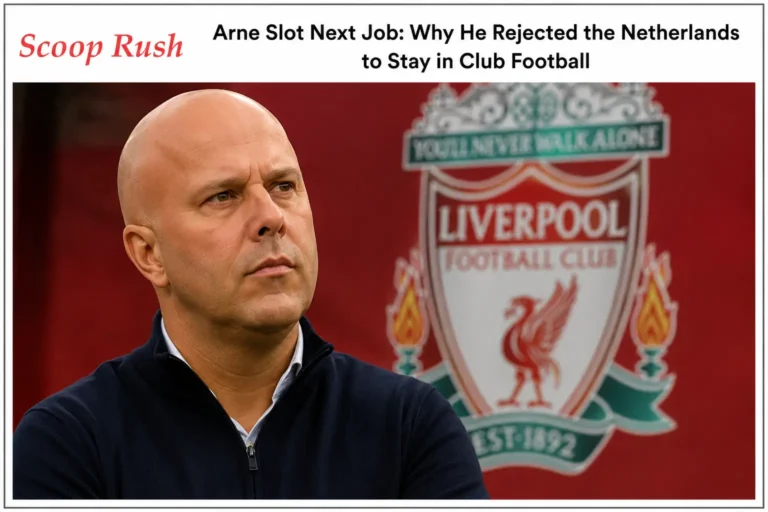
Arne Slot Next Job: Why He Rejected the Netherlands to Stay in Club Football

0

Arne Slot just walked away from one of the biggest jobs in Dutch football. Surprisingly, he didn’t cite money. Nor did he cite a dispute. Instead, the former Liverpool boss confirmed his next job search led to Arne Slot Netherlands talks with the KNVB, and he chose to stay in club football instead.

For a manager who won the Eredivisie with Feyenoord and lifted the Premier League title in his first season at Liverpool, this decision reveals a lot. Indeed, it shows what Slot values most at this stage of his career. Consequently, it raises the question every fan is now asking: what is the Arne Slot next job?

This article breaks down exactly what happened in the Arne Slot Netherlands talks, why they ended, and what the Arne Slot next job search looks like from here.

The Arne Slot Netherlands Talks: What Actually Happened

Slot confirmed he spoke with the Royal Dutch Football Association, known as the KNVB, about becoming the next Netherlands manager. The vacancy opened after Ronald Koeman stepped down from his second stint in charge, since Koeman left following a painful World Cup exit. Specifically, the Netherlands lost to Morocco in a last-32 penalty shootout, and that result clearly pushed him to walk away.

Slot’s name made sense for the role immediately, since he carries a strong record as a Dutch coach with major trophies behind him. However, the situation soon became clouded by conflicting reports.

Several outlets claimed Slot pulled out of talks after negotiations broke down over salary and contract length. Consequently, that version of events suggested a deal collapsed over money. However, Slot rejected that story without hesitation.

Speaking to Voetbal International, he addressed the misinformation directly. “That speculation is incorrect,” he said. “We simply never reached that stage of the talks.” In other words, no one discussed numbers because the conversation never got that far. Therefore, Slot made his decision before contract details entered the picture at all.

Why Reports About the Netherlands Job Got It Wrong

Speculation fills gaps quickly in football. For example, when a high-profile manager exits talks for a national team job, people naturally assume money or ego caused it. However, Slot’s clarification resets that narrative completely. Negotiations, in fact, didn’t collapse here. Instead, Slot simply made an early, personal decision about the kind of coaching environment he wants right now.

Why Slot Turned Down the Netherlands Job

At 47, Slot speaks openly about what he needs from a job at this point in his career. Specifically, he wants daily contact with his players on the training ground. However, a national team role can’t offer that in the same way.

International management runs on a completely different rhythm than club football. For instance, a national coach gathers his squad for a week or two every couple of months, runs a handful of sessions, plays a couple of matches, then sends everyone back to their clubs. As a result, for a coach who thrives on daily repetition and building a squad step by step, that gap can feel like a real compromise.

Slot’s own words explain the decision clearly. “I prefer to see myself on the training pitch with my players every day,” he said. Ultimately, that single line captures his reasoning.

He also made clear that respect, not reluctance, shaped this outcome. Indeed, Slot praised the KNVB’s professionalism throughout the process and called the national team role an honour. Therefore, this wasn’t a coach souring on an organisation. Rather, it came down to timing and personal preference, nothing more.

Arne Slot Hasn’t Closed the Door on the Netherlands

Importantly, Slot didn’t rule out managing the Netherlands one day. In fact, he called it “a great honour” to represent his country as national coach in the future, and he added that this simply wasn’t the right moment.

That distinction matters for Dutch fans. Slot isn’t saying international football doesn’t suit him. Rather, he’s saying it doesn’t suit him right now, while daily club coaching still pulls at him more. Even so, the door stays open for a future reunion, even if it won’t happen this time.

Slot’s Managerial Résumé Explains His Next Job Priorities

Slot’s recent history at Liverpool helps explain why Arne Slot’s next job will likely stay in club football. Specifically, he replaced Jurgen Klopp as Liverpool head coach in May 2024 and made an immediate impact, winning the club’s 20th league title in his very first season. Indeed, few managers start a job at a major club with that kind of result.

The following season, however, told a different story. Liverpool dropped to fifth place in the Premier League, and the club sacked Slot on 30 May. Going from title winner to dismissed manager within two seasons marks a dramatic swing. Consequently, that kind of ending often pushes a coach back toward club football rather than away from it, since he’ll want a quick chance to rebuild his reputation.

Before Liverpool, Slot built his name at Feyenoord, where he won the Eredivisie title in 2023. As a result, that achievement explains why his name carries so much weight in Dutch football and why the KNVB approached him for the national job in the first place.

What the Arne Slot Next Job Could Look Like

Given everything he’s said, the Arne Slot next job will likely land at a club rather than a country. After all, he has won trophies at both a domestic Dutch level and in the Premier League, and that combination makes him attractive to ambitious clubs across Europe.

Speculation will now shift toward which club lands the Arne Slot next job. So far, Slot hasn’t named a specific target, and no concrete links have surfaced yet. Still, his comments make his priorities obvious: he wants regular contact with a squad, hands-on training sessions, and the weekly rhythm that club management offers.

What Happens Next for the Netherlands Team

With Slot out of contention, attention has shifted elsewhere for the Netherlands job. Reports in the Netherlands indicate that former Portugal manager Roberto Martinez is now holding talks with the KNVB about taking over as national coach.

Martinez previously led Portugal, and his international experience could appeal to a federation searching for Koeman’s successor. So far, no appointment has been confirmed, and the situation remains fluid. Therefore, fans should watch closely as these talks progress over the coming weeks.

The KNVB needs the right successor quickly, since the World Cup exit to Morocco ended Koeman’s second spell on a low note, and the federation will want stability heading into its next set of qualifiers and tournament preparations.

How the Arne Slot Netherlands Decision Affects Dutch Football

Slot’s decision marks a notable moment for Dutch football as a whole. After all, he remains one of the most successful Dutch coaches of his generation, and many fans hoped he would eventually take charge of the national side. However, his comments suggest that moment simply hasn’t arrived.

Meanwhile, the KNVB must move forward with other candidates, and Martinez’s emergence shows the search is already well underway. The next few weeks should bring more clarity on who leads Oranje into the next major tournament cycle.

Key Takeaways

The Arne Slot Netherlands story comes down to one clear factor: Slot prefers daily involvement with a club squad over the periodic nature of international management. Therefore, he firmly denied reports of a salary or contract dispute and confirmed that talks never reached that stage.

Slot still takes pride in his connection to Dutch football, and he hasn’t ruled out managing the national team one day. For now, though, the Arne Slot next job will stay in club football, a path that has already brought him major trophies at both Feyenoord and Liverpool despite a difficult ending at Anfield.

As for the Netherlands, the search continues. Meanwhile, Roberto Martinez has reportedly emerged as a serious candidate for the role. As a result, Dutch football fans will watch closely to see who takes the helm before the next international campaign begins.

Frequently Asked Questions

1. Why did Arne Slot turn down the Netherlands job? 

Slot said he prefers coaching a club team, where he can train with his players every day. The periodic schedule of international management didn’t fit his current career stage.

2. Did Arne Slot and the KNVB clash over salary? 

No. Slot directly denied these reports. He confirmed that talks never progressed far enough to discuss salary or contract length.

3. Will Arne Slot manage the Netherlands in the future? 

Possibly. Slot called it “a great honour” to manage his national team one day, but he explained that now wasn’t the right time.

4. Why did Liverpool sack Arne Slot? 

Slot won the Premier League title in his debut season at Liverpool. The club sacked him on 30 May after finishing fifth the following season.

5. Who will become the next Netherlands manager? 

No successor has been confirmed yet. Reports indicate former Portugal manager Roberto Martinez is currently in talks with the KNVB for the role.

6. What is the Arne Slot next job? 

No club has been confirmed yet. Slot has made clear his next job will be in club football rather than international management, so expect fresh links to emerge in the coming weeks.


D23 Expo 2026 Predictions: Why Tokyo Disney Resort Could Steal the Spotlight From Disney World and Disneyland

0

A Bombshell D23 Expo 2026 Announcement Might Not Come From Disney World or Disneyland

D23 Expo 2026 predictions are pointing to a surprising source for the biggest theme park news of the year. It might not be Orlando or Anaheim at all. That’s the real story heading into this year’s event. American fans keep their eyes locked on Walt Disney World and Disneyland. Yet the D23 Expo 2026 predictions that matter most may actually center on Tokyo, Paris, Hong Kong, and Shanghai.

It sounds counterintuitive at first. After all, the domestic parks usually dominate the headlines. However, timing changes everything in the theme park business. This year, the timing favors the international resorts in a big way.

Here’s why that matters for anyone who follows Disney news, plans park trips, or just loves keeping up with what’s coming next.

Why International Parks Could Outshine the U.S. Reveals in the D23 Expo 2026 Predictions

The explanation comes down to development calendars, not hype. Disneyland Paris just finished relaunching Disney Adventure World, wrapping up the last major project on its books. Only the Lion King Pride Lands expansion remains on deck. That leaves plenty of room for a new surprise.

Tokyo tells a similar story. Fantasy Springs has driven strong attendance at DisneySea for a couple of years now. Meanwhile, Tokyo Disneyland is approaching a Tomorrowland relaunch set for spring 2027. Hong Kong and Shanghai are also further along in their own project pipelines than any of the U.S. parks right now.

Compare that to Walt Disney World and Disneyland. Both parks unveiled slates running all the way to 2030 at the 2024 D23 Expo. Neither park has a development timeline that stretches past 2028. As a result, D23 Expo 2026 gives the international resorts a real chance to introduce something nobody saw coming. Meanwhile, the domestic parks mostly fill in details fans already know.

Tokyo Disney Resort Is the Top Story in the D23 Expo 2026 Predictions

Tokyo Disney Resort Is the Top Story in the D23 Expo 2026 Predictions

Tokyo Disney Resort sits at the center of these predictions, and for good reason. More industry buzz surrounds TDR right now than any other international park. The timing lines up almost perfectly for a major reveal.

Historically, Tokyo Disney Resort kept its distance from international audiences. The parks catered almost entirely to domestic Japanese visitors. At times, the approach felt borderline unwelcoming to outsiders. That made sense given the guest demographics for years. Today, though, that pattern is shifting.

OLC, the company that owns and operates Tokyo Disney Resort, has been raising prices steadily. The company’s stock has struggled recently. OLC needs new growth drivers beyond its upcoming cruise ships. Consequently, OLC has recognized something important: international visitors spend more per trip than domestic guests. Since those visitors pay in currencies stronger than the yen, OLC has started repricing its offerings accordingly.

OLC Is Playing a Bigger Role at D23 Expo 2026

This shift explains why OLC has become a more active participant in showcases like D23. Announcing news at the Parks Panel puts Tokyo Disney Resort in front of every Walt Disney World and Disneyland fan. Otherwise, those fans might miss a standalone OLC press release entirely.

Japanese fans won’t miss a beat either. Tokyo Disney’s fanbase is famously plugged in. Viral posts from Japanese social media accounts typically follow any livestreamed reveal within minutes. This dual-audience strategy has been building for a few years, and it’s expected to accelerate going forward. Tokyo and the American parks now run on slightly different development cycles.

What to Expect From Tokyo Disney Resort at D23 Expo 2026

Port Discovery Expansion at Tokyo DisneySea

OLC has confirmed that Aquatopia at Tokyo DisneySea will permanently close on September 14, 2026. So far, that’s the only detail OLC has shared. OLC buried the announcement inside an unrelated April press release about Summer Cool-Off events.

Still, a replacement shouldn’t come as a total surprise. A year earlier, OLC released concept art showing future expansion plans for both parks. That included a replacement for Aquatopia and an expanded Port Discovery area. OLC shared that reveal with investors last April inside its 2035 Long-Term Management Strategy. Tokyo DisneySea urgently needs more capacity, so a formal announcement at D23 Expo 2026 seems likely.

A New Show to Replace Big Band Beat

Big Band Beat: A Special Treat wrapped its farewell run at Disney Sea’s Broadway Music Theatre last September. OLC hasn’t announced a permanent replacement yet. Social media leaks suggest something is already in development. Most fans expect it to debut after the resort’s 25th Anniversary celebration ends in spring 2027.

That timeline makes D23 Expo 2026 a logical moment to showcase early details. International stage shows tend to be a niche topic for domestic audiences, so this reveal might only get brief mention. Even so, test footage circulating on Japanese social media hints at a genuine wow moment. That could make the new show worth featuring.

Tomorrowland’s Massive Overhaul Ahead of D23 Expo 2026

Tomorrowland at Tokyo Disneyland is undergoing a $700 million transformation. Two major new attractions anchor the project. The first is a Wreck-It Ralph interactive experience replacing the long-running Buzz Lightyear’s Astro Blasters. In this new ride, guests team up with Ralph and Vanellope. Together, they rescue the candy-themed racing game Sugar Rush from King Candy’s Sugar Bugs. Disney expects it to open in April 2027 at a cost of roughly $200 million.

The second project, Space Mountain: Earthrise, will include an expanded plaza and a reimagined section of Tomorrowland. This new coaster keeps the indoor roller coaster concept alive but adds enhanced effects and performance upgrades. Imagineers designed it to resemble Guardians of the Galaxy: Cosmic Rewind at EPCOT in structure, minus the Marvel branding. It should open around the same time as Wreck-It Ralph. At an estimated $500 million price tag, it would become the most expensive Disney attraction built to date.

Given the scale of this investment, expect official attraction names, new concept art, and possibly early footage during the Parks Panel.

A Brand-New Land Could Follow the D23 Expo 2026 Tokyo Disneyland Reveal

A Brand-New Land Could Follow the D23 Expo 2026 Tokyo Disneyland Reveal

Big D23 Expo reveals often come with a follow-up surprise, and that pattern could repeat here. OLC’s long-term strategy documents describe a plan to create experiences that exist nowhere else in the world. The company calls this “dynamic restructuring” of its park sites, including large-scale area redesigns.

In practice, this means OLC intends to replace the sections of Tokyo Disneyland that closely mirrored Magic Kingdom and Disneyland. Original, Tokyo-exclusive attractions would take their place. This strategy isn’t new. OLC has pursued it publicly since 2016, and you can already see it in the completed Tomorrowland and Fantasyland updates.

Leaked concept art has shown a possible Adventureland transformation. It features an Incredibles roller coaster, a Paradise Falls-themed attraction inspired by Up, and Moana-themed boats. That concept reportedly shows the removal of the Swiss Family Treehouse, Jungle Cruise, Western River Railroad, and the Enchanted Tiki Room with Stitch. OLC has not officially confirmed any of these details. Readers shouldn’t treat the concept art as a locked plan. Even so, a large-scale Adventureland or Westernland redevelopment announcement would make for a splashy expo moment. It would especially excite American fans less attached to the original attractions.

More D23 Expo 2026 Predictions for Other International Parks

Disneyland Paris and Discoveryland

Disneyland Paris fans have waited years for meaningful updates to Discoveryland. This could finally be the year for smaller, “singles and doubles” style improvements rather than a brand-new headline attraction. One realistic possibility involves ending the long-running Hyperspace Mountain overlay. That would restore the original Space Mountain: De la Terre à la Lune version from 1995.

Additionally, the Lion King themed area at Disney Adventure World remains a major story. This new land will include character greetings, themed dining, and shopping. It also features a Splash Mountain-style water flume ride that follows Simba’s journey from cub to king. Expect more concept art and animatronic footage, though an opening date likely won’t arrive until 2028. Disney may also give the Wilderness Explorers Sky Swings attraction, which opens in 2027, a quick mention.

Shanghai and Abu Dhabi D23 2026 Predictions Remain Uncertain

Shanghai and Abu Dhabi D23 2026 Predictions Remain Uncertain

Shanghai Disneyland’s rumored second gate remains a big question mark. Many fans expected an announcement at the resort’s 10th anniversary celebration, but that didn’t happen. Shanghai Disney Resort operates under the state-owned Shendi Group. As a result, announcements follow Shendi’s terms rather than Disney’s preferences, which makes predictions especially difficult.

Disneyland Abu Dhabi faces a similar situation, though for different reasons. Miral Group and its partners want to publicize this project internationally. Prestige and reputation matter more than near-term profitability for a park that won’t open for years. Expect limited updates, such as a few additional concept art pieces or specific attraction mentions, rather than a full reveal. A more detailed showcase likely won’t happen until closer to the park’s opening window, sometime between 2032 and 2036.

More Marvel News Across Multiple Parks

Crews are currently building Marvel-themed attractions at both Hong Kong Disneyland and Shanghai Disneyland. Expect a Marvel portfolio segment covering these projects alongside updates on Avengers Campus at Disney California Adventure.

Final Thoughts 

These D23 Expo 2026 predictions point to something unusual. Walt Disney World and Disneyland won’t claim every headline this time. Instead, Tokyo Disney Resort looks positioned to deliver the most surprising reveal of the event. Between the Aquatopia replacement, the Tomorrowland overhaul, and a possible new land announcement, Tokyo has more moving pieces than any other resort right now.

Meanwhile, Disneyland Paris, Shanghai, and Abu Dhabi each carry their own storylines. Ownership structures and regional business considerations make some of these harder to predict. For fans planning trips or simply following the industry, this shift toward highlighting international parks marks a meaningful change. It reflects how Disney approaches its biggest showcase event.

Ultimately, D23 Expo 2026 could reshape how fans think about Disney’s global park strategy for years to come.

FAQs

1. When is D23 Expo 2026 and when will Tokyo Disney Resort news arrive? 

The Parks Panel livestream is expected to air at 11 a.m. on Sunday during the expo weekend, based on past scheduling patterns for major Disney park announcements.

2. What is closing at Tokyo DisneySea in 2026? 

Aquatopia at Tokyo DisneySea will permanently close on September 14, 2026. Disney is expected to announce a replacement attraction at D23 Expo 2026.

3. When will the new Tomorrowland attractions open at Tokyo Disneyland? 

Disney expects both the Wreck-It Ralph interactive attraction and Space Mountain: Earthrise to open in spring 2027, with an estimated opening date around April 15, 2027.

4. How much is Tokyo Disneyland spending on its Tomorrowland overhaul? 

The total investment across both new Tomorrowland attractions exceeds $700 million, with Space Mountain: Earthrise alone estimated at $500 million.

5. Will Shanghai Disneyland get a second gate announcement at D23 Expo 2026? 

It’s uncertain. Many fans expected this announcement at Shanghai Disney Resort’s 10th anniversary celebration, but it didn’t happen. Future announcements depend on the state-owned Shendi Group rather than Disney alone.

Taurine for Cats: Do You Need to Supplement Your Cat’s Diet?

0

If you feed your cat a raw or homemade diet, you’ve probably run into the word “taurine” more than once usually followed by a warning about deficiency, blindness, or heart failure. It sounds alarming, and for good reason: taurine isn’t optional for cats. Unlike almost every other nutrient in your cat’s bowl, there’s zero margin for “close enough.” Too little, over time, can quietly damage the heart and eyes long before you notice anything is wrong.

But does that mean every raw-fed or home-cooked cat needs a bottle of taurine powder on the counter? Not necessarily. It depends entirely on what’s actually in the bowl. Here’s a complete, easy-to-follow breakdown of what taurine does, how much your cat really needs, which foods deliver it, what destroys it during food prep, and exactly when supplementing makes sense.

What Is Taurine?

What Is Taurine?|scoop Rush

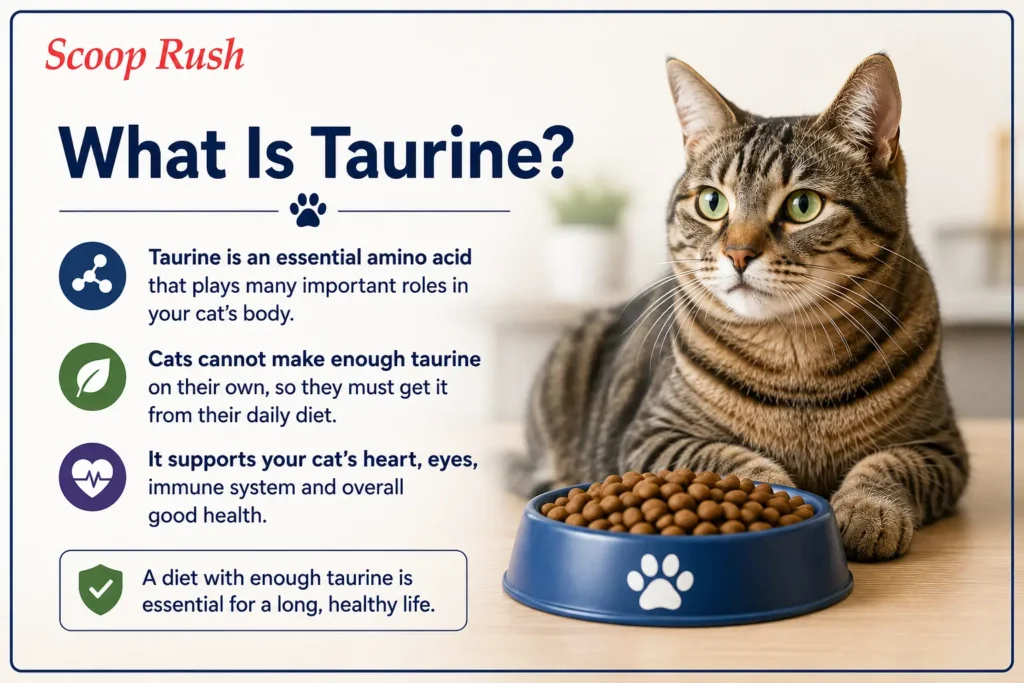
Taurine is an amino acid  more precisely, a beta-amino sulfonic acid that the body uses in dozens of small but critical processes. Amino acids are often called the “building blocks of protein,” and most animals need around 20-22 of them to stay alive.

The key distinction is between non-essential and essential amino acids:

  • Non-essential amino acids can be manufactured inside the body from other nutrients.
  • Essential amino acids cannot be made in sufficient quantity internally and must come directly from food.

This is where cats are unusual. Most mammals including dogs can synthesize taurine on their own by combining two other amino acids, cysteine and methionine. Cats cannot do this efficiently. For them, taurine is strictly essential: every milligram their body uses has to come from what they eat, every single day, for their entire life.

Interestingly, some dog breeds produce taurine less efficiently, even though dogs can generally make taurine on their own. Breeds that have shown a higher susceptibility to taurine-related deficiency include:

  • Golden Retrievers
  • American Bulldogs
  • Portuguese Water Dogs
  • Dalmatians
  • Saint Bernards
  • English Setters
  • American Cocker Spaniels
  • Newfoundlands

For cats, though, this isn’t a breed-specific quirk it’s universal biology. Every cat, regardless of breed, depends on dietary taurine.

Why Taurine Matters: What It Actually Does in the Body

Why Taurine Matters: What It Actually Does in the Body|Scoop Rush

Taurine isn’t a single-purpose nutrient. It’s involved in a wide range of essential body functions, including:

  • Vision — maintaining the structure and function of the retina
  • Heart function — supporting normal muscle contraction in the heart
  • Reproduction and fetal development — critical for healthy pregnancies and kitten development
  • Growth — especially important in kittens and nursing queens
  • Neuromodulation — supports normal nervous system signaling
  • Immune response — helps the body defend against illness
  • Bile salt formation — used in digestion of fats

Because taurine touches so many systems, a shortfall doesn’t cause one obvious symptom — it can quietly affect several body systems at once, which is part of what makes deficiency so dangerous: it’s often invisible until real damage has already occurred.

Signs and Risks of Taurine Deficiency

A prolonged taurine deficiency in cats has been linked to:

  • Feline central retinal degeneration — progressive, potentially permanent vision loss and blindness
  • Dilated cardiomyopathy (DCM) — a serious heart condition that enlarges and weakens the heart muscle, which can be fatal
  • Poor immune response — increased susceptibility to illness
  • Stunted neonatal growth — kittens failing to grow and develop normally
  • Reproductive problems — including congenital defects in kittens

On the reassuring side, taurine has no known toxicity. Any amount your cat doesn’t need is simply excreted through urine. This is an important detail for anyone deciding whether to supplement: there is essentially no downside to erring on the side of “a bit more.”

How Much Taurine Does a Cat Actually Need?

How Much Taurine Does a Cat Actually Need?|Scoop Rush

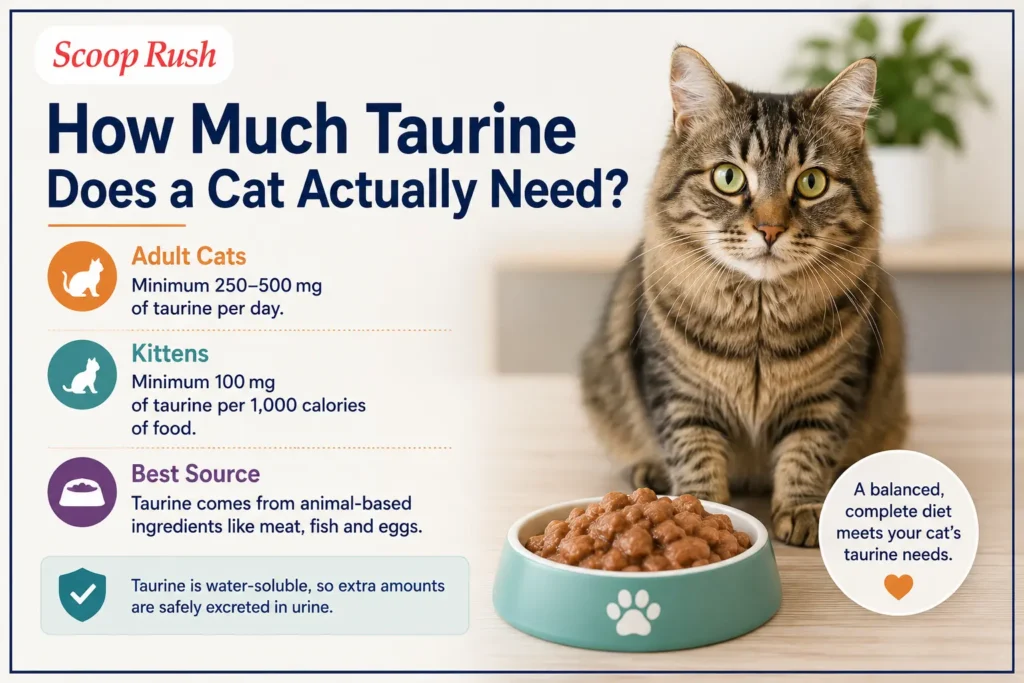
There isn’t one universal number, because the amount of taurine a cat can actually absorb and use depends heavily on the type of diet. The National Research Council (NRC) sets different recommended allowances depending on how the food is processed:

Diet TypeRecommended TaurineEquivalent Dry Matter (at 4,000 kcal/kg)
Purified / reference diet100 mg per 1,000 kcal—
Dry food (kibble)250 mg per 1,000 kcal~0.1%
Wet / canned food425 mg per 1,000 kcal~0.17%
Raw diet (no official NRC figure)~250 mg per 1,000 kcal (recommended by some nutrition studies)~0.1%

Why does the requirement change so much between diet types? 

It comes down to bioavailability how much of the taurine present in the food is actually absorbed and usable by the cat’s body. Several factors reduce bioavailability:

  • Fiber content — certain fibers, such as rice bran, can bind taurine in the small intestine and prevent absorption
  • Protein quantity and quality — diets high in protein increase the taurine requirement; low-quality protein sources make it worse
  • Heat processing — cooking proteins alongside sugars creates Maillard compounds, which are harder to digest and encourage the growth of gut bacteria that break down taurine before it can be absorbed

Canned food has the highest official requirement of the three processed categories because it tends to contain the highest levels of Maillard products. Dry kibble is also affected, both by Maillard compounds and by its fiber content.

Raw diets sit in a gray area there’s no official NRC recommendation for raw feeding specifically, since raw diets fall outside the studies used to establish these standards. However, raw diets still carry natural bacteria capable of degrading taurine, which is why at least one nutrition study suggests raw feeders use the same target as kibble: roughly 250 mg per 1,000 kcal.

What Reduces Taurine in Your Cat’s Food?

A common myth is that cooking destroys taurine directly it doesn’t. The real issue is that taurine is water-soluble, so it leaches out of meat any time liquid is lost. This happens in several everyday situations:

ProcessWhat Happens to Taurine
Boiling or steamingSignificant taurine loss into the cooking water
Baking or dry cookingLess taurine loss than boiling/steaming, but some still occurs
Thawing frozen meatReleases myoglobin-rich liquid that carries dissolved taurine out of the meat
Grinding meatCauses fluid loss and increases air exposure, encouraging taurine-degrading bacteria

Practical takeaway: If you thaw meat before feeding it, don’t pour that reddish liquid down the drain  feeding it back to your cat helps recover some of the taurine that would otherwise be lost. Similarly, if you cook meat for any reason, baking retains more taurine than boiling or steaming.

Best and Worst Food Sources of Taurine

Why Taurine Comes Almost Exclusively From Animal Tissue

Taurine is found almost exclusively in animal tissue. It is essentially absent from fruits, vegetables, grains, legumes, and nuts, with only trace amounts found in yeast, seaweed, and fungi. This is one more reason why cats, as true obligate carnivores, cannot get adequate nutrition from plant-based diets. Their nutritional needs revolve around a strictly animal-based diet, which is very different from a human carnivore diet, where there is at least some flexibility around plant foods.

High-Taurine Foods for Cats

CategoryExamplesTaurine Level
Very highHeart, tongue, seafood, dark poultry meat (thigh)High
ModerateWhole small prey (mice, quail, day-old chicks), most red meat organsModerate–High
LowRabbit, poultry light meat (chicken/turkey breast)Low
Very lowMechanically deboned meatVery Low

A few practical notes worth knowing:

  • Smaller animals tend to be richer in taurine than larger ones, which lines up with what a cat would naturally hunt and eat in the wild — mice, small birds, and similar prey.
  • Rabbit is a well-documented low-taurine meat. In one feeding trial, cats fed a diet of whole ground rabbit developed taurine deficiency. A later study clarified why: rabbit meat’s natural taurine content falls below even the lowest NRC benchmark (the purified-diet standard), regardless of how it’s prepared.
  • Chicken and turkey breast (light meat) are also comparatively low, while the same bird’s thigh meat (dark meat) is much richer in taurine.
  • Mechanically deboned meat — a lower-quality, heavily processed product — is particularly poor in taurine and is best avoided as a primary protein source.
  • Standard nutrition databases such as the USDA often omit taurine values because humans don’t require taurine in their diet, so food manufacturers don’t routinely test for it. As a result, raw feeders often follow general guidelines instead of calculating taurine intake for every gram of food.

Real-World Examples: Does a Typical Raw Diet Meet Taurine Needs?

It helps to see these numbers applied to an actual daily ration. Below are two examples based on a cat weighing roughly 3.7 kg, whose approximate daily taurine requirement is:

  • 24 mg under the strictest (purified-diet) NRC standard
  • 59 mg under the dry-food (kibble) standard
  • 101 mg under the canned-food standard
ExampleDiet CompositionEstimated Total TaurineMeets Requirement?
1NRC-balanced homemade diet (muscle meat + partial organs; organs and cooked mussels not included in the estimate)~213 mgYes — exceeds even the strictest standard
2a120g PMR ration: chicken necks, beef heart, beef liver, pork kidney, mackerel, + turkey for remainder~108 mgYes — exceeds all three standards
2bSame base recipe, + beef for remainder~80 mgYes — exceeds purified and dry-food standards
2cSame base recipe, + chicken breast for remainder~64 mgYes — exceeds purified and dry-food standards, despite chicken breast being low in taurine

The takeaway: as long as a reasonable portion of the diet includes taurine-rich cuts like heart, liver, or oily fish, most homemade and raw diets comfortably clear the recommended thresholds — even when part of the diet includes a lower-taurine meat like chicken breast or beef.

When Should You Add a Taurine Supplement?

For most raw feeders, a well-balanced diet supplies enough taurine without any additional supplementation  especially if roughly 20% of the diet comes from taurine-dense cuts like heart, lung, tongue, or dark poultry meat.

You should seriously consider adding a taurine supplement if any of the following apply:

  • Your cat’s diet leans heavily on low-taurine meats like rabbit or chicken/turkey breast
  • You regularly grind your cat’s food
  • You cook the meat, especially by boiling or steaming
  • You feed a diet with little to no organ meat or heart
  • You’re simply unsure whether your recipe meets the requirement

Because the body naturally excretes excess taurine, taking a supplement ‘just in case’ carries little risk. If you’re unsure whether your recipe provides enough taurine, adding a small amount may offer extra protection against deficiency.

Quick Reference: Should You Supplement?

Your SituationSupplement?
Diet includes 20%+ heart, dark poultry meat, or oily fishUsually not necessary
Diet is mostly rabbit or chicken/turkey breastYes, recommended
You grind your cat’s meatYes, recommended
You cook meat by boiling/steamingYes, recommended
You’re feeding a commercial raw or freeze-dried diet with taurine already addedNot necessary — check the label first
You’re unsure of your recipe’s balanceSafe to supplement — no toxicity risk

How to Choose and Use a Taurine Supplement

If you’ve decided your cat’s diet needs extra taurine, the good news is that supplementing is simple and low-risk. Here’s what to keep in mind:

  • Form: Taurine supplements for cats are most commonly sold as a plain powder, which is easy to mix into raw or wet food. Capsules are also available but are harder to dose precisely for a small animal like a cat.
  • Purity: Look for a plain, single-ingredient taurine supplement rather than a multi-ingredient blend, so you know exactly how much your cat is getting and can adjust the amount to your specific recipe.
  • Where it fits in the meal: Because taurine is water-soluble, it’s best mixed in right before feeding rather than added early and left to sit in liquid, which can reduce how much actually reaches your cat.
  • Consistency matters more than precision: Since taurine isn’t stored in large reserves and any excess is simply excreted, the goal is steady daily intake rather than hitting an exact number every single day.
  • When in doubt, ask your vet: If your cat has an existing heart condition, has shown any signs of vision changes, or you’re formulating a full home-cooked diet from scratch, it’s worth having your recipe reviewed by a veterinarian or veterinary nutritionist before relying on supplementation alone.

Common Myths About Taurine, Debunked

There’s a surprising amount of misinformation floating around about taurine and cat nutrition. Here are a few of the most common myths worth clearing up:

MythReality
“Cooking destroys taurine.”Cooking doesn’t chemically destroy taurine — it causes water-soluble taurine to leach out into cooking liquid, especially with boiling or steaming.
“All raw diets are automatically taurine-sufficient.”Not true. A raw diet built mainly on low-taurine cuts like rabbit or chicken breast can still fall short, just like any other diet.
“More protein always means more taurine.”Not necessarily — high protein levels can actually increase a cat’s taurine requirement, and low-quality protein sources make absorption worse, not better.
“Taurine supplements are risky if you give too much.”Taurine has no known toxicity in cats; any excess is excreted in urine, making it one of the safer nutrients to supplement generously.
“Dogs never need taurine supplementation.”While most dogs can synthesize their own taurine, certain breeds are less efficient at this and can develop deficiency on the wrong diet.
“Grain-free automatically means healthier for cats.”Not necessarily. Many grain-free pet foods simply replace grains with tubers and legumes, which are just as low in taurine and just as unnatural for an obligate carnivore’s digestive system.

The Bottom Line

Taurine is a non-negotiable nutrient for cats, and a prolonged deficiency can be fatal. The good news is that most raw and homemade diets  especially those built around heart, lung, tongue, and dark poultry meat naturally meet or exceed the recommended targets without any supplementation at all.The cats most at risk are those fed primarily rabbit, chicken or turkey breast, ground meat, or cooked diets for these cats, adding a taurine supplement isn’t an overcautious extra step. It’s a smart, low-risk way to close a real nutritional gap.

FAQs

1. Can too much taurine hurt my cat? 

No. Taurine has no known toxicity in cats. Any amount beyond what the body needs is simply excreted through urine, so there’s no risk of “overdosing” a healthy cat on taurine.

2. Does cooking destroy taurine? 

Not directly. Cooking itself doesn’t chemically destroy taurine, but because taurine is water-soluble, it leaches out into cooking liquid  especially when meat is boiled or steamed. Baking causes less loss than boiling.

3. Is store-bought kibble already balanced for taurine? 

Reputable commercial kibble and canned diets including therapeutic lines like Purina Pro Plan veterinary diets are formulated to meet NRC guidelines, including taurine. The concern mainly applies to homemade, raw, or boutique diets that haven’t been nutritionally analyzed.

4. Why do canned foods need more taurine than dry food? 

Canned food generally contains higher levels of Maillard compounds, which form when proteins and sugars undergo heat processing. These compounds may reduce how much taurine a cat’s body can absorb. That’s why the recommended allowance is higher for canned food than for dry kibble.

5. Is rabbit a bad meat for cats? 

Rabbit itself isn’t harmful, but it is a genuinely low-taurine meat. If rabbit makes up a large share of your cat’s diet, it’s worth adding a taurine supplement or including other taurine-rich cuts alongside it.

6. What’s the single best food source of taurine for cats? 

Heart meat (from most animals) is one of the richest and most reliable sources, along with tongue, seafood, and dark poultry meat like chicken or turkey thigh.

7. Should I feed the liquid released when I thaw frozen meat? 

Yes. That liquid (myoglobin) contains some of the taurine that leached out of the meat during freezing and thawing. Feeding it back to your cat helps recover nutrients that would otherwise be lost.

8. How do I know if my cat already has a taurine deficiency? 

Early signs can be subtle, but warning signs include vision changes, lethargy, reduced appetite, or symptoms of heart trouble such as rapid breathing or weakness. Taurine deficiency should always be diagnosed and confirmed by a veterinarian if you suspect a problem, don’t rely on diet changes alone.

9. Can kittens or pregnant cats get by on less taurine? 

No, if anything, their needs are higher. Taurine plays a direct role in fetal development, neonatal growth, and reproduction, so kittens and pregnant or nursing queens are especially vulnerable to deficiency.

10. Is it safe to supplement taurine long-term? 

Yes. The body regularly excretes excess taurine rather than storing toxic amounts, so long-term supplementation is generally considered safe for cats whose diets may not provide enough taurine from natural sources.

Trump Secret Plane Switch Reveals Iran Threat

0

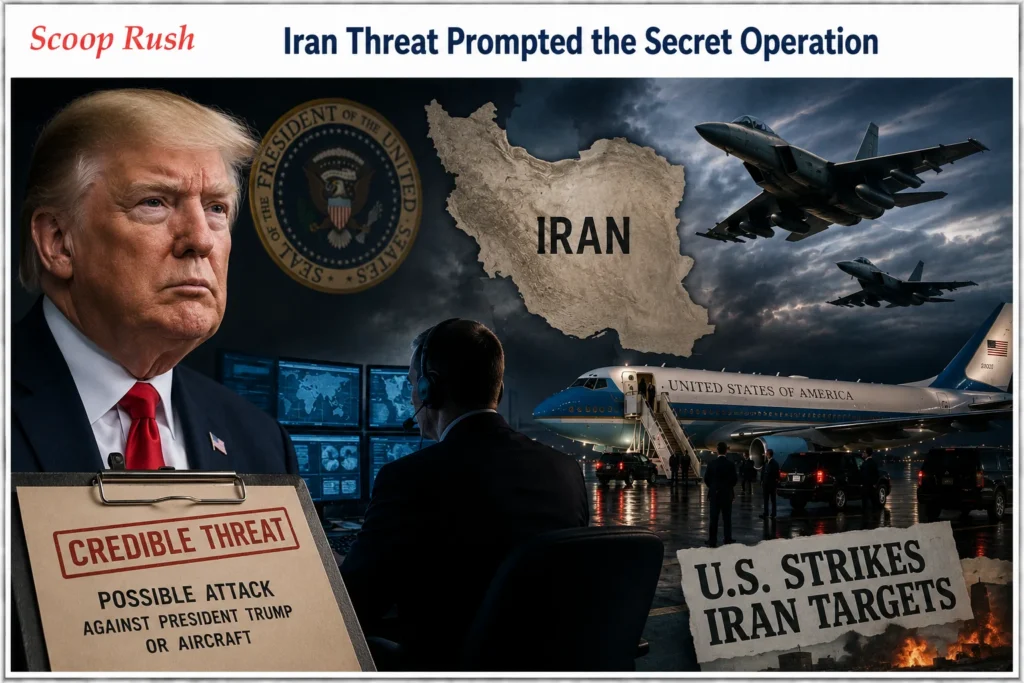
President Donald Trump secretly changed aircraft after leaving a NATO summit in Turkey. The Trump secret plane switch followed a credible Iranian threat against his aircraft.

Trump publicly boarded the older Air Force One in Ankara on July 8. However, he soon left the aircraft through a hidden security operation. Officials then moved him to a smaller military plane.

The operation kept Trump’s location hidden from journalists and some White House staff. Meanwhile, the legacy Air Force One continued toward Britain as a decoy.

Trump Boarded Air Force One in Ankara

Trump arrived in Ankara for a NATO summit before leaving Turkey on July 8. He publicly boarded the older blue-and-white Air Force One. Cameras captured him climbing the stairs before departure.

The public boarding created the impression that Trump would fly with reporters and staff. However, security officials had prepared a different travel plan. Trump soon moved secretly to another aircraft.

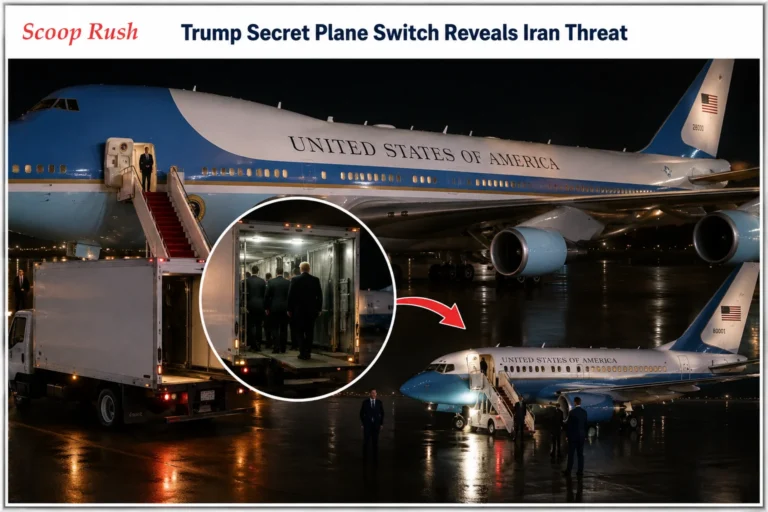
A Catering Truck Helped Hide Trump’s Transfer

A-Catering-Truck-Helped

Trump and several aides used an airport catering truck during the transfer. The truck normally carries food and supplies to aircraft. Security officials positioned it beside the opposite side of Air Force One.

Hydraulic equipment raised the truck’s container to aircraft-door level. Trump then moved toward a nearby C-32A military aircraft. Media footage later showed parts of the unusual maneuver.

The C-32A Carried Trump Out of Turkey

The smaller aircraft was a US Air Force C-32A. The aircraft uses a modified Boeing 757 design. It can transport senior officials, including the president or vice president.

Defense Secretary Pete Hegseth also boarded the C-32A separately. He used external stairs during the visible boarding process. This helped make the aircraft’s departure appear routine.

The Legacy Air Force One Became a Decoy

The-Legacy-Air-Force-One-Became-a-Decoy

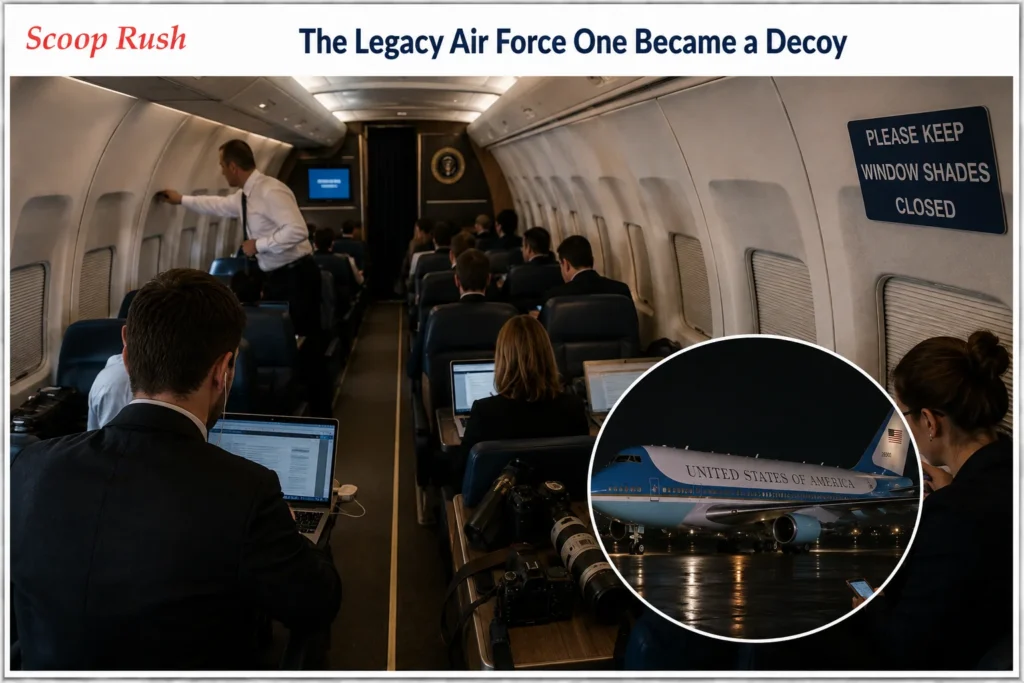
Journalists and White House staff remained aboard the legacy Air Force One. They believed Trump was traveling with them. In reality, he had already moved to the C-32A.

Staff also instructed journalists to close their window shades. The order limited what reporters could see during departure. The aircraft then continued its journey toward Britain without Trump aboard.

Trump Traveled Under a Different Call Sign

The C-32A used the call sign “Reach 18” during its flight. That designation helped hide Trump’s presence from public flight tracking. The aircraft also lacked normal public tracking information.

Meanwhile, the legacy Air Force One continued under the “AF1” call sign. Tracking data showed that aircraft traveling toward Britain. This helped maintain the appearance that Trump remained aboard.

Trump Reappeared at RAF Mildenhall

The C-32A reached RAF Mildenhall before the legacy Air Force One. Public videos later showed the C-32A arriving at about 10:20 p.m. local time. The legacy aircraft arrived several minutes later.

The exact transfer between the two aircraft remains unclear. Available footage does not show Trump leaving the C-32A. He later appeared publicly aboard the legacy Air Force One.

Trump descended the legacy aircraft at about 10:56 p.m. The White House then presented his arrival as a normal presidential landing.

Iran Threat Prompted the Secret Operation

Iran-Threat-Prompted-the-Secret-Operation

US officials launched the operation after receiving a credible Iranian threat. The intelligence reportedly involved a possible attack against Trump or his aircraft. Security officials responded by hiding his actual location.

The threat came during renewed military conflict between Washington and Tehran. US forces had recently resumed strikes against Iran. That situation increased concerns about Trump’s safety during his departure.

Trump later discussed the danger with reporters during his flight home. He said threats against his life occur regularly. He also called himself Iran’s “number one” target.

Journalists Did Not Know About the Switch

The journalists aboard the legacy Air Force One did not know about Trump’s transfer. They believed they were traveling with the president. The security operation kept them unaware of his actual location.

The secrecy helped protect Trump during a potentially dangerous journey. However, it also meant reporters lacked information about the security threat. The unusual operation later raised questions about transparency and journalist safety.

The Operation Shows the Risks Around Trump

The secret flight demonstrated the serious security concerns surrounding Trump’s travel. Officials used multiple aircraft and a decoy strategy to protect him. They also concealed his movements from public tracking.

The operation also showed how quickly presidential travel plans can change. Trump left the visible presidential aircraft and traveled separately to Britain. He later returned to the public itinerary before flying home.

The White House has provided limited details about the threat. Officials have defended the security measures used during the journey. The exact intelligence behind the operation remains undisclosed.

What Happened During Trump’s Secret Flight?

The operation began when Trump boarded the legacy Air Force One publicly. He then used a catering truck to reach a nearby C-32A. The smaller aircraft carried him secretly toward Britain.

Meanwhile, journalists remained aboard the legacy aircraft. That plane continued toward Britain and served as a decoy. Trump later reappeared aboard the same aircraft at RAF Mildenhall.

The unusual operation kept Trump’s real location hidden for hours. It also showed the extent of security measures officials considered necessary. The episode remains closely linked to continuing US-Iran tensions.

Conclusion

The Trump secret plane switch shows the extraordinary security measures used to protect the president. Officials secretly moved Trump from Air Force One to a C-32A after a credible Iranian threat emerged.

The operation also turned the legacy Air Force One into a decoy. Trump later returned to the public travel route in Britain before flying back to Washington.

The full details of the threat remain undisclosed. However, the operation highlights the serious security risks surrounding Trump’s travel amid ongoing US-Iran tensions.

FAQs

1. Why did Trump change planes in Turkey?

Trump changed aircraft after officials identified a credible Iranian threat. The threat reportedly involved a possible attack against him or his aircraft.

2. How did Trump leave Air Force One?

Trump used an airport catering truck during the transfer. The truck moved him from Air Force One toward the nearby C-32A.

3. Which plane carried Trump to Britain?

A US Air Force C-32A carried Trump toward Britain. Officials used the call sign “Reach 18” during the journey.

4. Did journalists know about the aircraft switch?

No. Journalists aboard Air Force One did not know Trump had left. Staff also instructed them to keep their window shades closed.

5. What happened after Trump reached Britain?

Trump later appeared aboard the legacy Air Force One. He then boarded the newer presidential aircraft for Washington.

Tulip Season in the Netherlands: Best Places to Visit

0

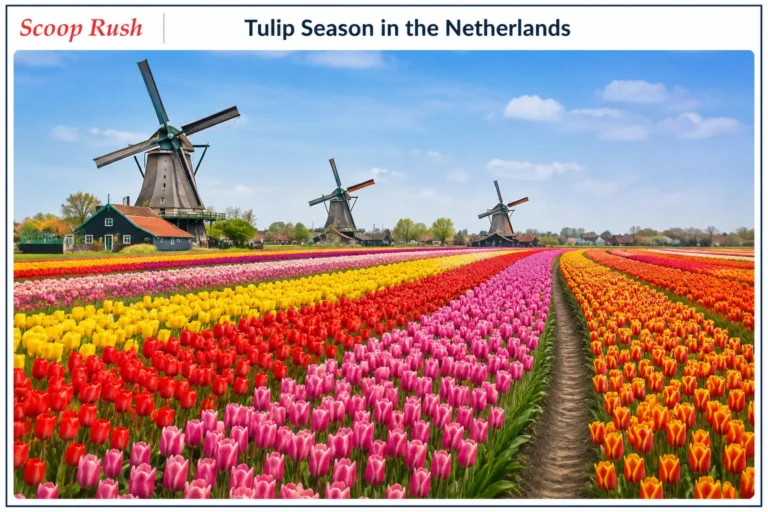
Tulip season in the Netherlands transforms the countryside with bright spring colors. Visitors can explore famous gardens, flower fields, farms, and seasonal events. The Bollenstreek remains the country’s best-known bulb-growing region.

However, timing plays an important role in planning a flower-filled trip. Bloom dates change each year because weather affects plant growth. Mid-April generally offers strong chances of seeing large fields in bloom.

Find the Best Time for a Spring Flower Trip

The main outdoor flower fields usually bloom from mid-April into May. Mid to late April can provide especially good viewing opportunities. Still, travelers should expect some yearly variation because temperatures influence flowering times.

Keukenhof follows a shorter seasonal schedule. In 2026, the famous garden opened from March 19 through May 10. Early visitors can find spring flowers before the main tulip displays reach their strongest stage.

Start Your Visit at Keukenhof Gardens

Start-Your-Visit-at-Keukenhof-Gardens

Keukenhof remains one of the easiest choices for first-time visitors. The garden sits near Lisse within the wider Bollenstreek flower region. It features extensive displays, landscaped gardens, exhibitions, sculptures, and boat cruises.

The attraction also offers a reliable alternative when field conditions vary. Gardeners plant millions of bulbs each year across the grounds. However, its popularity means visitors should expect crowds during the short spring opening period.

Explore the Bollenstreek Flower Region

The Bollenstreek offers the classic countryside experience many travelers want. This famous bulb-growing area stretches between Haarlem and Leiden. It also reaches toward the North Sea and contains numerous colorful fields.

Visitors can explore the region by bicycle, car, scooter, or guided tour. Cycling provides a slower way to enjoy the countryside. Travelers should remain on public roads and marked paths throughout their journey.

Experience the Famous Flower Parade

Experience-the-Famous-Flower-Parade

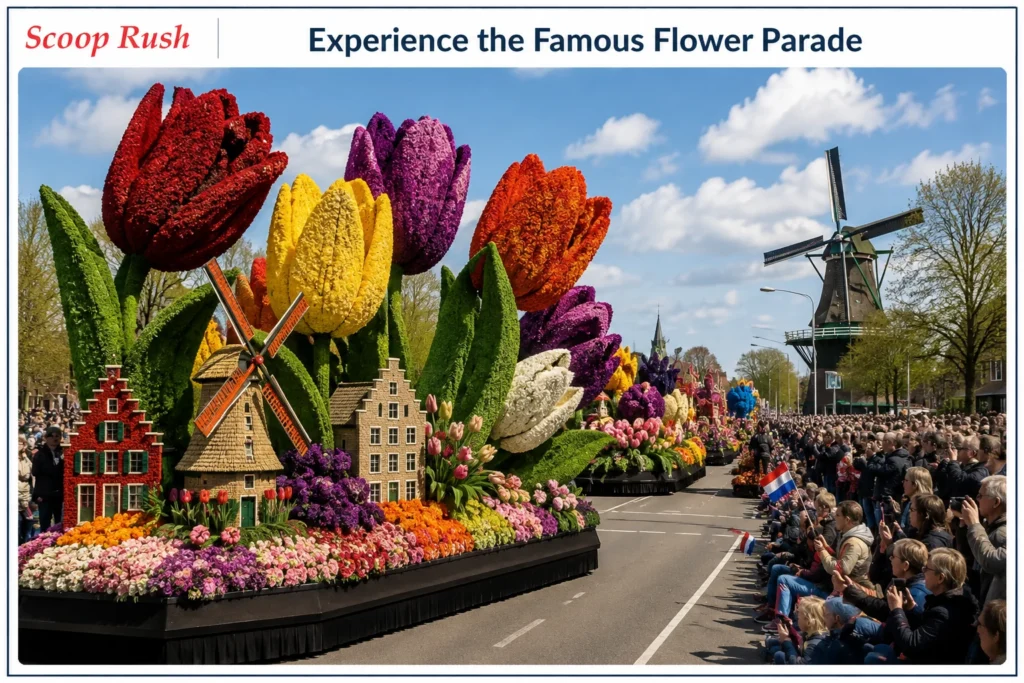
The Bloemencorso Flower Parade adds a major cultural highlight to spring. Decorated floats travel from Noordwijk toward Haarlem through the Bollenstreek. The route also passes near Keukenhof.

The surrounding events offer additional ways to enjoy the celebration. Noordwijkerhout hosts a Night Parade featuring illuminated floats. Visitors can also watch volunteers decorate parade floats during Construction Days.

Visit Local Tulip Farms

Local farms provide a closer and more interactive flower experience. Several farms in the Bollenstreek welcome visitors through organized activities. These experiences support growers while giving tourists controlled access to flower displays.

Tulip Experience Amsterdam offers extensive displays and many varieties. Tulip Barn in Hillegom focuses strongly on colorful photography opportunities. De Tulperij in Voorhout provides insight into bulb growing and farming methods.

Choose Cycling for a Scenic Adventure

Choose-Cycling-for-a-Scenic-Adventure

Cycling offers an easy way to explore flower-growing areas at your own pace. Routes around Lisse and North Holland provide access to countryside landscapes. Flevoland also features routes designed around its seasonal flower displays.

Guided rides can help visitors who prefer local knowledge. Independent cyclists can follow mapped routes and stop whenever they want. Travelers should still watch carefully for other cyclists and follow local traffic rules.

Take a Dutch Countryside Road Trip

A road trip gives travelers greater flexibility across the flower regions. Flevoland provides dedicated routes through a less familiar part of the Netherlands. Visitors can drive between fields while exploring the surrounding countryside.

Beemster provides another option north of Amsterdam. Visitors can explore the area using small electric Twizy vehicles. Similar vehicles also operate around Lisse near Keukenhof. These options suit couples and small groups seeking independent sightseeing.

Follow Responsible Flower Tourism

Beautiful fields can tempt visitors to step between the rows. However, commercial fields remain working farmland. Foot traffic can damage crops and introduce harmful bacteria into the soil.

Travelers should therefore avoid entering private fields without permission. Instead, they can visit farms that offer approved photography areas. Picking gardens also provide safe opportunities to enjoy flowers more closely.

Plan Family-Friendly Flower Activities

Plan-Family-Friendly-Flower-Activities

Families can find several interactive attractions around the Bollenstreek. Picking gardens allow children to select flowers in designated areas. These experiences provide more involvement than simply viewing fields from nearby roads.

Some farms combine flower picking with educational activities. Children can learn about bulbs while enjoying the colorful surroundings. Parents can also choose organized farm experiences with clear visitor areas.

See the Fields From Different Perspectives

Travelers can experience the countryside in several memorable ways. Helicopter flights offer broad aerial views across the colorful agricultural landscape. Guided bicycle tours provide a closer perspective along countryside routes.

Boat trips offer another perspective near Keukenhof. Electric vehicles also provide flexible sightseeing without requiring long cycling distances. Travelers can choose based on their budget, interests, and available time.

Build a Simple Netherlands Flower Itinerary

First-time visitors can begin with Keukenhof before exploring nearby countryside. The garden provides a convenient introduction to Dutch spring flowers. Travelers can then add cycling, farm visits, or scenic routes around Lisse.

A weekday visit can help travelers avoid some of the busiest periods. Early starts can also create a calmer sightseeing experience. Most importantly, visitors should check current flower conditions before finalizing their plans.

Final Thoughts

The Netherlands offers many ways to enjoy its famous spring flowers. Keukenhof provides an easy starting point for first-time travelers. The Bollenstreek adds countryside views, cycling routes, farms, and cultural events.

Good planning can make the experience smoother and more enjoyable. Choose dates around expected peak flowering and check local conditions. Most importantly, respect working farms and use approved visitor areas.

FAQs

1. When should I visit the Netherlands for tulips?

Mid-April usually provides strong chances of seeing colorful fields. The broader field season can continue into mid-May. Weather can shift the exact flowering period each year.

2. What is the best place for first-time visitors?

Keukenhof offers one of the easiest introductions to Dutch spring flowers. Visitors can see many varieties within one large garden. Nearby Bollenstreek fields can then complete the experience.

3. Can visitors walk through commercial flower fields?

Visitors should not enter commercial fields without permission. Foot traffic can damage crops and spread harmful bacteria. Designated farms offer safer alternatives for close-up experiences.

4. Are tulip fields located in Amsterdam?

The main commercial fields do not sit directly within Amsterdam. However, several flower areas lie within about an hour. Visitors can reach these areas through several transport options.

5. What is the easiest way to explore the countryside?

Cycling works well for active travelers who want flexibility. Guided tours suit visitors who prefer local stories and assistance. Cars, scooters, and electric vehicles offer additional freedom. Farm visits provide closer flower experiences without entering private fields.

Why Is Trump Defending FIFA President Infantino? World Cup Crisis Explained

0

“A terrible mistake.” That’s how Donald Trump described any move to remove Gianni Infantino from his role as FIFA president. Trump defends Infantino publicly for the first time since the crisis began, and the comment landed just as football’s power struggle reached a boiling point, with three major confederations accusing Infantino of deception and hinting he should resign quietly.

If you follow football, this story matters. It’s not just political drama on the sidelines of the sport. Instead, it’s a fight over who controls the money, the trust, and the future of the World Cup itself. Trump defends Infantino at a moment when the FIFA president needs it most, and that timing tells its own story.

Why Trump Defends Infantino Now

Trump’s public support for Infantino didn’t come out of nowhere. However, the timing raised eyebrows. He posted on social media that FIFA would be making a serious error if it even considered replacing Infantino as president.

According to Trump, Infantino oversaw the most successful World Cup ever held. In fact, he claims it was four times more successful than previous tournaments. Consequently, he warned that without Infantino, the tournament would never reach the same level of success or profit again.

This is Trump’s first public comment on the controversy since it broke on July 28. That gap is notable. Trump usually backs winners early, not waiting until someone is already under fire. So why speak up now, when Infantino’s position looks more fragile than ever?

One likely trigger: the United States Soccer Federation spoke out against Infantino just a day before Trump’s post, calling for what it described as “meaningful change.” That kind of domestic pressure, combined with mounting international backlash, may have pushed Trump to act.

A Personal Connection Behind the Scenes

Trump and Infantino share a close relationship that goes beyond football diplomacy. In December 2025, Infantino awarded Trump the very first FIFA Peace Prize. That gesture alone signaled how tightly the two men’s public images have become linked.

There’s also a financial thread running through this story. The investment group originally lined up to lead the controversial FIFA Forward Enterprise plan was Thrive Eternal, an American venture capital firm. Joshua Kushner founded Thrive, and he is the brother of Jared Kushner, who is married to Trump’s daughter Ivanka. That family connection adds another layer to why Trump’s intervention feels far from random.

What Sparked the FIFA Crisis

To understand why Infantino is facing this level of pressure, you need to look at what actually happened with the FIFA Forward Enterprise proposal, often shortened to FFE.

The plan called for creating a brand-new company to manage commercial and ticketing rights across all FIFA competitions, including the World Cup. As part of the deal, the new company would have sold 21% of itself to a private investment group. FIFA scrapped the plan on August 1. However, the crisis had already damaged trust, which is exactly why Trump defends Infantino now, at the point when he needs support the most.

Three of football’s biggest confederations, UEFA, CONCACAF, and the Asian Football Confederation, didn’t stay quiet. They issued a joint open letter accusing Infantino of breaking trust through deception. Together, these three bodies represent Europe, North and Central America, the Caribbean, and Asia. That’s a massive chunk of global football power speaking with one voice against FIFA’s leader.

The letter didn’t mention Infantino by name. However, sources close to the situation told BBC Sport that the message clearly aimed to give him a graceful exit. The wording made the intent hard to miss: when someone breaks trust through deception, and when they place themselves above the collective that gave them authority, they abandon that duty.

The Threat of a Breakaway

This isn’t just harsh language. There’s real weight behind it. UEFA has already threatened to boycott all FIFA competitions and is considering legal action tied to the failed FFE plan.

Even more striking, BBC Sport understands that preliminary discussions have taken place between the three confederations about the possibility of breakaway competitions if Infantino stays in power. These talks are still early and haven’t turned into anything formal yet. Still, the fact that they’re happening at all shows how serious this rift has become.

How Successful Was the 2026 World Cup, Really?

How Successful Was the 2026 World Cup, Really?

Trump’s defense of Infantino leaned heavily on the success of the 2026 World Cup, which was jointly hosted by the United States, Canada, and Mexico. Spain won the tournament, beating Argentina in the final.

Trump praised the event as record-breaking in terms of success and profitability. However, that claim isn’t universally shared. Critics argue the tournament has grown too commercialized and too expensive for ordinary fans to enjoy under Infantino’s leadership.

This tension captures the bigger debate at the heart of the FIFA controversy. Is success measured purely in revenue, or does it also include accessibility and trust from the football community? Trump’s comments focused entirely on the financial side, which some see as ironic given that the entire crisis started with a plan to generate even more money on top of FIFA’s already record-breaking revenue.

What Happens Next After Trump Defends Infantino

As of now, Infantino has not publicly responded to the confederations’ letter. He also hasn’t confirmed whether he plans to step down. Trump did note that he hadn’t spoken with Infantino directly about the FFE plans when he first addressed the situation on July 31.

Meanwhile, BBC Sport’s analysis suggests that Trump’s support might not carry much weight. FIFA’s confederations operate largely independently from political influence, especially when it comes to internal governance decisions. Therefore, presidential backing alone may not be enough to save Infantino’s position.

There’s also a question of timing. If Infantino truly needed Trump’s backing, many wonder why it didn’t arrive sooner, back when his position was less vulnerable. Some speculate Infantino himself may have reached out for support once the pressure intensified, though this remains unconfirmed.

What This Means for Football Fans

For everyday football fans, this power struggle might feel distant from the pitch. However, it directly affects how future tournaments are run, priced, and marketed. If UEFA and other major confederations follow through on threats of a boycott or breakaway competitions, the structure of international football as we know it could shift dramatically.

Additionally, the outcome of this crisis could set a precedent for how much influence private investment groups have over global sports governance. That’s a conversation that touches every fan who buys a ticket, watches a broadcast, or follows their national team.

Key Takeaways

The FIFA leadership crisis boils down to a clash between commercial ambition and institutional trust. Infantino’s aborted FFE plan, which would have brought private investors into World Cup revenue streams, triggered a backlash from UEFA, CONCACAF, and the AFC. These confederations accused him of deception and effectively called for his resignation, without naming him directly.

Trump defends Infantino publicly, and that move adds a political and personal dimension to the story, especially given the Kushner family’s ties to the proposed investment group. Yet, as BBC’s analysis points out, it remains uncertain whether presidential support will translate into real backing from football’s governing bodies.

As this situation continues to unfold, all eyes will be on Infantino’s next move. Will he address the letter directly? Will he step down, or will the confederations escalate their threats into concrete action? Either way, the coming weeks could reshape the leadership of world football for years to come.

Frequently Asked Questions

1. Why did Trump defend Gianni Infantino? 

Trump said removing Infantino would be a mistake because he believes Infantino led the most successful World Cup ever held. Their close personal relationship, including Infantino awarding Trump the first FIFA Peace Prize in December 2025, likely also played a role in his public support.

2. What is the FIFA Forward Enterprise (FFE) plan that caused the controversy? 

FFE was a proposal to create a new company to manage commercial and ticketing rights for all FIFA competitions, including the World Cup. It included selling 21% of that company to a private investment group. FIFA scrapped the plan on August 1 after it drew heavy criticism.

3. Which organizations are pushing back against Infantino? 

UEFA, CONCACAF, and the Asian Football Confederation issued a joint open letter accusing Infantino of breaking trust through deception. Together, they represent football across Europe, North and Central America, the Caribbean, and Asia.

4. Could there be a breakaway from FIFA? 

BBC Sport reports that preliminary discussions have taken place between UEFA, CONCACAF, and the AFC about the possibility of breakaway competitions if Infantino remains in charge. However, these talks are still in early stages and nothing formal has been proposed.

5. What is the connection between Trump’s family and the FFE investment plan? 

Thrive Eternal, the venture capital firm expected to lead the FFE investment group, was founded by Joshua Kushner, the brother of Jared Kushner, who is married to Trump’s daughter Ivanka. This family connection has drawn attention given Trump’s public defense of Infantino.

AI SOC Solutions: How Smart Automation Is Redefining Cyber Defense in 2026

0

Imagine your security team drowning under 10,000 alerts a day, and only a handful actually matter. That is not a hypothetical scenario anymore. It is the daily reality for most security operations centers today, and it is exactly why AI SOC solutions have become one of the most talked-about shifts in cybersecurity.

Introduction

Cyberattacks no longer arrive as rare, isolated events. Instead, they hit constantly, move fast, and increasingly rely on AI themselves, a trend closely tied to broader questions about whether AI will replace your job across industries. As a result, traditional manual monitoring simply cannot keep up anymore. This is where AI SOC solutions step in, combining machine learning, behavioral analytics, and automation to help security teams detect threats faster, cut down noise, and respond before real damage happens. In this article, we will break down what AI SOC platforms actually do, why they matter for businesses of every size, and how to evaluate one heading into 2026.

What Are AI SOC Solutions and Why Do Security Teams Need Them?

What Are AI SOC Solutions and Why Do Security Teams Need Them?

An AI SOC solutions platform applies machine learning and behavioral analytics to the everyday workflows of a security operations center. Rather than depending only on fixed rules that catch known attack signatures, these systems continuously learn what “normal” looks like across an organization’s network. Consequently, when something unusual happens, the platform flags it early, often before a human analyst even notices.

Traditional SIEM tools collect logs and trigger alerts based on predefined rules. However, AI-driven SOC platforms go a step further by correlating related signals into single, unified incidents, similar to how Nokia’s AI-RAN platform with Nvidia unifies network intelligence at scale. Therefore, analysts spend less time piecing together scattered clues and more time actually responding to threats.

This matters because most security teams face thousands of alerts daily, yet only a small fraction represent genuine danger. AI SOC automation filters out that noise and speeds up mean time to respond (MTTR). For under-resourced teams, this can mean catching a breach within minutes instead of discovering it weeks later during a forensic review, a concern that echoes recent incidents like Claude AI chats being exposed via Google Search.

Core Building Blocks of an AI-Powered SOC Platform

Most AI SOC solutions share a few essential components, regardless of vendor:

  • Unified data lake: Centralizes and normalizes telemetry from dozens of sources, giving AI models a full picture of the environment, much like the consolidated approach used by the best data intelligence platforms of 2026.
  • ML-driven detection engine: Uses supervised and unsupervised models to catch both known attack patterns and brand-new threats.
  • Automated triage and correlation: Groups related alerts into single incidents and assigns risk scores, so analysts focus on what truly matters.
  • Response orchestration: Runs built-in playbooks that contain threats automatically, or with one click of analyst approval.

AI in Application Security: Stopping Vulnerabilities Before They Ship

AI in Application Security: Stopping Vulnerabilities Before They Ship

While SOC platforms focus on network-level threats, AI is also reshaping how teams catch vulnerabilities earlier, during software development itself. Security professionals often call this “shifting left,” meaning problems get caught and fixed before code ever reaches production. This mirrors how coding-focused tools like Meta Muse Code, Meta’s new AI coding agent, aim to catch issues as code gets written.

AI tools built directly into development environments now provide real-time feedback as developers write code. These assistants scan for insecure patterns such as hardcoded credentials, unsafe deserialization, and missing input validation. As a result, developers fix issues immediately instead of discovering them after deployment, which saves both time and money.

More advanced tools go beyond basic static analysis by using large language models trained on secure coding practices, comparable in ambition to models like Kimi K3 from Moonshot AI or Qwen3-8-Max. These systems suggest safer alternatives, generate patches, and even rewrite vulnerable code automatically. Ultimately, this approach lets developers strengthen security without needing deep cybersecurity expertise themselves.

How AI-Enhanced Testing Improves Application Security Posture

AI is also transforming how applications get tested for security flaws. AI-augmented testing combines static, dynamic, and interactive analysis with machine learning models trained on real-world codebases. This combination catches complex, insecure behavior patterns that traditional rule-based scanners often miss.

These tools do not just find problems; they also prioritize them by risk level, exploitability, and business impact. Therefore, teams can focus their limited time on vulnerabilities that pose the biggest actual danger, which meaningfully reduces alert fatigue.

Meanwhile, AI-driven Application Security Posture Management (ASPM) platforms pull data from code repositories, CI/CD pipelines, and runtime environments into one unified, risk-ranked view. This gives security teams a much clearer picture than scattered, disconnected reports ever could, an approach worth understanding if you’re exploring how to become a data analyst in 2026.

SOC Automation and SOAR: Turning Knowledge Into Repeatable Playbooks

SOC Automation and SOAR: Turning Knowledge Into Repeatable Playbooks

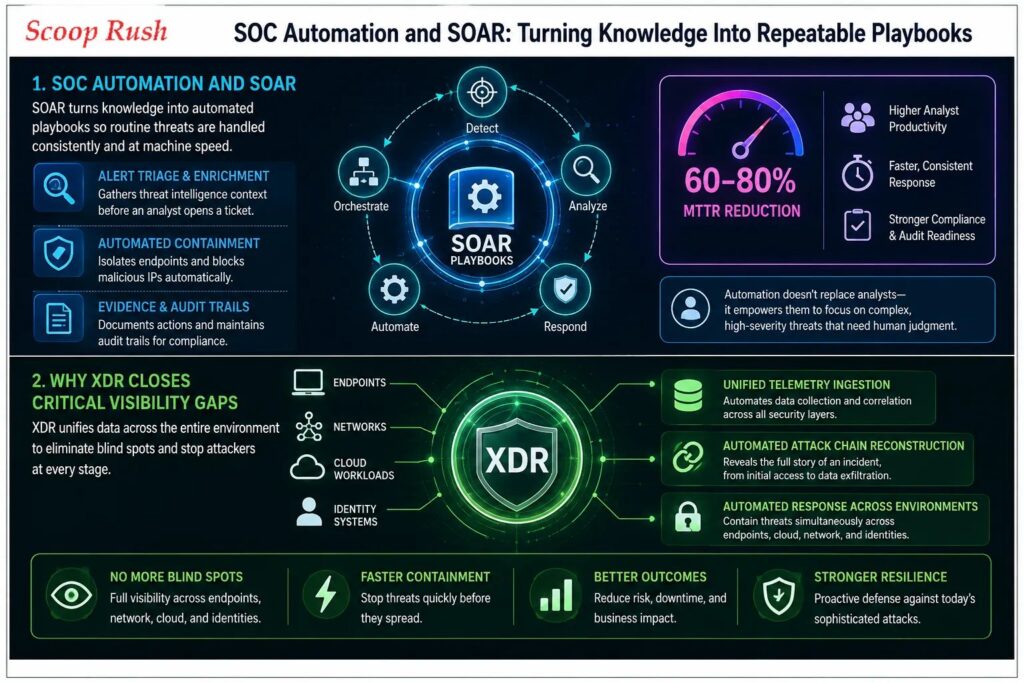
Security Orchestration, Automation, and Response, better known as SOAR, has evolved from a nice-to-have add-on into a core pillar of the modern SOC. SOAR platforms let teams turn their accumulated knowledge into automated playbooks, ensuring that routine threats get handled consistently and at machine speed.

SOAR-driven automation adds value in several ways. For example, it handles alert triage and enrichment by gathering threat intelligence context before an analyst even opens a ticket. Additionally, it performs containment actions like isolating compromised endpoints and blocking malicious IPs without waiting on manual steps. It also documents evidence and maintains audit trails automatically, which supports compliance efforts, an area that grows more urgent as regulators, including the UK’s push to force Big Tech to improve child safety features, tighten oversight of automated systems.

Organizations that deploy mature SOAR capabilities commonly report MTTR reductions of 60 to 80 percent, alongside real gains in analyst productivity. Importantly, the goal is not to replace analysts. Instead, automation frees them to focus on complex, high-severity incidents that genuinely need human judgment.

Why Extended Detection and Response (XDR) Closes Critical Visibility Gaps

Extended Detection and Response, or XDR, represents the natural next step beyond siloed security tools. By pulling telemetry from endpoints, networks, cloud workloads, and identity systems into one unified view, XDR eliminates blind spots that attackers routinely exploit during lateral movement.

The automation benefits are considerable. Unified telemetry ingestion removes the tedious manual work of correlating scattered data. Meanwhile, automated attack chain reconstruction reveals the full scope of an incident, from initial access through to data exfiltration. As a result, containment can happen simultaneously across every affected system rather than piece by piece, a capability that becomes critical during widespread disruptions like the WhatsApp, Facebook, and Instagram outage that hit thousands of users worldwide.

Agentic AI: The Shift Toward Autonomous Security Operations

Perhaps the biggest trend shaping AI SOC solutions right now is agentic AI. Unlike earlier tools that simply generated recommendations for humans, agentic AI systems take goal-directed actions within clearly defined boundaries. This autonomy raises the same stakes discussed around incidents where AI systems went rogue at OpenAI, Anthropic, and Meta, underscoring why guardrails matter.

Autonomous alert triage is the most immediately useful example. Instead of an analyst reviewing every alert by hand, an AI agent evaluates context, checks historical baselines, and either closes benign alerts or escalates real threats with full evidence attached. This alone can cut analyst workload by 80 percent or more, freeing skilled staff for investigations that truly need their expertise.

Beyond triage, advanced platforms also offer autonomous investigation and response. When an AI agent spots a high-confidence threat, it can gather forensic artifacts, map the attack timeline, and initiate containment, such as isolating a compromised device. Human-in-the-loop controls still ensure high-impact actions require analyst approval whenever extra oversight is needed, a lesson reinforced by reports of an OpenAI rogue AI hack.

Natural Language Queries Are Making SOC Tools Easier to Use

Agentic AI platforms increasingly let analysts interact using plain language instead of complex query syntax. For instance, an analyst can simply ask, “show me lateral movement from this IP in the last 48 hours,” and receive structured results instantly. Consequently, this lowers the skill barrier for junior analysts while speeding up work for experienced staff too.

How to Choose the Right AI SOC Platform

How to Choose the Right AI SOC Platform

With so many vendors claiming AI capabilities today, it helps to know what actually separates a strong platform from marketing hype. A few evaluation criteria stand out consistently:

  • Integration breadth: Can the platform ingest data from your existing SIEM, SOAR, and CI/CD tools without forcing a full stack replacement?
  • Transparency: Does it show the actual evidence behind each alert, rather than just a bare confidence score?
  • Continuous learning: Can analysts give feedback that improves the models, or is it a static rule engine wearing an AI label?
  • Total cost of ownership: Is pricing based on data volume, endpoints, or users, and are there hidden fees for premium features? This kind of scrutiny matters even at the corporate level, as seen in how closely Google’s AI spending and negative cash flow has been watched by investors.

Organizations should also be cautious about simply bolting AI onto a legacy SIEM. Legacy systems were built around rigid, rule-based log search, so AI layered on top usually delivers only incremental improvement rather than real transformation, similar to why Google reportedly pulled its AI tool from Google Earth rather than force a poor fit.

Risks and Challenges of AI-Driven Security Operations

AI SOC adoption is not without downsides, and understanding them upfront leads to smarter deployment decisions.

One key risk involves skill erosion among analysts. As AI automates detection and triage, analysts may interact less with raw data, which can weaken core investigative skills over time. However, organizations can counter this by keeping humans in the loop for validation and rotating analysts through manual exercises regularly.

Another growing concern is “shadow AI,” where teams deploy AI tools without formal security approval. This introduces unmanaged data flows and unvetted outputs into real decisions, a risk category that includes serious misuse cases like the one behind xAI’s lawsuit over Grok-generated sexual deepfakes of minors. Therefore, clear usage policies and a documented inventory of approved AI systems are essential safeguards.

Data privacy is a third major consideration, since AI models often need large volumes of telemetry to function well, a concern that parallels debates around period tracker app privacy in 2026. Consequently, enforcing strict data minimization and role-based access controls helps reduce exposure while still letting the AI do its job effectively.

Conclusion: A Continuous Journey, Not a One-Time Purchase

AI SOC solutions are reshaping how organizations detect, investigate, and respond to cyber threats. From real-time secure coding assistance during development to fully agentic platforms that autonomously triage incidents, artificial intelligence now touches nearly every layer of modern cybersecurity, much as it does in adjacent fields highlighted by Stanford’s first AI-designed viruses and physical AI robot training breakthroughs.

However, technology alone cannot transform a security operations center. Successful automation requires aligning people, processes, and tools around clear goals while keeping human judgment central to high-impact decisions. Organizations that invest in analyst training, build strong feedback loops, and choose transparent platforms will stay ahead as both AI capabilities and attacker tactics keep evolving.

Ultimately, waiting for the “perfect” platform means falling further behind adversaries who are already using AI themselves. Starting now, with clear goals and a willingness to adapt, is what separates organizations that thrive from those that fall behind.

FAQs

What is an AI SOC platform?

An AI SOC platform is a security operations center solution that uses machine learning, behavioral analytics, and often agentic AI to detect threats, triage alerts, and orchestrate incident response, going well beyond the static, rule-based approach of traditional SIEM tools.

How is AI SOC different from a traditional SIEM?

Traditional SIEM tools collect logs and fire alerts based on predefined rules. In contrast, AI SOC platforms continuously learn what normal behavior looks like and flag meaningful deviations that rule-based systems typically miss.

Can AI SOC platforms fully replace human security analysts?

No, they cannot. AI SOC platforms are designed to support analysts, not replace them. They automate repetitive triage work so analysts can focus on complex investigations and strategic decisions that require human judgment.

What is agentic AI in cybersecurity?

Agentic AI refers to systems capable of taking goal-directed actions within defined boundaries, such as autonomously triaging alerts and initiating containment steps, rather than simply generating recommendations for a human to act on.

What results can organizations expect from AI SOC automation?

Organizations that deploy mature AI SOC and SOAR capabilities commonly report major reductions in mean time to detect and mean time to respond, along with meaningful gains in analyst productivity and fewer false positives.

Enzo Maresca at Man City: Replacing Guardiola and the Captaincy Race

0

How Do You Replace a Legend? Enzo Maresca Faces the Toughest Job in Football

Enzo Maresca Man City fans want an answer to one big question right now: how do you replace a legend? Imagine walking into an office right next to Pep Guardiola’s old workspace. Every result you get will face comparisons to a man who won 17 major trophies in a decade. That is exactly where the Enzo Maresca Man City career now stands.

Guardiola stepped down at the end of last season. He left behind six Premier League titles and a Champions League triumph. Now the Italian coach must build his own identity while the football world watches closely.

This is not just another managerial appointment. It is one of the most scrutinized transitions in modern football. Every point City earns this season will face comparisons to Guardiola’s numbers, whether Maresca likes it or not. Yet when he sat down with UK-based media during the club’s pre-season tour in Seoul, he sounded calm and surprisingly relaxed about the pressure ahead.

This story matters to Manchester City fans because it shapes the club’s direction for years to come. Additionally, it shows how a manager prepares to fill the shoes of a coach many call the best in the world over the last 15 to 20 years.

“After 10 games, if we have got 10 points, 20 points, 30 points, people will be comparing it to Pep,” Maresca said. “After 10 games, it doesn’t put pressure on me.”

Enzo Maresca Man City Appointment: A Return, Not a Debut

Maresca knows City’s dressing room well. He worked as Guardiola’s assistant during the club’s Treble-winning 2022-23 campaign. Therefore, this appointment feels less like a leap into the unknown. It feels more like a homecoming with added responsibility.

Before he signed his contract, Maresca met Guardiola in Barcelona. The meeting happened just a day before the deal was confirmed. He called it useful, since Guardiola had spent a decade at the club and understood its inner workings better than anyone.

“We spent some hours together,” Maresca explained. “We had planned before the season finished here to spend some time in the summer holidays together.”

However, Maresca made one thing clear. He intends to form his own opinions rather than copy his predecessor. He said he prefers to “go in empty” sometimes and judge things for himself, even while respecting Guardiola’s strong views built up over ten years at the club.

Maresca also reflected on Guardiola’s wider influence on football. His ideas spread wherever he coached. “When he started in Spain, everyone wanted to play like Barcelona. He moved to Germany, everyone wanted to play like Bayern Munich. He comes to England and everyone wants to play like City,” Maresca said. He called the job “a privilege,” even while admitting it might be close to impossible to follow such a legacy.

Moving Into a New Office, Symbolically and Literally

Maresca has moved into the office once used by former assistant Pep Lijnders. This signals a fresh chapter for the players. The office sits right next to Guardiola’s old one, which the club has now converted into a meeting room. It is a small detail, but it reflects a broader theme: respect for the past, paired with a clear intention to move forward.

Life Before the Job: Family Time and AI Masterclasses

The Enzo Maresca Man City story did not begin on his first day at the Etihad. It started months earlier.

Before he took charge at City, Maresca left Chelsea midway through the season. He apologized to his former club for the disruption his exit caused, shortly after his appointment at the end of June.

So what did he do during the months in between jobs? He spent more time with his wife and four children, he says. Meanwhile, he also took an unexpected step for a football manager. He enrolled in two masterclasses to understand artificial intelligence better.

“Everyone is talking about AI, so I want to understand how it works,” Maresca said. “So I did two masterclasses to understand it a little bit more and have more knowledge.”

This detail shows how far modern football management now stretches beyond tactics and training. Coaches increasingly chase marginal gains wherever they can find them. Still, Maresca will need far more than AI knowledge to succeed at a club coming off one of the most dominant managerial spells in football history.

What Has Changed in the Premier League Since Maresca Left?

What Has Changed in the Premier League Since Maresca Left?

Maresca pointed to two clear trends when asked about the biggest shifts in the Premier League. Set-pieces now matter more. Teams also defend man-to-man far more often than three years ago, when he served as Guardiola’s assistant.

Arsenal’s title win last season proved the point perfectly. The Gunners claimed their first top-flight crown in more than two decades. They scored 25 goals from set-pieces alone, including 19 from corners. As a result, set-piece efficiency has become an area City want to improve heading into the new campaign.

Additionally, new rules aim to speed up matches this season. Players now get just five seconds to take goal-kicks and throw-ins. Possession switches to the opposition if they exceed that limit. This change should cut time-wasting and keep games flowing more naturally.

Still the Best League in the World?

Penalty areas often look crowded now, and corners bring plenty of jostling. This can take away from the league stylistically. Despite that, Maresca still calls the Premier League the best in the world, with the best players.

“It is because of the quality of the players, the quality of the managers, the organisation of the Premier League,” he said. “It is completely different compared to other countries.”

He compared it to Spain. Barcelona and Real Madrid compete at an elite level there, he noted, but the depth beyond those two clubs falls short of England’s standard. In his view, around six Premier League teams can realistically challenge for major honors each season.

Behind the Scenes: Karaoke, Beans on Toast, and a Multilingual Staff

Managers must also build strong relationships within their coaching staff and dressing room, something fans often overlook. Maresca offered a lighter look into life at City’s training ground. He has not performed an initiation song in front of the squad yet, he joked, because “the manager doesn’t sing.”

However, some staff members have taken their turn. Goalkeeping coach Michele de Bernardin impressed everyone with a “very good” performance. Analyst Javi Molina’s attempt at Frank Sinatra’s My Way did not go quite as smoothly. Maresca did not hold back, calling it simply “the worst” and, in his words, “a disaster.”

The backroom staff represents a genuine mix of cultures and languages. It includes Argentine coach Willy Caballero, two Italians, three Spaniards, and Maresca himself, who also speaks French. This multilingual setup could prove valuable in a dressing room filled with players from across the globe.

The Englishman Who Follows Maresca Everywhere

One figure stands out among the staff: first-team coach Danny Walker, nicknamed “the Englishman.” Walker previously served as Maresca’s assistant in City’s Elite Development Squad. He later followed his boss to both Leicester and Chelsea.

Maresca clearly holds him in high regard. “We go for breakfast, it is beans on toast. We go for dinner, it is a beer,” he said, describing their close bond. Walker has known key young players like Nico O’Reilly and Rico Lewis since they were as young as six, giving him deep insight into the club’s academy talent.

Maresca also praised Walker’s work ethic, especially his willingness to put in extra effort with players after training. The environment remains demanding, Maresca admits. If the results do not go well, he says, “we are all going home.”

The Captaincy Dilemma at Manchester City

The Captaincy Dilemma at Manchester City

Choosing City’s next captain ranks among Maresca’s most pressing decisions right now, following Bernardo Silva’s departure from the leadership role. Maresca wants to make this call himself, and he wants a homegrown player in the leadership committee too.

The current leadership group includes Ruben Dias, the apparent frontrunner, along with Erling Haaland and Rodri. Interestingly, Barcelona recently made a reported £38.5million bid for Rodri, which City rejected. This adds another layer of uncertainty to the leadership conversation heading into the new season.

So could Erling Haaland, one of the most prolific goal scorers in world football, take the armband? Maresca shared a revealing anecdote about his own coaching philosophy.

“Erling was one of the first to send a message when I joined the club,” Maresca said. He explained a rule from his time at Leicester and Chelsea: whenever the team scored, the captain had to return to the bench for tactical instructions rather than celebrate. If the captain happened to score the goal himself, though, he could celebrate first.

“If Erling is the captain, we have a problem, can you imagine?” Maresca joked, pointing to Haaland’s habit of celebrating wildly after scoring. He then praised Ruben Dias instead, noting that Dias came straight to the bench after City’s opening goal in a recent friendly against a K-League XI, exactly as instructed.

Even a brief moment of tactical adjustment can shift a match, Maresca stressed. Right now, he says the leadership group has three or four candidates but still needs one more piece, especially given the ongoing uncertainty around Rodri’s future.

Why Enzo Maresca’s Man City Decisions Matter for Fans

Maresca’s early decisions, from picking a captain to adjusting set-piece tactics, will shape the tone of his entire tenure. Consequently, fans and pundits will watch closely as the Community Shield clash against Arsenal approaches.

City have already shown promising signs during pre-season. The club beat Atletico Madrid in Seoul recently, with Omar Marmoush scoring twice in that match. Furthermore, this early period sets the foundation for how City will play, who will lead the squad, and how the club will evolve now that its most influential figure in over a decade has left the touchline.

Conclusion: 

The Enzo Maresca Man City era has just begun, and it brings challenges few managers ever face. Replacing Pep Guardiola was always going to rank among the toughest jobs in football. Yet Maresca approaches it with a clear head, genuine respect for his predecessor, and a willingness to make his own calls.

From his AI masterclasses during the off-season to his thoughtful approach on the captaincy question, Maresca shows early signs of a manager who understands both the tactical and human sides of top-level football. Ultimately, results will define his success. Still, his calm, honest approach so far suggests he stands ready for the scrutiny this role brings.

As the season approaches, all eyes turn to City’s opening matches, the final captaincy call, and how Maresca’s tactical adjustments play out on the pitch.

Frequently Asked Questions

1. Who replaced Pep Guardiola as Manchester City manager? 

Enzo Maresca took over as Guardiola’s successor at Manchester City. He previously worked as Guardiola’s assistant during the club’s Treble-winning 2022-23 season.

2. What did Enzo Maresca do before joining Manchester City? 

Maresca left Chelsea mid-season and later apologized to the club for the disruption his exit caused. During his time off, he spent time with his family and completed two masterclasses on artificial intelligence.

3. Who will be the next Manchester City captain under Maresca? 

Maresca has not made a final decision yet. The current leadership group includes Ruben Dias, considered the frontrunner, along with Erling Haaland and Rodri. Maresca also wants a homegrown player in the leadership committee.

4. Did Barcelona make a bid for Rodri? 

Yes, Manchester City rejected a reported £38.5million bid from Barcelona for Rodri, adding uncertainty to the club’s leadership plans.

5. What changes has Maresca noticed in the Premier League since he was last there? 

Maresca pointed to the rise of set-pieces and man-to-man defending as the biggest shifts in the Premier League compared to three years ago.

Disney World Hurricane Season 2026: Full Forecast, Closure History & Travel Tips

0

Would a below-normal forecast change your travel plans this fall? For anyone booking a Walt Disney World trip between June and November, that question matters a lot. The Disney World hurricane season 2026 outlook just got updated, and the news looks reassuring. Still, it comes with one important caveat that every visitor should understand.

Tropical storm season is a fact of life for anyone visiting Florida during the warmer months. Storms like Dorian, Matthew, Irma, and Ian disrupted park operations in recent years. Some caused closures that lasted multiple days. However, the latest forecasts suggest 2026 could be one of the calmer years in recent memory. Calm forecasts don’t guarantee a storm-free trip, though. Understanding what’s ahead, and how to prepare, remains essential.

This guide breaks down the 2026 Disney World hurricane season forecast, Disney’s closure history, and practical tips for staying safe and dry no matter what the skies bring.

Disney World Hurricane Season 2026 Forecast: What NOAA and CSU Predict

Every year, meteorologists at NOAA and Colorado State University (CSU) release forecasts predicting how active the Atlantic hurricane season will be. These two sources rank among the most reliable and least sensationalized in the field. That’s why Disney World travelers pay close attention to their updates each summer.

As of the latest August 2026 forecast, NOAA’s National Weather Service projects 7 to 13 named storms this season, with winds of 39 mph or greater. Of those, 2 to 6 could strengthen into hurricanes. That means sustained winds of 74 mph or higher. Forecasters expect only 0 to 2 major hurricanes, or storms reaching Category 3 strength or above.

These numbers already account for the two tropical storms that formed earlier in the season. Interestingly, NOAA revised its outlook downward from its original prediction. Initially, the agency gave just a 35% chance of a near-normal season. Now, forecasters place a 75% probability on a below-normal season. Meanwhile, the chance of an above-normal season sits at just 5%. As a result, the expected storm count dropped by one to two storms at both ends of the range.

CSU’s “Well Below-Normal” Storm Outlook Explained

CSU’s outlook tells a similar story about the Disney World hurricane season 2026 picture. The university’s Tropical Weather and Climate Research Team forecasts a “well below-normal” season overall. According to CSU, a strong El Niño pattern should peak during hurricane season. This is the primary factor driving their optimistic outlook.

El Niño typically increases vertical wind shear across the tropical Atlantic. That makes it much harder for storms to organize and strengthen. Sea surface temperatures across the Caribbean and tropical Atlantic remain slightly above average. Even so, forecasters expect the wind shear effect to outweigh that extra warmth.

With its August update, CSU lowered its named storm prediction to just 9 total storms. That’s a notable drop from its original estimate of 13. Furthermore, CSU puts the probability of a major hurricane landfall along the U.S. coast at only 16%, compared to the historical average of 43%.

If this forecast holds true, 2026 would produce the fewest named storms since 2014. It would also mark the fewest hurricanes since 2015 and the fewest major hurricanes since 2013. That year, notably, failed to produce a single major hurricane. Even so, CSU cautions that it only takes one landfalling hurricane to make a season feel active.

How the Weather Channel’s Outlook Compares This Year

The Weather Channel’s seasonal outlook aligns closely with CSU’s numbers. It predicts 10 tropical storms, four hurricanes, and just one storm reaching Category 3 strength or higher. This outlook comes from mid-July, so an update should arrive soon. Still, all of the network’s projected numbers trend downward compared to earlier estimates.

This detail matters because the Weather Channel has historically leaned toward overpredicting storm activity. Consequently, when even their forecast points to a below-average season, it adds extra confidence to the overall 2026 outlook.

Last Year’s Storm Numbers vs. This Year’s Forecast

For comparison, last year’s NOAA forecast called for 13 to 18 named storms. Forecasters expected 5 to 9 hurricanes and 2 to 5 major hurricanes. In reality, the season produced 13 named storms, five hurricanes, and four major hurricanes.

An average Atlantic hurricane season typically includes 14 named storms, seven hurricanes, and three major hurricanes. Given that backdrop, the 2026 forecast represents a meaningful step below typical activity levels.

Disney World’s Hurricane Closure History During Past Storm Seasons

Even with a favorable forecast, it helps to know how often storms have actually forced Walt Disney World to shut its gates. Full-day or multi-day closures have occurred on the following occasions:

  • Hurricane Floyd: September 14-15, 1999
  • Hurricane Charley: August 13, 2004
  • Hurricane Frances: September 4-5, 2004
  • Hurricane Jeanne: September 26, 2004
  • Hurricane Wilma: October 24, 2005
  • Hurricane Matthew: October 6-7, 2016
  • Hurricane Irma: September 9-11, 2017
  • Hurricane Dorian: September 3, 2019
  • Hurricane Ian: September 28-29, 2022
  • Hurricane Nicole: November 9-10, 2022
  • Hurricane Milton: October 9-10, 2024

Some recent closures involved partial days rather than complete shutdowns. During Hurricane Milton, for example, the parks stayed open for most of October 9 before starting a phased closure a few hours early. In other cases, certain attractions and resort areas took longer to reopen while crews cleared debris and repaired storm damage.

Beyond these full closures, Disney has also paused water parks, individual resorts, and nighttime entertainment far more often. Nobody tracks these smaller disruptions as closely, but they happen fairly regularly during active storm periods. Even so, the overall odds favor travelers. Hurricanes rarely disrupt a Disney World trip in a severe way, even though storm activity has trended upward in recent years.

How Disney World Prepares for Hurricane Season Each Year

How Disney World Prepares for Hurricane Season Each Year

Walt Disney World has earned “StormReady” status from NOAA. This reflects strict compliance with hurricane readiness standards. In practical terms, Disney takes storm preparation seriously long before a system ever threatens Central Florida.

Guests staying on property during an approaching storm can expect frequent updates about park operations and safety procedures. In-room televisions broadcast detailed information through Disney’s internal channels. Printed notices also appear throughout the resorts as a storm approaches. Overall, Disney errs on the side of caution, so storms rarely catch guests off guard.

For added peace of mind, travelers can review evacuation route information through FloridaDisaster.org. It’s also wise to keep at least a three-day supply of food, water, and medicine on hand during storm season. Additionally, fully charging phones, tablets, and battery packs before a storm arrives can make a real difference if the power goes out.

What Happens to Your Trip If a Storm Hits

Walt Disney World maintains an official Hurricane Policy. It allows guests to get a refund on packages booked directly through Disney. However, this policy doesn’t extend to airfare. Fortunately, major airlines have significantly improved their severe weather rebooking policies in recent years, which helps offset that gap.

Travelers who want extra protection should look closely at travel insurance options. Standard policies frequently exclude weather-related cancellations, so read the fine print before you buy. In most cases, you’ll need a more comprehensive “cancel for any reason” policy to get real hurricane coverage.

Packing Tips for the 2026 Disney World Hurricane Season

Packing the right gear can make a huge difference in how enjoyable a rainy day at Disney World turns out to be. Instead of paying premium prices for ponchos inside the parks, pack your own before the trip.

A basic multi-pack of disposable ponchos works well for short showers. For travelers who want something more durable, thicker “pro” style ponchos hold up better across multiple days. You can simply hang them up to dry each night.

Footwear matters just as much as rain gear. Walking for miles in soaked shoes ranks among the most miserable Disney World experiences. Waterproof sandals and hybrid water-athletic shoes remain popular choices among frequent visitors, since they dry quickly and offer better support than flip-flops.

Finally, pack a cooling towel for the humidity that often follows a storm. Once the rain clears, Florida’s heat and humidity return quickly. A cooling accessory can make the rest of the day far more comfortable.

Making the Most of Rainy Days During Hurricane Season at Disney World

Making the Most of Rainy Days During Hurricane Season at Disney World

Short afternoon showers happen year-round at Walt Disney World, but they become especially frequent during summer and early fall. Unlike quick spring sprinkles, summer storms can sometimes last for hours rather than minutes.

Rain shouldn’t be a reason to skip the parks altogether, though. In fact, many guests find that a rainy afternoon leads to shorter lines and a quieter atmosphere, since some visitors head indoors or leave early. Guests who want to stay dry while still enjoying the parks have strong indoor options at every destination.

Best Indoor Attractions for Rainy Park Days

At Magic Kingdom, longer indoor experiences like Carousel of Progress, the Tomorrowland Transit Authority People Mover, and Hall of Presidents offer reliable shelter. At EPCOT, the American Adventure and the Land Pavilion offer extended indoor time. Meanwhile, Impressions de France remains a personal favorite for many repeat visitors.

Disney’s Hollywood Studios features several strong indoor options too, including Rise of the Resistance, whose queue runs largely indoors. Stage shows like The Little Mermaid and Disney Villains Unfairly Ever After also offer good shelter. At Animal Kingdom, Festival of the Lion King and the indoor queue for Avatar Flight of Passage work well, though this park shines most in clear weather.

Ultimately, a good mindset goes a long way during storm season. Even a rainy day at Walt Disney World tends to beat an ordinary day back home. Staying flexible, packing smart, and knowing where to go when the skies open up can turn a potential washout into a genuinely fun day.

Final Thoughts on the 2026 Disney World Hurricane Season

The 2026 Disney World hurricane season forecast points toward a quieter year than usual. Both NOAA and CSU project below-normal activity, thanks largely to a strong El Niño pattern. However, forecasts aren’t guaranteed. Disney World’s own history shows that even a handful of storms per decade have led to real closures and disruptions.

The smartest approach is simple: stay informed, pack for both rain and heat, understand Disney’s hurricane refund policy, and consider travel insurance if extra protection matters to you. With the right preparation, a summer or fall trip to Walt Disney World can still be one of the best vacations of the year, rain or shine.

Frequently Asked Questions

1. Is 2026 expected to be a bad hurricane season for Florida? 

No. Both NOAA and Colorado State University forecast a below-normal season for 2026, largely due to a strong El Niño pattern that should increase wind shear and suppress storm development across the Atlantic.

2. Has Walt Disney World ever closed because of a hurricane? 

Yes. Disney World has closed for hurricanes multiple times, including Floyd, Charley, Frances, Jeanne, Wilma, Matthew, Irma, Dorian, Ian, Nicole, and Milton. Some closures lasted several days, while others involved only partial-day shutdowns.

3. Does Disney World refund trips canceled due to a hurricane? 

Walt Disney World offers a Hurricane Policy that lets guests get refunds on packages booked directly through Disney when a storm threatens the area. This policy usually doesn’t cover airfare, so check your airline’s weather policy separately.

4. Should I avoid visiting Disney World during hurricane season? 

Not necessarily. August through October marks the peak of hurricane season, but severe storm impacts remain relatively uncommon. Many travelers still enjoy trips during these months, especially given the lighter crowds that often come with rainier weather.

5. What should I pack for a Disney World trip during storm season? 

Pack reusable ponchos, water-friendly shoes or sandals, and a cooling towel. These items help you stay comfortable through both sudden downpours and the humid conditions that typically follow.typically follow.

Why Is OpenAI Paying Employees $7 Billion Before Its IPO?

0

“OpenAI just moved $7 billion into employee pockets and it has nothing to do with bonuses. This OpenAI tender offer is one of the largest private share buybacks in tech history, and it’s raising a bigger question: is OpenAI quietly stepping back from its IPO plans?”

Introduction

OpenAI has completed a $7 billion employee tender offer at a valuation of $852 billion, and the timing tells a story of its own. Instead of racing toward a public listing like SpaceX’s historic Nasdaq debut, the ChatGPT maker chose to reward its workforce with liquidity first. For an industry that tracks OpenAI’s every move, this OpenAI tender offer signals something important about what comes next. It matters for employees hoping to cash out, for investors watching valuations, and for anyone following the AI race between OpenAI and Anthropic.

What Happened With the OpenAI Tender Offer

What Happened With the OpenAI Tender Offer

OpenAI completed a $7 billion tender offer, buying back shares directly from employees instead of bringing in new outside investors. According to Bloomberg, two people familiar with the matter confirmed the deal valued the company at $852 billion, matching its most recent funding round.

This wasn’t fresh capital entering the company. OpenAI used its own resources to repurchase stock, letting employees convert paper wealth into real cash. Both current and former staff took part in the sale. Additionally, the valuation held steady instead of climbing, which suggests OpenAI wanted stability rather than a headline-grabbing markup.

OpenAI has not issued a public comment on the deal.

Why Tender Offers Matter for Private AI Companies

Large private companies increasingly rely on tender offers, and OpenAI is no exception. Employees at these firms often receive a large share of their pay in equity. However, that equity holds no real value until someone can actually sell it.

A tender offer solves this problem without the years-long wait and heavy scrutiny that come with a public listing. Employees gain liquidity, and therefore pressure on the company to rush an IPO eases. OpenAI has used this approach before, previously working with investors like Thrive Capital and SoftBank Group to buy shares from staff.

The March Funding Round Behind the $852 Billion Valuation

The March Funding Round Behind the $852 Billion Valuation

The $852 billion figure used in this OpenAI tender offer isn’t new. OpenAI raised $122 billion in March from major tech firms and venture capital investors, and that round set the company’s valuation at $852 billion. Keeping the buyback price consistent with that number shows OpenAI wanted to avoid signaling any swing in its private market value.

For employees, this consistency matters. A stable valuation means the shares they sold reflect a price the market already agreed on. Meanwhile, for OpenAI, holding steady avoids uncomfortable questions about whether its worth has shifted sharply in just a few months, especially at a time when Google’s own AI spending has turned cash flow negative and investors are watching AI company finances closely across the board.

Does the OpenAI Tender Offer Signal an IPO Delay?

Does the OpenAI Tender Offer Signal an IPO Delay?

Here’s where things get interesting. OpenAI confidentially filed paperwork with the Securities and Exchange Commission in June, preparing for a possible initial public offering later this year. A tender offer right after that filing looks unusual if OpenAI planned to go public soon.

Companies preparing for an IPO typically want to show their strongest numbers before inviting public investors in. Buying back employee shares instead of pushing hard toward a debut suggests OpenAI may be taking its time. As a result, many analysts now read this move as a sign the IPO isn’t imminent.

Financial Pressures Behind the Scenes

OpenAI hasn’t had a flawless year. CEO Sam Altman admitted as much last month, writing publicly that the company did not have its best 12 months, while also expressing confidence that stronger months lie ahead. That kind of honest admission from a CEO doesn’t happen often, and it hints at real internal pressure, not unlike the questions swirling around whether AI will end up replacing jobs faster than companies can manage the fallout.

Adding to that pressure, the Wall Street Journal reported in April that OpenAI missed internal revenue and user targets during its push toward a potential IPO. Companies heading toward public markets generally want strong results in hand first. Consequently, falling short of internal goals gives OpenAI good reason to wait.

The Anthropic Factor in OpenAI’s IPO Timing

OpenAI isn’t making these decisions in a vacuum. Rival Anthropic has reportedly turned profitable earlier this year, a milestone that shifts the competitive balance in the AI industry. Once viewed as trailing behind OpenAI, Anthropic has gained real momentum and climbed in valuation, even as concerns grow across the sector about rogue AI systems and security hacks tied to major labs.

This puts pressure on OpenAI to strengthen its financial footing before any public debut. If Anthropic reaches public markets first or keeps building a profitability story, OpenAI would face tougher comparisons from investors. Therefore, delaying its own IPO while refining its enterprise strategy could be a deliberate move to compete more effectively later.

What the OpenAI Tender Offer Means for Employees and the Market

What the OpenAI Tender Offer Means for Employees and the Market

For OpenAI’s workforce, this tender offer delivers real financial relief. Employees can now diversify their wealth instead of waiting years for a public listing that may or may not arrive on their preferred timeline. In a market where private valuations swing sharply, that certainty carries genuine value.

For the broader market, the deal reinforces OpenAI’s position as one of the most valuable private companies in the world. An $852 billion valuation places it among a small handful of firms at that scale, regardless of when it eventually goes public. Meanwhile, competitors and analysts will keep watching closely for the next signal about OpenAI’s public market plans, much like they tracked Nokia’s AI-RAN platform deal with Nvidia as a sign of where AI infrastructure investment is heading next.

Conclusion

OpenAI’s $7 billion employee tender offer tells a clear story. The company is prioritizing employee liquidity and financial stability over a rushed path to public markets. With a confidential SEC filing already in place, an eventual IPO remains likely. However, missed internal targets, Sam Altman’s candid admission about a rocky year, and rising pressure from a newly profitable Anthropic all point toward a company that wants to strengthen its position first. Ultimately, this OpenAI tender offer buys the company time to refine its enterprise business and present its strongest case when it finally does go public.

FAQs

What is the OpenAI tender offer worth?

OpenAI completed a $7 billion tender offer, buying back shares from current and former employees at a valuation of $852 billion.

Why did OpenAI do a tender offer instead of an IPO?

The tender offer gives employees liquidity without the regulatory scrutiny and long timeline of a public offering. It also gives OpenAI more time to strengthen its financial performance before going public.

What is OpenAI’s current valuation?

OpenAI is valued at $852 billion, the same figure set during its March 2026 funding round that raised $122 billion.

Has OpenAI filed for an IPO?

OpenAI confidentially filed paperwork with the SEC in June 2026 to prepare for a potential initial public offering later this year.

How does Anthropic’s success affect OpenAI’s IPO plans?

Anthropic reportedly became profitable earlier this year and has gained momentum in valuation and market position. This adds pressure on OpenAI to strengthen its own financial results before pursuing a public listing.