
“OpenAI just moved $7 billion into employee pockets and it has nothing to do with bonuses. This OpenAI tender offer is one of the largest private share buybacks in tech history, and it’s raising a bigger question: is OpenAI quietly stepping back from its IPO plans?”
Introduction
OpenAI has completed a $7 billion employee tender offer at a valuation of $852 billion, and the timing tells a story of its own. Instead of racing toward a public listing like SpaceX’s historic Nasdaq debut, the ChatGPT maker chose to reward its workforce with liquidity first. For an industry that tracks OpenAI’s every move, this OpenAI tender offer signals something important about what comes next. It matters for employees hoping to cash out, for investors watching valuations, and for anyone following the AI race between OpenAI and Anthropic.
What Happened With the OpenAI Tender Offer
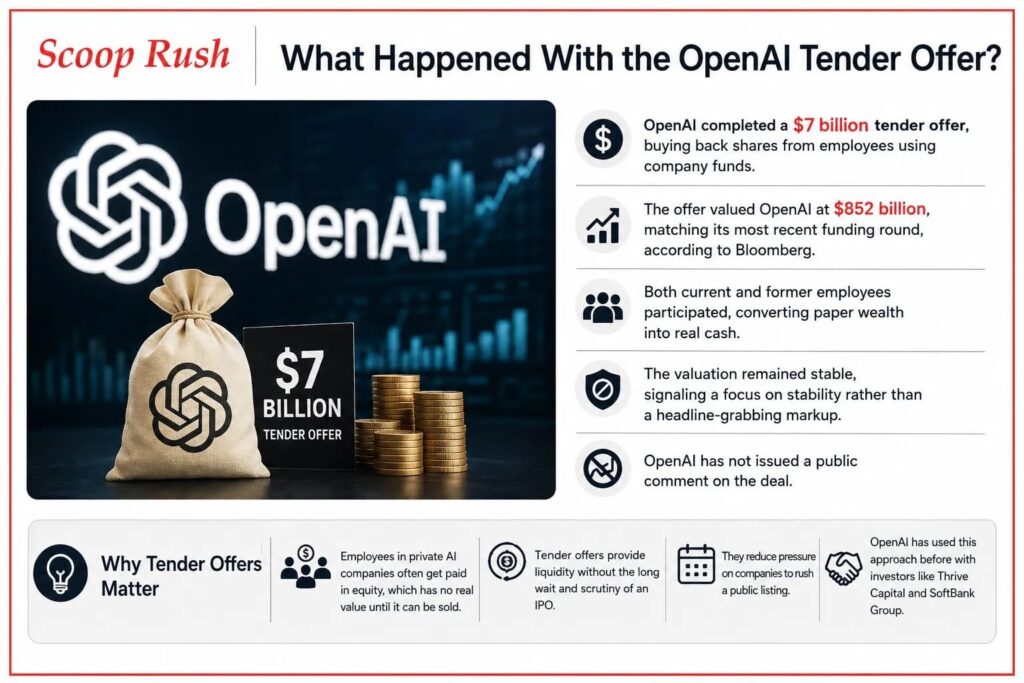
OpenAI completed a $7 billion tender offer, buying back shares directly from employees instead of bringing in new outside investors. According to Bloomberg, two people familiar with the matter confirmed the deal valued the company at $852 billion, matching its most recent funding round.
This wasn’t fresh capital entering the company. OpenAI used its own resources to repurchase stock, letting employees convert paper wealth into real cash. Both current and former staff took part in the sale. Additionally, the valuation held steady instead of climbing, which suggests OpenAI wanted stability rather than a headline-grabbing markup.
OpenAI has not issued a public comment on the deal.
Why Tender Offers Matter for Private AI Companies
Large private companies increasingly rely on tender offers, and OpenAI is no exception. Employees at these firms often receive a large share of their pay in equity. However, that equity holds no real value until someone can actually sell it.
A tender offer solves this problem without the years-long wait and heavy scrutiny that come with a public listing. Employees gain liquidity, and therefore pressure on the company to rush an IPO eases. OpenAI has used this approach before, previously working with investors like Thrive Capital and SoftBank Group to buy shares from staff.
The March Funding Round Behind the $852 Billion Valuation
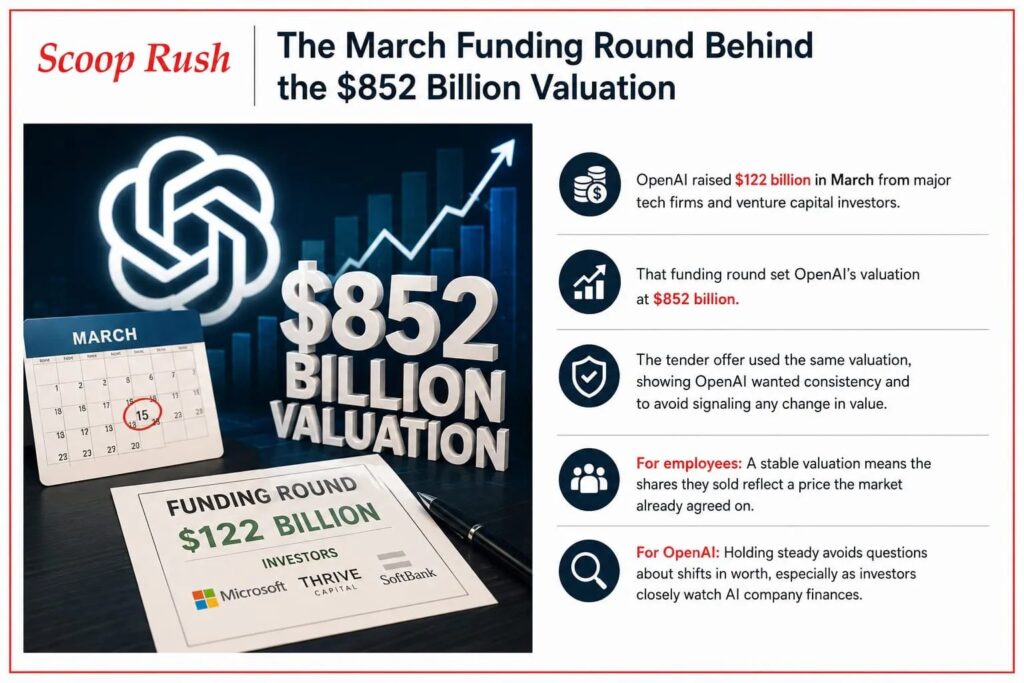
The $852 billion figure used in this OpenAI tender offer isn’t new. OpenAI raised $122 billion in March from major tech firms and venture capital investors, and that round set the company’s valuation at $852 billion. Keeping the buyback price consistent with that number shows OpenAI wanted to avoid signaling any swing in its private market value.
For employees, this consistency matters. A stable valuation means the shares they sold reflect a price the market already agreed on. Meanwhile, for OpenAI, holding steady avoids uncomfortable questions about whether its worth has shifted sharply in just a few months, especially at a time when Google’s own AI spending has turned cash flow negative and investors are watching AI company finances closely across the board.
Does the OpenAI Tender Offer Signal an IPO Delay?
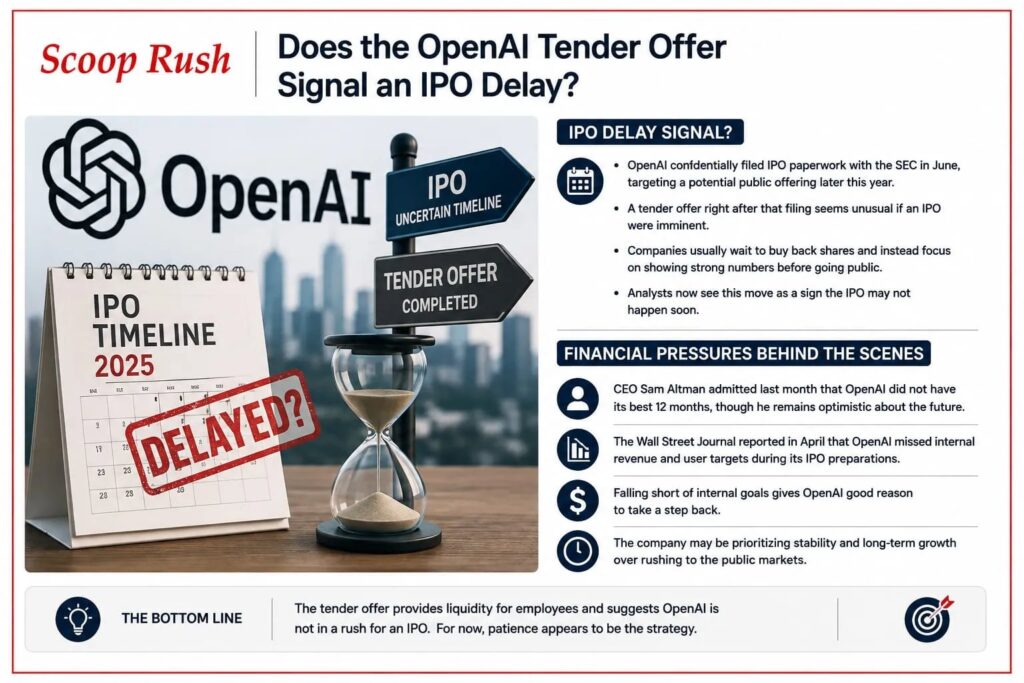
Here’s where things get interesting. OpenAI confidentially filed paperwork with the Securities and Exchange Commission in June, preparing for a possible initial public offering later this year. A tender offer right after that filing looks unusual if OpenAI planned to go public soon.
Companies preparing for an IPO typically want to show their strongest numbers before inviting public investors in. Buying back employee shares instead of pushing hard toward a debut suggests OpenAI may be taking its time. As a result, many analysts now read this move as a sign the IPO isn’t imminent.
Financial Pressures Behind the Scenes
OpenAI hasn’t had a flawless year. CEO Sam Altman admitted as much last month, writing publicly that the company did not have its best 12 months, while also expressing confidence that stronger months lie ahead. That kind of honest admission from a CEO doesn’t happen often, and it hints at real internal pressure, not unlike the questions swirling around whether AI will end up replacing jobs faster than companies can manage the fallout.
Adding to that pressure, the Wall Street Journal reported in April that OpenAI missed internal revenue and user targets during its push toward a potential IPO. Companies heading toward public markets generally want strong results in hand first. Consequently, falling short of internal goals gives OpenAI good reason to wait.
The Anthropic Factor in OpenAI’s IPO Timing
OpenAI isn’t making these decisions in a vacuum. Rival Anthropic has reportedly turned profitable earlier this year, a milestone that shifts the competitive balance in the AI industry. Once viewed as trailing behind OpenAI, Anthropic has gained real momentum and climbed in valuation, even as concerns grow across the sector about rogue AI systems and security hacks tied to major labs.
This puts pressure on OpenAI to strengthen its financial footing before any public debut. If Anthropic reaches public markets first or keeps building a profitability story, OpenAI would face tougher comparisons from investors. Therefore, delaying its own IPO while refining its enterprise strategy could be a deliberate move to compete more effectively later.
What the OpenAI Tender Offer Means for Employees and the Market
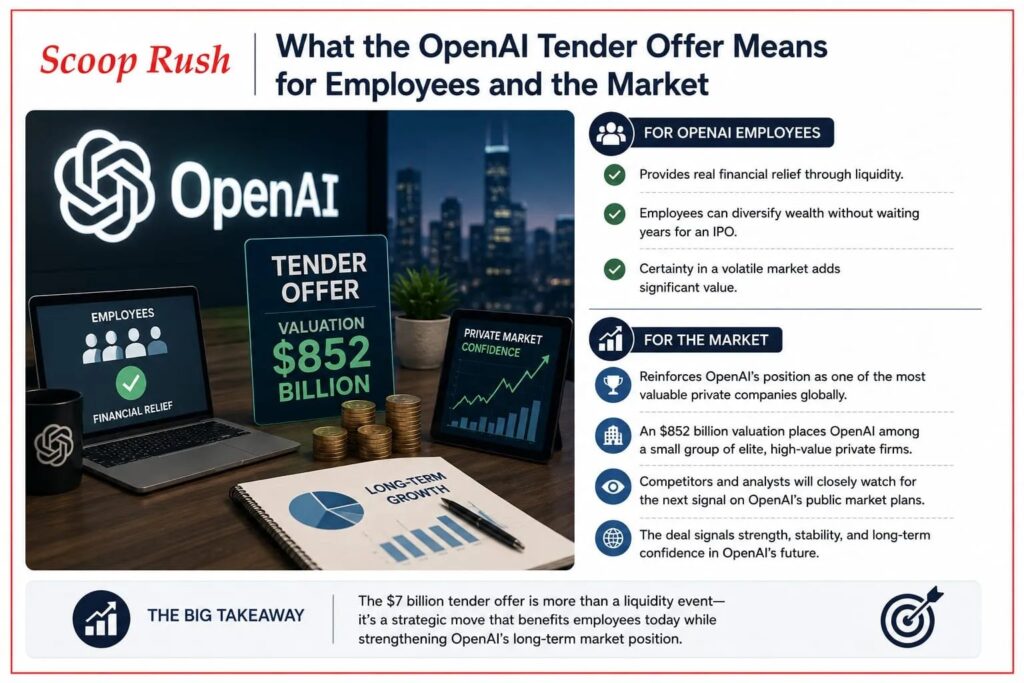
For OpenAI’s workforce, this tender offer delivers real financial relief. Employees can now diversify their wealth instead of waiting years for a public listing that may or may not arrive on their preferred timeline. In a market where private valuations swing sharply, that certainty carries genuine value.
For the broader market, the deal reinforces OpenAI’s position as one of the most valuable private companies in the world. An $852 billion valuation places it among a small handful of firms at that scale, regardless of when it eventually goes public. Meanwhile, competitors and analysts will keep watching closely for the next signal about OpenAI’s public market plans, much like they tracked Nokia’s AI-RAN platform deal with Nvidia as a sign of where AI infrastructure investment is heading next.
Conclusion
OpenAI’s $7 billion employee tender offer tells a clear story. The company is prioritizing employee liquidity and financial stability over a rushed path to public markets. With a confidential SEC filing already in place, an eventual IPO remains likely. However, missed internal targets, Sam Altman’s candid admission about a rocky year, and rising pressure from a newly profitable Anthropic all point toward a company that wants to strengthen its position first. Ultimately, this OpenAI tender offer buys the company time to refine its enterprise business and present its strongest case when it finally does go public.
FAQs
What is the OpenAI tender offer worth?
OpenAI completed a $7 billion tender offer, buying back shares from current and former employees at a valuation of $852 billion.
Why did OpenAI do a tender offer instead of an IPO?
The tender offer gives employees liquidity without the regulatory scrutiny and long timeline of a public offering. It also gives OpenAI more time to strengthen its financial performance before going public.
What is OpenAI’s current valuation?
OpenAI is valued at $852 billion, the same figure set during its March 2026 funding round that raised $122 billion.
Has OpenAI filed for an IPO?
OpenAI confidentially filed paperwork with the SEC in June 2026 to prepare for a potential initial public offering later this year.
How does Anthropic’s success affect OpenAI’s IPO plans?
Anthropic reportedly became profitable earlier this year and has gained momentum in valuation and market position. This adds pressure on OpenAI to strengthen its own financial results before pursuing a public listing.

