Occupied southern Lebanon now shows heavy destruction, military checkpoints, and growing uncertainty. Israeli forces still hold a border strip inside Lebanese territory. Meanwhile, strikes continue almost daily despite a declared ceasefire between Israel and Hezbollah.
Recent reports from CNN and BBC give rare access to the region. Reporters traveled with approved civilian and humanitarian convoys to see conditions firsthand. Their accounts describe flattened villages, damaged homes, and expanding Israeli military positions across the south.
Israeli Forces Still Control Border Areas
Israeli forces occupy a strip that stretches several kilometers into southern Lebanon. In some spots, this controlled zone reaches nearly 10 kilometers from the Israeli border. According to BBC reporting, the area covers about five percent of Lebanese territory.
Checkpoints now sit along roads that once linked southern towns freely. Israeli flags mark several points inside the controlled zone as well. Military vehicles and fortified posts remain visible close to residential communities, and officials say this presence protects northern Israel from Hezbollah threats.
Villages Show the Heavy Toll of War
Large parts of southern Lebanon carry the scars of ongoing military operations. Many villages have lost homes, shops, roads, and basic infrastructure. Controlled demolitions also continue near several communities, adding to the damage.
CNN journalists witnessed flattened buildings while traveling through the region recently. They also heard explosions and saw military activity nearby during their visit. Israeli officials claim Hezbollah used many of these buildings for military purposes, though human rights groups question whether the destruction followed international law.
Christian Villages Remain Intact but Isolated
Three mostly Christian villages have avoided the heaviest destruction seen elsewhere. Rmeish, Ain Ebel, and Debel remain among the least damaged communities in the region. Even so, residents cannot move freely through the surrounding occupied land.
People need approval before entering or leaving these villages today. Humanitarian groups organize convoys through a system backed by the United Nations. Authorities must coordinate each trip directly with Israeli forces, which slows daily life considerably.
Families Struggle With Separation and Loss
Ronnie and Rita Alam fled Rmeish with their two daughters during intense fighting. They rented a place in Beirut, which strained their household budget. Eventually, the family returned home through an authorized convoy route.
However, Ronnie soon planned to head back to Beirut for work. Rita therefore faced staying in Rmeish without her husband nearby. Many families across the region face this same hard choice between safety, income, and staying together.
Life Beside Ruins in Ain Ebel
Ain Ebel has stayed mostly intact compared with nearby Shia communities. Still, residents live close to areas badly damaged by Israeli strikes. This contrast has created a strange and uneasy daily reality.
Yorgos Mitri chose to stay in Ain Ebel throughout the conflict. He said his young son already recognizes the sound of military jets overhead. Mitri criticized Hezbollah’s choice to fight Israel, yet he also expressed sympathy for displaced Shia families nearby.
Lebanese Army Works to Restore Authority
Lebanon’s army has started operating in select areas near the conflict zone. These locations form part of a framework backed by the United States. Officials call them pilot zones meant to rebuild government control.
Soldiers patrol these areas and search for weapons where legally allowed. They also clear debris from fighting and help support civilian returns. Still, the army struggles with limited funding, since many soldiers earn roughly $500 each month.
Pilot Zones Face Tough Obstacles
Zawtar al-Gharbiyeh stands as one of the chosen pilot zones for transition. Lebanese soldiers now work there without a constant Israeli presence nearby. Yet Israeli tanks and bulldozers remain visible just hundreds of yards away.
Residents report frequent drone flights above the village throughout the day. Artillery explosions also continue to disturb nearby areas regularly. As a result, fewer than one in twenty displaced residents have returned to this pilot zone so far.
Strikes Continue Despite the Ceasefire
Lebanese officials say Israeli attacks have not stopped since the ceasefire began. The Lebanese army has documented thousands of alleged violations already. These reportedly include airstrikes, drone attacks, and artillery fire across the south.
Israeli officials insist their actions remain permitted under existing agreements. They argue Hezbollah still poses security threats near Israeli positions. Hezbollah, meanwhile, has avoided broad attacks but has targeted Israeli troops inside Lebanese land.
Hezbollah’s Deep Roots in the South
Hezbollah holds strong ties within southern Lebanon’s Shia Muslim communities. The group blends political activity with an armed military wing. It also provides social services where government support remains weak or absent.
Many supporters see Hezbollah as protection against Israeli military action. That support grew through decades of conflict and past occupation. However, many other Lebanese communities strongly reject Hezbollah’s military role in national affairs.
Displacement Remains a Major Crisis
Displacement continues as one of southern Lebanon’s biggest challenges today. Hundreds of thousands of people still live away from their homes. Many villages also lack basic conditions needed for safe returns.
Mahmoud Darwish returned to Zawtar al-Gharbiyeh after months of being away. He found his home badly damaged, with rubble covering the floors. His destroyed olive trees also meant a major loss of income for his family.
Residents Want Security and a Political Fix
People across southern Lebanon want lasting safety after years of conflict. Many also want government institutions to regain full control of the region. Still, political disagreements continue to block real progress.
Lebanon wants Israel to withdraw fully from occupied areas soon. Israel links any withdrawal to Hezbollah’s disarmament and security guarantees. This standoff leaves residents caught between military pressure and political deadlock.
A Fragile Path Forward
Southern Lebanon shows little sign of a fast return to normal life. Israeli positions remain active while destruction continues shaping daily existence. The pilot zone plan could eventually help restore government authority.
Even so, the strategy faces serious security, financial, and political barriers. Continued strikes make civilian returns harder with each passing month. For now, occupied southern Lebanon remains an unstable and deeply divided region.
FAQs
1. Why does Israel still control parts of southern Lebanon?
Israel says the zone protects northern communities from Hezbollah threats. Officials link any withdrawal to Hezbollah’s full disarmament. Lebanon, however, demands an immediate and complete Israeli exit.
2. Are Israeli strikes still happening during the ceasefire?
Yes, Lebanese officials report frequent Israeli strikes and military activity. Israel says these actions fall within current security agreements. Both sides strongly disagree over what counts as a violation.
3. Which Lebanese villages have avoided major destruction?
Rmeish, Ain Ebel, and Debel remain relatively intact compared to others. All three villages have mostly Christian populations. Residents there still face strict travel restrictions daily.
4. What exactly are Lebanon’s pilot zones?
Pilot zones are areas chosen to test restored Lebanese government control. Lebanese army units operate there with limited outside interference. The goal is helping displaced residents safely return home.
5. Why haven’t more displaced residents returned home?
Many fear renewed strikes and ongoing military activity nearby. Damaged homes and destroyed farmland add further hardship. Movement restrictions also make rebuilding and resettling extremely difficult.
You already know the drill: brush twice a day, floss, see your dentist. But there’s a piece of the puzzle that rarely makes it into that routine advice what you eat doesn’t just fuel your body, it feeds an entire community of microbes living in your mouth. And whether that community thrives or turns against you depends heavily on your plate.
Your mouth is home to hundreds of species of bacteria, fungi, and other microorganisms, collectively known as the oral microbiome. Some of these microbes are troublemakers that convert sugar into tooth-eroding acid. Others are protective allies that crowd out harmful bacteria and even produce their own natural “antibiotics.” The foods you choose determine which group gets the upper hand and the effects reach far beyond your smile, influencing everything from gum health to cardiovascular risk.
Here’s a science-backed, dentist-informed guide to the best foods for healthy teeth, the ones to limit, and how timing your meals can make an outsized difference.
Why Diet Matters More Than You Think
Cavities remain one of the most common chronic conditions worldwide, with the vast majority of adults experiencing at least one by their mid-30s. The usual suspects candy, soda, pastries get plenty of attention. But dental researchers are increasingly focused on the flip side of the equation: foods that actively support a healthier balance of oral bacteria.
A poorly balanced oral microbiome doesn’t just mean more trips to the dentist. Bacterial imbalance in the mouth has been linked to gum disease, and gum disease itself has been associated with a wider set of health concerns, including cardiovascular issues, diabetes complications, and inflammatory conditions elsewhere in the body. Some recent research has even connected certain oral bacterial patterns with increased pancreatic cancer risk, and a lower diversity of oral microbes has been associated with depression in some studies.
The takeaway: nourishing the “good” bacteria in your mouth isn’t a wellness trend it’s a legitimate extension of preventive dental care.
Foods and Drinks to Limit
Before getting to the good stuff, it helps to know what feeds the bacteria you don’t want around:
Sugary drinks and candy — soda, energy drinks, and sweets are prime fuel for acid-producing bacteria like Streptococcus mutans.
Refined, starchy snacks — white bread, crackers, biscuits, and pretzels break down into sugars quickly once they hit saliva.
Frequent snacking on processed foods — it’s not just what you eat but how often; constant grazing means constant acid exposure.
Sticky dried fruit with added sugar — some packaged dried fruits are coated in extra sugar that lingers on tooth surfaces.
The goal isn’t zero sugar forever natural sugars in fruit and dairy come packaged with nutrients your teeth actually need. It’s the added, refined sugars eaten frequently throughout the day that do the most damage.
The Best Foods for Healthy Teeth and a Balanced Oral Microbiome
1. Leafy Greens
Kale, spinach, and other leafy greens are rich in nitrates, which oral bacteria convert into compounds that support healthy blood pressure and circulation a two-for-one benefit for your mouth and heart.
2. Cheese
Cheese is a standout for dental health. It’s low in sugar, packed with calcium and phosphate, and contains casein, a protein that helps fortify enamel. Chewing cheese also stimulates saliva flow, which helps neutralize the acids left behind from other foods.
3. Plain Yogurt and Milk
Dairy without added sugar delivers calcium and, in the case of yogurt, probiotics that may help crowd out cavity-causing bacteria and reduce the odds of bad breath.
4. Crunchy Vegetables (Carrots and Celery)
Their fibrous texture works almost like a natural toothbrush, scrubbing away plaque and food debris while boosting saliva production.
5. Apples and Pears
Fresh, whole apples increase saliva flow and help neutralize the acids produced by other foods. Pears, in particular, are notably good at rebalancing mouth pH after eating.
6. Green and Black Tea
Tea leaves are rich in compounds called catechins, which appear to interfere with plaque formation, along with natural fluoride that helps enamel resist acid. Tea has also shown antibacterial effects relevant to gum inflammation and bad breath.
7. Berries and Cranberries
Dark berries are loaded with polyphenols plant compounds that seem to stop bacteria from sticking to tooth surfaces and forming plaque, despite their natural sugar and acid content.
8. Garlic and Onions
Not exactly breath-friendly, but garlic contains allicin, a compound with notable antimicrobial action against the bacteria responsible for cavities and gum disease.
9. Nuts (Almonds, Cashews, Walnuts)
Low in carbohydrates and rich in calcium and phosphorus, nuts also require plenty of chewing, which ramps up saliva production.
10. Fatty Fish
Salmon and similar fish are a natural source of fluoride and phosphorus, both important for protecting enamel.
11. Whole Grains
Because they’re broken down more slowly than refined carbohydrates, whole grains give acid-producing bacteria far less to work with.
12. Legumes and Pulses
Chickpeas, lentils, and beans provide fluoride and plant protein without the sugar spike of processed snacks.
13. Water (Ideally Fluoridated)
Simple but essential water rinses away food particles, dilutes acids, and keeps saliva production up. Fluoridated water adds an extra layer of enamel protection.
14. Dark Chocolate (70%+ Cocoa)
Good news for chocolate lovers dark chocolate contains phosphates and polyphenols that may help protect against acid and bacterial buildup, unlike its sugar-laden milk chocolate counterpart.
15. Shiitake Mushrooms
These contain a compound called lentinan that has shown some ability to inhibit the growth of oral bacteria.
Quick Reference: Foods and Their Dental Benefits
Food
Key Compound/Property
Main Benefit
Leafy greens
Nitrates
Supports beneficial bacteria, blood pressure
Cheese
Casein, calcium, phosphate
Strengthens enamel, buffers acid
Plain yogurt/milk
Calcium, probiotics
Lowers mouth acidity, may reduce cavity risk
Carrots/celery
Fiber, crunch
Mechanically cleans teeth, boosts saliva
Apples/pears
Fiber, malic acid
Stimulates saliva, neutralizes acid
Green/black tea
Catechins, fluoride
Reduces plaque, fights bad breath
Berries/cranberries
Polyphenols
Prevents bacterial adhesion
Garlic/onions
Allicin
Antimicrobial against cavity-causing bacteria
Nuts
Calcium, phosphorus
Low-carb chewing food, boosts saliva
Fatty fish
Fluoride, phosphorus
Protects enamel
Whole grains
Complex carbohydrates
Limits bacterial fuel supply
Legumes
Fluoride, plant protein
Supports remineralization
Water
Fluoride (if fluoridated)
Rinses acids, boosts saliva
Dark chocolate (70%+)
Phosphates, polyphenols
Protects against acid and bacteria
Shiitake mushrooms
Lentinan
Inhibits oral bacterial growth
Timing Matters Just as Much as Food Choice
Dental researchers increasingly point out that when and how often you eat can matter as much as what you eat. Every time you snack, your mouth goes through an acid attack as bacteria respond to available sugars and it can take saliva up to 30–60 minutes to neutralize that acid and restore a healthy pH.
Practical ways to apply this:
Eat sugary or starchy foods as part of a meal rather than as standalone snacks, since meals trigger more saliva production.
Finish meals with a “neutralizing” food such as cheese, plain yogurt, or unsweetened tea to help offset acid from earlier courses.
Limit grazing throughout the day; fewer, more complete eating occasions give your mouth more recovery time.
Rinse with water after eating or drinking anything acidic or sugary, especially if you can’t brush right away.
Save raw, crunchy produce for the end of a meal, when its scrubbing action can do the most good.
Diet, Gum Disease, and Whole-Body Health
Gum disease isn’t just a dental inconvenience it’s a leading cause of adult tooth loss and has been linked to broader inflammation in the body. Diets closely resembling the Mediterranean pattern rich in vegetables, whole grains, legumes, and healthy fats, with modest amounts of red meat have been associated with less severe gum disease in research populations. By contrast, diets high in added sugar, saturated fat, and frequent red meat consumption have shown stronger associations with more advanced gum disease, although researchers are still working out the exact mechanisms behind that link.
The consistent theme across dental researchers: there’s no single miracle food. What matters most is the overall pattern a diet built around whole plant foods, lean proteins, dairy, and water, with sugar treated as an occasional guest rather than a daily staple.
Vitamins and Micronutrients Your Teeth Actually Need
Diet supports oral health partly through whole foods and partly through the specific micronutrients those foods deliver. A handful of vitamins and minerals do most of the heavy lifting:
Calcium — the primary building block of both bone and tooth structure, found in dairy, leafy greens, and fortified plant milks.
Vitamin D — helps the body actually absorb and use calcium; without enough of it, calcium-rich foods can’t do their job as effectively.
Vitamin C — essential for healthy gum tissue and wound healing; a deficiency is one of the classic causes of bleeding, inflamed gums.
Vitamin A — supports the mucous membranes of the mouth and plays a role in enamel formation.
Phosphorus — works alongside calcium to remineralize enamel that’s been softened by acid.
Zinc — has antibacterial properties in the mouth and supports tissue repair.
The good news is that a varied, whole-food diet covers most of these needs without any extra effort. The temptation, especially for anyone chasing faster results, is to reach for high-dose supplements instead. That’s worth approaching carefully megadosing on fat-soluble vitamins like A and D can actually cause harm rather than help, and more isn’t always better when it comes to micronutrients. If you’re considering supplementation on top of your diet, it’s worth understanding the risks of taking too many vitamins before adding anything beyond a standard multivitamin.
How Your Broader Lifestyle Shapes Oral Health
Diet doesn’t operate in isolation. Several everyday lifestyle factors influence the same bacterial balance and inflammatory pathways that determine whether your gums and teeth stay healthy.
Stress and gum inflammation. Chronic stress raises cortisol levels, which can suppress immune function and make gum tissue more vulnerable to the bacteria that cause periodontal disease. Stress also tends to correlate with worse dietary choices, more teeth grinding, and less consistent brushing habits a compounding effect rather than a single cause. Building in small, sustainable ways to relieve stress throughout your week can indirectly support a healthier mouth, not just a calmer mind.
Movement and circulation. Regular physical activity improves blood flow throughout the body, including to gum tissue, which supports faster healing and better immune response. You don’t need an intense workout routine to see a benefit something as simple as taking a 5-minute walk every hour during a sedentary day has been associated with broader metabolic and cardiovascular benefits that circle back to gum and heart health, given how closely the two are linked.
Sleep and saliva production. Saliva flow naturally decreases during sleep, which is part of why the “morning mouth” feeling exists. Poor sleep quality and habits like sleeping with the mouth open (often linked to stress or congestion) can leave teeth exposed to acid for longer stretches with less natural protection.
None of these factors replace a tooth-friendly diet, but they interact with it. Someone eating well but under constant stress, or barely moving throughout the day, may still see slower healing and more gum inflammation than the diet alone would predict.
How Popular Diet Trends Affect Your Teeth
A lot of people adjust their overall eating pattern for reasons that have nothing to do with dental health weight management, blood sugar control, or general wellness goals. It’s worth knowing how some of the most common approaches intersect with oral health.
Low-carb and keto-style eating. Cutting refined carbohydrates and added sugar is generally a win for your teeth, since it directly reduces the fuel available to acid-producing bacteria. That said, some people on very low-carb diets develop “keto breath,” caused by ketone production, and may lean on sugar-free alternatives that still bring acidity into the mix. If you’re exploring this style of eating, it helps to look at the full picture of benefits, risks, and foods on a low-carb diet rather than just the weight-loss headline.
Plant-based and largely vegetarian diets. Diets built around vegetables, legumes, whole grains, nuts, and fruit tend to align closely with what dental researchers recommend for a stable oral microbiome high fiber, high polyphenol content, and naturally lower in the ultra-processed foods most associated with cavities. Anyone considering a shift in this direction can find a useful starting point in this plant-based diet guide, which covers the nutritional basics beyond just oral health.
Diet soda as a “healthier” swap. Many people cut back on regular soda specifically to protect their teeth, switching to diet versions instead. The sugar reduction is a genuine benefit, but diet sodas are often still highly acidic, which can erode enamel over time even without the sugar. If you’re weighing your options here, this comparison of Diet Coke vs. Coke Zero breaks down the differences in acidity and ingredients so you can make a more informed swap water and unsweetened tea remain the better default for daily hydration.
Making It Stick: Building a Tooth-Friendly Habit for Life
Knowing which foods help your teeth is only useful if it translates into consistent behavior. A few practical strategies make that transition easier:
Anchor new habits to existing routines. Add a glass of water or a small piece of cheese to the end of meals you already eat every day, rather than trying to overhaul your entire diet at once.
Batch-prep tooth-friendly snacks. Wash and portion carrots, celery, and apple slices at the start of the week so they’re as convenient to grab as anything processed.
Make meals social when you can. Eating in a relaxed, unhurried setting rather than rushed and alone tends to slow down eating pace and encourage more mindful choices. There’s evidence that the benefits of eating together extend beyond mood and connection into genuinely better dietary patterns, since shared meals are less likely to be dominated by convenience snacking.
Think in decades, not weeks. The cumulative effect of dietary choices on oral health compounds slowly, which is exactly why it’s easy to underestimate. Establishing healthy habits in your 20s and 30s including dietary ones tends to pay off disproportionately later, since enamel doesn’t regenerate and gum damage becomes harder to reverse the longer it’s left unaddressed.
A Note on Your Morning Coffee or Tea
Given how often tea came up earlier in this guide as a genuine ally for oral health, it’s worth a closer look at how you drink it. Black coffee and unsweetened tea are both far better choices than sweetened versions, but timing and additions matter. Coffee’s natural acidity can be harder on enamel when consumed on an empty stomach first thing in the morning, both for digestive comfort and because there’s less food present to buffer the acid. If your routine involves coffee before breakfast, it’s worth understanding what drinking coffee on an empty stomach actually does, so you can decide whether pairing it with food or simply following it with a glass of water makes sense for you.
The Bottom Line
There’s no shortcut food that undoes a diet high in sugar, and there’s no need to obsess over a single “superfood” either. The strongest, most consistent finding across dental research is that an overall eating pattern rich in vegetables, whole grains, dairy, lean protein, and water, with added sugar kept occasional creates a mouth environment where beneficial bacteria can outcompete the harmful ones. Pair that with consistent brushing, flossing, and regular dental visits, and you’re covering both sides of the equation that actually determines the health of your smile.
FAQs
Is it more important to eat the right foods or just brush and floss well?
Both matter, and neither replaces the other. Brushing and flossing physically remove plaque, but they don’t change what fuels the bacteria in your mouth between cleanings. A diet high in added sugar can outpace even a diligent oral hygiene routine.
Does natural sugar in fruit damage teeth the same way as added sugar?
Not to the same degree. Whole fruit comes with fiber, water content, and nutrients that help offset its sugar content, and chewing it stimulates saliva. Fruit juice and dried fruit with added sugar are more concerning since they lack that buffering fiber and often cling to teeth longer.
Can diet alone reverse a cavity?
No. Once enamel has broken down into an actual cavity, it requires professional dental treatment. Diet is most powerful as prevention supporting remineralization and limiting the acid exposure that leads to decay in the first place.
Is dark chocolate really good for teeth?
Compared with other sweets, yes, dark chocolate with a high cocoa content (70% or more) contains compounds that may help resist plaque and acid, and it’s typically lower in added sugar than milk chocolate. It’s a better-for-you treat, not a substitute for brushing.
How long does it take saliva to neutralize acid after eating?
Roughly 30 to 60 minutes, depending on the food and individual saliva flow. This is part of why limiting snack frequency, rather than just snack choice, is a meaningful strategy for protecting enamel.
Are mouthwashes a good substitute for a tooth-friendly diet?
Not entirely. Over-the-counter mouthwashes vary widely in effect, and some antibacterial formulas can disrupt the balance of the oral microbiome rather than support it. Diet works more consistently to shape which bacteria are able to thrive.
What’s the single best habit for a tooth-friendly diet?
Most dental researchers land on the same, unglamorous answer: a balanced diet with plenty of vegetables, lean protein, and whole grains, minimal added sugar, and consistent hydration with water ideally fluoridated.
Does stress really affect my teeth and gums?
Yes. Chronic stress can weaken immune response in gum tissue, increase teeth grinding, and disrupt sleep and eating patterns all of which make it easier for harmful bacteria to gain ground. Managing stress is a legitimate, if often overlooked, part of a complete oral health strategy.
Should I take vitamin or mineral supplements specifically for my teeth?
Not by default. A varied diet covering calcium, vitamin D, vitamin C, and phosphorus is usually sufficient. Supplements can help fill a genuine gap, but high-dose, unsupervised supplementation carries its own risks and isn’t a substitute for a well-rounded diet.
Fireworks lit up the sky over Disney’s Hollywood Studios last night. Longtime fans immediately noticed something unusual. The blasts didn’t come from the small rooftop spots used in recent years. Instead, they came from the old Disney World Star Wars fireworks launch site across World Drive, a spot that has sat untouched since March 2020.
Guests walking out of the park barely blinked. But fans who follow Walt Disney World closely felt something different. Is this the return of a full nighttime spectacular? Or does a simpler explanation explain the pyro?
This story matters because Disney’s Hollywood Studios has gone years without a true fireworks-based nighttime show. Fantasmic and small seasonal effects filled the gap instead. However, nothing has used the dedicated Star Wars fireworks launch site since Star Wars: A Galactic Spectacular ended its run. Any activity there deserves attention, especially with major park changes approaching.
Disney World Star Wars Fireworks Testing: What Actually Happened
Guests leaving Disney’s Hollywood Studios reported fireworks launching periodically from the site across World Drive. The bursts came in spaced intervals, often around 90 seconds apart. That pattern points to pyrotechnic testing rather than a full rehearsal. Testing usually comes first. A full rehearsal follows only if a real show is in the works.
This launch site carries a layered history. Disney built it roughly a decade ago after the original fireworks location became part of Toy Story Land. Once construction began there, Imagineers needed a new spot that could still support full-scale shows. The World Drive site became that replacement.
It debuted alongside Star Wars: A Galactic Spectacular, which followed the earlier and better-received Symphony in the Stars: A Galactic Spectacular. Unfortunately, the newer show suffered from off-center pyro and felt more limited than fans expected. As a result, reviews stayed mixed from the start.
Why the Star Wars Fireworks Launch Site Went Quiet
The World Drive location fell silent after only a few years of use. Star Wars: A Galactic Spectacular ended without a proper send-off, and the site has mostly stayed dark since then. A few exceptions broke the silence, including “Jingle Bell, Jingle BAM!” during Jollywood Nights and occasional New Year’s Eve and Fourth of July displays.
Meanwhile, most nighttime entertainment at Disney’s Hollywood Studios shifted to smaller rooftop launch points. These still look impressive and add an immersive feel. However, they lack the scale and distance that a dedicated launch site provides. A truly wow-worthy production usually needs both elements working together.
Given how long the site sat unused, some fans wondered if Disney had quietly decommissioned it, much like the shuttered Star Wars: Galactic Starcruiser. Last night’s test suggests otherwise.
Why This Disney World Star Wars Fireworks Test Might Mean Less Than You Think
One date stands out before anyone gets too excited: October 20, 2026. This date already ranks as one of the best low-crowd days at Disney’s Hollywood Studios this fall. A private park buyout tied to the Gartner IT Symposium explains why.
These corporate buyouts often include large-scale fireworks shows as part of the package. There’s a strong chance, somewhere between 66 and 75 percent, that this buyout triggered last night’s testing. If so, the fireworks would serve one private group rather than launch a new permanent show for regular guests.
These buyouts carry real financial weight. October reportedly ranks as Walt Disney World’s biggest month for corporate events, and conventions like the Gartner IT Symposium drive major spending on resorts, dining, and private experiences. Disney even canceled Magic Kingdom’s Not So Scary Halloween Party on October 20, despite it being an otherwise open Tuesday. That single decision shows how disruptive closing two parks early can be. Disney clearly decided the trade-off was worth it.
Rough estimates suggest this one evening could cost Gartner $5 million or more once you factor in the buyout and the lost Halloween party revenue. Event registration alone starts around $8,200 per person, and that fee doesn’t even cover the Hollywood Studios night. These numbers reveal just how much weight these conventions carry for Disney’s bottom line.
The More Exciting Star Wars Fireworks Possibility
A smaller chance, around 25 percent, points to something bigger. Even before the pandemic, many expected Disney to eventually replace Star Wars: A Galactic Spectacular. Hollywood Studios already carried a heavy concentration of Star Wars content, and Galaxy’s Edge never drew the massive crowds Disney originally projected.
That imbalance pushed Disney to prepare extensively for Galaxy’s Edge’s opening. The team added extra nighttime entertainment to help spread out attendance. Two projection shows, Wonderful World of Animation and Disney Movie Magic, launched alongside Fantasmic and the Star Wars fireworks show. For a stretch in late 2019 and early 2020, the park ran five nighttime productions on some evenings, including two Fantasmic performances.
Interestingly, ride capacity during the day caused the bigger headache back then, not the nighttime shows. Even during busy periods, the projection shows often played to sparse crowds, and the Star Wars fireworks only drew moderate turnout.
How Monstropolis Could Bring Star Wars Fireworks Back
Disney plans to open the first phase of Monstropolis in Summer 2027. Disney’s planning teams may already be preparing for a familiar challenge. A major new land historically brings more guests who stay later into the evening, and current offerings might not handle that shift well.
Fantasmic alone may not provide enough crowd-absorbing capacity once Monstropolis draws bigger evening crowds. Additionally, a full-scale fireworks show could serve as valuable counterprogramming. It would encourage guests to stick around for extra meals, drinks, or dessert parties.
A practical angle supports this theory too. Reviving the World Drive launch site could give Disney the flexibility to run a single nighttime show on quieter days, since Fantasmic demands a heavier entertainment budget. Disney has cut costs on several shows in recent years, yet Fantasmic has largely escaped those cuts, aside from some technical issues this summer that appear unrelated to budget decisions.
History May Be Repeating Itself for Disney World Star Wars Fireworks
The parallels between now and the pre-Galaxy’s Edge buildup are hard to ignore. Disney seems to be pulling from that same playbook again, this time ahead of Monstropolis. If that pattern extends to nighttime entertainment, Disney’s Hollywood Studios could welcome a new fireworks-based spectacular sometime in 2027 or 2028.
That said, this remains speculation built on a single overnight test. Early pyro tests have historically given the first clue before Walt Disney World confirmed new nighttime shows or seasonal spectaculars. Therefore, it makes sense to watch closely rather than dismiss the possibility outright.
What to Watch For Next
The Gartner IT Symposium buyout remains the most likely explanation for now. Corporate events at this scale often justify activating a launch site that otherwise sits idle. However, the timing relative to Monstropolis adds enough intrigue to keep watching for future updates from Walt Disney World.
Additional testing in the coming weeks would strengthen the bigger theory, especially if the pattern shifts toward a full rehearsal instead of spaced-out bursts. Until then, treat this development as an interesting lead rather than a confirmed announcement.
The spaced-out timing of the bursts suggests pyrotechnic testing, not a full show rehearsal.
A private park buyout for the Gartner IT Symposium on October 20, 2026, is the most likely reason, with an estimated 66 to 75 percent probability.
A smaller possibility ties this testing to preparations for increased evening crowds ahead of Monstropolis, which opens in phases starting Summer 2027.
Disney has not officially announced a new nighttime spectacular, so this remains speculative until further testing or confirmation occurs.
Frequently Asked Questions
Why did Disney’s Hollywood Studios test fireworks from an old launch site?
Guests reported fireworks launching from the World Drive site, which had sat dormant since March 2020. The most likely reason involves preparation for a private park buyout tied to the Gartner IT Symposium on October 20, 2026.
What happened to Star Wars: A Galactic Spectacular?
The nighttime show ended its run, and Disney never replaced it with a full-scale fireworks production. Since then, Disney’s Hollywood Studios has relied mainly on Fantasmic and smaller seasonal pyro effects.
Is Disney bringing back a nighttime fireworks show at Hollywood Studios?
No official confirmation exists yet. The testing could simply support a private event, though some fans speculate it may relate to preparations for Monstropolis, which begins opening in 2027.
What is Monstropolis, and how does it relate to this fireworks testing?
Monstropolis is an upcoming land planned for Disney’s Hollywood Studios, with its first phase arriving in Summer 2027. The expansion could bring bigger evening crowds, which may eventually require additional nighttime entertainment like a revived Star Wars fireworks show.
When is the best day to visit Disney’s Hollywood Studios for low crowds this fall?
October 20, 2026, should bring low crowds because of a private park buyout, though the park will also close early to regular guests that evening.
A Deal That Changed Everything: What Makes the Best Premier League Transfers Stand Out
What if one signing could turn a mid-table club into champions within a single season? That is exactly what happened more than once in Premier League history, and it is why fans still argue about the best Premier League transfers of all time decades later.
Every summer and winter, transfer deadline day brings chaos, rumors, and last-minute deals. However, once the dust settles, only a handful of signings actually change a club’s direction. This list looks past the price tags and headlines. Instead, it ranks the best Premier League transfers of all time: the deals that turned trophy droughts into titles and reshaped the competition for years.
From a rule-breaking Frenchman who arrived mid-season to a record-breaking defender who changed how Liverpool played, these are the deals that left a lasting mark on English football.
What Makes a Signing One of the Best Premier League Transfers of All Time?
Before diving into the list, it helps to understand the criteria. A game-changing transfer is not just about goals scored or trophies won. It is about immediate and lasting impact, both for the player and for the club’s fortunes.
For example, some hugely talented signings, such as Thierry Henry at Arsenal, took time to develop into legends. Cristiano Ronaldo also needed a few seasons to fully bloom at Manchester United. These players were undoubtedly great, but their impact built gradually rather than transforming their club overnight.
Meanwhile, the players on this list either delivered instant results or fundamentally altered the balance of power in English football. That distinction is what separates a good signing from a truly historic one.
Ranking the Best Premier League Transfers of All Time
10. Petr Cech: The Bargain Signing That Built Chelsea’s Wall
When Roman Abramovich took over Chelsea in 2003, the club made several big-money signings. Yet a relatively low-key £7m move for goalkeeper Petr Cech from Rennes in 2004 delivered the deepest long-term impact.
Cech was extraordinary from the start. He conceded just 15 goals in his debut Premier League season and went 1,025 minutes without conceding a single one. He also finished that campaign with a record 24 clean sheets, a mark that still stands out today.
Over 11 seasons at Stamford Bridge, Cech helped Chelsea win four Premier League titles and a Champions League trophy. Considering the modest fee, his transfer remains one of the smartest business decisions in the league’s history.
9. Alan Shearer: The Signing That Put Blackburn on the Map
Blackburn Rovers had just secured promotion through the play-offs when they made a statement of intent in 1992. Backed by businessman Jack Walker, the club paid a British record £3.6m to sign Alan Shearer from Southampton, beating interest from Manchester United.
The impact was almost immediate. Shearer scored 16 goals in his first 21 league appearances before injury interrupted his season. Even so, Blackburn finished fourth, their best result in 27 years.
Shearer followed up with 31 goals the next season as Rovers finished as runners-up. Then, in 1994-95, he scored 34 times as Blackburn won their first title since 1914. His partnership with fellow record signing Chris Sutton became legendary, but it was Shearer’s arrival that set the transformation in motion.
8. Carlos Tevez: The Transfer That Rescued West Ham
In August 2006, West Ham stunned the football world by signing two of Argentina’s brightest young stars, Carlos Tevez and Javier Mascherano, in a single move. While Mascherano struggled to settle and left on loan by January, Tevez became a hero.
West Ham were bottom of the table with just 11 games remaining, nine points behind safety. Remarkably, they won seven of those final matches. Tevez scored seven crucial goals, including the winner against Manchester United on the last day of the season, a result that relegated Sheffield United instead.
The transfer later became controversial due to third-party ownership rules, and West Ham eventually had to pay £20m in compensation. Still, Tevez’s impact on West Ham’s survival remained undeniable on the pitch.
Robinho’s time at Manchester City is often remembered for how it fell apart, but his first season was genuinely productive. He scored on his Premier League debut and finished as the club’s top scorer with 14 goals in 31 appearances.
However, his real significance lies elsewhere. Robinho arrived on the same day the Abu Dhabi United Group completed their takeover of Manchester City, and his British record £32.5m fee sent a clear message to the rest of English football.
City finished only 10th that season. Yet more than £3bn in transfer spending later, they have become the most dominant force in the Premier League, winning eight titles. Robinho’s signing marked the beginning of that transformation.
6. Virgil van Dijk: The Signing That Completed Liverpool
Mohamed Salah’s debut season at Liverpool in 2017 was spectacular, with 32 Premier League goals. Yet the club still finished fourth, showing that individual brilliance alone was not enough.
Everything changed when Liverpool signed Virgil van Dijk from Southampton for £75m in January 2018, a then world-record fee for a defender. Combined with the summer arrival of goalkeeper Alisson Becker, Van Dijk transformed Liverpool’s defense.
The following season, Liverpool lost just one league game and conceded only 22 goals, racking up 97 points. Despite this remarkable form, Manchester City still pipped them to the title. Liverpool instead became European champions that year, before finally winning their first league title in 30 years the season after.
5. Robin van Persie: The Move That Shocked North London
For years, the idea of Arsenal’s top scorer joining Manchester United would have seemed unthinkable given the rivalry between the two clubs. Yet in 2012, that is exactly what happened.
Robin van Persie had just finished the previous season with 30 goals, making him the league’s top scorer. He then left Arsene Wenger’s Arsenal to join Sir Alex Ferguson, who was determined to reclaim the title after watching Manchester City win it dramatically the season before.
The gamble paid off instantly. Van Persie scored 26 goals as United won the league in what turned out to be Ferguson’s final season in charge. Arsenal, meanwhile, slipped to a distant fourth place, highlighting just how much the balance of power had shifted.
4. Sol Campbell: The Transfer That Stunned Tottenham Fans
Few transfers in Premier League history carry the shock factor of Sol Campbell’s move to Arsenal in 2001. Journalists gathered at Arsenal’s training ground expecting to see a different signing altogether, only to watch the former Tottenham captain walk through the door instead.
Campbell had offers from clubs like Barcelona, Bayern Munich, and Inter Milan. Instead, he chose to join Tottenham’s fiercest rivals on a free transfer. Arsene Wenger and vice-chairman David Dein reportedly finalized the deal during secret meetings.
At his unveiling, Campbell reflected on the decision, saying he had stayed calm and composed even as those around him panicked. The move proved worth the controversy. Campbell won the league and FA Cup double in his first season and added another Premier League title two years later as part of Arsenal’s famous “Invincibles” squad. Fittingly, Arsenal sealed that triumph at White Hart Lane.
3. N’Golo Kante: The Bargain Signing From France’s Amateur Leagues
Few footballing stories are as remarkable as N’Golo Kante’s rise. Just three years before joining Leicester City in 2015, he was playing in France’s third tier. Leicester signed him for a modest £5.6m from Caen, not fully realizing what they had found.
Kante quickly became the engine of Claudio Ranieri’s midfield during Leicester’s astonishing title-winning campaign. While Jamie Vardy provided the goals and Riyad Mahrez the flair, Kante’s relentless work rate held the team together.
He missed just one game all season and led the division in tackles and interceptions. A year later, Chelsea paid almost five times what Leicester had spent to sign him, and Kante went on to win a second Premier League title.
2. Sergio Aguero: The Signing That Changed Manchester City Forever
Sergio Aguero wasted no time making an impression. On his debut for Manchester City in 2011, he scored twice and set up another goal in just 30 minutes off the bench against Swansea City.
At the time, City had not won a top-flight title since 1968. Ten months after Aguero’s arrival, that changed. He had scored 23 goals in 34 Premier League appearances, including one of the most famous goals in the competition’s history, netted deep into stoppage time to clinch the title.
City had spent heavily on forwards before, but none delivered quite like Aguero. Over a decade in Manchester, he became the club’s all-time record scorer with 260 goals and won five league titles.
1. Eric Cantona: The Greatest Transfer in Premier League History
At the top of the list sits Eric Cantona, whose move to Manchester United in November 1992 remains one of the most influential transfers in football history. His path to Old Trafford was anything but conventional.
Cantona had already won a title with Marseille in France, but controversy marked his career there, including a two-month ban for throwing a ball at a referee. After a fallout with the club hierarchy, he moved to England, briefly training with Sheffield Wednesday before joining Leeds United in January 1991, where he helped the club win the First Division title.
By late 1992, Cantona’s relationship with Leeds manager Howard Wilkinson had broken down. Manchester United, struggling in mid-table and without a league title in 26 years, saw an opportunity after missing out on striker David Hirst.
The gamble transformed the club. Cantona scored nine goals in 23 games as United won the inaugural Premier League title by 10 points. Over the next five years, he added three more titles, laying the foundation for one of the most successful eras in English football before his sudden retirement in 1997.
Final Thoughts
Looking back at these deals, one thing becomes clear. The best Premier League transfers of all time are not always the most expensive or the most hyped. Sometimes, as with Kante or Cantona, they arrive quietly and change everything within months.
Meanwhile, other signings like Robinho and Van Dijk represent turning points that took years to fully reveal their significance. Ultimately, what unites every name on this list is impact, whether measured in trophies, records, or a complete shift in a club’s identity.
1. What is considered the most game-changing transfer in Premier League history?
Eric Cantona’s move from Leeds United to Manchester United in 1992 is widely regarded as the most influential transfer. His arrival helped United win their first Premier League title and laid the foundation for a dominant era under Sir Alex Ferguson.
2. Why wasn’t Thierry Henry included in the list of top transfers?
Although Thierry Henry became one of the greatest forwards in Premier League history, Arsenal had already won the league before his arrival, and it took three seasons for the club to reclaim the title with him in the team. This gradual impact placed him outside the top ten in this ranking.
3. How did Sergio Aguero change Manchester City’s history?
Sergio Aguero scored the title-winning goal in stoppage time during his first season, helping Manchester City win their first top-flight title since 1968. He went on to become the club’s all-time leading scorer with 260 goals.
4. Which transfer had the biggest impact on Liverpool’s success?
The signing of Virgil van Dijk from Southampton in January 2018 is often credited as the turning point for Liverpool. His arrival strengthened the defense significantly, helping the club win the Champions League and, later, their first league title in 30 years.
5. Was N’Golo Kante’s transfer really considered a bargain?
Yes. Leicester City signed N’Golo Kante for just £5.6m from Caen in 2015. He became a key player in their unexpected Premier League title win the following season, and Chelsea later paid almost five times that fee to sign him.
What if your next cab had no one driving it? That’s exactly what’s happening with the new Uber robotaxi London service, and the response from riders has already been huge.
Introduction
The Uber robotaxi London launch is officially live, and it marks the first time a self-driving minicab service has operated anywhere in the United Kingdom. Fifteen autonomous vehicles are now active on the app, and more than 100,000 London-based riders have already told Uber they would choose one over a regular car if given the chance.
This matters because it signals a real shift in how people move around one of the world’s busiest cities. However, this is not a fully driverless experience yet. Every robotaxi still carries a trained human safety driver behind the wheel, ready to step in at any moment. For riders curious about the future of urban transport, this launch offers a genuine first look at what is coming next.
In this article, we explain how the Uber robotaxi London service works, what it was like for a BBC journalist to ride in one, and what regulators and industry experts are saying about the road ahead.
What Is Uber’s Self-Driving Taxi Service In London?
Uber has become the first company to launch a self-driving minicab service in the UK capital. The initial robotaxi fleet is small, with only 15 autonomous vehicles licensed to operate in the city. : Uber built each car on the Ford Mustang Mach-E electric platform and fitted it with self-driving technology from Wayve, a UK-based artificial intelligence firm.
Unlike many older self-driving systems that rely on pre-set routes, Wayve’s technology works differently.Nobody pre-programs the cars. Instead, they use AI to interpret real-time data from sensors mounted in a bar on the roof and elsewhere on the vehicle, then decide how to respond to whatever is happening around them.
Riders cannot choose a robotaxi directly. Instead, the self-driving option only appears in the Uber app after a journey has already been booked, and only if one of the autonomous cars happens to be available nearby. Fares for these rides match the standard cost of an UberX, Uber Electric, or Uber Comfort trip, and the app shows the price upfront before the ride begins.
Why Every Uber Robotaxi Still Needs A Human Driver
Every robotaxi currently on London’s roads must carry a licensed human safety driver in the front seat. This person is there specifically to take control if anything goes wrong during the journey. Uber’s global head of autonomous mobility and delivery, Sarfraz Maredia, explained that the company wants to keep both options open for customers well into the future.
He noted that Uber expects human-driven cars to remain part of Uber London for a long time, even as the self-driving fleet grows. Additionally, Uber plans to phase in more autonomous vehicles gradually over the coming years rather than rushing a large-scale rollout.
What It’s Actually Like To Ride In A London Robotaxi
A BBC journalist became the first UK reporter to experience the Uber robotaxi London service firsthand this week. The ride began with a brief 30-second safety briefing from the human driver before setting off through central London traffic.
For the most part, the trip went smoothly. The vehicle successfully navigated busy streets, traffic lights, and roadworks, and it even passed a demonstration taking place outside parliament. At one point, a cyclist paused at a mini roundabout and waved the car forward with a hand gesture, and the robotaxi responded appropriately by moving ahead.
However, the ride was not entirely without incident. As the car began pulling away from a parked position, the back doors of a nearby van suddenly swung open. The vehicle braked sharply, an internal alarm sounded, and the safety driver immediately took manual control.
According to Wayve, the intervention was the driver’s own judgment call. The company later said it believed its AI system would have handled the situation safely on its own. Even so, the entire episode lasted only a couple of seconds, showing just how quickly these systems must respond to unpredictable street conditions.
London’s Robotaxi Race: Uber, Waymo, And Baidu
Uber is not the only company racing to bring driverless cars to London. Google’s autonomous vehicle division, Waymo, along with Chinese tech company Baidu, are also working toward launching services in the UK. Waymo vehicles have already been driving London streets for several months, though currently only for mapping purposes with safety staff on board. Notably, Waymo has said it does not intend to offer a service that includes a human at the wheel, which sets it apart from Uber’s current approach.
Wayve’s chief executive, Alex Kendall, described the broader race to develop this technology as nothing less than the space race of this generation. He pointed out that scaling autonomous driving to work reliably in a dense, unpredictable city like London involves solving genuinely difficult engineering problems.
Safety Concerns And Regulatory Roadblocks For Driverless Cars
Earlier this year, both government officials and industry leaders suggested that fully driverless taxis could be operating in London by the end of 2026. That timeline now looks increasingly unlikely to hold.
Oversight of the rollout falls to the Department for Transport (DfT) and Transport for London (TfL), and both bodies have faced criticism for moving too slowly. A DfT spokesperson said the department is working toward putting a regulatory framework in place so self-driving cars can legally operate on UK roads by 2027, though no specific date has been confirmed.
The department stressed that these services will be introduced carefully and will remain subject to rigorous safety testing and regulatory approval. Furthermore, any expansion will require local consent, which takes into account potential effects on roads, jobs, and surrounding communities.
Christina Calderator, TfL’s director of transport strategy and policy, pushed back on suggestions that the authority is unnecessarily delaying progress. She said TfL is not holding up any decision, but is instead taking the time needed to get the rollout right, given how new this technology is to London’s streets.
What Unions And Safety Experts Are Saying
Not everyone is convinced the robotaxi rollout is moving at the right pace. David McMullen, senior organiser for the trade union GMB, warned that caution is essential unless people are prepared to face significant social and economic disruption. He called on TfL and the government to build a clear plan that protects existing drivers’ jobs before any wider expansion takes place, arguing that moving to driverless services now would be premature without one.
Safety researchers are also raising technical questions that go beyond basic navigation. Professor Siddartha Khastgir, head of safe autonomy at the University of Warwick’s Warwick Manufacturing Group, pointed to the complexity of everyday human driving decisions that are not always strictly legal. For example, human drivers sometimes mount a kerb to let an ambulance pass safely.
He questioned how a self-driving vehicle is meant to interpret and respond to emergency situations like this, especially in a crowded and unpredictable environment like central London. These are exactly the kinds of edge cases that regulators want tested thoroughly before granting wider approval for fully driverless operation.
Why The Uber Robotaxi Launch Matters For London’s Future
The Uber robotaxi London launch represents more than just a tech demo. It is a real, commercial service that ordinary Londoners can now book through an app they already use every day. That accessibility sets it apart from earlier autonomous vehicle trials, which were often limited to closed testing environments or small pilot groups.
At the same time, the presence of a human safety driver in every vehicle shows how much caution remains built into the system. Regulators, unions, and safety experts clearly are not willing to rush toward full autonomy without extensive real-world testing first. As a result, London’s approach looks measured rather than aggressive, even as competition from Waymo and Baidu continues to build pressure on Uber and Wayve.
Ultimately, this slow and careful rollout could shape how other major cities approach robotaxi services in the years ahead. If London succeeds in balancing innovation with public safety, it may become a template that other regulators look to follow.
Conclusion
Uber’s launch of the UK’s first robotaxi service marks a genuine turning point for transport in London, even though the technology is still far from fully driverless. With just 15 vehicles on the road and a human safety driver in every seat, this is very much a first step rather than a finished product. The BBC’s test ride showed both the promise and the limitations of the system, including one moment where human judgment overruled the AI.
Meanwhile, regulators continue working toward a broader framework that could allow fully autonomous rides by 2027, though that timeline remains unconfirmed. As competitors like Waymo and Baidu push to enter the London market, the pressure on Uber and Wayve to prove their technology is safe, reliable, and ready for a complex city will only increase. For now, Londoners have a new travel option to try, and the eyes of the entire industry are watching closely to see how it performs.
FAQs
1. Is the Uber robotaxi in London fully driverless?
No. Every current robotaxi in London includes a human safety driver who can take control of the vehicle if needed. Fully driverless rides are not yet available.
2. How many robotaxis does Uber currently operate in London?
Uber launched with 15 autonomous vehicles licensed to operate in the city, with plans to expand the fleet gradually over the coming years.
3. What technology powers Uber’s London robotaxis?
The vehicles are Ford Mustang Mach-E electric cars fitted with self-driving technology developed by the UK firm Wayve, which uses AI to interpret real-time sensor data rather than relying on pre-programmed routes.
4. How much does an Uber robotaxi ride cost in London?
Robotaxi fares currently match the standard price of an UberX, Uber Electric, or Uber Comfort ride, with the fare shown upfront in the app before booking.
5. When will fully driverless taxis be allowed in London?
The UK government is working toward a regulatory framework that could permit fully driverless cars on London roads by 2027, though officials have not confirmed an exact date.
What if you could get an answer to any sales question in seconds, instead of waiting three days for a report? That question is no longer hypothetical. FieldAssist’s new Pulse AI tool has made it a daily reality for CPG and FMCG leaders.
Introduction
For years, business leaders have depended on data teams to pull reports, build dashboards, and explain what the numbers actually mean. However, by the time those reports finally land on a desk, the market has usually already moved. Pulse AI was built specifically to close this gap, and its “Ask AI” feature sits at the heart of the change.
This shift matters because speed has quietly become the biggest competitive advantage in consumer goods today. Companies that can answer a question in seconds will consistently outmaneuver those still waiting on Monday morning reports. Therefore, if you work in sales, distribution, or retail execution, this development directly affects how your team operates every single day. It also fits into a much larger conversation about whether AI will replace your job across industries like this one.
What Is Pulse AI and Why Does It Matter?
Pulse AI is a conversational AI layer that FieldAssist built to sit on top of a company’s existing sales technology stack. Instead of forcing executives to interpret complex dashboards, Pulse AI lets them simply ask a question in plain English and receive an instant answer.
The core feature driving this shift is Ask AI. Rather than hunting through modules or waiting for an analyst to build a report, users type or speak a question the same way they would ask their regional sales head. Consequently, the system responds immediately with the exact figure or insight needed.
Traditional business intelligence tools were never designed with speed in mind. They were built to display data, not explain it. As a result, executives often became data interpreters instead of decision makers. Pulse AI flips that model entirely, since it treats data access as a conversation rather than a research project, much like how Kimi K3 from Moonshot AI is reshaping how people interact with complex models through simple prompts.
The Problem Pulse AI Sales Assistant Was Built to Solve
Dashboards were supposed to simplify decision making. Instead, they often created more confusion for the people relying on them. Leaders were handed visual noise and expected to find the one metric that actually mattered.
This pattern created what the industry now calls dashboard fatigue. Teams had access to more data than ever before, yet decision velocity remained painfully slow. Meanwhile, competitors who moved faster kept gaining ground on shelf space and market share, a dynamic playing out across sectors as businesses weigh how to actually turn AI spending into profit.
Pulse AI addresses this problem directly. Instead of offering more charts, it offers clarity. Users no longer need to know SQL or navigate multiple systems, since they can simply ask a question and get an answer grounded in real sales data.
How the Pulse AI Ask AI Feature Works in Practice
The Ask AI advantage comes down to three core capabilities that reshape how leaders interact with their data.
Instant Turnaround. Instead of waiting three days for an analyst to build a report, users get critical metrics in milliseconds. As a result, data-backed decisions can happen live, even in the middle of a boardroom meeting.
Conversational Simplicity. Users can interrogate their entire data stack using plain English. There is no need to learn a new tool or navigate a maze of dashboards, because you simply ask your question.
Automated Data Science. Pulse AI does more than return static numbers. It detects trend breaks, calculates projections, and explains why the data is shifting in the first place, similar to how social listening tools now flag shifts in consumer sentiment automatically.
For example, consider a Month-to-Date primary sales figure. Instead of relying on a dashboard that might already be 48 hours old, a leader can ask Pulse AI directly and get the precise number instantly. That leader then walks into a distributor review with real-time confidence instead of a stale snapshot.
Turning Sales Insights Into Field Action
Pulse AI does not stop at answering questions. It also converts insights into what FieldAssist calls Instant Execution Nudges. These are proactive, role-aware prompts that guide field reps toward specific actions.
For instance, instead of expecting a rep to dig through a retailer’s purchase history, Pulse AI can directly tell them to push a particular SKU at a specific outlet because the store has not restocked in 14 days and a relevant scheme is currently active.
This works because Pulse AI unifies data from multiple sources, including SFA, DMS, ERP, BI tools, and Perfect Store metrics. By connecting these systems into one conversational layer, it ensures nothing falls through the cracks between a stock gap and a beat plan. This kind of unified data approach echoes how data intelligence platforms are consolidating fragmented business tools into single dashboards.
Additionally, the system is role-aware. A Zonal Manager asking a question receives macro-level summaries and territory performance metrics. Meanwhile, a frontline rep asking the same type of question instead receives outlet-level priorities and specific recommendations relevant to their daily route.
Real-World Impact of Pulse AI Across the Sales Hierarchy
Pulse AI’s influence stretches across every level of a sales organization, from frontline reps to regional leadership.
At the assortment and pitching stage, frontline reps get nudges toward specific Must-Sell SKUs based on a retailer’s purchase history and current stock gaps. This directly increases Lines Per Call and drives up-selling.
For beat prioritization, the system flags high-priority outlets that are either at risk of churn or close to hitting scheme thresholds. This helps maximize the Productive Call ratio and improves daily route efficiency.
When it comes to promotions and trade spend, reps get alerts about active, hyper-local schemes that apply to a specific retailer. This helps close volume gaps on the spot and improves trade promotion return on investment.
Regional and area managers benefit too. Pulse AI highlights underperforming zones in real time and suggests immediate course corrections, such as initiating a new product development drive in a specific zone. Therefore, leaders can make agile, mid-month strategy pivots instead of waiting until month-end to react. This is the same kind of real-time responsiveness driving demand for skilled professionals, which is part of why more people are learning how to become a data analyst in the current job market.
Merchandisers and reps also get support with retailer compliance. If asset visibility is low at a particular outlet, Pulse AI can recommend requesting an updated photo, which helps protect brand visibility and shelf share.
Why Speed Changes the Sales Decision Equation
For business leaders, the real metric that matters is Turnaround Time, or TAT. The organization that compresses the time between asking a question and executing a response gains a measurable edge over competitors.
Every hour spent waiting for a report is an hour a competitor spends acting on the shelf. Pulse AI eliminates that lag almost entirely. When a key territory dips in performance, leaders no longer need three days to understand why. Instead, they can ask Pulse AI, get an instant projection and trend explanation, and redirect trade spend that same afternoon.
This same-day responsiveness prevents small issues from snowballing into problems that damage quarterly performance. Additionally, when leaders need to share findings with field managers, Pulse AI can export a fully formatted, boardroom-ready report with a single click. This removes the hours once spent building presentation slides.
The Broader Strategic Value of Pulse AI for CPG and FMCG Leaders
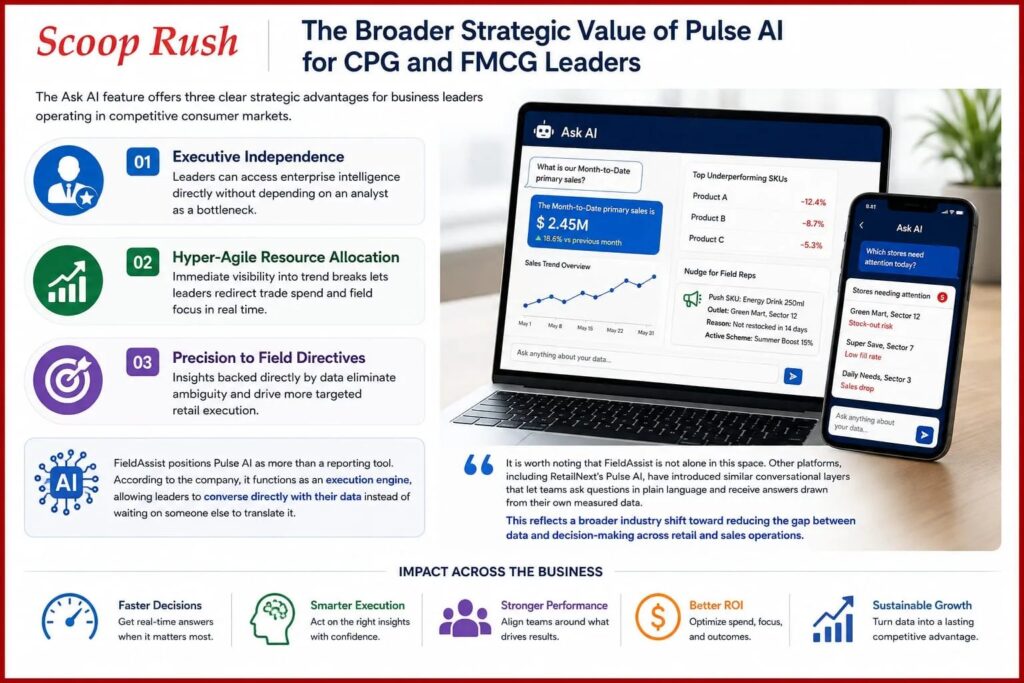
The Ask AI feature offers three clear strategic advantages for business leaders operating in competitive consumer markets.
First, it delivers executive independence, since leaders can access enterprise intelligence directly without depending on an analyst as a bottleneck. Second, it enables hyper-agile resource allocation, because immediate visibility into trend breaks lets leaders redirect trade spend and field focus in real time. Third, it brings precision to field directives, as insights backed directly by data eliminate ambiguity and drive more targeted retail execution.
FieldAssist positions Pulse AI as more than a reporting tool. According to the company, it functions as an execution engine, allowing leaders to converse directly with their data instead of waiting on someone else to translate it.
It is worth noting that FieldAssist is not alone in this space. Other platforms, including RetailNext’s own Pulse AI, have introduced similar conversational layers that let teams ask questions in plain language and receive answers drawn from their own measured data. This reflects a broader industry shift toward reducing the gap between data and decision-making across retail and sales operations, one that mirrors how AI is quietly reshaping property search platforms and other consumer-facing tools far beyond sales.
Conclusion
The days of waiting three days for a sales report are fading fast. Pulse AI, and specifically its Ask AI feature, shows how conversational AI is reshaping the way CPG and FMCG leaders interact with their business data. Instead of interpreting dashboards, leaders can now simply ask a question and get an immediate, data-backed answer.
This shift matters because speed has become a genuine competitive advantage. Companies that compress the time between a question and a decision are better positioned to protect shelf space, correct underperforming territories, and drive stronger field execution. As more platforms adopt this conversational approach, the traditional dashboard-heavy model of business intelligence may soon become a thing of the past.
FAQs
1. What is Pulse AI’s Ask AI feature?
Ask AI is a conversational interface within FieldAssist’s Pulse AI that lets business leaders ask questions about their sales data in plain English and receive instant answers, without needing dashboards or analyst support.
2. How does Pulse AI reduce decision-making time?
Pulse AI replaces the traditional three-day analyst turnaround with instant responses. Leaders can ask a question and receive precise metrics, trend explanations, and projections within milliseconds.
3. What is an Instant Execution Nudge in Pulse AI?
An Instant Execution Nudge is a proactive, role-aware recommendation that Pulse AI sends to field reps, such as pitching a specific SKU at an outlet based on stock gaps and active schemes.
4. Which data sources does Pulse AI integrate with?
Pulse AI unifies data from SFA, DMS, ERP, BI tools, and Perfect Store metrics into a single conversational layer, ensuring insights are based on a complete view of the business.
5. Who benefits from using Pulse AI in a sales organization?
Pulse AI benefits users across the sales hierarchy, from frontline reps who receive outlet-level nudges to zonal and regional managers who get macro-level performance summaries and territory insights.
Iran retaliates after fresh US strikes hit several military sites across the country. Tehran fired missiles and drones at US-linked targets in three different nations. The attacks came right after another round of American strikes on Iranian military positions.
The fighting broke out on Tuesday, September 1, 2026. It followed renewed clashes between Washington and Tehran after weeks of relative calm. President Donald Trump had already warned Iran against striking back, calling any retaliation a serious mistake.
Iran Retaliates After US Strikes on Key Sites
Iran ignored Trump’s warning and promised a strong response within hours. Tehran then launched ballistic missiles toward Jordan under the cover of night. It also sent drones toward Bahrain and Kuwait, catching some regional defense teams off guard.
Iranian officials said the strikes targeted American military assets stationed in the region. This move directly challenged Trump’s earlier threat and raised the stakes considerably. The exchange pushed the conflict into new territory, pulling in more countries than the earlier rounds of fighting.
US Targets Iranian Military Infrastructure
The US military carried out a fresh wave of strikes across several Iranian provinces. CENTCOM said the attacks focused mainly on Islamic Revolutionary Guard Corps assets tied to recent threats. Forces hit air defenses, radar systems and maritime facilities used to monitor shipping lanes.
The strikes also hit mine-laying equipment and communication sites near the coast. Officials linked the operation to recent Iranian threats against commercial shipping in the Gulf. American troops stationed across the region also faced growing risks, officials said, prompting the expanded response.
Missiles and Drones Hit Regional Targets
Jordan’s military said it intercepted ten Iranian missiles over its airspace. Three more missiles landed in remote desert areas away from towns. Officials reported no casualties from these strikes, calling the outcome fortunate given the scale of the barrage.
Bahrain and Kuwait activated their air defense systems soon after the missiles launched. Both countries intercepted incoming Iranian drones before they reached populated areas, local authorities said. Iran also claimed a combined missile and drone attack near Erbil in Iraqi Kurdistan, widening the reach of its response even further.
Trump Warns of an Even Bigger Response
Trump issued a strong warning right after the latest US strikes went public. He said Iran would face a tougher, more severe response if it retaliated again. This message came just before Tehran launched its regional attacks, suggesting the warning went unheeded.
Trump later said an even larger military strike remained in reserve if needed. He described it as capable of causing severe, lasting damage across Iran’s infrastructure. Still, he also said he preferred holding the current position around Hormuz for now rather than escalating immediately.
Strait of Hormuz Faces Rising Risk
The Strait of Hormuz sits at the center of this entire conflict. Iran claims special rights over the narrow, strategically vital waterway between the Gulf states. The United States, however, treats it as international waters open to all shipping.
This route carries a major share of the world’s daily oil supply. Recent attacks have made shipping through it noticeably more difficult and risky for tankers. Even so, US officials say record volumes of oil still passed through the strait this week, easing some immediate market fears.
Civilian Casualties Spark Dispute
Iranian authorities reported civilian deaths following the latest round of American strikes. They said a wedding gathering in southern Iran was hit by flying shrapnel. State media reported dozens of injuries, including several children, and described the scene as chaotic.
CNN geolocated footage from the aftermath to a residential area in Kouhestak. However, the network could not independently confirm the full casualty details reported by Iranian outlets. US Central Command has not yet confirmed or denied Iran’s account of the incident.
Washington Adds Economic Pressure
The Trump administration is also raising economic pressure on Tehran alongside the strikes. Treasury Secretary Scott Bessent said more sanctions could target Iranian banks in the coming weeks. Officials hope this financial squeeze will eventually push Iran back toward serious negotiations.
Bessent also discussed longer-term plans to cut reliance on the Strait of Hormuz. Gulf states could build new overland routes for oil exports in the future. Such infrastructure projects would gradually reduce the waterway’s strategic importance and limit Iran’s leverage over global energy markets.
Pakistan Continues Mediation Efforts
Pakistan says it remains actively engaged with both Tehran and Washington despite the violence. Officials confirmed they have not stepped back from their mediation role in the crisis. Foreign Ministry spokesperson Tahir Andrabi said the fighting should not derail these ongoing talks.
Each new military exchange makes negotiations noticeably harder to sustain and schedule. Still, continued contact between all sides could eventually help ease the mounting tensions. Diplomatic engagement therefore remains an important, if fragile, thread alongside the ongoing military activity in the region.
What Happens Next in the Iran-US Conflict?
Attention now turns to whether Iran plans to launch further attacks soon. Washington has already warned Tehran about an even stronger military response if needed. Iran’s latest actions show it does not intend to back down easily.
The Strait of Hormuz will stay under close watch in the coming days. Any new attack on shipping there could trigger another swift American strike. Meanwhile, Washington keeps combining military pressure with fresh economic sanctions aimed squarely at Tehran’s finances.
FAQs
1. Why did Iran retaliate against the United States?
Iran retaliated after the US struck Iranian military targets on September 1, 2026. Tehran said its response hit American military assets in the region, directly answering Trump’s earlier warning against further action.
2. Which countries did Iran target in its response?
Iran fired ballistic missiles at Jordan and sent drones toward Bahrain and Kuwait. It also claimed a missile and drone attack near Erbil in Iraqi Kurdistan, expanding the conflict well beyond its own borders.
3. What did the US strike inside Iran?
CENTCOM said American forces hit Revolutionary Guard Corps targets, including air defenses, radar systems and maritime facilities. The strikes also targeted mine-laying equipment and coastal communication sites linked to shipping threats.
4. Why is the Strait of Hormuz so important?
The Strait of Hormuz carries a huge share of global oil shipments each day. Any lasting disruption there can quickly raise oil prices and shipping costs worldwide, making it a major flashpoint in this crisis.
5. Could this conflict escalate further?
Yes, further escalation remains possible after Iran’s latest retaliation against US-linked targets. Trump has threatened a much larger strike if Tehran attacks again, though Pakistan’s ongoing mediation offers a possible path toward reduced tensions.
For years, anyone flagged for possible bladder cancer faced the same grim next step: a cystoscopy. A thin camera. A trip through the urethra. An uncomfortable, invasive procedure that most patients dread.
Now a new study asks a bold question what if a urine sample could do the job instead?
The answer, according to fresh research published today in European Urology Oncology, is surprisingly promising. A non-invasive urine test has detected more than nine in ten bladder cancers in one of the largest real-world NHS studies of its kind.
Could this be the beginning of the end for routine invasive testing? Let’s break down what the study actually found.
What Is This New Bladder Cancer Urine Test?
The test is called GALEAS Bladder. It was developed using genomic science pioneered at the University of Birmingham, with early funding from Cancer Research UK. It has since been commercialised by diagnostics company Nonacus.
Here’s the simple version of how it works:
Bladder tumours shed tiny fragments of DNA into urine.
GALEAS Bladder scans that urine for genetic mutations linked to cancer.
It checks for more than 450 known mutations across 23 genes.
No camera. No sedation. No trip to a procedure room.
Just a urine sample and a lab.
Why Does This Matter So Much Right Now?
The NHS has a bladder cancer problem, and it’s not just about the disease itself. It’s about the sheer volume of people funnelled into urgent testing.
Consider this:
Blood in urine (haematuria) is the classic warning sign of bladder cancer.
But haematuria has dozens of possible causes infections, kidney stones, and more.
Because doctors can’t tell the difference just by looking, almost everyone with the symptom gets sent for urgent investigation.
The numbers from this study make the scale of the issue obvious. Out of 964 patients referred through the urgent pathway, only 8% actually had bladder cancer.
That means 92 out of every 100 patients went through an anxious, resource-heavy diagnostic process for a disease they didn’t have.
The Study, in Plain English
Researchers wanted to know: does GALEAS Bladder actually work outside a controlled lab setting? So they tested it in the real world.
The setup:
964 patients
7 NHS urology departments
Locations across England and Scotland
All patients referred urgently for suspected bladder cancer
The goal: compare GALEAS Bladder results against actual diagnoses, and see if the test held up.
It did and then some.
The Headline Numbers
Let’s get straight to what everyone wants to know: does it actually catch cancer?
Metric
Result
Overall cancer detection rate
92.2% (71 of 77 cancers found)
Muscle-invasive cancer detection
100% (17 of 17 found)
High-grade cancer detection
97.2% (35 of 36 found)
Negative result reliability (overall)
99.3% chance of no cancer
Non-visible haematuria subgroup detection
100% (all cancers found)
Non-visible haematuria negative reliability
100% chance of no cancer
Estimated cystoscopy reduction
730 fewer per 1,000 patients
Look at that muscle-invasive number again. 100%.
That’s the category of bladder cancer that’s most likely to spread and turn life-threatening if missed. The test didn’t miss a single one.
Why the “Negative Result” Number Might Be the Real Story
Detecting cancer matters. But so does ruling it out with confidence.
Here’s why that 99.3% figure is such a big deal:
If a patient tests negative, doctors can be highly confident there’s no cancer.
That confidence means fewer unnecessary cystoscopies.
Fewer unnecessary procedures means shorter waits for patients who genuinely need one.
And for one specific group of patients, the results were even better.
The Non-Visible Haematuria Breakthrough
Around 30% of patients in the study had what’s called non-visible haematuria blood in urine that isn’t visible to the eye but shows up in lab testing.
This group is often trickier for doctors. The risk is generally lower than with visible blood in urine, but it’s still enough to trigger urgent referral under current guidelines.
For these patients, GALEAS Bladder performed flawlessly:
100% of bladder cancers detected
100% probability of no cancer with a negative result
In other words, for this specific group, the test didn’t miss a single case — and a clear result meant total confidence.
Could This Actually Ease NHS Waiting Lists?
Here’s where the story shifts from “impressive science” to “practical impact.”
The UK performs more than 300,000 cystoscopies every year. In some regions, waiting lists for the procedure are significant. Every cystoscopy eats up:
Clinical staff time
Specialist equipment
Appointment slots that could go to higher-risk patients
Researchers modelled what would happen if GALEAS Bladder were used to help decide who truly needs an urgent cystoscopy.
Even using the most cautious threshold tested, the results suggested:
730 fewer urgent cystoscopies per 1,000 patients
No loss of overall clinical benefit meaning high-risk patients still get flagged
Scale that across the NHS, and the potential is enormous. Tens of thousands of patients a year could potentially skip a procedure they don’t need.
What the Experts Are Saying
This isn’t just exciting to headline writers the researchers behind it are genuinely optimistic too.
Professor Richard Bryan, Director of the University of Birmingham’s Bladder Cancer Research Centre and a former practising urologist, has spent years developing the science behind this test. He described seeing the early promising results reproduced across multiple real NHS centres, in a large real-world patient population, as genuinely significant.
His view is straightforward: this data supports using molecular urine testing now to help decide which patients need urgent cystoscopy and which can safely wait.
Lee Silcock, Co-founder and Chief Product Officer at Nonacus, pointed to something specific: this wasn’t a small pilot in one lab. It was tested across seven different NHS departments, treating real patients on real pathways. That, he suggested, is what gives the results their weight.
Michelle Mitchell, Chief Executive of Cancer Research UK, offered a note of both encouragement and caution. She acknowledged that too many patients currently wait longer than they should for a bladder cancer diagnosis but stressed that it’s still early days, and further research is needed before the test reshapes standard practice.
So… Does This Replace Cystoscopy?
Not yet. And that distinction matters.
Here’s what GALEAS Bladder is not:
It’s not a full replacement for cystoscopy
It’s not being used as a standalone diagnostic tool
It’s not perfect — six cancers in the study were missed
Here’s what it is shaping up to be:
A triage tool
A way to prioritise genuinely high-risk patients
A way to safely defer cystoscopy for lower-risk patients
A second layer of confidence for doctors making difficult calls
Cystoscopy still has an essential role, especially for patients whose symptoms or risk profile call for direct visual examination regardless of test results.
Is This Test Already Being Used?
Yes — and that’s arguably the most surprising part of this story.
GALEAS Bladder isn’t stuck in a research lab waiting for approval. It’s already being used within NHS pathways in England and Wales, and more NHS sites are adopting it as clinical use expands.
That real-world deployment is part of what makes this study so credible. The data didn’t come from a single specialist unit it came from seven different departments, treating a genuinely mixed patient population.
What Happens Next?
The path forward likely involves:
Larger follow-up trials to confirm these results at scale
Health economic evaluation to assess cost-effectiveness across the NHS
Gradual expansion into more urology departments nationwide
Ongoing refinement of the clinical thresholds used to guide triage decisions
If those next steps go well, researchers believe the eventual impact could be significant: tens of thousands of patients spared unnecessary invasive procedures every year, while high-risk patients are identified and fast-tracked with even greater confidence. It’s a pattern echoed elsewhere in medicine, too such as how teplizumab is changing outcomes for type 1 diabetes by shifting care toward earlier intervention rather than late-stage crisis management.
A Quick Primer: What Should You Know About Bladder Cancer?
If you’re reading this because you or someone you know is facing testing, here’s the essential context.
Who’s most at risk?
Bladder cancer is more common in people over 60
It occurs more frequently in men than women
What’s the main warning sign?
Blood in the urine whether visible or only detectable through lab testing
What determines how serious a case is?
The size of the tumour
Whether it has spread beyond the bladder
Why does early detection matter so much?
Earlier-stage bladder cancer is generally far more treatable
Catching muscle-invasive disease early can be the difference between a manageable treatment path and a much more serious one
This is exactly why a test with a 100% detection rate for muscle-invasive cancer is generating so much attention.
GALEAS Bladder vs. Cystoscopy: A Side-by-Side Look
Numbers are easier to digest side by side. Here’s how the two approaches compare, based on what the study and existing clinical practice tell us.
Factor
GALEAS Bladder (Urine Test)
Cystoscopy
Invasiveness
None standard urine sample
Invasive camera inserted via urethra
Discomfort
Minimal
Can be significant
Setting required
Lab analysis
Hospital procedure room
Sedation/anaesthetic
Not required
Sometimes required (local, occasionally general)
Turnaround
Days (lab processing)
Immediate visual result
Muscle-invasive cancer detection (study)
100%
Gold standard reference
Overall NHS annual volume
Emerging
300,000+ procedures/year
Current role
Triage / risk stratification
Definitive diagnosis
This isn’t really an “either/or” comparison. Right now, the two work best together — one narrowing down who needs the other.
What Would This Mean for a Patient, Practically Speaking?
It’s worth pausing on what this could actually look like from a patient’s chair, not just a researcher’s spreadsheet.
Imagine two people, both referred urgently after noticing blood in their urine.
Patient A has a genuinely high risk profile. Under a GALEAS-informed pathway:
They provide a urine sample.
The test flags concerning genetic signals.
They’re fast-tracked for an urgent cystoscopy and further investigation.
Because they were prioritised rather than queued behind lower-risk patients, treatment could start sooner if cancer is confirmed.
Patient B has a much lower risk profile perhaps non-visible haematuria and no other red flags. Under the same pathway:
They provide a urine sample.
The test comes back negative, with a reliability of up to 100% in this subgroup.
Instead of an immediate invasive procedure, their care team can safely monitor or defer cystoscopy.
They avoid an unnecessary, uncomfortable procedure and free up a slot for someone who needs it more urgently.
Multiply that across an entire NHS trust, and the ripple effects on waiting lists start to make sense. For patients navigating that anxious waiting period between tests and results, small grounding habits like practicing box breathing to manage stress or exploring other simple ways to relieve stress can genuinely help.
A Broader Pattern: Cancer Testing Is Getting Less Invasive
This study doesn’t exist in isolation. It’s part of a wider shift happening across cancer diagnostics generally, where researchers are racing to develop tests that can catch disease early without subjecting patients to uncomfortable or high-risk procedures.
Some of the driving forces behind that shift include:
Genomic sequencing costs falling, making DNA-based tests more affordable to run at scale.
NHS capacity pressures, pushing health systems toward triage tools that reduce unnecessary procedures.
Patient demand for convenience, particularly for people managing chronic anxiety around cancer symptoms.
Advances in liquid biopsy science, the broader field this bladder cancer test belongs to, which also includes blood-based tests being developed for other cancer types.
Bladder cancer has historically lagged behind some other cancers when it comes to non-invasive screening innovation, partly because urine — while a logical sample source — required more refined genetic analysis techniques to reliably detect cancer signals. This study suggests that gap is closing.
Limitations Worth Keeping in Mind
It’s easy to get swept up in strong headline numbers, so it’s worth grounding expectations with a few caveats directly from the research and expert commentary.
The study, while large for this type of research, still represents a specific patient population within UK NHS haematuria pathways results may look different in other healthcare systems or populations.
Six cancers were missed by the test, underlining that it isn’t foolproof.
Long-term outcome data such as whether earlier triage actually improves survival rates at a population level will take more time and further studies to confirm.
Cost-effectiveness across the whole NHS still needs formal health economic evaluation before wider rollout decisions are made.
As Cancer Research UK’s Michelle Mitchell noted, it remains early days, and further research is still required before conclusions can be considered settled science.
None of these caveats undercut the strength of the results but they do explain why researchers are describing this as a major step forward rather than a finished solution. In the meantime, general preventive steps still matter alongside better diagnostics hings like staying active with a 5-minute walk every hour and being mindful of supplement risks from taking too many vitamins remain sensible habits regardless of how testing technology evolves.
How Common Is Bladder Cancer, Really?
Numbers help put the urgency of this research into context.
Bladder cancer is among the more frequently diagnosed cancers in the UK.
It ranks higher in incidence among men than women, largely due to risk factors like smoking history and occupational exposures.
The over-60 age group represents the bulk of new diagnoses — a life stage where staying on top of general health monitoring, from cancer screening to managing heat and humidity risks for older people, becomes increasingly important.
Survival outcomes vary dramatically depending on how early the cancer is caught which is exactly why detection tools matter as much as treatment advances.
This is also a cancer type that tends to recur. Patients who’ve had non-muscle-invasive bladder cancer often require repeated monitoring over years, sometimes involving multiple follow-up cystoscopies. A reliable, low-burden urine test could ease that long-term monitoring load too, not just the initial diagnostic pathway though that specific use case wasn’t the focus of this particular study.
What Symptoms Should Prompt You to See a Doctor?
Awareness matters just as much as new testing technology, and it fits into a wider pattern of building healthy habits in your 20s and 30s that pay off decades later. Here are the symptoms doctors generally recommend taking seriously:
Blood in urine even a single episode, even if it isn’t painful
Urine that looks pink, red, or darker than usual
Needing to urinate more frequently than normal
A burning sensation when urinating, without an obvious infection
Pelvic pain that doesn’t have another clear explanation
None of these symptoms automatically mean bladder cancer most people with blood in their urine turn out not to have it, as this very study demonstrates. But they’re worth flagging to a GP promptly rather than waiting to see if they resolve on their own. It’s a similar principle to staying alert to early lung cancer symptoms, where catching warning signs early can meaningfully change outcomes.
How Does This Compare to Testing Innovations in Other Cancers?
Bladder cancer isn’t the only area where researchers are chasing less invasive diagnostic tools. It’s useful to see this development in that wider context.
Colorectal cancer has FIT (faecal immunochemical testing), a home-based stool test that’s already reduced reliance on routine colonoscopies for lower-risk patients.
Cervical cancer screening has shifted toward HPV testing, changing how frequently invasive follow-up procedures are needed a shift that has also driven renewed attention to how the HPV vaccine prevents cervical cancer deaths in the first place.
Lung cancer research is exploring blood-based biomarkers to catch disease earlier in high-risk groups, such as long-term smokers.
Prostate cancer diagnostics continue to evolve beyond the traditional PSA blood test, incorporating MRI and genomic risk scoring to reduce unnecessary biopsies.
Bladder cancer diagnostics arguably had more catching up to do, given how central cystoscopy has remained to the diagnostic pathway. This study is a signal that the field is starting to close that gap, following a broader trend of using genetic and molecular signals rather than direct visual or physical examination as a first-line filter.
Could This Technology Expand Beyond the UK?
The study was conducted entirely within NHS settings, but the underlying science isn’t inherently UK-specific. Genomic urine testing for cancer detection is being explored and adopted in various forms internationally, and a validated, peer-reviewed dataset like this one spanning multiple hospital sites is exactly the kind of evidence that tends to support wider international interest and regulatory conversations.
That said, healthcare systems differ enormously in how new diagnostics get adopted:
Reimbursement structures vary widely, affecting whether a test like this gets funded for widespread use.
Regulatory approval pathways differ by country, and evidence generated in one health system doesn’t automatically transfer to another’s clinical guidelines.
Existing diagnostic infrastructure — lab capacity, genomic testing familiarity, referral pathways shapes how quickly something like this could scale elsewhere.
For now, the clearest and most immediate impact is within the NHS, where the test is already live in some pathways. Wider international adoption, if it happens, would likely follow additional validation studies tailored to those specific health systems.
What Should You Take Away From All This?
If you strip away the statistics and expert quotes, the core message of this study is fairly simple:
A basic urine sample can now catch the overwhelming majority of bladder cancers, including virtually all of the most dangerous ones.
A negative result is reliable enough that doctors can use it to safely deprioritise or delay invasive procedures for lower-risk patients.
This isn’t a hypothetical future technology it’s already being used in parts of the NHS today.
It won’t replace cystoscopy, but it’s already changing how quickly the right patients get to one.
For a disease where early detection genuinely saves lives, and for a health system where diagnostic capacity is stretched thin, that combination is worth watching closely as more hospitals adopt the approach.
The Bottom Line
Nobody looks forward to invasive medical testing. But for a long time, it’s been the necessary trade-off for catching bladder cancer early.
This study suggests that trade-off might be shrinking.
A simple urine sample, tested in a lab, caught 92% of bladder cancers including every single muscle-invasive case across almost 1,000 real NHS patients. And it did so while pointing toward hundreds of unnecessary cystoscopies avoided per 1,000 patients tested.
It’s not a full replacement for cystoscopy. Not yet, anyway. But as a way to sort urgent cases from lower-risk ones, the evidence is compelling enough that the test is already live in NHS pathways today with more hospitals adopting it as the data keeps rolling in.
For patients anxious about invasive testing, and for an NHS system stretched thin on capacity, that’s a combination worth paying attention to.
FAQs
1. What is the new bladder cancer urine test called?
It’s called GALEAS Bladder, developed from University of Birmingham research and commercialised by Nonacus.
2. How accurate is the GALEAS Bladder urine test?
In this NHS study, it detected 92.2% of bladder cancers overall, 100% of muscle-invasive cancers, and 97.2% of high-grade cancers.
3. Is this test available to everyone right now?
Not universally. It’s already in use within some NHS pathways in England and Wales, with more hospitals adopting it, but it isn’t yet standard nationwide.
4. Does a negative result mean I definitely don’t have bladder cancer?
No test offers absolute certainty. But a negative GALEAS result was associated with a 99.3% probability of no cancer overall, and 100% within the non-visible haematuria subgroup high enough that clinicians can use it to guide next steps with real confidence.
5. Will this urine test replace cystoscopy entirely?
Not based on current evidence. Six cancers in the study were missed by the urine test, which is why cystoscopy remains essential, particularly for higher-risk patients or ambiguous cases.
6. How does the test actually work?
It analyses a urine sample for DNA fragments shed by bladder tumours, screening for more than 450 known cancer-linked mutations across 23 genes.
7. Is the test painful or invasive?
No. It only requires a standard urine sample no camera, no sedation, and no procedure room required.
8. Why does this matter for people who don’t have bladder cancer?
Because 92% of patients in urgent haematuria pathways don’t have bladder cancer, tools like this help avoid subjecting that majority to unnecessary invasive procedures freeing up capacity across the system.
9. What is non-visible haematuria, and why did it perform so well in the study?
It’s blood in urine that isn’t visible to the eye but shows up on lab testing. This lower-risk group saw the test’s strongest results: 100% cancer detection and 100% negative-result reliability.
10. Could this urine test reduce NHS waiting lists?
Potentially, yes. Researchers estimated up to 730 fewer urgent cystoscopies per 1,000 patients if the test is used for triage, without losing overall clinical benefit.
11. Who funded and developed this technology?
The underlying science originated at the University of Birmingham, supported by funding from Cancer Research UK, before being commercially developed by Nonacus under a licensing agreement that returns a share of revenue to the university and the charity.
12. Is more research still needed?
Yes. Experts, including Cancer Research UK’s Michelle Mitchell, have stressed that while results are promising, it remains early days and further research is required before the test’s role is fully established.
Self-flying planes are already changing how aircraft work, and one is skimming just a few feet above a field in California right now. There is no cockpit. There is no pilot. Yet the plane flies lower and more precisely than any human ever could.
This is not a scene from a futuristic movie. It is happening right now, and self-flying planes are already doing real work in real fields. So the question worth asking is simple: are self-flying planes actually the future of air travel, or just a niche tool for farms and cargo runs?
For years, self-driving cars dominated headlines about autonomous technology. Meanwhile, a quieter revolution has been unfolding in the skies. Self-flying planes are moving out of test labs and into farms, cargo routes, and even war zones. This shift matters because it touches agriculture, shipping, defense, and eventually, the way ordinary people may one day travel.
Why Self-Flying Planes Are Suddenly in the Spotlight
Self-driving cars received massive investment first, largely because big tech companies poured resources into that race early on. As a result, autonomous aviation moved at a slower pace, even though planes generally fly through more predictable environments than city streets, unlike the sensor challenges seen in self-driving car technology.
However, that gap is closing quickly. Several companies are now racing to bring self-flying planes into everyday commercial use. Some are building aircraft from scratch with no cockpit at all. Others are retrofitting existing planes with autonomous systems. Additionally, military contracts are speeding up development, since defense programs often face fewer regulatory hurdles than civilian projects, a pattern also visible in critical infrastructure security work.
Autopilot vs True Autonomy: What Is the Real Difference?
It helps to understand what separates these self-flying planes from the autopilot systems already used in commercial jets. Autopilot simply assists a human pilot, much like cruise control assists a driver. Full autonomy is different. These systems manage the entire flight, including takeoff and landing, using algorithms that process sensor data and make decisions largely on their own, similar in spirit to how physical AI is trained for robots.
This distinction matters because aviation carries enormous stakes. Air accidents can have severe consequences, so aircraft face far stricter safety standards than cars.
Meet the Companies Building Self-Flying Planes Today
Pyka: Crop Dusting Without a Human in the Cockpit
Pyka builds self-flying aircraft with no cockpit whatsoever, designed to spray crops or deliver cargo. According to flight test engineer Russ Marotzke, these planes can fly lower than a human pilot would, which reduces spray drift and cuts down on the chemicals needed.
Each Pyka aircraft has an 11.5-meter wingspan and can fly for about 35 minutes while carrying up to 300 liters of spray. When the plane senses it is running low, it lands itself for a refill and battery swap, then takes off again to finish exactly where it left off.
About a dozen Pyka aircraft already spray cotton and soybean fields in Brazil, work that human pilots previously handled. In the United States, Pyka’s crop sprayer is the largest autonomous fixed-wing aircraft approved for commercial civilian use, having won authorization last year. Even so, operations remain limited to agricultural settings and still require a ground operator and visual observer.
Pyka plans to scale production from around two dozen planes a year to as many as 1,000 by 2030. Each aircraft sells for $550,000. Michael Norcia, Pyka’s co-founder and CEO, envisions fleets of minibus-sized planes eventually ferrying passengers along the US coasts, and he believes his company could reach that milestone before flying taxis do.
Windracers: Autonomous Cargo Delivery for Remote Areas
Windracers, a British company, is pursuing a different mission. The firm wants to launch an autonomous cargo service across Scotland’s Shetland and Orkney islands, delivering goods to communities that are difficult to reach by other means. Windracers aircraft already fly cargo missions in Ukraine, which has tested their reliability under demanding conditions.
Stephen Wright, Windracers founder and chairman, believes this project could become the first heavy-lift air cargo drone service anywhere in the world. Unlike some rivals, Windracers builds its planes from the ground up, allowing autonomy to be designed into every part of the aircraft from the start.
Reliable Robotics: Retrofitting Planes Instead of Building New Ones
Not every company starts from a blank slate. Reliable Robotics, backed by Boeing’s investment arm, is testing its autonomous system on the Cessna 208B Grand Caravan, a single-pilot cargo plane that can carry roughly 1,360 kilograms over long distances.
Robert Rose, Reliable’s co-founder and CEO, explains that retrofitting certified aircraft lets the company focus entirely on proving its autonomous system is safe, rather than also seeking approval for an entirely new aircraft design. Reliable has chosen to avoid artificial intelligence altogether, arguing it would complicate certification. Instead, the company relies on forward-looking radar that detects other aircraft more than eight kilometers away, paired with rule-based software. Rose describes this system as better than a pilot’s own eyesight.
Merlin Labs: Betting Big on Artificial Intelligence
Merlin Labs is taking the opposite approach from Reliable. The company has steadily worked its way up through progressively larger military aircraft and is now applying its system to the two-pilot Lockheed Martin C-130J transport plane. Commercial multi-crew cargo planes are next.
Matt George, Merlin’s founder and CEO, describes the technology as a common autonomy brain that can transition between different aircraft types. Merlin embraces AI throughout its system, using AI-powered cameras to detect and classify objects in the sky, an approach that echoes how AI models like Kimi K3 and Qwen3 are trained on massive datasets. The company also plans to use generative AI, trained on thousands of hours of recorded exchanges, to interpret air traffic control instructions and respond automatically.
Merlin intends to reduce pilots gradually, moving from two down to one and eventually to none. George admits that communicating with air traffic control remains one of the harder problems his team faces, but he says the ultimate goal is moving beyond remote piloting entirely.
The Toughest Challenge: Spotting and Avoiding Other Aircraft
One of the hardest problems in autonomous flight is replicating a pilot’s ability to spot other aircraft and obstacles, then maneuver around them safely. There is almost no room for error here, so companies are layering multiple sensor systems for backup.
Pyka has used lidar from the start to detect trees, vehicles, large birds, and terrain. However, lidar has a short range, so the company plans to add AI-powered cameras as its first real use of onboard artificial intelligence, not unlike the wider-view lidar chip breakthroughs from MIT. Norcia explains that AI is not needed for most tasks, but figuring out whether a few distant pixels represent an airplane or something else entirely is exactly where AI excels.
This split between AI-avoidant and AI-embracing strategies reflects a broader debate across the autonomous aviation industry, one that also shows up in questions about why some companies aren’t profiting from AI yet. No single solution has emerged yet, so different approaches will likely coexist for years.
What Supporters and Skeptics Say About Self-Flying Planes
Supporters point to several benefits. Self-flying planes could ease pilot shortages, remove workers from dangerous jobs like crop spraying, and improve efficiency by carrying more cargo per flight. Furthermore, costs could fall if a single operator oversees multiple aircraft at once. Advocates also argue automation could make flying safer overall, citing historical accident declines as automated systems became more common. This mirrors ongoing debates about whether AI will replace jobs across other industries.
Pilot groups remain far more cautious. The US Air Line Pilots Association has called removing pilots a serious gamble with safety. Similarly, the US National Agricultural Aviation Association, representing crop dusting pilots, says small uncrewed aircraft can be hard for its pilots to spot in the air. The group also notes that piloted planes can currently cover larger areas more quickly.
This tension between innovation and caution will likely shape how fast regulators allow autonomous planes to expand beyond agriculture and cargo into passenger transport, much like ongoing regulatory pressure on big tech over child safety features.
How Military Contracts Are Speeding Things Up
Defense contracts are playing a major role in advancing self-flying plane technology. Many companies in this space test and demonstrate their systems through military partnerships, which often involve fewer regulatory obstacles than civilian projects. Some companies already supply autonomous aircraft to military customers, giving them valuable real-world data as they pursue civilian certification.
This pattern mirrors how other major technologies developed historically, since military use often paves the way for later civilian adoption, much like SpaceX’s rapid growth has been fueled partly by government contracts.
So, Are Self-Flying Planes Really the Future of Air Travel?
Fully autonomous passenger flights remain a distant goal. Still, many experts expect this technology to gradually work its way into mainstream commercial aviation. Consequently, piloted flights could become safer as these systems and sensors get built into traditional aircraft.
The US Air Line Pilots Association has acknowledged that this kind of gradual safety improvement would be welcome, even while the group stays cautious about removing pilots entirely.
For now, the path forward looks incremental. Agricultural spraying and cargo delivery are serving as proving grounds where autonomous systems build flight hours and public trust, similar to how Starship’s test flights are gradually building toward larger goals. Passenger flights, if they arrive, will likely follow years of accumulated safety data and regulatory approval.
Conclusion: What Self-Flying Planes Mean for the Future of Aviation
Self-flying planes are no longer a distant concept confined to research labs. Companies like Pyka, Windracers, Reliable Robotics, and Merlin Labs are already putting pilotless aircraft to work in real conditions, from spraying crops in Brazil to delivering cargo in Ukraine.
Each company takes a different path, whether that means building aircraft from scratch, retrofitting existing planes, avoiding AI, or embracing it fully. Real challenges remain, particularly around detecting other aircraft and communicating with air traffic control. Pilot groups remain understandably cautious about removing humans from the cockpit.
Still, the momentum is unmistakable. Agriculture and cargo are leading the way today, and many in the industry believe passenger flights could eventually follow. Whether or not self-flying planes fully take over passenger travel, the safety improvements from this technology will likely reach commercial aviation in some form.
FAQs
Are self-flying planes the future of air travel?
They could be. Companies like Pyka and Merlin Labs believe autonomous passenger flights are possible in the coming years, though full adoption will likely take time and depend heavily on regulatory approval and public trust.
What is the difference between autopilot and a self-flying plane?
Autopilot only assists a human pilot during flight, similar to cruise control in a car. A self-flying plane handles the entire flight, including takeoff and landing, using algorithms and sensors with little or no human involvement.
Which company has the largest autonomous plane approved for commercial use in the US?
Pyka currently holds this distinction. Its crop-spraying aircraft is the largest autonomous fixed-wing plane approved for commercial civilian use in the United States, having won authorization last year for agricultural spraying.
Are self-flying planes already being used commercially?
Yes. Pyka’s autonomous crop sprayers actively spray fields in the United States and Brazil. Windracers also flies autonomous cargo missions in Ukraine and is seeking approval for a cargo service in Scotland.
Will self-flying planes eventually carry passengers?
It is not certain yet, but several companies believe it is possible. Pyka’s CEO has expressed hope that passenger service could arrive before flying taxis become common. However, full passenger autonomy will likely require years of additional testing and regulatory approval.
Fort Ross stands as one of California’s most unusual travel destinations. Long before American settlers arrived, Russia built a colony on the Sonoma Coast. From 1812 to 1841, the Russian-American Company ran this remote outpost. Today, Fort Ross remains a fascinating stop for anyone exploring Northern California history.
The colony was never meant to conquer California for Russia. Instead, officials wanted steady food supplies and sea otter pelts. Fort Ross also supported Russia’s wider trade network across the Pacific. Its short but rich history still shapes Sonoma Coast tourism today.
Russia’s Push South From Alaska
Russia expanded into Alaska during the late 1700s. Fur traders chased the region’s valuable sea otter population. The Russian-American Company soon controlled most of Russia’s North Pacific trade. This growth, however, created a major problem back home.
Alaska’s harsh climate made farming nearly impossible. Food shortages became a constant worry for Russian settlers. As a result, company leaders searched for milder land further south. California offered better weather, fertile soil, and easy Pacific access.
The Founding of Fort Ross in 1812
Ivan Kuskov led the expedition that founded Fort Ross in 1812. His group included 25 Russians and about 80 Native Alaskans. Together, they built a settlement near the Kashia Pomo homeland. The Russians called it “Ross,” a nod to their homeland.
Americans later renamed the site Fort Ross. It quickly became Russia’s southernmost outpost in North America. For travelers today, this small stretch of coastline holds a surprisingly deep history. Few places in California blend Russian, Native, and Pacific stories so closely.
Why Russia Chose the Sonoma Coast
The Sonoma Coast offered clear advantages for a new colony. Thick redwood forests provided strong building material nearby. Fresh water, open pasture, and farmland supported daily life. These resources made the site practical for long-term settlement.
The coastline also gave access to rich marine life. Sea otters remained the company’s most valuable resource. Leaders also hoped to grow wheat and other crops. These supplies were meant to feed Russian colonies back in Alaska.
A Multicultural Settlement
Fort Ross grew into a genuinely diverse community. Russians, Native Alaskans, and local Native groups lived side by side. People of mixed Russian and Native heritage also called it home. This mix shaped daily life across the entire colony.
The Kashia Pomo played a central role in the settlement’s success. Many worked closely with Russian traders and workers. Family ties between Russian and Native residents grew over time. Fort Ross became a true meeting point of different cultures.
Life and Industry Inside Fort Ross
Fort Ross was far more than a simple fort. Workers built a wooden stockade with fortified blockhouses for defense. Homes, workshops, gardens, and storage buildings filled the grounds. Most structures used redwood harvested from nearby forests.
The settlement also supported shipbuilding and other trades. California State Parks notes its windmills as the state’s first. Gardens and farming operations ran alongside these industries. Together, they supported the colony’s wider commercial goals.
Trade and Relations With Spanish and Mexican California
The Russian-American Company managed all economic activity at Fort Ross. Workers produced food and gathered valuable natural resources daily. They also traded goods with nearby Mexican California settlements. This trade helped the colony stay self-sufficient.
Spain, and later Mexico, never fully accepted Russia’s presence. Still, no direct conflict ever broke out between them. Diplomacy and practical trade kept relations relatively calm. Distance also helped both sides avoid serious confrontation.
Decline of the Colony
Despite early hopes, Fort Ross never matched Russian expectations. Coastal fog and poor soil limited large-scale farming. Crop yields consistently fell short of what Alaska needed. This shortfall weakened the colony’s original purpose.
The sea otter population also declined sharply from overhunting. That drop hurt one of Russia’s key economic interests. Running a distant colony grew more expensive each year. Eventually, company leaders decided the settlement was no longer worth keeping.
Sutter’s Purchase and the End of Russian California
By the late 1830s, Russia actively looked for buyers. The Russian-American Company approached several potential purchasers. Mexico rejected the terms, and other buyers backed out too. This left the company searching for a new solution.
Captain John A. Sutter finally agreed to buy the company’s assets. The 1841 deal included buildings, livestock, and equipment. It did not, however, transfer legal ownership of the land. Mexico still held official claim to the territory.
Fort Ross State Historic Park Today
Fort Ross State Historic Park now welcomes visitors year-round. Guests can explore reconstructed sections of the original stockade. Highlights include the Russian Orthodox chapel and two restored blockhouses. The park offers a rare, hands-on history lesson by the sea.
For travelers planning a Sonoma Coast road trip, Fort Ross is a must-see stop. The park also honors the area’s deeper Indigenous history. This land remains the ancestral home of the Kashia Pomo people. Their story stays central to any visit today.
Russia’s Lasting Legacy in Northern California
Traces of Russian California still appear across the region today. San Francisco’s Russian Hill carries a familiar reminder of that era. The Russian River offers another lasting link to this history. Both names connect modern travelers to California’s Pacific past.
Fort Ross remains the clearest physical reminder of that period. California protects the site as a State Historic Park. It also earned National Historic Landmark status in 1961. For history lovers and road trippers alike, it remains well worth the visit.
Final Thoughts
Fort Ross tells a story most travelers never expect from California. Russia’s brief colonial chapter left a real mark on the Sonoma Coast. From redwood buildings to Native and Russian family ties, the site captures a complex past. It reminds visitors that California’s history reaches far beyond Spanish and American settlers.
A visit to Fort Ross offers more than old buildings and coastal views. It connects Alaska, California, Indigenous communities, and Pacific trade in one place. For anyone planning a Northern California road trip, this park adds real depth. Fort Ross remains a rare and rewarding stop on the Sonoma Coast.
FAQs
1. When was Fort Ross established?
Russia founded Fort Ross in 1812 on the Sonoma Coast. The Russian-American Company ran it until 1841.
2. Why did Russia build a colony in California?
Russia needed food for its Alaskan settlements. Officials also wanted sea otter pelts and new trade opportunities.
3. Who lived at Fort Ross?
Russians, Native Alaskans, and local Native communities all lived there. Many families had mixed Russian and Native heritage.
4. Who eventually bought Fort Ross?
Captain John A. Sutter purchased the company’s buildings and equipment in 1841. The deal did not include the land itself.
5. Is Fort Ross open for visitors today?
Yes, Fort Ross State Historic Park is open to the public. Visitors can tour original and reconstructed historic buildings.