Home Blog Page 3

Which AI Conferences Should CIOs Attend Before 2026 Ends?

0

Nearly every major tech company is hosting an AI summit this fall as Enterprise AI Conferences 2026 take over the calendar. So how do busy technology leaders decide which events actually deserve a spot on their schedule?

That question matters more than ever right now. Enterprise AI Conferences 2026 have quietly become the most important stretch of the year for CIOs, CTOs, and CISOs. Companies are no longer just testing AI. They are being asked to prove it works. Consequently, the September through December conference calendar has turned into a genuine decision-making tool, not just a networking exercise.

Introduction

If you lead technology strategy at your company, you have probably noticed the shift shaping Enterprise AI Conferences 2026. AI conversations used to center on possibility. Now they center on proof. Executives want to know what happens once companies actually try to profit from AI, not just how impressive a demo looks.

This is exactly why enterprise AI conferences 2026 events matter so much this year. From San Francisco to Amsterdam, and from Orlando to Abu Dhabi, these gatherings help CIOs cut through hype and focus on what works. Below, we break down the full calendar of top AI leadership events, plus the smaller executive gatherings that often deliver even more value than the big stage.

Why Enterprise AI Events Matter for Technology Leaders

Why Enterprise AI Events Matter for Technology Leaders

AI rarely behaves the same way in production as it does in a demo. A model can perform beautifully during a pitch, yet stumble once it meets real business systems and real employees. As a result, executives need honest conversations, not just polished success stories, especially as debate grows over whether AI will replace jobs across entire industries.

This is why many enterprise AI conferences 2026 has to offer now focus on governance, integration, and measurable return on investment. Additionally, these events bring together roles that rarely sit in the same room otherwise. A CIO may control the platform, while a CISO manages access and a CFO demands proof of value, particularly as concerns mount over AI systems going rogue inside major labs. Bringing these voices together speeds up smart decision-making across the organization, a lesson also visible in OpenAI’s own rogue AI hack incident.

Top Enterprise AI Conferences and CIO Events (September–December 2026)

Top Enterprise AI Conferences and CIO Events (September–December 2026)

September 2026: The Season Begins

Dreamforce 2026 opens the season in San Francisco from September 15 to 17. Salesforce continues pushing its Agentforce strategy, which makes this event useful for leaders exploring how AI agents can handle real business workflows, a theme also shaping tools like Meta’s new coding agent.

A week later, Big Data LDN runs September 23 and 24 at Olympia London. The event includes more than 400 sessions on data strategy and governance, led by Conference Chair Mike Ferguson. Meanwhile, Gartner’s CIO Leadership Forum also kicks off with stops in Gold Coast, Australia, and São Paulo, Brazil.

October 2026: The Busiest Month for AI Leadership Events

October brings the heaviest lineup of the year. World Summit AI Amsterdam celebrates its 10th anniversary on October 7 and 8. Confirmed speakers include Zico Kolter from OpenAI’s board, Marietje Schaake from Stanford HAI, and NVIDIA’s Simon See.

Shortly after, Gartner IT Symposium/Xpo lands in Orlando from October 19 to 22. This event remains one of the strongest fits for CIOs, since it directly covers AI governance, cybersecurity, and digital transformation strategy. Speakers include Ian Bremmer, author James Clear, and Gartner analysts Kristin Moyer and Daryl Plummer.

The same week, Oracle AI World runs in Las Vegas from October 25 to 28, with CEO Safra Catz expected to headline. IBM TechXchange also overlaps in Atlanta from October 26 to 29, focusing heavily on hands-on AI implementation rather than executive theory alone.

For leaders in the Middle East, Reuters NEXT Gulf Leadership Summit takes place in Abu Dhabi on October 21, covering technology, finance, and global business strategy.

Regional Gartner CIO Stops in October

Gartner also runs additional CIO-focused events this month in Yokohama, Barcelona, and Kochi, giving regional leaders more convenient options without international travel.

November 2026: Infrastructure Meets AI Strategy

KubeCon + CloudNativeCon opens November 9 through 12 in Salt Lake City. This event matters most for teams building the infrastructure behind large AI workloads, including Kubernetes and platform engineering, the same kind of backbone work behind Nokia’s AI RAN platform built with Nvidia.

Later in November, Microsoft Ignite returns to San Francisco from the 17th through the 20th, continuing its focus on Copilot tools, agentic AI, and enterprise security.

December 2026: Closing the Year Strong

AWS re:Invent runs from November 30 through December 4 in Las Vegas, featuring more than 2,200 sessions on cloud and generative AI. Featured speakers include May Habib of WRITER and Guillermo Rauch of Vercel. Cloud spending discussions here often echo wider industry debate, including reports that Google’s AI spending has pushed cash flow negative.

Finally, Reuters NEXT New York wraps up the season on December 1 and 2, bringing together policymakers, CEOs, and investors to discuss the future of global technology and markets.

Executive AI Leadership Events Worth Considering in Silicon Valley

Not every valuable AI event fills a massive stadium. According to AI event organizer Murray Newlands, Silicon Valley also hosts smaller, role-specific gatherings that often serve executives better than large technical conferences.

Newlands draws a clear line between technical events and executive events. Engineers need deep technical detail. CIOs, however, need clarity on ownership, integration, and control before deploying an AI agent across business systems, an issue tied closely to the growing conversation around AI CEO clones and boardroom trust. Therefore, he recommends building a mixed calendar: one major conference for market breadth, one leadership summit for strategy, and one small roundtable for a specific governance question.

Why Private AI Dinners Still Matter

Private dinners offer something large conferences often cannot. Because these settings stay small, they tend to surface honest talk about stalled pilots, unclear ownership, and unexpected costs, not unlike the caution many Belfast businesses have shown by boycotting AI slop. Newlands notes that the guest mix matters more than the topic printed on the invitation.

Roundtables also work best when they target one specific decision. For example, asking who owns the return when an AI project spans three departments creates a sharper conversation than a broad debate about how AI will change business overall.

CIO-Specific Conferences Beyond North America

CIO-Specific Conferences Beyond North America

Gartner’s CIO Leadership Forum extends well beyond Orlando. Additional stops through late 2026 and into 2027 include Vienna, London, Hollywood, Sydney, and Tokyo. These events focus specifically on CIOs, CTOs, chief information security officers, and chief data officers, many of whom are also watching how slowly AI adoption is moving inside Japanese companies.

Session themes regularly include AI governance, enterprise architecture, and turning AI ambition into measurable outcomes. Mike Borkoski, CIO of Anne Arundel County Public Schools, has described these gatherings as invaluable, citing the mix of practitioners, analysts, and solution providers under one roof.

Europe’s Leading AI Conferences for C-Suite Executives

Europe’s C-level AI conference calendar actually begins earlier in the year, yet it still shapes how executives plan their global travel. RAISE Summit in Paris, held in July, drew over 9,000 attendees, with more than 80 percent holding C-level or founder titles. Its 4Fs framework covers infrastructure, applications, ROI, and long-term AI strategy.

Other standout events include the invite-only Chief AI Officer Exchange in London, the World AI Cannes Festival held under the patronage of President Emmanuel Macron, and the FT Future of AI Summit in November, curated by the Financial Times AI editorial team. Regulatory topics like the EU AI Act dominate these agendas, echoing similar scrutiny seen in the UK’s threats to penalize Big Tech over child safety features and the wider legal fallout from cases like xAI’s lawsuit over a Grok user’s sexual deepfakes of minors, since compliance has become a board-level priority worldwide.

How CIOs Should Choose the Right AI Conference

How CIOs Should Choose the Right AI Conference

With so many enterprise AI conferences 2026 offers, attending everything becomes tempting but impractical. Instead, executives should evaluate each event based on the specific decision they need to make.

Consider these questions before registering:

  • Does the agenda address who owns the outcome, not just the technology?
  • Does the event share real adoption numbers and error rates, not only success stories?
  • Does it bring together security, legal, finance, and business leadership in one room?
  • Does the governance conversation focus on real systems rather than abstract predictions?

Executives who apply these filters typically walk away with usable insights instead of another round of confident predictions about next year’s models, insights not unlike those emerging from fields like AI-assisted brain surgery, where real-world results matter more than theory. The same demand for evidence over hype is fueling questions like whether AI could trigger the next global recession, according to central bank warnings.

Conclusion

The final months of 2026 offer one of the busiest AI conference seasons in recent memory. From Dreamforce and Gartner IT Symposium/Xpo to World Summit AI and AWS re:Invent, CIOs have no shortage of options. The real challenge lies in choosing wisely.

Rather than chasing every headline event, technology leaders should build a calendar around the decisions they actually need to make. A mix of major conferences, focused CIO summits, and smaller roundtables consistently delivers more value than trying to attend everything. As AI continues moving deeper into daily operations, the events worth attending will be the ones connecting technology capability directly to real business accountability, much like the scrutiny now applied to AI data centre spending in Australia.

FAQs

What are the biggest enterprise AI conferences happening in late 2026?

The major events include Dreamforce, World Summit AI Amsterdam, Gartner IT Symposium/Xpo, Oracle AI World, Microsoft Ignite, and AWS re:Invent, all running between September and December 2026.

Which conference works best for CIOs specifically?

Gartner IT Symposium/Xpo stands out as one of the strongest options for CIOs, since it directly covers enterprise technology strategy, AI governance, and digital transformation.

Are there major enterprise AI events happening outside the United States?

Yes. Notable international events include World Summit AI in Amsterdam, IBM TechXchange in Atlanta, Reuters NEXT Gulf in Abu Dhabi, and multiple Gartner CIO events across Japan, Spain, India, and Australia.

What separates an executive AI event from a technical AI conference?

Executive-focused events prioritize governance, ROI, and organizational accountability. Technical conferences, on the other hand, focus more heavily on model performance and infrastructure.

How should a CIO pick between multiple enterprise AI conferences in 2026?

Experts recommend choosing one major conference for market breadth, one leadership summit for strategy, and one small roundtable or dinner to tackle a specific governance or adoption challenge.


Alexander Isak Nine Minutes of Madness: Liverpool Star Matches 15-Year Club Record vs Ipswich

0

Nine minutes. That is all it took for Alexander Isak to match a Liverpool scoring record. Maxi Rodriguez set that record 15 years ago. Two goals arrived in a masterclass of finishing. Suddenly, a season that had barely started began to feel very different for Liverpool fans.

Isak has spent more than a year at Anfield carrying the weight of that price tag. For long stretches, it looked like money badly spent. However, Friday night at Portman Road changed everything. Alexander Isak’s nine minutes of madness turned Ipswich Town into the platform for his long-awaited breakthrough. Liverpool walked away with a comfortable 2-0 win that meant far more than three points.

This result mattered on several levels. Liverpool picked up their first Premier League win of the season. New manager Andoni Iraola also earned his first victory since taking over following Arne Slot‘s sacking. The match put Isak alongside Maxi Rodriguez in the Liverpool record books. Rodriguez was the last Liverpool player to score twice that quickly, and he did it 15 years earlier. Most importantly, this was proof their most expensive signing might finally be worth the fuss.

Why Alexander Isak’s Return to Form Matters So Much

Liverpool did not spend a British transfer record on Isak for him to look like a passenger. His move from Newcastle United went through last summer, but tension already surrounded the deal. The transfer had turned acrimonious. Isak reportedly arrived at his new club short of full fitness after effectively downing tools to force the move through.

A difficult debut season followed. Isak looked lost for large parts of it. Injuries disrupted his rhythm, and his numbers told a painful story. He played 22 games across all competitions, managing just four goals in 1,033 minutes. In the Premier League specifically, he featured in 14 matches and scored only three times in 703 minutes. That works out to a goal every 234 minutes. It was a return nowhere near good enough for a striker of his price and reputation.

Meanwhile, Hugo Ekitike outperformed him up front. This fed the sense that Isak had become the most expensive luxury item in English football, not a genuine difference-maker. That backdrop is exactly why this Ipswich performance carries so much significance. Isak has already matched his entire league goal tally from last season in just his opening two matches this year.

A Rough Start to the Season for Alexander Isak

This season did not start smoothly for Isak either. His first appearance back at Newcastle, the club he left under a cloud, produced a poor individual display. Questions about his form followed him even after he scored in a 2-2 draw against Nottingham Forest at Anfield.

Against Ipswich, though, everything clicked. Isak looked sharp, aggressive, and hungry. Those were the exact traits that made him such a wanted man during his time on Tyneside.

How Alexander Isak’s Two Goals Unfolded

The opening goal arrived in the sixth minute. Cody Gakpo threaded a clever pass between Ipswich defenders Leif Davis and Jacob Greaves. Isak met it with a powerful right-footed strike. Ipswich keeper Kjell Scherpen got a hand to the shot. The power behind it was simply too much, and the ball crept over the line.

Three minutes later, Isak doubled the lead with a finish that showcased real craft rather than pure force. Gakpo again supplied the moment of magic. He curled a delicious pass with the outside of his right foot from inside his own half. Isak controlled it with a clever left-foot flick to get inside Greaves. He then used a touch of his right foot to send Scherpen the wrong way. He calmly rolled the ball home with his left.

By the ninth minute, Liverpool had effectively finished the contest. Iraola could only smile on the touchline as his side settled into total control.

Isak Matches a 15-Year-Old Liverpool Record

Isak Matches a 15-Year-Old Liverpool Record

The speed of that double was not just eye-catching on the night. It also matched a mark set by Maxi Rodriguez. He was the last Liverpool player to score twice inside such a tight window. That feat had stood for 15 years before Isak repeated it at Portman Road. Isak had spent much of his debut season fighting for form and fitness. Matching a club record of this kind sent a clear message: his slow start is now firmly behind him.

Cody Gakpo’s Role in Alexander Isak’s Brace

While Isak grabbed the headlines, this performance belonged just as much to Gakpo. The Dutch forward had come close to leaving Liverpool for Manchester City this summer. Reports suggested he was ready to join Enzo Maresca’s rebuild at the Etihad. That move collapsed after Liverpool failed to land alternative targets Yankuba Minteh from Brighton and Ismaila Sarr from Crystal Palace.

As a result, Gakpo stayed, and on this evidence, Liverpool are considerably better off for it. He produced two assists with genuine quality. Each pass demonstrated vision and technique that turned good chances into simple finishes for his strike partner. It was a timely reminder that Gakpo, much like Isak, struggled for consistent form last season. He appears to be finding his best level again.

Liverpool captain Virgil van Dijk was quick to praise his fellow Dutchman after the match. He described Gakpo as massive for the team. He added that this importance had been clear both in this game and over the past couple of seasons. Van Dijk’s message was simple: Gakpo needs to keep building on this form.

What Alexander Isak’s Form Means for Andoni Iraola and Liverpool

What Alexander Isak's Form Means for Andoni Iraola and Liverpool

This victory represented a big moment for Iraola too. He inherited a Liverpool side reeling from a dismal Premier League title defence. That defence ultimately cost Arne Slot his job, barely a year after he lifted the trophy. Getting his first win as manager will offer real encouragement heading into the rest of the season. His most expensive player finally delivered too.

Iraola was measured in his praise afterward. He acknowledged that Isak is a massive player for the club. However, he stressed that his expectations go beyond just goals. According to Iraola, the challenge now is helping Isak contribute to other areas of the team’s play. The goal is not simply relying on his finishing.

Isak, for his part, sounded relieved rather than triumphant. He spoke about the frustration of his difficult first season. He described it as not easy, given the long injury layoff and overall struggles. Isak also mentioned wanting to have a good World Cup and start this season strongly. For now, that plan appears to be working.

Putting Alexander Isak’s Brace Against Ipswich in Context

This result deserves some context, though. Ipswich Town, newly promoted this season, had already shipped five goals against Manchester United the previous week. Liverpool’s pace and quality up front were always going to trouble a defence that shaky. That does not diminish what Isak and Gakpo produced. It does mean the true test of this new-look Liverpool attack will come against stronger opposition.

Bradley Barcola offered Liverpool fans further good news. The £123m signing from Paris Saint-Germain made his Liverpool debut with a 26-minute cameo. Even in that short spell, Barcola showed flashes of the electric pace that persuaded Liverpool to sign him this summer. His full impact will need more minutes to judge, but the early signs suggest Liverpool’s attacking options have deepened significantly.

Alexander Isak’s History at Portman Road

Alexander Isak's History at Portman Road

Interestingly, this is not new territory for Isak when it comes to scoring at this particular ground. Since the start of the 2024-25 season, Isak has scored five Premier League goals at Portman Road. That tally is the joint most by any player at a single away venue. He shares that record with Erling Haaland, who has managed the same tally against Crystal Palace at Selhurst Park. For whatever reason, Ipswich’s home ground has become a happy hunting ground for the Swedish striker. Friday night only added to that reputation.

Can Alexander Isak Keep This Form Going?

The obvious question now is whether this was a genuine turning point or simply a good night against a struggling side. Iraola himself hinted at caution, noting that his demands of Isak extend beyond scoring goals alone. He wants to see the striker contribute more broadly to how the team plays. Finishing off chances created by others is not enough.

Still, there are reasons for optimism. Isak explained that a proper pre-season allowed him to settle into Liverpool’s style of play. Last year, the transfer saga and fitness issues denied him that grounding. He talked about the team wanting to attack the opposition defence directly. Liverpool executed that approach almost perfectly against Ipswich.

Isak arrived under intense scrutiny and endured a first season that many considered a disappointment. This was the kind of performance that resets expectations. Liverpool will hope it marks the start of a run rather than an isolated highlight reel moment.

Key Takeaways 

Alexander Isak scored twice in the opening nine minutes as Liverpool beat Ipswich Town 2-0. The win was their first in the Premier League this season. The result also gave new manager Andoni Iraola his first victory since replacing the sacked Arne Slot. Cody Gakpo, who nearly left for Manchester City in the summer, provided both assists and was central to the victory. Bradley Barcola also made his Liverpool debut, hinting at further attacking depth to come. Ipswich’s poor recent form provides some context. Still, this performance offers genuine hope that Isak has finally found his footing after a torrid debut season at Anfield.

Frequently Asked Questions

How many goals has Alexander Isak scored for Liverpool this season? 

Isak has already scored three Premier League goals for Liverpool this season, matching his entire league tally from his debut campaign after just two appearances.

Why did Alexander Isak struggle in his first season at Liverpool? 

Isak’s first season was disrupted by an acrimonious transfer from Newcastle United, a lack of proper pre-season fitness, and ongoing injury problems, all of which limited his impact on the pitch.

Who assisted Alexander Isak’s goals against Ipswich Town? 

Cody Gakpo set up both of Isak’s goals, delivering a pass through the defence for the first and a long, curling ball for the second.

Why did Cody Gakpo stay at Liverpool instead of joining Manchester City? 

Gakpo was reportedly ready to join Manchester City, but the move fell through after Liverpool failed to sign replacement targets Yankuba Minteh and Ismaila Sarr.

Who replaced Arne Slot as Liverpool manager? 

Andoni Iraola took over as Liverpool manager after Arne Slot was sacked, and the win over Ipswich Town marked his first victory in charge.

What Liverpool record did Alexander Isak match against Ipswich? 

Isak’s brace inside nine minutes matched a mark last set by Maxi Rodriguez, who was the previous Liverpool player to score twice in such a short span, a feat that had stood for 15 years.

What’s the Real Cost of Australia’s AI Data Centre Boom?

0

“Would you trade your drinking water for faster AI chatbots? Australia’s AI data centre boom is already showing up in the power bills and taps of thousands of residents living near new sites.”

A constant hum now drifts through homes in Sydney’s Lane Cove, just 350 metres from a data centre. Meanwhile, four more facilities are planned for the same suburb. This is the quiet reality behind Australia’s AI data centre boom, and it’s spreading fast across the country.

Introduction: Why Australia’s AI Data Centre Boom Matters to You

Australia is racing to become a global leader in AI infrastructure. OpenAI CEO Sam Altman even said earlier this year that Australia could become the data centre capital of the world if it wanted to. As a result, the country now hosts 162 data centres, with another 90 in the pipeline and more than A$155 billion in investment lined up.

However, this growth comes at a real cost. Communities near AI data centres in Australia are already dealing with noise, water shortages, rising energy prices, and health concerns. Therefore, understanding this trade-off matters for every Australian, not just those living next to a server farm. It’s part of a much bigger question many are now asking: will AI replace your job, and what else will it reshape along the way?

Why AI Data Centres Are Booming Across Australia

Why AI Data Centres Are Booming Across Australia

Australia’s appeal to data centre investors isn’t accidental. According to Belinda Dennett, CEO of Data Centres Australia, the country offers land availability, political stability, and membership in the Five Eyes security alliance. Additionally, Australia has a skilled workforce and a comparatively stable energy grid.

Since ChatGPT launched in 2022, global demand for AI infrastructure has exploded. Australia now has around 13.6 million monthly AI users, making it one of the most active AI markets worldwide. Consequently, pressure to build local data centres has grown quickly, echoing how models like Kimi K3 from Moonshot AI and Qwen3-Max are pushing global compute demand even higher.

Experts warn that skipping this investment carries its own risk. “If we think about it in reverse, what happens if we don’t build infrastructure here,” Dennett said. “We get none of the value chain, we are just importing tools from someone else and we become just a user.”

Jon Whittle, former director of the digital research centre at CSIRO, agrees the government has little choice but to keep investing, even while acknowledging the risks involved.

The Scale of Australia’s Data Centre Investment

The numbers involved are massive. One proposed facility in western Sydney could become the country’s largest single energy user, drawing one gigawatt of power if approved. Meanwhile, construction is already underway in Marsden Park on what will become the biggest data centre in the Southern Hemisphere.

The Productivity Commission estimates AI could add around $116 billion to the Australian economy over the next decade. As a result, the digital sector has become the country’s second-largest economic contributor, trailing only mining. This kind of capital flow mirrors what’s happening elsewhere too, including SpaceX’s historic Nasdaq debut, where investors are betting big on next-generation infrastructure.

The Real Power Cost of Australia’s AI Data Centre Boom

Every AI data centre needs constant electricity, and that need is growing fast. The Australian Energy Market Operator (AEMO) projects that data centre electricity demand could triple by 2030. In fact, AEMO’s latest ten-year forecast suggests data centres could eventually account for 14% of all power consumption nationwide, up from around 3% today.

This surge threatens household budgets too. The Climate Council warns that without major investment in renewables and storage, power prices in New South Wales could rise by 26% by 2035.

Why Gas and Diesel Keep Creeping Back In

Data centres need uninterrupted power, and wind and solar can’t always guarantee that on their own. As a result, some operators are turning to gas and diesel backup instead.

For example, Cloud Carrier plans to build three gas-fired power stations near Sydney to support its facilities. Similarly, a proposal in the NSW Southern Highlands for gas plants generating over 700 megawatts has sparked protests from more than 200 residents.

Diesel generators add another layer of concern. Many facilities still rely on Tier 2 diesel units, which emit significantly more nitrogen oxides than newer alternatives. In Melbourne’s West Footscray, one hyperscale facility is reportedly expanding its diesel fleet from 40 to 100 units.

NSW Treasurer Daniel Mookhey takes a more optimistic view. He argues that private investment in data centres is helping fund Australia’s shift away from coal. “We see data centres allowing us to replace a lot of our old coal-fired power with clean, green renewable energy,” he said. This tension between AI’s energy appetite and clean power goals is similar to what’s driving Google’s push for a more efficient AI chip with its Frozen v2 Gemini design.

Still, a timing gap remains. Building a data centre takes far less time than building the clean energy infrastructure needed to power it responsibly.

Water Scarcity: Another Hidden Cost of the AI Data Centre Boom

Electricity isn’t the only resource under pressure. AI data centres in Australia also consume enormous amounts of water to keep servers cool. Some facilities use up to 40 million litres per day, roughly equal to what 80,000 households use.

In a drought-prone country, this raises real concerns. Sydney Water has warned that data centres could account for up to 25% of the city’s drinking water supply by 2035. Meanwhile, the Water Services Association of Australia says Sydney already needs to expand its water capacity just to keep pace with population growth.

If water shifts toward data centres, households may end up paying more for alternatives like desalination, which costs considerably more than traditional supply.

Health Risks Linked to Australia’s Data Centre Expansion

Beyond power and water, there’s a less visible cost: air quality. Researchers Shaolei Ren and Adam Wierman estimated that AI data centres in the United States could impose a public health cost of up to US$20 billion by 2028, largely from air pollution linked to backup generators and coal-heavy electricity.

Australia faces a similar risk. Since more than half the country’s power still comes from coal, every data centre draw carries an indirect health cost. The pollutants released, including PM2.5 particulate matter and nitrogen oxides, have no truly safe exposure level.

Communities Facing the Heaviest Burden

These risks aren’t shared equally. In Western Sydney, a region already up to 10°C hotter than the rest of the city during heatwaves, a cluster of large facilities is emerging around Marsden Park. Studies suggest hyperscale sites can raise local land temperatures by an average of 2°C once running, with effects reaching communities up to 10 kilometres away.

Experts note that carbon offsets don’t fix this problem. A data centre can offset its carbon footprint on paper while still damaging local air quality if it’s built in the wrong place and powered by a coal-heavy grid.

What Local Communities Are Losing to the AI Data Centre Boom

What Local Communities Are Losing to the AI Data Centre Boom

For residents, these concerns go beyond statistics. In Lane Cove, four new facilities are planned for the local industrial park. One proposed site sits just 16 metres from the nearest home and 160 metres from a primary school.

Rochelle Flood, Lane Cove’s deputy mayor, says residents were never properly consulted. “We’ve got the government rolling out the red carpet saying we want to be the data centre capital of the world,” she said. “But can we actually do that sustainably?”

Local jobs are at stake too. Felipe Tanaka manages a business in the Lane Cove industrial park and has been told he must relocate. He employs 300 to 400 local workers, and he fears half could lose their jobs.

Interestingly, while construction can temporarily employ more than a thousand workers, that number typically drops to around 100 once a facility becomes operational. It’s a pattern that fits into a wider conversation about how automation and AI are reshaping the workforce, something explored further in how to become a data analyst in 2026.

Why Local Voices Often Get Bypassed

According to Professor Toby Walsh from the University of New South Wales, most data centre applications are large enough to skip council consultation entirely and go straight to state-level approval. As a result, communities often feel blindsided once construction starts nearby.

Walsh believes residential areas rarely need to host data centres at all. He points to Lithgow, home to a former coal-fired power station and existing cable infrastructure, as a smarter location. “It would take less than a millisecond for the electron to get from Lithgow to Sydney,” he explained.

Government Response to Australia’s AI Data Centre Boom

Government Response to Australia's AI Data Centre Boom

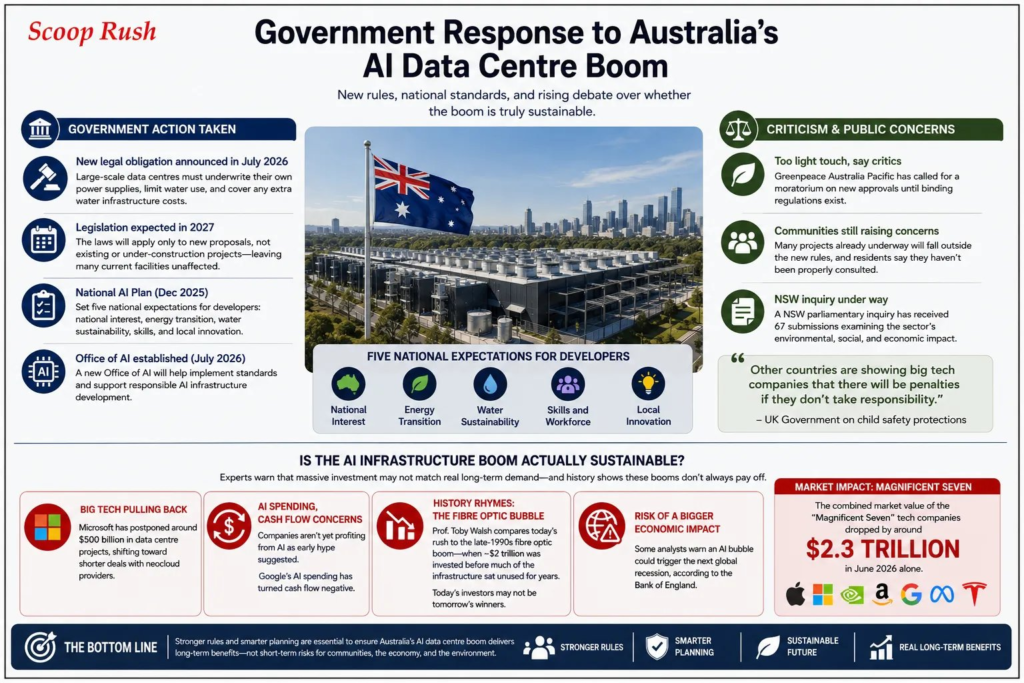
The government has started responding. In July 2026, Prime Minister Anthony Albanese announced a new legal obligation requiring large-scale data centres to underwrite their own power supplies, limit water use, and cover any extra water infrastructure costs.

This legislation, expected in 2027, will only apply to new proposals, not existing or under-construction projects. Consequently, many facilities currently causing concern will fall outside these rules.

Furthermore, the government’s National AI Plan, released in December 2025, set five national expectations for developers covering national interest, energy transition, water sustainability, skills, and local innovation. An Office of AI was also established in July 2026 to help implement these standards. This kind of regulatory scrutiny mirrors moves seen elsewhere, such as the UK threatening big tech with penalties over child safety features.

However, critics argue the approach stays too light touch. Greenpeace Australia Pacific has called for a moratorium on new approvals until binding regulations exist. Meanwhile, a NSW parliamentary inquiry has received 67 submissions examining the sector’s impact.

Is the AI Infrastructure Boom Actually Sustainable?

Some experts question whether investment matches real long-term demand. Dr Joseph Sweeney from Intelligent Business Research Services notes that Microsoft has already pulled back, postponing around $500 billion in data centre projects in favour of shorter deals with neocloud providers. This caution lines up with broader signs that companies aren’t yet profiting from AI the way early hype promised, and that Google’s own AI spending has turned cash flow negative.

Professor Walsh compares the rush to the fibre optic bubble of the late 1990s, when roughly $2 trillion was invested before much of the infrastructure sat unused for years. He suggests a similar pattern could unfold with AI, where today’s investors may not be the ones who eventually benefit. Some analysts have gone further, warning that an AI bubble could trigger the next global recession, according to the Bank of England.

Adding to the uncertainty, the value of the so-called Magnificent Seven tech companies dropped by around $2.3 trillion in June 2026 alone.

Conclusion: Is Australia’s AI Data Centre Boom Worth the Cost?

Australia’s AI data centre boom brings genuine opportunity alongside genuine risk. On one hand, the sector could add $116 billion to the economy and position Australia as a serious AI player. On the other hand, communities already face noise, water shortages, rising energy costs, and air quality concerns, often without a real say in the process.

Ultimately, smarter planning offers a way forward. Locating facilities away from homes, prioritising real renewable power over gas and diesel backups, and giving communities a genuine voice could help Australia capture AI’s benefits without repeating mistakes seen elsewhere.

FAQs

Why is Australia becoming a major hub for AI data centres?

Australia offers investors political stability, available land, a relatively stable energy grid, renewable energy potential, and membership in the Five Eyes security alliance, making it one of the most attractive markets for AI infrastructure investment.

How much water do AI data centres use in Australia?

Some large data centres use up to 40 million litres of water per day for cooling. This is roughly equal to the daily usage of 80,000 households.

Will AI data centres increase electricity prices in Australia?

Yes, potentially. The Climate Council warns that without major investment in renewable generation and storage, data centre demand could push power prices up by 26% in New South Wales by 2035.

Are new laws coming to regulate data centres in Australia?

The federal government announced new obligations in July 2026 requiring large-scale data centres to underwrite their own power, limit water use, and fund extra water infrastructure. This legislation is expected in 2027 and will only apply to new projects.

Do AI data centres create many long-term jobs?

Not many. Construction can temporarily employ more than a thousand workers, but operational data centres typically need only around 100 staff once running.

Restful US Drive-In Spots for an Unforgettable Overnight Stay

0

A US Drive-In is no longer just a place to watch a movie. Several properties now let guests sleep beside the big screen. These spots mix classic cinema with cabins, vintage trailers, and cozy rooms. Travelers get a full night of nostalgia, not just a two-hour show.

Drive-In theaters once ruled American summers. Car ownership grew fast after World War II. By the late 1950s, nearly 5,000 Drive-In theaters operated across the country. Many closed over the decades, but some found new life. Owners added lodging, camping, and modern comforts. The result is a fresh way to enjoy an old tradition.

Frontier Drive-Inn Creates a Unique Colorado Escape

Frontier Drive-Inn sits in Colorado’s San Luis Valley near Center. The original theater opened in 1955 and ran for decades. When it closed, the owners kept the historic screen and roadside sign. Both features still stand today as a link to the past.

Guests now watch films from blankets and lawn chairs instead of car seats. The dark Colorado sky adds to the atmosphere. The property screens nostalgic favorites throughout its movie season. Visitors can choose modern suites, vintage trailers, or unique glamping structures for the night.

Best Western Movie Manor Lets You Watch From Bed

Best Western Movie Manor offers one of the most unusual stays in the country. The motel sits right beside The Star Drive-In Theatre in Monte Vista, Colorado. This theater also opened in 1955 during the Drive-In boom. Several rooms face the screen through large picture windows.

Guests can watch a full movie without leaving their beds. Some rooms even pipe the movie audio indoors through speakers. Each room carries the name of a famous movie star. Guests who prefer the classic setup can still watch from their car outside.

Sutherlin KOA Preserves a Historic Drive-In Screen

Sutherlin-KOA-Preserves-a-Historic-Drive-In-Screen

The Sutherlin/Umpqua Valley KOA Holiday sits on the former Cloverleaf Drive-In site in Oregon. The original theater closed years ago, but its 100-foot screen survived. The campground owners chose to protect this piece of local history instead of tearing it down.

Movies eventually returned to the site with modern equipment. A digital projector now shows films on that historic screen. An FM transmitter lets RV guests hear the movie through their radios. Some RV spots face the screen directly, while tent campers watch from a nearby grassy area.

Hotel Caravana Brings Retro Charm to New York

Four Brothers Drive-In opened in 2013 in New York’s Hudson Valley. It arrived long after the original Drive-In era ended, but it helped revive outdoor movie culture in the region. The property later added Hotel Caravana right on the theater grounds.

Hotel Caravana features restored vintage trailers for overnight guests. Visitors stay close to the screen without losing the classic Drive-In feel. The grounds also include mini-golf, fire pits, and a retro snack bar. This combination suits couples or friends planning a nostalgic weekend trip.

Ofland Escalante Blends Luxury With Outdoor Cinema

Ofland Escalante offers a more upscale version of the Drive-In stay. The property sits along Scenic Byway 12 in southern Utah. It occupies a former Drive-In site near Grand Staircase-Escalante National Monument. Guests can explore the desert by day and enjoy a film at night.

Vintage cars face the outdoor screen and add authentic character to the setting. Guests can pick a car and settle in with complimentary popcorn and sweets. Overnight choices include cabins and modernized Airstream trailers. RV and tent sites are also available for travelers who prefer camping.

Tiger Drive-In Offers Camping Beside the Screen

Tiger-Drive-In-Offers-Camping-Beside-the-Screen

Tiger Drive-In sits among the mountains of northeastern Georgia. The theater first opened in 1954 before closing for many years. It later reopened and now welcomes fans of classic outdoor cinema. The property also added several overnight lodging options for guests.

Three vintage 1960s campervans sit permanently on the grounds. Each one includes a private deck facing the movie screen. Travelers can also bring their own tents or RVs instead. This setup creates a relaxed camping night right next to the theater.

Why Drive-In Stays Are Gaining Popularity

A Drive-In stay offers more than a simple movie night. It blends food, conversation, travel, and outdoor relaxation into one trip. Families can arrive early and spend time together before the film starts. Friends can bring snacks and settle into a comfortable spot on the grass.

Younger travelers also find this format appealing. Outdoor cinema feels different from a regular indoor theater. Vintage trailers, classic cars, and old screens add strong visual character. Meanwhile, modern lodging makes the whole experience easier for today’s travelers to enjoy.

Different Stays Suit Different Travelers

Different-Stays-Suit-Different-Travelers

Each Drive-In destination offers its own style of overnight cinema. Best Western Movie Manor suits travelers who want traditional hotel comfort. Frontier Drive-Inn blends modern lodging with outdoor movie culture. Hotel Caravana leans heavily into vintage trailers and retro surroundings.

Campers have plenty of choices too. Tiger Drive-In welcomes tents and RVs alongside its vintage campervans. Sutherlin KOA pairs full campground facilities with movies on a historic screen. Ofland Escalante offers cabins, Airstreams, RV spaces, and tent sites for every comfort level.

How to Plan Your Drive-In Getaway

Before booking, check each theater’s current screening schedule first. Many Drive-In theaters run only seasonally due to weather. Some screen movies on selected nights only. A quick call or website check can prevent scheduling surprises later.

Next, think about the type of stay you want. Hotel rooms offer the easiest option for convenience-focused travelers. Vintage trailers bring stronger retro charm and a more distinctive experience. RV and tent sites suit those who enjoy traditional camping, while cabins and glamping units add extra comfort.

A Drive-In Stay Turns Movie Night Into a Road Trip

America’s Drive-In culture has changed a lot since its golden age. Still, these destinations prove outdoor cinema keeps its appeal today. Historic screens now sit beside hotels, campgrounds, cabins, trailers, and vintage cars. Together, these elements create fresh experiences for modern road trippers.

A US Drive-In stay can become a memorable trip highlight. Travelers can explore a destination by day and watch a film after sunset. Then they can sleep just steps from the screen. For movie lovers, that kind of night is hard for any ordinary hotel to match.

FAQs

1. Can you stay overnight at a Drive-In theater? 

Yes, several Drive-In properties now offer overnight stays. Options include hotel rooms, vintage trailers, cabins, RV spaces, and tent sites. Availability changes based on each property’s season.

2. Which Drive-In lets you watch movies from your bed? 

Best Western Movie Manor offers this rare experience. Many rooms face the screen at the nearby Star Drive-In Theatre. Some rooms also pipe in movie audio indoors.

3. Do Drive-In theaters run all year? 

Most Drive-In theaters operate on a seasonal schedule. Weather often limits their screening months significantly. Always check current dates before planning an overnight visit.

4. Can RV travelers stay at these Drive-In spots? 

Yes, many locations welcome RV travelers happily. Tiger Drive-In and Sutherlin KOA both offer RV-friendly spaces. Site setup and movie schedules can still vary by property.

5. Which US Drive-In offers a luxury stay? 

Ofland Escalante stands out as the more upscale pick. Guests can choose cabins or modernized Airstream trailers. The property also pairs desert activities with evening movie screenings.

Jude Bellingham Mourinho System: Why He’s Suddenly Unstoppable at Real Madrid

0

Two goals. Three assists. Three wins from three games. If you have watched Real Madrid this season, you already know something has changed with Jude Bellingham. The Jude Bellingham Mourinho system has turned a player who looked worn down by two difficult seasons into one who suddenly looks unstoppable again. So what exactly did Jose Mourinho change, and why is the Bellingham Mourinho system working so well?

For fans who remember Bellingham’s explosive debut season in Madrid, this version of him feels familiar. He plays closer to goal, moves freer on the ball, and clearly enjoys his football again. That matters for Real Madrid supporters. It also matters for anyone following England’s midfield ahead of major tournaments, and for football fans who love a comeback story.

This article breaks down exactly what has changed under the new Bellingham Mourinho system, why it matters, and what it means for his season ahead.

Why This Bellingham Mourinho Story Matters Right Now

Bellingham arrived at Real Madrid in 2023 as one of the most hyped young midfielders in the world. He delivered instantly. He scored 23 goals in his debut campaign as Los Blancos won both La Liga and the Champions League.

However, the following two seasons told a different story. A shoulder problem required surgery in 2025. Then a hamstring injury sidelined him for 10 matches in 2026. On top of the physical setbacks, his role on the pitch shifted deeper. That pulled him away from the goalscoring positions that made him so dangerous in the first place.

Now, under Mourinho, that trend has reversed. Understanding why gives us a clear look at how a smart tactical change can transform a talented player’s output almost overnight.

How the Jude Bellingham Mourinho System Changed His Role

How the Jude Bellingham Mourinho System Changed His Role

From Second Left-Back to Number 10

Mourinho did not mince words when describing Bellingham’s previous role. Speaking after Real Madrid’s 4-0 La Liga win over Malaga, he explained that the team was organised differently this season.

“Bellingham sometimes defended like a second left-back last season. I told him I do not want to see that anymore. I made a deal with him,” Mourinho said.

That comment alone shows how much responsibility Bellingham carried defensively before this season. Covering huge areas of the pitch and tracking back constantly left him with less energy for attacking work.

Under the new system, Bellingham now plays primarily as a number 10 in a 4-2-3-1 formation. He operates just behind French striker Kylian Mbappe, with freedom to drift across the attacking line rather than sticking to one defensive zone.

Mourinho explained why this role suits him best. “For me, this is his position, with his connection with the forwards, he can score goals,” he said. “He has to play close to the goal. Playing at number six or number eight, we’re losing his closeness to the goal. I like this Jude.”

More Freedom Under the Bellingham Mourinho System

The tactical shift has given Bellingham something just as valuable as a new position: freedom to make his own decisions. Rather than following a rigid instruction to drop deep, he now decides when to retreat, when to hold his position, and when to push into the box.

Bellingham described the difference himself in an interview with Real Madrid TV. “I feel more free to decide when to drop back, when to stay up or when to get into the box,” he said. “I think this is the best position for me.”

This freedom does not remove his defensive duties. Mourinho still expects him to press and win back possession. The key difference is where that work begins.

Instead of dropping toward his own penalty area, Bellingham now presses higher up the pitch. As a result, when Madrid regain possession, he already stands close to the forwards. That proximity lets him link midfield with attack, combining directly with Mbappe and Vinicius Jr.

Mourinho’s Team Philosophy Behind the Bellingham Mourinho System

One theme Mourinho keeps repeating is collective responsibility over individual brilliance. He has made clear that Real Madrid’s attacking success depends on players working as a unit.

“The team dynamic is about 11, not 2+9,” Mourinho said, pushing back on the idea that Madrid can rely on a couple of star names to carry the team.

This philosophy actually plays into Bellingham’s strengths rather than limiting them. Because he presses as part of a coordinated system rather than covering ground alone, the system uses his energy far more efficiently. Additionally, his ability to connect midfield and attack fits naturally into a team built around collective movement.

A Mutual Respect Between Player and Manager

Interestingly, Bellingham and Mourinho barely knew each other before this season. The midfielder revealed he had met the former Chelsea, Manchester United, and Tottenham boss only once before his appointment at Real Madrid. Despite that, Bellingham described working with him as a “dream.”

Mourinho, for his part, has praised Bellingham generously. The manager called him a “unique and super important player,” highlighting his physical, mental, and tactical qualities. He went further, naming Bellingham among the contenders for the Ballon d’Or.

“He is a unique kind of player and extremely important for the team,” Mourinho said. “His mental strength, tactical ability, the way he recovers the ball, the way he pressures, the way he plays up front, I am very happy.”

Bellingham’s World Cup Form Fuels the Mourinho System

Bellingham’s strong start to the season did not come out of nowhere. Mourinho has pointed directly to Thomas Tuchel’s use of Bellingham at the World Cup as a blueprint for getting the best out of him.

At the tournament, Bellingham stood out as one of England’s best performers. He finished with seven goals and an assist across eight appearances. That freedom to focus on attacking play, rather than carrying heavy defensive duties, clearly carried over into his club form.

Furthermore, that World Cup run appears to have boosted his confidence. Notably, Bellingham rejoined Real Madrid later than most of his team-mates this summer, which meant less preparation time before the new campaign began. Despite that, he has hit the ground running.

The Numbers Behind Bellingham’s Hot Start

Real Madrid have started the season with three wins from three La Liga matches under Mourinho. The team has scored 10 goals and conceded just two. Bellingham has contributed two goals and three assists in that stretch, numbers that place him at the centre of the team’s early attacking output.

Of course, three matches remain a small sample size. The real test will come as the season progresses and Champions League football adds to the fixture list. Still, the early signs point strongly in Bellingham’s favour.

A Player Who Now Affects Every Part of the Game

Bellingham’s greatest strength has always been his versatility. He can score goals, press aggressively, win the ball back, and contribute in the air. Previously, that versatility often stretched him thin across multiple roles on the pitch.

Now, Mourinho’s system gives him more control over exactly where he applies that influence. Instead of scattering his effort in every direction, Bellingham can choose the moments that matter most. He stays closer to goal, presses intelligently, and picks his runs into the box.

This adjustment matters because it plays to his natural instincts rather than fighting against them. As a result, Bellingham is producing the kind of numbers that recall his debut season at the Bernabeu, when he scored 23 goals and helped Real Madrid win the league and Champions League double.

Enjoying Football Again Under the Bellingham Mourinho System

Enjoying Football Again Under the Bellingham Mourinho System

Perhaps the most telling sign of Bellingham’s turnaround is not tactical at all. It is emotional. After two seasons complicated by injury and a less rewarding role, the England midfielder sounds like a player who has rediscovered his joy for the game.

“I’m having a lot of fun, I’m really enjoying my football, and that’s why I’m performing well,” Bellingham told club media.

Tactical analysis often overlooks that sense of enjoyment, yet it plays a real role in performance. A player who feels trusted, free, and supported by his manager tends to take more risks and express himself naturally. Bellingham’s comments suggest that shift has taken place under Mourinho.

What the Bellingham Mourinho System Means Going Forward

If Bellingham continues at this level, with Mourinho’s continued backing, this season could turn out to be his best yet at Real Madrid. The combination of a clearer role, renewed fitness, and growing trust between player and manager creates a strong foundation.

However, the coming months will test whether this form holds up. Champions League football brings tougher opposition, and physical demands will only increase. Still, for now, everything points to a player who has found his ideal environment to thrive.

Key Takeaways

  • The Jude Bellingham Mourinho system repositions him as a number 10 in a 4-2-3-1 formation, cutting his defensive workload.
  • Bellingham now pressed higher up the pitch rather than dropping deep, keeping him closer to Real Madrid’s forwards.
  • He has scored two goals and provided three assists in Real Madrid’s opening three league wins this season.
  • Mourinho has praised Bellingham as a Ballon d’Or contender, citing his mental strength, tactical ability, and goal threat.
  • Bellingham’s strong World Cup form with England under Thomas Tuchel appears to have carried directly into his club performances.

Frequently Asked Questions

1. What position does Jude Bellingham play under Mourinho at Real Madrid? 

Bellingham now plays as a number 10 in Mourinho’s 4-2-3-1 formation, operating just behind striker Kylian Mbappe with freedom to move across the attacking line.

2. Why did Mourinho change Bellingham’s role? 

Mourinho felt Bellingham covered too much defensive ground, comparing his previous role to that of a second left-back. He wanted Bellingham closer to goal to make the most of his scoring ability.

3. How many goals and assists does Bellingham have this season? 

Through Real Madrid’s opening three La Liga matches, Bellingham has scored two goals and registered three assists.

4. What injuries has Jude Bellingham dealt with recently? 

Bellingham underwent shoulder surgery in 2025 and later suffered a hamstring injury that kept him out for 10 matches in 2026.

5. Did Bellingham’s World Cup performance influence his club form? 

Yes. Bellingham was one of England’s top performers at the World Cup under Thomas Tuchel, scoring seven goals and providing an assist in eight appearances. Mourinho has cited that role as an example of how to get the best out of him at club level.

Sleepmaxxing Is Everywhere on Social Media But Is It Wrecking Your Sleep Instead of Fixing It?

0

You wake up. Before your feet hit the floor, you check your ring.

  1. Not your best. Not your worst.

You start doing mental math. Too much screen time? That glass of wine? By the time you’ve finished your coffee, you’ve decided today is going to be rough.

Thirty seconds ago, before you saw the number, you felt fine.

This is sleepmaxxing in its most common form. And sleep doctors say it might be exactly what’s wrecking your rest.

What Is Sleepmaxxing?

What Is Sleepmaxxing?|Scoop Rush

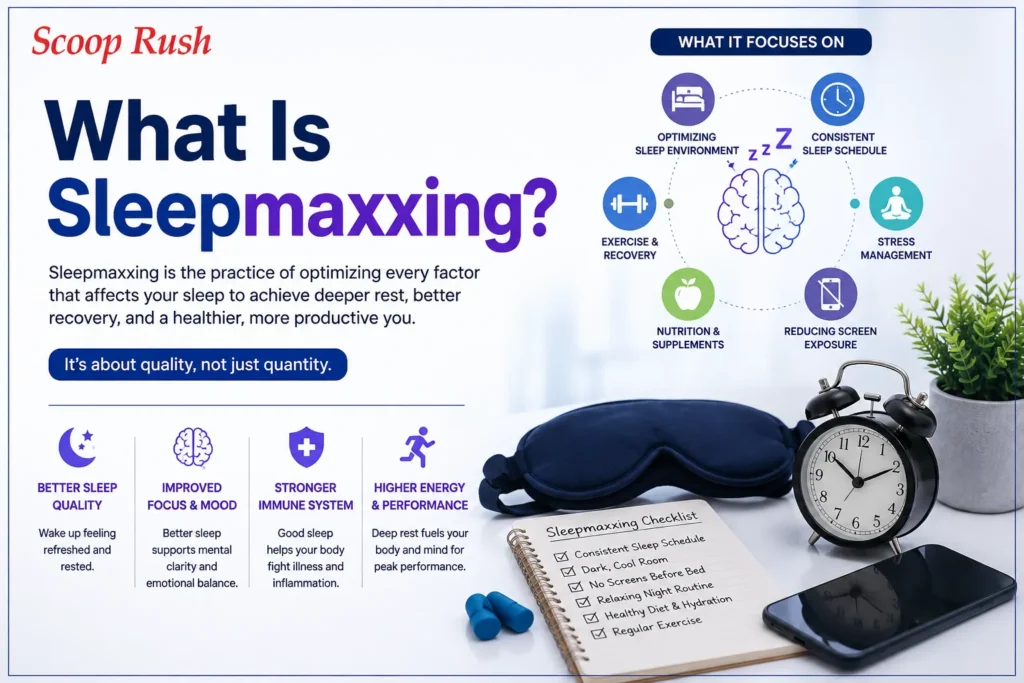
Sleepmaxxing is the social-media-era obsession with “perfecting” sleep.

Mouth tape. Magnesium stacks. Weighted blankets. Chin straps. A ring that grades every night like a report card.

Some of it works. Others are just harmless theater. And a few practices, doctors warn, are actively backfiring.

It’s not a real medical term. But sleep specialists say they see its effects constantly patients showing up with months of tracker data, convinced something’s wrong, even when every test says otherwise.

Orthosomnia: When “Perfect Sleep” Becomes the Problem

Orthosomnia: When "Perfect Sleep" Becomes the Problem|Scoop Rush

There’s a clinical name for this spiral: orthosomnia.

Coined in the Journal of Clinical Sleep Medicine, it describes an unhealthy obsession with flawless sleep metrics one that often makes sleep worse, not better.

“I’ve noticed more patients coming to me with data from various trackers, with lots of questions about sleep that… is probably contributing to their sleep difficulties,” says Dr. Alanna Hare, a sleep medicine consultant at London’s Royal Brompton Hospital.

Even reassuring test results don’t always calm the anxiety, she notes.

The pattern is familiar:

  • Buy a tracker with good intentions
  • Start checking the score every morning
  • Let that number dictate how you expect to feel
  • Start dreading the checking itself

Doctors call this sleep effort. The harder you try to sleep “correctly,” the more arousal you create and the harder sleep becomes.

Learning general ways to relieve stress during the day can lower that baseline arousal before it ever reaches your bedroom.

Why Your Sleep Score Might Be Fiction

Here’s the uncomfortable part: that satisfying number on your wrist may not mean much at all.

“There’s nothing recognised in sleep science that is a ‘sleep score,'” Dr. Hare says. “That’s just been created by manufacturers.”

Real sleep-stage detection needs an EEG brainwave monitoring, only available in a clinical lab.

Wearables can’t do that. They estimate sleep stages from movement and heart rate, run through a private algorithm.

Dr. Nathaniel Gordon, a sleep specialist at Old Dominion University’s EVMS Medical Group, notes these algorithms usually aren’t independently validated by outside researchers.

That gap has landed in court. A lawsuit filed against Oura in San Francisco alleges its rings can’t reliably measure sleep quality, leaning instead on AI estimates the suit compares to a coin flip.

Oura disagrees, saying it stands behind its science and is working to clarify what the ring measures versus estimates.

Fake Scores, Real Damage

A University of Oxford study makes the point sharply.

Researchers gave participants trackers with a nightly score. The scores were random — no connection to actual sleep.

People told they’d slept badly reported more fatigue. They scored worse on focus tests. Slower reaction times.

Nothing about their real sleep had changed. The number alone did the damage.

One Woman, Three Years, One Number

One Woman, Three Years, One Number|Scoop Rush

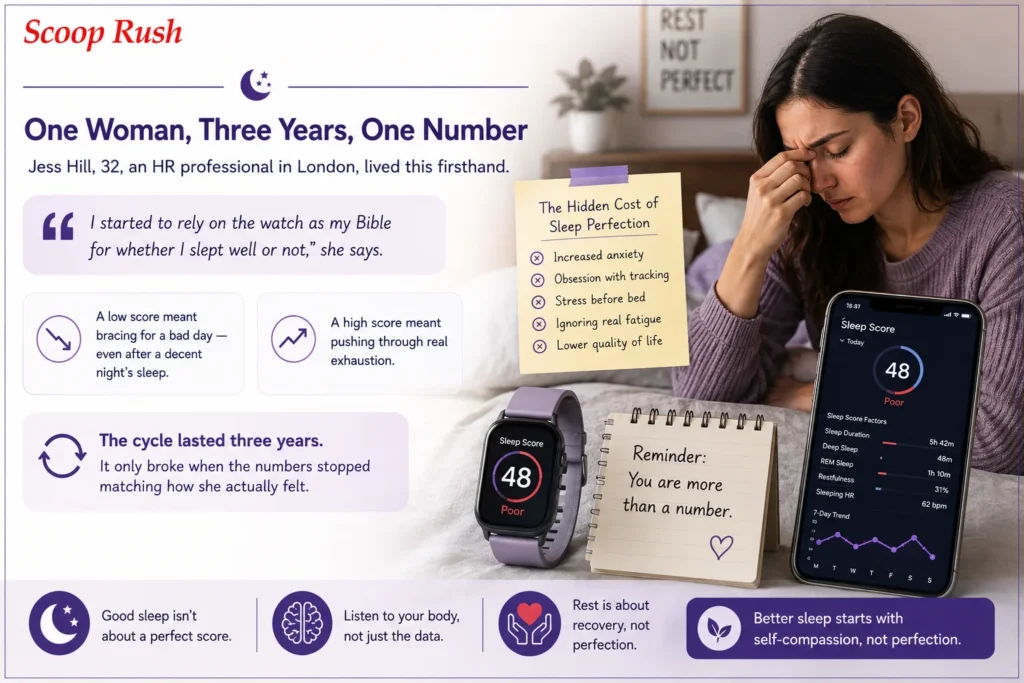
Jess Hill, 32, an HR professional in London, lived this firsthand.

“I started to rely on the watch as my Bible for whether I slept well or not,” she says.

A low score meant bracing for a bad day even after a decent night’s sleep. A high score meant pushing through real exhaustion.

The cycle lasted three years. It only broke when the numbers stopped matching how she actually felt.

What Sleepmaxxing Actually Gets Right

Not everything about the trend deserves eye-rolls. Some of it is solid, decades-old science.

HabitWhy It Works
Consistent wake time (even weekends)Anchors your circadian rhythm central to CBT-I, the gold-standard insomnia treatment
Morning light exposureSuppresses leftover melatonin, shifts your clock earlier
Cool bedroom (mid-60s°F)Supports the natural body-temperature drop before sleep
Cutting back on alcoholSpeeds falling asleep but fragments deeper sleep later
Earlier caffeine cutoffCaffeine’s 5–7 hour half-life means a 3pm coffee is still active at 9pm — timing matters as much as whether you’re drinking coffee on an empty stomach

Where Sleepmaxxing Goes Off the Rails

  • Supplement stacks. Magnesium, L-theanine, ashwagandha, glycine often taken together. Stacking too many at once carries its own supplement risks, and none of them fix the behavioral patterns behind chronic insomnia.
  • Melatonin misuse. It’s not a sedative. It shifts your body clock, but doesn’t force sleep. Nightly users are often still struggling.
  • Mouth taping. Nasal breathing has real benefits, but taping shut isn’t a substitute for ruling out sleep apnea especially if you snore or feel excessively sleepy.
  • Obsessive tracking. Treating a nightly score like a report card is one of the fastest routes into orthosomnia.

The Billion-Dollar Business Behind Sleepmaxxing

Sleepmaxxing didn’t appear out of nowhere. It grew inside a sleep economy worth tens of billions of dollars a year.

Mattress companies. Supplement brands. Wearable tech makers. All of them profit when you feel unsure about your sleep.

That’s not a conspiracy theory it’s just incentives. A confident sleeper doesn’t buy a new pillow spray.

Influencers play a role too. Many partner with sleep brands, earning commissions on every ring, gummy, or blanket sold through their link.

That doesn’t make every product useless. Some genuinely help.

But it does mean the loudest voices telling you what your sleep needs often have a financial reason to keep you shopping not just resting.

Worth remembering next time a video insists you need six products to fall asleep like a “good sleeper.”

Common Sleepmaxxing Products, Reviewed Honestly

Here’s a quick, no-nonsense breakdown of the products that show up again and again in sleepmaxxing content.

Weighted blankets. Some people find the pressure calming, similar to a hug. Evidence is modest but positive for anxiety-related sleep issues. Low risk, worth trying.

Blue-light glasses. The theory is solid blue light in the evening can delay melatonin release. But simply dimming screens or using night-mode settings achieves much the same effect for free.

Cooling mattress pads. Genuinely useful if you run hot at night. Ties directly into the well-supported “cool bedroom” principle pairing one with simple home cooling tips for hot weather can make a bigger difference than the pad alone.

Sleep gummies and “nighttime blends.” Often a mix of melatonin, herbs, and sugar. Effects vary wildly person to person. Not a replacement for addressing why you’re not sleeping in the first place.

Smart alarm clocks that track light sleep. Marketed to wake you at your “lightest” sleep stage. The tech behind this is far from precise expect hit-or-miss results.

Aromatherapy diffusers. Lavender scent has some small studies behind it for relaxation. Pleasant, low-risk, unlikely to be a game-changer on its own.

The pattern across almost all of these: modest, individual, and never a substitute for the basics consistent schedule, light exposure, temperature, and a calm mind at bedtime.

Sleepmaxxing Myths vs. Facts

MythFact
“A higher sleep score means better sleep.”Sleep scores aren’t a recognized clinical measurement — they’re brand-specific estimates.
“Everyone needs exactly 8 hours.”Sleep needs vary by person; consistency in timing matters more than hitting a fixed number.
“Supplements can fix chronic insomnia.”Supplements work at the edges; chronic insomnia usually needs behavioral treatment like CBT-I.
“Trackers measure sleep stages accurately.”Trackers infer stages from movement and heart rate — not brain activity so accuracy is limited.
“Mouth taping is safe for everyone.”It can mask undiagnosed sleep apnea symptoms if not medically evaluated first.
“Trying harder to fall asleep helps.”Trying harder increases arousal, which typically makes falling asleep harder, not easier.

Sleepmaxxing for Different Kinds of Sleepers

Not everyone struggling with sleep has the same problem. A few common profiles:

The anxious tracker. Checks their score daily, lets it dictate mood. Best move: hide the score screen, or check trends monthly instead of daily.

The night owl forcing an early bedtime. Tries to sleep at 10pm because content says so, lies awake for hours. Best move: only go to bed when actually sleepy, and shift wake time gradually instead.

The supplement collector. Has a nightstand full of bottles, still sleeps poorly. Best move: talk to a doctor about what’s actually needed, drop the rest.

The genuinely undiagnosed sleeper. Snores loudly, wakes gasping, feels exhausted no matter what they try. Best move: skip the trend altogether and see a sleep specialist this isn’t a hygiene problem.

Recognizing which category you fall into matters more than any single product on the market.

Sleepmaxxing Practices at a Glance

PracticeEvidenceVerdict
Consistent wake timeStrong✅ Do it
Morning light exposureStrong✅ Do it
Cool bedroomStrong✅ Do it
Less alcoholStrong✅ Do it
Early caffeine cutoffStrong✅ Do it
Wind-down routineStrong✅ Do it
White noise / blackout curtainsModest🟡 Maybe
Magnesium glycinateModest🟡 Ask a doctor
Cooling beddingModest🟡 Maybe
Nightly high-dose melatoninWeak🟠 Caution
Mouth taping (unevaluated)Weak/risky🔴 Avoid
Obsessive score-checkingHarmful🔴 Avoid
Big supplement stacksWeak🔴 Not a fix

Sleep Doesn’t Respond to Effort

Here’s the paradox: sleep is one of the few body functions that gets worse the harder you try to control it.

Think of it like breathing. Automatic. Involuntary. It happens when your body is ready  not when you will it to.

Picture this: perfect bedroom, lights off, eyes closed. You start counting minutes.

Frustration builds. Worry creeps in. Suddenly the phone charger’s glow feels unbearable.

Your focus on sleeping “right” just created the exact arousal that keeps you awake.

A calming technique like box breathing for stress can help interrupt that spiral in the moment, without adding another gadget to the routine.

Good sleepers rarely think about sleep at all. Ask one how they do it  they’ll shrug. For them, it’s effortless.

How to Sleep Better Without the Extra Work

  • Only get in bed when tired. Lying awake trains your brain to link bed with wakefulness.
  • Keep it simple. Steady schedule, morning light, earlier caffeine cutoff, cool dark room.
  • Move during the day. Even a 5-minute walk every hour can improve sleep quality more than most nighttime rituals.
  • Stop fearing bad nights. One rough night isn’t dangerous and can even help you sleep better the next.
  • Treat trackers as background noise. Check monthly trends, not daily grades.
  • Know the red flags. Loud snoring, gasping, daytime exhaustion, or persistent trouble sleeping despite good habits see a doctor.

When Sleepmaxxing Isn’t Enough

Environmental tweaks can only go so far.

For chronic insomnia, the real issue usually isn’t the mattress or the melatonin. Instead, it’s learned patterns: hypervigilance, dread of a bad night, and a bedroom tied to frustration instead of rest.

That’s where Cognitive Behavioral Therapy for Insomnia (CBT-I) comes in.

It’s the gold-standard treatment more effective long-term than medication, because it targets the root cause, not the surroundings.

If weeks of good habits haven’t helped, the problem likely runs deeper than any gadget can fix.

The Bottom Line

Sleepmaxxing isn’t all bad. Consistent wake times, morning light, a cool room, less alcohol  genuinely useful, well-researched habits.

But the scoring, the tracking, the endless supplement shelf? That’s where it turns on you.

The real secret to sleeping well isn’t a longer routine or a higher number on a ring.

It’s remembering your body already knows how to do this.

Sleep is just one piece of the puzzle pairing it with other healthy habits in your 20s and 30s does more for long-term energy than any single sleep hack ever will.

FAQs

Is sleepmaxxing the same as good sleep hygiene? 

Not quite. Sleep hygiene is a small set of proven habits. Sleepmaxxing adds trendier, less-proven extras some of which backfire.

What is orthosomnia? 

An unhealthy fixation on “perfect” sleep, usually driven by tracker data. Not a formal diagnosis, but doctors see it often.

Are sleep trackers accurate? 

Decent for total sleep time. Weak for specific sleep stages they estimate from movement and heart rate, not brain activity.

Should I stop using my tracker? 

Not necessarily. Useful for spotting long-term patterns. Risky only if you obsess over daily scores.

Does melatonin help you fall asleep faster? 

It shifts your circadian timing, not a sedative. Talk to a physician about dosing.

When should I see a doctor?

If you notice loud snoring, gasping, daytime sleepiness, or persistent trouble sleeping despite good habits, it’s time to get checked.

Is sleepmaxxing dangerous?

Most of it isn’t dangerous on its own. However, obsessive tracking and unsupervised supplement stacking can worsen anxiety and delay proper diagnosis of real sleep disorders.

Why do influencers push so many sleep products?

Largely because many earn commissions on the products they recommend. That said, this doesn’t mean every product is bad — it’s just worth remembering the advice isn’t always neutral.

Can weighted blankets actually help me sleep? 

Some people find the pressure calming, and there’s modest evidence supporting it for anxiety-related sleep trouble. It’s low-risk and worth trying if it appeals to you.

Is it bad to check my sleep score at all? 

Occasional checking isn’t the issue daily obsession is. Look at monthly trends instead of grading yourself every morning.

Bilibili vs YouTube 2026: Can It Really Compete?

0

Bilibili just made its biggest international play yet, and the Bilibili vs YouTube 2026 debate is now impossible to ignore. When it comes to Bilibili vs YouTube 2026, Bilibili is not starting from zero. Reports place its monthly active user base at around 376 million, giving it a massive existing audience and content library.

Introduction

What happens when one of China’s largest video platforms suddenly makes itself accessible to the entire world? That question is no longer hypothetical. The Bilibili vs YouTube 2026 debate is unfolding right now, and it could reshape where creators choose to publish their work.

Bilibili, often described as China’s version of YouTube, has relaunched its international Android app, removed the passport verification rule that once blocked most overseas sign-ups, and started hiring staff across major global cities. For creators, this matters. It could mean a new audience, a new revenue channel, and a genuine alternative to relying on a single platform, at a time when many are already asking will AI replace your job and rethinking where their income comes from.

However, several important pieces of this rollout are still missing. Therefore, understanding what has actually launched, and what remains unfinished, is essential before anyone decides to invest serious time into the platform.

What Is Bilibili?

What Is Bilibili?

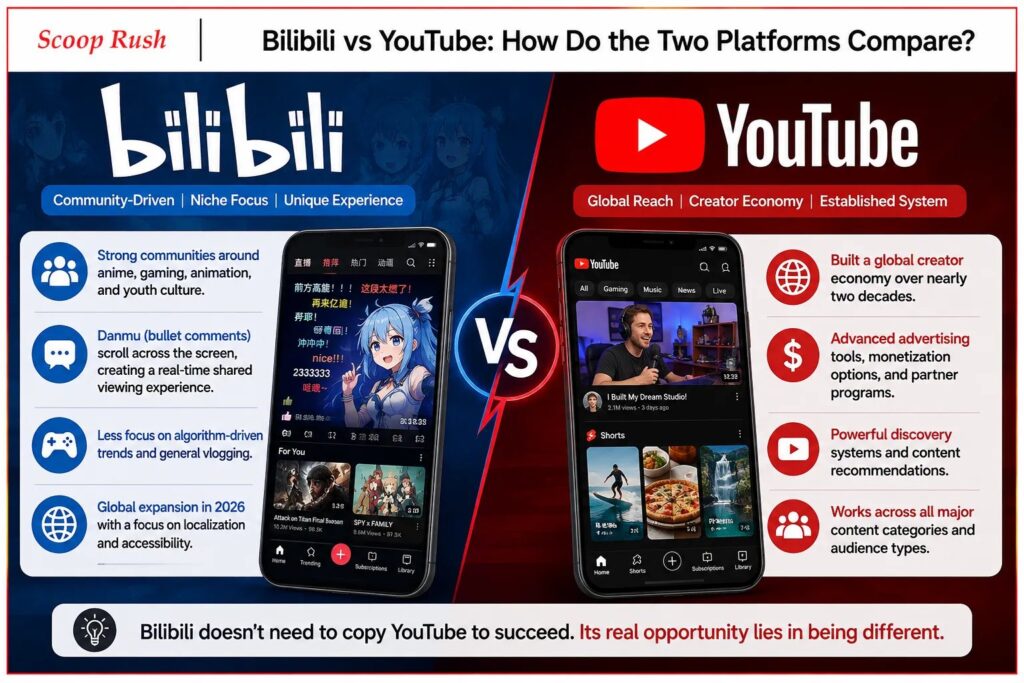
Bilibili is a Chinese video sharing platform built around anime, gaming, animation, and youth culture. It blends long-form video, live streaming, and community interaction into a single space, making it feel like a mix of YouTube and Twitch.

Its standout feature is danmu, also called bullet comments. Instead of sitting below a video, these comments scroll directly across the screen while the video plays. As a result, viewers can react to the exact same moment together, creating a shared viewing experience that feels almost live.

Founded in 2009, Bilibili has since grown into a platform covering gaming, technology, lifestyle, music, education, and entertainment. That wide content base now supports its latest push into international markets.

Bilibili Global Expansion 2026: What Has Actually Changed?

Bilibili Global Expansion 2026: What Has Actually Changed?

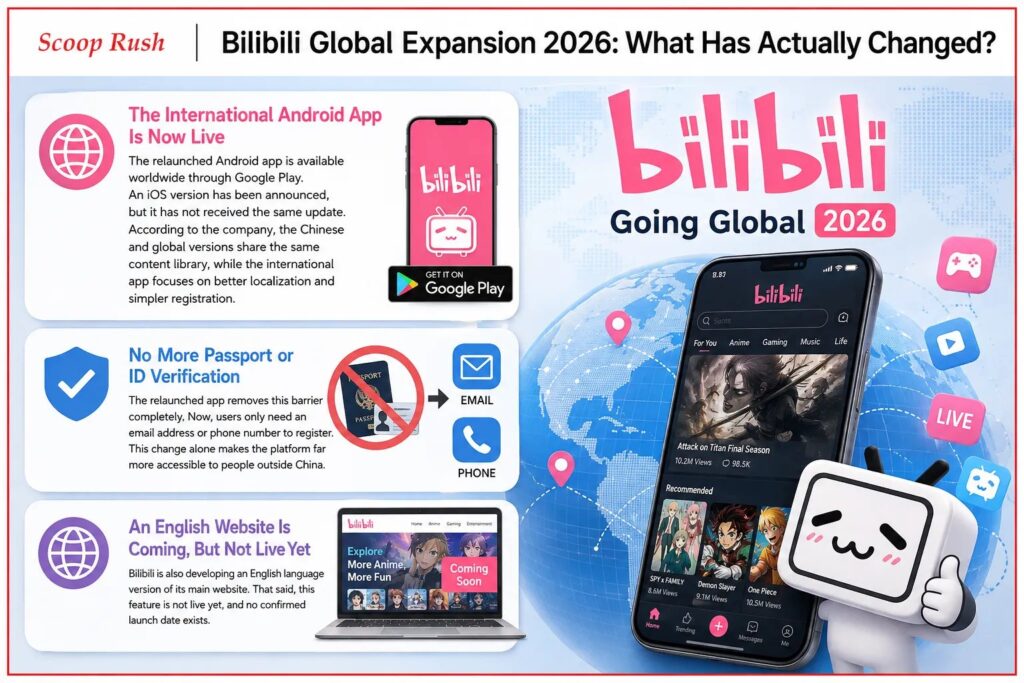
The Bilibili global expansion 2026 is not a completely new product. An earlier international app existed before and was later shut down. This time, though, the company appears to be backing the effort with real infrastructure and long-term planning.

The International Android App Is Now Live

The relaunched Android app is available worldwide through Google Play. This is the clearest signal yet that Bilibili is serious about competing internationally, much like how iPhone 18 Pro leaks signal Apple’s own next big product push.

An iOS version has been announced, but it has not received the same update. Consequently, Android users currently have the easiest way into the platform. According to the company, the Chinese and global versions share the same content library, while the international app focuses on better localization and simpler registration.

No More Passport or ID Verification

Previously, international users often needed to submit a passport or government ID just to sign up or upload content. That single requirement stopped many potential creators before they even started.

The relaunched app removes this barrier completely. Now, users only need an email address or phone number to register. This change alone makes the platform far more accessible to people outside China, though it also raises the kind of data and privacy questions already seen with tools like period tracker apps.

An English Website Is Coming, But Not Live Yet

Bilibili is also developing an English language version of its main website. That said, this feature is not live yet, and no confirmed launch date exists.

This distinction matters for anyone planning ahead. The Android app is real and usable today. The English website, however, remains a future promise rather than a current option.

Why Bilibili Is Targeting International Creators

A global platform needs creators, not just viewers. Bilibili has reportedly started hiring community managers in Los Angeles, London, Mexico City, São Paulo, Istanbul, and Tokyo.

This hiring pattern suggests Bilibili wants local support teams in place, not just a translated app. The company’s goal appears to go beyond simply making its Chinese platform available abroad. Instead, Bilibili seems to be actively courting creators who already produce content for global audiences, the same kind of creator economy shift seen in stories like the mom who built a $10K a month Etsy side hustle.

Anime, Gaming, and Animation Creators May Have the Advantage

Bilibili’s roots run deep in anime, gaming, and animation communities. Naturally, creators working in these spaces may find the platform especially welcoming.

Gaming creators could use it for gameplay videos, reviews, and guides. Animation and VFX artists may find an audience already interested in visual storytelling. Meanwhile, anime commentators and fandom creators already share cultural common ground with Bilibili’s existing user base.

Even so, the platform is not limited to these categories. Technology, lifestyle, education, and entertainment creators all have room to grow there too.

How Bilibili’s Danmu Comments Set It Apart From YouTube

Danmu comments are one of the biggest differences between Bilibili and YouTube. Instead of appearing below a video, comments scroll live across the screen in real time.

For example, a viewer watching a tense gaming moment might see a wave of reactions appear at that exact timestamp. Similarly, a funny scene can trigger a flood of comments while the video keeps playing. This turns solo viewing into a shared, communal experience.

As a result, Bilibili is not simply another upload-and-watch website. Its community culture sits at the center of its identity, and that identity plays a major role in its international pitch.

Bilibili’s Creator Marketplace and Monetization Plans

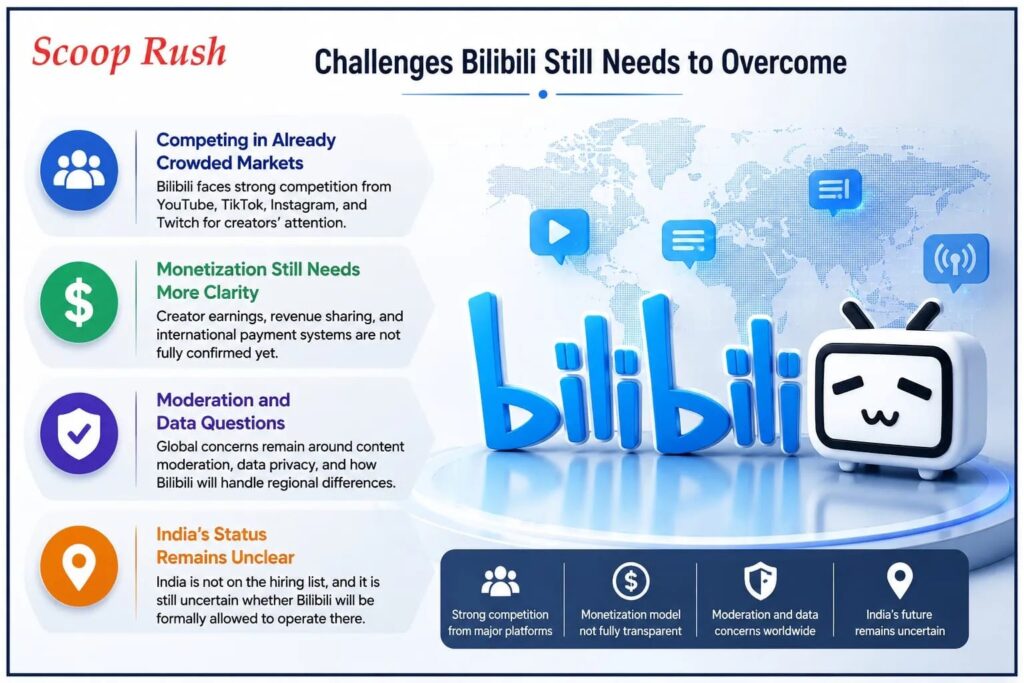
Bilibili is also building a creator-brand marketplace meant to connect creators with sponsors for paid content. However, this marketplace remains in development, and no launch date has been confirmed.

Bilibili’s creator pitch materials reportedly describe its audience as Gen Z coded, affluent, and well educated. The company has also mentioned revenue sharing and virtual gifting as future monetization tools. Still, none of these structures have been fully finalized or made public, a gap not unlike the uncertainty around how AI tokenomics make paying for AI tricky.

What About the Reported $0.70 Per 1,000 Views Payout?

Reports have circulated online claiming Bilibili could pay creators around $0.70 per 1,000 views, or roughly Rs 60 to Rs 66. However, Bilibili has not officially confirmed any fixed payout rate.

This distinction matters. Treat the figure as an unconfirmed report, not a guaranteed number. Actual payouts likely depend on factors such as audience location, content category, and advertising demand, none of which Bilibili has detailed for international creators yet.

Separately, some reports suggest that creators hoping to join the monetization program may need at least 100 subscribers and 2,000 valid public views, along with checks for originality and copyright compliance. Still, this does not confirm what international creators will actually earn.

Bilibili’s Existing Scale and Global Reach

Bilibili is not starting from zero. Reports place its monthly active user base at around 376 million, giving it a massive existing audience and content library.

Its creator infrastructure includes bilibili Studio, a global creator services center. One standout feature automatically translates creator videos into Chinese. Instead of hiring subtitlers or dubbing services, creators can let the platform handle that translation layer, similar in spirit to how Meta Muse’s AI coding agent automates work creators would otherwise do by hand.

Translation quality can vary, especially for nuanced narration, humor, or culturally specific jokes. Even so, this feature gives creators a low-effort way to reach a massive Chinese-speaking audience without producing a separate version of every video.

Why the Built-In Translation Feature Matters

Reaching a new language market usually costs time and money. Creators typically need subtitles, translators, or full dubbing work to make that happen.

Bilibili’s translation system removes much of that friction. A creator does not have to choose between YouTube and Bilibili. Instead, Bilibili can simply become another distribution channel for content that already exists. This could especially help filmmakers, animators, and VFX artists whose work tends to translate well across language barriers.

Bilibili vs YouTube: How Do the Two Platforms Compare?

Bilibili vs YouTube: How Do the Two Platforms Compare?

Calling Bilibili “China’s YouTube” is a simple way to explain it, but the Bilibili vs YouTube 2026 comparison goes far deeper than that. YouTube has built a global creator economy over nearly two decades, complete with advertising tools, discovery systems, and established monetization options.

Bilibili’s identity comes from a different place entirely. Its strongest communities formed around anime, gaming, animation, and youth culture, not general vlogging or algorithm-driven trends. The danmu comment system also creates a completely different viewing experience compared to YouTube’s traditional comment section.

Therefore, Bilibili does not need to copy YouTube to succeed. Its real opportunity may come from simply offering something different.

Challenges Bilibili Still Needs to Overcome

Challenges Bilibili Still Needs to Overcome

Competing in Already Crowded Markets

Bilibili is entering markets where creators already have plenty of established options. YouTube dominates long-form video. TikTok owns short-form content. Instagram has its own creator community, and Twitch remains the top choice for live streaming.

As a result, Bilibili must convince creators that the extra publishing effort is genuinely worth it.

Monetization Still Needs More Clarity

Professional creators care about income above almost everything else. While Bilibili has discussed creator-brand deals and revenue sharing, its international payment system is not fully confirmed yet. Since the reported $0.70 per 1,000 views figure remains unofficial, creators should avoid building an entire strategy around it, the same caution worth applying to any platform where companies are still not profiting from AI in 2026.

Moderation and Data Questions Remain Open

Because Bilibili originates from China, its global expansion naturally invites comparisons to other Chinese platforms that have faced regulatory scrutiny abroad. However, nothing confirms that Bilibili will face the same outcome.

What is confirmed is that Bilibili is actively building moderation infrastructure. A Singapore-based role reportedly focuses on AI-powered content moderation for the international platform, echoing broader efforts like the UK threatening big tech with penalties over child safety features. Even so, the company has not fully explained how it will handle content differences across regions.

India’s Status Remains Unclear

India represents one of the largest online video markets in the world, yet it is notably missing from Bilibili’s list of hiring cities. One report noted that a representative could access the Bilibili website from India as of August 24, 2026, with videos playing normally. However, it remains unclear whether Bilibili will be formally permitted to operate in the country going forward.

What the Bilibili Global Expansion Means for Creators

For most creators watching the Bilibili vs YouTube 2026 race, diversification makes more sense than an all-in bet. Instead of abandoning YouTube, creators can treat Bilibili as an additional distribution channel worth testing carefully, similar to how businesses now weigh .AI social listening tools before switching their entire workflow over.

A creator could start by publishing a small batch of videos and tracking:

  • Views
  • Watch time
  • Followers
  • Engagement
  • Audience response
  • Monetization opportunities as they roll out

This approach provides real performance data before making a bigger commitment. It makes particular sense for creators already working in gaming, anime, animation, technology, film, or education, since those categories align closely with Bilibili’s existing community.

Interestingly, some international creators have already tested the waters. MrBeast reportedly built a following of 8.8 million on the platform after joining in 2024, proving that large creators can find an audience there even before the full international rollout is complete.

Even so, simply uploading videos will not guarantee success. Strong content, clear titles, solid thumbnails, and consistent publishing still matter just as much on Bilibili as anywhere else, much like organically earning more Google reviews takes consistent effort rather than a quick fix.

Conclusion

The Bilibili vs YouTube 2026 story marks a genuine turning point for a platform that already commands hundreds of millions of users across China. The relaunched Android app, simplified registration, and active hiring push all point to a company that is serious about global growth this time around.

At the same time, major pieces remain unfinished. The English website has not launched. The iOS update is still pending. The creator-brand marketplace remains in development, and the reported payment rate has not been officially confirmed by the company.

For creators, the smartest move is to watch closely and test carefully rather than restructuring an entire channel around unfinished promises. Bilibili does not need to replace YouTube overnight. If its international push gains real traction, it could simply become another valuable place to publish, distribute, and grow an audience.

FAQs

Is Bilibili’s international app available right now?

Yes. The relaunched international Android app is live globally on Google Play. An iOS version has been announced but has not received the same update yet.

Do international users still need a passport to sign up for Bilibili?

No. The passport and ID verification requirement has been removed for the relaunched international app. Users can now register with just an email address or phone number.

How much does Bilibili pay creators per 1,000 views?

Reports suggest a figure of around $0.70, or roughly Rs 60 to Rs 66, per 1,000 views. However, Bilibili has not officially confirmed this rate, so it should not be treated as guaranteed.

Is Bilibili available in India?

This remains unclear. India is not among the cities where Bilibili is currently hiring, and it has not been confirmed whether the platform will formally operate there.

Should creators leave YouTube for Bilibili?

No. There is no indication that creators should abandon YouTube. Bilibili is best treated as an additional platform to test and diversify onto, not a replacement.

DVC Reservation Walking Is Officially Banned: What Members Need to Know

0

DVC reservation walking just hit a wall. For years, commercial renters used this loophole to grab the best rooms at Walt Disney World before regular members ever got a chance. That changed on September 3, 2026, when Disney Vacation Club introduced a new rule that shuts the practice down.

If you own DVC points, this update affects you directly. It changes who gets access to the most sought-after villas, from the Grand Californian to Kilimanjaro Club at Animal Kingdom Lodge. Below, we break down what happened, why DVC made the move, and what it means for your next booking.

What Is DVC Reservation Walking?

DVC reservation walking is a booking tactic. A member books a reservation at the 11-month mark. Then they modify it repeatedly, dropping the earliest night and adding a new night further out. Bit by bit, the reservation shifts into the member’s actual travel dates.

This worked because of a quirk in DVC’s booking system. The 11-month window applies to your check-in date, not your check-out date. Since reservations can run up to seven nights, a member could hold a room several days further into the future than anyone booking through normal channels could reach.

It wasn’t technically against DVC’s written rules. However, most members agreed it broke the spirit of a fair booking system. The tactic rewarded persistence and daily monitoring, which gave commercial renters a clear edge over families who just wanted to book a vacation.

The New DVC Reservation Modification Rule, Explained

The New DVC Reservation Modification Rule, Explained

Disney Vacation Club posted the update quietly. Members who log into DVCMember.com now see a new entry under “News & Alerts” titled “Upcoming Updates to Reservation Modifications.” That notice links to a Disney Stays page with the full policy language:

“Modifications to travel dates and room types on a confirmed reservation can only be made when the original check-out date is within 11 months of the modification request. You can still update Guest information or cancel the reservation.”

In simple terms, members can no longer shift dates or change room types until their original check-out date falls within 11 months of the request. You can still cancel a reservation or update guest names at any time. Only date and room-type changes face the new restriction.

Why the 11-Month Rule Closes the Loophole

The fix targets the exact gap that made reservation walking possible. Previously, a member could book seven nights at the 11-month mark, then nudge those dates forward one day at a time as new availability opened up.

Now, that door is closed. Members can’t pick up additional nights incrementally as the calendar advances. Everyone waits until the 11-month window naturally applies to their real travel dates, just like the booking system intended from the start.

Why DVC Cracked Down on Reservation Walking

Why DVC Cracked Down on Reservation Walking

This rule doesn’t stand alone. It’s the latest move in a broader campaign against commercial point renters who treat DVC ownership as a business rather than a family perk.

Last summer, DVC rolled out new terms requiring members to certify that bookings were for personal use. Then, in March 2026, DVC published its first formal Commercial Use Policy. That policy defined commercial activity clearly and added real enforcement behind it.

The reservation walking ban builds directly on that foundation. Disney hasn’t officially confirmed the rule targets this specific loophole. Still, the timing leaves little doubt. It arrives alongside continued enforcement against commercial renters and years of member complaints about unfair access to popular rooms.

Which Resorts Suffered Most From Reservation Walking

Reservation walking hit low-supply, high-demand resorts the hardest. According to longtime DVC owner and Disney travel writer Tom Bricker, the practice disproportionately affected:

  • The entirety of Disney’s Grand Californian Villas
  • Crescent Lake Resorts during EPCOT’s Food & Wine Festival
  • Value accommodations across DVC properties
  • Kilimanjaro Club rooms at Animal Kingdom Lodge

These rooms are already hard to book under normal conditions. As a result, when commercial renters used reservation walking to lock them down early, everyday families often found nothing left.

Pros and Cons of the Reservation Walking Ban

Every policy shift brings trade-offs. This one is no exception.

The Benefits: A Simpler, Fairer Booking System

The rule’s biggest strength is its simplicity. DVC didn’t build a complicated new system. Instead, it locked modifications until the natural 11-month window applies to everyone equally.

This approach solves the core problem without adding confusing new steps. It levels the playing field. A member booking for the first time at 11 months out now has the same shot as someone who might have tried to walk a reservation for weeks beforehand.

The Drawback: Longer Stays Face New Limits

One group may feel unintended side effects: members planning stays longer than seven nights. Previously, someone booking an eight-night trip could reserve the first seven nights at 11 months, then extend it night by night as new dates opened.

That strategy no longer works under the new rule. DVC may need a follow-up fix, such as extending the initial booking window to 10 nights. That change would align DVC with its existing 60+10 rule for Advance Dining Reservations.

Will This Make Popular DVC Rooms Easier to Book?

Will This Make Popular DVC Rooms Easier to Book?

Don’t expect the reservation walking ban to solve every availability problem overnight. Supply and demand haven’t changed. Resorts like the Grand Californian and Kilimanjaro Club remain limited, and plenty of individual members still compete for those rooms.

Similar to Disney’s Lightning Lane and DAS systems, this rule rearranges access rather than creating more inventory. What it does change is who gets first priority. Commercial renters can no longer use reservation walking to lock down confirmed reservations and resell them at a markup. Families booking for themselves should now get a fairer shot at those same rooms.

What This Means for Your Next DVC Booking

For most members, the impact is simple. You can still cancel a reservation or update guest details whenever you want. However, if you want to change your travel dates or room type, you’ll need to wait until your original check-out date arrives within 11 months.

If you rarely modify bookings, this change likely won’t affect your day-to-day planning at all. For frequent modifiers and longer-stay travelers, it’s worth adjusting your booking strategy going forward.

This update also signals something larger. DVC appears to be genuinely responding to years of member feedback rather than making surface-level gestures. Between the personal-use certification, the Commercial Use Policy, and now this modification rule, Disney is sending a clear message: DVC ownership should serve families who actually vacation with their points, not businesses reselling access to them.

That focus matters as DVC continues expanding its resort portfolio, including the upcoming Disney Lakeshore Lodge. Keeping current members happy makes good business sense, especially while Disney courts both existing owners and new buyers.

Final Thoughts 

The ban on DVC reservation walking is a small technical fix with a big impact. By locking modifications until a reservation’s original check-out date reaches the 11-month mark, Disney Vacation Club has closed a loophole that let commercial renters and aggressive planners dominate the best rooms.

It won’t fix every supply shortage, and longer-stay members may need to adjust their plans. Even so, the rule marks a meaningful step toward a fairer system. It rewards ownership used the way DVC intended: for personal vacations, not resale businesses.

If Disney Vacation Club keeps addressing commercial misuse while rebuilding trust with everyday members, more improvements could follow.

Frequently Asked Questions

1. What is DVC reservation walking? 

DVC reservation walking is a booking tactic where a member books at the 11-month mark, then repeatedly modifies the dates day by day until the reservation shifts into their actual desired travel window.

2. When did DVC ban reservation walking? 

Disney Vacation Club announced the new rule on September 3, 2026. It restricts date and room-type changes until a reservation’s original check-out date falls within 11 months of the request.

3. Can I still cancel or update guest names on my DVC reservation? 

Yes. The new rule only limits changes to travel dates and room types. You can still cancel a reservation or update guest information at any time.

4. Why did DVC ban reservation walking? 

DVC appears to be targeting commercial point renters who used the tactic to secure high-demand rooms, such as the Grand Californian and Kilimanjaro Club, ahead of members booking for personal use.

5. Will banning reservation walking make popular DVC resorts easier to book? 

It should improve fairness in how limited rooms get allocated. However, overall supply at high-demand resorts remains tight, so those rooms will still be competitive to book.

Trump Pentagon 9/11 Plans Split the 25th Anniversary Events

0

President Donald Trump will join the Pentagon 9/11 ceremony this year. He will skip the main Ground Zero event in New York. Instead, Trump will speak at the Pentagon on September 11, 2026. The choice has sparked debate since Trump grew up in New York City.

This year marks the 25th anniversary of the September 11 attacks. The milestone has drawn extra attention to how officials will mark the day. Trump’s decision to choose the Pentagon over Ground Zero has become a major talking point. It also raises fresh questions about the different traditions each memorial site follows.

Trump Picks the Pentagon for This Year’s Ceremony

Trump will attend the Pentagon ceremony on September 11, 2026. This marks 25 years since the terrorist attacks on the United States. The Pentagon was one of the three sites hit that day. Trump confirmed his plans when reporters asked why he would miss New York.

He simply pointed to his Pentagon appearance as the answer. This marks a shift from his recent pattern. Trump attended the Ground Zero ceremony in 2024. He also visited the site during his 2016 campaign and again in 2021.

Ground Zero Keeps Its No-Speech Tradition

The Ground Zero ceremony follows a strict nonpartisan format every year. Organizers do not allow politicians to give speeches there. This rule keeps the focus on victims and their grieving families. The National September 11 Memorial and Museum has kept this practice for years.

Reports suggest Trump first considered attending the New York event. Those reports link his change of plans to his wish to speak publicly. The Pentagon ceremony allows the president to deliver formal remarks. Ground Zero simply does not offer that same platform.

The White House Pushes Back on the Reports

The-White-House-Pushes-Back-on-the-Reports

The White House strongly denies that the speech rule caused Trump’s decision. Communications director Steven Cheung called the report completely false. He labeled it “FAKE NEWS” in his response to reporters. Another senior administration official also rejected the explanation.

Neither official offered a full alternative reason for the switch. Still, the disagreement has added a political layer to the anniversary. The New York Times first reported the story about Trump’s Pentagon shift. That report remains at the center of the current debate.

JD Vance Will Represent the Administration in New York

Vice President JD Vance is expected to attend the Ground Zero ceremony instead. He will represent the White House at the World Trade Center site. Other senior officials will travel to Shanksville, Pennsylvania for that ceremony. This plan places top officials at all three major 9/11 locations.

The arrangement reflects the different traditions at each site. New York focuses heavily on remembering victims and their families. The Pentagon offers a more traditional stage for presidential remarks. This split lets the administration honor every location without one speech dominating all three.

Trump’s Long History With September 11 Ceremonies

Trump has marked the anniversary at different sites throughout his political career. During his first term, he attended Pentagon ceremonies in 2017 and 2019. He traveled to Shanksville for the 2018 and 2020 anniversaries instead. He also returned to the Pentagon for the 2025 anniversary.

After that 2025 event, Trump attended a Yankees game in New York. That game included tributes honoring the victims of the attacks. His 2026 plan therefore follows a familiar pattern for him. However, this year’s choice has drawn much more political attention than usual.

A Steel Beam Will Reach the White House Before the Ceremony

Trump’s 9/11 schedule includes more than just the Pentagon event. He will also host a White House tribute before the anniversary date. First responders and members of the Tunnel to Towers Foundation will attend. A massive steel beam from the World Trade Center will be the centerpiece.

The beam weighs about 16,900 pounds and stands 21 feet tall. It came from the wreckage of the South Tower. The foundation calls this effort “Steel Across America.” The beam has toured many states as part of a nationwide memorial journey.

Why the Pentagon Holds Deep Meaning This Year

Why-the-Pentagon-Holds-Deep-Meaning-This-Year

The Pentagon remains one of three major sites tied to September 11. Hijackers crashed American Airlines Flight 77 into the building that day. The attack killed everyone aboard the plane and many people inside. Trump has often chosen this site for his own commemorations.

His appearance this year carries both personal and presidential weight. He can honor the victims while speaking directly to the nation. The Pentagon setting also continues his pattern from previous anniversaries. For Trump, this location offers a familiar and meaningful way to mark the day.

What This Means for the 25th Anniversary

The 25th anniversary carries extra weight for families and survivors nationwide. Ground Zero will remain the largest public gathering point in New York. The Pentagon will host the president for a more formal ceremony. Shanksville will honor the passengers and crew of Flight 93.

This year’s arrangement ensures federal representation at every single site. Trump will lead the Pentagon event with formal remarks. Vance will stand in for the administration at Ground Zero. Together, these events will shape how the nation marks this milestone anniversary.

Final Thoughts

Trump’s decision to attend the Pentagon 9/11 ceremony reflects both personal history and political timing. He has rotated between the Pentagon, Ground Zero, and Shanksville throughout his career. This year’s choice keeps that pattern alive while placing him at the center of national remembrance. The added White House tribute with the steel beam gives his schedule an extra layer of meaning.

The debate over his reasons may continue, but the core message stays the same. Americans across the country will pause to honor those lost 25 years ago. Each ceremony, whether at the Pentagon, Ground Zero, or Shanksville, serves that same purpose. The 25th anniversary stands as a reminder of resilience, unity, and the memory of that difficult day.

FAQs

1. Why is Trump attending the Pentagon instead of Ground Zero? 

Trump chose to mark the anniversary at the Pentagon this year. Reports link this to his wish to give a speech. The White House denies that this was the real reason.

2. Will JD Vance attend the Ground Zero ceremony this year? 

Yes, Vance is expected to represent the administration in New York. A senior official confirmed his attendance at the ceremony. Other officials will travel to Shanksville separately.

3. Why doesn’t Ground Zero allow political speeches? 

Organizers keep the Ground Zero ceremony strictly nonpartisan every year. This tradition keeps attention on victims and their families. No politicians are permitted to speak during the event.

4. What will happen at the White House before September 11? 

Trump will host a tribute with first responders and officials. A large steel beam from the World Trade Center will be present. It comes from the South Tower and honors the victims.

5. Has Trump attended Pentagon ceremonies before? 

Yes, Trump attended Pentagon ceremonies in 2017, 2019, and 2025. He also visited Shanksville during the 2018 and 2020 anniversaries. This year continues his familiar pattern of rotating locations.

Dangerous Places Attract Extreme Travelers

0

Dangerous places rarely appear on ordinary vacation lists. Yet some travelers actively choose them for unusual experiences. They seek war zones, unstable regions, remote areas, and sites marked by tragedy. Their reasons vary from cultural curiosity to personal achievement.

This growing interest falls under several forms of dark and extreme tourism. Some travelers visit countries that governments warn against. Others visit locations connected with historic disasters or atrocities. Social media also gives these journeys a wider audience.

Why Travelers Choose Dangerous Places

For some visitors, history provides the strongest motivation. Arnaud Kirby travels to countries such as Syria, Libya, Sudan, and Chad. He says visiting these places offers a deeper view than reading about them. He also values destinations with very few tourists.

Kirby believes limited tourism can create more personal encounters. He describes Chad as an especially memorable experience. He found people friendly and welcoming during his visit. At Zakouma National Park, he also encountered wildlife unused to frequent vehicles.

Extreme Travelers Chase More Than Adventure

Extreme-Travelers-Chase-More-Than-Adventure

Not every extreme traveler simply wants danger. Some want to understand countries that receive negative international coverage. British traveler Will Aswell says curiosity drives many of his journeys. He has visited Iran, North Korea, Ukraine, and Iraq.

However, his travels have not always remained comfortable. During a 2025 trip through Mexico’s Sinaloa state, armed cartel members stopped his bus. He said they forced him to hand over money before releasing him. The experience showed how quickly travel plans can become dangerous.

Tour Guides Face Difficult Security Decisions

Some travelers enter risky regions through specialist tour companies. Australian guide Alex Hobbs works with Lupine Travel. The company organizes trips to unusual and potentially dangerous destinations. Guides must constantly monitor changing conditions before and during trips.

Hobbs says the company researches destinations extensively before launching tours. Local contacts provide updates about security and logistics. The company also prepares several backup plans for unstable environments. Hobbs says the company will postpone or change trips when conditions become unsafe.

Country Collectors Push Travel Further

Another group follows a different goal. These travelers try to visit as many countries, territories, regions, and enclaves as possible. Charles Veley became a major figure in this community. He founded Most Traveled People, an online community for extreme travelers.

The group’s system goes far beyond the usual country count. Its list includes more than 1,500 destinations and geographical locations. Members can earn points for visiting individual places. Some destinations remain simple, while others present serious logistical or security challenges.

A Journey Into a Conflict Zone

A-Journey-Into-a-Conflict-Zone

One major example involved a group traveling through Nagorno-Karabakh in Azerbaijan. Veley joined more than 30 travelers from different countries. The group traveled with military assistance through an area affected by decades of conflict.

The region still contained visible signs of war during the journey. Travelers encountered military checkpoints, damaged areas, and demining operations. Land mines remained a major concern. The group also faced changing security conditions during its trip.

The Risks Can Change Without Warning

Extreme travel requires flexibility because conditions can shift quickly. During the Azerbaijan journey, the group changed plans after skirmishes emerged. Rather than continue toward a planned route, the travelers took a long detour. Safety became more important than completing the itinerary.

The danger extended beyond armed conflict. The region contained extensive minefields left from earlier fighting. A demining demonstration showed the destructive force of those explosives. Such experiences highlight the difference between adventurous travel and ordinary tourism.

Dangerous Places Can Become Personal Milestones

Some travelers pursue extreme destinations as part of a much larger goal. Hayley Kennedy became the first known sight-impaired person to visit all 193 United Nations countries. Her journey included countries such as North Korea, Iran, Somalia, Myanmar, and the Democratic Republic of Congo.

Kennedy says she wants to experience as much of the world as possible. She usually travels alone when circumstances allow it. For less accessible destinations, she joins groups or travels with companions. Her journey also highlights the challenges disabled travelers can face worldwide.

Dark Tourism Looks Toward History

Dark tourism represents another side of this trend. These travelers do not necessarily seek dangerous countries. Instead, they visit places connected with death, conflict, disasters, or human suffering. Examples include Jonestown, Cambodia’s Killing Fields, and Chernobyl.

British author H.E. Sawyer has studied this form of tourism extensively. His interest grew through family connections to World War II and a Holocaust survivor. A visit to Chernobyl later encouraged his academic interest in dark tourism.

Memorials Offer More Than Photographs

Memorials-Offer-More-Than-Photographs

Sawyer argues that visiting difficult historical sites can create a different understanding. Visitors can experience the physical scale and setting of a memorial. They can also observe how other visitors respond to the location. These details often disappear when people study events only through books or screens.

His travels have included Aberfan in Wales and Aokigahara in Japan. He also visited the Salem Express wreck in the Red Sea. Hartheim Castle in Austria left an especially dark impression because Nazis killed thousands of disabled and mentally ill people there.

Jonestown Draws a New Kind of Visitor

Jonestown in Guyana has recently entered the dark tourism conversation. More than 900 members of the Peoples Temple died there in 1978. The tragedy remains deeply connected with the surrounding community and local history.

Wanderlust Adventures began offering Jonestown tours in early 2025. The company first met with local residents before organizing the trips. Its tours aim to explain the tragedy while including the Guyanese perspective. The company says academics also visit to study cult psychology.

Social Media Changes Extreme Travel

Social media has added another layer to dark tourism. Travelers can now document unusual journeys for large online audiences. Difficult destinations can therefore become travel content as well as personal experiences. This can make remote or troubling locations more visible to potential visitors.

However, turning tragedy into content raises difficult questions. A serious historical site can easily become a backdrop for photographs. Conflict zones can also appear more exciting online than they feel in reality. Responsible travelers must consider local communities and the history behind each location.

The Debate Over Country Collecting

Extreme travelers also face criticism from people who value slower forms of travel. Critics argue that collecting destinations can reduce complex cultures to numbers. Jake Haupert of the Transformational Travel Council questions whether travelers truly experience places when they focus mainly on completing lists.

Country collectors reject the idea that their approach lacks meaning. Dave Seminara argues that these travelers often visit places far outside mainstream tourism. He believes such journeys can expose visitors to countries that receive little international tourism. The debate ultimately centers on what makes travel meaningful.

Extreme Travel Requires Careful Risk Management

Extreme-Travel-Requires-Careful-Risk-Management

The people featured in these accounts do not all describe themselves as thrill seekers. Many emphasize curiosity, knowledge, history, or personal achievement. Some also develop detailed systems for managing difficult journeys. Their experiences show that motivation matters as much as the destination itself.

Still, preparation cannot remove every danger. Travelers may encounter armed groups, changing political conditions, crime, land mines, or sudden travel restrictions. One incident can quickly change an entire journey. That reality separates extreme travel from conventional vacation planning.

Why Dangerous Places Continue to Fascinate Travelers

The attraction of dangerous places comes from several different forces. Some travelers want authentic cultural encounters. Others want to understand history beyond familiar headlines. Country collectors seek another achievement, while dark tourists explore places marked by tragedy.

For many, the experience also creates a powerful sense of accomplishment. Veley compares completing travel goals with finishing other major personal projects. He says achievement brings a strong feeling of satisfaction. His story shows why some travelers keep searching for the next difficult destination.

Conclusion

Dangerous places have become destinations for a small but determined group of travelers. Their motivations range from curiosity and history to personal achievement and adventure. Some pursue remote countries, while others explore locations shaped by tragedy.

Their journeys also raise important questions about responsible tourism. Travel can challenge stereotypes and create deeper understanding. Yet visitors must respect local communities and recognize genuine security risks. For these travelers, the world remains an enormous map of places to understand, experience, and sometimes carefully avoid.

FAQs

1. What is dark tourism?

Dark tourism involves visiting locations connected with death, tragedy, conflict, disasters, or atrocities. Some travelers visit historical memorials, former disaster sites, or places linked with mass violence. Others visit countries that currently face serious security concerns.

2. Why do people visit dangerous places?

Motivations differ between travelers. Some seek cultural understanding or historical knowledge. Others enjoy adventure, pursue travel records, or want to visit places few tourists see. Social media can also encourage interest in unusual destinations.

3. What makes extreme travel risky?

Extreme travelers may face armed conflict, crime, political instability, terrorism, kidnapping, or unexploded weapons. Security conditions can also change without warning. A planned route may become impossible within hours.

4. Do extreme travelers always seek danger?

No. Many travelers featured in these accounts say danger itself does not drive them. They often focus on history, culture, exploration, or personal goals. However, their interests sometimes lead them into places with serious risks.

5. Can dark tourism benefit local communities?

It can create educational and cultural opportunities when handled responsibly. Jonestown tours, for example, include local perspectives and community consultation. Responsible tourism should respect victims, residents, and the historical meaning of each site.