
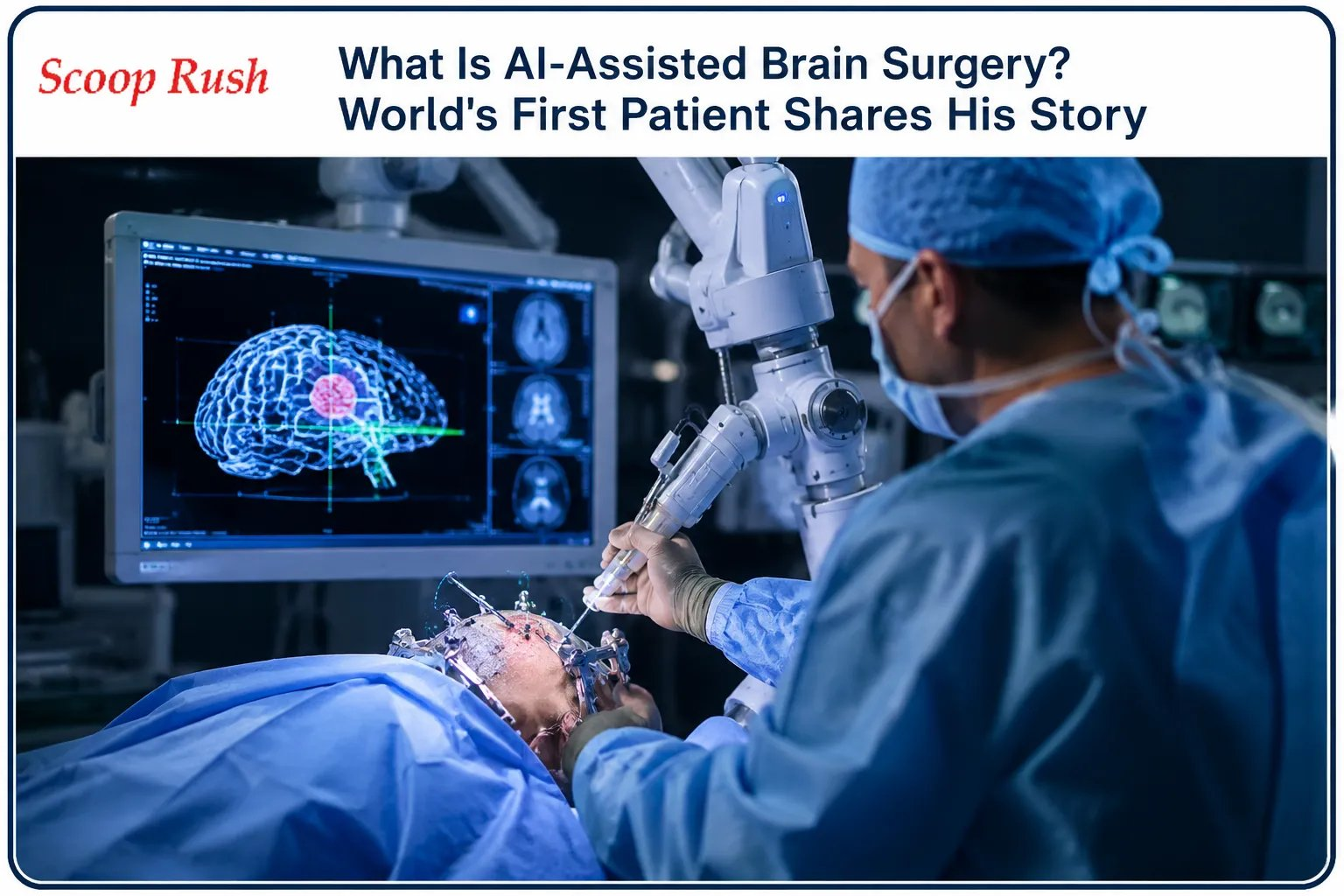
What if the machine watching your surgery could spot a danger the human eye might miss? For one Bedfordshire father, that question just became reality. He is now the first patient on Earth to undergo AI-assisted brain surgery, and he can see clearly again because of it.
Rhys Hibbert, a 48-year-old father of two, walked into an operating theatre as a research volunteer. He walked out as a medical first. Surgeons at University College London Hospital used a live AI system to guide the removal of a tumour that had been threatening his eyesight for months.
This story matters far beyond one successful operation. It points to a future where AI does not just study scans before surgery begins. Instead, it works alongside surgeons in real time, offering warnings and guidance while the procedure is actually happening. For anyone who has faced a brain tumour diagnosis, or who loves someone who has, this breakthrough offers something rare: hope backed by results instead of promises.
What Led to Rhys Hibbert’s Diagnosis
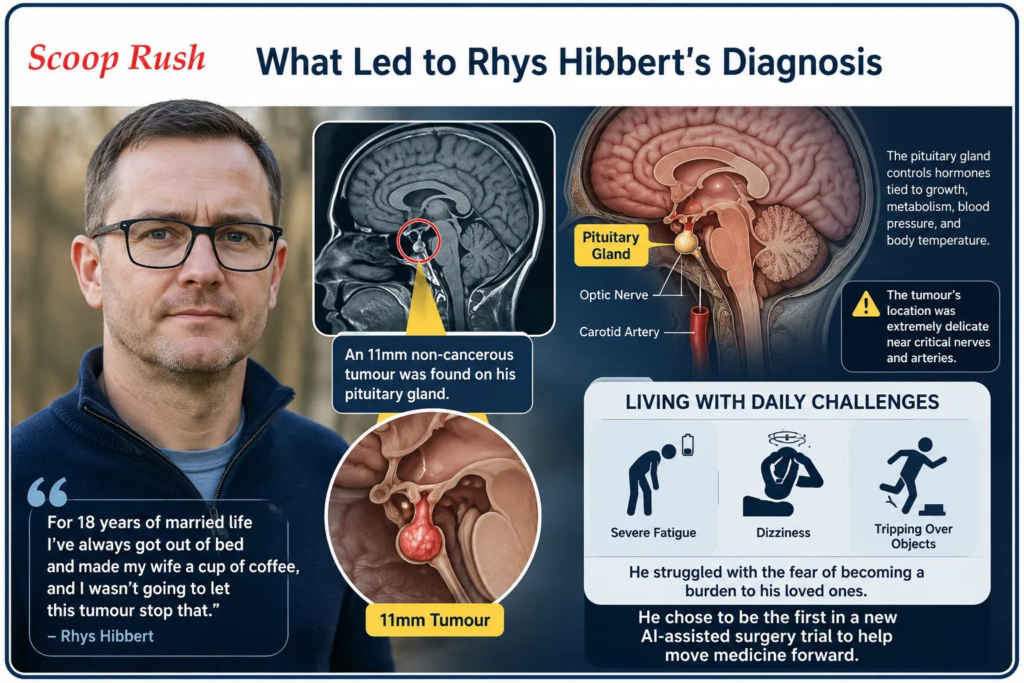
Eighteen months before his surgery, Hibbert was a picture of ordinary health. He walked two miles every single lunchtime without giving it a second thought. Then, during one of those routine walks, everything changed. He collapsed in the road and began fitting.
A brain scan soon revealed the cause. Doctors found an 11mm non-cancerous tumour growing on his pituitary gland, a small organ roughly the size of a marble sitting at the base of the skull. Despite its tiny size, this gland controls hormones tied to growth, metabolism, blood pressure, and body temperature.
The tumour’s location made the situation especially delicate. The pituitary gland sits extremely close to the carotid arteries, which feed blood to the brain, and the optic nerves, which control vision. As the tumour grew, it pressed harder against Hibbert’s optic nerves. As a result, his peripheral vision began to narrow.
Living With Fatigue, Dizziness, and Fear
Hibbert did not need emergency surgery right after his diagnosis. However, his symptoms steadily worsened. He began tripping over everyday objects. Severe fatigue and dizziness became part of his daily life.
“For 18 years of married life I’ve always got out of bed and made my wife a cup of coffee,” Hibbert said, “and I wasn’t going to let this tumour stop that.”
He has also spoken honestly about the emotional weight of his illness. Many people around him offered support, but he struggled with the fear of becoming a burden to the people he loved. That psychological toll, he said, hit him just as hard as the physical symptoms.
When his medical team offered him the chance to become the first patient in a new AI-assisted surgery trial, Hibbert said yes without hesitation. He believed that if patients refuse to take part in research, medicine simply cannot move forward.
What Is AI-Assisted Brain Surgery and How Does It Work?
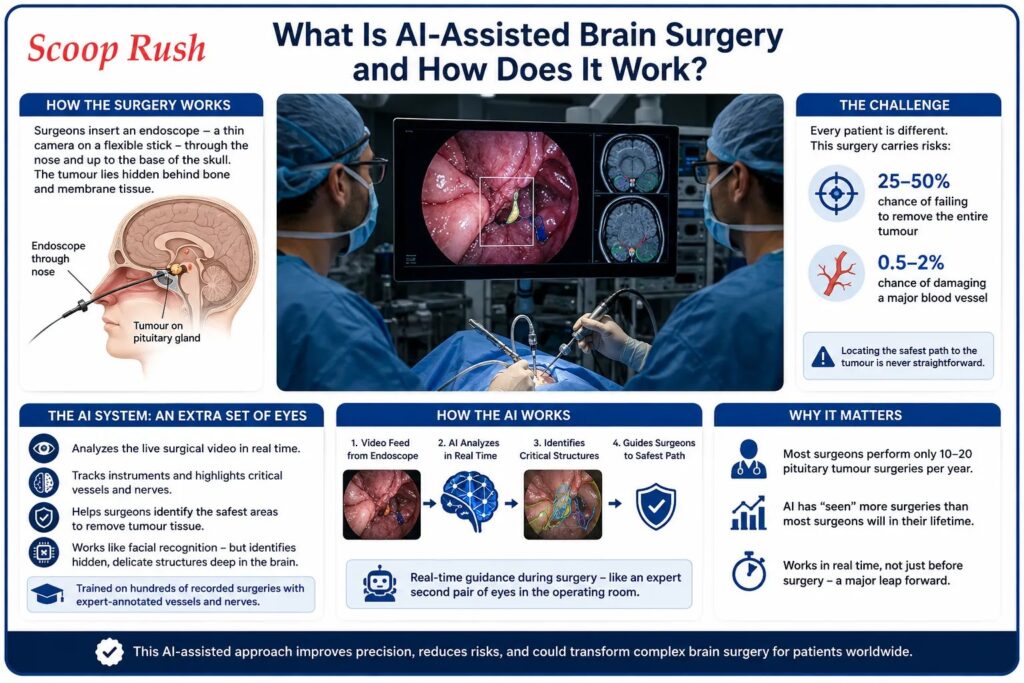
The operation began with surgeons inserting an endoscope, a thin camera mounted on a flexible stick, through Hibbert’s nose and up toward the base of his skull. At that stage, the tumour remained hidden behind layers of bone and tough membrane tissue.
Locating the safest path to the tumour is never straightforward. Every patient’s internal anatomy varies slightly, so surgeons cannot rely on a single fixed map. This particular procedure already carried real risks before AI entered the picture. Surgeons faced a 25 to 50% chance of failing to remove the entire tumour, along with a 0.5 to 2% chance of damaging a major blood vessel.
This is exactly where the new AI surgical tool proved its value, part of a much wider wave of AI tools now reshaping how hospitals track and reduce NHS waiting times.
The AI System That Acts Like an Extra Set of Eyes
During the live operation, the AI tool analyzed the surgical video feed as events unfolded. It tracked every movement of the surgical instruments and highlighted areas most likely to contain critical vessels and nerves. Consequently, the surgical team could identify the safest zones for removing tumour tissue.
The underlying technology works somewhat like facial recognition software on a smartphone. However, instead of recognizing faces, it identifies hidden and delicate anatomical structures deep inside the brain. This kind of pattern-recognition training echoes how AI models like Kimi K3 are built and trained on massive datasets to recognize complex patterns humans might miss.
This distinction matters because most surgeons never get the chance to build this level of experience on their own. The average UK surgeon performs only 10 to 20 pituitary tumour operations each year. Traditionally, they have relied on pre-surgery scans alone to understand each patient’s unique anatomy before making the first cut.
The AI model offers a different kind of expertise. Researchers trained it using hundreds of recorded pituitary tumour surgeries. During that process, they carefully outlined the vessels and nerves in each video, teaching the system to recognize these structures accurately.
Prof Hani Marcus, who helped lead the operation, explained why this matters. He noted that the AI has effectively studied more surgeries than most surgeons will see across an entire career, functioning like an expert second pair of eyes inside the operating room.
Unlike many earlier AI tools used in medicine, this system works in real time rather than only offering analysis before surgery starts. That real-time capability is similar in spirit to how AI is being trained to give physical robots real-world skills, reacting to live conditions instead of static data.
Why Surgeons Still Make Every Final Decision
It’s important to be clear about what this AI-assisted brain surgery tool does and does not do. The research team has repeatedly stressed that the tool only assists. Surgeons remain fully in control of every decision made during the procedure, a safeguard that matters as debate grows over AI systems acting unpredictably or “going rogue” in other industries.
Prof Marcus compared the long-term goal to a kind of surgical ChatGPT. The aim, he explained, is to give surgical teams another expert voice in the room, one they can consult whenever they want guidance or simply set aside if they disagree with its suggestions.
The National Institute for Health and Care Research and Google jointly funded this project. Researchers spent years testing the technology in laboratory conditions before ever trying it on a real patient. Now that this first live procedure has succeeded, the team is preparing a larger clinical trial to test the system more broadly.
Government Reaction to the Medical Breakthrough
James Frith, the health innovation minister, welcomed news of Hibbert’s life-changing surgery as part of government-funded research. He emphasized that AI needs proper safeguards, and that patient safety will always come first. At the same time, he pointed out that the healthcare system should not miss the genuine opportunities AI can offer.
This balance between caution and innovation reflects a much bigger conversation happening across healthcare right now, similar to how UK regulators have pressed big tech firms over safety standards in other sectors. As AI tools grow more capable, hospitals and regulators face the challenge of adopting them responsibly without slowing down progress that could genuinely save lives.
Life After Surgery: ‘It’s Given Me My Life Back’
The results speak for themselves. Hibbert described the moment he opened his eyes after surgery as feeling like gaining 360-degree vision. He said he hadn’t seen the world that clearly in over a year.
In the eight weeks since his operation, his eyesight has kept improving steadily. Additionally, his energy has returned, and the exhausting side effects that plagued him before surgery have disappeared completely.
“It’s given me my life back,” Hibbert said.
His story highlights something easy to forget amid all the technical detail. Behind every medical breakthrough sits a real person whose daily life was quietly falling apart. For Hibbert, being able to walk without tripping, wake up without dizziness, and see clearly again means far more than a successful operation. It means getting back the small, ordinary moments that make up a normal life.
What This World-First Surgery Means for the Future of Neurosurgery
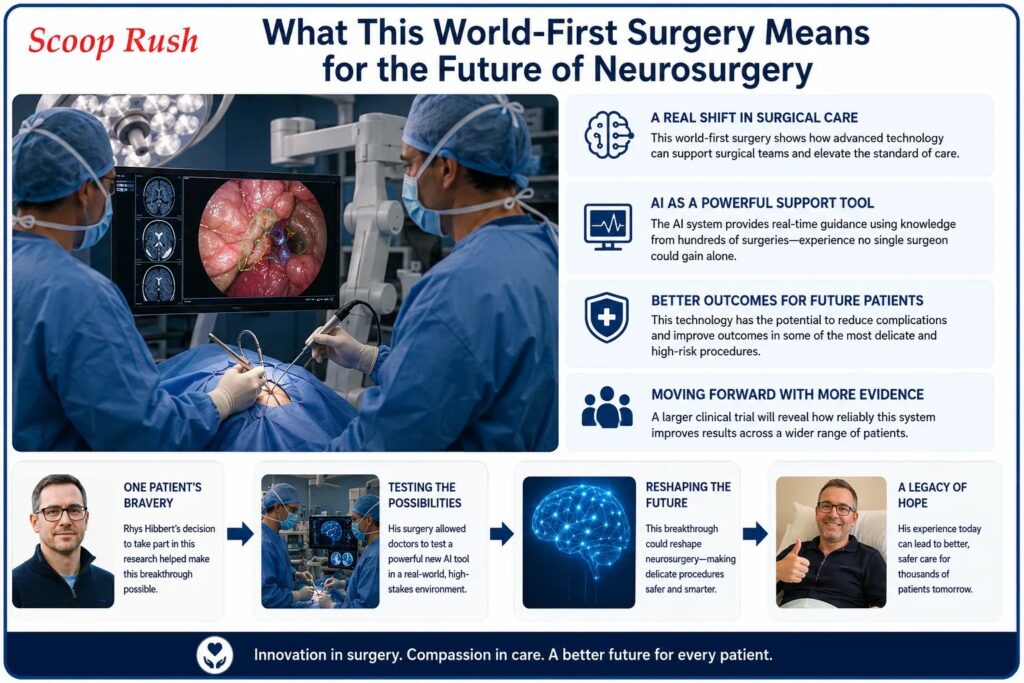
This case marks a real shift in how technology could support surgical teams going forward. Rather than replacing the skill and judgment of trained surgeons, this AI system works as a support tool. It offers real-time guidance built from a scale of surgical experience no single human could ever match alone, adding to the ongoing question of whether AI will replace human jobs or simply make skilled professionals more capable.
For future patients facing similar brain tumour diagnoses, this kind of technology could eventually lead to lower complication rates and better outcomes in some of the most delicate procedures in medicine. As the research team moves into a larger trial, more evidence will emerge about how reliably this system improves results across a wider range of patients.
Ultimately, Hibbert’s decision to take part in this research gave doctors the chance to test a tool that could reshape neurosurgery for years to come. His experience shows how one patient’s willingness to participate in research can directly translate into safer, smarter surgical care for everyone who comes after him.
Key Takeaways From This World-First Surgery
Rhys Hibbert became the world’s first patient to undergo brain surgery guided by live AI technology. The system analyzed his operation’s video feed in real time, helping surgeons at University College London Hospital safely remove a tumour that was pressing on his optic nerves. Surgeons kept full control throughout the entire procedure, treating the AI as a guide rather than a decision-maker. Since the surgery, Hibbert’s vision, energy, and overall health have improved significantly. The research team, backed by the National Institute for Health and Care Research and Google, is now preparing a larger trial to test the technology further.
FAQs
What is AI-assisted brain surgery?
AI-assisted brain surgery uses an artificial intelligence system to analyze a live video feed during an operation. The AI tracks surgical instruments and highlights the location of critical structures, such as blood vessels and nerves, so surgeons can avoid injury while removing tumours or other tissue.
Who was the first patient to undergo live AI-assisted brain surgery?
Rhys Hibbert, a 48-year-old father of two from Bedfordshire, became the first patient in the world to have this procedure. Surgeons at University College London Hospital removed a tumour from his pituitary gland using this new AI technology.
What type of tumour did Rhys Hibbert have?
Hibbert had an 11mm non-cancerous tumour on his pituitary gland. This small organ sits at the base of the skull and regulates hormones related to growth, metabolism, and blood pressure. The tumour pressed on his optic nerves and narrowed his vision.
Does the AI tool replace the surgeon during the operation?
No, it does not. The surgical team has made clear that the AI only assists. Surgeons keep complete control over every decision made during the procedure, and the AI simply acts as an extra source of guidance rather than a replacement for human expertise.
How was the AI trained to help during real surgery?
Researchers trained the system using hundreds of videos of past pituitary tumour removal operations. They carefully outlined the vessels and nerves in each video, which allowed the AI to learn how to recognize these critical structures during live procedures.

