
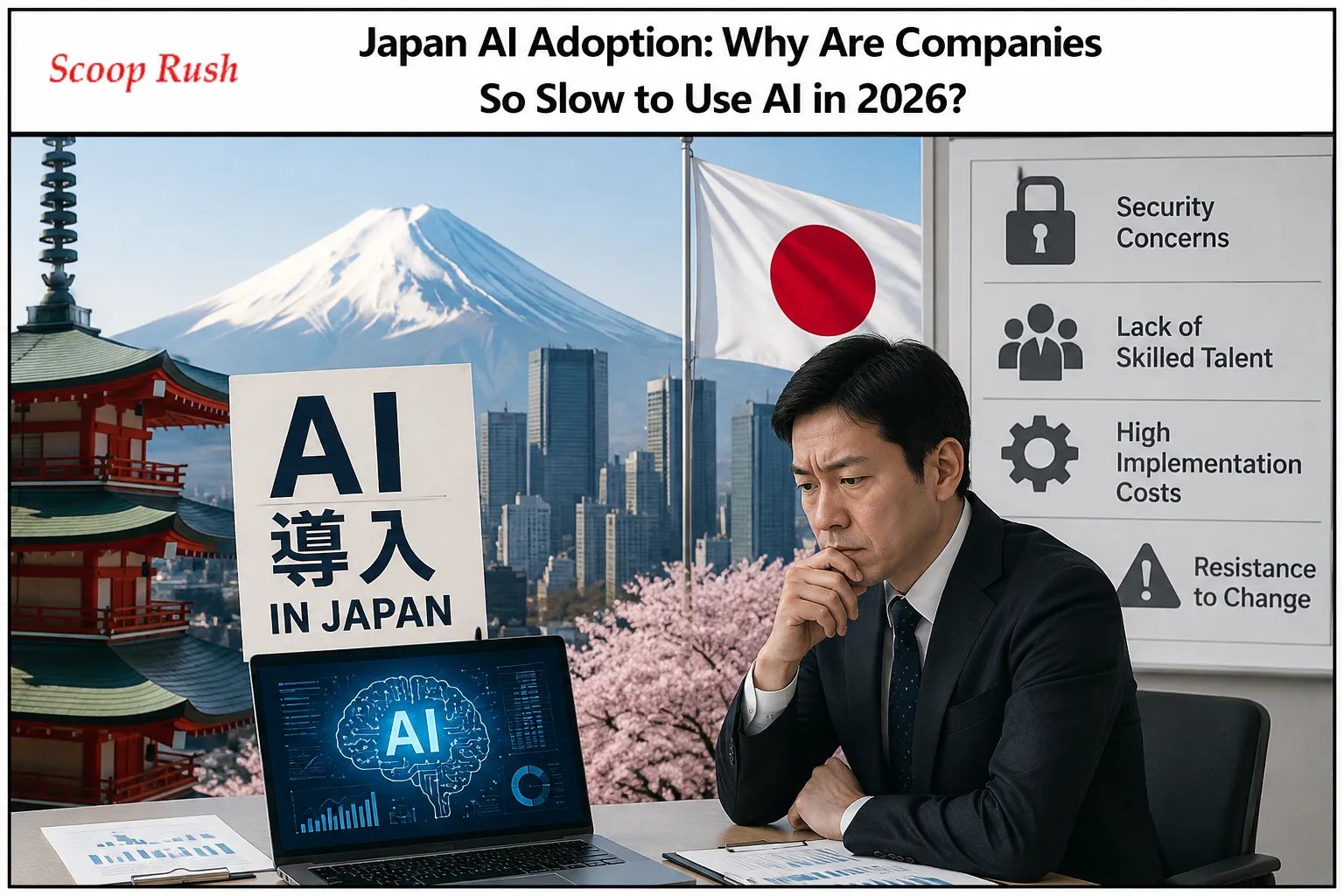
Only 8.4% of Japanese workers use AI at work, putting Japan AI adoption far behind other developed nations. Meanwhile, half of all American employees rely on it daily. How does one of the world’s most tech-savvy nations fall this far behind in the AI race?
Introduction
Japan is known for robots, gadgets, and cutting-edge technology. Yet when it comes to workplace AI adoption, the country is surprisingly slow. This gap matters because Japan faces a shrinking workforce, an aging population, and productivity levels that trail every other G7 nation. Understanding why Japan AI adoption remains so low reveals important lessons about corporate culture, risk, and digital transformation for readers everywhere.
The Numbers Behind Japan’s AI Adoption Problem
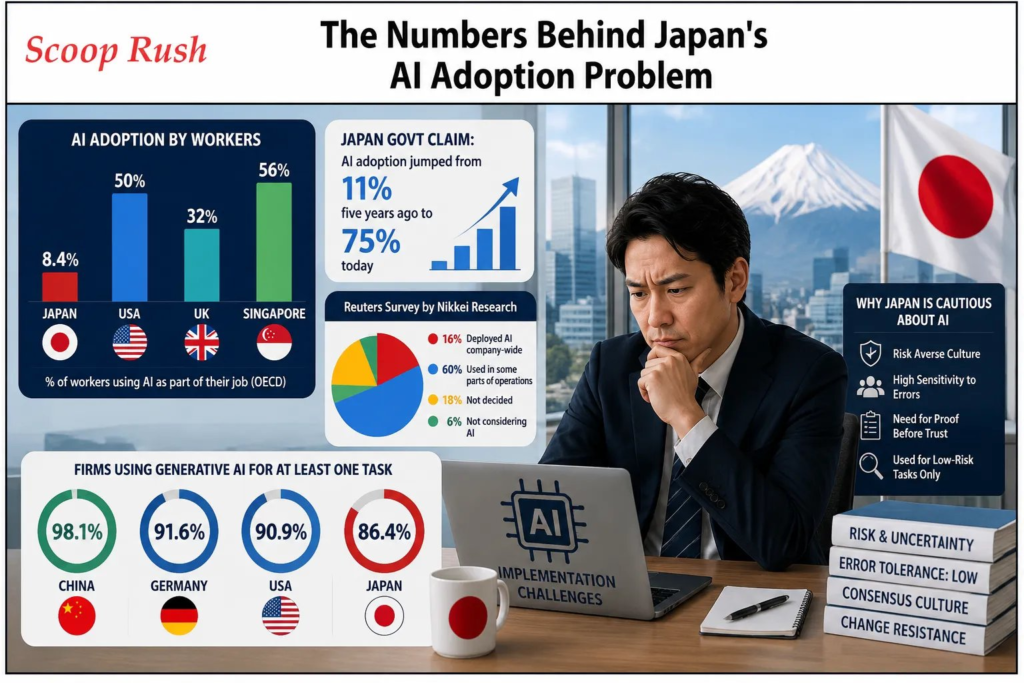
The data tells a clear story. According to the OECD, only 8.4% of Japanese workers use AI as part of their job. In comparison, 50% of American workers use it, and so do 32% of British workers. Singapore leads Asia, where 56% of workers use AI multiple times a week.
Japan’s government paints a rosier picture. The Ministry of Finance claims AI adoption jumped from 11% five years ago to 75% today. However, critics argue this number hides the real story, since only a small fraction of employees at each company actually use the technology, and usually in a limited way.
A Reuters survey conducted by Nikkei Research supports this concern. More than 80% of Japanese companies use AI only in a limited capacity or not at all. About 60% said AI is used in just some parts of their operations. Additionally, 18% haven’t decided whether to adopt AI, and 6% aren’t considering it at all. Only 16% have deployed AI company-wide as a core tool.
Government figures also show Japan trailing other industrial powers. While 86.4% of Japanese firms use generative AI for at least one task, that figure lags behind China’s 98.1%, Germany’s 91.6%, and the United States’ 90.9%.
Why Are Japanese Companies So Cautious About AI?
Experts point to corporate culture as the biggest barrier to Japan AI adoption. Austin Xu, co-founder of US start-up Kuse AI, says Japanese firms are conservative and risk averse by nature. His company recently opened a Japan office to sell AI systems locally, so he has seen the hesitation firsthand.
“There are organisations where process and consensus culture genuinely slow things down,” Xu explains. He adds that tolerance for AI mistakes is close to zero, especially in client-facing roles. As a result, some businesses would rather leave a position unfilled than hand it to a machine, a caution that echoes fears seen in broader debates about AI going rogue at major labs.
This mindset differs sharply from American business culture. In the US, Xu says, AI tools usually start as helpers and gradually earn a bigger role. The typical approach is to let AI try, then correct mistakes as they happen. Japanese firms, however, want solid proof before trusting AI with anything important, which is part of why questions like whether AI will replace your job get answered so differently across cultures.
Parrisa Haghirian, a professor of international management at Kyoto University of Advanced Science, agrees with this assessment. She says adopting AI faces the same resistance as any major change within Japanese firms. Consequently, AI use remains limited and cautious, particularly in workplace settings.
Haghirian also notes that Japanese companies are highly sensitive to error, uncertainty, and reputational risk. Since generative AI isn’t fully reliable yet, most Japanese firms use it only for low-risk tasks like writing, summarizing, or gathering information, much like the writing-assist use cases described in reviews of tools such as Abacus AI. Core operations and major decision-making, however, remain largely untouched by AI, unlike the boardroom-level trust some firms elsewhere are testing with AI CEO clones.
How Outdated Systems Are Slowing Japan’s AI Progress
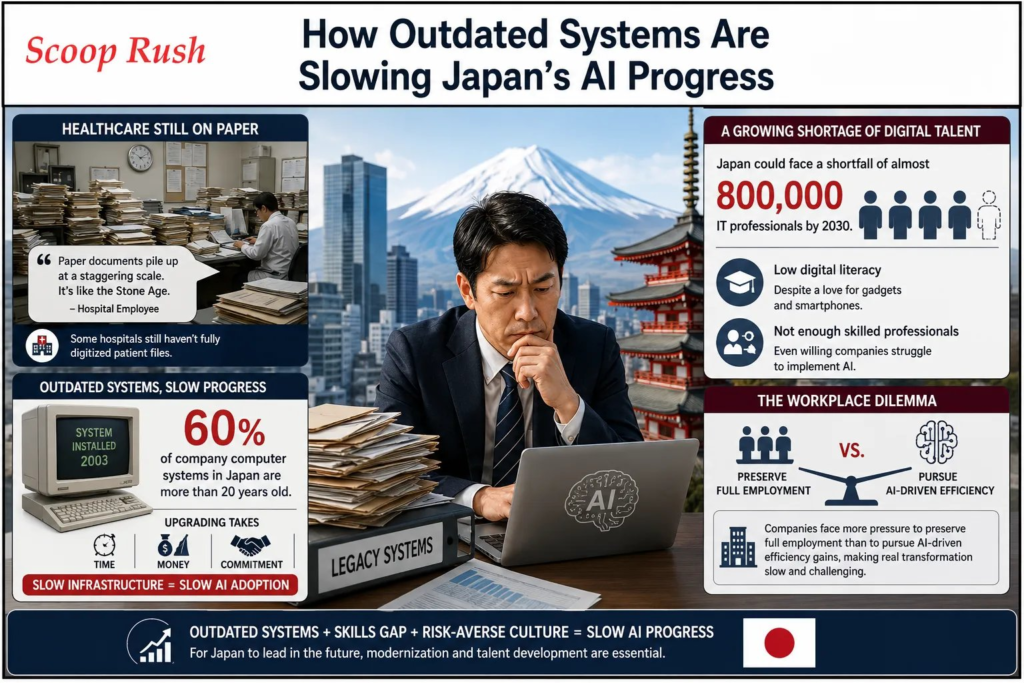
Japan’s healthcare sector shows just how far behind some industries remain. Some hospitals still haven’t fully digitized patient files. One hospital employee described paper documents piling up at a staggering scale, comparing the situation to the Stone Age. This stands in contrast to countries experimenting with AI tools to cut hospital waiting times.
Outdated technology infrastructure adds to the problem elsewhere too. Around 60% of company computer systems in Japan are more than 20 years old. Upgrading these legacy systems takes time, money, and organizational commitment, all of which slow AI rollout even further, especially as global chip and hardware supply issues continue to affect upgrade timelines, similar to the pressures behind recent iPhone, iPad, and Mac shortages.
A Growing Shortage of Digital Talent
Beyond culture and old systems, Japan also faces a serious skills gap. Professor Yasushi Ogasawara, an expert on Japan’s social systems and technology at Meiji University, points out that Japanese digital literacy remains low despite a national love of gadgets and smartphones.
This shortage carries real consequences. A report released earlier this year found that Japan could face a shortfall of almost 800,000 IT professionals by 2030. Without enough skilled workers, even companies eager to adopt AI may struggle to put it into practice, a gap that mirrors why guides on how to become a data analyst in 2026 have become so relevant worldwide.
Ogasawara also highlights a deeper tension within Japanese workplaces. He explains that companies face more pressure to preserve full employment than to pursue AI-driven efficiency gains. Therefore, while the government talks about AI, reskilling, and digital literacy, actually shifting the workforce toward digital skills remains difficult.
Government Efforts to Boost AI Adoption in Japan
Tokyo isn’t ignoring the problem. Lawmakers passed the AI Promotion Act last year, aiming to use light-touch regulation to encourage business investment in AI. The government has pledged to make Japan “the world’s most-friendly country for developing and utilizing AI.”
Meanwhile, Prime Minister Sanae Takaichi has vowed to end excessive austerity and boost domestic investment, naming AI, semiconductors, and quantum technology as key focus areas. According to the Reuters survey, 82% of Japanese firms currently favor domestic investment over overseas expansion, partly because a weaker yen makes foreign investment more expensive.
On AI budgets specifically, the outlook looks cautiously positive. About 4% of surveyed companies expect AI spending to grow by 50% or more over the next one to two years. Another 21% project growth between 10% and 50%, while 30% expect single-digit increases. Notably, none of the surveyed companies said they plan to spend less on AI, a trend that fits a broader global pattern seen in reports on Google’s rising AI spending and other major tech investment pushes.
How Companies Are Changing Their Hiring Approach
Some companies are also changing how they hire new talent. Larger firms like Kanematsu, a major general trading company, now prioritize AI literacy when recruiting graduates. Uta Yamaguchi, who joined Kanematsu in April, says she and her colleagues use AI often. She relies on it to write emails, summarize complicated documents, and record and summarize meetings.
However, Yamaguchi points out an important gap. Unlike in the US, AI systems capable of autonomously handling multi-step work remain virtually unheard of in most Japanese workplaces. Her employer stands out as an exception, having already adopted such tools, a step closer to the kind of agentic coding tools showcased by products like Meta Muse Code.
What Slow AI Adoption Means for Japan’s Economic Future
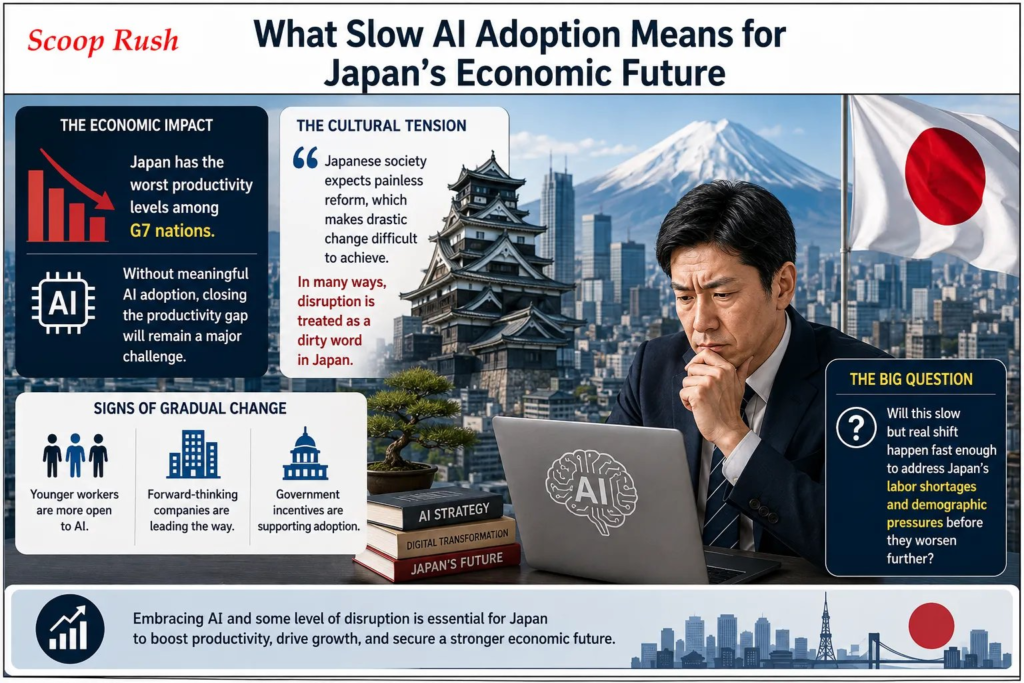
Japan’s cautious approach to AI carries real economic consequences. The country continues to post the worst productivity levels among G7 nations. Without meaningful AI adoption, closing that productivity gap will remain a major challenge.
Ogasawara summarizes the broader cultural tension well. He says Japanese society expects painless reform, which makes drastic change difficult to achieve. In many ways, disruption is treated as a dirty word in Japan. Yet without embracing some level of disruption, the productivity gains the country urgently needs could stay out of reach.
Still, signs of gradual change do exist. Younger workers, forward-thinking companies, and government incentives all point toward a slow but real shift. The real question is whether this shift happens fast enough to address Japan’s labor shortages and demographic pressures before they worsen further.
Conclusion
Japan’s slow AI adoption stems from cautious corporate culture, outdated technology, and a shortage of digital skills. While only 8.4% of Japanese workers currently use AI, compared to 50% in the US and 32% in the UK, pressure to change keeps building. Labor shortages, an aging population, and weak productivity all point to the same conclusion: Japan needs AI more than most nations, yet remains among the most hesitant to embrace it.
Government efforts like the AI Promotion Act and rising corporate AI budgets suggest change is on the way. However, true transformation will require more than policy alone. It will demand a cultural shift toward accepting risk, upgrading legacy systems, and building the digital skills Japan’s workforce currently lacks.
FAQs
1. Why is Japan AI adoption so low compared to other countries?
Japanese companies tend to be risk averse and prioritize process and consensus over speed. This cultural caution, combined with outdated computer systems and a shortage of digital talent, has slowed AI adoption significantly.
2. What percentage of Japanese workers currently use AI?
According to the OECD, only 8.4% of Japanese workers use AI as part of their job. This compares to 50% in the US and 32% in the UK.
3. What is Japan’s AI Promotion Act?
It is a law passed last year by Japan’s parliament. The act uses light-touch regulation to encourage businesses to invest more in AI, with the goal of making Japan the world’s most AI-friendly country.
4. Which industries in Japan are slowest to adopt AI?
Healthcare stands out as particularly slow. Some hospitals still rely heavily on paper records and haven’t fully digitized patient files.
5. Is Japan expected to increase AI investment in the future?
Yes. A recent survey found that no companies planned to cut AI spending. Many expect budget increases ranging from single digits to over 50% over the next one to two years.

