
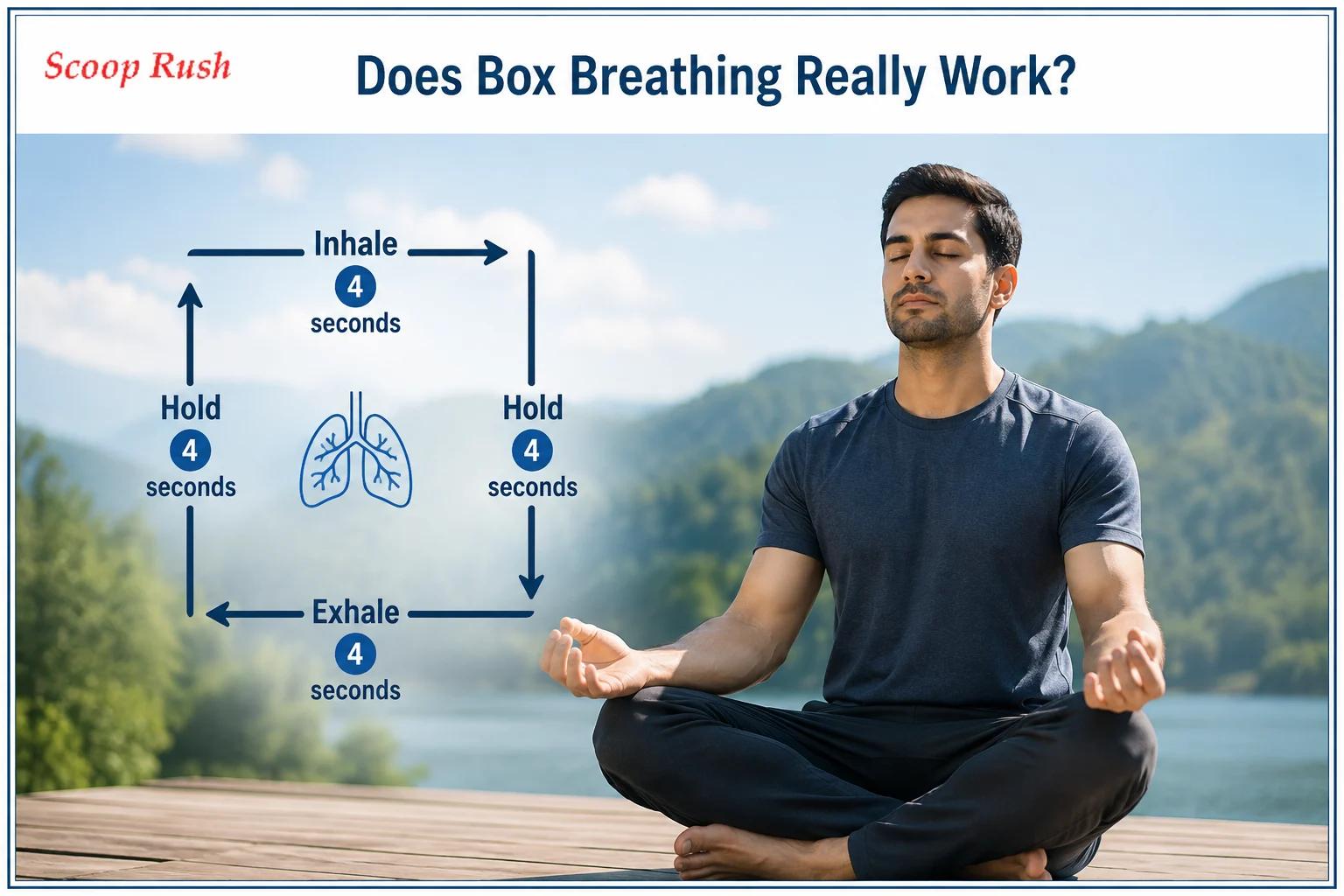
When a natural disaster struck her hometown overseas earlier this year, one woman was thousands of miles away, unable to do anything but wait for news of family and friends.
She could do nothing but wait for updates. The sleepless nights that followed didn’t improve when she scrolled through the news or replayed worst-case scenarios in her head.
What helped, she says, was a technique so simple that it sounds almost too basic to work: counting her breaths in a box.
Box breathing—inhale for four seconds, hold for four, exhale for four, hold for four, then repeat—has quietly become one of the most talked-about stress tools in recent years. Elite soldiers, professional athletes, and therapists who work with burned-out healthcare workers all use and recommend the technique.
Unlike a lot of wellness trends that fade as quickly as they arrive, this one has research behind it. Understanding why it works can make it far more useful than simply following an animated guide on social media.
What Exactly Is Box Breathing?
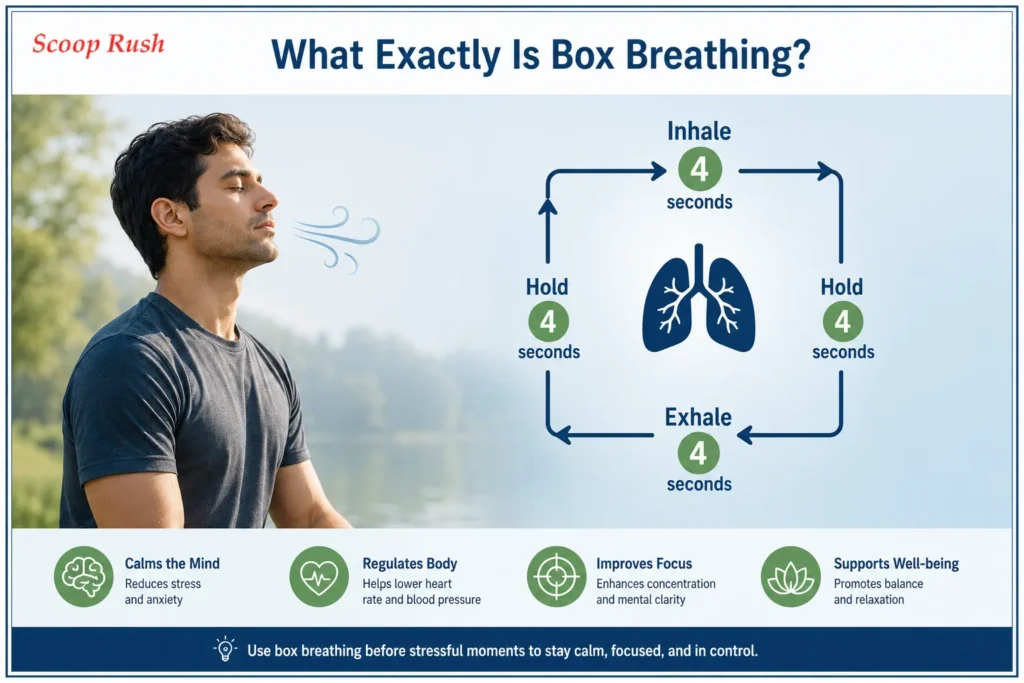
The technique gets its name from its shape: four equal phases, each lasting the same count, forming a mental “box.”
A breathwork coach who has taught the method to professional sports teams explains that the exact length of each phase doesn’t matter as much as keeping all four phases identical whether that’s four seconds, six, or eight.
There’s no fixed session length either. Some people notice a shift in their body within a couple of minutes; others prefer to sit with it for ten or fifteen. The point isn’t to hit a target number, but to give your nervous system enough repetitions to register the change.
Box breathing tends to work best as a pre-emptive tool. It’s something to use before a stressful event like an exam, a big presentation, or a difficult conversation rather than only reaching for it once anxiety has already taken hold.
How to Practice Box Breathing, Step by Step
If you’ve never tried it, the method is easy to learn in under a minute.
Sit comfortably with your back straight, or lie down if you’re using it before sleep. Start by exhaling fully through your mouth to empty your lungs.
From there, inhale slowly through your nose for a count of four, then hold the breath gently for a count of four don’t clench your chest or throat.
Exhale slowly through your mouth for a count of four, then hold again, with empty lungs, for a count of four. Repeat the cycle for two to fifteen minutes, depending on how you feel.
A few practical tips: keep your shoulders relaxed rather than raised, breathe through your nose on the inhale where possible, and don’t force the holds to the point of discomfort — especially when you’re just starting out. It’s fine to begin with a shorter count, like two or three seconds, and build up gradually.
Where the Practice Comes From
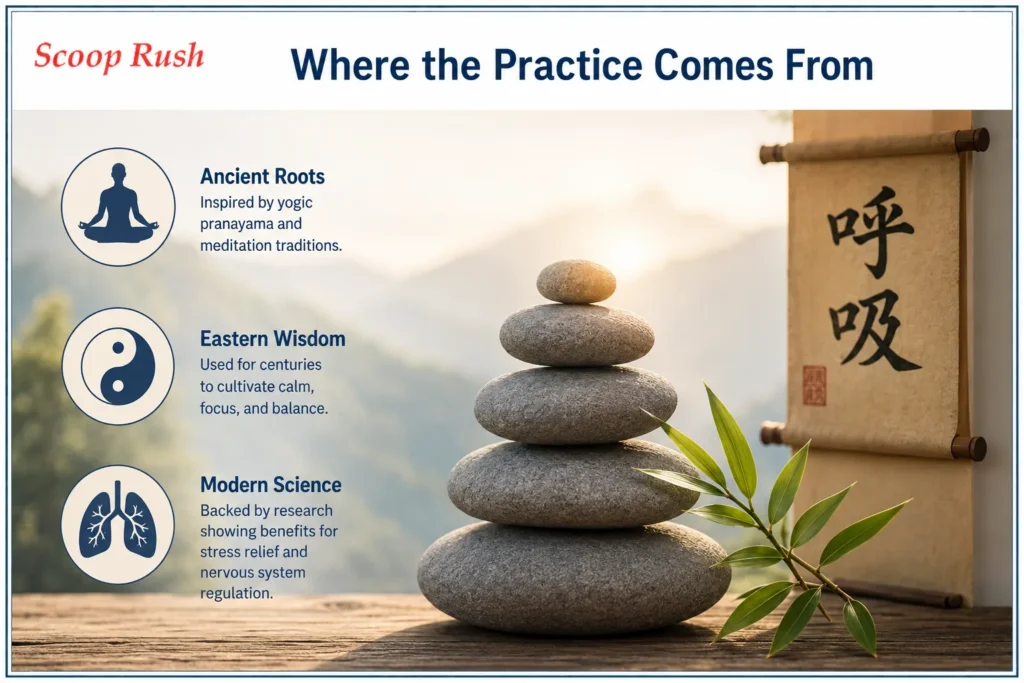
Breathwork itself isn’t new. Its roots trace back to traditional yogic practice and to martial arts disciplines.
These traditions have used controlled breathing for centuries to sharpen focus and steady the body under pressure. What’s changed is how mainstream it’s become largely because it offers a dual benefit that few other quick techniques can claim.
It sharpens mental focus while simultaneously calming the nervous system. That combination is rare among stress-relief tools, most of which lean toward either relaxation or alertness, not both at once.
Its association with elite military and special-operations training, where the technique is reportedly used before entering high-stakes situations, has helped cement its reputation as a serious, performance-grade tool rather than a soft wellness fad.
That crossover appeal equally at home on a sports field, in an operating theatre, or in a therapist’s office is part of why it has spread so widely across very different professions and communities.
The Real Reason the Last Hold Matters Most
A doctor who treats healthcare workers experiencing mental health difficulties is one of many clinicians who now regularly recommend box breathing to patients.
She considers it one of the most effective evidence-based tools available for regaining control over the body’s stress response.
According to her, the final hold the pause after you exhale, before you breathe in agai is doing the real physiological work.
What Happens in the Body During the Hold
During that final hold, carbon dioxide builds up in the bloodstream. Because the brain interprets rising CO2 levels as a warning sign, it triggers a subtle sense of urgency or panic.
This generates the very same “need to breathe” sensation that stress produces naturally in everyday high-pressure moments the tight chest, the shallow gasping breath, the racing pulse.
By deliberately sitting with that discomfort in a controlled way, the theory goes, you’re training your nervous system to tolerate CO2 fluctuations without spiralling into panic.
Over repeated practice, this can blunt the intensity of the body’s stress response in real-world situations. That’s because stressed breathing patterns themselves alter CO2 levels in the blood, and box breathing essentially rehearses the body’s ability to stay calm through that shift, again and again, until it becomes a more automatic response.
What the Research Actually Shows
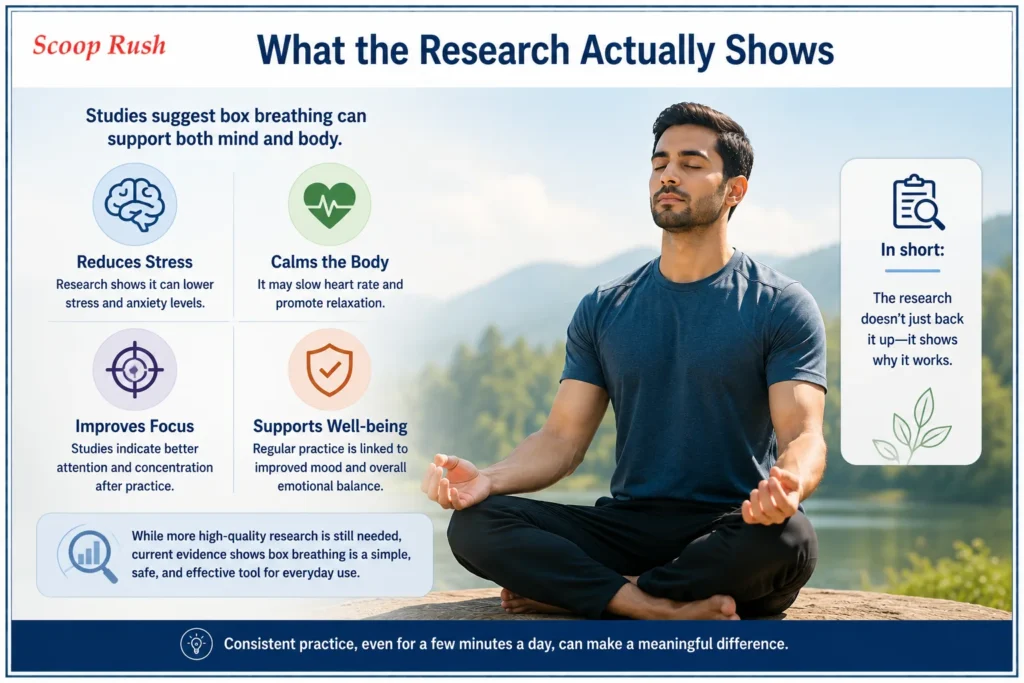
A recent academic study looked at how effective box breathing is in genuinely high-pressure situations.
The findings suggest the technique can blunt the sharp spikes in heart rate and other physiological stress markers that typically accompany pressure-filled moments.
This lends scientific weight to what practitioners have been saying anecdotally for years that a few minutes of structured breathing can meaningfully change how the body responds to acute stress.
This matters because a lot of stress-relief advice circulating online is more folklore than fact. Box breathing stands out partly because it has been tested in controlled academic settings.
It also stands out because its mechanism CO2 tolerance and nervous system regulation is well understood in physiology, not just wellness marketing.
A Nightly Ritual and a Morning Reset
For one woman in her early thirties who works in tech, box breathing has become a bedtime tool.
It’s something she turns to when she’s lying awake, unable to switch her mind off. She first learned the technique from a therapist a few years ago, while juggling further study with a full-time job during a particularly demanding period.
Years later, it remains her go-to when worry threatens to keep her up at night, including during the recent crisis affecting people close to her.
Another woman, a life coach in her late twenties, uses the technique in the opposite direction first thing in the morning, right after waking.
She discovered box breathing online during a personally difficult period and found it effective enough that she went on to study other breathing methods. She eventually trained as a life coach and is now pursuing licensure as a therapist.
She now opens client sessions with the practice, particularly before conversations about emotionally heavy topics, because it helps both her and her clients arrive in a steadier state before the harder conversation begins.
Both women’s experiences highlight an important point: box breathing doesn’t follow a one-size-fits-all routine or depend on a specific time of day.It’s flexible enough to slot into whatever moment actually needs calming a racing mind before sleep, a jittery start to the morning, or the few minutes before a difficult meeting.
Common Mistakes People Make With Box Breathing
Because the technique looks so simple, it’s easy to do it in a way that blunts its benefits. A few common pitfalls:
- Rushing the counts. Speeding through each phase to “get it over with” defeats the purpose the slowness is the mechanism, not a side effect.
- Skipping the final hold. Many beginners shorten or drop the second hold because it feels uncomfortable, but that’s the phase doing most of the physiological work.
- Tensing the body. Clenching the jaw, shoulders, or stomach during the holds keeps the nervous system activated instead of calming it.
- Expecting instant results. Like most nervous-system training, benefits compound with repeated practice rather than appearing after a single session.
- Using it only during a crisis. The technique is most effective as a regular practice, not just an emergency measure reached for once anxiety has already peaked.
Other Breathing Techniques Worth Knowing
Box breathing isn’t the only structured breathing method with stress-relieving potential. A few close relatives are worth trying if the four-count box doesn’t suit you:
- Diaphragmatic (belly) breathing — breathing deeply enough that your belly rises rather than your chest, which naturally slows the heart rate.
- Alternate nostril breathing — a yogic technique that involves breathing through one nostril at a time, often described as balancing the mind and body.
- Extended exhale breathing — simply making your out-breath longer than your in-breath, which nudges the body toward its natural relaxation response.
The common thread across all of these is intentionality. Slowing down, lengthening the breath, and directing attention to the physical sensation of breathing rather than letting it happen unconsciously.
Beyond Breathing:Building a Broader Stress-Management Toolkit
Breathwork is powerful, but clinicians are consistent on one point: it works best as part of a wider set of habits rather than a standalone fix.
Stress specialists often group techniques into two categories things you can do in the moment, and healthy habits that build long-term resilience.
Fast Relief (Five Minutes or Less)
When stress hits and you need something immediate, these options can help take the edge off quickly:
- Step outside for a few minutes of natural light and fresh air
- Take a brisk five-minute walk around the block
- Listen to a favourite song, or sing along if you’re somewhere private
- Do a quick hand, neck, or shoulder stretch at your desk
- Splash cold water on your wrists, where major arteries sit close to the skin
- Chew a piece of gum or sip green tea
- Cuddle a pet, or even just watch a funny video for a quick laugh
- Close your eyes for a minute and simply be still
Daily Habits That Build Resilience
- Move your body regularly. Even modest aerobic activity, done a couple of times a week, has been linked in research to meaningfully lower perceived stress.
- Eat whole foods over ultra-processed ones. Diets heavy in processed food and added sugar are associated with higher reported stress levels.
- Cut back on screen time, especially before bed, since excess use is linked to poorer sleep and higher stress.
- Journal regularly to process emotions rather than let them build up silently.
- Watch your caffeine intake staying under roughly 400mg a day (about four to five cups of coffee) helps avoid compounding anxiety and disrupted sleep. If you rely on your morning cup to function, it’s worth knowing what drinking coffee on an empty stomach does to your body.
- Practise mindfulness or meditation, even in short daily bursts.
- Spend time in green spaces, even briefly as little as ten minutes in a natural setting has been shown to improve psychological wellbeing.
- Prioritise physical touch, whether that’s a hug, cuddling a pet, or spending time with people you trust physical contact is linked to lower cortisol.
- Share meals with others when you can. Beyond the food itself, there are real benefits of eating together that extend to mood and stress levels.
A Simple Framework for Managing Stressors
Beyond individual techniques, therapists often recommend thinking about stress at the level of the situation itself, using a few broad strategies:
- Avoid unnecessary stressors where possible learn to say no, limit time with people who drain you, and trim your to-do list to what actually matters.
- Alter the situation by communicating openly, compromising, and being more assertive about your needs.
- Adapt your expectations reframe problems, adjust perfectionist standards, and keep the bigger picture in view.
- Accept what genuinely can’t be changed, and focus your energy on how you respond rather than the circumstance itself.
When It’s Time to See a Professional
Breathing techniques, journaling, and lifestyle tweaks can meaningfully reduce everyday stress. But they aren’t a substitute for professional support, particularly when stress starts affecting daily functioning.
It may be worth speaking to a doctor or therapist if:
- You’re increasingly relying on alcohol, food, or other coping mechanisms to get through the day
- Stress is straining relationships or making you withdraw from people you care about
- You’re experiencing ongoing physical symptoms like headaches, muscle tension, or insomnia
- Stress is interfering with your ability to concentrate at work or school
Quick Reference: Stress-Relief Techniques at a Glance
| Technique | Time Needed | Best Used When | Why It Helps |
| Box breathing | 2–15 minutes | Before a stressful event, or when lying awake at night | Trains CO2 tolerance, calms the nervous system |
| Diaphragmatic breathing | 1–5 minutes | Any time, especially during acute anxiety | Slows heart rate, engages relaxation response |
| Quick walk or sunlight | 5–10 minutes | Mid-task overwhelm, low mood | Boosts circulation, lifts mood naturally |
| Journaling | 5–15 minutes | End of day, or after a stressful event | Processes emotion, reveals stress patterns |
| Movement/exercise | 20–30 minutes, few times a week | Ongoing resilience building | Releases endorphins, lowers baseline stress |
| Mindfulness/meditation | 5–20 minutes | Daily practice | Reduces rumination, improves emotional regulation |
| Connecting with others | Varies | Whenever isolation increases stress | Triggers hormones that counter fight-or-flight |
| A simple framework (avoid, alter, adapt, accept) | Ongoing mindset shift | Chronic or recurring stressors | Addresses the root cause, not just symptoms |
The Takeaway
What makes box breathing stand out isn’t novelty it’s that a technique this simple has genuine physiological backing.
It has real endorsements from high-pressure professions, and a growing body of clinical research behind it. For the people who rely on it, it isn’t a cure-all; it’s one reliable tool in a much bigger stress-management toolkit.
It costs nothing, requires no equipment, and works anywhere from your bed at midnight to your desk before a big meeting.
In the moments where there’s little else you can do, remembering to breathe deliberately and intentionally can be more powerful than it sounds.
FAQs
Is box breathing the same as square breathing?
Yes. “Box breathing” and “square breathing” refer to the same four-phase, equal-count technique. The names are used interchangeably, though “box breathing” is more common in military and athletic contexts.
How long does it take to see results from box breathing?
Some people feel calmer within two to three minutes of a single session. The longer-term benefit better tolerance of stress overall tends to build with consistent, repeated practice over days and weeks rather than from one session alone.
Can box breathing help with panic attacks?
Many people use it for acute anxiety, and its focus on slow, controlled breathing can help interrupt the physical spiral of a panic response. That said, it isn’t a clinical treatment for panic disorder, and anyone experiencing frequent panic attacks should speak with a healthcare provider.
Is there a “right” count to use?
You don’t need to follow a fixed number. Four seconds per phase is the most common starting point, but some people use two, six, or even eight seconds. The key is to keep all four phases the same length.
Can box breathing be harmful for anyone?
For most healthy adults it’s considered safe. However, people with certain respiratory or cardiovascular conditions should check with a doctor before practicing breath-holding exercises, since prolonged holds can affect blood pressure and oxygen levels.
What’s the best time of day to practice it?
There isn’t a single best time it depends on what you need. Some people use it before bed to quiet a racing mind, others first thing in the morning to start the day calmer, and many simply use it right before a known stressful event, like a meeting or exam.

