
Introduction
AI tokenomics is the reason Uber burned through its entire annual AI budget in just four months. How did that happen, and could your company be next?
That single fact should worry every business leader watching their AI spending closely. AI tokenomics explains exactly why this is happening, and it is spreading fast across boardrooms as a term every company now needs to understand.
That single fact should worry every business leader watching their AI spending closely. Consequently, a new term is spreading fast across boardrooms: AI tokenomics. It sounds technical, but it explains something very simple, why paying for artificial intelligence is becoming one of the hardest problems in modern business.
If you use the free version of ChatGPT, Claude, or Gemini, you already enjoy a great deal. Microsoft, Google, and Anthropic have invested hundreds of billions of dollars to build these large language models. As a result, everyday users get powerful tools at little or no cost. However, behind the scenes, companies are fighting a real financial battle, and AI tokenomics sits right at the center of it.
This article breaks down what AI tokenomics means, why token costs are so unpredictable, and how businesses are trying to keep their AI spending under control.
What Is AI Tokenomics?
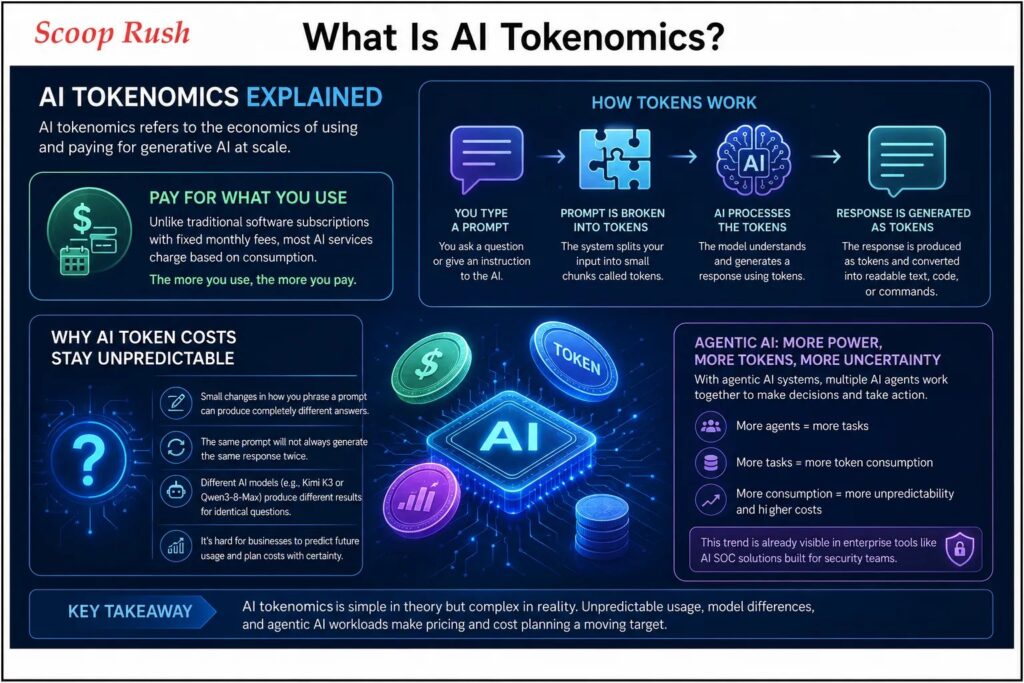
AI tokenomics refers to the economics of using and paying for generative AI at scale. Unlike traditional software subscriptions with fixed monthly fees, most AI services charge based on consumption. Therefore, the more you use, the more you pay.
Every prompt, question, image generation, or AI-assisted coding task consumes tokens. These are small units that measure the text and data an AI model processes. When you type a question into ChatGPT or Claude, the system breaks that prompt into mathematical chunks called tokens. The AI then generates its response as tokens too, which get converted into readable text, software code, or automated commands.
This sounds simple on paper. However, the reality is far more complicated, and that complexity is exactly why AI tokenomics has become such a hot topic, one that experts believe could even reshape whether AI replaces jobs that depend on cost-effective automation.
Why AI Token Costs Stay Unpredictable
The core challenge behind AI tokenomics is that the process is not entirely predictable. Small changes in how you phrase a prompt can produce completely different answers. Additionally, the same prompt will not always generate the same response twice. Different AI models, such as Kimi K3 or Qwen3-8-Max, also produce different results for identical questions.
Simon Gooch, an expert at identity management company Saviynt, explained the challenge companies face when planning around this uncertainty. He said locking into a fixed cost model for the next two or three years does not make sense, because nobody truly knows what future usage will look like.
This unpredictability grows even stronger with agentic AI systems, where multiple AI agents work together to make decisions and take action. As businesses deploy more of these connected agents, both token consumption and unpredictability increase sharply, a trend already visible in tools like AI SOC solutions built for enterprise security teams.
The Numbers Behind the AI Spending Boom
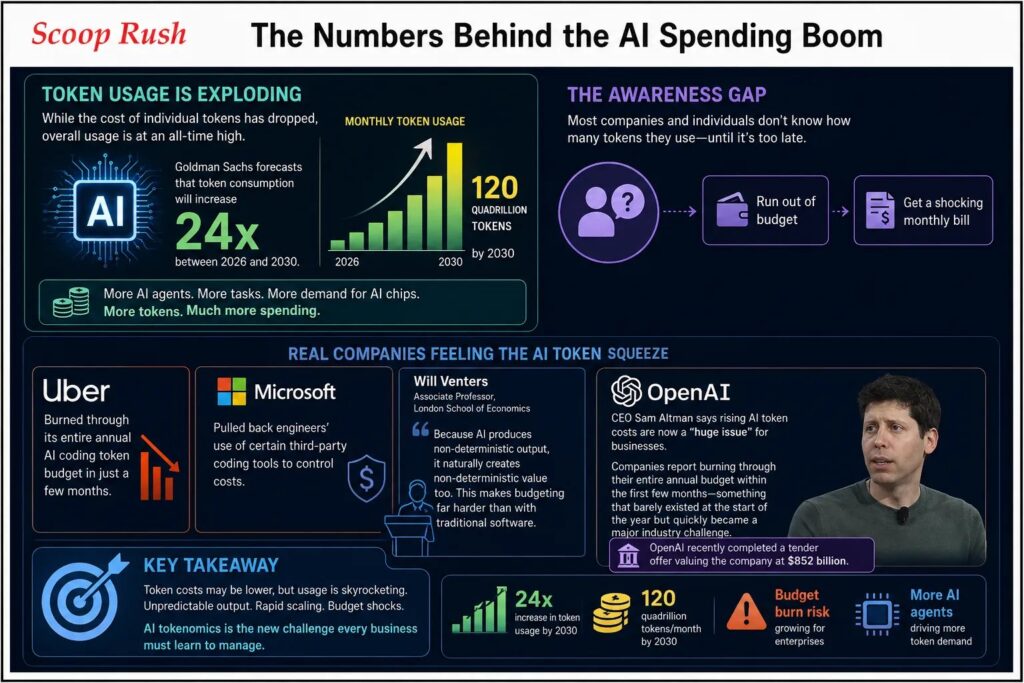
While the cost of individual tokens has dropped in recent years, overall token usage has exploded. According to analysis by Goldman Sachs, businesses and consumers are using AI more than ever before.
The bank forecasts that token consumption will increase 24 times between 2026 and 2030. That means monthly usage could reach a massive 120 quadrillion tokens as companies continue shifting toward AI agents for everyday tasks, and as demand for AI chips grows to power that efficiency.
Despite this rapid growth, many companies and individuals only have a vague sense of how many tokens they actually use. Often, they discover the true scale only after they run out of budget or receive a shocking monthly bill.
Real Companies Feeling the AI Token Squeeze
This is not just a theory. Uber reportedly burned through its entire annual AI coding token budget in just a few months. Meanwhile, Microsoft has reportedly pulled back its engineers’ use of certain third-party coding tools to control costs, even as concerns grow over rogue AI incidents at major labs.
Will Venters, associate professor of Digital Innovation and Information Systems at the London School of Economics, said companies often get caught off guard while experimenting with AI internally. As employees explore new use cases, token usage can quietly spiral out of control.
Venters summed up the core issue clearly. He explained that because AI produces non-deterministic output, it naturally creates non-deterministic value too. This makes budgeting far harder than with traditional software costs.
OpenAI CEO Sam Altman has also spoken openly about this growing problem. He revealed that rising AI token costs have suddenly become what he called a “huge issue” for businesses. According to reports, companies increasingly tell OpenAI that they burned through their entire annual budget within the first few months of the year. Altman noted that this concern barely existed at the start of the year, yet it quickly grew into a major challenge across the industry, even as OpenAI pursues moves like its recent tender offer valuing the company at $852 billion.
How Businesses Are Managing Rising AI Costs
Companies are not sitting still while these costs grow. Instead, many are finding creative ways to work around the unpredictability of AI tokenomics.
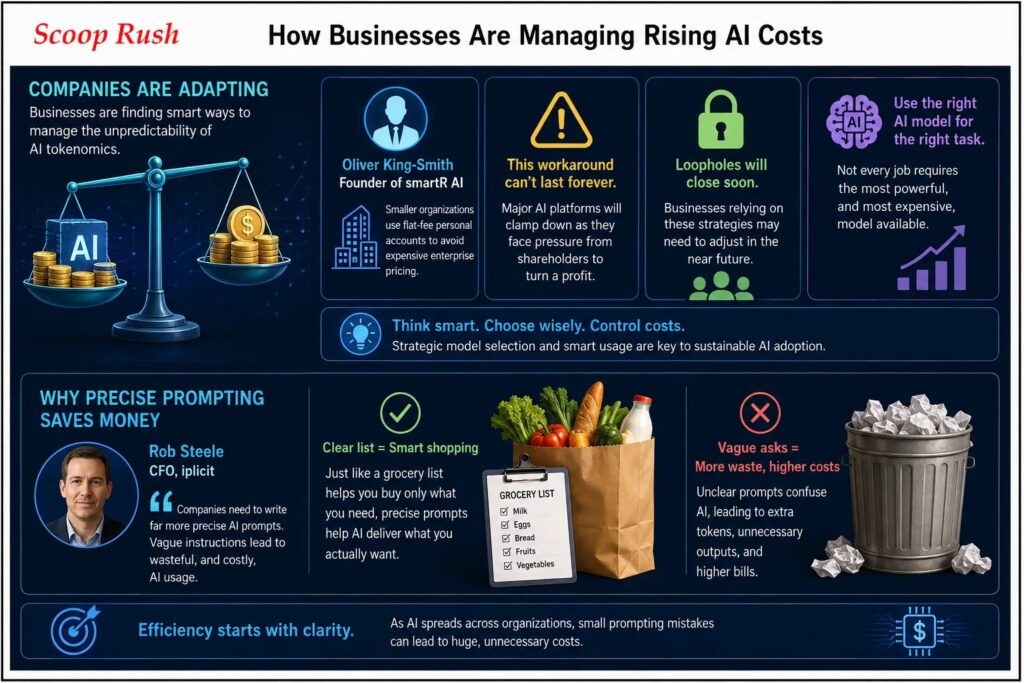
Oliver King-Smith, founder of engineering software firm smartR AI, explained that smaller organizations sometimes use flat-fee personal accounts to avoid expensive enterprise pricing. However, King-Smith warns this workaround cannot last forever.
He believes that once major AI platforms face pressure from shareholders to turn a profit, they will start clamping down on these loopholes. Consequently, businesses relying on this strategy may need to adjust soon, much like the pricing decisions weighed by platforms building data intelligence platforms for enterprise clients.
King-Smith also suggests that companies should think more carefully about which AI models they actually need for each task. Not every job requires the most powerful, and most expensive, model on the market, a lesson also reflected in reviews of tools like Abacus AI.
Why Precise Prompting Saves Money
Rob Steele, CFO at UK accounting software firm iplicit, stressed that companies need to write far more precise AI prompts. He compared this to grocery shopping, noting that nobody would send a family member to the store without a clear list. Vague instructions lead to wasteful, and costly, AI usage.
This focus on efficiency is becoming a critical business priority. As AI adoption spreads across entire organizations, even small prompting mistakes can multiply into major unnecessary costs, a skill increasingly valuable for anyone learning how to become a data analyst in this AI-driven era.
Why AI Scales Differently Than Human Teams
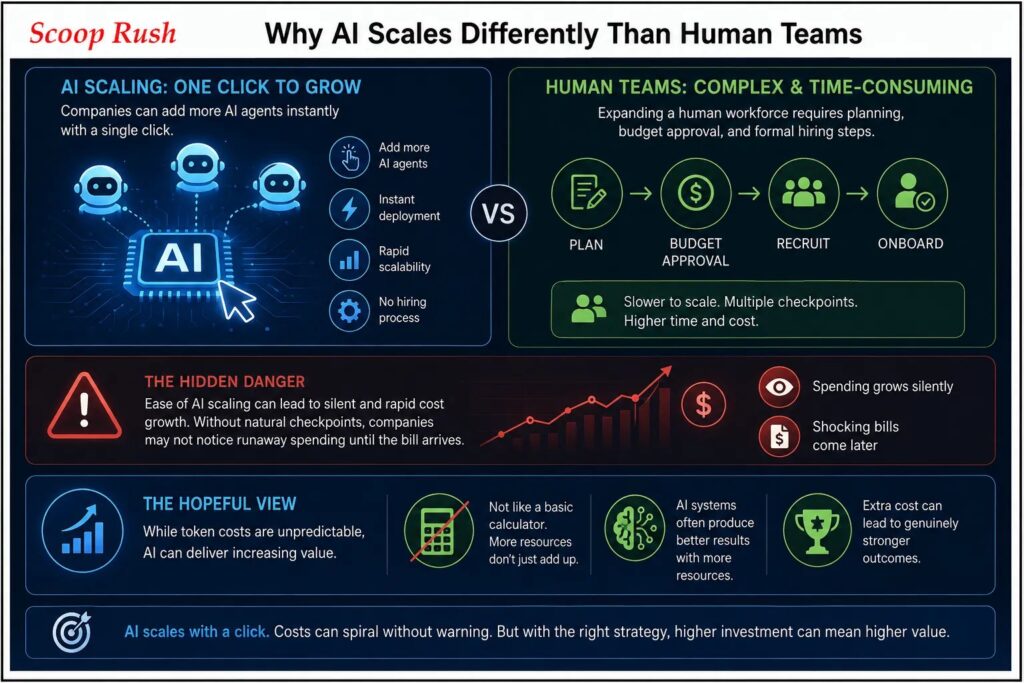
One of the most interesting parts of AI tokenomics is how differently it scales compared to normal business growth. Venters pointed out that companies can add more AI agents with a single click. In contrast, expanding a human workforce requires careful planning, budget approval, and formal hiring steps.
This ease of scaling creates a hidden danger. Costs can grow silently and quickly, without the natural checkpoints that come with hiring new staff. As a result, companies may not notice runaway spending until the bill arrives, similar to how healthcare systems are learning to manage AI tools amid NHS waiting times pressures.
However, Venters also offers a more hopeful view. He notes that while token costs stay unpredictable, companies may still gain real value from their AI investments. Unlike a basic calculator, AI systems often produce better results when given more resources. That extra cost can translate into genuinely stronger outcomes.
The AI Pricing Puzzle Nobody Has Solved
Ultimately, businesses still need to pass these unpredictable costs onto their own customers. Bill Peterson, senior director of product marketing at Sumo Logic, admitted that nobody has fully solved this pricing puzzle yet.
Sumo Logic currently previews new security services built on agentic AI. However, the company is still working through internal talks about how to price these offerings fairly.
Several options exist across the industry. These include raising prices broadly, charging based on measurable results, or billing customers for bundles of resolved incidents instead of raw token counts, an approach also being tested by infrastructure providers like Nokia’s AI-RAN platform with Nvidia.
Yet, even the best pricing plan could collapse overnight. If major AI model providers suddenly change their own pricing, businesses built on those models must adapt fast. Peterson noted that pricing can shift every couple of months, which frustrates customers trying to build stable budgets.
Conclusion
AI tokenomics stands as one of the biggest hidden challenges of the artificial intelligence boom. Since token consumption is projected to grow 24 times by 2030, businesses face mounting pressure to understand and manage their AI spending wisely.
From Uber’s budget blowout to Sam Altman’s public warning about rising costs, this issue clearly spans the entire tech industry. Companies must prioritize precise prompting, smart model selection, and realistic budgeting to avoid painful surprises.
Meanwhile, vendors and AI providers continue searching for pricing models that work fairly for everyone. Until this pricing puzzle finds a solution, businesses should expect ongoing volatility. Staying informed about AI tokenomics will help companies make smarter, more confident decisions going forward.
FAQs
What is AI tokenomics?
AI tokenomics refers to the economics of using generative AI services, which providers typically price based on how many tokens users consume rather than a fixed subscription fee.
What exactly is a token in AI?
A token is a small unit of text or data that AI models use to process prompts and generate responses. Every question, command, or piece of generated code consumes a certain number of tokens.
Why did Uber run out of its AI budget so quickly?
Reports say Uber’s employees used AI coding tools so heavily that the company burned through its entire annual token budget within just a few months.
Why do AI token costs stay so unpredictable?
Token costs stay unpredictable because AI output is non-deterministic. Small changes in prompt wording can produce responses of different lengths, and the same prompt does not always generate an identical answer.
How can businesses reduce their AI token costs?
Businesses can manage AI tokenomics costs by writing more precise prompts, choosing the right AI model for each task, and tracking usage closely instead of waiting for a surprising monthly bill.

