
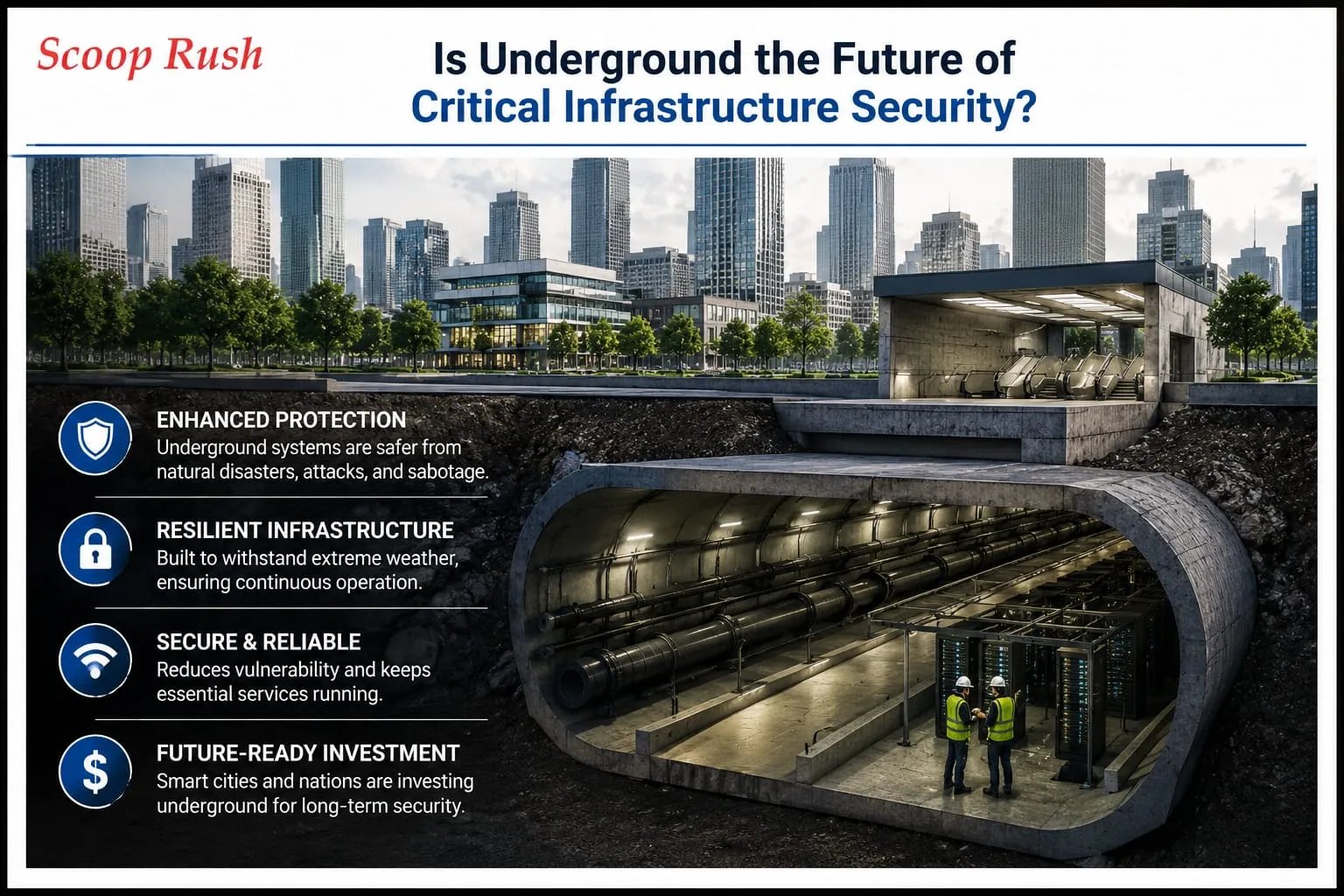
Could critical infrastructure underground be the safest way to protect the internet from attack? That question no longer sounds far-fetched.
A machine hot enough to melt granite just chewed through solid rock in a California quarry, and it signals something much bigger. Engineering firms worldwide are reporting a sharp rise in demand for critical infrastructure underground, and the reason is unsettling: above-ground facilities are proving far too easy to attack.
Introduction
Russia’s ongoing war with Ukraine has exposed just how vulnerable power stations, data centers, and telecom hubs are to drone strikes. As a result, governments and private companies are rethinking where they build the systems that keep modern life running. From plasma-powered tunnel boring machines to a repurposed wine cellar in the Italian Alps, the race to move critical tech underground is accelerating fast.
This shift matters to everyone, not just engineers and defense planners. Consequently, the internet connections, power grids, and data storage systems most people rely on every day could soon move underground for good.
A Machine That Melts Through Granite
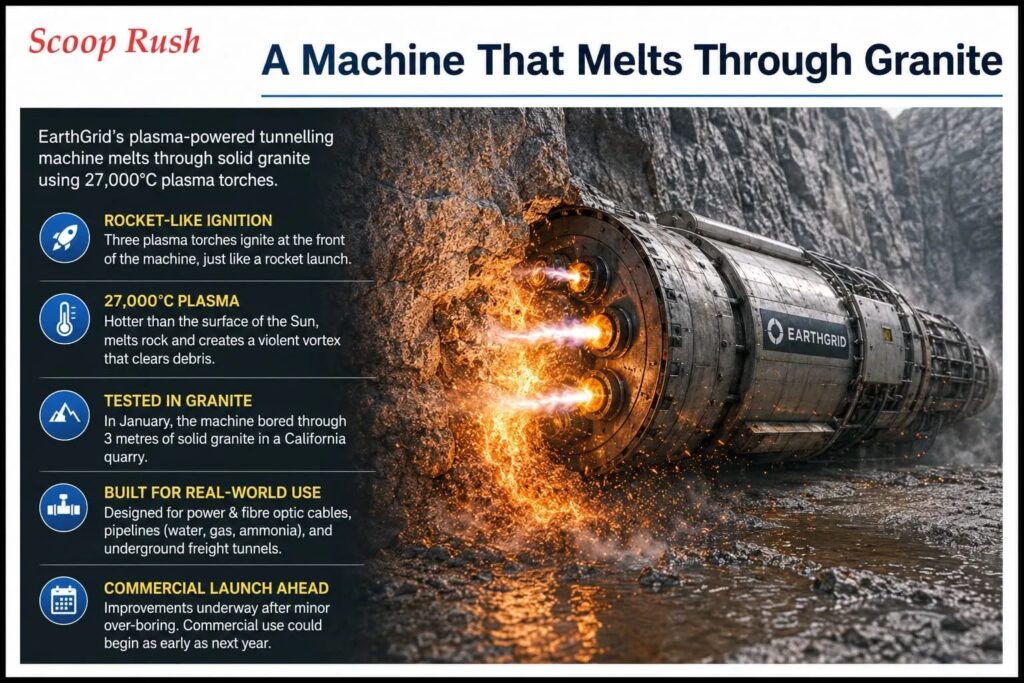
In a California quarry earlier this year, a small team of engineers watched a cigar-shaped machine roar to life against a wall of solid granite. The rock had always seemed nearly impenetrable. That didn’t last long.
The machine belongs to EarthGrid, and its founder, Troy Helming, compares the startup process to a space launch, much like the abort sequences engineers rehearse before a Starship launch. “It’s kind of like igniting a rocket,” he explains, describing how three plasma torches ignite at the front of the machine before settling into quieter, steady operation.
Once running, those torches produce plasma reaching 27,000 degrees Celsius. That’s significantly hotter than the surface of the Sun. During the January test, the machine chewed through three metres of granite, creating what Helming calls a violent vortex that sucks away debris, some of which turns molten.
For Helming, the moment carried real weight. “I actually got a little bit emotional watching it,” he says. “I’ve been waiting for this moment for 10 years.”
What This Underground Tunnelling Technology Could Power
EarthGrid’s tunnel boring machine isn’t just a research curiosity. Helming says companies have already shown interest in using it for power and fibre optic cables, along with pipelines that could carry water, natural gas, or ammonia. One proposed project would even route underground freight around airports and warehouses, cutting truck traffic in the process.
The January test wasn’t flawless, however. The machine “over-bored” slightly toward the top and left of the tunnel. Helming’s team now plans to fix this by making the vortex spin in alternating directions every five minutes or so. If that adjustment works, commercial deployment could begin as early as next year.
Why Undergrounding Critical Infrastructure Is Suddenly in Demand
Burying cables and equipment underground has always been possible. However, it has also been expensive and difficult, which kept it a niche option for decades. That situation is changing quickly.
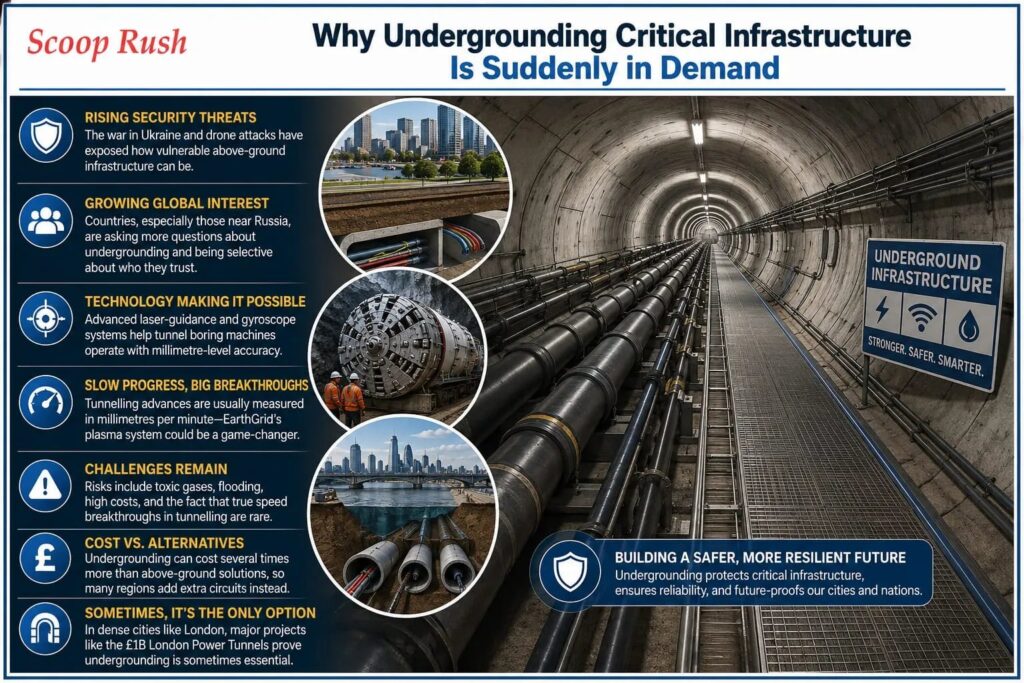
Engineering firms told BBC News they’re seeing rising demand for undergrounding, largely driven by the war in Ukraine. Drone attacks have shown how exposed above-ground infrastructure really is, and that lesson hasn’t gone unnoticed elsewhere.
Robbie McGoran, head of work winning and business development at tunnelling firm Joseph Gallagher, says the shift is measurable. Countries bordering Russia, in particular, are asking more questions about undergrounding. “They’re very cautious about who they’ll even let do their work,” he notes, “and also burying infrastructure and making sure it’s well protected.”
Technology is helping too. McGoran points to laser-guidance systems and gyroscopes, which now let boring machines track their position with far greater accuracy, not unlike the wider-view sensing breakthroughs behind MIT’s new lidar chip for self-driving cars. Even so, progress remains slow by nature. “We usually measure progress in millimetres per minute,” he says, which highlights just how significant a breakthrough EarthGrid’s plasma system could become.
The Challenges Undergrounding Still Faces
Tunnelling carries real risks. Crews can release dangerous gases trapped underground, and flooding remains an ongoing concern. Meanwhile, genuine leaps forward in tunnel boring speed are rare, which is part of why EarthGrid’s test has drawn so much attention.
Cost is another major factor. Mark Neller, energy leader for Europe, India, Middle East and Africa at engineering consultants Arup, says the UK hasn’t seen a major shift toward undergrounding yet. Tunnelling can cost several times more than above-ground cable infrastructure. Therefore, many regions simply add extra circuits instead to build resilience.
“That’s actually a much more cost-effective way,” Neller explains. “The electricity system in Great Britain is designed with quite a lot of redundancy built into it.”
Still, some projects leave no alternative. Neller and his colleagues worked on the £1 billion London Power Tunnels project, which involved building 18 miles of tunnels beneath London to house large electricity cables. In a dense urban area like that, tunnelling was the only practical choice.
Underground Data Centers Are Becoming a Global Trend
It isn’t just cables and pipelines moving below the surface. Data centers, the physical backbone of the internet and the infrastructure behind everyday tools like AI social listening platforms, are following the same trend.
Alexander RE Taylor, senior lecturer in communications at the University of Exeter, has tracked what he calls a “data bunker boom.” According to Taylor, physical protection still matters enormously in a digital world. “What we’re seeing is that brutal materiality is still important,” he says.
One striking example opened earlier this year in Italy’s Dolomite Mountains. Trentino DataMine built its facility inside freshly excavated caverns 100 metres underground, right next to spaces once used for storing sparkling wine, apples, and cheese. As a result, the naturally cool environment makes it cheaper and less energy-intensive to keep servers running, a cost pressure similar to what’s driving Google’s AI spending and cash flow concerns.
Chief executive Dennis Bonn describes the protection this way: “Ninety million cubic metres of dolomite rock provide natural protection against physical intrusion, electromagnetic interference, seismic events and hydrogeological risks.” According to Bonn, that level of security simply can’t be matched above ground.
Sweden offers another compelling example. Bahnhof’s Pionen data bunker sits roughly 100 feet below Stockholm inside a decommissioned civil defense bunker built in 1943. The site is famous for its dramatic design, complete with a glass-enclosed “floating” conference room, simulated daylight, and waterfalls carved into solid rock. Backup power even comes from Maybach diesel engines originally used in German submarines. The facility has hosted high-profile clients, including WikiLeaks, and Bahnhof is now building a second underground data fortress beneath the streets of Gothenburg.
In North America, Iron Mountain operates a similar facility in Boyers, Pennsylvania, inside a former limestone mine. The site’s constant temperature range of 53 to 55 degrees Fahrenheit makes it ideal for preserving sensitive materials, and access stays tightly controlled through a single entrance road.
Subsea Cables Are Going Deeper Too
The trend isn’t limited to land. Subsea internet cables, which stretch for thousands of kilometres beneath the ocean and keep services like WhatsApp, Facebook, and Instagram running worldwide, are occasionally damaged by ship anchors. Consequently, burying these cables has become a common protective measure.
Lane Burdette, senior analyst at telecoms research firm TeleGeography, says the data backs this up. Faults per kilometre of deployed cable have become rarer as burial practices have expanded. “Submarine cables are increasingly being buried up to three meters deep,” she explains. “In some fault-prone areas, they are buried along their entire lengths.”
Lessons From Cold War Bunkers and Modern Conflicts
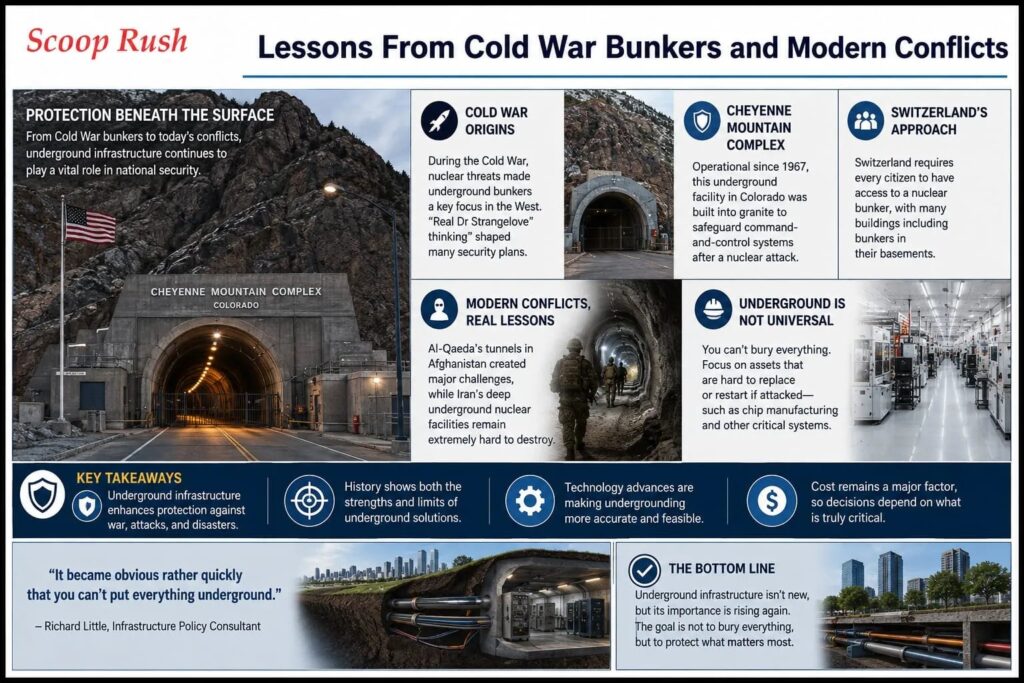
Burying infrastructure for protection isn’t a new idea. The concept goes back decades, particularly to the Cold War era, when the looming threat of nuclear war made underground bunkers a common topic of discussion in the West.
Richard Little, infrastructure policy consultant and editor of the Journal of Critical Infrastructure Policy, remembers that period well. He describes much of the thinking at the time as “real Dr Strangelove stuff,” referring to conversations during the Reagan administration about preserving a small group of critical people underground if the worst happened.
One of the most famous examples from that era is the Cheyenne Mountain Complex in Colorado, operational since 1967. Built inside a granite mountain, it was designed to keep command-and-control computing systems running even after a nuclear first strike.
Switzerland took a different, more universal approach. To this day, the country requires every citizen to have access to a nuclear bunker, and many apartment buildings include such facilities in their basements.
Taylor also points to more recent examples of underground defense strategy. He notes that tunnels used by Al-Qaeda created major strategic problems for the United States during the war in Afghanistan. Similarly, Iran’s underground nuclear facilities, known for being extremely difficult to destroy, have drawn significant international attention in recent years.
Why You Can’t Bury Every Piece of Infrastructure
Despite all this history, Little is quick to point out the limits of undergrounding. He authored policy documents on underground critical infrastructure back in the 1990s and learned an important lesson early on. “It became obvious rather quickly that you can’t put everything underground,” he says.
Instead, Little suggests focusing on facilities that would be genuinely difficult to restart or replace if attacked. Computer chip manufacturing is one example he raises immediately, a concern echoed by the persistent iPhone, iPad, and Mac shortages tied to fragile global chip supply chains. As he puts it, underground facilities make sense in certain instances, “but it’s all about what’s critical.”
Conclusion
The push toward critical infrastructure underground is picking up real speed, and very real threats are driving it. Drone warfare in Ukraine has shown how exposed power grids, data centers, and cables can be above ground. This global move toward critical infrastructure underground reflects a fundamental shift in how nations think about security.
At the same time, undergrounding isn’t a cure-all. It remains expensive, technically demanding, and unnecessary in many cases where above-ground redundancy already works well. Ultimately, as Richard Little puts it, the real question isn’t whether something can be buried. It’s whether it’s critical enough to justify the cost.
FAQs
Why is critical infrastructure moving underground now?
Engineering firms report rising demand for undergrounding critical infrastructure, largely because drone attacks during the war in Ukraine have exposed how vulnerable above-ground facilities are to strikes.
What is EarthGrid’s plasma tunnel boring machine?
It’s a rock-melting tunnel-boring machine that uses three plasma torches reaching 27,000°C to bore through solid granite, creating tunnels for cables, pipelines, or freight systems.
Where are underground data centers already operating?
Examples include Trentino DataMine in Italy’s Dolomite Mountains, Bahnhof’s Pionen bunker beneath Stockholm, and Iron Mountain’s facility in a former limestone mine in Boyers, Pennsylvania.
Is burying infrastructure underground more expensive than building above ground?
Yes. Tunnelling can cost several times more than above-ground cable infrastructure, which is why some regions, like the UK, rely on added circuit redundancy instead.
Are undersea internet cables also being buried for protection?
Yes. Subsea cables are increasingly buried up to three metres deep, and in fault-prone areas they may be buried along their entire length to reduce damage from ship anchors.

