

One second. That is all that stood between Elon Musk’s SpaceX Starship and its 13th test flight on Thursday. The engines lit. Then, almost instantly, they cut off. A sudden Starship launch abort stopped the massive rocket from leaving the pad, and now the world is waiting to see what happens next.
For space fans, engineers, and investors alike, this moment mattered. Musk had built enormous anticipation around Flight 13, and a last-second stop is never just a footnote. It raises real questions about engine reliability, mission timing, and what it means for SpaceX’s ambitious Starship program moving forward. Musk himself confirmed the issue publicly soon after, explaining what went wrong and when the next launch attempt might happen.
In this article, we break down exactly what happened during the Starship launch abort, why it happened, and what comes next for SpaceX and its Starship rocket.
What Happened During the Starship Launch Attempt
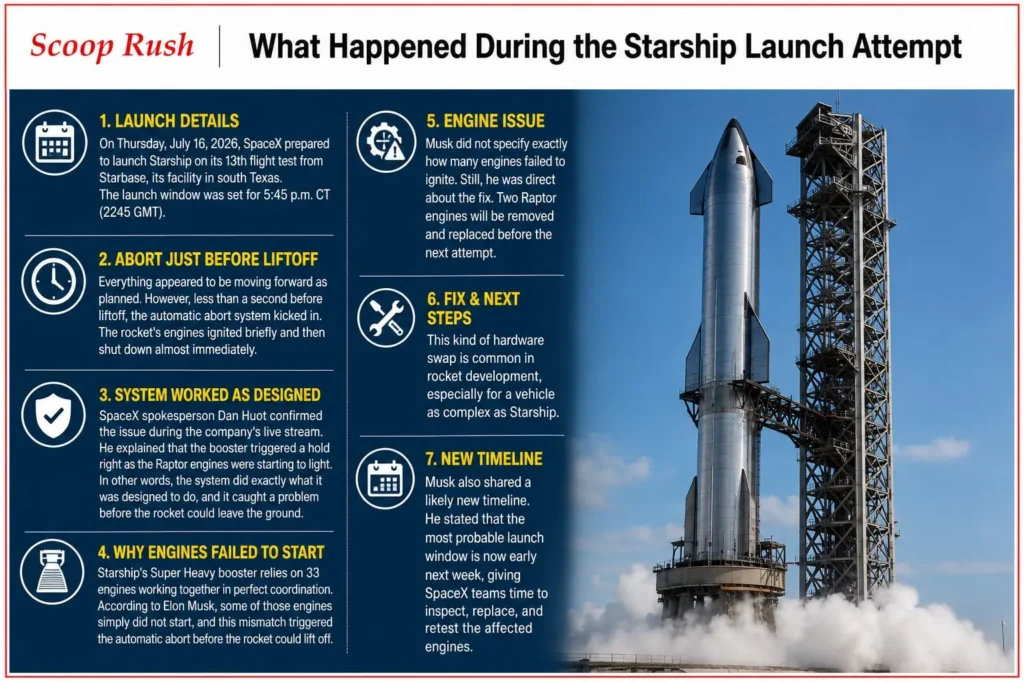
On Thursday, July 16, 2026, SpaceX prepared to launch Starship on its 13th flight test from Starbase, its facility in south Texas. The launch window was set for 5:45 p.m. CT (2245 GMT).
Everything appeared to be moving forward as planned. However, less than a second before liftoff, the automatic abort system kicked in. The rocket’s engines ignited briefly and then shut down almost immediately.
SpaceX spokesperson Dan Huot confirmed the issue during the company’s live stream. He explained that the booster triggered a hold right as the Raptor engines were starting to light. In other words, the system did exactly what it was designed to do, and it caught a problem before the rocket could leave the ground.
Why Some Raptor Engines Failed to Start
Starship’s Super Heavy booster relies on 33 engines working together in perfect coordination. According to Elon Musk, some of those engines simply did not start, and this mismatch triggered the automatic abort before the rocket could lift off.
Musk did not specify exactly how many engines failed to ignite. Still, he was direct about the fix. Two Raptor engines will be removed and replaced before the next attempt. This kind of hardware swap is common in rocket development, especially for a vehicle as complex as Starship.
Musk also shared a likely new timeline. He stated that the most probable launch window is now early next week, giving SpaceX teams time to inspect, replace, and retest the affected engines.
How SpaceX Stock Reacted to the Scrubbed Launch

Rocket launches do not just capture public attention. They also move markets, and this one was no exception.
SpaceX shares fell about 3% in aftermarket trading following the scrubbed launch. The stock closed at $131.11 on Thursday. That price fell below the company’s IPO price of $135, marking the first time shares had dropped under that level since SpaceX made history on Nasdaq last month.
This detail matters for investors tracking SpaceX’s performance as a newly public company. A test flight delay is a normal part of rocket development. Therefore, market reactions like this highlight just how closely investors are watching every milestone, especially early in a stock’s trading history.
What the Stock Dip Means for a Newly Public Company
Going public brings a new layer of scrutiny. Every technical hiccup, including a routine engine issue, can influence investor sentiment. Consequently, SpaceX now faces the challenge of balancing ambitious testing schedules with the expectations of public shareholders.
This does not mean the setback is a major crisis. Launch aborts happen across the industry, and safety systems exist precisely to prevent bigger failures. Still, the stock dip shows how tightly linked SpaceX’s public image now is to real-time technical outcomes, especially after its record-setting SPCX Nasdaq debut pushed Musk toward trillionaire status.
Why This Starship Test Flight Matters
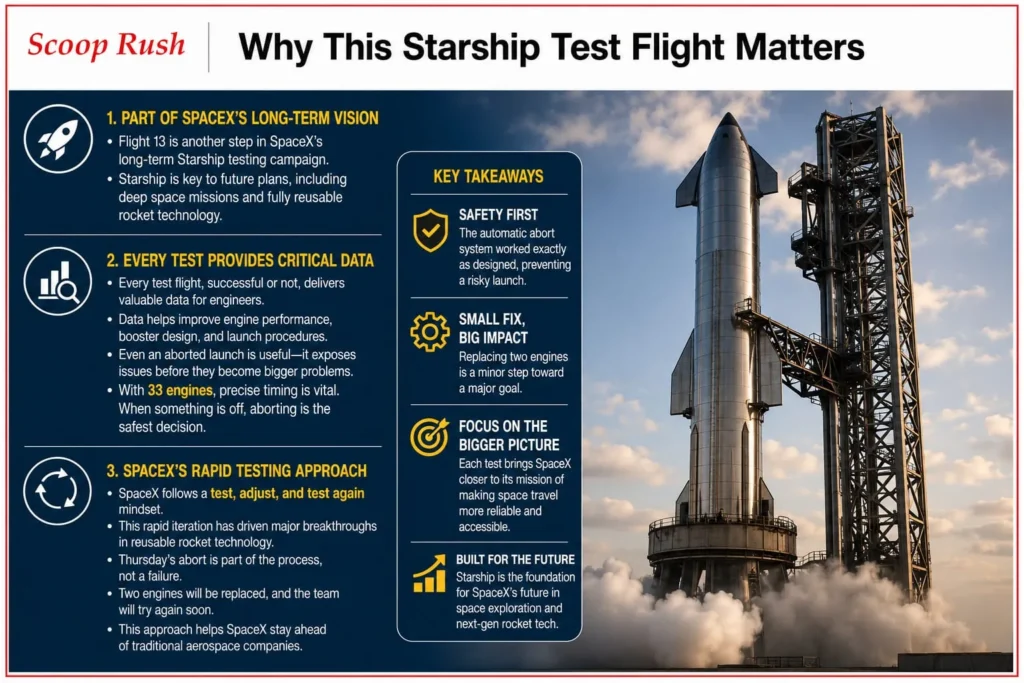
Flight 13 represents another step in SpaceX’s long-term Starship testing campaign. Starship is central to the company’s future plans, including deep space missions and reusable rocket technology at a massive scale.
Each test flight, successful or not, provides critical data. Engineers use that information to refine engine performance, booster design, and launch procedures. As a result, even an aborted launch serves a purpose, since it reveals weaknesses before they become larger problems during an actual flight.
This is especially true for a vehicle using 33 engines simultaneously. Coordinating that many engines requires extremely precise timing. When something doesn’t align, the safest move is always to stop the launch rather than risk a failure once the rocket is airborne.
SpaceX’s Rapid Testing Approach
SpaceX has built its reputation on rapid iteration. Instead of waiting for a flawless launch every time, the company tests, adjusts, and tests again. This approach has led to major breakthroughs in reusable rocket technology over the years.
Thursday’s abort fits neatly into that pattern. Rather than treating the scrubbed launch as a failure, SpaceX is treating it as expected troubleshooting. Two engines will be swapped, and the team will attempt again soon. This mindset has helped the company move faster than many traditional aerospace competitors.
Elon Musk’s Growing List of Headlines Beyond Starship
This launch abort is only the latest chapter in what has been a busy stretch for Musk across his companies. Separately, he recently made headlines after offering $1 million checks tied to a Wisconsin legal matter, drawing significant public attention. Musk’s other venture, xAI, has also been in the news after suing a user over sexual deepfakes involving minors created using Grok.
While these stories are unrelated to Starship’s engineering, they reflect just how frequently Musk and his companies dominate the news cycle right now. Meanwhile, the Starship program remains his most closely watched long-term project.
What Comes Next for Starship’s 13th Flight Test
According to Musk, the next launch attempt is most likely early next week. Before that happens, SpaceX teams will need to complete several important steps.
First, engineers must remove the two Raptor engines that failed to start. Then, they will install replacement engines and run additional checks to confirm everything is functioning correctly. Finally, SpaceX will need to reconfirm launch conditions, including weather and safety clearances, before setting a new date.
Meanwhile, all eyes remain on Starbase. Any additional test flight from this location tends to draw major public interest, partly due to the scale of the rocket and partly due to its importance to SpaceX’s broader mission goals.
Key Takeaways on the Starship Launch Abort
The Starship launch abort on Thursday was not a catastrophic failure. Instead, it was a safety system functioning exactly as intended. Some engines in the 33-engine Super Heavy booster failed to ignite, triggering an automatic abort in the final second before liftoff.
As a result, SpaceX shares dipped nearly 3%, falling below their IPO price for the first time. However, the company remains confident. Two Raptor engines will be replaced, and Musk says another launch attempt is likely early next week.
Ultimately, this event highlights both the complexity of Starship’s engineering and the high stakes of operating as a newly public company. Every test, delay, and fix now plays out under a much bigger spotlight.
FAQs
Q1. Why did SpaceX’s Starship launch abort before liftoff?
Some of the Super Heavy booster’s 33 engines failed to start, which triggered an automatic launch abort less than a second before liftoff.
Q2. How many engines failed to ignite during the Starship launch attempt?
Elon Musk did not specify the exact number of engines that failed to start. However, he confirmed that two Raptor engines would be removed and replaced.
Q3. When will SpaceX attempt Starship’s 13th flight test again?
According to Musk, the most probable launch timing is early next week, pending engine replacement and system checks.
Q4. How did SpaceX’s stock react to the scrubbed launch?
SpaceX shares fell about 3% in aftermarket trading, closing at $131.11, which is below the company’s IPO price of $135.
Q5. Where did the Starship launch attempt take place?
The launch attempt took place at Starbase, SpaceX’s facility in south Texas, during a launch window set for 5:45 p.m. CT.

