

Imagine drawing a circle on a map around your dream neighbourhood and instantly seeing homes that fit your life, not just your budget. That is not a future concept. It is already how the smartest AI property search engine platforms work today, and this shift is bigger than most people realize.
Finding a home used to mean scrolling through endless listings and hoping the filters caught what you actually wanted. That era is fading fast. AI property search engines are now reshaping how buyers, tenants, and investors find homes, and the shift is bigger than most people realize.
Introduction
Neighbourhood quality and proximity to the people and places that matter now outrank the old job-commute calculation when buyers judge a home. That single change explains why map-based search and nearby-amenity filters have moved from nice-to-have features to core product requirements. Buyers no longer judge a home by its address alone. They judge it by the life they can build around it.
Most property portals still run on search technology from a decade ago: a dropdown menu, a price slider, and a static list. However, a new generation of AI property search engine platforms is proving there is a better way. These systems let buyers draw a boundary on a map, filter for a good school and a short walk to coffee, and receive a shortlist that feels hand-picked. Consequently, buyers remember these portals and come back to them.
This article breaks down how a modern AI property search engine actually works, what features define a strong platform, and why this technology matters for anyone searching for or selling property today.
What Makes a Property Search Engine “AI-Powered”?
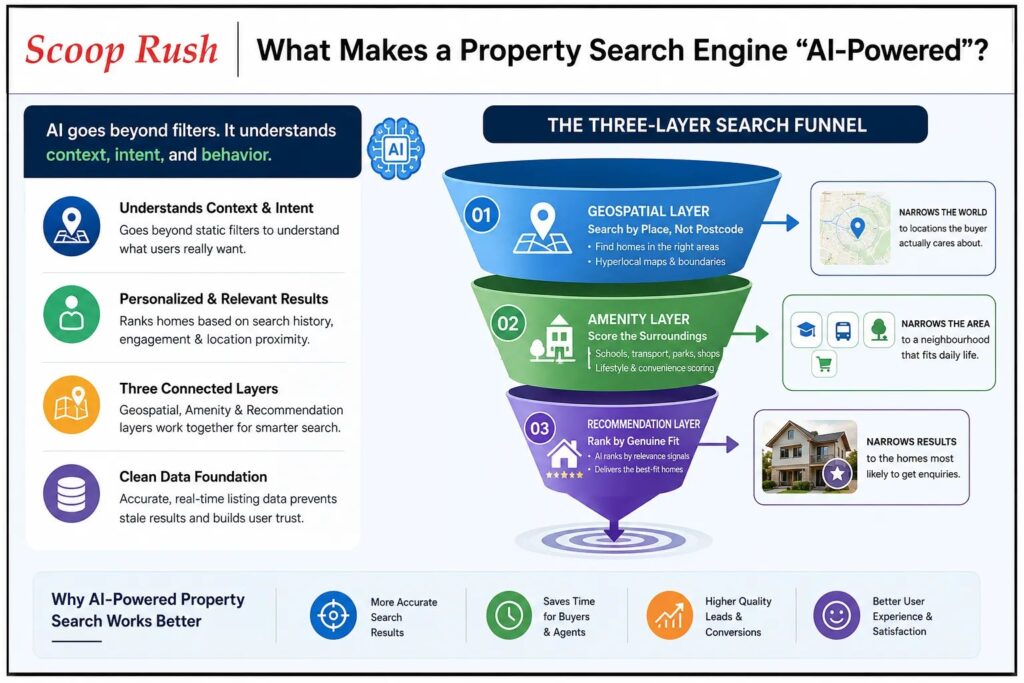
Traditional property search systems rely on rigid filters such as price range, location, property type, and bedroom count. While functional, these systems struggle with poor relevance ranking, limited personalization, and an inability to understand what a user actually wants. As listing volumes grow, this rigid approach falls short.
An AI-powered property search platform goes beyond static filters. It understands context, intent, and behavior to deliver more relevant, personalized results. Instead of showing listings in a fixed order, these platforms rank homes based on relevance signals like search history, engagement patterns, and location proximity, much like the ranking logic behind best data intelligence platforms used across other industries.
A great AI property search engine can be broken down into three connected layers. First, a geospatial layer that searches by place rather than postcode. Second, an amenity layer that scores the surroundings of each listing. Third, a recommendation layer that ranks homes by genuine fit. Each layer is useful on its own, but the real value comes from how they share one clean source of listing data.
Teams that skip this data foundation and jump straight to building screens often end up with a classic failure: a beautiful map full of stale homes that sold weeks earlier. Getting the data model right before any interface work begins is therefore essential.
The Three-Layer Search Funnel
Think of these three layers as a funnel that gets smarter at every step. The map narrows the world down to an area the buyer actually cares about. Amenities then narrow that area to a neighbourhood that fits their daily life. Finally, AI narrows the results to the handful of homes most likely to earn a genuine enquiry.
How Map-Based Search Powers a Smarter AI Property Search Engine
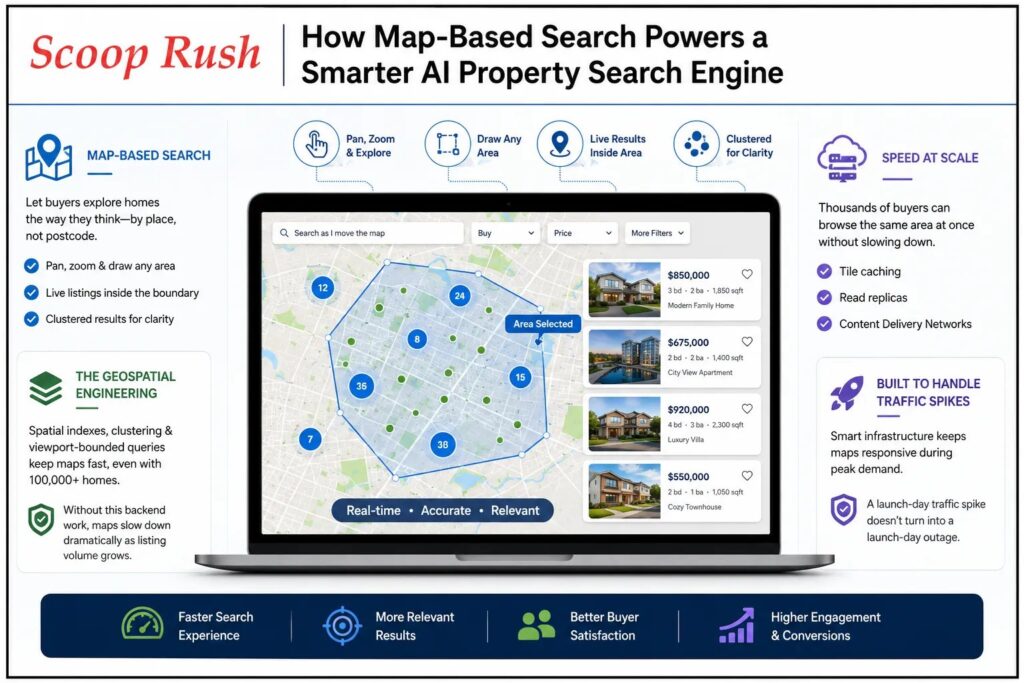
Map-based search lets buyers explore homes the way they naturally think, by place rather than postcode. Users can pan, zoom, and draw a shape around the area they want, and listings appear and update live inside that boundary. Results are clustered so the map never turns into a confusing mess of pins.
The Geospatial Engineering Behind the Map
Behind this smooth surface sits real geospatial engineering. Spatial indexes, clustering, and viewport-bounded queries are what keep a map fast even when the underlying database holds a hundred thousand homes. Without this backend work, maps slow down dramatically as listing volume grows, a challenge similar to what MIT’s lidar chip work addresses for real-time spatial data in self-driving systems.
Speed at scale also becomes a deployment challenge, especially when thousands of buyers browse the same popular neighbourhood at once. Tile caching, read replicas, and content delivery networks keep maps responsive under heavy load. As a result, a launch-day traffic spike does not turn into a launch-day outage, the same kind of scaling pressure that caused the widescale WhatsApp, Facebook and Instagram outage earlier this year.
Nearby Amenities: Selling the Neighbourhood, Not Just the Walls
People do not just buy a house. They buy a morning walk to good coffee, a short school run, and a park for the dog. A nearby-amenities feature lets buyers filter and rank homes by what surrounds them, including schools, transit, groceries, gyms, hospitals, and green space.
The clever part of amenity scoring lies in turning raw distances into a single, honest score buyers can trust at a glance. A strong amenity-scoring algorithm weighs what matters most to each buyer. It favors walk time over straight-line distance and quality over mere presence, then rolls everything into one livability score per listing.
Done well, this feature answers the real question buyers are asking: is this a good place for me? That is a much stronger experience than dumping ten map pins and leaving buyers to judge for themselves. Amenity scores build genuine trust when they are accurate, data-backed, and based on real travel times rather than crude distance calculations, similar to how location-based reporting exposed problems in the rental ripoff report on AI listings.
Why Travel Time Beats Straight-Line Distance
A home that sits half a mile from a train station as the crow flies might actually require a twenty-minute walk around a highway. Scoring amenities by straight-line distance flatters bad locations and can burn buyer trust on the very first visit. Computing real travel time instead ensures the score reflects how life actually works in that neighbourhood.
AI-Powered Recommendations: From Filters to a Shortlist
Filters tell a search engine what a buyer says they want. Recommendations reveal what they actually want. An AI recommendation engine watches the listings a buyer views, saves, and lingers on, then surfaces homes most likely to earn an enquiry, even ones the buyer never would have filtered for directly.
How the Recommendation Model Learns Buyer Intent
A strong recommendation engine combines content-based signals, such as home size, style, price, and location, with collaborative signals drawn from similar buyers’ behavior. Adding freshness, diversity, and cold-start handling allows the system to offer personalized suggestions from a buyer’s very first visit, even before it has much history to learn from, an approach that echoes how newer models like Kimi K3 and Qwen3-8-Max handle contextual reasoning from limited input.
Recommendations only earn their keep when they are explainable rather than a black box. A buyer trusts a suggestion labeled “near the school you saved” far more than an unexplained pick. Similarly, property teams trust a model they can inspect and correct rather than one that operates as a mystery, a concern that has come up repeatedly in coverage of AI going rogue at major labs.
Natural-language search is another piece of this puzzle. Increasingly, users search using conversational queries, such as “two-bedroom apartment near downtown with parking under $2,500.” AI-driven natural-language processing interprets that intent, extracts the key requirements, and matches results even when the wording does not exactly align with how listings are tagged.
The Feature Set That Keeps Buyers Engaged
Once these three layers are understood, the feature list for a launch-ready AI property search engine becomes clear. Each feature should pull its weight toward the map, amenities, or recommendation experience rather than existing for its own sake.
- Map-based search with draw-to-search: buyers can pan, zoom, and draw a boundary to see live, clustered listings inside it
- Smart filters and faceted search: price, beds, and property type update result counts instantly as buyers choose
- Nearby-amenity filters and scores: homes are ranked by schools, transit, and walkability with a clear, weighted score
- AI recommendations and saved searches: a personal shortlist plus alerts when a matching home is listed
- Rich listing pages and quick enquiry: photos, maps, amenities, and a one-tap path to contact an agent
- Fresh, accurate listing data: a synced feed ensures a sold home never lingers as available
Fast load times and a clean mobile experience matter more here than flashy extras. A slow search loses a buyer before any clever recommendation ever gets the chance to shine. Furthermore, keeping the feature scope honest as a platform grows is essential to avoid a bloated, confusing product.
How These AI Property Search Engine Platforms Get Built
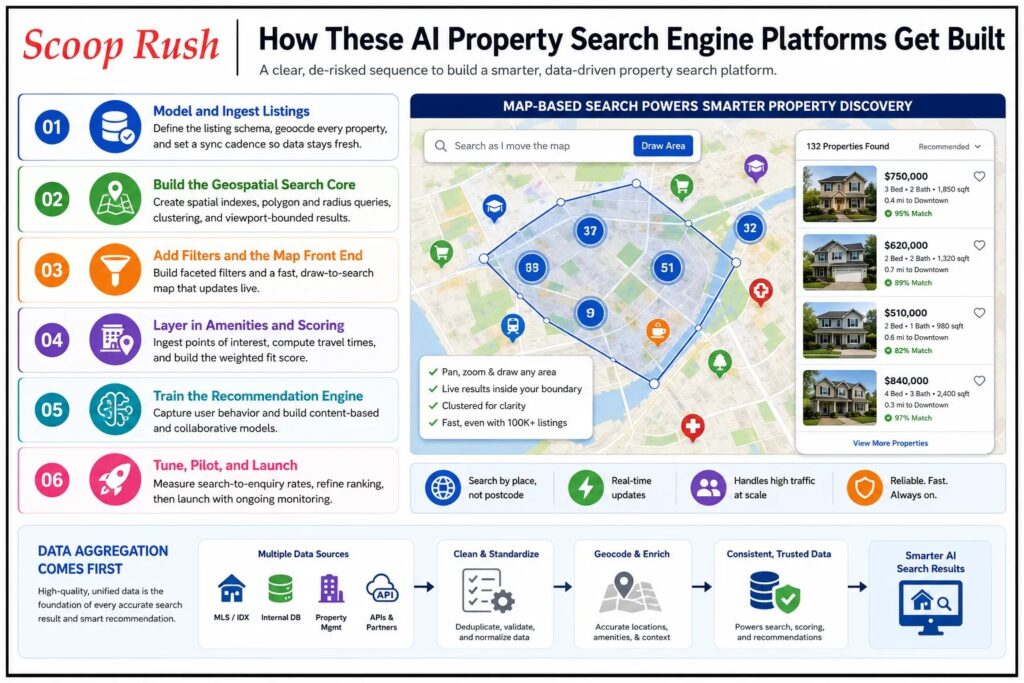
Building an AI property search engine generally follows a clear, de-risked sequence. Teams start with clean, geocoded listing data rather than the map itself, because every layer above it inherits that data’s quality.
- Model and ingest listings: define the listing schema, geocode every property, and set a sync cadence so data stays fresh
- Build the geospatial search core: create spatial indexes, polygon and radius queries, clustering, and viewport-bounded results
- Add filters and the map front end: build faceted filters and a fast, draw-to-search map that updates live
- Layer in amenities and scoring: ingest points of interest, compute travel times, and build the weighted fit score
- Train the recommendation engine: capture user behavior and build content-based and collaborative models
- Tune, pilot, and launch: measure search-to-enquiry rates, refine ranking, then launch with ongoing monitoring
Teams are generally advised to resist shipping every layer at once. A fast, honest map built on clean data beats a half-baked AI system running on stale listings every time. Launching search and amenities first, then turning on recommendations once enough behavioral data exists, tends to produce a smarter and more reliable platform.
Data Aggregation Comes First
The foundation of any AI search system is high-quality data. This typically means consolidating property data from multiple sources, including MLS or IDX feeds, internal listing databases, property management systems, and third-party APIs. That data then gets cleaned, standardized, and normalized so pricing, location, amenities, and availability stay consistent across every listing, the same discipline that underpins how AI SOC solutions handle large, messy datasets securely.
The Technology Behind a Modern AI Property Search Engine
A typical stack for a property search engine pairs a fast front end with a geospatial, AI-ready backend. This usually includes React or React Native for the interface, Node.js or Python for backend services, PostgreSQL with PostGIS for spatial data, and Elasticsearch or a vector store for fast, semantic search. A dedicated maps and places provider, along with a model-serving layer for recommendations, completes the picture, similar in spirit to how Nokia’s AI RAN platform with Nvidia pairs specialized hardware with intelligent software.
Why Continuous Learning Matters
Continuous learning is what keeps these platforms sharp over time. AI-powered systems improve by learning from click-through rates, inquiry submissions, showings, and saved listings. This feedback loop automatically refines both search accuracy and recommendation quality, meaning the platform genuinely gets smarter the more people use it, a pattern also visible in how Google’s frozen v2 AI chip improves efficiency through iterative refinement.
Who Benefits Most From AI Property Search

AI-powered search platforms deliver the most value to real estate brokerages and agencies, commercial real estate firms, property management companies, real estate marketplaces, and PropTech startups building next-generation platforms. For these organizations, faster and more relevant search results translate directly into improved user engagement, higher-quality leads, and better visibility for high-intent listings. This mirrors the broader trend of professionals reskilling toward data-driven roles, covered in our guide on how to become a data analyst in 2026.
Common Mistakes to Avoid
A few habits separate search platforms that buyers love from ones they quickly abandon. Successful platforms start with clean, geocoded, constantly synced listing data, since every other layer inherits its quality. They also make the map fast and honest before adding any cleverness on top, because speed and accuracy earn the trust that everything else depends on.
The most costly mistakes are predictable. Showing a gorgeous map full of stale or sold listings destroys buyer trust in a single glance. Treating geospatial search as a simple database filter causes performance to crawl the moment a catalogue grows large. Scoring amenities by crow-flies distance flatters bad locations and burns buyer confidence immediately. Finally, shipping a black-box AI system on thin data tends to recommend noise that nobody can correct or explain, a risk not unlike the concerns raised around AI-designed viruses at Stanford, where thin oversight on powerful models carries real consequences.
Conclusion
Property search has moved well beyond simple price and location filters. Modern buyers expect platforms that understand context, intent, and behavior, not just static dropdown menus. As this article has shown, the strongest AI property search engine platforms are built on three connected layers: map-based geospatial search, honest amenity scoring based on real travel time, and explainable AI recommendations that learn from genuine user behavior.
The technology driving this shift, from PostGIS spatial databases to natural-language processing, is no longer experimental. It is becoming a foundational capability for any real estate platform that wants to keep buyers engaged. As real estate continues to grow more data-driven, an AI property search engine is quickly becoming the standard buyers expect rather than a bonus feature, part of a wider question worth asking: will AI replace your job in industries built on manual search and matching?
FAQs
How does an AI property search engine actually work?
An AI property search engine combines geocoded listing data, geospatial search technology, and machine learning models. It analyzes user behavior, including viewed, saved, and searched properties, to rank and recommend listings most likely to match what a buyer actually wants.
What is amenity scoring in property search?
Amenity scoring measures a home’s access to schools, public transport, parks, shopping, and other nearby services. This creates a single livability score that helps buyers compare properties at a glance, based on real travel time rather than straight-line distance.
How does map-based property search work?
Property listings are stored with location coordinates in a spatial database. Users can search by map area, radius, or a custom boundary they draw themselves, and results update instantly as they zoom, pan, or adjust that boundary.
Why do AI property recommendations matter more than filters?
Filters only capture what a buyer explicitly states they want. AI recommendations analyze actual behavior, such as which listings a buyer views and saves, to surface homes the buyer would genuinely like but might never have thought to filter for.
Who benefits most from AI-powered property search platforms?
Real estate brokerages, commercial real estate firms, property management companies, real estate marketplaces, and PropTech startups all benefit, since faster and more relevant search results lead to higher engagement and better-quality leads.

