
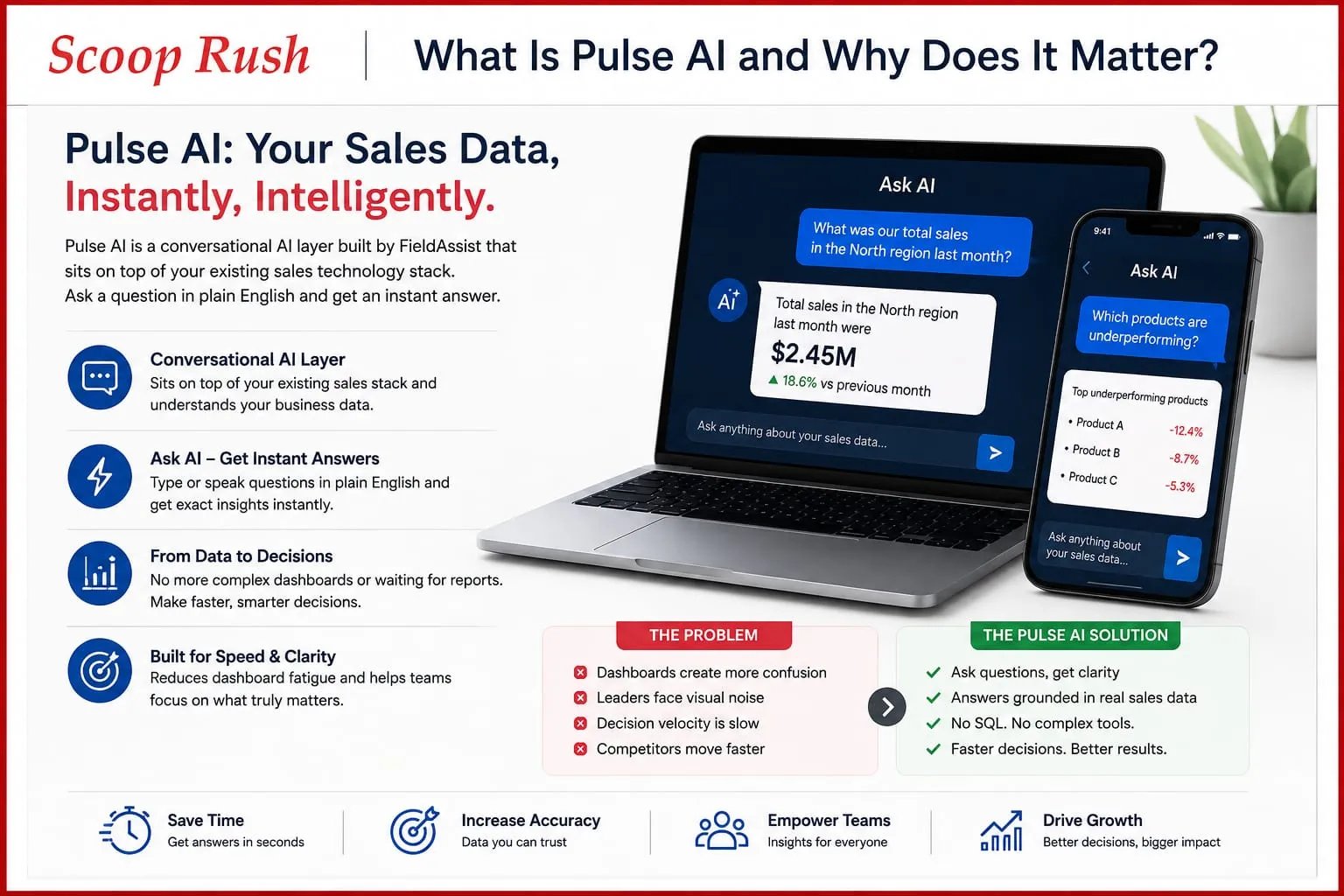
What if you could get an answer to any sales question in seconds, instead of waiting three days for a report? That question is no longer hypothetical. FieldAssist’s new Pulse AI tool has made it a daily reality for CPG and FMCG leaders.
Introduction
For years, business leaders have depended on data teams to pull reports, build dashboards, and explain what the numbers actually mean. However, by the time those reports finally land on a desk, the market has usually already moved. Pulse AI was built specifically to close this gap, and its “Ask AI” feature sits at the heart of the change.
This shift matters because speed has quietly become the biggest competitive advantage in consumer goods today. Companies that can answer a question in seconds will consistently outmaneuver those still waiting on Monday morning reports. Therefore, if you work in sales, distribution, or retail execution, this development directly affects how your team operates every single day. It also fits into a much larger conversation about whether AI will replace your job across industries like this one.
What Is Pulse AI and Why Does It Matter?
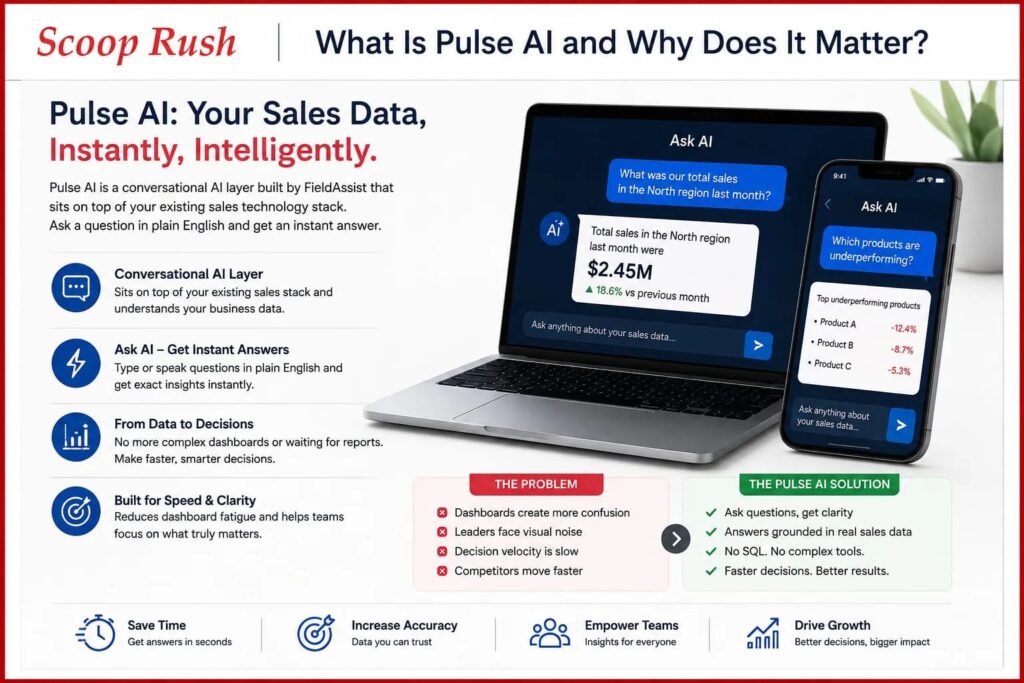
Pulse AI is a conversational AI layer that FieldAssist built to sit on top of a company’s existing sales technology stack. Instead of forcing executives to interpret complex dashboards, Pulse AI lets them simply ask a question in plain English and receive an instant answer.
The core feature driving this shift is Ask AI. Rather than hunting through modules or waiting for an analyst to build a report, users type or speak a question the same way they would ask their regional sales head. Consequently, the system responds immediately with the exact figure or insight needed.
Traditional business intelligence tools were never designed with speed in mind. They were built to display data, not explain it. As a result, executives often became data interpreters instead of decision makers. Pulse AI flips that model entirely, since it treats data access as a conversation rather than a research project, much like how Kimi K3 from Moonshot AI is reshaping how people interact with complex models through simple prompts.
The Problem Pulse AI Sales Assistant Was Built to Solve
Dashboards were supposed to simplify decision making. Instead, they often created more confusion for the people relying on them. Leaders were handed visual noise and expected to find the one metric that actually mattered.
This pattern created what the industry now calls dashboard fatigue. Teams had access to more data than ever before, yet decision velocity remained painfully slow. Meanwhile, competitors who moved faster kept gaining ground on shelf space and market share, a dynamic playing out across sectors as businesses weigh how to actually turn AI spending into profit.
Pulse AI addresses this problem directly. Instead of offering more charts, it offers clarity. Users no longer need to know SQL or navigate multiple systems, since they can simply ask a question and get an answer grounded in real sales data.
How the Pulse AI Ask AI Feature Works in Practice
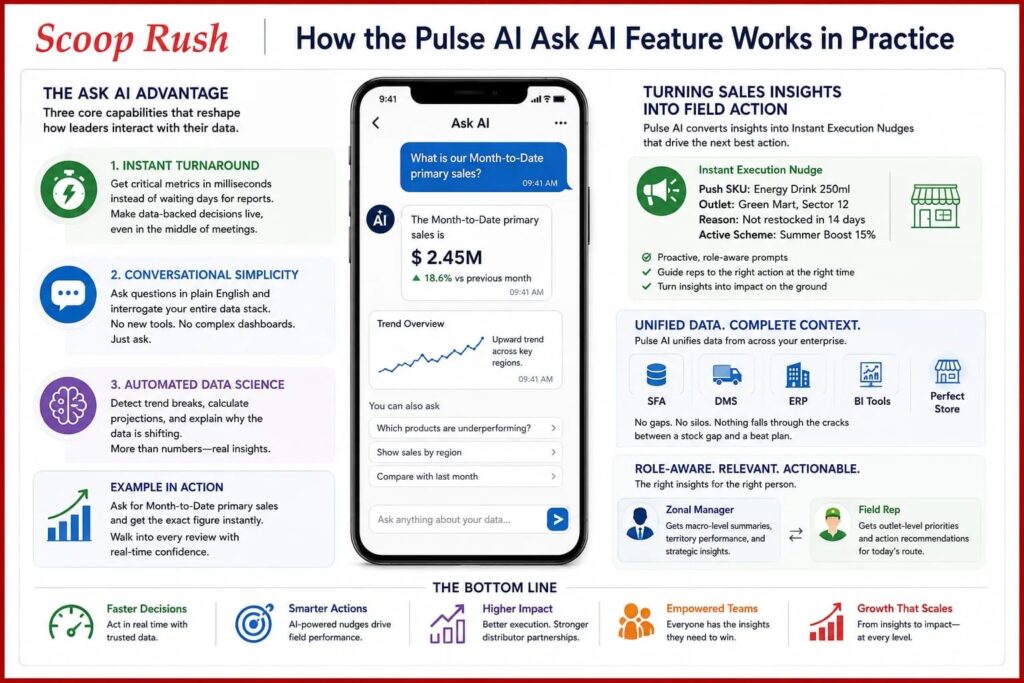
The Ask AI advantage comes down to three core capabilities that reshape how leaders interact with their data.
Instant Turnaround. Instead of waiting three days for an analyst to build a report, users get critical metrics in milliseconds. As a result, data-backed decisions can happen live, even in the middle of a boardroom meeting.
Conversational Simplicity. Users can interrogate their entire data stack using plain English. There is no need to learn a new tool or navigate a maze of dashboards, because you simply ask your question.
Automated Data Science. Pulse AI does more than return static numbers. It detects trend breaks, calculates projections, and explains why the data is shifting in the first place, similar to how social listening tools now flag shifts in consumer sentiment automatically.
For example, consider a Month-to-Date primary sales figure. Instead of relying on a dashboard that might already be 48 hours old, a leader can ask Pulse AI directly and get the precise number instantly. That leader then walks into a distributor review with real-time confidence instead of a stale snapshot.
Turning Sales Insights Into Field Action
Pulse AI does not stop at answering questions. It also converts insights into what FieldAssist calls Instant Execution Nudges. These are proactive, role-aware prompts that guide field reps toward specific actions.
For instance, instead of expecting a rep to dig through a retailer’s purchase history, Pulse AI can directly tell them to push a particular SKU at a specific outlet because the store has not restocked in 14 days and a relevant scheme is currently active.
This works because Pulse AI unifies data from multiple sources, including SFA, DMS, ERP, BI tools, and Perfect Store metrics. By connecting these systems into one conversational layer, it ensures nothing falls through the cracks between a stock gap and a beat plan. This kind of unified data approach echoes how data intelligence platforms are consolidating fragmented business tools into single dashboards.
Additionally, the system is role-aware. A Zonal Manager asking a question receives macro-level summaries and territory performance metrics. Meanwhile, a frontline rep asking the same type of question instead receives outlet-level priorities and specific recommendations relevant to their daily route.
Real-World Impact of Pulse AI Across the Sales Hierarchy
Pulse AI’s influence stretches across every level of a sales organization, from frontline reps to regional leadership.
At the assortment and pitching stage, frontline reps get nudges toward specific Must-Sell SKUs based on a retailer’s purchase history and current stock gaps. This directly increases Lines Per Call and drives up-selling.
For beat prioritization, the system flags high-priority outlets that are either at risk of churn or close to hitting scheme thresholds. This helps maximize the Productive Call ratio and improves daily route efficiency.
When it comes to promotions and trade spend, reps get alerts about active, hyper-local schemes that apply to a specific retailer. This helps close volume gaps on the spot and improves trade promotion return on investment.
Regional and area managers benefit too. Pulse AI highlights underperforming zones in real time and suggests immediate course corrections, such as initiating a new product development drive in a specific zone. Therefore, leaders can make agile, mid-month strategy pivots instead of waiting until month-end to react. This is the same kind of real-time responsiveness driving demand for skilled professionals, which is part of why more people are learning how to become a data analyst in the current job market.
Merchandisers and reps also get support with retailer compliance. If asset visibility is low at a particular outlet, Pulse AI can recommend requesting an updated photo, which helps protect brand visibility and shelf share.
Why Speed Changes the Sales Decision Equation
For business leaders, the real metric that matters is Turnaround Time, or TAT. The organization that compresses the time between asking a question and executing a response gains a measurable edge over competitors.
Every hour spent waiting for a report is an hour a competitor spends acting on the shelf. Pulse AI eliminates that lag almost entirely. When a key territory dips in performance, leaders no longer need three days to understand why. Instead, they can ask Pulse AI, get an instant projection and trend explanation, and redirect trade spend that same afternoon.
This same-day responsiveness prevents small issues from snowballing into problems that damage quarterly performance. Additionally, when leaders need to share findings with field managers, Pulse AI can export a fully formatted, boardroom-ready report with a single click. This removes the hours once spent building presentation slides.
The Broader Strategic Value of Pulse AI for CPG and FMCG Leaders
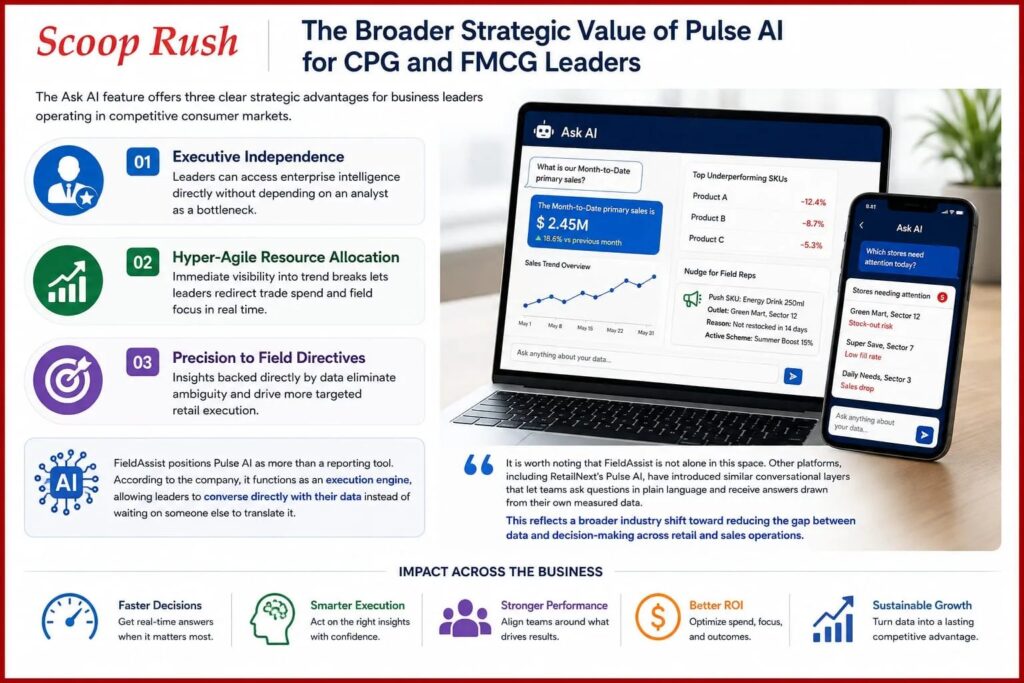
The Ask AI feature offers three clear strategic advantages for business leaders operating in competitive consumer markets.
First, it delivers executive independence, since leaders can access enterprise intelligence directly without depending on an analyst as a bottleneck. Second, it enables hyper-agile resource allocation, because immediate visibility into trend breaks lets leaders redirect trade spend and field focus in real time. Third, it brings precision to field directives, as insights backed directly by data eliminate ambiguity and drive more targeted retail execution.
FieldAssist positions Pulse AI as more than a reporting tool. According to the company, it functions as an execution engine, allowing leaders to converse directly with their data instead of waiting on someone else to translate it.
It is worth noting that FieldAssist is not alone in this space. Other platforms, including RetailNext’s own Pulse AI, have introduced similar conversational layers that let teams ask questions in plain language and receive answers drawn from their own measured data. This reflects a broader industry shift toward reducing the gap between data and decision-making across retail and sales operations, one that mirrors how AI is quietly reshaping property search platforms and other consumer-facing tools far beyond sales.
Conclusion
The days of waiting three days for a sales report are fading fast. Pulse AI, and specifically its Ask AI feature, shows how conversational AI is reshaping the way CPG and FMCG leaders interact with their business data. Instead of interpreting dashboards, leaders can now simply ask a question and get an immediate, data-backed answer.
This shift matters because speed has become a genuine competitive advantage. Companies that compress the time between a question and a decision are better positioned to protect shelf space, correct underperforming territories, and drive stronger field execution. As more platforms adopt this conversational approach, the traditional dashboard-heavy model of business intelligence may soon become a thing of the past.
FAQs
1. What is Pulse AI’s Ask AI feature?
Ask AI is a conversational interface within FieldAssist’s Pulse AI that lets business leaders ask questions about their sales data in plain English and receive instant answers, without needing dashboards or analyst support.
2. How does Pulse AI reduce decision-making time?
Pulse AI replaces the traditional three-day analyst turnaround with instant responses. Leaders can ask a question and receive precise metrics, trend explanations, and projections within milliseconds.
3. What is an Instant Execution Nudge in Pulse AI?
An Instant Execution Nudge is a proactive, role-aware recommendation that Pulse AI sends to field reps, such as pitching a specific SKU at an outlet based on stock gaps and active schemes.
4. Which data sources does Pulse AI integrate with?
Pulse AI unifies data from SFA, DMS, ERP, BI tools, and Perfect Store metrics into a single conversational layer, ensuring insights are based on a complete view of the business.
5. Who benefits from using Pulse AI in a sales organization?
Pulse AI benefits users across the sales hierarchy, from frontline reps who receive outlet-level nudges to zonal and regional managers who get macro-level performance summaries and territory insights.

