

For years, anyone flagged for possible bladder cancer faced the same grim next step: a cystoscopy. A thin camera. A trip through the urethra. An uncomfortable, invasive procedure that most patients dread.
Now a new study asks a bold question what if a urine sample could do the job instead?
The answer, according to fresh research published today in European Urology Oncology, is surprisingly promising. A non-invasive urine test has detected more than nine in ten bladder cancers in one of the largest real-world NHS studies of its kind.
Could this be the beginning of the end for routine invasive testing? Let’s break down what the study actually found.
What Is This New Bladder Cancer Urine Test?
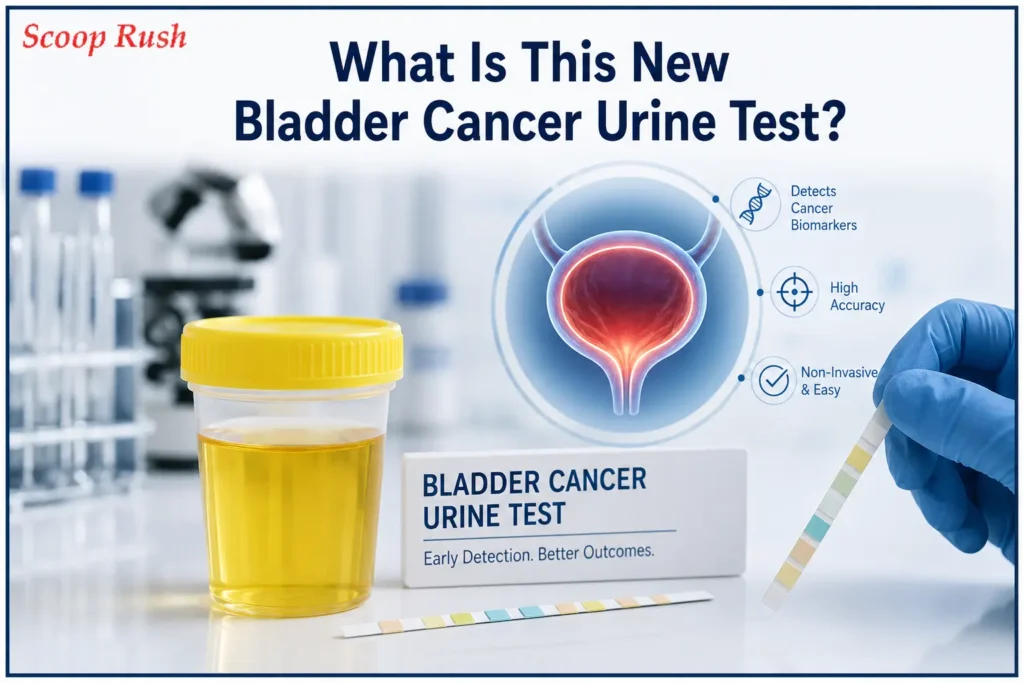
The test is called GALEAS Bladder. It was developed using genomic science pioneered at the University of Birmingham, with early funding from Cancer Research UK. It has since been commercialised by diagnostics company Nonacus.
Here’s the simple version of how it works:
- Bladder tumours shed tiny fragments of DNA into urine.
- GALEAS Bladder scans that urine for genetic mutations linked to cancer.
- It checks for more than 450 known mutations across 23 genes.
- No camera. No sedation. No trip to a procedure room.
Just a urine sample and a lab.
Why Does This Matter So Much Right Now?
The NHS has a bladder cancer problem, and it’s not just about the disease itself. It’s about the sheer volume of people funnelled into urgent testing.
Consider this:
- Blood in urine (haematuria) is the classic warning sign of bladder cancer.
- But haematuria has dozens of possible causes infections, kidney stones, and more.
- Because doctors can’t tell the difference just by looking, almost everyone with the symptom gets sent for urgent investigation.
The numbers from this study make the scale of the issue obvious. Out of 964 patients referred through the urgent pathway, only 8% actually had bladder cancer.
That means 92 out of every 100 patients went through an anxious, resource-heavy diagnostic process for a disease they didn’t have.
The Study, in Plain English
Researchers wanted to know: does GALEAS Bladder actually work outside a controlled lab setting? So they tested it in the real world.
The setup:
- 964 patients
- 7 NHS urology departments
- Locations across England and Scotland
- All patients referred urgently for suspected bladder cancer
The goal: compare GALEAS Bladder results against actual diagnoses, and see if the test held up.
It did and then some.
The Headline Numbers
Let’s get straight to what everyone wants to know: does it actually catch cancer?
| Metric | Result |
| Overall cancer detection rate | 92.2% (71 of 77 cancers found) |
| Muscle-invasive cancer detection | 100% (17 of 17 found) |
| High-grade cancer detection | 97.2% (35 of 36 found) |
| Negative result reliability (overall) | 99.3% chance of no cancer |
| Non-visible haematuria subgroup detection | 100% (all cancers found) |
| Non-visible haematuria negative reliability | 100% chance of no cancer |
| Estimated cystoscopy reduction | 730 fewer per 1,000 patients |
Look at that muscle-invasive number again. 100%.
That’s the category of bladder cancer that’s most likely to spread and turn life-threatening if missed. The test didn’t miss a single one.
Why the “Negative Result” Number Might Be the Real Story
Detecting cancer matters. But so does ruling it out with confidence.
Here’s why that 99.3% figure is such a big deal:
- If a patient tests negative, doctors can be highly confident there’s no cancer.
- That confidence means fewer unnecessary cystoscopies.
- Fewer unnecessary procedures means shorter waits for patients who genuinely need one.
And for one specific group of patients, the results were even better.
The Non-Visible Haematuria Breakthrough

Around 30% of patients in the study had what’s called non-visible haematuria blood in urine that isn’t visible to the eye but shows up in lab testing.
This group is often trickier for doctors. The risk is generally lower than with visible blood in urine, but it’s still enough to trigger urgent referral under current guidelines.
For these patients, GALEAS Bladder performed flawlessly:
- 100% of bladder cancers detected
- 100% probability of no cancer with a negative result
In other words, for this specific group, the test didn’t miss a single case — and a clear result meant total confidence.
Could This Actually Ease NHS Waiting Lists?
Here’s where the story shifts from “impressive science” to “practical impact.”
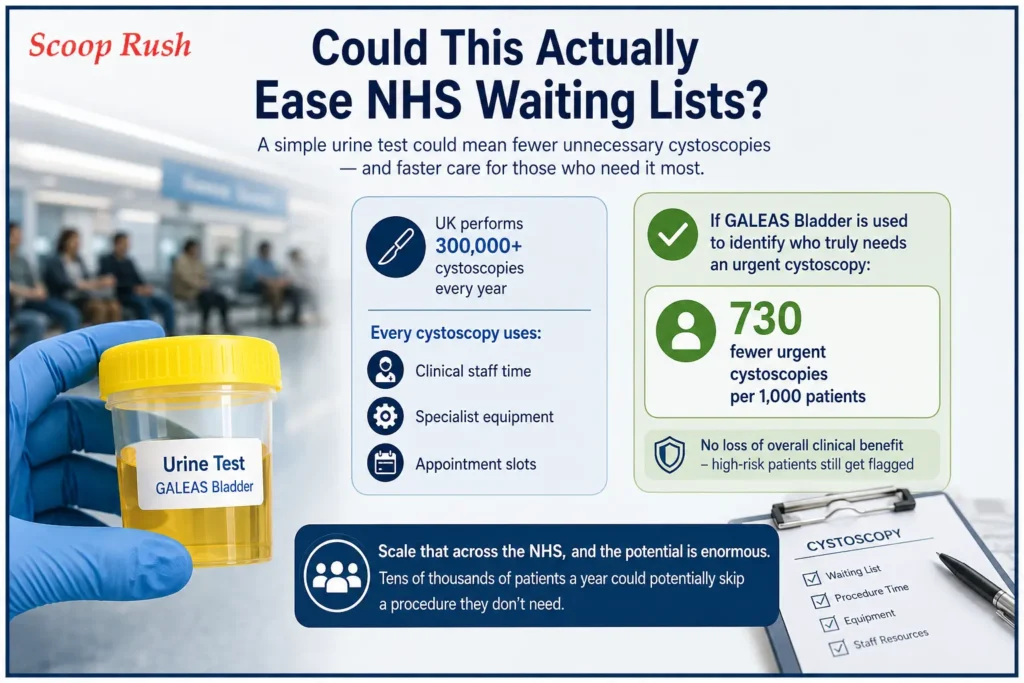
The UK performs more than 300,000 cystoscopies every year. In some regions, waiting lists for the procedure are significant. Every cystoscopy eats up:
- Clinical staff time
- Specialist equipment
- Appointment slots that could go to higher-risk patients
Researchers modelled what would happen if GALEAS Bladder were used to help decide who truly needs an urgent cystoscopy.
Even using the most cautious threshold tested, the results suggested:
- 730 fewer urgent cystoscopies per 1,000 patients
- No loss of overall clinical benefit meaning high-risk patients still get flagged
Scale that across the NHS, and the potential is enormous. Tens of thousands of patients a year could potentially skip a procedure they don’t need.
What the Experts Are Saying
This isn’t just exciting to headline writers the researchers behind it are genuinely optimistic too.
Professor Richard Bryan, Director of the University of Birmingham’s Bladder Cancer Research Centre and a former practising urologist, has spent years developing the science behind this test. He described seeing the early promising results reproduced across multiple real NHS centres, in a large real-world patient population, as genuinely significant.
His view is straightforward: this data supports using molecular urine testing now to help decide which patients need urgent cystoscopy and which can safely wait.
Lee Silcock, Co-founder and Chief Product Officer at Nonacus, pointed to something specific: this wasn’t a small pilot in one lab. It was tested across seven different NHS departments, treating real patients on real pathways. That, he suggested, is what gives the results their weight.
Michelle Mitchell, Chief Executive of Cancer Research UK, offered a note of both encouragement and caution. She acknowledged that too many patients currently wait longer than they should for a bladder cancer diagnosis but stressed that it’s still early days, and further research is needed before the test reshapes standard practice.
So… Does This Replace Cystoscopy?
Not yet. And that distinction matters.
Here’s what GALEAS Bladder is not:
- It’s not a full replacement for cystoscopy
- It’s not being used as a standalone diagnostic tool
- It’s not perfect — six cancers in the study were missed
Here’s what it is shaping up to be:
- A triage tool
- A way to prioritise genuinely high-risk patients
- A way to safely defer cystoscopy for lower-risk patients
- A second layer of confidence for doctors making difficult calls
Cystoscopy still has an essential role, especially for patients whose symptoms or risk profile call for direct visual examination regardless of test results.
Is This Test Already Being Used?
Yes — and that’s arguably the most surprising part of this story.
GALEAS Bladder isn’t stuck in a research lab waiting for approval. It’s already being used within NHS pathways in England and Wales, and more NHS sites are adopting it as clinical use expands.
That real-world deployment is part of what makes this study so credible. The data didn’t come from a single specialist unit it came from seven different departments, treating a genuinely mixed patient population.
What Happens Next?
The path forward likely involves:
- Larger follow-up trials to confirm these results at scale
- Health economic evaluation to assess cost-effectiveness across the NHS
- Gradual expansion into more urology departments nationwide
- Ongoing refinement of the clinical thresholds used to guide triage decisions
If those next steps go well, researchers believe the eventual impact could be significant: tens of thousands of patients spared unnecessary invasive procedures every year, while high-risk patients are identified and fast-tracked with even greater confidence. It’s a pattern echoed elsewhere in medicine, too such as how teplizumab is changing outcomes for type 1 diabetes by shifting care toward earlier intervention rather than late-stage crisis management.
A Quick Primer: What Should You Know About Bladder Cancer?
If you’re reading this because you or someone you know is facing testing, here’s the essential context.
Who’s most at risk?
- Bladder cancer is more common in people over 60
- It occurs more frequently in men than women
What’s the main warning sign?
- Blood in the urine whether visible or only detectable through lab testing
What determines how serious a case is?
- The size of the tumour
- Whether it has spread beyond the bladder
Why does early detection matter so much?
- Earlier-stage bladder cancer is generally far more treatable
- Catching muscle-invasive disease early can be the difference between a manageable treatment path and a much more serious one
This is exactly why a test with a 100% detection rate for muscle-invasive cancer is generating so much attention.
GALEAS Bladder vs. Cystoscopy: A Side-by-Side Look
Numbers are easier to digest side by side. Here’s how the two approaches compare, based on what the study and existing clinical practice tell us.
| Factor | GALEAS Bladder (Urine Test) | Cystoscopy |
| Invasiveness | None standard urine sample | Invasive camera inserted via urethra |
| Discomfort | Minimal | Can be significant |
| Setting required | Lab analysis | Hospital procedure room |
| Sedation/anaesthetic | Not required | Sometimes required (local, occasionally general) |
| Turnaround | Days (lab processing) | Immediate visual result |
| Muscle-invasive cancer detection (study) | 100% | Gold standard reference |
| Overall NHS annual volume | Emerging | 300,000+ procedures/year |
| Current role | Triage / risk stratification | Definitive diagnosis |
This isn’t really an “either/or” comparison. Right now, the two work best together — one narrowing down who needs the other.
What Would This Mean for a Patient, Practically Speaking?
It’s worth pausing on what this could actually look like from a patient’s chair, not just a researcher’s spreadsheet.
Imagine two people, both referred urgently after noticing blood in their urine.
Patient A has a genuinely high risk profile. Under a GALEAS-informed pathway:
- They provide a urine sample.
- The test flags concerning genetic signals.
- They’re fast-tracked for an urgent cystoscopy and further investigation.
- Because they were prioritised rather than queued behind lower-risk patients, treatment could start sooner if cancer is confirmed.
Patient B has a much lower risk profile perhaps non-visible haematuria and no other red flags. Under the same pathway:
- They provide a urine sample.
- The test comes back negative, with a reliability of up to 100% in this subgroup.
- Instead of an immediate invasive procedure, their care team can safely monitor or defer cystoscopy.
- They avoid an unnecessary, uncomfortable procedure and free up a slot for someone who needs it more urgently.
Multiply that across an entire NHS trust, and the ripple effects on waiting lists start to make sense. For patients navigating that anxious waiting period between tests and results, small grounding habits like practicing box breathing to manage stress or exploring other simple ways to relieve stress can genuinely help.
A Broader Pattern: Cancer Testing Is Getting Less Invasive
This study doesn’t exist in isolation. It’s part of a wider shift happening across cancer diagnostics generally, where researchers are racing to develop tests that can catch disease early without subjecting patients to uncomfortable or high-risk procedures.
Some of the driving forces behind that shift include:
- Genomic sequencing costs falling, making DNA-based tests more affordable to run at scale.
- NHS capacity pressures, pushing health systems toward triage tools that reduce unnecessary procedures.
- Patient demand for convenience, particularly for people managing chronic anxiety around cancer symptoms.
- Advances in liquid biopsy science, the broader field this bladder cancer test belongs to, which also includes blood-based tests being developed for other cancer types.
Bladder cancer has historically lagged behind some other cancers when it comes to non-invasive screening innovation, partly because urine — while a logical sample source — required more refined genetic analysis techniques to reliably detect cancer signals. This study suggests that gap is closing.
Limitations Worth Keeping in Mind
It’s easy to get swept up in strong headline numbers, so it’s worth grounding expectations with a few caveats directly from the research and expert commentary.
- The study, while large for this type of research, still represents a specific patient population within UK NHS haematuria pathways results may look different in other healthcare systems or populations.
- Six cancers were missed by the test, underlining that it isn’t foolproof.
- Long-term outcome data such as whether earlier triage actually improves survival rates at a population level will take more time and further studies to confirm.
- Cost-effectiveness across the whole NHS still needs formal health economic evaluation before wider rollout decisions are made.
- As Cancer Research UK’s Michelle Mitchell noted, it remains early days, and further research is still required before conclusions can be considered settled science.
None of these caveats undercut the strength of the results but they do explain why researchers are describing this as a major step forward rather than a finished solution. In the meantime, general preventive steps still matter alongside better diagnostics hings like staying active with a 5-minute walk every hour and being mindful of supplement risks from taking too many vitamins remain sensible habits regardless of how testing technology evolves.
How Common Is Bladder Cancer, Really?
Numbers help put the urgency of this research into context.
- Bladder cancer is among the more frequently diagnosed cancers in the UK.
- It ranks higher in incidence among men than women, largely due to risk factors like smoking history and occupational exposures.
- The over-60 age group represents the bulk of new diagnoses — a life stage where staying on top of general health monitoring, from cancer screening to managing heat and humidity risks for older people, becomes increasingly important.
- Survival outcomes vary dramatically depending on how early the cancer is caught which is exactly why detection tools matter as much as treatment advances.
This is also a cancer type that tends to recur. Patients who’ve had non-muscle-invasive bladder cancer often require repeated monitoring over years, sometimes involving multiple follow-up cystoscopies. A reliable, low-burden urine test could ease that long-term monitoring load too, not just the initial diagnostic pathway though that specific use case wasn’t the focus of this particular study.
What Symptoms Should Prompt You to See a Doctor?
Awareness matters just as much as new testing technology, and it fits into a wider pattern of building healthy habits in your 20s and 30s that pay off decades later. Here are the symptoms doctors generally recommend taking seriously:
- Blood in urine even a single episode, even if it isn’t painful
- Urine that looks pink, red, or darker than usual
- Needing to urinate more frequently than normal
- A burning sensation when urinating, without an obvious infection
- Pelvic pain that doesn’t have another clear explanation
None of these symptoms automatically mean bladder cancer most people with blood in their urine turn out not to have it, as this very study demonstrates. But they’re worth flagging to a GP promptly rather than waiting to see if they resolve on their own. It’s a similar principle to staying alert to early lung cancer symptoms, where catching warning signs early can meaningfully change outcomes.
How Does This Compare to Testing Innovations in Other Cancers?
Bladder cancer isn’t the only area where researchers are chasing less invasive diagnostic tools. It’s useful to see this development in that wider context.
- Colorectal cancer has FIT (faecal immunochemical testing), a home-based stool test that’s already reduced reliance on routine colonoscopies for lower-risk patients.
- Cervical cancer screening has shifted toward HPV testing, changing how frequently invasive follow-up procedures are needed a shift that has also driven renewed attention to how the HPV vaccine prevents cervical cancer deaths in the first place.
- Lung cancer research is exploring blood-based biomarkers to catch disease earlier in high-risk groups, such as long-term smokers.
- Prostate cancer diagnostics continue to evolve beyond the traditional PSA blood test, incorporating MRI and genomic risk scoring to reduce unnecessary biopsies.
Bladder cancer diagnostics arguably had more catching up to do, given how central cystoscopy has remained to the diagnostic pathway. This study is a signal that the field is starting to close that gap, following a broader trend of using genetic and molecular signals rather than direct visual or physical examination as a first-line filter.
Could This Technology Expand Beyond the UK?
The study was conducted entirely within NHS settings, but the underlying science isn’t inherently UK-specific. Genomic urine testing for cancer detection is being explored and adopted in various forms internationally, and a validated, peer-reviewed dataset like this one spanning multiple hospital sites is exactly the kind of evidence that tends to support wider international interest and regulatory conversations.
That said, healthcare systems differ enormously in how new diagnostics get adopted:
- Reimbursement structures vary widely, affecting whether a test like this gets funded for widespread use.
- Regulatory approval pathways differ by country, and evidence generated in one health system doesn’t automatically transfer to another’s clinical guidelines.
- Existing diagnostic infrastructure — lab capacity, genomic testing familiarity, referral pathways shapes how quickly something like this could scale elsewhere.
For now, the clearest and most immediate impact is within the NHS, where the test is already live in some pathways. Wider international adoption, if it happens, would likely follow additional validation studies tailored to those specific health systems.
What Should You Take Away From All This?
If you strip away the statistics and expert quotes, the core message of this study is fairly simple:
- A basic urine sample can now catch the overwhelming majority of bladder cancers, including virtually all of the most dangerous ones.
- A negative result is reliable enough that doctors can use it to safely deprioritise or delay invasive procedures for lower-risk patients.
- This isn’t a hypothetical future technology it’s already being used in parts of the NHS today.
- It won’t replace cystoscopy, but it’s already changing how quickly the right patients get to one.
For a disease where early detection genuinely saves lives, and for a health system where diagnostic capacity is stretched thin, that combination is worth watching closely as more hospitals adopt the approach.
The Bottom Line
Nobody looks forward to invasive medical testing. But for a long time, it’s been the necessary trade-off for catching bladder cancer early.
This study suggests that trade-off might be shrinking.
A simple urine sample, tested in a lab, caught 92% of bladder cancers including every single muscle-invasive case across almost 1,000 real NHS patients. And it did so while pointing toward hundreds of unnecessary cystoscopies avoided per 1,000 patients tested.
It’s not a full replacement for cystoscopy. Not yet, anyway. But as a way to sort urgent cases from lower-risk ones, the evidence is compelling enough that the test is already live in NHS pathways today with more hospitals adopting it as the data keeps rolling in.
For patients anxious about invasive testing, and for an NHS system stretched thin on capacity, that’s a combination worth paying attention to.
FAQs
1. What is the new bladder cancer urine test called?
It’s called GALEAS Bladder, developed from University of Birmingham research and commercialised by Nonacus.
2. How accurate is the GALEAS Bladder urine test?
In this NHS study, it detected 92.2% of bladder cancers overall, 100% of muscle-invasive cancers, and 97.2% of high-grade cancers.
3. Is this test available to everyone right now?
Not universally. It’s already in use within some NHS pathways in England and Wales, with more hospitals adopting it, but it isn’t yet standard nationwide.
4. Does a negative result mean I definitely don’t have bladder cancer?
No test offers absolute certainty. But a negative GALEAS result was associated with a 99.3% probability of no cancer overall, and 100% within the non-visible haematuria subgroup high enough that clinicians can use it to guide next steps with real confidence.
5. Will this urine test replace cystoscopy entirely?
Not based on current evidence. Six cancers in the study were missed by the urine test, which is why cystoscopy remains essential, particularly for higher-risk patients or ambiguous cases.
6. How does the test actually work?
It analyses a urine sample for DNA fragments shed by bladder tumours, screening for more than 450 known cancer-linked mutations across 23 genes.
7. Is the test painful or invasive?
No. It only requires a standard urine sample no camera, no sedation, and no procedure room required.
8. Why does this matter for people who don’t have bladder cancer?
Because 92% of patients in urgent haematuria pathways don’t have bladder cancer, tools like this help avoid subjecting that majority to unnecessary invasive procedures freeing up capacity across the system.
9. What is non-visible haematuria, and why did it perform so well in the study?
It’s blood in urine that isn’t visible to the eye but shows up on lab testing. This lower-risk group saw the test’s strongest results: 100% cancer detection and 100% negative-result reliability.
10. Could this urine test reduce NHS waiting lists?
Potentially, yes. Researchers estimated up to 730 fewer urgent cystoscopies per 1,000 patients if the test is used for triage, without losing overall clinical benefit.
11. Who funded and developed this technology?
The underlying science originated at the University of Birmingham, supported by funding from Cancer Research UK, before being commercially developed by Nonacus under a licensing agreement that returns a share of revenue to the university and the charity.
12. Is more research still needed?
Yes. Experts, including Cancer Research UK’s Michelle Mitchell, have stressed that while results are promising, it remains early days and further research is required before the test’s role is fully established.

