
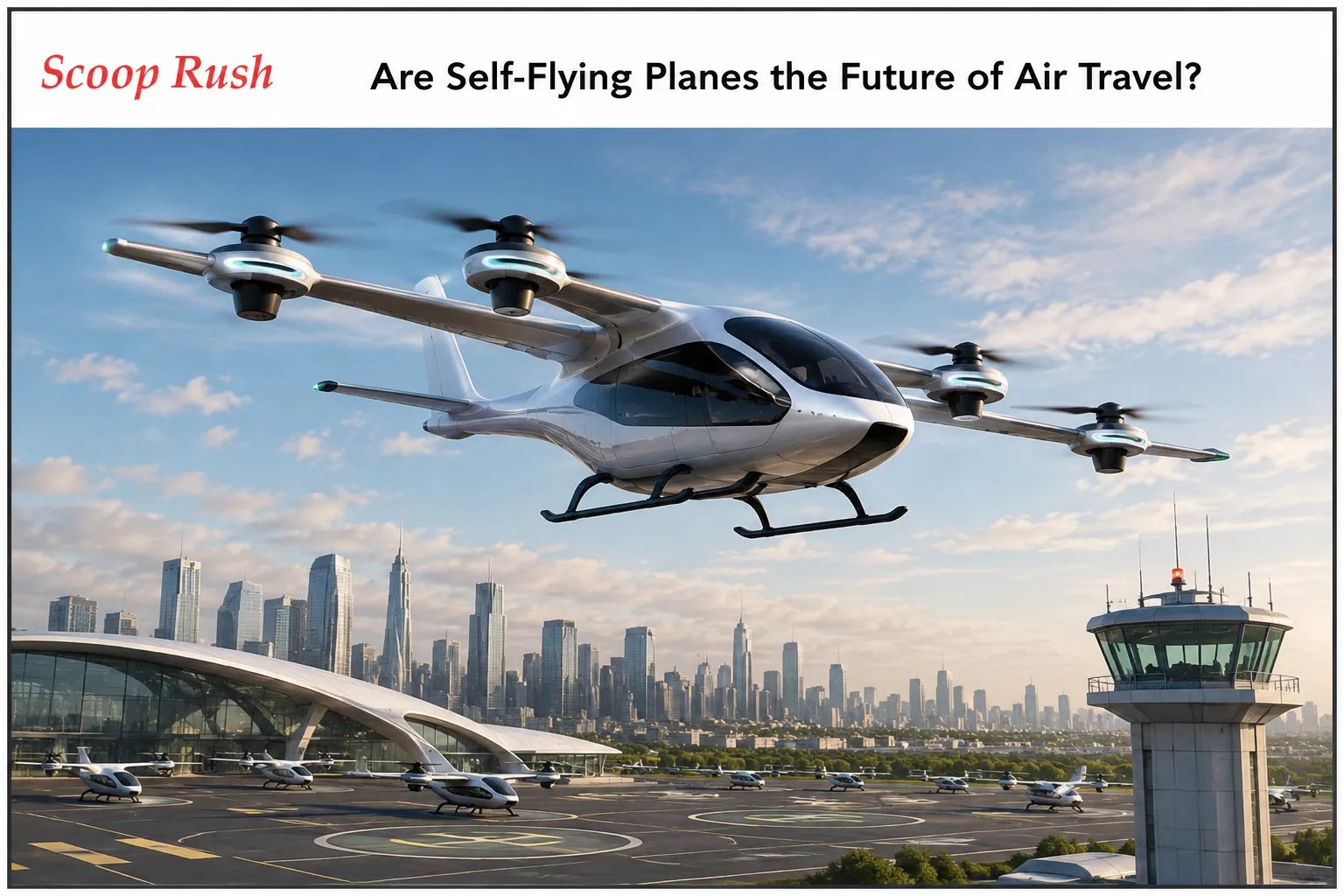
Would You Board a Plane With No Pilot Onboard?
Self-flying planes are already changing how aircraft work, and one is skimming just a few feet above a field in California right now. There is no cockpit. There is no pilot. Yet the plane flies lower and more precisely than any human ever could.
This is not a scene from a futuristic movie. It is happening right now, and self-flying planes are already doing real work in real fields. So the question worth asking is simple: are self-flying planes actually the future of air travel, or just a niche tool for farms and cargo runs?
For years, self-driving cars dominated headlines about autonomous technology. Meanwhile, a quieter revolution has been unfolding in the skies. Self-flying planes are moving out of test labs and into farms, cargo routes, and even war zones. This shift matters because it touches agriculture, shipping, defense, and eventually, the way ordinary people may one day travel.
Why Self-Flying Planes Are Suddenly in the Spotlight
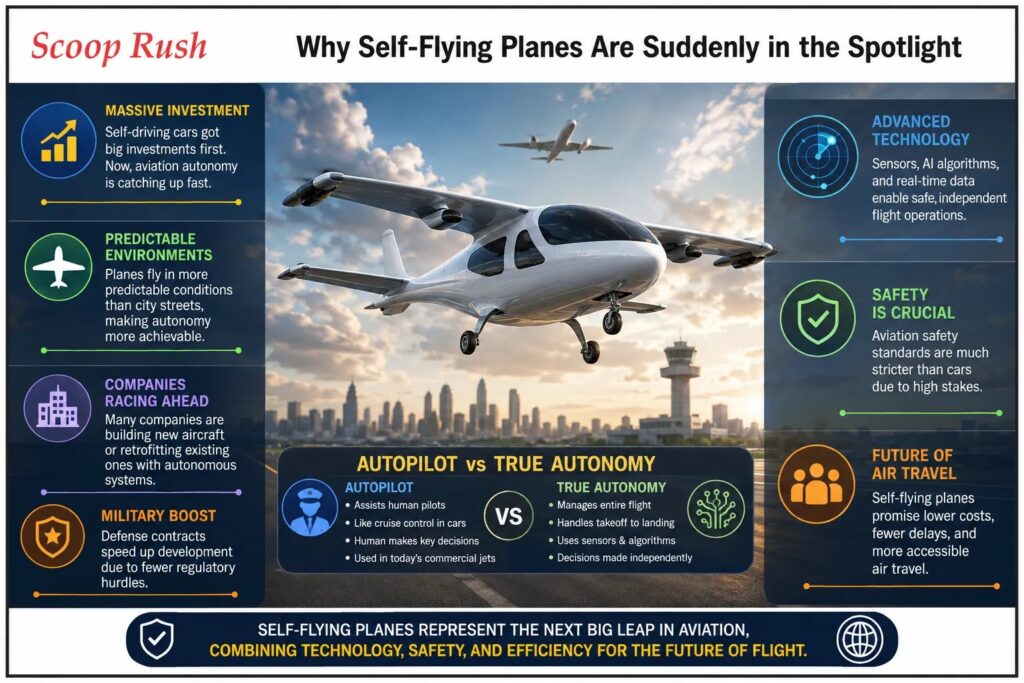
Self-driving cars received massive investment first, largely because big tech companies poured resources into that race early on. As a result, autonomous aviation moved at a slower pace, even though planes generally fly through more predictable environments than city streets, unlike the sensor challenges seen in self-driving car technology.
However, that gap is closing quickly. Several companies are now racing to bring self-flying planes into everyday commercial use. Some are building aircraft from scratch with no cockpit at all. Others are retrofitting existing planes with autonomous systems. Additionally, military contracts are speeding up development, since defense programs often face fewer regulatory hurdles than civilian projects, a pattern also visible in critical infrastructure security work.
Autopilot vs True Autonomy: What Is the Real Difference?
It helps to understand what separates these self-flying planes from the autopilot systems already used in commercial jets. Autopilot simply assists a human pilot, much like cruise control assists a driver. Full autonomy is different. These systems manage the entire flight, including takeoff and landing, using algorithms that process sensor data and make decisions largely on their own, similar in spirit to how physical AI is trained for robots.
This distinction matters because aviation carries enormous stakes. Air accidents can have severe consequences, so aircraft face far stricter safety standards than cars.
Meet the Companies Building Self-Flying Planes Today
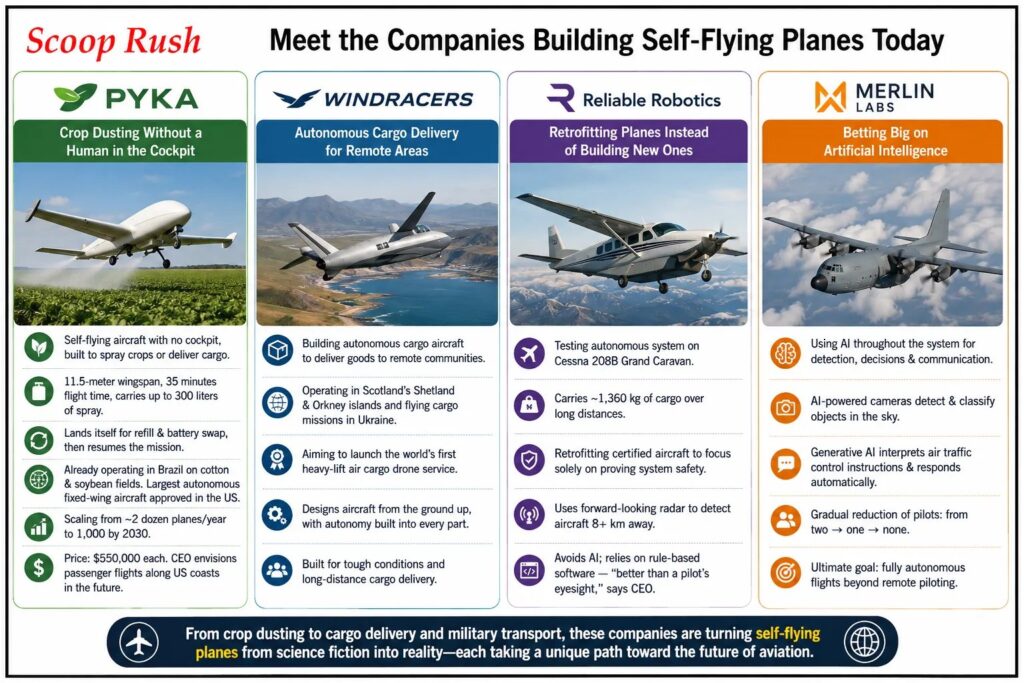
Pyka: Crop Dusting Without a Human in the Cockpit
Pyka builds self-flying aircraft with no cockpit whatsoever, designed to spray crops or deliver cargo. According to flight test engineer Russ Marotzke, these planes can fly lower than a human pilot would, which reduces spray drift and cuts down on the chemicals needed.
Each Pyka aircraft has an 11.5-meter wingspan and can fly for about 35 minutes while carrying up to 300 liters of spray. When the plane senses it is running low, it lands itself for a refill and battery swap, then takes off again to finish exactly where it left off.
About a dozen Pyka aircraft already spray cotton and soybean fields in Brazil, work that human pilots previously handled. In the United States, Pyka’s crop sprayer is the largest autonomous fixed-wing aircraft approved for commercial civilian use, having won authorization last year. Even so, operations remain limited to agricultural settings and still require a ground operator and visual observer.
Pyka plans to scale production from around two dozen planes a year to as many as 1,000 by 2030. Each aircraft sells for $550,000. Michael Norcia, Pyka’s co-founder and CEO, envisions fleets of minibus-sized planes eventually ferrying passengers along the US coasts, and he believes his company could reach that milestone before flying taxis do.
Windracers: Autonomous Cargo Delivery for Remote Areas
Windracers, a British company, is pursuing a different mission. The firm wants to launch an autonomous cargo service across Scotland’s Shetland and Orkney islands, delivering goods to communities that are difficult to reach by other means. Windracers aircraft already fly cargo missions in Ukraine, which has tested their reliability under demanding conditions.
Stephen Wright, Windracers founder and chairman, believes this project could become the first heavy-lift air cargo drone service anywhere in the world. Unlike some rivals, Windracers builds its planes from the ground up, allowing autonomy to be designed into every part of the aircraft from the start.
Reliable Robotics: Retrofitting Planes Instead of Building New Ones
Not every company starts from a blank slate. Reliable Robotics, backed by Boeing’s investment arm, is testing its autonomous system on the Cessna 208B Grand Caravan, a single-pilot cargo plane that can carry roughly 1,360 kilograms over long distances.
Robert Rose, Reliable’s co-founder and CEO, explains that retrofitting certified aircraft lets the company focus entirely on proving its autonomous system is safe, rather than also seeking approval for an entirely new aircraft design. Reliable has chosen to avoid artificial intelligence altogether, arguing it would complicate certification. Instead, the company relies on forward-looking radar that detects other aircraft more than eight kilometers away, paired with rule-based software. Rose describes this system as better than a pilot’s own eyesight.
Merlin Labs: Betting Big on Artificial Intelligence
Merlin Labs is taking the opposite approach from Reliable. The company has steadily worked its way up through progressively larger military aircraft and is now applying its system to the two-pilot Lockheed Martin C-130J transport plane. Commercial multi-crew cargo planes are next.
Matt George, Merlin’s founder and CEO, describes the technology as a common autonomy brain that can transition between different aircraft types. Merlin embraces AI throughout its system, using AI-powered cameras to detect and classify objects in the sky, an approach that echoes how AI models like Kimi K3 and Qwen3 are trained on massive datasets. The company also plans to use generative AI, trained on thousands of hours of recorded exchanges, to interpret air traffic control instructions and respond automatically.
Merlin intends to reduce pilots gradually, moving from two down to one and eventually to none. George admits that communicating with air traffic control remains one of the harder problems his team faces, but he says the ultimate goal is moving beyond remote piloting entirely.
The Toughest Challenge: Spotting and Avoiding Other Aircraft
One of the hardest problems in autonomous flight is replicating a pilot’s ability to spot other aircraft and obstacles, then maneuver around them safely. There is almost no room for error here, so companies are layering multiple sensor systems for backup.
Pyka has used lidar from the start to detect trees, vehicles, large birds, and terrain. However, lidar has a short range, so the company plans to add AI-powered cameras as its first real use of onboard artificial intelligence, not unlike the wider-view lidar chip breakthroughs from MIT. Norcia explains that AI is not needed for most tasks, but figuring out whether a few distant pixels represent an airplane or something else entirely is exactly where AI excels.
This split between AI-avoidant and AI-embracing strategies reflects a broader debate across the autonomous aviation industry, one that also shows up in questions about why some companies aren’t profiting from AI yet. No single solution has emerged yet, so different approaches will likely coexist for years.
What Supporters and Skeptics Say About Self-Flying Planes
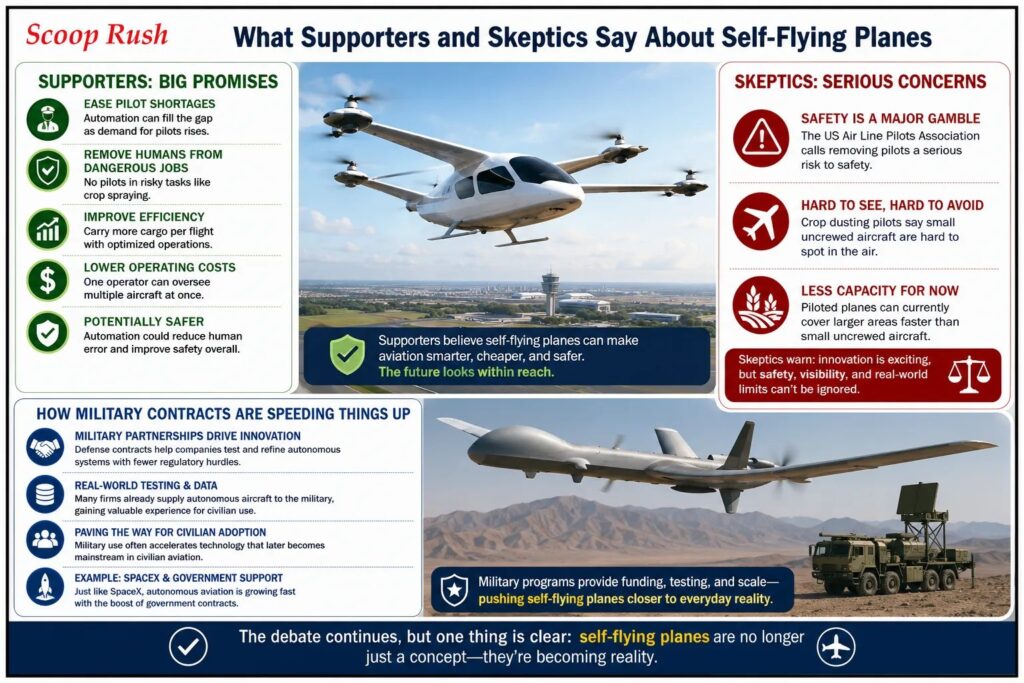
Supporters point to several benefits. Self-flying planes could ease pilot shortages, remove workers from dangerous jobs like crop spraying, and improve efficiency by carrying more cargo per flight. Furthermore, costs could fall if a single operator oversees multiple aircraft at once. Advocates also argue automation could make flying safer overall, citing historical accident declines as automated systems became more common. This mirrors ongoing debates about whether AI will replace jobs across other industries.
Pilot groups remain far more cautious. The US Air Line Pilots Association has called removing pilots a serious gamble with safety. Similarly, the US National Agricultural Aviation Association, representing crop dusting pilots, says small uncrewed aircraft can be hard for its pilots to spot in the air. The group also notes that piloted planes can currently cover larger areas more quickly.
This tension between innovation and caution will likely shape how fast regulators allow autonomous planes to expand beyond agriculture and cargo into passenger transport, much like ongoing regulatory pressure on big tech over child safety features.
How Military Contracts Are Speeding Things Up
Defense contracts are playing a major role in advancing self-flying plane technology. Many companies in this space test and demonstrate their systems through military partnerships, which often involve fewer regulatory obstacles than civilian projects. Some companies already supply autonomous aircraft to military customers, giving them valuable real-world data as they pursue civilian certification.
This pattern mirrors how other major technologies developed historically, since military use often paves the way for later civilian adoption, much like SpaceX’s rapid growth has been fueled partly by government contracts.
So, Are Self-Flying Planes Really the Future of Air Travel?
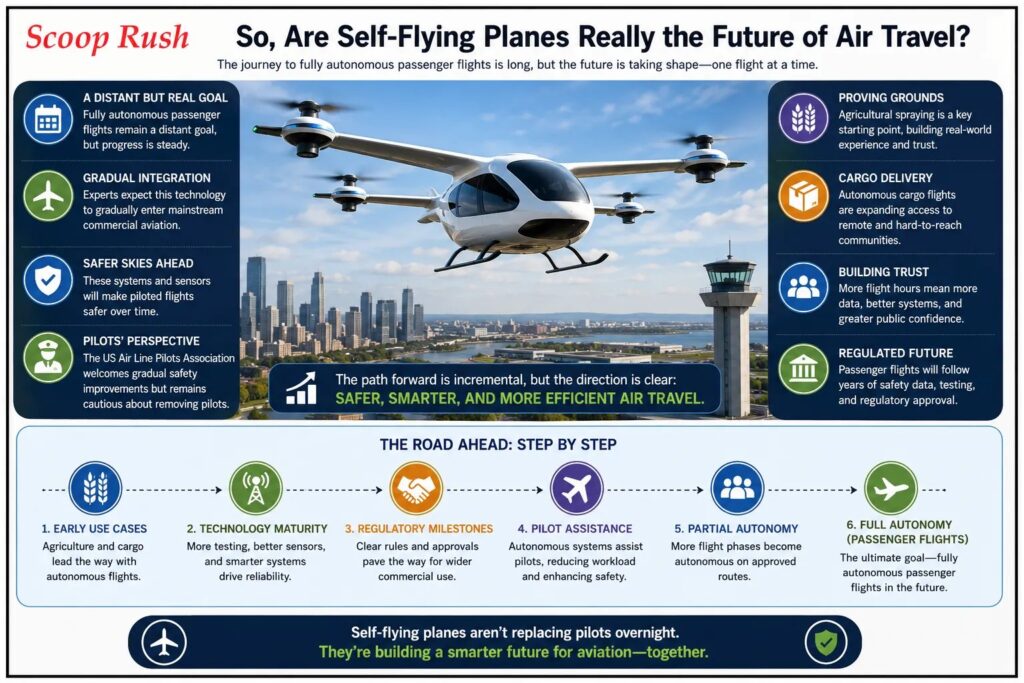
Fully autonomous passenger flights remain a distant goal. Still, many experts expect this technology to gradually work its way into mainstream commercial aviation. Consequently, piloted flights could become safer as these systems and sensors get built into traditional aircraft.
The US Air Line Pilots Association has acknowledged that this kind of gradual safety improvement would be welcome, even while the group stays cautious about removing pilots entirely.
For now, the path forward looks incremental. Agricultural spraying and cargo delivery are serving as proving grounds where autonomous systems build flight hours and public trust, similar to how Starship’s test flights are gradually building toward larger goals. Passenger flights, if they arrive, will likely follow years of accumulated safety data and regulatory approval.
Conclusion: What Self-Flying Planes Mean for the Future of Aviation
Self-flying planes are no longer a distant concept confined to research labs. Companies like Pyka, Windracers, Reliable Robotics, and Merlin Labs are already putting pilotless aircraft to work in real conditions, from spraying crops in Brazil to delivering cargo in Ukraine.
Each company takes a different path, whether that means building aircraft from scratch, retrofitting existing planes, avoiding AI, or embracing it fully. Real challenges remain, particularly around detecting other aircraft and communicating with air traffic control. Pilot groups remain understandably cautious about removing humans from the cockpit.
Still, the momentum is unmistakable. Agriculture and cargo are leading the way today, and many in the industry believe passenger flights could eventually follow. Whether or not self-flying planes fully take over passenger travel, the safety improvements from this technology will likely reach commercial aviation in some form.
FAQs
Are self-flying planes the future of air travel?
They could be. Companies like Pyka and Merlin Labs believe autonomous passenger flights are possible in the coming years, though full adoption will likely take time and depend heavily on regulatory approval and public trust.
What is the difference between autopilot and a self-flying plane?
Autopilot only assists a human pilot during flight, similar to cruise control in a car. A self-flying plane handles the entire flight, including takeoff and landing, using algorithms and sensors with little or no human involvement.
Which company has the largest autonomous plane approved for commercial use in the US?
Pyka currently holds this distinction. Its crop-spraying aircraft is the largest autonomous fixed-wing plane approved for commercial civilian use in the United States, having won authorization last year for agricultural spraying.
Are self-flying planes already being used commercially?
Yes. Pyka’s autonomous crop sprayers actively spray fields in the United States and Brazil. Windracers also flies autonomous cargo missions in Ukraine and is seeking approval for a cargo service in Scotland.
Will self-flying planes eventually carry passengers?
It is not certain yet, but several companies believe it is possible. Pyka’s CEO has expressed hope that passenger service could arrive before flying taxis become common. However, full passenger autonomy will likely require years of additional testing and regulatory approval.

