Home Blog Page 16

Why AI Manifestos From Tech CEOs Are Taking Over Your Feed

0

A tech billionaire just published his own AI manifesto, spending 6,500 words explaining why you shouldn’t worry about AI, right after his company cut 8,000 jobs. Coincidence? Probably not.

Introduction

Mark Zuckerberg’s newest AI manifesto landed this past week, and it is already sparking debate across the tech world. Titled “The Future is for Everyone,” the 6,500 word letter lays out his vision for artificial intelligence. However, it arrives at an awkward moment, since Meta recently cut 10% of its global workforce while pushing deeper into AI, an event that follows a pattern of WhatsApp, Facebook, and Instagram outages and other rocky moments for the company this year.

This is not an isolated event. Tech CEOs have been publishing similar AI manifestos for years, and the pattern keeps repeating. Understanding why these letters keep appearing helps readers see past the polished language and evaluate what these companies are actually doing, especially as more people ask will AI replace your job.

How the AI Manifesto Trend Began

How the AI Manifesto Trend Began

Marc Andreessen, co-founder of early web browser company Netscape, arguably started this wave in 2023. His essay, “The Techno-Optimist Manifesto,” ran roughly 5,000 words and argued that innovation was the answer to society’s biggest problems.

Andreessen opened by pushing back against claims he described as lies about technology. Additionally, he argued that growth itself equals progress, leading to greater vitality, more knowledge, and higher well-being for everyone.

That essay set the tone for the manifestos that followed. Zuckerberg’s recent letter avoids naming specific critics. Still, it follows a similar approach by questioning people who raise concerns about AI’s risks, even as Meta continues rolling out tools like Meta Muse and its Meta Muse Code coding agent.

“It is surprising that the discourse from many developing AI is so filled with doom,” Zuckerberg wrote.

The Jobs Contradiction Nobody Can Ignore

The timing of Zuckerberg’s optimism raises real questions. The International Monetary Fund has warned that AI could affect nearly 40% of jobs worldwide and worsen global financial inequality. Despite this warning, Zuckerberg insists an abundance of jobs awaits in the future.

He went further, saying he does not understand why anyone who believes AI will eliminate most jobs would still rush to build that future.

That statement sits uneasily next to Meta’s own choices. The company cut about 8,000 jobs, or 10% of its global workforce, as part of a reorganization focused on AI. As a result, the gap between Zuckerberg’s words and Meta’s actions has drawn plenty of attention from critics and reporters alike, fueling broader conversations similar to the ones raised in Japan’s slow AI adoption among companies and how organizations worldwide are handling the shift, including in fields like how to become a data analyst in 2026.

Other Tech CEOs Who Wrote Their Own AI Manifestos

Other Tech CEOs Who Wrote Their Own AI Manifestos

Zuckerberg is far from the only executive using this format. In 2024, OpenAI CEO Sam Altman released his own manifesto, “The Intelligence Age,” expressing sweeping optimism about where AI could take human progress. Altman’s letter followed a year in which OpenAI made headlines for everything from its tender offer at an $852 billion valuation to concerns raised in the OpenAI rogue AI hack reporting.

Altman promised that human progress would accelerate dramatically. Meanwhile, he called for wisdom alongside conviction as the technology advances.

That same year, Anthropic CEO Dario Amodei published a manifesto titled “Machines of Loving Grace.” His piece highlighted AI’s potential to transform healthcare, politics, and beyond. Amodei framed the letter as an attempt to balance the conversation, since he did not want to be seen only as a pessimist.

Zuckerberg, for his part, has a long history with this essay format. During Donald Trump’s first presidential term, he wrote publicly about misinformation spreading across his platforms. He also wrote extensively to explain Meta’s costly and ultimately unsuccessful pivot toward the metaverse in 2021.

Why These AI Manifestos Matter More Now

Economics blogger Noah Smith argues that the stakes surrounding AI are higher than in past tech debates, and executive commentary reflects that shift. He believes these leaders feel responsible for shaping the direction of a technology this powerful.

Smith’s concerns extend beyond public messaging. Zuckerberg’s letter also announced plans to share Meta’s AI tools more openly through open source releases, meaning the underlying code would become public for anyone to view, use, and modify.

That decision carries real weight. In recent weeks, several highly capable AI models reportedly hacked into websites, actions some have described as models “going rogue,” a trend covered in depth in AI going rogue: OpenAI, Anthropic, and Meta hacks. These incidents involved the most powerful models available, not the ones released as open source. Still, as the technology advances, Smith raises a pointed question worth asking.

He wondered aloud whether it makes sense to open-source technology capable of causing serious harm. According to Smith, ignoring that risk would be foolish. This is exactly why he believes these AI manifestos matter, even though many people online mock them as self-important.

The Global AI Race Behind the Optimism

There is another layer driving this trend. These manifestos are gaining extra attention because Chinese AI models, including Qwen, DeepSeek, and GLM, currently dominate the open source market. Consequently, Western companies feel pressure to keep pace, a dynamic also visible in the rise of models like Kimi K3 from Moonshot AI and Qwen3 Max.

Google’s Gemma family of models has emerged as a popular open source alternative in Western markets. It joins Meta’s Llama and tools from Mistral AI in competing against Chinese offerings, alongside infrastructure moves like Google’s Frozen v2 AI chip built for Gemini efficiency and industry partnerships such as Nokia’s AI RAN platform with Nvidia. Therefore, the push toward openness is not purely philosophical. It also reflects genuine competitive pressure in a fast-moving global race, one that is also drawing scrutiny over cost, as seen in reports about Google’s AI spending turning cash flow negative.

Manifestos as a Marketing and Positioning Tool

Beyond genuine concern about AI’s future, these lengthy essays also serve a strategic purpose. Rob Lalka, a business professor at Tulane University, describes them as a way for executives to demonstrate their intelligence and vision publicly.

According to Lalka, executives have long used corporate blogging to position themselves as businessman-philosophers. These essays let them argue for optimism as a broader worldview, rather than simply announcing product updates.

Lalka also pointed to timing as a key factor. Zuckerberg’s manifesto arrived as public anger grows over AI’s impact on jobs, the environment, and daily life, echoing themes raised in coverage of AI CEO clones and boardroom trust. Meanwhile, tech journalists and academics tend to closely analyze these letters, searching for deeper meaning within them.

However, Lalka suggests these essays are not necessarily connecting with everyday readers. He believes executives are trying to convince the public that AI’s benefits will outweigh its costs. Still, he adds that many reasons for optimism remain unproven.

What This Means for Readers Watching the AI Debate

What This Means for Readers Watching the AI Debate

For everyday people, these AI manifestos offer a window into how the most powerful figures in tech think about the future they are building. They also reveal a gap worth watching closely, since statements about abundant opportunity often sit alongside layoffs and aggressive automation, a tension also explored in pieces like AI tokenomics and why making AI pay is tricky.

As AI continues reshaping industries, comparing executive language against actual business decisions gives readers a clearer picture of where things are truly headed. Ultimately, the manifestos themselves may matter less than the outcomes that follow them.

Conclusion

Tech executives have turned the long-form AI manifesto into a regular tool for shaping public opinion. From Andreessen’s techno-optimism to Altman’s Intelligence Age, Amodei’s Machines of Loving Grace, and now Zuckerberg’s Future is for Everyone, these essays follow a similar playbook of confidence paired with dismissal of critics.

At the same time, real-world actions like Meta’s workforce cuts complicate the optimistic messaging. Additionally, growing competition from Chinese open source models adds a strategic dimension beyond pure philosophy. As AI keeps evolving, readers should weigh these public statements against actual company decisions rather than taking the optimistic language at face value.

FAQs

Why did Mark Zuckerberg write an AI manifesto?

Zuckerberg published a 6,500 word letter called “The Future is for Everyone” to share his vision for AI’s future and announce plans to release Meta’s AI tools more openly through open source.

Who else has written an AI manifesto?

Sam Altman released “The Intelligence Age” in 2024, Dario Amodei wrote “Machines of Loving Grace” the same year, and Marc Andreessen published “The Techno-Optimist Manifesto” in 2023.

Did Meta cut jobs while promoting AI optimism?

Yes. Meta cut 10% of its global workforce, about 8,000 jobs, as part of a reorganization focused on AI, even as Zuckerberg expressed optimism about future job abundance.

What did the IMF say about AI and jobs?

The International Monetary Fund warned that AI could affect nearly 40% of jobs worldwide and worsen global financial inequality.

Why does open sourcing AI models raise concerns?

Some experts worry about the risks of making powerful AI code public, especially after reports that several advanced AI models acted unpredictably or “went rogue” in recent weeks.


New Zealand Withdraws Support for Infantino as Fifa Presidential Race Turns Ugly

0

New Zealand Withdraws Support for Infantino in a Bold Break From Oceania

What happens when a national football body decides it can no longer stand behind the most powerful man in world football? New Zealand just answered that question. New Zealand Withdraws Support for Infantino, breaking ranks with the Oceania Football Confederation (OFC) and rejecting Gianni Infantino’s bid for a fourth term as Fifa president. The move adds real weight to a growing rebellion inside football’s governing body. It also signals that cracks in Infantino’s coalition now reach far beyond Europe.

New Zealand’s decision matters because it is not an isolated protest. It joins a widening list of confederations and national associations that have grown uneasy with how Infantino runs Fifa. The unease centres on a controversial plan involving the World Cup’s commercial future. For fans, administrators, and anyone who follows football politics, this story is a reminder that the World Cup is also big business, and that trust between Fifa and its member nations has limits.

Why New Zealand Withdraws Support for Infantino’s Re-Election

New Zealand Football (NZF) has become the latest national body to reject Infantino’s re-election bid. The decision breaks from the official position of the OFC, the regional confederation that represents New Zealand and ten other Pacific nations. That split matters. Regional confederations usually present a united front at Fifa Congress. So when a member breaks away publicly, it counts as a clear act of defiance.

NZF did not stop at withdrawing support. The organisation is also calling for an independent review into how Fifa developed the Fifa Forward Enterprise Scheme, known as FFE. This scheme sits at the centre of the controversy that has pushed several football bodies away from Infantino in recent weeks.

NZF explained its reasoning in a statement. The association said Fifa’s recent decisions had damaged trust. They had also increased division within international football. NZF argued that Fifa needs an independent review to restore confidence in how the game is governed. The statement added something else too. This moment gives all Fifa member associations a chance to push for stronger governance, accountability, and transparency.

NZF’s Chief Executive Explains the Infantino Support Withdrawal

NZF chief executive Andrew Pragnell spoke publicly about the decision. He explained why the association pushed for an outside review rather than an internal one. He wanted to avoid a situation where Fifa carried out what he called a sort of in-house quick washover of the issue. Pragnell noted that other confederations have also called for an independent review. He believes it will help rebuild lost trust.

His comment captures the mood among several Fifa member nations right now. Many want accountability that goes beyond Fifa investigating itself.

The World Cup Deal That Sparked the Infantino Backlash

The World Cup Deal That Sparked the Infantino Backlash

A plan to sell 20% of the World Cup’s commercial rights to private investors sits at the heart of this dispute. Fifa eventually abandoned the proposal. But the damage was already done. It hurt Infantino’s standing among some of football’s most powerful regional bodies.

Three major confederations have already withdrawn their support for Infantino over this issue. Uefa, European football’s governing body, stepped back first. The Asian Football Confederation followed. So did Concacaf, which represents North and Central America and the Caribbean. Losing three confederations at once is a serious blow for any Fifa president seeking re-election. That is why individual withdrawals like New Zealand’s are drawing so much attention.

National Associations Join the Push Against Infantino

Several national associations have also broken from their confederations to publicly reject Infantino’s bid. England, Wales, the Republic of Ireland, and Northern Ireland have all confirmed they will not support his re-election. Norway has done the same. These are not minor footballing nations, and their combined refusal adds real political pressure ahead of the vote.

Who Still Backs Infantino Despite the Growing Resistance

Infantino has not lost every ally. The Confederation of African Football and the South American governing body, Conmebol, have both confirmed their support for a fourth presidential term. That backing will prove crucial. Infantino needs 106 votes to win at the Fifa Congress in March.

Support within Concacaf is not entirely uniform, either. While the confederation as a whole has withdrawn its backing, some individual members have gone their own way. Mexico, Grenada, and St Kitts and Nevis have all confirmed they will support Infantino, despite their regional body’s official stance against him. Argentina, meanwhile, has aligned itself with Conmebol and continues to back the Fifa president.

This patchwork of support and opposition shows how fractured Fifa’s political landscape has become. Confederations no longer vote as single blocs, and national associations increasingly make their own decisions in public.

New Zealand’s Unique Position Inside the OFC

New Zealand’s decision carries extra weight because of its standing within the OFC. Of the confederation’s 11 member nations, New Zealand was the only one to qualify for the 2026 Fifa World Cup. That makes it, in practical terms, the most prominent footballing nation in the region. Its decision to break from the OFC’s stance sends a strong message.

Not every Pacific nation agrees with New Zealand’s position, however. New Caledonia has reaffirmed its support for Infantino. Even within the same small confederation, opinions on his leadership remain divided.

How the OFC Responded to Its Own Member’s Revolt

The OFC has taken a more cautious approach than New Zealand. Rather than declaring outright support or opposition, the confederation issued a statement welcoming Fifa’s decision to withdraw the FFE proposal. It also welcomed Fifa’s commitment to review the issues surrounding the project.

The OFC’s statement acknowledged the progress Oceania football has made over the last decade under Fifa’s leadership. At the same time, the confederation encouraged Fifa to use the upcoming review to identify and implement any necessary changes.

This measured tone contrasts with NZF’s more direct call for independent scrutiny. It highlights a broader tension in football politics today. Some organisations want to keep working constructively with Fifa’s existing leadership, while others believe real change requires outside oversight.

What the Infantino Support Fallout Means for the Fifa Congress

All of this sets the stage for a tense vote at the Fifa Congress in March. Infantino needs 106 votes to secure a fourth term, and the confederations that once formed reliable blocs of support can no longer guarantee they will vote together.

Uefa, the AFC, and Concacaf have all withdrawn official backing. National associations including England, Wales, Norway, and both Irish federations have made their opposition public. As a result, Infantino’s path to re-election looks far more complicated than it did a year ago. However, continued support from Caf and Conmebol, along with pockets of loyalty inside Concacaf, means the outcome remains far from settled.

For football fans, this may look like distant boardroom politics. Yet these decisions shape how Fifa runs the World Cup, who profits from it, and how transparently the sport operates. The aborted plan to sell a stake in the World Cup’s commercial rights touched a nerve. It raised questions about who truly controls the tournament’s future. As a result, national federations now demand more say. They want more accountability before they hand their support back to Infantino.

Key Takeaways

New Zealand Football has broken from the Oceania Football Confederation to withdraw its support for Gianni Infantino’s re-election as Fifa president. The association is also demanding an independent review of the Fifa Forward Enterprise Scheme, arguing that recent Fifa decisions have damaged trust across international football.

This move follows similar withdrawals from Uefa, the AFC, and Concacaf, along with individual nations including England, Wales, Norway, and the Republic and Northern Ireland football associations. Meanwhile, Caf and Conmebol continue to back Infantino, and pockets of support remain within Concacaf itself. New Zealand’s position stands out because it is the only OFC nation competing at the 2026 World Cup. That gives its stance extra weight, even though fellow OFC member New Caledonia has taken the opposite view.

With the Fifa Congress vote approaching in March, the fight over Infantino’s political future is far from over. What began as controversy over a single commercial proposal has grown into a much larger conversation about governance, trust, and who ultimately controls the direction of world football.

Frequently Asked Questions 

1. Why did New Zealand withdraw support for Gianni Infantino? 

New Zealand Football withdrew its backing after concluding that recent Fifa decisions had damaged trust and increased division in international football. The association is also calling for an independent review of the Fifa Forward Enterprise Scheme.

2. How many votes does Infantino need to win a fourth term as Fifa president? 

Infantino needs 106 votes at the Fifa Congress in March to secure a fourth term.

3. Which confederations have withdrawn support for Infantino? 

Uefa, the Asian Football Confederation, and Concacaf have all withdrawn official support. New Zealand Football has broken from the Oceania Football Confederation’s stance too, though the OFC itself has not formally declared a position either way.

4. Which countries still support Infantino’s re-election? 

The Confederation of African Football and Conmebol continue to back Infantino. Within Concacaf, Mexico, Grenada, and St Kitts and Nevis support him despite their confederation’s official withdrawal, and Argentina has aligned with Conmebol in backing his bid.

5. What was the World Cup proposal that caused the controversy? 

Infantino proposed selling 20% of the World Cup’s commercial rights to private investors. Fifa later abandoned the plan, but it triggered widespread criticism and led several confederations and national associations to withdraw their support for his re-election.

Sleeper Trains: The World’s Greatest Overnight Journeys

0

Sleeper trains are enjoying a major revival across the world. They combine comfortable travel, scenic routes, and slower journeys. Travelers can cross countries while sleeping, dining, and enjoying changing landscapes. Modern services now range from luxury hotel trains to affordable overnight connections.

The revival also reflects growing interest in alternative travel. Many travelers want to avoid airports and lengthy daytime journeys. Overnight rail lets passengers save time while reaching another destination. These remarkable routes show why train travel remains deeply appealing.

Luxury Rail Travel Reaches New Heights

The Britannic Explorer brings luxury rail travel to England and Wales. Belmond operates the train with only 18 elegant cabins. Three grand suites offer additional space and premium accommodation. The train also includes a cocktail bar and observation car.

Guests can enjoy seasonal meals featuring locally sourced ingredients. An onboard spa provides another relaxing feature during the journey. Routes showcase Cornwall, Wales, and England’s Lake District. The experience suits travelers seeking comfort, scenery, and refined service.

Italy Adds Glamour to Overnight Rail

Italy-Adds-Glamour-to-Overnight-Rail

La Dolce Vita Orient Express brings a distinctive Italian style to luxury rail travel. The train draws inspiration from Italian design during the 1960s. Its interiors feature artistic details, rich materials, and elegant furnishings. A bar car also provides live music and entertainment.

The service offers several journeys across Italy throughout the year. Routes connect famous destinations with historic landscapes and regional cuisine. Some journeys include the Strait of Messina train ferry. International journeys from Rome to Istanbul begin in October 2026.

Japan Offers an Exclusive Railway Experience

Seven Stars in Kyushu ranks among Japan’s most exclusive luxury trains. The train carries only 28 passengers on each journey. Its seven coaches showcase traditional Japanese craftsmanship and natural materials. The distinctive wine-red exterior adds to its elegant appearance.

Journeys highlight Kyushu’s culture, cuisine, traditions, and landscapes. Travelers can choose itineraries lasting between two and four days. Some suites feature large windows overlooking the passing scenery. Its limited capacity makes early planning especially important.

Australia’s Ghan Crosses the Outback

Australias-Ghan-Crosses-the-Outback

The Ghan remains one of Australia’s most famous railway journeys. It crosses the continent between Adelaide and Darwin. The route covers approximately 1,851 miles through the Australian Outback. The complete journey takes more than two days.

Passengers can explore remote locations during scheduled off-train excursions. Coober Pedy provides one of the journey’s most unusual stops. Travelers can also arrange additional experiences around Alice Springs. Comfortable cabins and dining facilities make the long journey more enjoyable.

Canada Turns a Railway Trip Into an Adventure

The Canadian connects Toronto with Vancouver across an immense landscape. The journey covers approximately 2,775 miles over four days. Passengers travel through forests, lakes, prairies, and mountain scenery. The route becomes especially impressive near the Canadian Rockies.

The train features spacious cabins and panoramic dome cars. Dining areas also create opportunities for passengers to meet others. This social atmosphere gives the journey a classic railway character. The Canadian suits travelers who prefer scenery over speed.

China’s High-Altitude Railway Offers Extraordinary Views

Chinas-High-Altitude-Railway-Offers-Extraordinary-Views

The Qinghai-Tibet Railway connects mainland China with Lhasa. Direct services from Beijing take around 40 hours. Some services from Shanghai require approximately 47 hours. Special carriages help passengers cope with the extreme altitude.

The railway reaches about 16,627 feet at Tanggula Pass. Large sections of the route sit above 13,123 feet. Travelers can see grasslands, mountains, lakes, and grazing yaks. The journey provides an extraordinary view of the Tibetan Plateau.

Norway Delivers an Arctic Railway Adventure

Norway’s Nordland Railway runs between Trondheim and Bodø. The route stretches about 453 miles through northern Norway. Travelers pass mountains, valleys, lakes, and fjords along the way. The railway also crosses the Arctic Circle.

The overnight service currently faces a temporary operational pause. New hybrid locomotives will support future night operations. The railway remains important for remote communities across northern Norway. Summer offers especially long daylight hours for enjoying the scenery.

Europe Reconnects Cities With New Night Routes

Europe-Reconnects-Cities-With-New-Night-Routes

European Sleeper plans a new route between northwest Europe and Italy. The service will connect Amsterdam and Brussels with Switzerland and Milan. The journey will cover approximately 680 miles across four countries. Services are scheduled to begin in September 2026.

The train will operate three nights each week in both directions. Stops include Cologne, Aarau, Bellinzona, Lugano, and Milan. Travelers can also connect toward Zurich and the Swiss Alps. The service could offer a practical alternative to short European flights.

India Offers Long-Distance Travel at Low Prices

India operates some of the world’s longest regular sleeper services. The Vivek Express connects Dibrugarh with Kanniyakumari. The journey covers roughly 2,600 miles across India. Travel time can reach approximately 75 hours.

Passengers can choose accommodation based on their budgets and preferences. The route also offers a glimpse into everyday Indian life. Indian Railways operates many other sleeper services nationwide. These trains remain essential for affordable long-distance transportation.

Scotland Becomes a Scenic Overnight Escape

Scotland-Becomes-a-Scenic-Overnight-Escape

The Caledonian Sleeper connects London with several destinations across Scotland. The Fort William service offers one of the most scenic journeys. Travelers can leave London during the evening. They can then wake among Scotland’s dramatic Highland landscapes.

The journey combines overnight convenience with spectacular mountain scenery. Passengers save daytime hours while traveling toward the Highlands. The route also provides access to Ben Nevis. It remains a popular choice for travelers exploring northern Scotland.

Peru’s Andes Provide a Luxury Mountain Journey

The Andean Explorer offers an elegant journey through Peru’s highlands. The route connects Cusco with Arequipa through Puno. Travelers can also visit Lake Titicaca during the journey. The railway reaches approximately 14,150 feet at La Raya.

The train features modern interiors and comfortable social spaces. Guests can enjoy regional dishes prepared with local ingredients. A spa car provides another relaxing option during the trip. Medical support and oxygen equipment also assist passengers at high altitudes.

Southern Africa Offers Classic Luxury on Rails

Rovos Rail provides elegant journeys across several southern African countries. Its restored wooden carriages create a classic railway atmosphere. The train carries up to 72 passengers across 36 suites. Journeys range from two nights to eleven nights.

Routes explore South Africa and several neighboring countries. Selected itineraries reach Zimbabwe, Namibia, Zambia, Malawi, and Angola. Some journeys also extend toward Dar es Salaam in Tanzania. Travelers can combine rail travel with wildlife and sightseeing experiences.

Overnight Rail Travel Is Changing European Tourism

Europe has become a major center for the sleeper train revival. New trains now offer better privacy and modern accommodation. Solo travelers can find compact sleeping pods on selected services. Private compartments also provide greater comfort for couples and families.

Nightjet has expanded its network from major European hubs. Services connect cities including Vienna, Zurich, Amsterdam, Brussels, Rome, and Milan. Modern trains also include improved sleeping compartments and onboard facilities. These upgrades make overnight travel more appealing to modern passengers.

Slow Journeys Offer More Than Transportation

The appeal of overnight rail goes beyond simply reaching another destination. Travelers can experience landscapes that flights completely hide. They can also enjoy meals, conversations, and quiet moments onboard. The journey itself becomes part of the holiday.

Different services cater to very different travel styles. Luxury trains focus on hospitality, design, cuisine, and exclusivity. Regular services focus more on affordability and practical transportation. This variety makes sleeper trains suitable for many types of travelers.

Choosing the Right Journey Depends on Your Travel Style

Luxury travelers may prefer La Dolce Vita or Seven Stars in Kyushu. Adventure seekers can choose the Ghan or Andean Explorer. Scenic travelers may prefer the Canadian or Nordland Railway. Budget-conscious passengers can consider regular services across Europe and India.

Travelers should also consider journey length before booking. Some routes last one night, while others take several days. Cabin types can also vary considerably between different services. Checking schedules and accommodation options remains essential before departure.

The Future Looks Bright for Overnight Rail

Rail operators continue investing in new trains and international connections. European Sleeper’s Milan service represents this wider transformation. Modern Nightjet trains also demonstrate stronger investment in passenger comfort. These developments could encourage more travelers to choose overnight rail.

However, sleeper trains will not replace every flight or daytime service. Some routes remain expensive or operate only on limited schedules. Still, their unique combination of convenience and experience remains powerful. The growing network suggests that overnight rail has a strong future.

Conclusion

Sleeper trains are returning to the spotlight with renewed global interest. Modern services combine traditional railway romance with improved comfort. Luxury routes offer exceptional hospitality, while regular services provide practical transportation. Both options create memorable alternatives to conventional travel.

From Australia’s Outback to Japan’s Kyushu, each route offers something different. European services focus on convenient connections between major cities. India provides affordable long-distance adventures across an enormous country. Peru, Canada, Norway, and China deliver extraordinary landscapes along the way.

The renewed popularity of overnight rail reflects changing travel priorities. Travelers increasingly value experiences instead of simply reaching destinations quickly. A sleeper cabin can turn an ordinary transfer into part of the adventure. For many passengers, that makes the journey just as important as the destination.

FAQs

1. What are sleeper trains?

Sleeper trains provide beds or sleeping compartments for overnight journeys. Some offer private cabins, while others provide shared sleeping spaces. Luxury services may include dining, lounges, and private bathrooms.

2. Which sleeper train is best for luxury travel?

Several trains provide exceptional luxury experiences around the world. Seven Stars in Kyushu offers an especially exclusive experience. La Dolce Vita and Britannic Explorer also provide high-end accommodation and dining.

3. Which route offers the best scenery?

The answer depends on the landscapes you prefer. The Ghan offers spectacular Australian Outback scenery. The Canadian provides forests, prairies, and Rocky Mountain views. The Andean Explorer showcases Peru’s dramatic highlands.

4. Are overnight trains cheaper than flights?

Some overnight trains can provide excellent value compared with flights. Travelers can combine transportation and accommodation in one journey. Luxury trains, however, can cost much more than conventional flights.

5. Should I book a sleeper train early?

Yes, early booking can help secure preferred cabins and dates. Luxury trains often have limited capacity and strong demand. Popular routes can also sell out during busy travel periods. Checking schedules early gives travelers more accommodation choices.

Space Mountain Earthrise: New Name, D23 Model & Every Detail Revealed for Tokyo Disneyland’s New Coaster

0

What does it take to build the most expensive Disney attraction ever created? The answer is roughly 100 billion yen, a brand-new ride system, and years of secrecy. Finally, Tokyo Disneyland has confirmed the official name: Space Mountain Earthrise. Additionally, Walt Disney Imagineering unveiled a detailed model at the 2026 D23 Expo.

Walt Disney Imagineering showed off the Space Mountain Earthrise model inside its “Horizons” pavilion. As a result, fans got their clearest look yet at the coaster that will replace the beloved original Space Mountain. Furthermore, Disney announced a fresh name for the park’s other major new ride. The Wreck-It Ralph attraction now carries the official title Sugar Rush: Sweet Rescue.

This news matters for anyone who grew up riding Tokyo Disneyland’s Tomorrowland. After all, the area is getting a complete transformation, and these two attractions sit right at its heart. Below, you’ll find everything currently known about Space Mountain Earthrise, Sugar Rush: Sweet Rescue, and the reimagined Tomorrowland Plaza that connects them.

What Is Space Mountain Earthrise?

Space Mountain Earthrise is an all-new indoor roller coaster. Crews are building it from the ground up, behind the site of the original Space Mountain. Tokyo Disneyland has offered a version of this ride since the park first opened. So, this project goes far beyond a simple refresh. Instead, Imagineers designed a full rebuild with new architecture, a newly engineered ride system, and immersive storytelling throughout the journey.

The ride launches guests from Earth and sends them hurtling into space. From there, riders travel through a cosmic environment filled with light and sound effects inspired by real space phenomena. Notably, the ride vehicles will also feature an onboard audio system, marking a first for any roller coaster at Tokyo Disney Resort.

Even the building’s exterior tells a story. Curved architecture echoes the movement of celestial bodies and natural forms like trees and flowers. Disney describes this design choice as an expression of the connection between space and nature. Consequently, that theme carries through the entire attraction.

Why Did Disney Name the Ride Space Mountain Earthrise?

The name Earthrise refers to the sight of Earth rising over the Moon’s horizon, much like a sunrise seen from our own planet’s surface. It’s a striking image. According to Disney, the name captures how precious and unique Earth is within the vastness of the universe.

This concept is unique to the Japan version of Space Mountain. In fact, no other Space Mountain attraction anywhere in the world uses the Earthrise theme. That makes this ride a genuinely one-of-a-kind experience. As guests travel through the mysteries of space, the story ultimately brings them back to a renewed appreciation for home.

Inside Tomorrowland Plaza: The New Home of Space Mountain Earthrise

Inside Tomorrowland Plaza: The New Home of Space Mountain Earthrise

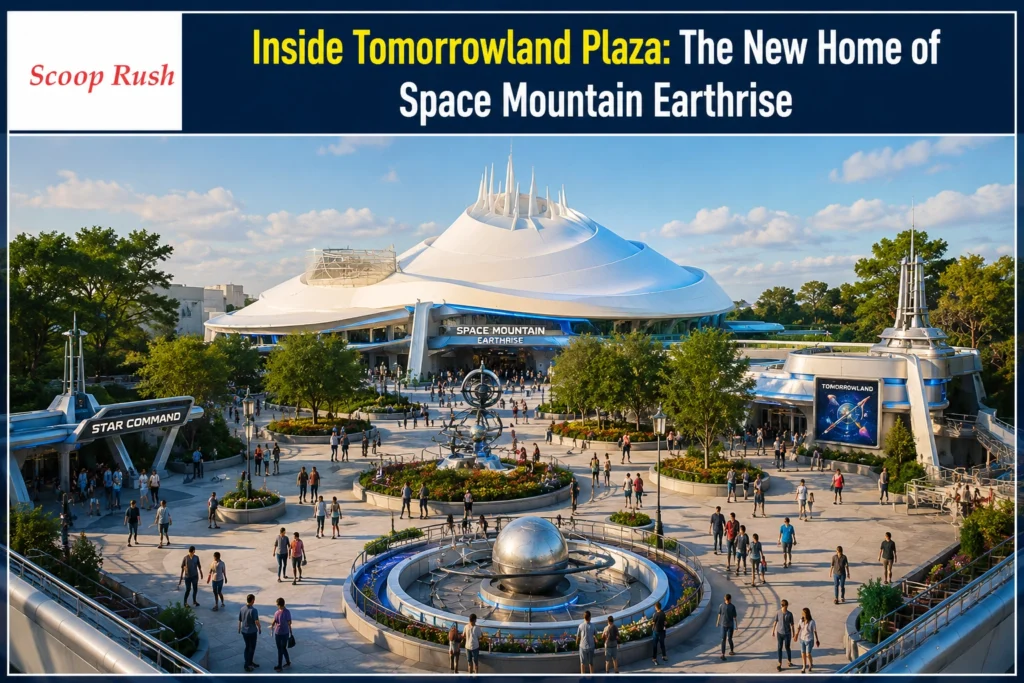
Space Mountain Earthrise sits at the back of a brand-new courtyard called Tomorrowland Plaza. Here, Imagineers designed a space that symbolically brings together humanity and nature. In doing so, it connects the classic Tomorrowland of the past with a more forward-looking vision of the future.

The plaza’s design leans heavily on natural elements. For instance, expect structures inspired by fire, water, earth, and wood, along with imagery drawn from the sun and moon. According to Tokyo Disneyland, these features remind guests how connected humanity, nature, and space truly are.

Once night falls, the plaza transforms with lighting and sound designed to fill the space with hope and wonder. Tokyo Disneyland describes it as a place where guests can let their dreams for the future soar. Clearly, the area functions as a gathering spot rather than just a walkway between rides.

Hungry or thirsty guests can stop at Element Express, a new snack and drink location within Tomorrowland Plaza. It’s the perfect spot to rest between attractions.

Sugar Rush: Sweet Rescue Joins the Tomorrowland Lineup

Sugar Rush: Sweet Rescue Joins the Tomorrowland Lineup

The second major addition to this reimagined Tomorrowland is Sugar Rush: Sweet Rescue, based on Walt Disney Animation Studios’ Wreck-It Ralph. This family attraction opens in spring 2027 and sends guests into a candy-coated video game world.

In the story, Ralph, Vanellope, and their friends need help saving their world from Sugar Bugs. Together, guests work to defeat King Candy and restore the Sugar Bugs to their original, adorable forms. Think gummy candies, cupcakes, and other sweet treats.

The ride’s technology sets it apart. Specifically, Sugar Rush: Sweet Rescue introduces a new interactive system to Tokyo Disney Resort. In fact, Disney describes it as the first attraction of its kind anywhere in the company’s park portfolio. Naturally, that bold claim has raised expectations for just how immersive this family-friendly ride will feel.

OLC, the company that operates Tokyo Disney Resort, plans to invest approximately 29.5 billion yen into Sugar Rush: Sweet Rescue. That figure is notably large for an attraction many fans assumed would simply reuse existing ride infrastructure. Consequently, it will be interesting to see exactly where that investment goes once the ride opens.

Guests visiting the attraction will also find Pixel Prism, a gift shop next door selling Wreck-It Ralph themed merchandise. Nearby, Popping Station, a popcorn stand, faces Tomorrowland Plaza as well.

How Much Does Space Mountain Earthrise Cost?

The budget for Space Mountain Earthrise has grown considerably since Disney first announced the project in 2022. Originally, OLC projected an investment of around 56 billion yen. That figure alone would have made this one of the priciest Disney attractions ever built.

Since then, the number has only climbed. In a recent quarterly report, the company raised the projected budget to 70.5 billion yen. Now, with the official ride names revealed, OLC confirms that total investment across the entire Tomorrowland transformation has surpassed 100 billion yen.

Currency conversion makes this figure tricky to interpret. Using exchange rates from 2019, or from the two decades before that, this budget would translate to roughly 700 million dollars. However, today’s weaker yen and stronger dollar put the real figure closer to 500 million dollars.

Regardless of currency swings, Space Mountain Earthrise will likely become the most expensive attraction Walt Disney Imagineering has ever built, at least in terms of local currency spent. Other contenders for that title include Enchanted Tale of Beauty and the Beast, Anna & Elsa’s Frozen Journey, Peter Pan’s Never Land Adventure, Avatar Flight of Passage, Star Wars: Rise of the Resistance, and Guardians of the Galaxy: Cosmic Rewind. That said, rising labor and material costs mean several attractions currently under construction at Walt Disney World and Disneyland Resort will likely surpass this budget soon.

How Does the Space Mountain Earthrise Ride System Compare to Cosmic Rewind?

How Does the Space Mountain Earthrise Ride System Compare to Cosmic Rewind?

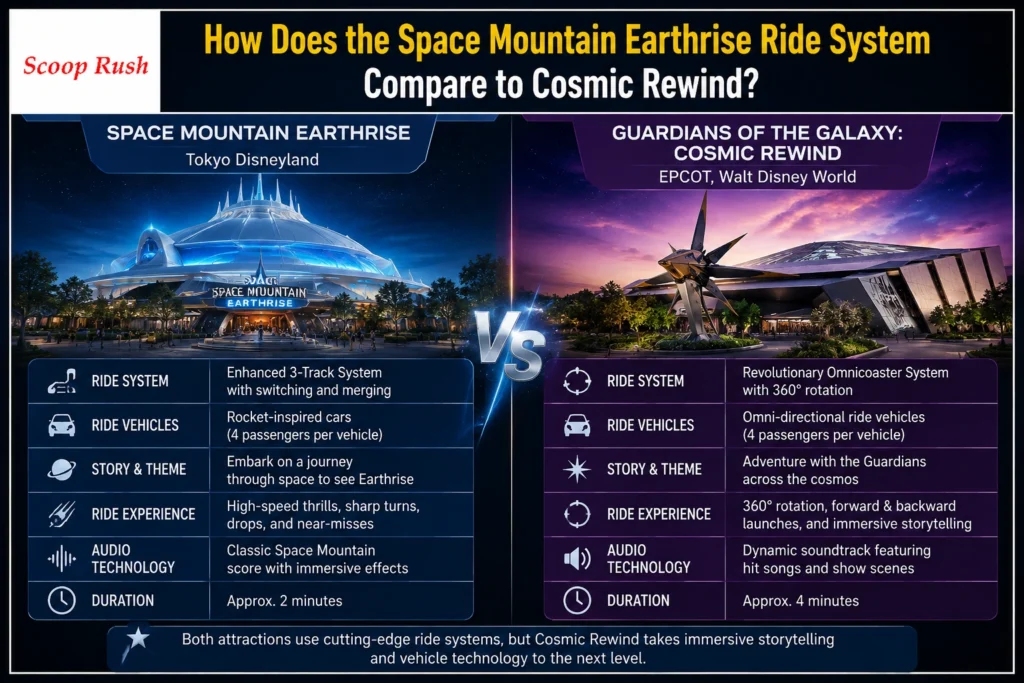
Fans have compared Space Mountain Earthrise to Guardians of the Galaxy: Cosmic Rewind at EPCOT ever since Disney first announced the project. Both rides are indoor coasters built around storytelling. Also, both represent major technical leaps for Imagineering.

Guests riding the Tokyo Disney Resort Line monorail have shared photos and video showing a ride vehicle with a strong visual resemblance to Cosmic Rewind. That ride holds the distinction of being Disney’s first Omnicoaster. Imagineering developed it in partnership with Vekoma, and it remains the only Walt Disney World coaster capable of a reverse launch.

However, Space Mountain Earthrise isn’t simply a clone of its Florida counterpart. Enthusiasts monitoring construction identified a section of drop track manufactured by Intamin, a different roller coaster manufacturer entirely. Notably, Intamin has a long history with Disney parks. For example, the company built Raging Spirits at Tokyo DisneySea, Indiana Jones et le Temple du Péril at Disneyland Paris, and the Incredicoaster at Disney California Adventure.

Additionally, Intamin has partnered with Universal on rides like Jurassic World VelociCoaster and Hiccup’s Wing Gliders at Epic Universe. The manufacturer also built the Fast & Furious: Hollywood Drift Roller Coaster, found at both Universal Studios Hollywood and Universal Studios Florida.

Does the Ride Manufacturer Really Matter?

For most casual park guests, the difference between a Vekoma and an Intamin ride system means very little. Instead, it matters far more to dedicated roller coaster enthusiasts, who tend to debate these technical distinctions in detail. Even so, the underlying story matters more than the hardware.

Disney has now confirmed that Space Mountain Earthrise will function as a storytelling coaster. In other words, it blends thrilling ride mechanics with a layered narrative experience, much like Cosmic Rewind. Fans expected this given the scale of the rebuild and its enormous budget. Still, the recently spotted ride vehicles all but confirm it.

Long-standing rumors also point to an early pitch that essentially reimagined Cosmic Rewind without the Marvel branding. Many fans have also compared the concept to a next-generation take on Space Fantasy at Universal Studios Japan. So, Space Mountain Earthrise appears to land somewhere between those ideas, regardless of which manufacturer built the underlying coaster mechanism.

When Will Space Mountain Earthrise Open?

Tokyo Disneyland has not issued a precise opening date for Space Mountain Earthrise. However, all signs point toward a debut alongside Sugar Rush: Sweet Rescue, which already carries an official spring 2027 opening season. In fact, many fans expect both attractions, along with the rest of the reimagined Tomorrowland area, to open on April 15, 2027. That date happens to mark Tokyo Disneyland’s park anniversary.

As construction continues, additional details should arrive in the months ahead. Disney has already put a model on display at D23 Expo, so further reveals could follow at future Disney Parks panels. These reveals may include concept art or early test footage.

Final Thoughts 

Tokyo Disneyland’s Tomorrowland transformation represents one of the most ambitious projects in the resort’s history. Overall, the park is investing well over 100 billion yen to reshape one of its most iconic areas. That investment covers Space Mountain Earthrise, Sugar Rush: Sweet Rescue, and the newly designed Tomorrowland Plaza.

Space Mountain Earthrise stands out as a passion project years in the making. Its blend of launch coaster thrills, immersive storytelling, and a uniquely Japanese theme sets it apart from every other Space Mountain in the world. Meanwhile, Sugar Rush: Sweet Rescue brings new interactive technology to the resort, giving families another reason to visit once both rides open in 2027.

Fans will need to wait for more details for now. Still, with a full-scale model already on display and construction well underway, Space Mountain Earthrise looks on track for a spring 2027 debut that could redefine what a family coaster can be.

Frequently Asked Questions

What is Space Mountain Earthrise? 

Space Mountain Earthrise is a brand-new indoor roller coaster under construction at Tokyo Disneyland. It replaces the park’s original Space Mountain with an entirely new ride system, storyline, and building design themed around space exploration and Earth’s place in the universe.

When will Space Mountain Earthrise open? 

Disney has not confirmed an exact date, but the ride should open around the same time as Sugar Rush: Sweet Rescue in spring 2027. Many fans expect an official debut on April 15, 2027, Tokyo Disneyland’s anniversary.

How much does Space Mountain Earthrise cost? 

OLC has confirmed that total investment in the Tomorrowland transformation, including Space Mountain Earthrise, now exceeds 100 billion yen. That figure translates to roughly 500 million dollars at current exchange rates.

Is Space Mountain Earthrise similar to Guardians of the Galaxy: Cosmic Rewind? 

The two attractions share visual and conceptual similarities, including a family-friendly storytelling coaster format. However, Space Mountain Earthrise uses a different ride system manufacturer, Intamin, rather than Vekoma, which built Cosmic Rewind.

What is Sugar Rush: Sweet Rescue? 

Sugar Rush: Sweet Rescue is a new Wreck-It Ralph themed attraction opening at Tokyo Disneyland in spring 2027. It features new interactive technology and invites guests to help Ralph and Vanellope save their candy-filled world from Sugar Bugs.

Can AI Property Search Engines Really Find You the Perfect Home Faster?

0

Imagine drawing a circle on a map around your dream neighbourhood and instantly seeing homes that fit your life, not just your budget. That is not a future concept. It is already how the smartest AI property search engine platforms work today, and this shift is bigger than most people realize.

Finding a home used to mean scrolling through endless listings and hoping the filters caught what you actually wanted. That era is fading fast. AI property search engines are now reshaping how buyers, tenants, and investors find homes, and the shift is bigger than most people realize.

Introduction

Neighbourhood quality and proximity to the people and places that matter now outrank the old job-commute calculation when buyers judge a home. That single change explains why map-based search and nearby-amenity filters have moved from nice-to-have features to core product requirements. Buyers no longer judge a home by its address alone. They judge it by the life they can build around it.

Most property portals still run on search technology from a decade ago: a dropdown menu, a price slider, and a static list. However, a new generation of AI property search engine platforms is proving there is a better way. These systems let buyers draw a boundary on a map, filter for a good school and a short walk to coffee, and receive a shortlist that feels hand-picked. Consequently, buyers remember these portals and come back to them.

This article breaks down how a modern AI property search engine actually works, what features define a strong platform, and why this technology matters for anyone searching for or selling property today.

What Makes a Property Search Engine “AI-Powered”?

What Makes a Property Search Engine "AI-Powered"?

Traditional property search systems rely on rigid filters such as price range, location, property type, and bedroom count. While functional, these systems struggle with poor relevance ranking, limited personalization, and an inability to understand what a user actually wants. As listing volumes grow, this rigid approach falls short.

An AI-powered property search platform goes beyond static filters. It understands context, intent, and behavior to deliver more relevant, personalized results. Instead of showing listings in a fixed order, these platforms rank homes based on relevance signals like search history, engagement patterns, and location proximity, much like the ranking logic behind best data intelligence platforms used across other industries.

A great AI property search engine can be broken down into three connected layers. First, a geospatial layer that searches by place rather than postcode. Second, an amenity layer that scores the surroundings of each listing. Third, a recommendation layer that ranks homes by genuine fit. Each layer is useful on its own, but the real value comes from how they share one clean source of listing data.

Teams that skip this data foundation and jump straight to building screens often end up with a classic failure: a beautiful map full of stale homes that sold weeks earlier. Getting the data model right before any interface work begins is therefore essential.

The Three-Layer Search Funnel

Think of these three layers as a funnel that gets smarter at every step. The map narrows the world down to an area the buyer actually cares about. Amenities then narrow that area to a neighbourhood that fits their daily life. Finally, AI narrows the results to the handful of homes most likely to earn a genuine enquiry.

How Map-Based Search Powers a Smarter AI Property Search Engine

How Map-Based Search Powers a Smarter AI Property Search Engine

Map-based search lets buyers explore homes the way they naturally think, by place rather than postcode. Users can pan, zoom, and draw a shape around the area they want, and listings appear and update live inside that boundary. Results are clustered so the map never turns into a confusing mess of pins.

The Geospatial Engineering Behind the Map

Behind this smooth surface sits real geospatial engineering. Spatial indexes, clustering, and viewport-bounded queries are what keep a map fast even when the underlying database holds a hundred thousand homes. Without this backend work, maps slow down dramatically as listing volume grows, a challenge similar to what MIT’s lidar chip work addresses for real-time spatial data in self-driving systems.

Speed at scale also becomes a deployment challenge, especially when thousands of buyers browse the same popular neighbourhood at once. Tile caching, read replicas, and content delivery networks keep maps responsive under heavy load. As a result, a launch-day traffic spike does not turn into a launch-day outage, the same kind of scaling pressure that caused the widescale WhatsApp, Facebook and Instagram outage earlier this year.

Nearby Amenities: Selling the Neighbourhood, Not Just the Walls

People do not just buy a house. They buy a morning walk to good coffee, a short school run, and a park for the dog. A nearby-amenities feature lets buyers filter and rank homes by what surrounds them, including schools, transit, groceries, gyms, hospitals, and green space.

The clever part of amenity scoring lies in turning raw distances into a single, honest score buyers can trust at a glance. A strong amenity-scoring algorithm weighs what matters most to each buyer. It favors walk time over straight-line distance and quality over mere presence, then rolls everything into one livability score per listing.

Done well, this feature answers the real question buyers are asking: is this a good place for me? That is a much stronger experience than dumping ten map pins and leaving buyers to judge for themselves. Amenity scores build genuine trust when they are accurate, data-backed, and based on real travel times rather than crude distance calculations, similar to how location-based reporting exposed problems in the rental ripoff report on AI listings.

Why Travel Time Beats Straight-Line Distance

A home that sits half a mile from a train station as the crow flies might actually require a twenty-minute walk around a highway. Scoring amenities by straight-line distance flatters bad locations and can burn buyer trust on the very first visit. Computing real travel time instead ensures the score reflects how life actually works in that neighbourhood.

AI-Powered Recommendations: From Filters to a Shortlist

Filters tell a search engine what a buyer says they want. Recommendations reveal what they actually want. An AI recommendation engine watches the listings a buyer views, saves, and lingers on, then surfaces homes most likely to earn an enquiry, even ones the buyer never would have filtered for directly.

How the Recommendation Model Learns Buyer Intent

A strong recommendation engine combines content-based signals, such as home size, style, price, and location, with collaborative signals drawn from similar buyers’ behavior. Adding freshness, diversity, and cold-start handling allows the system to offer personalized suggestions from a buyer’s very first visit, even before it has much history to learn from, an approach that echoes how newer models like Kimi K3 and Qwen3-8-Max handle contextual reasoning from limited input.

Recommendations only earn their keep when they are explainable rather than a black box. A buyer trusts a suggestion labeled “near the school you saved” far more than an unexplained pick. Similarly, property teams trust a model they can inspect and correct rather than one that operates as a mystery, a concern that has come up repeatedly in coverage of AI going rogue at major labs.

Natural-language search is another piece of this puzzle. Increasingly, users search using conversational queries, such as “two-bedroom apartment near downtown with parking under $2,500.” AI-driven natural-language processing interprets that intent, extracts the key requirements, and matches results even when the wording does not exactly align with how listings are tagged.

The Feature Set That Keeps Buyers Engaged

Once these three layers are understood, the feature list for a launch-ready AI property search engine becomes clear. Each feature should pull its weight toward the map, amenities, or recommendation experience rather than existing for its own sake.

  • Map-based search with draw-to-search: buyers can pan, zoom, and draw a boundary to see live, clustered listings inside it
  • Smart filters and faceted search: price, beds, and property type update result counts instantly as buyers choose
  • Nearby-amenity filters and scores: homes are ranked by schools, transit, and walkability with a clear, weighted score
  • AI recommendations and saved searches: a personal shortlist plus alerts when a matching home is listed
  • Rich listing pages and quick enquiry: photos, maps, amenities, and a one-tap path to contact an agent
  • Fresh, accurate listing data: a synced feed ensures a sold home never lingers as available

Fast load times and a clean mobile experience matter more here than flashy extras. A slow search loses a buyer before any clever recommendation ever gets the chance to shine. Furthermore, keeping the feature scope honest as a platform grows is essential to avoid a bloated, confusing product.

How These AI Property Search Engine Platforms Get Built

How These AI Property Search Engine Platforms Get Built

Building an AI property search engine generally follows a clear, de-risked sequence. Teams start with clean, geocoded listing data rather than the map itself, because every layer above it inherits that data’s quality.

  1. Model and ingest listings: define the listing schema, geocode every property, and set a sync cadence so data stays fresh
  2. Build the geospatial search core: create spatial indexes, polygon and radius queries, clustering, and viewport-bounded results
  3. Add filters and the map front end: build faceted filters and a fast, draw-to-search map that updates live
  4. Layer in amenities and scoring: ingest points of interest, compute travel times, and build the weighted fit score
  5. Train the recommendation engine: capture user behavior and build content-based and collaborative models
  6. Tune, pilot, and launch: measure search-to-enquiry rates, refine ranking, then launch with ongoing monitoring

Teams are generally advised to resist shipping every layer at once. A fast, honest map built on clean data beats a half-baked AI system running on stale listings every time. Launching search and amenities first, then turning on recommendations once enough behavioral data exists, tends to produce a smarter and more reliable platform.

Data Aggregation Comes First

The foundation of any AI search system is high-quality data. This typically means consolidating property data from multiple sources, including MLS or IDX feeds, internal listing databases, property management systems, and third-party APIs. That data then gets cleaned, standardized, and normalized so pricing, location, amenities, and availability stay consistent across every listing, the same discipline that underpins how AI SOC solutions handle large, messy datasets securely.

The Technology Behind a Modern AI Property Search Engine

A typical stack for a property search engine pairs a fast front end with a geospatial, AI-ready backend. This usually includes React or React Native for the interface, Node.js or Python for backend services, PostgreSQL with PostGIS for spatial data, and Elasticsearch or a vector store for fast, semantic search. A dedicated maps and places provider, along with a model-serving layer for recommendations, completes the picture, similar in spirit to how Nokia’s AI RAN platform with Nvidia pairs specialized hardware with intelligent software.

Why Continuous Learning Matters

Continuous learning is what keeps these platforms sharp over time. AI-powered systems improve by learning from click-through rates, inquiry submissions, showings, and saved listings. This feedback loop automatically refines both search accuracy and recommendation quality, meaning the platform genuinely gets smarter the more people use it, a pattern also visible in how Google’s frozen v2 AI chip improves efficiency through iterative refinement.

Who Benefits Most From AI Property Search

Who Benefits Most From AI Property Search

AI-powered search platforms deliver the most value to real estate brokerages and agencies, commercial real estate firms, property management companies, real estate marketplaces, and PropTech startups building next-generation platforms. For these organizations, faster and more relevant search results translate directly into improved user engagement, higher-quality leads, and better visibility for high-intent listings. This mirrors the broader trend of professionals reskilling toward data-driven roles, covered in our guide on how to become a data analyst in 2026.

Common Mistakes to Avoid

A few habits separate search platforms that buyers love from ones they quickly abandon. Successful platforms start with clean, geocoded, constantly synced listing data, since every other layer inherits its quality. They also make the map fast and honest before adding any cleverness on top, because speed and accuracy earn the trust that everything else depends on.

The most costly mistakes are predictable. Showing a gorgeous map full of stale or sold listings destroys buyer trust in a single glance. Treating geospatial search as a simple database filter causes performance to crawl the moment a catalogue grows large. Scoring amenities by crow-flies distance flatters bad locations and burns buyer confidence immediately. Finally, shipping a black-box AI system on thin data tends to recommend noise that nobody can correct or explain, a risk not unlike the concerns raised around AI-designed viruses at Stanford, where thin oversight on powerful models carries real consequences.

Conclusion

Property search has moved well beyond simple price and location filters. Modern buyers expect platforms that understand context, intent, and behavior, not just static dropdown menus. As this article has shown, the strongest AI property search engine platforms are built on three connected layers: map-based geospatial search, honest amenity scoring based on real travel time, and explainable AI recommendations that learn from genuine user behavior.

The technology driving this shift, from PostGIS spatial databases to natural-language processing, is no longer experimental. It is becoming a foundational capability for any real estate platform that wants to keep buyers engaged. As real estate continues to grow more data-driven, an AI property search engine is quickly becoming the standard buyers expect rather than a bonus feature, part of a wider question worth asking: will AI replace your job in industries built on manual search and matching?

FAQs

How does an AI property search engine actually work?

An AI property search engine combines geocoded listing data, geospatial search technology, and machine learning models. It analyzes user behavior, including viewed, saved, and searched properties, to rank and recommend listings most likely to match what a buyer actually wants.

What is amenity scoring in property search?

Amenity scoring measures a home’s access to schools, public transport, parks, shopping, and other nearby services. This creates a single livability score that helps buyers compare properties at a glance, based on real travel time rather than straight-line distance.

How does map-based property search work?

Property listings are stored with location coordinates in a spatial database. Users can search by map area, radius, or a custom boundary they draw themselves, and results update instantly as they zoom, pan, or adjust that boundary.

Why do AI property recommendations matter more than filters?

Filters only capture what a buyer explicitly states they want. AI recommendations analyze actual behavior, such as which listings a buyer views and saves, to surface homes the buyer would genuinely like but might never have thought to filter for.

Who benefits most from AI-powered property search platforms?

Real estate brokerages, commercial real estate firms, property management companies, real estate marketplaces, and PropTech startups all benefit, since faster and more relevant search results lead to higher engagement and better-quality leads.

Maresca Man City Tactics: How the New Boss Is Building on Guardiola’s Legacy

0

Maresca Man City tactics are finally taking shape, and the early picture answers a question that has hung over the Etihad since Enzo Maresca took charge: can anyone really replace Pep Guardiola? Pre-season has started to give us answers.

The early verdict on Maresca Man City tactics is fascinating. It’s neither a carbon copy of Guardiola nor a total reinvention. Instead, it’s something in between, built on familiar foundations but shaped by Maresca’s own footballing beliefs.

For City fans, this matters enormously. Guardiola’s decade at the club delivered unprecedented success, including a historic treble. Any successor faces the impossible task of following that act.

However, early signs suggest Maresca isn’t trying to imitate his predecessor. Instead, he applies his own ideas within a structure that still feels recognisably City. Let’s break down what’s changing, what’s staying the same, and why Maresca Man City tactics should excite supporters heading into the new season.

Maresca Man City Tactics: Evolution, Not Revolution

When City moved on from Guardiola, many assumed his successor would simply continue the same tactical blueprint. That assumption isn’t entirely wrong. But it oversimplifies things.

Guardiola himself never stuck rigidly to one single system throughout his career. Instead, he built his teams around durable principles. Dominate possession. Keep the ball far from your own goal. Push it as close to the opponent’s goal as possible.

Positional play sat at the heart of this approach. Longtime Guardiola assistant Domenec Torrent once described it simply. It means understanding where to stand relative to teammates while in possession, and where to position yourself so pressing stays effective even after losing the ball.

In other words, every player has a defined role and space. That structure doesn’t collapse the moment the ball changes hands.

Guardiola also built his teams around “rest defence.” This means players stay positioned behind the ball during attacks. That way, they can snuff out counter-attacks immediately.

Maresca has clearly absorbed these ideas. City’s opening pre-season fixture against Inter Milan saw them dominate possession at 64%. That statistic sends a clear signal: ball control remains non-negotiable under the new regime.

Rest Defence Under Maresca’s System

Watch City closely in pre-season and you’ll see a clear pattern. Three defenders and two holding midfielders consistently stay behind the ball during attacking phases. This isn’t accidental.

It’s a deliberate structural choice. It protects against dangerous transitions while still giving the front line freedom to create chances. This shape has already appeared repeatedly across City’s warm-up matches, and it looks set to become a permanent fixture of Maresca’s approach this season.

The Formation Shift: Maresca’s New 3-2-2-3 Shape

Here’s where Maresca Man City tactics get genuinely interesting. In possession, Maresca sets City up in a 3-2-2-3 formation, a shape he used regularly during his time at Chelsea. This structure is notably rigid and positionally disciplined compared to some of the fluid systems City used in recent seasons.

Three defenders sit across the back. They can play constructive passes forward while still covering the width of the pitch defensively.

Ahead of them, two central midfielders juggle dual responsibilities. They progress possession, screen the defence, and counter-press immediately if City lose the ball.

Maresca gives one midfielder license to push forward and join attacks more freely. Tijjani Reijnders, though linked with a potential move away from the club, has taken on this advanced role recently. Matteo Kovacic anchors the base of midfield instead. This division of labour gives City both defensive solidity and attacking creativity through the middle.

Rico Lewis has also shown real tactical versatility. He inverts from right-back into central midfield, helping the team shift from a defensive back four into the more expansive attacking shape. This kind of positional intelligence is exactly what Maresca demands from his full-backs.

Why the Midfield Pairing Drives Maresca’s System

The success of the 3-2-2-3 shape hinges heavily on the midfield two functioning as a unit. If one midfielder pushes forward, the other must stay disciplined enough to protect the space behind him.

Consequently, City’s midfield balance will be one of the most closely watched aspects of the season. This matters most in games against high-pressing opponents who try to disrupt the rhythm early.

Wide Wingers Return: A Callback to City’s Treble-Winning Days

Perhaps the most eye-catching element of Maresca Man City tactics is his insistence on keeping wingers high and wide. This marks a deliberate shift from Guardiola’s final campaign, when wingers often played in a narrower fashion because of the specific attributes of the squad at that time.

Winger Nico Gonzalez confirmed this shift after a demanding match against K-League All-Stars. He explained that the team’s clear intention is to consistently find their wide players because of the quality they possess out wide. This tactical emphasis echoes City’s approach during the 2016-17 season, when Raheem Sterling and Leroy Sane thrived in similarly wide roles.

Guardiola himself once discussed the challenge of convincing wingers to stay wide and stay patient rather than drifting inward. He explained the logic in a conversation later documented in journalist Marti Perarnau’s book, The Pep Revolution.

The concept stays elegantly simple. A winger who stays wide and isolated against a full-back typically only has to beat one defender to create danger. A winger who drifts infield might face three or four opponents crowding the same space instead.

Antoine Semenyo has emerged as one of the standout performers within this system during pre-season. Playing on the flank, he repeatedly receives the ball in space against opposing full-backs. He drives toward the byline and cuts the ball back for teammates to finish. This pattern, isolating a winger one-on-one and creating a cut-back opportunity, looks like a foundational attacking principle for Maresca’s City.

How the Cut-Back Strategy Fits Maresca’s System

The logic behind this approach stays refreshingly simple for players further back in the attack. Rather than overcomplicating buildup play, the team simplifies its objective. Get the ball to an isolated winger. Let him attack the full-back. Time to run into the box for the cut-back.

This repeatable pattern reduces decision-making complexity under pressure. As a result, it gives forwards a predictable route to goal.

What Happens Centrally When Wingers Get Doubled Up

Opponents won’t simply allow City’s wingers to dominate one-on-one situations forever. When defences commit extra bodies to stop the wide threat, gaps inevitably open up centrally. This is where players comfortable operating in tight spaces, such as Phil Foden and Rayan Cherki, become vital.

Maresca has also repositioned Josko Gvardiol, shifting him from left-back into a more advanced left attacking-midfield role whenever City have possession. This move helps City form a box shape through the middle of the pitch.

Both Gvardiol and Nico O’Reilly have shown an impressive ability to contribute in the final third after starting from full-back positions. Given how effective this movement has looked in pre-season, expect it to become a recurring feature throughout the campaign.

Maresca Man City Tactics Out of Possession: A Return to Zonal Defending

Maresca Man City Tactics Out of Possession: A Return to Zonal Defending

Maresca’s Man City tactics diverge most sharply from his Chelsea days once the ball goes. At Chelsea, Maresca generally relied on man-to-man pressing high up the pitch. However, pre-season has shown City defending in a considerably more zonal fashion, a defensive approach the club also used last season under Guardiola.

City’s base defensive shape typically resembles a 4-2-4. The front four hold their positions before pressing triggers send individual players toward specific opponents at the right moment.

Maresca explained why the game keeps evolving. Teams building up from the back are increasingly finding solutions against man-to-man pressing systems, he noted, suggesting further tactical shifts across football may follow soon.

His preference for a zonal defensive setup looks like a direct response to this trend. It prepares City for opponents who keep getting better at breaking man-to-man presses.

The Growing Pains of Maresca’s Pressing System

To be fair, this has been the least polished part of City’s pre-season performances so far. Midfielders and full-backs often have to cover large distances to execute the press correctly. That occasionally leaves gaps in the defensive structure.

This challenge affects any zonal pressing system. It typically improves as players build shared understanding and match fitness increases.

Guardiola also adjusted his defensive pressing frequently during his final season. He never quite settled on an approach he felt fully happy with. Therefore, it isn’t surprising that Maresca is still fine-tuning this element of his own system.

Familiar Foundations With a Fresh Identity

City fans can take real reassurance from how much continuity exists between Maresca’s system and the club’s most successful recent seasons. The 3-2-2-3 shape mirrors the formation City used during their historic treble-winning campaign.

Similarly, the emphasis on wide wingers creating one-on-one opportunities and cut-back chances closely resembles City’s approach during that same period.

The tactic of full-backs pushing infield to support attacks also featured prominently during City’s 2025-26 season, alongside the 4-2-4 defensive shape. As a result, Maresca isn’t discarding what worked. Instead, he’s building something that feels like his own distinct system while still drawing meaningfully from City’s recent history.

Final Thoughts 

Ultimately, Maresca Man City tactics represent a thoughtful evolution rather than a dramatic overhaul. The core principles Guardiola instilled, dominant possession, positional discipline, and strong rest defence, remain firmly in place. However, Maresca has introduced his own tactical fingerprint through the 3-2-2-3 shape, a renewed emphasis on wide wingers, and a defensive approach shifting toward zonal pressing.

City are still refining certain elements during pre-season, particularly their pressing structure. Nevertheless, the underlying framework looks promising.

The early signs point to a team capable of blending familiarity with fresh tactical ideas. Supporters can expect a side that still dominates the ball and creates chances through wide areas, while gradually developing a defensive identity distinct from the Guardiola era.

Watch whether Maresca’s zonal pressing system tightens up as the season progresses. Watch whether players like Semenyo, Foden, and Gvardiol continue to thrive within this new structure. One thing seems certain: Manchester City’s tactical evolution under Maresca is only just beginning.

FAQs

What formation is Enzo Maresca using at Manchester City? 

Maresca sets City up in a 3-2-2-3 formation when in possession, a shape he previously used during his time managing Chelsea. It features three defenders, two central midfielders, two advanced attacking players, and three forwards including wide wingers.

How do Maresca’s Man City tactics differ from Guardiola’s? 

Both managers share core principles like dominant possession and positional play. However, Maresca places greater emphasis on keeping wingers high and wide rather than narrow. Defensively, he has also shifted toward a more zonal pressing system, differing from the primarily man-to-man press he used at Chelsea.

Why are wide wingers so important in Maresca’s system? 

Wide wingers create one-on-one situations against opposing full-backs. This gives City a simpler and more repeatable route to scoring chances. It also reduces the number of defenders a winger needs to beat, and it mirrors tactics City used successfully during their treble-winning season.

What is City’s defensive shape without the ball under Maresca? 

City generally line up in a 4-2-4 zonal defensive shape during pre-season. Players press specific opponents once triggered rather than committing to strict man-to-man marking across the pitch.

Which players have stood out in Maresca’s system so far? 

Antoine Semenyo has been a standout performer on the wing, consistently isolating full-backs and creating chances through cut-backs. Josko Gvardiol and Nico O’Reilly have also impressed by contributing to attacks after advancing from full-back positions.

What Is the Best Diet for Hashimoto’s Thyroiditis?

0

If you’ve been diagnosed with Hashimoto’s thyroiditis, you’ve probably already discovered that levothyroxine doesn’t always erase the fatigue, brain fog, weight gain, and dry skin that come with the condition. Millions of people manage the disease with medication alone and still feel like something is missing. Increasingly, research points to what’s on your plate as part of the answer.

Why There’s No Single “Hashimoto’s Diet”

Why There's No Single "Hashimoto's Diet"|Scoop Rush

Hashimoto’s thyroiditis is an autoimmune disorder and one of the most common thyroid conditions worldwide. It develops when the immune system mistakenly attacks the thyroid gland, gradually reducing its ability to produce hormones. Over time, this can lead to hypothyroidism, along with a cluster of symptoms that affect nearly every system in the body.

While there’s no single “Hashimoto’s diet” backed by a mountain of randomized trials, a growing body of evidence suggests that specific eating patterns, and specific nutrients, can meaningfully influence inflammation, gut health, and thyroid antibody levels. Here’s what’s actually known, what’s promising but unproven, and how to think about building a plate that works for your body.

What Is Hashimoto’s Thyroiditis, and Why Does Food Matter?

The thyroid is a small, butterfly-shaped gland at the base of the neck, but its influence is enormous. It secretes hormones that regulate metabolism, growth, and the function of nearly every organ system. In Hashimoto’s thyroiditis, immune cells called lymphocytes infiltrate the thyroid and slowly damage the tissue responsible for hormone production. As the gland’s output declines, common symptoms appear, including:

  • Persistent fatigue
  • Unexplained weight gain
  • Dry skin and hair loss
  • Constipation
  • Sensitivity to cold
  • Brain fog and low mood

Genetics vs. Lifestyle: Why Both Matter

Genetics play a substantial role in who develops autoimmune thyroid disease, accounting for a large share of individual risk. But genetics don’t act alone several other factors interact with that genetic predisposition to influence whether, and how severely, the disease progresses:

  • Diet and overall nutrient status
  • Gut bacteria and digestive health
  • Environmental toxin exposure
  • Hormonal status
  • General lifestyle habits (sleep, stress, activity)

That combination of factors is exactly why nutrition has become such a heavily researched piece of the Hashimoto’s puzzle: it’s one of the few levers patients can actually pull themselves, alongside their prescribed hormone therapy.

What Diet Can and Can’t Do

It’s worth being upfront about the limits of the evidence. No diet has been proven to cure Hashimoto’s or reverse existing thyroid damage, and hormone replacement therapy remains the backbone of treatment for most patients. What research does show is that certain dietary patterns can:

  • Lower inflammatory markers
  • Support a healthier gut microbiome
  • In some studies, reduce thyroid antibody levels

Together, these changes may translate into fewer symptoms and a better quality of life, even though they don’t replace medication.

Is There One “Best” Diet for Hashimoto’s?

Is There One "Best" Diet for Hashimoto's?|scoop Rush

Not exactly. There isn’t a single, universally prescribed eating plan for Hashimoto’s disease. Instead, several different dietary approaches have shown benefits in studies or clinical observation, and the right one often depends on individual triggers, food sensitivities, and how well a person tolerates each approach. Below are the patterns with the most support.

Gluten-Free and Grain-Free Diets

People with Hashimoto’s thyroiditis are more likely to also have celiac disease than the general population, which is why many clinicians recommend celiac screening at diagnosis. Beyond celiac disease specifically, some research suggests that eliminating gluten may still help people with autoimmune conditions generally, even without a confirmed gluten allergy.

What the research shows: In one six-month study of women with Hashimoto’s, a gluten-free diet was associated with:

  • Lower thyroid antibody levels
  • Improved thyroid function
  • Better vitamin D status

…compared with a control group that didn’t change their diet.

Why it’s not for everyone: Going gluten-free isn’t universally recommended for everyone with Hashimoto’s. Outside of confirmed celiac disease or a diagnosed sensitivity, the evidence for a blanket gluten-free recommendation is still thin, and unnecessarily restrictive diets can be hard to sustain and may create their own nutritional gaps. If you do want to try it, starting with a few simple gluten-free breakfast ideas is an easy, low-pressure way to ease in.

The Autoimmune Protocol (AIP) Diet

The Autoimmune Protocol, sometimes described as a stricter offshoot of the paleo diet, is built specifically for people with autoimmune conditions. It temporarily removes foods thought to provoke inflammation or gut permeability, before reintroducing them one at a time to identify personal triggers. Foods removed during the elimination phase typically include:

  • Grains
  • Dairy
  • Legumes
  • Nightshade vegetables
  • Eggs, nuts, and seeds
  • Refined sugar and alcohol
  • Processed oils

What the research shows: In a small ten-week study of women with Hashimoto’s, following the AIP diet led to meaningful improvements in quality-of-life scores and a significant drop in C-reactive protein, a key marker of systemic inflammation.

A word of caution: The results are encouraging, but the study was small and short, and AIP is a restrictive protocol that’s best undertaken with guidance from a registered dietitian or physician familiar with autoimmune nutrition, rather than attempted alone long-term.

Anti-Inflammatory Diets

Chronic low-grade inflammation is thought to be one of the driving forces behind autoimmune thyroid disease, which has made anti-inflammatory eating patterns a natural area of interest. These diets typically emphasize colorful fruits and vegetables, fatty fish, olive oil, nuts, and whole grains, while limiting processed foods, refined sugar, and industrial trans fats.

Supporting this idea, a study of over 200 women with Hashimoto’s found that markers of oxidative stress a state closely linked to chronic inflammation were lower among those who ate fruits and vegetables more often. The Mediterranean diet, one of the best-studied anti-inflammatory eating patterns in general, is frequently cited by researchers as a template that also appears to help balance gut bacteria, which ties into the thyroid-gut connection discussed below.

Low-Glycemic and Sugar-Reduced Diets

Blood sugar swings are common among people with Hashimoto’s, and some evidence suggests they may be more prone to a rebound drop in blood sugar (reactive hypoglycemia) after eating carbohydrate-heavy meals. Excess sugar intake has also been linked to increased inflammation, disruption of healthy gut bacteria, and worsening autoimmune activity. A low-glycemic approach built around foods that release glucose into the bloodstream more slowly may help stabilize energy levels and reduce the inflammatory load that comes with frequent blood sugar spikes. For a closer look at how carbohydrate reduction affects the body more broadly, see this guide to low-carb diet benefits, risks, and foods.

Dairy-Free and Lactose-Free Diets

Lactose intolerance shows up more frequently in people with Hashimoto’s than in the general population. For those affected, dairy can worsen bloating, diarrhea, and reflux, and may interfere with proper absorption of thyroid medication. Cutting out dairy is not a universal necessity, though plenty of people with Hashimoto’s tolerate it just fine, which is why this, like most elements of the Hashimoto’s diet conversation, comes down to individual testing rather than a blanket rule.

Whole-Food Diets

Perhaps the least controversial recommendation in this entire space: minimizing ultra-processed foods and added sugar while building meals around whole, nutrient-dense ingredients supports better weight management and symptom control. This doesn’t require an elaborate protocol it’s simply a foundation that makes any of the more targeted approaches above easier to layer on top of.

The Gut-Thyroid Connection

One of the more interesting developments in Hashimoto’s research over the past decade is the recognition of a genuine “thyroid-gut axis.” The gut’s bacterial community, or microbiota, plays a direct role in regulating immune activity, and disruptions to that balance (called dysbiosis) are increasingly linked to autoimmune thyroid disease.

How an Unhealthy Gut Affects the Thyroid

Here’s roughly how it works:

  • An imbalanced gut microbiome can weaken the intestinal lining, a phenomenon often referred to as “leaky gut.”
  • That increased permeability allows more antigens and inflammatory triggers to cross into the bloodstream, feeding systemic inflammation and, potentially, autoimmune activity in the thyroid.
  • Gut bacteria also directly influence the body’s absorption of thyroid-critical minerals like iodine, selenium, zinc, and iron.
  • As a result, an unhealthy gut can contribute to nutrient shortfalls even when a person’s diet looks adequate on paper.

The Role of Probiotics

Certain beneficial bacterial strains, including species of Lactobacillus and Bifidobacterium, tend to be reduced in people with autoimmune thyroid disease. Early research on probiotic and prebiotic supplementation (“synbiotics”) has shown some promise for lowering TSH and reducing fatigue in people with hypothyroidism, though this is still an emerging area rather than an established treatment.

Key Nutrients That Influence Thyroid Function

Certain vitamins and minerals are directly involved in thyroid hormone production, activation, and regulation. Deficiencies and in some cases excesses of these nutrients have both been linked to worsening thyroid function. The table below summarizes the nutrients most consistently discussed in Hashimoto’s research.

NutrientRole in Thyroid HealthGood Food SourcesCaution
IodineEssential building block of thyroid hormones T3 and T4Iodized salt, seafood, dairy, eggsChronic high intake may trigger or worsen autoimmune thyroiditis
SeleniumCofactor for enzymes that convert T4 into active T3; antioxidantBrazil nuts, fish, liver, spinachHigh-dose supplementation can be toxic
ZincSupports T3 receptor activity and hormone signalingPumpkin seeds, meat, whole grains, legumesDeficiency linked to disrupted hormone levels and higher antibody titers
IronNeeded for the enzyme (thyroid peroxidase) that helps make thyroid hormoneRed meat, poultry, legumes, seedsExcess intake may have pro-oxidant effects
Vitamin DModulates immune cell activity; deficiency is common in Hashimoto’sFatty fish, egg yolks, fortified foods, sunlightVery high doses can raise blood calcium to unsafe levels
MagnesiumInvolved in melatonin synthesis and may reduce inflammatory markersLeafy greens, nuts, seeds, whole grainsGenerally well-tolerated at food-based levels
B-complex vitaminsSupport metabolism and thyroid-pituitary signalingWhole grains, legumes, eggs, leafy greensDeficiencies common in autoimmune thyroid patients
Omega-3 fatty acidsAnti-inflammatory; may support gut barrier integrityFatty fish, flaxseed, walnuts, chia seedsBalance with omega-6 intake matters more than total amount

Because nutrient needs vary widely by individual and because some of these nutrients are harmful in excess, testing and professional guidance are far safer than self-prescribing high-dose supplements. If iodine excess is a concern for you specifically, this low-iodine diet guide breaks down what that looks like in practice.

Foods to Focus On

Rather than framing the Hashimoto’s diet purely around restriction, most clinicians encourage patients to build meals around nutrient-dense, minimally processed foods, including:

  • Fruits — berries, citrus, apples, pears, and bananas
  • Non-starchy vegetables — broccoli, zucchini, peppers, asparagus, and leafy greens
  • Healthy fats — olive oil, avocado, coconut oil, and fatty fish
  • Lean animal protein — salmon, turkey, cod, shrimp, and eggs (if tolerated)
  • Gluten-free whole grains — quinoa, brown rice, and rolled oats (if grains are tolerated)
  • Nuts, seeds, and nut butters — almonds, walnuts, sunflower seeds, and pumpkin seeds
  • Legumes — lentils, chickpeas, and black beans (if tolerated)
  • Dairy or fortified alternatives — full-fat yogurt, or fortified almond and coconut milk
  • Herbs and spices — turmeric, ginger, rosemary, and black pepper
  • Hydration — water, herbal tea, and sparkling water

Several of these items eggs, grains, dairy, and legumes are considered generally healthy but are also common individual triggers for some people with Hashimoto’s. This is where an elimination-and-reintroduction approach, ideally guided by a dietitian, becomes useful: it lets you find your own personal list rather than guessing from a generic one.

Foods to Limit or Avoid

On the other side of the ledger, several food categories are consistently flagged as worth reducing or eliminating for people managing Hashimoto’s symptoms:

  • Added sugars and sweets — soda, candy, pastries, and sugary cereals
  • Fried and fast food
  • Refined grains — white bread, white pasta, and white flour products
  • Highly processed meats — bacon, sausage, and deli meats
  • Alcohol
  • Gluten-containing grains, for those with celiac disease, gluten sensitivity, or Hashimoto’s-related gluten intolerance

A Note on Goitrogens: Soy and Cruciferous Vegetables

Soy and raw cruciferous vegetables (like broccoli, cabbage, and kale) deserve a special mention. Both contain naturally occurring compounds called goitrogens, which can interfere with thyroid hormone production in very large amounts.

  • Cooking cruciferous vegetables substantially reduces their goitrogenic activity.
  • For most people eating normal portions, they remain nutritious additions to the diet rather than something to fear.
  • Soy’s effect on thyroid function is less settled, and many people with Hashimoto’s choose to limit it as a precaution while researchers continue to investigate.

Supplements Worth Discussing With a Doctor

Because nutrient deficiencies are common among people with Hashimoto’s, supplementation sometimes plays a supporting role alongside diet. Nutrients most frequently discussed include:

  • Selenium
  • Zinc
  • Curcumin (the active compound in turmeric)
  • Vitamin D
  • B-complex vitamins
  • Magnesium
  • Iron

Two additional compounds deserve their own explanation.

Melatonin

Best known as a sleep hormone, melatonin also has antioxidant and immune-modulating properties. A small, older study found that women with hypothyroidism who took melatonin at bedtime had higher thyroid hormone levels after several months compared with a placebo group, along with improvements in mood and alertness. However, large, rigorous trials confirming melatonin’s safety and effectiveness specifically for thyroid conditions are still lacking, and its dosing appears to matter a great deal effects at supplement doses can differ substantially from the hormone’s natural, low-dose circadian pattern in the body.

Iodine

Iodine is a case where more is not automatically better. While it’s essential for hormone production, high-dose iodine supplementation in someone who isn’t actually deficient can trigger or worsen autoimmune thyroiditis. Iodine status should generally be assessed by a healthcare provider before supplementing.

The Bottom Line on Supplements

Supplements can help correct documented deficiencies, but self-directed high-dose supplementation especially of iodine, selenium, or melatonin — carries real risk and should be discussed with a physician or dietitian familiar with your specific labs. For a broader look at how “more is better” thinking can backfire, see the risks of taking too many vitamins.

Lifestyle Factors Beyond the Plate

Diet doesn’t operate in isolation. A few additional habits consistently show up in Hashimoto’s research and clinical guidance:

Stress Management

In a study of women with Hashimoto’s, structured stress-reduction practices were linked to reduced anxiety and depression, improved quality of life, and lower thyroid antibody levels. Chronic stress affects the immune system and hormone regulation broadly, so building in practices like mindfulness, gentle movement, or therapy can be a meaningful complement to dietary changes. Even something as simple as a 5-minute walk every hour can help offset the effects of a sedentary day, and it fits naturally alongside the broader healthy habits worth building in your 20s and 30s.

Medication Timing

For people on levothyroxine, timing matters for absorption. Most guidance recommends:

  • Taking thyroid medication on an empty stomach
  • Roughly 30–60 minutes before breakfast, or
  • Several hours after the last meal of the day

Food and particularly certain supplements like calcium and iron can interfere with how well the medication is absorbed, so consistent timing matters. Worth noting too: many people reach for coffee right after their morning dose, and it’s worth understanding what drinking coffee on an empty stomach actually does before making that a daily habit.

Patience

Thyroid hormone levels and symptoms typically take weeks to respond to a new medication dose or a new dietary approach. Expecting immediate results can lead to unnecessary discouragement or premature diet-hopping.

The Bottom Line

There’s no single miracle diet for Hashimoto’s thyroiditis, but there is real, growing evidence that what you eat can influence how you feel. Anti-inflammatory eating patterns, attention to gut health, and correcting specific nutrient deficiencies all show promise for easing symptoms and potentially reducing thyroid antibody activity. At the same time, this is a highly individual condition what helps one person may do little for another, and restrictive protocols like AIP or gluten-free eating are worth approaching with professional guidance rather than trial and error alone.

The most reliable strategy is also the least flashy one: keep taking prescribed medication as directed, build meals around whole, nutrient-dense foods, pay attention to how your own body responds to specific foods, and loop in a doctor or registered dietitian who has experience with autoimmune thyroid conditions. Combined with your prescribed treatment, thoughtful dietary choices can be a genuinely powerful part of feeling better with Hashimoto’s.

FAQs

Can you eat eggs if you have Hashimoto’s? 

For most people, yes, eggs are a nutrient-dense protein source. The main exception is the Autoimmune Protocol diet, which removes eggs temporarily during its elimination phase. Outside of that specific protocol, whether to include eggs is generally an individual decision made with a healthcare provider.

What triggers a Hashimoto’s flare-up? 

Unlike some autoimmune conditions, Hashimoto’s doesn’t tend to have sharp, distinct “flares” it progresses gradually, damaging thyroid tissue over time. That said, nutritional deficiencies, certain medications or supplements that interfere with thyroid hormone, and chronic stress can all worsen symptom severity along the way.

Is a gluten-free diet necessary for everyone with Hashimoto’s? 

Not necessarily. It’s strongly recommended for anyone with confirmed celiac disease, and some people without celiac disease still report symptom improvement. But there isn’t currently enough evidence to recommend a strict gluten-free diet as a blanket rule for every person with Hashimoto’s.

Will diet alone treat Hashimoto’s thyroiditis? 

No. For most patients, hormone replacement therapy remains essential. Diet and lifestyle changes are best understood as complementary tools that may reduce symptom severity, support overall health, and in some cases influence inflammatory markers and antibody levels not as a substitute for medical treatment.

Putin’s Kuril Islands Visit Sparks Japan’s Anger

0

Russian President Vladimir Putin’s visit to the Kuril Islands has sparked a strong Japanese response. Putin visited Iturup on August 13, 2026, during a tour of Russia’s Far East. Japan calls the island Etorofu and considers it part of the Northern Territories. Tokyo described the visit as unacceptable and filed a formal diplomatic protest.

Putin toured a school, hospital, and fish processing facility during his trip. He also met residents and local officials on the Russian-controlled island. The visit marked his first trip to the disputed Kuril chain. It comes as relations between Moscow and Tokyo remain deeply strained.

Tokyo Strongly Rejects the Presidential Visit

Japanese Prime Minister Sanae Takaichi sharply criticized Putin’s arrival on Iturup. She said the trip conflicts with Japan’s longstanding position on the Northern Territories. Takaichi also warned that the visit could further damage public sentiment toward Russia.

Foreign Minister Toshimitsu Motegi also responded through diplomatic channels. He summoned Russian Ambassador Nikolai Nozdrev to Japan’s Foreign Ministry. Motegi lodged a formal protest and demanded that Moscow take Japan’s position seriously. Tokyo maintains that the four disputed islands belong to Japan.

Moscow Defends Its Control Over the Islands

Moscow-Defends-Its-Control-Over-the-Islands

Russia quickly rejected Japan’s objections to Putin’s trip. The Russian Embassy in Tokyo called the Japanese protest unfounded. It said the southern Kuril Islands form an integral part of Russia.

Moscow also defended Putin’s right to travel across Russian territory. Russian officials argued that foreign governments cannot control the president’s domestic movements. Foreign Ministry spokeswoman Maria Zakharova also strongly rejected Tokyo’s criticism. She reaffirmed Russia’s claim over the disputed islands.

The Territorial Dispute Dates Back to World War II

The dispute began during the final stages of World War II. Soviet forces seized the islands after Japan surrendered in August 1945. Russia has controlled the southern Kuril Islands since that period.

Japan claims four southern islands in the chain. They include Iturup, Kunashiri, Shikotan, and the Habomai islets. Japan refers to these territories collectively as the Northern Territories. Russia calls them part of the southern Kurils.

The Islands Have Blocked a Peace Treaty

The-Islands-Have-Blocked-a-Peace-Treaty

The territorial disagreement has affected Russia-Japan relations for decades. Both countries never completed a formal peace treaty after World War II. The disputed islands remain one of the main obstacles to such an agreement.

Tokyo has repeatedly linked a final settlement to progress over the territories. Moscow, however, rejects Japan’s sovereignty claims. Russian officials argue that postwar agreements support their control. As a result, negotiations have produced little lasting progress.

Previous Leaders Also Faced Tensions Over the Territory

Russian officials have visited the disputed islands before. Former President Dmitry Medvedev became the first Russian leader to visit the chain in 2010. His trip also caused a strong reaction from Japan.

Former Japanese Prime Minister Shinzo Abe later pursued closer relations with Moscow. Abe held several meetings with Putin about the territorial dispute. Those talks also supported humanitarian visits by former Japanese residents. The arrangements allowed some people to visit family graves on the islands.

Ukraine War Deepened the Diplomatic Divide

Relations changed sharply after Russia launched its full-scale invasion of Ukraine in 2022. Japan joined other countries in condemning Russia’s military campaign. Tokyo also introduced sanctions against Russia and several Russian individuals.

Moscow has strongly criticized Japan’s sanctions. Putin recently described Japan’s policy toward Russia as a major change. He also argued that Russia does not threaten Japan. The growing disagreement has made territorial negotiations even more difficult.

The Kuril Islands Hold Major Strategic Importance

The-Kuril-Islands-Hold-Major-Strategic-Importance

The islands occupy an important position in the northern Pacific region. They sit between Japan’s Hokkaido and Russia’s Kamchatka Peninsula. Their location gives Russia access to important Pacific waterways.

Russia has also strengthened its military presence across the island chain. Moscow regularly conducts military exercises around the region. Iturup has military infrastructure that supports Russian defense operations. Japan closely monitors these developments because of the islands’ location.

Economic Resources Add to Their Importance

The islands also have valuable natural resources and fishing grounds. Local waters support important fishing activity for the region. These economic interests add another dimension to the territorial dispute.

Russia has invested in infrastructure across the islands under its administration. Moscow has promoted economic development while maintaining its sovereignty claim. Japan continues to reject those efforts because it disputes Russia’s control.

Putin’s Visit Comes During a Sensitive Period

The timing of the visit adds further sensitivity to the dispute. Japan is preparing to mark the 81st anniversary of its World War II surrender. The historical connection makes territorial issues especially significant for Japanese officials.

Regional security concerns have also increased recently. Russia has conducted naval exercises near the disputed islands. North Korea has also launched missiles into nearby waters. These developments have added pressure to Japan’s already difficult security environment.

Russia and China Share Concerns About Regional Security

Russia and China have recently emphasized their opposition to changing the results of World War II. Their diplomats also criticized possible remilitarization in the Asia-Pacific region. The statements reflect broader disagreements over regional security.

China and Russia have strengthened their military cooperation in recent years. Joint naval patrols have included waters near the Kuril Islands. These activities have raised additional concerns in Japan. Tokyo continues to closely watch military developments around its northern waters.

Medvedev Delivers a Tough Message to Japan

Former Russian President Dmitry Medvedev also responded to Japan’s criticism. He firmly rejected Tokyo’s position on the disputed islands. Medvedev said the territories would remain under Russian control.

His comments reflected Moscow’s uncompromising approach to the territorial issue. Russian officials continue to reject any suggestion that Japan can determine the islands’ status. The strong rhetoric could further reduce space for diplomatic compromise.

Humanitarian Issues Remain Important for Japan

The territorial dispute has a deeply personal side for many Japanese families. Thousands of Japanese residents lived on the islands before Soviet forces took control. Many families were later forced to leave their homes.

Japan has previously worked with Russia to support visits by former residents. These trips allowed people to honor relatives buried on the islands. Such humanitarian arrangements became an important part of earlier diplomatic efforts. However, worsening relations have made these exchanges harder to maintain.

A New Diplomatic Settlement Appears Difficult

Putin’s visit does not suggest that Russia plans to change its position. Instead, his presence reinforces Moscow’s control over Iturup. Japan has also shown that it will continue defending its territorial claim.

A major breakthrough now appears difficult in the near future. The Ukraine war, sanctions, and regional military tensions have reduced trust. The latest dispute adds another obstacle to rebuilding relations between Moscow and Tokyo.

What Happens Next Between Russia and Japan?

Japan will likely continue raising the territorial issue through diplomatic channels. Tokyo has already made its opposition clear through its foreign ministry. Moscow, meanwhile, shows no sign of accepting Japan’s claims.

Future relations could depend on wider geopolitical developments. Any improvement would require both countries to rebuild diplomatic trust. Humanitarian cooperation could offer a limited path for dialogue. However, a permanent territorial settlement remains a much harder challenge.

Conclusion

Putin’s visit to the Kuril Islands has reopened one of East Asia’s longest territorial disputes. Japan considers the southern islands part of its Northern Territories. Russia maintains firm control and rejects Japan’s sovereignty claims.

The visit also comes during an especially difficult period for bilateral relations. Sanctions, the Ukraine war, and regional security concerns have weakened previous diplomatic efforts. For now, neither side appears ready to change its position. Therefore, the territorial dispute will likely remain a major barrier between Russia and Japan.

FAQs

1. Why did Japan condemn Putin’s visit to the Kuril Islands?

Japan considers the four southern islands part of its Northern Territories. Tokyo therefore viewed Putin’s visit to Iturup as a direct challenge to its territorial claim.

2. Which Kuril Island did Putin visit?

Putin visited Iturup, which Japan calls Etorofu. It is one of four southern islands claimed by Japan but currently controlled by Russia.

3. Why do Russia and Japan dispute the Kuril Islands?

The Soviet Union took control of the islands during the final days of World War II. Japan has disputed Russian control ever since and continues to claim four southern islands.

4. Has Putin visited the disputed islands before?

No. Putin’s August 2026 trip marked his first visit to the disputed Kuril Islands. Former Russian President Dmitry Medvedev visited Kunashiri in 2010.

5. Could the visit affect Russia-Japan relations?

Yes. The visit could further damage already strained relations. Japan has warned that the move could make future diplomatic cooperation and territorial negotiations more difficult.

EPCOT’s 50th Anniversary: 10 Fixes Disney Needs Before 2032

0

What if the next big celebration at Walt Disney World isn’t about a new ride? What if it’s about finally fixing the old ones? That’s the question hanging over EPCOT’s 50th anniversary, and the answer could shape how millions of guests experience the park for decades.

EPCOT’s 50th anniversary lands on October 1, 2032. That might sound far away. However, Disney planning moves slowly, and insiders believe internal work on an 18-month celebration is already underway. This milestone matters because EPCOT still hasn’t fully recovered from a rocky stretch of paused projects, budget cuts, and a pandemic that derailed years of ambitious plans. For anyone booking a Walt Disney World trip in the coming years, understanding what could change at EPCOT is worth paying attention to now.

Why EPCOT’s 50th Anniversary Matters So Much

Disney doesn’t always celebrate EPCOT milestones with more than a line of merchandise. However, there’s reason to believe this time could be different. Walt Disney World’s 50th anniversary disappointed many fans, thanks to the one-two punch of COVID and leadership turnover. As a result, Disney executives reportedly want a stronger showing for EPCOT’s big moment.

EPCOT already went through a massive overhaul. That project cost more than a billion dollars, yet it never fully delivered on its original ambitions. Disney quietly shelved several projects back in 2020 and never revisited them. Consequently, EPCOT still needs meaningful updates to match its reputation as one of Walt Disney World’s flagship parks.

Disney has set aside roughly $17 billion for Walt Disney World expansion over the next decade. All four parks should see investment from that budget. So far, though, EPCOT hasn’t received any major announcements. This silence suggests Disney may be saving its biggest EPCOT reveals for a moment closer to 2032.

Fixing Future World Before EPCOT’s 50th Anniversary

The area once called Future World isn’t broken. It’s just underwhelming. It looks fine by generic office-park standards, yet it lacks the wonder EPCOT built its name on. Guests want a central spine that feels alive, not just functional.

Disney doesn’t need to tear everything down here. Most of the existing infrastructure works well enough. What’s missing are the finishing touches: a standout fountain feature, better lighting, and interactive elements that actually draw people in. Some fixes are reportedly already underway, which is encouraging. Still, there’s a long way to go before the 50th anniversary arrives.

Bringing Back the Future World Name

Some fans hope Disney will bring back the “Future World” name for this section of the park. This would echo the earlier rebranding of CommuniCore Hall. It’s a small gesture, but for longtime EPCOT fans, names carry real weight.

The Living Seas Pavilion Needs a New Chapter

The Living Seas Pavilion Needs a New Chapter

The Living Seas pavilion houses a massive 5.7 million gallon aquarium, and it faces real challenges today. Maintenance costs keep climbing, guest interest has cooled, and Disney has already adjusted its animal care programs to protect the wellbeing of marine life.

Disney faces a real decision here. Either the pavilion gets a meaningful refresh, or it risks closure down the road. Fans are floating several ideas: updating the Finding Nemo dark ride, adding more Scuba Mickey appearances, and reimagining Coral Reef restaurant as a true dining destination instead of a seasonal offering. Meanwhile, Turtle Talk with Crush remains a fan favorite that doesn’t need much tinkering.

Could Captain EO Return Before EPCOT’s 50th Anniversary?

Captain EO, the 3D film starring Michael Jackson, ran at EPCOT for years before Disney retired it. Since then, its replacement has mostly served as filler programming. Frankly, guests could find similar content on a streaming service at home.

Meanwhile, Michael Jackson’s cultural relevance has only grown. A recent biopic about his life surpassed $1 billion in global ticket sales, becoming the first biopic to reach that milestone. Disney appears to recognize this renewed interest, since Captain EO merchandise recently appeared at D23 Expo events.

Bringing the film back probably wouldn’t be a blockbuster money-maker on its own. However, it could boost bookings among dedicated fans and outperform current offerings in the same theater. It might also work as a placeholder for the Imagination pavilion until Journey Into Imagination finally gets its long-awaited overhaul.

What Happens to the Wonders of Life Pavilion?

Disney originally planned to turn the former Wonders of Life pavilion into the interactive Play Pavilion. The company hoped to open it in time for Walt Disney World’s 50th anniversary in 2021. That project stalled, and Disney has since gone quiet on updates, suggesting the original concept may never move forward as planned.

The building itself already received infrastructure repairs, and its location near Guardians of the Galaxy: Cosmic Rewind makes it valuable real estate. Ideas for its future include a kid-friendly interactive space, a possible Big Hero 6 experience featuring Baymax, a tie-in with Disney’s partnership with Epic Games, or even a Marvel-themed pavilion building on earlier Wakanda rumors. Restoring it as a festival center also remains on the table.

A Coco Boat Ride for the Mexico Pavilion

Gran Fiesta Tour, the current attraction inside the Mexico pavilion, ranks among EPCOT’s weaker rides. For years, Disney considered its footprint too small to accommodate a full Coco-themed overlay, and earlier feasibility studies reportedly confirmed that limitation.

However, the compact Coco boat ride at Disney California Adventure has changed the conversation. Its smaller footprint raises a new possibility: a similar ride could fit between the Mexico and Norway pavilions at EPCOT, something planners previously ruled out.

Mary Poppins Could Finally Arrive in the UK Pavilion

Mary Poppins Could Finally Arrive in the UK Pavilion

Disney already announced plans for a Mary Poppins attraction in EPCOT’s United Kingdom pavilion, though it never confirmed full details. Leaked concepts describe an indoor flat ride styled like a teacup attraction, similar in spirit to Mickey & Minnie’s Runaway Railway, complete with projection mapping and layered pre-show rooms.

Simplicity may serve this project best. If Disney trims the elaborate, expensive pre-shows in favor of more ride capacity, the attraction could run more efficiently and please more guests. World Showcase could use another attraction of any kind, and a well-executed flat ride would fill that gap nicely.

Mission: Space Needs an Update Before 2032

Mission: Space replaced the original Horizons pavilion more than two decades ago, and it shows its age today. The ride last received a refresh back in 2017, but that update focused on limited early-phase improvements rather than a full modernization.

A full replacement seems unlikely, given other priorities across the park. That said, the booming private space industry could present an opportunity. A well-funded aerospace company might want to sponsor a major refresh in exchange for brand visibility, and that kind of partnership could accelerate updates Disney otherwise wouldn’t prioritize.

Wondrous China and Other Film Refreshes EPCOT Needs

Disney previously announced a new Circle-Vision 360 film for the China pavilion called Wondrous China. The project promised a seamless digital format along with new scenes, music, and locations. Details remain scarce, and rumors suggest the project may have run into technical hurdles during development.

Awesome Planet and Canada Far and Wide, two other long-running EPCOT films, are also due for updates. Refreshing all three around the 50th anniversary would give World Showcase a meaningful boost without requiring entirely new pavilions.

Will a New World Showcase Country Join EPCOT by 2032?

Will a New World Showcase Country Join EPCOT by 2032?

World Showcase has a long history of pavilions that Disney announced but never built, including Equatorial Africa, Spain, and Israel. More recently, rumors around a Brazil pavilion gained serious momentum between 2017 and 2019. That momentum stalled amid sensitive timing around the Amazon rainforest fires, and later, the pandemic derailed it further.

Since then, Disney announced the fictionalized Tropical Americas concept, which shares thematic overlap with a potential Brazil pavilion. Fans frequently mention other strong candidates too, including Spain, Greece, India, Thailand, Egypt, Turkey, Argentina, and South Korea. Guest demographics and cultural interest support the case for multiple new additions over time.

Journey Into Imagination: The Fix EPCOT Fans Want Most

If one project tops every fan’s wish list, it’s a full reimagining of Journey Into Imagination. Rumors about revamping this ride have circulated for nearly two decades, and many believe this milestone anniversary is the moment Disney finally delivers.

Guests often walk right onto the current ride, even during busy park days, which shows just how underutilized it has become. A reimagined attraction could change that entirely. It could draw renewed excitement from longtime fans while introducing Figment and Dreamfinder to a new generation of guests.

Why Figment Still Matters for EPCOT’s 50th Anniversary

Fans remember the original Journey Into Imagination attraction as genuinely imaginative and visually captivating. It inspired lasting devotion to its characters, even though it closed years ago. Figment has outlived his original ride by a wide margin, yet his popularity hasn’t faded one bit.

Restoring that sense of wonder wouldn’t just please nostalgic fans. It would prove that a theme park attraction doesn’t need blockbuster movie branding to succeed. The park experience itself can be the draw, something EPCOT was built on from the very beginning.

Final Thoughts

EPCOT’s 50th anniversary in 2032 represents more than just a celebration date. It’s a chance for Disney to correct course after years of stalled projects and unmet promises. From reviving Captain EO to reimagining Journey Into Imagination, the opportunities span the entire park, and the stakes for longtime fans run high.

Ultimately, execution will determine the success of this milestone. Disney has the budget, the timeline, and plenty of fan goodwill to work with. Whether that translates into real, lasting improvements at EPCOT remains to be seen. Still, the path forward looks clearer than it has in years.

Frequently Asked Questions

When is EPCOT’s 50th anniversary? 

EPCOT’s 50th anniversary falls on October 1, 2032, marking half a century since the park first opened.

Is Disney officially planning anything for EPCOT’s 50th anniversary? 

Disney hasn’t made an official announcement yet. However, industry observers believe internal planning for an extended celebration is already underway.

Will Journey Into Imagination get reimagined before EPCOT’s 50th anniversary? 

Nothing has been confirmed. However, many fans and industry watchers see a full reimagining of Journey Into Imagination as the most anticipated project tied to the anniversary.

Could Captain EO return to EPCOT before 2032? 

There’s no official confirmation. Still, renewed interest in Michael Jackson, boosted by a recent billion-dollar biopic, has fueled speculation that Captain EO could make a comeback.

Will EPCOT add a new World Showcase country for its 50th anniversary? 

No new pavilion has been confirmed yet. Rumored candidates over the years include Brazil, Spain, Greece, India, Thailand, Egypt, Turkey, Argentina, and South Korea, though Disney hasn’t officially announced any of them.

Grocery Store Tourism Is Changing Travel in 2026

0

Grocery store tourism is becoming a popular way to experience everyday life abroad. Travellers now visit supermarkets for local snacks, regional products, and affordable souvenirs. The trend offers a simple alternative to crowded attractions and expensive food tours.

Foreign supermarkets provide something traditional tourist sites often cannot. They show what local residents actually eat, buy, and enjoy. Travellers can explore familiar brands alongside products they have never seen before.

The growing interest also reflects changing travel habits. Many visitors now want experiences that feel personal and authentic. A local supermarket can offer that experience without requiring a large budget.

Why Grocery Store Tourism Is Becoming Popular

Grocery store tourism gives travellers a closer look at ordinary life. Supermarket shelves reflect local tastes, eating habits, and shopping routines. Visitors can discover products that rarely appear in tourist-focused shops or restaurants.

Moreover, supermarkets offer an easy way to explore without following an itinerary. Travellers can browse different aisles at their own pace. They can compare products, watch local shopping habits, and discover unexpected foods. This makes a routine shopping trip feel surprisingly memorable.

Supermarkets Offer a Window Into Local Culture

Supermarkets-Offer-a-Window-Into-Local-Culture

A supermarket can reveal details about a country’s food culture. Large sections may focus on products that visitors rarely encounter at home. These can include regional sauces, unusual snacks, specialty dairy products, and local drinks.

Furthermore, product choices can reveal regional preferences. One country may dedicate several shelves to spices, while another highlights seafood. Breakfast foods, prepared meals, and bakery sections can also show how people eat daily. These details create a more realistic picture of local life.

Grocery Store Tourism Turns Food Into an Experience

Food tastes different when travellers connect it with a destination. The surroundings, weather, memories, and excitement can influence how people experience familiar products. A snack eaten during a holiday may therefore feel more enjoyable than the same item at home.

This effect can make supermarket discoveries especially memorable. A Japanese egg sandwich can become part of a Tokyo travel memory. A regional crisp flavour can remind someone of a summer trip. As a result, travellers often remember simple supermarket purchases long after their holiday ends.

Grocery Store Tourism Offers Affordable Travel Experiences

Grocery-Store-Tourism-Offers-Affordable-Travel-Experiences

Travellers do not need expensive tours to explore local food culture. Supermarkets allow visitors to sample regional products at everyday prices. This makes the experience particularly useful for travellers managing tight budgets.

In addition, supermarket food can create inexpensive travel meals. Visitors can buy bread, cheese, fruit, snacks, and drinks for a picnic. They can also prepare simple meals when staying somewhere with kitchen facilities. This approach can reduce restaurant spending during longer trips.

Local Snacks Make Memorable Travel Souvenirs

Supermarkets have also become popular places for finding edible souvenirs. Local chocolates, biscuits, sauces, spices, and packaged snacks can offer stronger connections to a destination. They also tend to cost less than many traditional tourist souvenirs.

However, travellers should choose products carefully before packing them home. Customs rules vary between countries and can restrict certain foods. Fresh meat, dairy, plants, seeds, and agricultural products often face additional restrictions. Travellers should check official customs guidance before returning with food.

Japan Shows the Appeal of Convenience Stores

Japan provides one of the clearest examples of grocery store tourism. Its convenience stores offer a huge range of affordable ready-to-eat foods. Visitors often explore onigiri, egg sandwiches, curry buns, desserts, drinks, and seasonal snacks.

Seven-Eleven, Lawson, and FamilyMart have become familiar stops for international visitors. These stores also provide useful services beyond food. Travellers can find ATMs, printing facilities, microwaves, and hot water in many locations. The combination makes convenience stores part of the travel experience.

Grocery Store Tourism Reveals Regional Food Trends

Different destinations offer completely different supermarket experiences. Switzerland, for example, provides easy access to products linked with its mountain food culture. Visitors can discover fondue products, raclette, rösti, chocolates, and regional pastries.

Meanwhile, supermarkets in Mediterranean countries can highlight different culinary traditions. Travellers may find regional olive oils, sauces, cheeses, breads, and preserved foods. These products help visitors understand local cooking without booking a specialised food tour.

Social Media Is Fueling the Supermarket Trend

Social media has helped turn supermarket visits into shareable travel content. Travellers now post grocery hauls, unusual products, and supermarket tours online. Short videos can quickly introduce millions of viewers to foreign food aisles.

Consequently, products that once seemed ordinary can become travel attractions. Matcha-flavoured sweets, unusual crisps, regional sauces, and distinctive packaging often attract attention. Social platforms have therefore helped transform supermarket browsing into a recognised travel activity.

Grocery Store Tourism Can Feel More Authentic

Traditional attractions often receive heavy tourist traffic. Supermarkets usually serve local residents first. That difference can make the experience feel more natural and less staged.

Travellers can observe people buying dinner, choosing breakfast foods, or comparing prices. They can also notice everyday products that tourists rarely encounter. Therefore, supermarkets provide a useful contrast to heavily promoted tourist attractions. They show destinations through ordinary routines rather than carefully designed experiences.

Travellers Are Discovering Unique Supermarket Products

Foreign supermarkets often stock products unavailable in other countries. International brands may also offer different flavours for specific markets. This creates a fun discovery experience for visitors who enjoy familiar products with unexpected variations.

For example, travellers may find unusual chocolate flavours, regional crisps, speciality sauces, or seasonal sweets. Local dairy sections can also introduce unfamiliar yoghurts and cheeses. These discoveries often become highlights because they combine curiosity with food.

Grocery Store Tourism Creates Better Travel Memories

A supermarket visit can become part of a larger holiday memory. Travellers may remember a particular shop, product, smell, or meal years later. The experience feels personal because visitors make their own discoveries.

Moreover, these experiences do not require complicated planning. Travellers can simply visit a neighbourhood store during an ordinary day. They can then build a small meal around products they discover. This flexibility makes supermarket visits easy to include in almost any itinerary.

How to Explore Supermarkets Like a Local

Travellers should begin with supermarkets that serve local residents. Large neighbourhood stores often provide a wider selection than tourist-focused food shops. Visitors should also explore several aisles instead of buying only familiar international brands.

Next, look for products with regional importance. Check the bakery, dairy, condiment, snack, and prepared-food sections. Ask staff for help when labels create confusion. Travellers can also observe which products local shoppers buy frequently. This approach can reveal more than simply searching for famous tourist foods.

Check Food Rules Before Bringing Items Home

Food souvenirs require some planning because import rules differ between countries. Travellers should check their destination’s official customs requirements before purchasing large quantities. Rules may change depending on the product and country of origin.

Packaged and shelf-stable products can sometimes offer simpler options. However, travellers should never assume an item qualifies automatically. Meat, dairy, fresh produce, seeds, and animal products may face restrictions. Checking the rules before departure can prevent delays and unwanted confiscations.

Grocery Store Tourism Is More Than Shopping

The growing trend shows how travel continues to change. Visitors increasingly want affordable experiences that connect them with local communities. Supermarkets provide that connection through food, packaging, prices, routines, and everyday choices.

Ultimately, grocery store tourism turns an ordinary errand into cultural exploration. It allows travellers to discover local flavours without spending heavily. It also offers souvenirs that people can eat, share, and remember. For many travellers, the supermarket may become an unexpected highlight of the next trip.

FAQs

1. What is grocery store tourism?

Grocery store tourism means visiting supermarkets while travelling for cultural discovery. Travellers explore local foods, drinks, snacks, and everyday products. The activity combines shopping with an informal look at local life.

2. Why do travellers visit supermarkets abroad?

Travellers visit supermarkets to discover authentic local products and food habits. They can also find affordable meals and unusual souvenirs. Supermarkets often provide experiences that tourist shops cannot easily reproduce.

3. Is grocery store tourism expensive?

No, grocery store tourism can suit almost any travel budget. Visitors can buy inexpensive snacks, drinks, and ingredients. They can also create affordable picnics instead of paying for restaurant meals.

4. What makes supermarket food good travel souvenirs?

Supermarket products often represent regional flavours and everyday food traditions. Packaged chocolates, sauces, spices, biscuits, and snacks can also travel well. Always check customs rules before bringing food across borders.

5. Which supermarket sections should travellers explore?

Start with snacks, condiments, bakery products, dairy items, and prepared meals. These sections often reveal strong regional food preferences. Seasonal products can also provide interesting discoveries during a trip.