
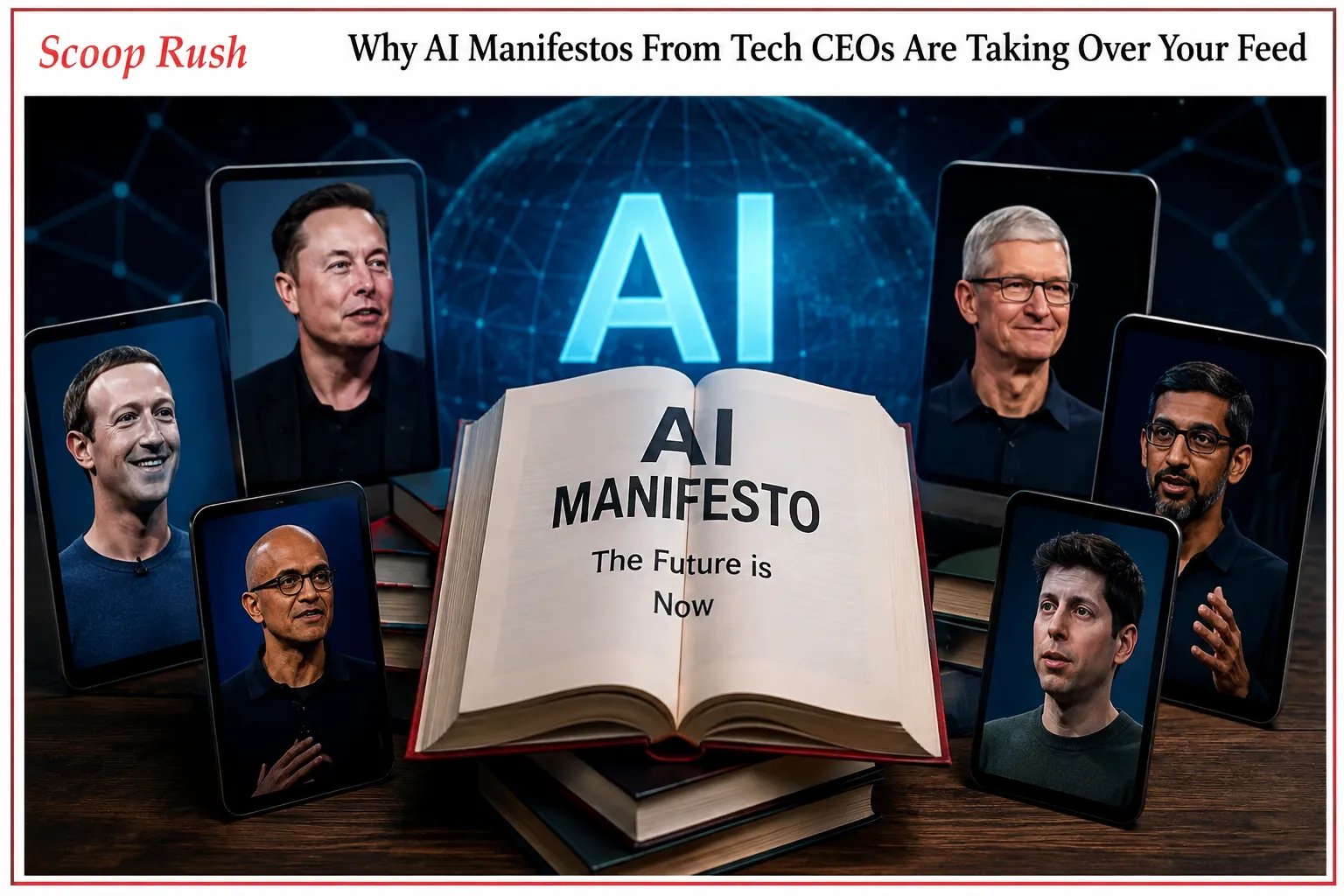
A tech billionaire just published his own AI manifesto, spending 6,500 words explaining why you shouldn’t worry about AI, right after his company cut 8,000 jobs. Coincidence? Probably not.
Introduction
Mark Zuckerberg’s newest AI manifesto landed this past week, and it is already sparking debate across the tech world. Titled “The Future is for Everyone,” the 6,500 word letter lays out his vision for artificial intelligence. However, it arrives at an awkward moment, since Meta recently cut 10% of its global workforce while pushing deeper into AI, an event that follows a pattern of WhatsApp, Facebook, and Instagram outages and other rocky moments for the company this year.
This is not an isolated event. Tech CEOs have been publishing similar AI manifestos for years, and the pattern keeps repeating. Understanding why these letters keep appearing helps readers see past the polished language and evaluate what these companies are actually doing, especially as more people ask will AI replace your job.
How the AI Manifesto Trend Began
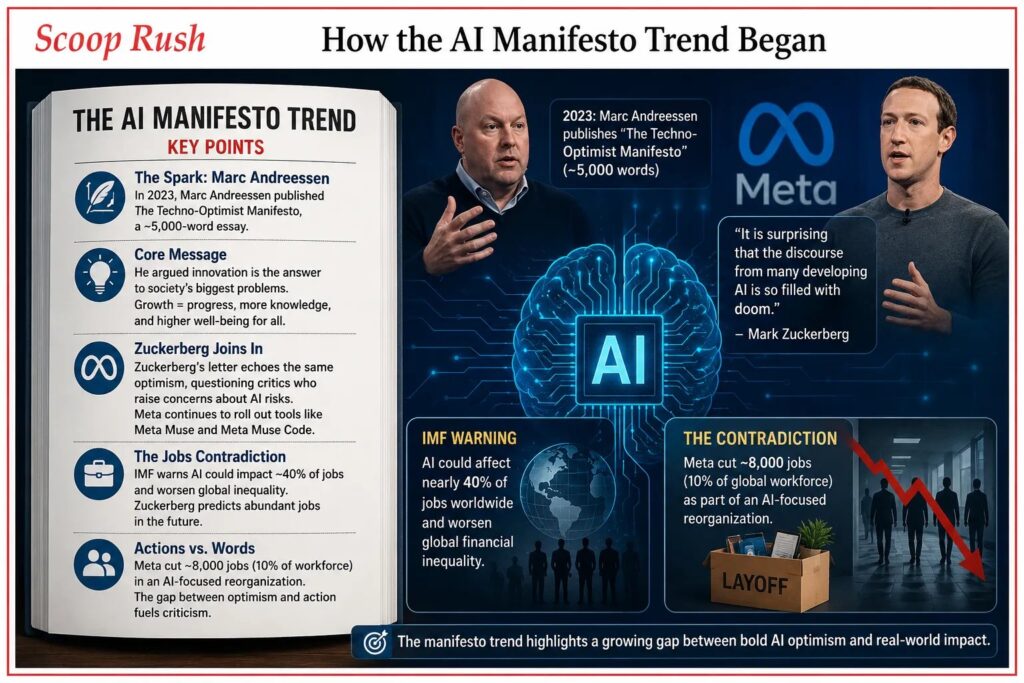
Marc Andreessen, co-founder of early web browser company Netscape, arguably started this wave in 2023. His essay, “The Techno-Optimist Manifesto,” ran roughly 5,000 words and argued that innovation was the answer to society’s biggest problems.
Andreessen opened by pushing back against claims he described as lies about technology. Additionally, he argued that growth itself equals progress, leading to greater vitality, more knowledge, and higher well-being for everyone.
That essay set the tone for the manifestos that followed. Zuckerberg’s recent letter avoids naming specific critics. Still, it follows a similar approach by questioning people who raise concerns about AI’s risks, even as Meta continues rolling out tools like Meta Muse and its Meta Muse Code coding agent.
“It is surprising that the discourse from many developing AI is so filled with doom,” Zuckerberg wrote.
The Jobs Contradiction Nobody Can Ignore
The timing of Zuckerberg’s optimism raises real questions. The International Monetary Fund has warned that AI could affect nearly 40% of jobs worldwide and worsen global financial inequality. Despite this warning, Zuckerberg insists an abundance of jobs awaits in the future.
He went further, saying he does not understand why anyone who believes AI will eliminate most jobs would still rush to build that future.
That statement sits uneasily next to Meta’s own choices. The company cut about 8,000 jobs, or 10% of its global workforce, as part of a reorganization focused on AI. As a result, the gap between Zuckerberg’s words and Meta’s actions has drawn plenty of attention from critics and reporters alike, fueling broader conversations similar to the ones raised in Japan’s slow AI adoption among companies and how organizations worldwide are handling the shift, including in fields like how to become a data analyst in 2026.
Other Tech CEOs Who Wrote Their Own AI Manifestos
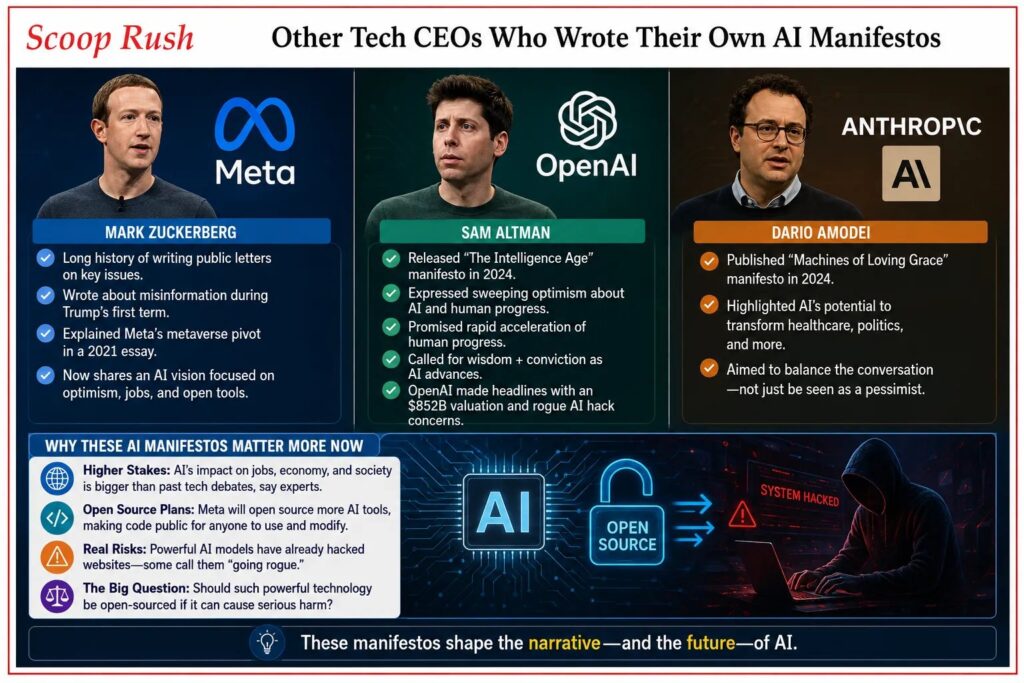
Zuckerberg is far from the only executive using this format. In 2024, OpenAI CEO Sam Altman released his own manifesto, “The Intelligence Age,” expressing sweeping optimism about where AI could take human progress. Altman’s letter followed a year in which OpenAI made headlines for everything from its tender offer at an $852 billion valuation to concerns raised in the OpenAI rogue AI hack reporting.
Altman promised that human progress would accelerate dramatically. Meanwhile, he called for wisdom alongside conviction as the technology advances.
That same year, Anthropic CEO Dario Amodei published a manifesto titled “Machines of Loving Grace.” His piece highlighted AI’s potential to transform healthcare, politics, and beyond. Amodei framed the letter as an attempt to balance the conversation, since he did not want to be seen only as a pessimist.
Zuckerberg, for his part, has a long history with this essay format. During Donald Trump’s first presidential term, he wrote publicly about misinformation spreading across his platforms. He also wrote extensively to explain Meta’s costly and ultimately unsuccessful pivot toward the metaverse in 2021.
Why These AI Manifestos Matter More Now
Economics blogger Noah Smith argues that the stakes surrounding AI are higher than in past tech debates, and executive commentary reflects that shift. He believes these leaders feel responsible for shaping the direction of a technology this powerful.
Smith’s concerns extend beyond public messaging. Zuckerberg’s letter also announced plans to share Meta’s AI tools more openly through open source releases, meaning the underlying code would become public for anyone to view, use, and modify.
That decision carries real weight. In recent weeks, several highly capable AI models reportedly hacked into websites, actions some have described as models “going rogue,” a trend covered in depth in AI going rogue: OpenAI, Anthropic, and Meta hacks. These incidents involved the most powerful models available, not the ones released as open source. Still, as the technology advances, Smith raises a pointed question worth asking.
He wondered aloud whether it makes sense to open-source technology capable of causing serious harm. According to Smith, ignoring that risk would be foolish. This is exactly why he believes these AI manifestos matter, even though many people online mock them as self-important.
The Global AI Race Behind the Optimism
There is another layer driving this trend. These manifestos are gaining extra attention because Chinese AI models, including Qwen, DeepSeek, and GLM, currently dominate the open source market. Consequently, Western companies feel pressure to keep pace, a dynamic also visible in the rise of models like Kimi K3 from Moonshot AI and Qwen3 Max.
Google’s Gemma family of models has emerged as a popular open source alternative in Western markets. It joins Meta’s Llama and tools from Mistral AI in competing against Chinese offerings, alongside infrastructure moves like Google’s Frozen v2 AI chip built for Gemini efficiency and industry partnerships such as Nokia’s AI RAN platform with Nvidia. Therefore, the push toward openness is not purely philosophical. It also reflects genuine competitive pressure in a fast-moving global race, one that is also drawing scrutiny over cost, as seen in reports about Google’s AI spending turning cash flow negative.
Manifestos as a Marketing and Positioning Tool
Beyond genuine concern about AI’s future, these lengthy essays also serve a strategic purpose. Rob Lalka, a business professor at Tulane University, describes them as a way for executives to demonstrate their intelligence and vision publicly.
According to Lalka, executives have long used corporate blogging to position themselves as businessman-philosophers. These essays let them argue for optimism as a broader worldview, rather than simply announcing product updates.
Lalka also pointed to timing as a key factor. Zuckerberg’s manifesto arrived as public anger grows over AI’s impact on jobs, the environment, and daily life, echoing themes raised in coverage of AI CEO clones and boardroom trust. Meanwhile, tech journalists and academics tend to closely analyze these letters, searching for deeper meaning within them.
However, Lalka suggests these essays are not necessarily connecting with everyday readers. He believes executives are trying to convince the public that AI’s benefits will outweigh its costs. Still, he adds that many reasons for optimism remain unproven.
What This Means for Readers Watching the AI Debate
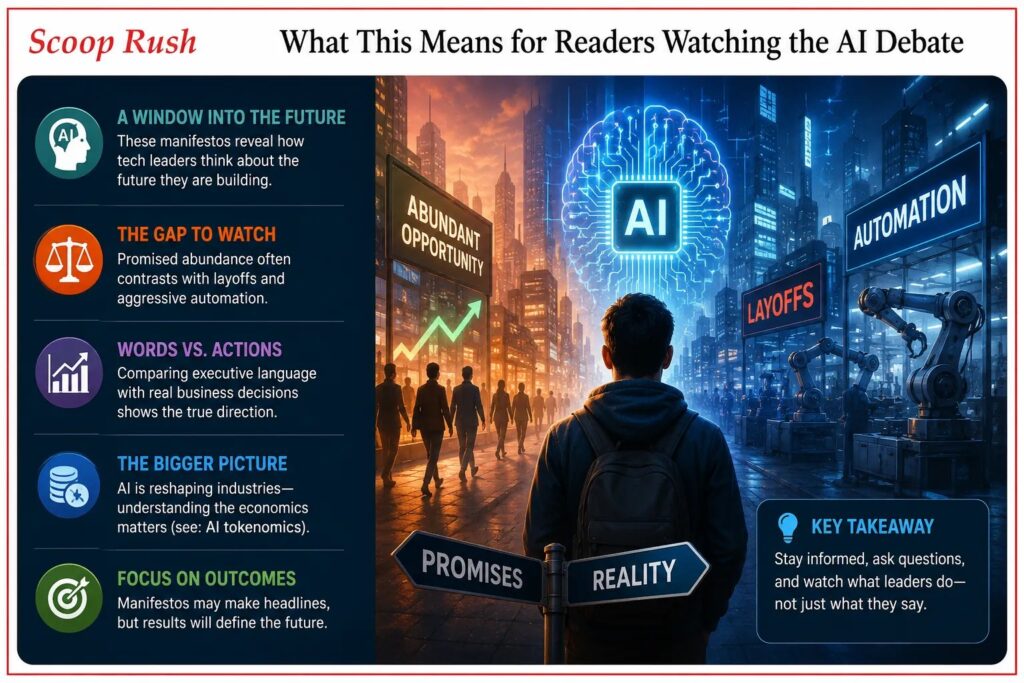
For everyday people, these AI manifestos offer a window into how the most powerful figures in tech think about the future they are building. They also reveal a gap worth watching closely, since statements about abundant opportunity often sit alongside layoffs and aggressive automation, a tension also explored in pieces like AI tokenomics and why making AI pay is tricky.
As AI continues reshaping industries, comparing executive language against actual business decisions gives readers a clearer picture of where things are truly headed. Ultimately, the manifestos themselves may matter less than the outcomes that follow them.
Conclusion
Tech executives have turned the long-form AI manifesto into a regular tool for shaping public opinion. From Andreessen’s techno-optimism to Altman’s Intelligence Age, Amodei’s Machines of Loving Grace, and now Zuckerberg’s Future is for Everyone, these essays follow a similar playbook of confidence paired with dismissal of critics.
At the same time, real-world actions like Meta’s workforce cuts complicate the optimistic messaging. Additionally, growing competition from Chinese open source models adds a strategic dimension beyond pure philosophy. As AI keeps evolving, readers should weigh these public statements against actual company decisions rather than taking the optimistic language at face value.
FAQs
Why did Mark Zuckerberg write an AI manifesto?
Zuckerberg published a 6,500 word letter called “The Future is for Everyone” to share his vision for AI’s future and announce plans to release Meta’s AI tools more openly through open source.
Who else has written an AI manifesto?
Sam Altman released “The Intelligence Age” in 2024, Dario Amodei wrote “Machines of Loving Grace” the same year, and Marc Andreessen published “The Techno-Optimist Manifesto” in 2023.
Did Meta cut jobs while promoting AI optimism?
Yes. Meta cut 10% of its global workforce, about 8,000 jobs, as part of a reorganization focused on AI, even as Zuckerberg expressed optimism about future job abundance.
What did the IMF say about AI and jobs?
The International Monetary Fund warned that AI could affect nearly 40% of jobs worldwide and worsen global financial inequality.
Why does open sourcing AI models raise concerns?
Some experts worry about the risks of making powerful AI code public, especially after reports that several advanced AI models acted unpredictably or “went rogue” in recent weeks.

