Home Blog Page 15

Ukraine Drone Attack on Russia Kills at Least Six

0

The Ukraine drone attack on Russia became one of Kyiv’s largest aerial assaults. Russian authorities reported 822 drones across several regions overnight. The strikes hit areas near Moscow and southern Russia. At least six people reportedly died in the attacks.

The assault also caused major fires and infrastructure damage. A large Wildberries warehouse near Moscow caught fire. Meanwhile, Ukrainian officials reported fresh Russian strikes across Ukraine. The attacks showed how both sides continue expanding their aerial warfare.

Ukraine Drone Attack Reaches Moscow Region

Ukraine-Drone-Attack-Reaches-Moscow-Region

Russia reported a huge wave of Ukrainian drones overnight on August 16. The Russian Defense Ministry said it intercepted or destroyed 822 drones. Officials reported drone activity across 17 Russian regions. Moscow faced an especially intense part of the attack.

Moscow Mayor Sergei Sobyanin reported around 600 drones heading toward the capital. Russian air defenses destroyed 201 drones over Moscow region, according to officials. These figures remain difficult to verify independently. The attack marked a major escalation in Ukraine’s long-range drone campaign.

Wildberries Warehouse Catches Fire Near Moscow

One major strike hit a Wildberries logistics facility near Podolsk. The warehouse sits around 45 kilometers south of Moscow. Reuters footage showed thick smoke rising above the facility. Russian authorities said the attack caused a large fire.

The facility belongs to Wildberries, one of Russia’s largest online retailers. Ukrainian forces have repeatedly targeted the company’s logistics facilities. Kyiv claims some Wildberries operations support Russian military supply networks. Ukraine has increasingly targeted Russian economic infrastructure during 2026.

Rostov Region Reports Five Deaths

Rostov-Region-Reports-Five-Deaths

The southern Rostov region also faced a major drone wave overnight. Regional Governor Yuri Slyusar reported five deaths there. He also reported damage to homes and other infrastructure. Ukrainian forces said they struck a defense-industrial facility in Rostov.

Kyiv described the site as a producer of solid rocket propellant. Russia has not independently confirmed Ukraine’s description of the target. The Rostov strikes added another serious dimension to the overnight assault. The region borders Ukraine and frequently faces Ukrainian drone attacks.

Moscow Region Suffers Civilian Casualty

An 83-year-old man died after a drone struck a home. Moscow region Governor Andrey Vorobyov reported the death. Officials also reported injuries linked to the wider attacks. The reported death highlighted the risks for civilians near targeted areas.

Drone warfare increasingly reaches populated regions far from active battlefronts. Moscow and surrounding areas have faced repeated Ukrainian drone attacks this year. Russian authorities described the assault as one of the largest attacks recently. Emergency teams continued checking affected areas after the overnight strikes.

Russia Continues Strikes Across Ukraine

Russia launched another large aerial assault against Ukraine during the same period. Ukrainian officials reported missile and drone strikes across several cities. The attacks killed civilians and damaged critical infrastructure. Kyiv suffered another missile attack during the early morning hours.

A book market in the city caught fire after the strike. Ukrainian officials said six people suffered injuries in the capital. Other Russian strikes hit Kryvyi Rih, Sumy, and other Ukrainian locations. Ukrainian authorities reported deaths in several affected areas.

Air War Intensifies Between Russia and Ukraine
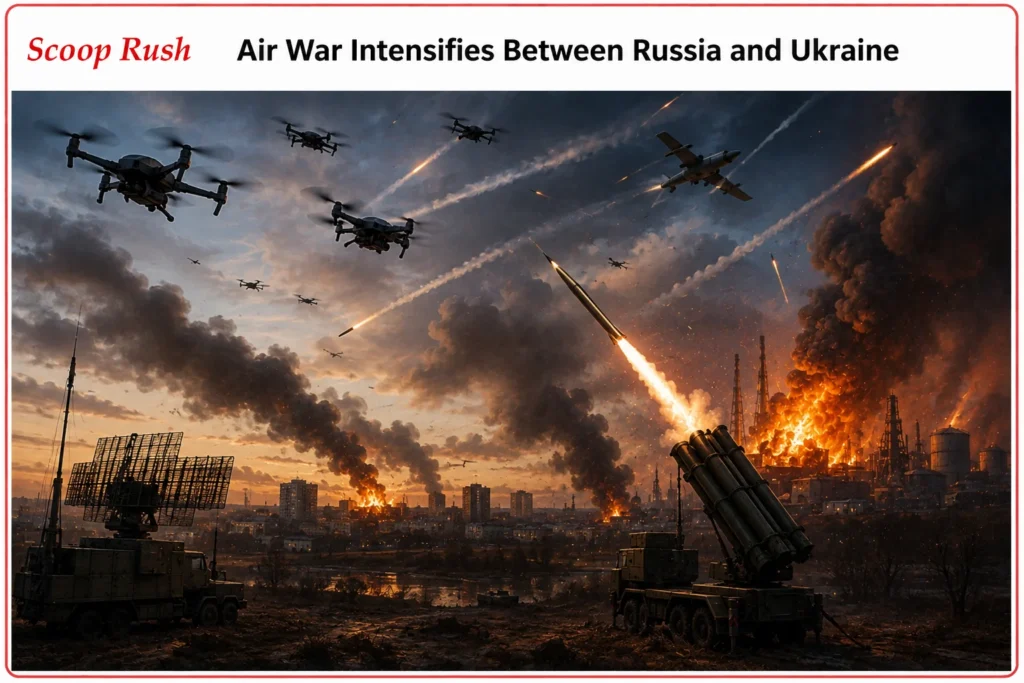
Air-War-Intensifies-Between-Russia-and-Ukraine

The latest attacks show the growing scale of the Russia-Ukraine air war. Both countries now launch drones hundreds of kilometers beyond frontline areas. Their attacks increasingly target infrastructure, logistics hubs, and industrial facilities. Ukraine has expanded its ability to conduct long-range strikes inside Russia.

Kyiv has targeted oil facilities, warehouses, ports, and military sites. These attacks seek to disrupt Russia’s military supply chains and economic capacity. Russia continues using drones and missiles against Ukrainian cities. The repeated barrages have placed additional pressure on air-defense systems.

Spanish Fighter Shoots Down Drone Over Romania

The latest escalation also affected neighboring NATO territory. A Spanish F-18 fighter intercepted a drone over Romanian airspace. The aircraft operated as part of a NATO air-policing mission. The drone entered Romania from the direction of Moldova, according to officials.

Romanian authorities said debris fell in an uninhabited area. NATO officials said the drone appeared to have Russian origins. Romania has repeatedly faced drone incidents during the war. The incident shows how the conflict can affect neighboring countries.

Ukraine Expands Long-Range Strike Strategy

Ukraine-Expands-Long-Range-Strike-Strategy

Kyiv has increasingly used long-range drones against targets inside Russia. The strategy represents an important shift in Ukraine’s military approach. Ukrainian forces previously focused more heavily on frontline operations. Now, Ukrainian drones can reach important targets far from the battlefield.

Kyiv has attacked Russian warehouses, refineries, ports, and military facilities. These operations aim to disrupt Russia’s ability to sustain its war effort. Ukrainian officials accuse Wildberries of supporting Russian military logistics. The attacks also create economic pressure inside Russia.

What the Latest Drone Assault Means

The scale of the Ukraine drone attack on Russia highlights Kyiv’s growing reach. Russia reported hundreds of drones across multiple regions. Moscow itself faced one of the largest recent drone waves. The attack also shows the changing nature of the conflict.

Ukraine increasingly combines battlefield operations with deep strikes. Russia continues responding with large missile and drone attacks against Ukrainian cities. Neither side appears ready to reduce its aerial campaign. Instead, both continue developing longer-range capabilities.

Conclusion

The Ukraine drone attack on Russia marked another major escalation in the conflict. Russia reported 822 intercepted drones during the overnight assault. Moscow and Rostov faced some of the heaviest reported activity. At least six people reportedly died across Russia.

The Wildberries warehouse fire became one of the attack’s most significant incidents. At the same time, Russia continued striking targets across Ukraine. The attacks also reached beyond the immediate combatants. A Spanish NATO fighter shot down a drone over Romania.

FAQs

1. What happened during the Ukraine drone attack on Russia?

Ukraine launched a major overnight drone assault across Russia. Moscow reported 822 Ukrainian drones intercepted or destroyed. The attack targeted areas near Moscow and southern Russia.

2. How many people died in the Russian drone attacks?

Russian authorities reported at least six deaths. Five deaths occurred in the Rostov region, according to its governor. An 83-year-old man also died in the Moscow region.

3. What happened to the Wildberries warehouse?

A Ukrainian drone strike caused a major fire there. The warehouse sits near Podolsk, south of Moscow. Reuters footage showed thick smoke rising from the facility.

4. Did Russia attack Ukraine during the same period?

Yes, Russia launched missiles and drones against several Ukrainian areas. Kyiv reported deaths, injuries, fires, and infrastructure damage. A book market in Kyiv also caught fire after a strike.

5. Why does the latest attack matter?

The attack demonstrates Ukraine’s expanding long-range strike capability. It also shows the growing scale of aerial warfare. Both sides increasingly target infrastructure far from the front lines.


Bangladesh Beat Australia by 9 Wickets in Historic First Test Win

0

Nobody saw this coming. Not the pundits, not the bookmakers, and certainly not Australia. On a sweltering afternoon in Darwin, Bangladesh beat Australia by nine wickets to claim their first-ever Test victory on Australian soil. The result has stunned the cricketing world.

This wasn’t a close call either. Bangladesh dominated from start to finish, and the manner of the win made it even more remarkable. A team ranked ninth in the world walked into the home of the top-ranked Test side and simply outplayed them. For a country that had waited 26 years for this moment, the celebrations in Darwin were nothing short of euphoric.

If you’re wondering how Bangladesh beat Australia, why it matters, and what it means for the future of Bangladesh cricket, you’re in the right place. Let’s break down every twist of this historic Test.

Why Bangladesh Beating Australia Is Such a Big Deal

To understand the magnitude of this result, you need context. Australia had never lost a home Test to Bangladesh before this match. In fact, Bangladesh had never won a single Test in Australia across their entire history in the format.

Additionally, Bangladesh hadn’t played a Test series in Australia since 2003, when they lost 2-0. The two sides simply hadn’t crossed paths in the longest format on Australian soil since then. So this wasn’t just a win. It ended a 23-year wait with a result nobody predicted.

Consequently, former players, commentators, and fans have called it one of the biggest boilovers in the sport’s history. ABC commentator Jim Maxwell captured the mood perfectly. He described the result as one of the most embarrassing defeats Australia have suffered in Test cricket.

How Bangladesh Beat Australia: A Day-by-Day Breakdown

The opening Test of the two-match series began with Australia struggling badly. Bowlers dismissed the hosts for just 198 in their first innings, with Steve Smith top-scoring on 71. Seamer Hasan Mahmud ran through the batting order and finished with figures of 6-55.

Bangladesh responded in style. Opener Tanzid Hasan anchored the innings with a maiden Test century, scoring 101, as the team posted a commanding 426. Captain Najmul Hossain Shanto added 84, while all-rounder Mehidy Hasan Miraz chipped in with a gritty 65 lower down the order. Fast bowler Josh Hazlewood claimed 6-89 for Australia, but it wasn’t enough to stop Bangladesh building a huge first-innings lead.

That lead put Australia under enormous pressure heading into their second innings. Cameron Green fought hard for a valiant 104, yet he couldn’t rescue his side alone. Miraz struck again as the chief destroyer, taking 5-66 to bowl Australia out for 284.

With just 57 runs needed for victory, Bangladesh made light work of the chase. Mominul Haque finished unbeaten on 30, and his boundary off Beau Webster sealed the historic nine-wicket win on day four, a day ahead of schedule.

Bangladesh vs Australia First Test: Full Scorecard

Here’s how the numbers stacked up across the four days of play:

  • Australia first innings: 198 all out (Steve Smith 71; Hasan Mahmud 6-55)
  • Bangladesh first innings: 426 all out (Tanzid Hasan 101, Najmul Hossain Shanto 84, Mehidy Hasan Miraz 65; Josh Hazlewood 6-89)
  • Australia second innings: 284 all out (Cameron Green 104; Miraz 5-66)
  • Bangladesh second innings: 57-1 (Mominul Haque 30 not out)
  • Result: Bangladesh won by nine wickets

The Bangladesh Stars Who Powered This Historic Test Win

The Bangladesh Stars Who Powered This Historic Test Win

Two players stood above the rest in Bangladesh’s win over Australia. Their contributions turned a competitive contest into a rout.

Mehidy Hasan Miraz’s Match-Defining Performance

Hasan Mahmud picked up the player-of-the-match award, but Miraz arguably shaped the outcome of the game on the final day. His five-wicket haul in the second innings dismantled Australia’s batting lineup piece by piece.

He caught wicketkeeper Alex Carey behind for 30, then bowled all-rounder Webster for just five with a pair of superb deliveries. Shortly after, he had Australia captain Pat Cummins caught in close for eight runs.

A defiant 43-run partnership between Green and Mitchell Starc briefly threatened to delay the inevitable. However, Taskin Ahmed broke that stand and had Starc caught behind for 18. Miraz then returned to remove Nathan Lyon, bringing Bangladesh to the brink of victory.

Earlier in the match, Miraz had also dismissed Australia’s biggest wicket, Steve Smith, in the second innings, further tilting momentum in Bangladesh’s favour. Combined with his 65 runs in the first innings, this was a genuine all-round performance that deserves just as much credit as Mahmud’s nine wickets across the match.

Hasan Mahmud’s Player-of-the-Match Heroics

Hasan Mahmud stood out as the top bowler of the Test. He finished with 6-55 in the first innings and added another 3-56 in the second. His new-ball spells set the tone early, and his dismissal of a well-set Cameron Green in the second innings effectively ended Australia’s hopes of saving the match.

His consistency throughout the four days made him the deserving player of the match, even as Miraz’s all-round contribution ran him close.

What the Captains Said After Bangladesh Beat Australia

Emotions ran high once the final wicket fell. Bangladesh captain Najmul Hossain Shanto didn’t hold back when he described the significance of the win.

“This is the biggest win so far for Bangladesh in any format,” Shanto said. “Going forward we want to do something special in the future. I’m very happy, proud of myself and the way the boys played. We did a lot of hard work.”

Shanto also pointed to a broader shift in mindset among Bangladesh’s fast bowlers as a key factor behind the team’s improved Test performances. He explained that pacers previously showed little interest in playing the longer format, but that attitude has changed significantly in recent years. He credited senior players like Mushfiqur Rahim and Mominul Haque for encouraging younger bowlers to embrace Test cricket and aim to become world class.

Australia captain Pat Cummins, meanwhile, was gracious in defeat. “They outplayed us in all facets, they were patient and disciplined,” Cummins admitted. “I thought our prep was spot-on, no excuses.”

That kind of honest reflection from a captain of Australia’s stature shows just how thoroughly Bangladesh dominated the contest.

The Backstory That Makes This Bangladesh Win Even More Remarkable

Here’s the twist that makes this victory almost unbelievable. Just days before the Test began, a Cricket Australia XI bowled Bangladesh out for a mere 54 runs in a warm-up match, also played in Darwin. On paper, that result suggested a heavy defeat was coming in the real Test.

Furthermore, Bangladesh’s recent form heading into the tour had been shaky. In June, Zimbabwe, the lowest-ranked of cricket’s ten Test-playing nations, thrashed them in a one-off match in Harare. Given that history, few could have predicted what was about to unfold in Darwin.

To add to the challenge, Bangladesh went into the Test without two of their leading fast bowlers. Injuries ruled out Nahid Rana and Shoriful Islam, meaning the bowling attack that dismantled Australia twice did so without two frontline options. That makes the collective bowling performance from Hasan Mahmud, Miraz, and Taskin Ahmed even more impressive.

How Bangladesh Celebrated a Historic Win Over Australia

How Bangladesh Celebrated a Historic Win Over Australia

The scale of the achievement wasn’t lost on anyone back home. Bangladesh Prime Minister Tarique Rahman personally congratulated the team on a video call after the win.

“We’re all eagerly waiting to welcome you home,” he told the players on social media, reflecting the national pride surrounding the result.

For a cricketing nation that critics have often written off in the Test format, this win offers a powerful moment of validation. It’s a reminder that with the right application and belief, even the underdogs can topple giants on their own turf.

What Beating Australia in Australia Means for Bangladesh’s Test Future

Australia’s only previous Test defeat at the hands of Bangladesh came in Mirpur back in 2017. That win happened on home soil, in conditions familiar to Bangladesh’s players. This latest victory is entirely different because it happened away from home, against a full-strength Australian side, in Australian conditions.

That distinction matters enormously. It shows Bangladesh can now compete and win outside their comfort zone, which has historically been one of the biggest criticisms of the team in the longest format.

As a result, this victory could mark a genuine turning point. If the mindset shift among the fast bowlers that Shanto referenced continues, and senior players keep mentoring the next generation, Bangladesh may finally start closing the gap with the established Test powers.

Looking Ahead to the Second Test

The series isn’t over yet. This was only the first of a two-Test series, with the second Test set to begin on 22 August. Australia will undoubtedly come back fired up, especially after Cummins’ candid admission that Bangladesh beat his side in every department.

For Bangladesh, though, the pressure has reversed. Instead of chasing history, they’ll look to complete a first-ever series win in Australia, something that would cement this tour as one of the greatest in the country’s cricketing history.

Fans wanting to follow the action can catch live ball-by-ball commentary on BBC Radio 5 Sports Extra, with coverage starting in the early hours UK time each day.

Final Thoughts

Bangladesh’s nine-wicket win over Australia in Darwin will go down as one of the most extraordinary results in modern Test cricket. A team written off after a humiliating warm-up defeat and a poor run of form somehow produced its best performance in a Test match, at exactly the right moment, against exactly the opponent that mattered most.

Hasan Mahmud’s nine wickets across the match earned him the player-of-the-match award, but this was every bit a team effort. Miraz’s all-round brilliance, Tanzid Hasan’s century, and disciplined bowling throughout gave Bangladesh the platform it needed.

Ultimately, this win proves Bangladesh can compete with, and beat, the very best in the world, even away from home. With the second Test just around the corner, all eyes will now watch whether Bangladesh can back up this famous win with a series victory to match.

Frequently Asked Questions

1. Did Bangladesh really beat Australia in a Test match for the first time? 

Yes. Bangladesh beat Australia by nine wickets in the first Test of their series in Darwin, marking their first-ever Test win on Australian soil in 26 years of playing Test cricket.

2. Who was the player of the match when Bangladesh beat Australia? 

Hasan Mahmud earned the player-of-the-match award after taking 6-55 in the first innings and 3-56 in the second innings, finishing with nine wickets in total.

3. What was the final result of the Bangladesh vs Australia first Test? 

Bangladesh won by nine wickets after bowling Australia out for 284 in the second innings and chasing down the required 57 runs with the loss of just one wicket.

4. When is the second Test between Bangladesh and Australia? 

The second Test of the two-match series begins on 22 August, with live ball-by-ball commentary available on BBC Radio 5 Sports Extra.

5. Has Bangladesh ever beaten Australia in Test cricket before? 

Yes, but only once before this Test, in Mirpur in 2017. That win came on home soil, whereas the Darwin victory marked Bangladesh’s first Test win on Australian territory.

Disneyland Delays Avatar Expansion to Fast-Track Tomorrowland Reimagining

0

Disney just confirmed the Disneyland Avatar delay that fans have quietly feared for years. The long-awaited Avatar expansion is moving to the back of the line. Tomorrowland is jumping ahead of it instead.

If you’ve been counting down the days until Pandora opens in Anaheim, this update changes everything you thought you knew about the resort’s next decade.

What Disney Announced at the 2026 D23 Expo

At the 2026 D23 Expo, Disneyland leadership laid out a revised construction roadmap for Disney California Adventure and Disneyland park. This news matters because it reshuffles nearly every major project on the horizon. That includes everything from Avengers Campus to the new Coco attraction. It also pushes the Avatar destination further into the future than most fans expected.

Disneyland President Jill Estorino confirmed the update during a media briefing. She was joined by Imagineering Portfolio Executive Creative Producer Emily O’Brien and Disney Experiences Chair Thomas Mazloum. Everything currently under construction stays on schedule. Avengers Campus, the Coco boat ride, and the Eastern Gateway transportation hub all keep their original timelines.

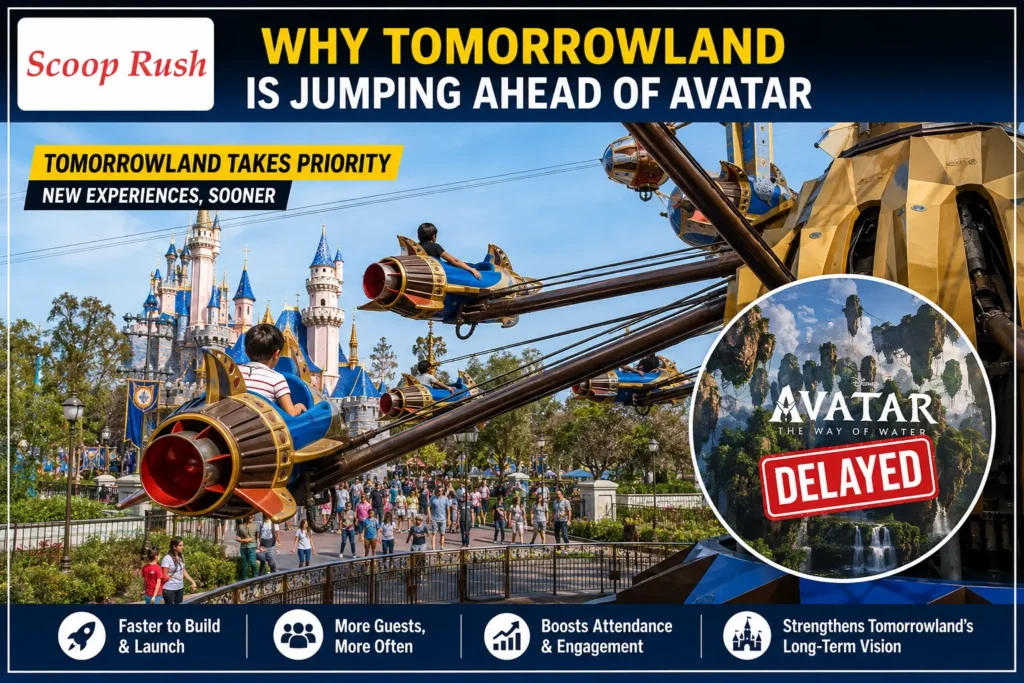
However, the order of everything after those three projects has changed. Disney will not move straight into the Avatar destination once Coco wraps up. Instead, Imagineers will shift focus to reimagining Tomorrowland first. Only after that work finishes will crews return to the Hollywood Backlot to build the Avatar land.

Confirmed Opening Dates Ahead of the Avatar Delay

A few solid dates came out of the presentation. Stark Flight Lab and Avengers Infinity Defense, the two new attractions at Avengers Campus, will open in 2028. That timeline lands later than many fans hoped, since a 2027 debut once seemed possible.

Disney has not announced an official opening year for the Coco boat ride yet. Still, since it follows Avengers Campus in the construction queue, a 2029 opening looks like a safe bet. Meanwhile, the Eastern Gateway parking and transportation hub also targets 2028, and crews will ramp up work there in the coming weeks.

Why Tomorrowland Is Jumping Ahead of Avatar

Why Tomorrowland Is Jumping Ahead of Avatar

Tomorrowland has needed a refresh for a long time. Now it sits next in line once the current wave of construction wraps up. Disney says phased work on Tomorrowland could realistically begin after Avengers Campus opens but before Coco debuts. The goal is simple: keep attractions opening at a steady pace instead of clustering them together.

If that timeline holds, Tomorrowland’s phased opening could begin around 2030. That timing pushes the Avatar destination even further out, with a realistic opening window of 2032 or later.

Disney argues this order makes more sense logistically and delivers new experiences to guests more often. Rather than making guests wait years between openings, spacing out these debuts keeps something new arriving at the resort on a regular basis.

Eastern Gateway Explains the Avatar Delay

Here’s the piece that explains almost everything else on this list. Eastern Gateway isn’t just another parking structure. It’s the key that unlocks space for the Avatar destination.

The new hub will occupy part of the current Manchester Cast Member parking lot and will add roughly 6,000 parking spaces, plus shuttle areas, rideshare drop-off, and security screening. A pedestrian bridge over Harbor Boulevard will connect guests to a new arrival esplanade, and it will also give the public access to and from Harbor Boulevard itself.

This detail matters because Disney needs to demolish the old bus loops to make room for the Avatar destination’s show building and surrounding landscape. However, that demolition can’t start until Eastern Gateway becomes fully operational and takes over transportation duties for the resort. As a result, space for Avatar construction likely won’t open up until 2028, which naturally pushes the entire project later.

Is the Disneyland Avatar Project Getting Cancelled?

This is the question on every fan’s mind, and honestly, nobody knows for certain. Disney has never given Avatar a firm start date or completion year. Company representatives have consistently described the project as being in the early stages of development. So technically, nothing has been “delayed” in the strictest sense, since there was never an official date to delay in the first place.

Still, slotting Tomorrowland ahead of Avatar in the construction queue sends a clear signal. The Avatar destination isn’t coming any time soon. Most industry watchers now expect construction won’t start until 2029 at the earliest, with 2030 also plausible. That timeline points to an opening somewhere around 2032 or later.

Signs Pointing in Both Directions

There are reasons for both optimism and skepticism here. On the encouraging side, Disney displayed a detailed model of the Avatar destination in the Imagineering pavilion at the D23 Expo show floor. The model shows a monorail routed around the back of the show building in a way that suggests genuine planning has gone into the project, not just early concept sketches.

On the other hand, time works against Avatar. Every year that passes without a construction start date fuels speculation that the project could eventually shrink or disappear altogether. This kind of long, quiet gap isn’t unprecedented, either. The original Pandora at Disney’s Animal Kingdom saw minimal movement for years before construction finally began. Therefore, a slow build-up doesn’t automatically mean cancellation.

Ultimately, the straightforward explanation may be the correct one. Building Tomorrowland first could simply be the more efficient sequencing choice for Disney’s construction teams, especially since Tomorrowland has needed attention for roughly two decades regardless of Avatar’s status.

How the Avatar Delay Affects Monsters, Inc. Mike & Sulley to the Rescue

How the Avatar Delay Affects Monsters, Inc. Mike & Sulley to the Rescue

Fans have also watched the fate of Monsters, Inc. Mike & Sulley to the Rescue closely. Disney already pushed the ride’s permanent closure back once, from early 2026 to sometime in 2027, and hasn’t given an exact closure date within that window.

Given the new timeline, the ride will likely avoid closing in 2027, and possibly even in 2028. Eastern Gateway remains the true prerequisite for freeing up space near the Hollywood Backlot, and that project won’t finish until 2028. So there’s simply no urgent need to close Monsters, Inc. ahead of schedule. Disney reportedly shifted the sequencing of other projects specifically to give this attraction a reprieve without slowing anything else down.

Why This Timeline Shift Makes Sense for Disneyland

Building an entire resort district takes years of planning, permitting, and construction, and Disneyland’s footprint is far more compact than properties like Walt Disney World. Every new project has to work around existing infrastructure, guest flow, and parking capacity.

Therefore, prioritizing Eastern Gateway first is a logical move. Without it, bigger and more ambitious projects like Avatar can’t move forward. Additionally, Tomorrowland’s aging attractions have needed a refresh for roughly two decades, so giving that land priority over an entirely new, unbuilt destination is a reasonable business decision.

Consequently, Disney appears to be betting that spacing out major openings will keep guest interest high. Avengers Campus arrives in 2028, Coco follows in 2029, Tomorrowland begins around 2030, and Avatar lands in 2032 or later. This pacing should also keep construction disruption manageable across a longer stretch of time.

The Case for Betting on Pandora at Disneyland

Despite the uncertainty, there’s a strong argument for Disney following through on the Avatar destination. Pandora currently holds the top spot for guest satisfaction at Walt Disney World, and Avatar Flight of Passage consistently draws long lines and glowing reviews.

That kind of proven popularity is hard to ignore. A West Coast version of Pandora, even a more compact one, could pair a strong headliner attraction with the same immersive world-building that made the original such a hit. Some fans have also pointed to the ride system used in Pirates of the Caribbean: Battle for the Sunken Treasure at Shanghai Disneyland as a perfect fit for a new Avatar attraction, since no other park has used that technology in over a decade.

Ultimately, Avatar’s appeal doesn’t depend on knowing the movies. The franchise’s detailed, otherworldly setting translates naturally into a theme park experience. That alone explains why so many fans want to see it built, regardless of how the film series performs at the box office in future years.

Final Takeaways on the Disneyland Avatar Delay

Disney’s updated timeline confirms that Avengers Campus, Coco, and Eastern Gateway remain on track for 2028 and 2029 openings. However, the Avatar destination now sits behind a full Tomorrowland reimagining, with construction unlikely to start before 2029 and an opening realistically landing in 2032 or later.

The Eastern Gateway project remains the true linchpin behind the entire Disneyland Avatar delay, since Disney must complete it before clearing space for Avatar in the Hollywood Backlot. Meanwhile, Monsters, Inc. Mike & Sulley to the Rescue will likely stick around longer than originally planned, since there’s no pressing need to close it early.

Whether Avatar ultimately gets built as planned, shrinks in scope, or quietly fades away remains an open question. For now, Disneyland fans have a clearer picture of what’s coming next, even if the most anticipated project on the list is still years away.

Frequently Asked Questions

Is the Avatar land at Disneyland officially cancelled? 

No. Disney hasn’t cancelled the project. However, it has never given Avatar a confirmed start date or opening year, and the new timeline pushes it behind the Tomorrowland reimagining. Construction likely won’t begin until 2029 at the earliest.

When will the Avengers Campus expansion open at Disneyland? 

Stark Flight Lab and Avengers Infinity Defense will both open in 2028, according to announcements made at the 2026 D23 Expo.

What is the Eastern Gateway project at Disneyland Resort? 

Eastern Gateway is a new parking and transportation hub under construction on part of the Manchester Cast Member parking lot. It will add roughly 6,000 parking spaces, rideshare and shuttle areas, security screening, and a pedestrian bridge over Harbor Boulevard leading to a new arrival esplanade.

Why did Disney delay Avatar in favor of Tomorrowland? 

Disney is prioritizing the Tomorrowland reimagining before starting Avatar construction. Since Avatar also depends on Eastern Gateway finishing first to free up space in the Hollywood Backlot, both factors combine to push the project’s realistic opening to 2032 or later.

Will Monsters, Inc. Mike & Sulley to the Rescue close soon? 

It probably won’t close soon. Disney already pushed its permanent closure from 2026 to sometime in 2027, and given the revised construction timeline, it may stay open even longer since the space it occupies isn’t needed until Eastern Gateway finishes.

Arsenal’s Premier League Title Defence Begins: Coventry Clash Kicks Off 2026-27 Season

0

A Question Every Gunners Fan Is Asking

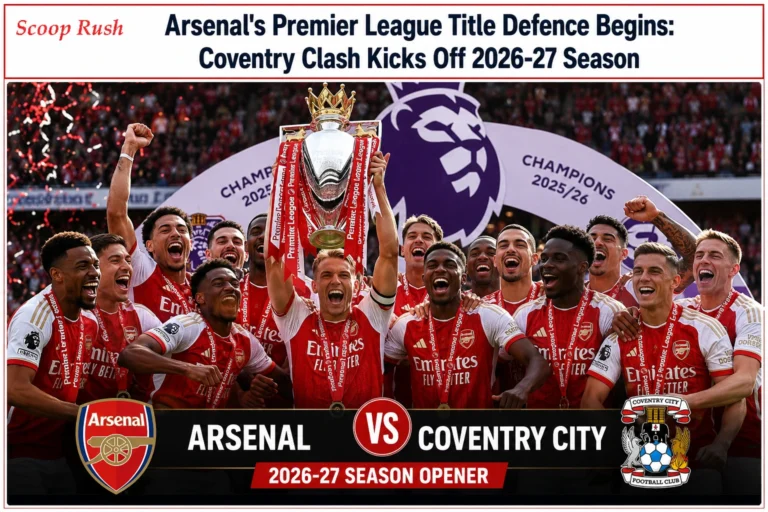
The Arsenal title defence 2026-27 begins this week, starting right at home against newly promoted Coventry City. Mikel Arteta’s side finished seven points clear of Manchester City last May. That effort finally ended their long wait for the trophy. Now they face a tougher task: staying at the top.

Premier League history treats title defences harshly. Since the league began, only a handful of managers have gone back-to-back. For Arsenal fans, the thrill of becoming champions comes wrapped in a nervous question. Can this squad do it all again?

This article breaks down what history tells us about title defences, how Arsenal’s rivals have strengthened, and whether the Gunners have the mentality and squad depth to go back-to-back.

Why a Premier League Title Defence Is So Difficult

Winning the league once is hard. Winning it twice in a row is a different challenge altogether, and the numbers prove it.

Manchester City changed the picture under Pep Guardiola. Before his arrival, though, the Premier League trophy changed hands every single season for eight years running. In fact, only two managers before Guardiola ever pulled off a successful title defence: Sir Alex Ferguson at Manchester United and Jose Mourinho at Chelsea.

That statistic is striking. It shows just how rare consistent dominance really is in English football, even for elite squads.

The Psychological Hurdle Behind Every Title Defence

Much of the difficulty isn’t tactical. It’s mental. A title-winning campaign demands months of sacrifice, pressure, and relentless focus. Once a team finally lifts the trophy, players feel a natural sense of relief.

However, that relief can quickly become a problem. Just months later, the same group must summon the same hunger again, this time with every rival specifically targeting them.

Leicester City’s 2016-17 season remains the cautionary tale people cite most often. After their fairytale title win, the Foxes battled relegation the very next year. One player from that squad compared it to reaching the top of a mountain, only to be told to climb it all over again.

Former Premier League winger Andros Townsend raised similar concerns about Arsenal. Speaking on BBC Radio 5 Live, he pointed to Liverpool as a recent example. Their last two title wins were followed by seasons where they simply couldn’t replicate that form, finishing third and fifth. Townsend’s point was simple: once a team crosses the finish line, rediscovering the same aggression the following season becomes genuinely difficult.

Arsenal’s Title Defence Advantage: Continuity in a Season of Change

The psychological challenge is real. Still, Arsenal hold one significant advantage this season: stability.

Mikel Arteta enters his seventh year in charge at the Emirates. That continuity stands out against a backdrop of change elsewhere in the league. Manchester City, Liverpool, and Chelsea all start the season under new managers. Meanwhile, Tottenham’s Roberto de Zerbi and Manchester United’s Michael Carrick are only just settling into their first full seasons, having been appointed mid-campaign last year.

That means several of Arsenal’s closest rivals are working through tactical adjustments and squad integration. Arteta’s group, by contrast, already knows exactly what’s expected of them.

Arsenal’s Transfer Business Ahead of the Title Defence

Unlike some rivals who overhauled entire squads, Arsenal made targeted additions. Greek forward Christos Tzolis arrived from Club Brugge for £34m. Brazilian midfielder Bruno Guimaraes joined from Newcastle United in a £75m deal.

Arteta has praised Guimaraes in particular. He describes the midfielder as a player with genuine leadership, charisma, and the character needed to push the whole club forward. The Arsenal boss made clear that personality and desire matter just as much as quality when building lasting success.

Injury Blow Threatens Arsenal’s Title Defence

The news isn’t all positive on the fitness front. Defender William Saliba faces an extended absence after suffering a back injury at the World Cup. His partnership with Gabriel Magalhaes anchored Arsenal’s defensive solidity last season. Losing him for a lengthy period could test the club’s depth at centre-back, even with reported interest in Aston Villa’s Ezri Konsa.

Can Arsenal’s Rivals Derail the Title Defence?

Can Arsenal's Rivals Derail the Title Defence?

Here’s where things get complicated for Arsenal fans hoping for a smooth title defence. Managerial changes create short-term uncertainty for some clubs. However, several of those same rivals have used the transfer window aggressively.

Chelsea’s Big-Money Rebuild Under Xabi Alonso

Chelsea, managed by highly rated Xabi Alonso, strengthened significantly. Alonso led Bayer Leverkusen to an unbeaten domestic double in 2023-24. This summer, he brought in England forward Morgan Rogers from Aston Villa for a club-record £117m, plus French defender Maxence Lacroix from Crystal Palace for £52m. New full-back Marco Palestra has reportedly impressed in pre-season. Experienced figures Jordan Henderson and Danny Welbeck also joined to add leadership to a young dressing room.

Manchester City and Manchester United Reload Their Midfields

Manchester City, now under Enzo Maresca following Guardiola’s departure, signed Nottingham Forest midfielder Elliot Anderson for £116m. However, they appear set to lose World Cup standout Rodri, with Chelsea’s Enzo Fernandez tipped as a potential replacement.

Manchester United strengthened their midfield too. They signed Youri Tielemans from Aston Villa for £35m and Andrey Santos from Chelsea for £48m. Santos reportedly caught the eye during pre-season.

Aston Villa, Liverpool and Tottenham Also Strengthen

Aston Villa lifted the Europa League only three months ago, yet the squad has already changed considerably. Rogers, Tielemans, and Lucas Digne all left the club. In response, Villa brought in Johan Manzambi from Freiburg for £59.5m and Joao Gomes from Wolves for £38m. Alejandro Garnacho arrived on loan from Chelsea. Behind the scenes, set-piece coach Austin MacPhee also departed for Chelsea.

Liverpool, champions two seasons ago, now play under Andoni Iraola. The club added centre-back Jeremy Jacquet from Rennes for £60m and brought in versatile defender Ronald Araujo on loan from Barcelona, along with 22-year-old forward Victor Munoz. That said, pre-season results have reportedly been mixed.

Tottenham, hoping to challenge the top end of the table again, spent heavily under De Zerbi. They brought in Sandro Tonali from Newcastle for £100m, Mateus Fernandes from West Ham for £85m, and Jan Paul van Hecke from Brighton for £52m, a combined outlay of well over £200m.

How Tough Is Arsenal’s Title Defence Fixture List?

Fixture difficulty rarely decides an entire season. Still, a strong or weak start can shape early momentum. Opta’s global power rankings score more than 13,500 domestic teams worldwide. Using that model, Opta has handed Manchester United the most favourable opening five fixtures among the leading title contenders.

Opta rates Arsenal and Manchester City, last season’s two main title protagonists, as facing an equally difficult run of opening matches.

Arsenal begin their campaign at home to Coventry. Away trips to Aston Villa and Brighton follow, sandwiched around a home clash with Chelsea and a trip to Sunderland.

Manchester City open with a home fixture against Bournemouth. They then travel to Crystal Palace, host Coventry, visit rivals Manchester United, and finish the run at home to Sunderland.

Final Verdict: Arsenal’s Premier League Title Defence Odds

So, can Arsenal defend their Premier League title? Based on the evidence, it’s genuinely too close to call, and that’s exactly what makes this season so compelling.

On one hand, Arsenal have continuity, a settled manager, and a squad that largely stayed intact over the summer. That stability could prove decisive while several rivals adapt to new managers and reshaped squads.

On the other hand, history isn’t kind to defending champions. The psychological weight of protecting a title, combined with the Saliba injury and a genuinely strengthened chasing pack, means Arsenal must perform at their very best just to match last season’s form.

Ultimately, the Premier League title race looks set to be one of the most open in years. Chelsea’s ambitious rebuild under Xabi Alonso, Tottenham’s heavy investment, and Manchester City’s transition under Enzo Maresca all suggest Arsenal won’t get an easy ride.

Key Takeaways

  • Arsenal are aiming to become the first club since Manchester City’s 2017-2022 run to win consecutive Premier League titles.
  • Before Guardiola’s City, only Sir Alex Ferguson and Jose Mourinho had managed back-to-back title wins in the Premier League era.
  • Arsenal’s main advantage is managerial and squad continuity, with several rivals starting the season under new coaches.
  • William Saliba’s extended injury absence is a significant concern for Arsenal’s defensive stability.
  • Chelsea, Tottenham, and Manchester City have all invested heavily in the transfer market this summer.
  • Opta rates Arsenal and Manchester City as facing equally tough opening fixtures.

Frequently Asked Questions

1. Can Arsenal defend their Premier League title in 2026-27? 

It’s possible, but far from guaranteed. Arsenal benefited from managerial continuity under Mikel Arteta. However, they face a strengthened chasing pack and an injury concern at centre-back, with William Saliba sidelined for an extended period.

2. Who was the last team to successfully defend the Premier League title? 

Manchester City, under Pep Guardiola, last defended the Premier League title. They did so on four separate occasions before Guardiola left the club in the summer of 2026.

3. Why is a Premier League title defence so hard? 

Beyond squad quality, the challenge is largely psychological. Players often struggle to rebuild the same intensity after achieving their main goal, while every rival specifically targets the reigning champions.

4. What injuries are affecting Arsenal ahead of their title defence? 

Defender William Saliba faces an extended absence after suffering a back injury at the World Cup. This could significantly affect Arsenal’s defensive consistency, given his partnership with Gabriel Magalhaes.

5. Which Premier League clubs have strengthened the most this summer? 

Chelsea, under new manager Xabi Alonso, made some of the most eye-catching signings, including Morgan Rogers and Maxence Lacroix. Tottenham also spent heavily, bringing in Sandro Tonali, Mateus Fernandes, and Jan Paul van Hecke.

Five Years of Taliban Rule Leave Afghanistan in Crisis

0

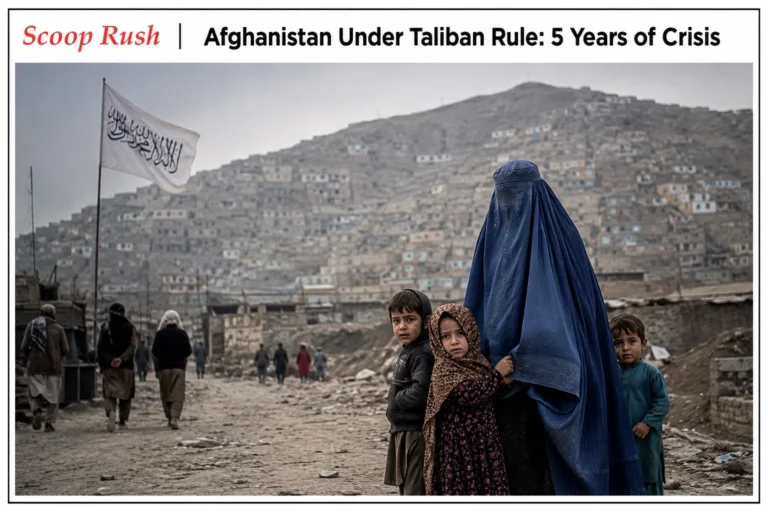
Five years after the Taliban returned to power, Afghanistan remains in crisis. Large-scale fighting has declined since the Taliban captured Kabul in 2021. However, poverty, hunger, unemployment, and repression continue to affect millions. Women and girls face the harshest restrictions across the country. At the same time, international aid has fallen sharply. These pressures have created a humanitarian crisis with few signs of improvement.

Afghanistan’s Economy Remains Under Severe Pressure

Afghanistan’s economy remains much weaker than before the Taliban takeover. Foreign aid once supported a large share of public spending. That financial support declined sharply after the Taliban seized power. The government now operates with far fewer resources. The Taliban’s 2023 budget stood at about $2.44 billion. That figure was less than half the previous government’s 2021 budget. Authorities also abolished the public pension system in 2024.

Unemployment has added another burden for Afghan families. Many people now depend on informal work to earn money. Food prices have also placed pressure on household budgets. Returning Afghans have increased competition for jobs and basic services. As a result, many families struggle to meet everyday needs. Economic growth has not yet translated into better living conditions for everyone.

Millions Face Hunger and Humanitarian Hardship

Afghanistan remains one of the world’s largest humanitarian emergencies. Around 21.9 million people need humanitarian assistance in 2026. That represents about 45 percent of the country’s population. Millions also face serious food insecurity and malnutrition. Children remain particularly vulnerable to hunger and disease. Humanitarian agencies remain essential for millions of struggling families.

However, international funding has fallen sharply in recent years. Aid organizations now have fewer resources to meet growing needs. Hundreds of healthcare facilities have closed or reduced services. This has made medical care harder to access in many areas. Poor families face the greatest difficulties when services disappear. The funding crisis has therefore made Afghanistan’s humanitarian situation even more severe.

Women and Girls Have Lost Fundamental Rights

Women-and-Girls-Have-Lost-Fundamental-Rights

Women and girls face sweeping restrictions under Taliban rule. Girls cannot continue their education beyond the sixth grade. Universities also remain closed to Afghan women. About 2.4 million girls remain excluded from secondary education. The ban has already affected an entire generation of young women. Many girls now face adulthood without completing secondary education.

Women also face severe restrictions on employment and public life. Authorities have excluded women from many workplaces and public spaces. Movement restrictions can further limit their independence. Strict clothing rules also control how women appear publicly. These policies have reduced women’s participation in society and the economy. They have also increased isolation among Afghan women.

Education Bans Threaten Afghanistan’s Future

Education-Bans-Threaten-Afghanistans-Future

The education ban affects Afghanistan far beyond its schools. Girls who cannot study lose important opportunities for their futures. The country also loses potential doctors, teachers, engineers, and other professionals. This can worsen existing shortages across essential sectors. It can also reduce Afghanistan’s future economic potential. The effects could continue long after current restrictions end.

Education restrictions also increase pressure on families. Poor households may see fewer options for their daughters. Economic hardship can increase the risk of child marriage. Girls may lose both education and independence at an early age. These problems can reinforce poverty from one generation to another. For many families, the education ban has changed their entire future.

Poverty Forces Families Toward Desperate Choices

Afghanistan’s economic crisis has created difficult choices for families. Many households struggle to afford enough food and basic necessities. Some have already exhausted their savings and other resources. The situation becomes worse when adults cannot find stable work. Families with daughters can face additional financial pressure. In some cases, poverty has contributed to early and forced marriages.

The problem becomes harder when women cannot earn incomes. Families lose potential earnings when women cannot work freely. Girls also lose future opportunities when education ends early. These problems reinforce poverty across generations. Humanitarian aid can provide temporary relief for struggling families. However, long-term recovery requires jobs, education, and economic opportunity.

Security Has Improved but Afghanistan Remains Vulnerable

The Taliban has reduced much of the large-scale fighting seen before 2021. However, Afghanistan has not achieved complete security. ISIS-K remains a major threat in the country. Other armed groups also challenge Taliban control in some areas. These groups continue to create risks for civilians. Security threats therefore remain despite the decline in major warfare.

Relations with neighboring countries have also become increasingly difficult. Pakistan and Afghanistan have experienced serious tensions along their border. Disputes over militant activity have contributed to repeated clashes. Border closures have also disrupted trade and local livelihoods. These tensions create additional problems for communities near the frontier. They also add pressure to Afghanistan’s already weak economy.

Returning Afghans Add Pressure to the Crisis

Millions of Afghans have returned from neighboring countries in recent years. Pakistan and Iran have increased pressure on undocumented Afghan migrants. Many returnees arrive without stable jobs or housing. They also need food, healthcare, and other essential services. Afghanistan already struggles to provide these services to its population. Large-scale returns therefore create additional pressure on vulnerable communities.

The return of migrants also affects the job market. More workers compete for a limited number of jobs. Housing shortages can create further difficulties for returning families. Schools and healthcare facilities may also face additional demand. Humanitarian agencies must support returnees alongside existing vulnerable populations. This makes Afghanistan’s recovery even more difficult.

International Engagement With the Taliban Is Growing

The Taliban remains largely isolated from Western governments. However, some countries have expanded diplomatic and economic engagement. Russia formally recognized the Taliban government in 2025. China has also maintained diplomatic and economic relations with Afghanistan. Other countries have increased contact with Taliban officials. These developments show that international engagement is gradually changing.

Human rights remain the biggest obstacle to wider acceptance. Governments continue to face pressure over the treatment of women. The education ban remains a major international concern. Rights groups oppose normalizing Taliban rule without meaningful reforms. At the same time, governments want regional security and migration cooperation. This leaves Afghanistan caught between isolation and limited engagement.

Afghanistan Still Faces a Long Road to Recovery

Five years after the Taliban takeover, Afghanistan remains deeply fragile. The decline in large-scale fighting has brought some stability. However, stability has not ended poverty or humanitarian suffering. Women and girls continue to face severe restrictions. Millions remain dependent on humanitarian assistance. The economy also struggles with unemployment and limited opportunities.

Afghanistan needs lasting solutions rather than temporary relief. Families need jobs, food security, healthcare, and reliable public services. Women and girls need access to education and employment. Humanitarian agencies also need sufficient funding to reach vulnerable people. Without major changes, Afghanistan’s humanitarian and economic crisis will continue. The Taliban’s fifth year in power has brought stability without meaningful recovery.

Conclusion

Five years after the Taliban returned to power, Afghanistan remains trapped in a deep crisis. Reduced fighting has brought some stability, but millions still face poverty and hunger. Women and girls continue to lose basic rights, education, and economic opportunities. Aid cuts have also weakened healthcare and humanitarian support. These problems show that security alone cannot deliver meaningful recovery for Afghanistan.

The country now needs lasting economic and social reforms. Families need jobs, food security, healthcare, and reliable public services. Women and girls need access to education and employment. Humanitarian agencies also need enough funding to support vulnerable communities. Without meaningful progress, Afghanistan’s humanitarian crisis will continue to worsen despite the decline in large-scale conflict.

FAQs

1. When did the Taliban return to power?

The Taliban captured Kabul on August 15, 2021. The takeover followed the withdrawal of US and allied forces from Afghanistan. It marked the end of the previous Afghan government and began the Taliban’s current rule.

2. How many Afghan girls cannot continue their education?

About 2.4 million girls remain excluded from education beyond sixth grade. The Taliban continues to restrict secondary and higher education for girls. This has left Afghanistan with the world’s most restrictive education policy for girls.

3. How many Afghans need humanitarian assistance?

Around 21.9 million people need humanitarian assistance in 2026. That equals roughly 45 percent of Afghanistan’s population. Food insecurity, poverty, healthcare shortages, and displacement remain major concerns.

4. Has violence decreased under Taliban rule?

Large-scale fighting has declined significantly since 2021. However, Afghanistan still faces attacks from ISIS-K and threats from other armed groups. Border tensions with neighboring countries also create security concerns.

5. Why is Afghanistan still facing an economic crisis?

Afghanistan lost much of its foreign aid after the Taliban takeover. Unemployment, inflation, weak public services, and returning migrants add further pressure. Restrictions on women also limit the country’s workforce and economic potential.

Best Countries for Expats in 2026

0

Moving abroad can change your career, finances, lifestyle, and social life. The best countries for expats offer more than attractive scenery and strong economies. They also provide affordability, friendly communities, reliable services, and better opportunities.

The 2026 InterNations Expat Insider survey ranked 31 destinations worldwide. Nearly 7,800 expatriates from 162 nationalities shared their experiences. The survey examined quality of life, working abroad, personal finances, settling in, and essential services.

Panama Holds the Number One Position

Panama ranked first overall for the third consecutive year. It also topped the Working Abroad and Personal Finance categories. Around 87% of expats reported happiness with their lives there. Housing also received strong feedback from international residents.

Around 90% of expats said finding housing was easy. Panama also offers strong work-life balance and financial comfort. The country attracts retirees, remote workers, professionals, and business owners. However, infrastructure quality can vary outside major urban areas.

Mexico Offers an Easy Social Welcome

Mexico-Offers-an-Easy-Social-Welcome

Mexico climbed to second place overall in the 2026 rankings. It also ranked first for Ease of Settling In. Around 73% of expats said making local friends was easy. That compares with only 39% globally.

Friendly communities remain one of Mexico’s biggest attractions. Expats also praise its food, culture, and relatively affordable lifestyle. However, safety remains an important concern. Mexico ranked 25th among 31 destinations for safety and security.

Thailand Combines Low Costs With High Satisfaction

Thailand ranked third overall and received the survey’s strongest cost-of-living score. Around 85% of expats rated affordability positively. Housing also received strong ratings. These advantages make Thailand especially attractive to retirees and remote workers.

Thailand also recorded the highest expat happiness level in the survey. About 86% of respondents reported satisfaction with life abroad. Healthcare and personal safety also received positive ratings. Newcomers should understand local customs to make cultural adjustment easier.

UAE Strengthens Its Appeal for Professionals

UAE-Strengthens-Its-Appeal-for-Professionals

The United Arab Emirates climbed to fourth place overall. It ranked first worldwide for career prospects. Around 80% of expats said their move improved their career opportunities. The country also performs strongly for visas and administrative services.

Dubai and Abu Dhabi remain major international business centers. Safety and modern infrastructure add further appeal for foreign residents. However, housing and daily expenses can become expensive. Professionals should compare salary packages with their expected living costs.

Brazil Makes the Biggest Leap

Brazil reached fifth place after climbing from 15th position. It recorded the biggest improvement among the leading destinations. Friendliness, culture, and social connections helped drive the country’s rise. Expats often praise Brazilian hospitality and openness.

Many newcomers find it easier to build local friendships in Brazil. The country also performs strongly for personal support networks. São Paulo offers extensive business and cultural opportunities. However, safety varies by location, so careful city research remains important.

Spain Leads Europe’s Top Choices

Spain ranked sixth overall and remains a leading European destination. It performs strongly for healthcare, safety, lifestyle, and social satisfaction. About 83% of expats rated healthcare availability positively. A similar percentage praised healthcare quality.

Around 86% of expats reported feeling personally safe in Spain. The country also combines pleasant weather, food, culture, and outdoor activities. Major cities have established international communities. Smaller cities can offer quieter lifestyles and lower costs.

Singapore, Portugal, Malaysia, and Luxembourg Complete the List

Singapore-Portugal-Malaysia-and-Luxembourg-Complete-the-List

Singapore ranked seventh and remains attractive to highly skilled professionals. Its strengths include infrastructure, healthcare, security, and public transportation. Portugal followed in eighth place. Its climate, safety, and welcoming communities continue to attract international residents.

Malaysia ranked ninth and offers an affordable multicultural environment. Luxembourg completed the top ten with strong career opportunities and job security. However, Singapore and Luxembourg have high living costs. Malaysia and Portugal offer stronger value for many lifestyle-focused expats.

Different Priorities Create Different Choices

The overall ranking does not automatically identify the right destination for everyone. Retirees may prioritize healthcare, housing, and affordability. Young professionals may focus on salaries and career opportunities. Families often need strong schools, healthcare, safety, and suitable housing.

Remote workers may care more about visas, internet access, and living costs. Socially focused newcomers may prioritize friendliness and community life. Income also changes the picture considerably. A foreign salary can stretch further in affordable destinations than a local salary.

Belonging Can Shape the Expat Experience

The 2026 rankings show that national wealth does not guarantee expat satisfaction. Norway provides a strong example of this difference. Despite ranking highly in global happiness measures, Norway finished last among expats. Around 72% struggled to make local friends.

Only around 31% of expats in Norway said they felt at home. Meanwhile, Mexico and Brazil perform strongly for social connections. Panama also combines financial comfort with a welcoming environment. These results show why belonging deserves serious attention during relocation planning.

The 2026 Rankings Bring Several Changes

Brazil recorded the biggest improvement among the leading destinations. It climbed from 15th to fifth place. The UAE also made a significant move. It rose from seventh place to fourth overall. Spain also improved from ninth to sixth position.

Mexico moved from third to second, while Thailand rose from fourth to third. Panama retained first place for another year. Singapore, Portugal, and Luxembourg entered the top ten. Malaysia also improved slightly and reached ninth place.

The Top 10 Destinations at a Glance

The leading destinations represent several different regions and lifestyles. Panama, Mexico, and Brazil dominate the upper part of the ranking. Thailand and Malaysia provide strong Asian options. The UAE offers a major choice for international professionals.

Spain, Portugal, Singapore, and Luxembourg provide different European and Asian alternatives. Their strengths range from healthcare and lifestyle to infrastructure and career opportunities. The complete 2026 ranking places Panama first and Luxembourg tenth. Each destination appeals to different expat priorities.

Choosing the Right Country Requires Planning

The first step involves identifying your income source and career situation. Remote workers have different requirements from local employees. Retirees need sustainable finances and dependable healthcare. Families also need to consider schools, housing, and employment options.

Next, identify your most important priorities and create a shortlist. Research specific cities because conditions can vary significantly within countries. Compare housing, safety, healthcare, transport, and daily expenses. Finally, check current immigration requirements through official government sources.

Conclusion

The 2026 rankings place Panama at the top of the global expat list. Mexico stands out for social integration, while Thailand leads for affordability. The UAE offers strong career opportunities, while Brazil excels in local connections. Spain remains one of Europe’s strongest choices.

However, the overall ranking should guide your research rather than decide your move. Your income, career, family situation, budget, and lifestyle should shape the final choice. A successful international move requires more than finding a highly ranked country. It requires finding a place where your finances, work, relationships, healthcare, and daily life can work together.

FAQs

1. Which country is best for expats in 2026?

Panama ranks first in the 2026 InterNations Expat Insider survey. It combines strong finances, career opportunities, housing, and overall satisfaction.

2. Where can expats make friends most easily?

Mexico ranks first for Ease of Settling In. Around 73% of expats say making local friends is easy. Its welcoming social culture supports newcomers.

3. Which country is most affordable for expats?

Thailand receives the strongest affordability rating in the 2026 survey. Around 85% of expats rate its cost of living positively. Housing also remains relatively affordable.

4. Which country is best for expat careers?

The UAE ranks first worldwide for career prospects. Around 80% of expats say their move improved their career opportunities. Its business environment attracts professionals worldwide.

5. What is the best European country for expats?

Spain ranks sixth overall and offers a strong combination of healthcare, safety, and lifestyle. Portugal also remains popular for retirees and lifestyle-focused expats.

Nvidia’s SpaceX Stake Hits $21 Billion, Making It Elon Musk’s No. 2 Investor

0

Introduction

The Nvidia SpaceX stake, disclosed today at $21 billion, instantly reshapes how investors should view the bond between these two companies, since it is currently Nvidia’s second-largest holding of any kind, sitting just behind its position in Intel.

Nvidia has now disclosed a $21 billion stake in SpaceX, and this filing instantly reshapes how investors should view the bond between these two companies. The Nvidia SpaceX stake is currently Nvidia’s second-largest holding of any kind, sitting just behind its position in Intel. Additionally, this news lands at a time when Nvidia is already the dominant force behind the global AI chip race.

For readers who follow Nvidia stock, SpaceX shares, or the wider AI infrastructure boom, this update carries real weight. It shows how closely these two giants are now connected, both financially and technologically. In this article, we explain exactly how large the Nvidia SpaceX stake is, how Nvidia ended up owning it, what Musk said about the partnership, and how the market has responded so far.

Nvidia SpaceX Stake: How Much Is It Worth?

Nvidia SpaceX Stake: How Much Is It Worth?

According to a filing with the Securities and Exchange Commission, Nvidia owns 122.8 million Class A shares of SpaceX (SPCX). That stake carries a value of roughly $21 billion. As a result, SpaceX now ranks as Nvidia’s second-biggest holding overall.

Only Nvidia’s Intel (INTC) stake ranks higher. However, that position has actually shrunk in recent months. It stood at about $30 billion at the end of the last quarter, then fell to around $22 billion. Even with that drop, Intel still edges out SpaceX for the top spot in Nvidia’s portfolio.

To put this in context, Nvidia invested $5 billion in Intel less than a year ago. The current value of that stake shows a huge return in a short window, even after the recent pullback. Meanwhile, the SpaceX position tells a different kind of story, because Nvidia never made a direct investment in SpaceX at all.

How Nvidia’s xAI Bet Turned Into a SpaceX Stake

Nvidia’s SpaceX shares trace back to a $10 billion investment in xAI, part of a larger $20 billion funding round completed in January. At that time, xAI operated as Musk’s separate artificial intelligence company, a venture that has also faced scrutiny, including a lawsuit over Grok-generated sexual deepfakes of minors.

Everything changed in February, when SpaceX acquired xAI in a deal valued at $1.25 trillion. Because Nvidia already held a stake in xAI, that investment converted directly into SpaceX shares once the acquisition closed. In other words, Nvidia became a major SpaceX shareholder almost overnight, simply because it had backed xAI months earlier.

This detail matters for anyone trying to understand Nvidia’s real exposure to SpaceX. Nvidia did not set out to build a $21 billion stake in a rocket and satellite company. Instead, its bet on Musk’s AI ambitions quietly evolved into a much bigger position once xAI folded into SpaceX.

The numbers have also moved along with SpaceX’s stock price. SpaceX shares closed at $140 on Friday, down from $170.86 at the end of June, since SpaceX’s IPO on Nasdaq in June. That decline pushed the value of Nvidia’s stake down to roughly $17.2 billion at one point, according to CNBC, before the figure settled near the $21 billion mark disclosed in the SEC filing.

Where Nvidia Ranks Among SpaceX Investors

Where Nvidia Ranks Among SpaceX Investors

Nvidia is far from SpaceX’s largest shareholder. According to FactSet data reported by CNBC, Nvidia currently holds the sixth-largest stake in the company.

Musk himself tops that list by a wide margin, with a personal stake worth roughly $850 billion. Alphabet (GOOGL), Google’s parent company, holds the second-largest position at around $78 billion.

Nvidia’s $21 billion stake, while smaller than these figures, still places it firmly among SpaceX’s top backers. Furthermore, this ranking shows how many major tech companies now hold a direct financial interest in SpaceX’s success, well beyond simply supplying it with hardware.

Musk Confirms Exclusive Nvidia Partnership for SpaceX Data Centers

The financial stake tells only part of the story. During SpaceX’s first public earnings call last week, Musk emphasized how deep the operational relationship with Nvidia has become.

He explained that SpaceX has chosen to build its data center infrastructure exclusively around Nvidia’s technology. According to Musk, Nvidia’s Vera Rubin architecture stands as the strongest option available for SpaceX’s AI computing needs.

He also described multiple layers of cooperation between the two companies. This detail matters because it shows the relationship extends well beyond a simple supplier arrangement. Instead, SpaceX appears to be building Nvidia into a core pillar of its AI and data center strategy going forward.

What the Vera Rubin GPU Deal Means for Nvidia’s Chip Supply

Musk also revealed that SpaceX expects a “significant allocation” of Nvidia’s Vera Rubin GPUs next year, chips that are also central to Nokia’s AI-RAN platform built with Nvidia. For Nvidia, this signals continued strong demand for its most advanced chips from one of the biggest names in tech.

For SpaceX, meanwhile, securing a strong GPU supply supports its expanding push into AI-driven applications, likely tied to its broader satellite and computing ambitions following the xAI acquisition. Consequently, the two companies now share overlapping incentives. Nvidia gains a major customer with massive data center ambitions, while SpaceX gains priority access to some of the most sought-after chips in the industry, a race that also touches Google’s own AI chip efficiency push.

How Investors Are Reacting to the Nvidia SpaceX Stake News

How Investors Are Reacting to the Nvidia SpaceX Stake News

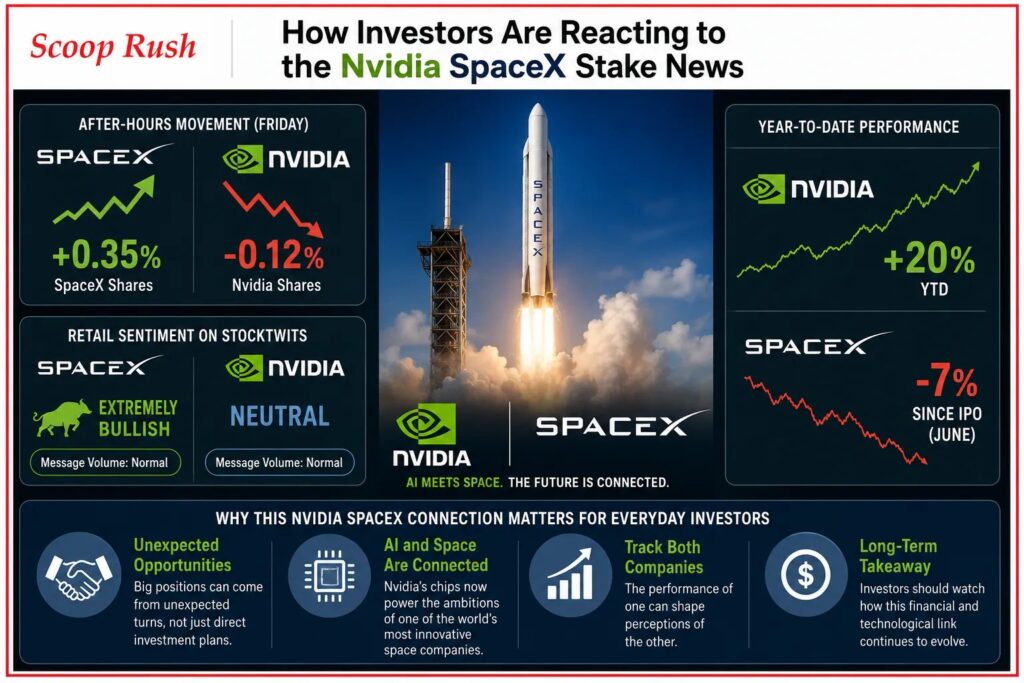
Investor sentiment around this disclosure has been mixed but revealing. In after-hours trading on Friday, SpaceX shares rose about 0.35%, while Nvidia shares slipped roughly 0.12%.

On Stocktwits, retail sentiment for Nvidia sat at “neutral,” with message volume also holding at “normal” levels. SpaceX, however, saw “extremely bullish” sentiment among retail investors, though message volume remained “normal” there too.

Looking at the bigger picture, Nvidia stock has climbed nearly 20% year-to-date. SpaceX shares, on the other hand, have lost close to 7% since going public on Nasdaq in June. This gap suggests that while long-term investors stay confident in Nvidia’s trajectory, SpaceX’s newly public stock is still finding its footing.

Why This Nvidia SpaceX Connection Matters for Everyday Investors

For everyday investors, this story offers a useful lesson. Sometimes the biggest positions in a company’s portfolio don’t come from a deliberate, direct investment plan. Instead, they emerge from unexpected turns, such as an acquisition that reshapes an existing stake overnight.

Furthermore, this filing highlights how tightly the AI and space industries have become intertwined, a shift also visible in SpaceX’s recent Starship launch abort during Flight 13. Nvidia’s chips no longer just power traditional data centers. They now tie directly into the ambitions of one of the world’s most closely watched private companies, all because of a chain of investments that started with a bet on xAI.

As a result, anyone following Nvidia stock or SpaceX shares now has another factor to track, much like investors weighing Google’s AI spending against its cash flow. The performance of one company can genuinely shape perceptions of the other, given how closely their financial and technological interests are now linked.

Conclusion

Nvidia’s $21 billion SpaceX stake shows how fast corporate relationships can shift in the AI era. What started as a $10 billion investment in xAI turned into a massive ownership position in SpaceX once the two companies merged in February.

Today, that stake ranks as Nvidia’s second-largest holding, trailing only its position in Intel. Beyond the numbers, Musk’s comments about an exclusive data center partnership built on Nvidia’s Vera Rubin architecture show that this relationship runs far deeper than a simple investment. With a “significant allocation” of next-generation GPUs expected next year, Nvidia and SpaceX look set to stay closely linked for the foreseeable future.

For investors, the takeaway is simple. Nvidia’s influence now reaches well beyond chips alone, and SpaceX’s ambitions increasingly run on Nvidia’s technology.

FAQs

How much is Nvidia’s stake in SpaceX worth?

Nvidia’s stake in SpaceX is valued at approximately $21 billion, based on its ownership of 122.8 million Class A shares disclosed in an SEC filing.

How did Nvidia get shares in SpaceX?

Nvidia originally invested $10 billion in xAI as part of a $20 billion funding round in January. When SpaceX acquired xAI in February in a deal valued at $1.25 trillion, Nvidia’s xAI stake converted into SpaceX shares.

Is Nvidia’s SpaceX stake bigger than its Intel stake?

No. Nvidia’s Intel stake remains its largest holding, valued at about $22 billion. The SpaceX stake, at roughly $21 billion, ranks as its second-largest.

Who are SpaceX’s biggest investors?

Elon Musk is by far the largest SpaceX shareholder, with a stake worth around $850 billion, a fortune that also stretches into other ventures like Musk’s fossil fuel company, APR Energy. Alphabet ranks second at about $78 billion, while Nvidia currently holds the sixth-largest stake.

What did Elon Musk say about SpaceX’s partnership with Nvidia?

Musk said SpaceX has chosen to build its data centers exclusively on Nvidia’s technology, calling its Vera Rubin architecture the best AI computing option available. He also said SpaceX expects a significant allocation of Vera Rubin GPUs next year.

Avengers Campus Expansion Opening Date: When Will Stark Flight Lab and Avengers Infinity Defense Debut?

0

What is the Avengers Campus opening date for its new expansion, and how close is Disney to confirming it?

At the 2026 D23 Expo, Walt Disney Imagineering unveiled a detailed construction model of the Avengers Campus expansion. As a result, fans finally got their clearest look yet at what’s coming to Disney California Adventure. This expansion will double the size of the current land. It adds two new rides: Stark Flight Lab and Avengers Infinity Defense.

However, the model also became one of the most talked-about surprises of the event. For example, several attendees compared the massive backstage show building to a big-box warehouse store.

That reaction aside, the real question on every fan’s mind is timing. After all, Avengers Campus expansion is the next major attraction project heading to Disneyland Resort. Construction has visibly progressed for over a year now. So, if you’re planning a future trip, or simply tracking what’s next for DCA, this guide covers the likely Avengers Campus opening date. It also breaks down what each ride will offer and what guests can expect once construction wraps.

Why the Avengers Campus Expansion Model Is Turning Heads for the Wrong Reasons

The 2026 D23 Expo model sits inside the “Imagineering: Horizons” pavilion. In fact, Disney calls it the largest pavilion Walt Disney Imagineering has ever built for the event. Additionally, it’s packed with models of projects Imagineering first teased two years earlier at the Horizons Showcase. Many of those projects are now under construction.

Among all the models on display, the Avengers Campus expansion draws the most criticism. Specifically, fans have jokingly nicknamed the backstage show building “Disneyland’s first Costco,” since it looks plain and boxy. It’s a joke, but not really a controversial one. In fact, even longtime Marvel fans touring the expo floor admit the model looks underwhelming next to other projects.

To be fair, though, the comparison isn’t entirely off base. After all, Avengers Campus was never known for architectural charm. Fans have often compared the existing land to an office park. So, a plain new show building isn’t exactly a dramatic downgrade.

There’s also good news here. Namely, the warehouse-like section sits almost entirely backstage, tucked behind Cars Land. Therefore, guests won’t actually see much of it once the ride opens. Instead, what guests will see is the canopy, which is already visible today, plus a courtyard out front.

One fair criticism, however, involves presentation. For instance, the Piston Peak National Park model, shown elsewhere in the pavilion, includes surrounding landmarks for context. By contrast, the Avengers Campus expansion model doesn’t show much beyond the building itself. Consequently, that gap makes it harder to judge how the finished space will actually feel.

Avengers Campus Expansion Construction: What’s Being Built Backstage

Construction on the Avengers Campus expansion broke ground at the start of last year. Since then, the show building has grown steadily. It now stretches all the way behind Cars Land.

From inside Avengers Campus, meanwhile, progress is hard to spot. That’s because the canopy already looks complete. However, crews are now enclosing the backstage structure. That’s a clear sign the project is moving into its next phase.

Avengers Campus Opening Date: When Will It Debut?

Avengers Campus Expansion Opening Date: When Will It Debut?

This is the question every Disneyland fan wants answered. Unfortunately, the honest answer is that Disney hasn’t confirmed an official date yet.

Still, we can make an educated estimate. It’s based on the current construction pace and Imagineering’s past patterns.

Of the two new attractions, Avengers Infinity Defense is by far the more complex build. After all, it’s a true E-Ticket experience. Stark Flight Lab, meanwhile, is a simpler, secondary attraction that rounds out the land’s ride lineup.

Earlier speculation suggested Stark Flight Lab could open as early as late 2026. That timeline would only work if Disney wanted to fast-track it. However, closer observation of construction now makes that timeline look unlikely. That’s because the two attractions sit tightly integrated on the same job site. Opening Stark Flight Lab early, therefore, could actually slow down progress on Avengers Infinity Defense. As a result, Disney may prefer to debut both rides together.

Comparing the Avengers Campus Opening Date to Tropical Americas

Right now, construction on the Avengers Campus expansion moves at a pace similar to Tropical Americas at Disney’s Animal Kingdom. Disney has already confirmed a 2027 opening for that project. Specifically, Tropical Americas will likely open in phases. The first half should arrive in summer 2027, and the second half should follow sometime between October 2027 and spring 2028.

Both projects broke ground around the same time. Although the Marvel attractions went vertical first, Tropical Americas wasn’t far behind. Therefore, there’s a real chance the two could end up opening close together. That would echo how Pandora and Guardians of the Galaxy: Mission Breakout both debuted on the same day at different parks.

Of course, the two projects differ in scope and conditions. For instance, Tropical Americas involves swampy terrain in Florida. Crews, meanwhile, are building the Avengers Campus expansion in dense, urban Southern California. Even so, the projects remain reasonably comparable in overall scale and timing.

Taking all of this into account, late 2027 looks like the most realistic target. Specifically, a mid-November debut fits Disneyland’s usual pattern of opening major attractions between Halloween and Thanksgiving. That said, hitting this window will be tough given the current pace of work. Therefore, a safer estimate places the opening anywhere between late 2027 and mid-2028.

Once this expansion opens, it clears the way for the next attraction in the pipeline. Meanwhile, crews have already started clearing ground for a separate Coco-themed project. That ride should follow roughly a year after the Avengers Campus expansion debuts.

Stark Flight Lab: What to Expect

Stark Flight Lab places guests inside “gyro-kinetic pods” that roll along a track before stopping beneath a large robotic arm. From there, that arm lifts riders into the air for a series of fast-paced maneuvers inspired by Iron Man and other Avengers characters.

Additionally, Robert Downey Jr. will reprise his role as Tony Stark throughout the land, adding a familiar face fans will appreciate. Overall, Stark Flight Lab looks like a fun, straightforward supporting attraction, and DCA could certainly use more rides like it to round out the lineup.

The concept, for example, draws comparisons to Sum of All Thrills, a former EPCOT attraction that used KUKA robotic arm technology inside Innoventions before it closed. That ride was ahead of its time, but it suffered from poor hourly throughput. Consequently, turning Stark Flight Lab into a proper ride, with a track and multiple robotic arm stations, should solve that efficiency problem.

Avengers Infinity Defense: The Expansion’s New E-Ticket Attraction

Avengers Infinity Defense: The Expansion's New E-Ticket Attraction

Avengers Infinity Defense takes guests into an alternate version of the Multiverse where Thanos has already won. Even so, it’s framed as a family-friendly adventure, and guests team up with the Avengers and their allies from across the Multiverse to fight back against King Thanos and his forces.

Specifically, the story centers on multiverse-jumping technology that has gone missing, which King Thanos now uses to cause chaos across multiple worlds. Along the way, guests will travel to iconic Marvel locations, including Asgard, Wakanda, and New York City, alongside familiar super heroes.

Imagineering has revealed that Avengers Infinity Defense will combine screen-based scenes with physical sets and built environments. For a helpful comparison, think of Universal’s Spider-Man ride or the Harry Potter attractions, both of which blend practical sets with digital effects.

The Ride System Behind Avengers Infinity Defense

The ride vehicle for Avengers Infinity Defense debuted at a previous D23 Expo, and it shares the same vehicle system as Peter Pan’s Never Land Adventure. In fact, fans describe that existing ride as a blend of Avatar Flight of Passage and Universal’s Spider-Man attraction, which offers a useful preview of what to expect from this new Marvel E-Ticket.

Given the shared ride system, Avengers Infinity Defense will likely follow a similar physical profile. Therefore, expect it to feel somewhat more intense, though it should still stay family-friendly. Worth noting, Peter Pan’s Never Land Adventure already handles a villain battle against Captain Hook in a family-friendly way, so Disney can likely pull off something similar with King Thanos.

If Avengers Infinity Defense matches the length, pacing, and overall satisfaction of Peter Pan’s Never Land Adventure, it should become one of the strongest E-Ticket attractions in the Disneyland Resort lineup.

Why the Avengers Campus Expansion Still Matters, Costco Jokes Aside

Despite the underwhelming model, there’s genuine reason for optimism. After all, Disneyland Resort has never considered Avengers Campus one of its most beautifully designed lands, so a plain backstage structure doesn’t change much about the actual guest experience. Instead, what matters more is what happens inside the attractions themselves, and Avengers Infinity Defense in particular has strong potential to become a genuine headliner.

The land’s best quality, meanwhile, has always been its energy. It lets super heroes interact freely with guests, without tying them down to strict storylines. Similarly, Avengers Infinity Defense builds on that same flexibility by leaning into the multiverse concept, an idea that works surprisingly well for a theme park attraction. Ultimately, it offers a way to feature many Marvel characters without needing a separate ride for each hero or villain.

Meanwhile, Stark Flight Lab adds a welcome secondary attraction that rounds out the land, similar to how Cars Land’s smaller rides complement its own E-Ticket centerpiece. Disney California Adventure has long needed more filler attractions to balance out its major rides, so this addition should help.

Once complete, ultimately, this expansion should help Disneyland’s Avengers Campus keep its title as the strongest version of the land across Disney’s global parks.

Key Takeaways

The Avengers Campus expansion will add two new attractions: Stark Flight Lab and Avengers Infinity Defense. Together, they’ll double the size of the existing Marvel land at Disney California Adventure.

The show building model drew criticism for its plain, warehouse-like look. However, most of that structure will stay hidden backstage. Meanwhile, Avengers Infinity Defense is shaping up to be a major E-Ticket experience, using the same ride system as Peter Pan’s Never Land Adventure, while Stark Flight Lab offers a simpler robotic-arm ride themed around Iron Man.

Based on current construction pace, therefore, the most likely Avengers Campus opening date falls somewhere between late 2027 and mid-2028.

Frequently Asked Questions

1. What is included in the Avengers Campus expansion? 

The expansion adds two new attractions to Disney California Adventure’s Avengers Campus: Stark Flight Lab, a robotic-arm ride themed around Iron Man, and Avengers Infinity Defense, a large-scale E-Ticket attraction centered on a multiverse battle against King Thanos.

2. What is the Avengers Campus opening date? 

Disney hasn’t announced an official opening date yet. However, based on current construction progress, the expansion will most likely open between late 2027 and mid-2028, with a target window around November 2027 looking realistic.

3. Will Stark Flight Lab open before Avengers Infinity Defense? 

Probably not. The two attractions sit closely integrated on the same construction site, so opening Stark Flight Lab separately could slow work on Avengers Infinity Defense. Instead, Disney may choose to open both rides together.

4. What is Avengers Infinity Defense about? 

The attraction takes place in a version of the Multiverse where Thanos has won. Guests join the Avengers and their allies to stop King Thanos, who is using missing multiverse-jumping technology to cause chaos across locations like Asgard, Wakanda, and New York City.

5. Why did the Avengers Campus expansion model get criticized at D23 2026? 

The backstage show building’s design resembled a large warehouse store, which led fans to nickname it Disneyland’s “Costco.” However, most of that structure will stay hidden behind Cars Land and won’t be visible to guests once the expansion opens.

Why Are Football Fans Following Players Instead of Clubs in 2026

0

Picture thousands of people walking through London or Berlin wearing flamingo pink Inter Miami shirts. It’s a small but telling sign that football fans are following players instead of clubs like never before.

None of them have ever set foot in Miami. None of them support the club’s history or its city. They bought the shirt for one reason only: Lionel Messi wears it.

This is why football fans are following players instead of clubs in 2026. The shift is reshaping how the sport gets marketed, watched, and followed around the world.

This matters to anyone who loves the game. It matters whether you are a lifelong supporter of one team, or someone who discovered football through a favorite player.

This shift explains why your social feed suddenly fills with shirts from clubs you’ve never heard of. It also explains why the sport itself is evolving faster than ever.

Fans Follow Players: The Messi and Ronaldo Effect

When Lionel Messi signed for Inter Miami in 2023, the impact went far beyond ticket sales.

Sports brand strategist James Kirkham says people across the UK and Europe now wear Inter Miami’s flamingo pink kit with zero connection to the city. Many of these fans have never visited Miami. Yet the shirt has become a badge of loyalty to one player.

Cristiano Ronaldo tells a similar story at Al-Nassr. Since joining the Saudi Pro League club, Ronaldo has scored 129 goals in 148 appearances. His fans didn’t move to Saudi Arabia. They moved with him.

For years, the Messi versus Ronaldo debate dominated football conversation. However, this rivalry no longer centers only on who ranks as the greatest player of all time. It has become a case study in how individual stars can now outshine the clubs they play for.

How Gaming Culture Pushed Fans to Follow Players

So why are fans behaving this way? Kirkham points to gaming as a major driver.

Younger fans grew up building Ultimate Teams in EA Sports FC. Many also managed squads in Football Manager. As a result, they built encyclopaedic knowledge of players across leagues and countries, often with far less loyalty to a single badge.

“Following a player and buying them as part of your Ultimate Team and then wearing that player’s name on the back of your shirt, be that Atletico Madrid or Chelsea or Dortmund, kind of makes no difference,” Kirkham explains.

In other words, the line between virtual fandom and real-life support has blurred. Add YouTube channels and trading cards into the mix, and it’s easy to see why younger supporters feel less tribal than older generations.

The Rise of the Second Club Fan Following Players Over Clubs

This shift isn’t just anecdotal.

A study titled “The Rise of the Second Club Fan,” published ahead of this summer’s World Cup, found that 80% of global supporters now follow a second team alongside their primary club.

Matthew Kyle leads insights at Engage and MTM and authored the report. He makes one thing clear: this doesn’t mean fans are abandoning their first love. Instead, they are adding new layers to their fandom.

This trend runs strongest in regions without a dominant domestic league. Geography places no limit on who fans choose to follow.

Sometimes the choice comes down to a club’s story, culture, or even its kit design. Most often, though, the report found that players offer the strongest gateway into second-club support.

As the study bluntly states, for this group of fans, “the club” essentially is the player. These supporters track individuals, not institutions.

How Players Took the Driving Seat From Clubs

From Griezmann to Personal Brands: Players Building Their Own Fanbase

Back in 2018, Antoine Griezmann tried something new. Days before the World Cup, he teased a half-hour documentary revealing his transfer decision. LeBron James’ famous televised announcement in 2010 inspired the format.

Barcelona fans felt convinced they had signed him. Instead, Griezmann announced he was staying at Atletico Madrid.

The move drew criticism at the time. Kyle notes that this kind of self-commercialization didn’t carry the same reach in 2018. It would land very differently today if a player like Erling Haaland or Kylian Mbappe tried it.

Griezmann, in many ways, arrived ahead of his time. Now, players routinely run their own YouTube channels and build personal media empires. Haaland, Ronaldo, Jude Bellingham, and Lionesses star Ella Toone all share content directly with fans. They bypass club and broadcaster channels entirely.

“Players are becoming their own distribution levers,” says Kyle, “with some in particular taking a driving seat in terms of how they project themselves onto the world.”

Kirkham agrees that players now carry more cultural weight than ever before. Fans want their favorite stars to represent something beyond the pitch.

He points to Marcus Rashford’s Covid-era campaign as proof. That campaign led to real changes in UK government policy. Kirkham calls it a clear example of a player using his platform for lasting impact.

The World Cup’s Real Winners: Players Gain Fans Faster Than Clubs

The World Cup's Real Winners: Players Gain Fans Faster Than Clubs

This summer’s World Cup took place across North America. The tournament became a launchpad for personal brands as much as national teams.

Vozinha, Cape Verde’s previously unknown goalkeeper, became an overnight sensation after a heroic performance against Spain. His Instagram following exploded from 50,000 to nearly 30 million.

Big names cashed in too. Spain and Barcelona forward Lamine Yamal saw a major spike in followers. Bellingham gained significant traction. Even Ronaldo, already the most-followed athlete on Instagram, added to his enormous base.

However, the standout winner was Norway’s Erling Haaland. His popularity surged across Instagram, TikTok, and Snapchat during the tournament.

Kyle notes that Haaland gained more than 51 million followers since July 1. That number compares to just 11 million across the first six months of the year combined.

What made the difference? According to Kyle, it wasn’t just Haaland’s performances. His relatable personality played a role. So did his playful social media presence and constant engagement with fans through memes and viral clips. His friendship with Bellingham and Norway’s historic run to the quarterfinals added fuel to the fire.

Notably, Haaland now counts nearly 20 million more Instagram followers than his own club, Manchester City. Similarly, England captain Harry Kane built his own platform, Cleats Club. It lets him interact with fans directly and on his own terms.

Why Clubs Are Losing Fans to Player Brands

Kirkham believes this trend will only accelerate. “You’ll see more and more creating their own entertainment formats, content networks, and that is away from the clubs,” he says.

Clubs remain aware of the shift, but they have limited power to stop it. They don’t fully own the player as a brand. Stars can freely appear on podcasts, launch shows, or discuss interests entirely unrelated to football.

For fans, though, this counts as good news. Kirkham describes an “insatiable appetite” among supporters for football content. Nothing can fully satisfy that appetite yet.

As players lean further into building their own audiences, fans gain more access and more ways to engage than ever before.

What Happens When a Star Player Leaves the Club?

A key question for clubs centers on whether fans who arrive because of one player will stick around once that player departs.

Turkish club Trabzonspor is experiencing this firsthand after signing Egyptian star Mohamed Salah, who spent nine years at Liverpool. Meanwhile, Tottenham Hotspur enjoyed a decade with South Korean icon Son Heung-min before he joined LAFC last summer.

Kyle points to Son as a particularly strong example. He wasn’t a global superstar when he joined Spurs.

Over his time in London, though, the club became the most-supported foreign team in South Korea. It even overtook Manchester United in that market.

Interestingly, when Son left for LAFC, Spurs didn’t lose millions of followers from Korea. LAFC, on the other hand, saw a modest spike in new fans following his arrival.

Reports show LAFC’s YouTube following more than doubled after Son joined the club. Around 70% of those new subscribers came from South Korea.

Kyle argues that clubs shouldn’t assume they’re powerless once a star leaves. Every club, he says, has characters worth building content around.

Clubs need to treat star players as valuable assets while they’re there. They also need to invest in behind-the-scenes content that appeals to fans regardless of which club they support.

“Even if you’re not a fan of that club, you might stop scrolling and watch a day in the life of a player because it might be good content,” Kyle explains.

Could Fans Follow Owners Instead of Clubs Too?

There’s another layer to this story worth watching. Wrexham’s rise under owners Ryan Reynolds and Rob McElhenney shows that star power doesn’t have to come from the pitch alone.

Kyle suggests these celebrity owners pulled in an entirely new audience who may know little about football itself. He acknowledges this creates tension within traditional football communities. Some fans question the football credentials of celebrity ownership.

Still, he compares the appeal to a soap opera. Seasons of football mirror seasons of television, and the storylines never truly end.

Final Thoughts:

Football fandom no longer depends purely on geography, family tradition, or club badges.

Gaming culture, social media, and player-driven content have combined forces. Together, they created a generation of fans who follow individuals as closely as institutions.

Clubs still hold enormous value through shirt sales, matchday revenue, and long-term loyalty. Nevertheless, players increasingly control their own narratives. They build direct relationships with fans and carry influence that can outlast a single transfer.

Ultimately, this doesn’t mean club loyalty is disappearing. Instead, fandom has become layered. Millions of supporters now proudly follow both a lifelong club and a favorite star, wherever that star’s career takes them next.

Frequently Asked Questions

1. Why are football fans following individual players instead of clubs? 

Fans increasingly gravitate toward players because of gaming culture, social media access, and players building their own content platforms. This creates a personal connection that goes beyond club loyalty.

2. What is the “Second Club Fan” phenomenon? 

It describes fans who support a primary club but also follow a second team, often because of a favorite player. A recent study found that 80% of global football fans now fall into this category.

3. Did Lionel Messi’s move to Inter Miami really increase the club’s global fanbase? 

Yes. Messi’s arrival drove a significant rise in Inter Miami merchandise sales, social media followers, and global attention. Many new fans had no prior connection to the club or city.

4. How much did Erling Haaland’s social media following grow after the World Cup? 

According to insights from Engage and MTM, Haaland gained more than 51 million new followers across his social platforms after July 1. That compares to just 11 million in the first six months of the year.

5. Do clubs lose fans permanently when a star player leaves? 

Not necessarily. As Son Heung-min’s move from Tottenham to LAFC shows, clubs often retain most of the fanbase built during a star’s tenure. The player’s new club may see only a smaller, immediate spike in interest.

What Did the Apostles Eat? Their Real Diet, Fasting, and Faith

0

There’s a testimony making the rounds in church circles and on social media: someone decides to “eat like the apostles,” drops a noticeable amount of weight in a few months, and suddenly a phrase like the “apostles’ diet” starts trending in group chats and Sunday school hallways.

It sounds catchy. It sounds biblical. And for anyone trying to get healthier, it sounds like permission to turn Scripture into a meal plan.

But before you start swapping your pantry for olives and lentils in the name of holiness, it’s worth asking a more honest question: what did the apostles actually eat, why did they eat that way, and is turning their lifestyle into a weight-loss program missing the entire point?

This article digs into the historical, cultural, and spiritual backdrop of first-century eating habits, the biblical food laws that shaped what “clean” and “unclean” meant to Jewish believers of that era, and why reducing any of it to a diet trend sells discipleship short. If you’re exploring faith-based eating more broadly, our biblical diet guide is a good companion read.

The Apostles Didn’t Have a Meal Plan They Had a Culture

The Apostles Didn't Have a Meal Plan They Had a Culture|Scoop Rush

A Diet Shaped by Geography, Not Strategy

It helps to remember that the apostles weren’t following a curated nutrition program. They were first-century Jewish men living in an agrarian Mediterranean economy.

Their food choices were shaped by geography, season, economics, and religious law long before any of them ever met Jesus.

What Was Actually on the Table

Historians and food scholars generally agree that the everyday diet of that time and place would have included:

  • Bread, usually made from barley or wheat, and often the centerpiece of a meal
  • Fish, especially for those living near the Sea of Galilee, where several disciples worked as fishermen
  • Olives and olive oil, used both for cooking and as a dietary staple
  • Legumes like lentils and chickpeas, a reliable source of protein
  • Fruit, including figs, dates, and grapes
  • Vegetables grown locally and eaten in season
  • Goat cheese and dairy, though meat overall was eaten sparingly and reserved for feasts
  • Water and diluted wine, since wine was frequently cut with water

Simple by Necessity, Not by Choice

There were no packaged snacks, no drive-through windows, no refined sugar in the way we understand it today, and no artificial anything.

Meals were simple because the food supply was simple. They were seasonal because refrigeration didn’t exist. And they were often communal, eaten around a table with family or a traveling band of disciples rather than alone and in a hurry.

None of this was a nutritional strategy. It was just what life looked like.

Where the “Clean” and “Unclean” Food Idea Comes From

Where the "Clean" and "Unclean" Food Idea Comes From|Scoopn Rush

Leviticus 11 and the Roots of Biblical Food Law

Anyone tracing the roots of a so-called apostolic or biblical diet eventually lands in the same place: Leviticus chapter 11. This Old Testament passage lays out which animals were considered permissible to eat and which were not, under the Mosaic law given to Israel.

As Jewish men shaped by that law, the apostles would have grown up observing these distinctions. Many Apostolic and Pentecostal church traditions today still draw directly from this chapter to guide what their members eat.

It Was Holiness, Not Health Science

The classification system in Leviticus doesn’t use modern nutritional science. It’s rooted in ceremonial holiness the idea that Israel was to be a nation “set apart,” and that even an ordinary meal could express that separation.

Here’s how the categories break down:

CategoryConsidered “Clean” (Permitted)Considered “Unclean” (Avoided)
Land animalsSplit hoof and chews the cud  beef, lamb, goat, venisonPork, rabbit, camel, and animals not meeting both criteria
PoultryChicken, turkey, dove, quail, most common domesticated birdsBirds of prey and scavenger birds
Fish and sea creaturesFins and scales salmon, tuna, cod, tilapia, troutShellfish (shrimp, crab, lobster, oysters, clams, mussels), scaleless fish like catfish or shark
InsectsA small number of locusts and similar insects, per the textMost insects

For observant Jews in the first century, including the apostles, this wasn’t a health regimen. It was religious identity. Eating within these boundaries was a way of living out covenant faithfulness, not managing cholesterol.

For comparison, modern restrictive eating patterns built around very different goals like the carnivore diet or an animal-based diet show how differently “clean eating” can be defined depending on whether the motivation is spiritual, medical, or performance-driven.

Portion, Restraint, and the Seriousness of Gluttony

Portion, Restraint, and the Seriousness of Gluttony|Scoop Rush

Why Overeating Was a Moral Issue, Not a Minor Flaw

One detail that often gets lost in modern retellings is how seriously the ancient world and the early church especially treated overeating.

Gluttony wasn’t viewed as a minor personal quirk. It was considered a genuine spiritual failure, a sign of a person ruled by appetite rather than self-control.

Food as Gift, Not Entitlement

This wasn’t unique to Christianity; Greek and Roman moral philosophy also prized moderation. But for the apostles, shaped by their Jewish upbringing and Jesus’ teaching, food was received with gratitude and eaten with restraint.

Meals were an occasion for community and thanksgiving, not indulgence. That posture food as gift rather than food as entitlement is arguably more countercultural today than any specific list of ingredients.

Modern overcorrection can swing the other way, too from stripped-back approaches like a bland diet to trend diets like the military diet, both built around short-term restriction rather than the steady, communal moderation the apostles practiced.

Fasting Wasn’t Optional It Was Rhythm

“When You Fast,” Not “If You Fast”

If there’s one part of the apostles’ relationship with food that’s underrepresented in modern conversations, it’s fasting.

Jesus didn’t frame fasting as optional. In the Sermon on the Mount, He said, “When you fast,” not “if you fast” (Matthew 6:16), treating it as a normal part of a disciple’s life.

The apostles followed that example. Acts 13 describes the early church fasting and praying before commissioning Paul and Barnabas for ministry. Fasting shows up repeatedly throughout the New Testament as a tool for discernment and repentance.

A Weekly Rhythm, Not a Crash Diet

Historical church practice backs this up. Early Christian communities, as described in documents like the Didache, reportedly observed regular fasting on Wednesdays and Fridays, often until mid-afternoon.

This wasn’t a crash diet or a body-image strategy. It was a spiritual discipline woven into the weekly rhythm of the church, meant to cultivate dependence on God.

Fasting, in other words, was never about the number on a scale. It was about clearing space  emotionally and spiritually to focus on something bigger than the next meal.

If you’re curious how modern fasting-adjacent approaches compare, pieces like our clear liquid diet guide explain how short-term restriction is used medically today a very different purpose from the apostles’ spiritual fasting, but a useful contrast.

They Also Moved. A Lot.

Walking, Fishing, and Ministry as Physical Labor

It’s easy to overlook, but physical activity was baked into apostolic life in a way that has almost nothing to do with the modern gym.

The apostles walked between towns, sometimes for days at a stretch. Fishermen among them, like Peter, James, and John, spent hours hauling nets and rowing boats.

A Baseline, Not a Fitness Goal

Ministry itself was physically demanding preaching outdoors, traveling on foot, carrying supplies, and living without modern conveniences.

The now-popular benchmark of 10,000 steps a day, often treated as an ambitious fitness goal, was probably closer to a baseline for people living the way the apostles did. They moved because ministry and daily survival required it.

Even small, consistent movement matters today our piece on the benefits of a 5-minute walk every hour breaks down why regular, low-intensity activity can matter more than occasional intense workouts.

So Was Their Lifestyle “Healthy”? Kind of But That Wasn’t the Point

The Health Benefits Were a Byproduct

Looking at all of this together  whole foods, modest portions, regular fasting, and constant movement it’s fair to say the apostles’ lifestyle would check a lot of boxes modern nutritionists recommend today.

Whole grains, lean proteins, healthy fats from olive oil, minimal processed food, and consistent activity are still considered foundational to good health. For those building similar habits today, our guide to healthy habits in your 20s and 30s covers practical, sustainable ways to eat and move well.

But It Was Never the Goal

Here’s the catch: none of it was designed with health outcomes in mind. The apostles weren’t trying to lower their cholesterol or fit into smaller robes. They weren’t optimizing macros.

They were, in the fullest sense of the phrase, giving their whole selves body, mind, and spirit to the mission Jesus had given them. That distinction matters enormously.

The Risk of Turning Discipleship Into a Brand

When modern wellness culture borrows the imagery of the apostles and repackages it as a diet plan, it risks flattening a spiritual discipline into a self-improvement product.

The danger isn’t that people lose weight; it’s that discipleship gets reduced to appearance, and following Jesus starts to look more like a lifestyle brand than a transformed life.

The Real Question Isn’t “What Did They Eat?”

A Better Question to Ask

If there’s a single shift worth making, it’s this: instead of asking “What did the apostles eat?” a question about replicating outward behavior a more useful question might be, “What does it mean to steward my body as a follower of Jesus today?”

That question doesn’t come with a shopping list. It comes with a posture. A few practical starting points that reflect apostolic values, without turning them into a rigid program, might include:

  • Eat with gratitude, not guilt. Food was received as a gift, not a source of shame or anxiety.
  • Eat to fuel service, not to soothe stress. The apostles ate to sustain a mission, not to numb emotions.
  • Practice moderation over excess. Restraint was a virtue, not a punishment.
  • Fast with intention. Fasting can still function as a way to seek God rather than a weight-loss shortcut.
  • Move your body as part of daily life. Walking and working reflects apostolic rhythm without needing a gym.
  • Treat rest as spiritual, not indulgent. Rest wasn’t a luxury reserved for the deserving.
  • Resist the pull toward image over substance. The goal was never to look a certain way, but to live a certain way.

Stewardship also means being cautious about over-optimizing our article on supplement risks and taking too many vitamins is a good reminder that more isn’t always better, even when the intentions are good.

A Body Given for a Purpose

Temple, Not Billboard

Scripture describes the body as a temple, not a display case (1 Corinthians 6:19–20). That distinction is worth sitting with.

A temple exists for worship and purpose. A billboard exists to be looked at. The apostles’ relationship with food, fasting, and physical discipline was oriented entirely around the first idea, not the second.

What’s Actually Worth Keeping

That doesn’t mean physical health doesn’t matter  moderation, whole foods, and regular movement carry real benefits. There’s nothing wrong with wanting to be healthier.

But when the motivation shifts from “I want to steward what God gave me” to “I want to look like I follow Jesus,” something essential gets lost.

Skipping processed food and building healthier habits are worthwhile. But the deeper invitation isn’t to eat like a first-century fisherman it’s to live with the same undivided devotion they did, regardless of what’s on the plate.

For readers thinking more broadly about purposeful living beyond the plate, our piece on Gen Z jobs with purpose and better pay explores a similar theme: choosing meaning over image in a different area of life.

FAQs

Did the apostles follow a specific “diet plan”? 

No. There’s no evidence the apostles followed a structured eating plan. Their food choices reflected the culture, geography, and religious laws of first-century Israel not a deliberate health strategy.

What does the Bible say the apostles actually ate? 

Historical and biblical context suggests a diet built around bread, fish, olives, legumes like lentils, fruit such as figs and dates, vegetables, goat cheese, and water or diluted wine. Meat was eaten occasionally rather than daily.

Is the “Apostolic Diet” the same as what the apostles ate? 

Not exactly. The term “Apostolic Diet” is more commonly associated with certain modern Apostolic and Pentecostal church traditions that follow the clean and unclean food categories in Leviticus 11. It’s related but distinct from a historical reconstruction of what the twelve apostles personally ate.

Why is pork excluded in these biblical food guidelines? 

Under the classification system in Leviticus, an animal is considered clean only if it has a split hoof and chews the cud. Pigs have a split hoof but don’t chew the cud, which is why pork falls into the “unclean” category.

Did the apostles fast regularly? 

Yes. Fasting appears repeatedly in the New Testament, including before major ministry decisions such as the commissioning of Paul and Barnabas in Acts 13. Early church tradition also points to regular fasting rhythms, such as Wednesdays and Fridays, per the Didache.

Is it wrong to try eating healthier by looking at what the apostles ate? 

Not at all  there’s nothing wrong with drawing inspiration from a simpler, less processed way of eating. The caution is against turning it into a spiritualized weight-loss gimmick centered on image rather than the deeper purpose behind their lifestyle. If you want structured, medically grounded guidance instead, our low-carb diet guide covers benefits, risks, and food lists for a more clinical approach.

What’s a better goal than “eating like an apostle”? 

Rather than replicating a first-century menu, the more meaningful goal is stewardship treating your body as a gift entrusted to you for a purpose, marked by gratitude, moderation, and service, rather than a project to perfect for appearance’s sake.