Home Blog Page 14

Is the Gary Brecka Diet Healthy? What to Know Before You Try It

0

If you spend any time on TikTok or Instagram in wellness circles, you’ve likely come across Gary Brecka telling people to eat 30 grams of protein within 30 minutes of waking up. The co-founder of 10X Health System has built a large following around his approach to longevity and “peak bodily function,” helped along by his work with high-profile clients like UFC president Dana White. Behind the viral soundbites, though, is a fairly strict, high-fat eating plan and health experts are split on whether it’s a smart choice for the average person.

What Is the Gary Brecka Diet?

What Is the Gary Brecka Diet?|Scoop Rush

At its core, the Gary Brecka diet is a version of the ketogenic diet: high fat, very low carbohydrate, and moderate protein, designed to push the body into ketosis. Brecka, who holds degrees in biology and human biology, generally advises cutting out refined sugar and unhealthy fats in favor of whole, unprocessed foods. He also tailors specific supplement and nutrition advice to each person’s blood work and genetic testing results, which sets his approach apart from a generic keto plan.

According to nutrition researcher John O’Connor, founder of Gene Food, the diet’s macronutrient breakdown leans heavily toward fat. Here’s how it typically splits:

MacronutrientShare of Daily Calories
Fat~75%
Protein10–20%
Carbohydrates5–10%

That ratio places it firmly in ketogenic territory, with all the potential upsides and downsides that come with that style of eating.

The 30-30-30 Rule, Explained

The 30-30-30 Rule, Explained|Scoop Rush

The most talked-about piece of Brecka’s advice is what’s become known as the 30-30-30 rule. Broken down, it looks like this:

  • 30 grams of protein eaten within 30 minutes of waking up
  • 30 minutes of low-intensity exercise immediately after that meal
  • Repeated daily, with some followers turning it into informal 30-day challenges

Brecka didn’t invent the concept, but his social media following helped push it into the mainstream. There’s some legitimate science behind it too research published in the American Journal of Clinical Nutrition found that high-protein breakfasts improved satiety, appetite control, and diet quality in adolescent girls compared with skipping breakfast. O’Connor has called the 30-30-30 approach one of the more evidence-backed parts of Brecka’s overall protocol.

Potential Benefits

Because the diet mirrors a standard ketogenic approach, it carries many of the same possible advantages:

  • Improved metabolic health
  • Lower blood sugar and insulin levels
  • Reduced blood pressure
  • Lower risk of heart disease for some people
  • Weight loss and appetite reduction

Brecka also emphasizes hydration throughout the diet, which can help offset some of the rougher side effects of cutting carbs.

The Downsides and Red Flags

Not everyone is convinced the diet is right for a general audience. The table below summarizes the main concerns experts raise:

ConcernWhy It Matters
Keto fluSharp carb restriction can trigger fatigue, nausea, constipation, and dizziness as the body adjusts
Rising LDL cholesterolA 75%-fat diet tends to raise LDL in most people, and LDL plays a causal role in heart disease
One-size-fits-all approachSupplements are personalized to genetics, but the core diet isn’t — despite genes like PPARA and ApoE4 affecting fat metabolism differently
Dairy relianceAn estimated 68% of people globally have some lactose intolerance, rising above 75% in Asian and African populations
Not for everyoneNot advised for chronic kidney disease, eating disorders, liver failure, pancreatitis, or unsupervised diabetes

O’Connor’s biggest concern is cardiovascular. He draws a distinction between dietary cholesterol, which the body regulates fairly well on its own, and saturated fat, which has a much more direct and individualized effect on LDL levels. Anyone considering the diet long-term should loop in a doctor first, especially given the added risk of kidney stones and low blood sugar.

What Gary Brecka Recommends Avoiding

What Gary Brecka Recommends Avoiding|scoop Rush

The plan generally steers people away from:

  • Refined sugar
  • White rice
  • Non-organic produce
  • Industrial seed oils

How the Brecka Diet Compares to Other Low-Carb Approaches

The Gary Brecka diet isn’t the only eating style built around cutting carbohydrates. Standard low-carb diets cover a wide spectrum, from moderate carb reduction to the near-total elimination found in Brecka’s plan. At the far end sits the carnivore diet, which strips out plant foods almost entirely a much more extreme approach than Brecka recommends, since his plan still leaves room for vegetables and plant-based fats.

Brecka’s plan also overlaps with the broader animal-based diet movement, which similarly prioritizes protein-dense animal foods while limiting processed carbs. The common thread is an attempt to stabilize blood sugar and reduce insulin spikes. Where they differ is in how strict the carb limit is, and how much personalization is built in.

For a gentler starting point, easing in with a rotation of keto-friendly snacks lets someone test how their body responds to reduced carbs before committing to Brecka’s full 75% fat target.

Why Movement Matters in the 30-30-30 Method

The exercise half of the 30-30-30 rule tends to get less attention than the protein half, but it’s arguably just as important. The idea is simple: light activity right after eating helps the body use incoming glucose more efficiently, blunting the blood sugar spike that would otherwise follow a meal.

This doesn’t require a gym membership or a structured workout. Research on light movement, including the benefits of a 5-minute walk every hour, shows that short, frequent bursts of activity can meaningfully improve blood sugar control over time. A brisk morning walk, some stretching, or an easy bike ride can check the same box as a formal workout useful for anyone who doesn’t have 30 spare minutes for the gym before work.

Are Brecka’s Supplement Recommendations Safe?

Because the diet leans on personalized bloodwork, supplements play a bigger role here than in many other plans. Brecka recommends everything from vitamin D3 to targeted formulations based on genetic markers like MTHFR status. That personalization is one of the more responsible parts of his approach but it comes with a caveat.

Not all supplementation is risk-free, and more isn’t automatically better. As explained in this guide to supplement risks tied to taking too many vitamins, fat-soluble vitamins can build up in the body and cause toxicity in excess. Anyone following Brecka’s supplement stack should ideally do so under a doctor’s guidance, confirming dosages against actual lab results rather than a generic list found online.

What About Your Morning Coffee?

Since the Brecka protocol centers on the first 30 minutes after waking, a lot of people wonder where coffee fits in especially if they’re used to drinking it before eating anything at all.

The research on drinking coffee on an empty stomach suggests it isn’t inherently dangerous for most healthy adults, though it can cause digestive discomfort in people sensitive to caffeine. A practical compromise: eat the protein-rich breakfast first, then have coffee afterward. That preserves the blood sugar benefits of the protein-first approach while keeping the morning caffeine ritual intact.

Building the Habit Long-Term

Any diet only works if someone can actually stick with it. One understated challenge with the Brecka approach is that it asks people to change several habits at once — what they eat, when they eat it, and how they move right at the busiest, least flexible part of the day.

This is where research on building healthy habits in your 20s and 30s becomes useful. Habit change tends to stick best when introduced gradually rather than all at once. A practical rollout might look like this:

WeekFocus
1–2Add the protein-first breakfast only
3–4Layer in the 30-minute post-meal walk
5+Begin tightening carb intake toward full keto ratios

Approaching it in stages makes the plan far more sustainable than adopting all three “30s” simultaneously.

A Note for People on GLP-1 Medications

A growing number of people trying the Brecka diet are also taking GLP-1 medications like semaglutide or tirzepatide for weight loss. GLP-1 drugs are known to accelerate muscle loss alongside fat loss, particularly when protein intake is inadequate one of the more common criticisms of these medications.

This is actually one area where Brecka’s protein-first philosophy may help. Prioritizing 30 grams of protein first thing in the morning is one strategy researchers point to for offsetting the muscle loss associated with GLP-1 medications. Anyone combining a GLP-1 prescription with this eating pattern should still coordinate with their doctor, since appetite suppression can make it harder to consistently hit protein targets.

A Middle-Ground Approach

Rather than adopting the diet wholesale, O’Connor suggests a modification: instead of near-elimination of carbs, replace some fat with “slow carb” sources black beans, lentils, quinoa, and sweet potatoes that have a gentler effect on blood sugar. He points to the PREDICT-1 study, which found that blood sugar response to food is heavily influenced by genetics and gut microbiome, meaning not all carbs affect people the same way.

He also cites an 18-month BMC Nutrition trial comparing a ketogenic diet to a personalized, low-glycemic plan. The keto group lost more weight short-term, but the personalized-nutrition group came out ahead at 18 months, with greater sustained weight loss and better cholesterol and blood glucose results.

Gary Brecka Diet vs. Standard Keto: What’s the Difference?

At a glance, the Brecka diet and a classic ketogenic diet look almost identical — both push the body into ketosis through high fat and minimal carbs. The real difference shows up in the details rather than the macros.

FeatureStandard KetoGary Brecka Diet
Macronutrient ratio~70–75% fat, varies by version~75% fat, 10–20% protein, 5–10% carbs
PersonalizationGenerally one-size-fits-allSupplements tailored to bloodwork and genetics
Morning protocolNo fixed rule30-30-30 rule (protein + movement)
Protein source guidanceOften includes whey and animal protein freelyLeans toward vegan, soy-free protein powders
Supplement emphasisOptional, varies by personCentral to the plan, especially vitamin D3

The takeaway is that Brecka’s version adds structure and personalization on top of a fairly conventional ketogenic foundation. That structure can make the diet easier to follow for some people, but it doesn’t change the underlying metabolic effects of eating 75% of calories from fat.

A Sample Day on the Gary Brecka Diet

It helps to see what the plan actually looks like in practice rather than just the percentages. A typical day might follow this rough structure:

TimeMeal or Activity
Within 30 min of waking30g protein shake or eggs
Immediately after30-minute walk or light cardio
Mid-morningBlack coffee or water
LunchSalad with avocado, olive oil, and grilled protein
AfternoonHandful of nuts or a fat-based snack
DinnerNon-starchy vegetables with a fatty protein source, like salmon

This isn’t an official Brecka meal plan, but it reflects the general shape of a 75/15/10 ketogenic day built around the 30-30-30 morning routine. Portion sizes and specific foods would still depend on someone’s individual bloodwork and calorie needs.

Who Should Consider This Diet and Who Should Skip It

Not every diet fits every body, and the Brecka plan is a good example of that. Based on the concerns experts have raised, it’s worth separating who might benefit from who should be more cautious.

Might be a reasonable fit:

  • People without existing cardiovascular risk factors
  • Those already comfortable with low-carb eating
  • People willing to get bloodwork done and adjust supplements accordingly
  • Anyone mainly interested in the 30-30-30 morning routine rather than the full 75% fat target

Should approach with caution or avoid:

  • People with chronic kidney disease, liver failure, or pancreatitis
  • Anyone with a history of disordered eating
  • People with diabetes, unless medically supervised
  • ApoE4 gene carriers or anyone with a known high LDL response to saturated fat
  • People who are lactose intolerant and can’t easily replace the diet’s dairy component

Common Mistakes People Make on the Brecka Diet

Because so much of the diet spreads through short social media clips, a lot of nuance tends to get lost along the way. A few mistakes come up often:

  1. Skipping bloodwork entirely. The diet is built around personalization, so following it without ever checking cholesterol, blood sugar, or genetic markers defeats much of the purpose.
  2. Treating 30-30-30 as the whole diet. The morning routine is just one piece; the bigger shift is the 75% fat macronutrient target, which requires more planning.
  3. Overdoing supplements. Adding multiple products without professional guidance raises the risk of excess intake, particularly with fat-soluble vitamins.
  4. Ignoring LDL changes. Some people don’t get their cholesterol rechecked after starting, missing an early warning sign that the diet isn’t a good metabolic fit for them.
  5. Going all-in immediately. Jumping straight to strict ketogenic ratios instead of easing in tends to increase dropout rates and worsen keto flu symptoms.

Cost and Accessibility Considerations

One aspect that doesn’t always come up in social media clips is cost. A few factors make the Brecka diet more expensive than a typical eating pattern:

  • Genetic and blood testing required for true personalization isn’t cheap and often isn’t covered by insurance.
  • Specialty supplements, including vitamin D3 and other targeted formulations, add a recurring monthly cost.
  • Full-fat dairy and quality protein sources can run higher than a standard grocery budget, especially for households trying to feed more than one person.
  • Soy-free, vegan protein powders, which Brecka specifically recommends, tend to cost more than standard whey options.

For people on a tighter budget, adopting just the 30-30-30 morning habit without the full testing and supplement stack captures a meaningful portion of the diet’s potential benefit at a fraction of the cost.

The Bottom Line

Gary Brecka has raised useful awareness around blood sugar regulation, DNA methylation, and personalized supplementation. The 30-30-30 protein-and-movement habit, in particular, has reasonable research behind it. But the diet’s heavy reliance on fat isn’t a universal fit. For people prone to high LDL response, carriers of certain genetic variants, or anyone with an underlying health condition, it could do more harm than good so it’s worth talking to a doctor or registered dietitian before making the switch.

FAQs

What is the Gary Brecka diet?

It’s a ketogenic-style eating plan built around roughly 75% fat, 10–20% protein, and 5–10% carbohydrates. It also includes personalized supplement recommendations based on each person’s bloodwork and genetic testing results.

What is the 30-30-30 rule?

It means eating 30 grams of protein within 30 minutes of waking up, then following that meal with 30 minutes of low-intensity exercise, such as a walk.

Is the Gary Brecka diet safe?

It can be safe for healthy adults without cardiovascular risk factors. However, it isn’t recommended for people with kidney disease, liver issues, unsupervised diabetes, or a history of disordered eating.

Does the Gary Brecka diet cause weight loss?

Yes, at least in the short term. Like most ketogenic diets, it tends to produce faster initial weight loss compared to moderate low-carb or personalized nutrition plans.

What protein powder does Gary Brecka recommend?

He recommends vegan, vegetable-based, soy-free protein powders and generally advises against whey protein.

What supplements does Gary Brecka take or recommend?

Vitamin D3 is a central recommendation, along with other supplements chosen based on individual bloodwork and genetic markers like MTHFR status.

Can I drink coffee on the Gary Brecka diet?

Yes. Most followers eat their protein-first breakfast, then have coffee afterward, so the morning routine stays intact.

Is the Gary Brecka diet the same as keto?

It’s a variation of keto with similar macronutrient targets, but it adds the 30-30-30 morning routine and a layer of personalized supplementation on top.

Does the Gary Brecka diet raise cholesterol?

It can. A diet that’s around 75% fat tends to raise LDL cholesterol in most people, which is one of the main concerns nutrition experts raise about the plan.

How did Gary Brecka help Dana White?

He used biomarker testing to guide changes to White’s diet and supplements, introduced cold plunges, and adjusted his training routine.

Who should avoid the Gary Brecka diet?

People with chronic kidney disease, liver failure, pancreatitis, a history of disordered eating, unsupervised diabetes, or ApoE4 gene carriers with a strong LDL response to saturated fat should approach it with caution or avoid it.

Is the Gary Brecka diet expensive?

It can be, mainly due to genetic and blood testing plus specialty supplements. That said, following just the 30-30-30 morning habit on its own can be done at little to no extra cost.


Ukraine Patriot Missiles Run Low as Russia Intensifies Attacks

0

Ukraine Patriot missiles face a serious shortage as Russia continues its heavy aerial attacks. Ukrainian air defense crews have nearly exhausted their interceptor supplies. Some Patriot launchers now sit empty because crews lack missiles to fire.

The shortage creates a major challenge for Ukraine’s air defense. Patriot systems remain among the few weapons capable of intercepting ballistic missiles. As Russian attacks increase, Kyiv needs more interceptors to protect civilians and critical infrastructure.

Ukraine Patriot Missiles Face a Critical Shortage

Ukraine Patriot missiles have become increasingly difficult to replace. CNN recently gained access to a Ukrainian Patriot system near Kyiv. The launcher had 16 tubes, but no interceptors remained ready for use.

Ukrainian officials have not disclosed their exact missile inventory. However, President Volodymyr Zelensky has offered an estimate. He says Ukraine currently has about one percent of the US Patriot stockpile. He believes Ukraine needs five percent to survive the coming winter.

Empty Patriot Launchers Reveal the Growing Risk

Empty-Patriot-Launchers-Reveal-the-Growing-Risk

The empty launchers show the pressure facing Ukrainian air defense crews. A Ukrainian engineer identified as Dmytro spoke to CNN about the shortage. He said he had not seen the launcher fire for six weeks.

Dmytro also recalled the first time he had no interceptor available. That happened in December 2025. He described the experience as extremely difficult. The crews can see dangerous missiles approaching but may lack the weapons needed to stop them.

Russia’s Attacks Put More Pressure on Air Defenses

Russia continues launching frequent missile and drone attacks across Ukraine. Its forces often combine different weapons during large aerial strikes. This tactic forces Ukrainian defenses to respond to several threats at once.

Ballistic missiles remain a particularly serious concern for Ukrainian cities. Patriot systems can intercept some ballistic missile threats. Therefore, a shortage of interceptors leaves Ukraine more exposed during major Russian attacks.

July Marked a Deadly Month for Ukrainian Civilians

The growing air campaign has already caused severe civilian losses. July became Ukraine’s deadliest month for civilians since May 2022. Russian attacks damaged residential buildings and critical infrastructure across the country.

The situation creates additional pressure before winter. Russian forces have previously targeted Ukraine’s energy infrastructure during colder months. Ukrainian officials therefore want more interceptors before another period of heavy attacks begins.

Global Demand Has Created a Patriot Interceptor Crisis

Global-Demand-Has-Created-a-Patriot-Interceptor-Crisis

Ukraine’s shortage forms part of a much larger global supply problem. Several countries have increased their demand for Patriot interceptors. The conflict involving Iran also placed additional pressure on existing supplies.

The Foreign Policy Research Institute reported heavy interceptor use during the first days of the Iran war. Coalition forces reportedly used an average of 225 interceptors daily during those first four days. Such consumption greatly exceeded normal production levels.

Production Cannot Match Wartime Consumption

Lockheed Martin produced 620 Patriot interceptors during 2025. That figure equals roughly 1.7 interceptors per day. The reported wartime usage therefore shows how quickly stocks can disappear.

The Pentagon has already moved to expand production. It signed a seven-year agreement with Lockheed Martin in January. The plan aims to reach 2,000 interceptors annually by 2030.

However, increased production will not solve Ukraine’s immediate shortage. Building new capacity takes time and requires specialized facilities. Ukraine needs additional interceptors much sooner as Russian attacks continue.

Zelensky Wants Patriot Production Inside Ukraine

Zelensky-Wants-Patriot-Production-Inside-Ukraine

President Volodymyr Zelensky has proposed manufacturing Patriot interceptors inside Ukraine. He has discussed the idea with American defense companies. Raytheon and Lockheed Martin representatives also traveled to Kyiv for talks.

Zelensky has offered Ukrainian engineers and local production capabilities. He wants American companies to control their interests in any manufacturing operation. His priority remains producing more interceptors for Ukraine’s defense.

Technical Challenges Could Delay Domestic Production

Ukraine cannot simply begin manufacturing Patriot interceptors without American assistance. The technology involves complex engineering and highly specialized systems. Sensitive technical information would also require careful protection.

Dmytro acknowledged these difficulties during CNN’s interview. He said Ukraine could not immediately build a Patriot battery and interceptor. The country would need extensive technical information and specialized knowledge first.

US Licensing Remains Uncertain

The possibility of Ukrainian production gained attention after the NATO summit in Ankara. Donald Trump reportedly offered Ukraine licenses to manufacture Patriot interceptors. The proposal could eventually help Kyiv reduce its dependence on foreign supplies.

However, questions remain over whether those licenses will receive final approval. American officials have not guaranteed domestic production. A White House official said no final decisions had been made. The official also stressed the need to protect US technology.

Ukraine Needs More Interceptors Before Winter

Ukraine’s immediate priority remains securing additional Patriot interceptors. Zelensky has repeatedly called for greater American support. He says the country needs five percent of the US stockpile to face the winter threat.

The shortage could force Ukrainian commanders to make difficult decisions. They may need to reserve interceptors for the most dangerous targets. That approach could leave some missiles and drones without effective interception.

Patriot Systems Remain Vital to Ukraine

Patriot systems remain a central part of Ukraine’s air defense network. Their ability to challenge ballistic missiles makes them especially important. Few other systems provide comparable protection against certain high-speed missile threats.

Ukrainian crews have also developed significant battlefield experience. They understand Russian attack patterns and can quickly assess incoming threats. However, experience cannot replace missing interceptors. A launcher cannot stop a missile without ammunition.

The Shortage Exposes a Wider Defense Challenge

The Patriot crisis highlights a major problem in modern warfare. Advanced defense systems can protect cities, but only while ammunition remains available. Long conflicts can quickly consume supplies that once appeared sufficient.

Ukraine now needs both immediate and long-term solutions. More foreign interceptors could strengthen its defenses in the short term. Domestic production could eventually provide a more reliable supply.

Ukraine Faces a Difficult Air Defense Battle

Ukraine’s Patriot interceptor shortage comes as Russian aerial attacks remain intense. Empty launchers show how much pressure the country’s defenses now face. The shortage could become even more serious if Russia increases its missile campaign.

Kyiv continues seeking additional support from its international partners. At the same time, Zelensky wants greater domestic production capacity. The outcome of those efforts could shape Ukraine’s ability to defend its cities in the months ahead.

For Ukrainian air defense crews, the problem remains immediate. They continue monitoring the skies while managing limited resources. Every available interceptor must serve the highest priority targets. As winter approaches, Ukraine will need more missiles to maintain its defenses.

Conclusion

Ukraine Patriot missiles remain vital as Russia continues its intense aerial attacks. However, dwindling interceptor supplies have exposed a serious weakness. Empty launchers show the growing pressure on Ukraine’s air defense forces. The coming winter could increase that pressure even further.

Kyiv now needs more interceptors while pursuing long-term production solutions. US support could help Ukraine strengthen its defenses and expand manufacturing. Until then, Ukrainian crews must carefully manage their limited supplies. The Patriot shortage remains a major challenge for Ukraine’s ability to protect its cities.

FAQs

1. Why are Ukraine Patriot missiles running low?

Ukraine has used Patriot interceptors extensively against Russian missile attacks. Global demand has also increased significantly. Heavy interceptor use during the Iran conflict added further pressure. Production has struggled to keep pace with wartime consumption.

2. Why are Patriot interceptors important for Ukraine?

Patriot interceptors can engage certain ballistic missiles and other aerial threats. Ukraine uses the systems to protect cities and critical infrastructure. Their ability to counter ballistic missiles makes them especially valuable.

3. How many Patriot interceptors does Ukraine have?

Ukraine has not publicly revealed its exact remaining inventory. Zelensky has instead compared Ukraine’s supply with the US stockpile. He says Ukraine currently has around one percent. He wants access to about five percent.

4. Can Ukraine manufacture Patriot interceptors domestically?

Ukraine cannot immediately manufacture Patriot interceptors independently. The technology requires specialized knowledge and sensitive technical information. Kyiv therefore needs approval and cooperation from American defense companies.

5. Will Patriot interceptor production increase?

The United States has already approved plans to expand production. A seven-year agreement with Lockheed Martin targets higher annual output. The planned capacity could reach 2,000 interceptors annually by 2030. However, production expansion will take time.

Tiny Tourism Tested in Dublin: Does It Beat Mass Tourism?

0

Tiny Tourism is gaining attention as travelers seek calmer and more local experiences. The trend encourages visitors to skip famous attractions and explore ordinary places instead. A recent Dublin experiment tested whether this approach could replace traditional sightseeing. The result offered a more balanced answer.

The experiment followed a simple idea. Travelers should experience a destination through everyday activities and local routines. That means shopping at supermarkets, using public transport, and exploring residential areas. It also means avoiding places that dominate social media.

However, the Dublin experience revealed a major weakness. Avoiding every famous attraction can leave travelers feeling disconnected from the city’s history. The experiment eventually led to a different idea called Medium Tourism. This approach combines major sights with quieter local experiences.

What Is Tiny Tourism?

What-Is-Tiny-Tourism

Tiny Tourism focuses on small experiences instead of famous tourist attractions. The concept came from UK creative platform It’s Nice That. Its basic rule asks travelers to avoid activities that feel traditionally touristy. Instead, they should notice ordinary details around them.

The concept also challenges social media driven travel. Viral locations often attract large crowds and create pressure on popular destinations. Tiny Tourism suggests treating viral content as a warning instead. Travelers can seek quieter streets, local shops, neighborhood parks, and everyday activities.

Why Tiny Tourism Appeals to Modern Travelers

Many travelers now want experiences that feel personal and less predictable. Famous landmarks can attract large crowds throughout the day. Queues and scheduled visits can also make travel feel rushed. Tiny Tourism offers a slower alternative that encourages curiosity.

The approach also creates opportunities for unexpected discoveries. A supermarket can reveal local food habits and popular flavors. A second-hand shop can offer unusual souvenirs and conversations. A neighborhood walk can reveal details that standard tours often overlook.

Dublin Becomes a Test Case

Dublin provided a useful setting for testing the concept. The city has famous attractions, busy tourist areas, and strong neighborhood culture. The traveler decided to avoid major attractions during a long weekend. Instead, she followed suggestions from Dublin’s local Reddit community.

The plan included thrift shopping and public transport. It also included supermarket browsing and visits to local pharmacies. These activities aimed to create a more ordinary Dublin experience. The traveler wanted to discover whether routine could replace traditional sightseeing.

Supermarkets Offer Unexpected Travel Experiences

Supermarkets-Offer-Unexpected-Travel-Experiences

The experiment began with a supermarket visit. The traveler initially doubted that grocery shopping could become a holiday activity. However, the colorful Taytos crisp selection quickly attracted attention. New flavors offered a small glimpse into local food culture.

The trip then moved toward Capel Street and second-hand shops. The traveler avoided a crowded tourist attraction along the way. A bric-a-brac shop provided unusual finds and a different shopping experience. Yet the traveler also noticed one problem with Tiny Tourism. Some activities could happen almost anywhere.

Everyday Experiences Can Still Feel Ordinary

A pharmacy visit provided the clearest example. The products looked similar to those available in Copenhagen. That discovery weakened the idea that every ordinary activity feels local. Some routines simply lack enough cultural difference to become meaningful travel experiences.

The same problem appeared during the search for local recommendations. The traveler spoke with people at an art shop. They suggested several independent galleries and ceramic studios. However, every suggested location had already closed. The experience showed the limits of relying on spontaneous local advice.

Temple Bar Challenges the Anti-Tourist Approach

The experiment also struggled when the traveler reached Temple Bar. The area had crowds, music, and groups celebrating outside pubs. The traveler originally planned to avoid the famous district. However, its lively atmosphere proved difficult to dismiss.

The experience changed the traveler’s view of famous tourist areas. Temple Bar clearly attracts visitors for a reason. The area has energy that can form part of Dublin’s identity. Avoiding it simply because tourists visit there seemed too restrictive. Tiny Tourism began to look less like a solution.

A Local Swim Reveals Tiny Tourism’s Strength

The strongest part of the experiment came outside central Dublin. The traveler and her daughter chose swimming instead of running. They took the DART train to Sandycove. They then visited the Forty Foot swimming spot along Dublin Bay.

The experience created genuine interaction with local swimmers. They exchanged stories and encouraged another swimmer before her jump. The activity also placed the travelers inside an everyday local routine. This moment showed Tiny Tourism at its best. It created a memorable experience without requiring a major attraction.

Why Tiny Tourism Cannot Replace Major Attractions

The Dublin experiment eventually exposed a major problem. The travelers still felt that something important was missing. On the final day, they visited Trinity College and its historic grounds. The visit connected them with Dublin’s literary and cultural history.

That experience changed the final verdict. Famous attractions do not automatically represent bad tourism. Some landmarks carry history that travelers cannot fully understand elsewhere. Completely avoiding those places can create an incomplete picture of a destination. The traveler concluded that Dublin needed both sides.

Medium Tourism Offers a Better Travel Balance

The experience inspired the idea of Medium Tourism. This approach does not reject famous attractions. Instead, it combines essential sights with slower local exploration. Travelers can visit major landmarks and still leave time for neighborhood discoveries.

The approach also removes unnecessary guilt from travel. Visitors should not feel wrong for enjoying popular attractions. They should simply avoid letting those attractions define every part of their trip. The Dublin experiment suggests that balance creates a richer travel experience.

What Travelers Can Learn From Dublin

What-Travelers-Can-Learn-From-Dublin

Tiny Tourism works best when travelers use it as an approach. It encourages people to look beyond obvious attractions. It can also help visitors notice local routines and unexpected details. The strongest experiences may come from activities that travelers never planned.

However, travelers should not turn the concept into another checklist. Buying groceries or visiting a pharmacy does not guarantee authenticity. The value comes from curiosity and genuine engagement with the destination. Travelers should choose experiences that offer cultural or personal meaning.

Dublin Works Best With A Flexible Itinerary

Dublin’s compact center makes traditional sightseeing relatively manageable. Travelers can therefore combine major attractions with neighborhood exploration. One morning could include Trinity College or another historic landmark. The afternoon could then focus on quieter streets and local businesses.

Travelers can also explore beyond the central tourist zone. Dublin’s coastline offers another way to experience the city. The wider Dublin area includes coastal towns, natural landscapes, and local communities. Responsible tourism initiatives also encourage visitors to explore beyond the city center.

Tiny Tourism Can Help Reduce Travel Pressure

Tiny Tourism also raises an important question about overtourism. Popular attractions often receive huge visitor numbers. Concentrating tourists in the same locations can increase pressure on local communities. Spreading visits across neighborhoods can create a different tourism pattern.

Dublin already promotes experiences beyond its central attractions. Its coastal routes encourage visitors to explore areas around Dublin Bay. These approaches can distribute visitor activity more widely. They also allow travelers to experience different sides of the destination.

The Future May Belong To Balanced Travel

The Dublin experiment does not prove that Tiny Tourism fails. Instead, it shows where the concept works best. Small experiences can create memorable moments and local connections. They can also encourage travelers to slow down and observe their surroundings.

At the same time, major landmarks still matter. Trinity College helped reveal Dublin’s deeper cultural history during the experiment. The best approach may therefore combine both styles. Medium Tourism gives travelers freedom to explore without abandoning the city’s defining sights.

Conclusion

Tiny Tourism offers a useful challenge to traditional sightseeing. It asks travelers to look beyond famous landmarks and crowded attractions. Supermarkets, second-hand shops, commuter trains, and local activities can reveal another side of Dublin. These experiences can feel more personal and less predictable.

However, the Dublin experiment shows that travelers should not reject famous sights completely. Historic attractions often provide essential context about a destination. The strongest travel style may combine both approaches. Visit the important landmarks, then slow down and explore like a local. That balance creates the best case for Medium Tourism.

FAQs

5. What is Tiny Tourism?

Tiny Tourism encourages travelers to avoid traditional tourist activities. It focuses on ordinary routines and small local experiences instead. Travelers might visit supermarkets, explore residential streets, or use public transport. The goal involves seeing everyday life from a visitor’s perspective.

4. Does Tiny Tourism help travelers avoid overcrowding?

It can help travelers move away from heavily visited attractions. The approach encourages exploration across less crowded areas. However, it cannot eliminate tourism pressure by itself. Travelers still need to consider local communities and responsible behavior.

3. Did Tiny Tourism work in Dublin?

The Dublin experiment produced mixed results. Some activities created memorable and local experiences. Sea swimming at the Forty Foot became a particular highlight. However, avoiding major attractions eventually felt incomplete.

4. What is Medium Tourism?

Medium Tourism combines famous attractions with smaller local experiences. Travelers can visit important landmarks without spending every day sightseeing. They can then explore neighborhoods, local activities, and quieter areas. This approach offers more flexibility than strict Tiny Tourism.

5. Should visitors skip Dublin’s famous attractions?

No, visitors do not need to skip Dublin’s famous attractions. The experiment showed that major sights can provide important cultural context. Travelers can simply balance them with local exploration. This strategy allows visitors to enjoy Dublin without following a rigid tourist checklist.

Trump Threatens Oman as Iran Deal Deadline Expires

0

Trump threatens Oman after the U.S.-Iran negotiation deadline expired without a final agreement. The warning adds fresh tension around the Strait of Hormuz. Trump said Oman could face attack if it interferes with American efforts there.

The comments came as Washington and Tehran remained divided over ending their conflict. The 60-day negotiation period under their June memorandum has now expired. However, Iran disputes the idea of a strict deadline. Tehran says the memorandum allowed negotiations to continue or extend.

Trump Issues Sharp Warning to Oman

Trump made the warning during a phone interview with Fox News. He discussed ongoing efforts involving Iran and the Strait of Hormuz. Trump said Oman should not interfere with American objectives there. He threatened military action if Oman became an obstacle.

The remarks represent a serious escalation in Washington’s rhetoric toward Oman. Oman has maintained close security ties with the United States. It also plays an important diplomatic role across the region. Muscat has repeatedly helped facilitate communication between opposing sides.

Oman Plays a Key Role in Iran Talks

Oman-Plays-a-Key-Role-in-Iran-Talks

Oman has long served as a channel between Washington and Tehran. Its diplomatic position allows it to communicate with both countries. That role became especially important during the latest regional conflict. Omani officials have continued discussions surrounding the Strait of Hormuz.

Iran and Oman have discussed arrangements concerning commercial shipping through the waterway. Reports indicate that both sides have worked on a proposed shipping route map. The discussions aim to support the eventual reopening of the strait.

Strait of Hormuz Becomes Central to the Dispute

The Strait of Hormuz remains central to the wider U.S.-Iran confrontation. The waterway connects the Persian Gulf with the Gulf of Oman. It also serves as a major route for international energy shipments. Any prolonged disruption could therefore affect global markets.

Washington wants the strait reopened for international commercial shipping. Iran has demanded changes involving the blockade and American military presence. The two sides remain far apart over those conditions. Their disagreement has complicated efforts to restore normal maritime traffic.

U.S.-Iran Negotiation Deadline Expires

The United States and Iran agreed to a memorandum in June. The agreement created a 60-day period for negotiations toward a broader settlement. That period expired on August 17 without a final agreement. The collapse leaves major questions about the conflict’s next stage.

However, Iran rejects Washington’s interpretation of the deadline. Iranian Foreign Ministry spokesman Esmaeil Baghaei said the deadline lost relevance. He said the memorandum did not create an absolute expiration date. Iran also accused the United States of violating the agreement.

Trump Says He Is Not Rushing a Deal

Trump has played down the importance of the expired negotiation window. He said he has no fixed timetable for reaching another agreement. He also said he was not in a hurry to end the conflict. His comments suggest Washington could maintain pressure on Tehran.

Trump has repeatedly identified Iran’s nuclear program as his main concern. He wants guarantees that Iran cannot obtain a nuclear weapon. At the same time, his administration faces pressure over the economic effects. The Strait of Hormuz remains particularly important to global energy markets.

Trump Claims Backchannel With Iran

Trump-Claims-Backchannel-With-Iran

Trump also said his administration maintains a backchannel with Iran. He claimed the channel involves Iran’s Islamic Revolutionary Guard Corps. Such a channel could provide an alternative route for exchanging messages. It could also help prevent misunderstandings during the ongoing confrontation.

However, Iran has publicly rejected several American claims about negotiations. Tehran has repeatedly questioned Washington’s commitment to previous arrangements. The reported backchannel therefore does not guarantee meaningful diplomatic progress. Both sides still face major disagreements over security and sanctions.

Iran Faces Pressure Over the Strait

Iran’s position remains closely linked to the future of the waterway. Tehran wants conditions addressed before normal shipping resumes. Those conditions include broader issues connected to the conflict. Iran also opposes continued American military pressure around its territory.

Meanwhile, Washington wants shipping restored under conditions acceptable to international maritime traffic. The competing demands have made the strait a major bargaining point. Any agreement would need cooperation from several regional actors. Oman could therefore remain central to future diplomatic efforts.

Kushner Pushes Gaza Peace Plan

The Iran dispute unfolded alongside renewed efforts over the Gaza conflict. Trump’s son-in-law and envoy Jared Kushner met Israeli Prime Minister Benjamin Netanyahu. The meeting followed Kushner’s rare talks with Hamas representatives in Cairo. Washington wants to restart its stalled Gaza peace initiative.

Kushner’s discussions focused on moving the proposed plan forward. Hamas and Israel continue to disagree over the order of key steps. Hamas has discussed disarmament alongside an Israeli withdrawal. Netanyahu has opposed arrangements that do not require full disarmament first.

Gaza Dispute Adds Pressure Across the Region

Gaza-Dispute-Adds-Pressure-Across-the-Region

The Gaza negotiations remain another major challenge for the Trump administration. Progress depends on resolving disagreements between Israel and Hamas. The two sides still differ over security and military withdrawal. They also face difficult questions about Gaza’s future governance.

Kushner’s meetings show Washington is pursuing several diplomatic tracks simultaneously. However, progress remains uncertain across each track. The Iran crisis and Gaza conflict also remain connected politically. Further escalation in either conflict could complicate wider regional diplomacy.

What the Oman Threat Could Mean

Trump’s threat increases uncertainty around Oman’s diplomatic role. Muscat has traditionally promoted dialogue instead of direct confrontation. A serious deterioration could make regional negotiations more difficult. It could also reduce the space available for quiet diplomacy.

There has been no announcement of an American attack on Oman. The reported comments represent a threat rather than confirmation of military action. Still, the warning could increase concerns among regional governments. It may also complicate efforts to reopen the Strait of Hormuz.

Global Markets Face Fresh Uncertainty

The Strait of Hormuz has major importance for global energy supplies. Disruptions can quickly create concerns about oil availability and shipping costs. Markets therefore closely monitor developments around the waterway. Any prolonged closure could have consequences beyond the Middle East.

Businesses and governments are watching negotiations for signs of further escalation. A diplomatic settlement could gradually restore confidence in shipping routes. Continued confrontation could produce additional economic pressure. For now, uncertainty remains the dominant feature of the crisis.

What Happens After the Iran Deal Deadline?

The expired deadline does not automatically end diplomatic contacts between Washington and Tehran. Both sides could still pursue negotiations through direct or indirect channels. Regional mediators may also continue efforts to bridge their differences. Pakistan has previously supported attempts to bring both sides together.

Still, the immediate outlook remains uncertain. Trump has shown little urgency about accepting another deadline. Iran also rejects pressure to negotiate under threats or ultimatums. The future could therefore depend on whether both governments find common ground.

Conclusion

Trump threatens Oman at a particularly sensitive moment in the Middle East crisis. His warning followed the expiration of the U.S.-Iran negotiation period. It also came amid disputes over the Strait of Hormuz. Oman now faces increased attention because of its diplomatic role.

At the same time, Washington continues pursuing separate efforts in Gaza. Jared Kushner’s meeting with Netanyahu highlights those wider diplomatic challenges. The Iran conflict, Hormuz dispute, and Gaza crisis remain closely connected. For now, diplomacy faces serious obstacles across several fronts.

FAQs

1. Why did Trump threaten Oman?

Trump threatened Oman over its involvement in discussions concerning the Strait of Hormuz. He warned against actions that could obstruct American objectives. The comments came during heightened tensions with Iran.

2. Why is Oman important in the Iran crisis?

Oman has longstanding diplomatic channels with both Iran and the United States. It often helps facilitate communication between the two countries. Its role makes Muscat important during periods of regional tension.

3. What happened to the U.S.-Iran 60-day agreement?

The 60-day negotiation period expired on August 17 without a final settlement. However, Iran disputes the interpretation of the deadline. Tehran says negotiations could continue beyond that period.

4. Why is the Strait of Hormuz important?

The Strait of Hormuz provides a vital shipping route between the Gulf and wider waters. Large volumes of global energy trade depend on the waterway. Disruption could therefore affect oil prices and international shipping.

5. Is the United States attacking Oman?

There is no confirmation of an American attack on Oman. Trump’s comments were a warning about possible military action. The threat has nevertheless increased concerns about regional escalation.

EPCOT Confirms Journey Into Imagination Reimagining, Dream finder Returns at Last

0

The Journey Into Imagination reimagining is finally here. Fans waited two decades for this moment, and it arrived inside the Honda Center on August 16, 2026, in front of a cheering crowd.

If you grew up riding the original EPCOT Center version of this attraction, you already know why this news feels huge. For everyone else, here is the short version. Disney has confirmed the Journey Into Imagination reimagining will bring Dreamfinder back. He reunites with Figment inside a fully rebuilt ride at EPCOT. This is not a rumor anymore. It is official.

Why the Journey Into Imagination Reimagining Matters So Much

The announcement happened during Disney’s Experiences Showcase at the D23 Expo. Parks Chairman Thomas Mazloum stepped up to close the presentation. Fans in the room briefly feared the biggest rumored reveal of the night would not happen.

Then a mysterious figure in a sack costume appeared behind him. The figure turned out to be Neil Patrick Harris, dressed as Dream finder and holding Figment. He asked Mazloum to keep a promise. Harris had hosted a live version of “Horizons: A Carousel of Progress” earlier in the show. He reportedly did so on the condition that Mazloum would confirm Dream finder’s return.

Mazloum kept his word. He told the crowd Disney is building a new Journey Into Imagination at EPCOT. Both Figment and Dreamfinder will star in it together. He also said Disney has heard how much this attraction means to longtime fans, and that restoring it shows the company is putting guests first.

That single sentence explains a lot about why this attraction sparks so much passion among park fans. Journey Into Imagination is not just another dark ride. For an entire generation of EPCOT Center visitors, it feels like a symbol of what the park used to be.

A Ride With a Complicated History

The original Journey Into Imagination opened with EPCOT Center. Figment and Dreamfinder quickly became fan favorites. However, the ride did not keep its original form for long. A rocky second version followed, and many fans consider it one of the low points in the attraction’s history.

Disney built the current version as a stopgap fix. It has now run far longer than either of its predecessors. That detail says a lot. A “temporary” solution became the longest-running version of the ride, and many fans feel it never matched the original.

Guest satisfaction scores for the current Journey Into Imagination trail other attractions of similar scale at EPCOT. Wait times stay short. The ride sometimes becomes a walk-on experience, which is unusual for a park this popular. The show building’s theater currently screens Pixar shorts, another placeholder that followed the removal of Captain EO.

Guests who never experienced the 1980s and 90s version often see the current Figment as a random mascot. They rarely sense the depth behind the character. That disconnect explains why so many longtime fans pushed hard for a true Journey Into Imagination reimagining instead of another quick refresh.

What Made the Original Figment and Dreamfinder So Beloved

What Made the Original Figment and Dreamfinder So Beloved

To understand the emotional reaction to this reimagining announcement, you need to understand what the original attraction offered. Figment embodied childhood curiosity itself. He was playful, a little mischievous, and instantly relatable to kids and adults alike.

Dream finder complemented that energy perfectly. He came across as part professor, part parental figure, and part warm holiday grandfather. Together, the two characters built a story about imagination that went far beyond a typical theme park script.

That combination explains why Figment merchandise still sells well today, even among guests who never rode the original attraction. The character represents optimism and wonder. That spirit keeps connecting with people, no matter when they first met him.

Years of Rumors Before the Official Reimagining News

Speculation about a Journey Into Imagination overhaul has circulated among Disney fans for well over a decade. Rumored concepts at various points included tying the pavilion to existing Disney film franchises. Some ideas would have replaced Figment and Dreamfinder as the stars entirely.

Earlier planning cycles reportedly lost momentum after Disney fast-tracked a Frozen-themed attraction elsewhere in EPCOT’s World Showcase. Later, many fans call this a low point for Disney parks leadership. Rumors shifted toward Figment being replaced entirely by movie intellectual property.

Understandably, that history left many longtime fans skeptical every time a new rumor surfaced. Trust had worn thin. Plenty of people braced for disappointment instead of celebration. As a result, this confirmed Journey Into Imagination reimagining lands with extra weight because it followed so many false starts.

Leadership Changes Behind the Reimagined Attraction

Fans and Disney watchers point to a leadership shift as a major factor behind this project finally moving forward. Since Josh D’Amaro became Disney’s CEO, observers have noticed something new. Walt Disney Imagineering and Walt Disney World’s park operations team now work more closely together.

That shift matters. Imagineering projects need both creative direction and operational buy-in to move from concept to construction. When those two sides fall out of sync, ambitious reimaginings can stall for years. That appears to be exactly what happened with Journey Into Imagination in the past.

Disney did not stop at Figment and Dream finder during the same Experiences Showcase. The night also brought news of a Tomorrowland reimagining. Updates involving the Yeti-themed Expedition Everest area followed too, along with other changes aimed directly at longstanding fan complaints across Disney’s parks.

Together, these announcements point to a broader strategy. Disney appears to be using D23 Expo to show fans it is listening. The company is signaling that it will invest in fixing attractions that felt neglected for years.

What We Still Don’t Know About the New Ride

Disney has confirmed the core details. Figment and Dreamfinder will both return, and the pavilion is getting a full reimagining. Beyond that, specifics remain limited. Disney says it will share more information about the project soon. However, a timeline, ride system details, and opening date have not arrived yet.

That gap is normal for a project at this early stage. Major EPCOT reimaginings typically take years to go from announcement to opening. Fans should expect a wait before they see concept art, construction updates, or a projected debut date. Still, official confirmation after so many years of rumors marks a real milestone on its own.

Why This EPCOT Reimagining Resonates Beyond the Ride Itself

Why This EPCOT Reimagining Resonates Beyond the Ride Itself

For many EPCOT enthusiasts, this news carries meaning that goes well past a single attraction. Journey Into Imagination has functioned almost like a litmus test. It shows how seriously Disney takes its own park history and its most passionate fan community.

Longtime fans often point out that Figment and Dream finder represent an era of EPCOT Center built around curiosity, discovery, and futurism. That era stands apart from franchise-driven entertainment. Bringing both characters back together signals that Disney will honor that legacy instead of replacing it with newer intellectual property, a real concern during earlier rumor cycles.

Additionally, this reimagining gives Disney a chance to introduce Figment and Dream finder to an entirely new generation of park guests. Kids visiting EPCOT today may have grown up seeing Figment on merchandise. However, many never learned the full story behind the character. A rebuilt attraction lets Disney properly reintroduce both characters through modern ride technology and storytelling.

Final Thoughts

This announcement closes the book on nearly twenty years of speculation, false starts, and cautious optimism among EPCOT fans. Disney has now confirmed that Figment and Dreamfinder will reunite inside a reimagined Journey Into Imagination pavilion. This answers one of the most persistent requests from its park fan community.

The current ride has long fallen short of guest expectations. This reimagining gives Disney a chance to fix that while restoring a piece of EPCOT Center history that many consider irreplaceable. Combined with other announcements from the same event, including the Tomorrowland reimagining, this news points to a period of renewed investment in fixing attractions fans have wanted addressed for years.

Concrete details like a timeline or concept art still lie ahead. Even so, this confirmation marks a turning point. For a fan community that waited decades for this exact outcome, that alone is worth celebrating.

Frequently Asked Questions

1. What is the Journey Into Imagination reimagining at EPCOT? 

It is a confirmed overhaul of the current Journey Into Imagination attraction at EPCOT. The new version will bring back both Figment and Dreamfinder together, replacing the long-running current ride.

2. When did Disney announce the Journey Into Imagination reimagining? 

Disney announced the reimagining on August 16, 2026. The reveal happened during the Disney Experiences Showcase at the D23 Expo.

3. Is Dreamfinder actually coming back to EPCOT? 

Yes. Disney Experiences Chairman Thomas Mazloum confirmed on stage that Dreamfinder will return alongside Figment as part of the reimagined attraction.

4. When will the new Journey Into Imagination open? 

Disney has not released an opening date, construction timeline, or concept art yet. The company says it will share more details in the future.

5. Why did fans consider the current Journey Into Imagination ride unpopular? 

The current version draws lower guest satisfaction scores than comparable EPCOT attractions. It often sees short wait times. Its Pixar shorts theater strikes many fans as a placeholder rather than a finished experience.ther than a finished experience.

Arsenal Crush Man City 3-0 in Community Shield Is the Premier League Title Race Already Over?

0

Arsenal Man City Result Sparks a Big Question

Arsenal Man City. Those three words sum up the biggest talking point in English football right now. Arsenal crushed City 3-0 in a Community Shield performance that stunned pundits and fans alike, raising an urgent question: is the Premier League title race already over before a ball has even been kicked in the league proper? The result wasn’t just a trophy lift. It sent a loud, early signal about where both clubs stand heading into the new season.

Arsenal beat Manchester City 3-0 in Cardiff. Riccardo Calafiori, Kai Havertz, and Martin Odegaard scored the goals. For Arsenal fans, the win capped off a summer of quiet, smart squad building. For Manchester City supporters, however, it marked a tough first outing for new manager Enzo Maresca, who took over after Pep Guardiola’s decade-long reign ended.

So why does the Arsenal Man City result matter so much, even though it’s technically a pre-season curtain-raiser? Because the manner of the win, combined with the context around both clubs, raises real questions about the gap between them. Let’s break down what happened and what it could mean for the season ahead.

How the Arsenal Man City Community Shield Match Unfolded

Arsenal wasted no time. They scored after just 23 seconds, and that blistering start set the tone for the whole match. The city never recovered. Arsenal doubled their lead in the 23rd minute after shaky City defending, then added a third goal just three minutes into the second half.

By full time, the Gunners had claimed their second trophy in four months. They also lifted their 18th Community Shield title overall. This marked Arsenal’s biggest win to nil against Manchester City since August 2014, when they also won 3-0 in the same competition. Meanwhile, City suffered their heaviest defeat to nil against an English opponent since a 4-0 loss to Tottenham in November 2024.

Arsenal vs City: What the Numbers Show

Scorelines can flatter a team, but the underlying stats backed up Arsenal’s performance. The Gunners racked up 2.19 expected goals (xG), compared to City’s 0.77. Expected goals measures how likely a team’s chances are to result in a goal, based on shot location and quality. Arsenal’s total nearly tripled City’s, and notably, none of it came from set-pieces. In other words, Arsenal didn’t rely on dead-ball situations. They created genuine chances in open play throughout.

Former Arsenal defender Martin Keown called the gap between the sides remarkably wide. He said Arsenal looked sharp and aggressive, while City appeared sluggish. Ally McCoist echoed similar concerns, admitting the result raised real worries for City this early in the season.

What the Arsenal Man City Scoreline Means for Maresca

What the Arsenal Man City Scoreline Means for Maresca

Enzo Maresca’s first competitive match in charge of Manchester City could hardly have gone worse. Still, the new manager quickly played down the defeat. He called it painful, but insisted it marked only the beginning of a longer journey.

That perspective makes sense given the scale of change at the Etihad this summer. The city’s window has looked unusual by their recent standards. They moved early to sign England midfielder Elliot Anderson in a £116m deal, showing real intent from the start. Yet they haven’t followed that move up with other major first-team signings, at least not yet.

Meanwhile, the club has lost several experienced players. Bernardo Silva and John Stones left on free transfers. City also sold Manuel Akanji, Nathan Ake, and James Trafford for significant fees. Most notably, key midfielder Rodri is heading to Barcelona in a £65m deal. Chelsea’s Enzo Fernandez has emerged as a potential replacement. Rodri entered the final year of his contract, so a departure was always possible. However, losing a player of his influence during a managerial transition adds real difficulty for Maresca.

Early Struggles Under the New Man City Manager

Both Erling Haaland and Elliot Anderson made their first appearances of the summer against Arsenal, fresh off World Cup duty. Match sharpness was always going to be an issue for them. Still, the performance raised eyebrows. Former Chelsea winger Pat Nevin noted that Anderson tried hard but hasn’t settled into the side yet. He also pointed out that City no longer look as controlled as they did under Guardiola.

Nevin stopped short of writing City off completely. He suggested they’ll likely stay in contention for a top-three finish. However, he was clear that Arsenal currently look a fair distance ahead.

Why Arsenal Look So Well-Positioned This Season

While City navigated a summer of upheaval, Arsenal’s approach has stayed far steadier. The club made only minor departures, letting fringe players Leandro Trossard, Jakub Kiwior, and Christian Norgaard leave. On the incoming side, they added first-team quality in Bruno Guimaraes and Christos Tzolis. They also made last season’s loan signing, Piero Hincapie, a permanent addition.

That stability showed on the pitch during the Arsenal Man City clash. Guimaraes looked composed anchoring the midfield, while Tzolis impressed with two assists on his big occasion. Just as important, Arsenal brought Bukayo Saka, Declan Rice, and Viktor Gyokeres off the bench, a reminder of how much strength in depth this squad now holds.

Captain Martin Odegaard didn’t hold back after the match. He said the team played brilliant football and delivered a great performance to start the season. He added that Arsenal showed their level and are ready and serious about the campaign ahead.

A Rare Case of Managerial Continuity at Arsenal

One factor works heavily in Arsenal’s favour: stability at the top. Mikel Arteta remains in charge. He’s the only manager among the Premier League’s traditional “big six” clubs who started last season in the same role he holds now.

Compare that to their rivals. Liverpool appointed Andoni Iraola this summer. Chelsea brought in Xabi Alonso. Manchester City handed the reins to Maresca. Manchester United and Tottenham changed managers partway through last season, appointing Michael Carrick and Roberto de Zerbi respectively. In a league where continuity has grown rare, Arsenal’s consistency could prove to be a genuine edge.

Are Arsenal Really the Premier League Title Race Favourites?

It’s a fair question, and the numbers suggest a strong case. Data analysts at Opta currently give Arsenal a 38% chance of winning the Premier League title, making them favourites heading into the new campaign. If they manage it, they would complete their first successful defence of the top-flight title since 1934-35. That statistic alone shows how difficult retaining the crown has historically been.

History also urges caution before reading too much into Community Shield results. Since the Premier League began in 1992-93, only eight of the 34 Charity Shield or Community Shield winners have gone on to win the league title in that same season. Manchester City themselves were the last club to complete that double, back in 2018-19. Before that, Manchester United achieved it under Sir Alex Ferguson in 2010-11.

Ferguson, a ten-time winner of the competition himself, once called it simply a stepping stone toward the season ahead rather than a genuine title indicator.

What Pundits and Fans Are Saying About Arsenal Man City

Reaction to the match has run strong on both sides. Pat Nevin suggested Liverpool could bounce back strongly, and he warned against writing off City after just one game. Still, he said Arsenal’s progress feels different this time. He described it as the product of six years of steady building rather than one strong transfer window, adding that the team looked comfortable and confident throughout.

Fans have reacted just as strongly. Supporters praised Tzolis’s impact and Arsenal’s overall sharpness, while City fans voiced frustration over the size of the gap on display. Some fans, however, pointed out that pre-season and season-opening matches can mislead, especially when key players lack full training time.

The Bigger Picture: Is the Gap Really This Big?

The Bigger Picture: Is the Gap Really This Big?

It’s tempting to draw big conclusions from one match, but context matters. Manchester City are dealing with the departure of a legendary manager, several key squad changes, and players returning from a demanding World Cup schedule. Arsenal, by contrast, enjoyed a settled summer built on a clear, incremental strategy.

That said, nobody can ignore the scale of this win, especially with strong underlying numbers behind it. Arsenal didn’t just win the match. They dominated territory, chances, and tempo from the first minute. For a club that has spent recent seasons chasing major trophies, this kind of statement adds real weight to their title credentials.

Ultimately, one match won’t define either club’s season. However, it has clearly shifted the conversation. Arsenal head into the new campaign with belief, depth, and stability. Manchester City, meanwhile, must rebuild both their squad and their identity under a new manager, all while staying competitive at the top of English football.

Final Thoughts

Arsenal’s Community Shield win over Manchester City delivered far more than a trophy. It offered an early glimpse into how the balance of power in English football might be shifting. Arsenal look settled, confident, and deep in quality, while Manchester City are still finding their footing under Enzo Maresca following Pep Guardiola’s departure.

As the Premier League season gets underway, all eyes will watch whether Arsenal can turn this early promise into sustained success. Fans will also wonder whether City can regroup quickly enough to mount a serious title challenge. One thing is certain: the Arsenal Man City rivalry will remain one of the most closely watched storylines of the season.

Frequently Asked Questions

1. What was the final score in the Arsenal vs Manchester City Community Shield match? 

Arsenal won 3-0. Riccardo Calafiori, Kai Havertz, and Martin Odegaard scored the goals.

2. Who is Manchester City’s new manager after Pep Guardiola? 

Enzo Maresca took over as Manchester City manager after Guardiola’s exit, ending his ten-year reign at the club.

3. Why is Rodri leaving Manchester City? 

Rodri entered the final year of his contract, and City struck a £65m deal to send him to Barcelona. Chelsea’s Enzo Fernandez has been named as a potential replacement.

4. Does winning the Community Shield mean a team will win the Premier League? 

Not usually. Since the Premier League began in 1992-93, only eight of 34 Community Shield or Charity Shield winners went on to win the league title that same season.

5. Are Arsenal favourites to win the Premier League this season? 

Yes. Data analysts at Opta give Arsenal a 38% chance of winning the Premier League title, making them the current favourites after their dominant Man City win.

Meta Faces $1.4 Trillion Trial: Will Instagram and Facebook Change Forever?

0

Could a single courtroom decision force Instagram to remove its like button? For 30 U.S. states, that question is no longer hypothetical, and the Meta trial starting this week could decide it.

Starting this week in Oakland, Meta faces the biggest child safety trial in its history. States are demanding not just record-breaking damages, but a complete overhaul of how Instagram and Facebook work for young users. If they win, the apps you use every day could look nothing like they do now.

Introduction

The Meta trial is heading into federal court this week, with allegations that could fundamentally reshape Instagram and Facebook. Thirty states claim the company knowingly built addictive features to hook children and teenagers, and they want Meta to pay as much as 1.4 trillion dollars while redesigning core parts of its platforms. This Meta trial matters because its outcome could determine whether the apps millions of young people rely on every day continue to look the way they do today.

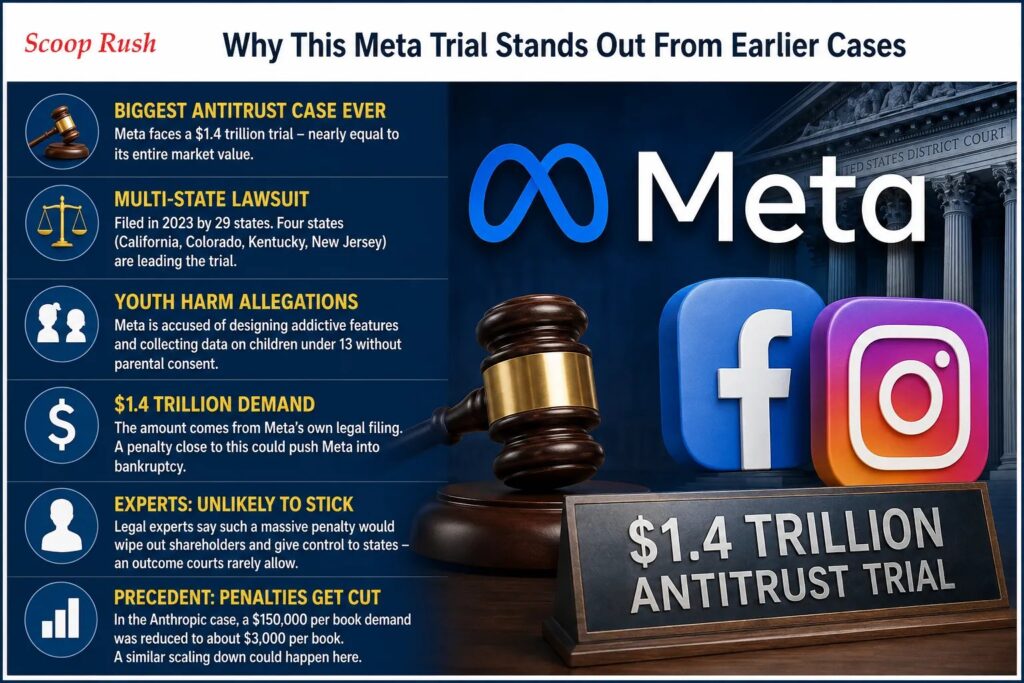
Why This Meta Trial Stands Out From Earlier Cases

Why This Meta Trial Stands Out From Earlier Cases

Meta has faced plenty of lawsuits over the years. However, this case stands apart because of its scale and the sweeping structural changes being demanded.

Dozens of states filed the original lawsuit back in 2023. The trial beginning this week features four states as plaintiffs: California, Colorado, Kentucky, and New Jersey. The remaining 25 states are expected to have their own trials later. Meanwhile, the case is being heard by Judge Yvonne Gonzalez Rogers, a federal judge known for being direct and incisive on the bench.

The lawsuit accuses Meta of contributing to a youth mental health crisis by deliberately designing addictive features. It also claims Meta collected data on children under 13 without parental consent, which would violate federal law. According to the lawsuit, Meta “harnessed powerful and unprecedented technologies to entice, engage, and ultimately ensnare youth and teens,” with profit as the driving motive.

The Staggering Dollar Figure Behind the Meta Trial

The 1.4 trillion dollar figure comes directly from a legal filing Meta itself disclosed. To put that in perspective, it is nearly equal to Meta’s entire market value as a publicly traded company. Consequently, if the company were ordered to pay anywhere close to that amount, it would almost certainly push Meta into bankruptcy.

Legal experts, though, do not expect the final penalty to reach that number. Cornell Law School professor James Grimmelmann pointed out that an award of that size would essentially wipe out Meta’s shareholders and hand control of the company to the states, calling that outcome extremely unlikely in practice.

Eric Goldman, a professor at Santa Clara University School of Law, offered a similar take. He said the state attorneys general are “going for the gusto,” aiming to set a defining legal precedent while pushing for both extraordinary damages and major structural changes to the platforms.

There is precedent for courts scaling back massive damage requests. For example, in the Anthropic AI training case, plaintiffs sought 150,000 dollars per copied book, yet the final penalty landed at roughly 3,000 dollars per book, totaling about 1.5 billion dollars. A similar scaling down could happen here.

What Changes Are the States Demanding From Instagram and Facebook?

What Changes Are the States Demanding From Instagram and Facebook?

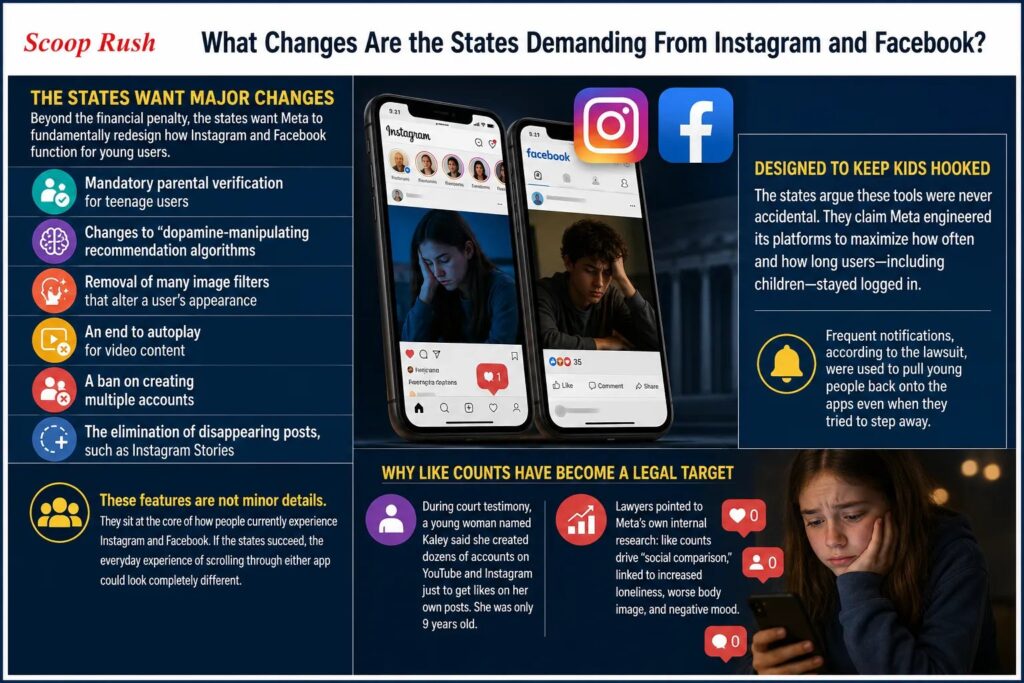
Beyond the financial penalty, the states want Meta to fundamentally redesign how Instagram and Facebook function for young users. Their list of demands includes:

  • Mandatory parental verification for teenage users
  • Changes to what they call “dopamine-manipulating recommendation algorithms”
  • Removal of many image filters that alter a user’s appearance
  • An end to autoplay for video content
  • A ban on creating multiple accounts
  • The elimination of disappearing posts, such as Instagram Stories

These features are not minor details. They sit at the core of how people currently experience Instagram and Facebook. As a result, if the states succeed, the everyday experience of scrolling through either app could look completely different.

The states argue these tools were never accidental. Instead, they claim Meta specifically engineered its platforms to maximize how often and how long users, including children, stayed logged in. Frequent notifications, according to the lawsuit, were used to pull young people back onto the apps even when they tried to step away.

Why Like Counts Have Become a Legal Target

Like counts have existed since Meta’s earliest days as Facebook. Today, they remain one of the primary ways people measure engagement across nearly every social platform. Yet research over recent years has linked these visible metrics to negative emotional effects in teenagers, including feelings of rejection and depression.

During court testimony, a young woman named Kaley described creating dozens of accounts on YouTube and Instagram just to generate likes on her own posts. She was only nine years old at the time and said she remembered feeling depressed, a condition she was later diagnosed with at age 10.

Lawyers for the states have also pointed to Meta’s own internal research. According to that research, like counts drive something called social comparison, where users measure their self-worth against images of other people. Meta’s internal findings reportedly linked this comparison to increased loneliness, worse body image, and negative mood.

Meta Already Lost a Similar Case in New Mexico

This is not the first time a court has ordered Meta to change how it operates. Earlier this month, a judge in New Mexico fined the company 942 million dollars and required a series of platform changes.

Judge Bryan Biedscheid’s order included eliminating like counts for users under 18, banning teenagers from sending or receiving nudity through Meta’s platforms, and restricting push notifications to certain hours of the day. Notably, Biedscheid also declared Meta a “public nuisance,” comparing it to a polluting factory causing harm across an entire population. It was the first time a social media company received that designation. Meta has said it will appeal the ruling.

While that New Mexico order only applies within the state, the California trial covers a far larger population. The 30 states involved in the broader lawsuit represent nearly two-thirds of the entire U.S. population. Therefore, a loss in Oakland would likely force Meta to roll out changes nationwide rather than in a single state. This mirrors a broader global trend, as regulators like the UK have also threatened big tech companies with penalties unless child safety features improve.

A Pattern of Legal Trouble for Meta

The Oakland trial arrives after a difficult stretch for Meta in court. The company has already lost two major cases this year involving harms to children and teens. It also reported a rare decline in profit last month, partly due to 2.4 billion dollars in legal expenses.

Earlier this year, a related case in Los Angeles served as a bellwether trial, meaning it was selected from thousands of similar lawsuits to test how arguments would play out before a jury. In that case, a state court awarded 6 million dollars to a young woman who testified that she became addicted to social media as a child. The jury found that Meta and Google’s YouTube had been negligent in designing their platforms and that this negligence substantially contributed to her harm. Jurors further concluded both companies knew their platforms could be dangerous for minors and failed to adequately warn users.

The Oakland case is more legally complex, however. Vanderbilt University law professor Rebecca Allensworth explained that the lawsuit involves multiple states and at least three different categories of statutes, including child privacy laws, false advertising laws, and unfair competition laws. Concerns about minors’ safety on tech platforms have also surfaced elsewhere, including a recent case where xAI faced a lawsuit over a Grok user creating sexual deepfakes of minors.

How Meta Has Responded to the Allegations

How Meta Has Responded to the Allegations

Meta has consistently denied wrongdoing throughout these legal battles. A company spokeswoman stated that Meta strongly disagrees with the allegations and remains confident the evidence will demonstrate its long-standing commitment to supporting young people.

In a July 6 court filing, Meta also pushed back hard against the scale of the requested penalty, calling it “untethered to any claimed violation” and noting that a sanction of that size has no precedent in the history of consumer protection enforcement.

At the same time, Meta has rolled out several safety features in recent years. In 2024, the company launched teen accounts on Instagram, which are private by default and include messaging restrictions along with parental controls. Additionally, Meta uses artificial intelligence to detect when users under 13 are on the platform or when teenagers may be lying about their age to access adult accounts.

Still, child safety advocates argue these steps fall short. Laura Marquez-Garrett of the Social Media Victims Law Center described this moment as a real point of reckoning for Meta, calling the ongoing legal cases a major leap forward rather than a small step.

What Jury Selection Revealed About Public Opinion

During jury selection last week, prospective jurors were asked whether they believed Meta had contributed to the youth mental health crisis. Many jurors agreed that it had. However, they also placed some responsibility on parents and pointed to broader issues, such as climate change and global instability, as additional factors affecting the mental health of children and teenagers.

This mixed sentiment could shape how the trial unfolds. Ultimately, the jury will need to weigh Meta’s specific role against these other contributing factors when reaching a verdict.

Conclusion

The Meta trial beginning this week in Oakland represents one of the most significant legal threats the company has ever faced. With 30 states involved and demands that reach into the trillions of dollars, this case goes far beyond a typical lawsuit. More importantly, the requested changes, from eliminating like counts to banning multiple accounts, could reshape the everyday experience of Instagram and Facebook for millions of users.

Meta has already lost similar battles in New Mexico and Los Angeles this year, adding pressure heading into this larger fight. While legal experts doubt the full 1.4 trillion dollar penalty will materialize, even a partial ruling in the states’ favor could force Meta to redesign core features across its platforms nationwide. As the trial unfolds, the outcome will likely influence not just Meta’s future, but how social media companies everywhere approach child safety going forward.

FAQs

Why are 30 states suing Meta?

The states accuse Meta of violating federal and state child privacy laws by knowingly designing addictive features for Instagram and Facebook, and by collecting data from children under 13 without parental consent.

How much money are the states seeking from Meta in this trial?

The states are seeking damages that could total as much as 1.4 trillion dollars, based on figures Meta itself disclosed in a legal filing, though legal experts consider the full amount unlikely to be awarded.

What changes could Instagram and Facebook face if Meta loses?

Possible changes include ending like counts, banning autoplay video, prohibiting multiple accounts, removing certain image filters, requiring parental verification for teens, and eliminating disappearing posts like Instagram Stories.

Has Meta lost similar lawsuits before this trial?

Yes. Earlier this month, a New Mexico judge fined Meta 942 million dollars and ordered safety changes, and a separate Los Angeles case resulted in a 6 million dollar award to a plaintiff who said she became addicted to social media as a child.

What has Meta said in response to the child safety allegations?

Meta has denied the allegations, stating it strongly disagrees with the claims and is confident the evidence will show its long-standing commitment to supporting young people.

Dublin Dons: The Bizarre True Story of Wimbledon’s Almost-Move to Ireland

0

What if a Premier League club had called Dublin home instead of London? It sounds like fantasy football talk. But in the mid-1990s, a group of Irish businessmen came remarkably close to turning Wimbledon FC into the Dublin Dons. The plan collapsed. Yet three decades later, the Dublin Dons story remains one of English football’s most fascinating what-ifs.

Today, thousands of Irish fans cross the sea every fortnight to watch Premier League football live. Record crowds recently packed Croke Park and the Aviva Stadium for pre-season friendlies. This proves Ireland’s appetite for top-flight football has never faded. So it’s worth asking: could a real, permanent Premier League presence in Dublin have actually worked? The Dublin Dons saga suggests the answer might have been yes.

Why the Dublin Dons Plan Still Matters Today

The Dublin Dons plan isn’t just a quirky footnote in football history. It’s a story about ambition, timing, and a missed opportunity that still shapes conversations about Irish football. Understanding how close Wimbledon came to relocating helps explain why the club eventually left London for Milton Keynes. It also explains why a grassroots movement rose from the ashes to create AFC Wimbledon.

For Irish football fans, the Dublin Dons tale raises bigger questions too. What might have happened to the League of Ireland? Would the national team’s profile have grown even further had a Premier League club set up shop on home soil?

How the Dublin Dons Idea First Started

A Club Without a Home

The Dublin Dons story begins with Wimbledon’s long-running housing problem. Chairman Sam Hammam bought the club in 1981. However, plans for a new all-seater stadium in Merton never got off the ground. As a result, Wimbledon shared a ground with Crystal Palace at Selhurst Park from 1991 onward. The arrangement pleased no one.

Kenny Cunningham, the Dublin-born full-back who joined Wimbledon from Millwall in 1994, remembers the awkward atmosphere well. Palace fans constantly hurled abuse at Wimbledon, calling them squatters. Cunningham felt little respect from the home crowd, though he suspects some of it was only half in jest.

Despite the uncertainty off the pitch, Wimbledon thrived on it. Under former Republic of Ireland international Joe Kinnear, the club moved past its rowdy, FA Cup-winning era of the 1980s, once nicknamed by fans and media at the time. Even so, the team remained genuinely competitive, finishing sixth in the 1993-94 season.

Still, the ground issue loomed over everything. Cunningham remembers constant speculation among players. Would they return to Plough Lane? Would they find another groundshare deal instead?

A Chance Meeting That Sparked the Dublin Dons Bid

The seeds of the Dublin Dons plan were planted almost by accident. A Sunday newspaper detailed Hammam’s frustrating standoff with Merton Council over the stadium issue. Tommy Higgins, then working with Ticketmaster Ireland, spotted an opportunity.

Higgins knew that property developer Owen O’Callaghan already held planning permission for a 40,000-seater stadium on the outskirts of Dublin. The project simply needed a tenant to anchor it. A stadium without a club, a club without a stadium. The pieces seemed to fit perfectly.

An initial meeting with Hammam’s brother went nowhere. Then fate intervened. Higgins and businessman Maurice Cassidy ran into former Ireland international and broadcaster Eamon Dunphy on the streets of Dublin. U2 manager Paul McGuinness was standing right beside him. That chance encounter brought together a genuinely heavyweight Irish consortium ready to give the Dublin Dons plan a real shot.

The Premier League’s Changing Landscape in the 1990s

The Premier League's Changing Landscape in the 1990s

To understand why the timing felt right, it helps to look at English football during the mid-1990s. The game was shifting away from the shadows of the Bradford City fire, Heysel, and Hillsborough. Meanwhile, the wave of foreign ownership that would later transform the sport, starting with Roman Abramovich’s Chelsea takeover, was still years off.

The Premier League itself was becoming a genuinely global product. Players like Jurgen Klinsmann, Dennis Bergkamp, and Juninho had already made moves to England that would have seemed unthinkable just a few years earlier.

On 17 August 1996, the opening day of that season, Gianfranco Zola and Fabrizio Ravanelli arrived as the league’s newest imported stars. Yet a home-grown talent stole the spotlight that day instead.

David Beckham’s audacious lob from the halfway line against Wimbledon at Selhurst Park remains one of the most replayed goals in Premier League history. Cunningham, asked about the strike years later, laughed off any blame. He admitted the cameras caught him standing in the corner of the shot, but he insisted he held no responsibility for that particular goal. For him, the moment captured the excitement building around the league right as the Dublin bid was taking shape.

The Irish consortium sat in the crowd at that very match. They were finalising a bid worth £6m for 74% of Wimbledon.

How the Dublin Dons Bid Split Opinion

Mixed Reactions From Players and the Media

Once news of the bid broke publicly, reaction split immediately. Cunningham remembers many people dismissing the idea outright. They simply couldn’t picture a Premier League team based in Dublin.

Cunningham also credits Hammam’s instinct for publicity. The chairman always found ways to generate headlines beyond matchday results, he noted. At first, Cunningham wondered whether the Dublin plan was just another attention-grabbing move. Then Kinnear made clear the ownership group was completely serious.

Being Irish himself, Cunningham understood the appeal immediately. Some of his English teammates struggled to grasp it, though. He remembers teammates asking, half-jokingly, whether Dublin even offered a decent night out, as if the city sat on the other side of the world.

However, not everyone shared that enthusiasm. Hammam believed convincing fellow club owners and broadcasters would prove straightforward. Winning over the fans, on the other hand, would take far more work.

Wimbledon Fans Reject the Dublin Move

Long-time supporter Ivor Heller had followed Wimbledon since their non-league days in the 1970s. He firmly opposed the move. Heller understood the business logic; after all, fans of the biggest clubs would relish an away trip to Dublin. Still, for him personally, the move represented the end of the football club as he knew it, regardless of which city it landed in.

Heller ran a printing business at the time. He produced placards for display at Selhurst Park that bluntly summed up the fanbase’s mood: “Dublin = Death.”

Meanwhile, opposition to the Dublin Dons plan wasn’t limited to supporters. The Football Association of Ireland pushed back strongly against the proposal too.

Why the FAI Opposed the Dublin Dons Move

The consortium believed a Premier League club in Dublin would lift Irish football as a whole. Kinnear even envisioned a wave of Irish internationals becoming realistic transfer targets. The FAI, however, feared the opposite outcome. They worried a Premier League presence would strangle the domestic League of Ireland instead of helping it.

Higgins, who later became chairman of League of Ireland club Sligo Rovers, still believes the concept was genuinely strong. He points to the timing: the plan arrived during the peak of Jack Charlton’s Ireland side, fresh off appearances at Italia ’90 and USA ’94. Dublin, he argues, missed a real chance to host a mini-international fixture every other week.

Looking back, Higgins believes the move could have transformed Irish soccer entirely. He claims the FAI focused too narrowly on the immediate threat rather than the bigger picture. He also points to how rugby and the GAA have since dominated sponsorship and broadcast revenue in Ireland, arguing that soccer lacked the vision to attempt something genuinely transformative when the chance arose.

How the Dublin Dons Deal Ultimately Collapsed

In the end, none of the opposition actually killed the Dublin Dons plan. The deal simply died from a lack of communication. After 18 months of negotiations, contact with Hammam went cold. Calls stopped coming back. Correspondence went unanswered.

Higgins still keeps the unsigned contract among his files today. He discovered the outcome almost by accident, while walking through an airport the following year. He looked up at a television screen and saw the news: Hammam had sold 80% of Wimbledon to Bjorn Rune Gjelsten and Kjell Inge Rokke for £26m, more than four times the amount the Irish consortium had offered.

A shopping centre now occupies the site where the proposed Dublin stadium once stood.

What Happened to Wimbledon After the Dublin Dons Plan Failed

Dublin never got its Premier League club. Ironically, Wimbledon didn’t keep their own identity either. The club relocated to Milton Keynes in 2004, becoming what is now known as MK Dons.

From the community left behind, a new club rose from the ground up. Supporters founded AFC Wimbledon that same year. The club started life in the ninth tier of English football, with Heller among its four co-founders.

Three decades after the first Dublin rumblings, AFC Wimbledon now competes in League One. The club has since returned to its spiritual home near Plough Lane.

Cunningham views that rebirth as the club’s greatest achievement, ranking it above any cup run or league finish. Surviving relegation after relegation and clawing back up the pyramid, he says, represents success every single time the team takes the pitch.

As for the Dublin Dons plan itself, Cunningham now describes it as a mix of nostalgia and quiet regret over a genuine missed opportunity. He remains convinced the idea would have worked. He also believes fans would have ultimately rowed in behind it, had the move actually gone ahead.

Key Takeaways

The Dublin Dons saga offers a rare glimpse into a genuinely serious attempt to relocate a Premier League club overseas. This happened decades before such ideas became common in global football discussions. Several factors ultimately doomed the plan.

Fan opposition ran fierce and organised, symbolised by Heller’s blunt “Dublin = Death” placards. Additionally, the FAI viewed the move as a threat to Irish domestic football rather than a boost. Ultimately, though, protest didn’t kill the deal. Hammam simply went silent and sold the club to new owners for a far higher sum than the Irish consortium had offered.

Today, Irish fans still travel in huge numbers to watch Premier League football live. Record crowds continue to turn out for one-off friendlies in Dublin. As a result, the Dublin Dons story feels more relevant than ever. It raises a lasting question: was this a wild idea rightly rejected, or a genuine missed chance to reshape football on the island of Ireland?

Frequently Asked Questions

What was the Dublin Dons plan? 

The Dublin Dons plan was a mid-1990s proposal by an Irish business consortium to relocate Wimbledon FC from London to a purpose-built 40,000-seater stadium on the outskirts of Dublin, making it the city’s own Premier League club.

Who was behind the Dublin Dons bid? 

The consortium included Tommy Higgins, businessman Maurice Cassidy, broadcaster and former Ireland international Eamon Dunphy, and U2 manager Paul McGuinness. Together, they planned to bid £6m for 74% of Wimbledon.

Why did the Dublin Dons deal collapse? 

After 18 months of negotiations, Wimbledon chairman Sam Hammam stopped responding to the consortium. He instead sold 80% of the club to Bjorn Rune Gjelsten and Kjell Inge Rokke for £26m, more than four times the Irish group’s offer.

How did Wimbledon fans react to the Dublin Dons proposal? 

Reaction was largely negative. Long-time supporter Ivor Heller and fellow fans produced placards reading “Dublin = Death” and displayed them at Selhurst Park to protest the idea.

What happened to Wimbledon after the Dublin Dons plan fell through? 

Wimbledon eventually relocated to Milton Keynes in 2004, becoming MK Dons. In response, supporters founded AFC Wimbledon that same year, starting in the ninth tier of English football before working their way back up to League One and returning near their original Plough Lane home.

Secondhand Book Sales AI Boom: Are Old Books Fueling Chatbots?

0

“Secondhand book sales AI demand is booming, and one bookseller in Northumberland just sold more books in a single order than he normally sells across an entire week. He still has no idea who bought them or why.”

Secondhand book sales AI demand could be the answer. Booksellers across the globe are starting to think artificial intelligence is quietly buying up the world’s old books.”

Introduction

Across the world, independent bookshops are reporting the same strange pattern. Massive bulk orders are landing out of nowhere, and the books are vanishing into distant warehouses. Nobody selling these books knows their final destination. However, many booksellers suspect the buyer is not a person at all. It might be artificial intelligence.

This secondhand book sales AI story matters because it touches everyone who has ever loved secondhand bookshops, cared about copyright law, or wondered how AI companies actually build their systems. As a result, understanding this trend gives readers a rare look at the hidden supply chain behind the chatbots many of us use every day.

Secondhand Book Sales AI Demand: A Sudden Surge in Bulk Orders

Secondhand Book Sales AI Demand: A Sudden Surge in Bulk Orders

Stuart Manley runs Barter Books in Northumberland, England. In a typical week, his shop sells between two and three thousand books. Recently, though, a single bulk order from a Canadian company matched what he would normally sell across seven full days.

Manley says he has never seen anything like it in thirty years of running a secondhand bookshop. Notably, he is not the only one. Booksellers from different countries have reported similarly unusual mega orders arriving without warning.

None of these sellers know exactly where their books end up. Still, the timing and scale of these orders point toward one likely explanation: the growing hunger of AI companies for fresh training material.

Books From Every Corner of the Shelf

What makes these orders even stranger is the variety of titles involved. Buyers have picked up everything from obscure Latin texts to old cowboy novels. There seems to be no obvious theme connecting the purchases.

Experts believe this randomness actually supports the AI training theory. Unusual and rare texts can offer fresh material that helps train large language models more effectively. Consequently, a chaotic mix of subjects makes more sense for a data-hungry AI system than for a curated personal library.

The Court Ruling Behind the AI Book Buying Trend

To understand why this is happening now, it helps to look back at a major legal decision from 2025. A US judge ruled that using books purchased through legitimate channels to train AI software did not violate copyright law.

The ruling came from a lawsuit filed against AI company Anthropic by three authors. Judge William Alsup described Anthropic’s use of the authors’ books as “exceedingly transformative.” Therefore, the court found the practice permitted under US law.

This decision opened a door. If buying and scanning physical books is legal, then companies have a strong incentive to acquire as many books as possible for training purposes.

What Emerged When the Court Documents Were Unsealed

Last month, court documents connected to the case were unsealed. They revealed something booksellers had not expected. Books were being destroyed during the process of training Anthropic’s AI chatbot, Claude.

A company spokesperson responded to the revelation. They said Claude is trained on a mix of publicly available web data, commercially acquired datasets, and internally generated data. They also stated that sourcing books for training is a common approach across the AI industry.

Importantly, the spokesperson added that none of the company’s data acquisition programs buy and destroy rare or antiquarian books. Even so, the idea that ordinary secondhand books are being pulped has caused real unease among sellers and readers alike, echoing broader concerns about AI going rogue without enough oversight.

Destructive Scanning: How AI Companies Digitise Old Books

Destructive Scanning: How AI Companies Digitise Old Books

The internal name for this book-digitisation effort, according to unsealed court documents, was “Project Panama.” Internal communications reportedly described the goal as an attempt to “destructively scan all the books in the world.”

Destructive scanning works by shipping physical books to facilities equipped for industrial-scale digitisation. Workers remove each book’s spine so the pages can be fed through scanners quickly. Afterward, the remaining paper is recycled.

Manley says a lot of mystery still surrounds Project Panama. He had not heard the name before, but the underlying practice was already a popular topic on bookseller forums. He cannot confirm whether his own stock was purchased for this specific project or a similar one run by another AI firm.

Why the Purchases Seem Random

Manley describes the buying pattern as having “no rhyme or reason.” This lines up with what intellectual property experts expect from AI training data collection. Unlike a collector or library, an AI training pipeline benefits from diversity rather than focus.

Professor Emily Hudson, an intellectual property specialist at Oxford University, points out that copyright law works differently outside the United States. In the UK, she explains, creating a training library and running the actual training process generally require permission from the copyright owner.

This distinction matters. It means the legal ruling that opened the door in the US does not automatically apply elsewhere. Meanwhile, secondhand books keep moving across borders regardless of where the buying company is based.

Booksellers Face a Difficult Ethical Question Over AI Book Purchases

For many independent booksellers, this trend creates a genuine dilemma. On one hand, these bulk orders bring welcome revenue. On the other hand, sellers worry about what happens to the books afterward.

David Tobin runs Walden Books in north London and has also noticed unusual sales patterns. He says it feels nice to finally sell titles that sat untouched for years. Still, he admits it would be sad if those same books are ultimately destroyed.

Derek Walker, owner of Edinburgh bookshop McNaughtan’s, offers a more nuanced take. He explains that a recent academic text published in only 100 copies, with 75 already sitting in libraries, would not represent a major loss if a single copy were destroyed.

However, Walker draws a clear line. His shop has sold books that represent the only known surviving example of an eighteenth-century edition. Losing one of those to destruction, he says, would be a genuinely significant problem.

Recycling Unwanted Titles Has a Silver Lining

Not every bookseller sees this trend as purely negative. Manley argues that recycling certain books is actually a sensible solution, especially for titles the public no longer wants on their shelves.

He points out that the world does not need five million copies of The Da Vinci Code sitting in circulation. In fact, some of his books had been advertised online for twenty years without a single buyer. Now, suddenly, they are selling, in a small-scale echo of how a mom built a $10k-a-month Etsy side hustle out of items nobody expected to sell.

This mix of opportunity and unease captures the tension running through the entire secondhand book trade right now. Bulk buyers are clearing out old inventory and putting cash into small businesses. At the same time, nobody fully knows what is happening to the physical books once they leave the shop.

Why the Secondhand Book Sales AI Trend Matters Beyond the Bookshop

Why the Secondhand Book Sales AI Trend Matters Beyond the Bookshop

This story is not just about used paperbacks changing hands. It touches on bigger questions about how AI companies source their training data, what counts as fair use, and how much transparency the public deserves.

For readers and collectors, the trend raises a practical concern. If AI firms keep buying up secondhand inventory at scale, prices and availability for certain books could shift over time. Additionally, rare or out-of-print titles could become harder to find if buyers are not careful about what they select for destruction.

For the AI industry, this practice highlights an unusual link between cutting-edge technology and old-fashioned paper. Even as companies build increasingly advanced systems like Kimi K3 and Qwen3-8-Max, they still depend on physical books scattered across secondhand shops for quality training material.

Ultimately, this situation shows how legal decisions in one courtroom can ripple outward into everyday small businesses across the world. A ruling about copyright and AI training has changed how bookshops in England, Scotland, and beyond experience a normal week of sales.

Conclusion

The secondhand book sales AI boom is largely unexplained, yet the evidence keeps pointing in one direction. Independent booksellers are receiving bulk orders far beyond their normal volume, and much of the evidence points toward AI companies acquiring books for training data.

A 2025 US court ruling made this kind of book buying legally viable, and unsealed documents later revealed that some books are destroyed during a process called destructive scanning. While companies insist rare and antiquarian books are not targeted, booksellers remain uneasy about not knowing where their stock truly ends up.

At the same time, this surge has brought real financial benefits to small bookshops and cleared out titles that sat unsold for decades. As AI companies continue searching for fresh training material, this quiet corner of the book trade is likely to stay in the spotlight for some time.

FAQs

Why are secondhand book sales suddenly increasing because of AI?

Independent booksellers are receiving unusually large bulk orders, and many suspect the books are being bought to train AI systems rather than for readers.

Is it legal for AI companies to use secondhand books for training?

A US court ruled in 2025 that using purchased books to train AI software was not a copyright violation, describing the practice as “exceedingly transformative.”

What is destructive scanning in relation to AI and books?

Destructive scanning involves removing a book’s spine so its pages can be scanned quickly at an industrial scale, after which the physical remains are recycled.

Are rare or antiquarian books being destroyed for AI training?

A spokesperson for Anthropic stated that none of the company’s data acquisition programs buy and destroy rare or antiquarian books, though booksellers say they cannot always verify what happens after a sale.

Does UK copyright law treat AI book scanning the same way as US law?

No. According to Oxford University’s Professor Emily Hudson, UK law generally requires permission from the copyright owner for both creating a training library and running the training process.

Perfume Shopping in Paris: A Local’s Guide 

0

Paris offers a remarkable choice for perfume shopping in Paris, from niche boutiques to historic fragrance houses. Visitors can discover scents unavailable in many mainstream stores. Moreover, Parisian perfumeries often focus on personal experiences rather than quick purchases. Local experts can guide shoppers toward fragrances that match their preferences. The city also offers elegant department stores with extensive fragrance collections. Therefore, visitors can enjoy very different perfume experiences across several neighborhoods.

The best approach involves slowing down and exploring a few fragrances. Trying too many scents can make it difficult to notice individual differences. Instead, shoppers should test fragrances gradually and allow them time to develop. Skin testing also reveals how a fragrance changes after application. This makes perfume shopping more thoughtful and helps prevent disappointing purchases.

Why Paris Remains a Perfume Shopping Destination

Why-Paris-Remains-a-Perfume-Shopping-Destination

Paris has a long relationship with fragrance and luxury. Historic perfume houses helped establish the city’s reputation for sophisticated scents. Today, independent brands continue that tradition through distinctive fragrance collections. Niche perfumeries now offer visitors alternatives to familiar designer perfumes.

The modern Paris fragrance scene also encourages personal discovery. Many specialist stores carry several independent perfume houses under one roof. This gives shoppers more opportunities to compare different styles. Visitors can also find unusual fragrances that rarely appear in mainstream stores.

Explore Niche Perfumeries for Unique Scents

Niche perfume shops provide one of the best Paris shopping experiences. These stores usually focus strongly on fragrance rather than wider fashion collections. Their selections can include smaller brands and less familiar perfume styles. Some niche houses also produce fragrances in smaller quantities.

Jovoy remains a major choice for shoppers seeking rare and niche fragrances. The store combines its own collection with many other perfume brands. Nose also provides a broad selection across numerous luxury fragrance houses. However, busy periods can make Nose crowded. Visitors should prepare to explore testers independently when staff remain occupied.

Discover Parisian Perfume Boutiques in Le Marais

Le Marais has become an important area for fragrance discovery. Several specialist stores operate within this lively central neighborhood. Shoppers can find independent brands alongside established perfume names. The area also allows visitors to combine fragrance shopping with other attractions.

Sens Unique offers another interesting option for adventurous fragrance shoppers. Its selection includes brands that many visitors may not recognize. The store also offers personalized sample boxes for different preferences. Customers can choose broad accords, preferred styles, or familiar fragrance notes.

Visit Historic Perfume Stores on the Left Bank

Visit-Historic-Perfume-Stores-on-the-Left-Bank

The Left Bank offers another rewarding route for perfume enthusiasts. Visitors can explore several fragrance stores around Saint-Germain-des-Prés. The area provides a more relaxed alternative to some busy central shopping districts. It also makes it possible to visit several specialist stores nearby.

Le Bon Marché provides an especially broad fragrance selection. Its perfume department combines designer houses with less mainstream brands. Visitors can also explore Diptyque and home fragrance collections within the store. Patricia de Nicolaï offers another independent option with perfumes and home fragrances.

Try Frederic Malle for a Specialist Experience

Éditions de Parfums Frédéric Malle offers a more focused perfume experience. The brand places strong emphasis on the perfumers behind its fragrances. Its Paris stores provide an environment designed for careful scent exploration.

Visitors can spend considerable time comparing fragrances inside the boutique. Trained assistants can also provide guidance during the selection process. The store presents its wider fragrance collection alongside candles and body products. This makes it suitable for shoppers seeking a specialist perfume experience.

Experience Traditional French Fragrance Brands

Experience-Traditional-French-Fragrance-Brands

Paris also offers several historic fragrance houses with distinctive identities. Caron provides a particularly traditional experience for fragrance enthusiasts. Its Saint-Germain boutique presents classic perfumes in an elegant setting. Visitors can also explore its powders and other beauty products.

Hermès offers another approach through its complete fragrance collection. The Saint-Germain boutique includes its more exclusive Hermessence range. Visitors can take time to explore different fragrance styles there. These heritage brands connect perfume shopping with Paris’s long luxury tradition.

Follow Simple Parisian Perfume Etiquette

Good manners can make perfume shopping more comfortable for everyone. Start with a polite “Bonjour” when entering a French perfume shop. Then explain what you want before touching products or testing bottles. Staff can often provide more useful recommendations after understanding your preferences.

Avoid testing too many fragrances during one visit. Experts recommend limiting your first selection to several scents. Testing a smaller group makes comparisons easier and clearer. Also, avoid rubbing your wrists together after spraying perfume. Let the fragrance settle naturally on your skin instead.

Let Fragrances Develop Before Buying

Let-Fragrances-Develop-Before-Buying

A fragrance can change noticeably after its first application. The opening notes may smell different from the later stages. Therefore, shoppers should avoid making immediate decisions based only on first impressions. Skin testing provides a better idea of the fragrance’s development.

Try a fragrance on your wrist and allow it to settle. Then continue your day before deciding whether you truly like it. This approach can reveal changes in longevity, character, and projection. It also reduces the chance of buying a fragrance that quickly disappoints.

Ask Staff for Personal Recommendations

Parisian perfume shopping becomes easier when you explain your preferences clearly. You do not need to know every fragrance note beforehand. Instead, describe scents you already enjoy or the feeling you want. Staff can then suggest fragrances that match your preferences.

Sens Unique demonstrates how personalized guidance can work in practice. Customers can create a sample box based on accords and preferences. They can also mention favorite perfumes or specific notes. This approach helps shoppers discover scents beyond familiar designer fragrances.

Consider Department Stores for Wider Choices

Department stores can save time when you want many brands together. Le Bon Marché offers an extensive selection across its fragrance department. Its collection includes brands such as Dior, Chanel, Guerlain, Byredo, and Tom Ford. Visitors can also find Diptyque elsewhere within the store.

BHV Marais provides another convenient option for fragrance shoppers. Its ground-floor beauty department includes designer and niche perfumes. Other major department stores also carry wide fragrance selections. These include Galeries Lafayette and La Samaritaine. Therefore, department stores work well for visitors with limited shopping time.

Plan Your Perfume Route Before Visiting

Plan-Your-Perfume-Route-Before-Visiting

Paris has too many perfume stores for one short shopping trip. A focused route can make the experience much more enjoyable. The Left Bank offers several options within a relatively concentrated area. Visitors can combine perfume stops with nearby cafes and other attractions.

You should also check opening hours before visiting individual boutiques. Some smaller stores may close temporarily during the afternoon. Sunday shopping can also create problems because many Paris businesses close. Planning your route in advance can prevent wasted travel time.

Think About Samples and VAT Refunds

Do not automatically expect free samples at every Paris perfume shop. Some stores control bottle testing through sales assistants. Others may offer samples depending on the store and purchase. Visitors should ask politely rather than assume samples come with every visit.

International visitors may also qualify for a VAT refund. Eligibility depends on the purchase and current French rules. The source recommends asking shop assistants about the refund process. Products usually need to remain sealed for VAT procedures. Therefore, shoppers should understand the requirements before opening purchased bottles.

Choose Perfume as a Memorable Paris Souvenir

Choose-Perfume-as-a-Memorable-Paris-Souvenir

Perfume can provide a more personal souvenir than ordinary tourist purchases. A niche fragrance may also remind you of a particular Paris trip. Smaller independent brands can make that souvenir feel more distinctive. The experience of finding the scent can become part of its appeal.

Paris offers options for almost every type of fragrance shopper. Niche boutiques suit visitors seeking unusual and independent scents. Department stores provide convenience and broad brand selections. Historic houses offer heritage and traditional French luxury. With patience, visitors can turn perfume shopping into a memorable Paris experience.

Conclusion

Perfume shopping in Paris offers more than buying a new fragrance. It gives visitors a chance to explore French perfume culture through niche boutiques and heritage houses. Shoppers can discover unusual scents while receiving personal recommendations from knowledgeable staff. With patience, visitors can find a fragrance that feels truly personal.

Ultimately, the best approach is to slow down and enjoy the experience. Test fewer fragrances, let them develop on your skin, and ask questions. From Le Marais to the Left Bank, Paris offers countless opportunities for fragrance discovery. A carefully chosen perfume can become a lasting reminder of your time in Paris.

FAQs

1. What is the best area for perfume shopping in Paris?

Le Marais offers several specialist perfume boutiques within a lively central area. Visitors can explore niche brands and personalized fragrance selections there. The Left Bank also provides excellent options around Saint-Germain-des-Prés.

2. Should I test perfume on my skin?

Yes, skin testing can provide a better understanding of a fragrance. Perfume develops differently after application and changes over time. Testing your skin can reveal its opening and later character.

3. How many perfumes should I test during one visit?

Testing several fragrances at once can quickly overwhelm your sense of smell. A smaller selection makes comparison much easier. Try a few scents before moving to another group.

4. Can tourists receive perfume samples in Paris?

Some stores may provide samples, but you should not expect them everywhere. Certain boutiques control fragrance testing through their staff. Ask politely if a sample remains available after testing.

5. Can tourists claim a VAT refund on perfume?

Eligible international visitors may qualify for a VAT refund. However, specific requirements apply to purchases and departure procedures. Ask the store about current rules before completing your purchase.