

“Secondhand book sales AI demand is booming, and one bookseller in Northumberland just sold more books in a single order than he normally sells across an entire week. He still has no idea who bought them or why.”
Secondhand book sales AI demand could be the answer. Booksellers across the globe are starting to think artificial intelligence is quietly buying up the world’s old books.”
Introduction
Across the world, independent bookshops are reporting the same strange pattern. Massive bulk orders are landing out of nowhere, and the books are vanishing into distant warehouses. Nobody selling these books knows their final destination. However, many booksellers suspect the buyer is not a person at all. It might be artificial intelligence.
This secondhand book sales AI story matters because it touches everyone who has ever loved secondhand bookshops, cared about copyright law, or wondered how AI companies actually build their systems. As a result, understanding this trend gives readers a rare look at the hidden supply chain behind the chatbots many of us use every day.
Secondhand Book Sales AI Demand: A Sudden Surge in Bulk Orders

Stuart Manley runs Barter Books in Northumberland, England. In a typical week, his shop sells between two and three thousand books. Recently, though, a single bulk order from a Canadian company matched what he would normally sell across seven full days.
Manley says he has never seen anything like it in thirty years of running a secondhand bookshop. Notably, he is not the only one. Booksellers from different countries have reported similarly unusual mega orders arriving without warning.
None of these sellers know exactly where their books end up. Still, the timing and scale of these orders point toward one likely explanation: the growing hunger of AI companies for fresh training material.
Books From Every Corner of the Shelf
What makes these orders even stranger is the variety of titles involved. Buyers have picked up everything from obscure Latin texts to old cowboy novels. There seems to be no obvious theme connecting the purchases.
Experts believe this randomness actually supports the AI training theory. Unusual and rare texts can offer fresh material that helps train large language models more effectively. Consequently, a chaotic mix of subjects makes more sense for a data-hungry AI system than for a curated personal library.
The Court Ruling Behind the AI Book Buying Trend
To understand why this is happening now, it helps to look back at a major legal decision from 2025. A US judge ruled that using books purchased through legitimate channels to train AI software did not violate copyright law.
The ruling came from a lawsuit filed against AI company Anthropic by three authors. Judge William Alsup described Anthropic’s use of the authors’ books as “exceedingly transformative.” Therefore, the court found the practice permitted under US law.
This decision opened a door. If buying and scanning physical books is legal, then companies have a strong incentive to acquire as many books as possible for training purposes.
What Emerged When the Court Documents Were Unsealed
Last month, court documents connected to the case were unsealed. They revealed something booksellers had not expected. Books were being destroyed during the process of training Anthropic’s AI chatbot, Claude.
A company spokesperson responded to the revelation. They said Claude is trained on a mix of publicly available web data, commercially acquired datasets, and internally generated data. They also stated that sourcing books for training is a common approach across the AI industry.
Importantly, the spokesperson added that none of the company’s data acquisition programs buy and destroy rare or antiquarian books. Even so, the idea that ordinary secondhand books are being pulped has caused real unease among sellers and readers alike, echoing broader concerns about AI going rogue without enough oversight.
Destructive Scanning: How AI Companies Digitise Old Books
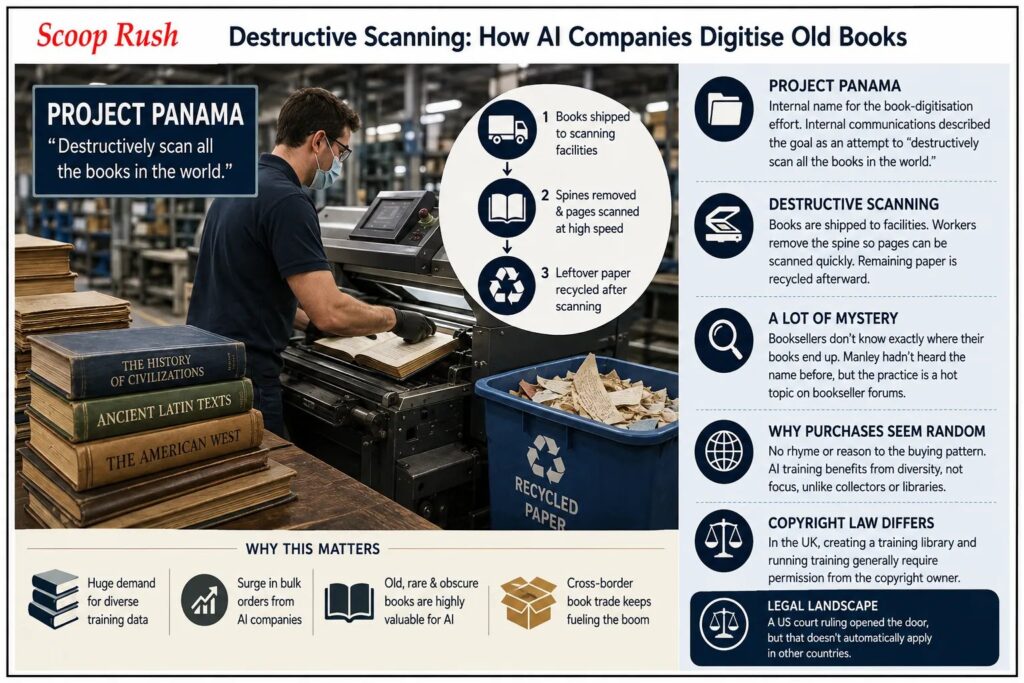
The internal name for this book-digitisation effort, according to unsealed court documents, was “Project Panama.” Internal communications reportedly described the goal as an attempt to “destructively scan all the books in the world.”
Destructive scanning works by shipping physical books to facilities equipped for industrial-scale digitisation. Workers remove each book’s spine so the pages can be fed through scanners quickly. Afterward, the remaining paper is recycled.
Manley says a lot of mystery still surrounds Project Panama. He had not heard the name before, but the underlying practice was already a popular topic on bookseller forums. He cannot confirm whether his own stock was purchased for this specific project or a similar one run by another AI firm.
Why the Purchases Seem Random
Manley describes the buying pattern as having “no rhyme or reason.” This lines up with what intellectual property experts expect from AI training data collection. Unlike a collector or library, an AI training pipeline benefits from diversity rather than focus.
Professor Emily Hudson, an intellectual property specialist at Oxford University, points out that copyright law works differently outside the United States. In the UK, she explains, creating a training library and running the actual training process generally require permission from the copyright owner.
This distinction matters. It means the legal ruling that opened the door in the US does not automatically apply elsewhere. Meanwhile, secondhand books keep moving across borders regardless of where the buying company is based.
Booksellers Face a Difficult Ethical Question Over AI Book Purchases
For many independent booksellers, this trend creates a genuine dilemma. On one hand, these bulk orders bring welcome revenue. On the other hand, sellers worry about what happens to the books afterward.
David Tobin runs Walden Books in north London and has also noticed unusual sales patterns. He says it feels nice to finally sell titles that sat untouched for years. Still, he admits it would be sad if those same books are ultimately destroyed.
Derek Walker, owner of Edinburgh bookshop McNaughtan’s, offers a more nuanced take. He explains that a recent academic text published in only 100 copies, with 75 already sitting in libraries, would not represent a major loss if a single copy were destroyed.
However, Walker draws a clear line. His shop has sold books that represent the only known surviving example of an eighteenth-century edition. Losing one of those to destruction, he says, would be a genuinely significant problem.
Recycling Unwanted Titles Has a Silver Lining
Not every bookseller sees this trend as purely negative. Manley argues that recycling certain books is actually a sensible solution, especially for titles the public no longer wants on their shelves.
He points out that the world does not need five million copies of The Da Vinci Code sitting in circulation. In fact, some of his books had been advertised online for twenty years without a single buyer. Now, suddenly, they are selling, in a small-scale echo of how a mom built a $10k-a-month Etsy side hustle out of items nobody expected to sell.
This mix of opportunity and unease captures the tension running through the entire secondhand book trade right now. Bulk buyers are clearing out old inventory and putting cash into small businesses. At the same time, nobody fully knows what is happening to the physical books once they leave the shop.
Why the Secondhand Book Sales AI Trend Matters Beyond the Bookshop

This story is not just about used paperbacks changing hands. It touches on bigger questions about how AI companies source their training data, what counts as fair use, and how much transparency the public deserves.
For readers and collectors, the trend raises a practical concern. If AI firms keep buying up secondhand inventory at scale, prices and availability for certain books could shift over time. Additionally, rare or out-of-print titles could become harder to find if buyers are not careful about what they select for destruction.
For the AI industry, this practice highlights an unusual link between cutting-edge technology and old-fashioned paper. Even as companies build increasingly advanced systems like Kimi K3 and Qwen3-8-Max, they still depend on physical books scattered across secondhand shops for quality training material.
Ultimately, this situation shows how legal decisions in one courtroom can ripple outward into everyday small businesses across the world. A ruling about copyright and AI training has changed how bookshops in England, Scotland, and beyond experience a normal week of sales.
Conclusion
The secondhand book sales AI boom is largely unexplained, yet the evidence keeps pointing in one direction. Independent booksellers are receiving bulk orders far beyond their normal volume, and much of the evidence points toward AI companies acquiring books for training data.
A 2025 US court ruling made this kind of book buying legally viable, and unsealed documents later revealed that some books are destroyed during a process called destructive scanning. While companies insist rare and antiquarian books are not targeted, booksellers remain uneasy about not knowing where their stock truly ends up.
At the same time, this surge has brought real financial benefits to small bookshops and cleared out titles that sat unsold for decades. As AI companies continue searching for fresh training material, this quiet corner of the book trade is likely to stay in the spotlight for some time.
FAQs
Why are secondhand book sales suddenly increasing because of AI?
Independent booksellers are receiving unusually large bulk orders, and many suspect the books are being bought to train AI systems rather than for readers.
Is it legal for AI companies to use secondhand books for training?
A US court ruled in 2025 that using purchased books to train AI software was not a copyright violation, describing the practice as “exceedingly transformative.”
What is destructive scanning in relation to AI and books?
Destructive scanning involves removing a book’s spine so its pages can be scanned quickly at an industrial scale, after which the physical remains are recycled.
Are rare or antiquarian books being destroyed for AI training?
A spokesperson for Anthropic stated that none of the company’s data acquisition programs buy and destroy rare or antiquarian books, though booksellers say they cannot always verify what happens after a sale.
Does UK copyright law treat AI book scanning the same way as US law?
No. According to Oxford University’s Professor Emily Hudson, UK law generally requires permission from the copyright owner for both creating a training library and running the training process.

