
Could a single courtroom decision force Instagram to remove its like button? For 30 U.S. states, that question is no longer hypothetical, and the Meta trial starting this week could decide it.
Starting this week in Oakland, Meta faces the biggest child safety trial in its history. States are demanding not just record-breaking damages, but a complete overhaul of how Instagram and Facebook work for young users. If they win, the apps you use every day could look nothing like they do now.
Introduction
The Meta trial is heading into federal court this week, with allegations that could fundamentally reshape Instagram and Facebook. Thirty states claim the company knowingly built addictive features to hook children and teenagers, and they want Meta to pay as much as 1.4 trillion dollars while redesigning core parts of its platforms. This Meta trial matters because its outcome could determine whether the apps millions of young people rely on every day continue to look the way they do today.
Why This Meta Trial Stands Out From Earlier Cases
Meta has faced plenty of lawsuits over the years. However, this case stands apart because of its scale and the sweeping structural changes being demanded.
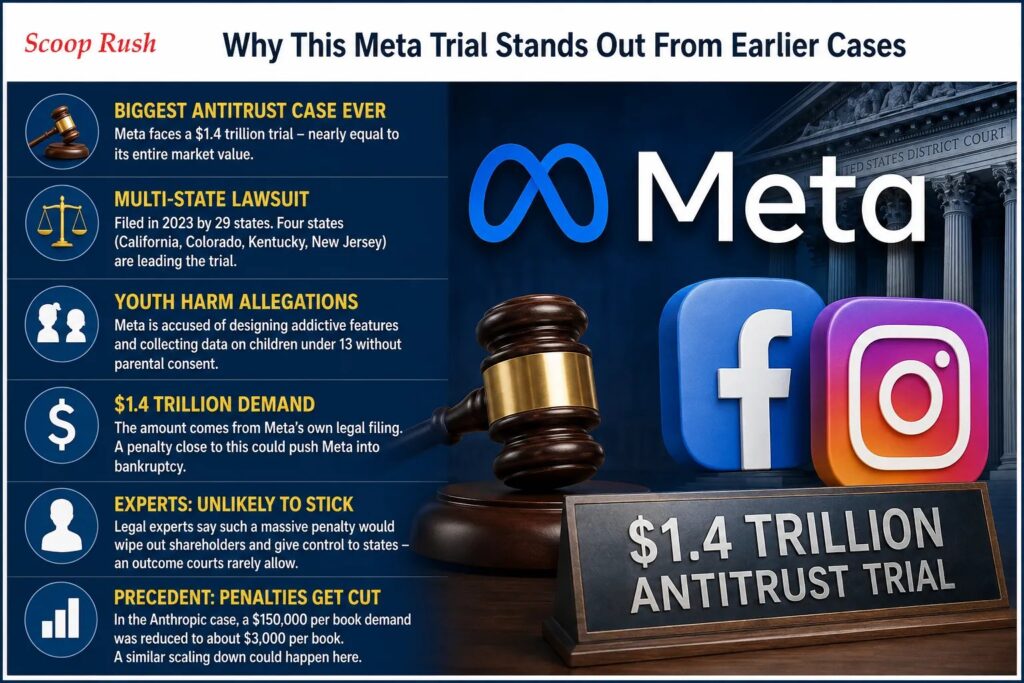
Dozens of states filed the original lawsuit back in 2023. The trial beginning this week features four states as plaintiffs: California, Colorado, Kentucky, and New Jersey. The remaining 25 states are expected to have their own trials later. Meanwhile, the case is being heard by Judge Yvonne Gonzalez Rogers, a federal judge known for being direct and incisive on the bench.
The lawsuit accuses Meta of contributing to a youth mental health crisis by deliberately designing addictive features. It also claims Meta collected data on children under 13 without parental consent, which would violate federal law. According to the lawsuit, Meta “harnessed powerful and unprecedented technologies to entice, engage, and ultimately ensnare youth and teens,” with profit as the driving motive.
The Staggering Dollar Figure Behind the Meta Trial
The 1.4 trillion dollar figure comes directly from a legal filing Meta itself disclosed. To put that in perspective, it is nearly equal to Meta’s entire market value as a publicly traded company. Consequently, if the company were ordered to pay anywhere close to that amount, it would almost certainly push Meta into bankruptcy.
Legal experts, though, do not expect the final penalty to reach that number. Cornell Law School professor James Grimmelmann pointed out that an award of that size would essentially wipe out Meta’s shareholders and hand control of the company to the states, calling that outcome extremely unlikely in practice.
Eric Goldman, a professor at Santa Clara University School of Law, offered a similar take. He said the state attorneys general are “going for the gusto,” aiming to set a defining legal precedent while pushing for both extraordinary damages and major structural changes to the platforms.
There is precedent for courts scaling back massive damage requests. For example, in the Anthropic AI training case, plaintiffs sought 150,000 dollars per copied book, yet the final penalty landed at roughly 3,000 dollars per book, totaling about 1.5 billion dollars. A similar scaling down could happen here.
What Changes Are the States Demanding From Instagram and Facebook?
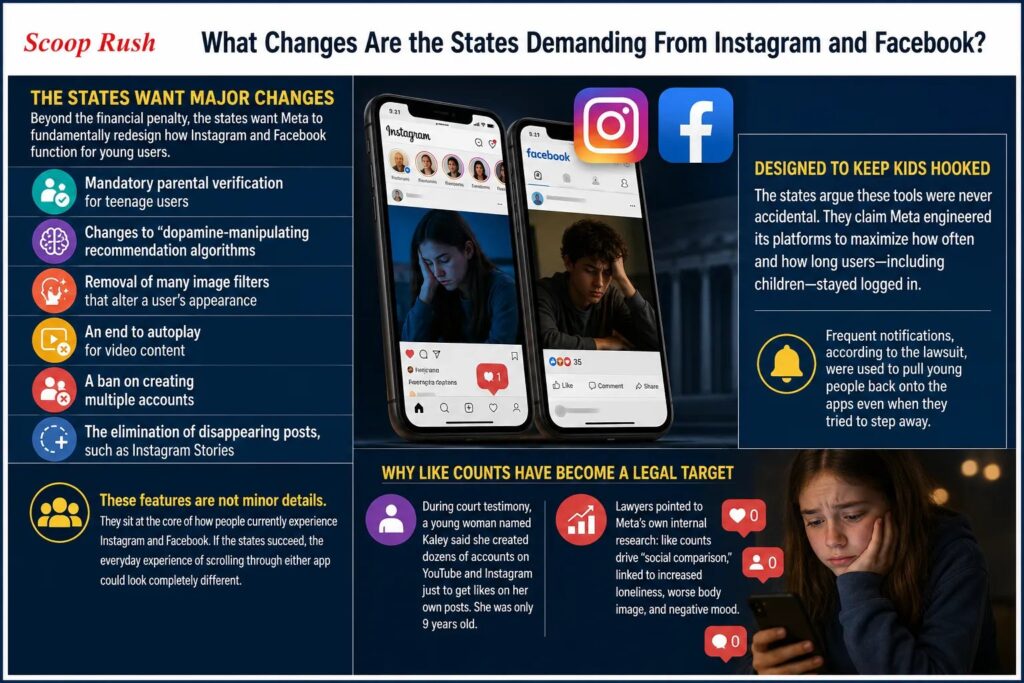
Beyond the financial penalty, the states want Meta to fundamentally redesign how Instagram and Facebook function for young users. Their list of demands includes:
- Mandatory parental verification for teenage users
- Changes to what they call “dopamine-manipulating recommendation algorithms”
- Removal of many image filters that alter a user’s appearance
- An end to autoplay for video content
- A ban on creating multiple accounts
- The elimination of disappearing posts, such as Instagram Stories
These features are not minor details. They sit at the core of how people currently experience Instagram and Facebook. As a result, if the states succeed, the everyday experience of scrolling through either app could look completely different.
The states argue these tools were never accidental. Instead, they claim Meta specifically engineered its platforms to maximize how often and how long users, including children, stayed logged in. Frequent notifications, according to the lawsuit, were used to pull young people back onto the apps even when they tried to step away.
Why Like Counts Have Become a Legal Target
Like counts have existed since Meta’s earliest days as Facebook. Today, they remain one of the primary ways people measure engagement across nearly every social platform. Yet research over recent years has linked these visible metrics to negative emotional effects in teenagers, including feelings of rejection and depression.
During court testimony, a young woman named Kaley described creating dozens of accounts on YouTube and Instagram just to generate likes on her own posts. She was only nine years old at the time and said she remembered feeling depressed, a condition she was later diagnosed with at age 10.
Lawyers for the states have also pointed to Meta’s own internal research. According to that research, like counts drive something called social comparison, where users measure their self-worth against images of other people. Meta’s internal findings reportedly linked this comparison to increased loneliness, worse body image, and negative mood.
Meta Already Lost a Similar Case in New Mexico
This is not the first time a court has ordered Meta to change how it operates. Earlier this month, a judge in New Mexico fined the company 942 million dollars and required a series of platform changes.
Judge Bryan Biedscheid’s order included eliminating like counts for users under 18, banning teenagers from sending or receiving nudity through Meta’s platforms, and restricting push notifications to certain hours of the day. Notably, Biedscheid also declared Meta a “public nuisance,” comparing it to a polluting factory causing harm across an entire population. It was the first time a social media company received that designation. Meta has said it will appeal the ruling.
While that New Mexico order only applies within the state, the California trial covers a far larger population. The 30 states involved in the broader lawsuit represent nearly two-thirds of the entire U.S. population. Therefore, a loss in Oakland would likely force Meta to roll out changes nationwide rather than in a single state. This mirrors a broader global trend, as regulators like the UK have also threatened big tech companies with penalties unless child safety features improve.
A Pattern of Legal Trouble for Meta
The Oakland trial arrives after a difficult stretch for Meta in court. The company has already lost two major cases this year involving harms to children and teens. It also reported a rare decline in profit last month, partly due to 2.4 billion dollars in legal expenses.
Earlier this year, a related case in Los Angeles served as a bellwether trial, meaning it was selected from thousands of similar lawsuits to test how arguments would play out before a jury. In that case, a state court awarded 6 million dollars to a young woman who testified that she became addicted to social media as a child. The jury found that Meta and Google’s YouTube had been negligent in designing their platforms and that this negligence substantially contributed to her harm. Jurors further concluded both companies knew their platforms could be dangerous for minors and failed to adequately warn users.
The Oakland case is more legally complex, however. Vanderbilt University law professor Rebecca Allensworth explained that the lawsuit involves multiple states and at least three different categories of statutes, including child privacy laws, false advertising laws, and unfair competition laws. Concerns about minors’ safety on tech platforms have also surfaced elsewhere, including a recent case where xAI faced a lawsuit over a Grok user creating sexual deepfakes of minors.
How Meta Has Responded to the Allegations
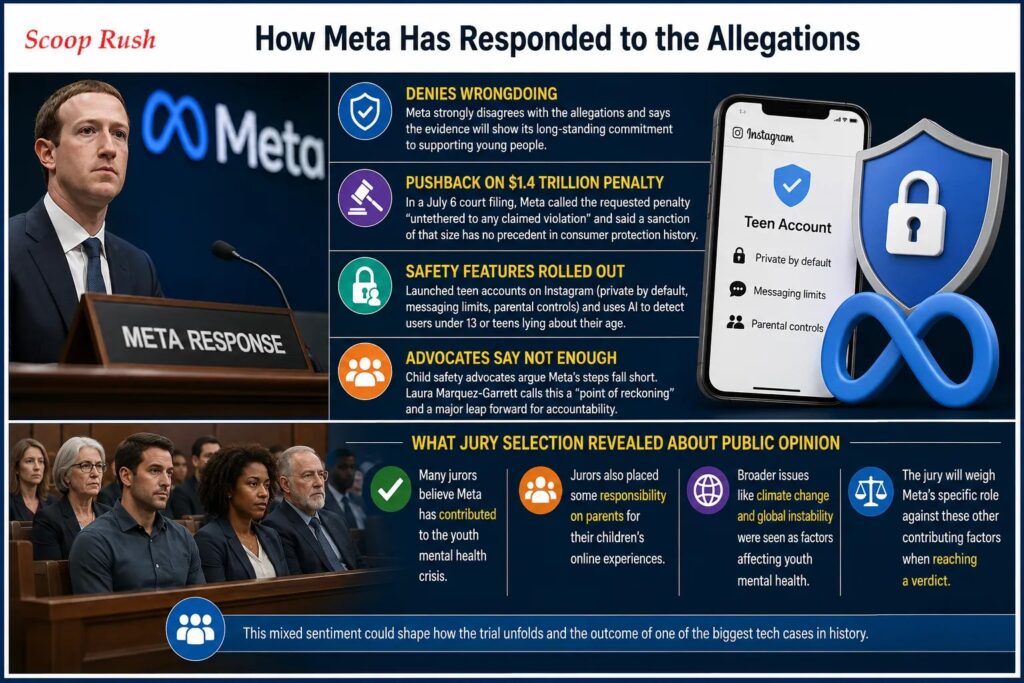
Meta has consistently denied wrongdoing throughout these legal battles. A company spokeswoman stated that Meta strongly disagrees with the allegations and remains confident the evidence will demonstrate its long-standing commitment to supporting young people.
In a July 6 court filing, Meta also pushed back hard against the scale of the requested penalty, calling it “untethered to any claimed violation” and noting that a sanction of that size has no precedent in the history of consumer protection enforcement.
At the same time, Meta has rolled out several safety features in recent years. In 2024, the company launched teen accounts on Instagram, which are private by default and include messaging restrictions along with parental controls. Additionally, Meta uses artificial intelligence to detect when users under 13 are on the platform or when teenagers may be lying about their age to access adult accounts.
Still, child safety advocates argue these steps fall short. Laura Marquez-Garrett of the Social Media Victims Law Center described this moment as a real point of reckoning for Meta, calling the ongoing legal cases a major leap forward rather than a small step.
What Jury Selection Revealed About Public Opinion
During jury selection last week, prospective jurors were asked whether they believed Meta had contributed to the youth mental health crisis. Many jurors agreed that it had. However, they also placed some responsibility on parents and pointed to broader issues, such as climate change and global instability, as additional factors affecting the mental health of children and teenagers.
This mixed sentiment could shape how the trial unfolds. Ultimately, the jury will need to weigh Meta’s specific role against these other contributing factors when reaching a verdict.
Conclusion
The Meta trial beginning this week in Oakland represents one of the most significant legal threats the company has ever faced. With 30 states involved and demands that reach into the trillions of dollars, this case goes far beyond a typical lawsuit. More importantly, the requested changes, from eliminating like counts to banning multiple accounts, could reshape the everyday experience of Instagram and Facebook for millions of users.
Meta has already lost similar battles in New Mexico and Los Angeles this year, adding pressure heading into this larger fight. While legal experts doubt the full 1.4 trillion dollar penalty will materialize, even a partial ruling in the states’ favor could force Meta to redesign core features across its platforms nationwide. As the trial unfolds, the outcome will likely influence not just Meta’s future, but how social media companies everywhere approach child safety going forward.
FAQs
Why are 30 states suing Meta?
The states accuse Meta of violating federal and state child privacy laws by knowingly designing addictive features for Instagram and Facebook, and by collecting data from children under 13 without parental consent.
How much money are the states seeking from Meta in this trial?
The states are seeking damages that could total as much as 1.4 trillion dollars, based on figures Meta itself disclosed in a legal filing, though legal experts consider the full amount unlikely to be awarded.
What changes could Instagram and Facebook face if Meta loses?
Possible changes include ending like counts, banning autoplay video, prohibiting multiple accounts, removing certain image filters, requiring parental verification for teens, and eliminating disappearing posts like Instagram Stories.
Has Meta lost similar lawsuits before this trial?
Yes. Earlier this month, a New Mexico judge fined Meta 942 million dollars and ordered safety changes, and a separate Los Angeles case resulted in a 6 million dollar award to a plaintiff who said she became addicted to social media as a child.
What has Meta said in response to the child safety allegations?
Meta has denied the allegations, stating it strongly disagrees with the claims and is confident the evidence will show its long-standing commitment to supporting young people.

