
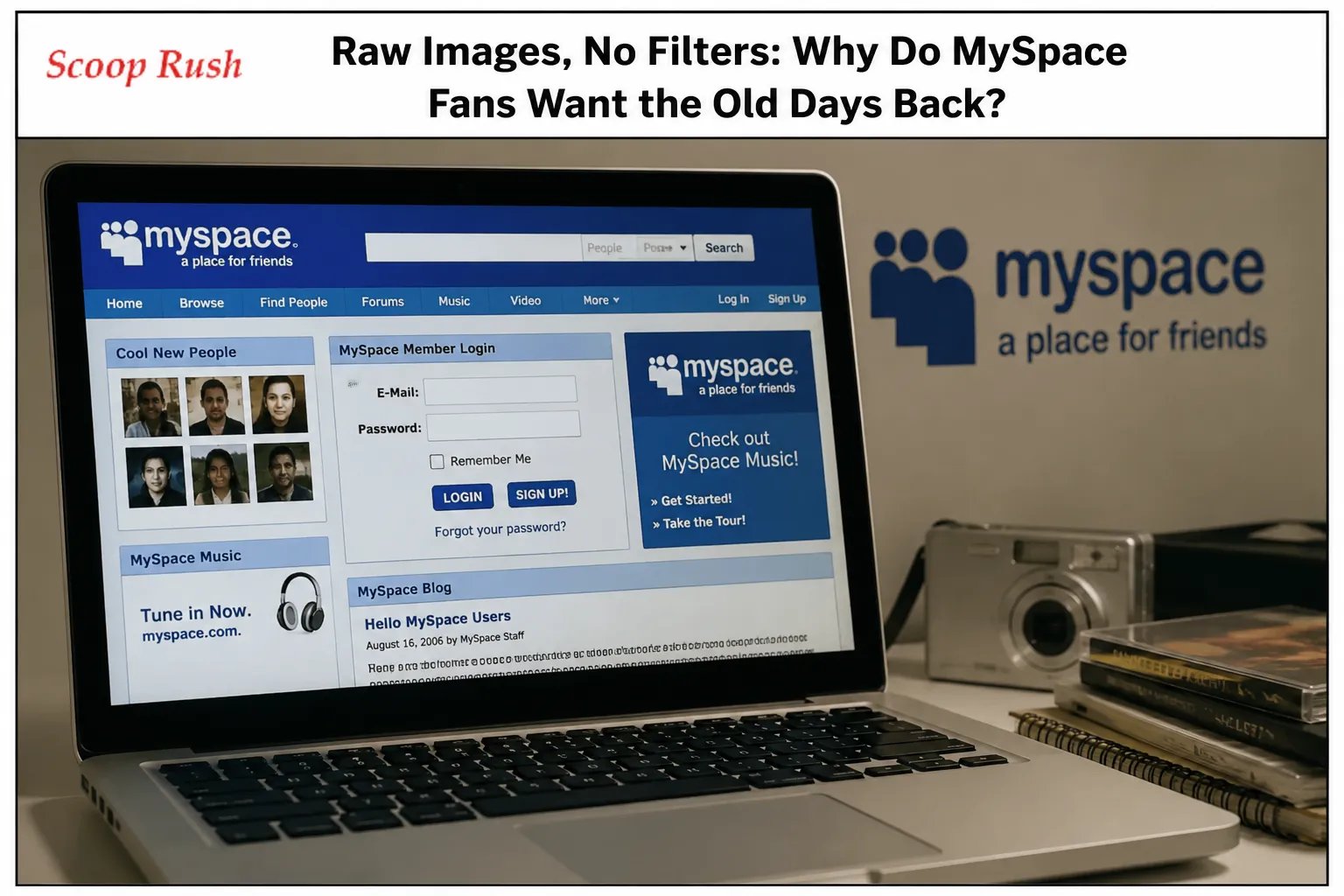
“Do you remember when your MySpace profile said more about you than any filtered photo ever could? A MySpace relaunch is now being hinted at, and that messy, music-blaring, endlessly customizable page might be making a comeback.”
For millions of millennials, one question is suddenly back in conversation: is MySpace coming back for real this time? The idea alone has been enough to get former users talking, and the excitement online has been hard to miss.
For many millennials, MySpace wasn’t just an early social network. It was the place where they first learned to build an identity online, one glittery background and auto-playing song at a time. Now that its owners have hinted at a MySpace relaunch, people are asking a bigger question: can any platform recapture what made that era feel so real?
This matters beyond simple nostalgia. Today’s social media landscape runs on algorithms, curated feeds, and content designed to keep users scrolling endlessly. A MySpace comeback, if it stays true to raw, unfiltered self-expression, could offer something genuinely different. Understanding why people miss it, and what a relaunch needs to get right, says a lot about what’s missing from social media right now.
Is a MySpace Relaunch Actually Happening?
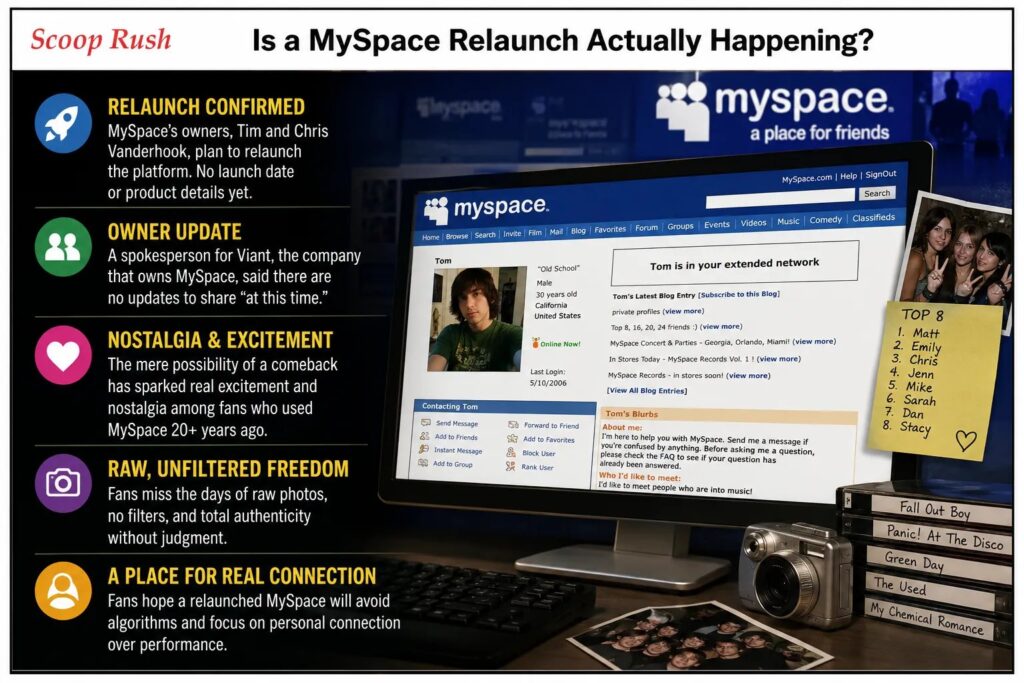
MySpace’s owners, brothers Tim and Chris Vanderhook, have confirmed they plan a MySpace relaunch However, they haven’t announced a launch date, and specific product details remain unclear for now. A spokesperson for Viant, the company that owns MySpace, said there are no updates to share “at this time.”
Still, that small amount of information sparked real excitement. Just the possibility of a comeback has stirred memories among people who used the platform more than 20 years ago. For them, MySpace represented a specific kind of internet freedom that newer platforms, including WhatsApp, Facebook, and Instagram, haven’t managed to replicate.
Why Do MySpace Fans Miss Raw, Unfiltered Images So Much?
Monticah Hawkins, a 31-year-old real-estate agent in Atlanta, describes MySpace as more than a website. She calls it a ritual.
“You could be authentic on MySpace,” she says. “Upload raw images, no filters. You could have snot coming out your nose and nobody would judge.”
That kind of unfiltered honesty feels almost foreign next to today’s heavily edited social media posts. Melissa Kristin, a TikTok creator with more than 900,000 followers, grew up using MySpace and remembers a similar sense of freedom.
“It was all very much your own little world, your own corner of the internet,” Kristin says.
That feeling shaped how she expresses herself online today. Additionally, she believes a revived MySpace should avoid the algorithm-driven, pay-to-play systems that dominate current platforms. Instead, she says it “would be best served for personal connection rather than performance.”
For Kristin, the appeal isn’t just about design. It’s about recapturing an emotional experience millennials remember fondly. As she puts it, the goal would be recreating “that high we felt as millennials when we got all the friend requests and comments,” which helped people feel genuinely connected.
What Happened to MySpace? A Quick Look Back
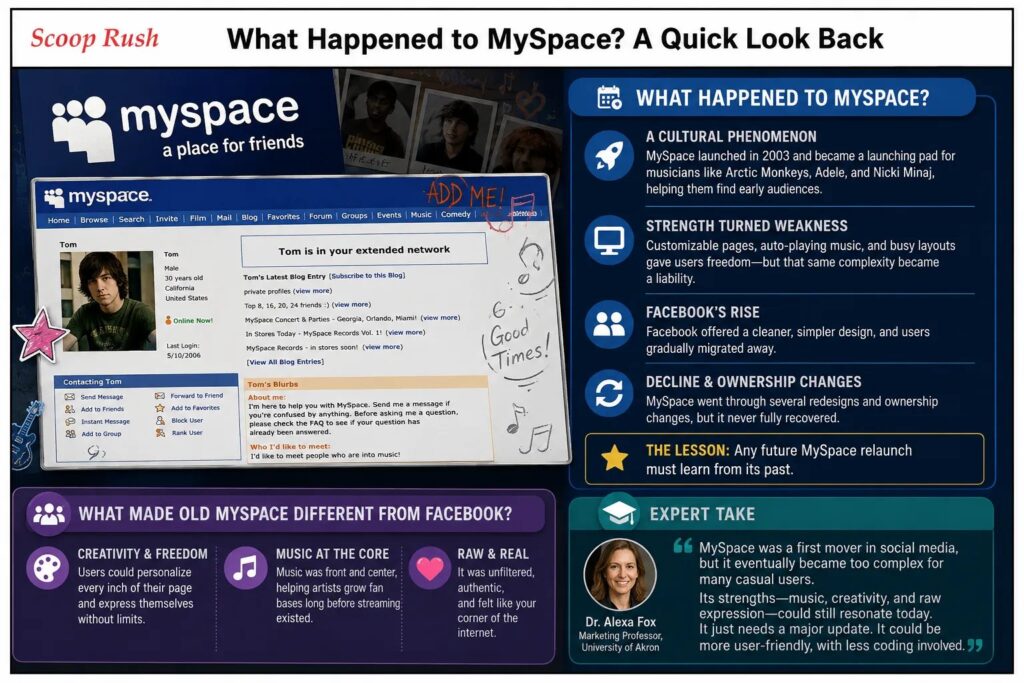
MySpace launched in 2003 and quickly grew into a major cultural force. It became a launching pad for musicians, helping artists like Arctic Monkeys, Adele, and Nicki Minaj find early audiences long before streaming platforms existed.
Its biggest strength was also its biggest challenge. Highly customizable pages, auto-playing music, and busy layouts gave users creative freedom, but that same complexity eventually became a liability. Meanwhile, Facebook introduced a cleaner, simpler design, and users gradually started migrating away. As a result, MySpace went through several redesigns and ownership changes, but it never fully recovered its dominant position.
Marketing experts say any future MySpace relaunch will need to learn from that history.
What Made the Old MySpace Different From Facebook?
Dr. Alexa Fox, a marketing professor at the University of Akron, explains that MySpace was a “first mover” in social media. However, it eventually became too complex for many casual users to navigate.
She believes the platform’s original strengths, including music, creativity, and raw personal expression, could still resonate with people today. That said, she notes it would need a major update. “It could be more user-friendly, with less coding involved,” she says.
What Would Make a Successful MySpace Comeback?
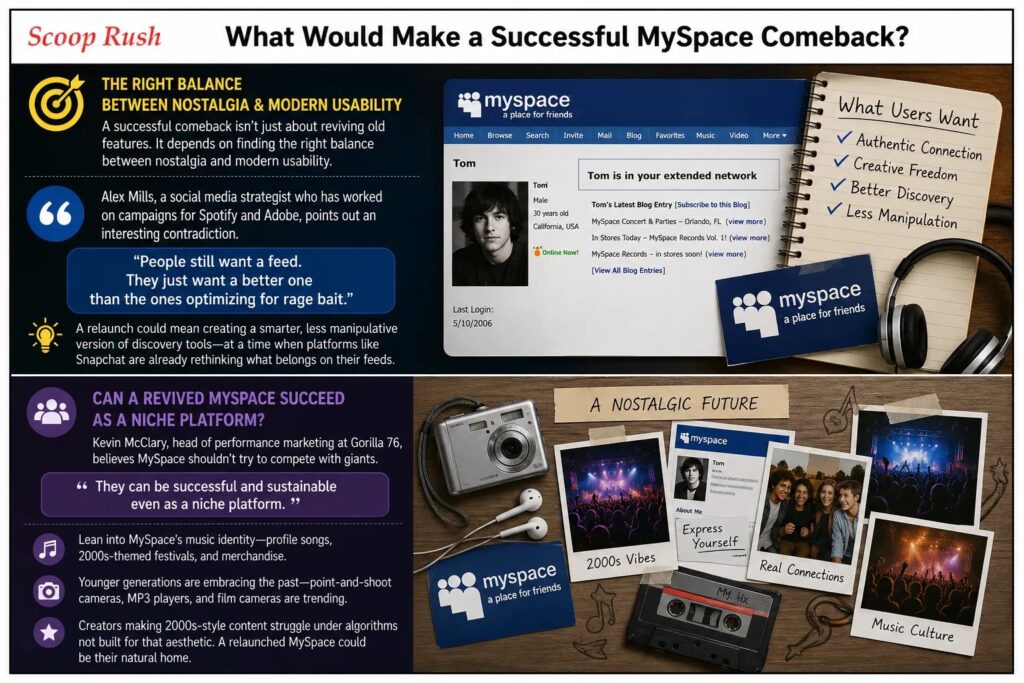
A successful comeback isn’t just about reviving old features. According to industry professionals, it depends on finding the right balance between nostalgia and modern usability.
Alex Mills, a social media strategist who has worked on campaigns for Spotify and Adobe, points out an interesting contradiction. The algorithm-free feed people miss so much was also part of what caused MySpace’s decline.
“People still want a feed,” Mills says. “They just want a better one than the ones optimizing for rage bait.”
This suggests that a relaunch wouldn’t necessarily mean removing algorithms entirely. Instead, it could mean creating a smarter, less manipulative version of the discovery tools users already expect, at a time when platforms like Snapchat are already rethinking what belongs on their feeds.
Can a Revived MySpace Succeed as a Niche Platform?
Kevin McClary, head of performance marketing at Gorilla 76, believes MySpace shouldn’t try to go head-to-head with giants like Meta, TikTok, or X. Instead, he argues it could thrive as a smaller, culturally rooted platform.
“They can be successful and sustainable even as a niche platform,” he says.
McClary suggests leaning heavily into MySpace’s music identity, from profile songs to 2000s-themed festivals and merchandise. He also points to a growing trend among younger users who weren’t even around during MySpace’s original run.
“You see younger generations now buying old point-and-shoot digital cameras, MP3 players, even film cameras,” McClary says. “They clearly have an interest in the past.”
He adds that creators making 2000s-style content on other platforms are often at the mercy of algorithms that weren’t built for that aesthetic. As a result, a relaunched MySpace rooted in that specific era could give them a more natural home.
Finding the Right Balance Between Old and New
Dr. Fox agrees that differentiation will be essential for any relaunch to succeed. She warns against MySpace trying to compete with features other platforms already dominate, such as Reels and short-form video.
Popular formats can still be included, she explains, but they shouldn’t define the platform’s identity. Instead, she sees an opportunity for MySpace to offer something increasingly rare: a calmer online experience.
Today’s feeds, she notes, are shaped by “algorithmic-driven AI, constantly in your face.” Therefore, a platform that gives users more control, or simply feels less overwhelming, could genuinely stand out in a crowded market, especially as scrutiny grows over how child safety features are handled across major platforms.
What Would a MySpace Return Mean for Former Users?
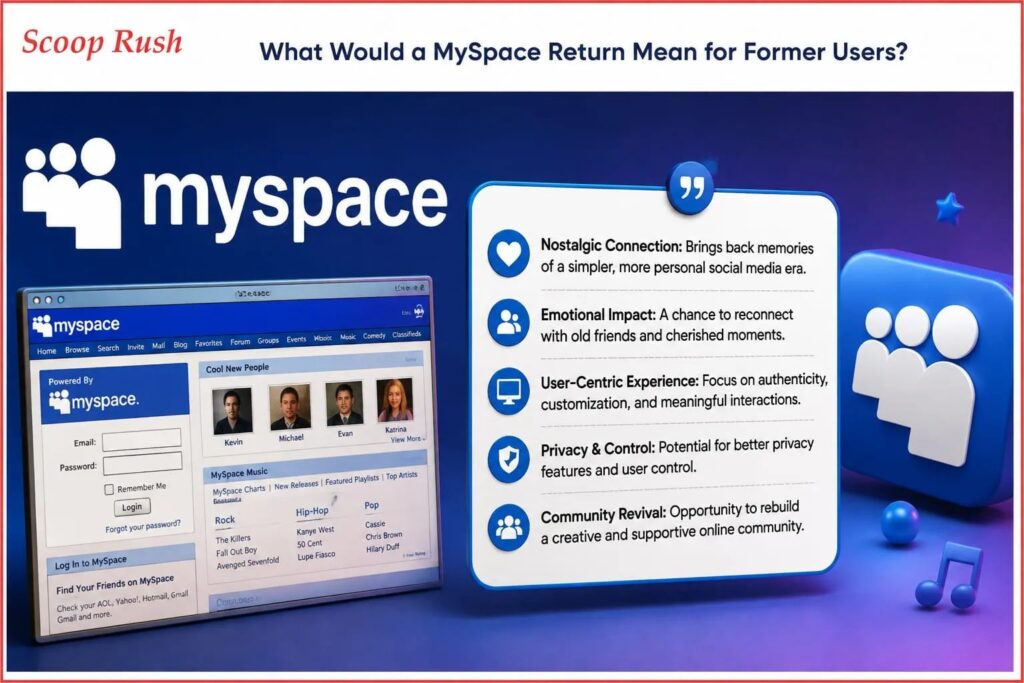
For longtime fans like Hawkins and Kristin, the appeal of a comeback is both emotional and practical. Both say they would return to MySpace if it kept its original spirit intact.
For now, the relaunch exists mostly as a promise. There’s no confirmed date, no revealed features, and no guarantee it will recapture the magic of the original. Still, it represents something meaningful: a reminder of a time when social media felt less polished and a lot more personal.
As Hawkins puts it, the real test will be emotional. “Are you still gonna have that same feeling?” she asks. “Are you still gonna feel like, ‘oh my god, somebody loves me?'”
Key Takeaways
MySpace’s potential comeback has reignited interest in a version of social media built around raw, no-filter personal connection rather than performance. Its original strengths, including music discovery, creative freedom, and authentic self-expression, still resonate with users today. However, experts agree that a successful relaunch will require careful updates, such as simpler design, smarter algorithms, and a clear niche identity rooted in early 2000s culture.
Whether MySpace can actually recreate that feeling remains uncertain. Ultimately, its future success will depend on whether it can modernize without losing the raw, unfiltered spirit that made it special in the first place.
FAQs
Is MySpace really coming back?
MySpace’s owners, Tim and Chris Vanderhook, have said they plan to relaunch the platform. However, no official launch date or specific product details have been announced yet.
Who owns MySpace now?
MySpace is owned by Viant, a company run by brothers Tim and Chris Vanderhook.
Why was MySpace popular in the first place?
MySpace stood out for its highly customizable profiles, auto-playing music, raw unfiltered photos, and strong music community. It helped launch the careers of artists like Arctic Monkeys, Adele, and Nicki Minaj.
Why did people stop using MySpace?
Facebook introduced a simpler, cleaner design, and as a result, users gradually moved away from MySpace’s more complex and customizable layout, which contributed to its decline in popularity.
What would make a MySpace relaunch successful?
Marketing experts suggest the platform should focus on user-friendly design, avoid over-reliance on aggressive algorithms, and lean into its music, raw self-expression, and early 2000s cultural identity rather than competing directly with platforms like TikTok or Instagram.

