
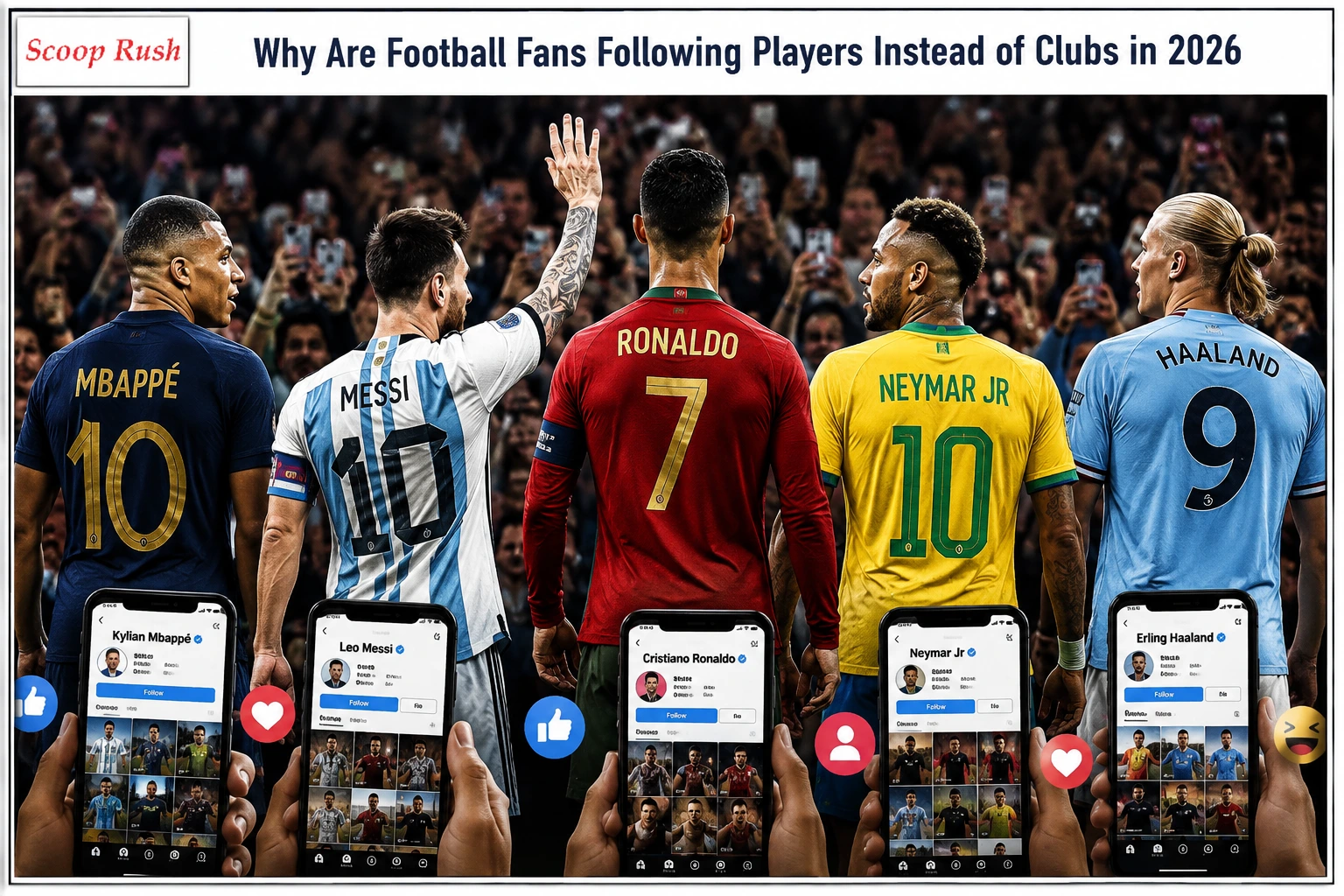
Picture thousands of people walking through London or Berlin wearing flamingo pink Inter Miami shirts. It’s a small but telling sign that football fans are following players instead of clubs like never before.
None of them have ever set foot in Miami. None of them support the club’s history or its city. They bought the shirt for one reason only: Lionel Messi wears it.
This is why football fans are following players instead of clubs in 2026. The shift is reshaping how the sport gets marketed, watched, and followed around the world.
This matters to anyone who loves the game. It matters whether you are a lifelong supporter of one team, or someone who discovered football through a favorite player.
This shift explains why your social feed suddenly fills with shirts from clubs you’ve never heard of. It also explains why the sport itself is evolving faster than ever.
Fans Follow Players: The Messi and Ronaldo Effect
When Lionel Messi signed for Inter Miami in 2023, the impact went far beyond ticket sales.
Sports brand strategist James Kirkham says people across the UK and Europe now wear Inter Miami’s flamingo pink kit with zero connection to the city. Many of these fans have never visited Miami. Yet the shirt has become a badge of loyalty to one player.
Cristiano Ronaldo tells a similar story at Al-Nassr. Since joining the Saudi Pro League club, Ronaldo has scored 129 goals in 148 appearances. His fans didn’t move to Saudi Arabia. They moved with him.
For years, the Messi versus Ronaldo debate dominated football conversation. However, this rivalry no longer centers only on who ranks as the greatest player of all time. It has become a case study in how individual stars can now outshine the clubs they play for.
How Gaming Culture Pushed Fans to Follow Players
So why are fans behaving this way? Kirkham points to gaming as a major driver.
Younger fans grew up building Ultimate Teams in EA Sports FC. Many also managed squads in Football Manager. As a result, they built encyclopaedic knowledge of players across leagues and countries, often with far less loyalty to a single badge.
“Following a player and buying them as part of your Ultimate Team and then wearing that player’s name on the back of your shirt, be that Atletico Madrid or Chelsea or Dortmund, kind of makes no difference,” Kirkham explains.
In other words, the line between virtual fandom and real-life support has blurred. Add YouTube channels and trading cards into the mix, and it’s easy to see why younger supporters feel less tribal than older generations.
The Rise of the Second Club Fan Following Players Over Clubs
This shift isn’t just anecdotal.
A study titled “The Rise of the Second Club Fan,” published ahead of this summer’s World Cup, found that 80% of global supporters now follow a second team alongside their primary club.
Matthew Kyle leads insights at Engage and MTM and authored the report. He makes one thing clear: this doesn’t mean fans are abandoning their first love. Instead, they are adding new layers to their fandom.
This trend runs strongest in regions without a dominant domestic league. Geography places no limit on who fans choose to follow.
Sometimes the choice comes down to a club’s story, culture, or even its kit design. Most often, though, the report found that players offer the strongest gateway into second-club support.
As the study bluntly states, for this group of fans, “the club” essentially is the player. These supporters track individuals, not institutions.
How Players Took the Driving Seat From Clubs
From Griezmann to Personal Brands: Players Building Their Own Fanbase
Back in 2018, Antoine Griezmann tried something new. Days before the World Cup, he teased a half-hour documentary revealing his transfer decision. LeBron James’ famous televised announcement in 2010 inspired the format.
Barcelona fans felt convinced they had signed him. Instead, Griezmann announced he was staying at Atletico Madrid.
The move drew criticism at the time. Kyle notes that this kind of self-commercialization didn’t carry the same reach in 2018. It would land very differently today if a player like Erling Haaland or Kylian Mbappe tried it.
Griezmann, in many ways, arrived ahead of his time. Now, players routinely run their own YouTube channels and build personal media empires. Haaland, Ronaldo, Jude Bellingham, and Lionesses star Ella Toone all share content directly with fans. They bypass club and broadcaster channels entirely.
“Players are becoming their own distribution levers,” says Kyle, “with some in particular taking a driving seat in terms of how they project themselves onto the world.”
Kirkham agrees that players now carry more cultural weight than ever before. Fans want their favorite stars to represent something beyond the pitch.
He points to Marcus Rashford’s Covid-era campaign as proof. That campaign led to real changes in UK government policy. Kirkham calls it a clear example of a player using his platform for lasting impact.
The World Cup’s Real Winners: Players Gain Fans Faster Than Clubs
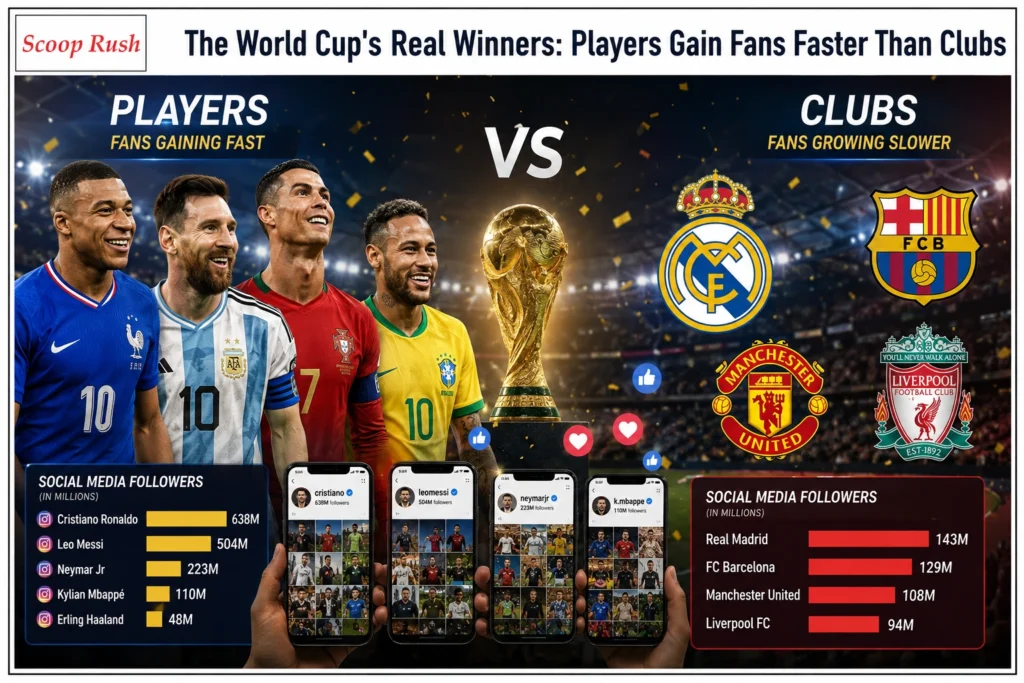
This summer’s World Cup took place across North America. The tournament became a launchpad for personal brands as much as national teams.
Vozinha, Cape Verde’s previously unknown goalkeeper, became an overnight sensation after a heroic performance against Spain. His Instagram following exploded from 50,000 to nearly 30 million.
Big names cashed in too. Spain and Barcelona forward Lamine Yamal saw a major spike in followers. Bellingham gained significant traction. Even Ronaldo, already the most-followed athlete on Instagram, added to his enormous base.
However, the standout winner was Norway’s Erling Haaland. His popularity surged across Instagram, TikTok, and Snapchat during the tournament.
Kyle notes that Haaland gained more than 51 million followers since July 1. That number compares to just 11 million across the first six months of the year combined.
What made the difference? According to Kyle, it wasn’t just Haaland’s performances. His relatable personality played a role. So did his playful social media presence and constant engagement with fans through memes and viral clips. His friendship with Bellingham and Norway’s historic run to the quarterfinals added fuel to the fire.
Notably, Haaland now counts nearly 20 million more Instagram followers than his own club, Manchester City. Similarly, England captain Harry Kane built his own platform, Cleats Club. It lets him interact with fans directly and on his own terms.
Why Clubs Are Losing Fans to Player Brands
Kirkham believes this trend will only accelerate. “You’ll see more and more creating their own entertainment formats, content networks, and that is away from the clubs,” he says.
Clubs remain aware of the shift, but they have limited power to stop it. They don’t fully own the player as a brand. Stars can freely appear on podcasts, launch shows, or discuss interests entirely unrelated to football.
For fans, though, this counts as good news. Kirkham describes an “insatiable appetite” among supporters for football content. Nothing can fully satisfy that appetite yet.
As players lean further into building their own audiences, fans gain more access and more ways to engage than ever before.
What Happens When a Star Player Leaves the Club?
A key question for clubs centers on whether fans who arrive because of one player will stick around once that player departs.
Turkish club Trabzonspor is experiencing this firsthand after signing Egyptian star Mohamed Salah, who spent nine years at Liverpool. Meanwhile, Tottenham Hotspur enjoyed a decade with South Korean icon Son Heung-min before he joined LAFC last summer.
Kyle points to Son as a particularly strong example. He wasn’t a global superstar when he joined Spurs.
Over his time in London, though, the club became the most-supported foreign team in South Korea. It even overtook Manchester United in that market.
Interestingly, when Son left for LAFC, Spurs didn’t lose millions of followers from Korea. LAFC, on the other hand, saw a modest spike in new fans following his arrival.
Reports show LAFC’s YouTube following more than doubled after Son joined the club. Around 70% of those new subscribers came from South Korea.
Kyle argues that clubs shouldn’t assume they’re powerless once a star leaves. Every club, he says, has characters worth building content around.
Clubs need to treat star players as valuable assets while they’re there. They also need to invest in behind-the-scenes content that appeals to fans regardless of which club they support.
“Even if you’re not a fan of that club, you might stop scrolling and watch a day in the life of a player because it might be good content,” Kyle explains.
Could Fans Follow Owners Instead of Clubs Too?
There’s another layer to this story worth watching. Wrexham’s rise under owners Ryan Reynolds and Rob McElhenney shows that star power doesn’t have to come from the pitch alone.
Kyle suggests these celebrity owners pulled in an entirely new audience who may know little about football itself. He acknowledges this creates tension within traditional football communities. Some fans question the football credentials of celebrity ownership.
Still, he compares the appeal to a soap opera. Seasons of football mirror seasons of television, and the storylines never truly end.
Final Thoughts:
Football fandom no longer depends purely on geography, family tradition, or club badges.
Gaming culture, social media, and player-driven content have combined forces. Together, they created a generation of fans who follow individuals as closely as institutions.
Clubs still hold enormous value through shirt sales, matchday revenue, and long-term loyalty. Nevertheless, players increasingly control their own narratives. They build direct relationships with fans and carry influence that can outlast a single transfer.
Ultimately, this doesn’t mean club loyalty is disappearing. Instead, fandom has become layered. Millions of supporters now proudly follow both a lifelong club and a favorite star, wherever that star’s career takes them next.
Frequently Asked Questions
1. Why are football fans following individual players instead of clubs?
Fans increasingly gravitate toward players because of gaming culture, social media access, and players building their own content platforms. This creates a personal connection that goes beyond club loyalty.
2. What is the “Second Club Fan” phenomenon?
It describes fans who support a primary club but also follow a second team, often because of a favorite player. A recent study found that 80% of global football fans now fall into this category.
3. Did Lionel Messi’s move to Inter Miami really increase the club’s global fanbase?
Yes. Messi’s arrival drove a significant rise in Inter Miami merchandise sales, social media followers, and global attention. Many new fans had no prior connection to the club or city.
4. How much did Erling Haaland’s social media following grow after the World Cup?
According to insights from Engage and MTM, Haaland gained more than 51 million new followers across his social platforms after July 1. That compares to just 11 million in the first six months of the year.
5. Do clubs lose fans permanently when a star player leaves?
Not necessarily. As Son Heung-min’s move from Tottenham to LAFC shows, clubs often retain most of the fanbase built during a star’s tenure. The player’s new club may see only a smaller, immediate spike in interest.

