Home Blog Page 10

D23 2026 Disney Parks Announcements Ranked: Every New Ride and Land, Worst to Best

0

Figment and Dream finder are back together. Did you ever think you would read that sentence again? For thousands of EPCOT diehards, that single reunion stood out. It made the D23 2026 Disney parks announcements the most emotional theme park news day in years.

D23 2026 delivered the biggest wave of Walt Disney World, Disneyland, and international park news in two years. Neil Patrick Harris hosted the event. Parks Chair Thomas Mazloum took the stage. A lineup of Imagineers then walked fans through 22 separate reveals. Some updates covered projects first teased back in 2024. Others were brand new. Together, they painted a picture of a company that finally listens to the fans who show up every year.

This matters for anyone planning a trip. It also matters if you track a favorite franchise or simply wonder where Disney parks are headed next. Below, we rank every D23 2026 Disney parks announcement from least exciting to most anticipated. These rankings come from firsthand impressions on the show floor.

Why the D23 2026 Disney Parks Announcements Feel Different This Year

Compared to 2024, this year’s slate leaned less on Wall Street and more on longtime fans. Two years ago, Disney needed to reassure investors that parks, not streaming, drove the company’s growth. That pressure produced flashy, headline-grabbing projects designed to boost attendance and Lightning Lane sales.

This year told a different story. Multiple reveals, from a fixed Yeti animatronic to a nostalgic Jules Verne-themed coaster, carry little obvious financial upside. Instead, they reflect a leadership team that finally understands what makes these parks special. Consequently, the tone throughout the night felt more personal and far less corporate.

That said, depth was lacking in places. Several far-along projects only received a sliver of concept art. A handful of freshly greenlit ideas still feel vague. Even so, the overall direction left many fans more optimistic. This writer included, many haven’t felt this hopeful in a long time.

The Full Ranking: 22 D23 2026 Disney Parks Announcements From Worst to Best

The Full Ranking: 22 D23 2026 Disney Parks Announcements From Worst to Best

Least Exciting D23 2026 Disney Parks Announcements (Ranks 22–15)

22. A New Class of Disney Cruise Line Ships

Kicking off the bottom of the list is an all-new class of Disney Cruise Line ships arriving in 2029. This class will sit between the classic and newest ships in size and will open the door to new destinations. The problem is that this wasn’t really news. Disney had already confirmed the plan over a year earlier. A recent earnings call had also revealed that three ships will launch in 2029.

21. Spider-Man Swings Into Shanghai Disneyland

Shanghai Disney Resort is getting its first land fully dedicated to Spider-Man, complete with a new coaster and Spider-Bots. It is a solid addition. However, fans who don’t live near Shanghai will feel limited excitement.

20. The Imagineering Story Season 2 Heads to Disney+

Filmmaker Leslie Iwerks is returning with a second season of The Imagineering Story. It gives fans a behind-the-scenes look at current projects. However, documentaries made in real time about ongoing work carry a risk. They often lose the candid edge that made her earlier films so compelling.

19. Miss Fritter Joins Magic Kingdom’s Piston Peak Area

Miss Fritter’s Daredevil Spin-Along brings the demolition derby character from Cars 3 to life as a flat ride. It is fun for younger kids. Yet after years of anticipation, the reveal felt straightforward rather than exciting. It also does not fit thematically with the rest of the Piston Peak National Park land.

18. A New Avengers Pavilion Rises Over Hong Kong Disneyland

Stark Expo at Hong Kong Disneyland is expanding with an Avengers Pavilion and a Quinjet landing platform. New attractions tied to Avengers Research Labs round out the addition. Marvel lands have become one of the more budget-friendly additions across the Disney portfolio globally. Still, this version fills a gap nicely.

17. Sugar Rush: Sweet Rescue Comes to Tokyo Disneyland

Wreck-It Ralph fans get a new attraction at Tokyo Disneyland based on Sugar Rush. Guests will help turn rogue sugar bugs back to normal while dodging King Candy. Given the popularity of the ride it replaces, some fans wonder if the budget could have gone elsewhere.

16. Disney Believe Sets Sail With a Moana-Themed Atrium

The newest Disney Cruise Line ship, Disney Believe, launches in 2027. Moana welcomes guests in the Grand Hall. Tinker Bell decorates the bow, while Buzz Lightyear and Woody appear at the stern. If the Polynesian-inspired design lands well, this could become the best atrium among the Triton-class ships.

15. Avengers Campus Doubles in Size at Disneyland

California Adventure’s Avengers Campus is adding two new attractions in 2028: Avengers Infinity Defense and Stark Flight Lab. Robert Downey Jr., Anthony Mackie, and Brie Larson all reprise their roles. The additions are welcome, but the timeline stretches nearly a decade from the original announcement.

Solid but Unspectacular D23 2026 Disney Parks Reveals (Ranks 14–8)

Solid but Unspectacular D23 2026 Disney Parks Reveals (Ranks 14–8)

14. The Yeti Animatronic Returns to Life at Animal Kingdom

Disney will finally repair Expedition Everest’s broken Yeti figure. Fans have requested this fix for years, and it represents a real shift in how Disney prioritizes ride quality. Still, Animal Kingdom needs more than one fix. Disney shared no word on a new nighttime show or additional entertainment for the park.

13. Coco Ride Announced for Disney California Adventure

Imagineers are working with Pixar on a brand-new Coco attraction that continues the story a year after the film. Guests will travel by boat through Miguel’s memories of the Land of the Dead. Coco stands among the best animated films of the last decade. This concept sounds like a worthy successor to Pirates of the Caribbean. The catch is timing. Based on current details, this looks like a 2029 project.

12. Spaceship Earth Begins Its Next Chapter

EPCOT’s iconic Spaceship Earth attraction is getting its first major update in nearly 20 years. The storyline will move into the internet age while keeping its focus on human connection. Fans first requested this upgrade back in 2019, so cautious optimism feels appropriate here.

11. Carousel of Progress Reveals New Voice Cast

Carousel of Progress is adding four new decades along with Florida’s first Walt Disney animatronic figure. Jamie Lee Curtis and Bryan Cranston will voice Sarah and John, the beloved family at the center of the attraction. The refurbished ride reopens in late spring 2027, and early impressions suggest the timeline shift could pay off well.

10. Nighttime Entertainment Returns to Disneyland in 2027

“Remember… Dreams Come True” and “World of Color” are both getting refreshed versions, returning in winter 2027. Meanwhile, the “Magic Happens” parade returns down Main Street in summer 2027. Both shows rank among Disney’s best nighttime spectaculars. Still, the wait until summer for a parade is a bit disappointing.

9. Space Mountain: From Earth to the Moon Returns to Disneyland Paris

Disney will replace Hyperspace Mountain with a restoration of the original Jules Verne-inspired Space Mountain. The ride keeps its original musical score. For longtime Disneyland Paris fans, this represents a major symbolic win. Many had hoped for years to see the classic version return.

8. The Lion King Gets Its First-Ever Ride

Disney Adventure World is building the first-ever Lion King attraction, following Simba’s journey from cub to king. The film’s music and atmosphere make it a natural fit for a ride. It’s also notable that Disney feels comfortable bringing back villains and confrontation in newer attractions.

The Best D23 2026 Disney Parks Announcements Fans Can’t Stop Talking About (Ranks 7–1)

The Best D23 2026 Disney Parks Announcements Fans Can't Stop Talking About (Ranks 7–1)

7. Space Mountain: Earthrise Debuts in Tokyo

Tokyo Disneyland’s Tomorrowland is getting a brand-new Space Mountain, called Earthrise. The ride celebrates the beauty of the planet from a fresh perspective. As Imagineering’s most expensive attraction to date, it stands as Tokyo’s biggest addition in 2027. It should also help ease overcrowding at Tokyo DisneySea.

6. Monstropolis Opens Its Doors to Humans

A new land based on Monsters, Inc. and Monsters University, called Monstropolis, begins welcoming guests in 2027. The rollout includes a theater show with an original Randy Newman song, two new restaurants, and a merchandise shop. A coaster remains in development. The phased approach mirrors the popular Zootopia land in Shanghai, which is an encouraging sign.

5. Tropical Americas Lands at Animal Kingdom

This new land draws from the myths and cultures of South America, Central America, and Mexico. It includes a family-friendly carousel and an Encanto-themed attraction featuring the film’s original voice cast. It also adds an Indiana Jones ride built around a giant animatronic serpent modeled after Harrison Ford himself. The concepts are exciting. However, the lack of a confirmed opening year raises some concern about a possible slip to 2028.

4. Cars Ridge Run Rally Races Through Piston Peak

This new coaster-style attraction sends racers through mountain trails, snowy peaks, and geysers, with commentary from Lightning McQueen and Mater. A detailed scale model of the surrounding Piston Peak National Park land appeared at the Imagineering pavilion. It suggests this project has the makings of a modern classic.

3. Villains Land Creeps Into Magic Kingdom

Villains Land ranks among the most anticipated Magic Kingdom projects in years. It introduces a dark forest story involving a corrupted Wishing Well. A cast of Disney villains moves in, including Cruella, the Evil Queen, and Dr. Facilier. The land will include two attractions, dining, and shopping. The scale compares to Star Wars: Galaxy’s Edge. Many fans view it as a passion project for new CEO Josh D’Amaro.

2. Tomorrowland Gets a Full Reimagining at Disneyland

Disneyland’s Tomorrowland has long ranked among the weaker lands in the entire Disney portfolio. Disney will finally reimagine it, though details remain limited and the project won’t finish until the 2030s. Even so, leadership across the company now agrees this land needs an overhaul. That alone feels like a long-overdue win for fans.

1. Figment and Dreamfinder Reunite at EPCOT

Topping the list is the return of Figment and his original companion, Dream finder. Both return in a reimagined Journey Into Imagination attraction at EPCOT. This reveal generated by far the most excitement of the night among longtime EPCOT fans. Many had waited decades to see the character pairing restored.

What the D23 2026 Disney Parks Announcements Mean for Your Next Trip

Taken together, the D23 2026 Disney parks announcements show Disney leaning into fan-favorite fixes alongside big new lands. Villains Land and Tropical Americas headline the next wave of Walt Disney World expansion. Meanwhile, Disneyland gets long-overdue attention with the Tomorrowland reimagining. International parks like Tokyo Disneyland, Disneyland Paris, and Shanghai Disney Resort are also getting significant new investment.

For travelers, this means more reasons to plan return visits over the next several years. Projects will roll out from 2027 onward. It also means older favorites, like Spaceship Earth and Carousel of Progress, are getting meaningful refreshes rather than neglect.

Final Thoughts 

The D23 2026 Disney parks announcements may not match the sheer scale of the 2024 slate, but they hit differently. This year felt built for the fans who show up year after year, not just for investors watching quarterly earnings. From a working Yeti to Figment’s long-awaited return, this news cycle proved a point. Current leadership understands what keeps people coming back to Disney parks.

As these projects move from concept art to opening day, expect plenty of updates on timelines and further details. Guest reactions will follow once the doors open.

Frequently Asked Questions 

What was the biggest announcement at D23 2026? 

The reunion of Figment and Dream finder in a reimagined Journey Into Imagination attraction at EPCOT generated the most buzz. Fans discussed this reveal more than any other.

When will Villains Land open at Magic Kingdom? 

Disney has not confirmed an official opening date for Villains Land. Even so, it ranks among the most significant upcoming projects at Walt Disney World.

Is the Yeti in Expedition Everest finally being fixed? 

Yes. Disney confirmed at D23 2026 that it will restore the iconic Yeti animatronic in Expedition Everest. The figure at Animal Kingdom will return to full working order.

What new lands are coming to Disney parks after D23 2026? 

Confirmed new lands include Villains Land and Tropical Americas at Magic Kingdom and Animal Kingdom. Monstropolis, inspired by Monsters, Inc., and an expanded Avengers Campus at Disney California Adventure round out the list.

When is the Tomorrowland reimagining coming to Disneyland?

Disney has only shared an early concept direction for the Tomorrowland reimagining at Disneyland. The bulk of the project is expected to arrive in the 2030s.


Liverpool Without Salah: Can Isak and Wirtz Finally Deliver at Anfield?

0

Liverpool Without Salah Enters a New For the first time in over a decade, Liverpool will open a season without Mohamed Salah in the squad. No player in Premier League history has scored more opening-day goals than Salah. His absence leaves a gap the club has never had to fill before. As Liverpool enters this new life after Salah under manager Andoni Iraola, all eyes turn to two expensive signings. Alexander Isak and Florian Wirtz now carry the weight of expectation Salah once shouldered alone.

This is not just a squad reshuffle. It marks the end of an era that reshaped Anfield’s identity. And it raises a genuine question every Liverpool fan is asking right now: with Liverpool now without Salah, can Isak and Wirtz finally deliver at Anfield?

Why Life After Salah Matters for Liverpool Fans

Salah’s departure to Trabzonspor in Turkey closes one of the most productive chapters in Liverpool’s modern history. Between 2015 and 2026, Salah, Sadio Mane, and Roberto Firmino combined for 488 goals for the club. Salah alone scored 257 of those, including a record 10 goals on Premier League opening matchdays.

None of that trio remains at Anfield now. In fact, this is the first season since 2015 that Liverpool will begin without any of the three. Consequently, a new generation of attackers must now carry the goalscoring burden. None of them has proven themselves at this level yet.

Cody Gakpo is currently Liverpool’s top scorer in the squad, with just 50 goals for the club. That number puts into sharp focus just how much responsibility Isak and Wirtz must now shoulder. Liverpool wants to compete on multiple fronts this season, and it needs their goals to make that happen.

Isak, Wirtz and Ekitike: Liverpool’s £320m Bet on Life Without Salah

Isak, Wirtz and Ekitike Liverpool's £320m Bet on Life Without Salah

Liverpool didn’t wait for Salah’s exit to start planning for life without him. Last summer, the club spent a combined £320m on three attacking talents: Alexander Isak, Florian Wirtz, and Hugo Ekitike. The idea was simple. Instead of relying on one superstar, Liverpool wanted to spread the creative and goalscoring load across several elite players.

However, the plan hit early obstacles. Ekitike, 24, showed real promise after his move to Anfield. But a ruptured Achilles tendon in April ended his season early. The club now hopes he can return fit for the second half of this campaign.

Meanwhile, both Isak and Wirtz endured disappointing debut seasons at Liverpool. Isak, who joined for a British record fee of £125m, managed only four goals in an injury-hit first year. Wirtz, 23, had a steadier campaign with seven goals and 10 assists. Still, expectations for a player of his talent remain far higher.

Despite those struggles, this season represents a genuine opportunity. Salah has gone, and Liverpool hasn’t signed a direct replacement. As a result, Isak and Wirtz no longer compete for minutes. They now sit at the center of Iraola’s attack.

Liverpool’s Search for a New Forward Without Salah

More than five months have passed since Liverpool confirmed Salah’s exit. Yet the club still hasn’t landed the marquee forward many expected. Liverpool missed out on 19-year-old Yan Diomande, who instead joined Real Madrid from RB Leipzig. That deal was reportedly worth up to £120m.

Ekitike’s injury has made the need for reinforcements even more urgent. As a result, confidence is growing that Liverpool will complete a deal for Paris St-Germain winger Bradley Barcola. The 23-year-old France international is reportedly open to the move, though the fee remains a sticking point. PSG initially wanted around £145m, while Liverpool hopes to negotiate closer to £100m.

Interestingly, Liverpool actually explored signing Barcola last summer too. At the time, the club held back because it didn’t want to block the pathway for academy graduate Rio Ngumoha. Now that Salah has left a year earlier than planned, that calculation has changed entirely.

Liverpool has also stayed active elsewhere in the market. Brighton rejected a £50m bid from the club for winger Yankuba Minteh this week. Liverpool has also explored a potential move for PSG’s Ibrahim Mbaye.

Ngumoha and Iraola’s Vision for Liverpool’s Post-Salah Attack

One name generating real excitement at Anfield is Rio Ngumoha. Last August at St James’ Park, he became the youngest goalscorer in Liverpool’s history, netting a dramatic 100th-minute winner. Ngumoha turns 18 next week, and that milestone will let him sign a five-year contract with the club.

Iraola has trialled Ngumoha on the right flank during pre-season, the same position Salah made his own for years. The manager’s tactical setup demands wingers who can play on both sides of the pitch. Liverpool showed that flexibility clearly when it signed Victor Munoz from Osasuna. Munoz is a direct, pacy attacker suited to breaking down defensive blocks.

For the season opener against Newcastle, Gakpo is expected to start on the left. Ngumoha should take the right in Salah’s old role. Munoz, who impressed in a pre-season match against Como, looks set to provide an attacking spark from the bench. Iraola has also floated the idea of using Gakpo as a central striker when needed.

Wirtz’s Role Behind the Striker in the Post-Salah Era

Florian Wirtz will operate primarily just behind the main striker this season. After a full year adjusting to English football, Wirtz himself feels better equipped for the Premier League. People inside the club share that confidence too. Many genuinely believe much more is still to come from the German playmaker.

His numbers last season, seven goals and 10 assists, hint at his potential rather than fully reflecting it. Additionally, reports from pre-season suggest his understanding with Isak has grown significantly. That growing chemistry could prove crucial for Liverpool’s attacking output this year.

Can Isak Deliver at Anfield Under Pressure to Perform?

Can Isak Deliver at Anfield Under Pressure to Perform?

All eyes will inevitably fall on Alexander Isak, given his British record £125m transfer fee. Manager Andoni Iraola has expressed confidence in the Swedish striker. He described him as being in “a very good place” and predicted he will be “very important” for the team this season.

Iraola said he knows Isak’s true level and expects the goals to follow if the striker can maintain his form. The manager also noted that his focus with Isak has shifted toward improving his movement without the ball. That movement helps him create space for teammates when Liverpool is in possession.

Former Liverpool striker Robbie Fowler has echoed that confidence. Speaking about Isak, Fowler said he remains “a massive fan.” He believes the striker will prove to be “a handful” for opposing defenses this season.

Fowler pointed out that Isak has already proven himself in the Premier League. He put last season’s struggles down largely to the injury problems Isak faced. Despite the tough first year, Fowler still expects the striker to score goals and cause problems for defenders. He also pushed back against the idea that the price tag should add extra pressure. Isak’s focus, he argued, should remain purely on performance.

Fowler pointed to Isak’s record of 62 goals in 109 games for Newcastle before his move to Anfield. That kind of consistency is exactly what Liverpool fans are hoping to see return this season. No experienced forward has been brought in to share the load, which makes his form even more important.

Captain Van Dijk’s Honest Assessment of Life After Salah

Liverpool captain Virgil van Dijk offered a measured but honest take on the squad’s situation ahead of the new season. He stressed that Liverpool needs a squad capable of competing on all four fronts. That, he said, is the only way the club can be successful this year.

Van Dijk’s comments suggest the current squad still needs reinforcement. Only then can it genuinely challenge across the Premier League, Champions League, and domestic cups. He added that the final weeks of the transfer window would be worth watching. That leaves the door open for further signings before it closes.

What Liverpool Without Salah Means Going Forward

Liverpool’s situation heading into the new season is unusual for a club of its stature. For the first time in over ten years, there’s no single dominant goalscorer to lean on. Instead, a young, talented, but largely unproven attacking group must carry that responsibility.

Ekitike’s injury has complicated matters further and pushed the club into an active search for reinforcements like Barcola. Meanwhile, academy talents like Ngumoha offer excitement and promise. Still, expecting a teenager to replace Salah’s output would be unrealistic.

Ultimately, this season will show whether Isak and Wirtz can translate their undeniable talent into consistent output at Anfield. Both players arrived with big reputations. Now, with Salah gone and the pressure firmly on their shoulders, they finally have the platform to prove they belong among Liverpool’s greats.

Key Takeaways

  • Mohamed Salah has left Liverpool for Trabzonspor, ending an era in which he, Sadio Mane, and Roberto Firmino combined for 488 goals.
  • Cody Gakpo is currently Liverpool’s top scorer in the squad with just 50 goals, highlighting the scale of the challenge ahead.
  • Alexander Isak and Florian Wirtz, signed alongside the injured Hugo Ekitike, should lead Liverpool’s attack this season.
  • Liverpool is closing in on a deal for PSG winger Bradley Barcola after missing out on Yan Diomande.
  • Rio Ngumoha, Liverpool’s youngest ever goalscorer, is training in Salah’s old position on the right wing.
  • Captain Virgil van Dijk has stressed the squad still needs strengthening to compete on all fronts this season.

Conclusion

Liverpool without Salah looks like a genuinely different club, and this season will test that new identity from matchday one. The Egyptian’s goals, his creativity, and his sheer consistency carried Liverpool for a decade. No single player has stepped in to replace him directly.

Instead, the club has placed its faith in Isak and Wirtz. That faith is backed by Ekitike once he returns from injury, and by academy talent like Ngumoha pushing for a first-team role. Add a potential Barcola arrival, and Iraola will have real attacking depth to work with, even without a like-for-like Salah replacement.

Whether that gamble pays off depends largely on fitness and form. Isak and Wirtz have shown flashes of what they can offer, but neither delivered consistently in their first Liverpool season. This time, with Salah gone and the spotlight fully on them, they no longer have the luxury of easing in. Liverpool fans will be watching closely to see if life without Salah becomes a step forward or a painful adjustment.

Frequently Asked Questions

1. Why did Mohamed Salah leave Liverpool? 

Liverpool confirmed Salah’s departure in March, and he has since joined Trabzonspor in the Turkish Super Lig. He will not be part of Liverpool’s squad for the 2026-27 season.

2. Who is Liverpool’s top scorer without Mohamed Salah? 

Cody Gakpo is currently Liverpool’s top scorer within the existing squad, with 50 goals for the club. That total sits far below the numbers Salah, Mane, and Firmino posted during their time at Anfield.

3. How much did Liverpool spend on Isak, Wirtz, and Ekitike? 

Liverpool spent a combined £320m to sign Alexander Isak, Florian Wirtz, and Hugo Ekitike. The goal was to share the attacking responsibilities that Salah once carried alone.

4. Is Liverpool signing Bradley Barcola? 

There is growing confidence that Liverpool will complete a transfer for Paris St-Germain winger Bradley Barcola. The two clubs are currently negotiating a fee between £100m and £145m.

5. Why is Hugo Ekitike not playing for Liverpool right now? 

Hugo Ekitike ruptured his Achilles tendon in April. Liverpool hopes he will be fit and available again for the second half of the 2026-27 season.

How Does an AI Detector Know the Difference Between Human and AI Writing?

0

Can a machine really tell if another machine wrote something? That’s the exact question AI detector tools are built to answer, and the results might surprise you.

Introduction

AI writing has moved fast into classrooms, offices, and newsrooms. As a result, the need to separate human writing from machine writing has grown just as quickly. Reports suggest the AI content detector market was valued at $25.13 billion in 2023 and is expected to reach $255.74 billion by 2032. That growth alone shows how seriously institutions now treat this issue, even as some question whether AI will replace their job entirely.

In this article, we’ll break down how an AI detector actually tells human writing apart from AI writing, where it gets used, and where it still comes up short.

What Is an AI Detector?

What Is an AI Detector?

An AI detector is a software tool built to examine text and determine whether a human or an AI system created it. It studies patterns in language, sentence structure, and word predictability to make that call.

Detection isn’t limited to text either. AI image and video detectors exist too, scanning for signs of artificial generation that most people would never catch on their own, similar to how platforms like Snapchat are now blocking AI-generated videos from certain features.

Today, AI detector tools show up in schools, publishing platforms, hiring departments, and newsrooms. Basically, anywhere authorship and originality matter, these tools tend to follow.

Who Actually Relies on AI Detection Tools

Different groups use AI detectors for different reasons. Students check their own papers before submission, hoping to avoid unfair flags. Professionals scan reports and résumés to protect their reputation. Writers use detection tools to confirm that editing software hasn’t diluted their personal voice. Meanwhile, content creators lean on them to keep blogs, captions, and scripts authentic, much like property listings are now being scrutinized for AI-generated content in the rental market.

How Does an AI Detector Know the Difference Between Human and AI Writing?

How Does an AI Detector Know the Difference Between Human and AI Writing?

AI detectors combine machine learning, natural language processing, and pattern recognition to tell machine writing apart from human writing. Trained models study structure, style, and tone, while NLP checks grammar, sentence length, and overall flow, a process that ties into the broader question of why AI systems sometimes behave unpredictably.

Linguistic Analysis

The detector examines how natural the sentence structure feels. AI-generated content often skips the small imperfections and emotional touches that show up naturally when a person writes.

Token Predictability

Models like those built on GPT generate text by predicting the next likely word, a technique also seen in newer systems like Moonshot AI’s Kimi K3 model and Qwen3’s latest release. Detectors measure this predictability closely. Consequently, when writing feels too smooth and lacks variation, it often gets flagged as machine-made.

Burstiness and Perplexity in AI Detection

Two terms come up constantly in this space: burstiness and perplexity. Burstiness measures how much sentence length and style shift throughout a piece. Perplexity measures how easily a model can predict the next word in line.

AI text tends to follow steady, predictable patterns. Human writing, however, shifts and surprises in ways that are harder to forecast, an idea that traces back to Alan Turing’s early thinking on machine intelligence.

Database Comparisons

Some tools compare submitted content against massive databases of previously generated AI text. Others rely on trained models that make probability-based predictions instead, powered increasingly by specialized hardware like Google’s efficiency-focused AI chips.

Watermarks and Hidden Markers

Some AI systems embed invisible watermarks directly into text, images, or videos during creation. These markers can include sentence embeddings, hash functions, or metadata tags, and detection tools scan for them to confirm origin.

Still, this method has a weakness. Once content gets edited or reprocessed, the watermark can get distorted or removed entirely, making detection much harder.

Why AI Content Detection Tools Matter

Several industries now depend on AI detectors as part of daily operations.

Academic integrity. Schools use detection tools to confirm assignments reflect real student effort rather than machine shortcuts.

Content authenticity. Publishers and editors want proof that submitted work is genuinely human-written, not just free of copied text.

Hiring and résumé checks. As more applicants lean on AI for cover letters, hiring managers increasingly run submissions through detectors first.

Online reviews and social media. Fake reviews and bot posts mislead consumers, so platforms use detection tools to protect their credibility, an issue closely tied to ongoing debates around child safety features on major tech platforms.

Journalism. A 2023 global study by JournalismAI found that over 75% of news organizations already use AI somewhere in their workflow. Therefore, editors need reliable ways to confirm whether a submitted story was automatically generated.

AI Detector vs. Plagiarism Checker: What’s the Difference?

People often confuse AI detectors with plagiarism checkers, but they serve different jobs.

Plagiarism checkers scan huge databases of published content to find text copied directly from an existing source. They compare sentences and passages looking for close or exact matches.

AI detectors work differently. Instead of hunting for copied material, they study structure, flow, and word choice to judge how likely it is that AI generated the content. This distinction matters because AI-written text is often completely original, meaning it wouldn’t trigger a plagiarism flag at all, even though a person never wrote it.

How Accurate Are AI Detectors?

How Accurate Are AI Detectors?

AI detectors have gotten better, but they’re still far from perfect. False positives and false negatives remain among the biggest issues.

A false positive happens when human writing gets wrongly flagged as AI-generated. A false negative happens when actual AI text slips through undetected. Both outcomes create real problems, especially in academic and hiring settings where the stakes run high, similar to concerns raised after private AI chat conversations were unexpectedly exposed through search indexing.

Common Limitations Worth Knowing

A few factors continue to limit accuracy across the board.

Linguistic diversity trips up many detectors, since people from different regions write the same language with different levels of complexity. Idioms and cultural references can throw results off.

Multilingual support is another weak point. Many tools are optimized mainly for English and may struggle with other languages, a gap that mirrors how AI adoption has moved slower in some countries like Japan compared to others.

AI models keep evolving fast too, forcing detectors to constantly adapt just to keep pace with newer, more convincing systems.

Finally, leaning too heavily on algorithmic metrics can cause detectors to misread nuanced or creative human writing. As a result, human judgment still matters in final calls.

What Sets Human Writing Apart

What Sets Human Writing Apart

Even as AI writing improves, it still struggles to fully copy certain human qualities. Human writing tends to stand out through individuality, personal perspective, and genuine expression. It also carries varied sentence structures and emotional depth that create real connection with readers.

Writers aiming for an authentically human tone often focus on personal voice, mix short and long sentences together, and add emotional or regional context that feels distinctly their own.

Popular AI Detection Tools Today

A handful of tools have become well known in this space. OpenAI built its own AI Text Classifier to help identify content from its models. GPTZero is widely used in education and analyzes both perplexity and burstiness. Other platforms focus on wide language support, browser integration, or deep enterprise-level analysis for businesses and schools, not unlike how data intelligence platforms are ranked for business use each year.

Many of these tools now support dozens of languages and can flag content from multiple AI systems at once, not just one.

AI Image and Video Detection

Detection doesn’t stop at written text. AI image and video detectors examine subtle irregularities that reveal artificial generation.

For images, tools check lighting inconsistencies, unrealistic textures, and facial asymmetries, a concern that came up around Meta’s Muse image tool. For videos, detectors look at visual mismatches in movement and audio irregularities like out-of-sync sound. This kind of detection has become especially important in the fight against deepfakes, particularly following xAI’s lawsuit over a Grok user’s deepfake images.

Using AI Detectors the Right Way

Ethical use matters just as much as technical accuracy. AI detectors should never be used to unfairly accuse or punish someone without proper verification. Instead, they should support fairness and transparency rather than limit creativity.

Institutions relying on these tools should build clear policies, explain how detection works, and offer a path for appeal when results get disputed. Given how often false positives happen, this kind of safeguard matters a lot.

Where AI Detection Is Headed Next

The AI detection space is expected to keep expanding alongside advances in generative AI.

Real-time detection is spreading into live chats and emails, not just static documents. Multilingual accuracy keeps improving as developers close gaps for non-English content. Integration into word processors and learning platforms is becoming more common too, making detection a built-in step rather than a separate one, much like how AI tools are already being used to cut NHS waiting times in healthcare settings. Additionally, hybrid systems pairing human reviewers with AI tools are gaining ground, since human judgment still catches nuances algorithms sometimes miss.

Conclusion

As artificial intelligence becomes a bigger part of everyday writing, AI detectors have stepped in to help verify where content really comes from. These tools lean on linguistic analysis, predictability scoring, and pattern comparison to judge whether a human or a machine wrote something.

They’re useful across education, publishing, hiring, and journalism, but they’re not flawless. False positives, limited multilingual support, and fast-changing AI models remain real challenges. Therefore, human judgment still plays a key role alongside these tools.

Ultimately, an AI detector is one piece of a bigger push to keep digital content transparent and trustworthy, and its role will likely keep growing as generative AI keeps advancing.

FAQs

Can an AI detector tell if ChatGPT wrote something?

Yes, most modern AI detectors are trained to recognize patterns from ChatGPT and similar models, though accuracy can vary depending on how heavily the text was edited afterward.

Why do teachers use AI detectors on student essays?

Teachers use AI detectors to confirm that essays and assignments reflect a student’s own effort, since these tools help flag content that may have been generated rather than written by hand.

Is it possible to trick an AI detector?

Yes, heavily edited or paraphrased AI content can sometimes slip past detectors, which is one reason these tools are not treated as final proof on their own.

What happens if an AI detector flags my work by mistake?

A false positive can happen with any AI detector, so most reliable platforms and institutions recommend a human review process before any final decision gets made.

Do free AI detectors work as well as paid ones?

Free AI detectors can offer solid basic accuracy, but paid versions often include higher scan limits, broader language support, and more detailed analysis for professional or academic use.

Iranian Women Hijab Defiance Grows Despite Renewed Crackdown

0

Iranian women hijab defiance keeps growing even as hardliners push for tougher enforcement. Many women in Iran still walk city streets without headscarves. Meanwhile, authorities have changed their strategy. Instead of large street patrols, officials now target businesses that allow unveiled customers.

This shift comes at a tense moment for Iran’s government. The country faces serious economic pressure and recent regional military tensions. At the same time, officials still fear another wave of unrest like the 2022 protests. As a result, the hijab issue has become a broader test of state authority. 

A New Enforcement Strategy Emerges

Iranian authorities have quietly changed how they handle hijab violations. Rather than confronting women directly, officials now punish the businesses around them. Cafes, restaurants, shops, and sports clubs have faced sudden closures in recent weeks. This shift lets the government apply pressure without triggering mass street clashes.

In Tehran, officials shut down at least seven cafes and restaurants on July 19. The human rights group HRANA reported these closures. Authorities used vague terms like “violation of norms” to justify the shutdowns. Similar closures have hit businesses in more than fifteen cities across Iran, including several cafes in South Khorasan Province.

Hardliners Demand Tougher Action

Hardliners-Demand-Tougher-Action

Conservative voices in Iran have grown louder in recent months. Politicians, clerics, and state media figures are calling for stricter hijab enforcement. Many describe the headscarf as central to Iran’s cultural and religious identity. Kayhan editor Hossein Shariatmadari has urged officials to treat enforcement as both a legal and religious duty.

Hardline groups have also organized public rallies in cities like Isfahan and Mashhad. Supporters at these events describe unveiling as a threat to Islamic values. Online, hardline accounts share videos of unveiled women and demand action against them. Some hardliners now frame hijab as a political symbol rather than a matter of personal choice.

Women Continue Public Resistance

Despite growing pressure, many Iranian women refuse to return to old norms. Young women appear without headscarves in parks, cafes, and busy streets. Social media videos from Tehran and other cities capture this ongoing defiance. Some clips even show women riding scooters and motorcycles without covering their hair.

This resistance still carries real risks for the women involved. Authorities can penalize businesses that serve unveiled customers or employees. Public institutions may also restrict entry for women without headscarves. Still, one Tehran woman in her sixties said daily life already looks different. She noted that many women now dress freely without fear on the streets.

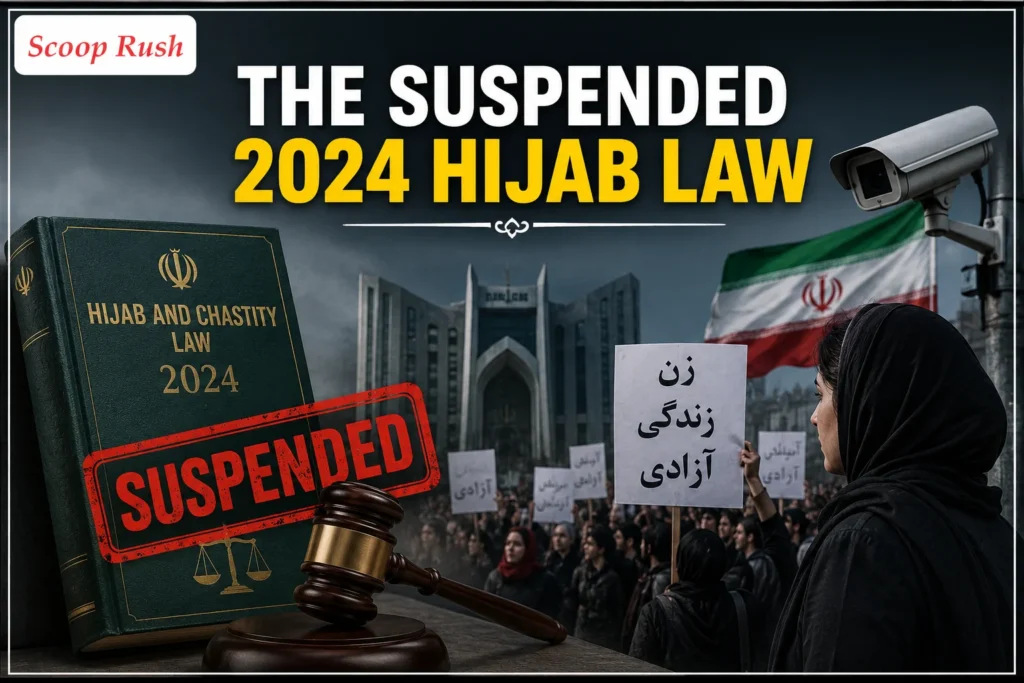
The Suspended 2024 Hijab Law

The-Suspended-2024-Hijab-Law

Iran passed a stricter Hijab and Chastity law back in 2024. The law introduced harsher penalties and expanded surveillance tools. However, officials never actually put the law into effect. The Supreme National Security Council stepped in and blocked its rollout.

Security officials feared the law could spark protests similar to those in 2022. Those earlier demonstrations followed the death of Mahsa Amini in police custody. Many hardliners remain frustrated by the ongoing delay. Even some hijab supporters, like cleric Morteza Panahian, have warned that strict enforcement could backfire and fuel more defiance.

Pezeshkian Resists Forced Enforcement

President Masoud Pezeshkian has taken a cautious stance on hijab enforcement. He argues that laws alone cannot force people to change their beliefs. Instead, he favors addressing the issue through cultural dialogue rather than punishment. His position has drawn sharp criticism from conservative factions within Iran’s government.

Former lawmaker Gholamali Jafarzadeh Imanabadi has echoed similar concerns publicly. He believes officials should focus on inflation and living costs instead. Many ordinary Iranians face serious economic struggles right now. Still, Pezeshkian does not control every institution in Iran’s political system, since the judiciary and other bodies continue pushing their own enforcement agenda.

Businesses Face Growing Pressure

Targeting businesses gives Iranian authorities a simpler enforcement tool. Officials can close a cafe or shop instantly, without deploying patrols. This method avoids the visible confrontations that fueled past unrest. However, it shifts the burden of enforcement onto private business owners instead.

Business owners must now decide whether to enforce dress codes themselves. Failing to comply can result in closures or legal consequences for them. The Tehran prosecutor’s office has already warned cafes, restaurants, and clothing stores. Yet many worry this approach could worsen economic hardship and trigger public backlash.

Roots of the Hijab Dispute

Mandatory hijab rules in Iran date back to the 1979 revolution. Article 638 of the Islamic Penal Code criminalizes appearing in public without hijab. However, the law never clearly defines what counts as proper covering. This ambiguity gives authorities wide room to interpret and enforce the rules.

The 2022 Woman, Life, Freedom protests reshaped public attitudes toward hijab enforcement. Many women kept resisting despite facing arrests and crackdowns. Their continued defiance has become more visible across Iran’s cities. Economic hardship and recent regional tensions have added further strain to this long-running dispute.

What Lies Ahead for Iran’s Hijab Rules

Iranian officials now face two competing pressures at once. Hardliners want immediate and forceful enforcement of hijab laws. Meanwhile, many women continue ignoring these rules in daily life. Authorities must weigh the risk of renewed protests against demands from conservative groups.

For now, officials appear to favor quieter, targeted pressure over mass crackdowns. Business closures and legal warnings offer a way to enforce rules without street confrontations. Even so, resistance continues to spread across Iranian society. Social media keeps documenting this shifting cultural and political reality.

Conclusion

Iranian women hijab defiance shows no sign of slowing down. Authorities have shifted tactics, but resistance remains strong. Hardliners keep pushing for stricter rules, while many women continue rejecting them openly. President Pezeshkian favors caution, yet other power centers in Iran continue applying pressure. The coming months will likely test how far each side is willing to go. Iran’s hijab debate remains a defining struggle between state control and personal freedom.

FAQs

1. Why are Iranian women resisting mandatory hijab rules? 

Resistance grew sharply after the 2022 Woman, Life, Freedom protests. Those protests followed Mahsa Amini’s death in police custody. Public defiance has remained visible in Iranian cities ever since.

2. Are Iranian authorities still enforcing hijab laws today? 

Yes, but their approach has changed. Officials now target businesses instead of confronting women directly. This shift reflects fear of triggering renewed street protests.

3. What happened to Iran’s 2024 Hijab and Chastity law? 

Iran passed the law in 2024 with harsher penalties. However, the Supreme National Security Council blocked its implementation. Officials feared it could spark unrest similar to 2022.

4. What is President Pezeshkian’s view on hijab enforcement? 

Pezeshkian believes force cannot change personal beliefs. He supports cultural solutions over strict legal punishment. His stance has drawn criticism from hardline conservatives.

5. Why are businesses facing closures over hijab violations? 

Authorities hold businesses responsible for customers who ignore dress codes. Cafes, restaurants, and shops have already faced closures. This tactic avoids large-scale street enforcement operations.

Hiking the Norway–Russia Border: A Different Kind of Arctic Adventure

0

In the far northeast corner of Norway, a new kind of hiking trip is drawing travelers to the small town of Kirkenes. Instead of just admiring fjords or chasing the Northern Lights, visitors can now walk toward one of Europe’s most closely watched borders through birch forest, open tundra, and land that has separated NATO from Russia since the Cold War.

It’s an unusual mix: peaceful wilderness on one side, watchtowers and patrols on the other. For travelers who want more than a typical Arctic sightseeing trip, that contrast is exactly the draw.

Why Kirkenes?

Why-Kirkenes

Kirkenes sits right at the edge of Norway, close to both Finland and Russia. That location has shaped the town for generations you’ll spot street signs in Norwegian and Russian, and Russian influence is woven into the local culture and history.

The town has long been a stop for Arctic coastal cruises, including Hurtigruten and Havila Voyages. But in recent years, a few local operators have started offering something more active: guided hikes that lead visitors directly to the official border markers, rather than just a bus ride to a viewpoint.

What the Hike Actually Looks Like

The route runs through birch forest and tundra, with the Pasvik River tracing part of the natural boundary between the two countries. Small guided groups some tours cap it at around seven people set out from Kirkenes and spend roughly two to three hours on the trail, depending on fitness level and how much of the route they take on.

One highlight is the climb up Russehøgda, a hill rising about 120 meters that opens up wide views over the Storskog border area and, on a clear day, across into Russia itself. It’s a strange feeling a quiet Arctic hillside with a heavily monitored international border running through the landscape below.

Reaching the Border Markers 

Reaching-the-Border-Markers

The trail eventually reaches a cleared strip of land marking the actual boundary. Hikers can’t cross it or get close to the markers yellow posts mark the Norwegian side, red ones mark the Russian side but guides explain the history and significance as you go, including the fact that this was once one of only two land borders between NATO and the Soviet Union.

Trail conditions shift with the seasons. After heavy rain, sections can turn muddy, so waterproof, ankle-high boots are worth having (some operators will lend rubber boots if you ask ahead). During the Midnight Sun season, roughly mid-May to late July, some companies even run the hike as an evening excursion, taking advantage of the round-the-clock daylight.

Storskog: The Only Land Crossing

A short distance from the hiking trail sits Storskog, Norway’s only official land border crossing with Russia. It still handles regular truck and vehicle traffic along the E105 highway, though recreational crossings have dropped off significantly in recent years.

Storskog carries real historical weight. During the Cold War, this was the frontier between NATO’s Norway and the Soviet Union and today it remains NATO’s northernmost land border, a fact that still shapes how closely the area is monitored.

Security Has Tightened Since 2022

Security-Has-Tightened-Since-2022

Border security in the region has become noticeably stricter since Russia’s invasion of Ukraine. Both Norwegian and Russian authorities have increased monitoring along the frontier, and while Storskog remains open for official crossings, recreational activity near the border has declined.

Travelers on guided hikes will notice this firsthand watchtowers, patrols, and surveillance are part of the scenery. The rules for visitors are strict and enforced:

  • Never touch, move, or approach the physical border markers
  • Stay within permitted trail areas at all times
  • Avoid photographing military personnel or security installations
  • Carry a passport, since authorities may request ID during patrol checks

Breaking these rules can result in fines, so most travelers find it far easier and safer to go with a local guide who knows exactly where the boundaries are.

A Town Shaped by Its Neighbors

Kirkenes isn’t just a jumping-off point for the hike it has its own layered history worth spending time in. The Borderland Museum digs into the overlapping histories of Norwegians, Finns, and Russians in the region, while a monument in town honors the Red Army’s liberation of the area from German occupation in the autumn of 1944.

Near the Pasvik River stands Boris Gleb Church, a Russian Orthodox church with roots going back to the medieval period. Some guided tours include a stop here, adding a layer of religious and cultural history to the trip. Visitors view it from the Norwegian side, since the site sits right at the edge of the border zone.

Wildlife and Arctic Scenery

Wildlife-and-Arctic-Scenery

The border itself is only part of the appeal the surrounding landscape is classic Arctic wilderness: forests, wetlands, rivers, and sweeping open tundra. Summer brings the Midnight Sun and long daylight hours; winter brings snow, darkness, and a completely different atmosphere.

Reindeer and various Arctic birds live in the area, and the wider Pasvik valley is also known for its brown bear population, though sightings on any given hike are never guaranteed. It’s best to go in expecting beautiful scenery rather than counting on wildlife encounters.

Planning Your Trip

Because conditions and rules can change quickly this close to an international border, a few basics go a long way:

  • Check the weather before you go. Arctic conditions shift fast, even on short hikes.
  • Wear proper gear. Waterproof, ankle-high boots and warm layers make a real difference on uneven terrain.
  • Bring your passport. It may be required for identification near the border.
  • Book with a licensed local operator. Guides know the current rules, the safe routes, and the history and they take the guesswork out of an area where mistakes can mean fines.

Independent hiking is technically possible on public trails, but given how strict the border regulations are, most visitors find a guided tour is the simpler and safer choice.

Worth the Trip?

A hike along the Norway–Russia border isn’t your typical Arctic outing. It combines genuine wilderness with a very real, very present piece of geopolitics watchtowers and patrols alongside birch forest and tundra views. For travelers who want their trip to include a little history and context, not just scenery, Kirkenes offers something few other places can.

Just remember: this is a sensitive international frontier, not a photo backdrop. Respecting the rules is what keeps the experience open to travelers in the first place.

Final Thoughts

A hike along the Norway–Russia border isn’t like any other Arctic outing. It’s wilderness and geopolitics side by side birch forest and tundra one moment, watchtowers and border patrols the next. Few places let you feel history this directly: standing on a quiet Arctic hillside, looking out at a frontier that’s been watched closely since the Cold War and even more closely since 2022.

For travelers who want their trip to hold more than scenery, Kirkenes delivers that rare combination of nature, history, and a genuine sense of place. Just go in with the right mindset: this is a real international border, not a backdrop. Following the rules, sticking with a licensed guide, and treating the area with respect is what keeps this experience open to travelers at all.

FAQs

1. Where can I do a Norway–Russia border hike? 

Guided hikes depart from Kirkenes in northeastern Norway, with routes running through permitted areas near the Pasvik River and Storskog border crossing.

2. How long is the hike? 

Most guided hikes run about two to three hours, depending on the route and group fitness level. Some operators offer a shorter version for those who want a less demanding walk.

3. Can I actually cross into Russia? 

No. The border corridor is strictly off-limits, and all guided hikes stay within permitted Norwegian territory.

4. What should I bring? 

A passport, waterproof ankle-high boots, warm layers, and a charged phone. Conditions can change quickly, even in summer.

5. Is this trip suitable for casual travelers? 

Yes, most hikes are designed for people with average fitness. Just make sure to book with a licensed local guide and follow all posted border rules.

Pescatarian Meal Prep for Beginners: 7 Easy Ideas

0

Sunday afternoons have a way of deciding how the rest of your week will go. Spend an hour with a cutting board and a sheet pan, and Tuesday night stops being a scramble for takeout menus. That’s the real promise of pescatarian meal prep: a little upfront planning that pays off in calmer evenings, steadier energy, and meals built around fish, seafood, whole grains, and vegetables instead of whatever’s fastest to order.

This guide walks through what pescatarian meal prep actually involves, how to tell if the diet fits your lifestyle, seven meal prep recipes worth putting on repeat, a step-by-step system for prepping efficiently, a sample five-day plan, and answers to the questions people ask most often before they get started.

What Is Pescatarian Meal Prep?

What Is Pescatarian Meal Prep?|Scoop Rush

Pescatarian meal prep is the practice of planning, cooking, and portioning meals in advance that center on fish and seafood alongside plant-based staples vegetables, whole grains, legumes, and, for many people, eggs and dairy. It borrows the same batch-cooking logic used in other structured eating plans, like a vegetarian keto meal plan or a vegan bodybuilder meal plan, but keeps seafood on the table as the primary protein.

Done well, it’s less about cooking in bulk and more about designing meals so your fridge and freezer function as a backup kitchen. When grab-and-go options are already portioned and ready, you’re far less likely to reach for delivery apps on a busy weeknight  and far more likely to hit a consistent intake of omega-3 fatty acids and lean protein without thinking too hard about it.

Is a Pescatarian Diet Right for You?

Is a Pescatarian Diet Right for You?|Scoop Rush

A pescatarian diet tends to appeal to people who like the structure of plant-forward eating but don’t want to give up the flavor and nutritional punch of seafood. It offers omega-3 fatty acids, vitamin B12, high-quality protein, and a wide range of textures and cuisines all without relying on red meat or poultry.

This way of eating is a natural fit if:

  • You care about heart health and want more omega-3s in your diet
  • You’re interested in sustainable, lower-impact protein sources
  • You want more flexibility than a strict vegetarian or vegan diet allows
  • You enjoy cooking with fish but also like building meals around vegetables and grains

It does take a bit more intention than an unrestricted diet. Because red meat and poultry are off the table, it’s worth paying attention to iron, zinc, and B12 intake, and being mindful of mercury levels in certain fish, especially if you eat seafood daily. Larger, longer-living fish think swordfish, king mackerel, and bigeye tuna tend to carry more mercury than smaller fish like salmon, sardines, and trout. If you’re pregnant, nursing, or managing a health condition, it’s worth talking with a registered dietitian or doctor before making the switch, so your plan accounts for your specific needs.

Pescatarian vs. Vegetarian vs. Vegan: Where It Fits

People often land on pescatarian eating after trying and not quite sticking with a stricter plant-based diet. Seeing how the three compare side by side makes it easier to understand why.

DietIncludes SeafoodIncludes Eggs/DairyIncludes Meat/PoultryTypical Appeal
VeganNoNoNoStrictest plant-based approach, avoids all animal products
VegetarianNoUsually yesNoPlant-forward with dairy/egg flexibility
PescatarianYesUsually yesNoPlant-forward with seafood as the primary protein source

The main advantage pescatarian eating has over a strict plant-based diet is flexibility during meal prep. Seafood-based proteins tend to be quicker to cook than many plant-based protein sources, which require more attention to combining foods for complete amino acid profiles. On the opposite end of the spectrum, people following an animal-based diet or a strict carnivore diet skip plant foods almost entirely pescatarian eating sits comfortably in the middle, borrowing structure from both. All of these approaches can be nutritionally sound with enough planning it comes down to which one fits your lifestyle, cooking habits, and taste preferences.

Building a Pescatarian Meal Prep Grocery List

A well-organized grocery list is what turns meal prep from a stressful Sunday chore into a quick, routine errand. Group your list by category so you’re not backtracking through the store:

Seafood (fresh or frozen)

  • Salmon fillets
  • Shrimp (peeled and deveined)
  • Cod or another mild white fish
  • Canned tuna (packed in water)
  • Scallops

Produce

  • Broccoli, bell peppers, sweet potatoes
  • Cucumber, cherry tomatoes, red onion
  • Snap peas, carrots, spinach or kale
  • Lemons, garlic, fresh herbs (dill, parsley, cilantro)

Grains and legumes

  • Quinoa, brown rice, farro
  • Canned chickpeas and white beans
  • Soba noodles

Pantry and sauces

  • Olive oil, sesame oil
  • White miso paste, rice vinegar
  • Dijon mustard, tahini
  • Plain Greek yogurt, feta cheese

Buying frozen seafood in bulk is one of the easiest ways to keep costs down without sacrificing quality — most frozen fish is flash-frozen shortly after catch, which locks in freshness comparable to what you’d find at the fish counter.

Key Nutrients to Watch on a Pescatarian Diet

Seafood does a lot of nutritional heavy lifting, but a well-rounded pescatarian diet still benefits from a little planning around a few key nutrients.

NutrientWhy It MattersGood Sources
Omega-3 fatty acidsSupports heart and brain health, reduces inflammationSalmon, sardines, mackerel, trout, walnuts, flaxseed
Vitamin B12Needed for nerve function and red blood cell productionFish, shellfish, eggs, dairy, fortified nutritional yeast
IronSupports energy and oxygen transport in the bloodShellfish (especially clams and mussels), lentils, spinach, fortified grains
ZincSupports immune function and wound healingOysters, shrimp, chickpeas, pumpkin seeds
ProteinBuilds and repairs muscle, keeps you full longerFish, shrimp, eggs, Greek yogurt, legumes, quinoa
FiberSupports digestion and steady blood sugarWhole grains, beans, vegetables, fruit

Rotating between different types of fish and shellfish, rather than leaning on one or two favorites, is an easy way to cover more nutritional ground without extra effort. If you’re also taking supplements to fill any gaps, it’s worth understanding the risks of taking too many vitamins before stacking on extras you may not need.

7 Pescatarian Meal Prep Recipe Ideas

These recipes were chosen because they hold up well in the fridge, reheat cleanly, and don’t lose flavor or texture after a few days a common problem with delicate fish dishes.

1. Lemon-Garlic Sheet-Pan Salmon & Veggies

This one-tray dinner comes together with minimal cleanup. Toss salmon fillets with chopped broccoli, bell peppers, and cubed sweet potatoes in olive oil, lemon juice, minced garlic, and a pinch of sea salt, then roast everything at 400°F for about 20–25 minutes, until the salmon flakes easily and the vegetables are tender.

It keeps well in the fridge for up to four days, making it a solid option if you’re following a high-protein meal plan. The salmon delivers heart-healthy omega-3s, while the vegetables bring fiber, vitamin C, and antioxidants.

2. Shrimp & Quinoa Mediterranean Bowls

Cook a batch of quinoa, then season shrimp with oregano, garlic, and olive oil and roast or pan-sear until just opaque. Add chopped cucumber, cherry tomatoes, Kalamata olives, and crumbled feta. Blend Greek yogurt with lemon juice and dill for the dressing, and store it separately so the bowls don’t get soggy.

The mix of whole grains, lean protein, and healthy fats makes this a balanced lunch, rich in selenium, vitamin B12, and anti-inflammatory compounds.

3. Tuna-Yogurt Grain Salad

Mix canned tuna (packed in water) with plain Greek yogurt, chopped celery, red onion, Dijon mustard, and parsley or dill. Serve it over cooked farro or brown rice, or spoon it into lettuce cups if you’re leaning toward a low-carb diet.

This one stays fresh for up to three days and is easy to adapt based on what’s already in your fridge. It’s a solid source of protein, calcium, and omega-3s, and the yogurt adds a dose of probiotics.

4. Miso-Glazed Cod with Stir-Fried Vegetables

Cod cooks quickly and holds its texture well, which makes it a good candidate for prepping ahead. Marinate fillets in white miso paste, rice vinegar, sesame oil, and a touch of honey for 15–30 minutes, then bake at 375°F for 15–18 minutes. While it bakes, stir-fry snap peas, bell peppers, and shredded carrots in sesame oil and garlic, and portion everything over brown rice or soba noodles.

It’s light but satisfying, with lean protein, B vitamins, and antioxidants from the vegetables.

5. Chickpea & Tuna Stuffed Peppers

Combine canned tuna, mashed chickpeas, lemon juice, chopped parsley, and a spoonful of tahini. Fill raw or roasted bell pepper halves with the mixture and chill until ready to eat.

These hold up well for three to four days and are high in plant-based fiber, protein, and folate — a good fit if you’re following a high-protein, high-fiber eating plan.

6. Seared Ahi Tuna Poke-Style Bowls

Sear ahi tuna steaks for about a minute per side, leaving the center rare, then slice thin. Toss with a light soy sauce, sesame oil, and rice vinegar dressing. Build bowls with cooked brown rice or sushi rice, shredded carrots, edamame, cucumber, and avocado, keeping the avocado separate until serving so it doesn’t brown.

This one is best eaten within two days given the seared tuna, but it’s an easy way to work more lean protein and healthy fats into a weekday lunch rotation.

7. Garlic Butter Scallops with White Beans and Greens

Pan-sear scallops in a little butter and garlic until golden on each side, then set aside. In the same pan, wilt spinach or kale and warm through a can of drained white beans with a squeeze of lemon. Portion the beans and greens as a base, with scallops on top.

Scallops are naturally low in fat and high in protein, and pairing them with beans adds fiber and iron to round out the meal.

How to Meal Prep for a Pescatarian Diet: A 5-Step System

How to Meal Prep for a Pescatarian Diet: A 5-Step System|Scoop Rush

Once you’ve picked a few recipes, the process of turning them into a week of ready-to-eat meals comes down to five repeatable steps.

Step 1: Plan Your Menu and Shopping List

Pick three to five meals for the week based on your schedule and what sounds appealing right now cravings matter more to consistency than most people admit. Check your fridge and pantry first; you likely already have grains, spices, or canned beans on hand. Then build a shopping list organized by seafood, produce, grains, and sauces so nothing gets missed at the store. This step alone cuts down on both wasted food and impulse purchases.

Step 2: Batch-Cook the Foundations

Set aside an hour or two to cook the building blocks: a big batch of grains like brown rice, quinoa, or farro, a tray of roasted vegetables, and your seafood of choice, baked or pan-seared. Seafood cooks fast usually under 15 minutes so it’s worth timing it last. With these staples ready, assembling meals through the week becomes a matter of combining, not cooking from scratch.

Step 3: Choose the Right Containers and Storage Strategy

Glass or BPA-free containers with separate compartments keep sauces, grains, and proteins from turning into a soggy mess. Most prepped meals hold safely in the fridge for four to five days; anything you won’t eat within that window should go straight into the freezer. Quality containers aren’t just a convenience they genuinely reduce both food waste and the risk of cross-contamination.

Step 4: Rotate Flavors and Sauces

The fastest way to abandon a meal prep routine is boredom. Swap a lemon-yogurt sauce one week for a spicy chili-garlic glaze the next, or rotate between Mediterranean, Asian-inspired, and Latin flavor profiles across different weeks. Small changes in seasoning keep the same base ingredients rice, salmon, roasted vegetables from feeling repetitive.

Step 5: Label and Track Use-By Dates

Write the prep date on every container. It’s a small habit, but it removes the guesswork of “is this still good?” later in the week. Aim to eat seafood-based meals within three to four days, or freeze portions immediately if you won’t get to them in time. This step is what actually keeps a meal prep routine sustainable and safe.

Sample 5-Day Pescatarian Meal Prep Plan

Here’s how the recipes above might come together across a week, mixing and matching to avoid repetition while keeping shopping and cooking manageable.

DayLunchDinner
MondayTuna-Yogurt Grain SaladLemon-Garlic Sheet-Pan Salmon & Veggies
TuesdayShrimp & Quinoa Mediterranean BowlMiso-Glazed Cod with Stir-Fried Vegetables
WednesdayChickpea & Tuna Stuffed PeppersGarlic Butter Scallops with White Beans and Greens
ThursdaySeared Ahi Tuna Poke-Style BowlLeftover Sheet-Pan Salmon & Veggies
FridayShrimp & Quinoa Mediterranean BowlMiso-Glazed Cod (fresh batch or leftovers)

Feel free to shuffle this based on what’s freshest at the store or on sale that week the structure matters more than the exact pairing. If you’re also prepping breakfasts, a batch of gluten-free breakfast ideas pairs well alongside this lineup without adding much extra shopping.

Best Storage and Food Safety Tips

  • Cool cooked seafood to room temperature before sealing it in a container trapping heat speeds up bacterial growth
  • Store sauces and dressings separately from grains and greens to prevent sogginess
  • Use shallow, wide containers rather than deep ones, so food cools evenly
  • Freeze portions you won’t eat within four days rather than pushing the fridge limit
  • Reheat fish gently, in a covered pan on low heat or in short microwave bursts, to avoid drying it out
  • Label everything with the prep date, even if you’re sure you’ll remember

Benefits of Pescatarian Meal Prep

Nutrient-rich, balanced meals. When you control the ingredients, you naturally end up with more fiber, protein, and healthy fats, and fewer additives and excess sodium. Combining seafood with vegetables, whole grains, and legumes provides a steady supply of omega-3s, vitamins A and C, and minerals like magnesium and potassium.

Time savings and convenience. Having meals ready in the fridge removes the nightly decision of what to cook. There’s no 45-minute scramble after a long day, and no reaching for delivery apps out of sheer decision fatigue.

Support for health goals. Portioning meals in advance keeps serving sizes consistent, whether the goal is heart health, blood sugar management, or weight management. Seafood’s combination of high-quality protein and anti-inflammatory fats supports both cardiovascular and brain health over time, and consistent protein intake is especially useful for preserving muscle mass if you’re managing weight through calorie changes or medication. Pairing this style of eating with other healthy habits  like taking a short walk every hour during the workday tends to compound the benefits far more than diet changes alone.

Less food waste. Buying with a specific menu in mind, rather than shopping on impulse, means fewer forgotten vegetables wilting in the crisper drawer.

Common Mistakes to Avoid

  • Prepping too much variety at once. Five completely different recipes in one session multiplies both shopping complexity and cleanup. Two or three recipes with overlapping ingredients is usually more sustainable.
  • Skipping the labeling step. It’s easy to lose track of what’s four days old versus what’s fresh, especially once containers start to look alike.
  • Over-seasoning early. Adding acidic dressings or sauces before storage can break down delicate fish and vegetables faster. Keep dressings separate until serving.
  • Ignoring variety in fish choices. Relying on the same one or two fish every week limits nutrient diversity and increases exposure to whatever contaminants that particular fish tends to carry.
  • Not accounting for texture changes. Some fish, like seared tuna, are best eaten within a day or two building your week around a mix of sturdier options (cod, salmon, shrimp) and quicker-turnaround ones keeps everything tasting its best.

Final Thoughts

Pescatarian meal prep isn’t about complicated recipes or hours in the kitchen every Sunday. It’s a system: a short list of go-to meals, a couple of hours of batch cooking, the right containers, and a habit of labeling what’s already done. Once that system is in place, the rest of the week takes care of itself  balanced meals are just a container away, and the daily “what’s for dinner” question stops being a source of stress.

If you’re building a plan around specific health goals, a registered dietitian can help tailor portions, fish selection, and nutrient targets to your individual needs.

FAQs

How long does prepped fish stay fresh in the fridge? 

Most cooked seafood keeps well for three to four days when stored properly in an airtight container. Delicate preparations, like seared or raw-style tuna, are best eaten within one to two days.

Can I freeze pescatarian meal prep? 

Yes. Cooked fish, shrimp, and grains generally freeze well for one to two months. Vegetables with high water content, like cucumber or lettuce, don’t freeze as well and are better added fresh after reheating.

Is pescatarian meal prep more expensive than meat-based meal prep? 

It depends on the type of seafood. Canned tuna, frozen shrimp, and cod are generally affordable and comparable to chicken or beef in price. Fresh salmon, scallops, and specialty fish tend to cost more, so mixing budget-friendly and premium options across the week helps manage cost.

How many times a week should I eat fish on a pescatarian diet? 

There’s no single rule, but many people aim for seafood at least three to four times a week to get consistent omega-3 and B12 intake, filling in other meals with eggs, dairy, legumes, and plant-based proteins.

What’s the best way to reheat fish without drying it out? 

Low, gentle heat works best  a covered pan on low, a low oven at around 275°F, or short 20–30 second bursts in the microwave. Avoid high heat, which tends to overcook fish quickly.

Do I need to worry about mercury if I eat fish daily? 

It’s worth paying attention to which fish you’re eating rather than avoiding fish altogether. Smaller fish like salmon, trout, and sardines carry less mercury than larger, longer-living species like swordfish or king mackerel. Rotating your choices and moderating high-mercury fish is a reasonable approach for most adults.

Can pescatarian meal prep work for a high-protein diet? 

Yes. Shrimp, tuna, salmon, cod, and scallops are all lean, high-protein options, and pairing them with legumes, quinoa, or Greek yogurt makes it straightforward to hit higher protein targets across the day.

Best Halal Restaurants in Downtown Toronto Near Union Station and the CN Tower?

0

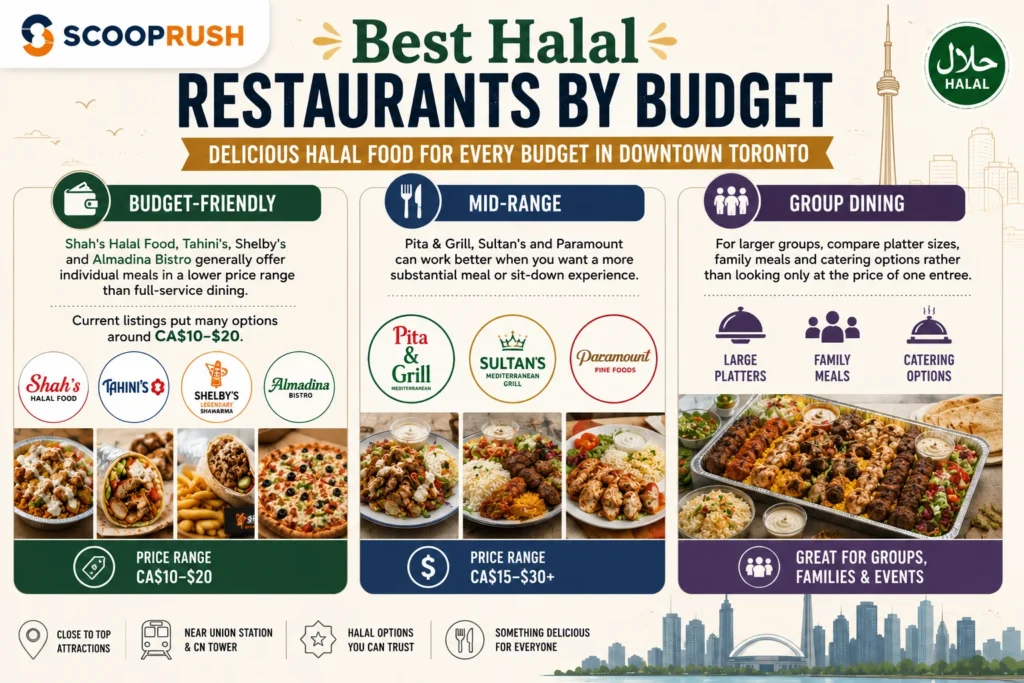
If you are searching for halal restaurants downtown Toronto, you do not have to travel far from the city’s biggest attractions. Around Union Station, the CN Tower, Rogers Centre, Scotiabank Arena, and the Entertainment District, you can find halal shawarma, Mediterranean plates, Afghan and South Asian food, burgers, pizza, and quick meals. Some of the most convenient choices include Paramount Fine Foods at Union Station, Pita & Grill on Bremner Boulevard, Tahini’s and Shelby’s on King Street West, and Shah’s Halal Food on Duncan Street. Current listings also show halal options around the Financial District and nearby downtown neighbourhoods.

For tourists, location matters almost as much as the food. A restaurant that is close to Union Station or the CN Tower can save time between sightseeing stops. For local diners, late-night hours, takeout, delivery, family seating, and price are often just as important.

Quick Answer: Where Can You Find Halal Food Near Union Station and the CN Tower?

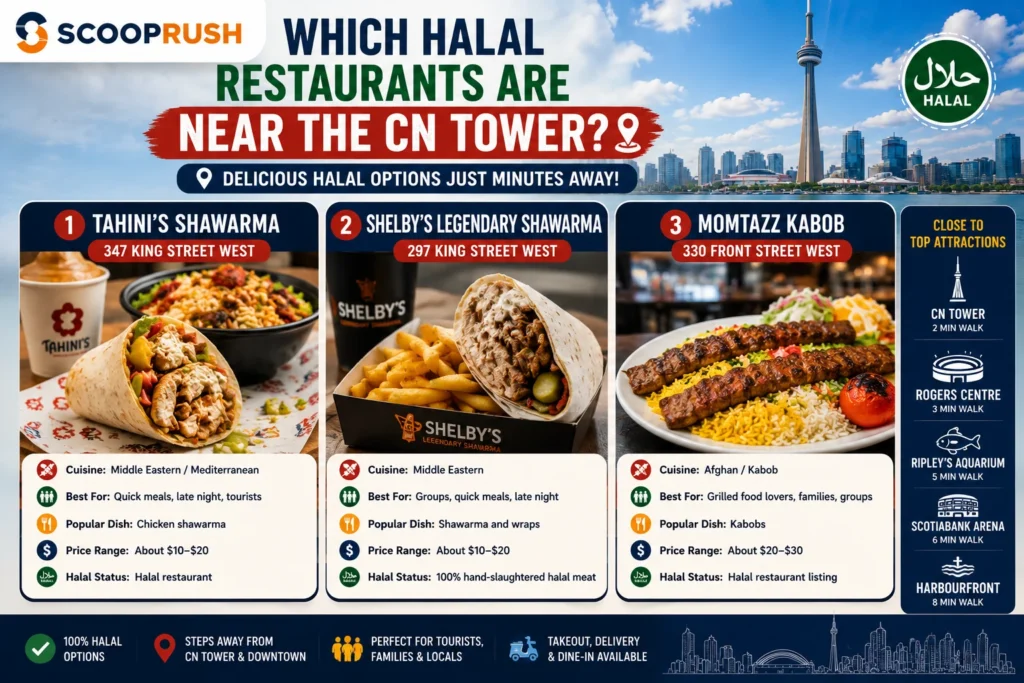
The best starting points are the restaurants closest to the waterfront and Entertainment District. Paramount Fine Foods at 65 Front Street West is particularly convenient for people arriving at Union Station, while Pita & Grill at 131 Bremner Boulevard is directly in the CN Tower and Rogers Centre area. Tahini’s at 347 King Street West and Shelby’s at 297 King Street West are useful choices around the Entertainment District.

For late-night halal food, Shah’s Halal Food on Duncan Street and several King Street West options are worth checking, but always confirm current hours before heading out.

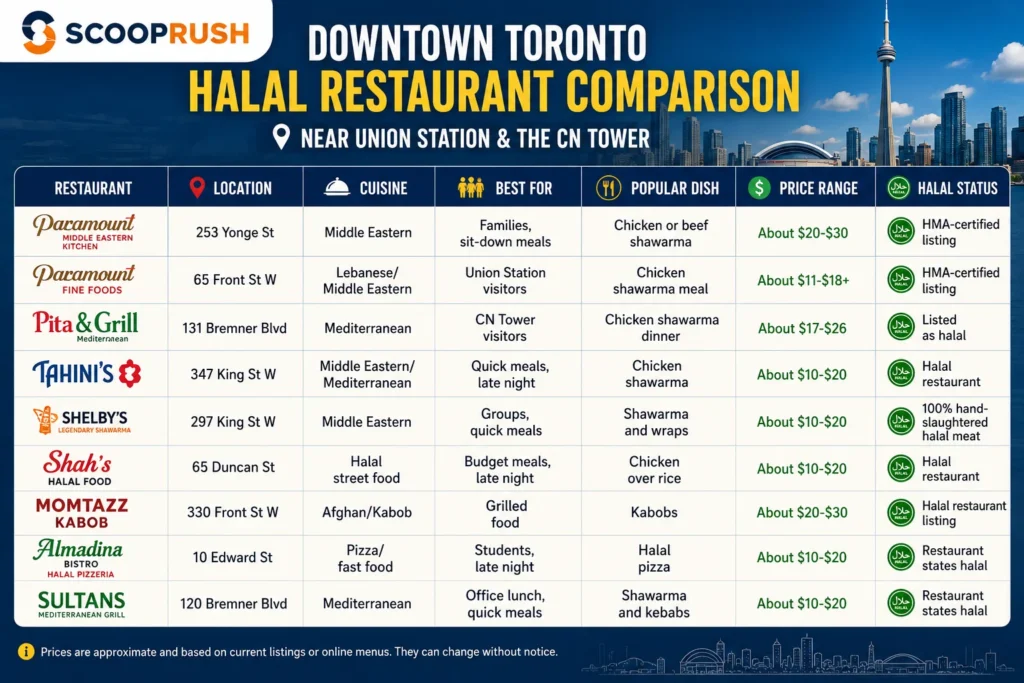
Downtown Toronto Halal Restaurant Comparison

RestaurantLocationCuisineBest ForPopular DishPrice RangeHalal Status
253 Yonge StMiddle EasternFamilies, sit-down mealsChicken or beef shawarmaAbout $20-$30HMA-certified listing
Paramount Fine Foods65 Front St WLebanese/Middle EasternUnion Station visitorsChicken shawarma mealAbout $11-$18+HMA-certified listing
131 Bremner BlvdMediterraneanCN Tower visitorsChicken shawarma dinnerAbout $17-$26Listed as halal
347 King St WMiddle Eastern/MediterraneanQuick meals, late nightChicken shawarmaAbout $10-$20Halal restaurant
297 King St WMiddle EasternGroups, quick mealsShawarma and wrapsAbout $10-$20100% hand-slaughtered halal meat
65 Duncan StHalal street foodBudget meals, late nightChicken over riceAbout $10-$20Halal restaurant
330 Front St WAfghan/KabobGrilled foodKabobsAbout $20-$30Halal restaurant listing
10 Edward StPizza/fast foodStudents, late nightHalal pizzaAbout $10-$20Restaurant states halal
120 Bremner BlvdMediterraneanOffice lunch, quick mealsShawarma and kebabsAbout $10-$20Restaurant states halal

Prices are approximate and based on current listings or online menus. They can change without notice.

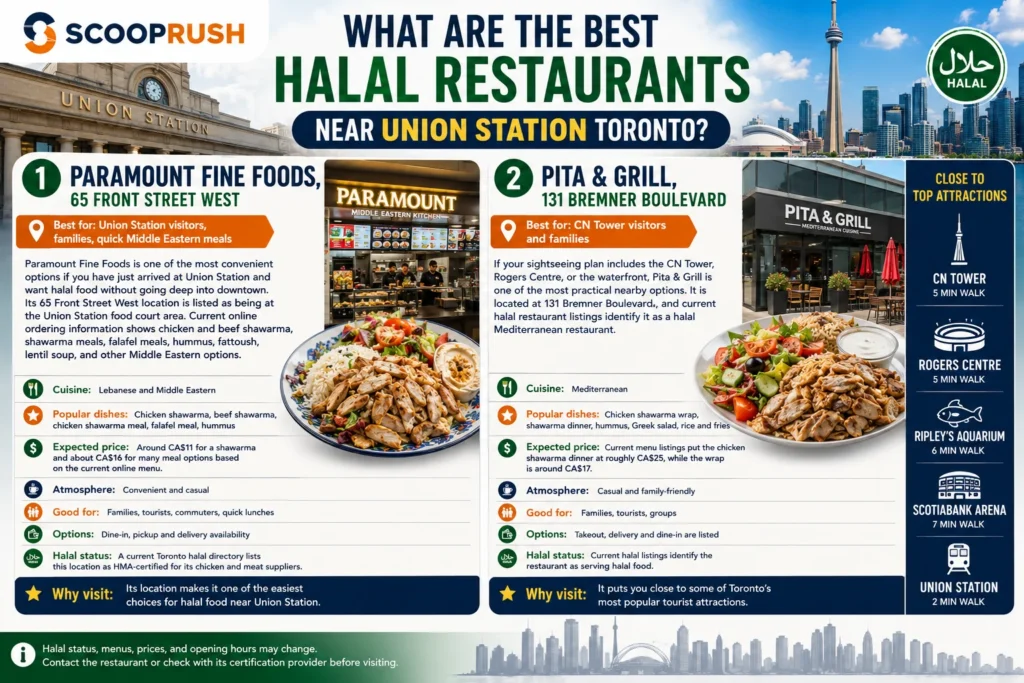
What Are the Best Halal Restaurants Near Union Station Toronto?

1. Paramount Fine Foods, 65 Front Street West

Best for: Union Station visitors, families, quick Middle Eastern meals

Paramount Fine Foods is one of the most convenient options if you have just arrived at Union Station and want halal food without going deep into downtown. Its 65 Front Street West location is listed as being at the Union Station food court area. Current online ordering information shows chicken and beef shawarma, shawarma meals, falafel meals, hummus, fattoush, lentil soup, and other Middle Eastern options.

Cuisine: Lebanese and Middle Eastern
Popular dishes: Chicken shawarma, beef shawarma, chicken shawarma meal, falafel meal, hummus
Expected price: Around CA$11 for a shawarma and about CA$16 for many meal options based on the current online menu.
Atmosphere: Convenient and casual
Good for: Families, tourists, commuters, quick lunches
Options: Dine-in, pickup and delivery availability
Halal status: A current Toronto halal directory lists this location as HMA-certified for its chicken and meat suppliers.

Why visit: Its location makes it one of the easiest choices for halal food near Union Station.

2. Pita & Grill, 131 Bremner Boulevard

Best for: CN Tower visitors and families

If your sightseeing plan includes the CN Tower, Rogers Centre, or the waterfront, Pita & Grill is one of the most practical nearby options. It is located at 131 Bremner Boulevard, and current halal restaurant listings identify it as a halal Mediterranean restaurant.

Cuisine: Mediterranean
Popular dishes: Chicken shawarma wrap, chicken shawarma dinner, hummus, Greek salad, rice and fries
Expected price: Current menu listings put the chicken shawarma dinner at roughly CA$25, while the wrap is around CA$17.
Atmosphere: Casual and family-friendly
Good for: Families, tourists, groups
Options: Takeout, delivery and dine-in are listed
Halal status: Current halal listings identify the restaurant as serving halal food.

Why visit: It puts you close to some of Toronto’s most popular tourist attractions.

Which Halal Restaurants Are Near the CN Tower?

3. Tahini’s Shawarma, 347 King Street West

Best for: Shawarma, quick meals and late-night dining

Tahini’s King Street West location sits in the Entertainment District, close to the Princess of Wales Theatre, TIFF Bell Lightbox and Rogers Centre. The restaurant’s own location page also notes that the CN Tower, Ripley’s Aquarium and Scotiabank Arena are nearby.

The menu focuses on Mediterranean food, including shawarma, rice bowls, salads, falafel and family meals. A current listing also identifies the restaurant as offering halal Mediterranean food, takeout, delivery, catering and late-night meals.

Cuisine: Middle Eastern/Mediterranean
Popular dishes: Chicken shawarma, rice bowls, falafel, salads and family meals
Expected price: Around CA$10-$20 for many individual meals
Atmosphere: Casual quick-service
Good for: Tourists, students, families and small groups
Options: Dine-in, takeout, delivery and catering
Halal status: Halal restaurant with halal options listed by current local information.

Why visit: It is a convenient choice after a game, theatre show or visit to the CN Tower area.

4. Shelby’s Legendary Shawarma, 297 King Street West

Best for: Groups, shawarma and late-night food

Shelby’s King & John location is at 297 King Street West in the Entertainment District. Its official location page lists dine-in and takeout, with the downtown branch currently operating late into the night.

Shelby’s is especially useful for Muslims who want a clear halal statement. The company says all of its meat is 100% hand-slaughtered halal, and its official halal page displays current certification information for its protein supply.

Cuisine: Middle Eastern
Popular dishes: Shawarma, wraps, saj-based meals and sides
Expected price: About CA$10-$20 for many individual meals
Atmosphere: Casual and lively
Good for: Friends, families, students and late-night diners
Options: Dine-in and takeout, with online ordering available
Halal status: Company states that all meat is 100% hand-slaughtered halal.

Why visit: The combination of a central location, clear halal policy and late hours makes it practical for tourists and locals.

5. MOMTAZZ KABOB, 330 Front Street West

Best for: Kabobs and grilled food

MOMTAZZ KABOB is at 330 Front Street West, putting it within the wider Entertainment District and Front Street area. Current business information identifies it as a halal restaurant and places it in the CA$20-$30 price category.

Cuisine: Kabob and grilled food
Popular dishes: Kabob-focused meals
Expected price: About CA$20-$30
Atmosphere: Casual
Good for: Families and groups looking for grilled food
Options: Check current ordering availability before visiting
Halal status: Current business information identifies the restaurant as halal.

Why visit: It is a useful option for diners who want grilled meat rather than shawarma or rice platters.

Which Halal Restaurants Are Best for Late-Night Food Downtown?

6. Shah’s Halal Food, 65 Duncan Street

Best for: Late-night halal food and affordable platters

Shah’s Halal Food is at 65 Duncan Street, near the Entertainment District and OCAD University area. Its current online ordering pages show chicken, lamb, mixed platters, gyros, falafel, fries and salads.

Current ordering information also shows late operating hours, with the Toronto location serving customers into the early morning on several days.

Cuisine: Halal street food, gyro and rice platters
Popular dishes: Chicken over rice, mixed platter, chicken gyro, lamb gyro, falafel over rice
Expected price: Many individual items are around CA$13-$18, with larger combos costing more.
Atmosphere: Casual and quick-service
Good for: Students, tourists, solo diners and late-night groups
Options: Pickup and delivery
Halal status: Halal restaurant

Why visit: It is one of the more practical downtown choices when you need a filling halal meal late at night.

7. Almadina Bistro, 10 Edward Street

Best for: Halal pizza and late-night comfort food

Not every halal restaurant downtown has to serve shawarma or kebabs. Almadina Bistro is a halal pizzeria at 10 Edward Street. Its own website says the restaurant serves halal pizza, wings, burgers and other comfort food.

The restaurant also says it has served the neighbourhood since 2020 and has a customer base that includes students and families. Its website lists late hours, with dine-in closing earlier than takeout.

Cuisine: Pizza and casual comfort food
Popular dishes: Halal pizza, chicken wings, burgers and sandwiches
Expected price: About CA$10-$20 for many items
Atmosphere: Casual and student-friendly
Good for: Students, families and late-night diners
Options: Dine-in and takeout, with online ordering
Halal status: The restaurant states that its pizza toppings are halal and its chicken wings are 100% halal.

Why visit: It gives halal diners a break from the usual shawarma and rice-platter options.

Which Halal Restaurant Is Good for a Downtown Business Lunch?

8. Sultan’s Mediterranean Grill, 120 Bremner Boulevard

Best for: Quick Mediterranean meals near the Financial District and sports venues

Sultan’s has a location at 120 Bremner Boulevard, placing it close to the CN Tower, Union Station area and major downtown sports and entertainment venues. The company’s current website lists the Bremner location as part of its Toronto locations.

Sultan’s official website states that it serves authentic halal meats and says its supplier delivers 100% halal meats to the restaurant.

Cuisine: Mediterranean
Popular dishes: Shawarma, grilled kebabs, salads, wraps and house dips
Expected price: About CA$10-$20 for many quick-service meals
Atmosphere: Casual and suited to lunch
Good for: Office workers, students and small groups
Options: Takeout, pickup, delivery and catering
Halal status: Restaurant states that its supplier provides 100% halal meats.

Why visit: Its Bremner Boulevard location is especially convenient if you are already around the South Core and waterfront.

9. Paramount Fine Foods, Yonge & Dundas

Best for: Families and a more traditional Middle Eastern dining experience

If you are willing to go a little farther north from Union Station, Paramount Fine Foods at Yonge and Dundas is another established downtown option. The restaurant’s official page describes the location as being in the heart of downtown Toronto and says it is designed for family and friend gatherings.

Cuisine: Middle Eastern
Popular dishes: Shawarma, grilled meats, fresh bread and Middle Eastern sweets
Expected price: Moderate
Atmosphere: Sit-down and family-friendly
Good for: Families, groups and casual celebrations
Options: Dine-in and catering
Halal status: A current Toronto halal directory identifies the location as HMA-certified for its chicken and meat suppliers.

Why visit: It is a useful option if your day includes Yonge Street, Eaton Centre or Dundas Square.

Where Can You Find Halal Food Near Rogers Centre?

For food close to Rogers Centre, Tahini’s at 347 King Street West, Shelby’s at 297 King Street West, Pita & Grill on Bremner Boulevard, and Sultan’s on Bremner Boulevard are among the most practical options to check. Tahini’s official location page specifically highlights its proximity to Rogers Centre, the CN Tower, Ripley’s Aquarium and Scotiabank Arena.

If you are going to a Blue Jays game or another event, allow extra time before the event begins. Downtown restaurants can become busy around major games and concerts.

Where Can You Find Halal Restaurants Near Scotiabank Arena?

The South Core and Entertainment District give halal diners several choices. Pita & Grill and Sultan’s are on Bremner Boulevard, while Tahini’s on King Street West is also close to Scotiabank Arena.

For a quick meal before an event, look for counter-service restaurants. For families or larger groups, check seating and reservation policies before arriving.

What About Halal Restaurants Near Harbourfront Toronto?

Harbourfront itself has fewer clearly verified halal options than the Entertainment District, but the surrounding downtown area has several choices within a reasonable trip. Union Station, Bremner Boulevard, Front Street and King Street West are useful areas to search.

For a visitor planning a Harbourfront day, Paramount Fine Foods on Front Street, Pita & Grill on Bremner Boulevard, and the King Street West restaurants are worth checking based on your route. Restaurant locations and menus can change, so confirm the current details before setting out.

Which Halal Restaurants Are Best for Families?

Pita & Grill, Paramount Fine Foods and Shelby’s are strong choices to consider for family dining because they offer familiar dishes such as shawarma, rice, grilled meats, wraps and sides.

For families with young children, look at the restaurant’s current seating arrangements and menu before visiting. A quick-service restaurant may be easier during a busy sightseeing day, while a sit-down restaurant may work better for a longer family meal.

Where Can You Find Affordable Halal Food Downtown Toronto?

For a lower-cost meal, start with quick-service options such as Shah’s Halal Food, Tahini’s, Shelby’s and Almadina Bistro. Current listings place many individual meals at these restaurants in the roughly CA$10-$20 range, although final prices depend on the item and ordering platform.

Students and tourists can also save money by choosing a wrap, platter or single meal instead of a larger family-style order.

Are These Restaurants Fully Halal?

Not every restaurant uses the same wording when describing its halal status. Some restaurants make a direct halal statement, some are listed by halal directories or certification organizations, and some may have halal meat supplied by a certified supplier.

For example, Shelby’s says all its meat is 100% hand-slaughtered halal, while Sultan’s states that its supplier delivers 100% halal meats. The Halal Guys also publishes halal certification information covering its chicken and beef gyro products across the US and Canada, although its Toronto location is farther from the CN Tower than several restaurants in this guide.

For this reason, the table above separates halal claims rather than treating every restaurant as having the exact same certification arrangement.

Is The Kabab Shoppe in Downtown Toronto?

The Kabab Shoppe is worth knowing if you are exploring halal food across the Greater Toronto Area, but it is not a downtown Toronto restaurant near Union Station or the CN Tower. Its current locations are in Pickering, Whitby, Oshawa and Brampton.

The brand says all of its meats are 100% certified halal and offers grilled kababs, rotisserie meat, wraps, platters and catering.

If your trip includes Brampton or the eastern GTA, The Kabab Shoppe can be a useful addition to a wider Toronto-area halal food itinerary. It is especially relevant for travellers looking for grilled halal food and catering rather than a downtown tourist stop.

Best Halal Restaurants by Occasion

Best for tourists

Paramount Fine Foods at 65 Front Street West is convenient for Union Station, while Pita & Grill and Tahini’s work well for visitors exploring the CN Tower and Entertainment District.

Best for families

Paramount Fine Foods, Pita & Grill and Shelby’s offer familiar Middle Eastern and Mediterranean dishes that can work well for groups.

Best for students

Shah’s Halal Food and Almadina Bistro are useful choices for casual meals, with current listings showing relatively accessible pricing and late-night options.

Best for shawarma

Tahini’s, Shelby’s and Paramount Fine Foods are good places to compare if shawarma is what you are craving.

Best for grilled food

Sultan’s and MOMTAZZ KABOB are worth considering for grilled Mediterranean or kabob-focused meals.

Best for late-night food

Shah’s, Tahini’s, Shelby’s and Almadina Bistro are the names to check first, but verify the current closing time before travelling.

Best Halal Restaurants by Budget

Budget-friendly

Shah’s Halal Food, Tahini’s, Shelby’s and Almadina Bistro generally offer individual meals in a lower price range than full-service dining. Current listings put many options around CA$10-$20.

Mid-range

Pita & Grill, Sultan’s and Paramount can work better when you want a more substantial meal or sit-down experience.

Group dining

For larger groups, compare platter sizes, family meals and catering options rather than looking only at the price of one entree.

How We Selected These Halal Restaurants

We considered restaurants based on several factors:

  • Verified or clearly stated halal status
  • Current restaurant and location information
  • Menu variety
  • Cuisine and dish selection
  • Location relative to Union Station, the CN Tower and major tourist areas
  • Value and available price information
  • Suitability for families, tourists, students and groups
  • Takeout, delivery or catering options
  • Available customer and local feedback

We also prioritized restaurants where the halal claim could be supported by the restaurant itself, a certification-related source, or a current halal-focused directory.

Halal verification notice

Halal status, menus, prices, and opening hours may change. Contact the restaurant or check with its certification provider before visiting.

This is especially important if you follow a specific halal standard, such as requiring zabiha meat, hand-slaughtered meat, a particular certification body, or no alcohol on the premises.

How Can Tourists Find Halal Restaurants Near the CN Tower?

Start by looking around Bremner Boulevard, Front Street West and King Street West. These streets connect several tourist attractions, including Union Station, Rogers Centre and the CN Tower area. Check the restaurant’s current halal statement before ordering, especially if certification is important to you.

What Is the Best Area for Halal Food Downtown Toronto?

The Entertainment District, Front Street, Bremner Boulevard and parts of the Financial District are useful areas to search. These areas put you close to Union Station, Rogers Centre, the CN Tower, Scotiabank Arena and Harbourfront, while several halal restaurants are located within the broader downtown core.

Can You Find Pakistani or Indian Halal Food Downtown?

Yes. Downtown Toronto has Pakistani and Indian halal choices, although the strongest concentration of Pakistani and South Asian restaurants is outside the immediate CN Tower and Union Station area. If you want Pakistani food specifically, search a wider area of downtown and consider restaurants such as Shah’s or other halal South Asian listings before choosing based on your exact route.

Is Halal Food Expensive in Downtown Toronto?

It does not have to be. Quick-service halal restaurants offer wraps, rice platters, shawarma and pizza at lower prices, while sit-down restaurants can cost more. Checking the current menu before visiting is the easiest way to match a restaurant with your budget.

Final Thoughts: Where Should You Eat Halal Food Downtown Toronto?

Finding halal restaurants downtown Toronto is easier when you plan around your sightseeing route. If you are arriving at Union Station, Paramount Fine Foods on Front Street is a convenient starting point. Near the CN Tower and Rogers Centre, Pita & Grill, Tahini’s, Shelby’s and Sultan’s give you several different halal options. For late-night food, Shah’s and other downtown quick-service restaurants can be useful choices.

The key is to check the current halal status, menu and hours before you go. Toronto’s restaurant scene changes quickly, and halal certification or supplier arrangements can also change.

If you have a favourite halal restaurant in downtown Toronto, share it with other readers. And if you are exploring more of the city, check out another Scooprush guide to find halal food across Toronto and other Canadian cities.

Frequently Asked Questions

1. What are the best halal restaurants near Union Station Toronto?

Paramount Fine Foods at 65 Front Street West is one of the most convenient choices near Union Station. Pita & Grill on Bremner Boulevard is another practical option if your route also includes the CN Tower and Rogers Centre. Always check the current halal information and opening hours before visiting.

2. Which halal restaurants are closest to the CN Tower?

Pita & Grill on Bremner Boulevard and the King Street West restaurants are among the useful nearby choices. Tahini’s specifically identifies the CN Tower, Rogers Centre, Ripley’s Aquarium and Scotiabank Arena as nearby attractions from its King Street West location.

3. Where can I get cheap halal food downtown Toronto?

Shah’s Halal Food, Tahini’s, Shelby’s and Almadina Bistro are good places to check for lower-cost halal meals. Current listings show many individual options in roughly the CA$10-$20 range, although prices vary by dish, tax and ordering platform.

4. Are halal restaurants downtown Toronto open late?

Some are. Shah’s Halal Food, Tahini’s, Shelby’s and Almadina Bistro all have current listings showing late service, although hours vary by restaurant and day. Before making a late-night trip, check the restaurant’s own website or ordering page because opening hours can change.

5. Do I need to ask restaurants about halal certification?

If you have specific halal requirements, asking is a good idea. Restaurants can use different certification bodies or halal suppliers, and some make a general halal statement rather than displaying a certification for the entire operation. Ask about the meat supplier, certification body and preparation practices if those details matter to you.

Disneyland Paris Is Bringing Back Space Mountain: De la Terre à la Lune in 2027

0

What if the ride you loved as a kid vanished for over a decade, then suddenly came back? That is exactly what is happening at Disneyland Paris right now. The park has confirmed that Space Mountain: De la Terre à la Lune, the original 1995 version of its most iconic coaster, is officially returning.

For longtime Disneyland Paris fans, this is not just another ride refurbishment. It marks the return of a piece of theme park history that many fans thought was gone forever. Disney made the announcement during the 2026 D23 Expo. While it did not generate the same viral buzz as Star Wars or Marvel news, it may be one of the most meaningful park announcements of the year for a passionate group of fans.

Here is everything we know about the Space Mountain: De la Terre à la Lune restoration, why it matters, and what guests can expect when the mountain reopens.

Space Mountain: De la Terre à la Lune Explained

Space Mountain: De la Terre à la Lune Explained

Space Mountain: De la Terre à la Lune debuted at Disneyland Paris in 1995. The name translates to “From the Earth to the Moon.” Imagineers based the attraction on Jules Verne’s classic novel and combined thrilling coaster action with retro-futuristic storytelling and world-first ride innovations.

A 22-meter-long cannon called the Columbiad Cannon launched riders into the story. In the original lore, the fictional Baltimore Gun Club built the cannon to send moontrains from Earth to the Moon. The theming, the score, and the launch sequence made this coaster an instant classic among fans who grew up visiting the park, then known as Euro Disneyland.

The ride changed over the years. It became Space Mountain: Mission 2 for a period. Then, for the past decade, it has operated as Star Wars Hyperspace Mountain, sending guests on a secret mission for the Rebel Alliance. Along the way, the original moon-themed story faded, and the cannon itself broke down. It has sat stuck in a stationary position since 2009.

Now, that is finally about to change.

The Official Space Mountain Restoration Announcement

Disneyland Paris confirmed that Star Wars Hyperspace Mountain will close at the end of 2027 for a multi-month refurbishment. The goal is to bring back the original 1995 theme while updating it for a new generation of guests.

The refurbishment will include extensive technical work, updated sets and props, a redesigned queue, and new special effects. Guests will once again travel to an idealized version of the first journeys to the Moon, presented in the steampunk aesthetic tied to Discoveryland.

One especially exciting detail: composer Steve Bramson’s original score will return, fully remastered for the reopening. Additionally, the redesigned queue will let guests watch the trains in motion again, building anticipation before the ride even begins.

Perhaps the biggest news for hardcore fans involves the Columbiad Cannon. Disney will finally restore it after years of sitting broken. Once fixed, it will launch riders from 0 to 44 mph in under two seconds, complete with the dramatic effects Imagineers originally designed for it.

Why the Space Mountain De la Terre à la Lune Return Matters

To understand why this news is such a big deal, you need to understand what this attraction represents to Disneyland Paris diehards. Fans often compare it to what Figment and Dream finder mean to old-school EPCOT Center purists, or what a nostalgic “wondrous worlds” Tomorrowland means to longtime Disneyland fans.

In other words, this is not a mass-market announcement. It is a deeply personal moment for a specific fan community that has waited nearly a decade to see the original vision return.

Star Wars Hyperspace Mountain has stayed popular, and that popularity actually explains part of the delay. Reportedly, Disney discussed and shelved this restoration project multiple times over the years because Hyperspace Mountain was simply too marketable to replace. Star Wars draws in casual park guests who may not know or care about the ride’s original 1995 story. So, from a business standpoint, keeping the Star Wars overlay made sense for a long time.

However, this project signals something different happening at Disneyland Paris now. Leadership appears to be shifting decisions away from pure marketability and toward what genuinely matters to fans who have supported these parks for decades.

A “New Magic” Initiative Brings Space Mountain Back

This restoration belongs to a broader program at Disneyland Paris called the “New Magic” initiative. The program aims to improve the overall guest experience and refresh classic attractions across the resort.

Other recent projects under this initiative include enhanced scenery along the banks of Rivers of the Far West in Frontierland, based on original designs from Disney Legend Marc Davis. Disneyland Paris also has several other projects at different stages of development, and the park plans to reveal them in phases.

Therefore, the Space Mountain: De la Terre à la Lune restoration is not an isolated project. It represents a larger commitment to honoring the park’s history while still investing in its future.

The Imagineers Leading the Space Mountain Restoration

The Imagineers Leading the Space Mountain Restoration

During the D23 Expo, two Imagineers took the stage to discuss the project in detail: Michel den Dulk and Tim Delaney. Their combined history with Disneyland Paris makes them uniquely qualified to lead this restoration.

Tim Delaney began his Disney career in 1976. He worked alongside legendary Imagineers such as Herb Ryman, X Atencio, and Marc Davis. Delaney played an instrumental role in creating EPCOT Center and later led the design of Discovery land at Euro Disneyland. He also served as Lead Designer and Producer for the original Space Mountain at Disneyland Paris, which makes him one of the few people who can speak firsthand about the attraction’s original creation. He has since returned to Imagineering to work on Tomorrowland and Discovery land projects.

Michel den Dulk represents a newer generation of Imagineering talent. He began his career at Efteling in the Netherlands before working at Europa Park in Germany. Since joining Imagineering in 2010, he has worked on major projects including Fantasy Faire at Disneyland, Frozen Ever After at EPCOT, and World of Frozen at Hong Kong Disneyland. He currently serves as Vice President Portfolio Executive for Disneyland Paris. By all accounts, he played a central role in finally getting this long-discussed restoration greenlit.

Together, they hosted a presentation called “Two Imagineers, One Mountain: The Evolution of Space Mountain at Disneyland Paris.” The session gave fans a detailed look at the attraction’s history and the thinking behind the restoration.

What to Expect From the New Space Mountain: De la Terre à la Lune

Walt Disney Imagineering Paris is still finalizing the design details. However, several key elements have already been confirmed. Guests can expect:

  • A redesigned queue that reveals the moontrains in motion before boarding
  • Updated indoor sets and props reflecting the original 1995 vision
  • New special effects enhancing the iconic blast sequence
  • Steve Bramson’s original score, fully remastered
  • A restored and fully functional Columbiad Cannon
  • State-of-the-art exterior dome lighting, already installed in 2025

Importantly, Imagineers do not plan to simply recreate the 1995 attraction exactly as it was. Instead, they are combining the original storytelling with more than 30 years of technological advancements. As a result, longtime fans should experience a version of the ride that feels both familiar and noticeably improved.

When Will Space Mountain: De la Terre à la Lune Reopen?

Star Wars Hyperspace Mountain will close at the end of 2027, and the refurbishment should take several months. Disneyland Paris has not yet announced an exact reopening date. Still, fans planning future trips may want to keep this timeline in mind, especially if they hope to ride Hyperspace Mountain one last time before it closes, or if they want to be among the first to experience the restored attraction.

Why Disney Leadership Chose to Bring Back Space Mountain

Why Disney Leadership Chose to Bring Back Space Mountain

Disney is framing this restoration as more than just a nostalgic nod. It also serves as evidence of a broader shift in how Disney Parks leadership approaches decision-making.

For years, ambitious but niche projects like this one struggled to get approved because they lacked a clear, mass-market return on investment. Restoring a 30-year-old ride theme for a relatively small, dedicated fan base does not typically pencil out financially the way a Star Wars or Marvel expansion does.

However, this project finally received the green light, and that suggests current leadership, including Disney Parks CEO Josh D’Amaro, values these kinds of fan-focused investments. Similar to other symbolic restoration projects across Disney Parks, this move shows that leadership will invest time and money into projects simply because they matter to longtime supporters.

Final Thoughts 

The return of Space Mountain: De la Terre à la Lune is a rare kind of theme park news. It will not dominate headlines the way a new land or IP-based attraction might. Yet for fans who have waited since the ride’s transformation years ago, this announcement means far more than marketability ever could. It feels like validation.

The restoration honors Tim Delaney’s original creative vision while giving a new generation of Imagineers, led by voices like Michel den Dulk, the chance to enhance it with decades of technological progress. Between the remastered score, the restored cannon, and the redesigned queue, Disneyland Paris looks set to deliver a genuinely special experience once the mountain reopens.

For now, guests still have time to experience Star Wars Hyperspace Mountain before it closes at the end of 2027. After that, the countdown begins for the return of one of Disneyland Paris’s most beloved classics.

Frequently Asked Questions

1. What is Space Mountain: De la Terre à la Lune? 

It is the original 1995 version of Space Mountain at Disneyland Paris, based on Jules Verne’s novel “From the Earth to the Moon.” It features a steampunk aesthetic and a launch sequence from the Columbiad Cannon.

2. When will Star Wars Hyperspace Mountain close? 

Star Wars Hyperspace Mountain will close at the end of 2027 so Disney can begin the refurbishment back into Space Mountain: De la Terre à la Lune.

3. Will Disney fix the Columbiad Cannon? 

Yes. Disney will restore the cannon, which has been stuck in a stationary position since 2009, as part of the project. Once repaired, it will launch riders from 0 to 44 mph in under two seconds.

4. Who is leading the Space Mountain restoration project? 

Imagineers Michel den Dulk, Vice President Portfolio Executive for Disneyland Paris, and Tim Delaney, the original Lead Designer and Producer of the 1995 attraction, are both closely involved in the restoration.

5. Is the Space Mountain restoration part of a larger project at Disneyland Paris? 

Yes. It belongs to the “New Magic” initiative, a broader program aimed at refreshing classic attractions and improving the guest experience across the resort.

James Maddison Opens Up on ACL Recovery: “My Second Set of Twins Got Me Through It”

0

Can raising five children under four actually help a footballer survive the worst injury of his career? For Tottenham Hotspur midfielder James Maddison, it did. His James Maddison ACL recovery story goes far beyond physio sessions and fitness tests. It centers on fatherhood, patience, and the family that carried him through what he calls the toughest year of his life.

Maddison shared this story with Kelly Somers on BBC’s The Football Interview. The new season’s first episode airs Saturday, 22 August. In it, Maddison opens up honestly about his knee injury, his growing family, and his path back to the pitch. His words give fans a rare, personal look at what a long-term injury really involves.

This story matters because Maddison’s ACL recovery shaped both his season and Tottenham’s. His honesty also offers a fuller picture of what professional athletes face when injuries strike at the worst possible time.

James Maddison’s ACL Injury: What Happened

Maddison ruptured his anterior cruciate ligament (ACL) last August. The injury ended his 2025-26 season almost before it started. ACL injuries are hard to recover from. They often require nine to twelve months of intense rehabilitation. For a 29-year-old midfielder who relies on quick movement and agility, this injury hit hard.

As a result, Maddison spent most of the season watching from home instead of playing. He found it difficult to sit on the sidelines during matches.

“We probably struggled a little bit for creativity, and I’m watching the games thinking, ‘what would I be doing there?'” he said.

Many injured athletes feel this same frustration. However, Maddison found a way to stay grounded. His family gave him a new sense of purpose during recovery.

A Second Set of Twins Arrives Mid-Recovery

While Maddison worked through his ACL recovery, his partner gave birth to their second set of twins. The couple suddenly had five children aged four and under at home.

Maddison described the household as being “in the trenches” during this stretch. Nappies, sleepless nights, and constant chaos filled his days. Still, he found joy in it.

“A lot of nappies flying about, a lot of accidents at home, but it’ll all be worth it,” he said. “We still love it. I wouldn’t change it for the world.”

How Fatherhood Shaped Maddison’s Injury Comeback

Maddison didn’t see his family responsibilities as extra pressure. Instead, he credits them with helping him push through his injury. Focusing on his partner and their newborns gave him a positive distraction from the pain and mental strain of rehab.

“I needed that positive distraction of my partner being pregnant and having to be there for her and forget about myself, even though I was going through a traumatic experience through my knee,” he told Somers.

This mindset stands out. Many athletes struggle with a loss of identity during long injuries because their sport shapes so much of who they are. Maddison’s experience shows how life outside football can offer real emotional support during hard times.

His Son Thought He Had Left Tottenham

One story from the interview stands out. Because Maddison missed a full year of football, his eldest son Leo believed at one point that his dad had left Tottenham for good.

“I missed a year of football, and a year in a child’s life, from three and a half to four and a half, it’s obviously massive,” Maddison explained. “He couldn’t even remember over a year ago when he was at all the games.”

This moment shows how deeply the injury affected his family, not just his career. Leo grew used to seeing his father sitting at home with a recovery machine on his knee instead of running out onto the pitch. Maddison now hopes his son will get to watch him play again and actually remember it.

Roberto De Zerbi’s Impact on Tottenham’s Recovery

Roberto De Zerbi's Impact on Tottenham's Recovery

Family wasn’t the only source of support during Maddison’s comeback. His relationship with new head coach Roberto de Zerbi also played a key role once he returned to full training. The Italian manager took charge at Tottenham Hotspur Stadium in March, arriving during a rocky stretch for the club.

Tottenham struggled badly last season. The team secured Premier League survival only on the final day, finishing just two points above the relegation zone. Maddison admitted it was tough to watch from the sidelines.

De Zerbi brought a different energy to the squad, and Maddison praised his approach.

Maddison described the Italian as clever, tactical, and clearly obsessed with football. “But to be honest, when he first came in, in comparison to pre-season and what we’re training now, he didn’t want to make it too complicated. He just wanted us to get the love back for playing football.”

Simple Gestures That Rebuilt Team Spirit

De Zerbi made an early move that stood out. He organised a team meal where players could drink alcohol. It sounds small, but Maddison believes it changed the squad’s mood.

“We’re all going to be drinking alcohol, we’re all going to be having a good night,” Maddison recalled De Zerbi saying. That night, he added, made the whole squad feel “more knitted together” almost immediately.

De Zerbi also included Maddison on the matchday bench before he felt ready to play. Maddison hesitated at first, unsure if he belonged there.

“He said I can come on the bench in my slippers if I want,” Maddison shared. “He just wanted me around the group and he thought that would benefit the group. I took that as a massive compliment.”

Maddison believes this small act of inclusion helped Tottenham steer clear of relegation danger during a tense run-in.

Maddison’s Return to Football and What Comes Next

Maddison finally returned to action against Leeds on 11 May. His comeback ended a layoff of 375 days. Despite that milestone, the club managed his workload carefully and did not risk him during pre-season this summer.

Still, Maddison stays optimistic about the season ahead. His main goal now is simple: stay fit.

“I’m working so hard to try and be fully fit and available for the majority of the season,” he said. “I just want a fully fit, healthy season where I can just enjoy football. Because if I’m fully fit and I’m healthy, then I know what I’m capable of.”

He added a confident note about his future impact. “I know that I can affect games more than a lot of players in this league. So, let’s just hope for that.”

Tottenham fans will welcome that confidence. A fully fit Maddison could give the team the creative spark it lacked during his long absence.

Key Takeaways

Maddison’s journey offers real lessons beyond football.

First, his story shows how life events, like the birth of children, can shape how athletes handle setbacks. Instead of isolating himself, Maddison leaned into fatherhood during his ACL recovery.

Second, his bond with Roberto de Zerbi shows how strong leadership and small team gestures can shift a struggling squad’s mindset, even under real pressure.

Finally, Maddison’s drive to return to full fitness shows the resilience it takes to come back from a serious ACL injury. His openness throughout the process helps fans understand what athletes truly go through during long-term recovery.

As the new Premier League season kicks off, fans will watch closely to see whether Maddison stays healthy and reclaims his spot as one of Tottenham’s most creative players.

FAQs 

What injury did James Maddison suffer?

Maddison ruptured his anterior cruciate ligament (ACL) last August. The injury kept him out for most of the 2025-26 season.

How long was James Maddison out with his ACL injury?

He missed 375 days before returning against Leeds on 11 May, following a long recovery from ACL surgery.

How many children does James Maddison have?

The Tottenham midfielder has five children aged four and under, including a second set of twins born during his ACL recovery.

Who is Tottenham’s head coach that Maddison praised?

He praised Roberto de Zerbi, the Italian coach who took over at Tottenham Hotspur Stadium in March and helped lift the team’s spirit.

Is James Maddison fully fit for the new season?

Maddison has returned to first-team action but sat out pre-season matches. He says he’s working hard to stay fully fit for most of the upcoming season.

Can AI Really Save Councils Millions? Northamptonshire Puts It to the Test

0

“Councils use AI to close a £37.6m hole. Two councils. One bold bet on artificial intelligence.”

As local budgets buckle under rising care costs, officials in Northamptonshire are betting that chatbots and transcription tools can help close the gap. But can software really fix a funding crisis this deep?

Introduction

Two councils are turning to artificial intelligence to close a combined £37.6m funding gap, and the story reveals just how deep the financial strain has become in local government. West Northamptonshire Council needs to save £24m by 2027/28. North Northamptonshire Council needs to find another £13.6m. Together, these numbers show how far local authorities are being pushed.

This matters far beyond Northamptonshire. Across the UK, 218 upper-tier councils must make a combined £3.2bn in cuts this year alone. That means fewer bin collections, higher parking charges, reduced grants, and in some cases, entire services disappearing. For residents, especially older and vulnerable people who rely on adult social care, these decisions hit close to home.

So why AI, and why now? Councils say the technology can save staff time, speed up assessments, and ease pressure on overstretched teams — part of a much wider shift as AI creeps into public sector roles, raising the same question workers everywhere are asking: will AI replace your job? However, charities and social work groups are raising serious concerns about accuracy, empathy, and where the line should be drawn. This article breaks down what is happening, why it matters, and what it could mean for the people who depend on these services.

Why Councils Use AI to Tackle the Funding Gap

Why Councils Use AI to Tackle the Funding Gap

West Northamptonshire Council and North Northamptonshire Council, both controlled by Reform UK, have identified major budget shortfalls heading into the next financial year. WNC faces a £24m gap for 2027/28, while NNC needs to close a £13.6m shortfall. Together, these add up to the £37.6m figure driving this latest round of cost cutting.

Both councils already use artificial intelligence in adult social care, an area where spending has climbed sharply in recent years. Adult social care and children’s services now absorb a growing share of council budgets, leaving less room for everything else. As a result, both authorities see technology as one tool among several to manage costs.

At NNC, AI transcribes conversations between social workers and residents. The goal is simple: save staff time on admin so they can spend more of it supporting people directly, a strategy similar to how NHS AI tools are being used to cut waiting times. Meanwhile, WNC has trialled an AI chatbot on WhatsApp to handle adult social care questions, similar to how AI-powered social listening tools are helping organisations triage large volumes of queries. The chatbot screens initial requests for education, health and care plans, helping to reduce a growing backlog. WNC has also approved technology that helps adults live independently with digital support tools.

What the Budget Cuts Look Like in Practice

WNC’s savings measures go well beyond AI. The council’s 2026/27 budget includes a 4.95% increase in council tax, higher charges for garden waste collection and parking, and reduced funding for community grants. Residents notice these changes immediately, long before any AI tool changes service delivery.

A WNC spokesperson called the council’s approach “robust and prudent,” adding that officials continuously look for ways to cut costs while protecting services for residents “as far as possible.” Graham Cheatley, the council’s deputy leader and executive member for finance, efficiency and change, said the authority is also pressing central government for a funding system that better reflects the pressures local authorities face.

The National Picture: Councils Face a £4bn Black Hole

The National Picture: Councils Face a £4bn Black Hole

The Northamptonshire story is not an isolated case. It sits inside a much larger national trend, according to a study by the BBC Shared Data Unit. Councils across the UK collectively face a looming £4bn financial black hole, and many now turn to AI as part of their response.

Local government experts remain cautious, though. Jonathan Carr West, chief executive of the Local Government Information Unit, said the sector still struggles to keep pace with rising demand and cost, particularly in adult social care and children’s services. He described the sector as “on the brink of collapse.”

The scale of the challenge is stark. Even if councils hit their savings targets this year, they still expect to need a further £3.8bn by the end of the 2027-28 financial year just to balance their books. A record 37 councils will receive exceptional financial support this year, a clear sign of how widespread the strain has become.

Examples from elsewhere in the country show how councils are experimenting with AI tools. Medway Council plans to use AI to draft care plans and automate invoice processing, part of a broader wave of AI adoption across sectors that has even reshaped areas like AI-powered SOC solutions in enterprise security. West Sussex County Council hopes to save £300,000 a year by replacing nine call handlers with an AI contact centre. Liverpool expects to save around £150,000 through AI in children’s social care, a modest figure next to its total budget gap of more than £29m over the same period.

Where AI Chatbots Have Struggled

Not every rollout has gone smoothly. Derby’s AI chatbot, known as Darcie, received complaints after it struggled to understand the local accent, a limitation not unlike the trust gaps seen in AI CEO clones in the boardroom, where accuracy and tone matter just as much as speed. This stumble highlights a wider worry among campaigners: AI systems built for efficiency can end up creating new barriers, particularly for people who already find it hard to navigate council services.

Silver Voices campaign group for older people, He said people seeking social care support are often confused or in pain, and they are not used to dealing with automated systems on first contact. What they need, he argued, is a sympathetic human voice rather than a robotic answering machine.

Denise Rowley, 71, offered a personal example of this tension. A former IT teacher who suffered a stroke nearly a decade ago, she relies on Wakefield Council’s Carelink service for support. She said older people already struggle with everyday technology, and speaking to an AI system on top of that adds another layer of difficulty, especially when the underlying system was flawed from the start.

Concerns Over AI in Vulnerable Care Decisions

The use of AI in adult social care raises questions that go beyond simple convenience. Caroline Abrahams, charity director at Age UK, warned there is an “inevitable risk” of inaccuracy or misunderstanding when AI handles transcription, echoing broader worries about how sensitive data is handled once it passes through AI systems, similar to concerns raised when Claude AI chats were exposed via Google Search.”care for older or vulnerable adults”

Andrew Reece, strategic lead for the British Association of Social Workers, raised a sharper concern. He said members worry about AI drafting care assessments, the documents that determine what support someone receives. According to Reece, this steps into decision-making territory, and he does not believe AI belongs there. He drew a clear line between AI that assists a social worker, such as recording a conversation to help with notes, and AI that takes over the assessment process itself.

Derby City Council says its AI-drafted care assessments always go through a social worker’s review before finalisation. However, a report from the Ada Lovelace Institute found that AI tools made frequent errors in care assessments, and some of those errors made it into finalised reports despite human review — a pattern that mirrors wider fears about AI systems going rogue when oversight falls short. This finding adds weight to concerns that oversight alone may not catch every mistake.

Reece also pushed back against the idea that AI mainly saves money. He argued that any savings will likely come from cutting social work jobs, which would only add more pressure to a system that already struggles. Social workers, he said, frequently cannot complete their work within normal hours as it stands today.

The Government’s Position on AI in Local Services

The Ministry of Housing, Communities and Local Government has taken a hands-off stance on how councils use AI. A spokesperson said the government does not mandate the technology’s use but encourages it where it can help “alleviate pressures and free up staff to help deliver better public services.”

The government points to broader funding reforms as part of the solution, even as some sectors globally move cautiously — a pace comparable to Japan’s slow AI adoption among companies. It has introduced multi-year funding settlements, giving councils clearer visibility of their budgets several years in advance rather than year by year. It has also changed the funding formula to direct more money toward areas with higher need and less ability to raise income through council tax. A ministry spokesperson said £78bn is available to local authorities this year, and nine in ten councils in England will receive funding that matches their relative need by the end of 2028-29 — a scale of public spending scrutiny that echoes debates elsewhere, such as the $110bn in savings claimed in the DOGE GAO report.

Carr West acknowledged these reforms have had some effect. He said they have “slightly slowed down” the sector’s slide toward crisis, even if they have not changed its overall direction. Meanwhile, Prime Minister Andy Burnham has pledged to reform social care and, in July, announced plans to give city region mayors a share of income tax revenue as part of a wider push to shift power away from Westminster.

What Councils Using AI Means Going Forward

What Councils Using AI Means Going Forward

For residents in West Northamptonshire and North Northamptonshire, the immediate impact already shows up through higher council tax, increased service charges, and reduced grant funding. Officials position AI as a way to soften the blow on frontline services, particularly in social care, rather than as a replacement for these broader savings measures — and as public bodies lean further into automation, demand for skilled talent is rising too, much like the growing interest in how to become a data analyst in 2026.

The national picture suggests this pattern will continue. Councils need to find billions more in savings over the coming years, so AI adoption in call handling, care assessments, and case documentation will likely expand further. Consequently, the debate over where AI should assist versus where it should stay out of decision making will only grow louder, feeding directly into the bigger question of whether AI will replace human jobs across the public sector.

Ultimately, the tension is clear. Councils need to save money, and AI offers a genuine way to reduce administrative burden and free up staff time. At the same time, charities, campaigners, and social work professionals warn that vulnerable people need human judgment and human warmth built into their care, not just efficient systems. How councils balance these two pressures will shape daily life for some of the most vulnerable residents in the country over the next few years.

Conclusion

West Northamptonshire and North Northamptonshire councils use AI to help close a combined £37.6m budget gap, part of a much larger £4bn shortfall facing councils across the UK. AI already handles transcription, chatbot triage, and care plan drafting, and officials say it frees up staff time for more meaningful work with residents. However, campaigners and social work bodies warn that accuracy problems, accent recognition issues, and the risk of AI overstepping into care decisions remain real concerns. As councils continue cutting budgets and raising charges, the debate over how far AI should go in social care is only just beginning.

FAQs

Why do West Northamptonshire and North Northamptonshire councils use AI?

Both councils face major budget gaps, £24m and £13.6m respectively for 2027/28. They use AI to reduce administrative workload and improve efficiency, particularly in adult social care.

How much money do UK councils need to save overall?

A BBC Shared Data Unit study found that 218 upper-tier councils across the UK must make a combined £3.2bn in cuts this financial year. Councils expect to need a further £3.8bn by the end of 2027-28.

What tasks is AI handling in council social care services?

Councils use AI to transcribe conversations between social workers and residents, run chatbots that screen initial care requests, draft care plans, and automate invoice processing.

Are there risks when councils use AI in adult social care?

Yes. Age UK warns of an “inevitable risk” of inaccuracy in AI transcription, while the British Association of Social Workers raises concerns about AI drafting care assessments that determine support entitlements.

Does the government require councils to use AI?

No. The Ministry of Housing, Communities and Local Government says it does not mandate how councils use AI, but it encourages its use where it can help ease pressure and support staff.