
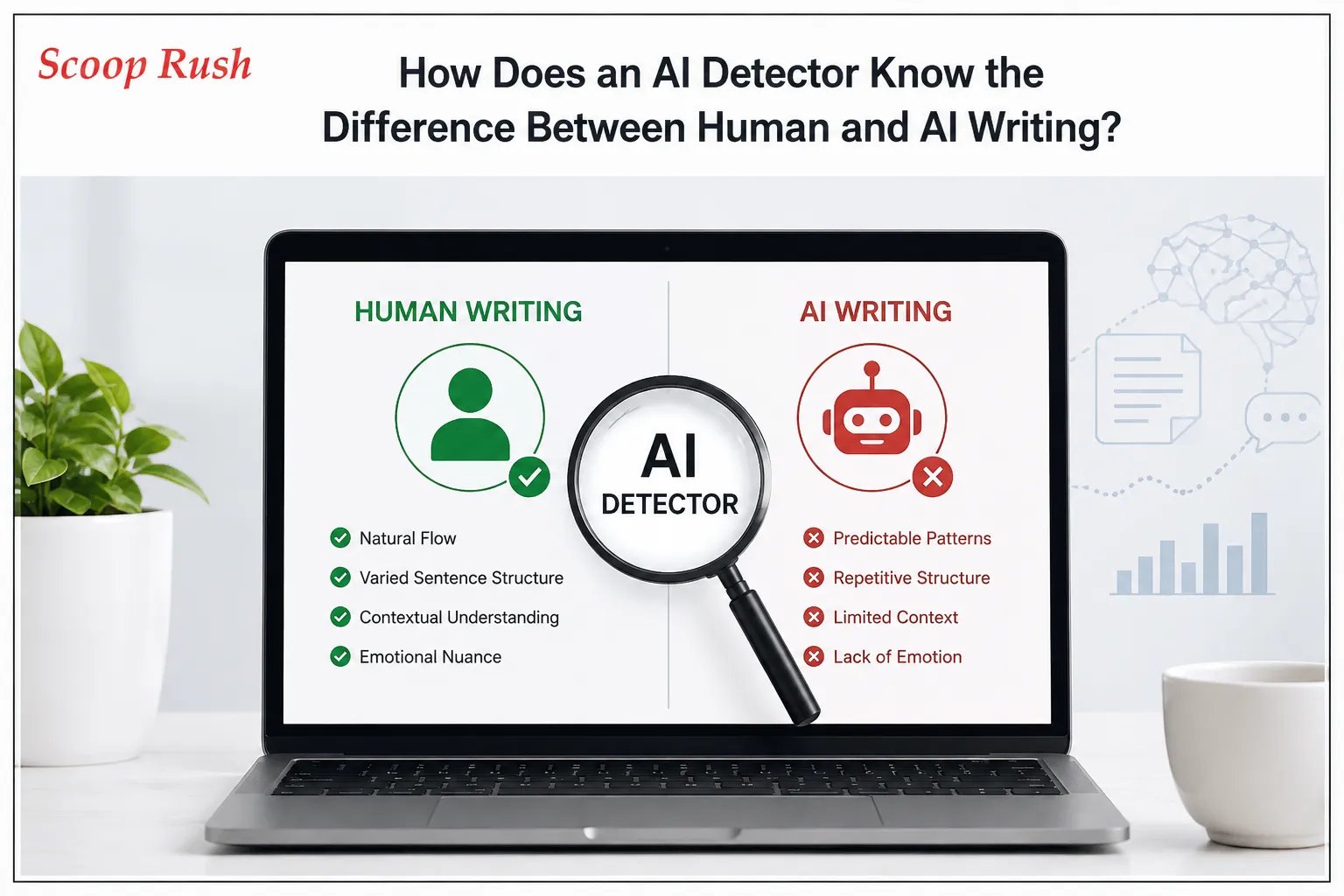
Can a machine really tell if another machine wrote something? That’s the exact question AI detector tools are built to answer, and the results might surprise you.
Introduction
AI writing has moved fast into classrooms, offices, and newsrooms. As a result, the need to separate human writing from machine writing has grown just as quickly. Reports suggest the AI content detector market was valued at $25.13 billion in 2023 and is expected to reach $255.74 billion by 2032. That growth alone shows how seriously institutions now treat this issue, even as some question whether AI will replace their job entirely.
In this article, we’ll break down how an AI detector actually tells human writing apart from AI writing, where it gets used, and where it still comes up short.
What Is an AI Detector?
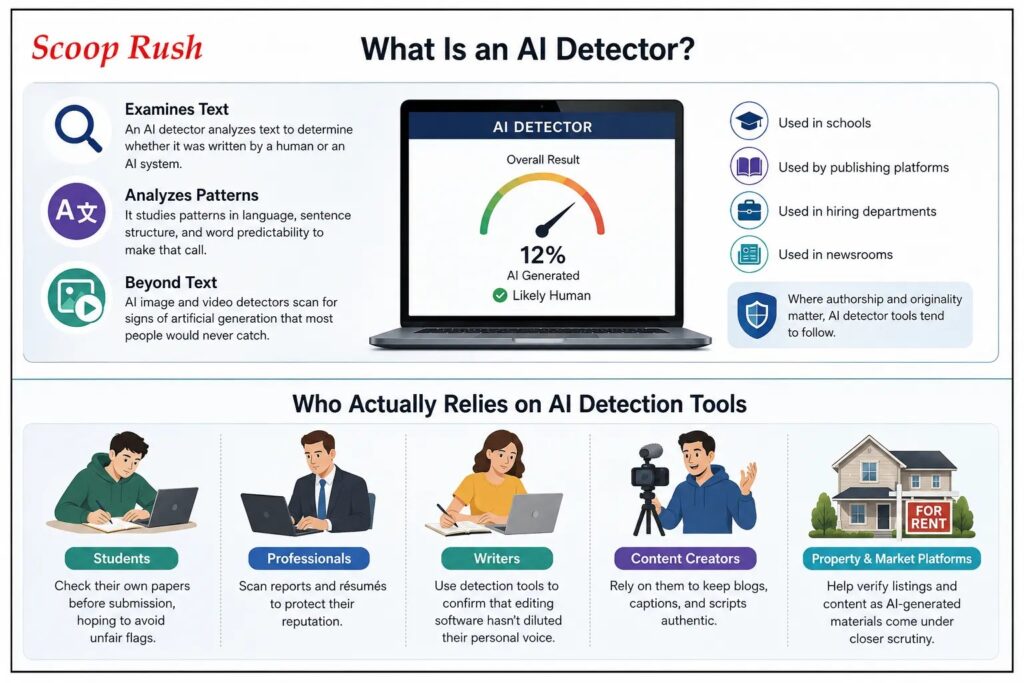
An AI detector is a software tool built to examine text and determine whether a human or an AI system created it. It studies patterns in language, sentence structure, and word predictability to make that call.
Detection isn’t limited to text either. AI image and video detectors exist too, scanning for signs of artificial generation that most people would never catch on their own, similar to how platforms like Snapchat are now blocking AI-generated videos from certain features.
Today, AI detector tools show up in schools, publishing platforms, hiring departments, and newsrooms. Basically, anywhere authorship and originality matter, these tools tend to follow.
Who Actually Relies on AI Detection Tools
Different groups use AI detectors for different reasons. Students check their own papers before submission, hoping to avoid unfair flags. Professionals scan reports and résumés to protect their reputation. Writers use detection tools to confirm that editing software hasn’t diluted their personal voice. Meanwhile, content creators lean on them to keep blogs, captions, and scripts authentic, much like property listings are now being scrutinized for AI-generated content in the rental market.
How Does an AI Detector Know the Difference Between Human and AI Writing?
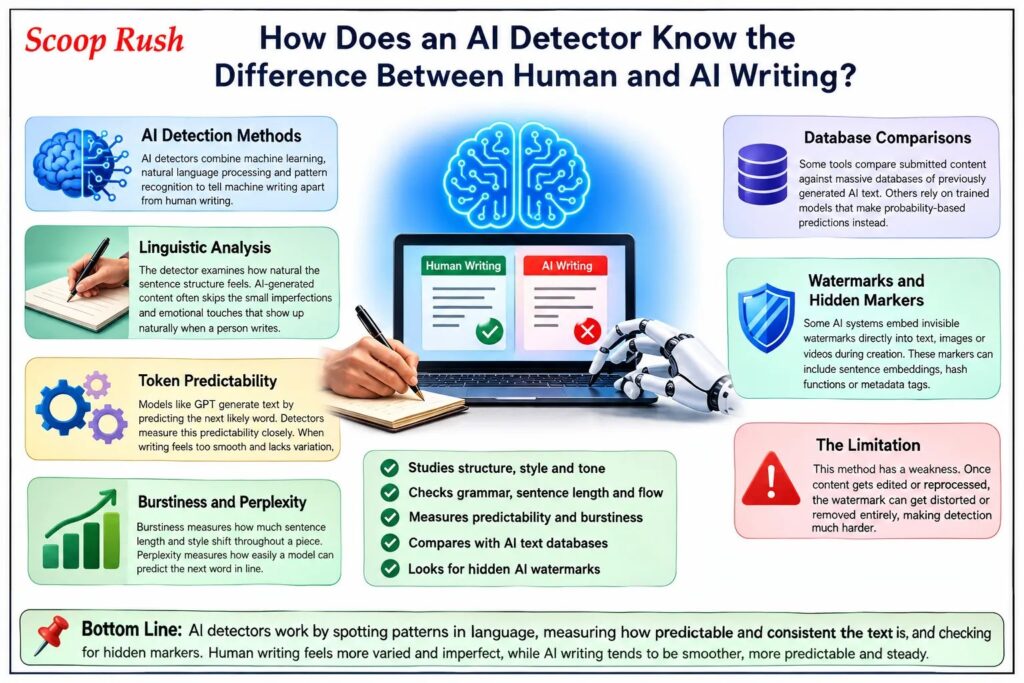
AI detectors combine machine learning, natural language processing, and pattern recognition to tell machine writing apart from human writing. Trained models study structure, style, and tone, while NLP checks grammar, sentence length, and overall flow, a process that ties into the broader question of why AI systems sometimes behave unpredictably.
Linguistic Analysis
The detector examines how natural the sentence structure feels. AI-generated content often skips the small imperfections and emotional touches that show up naturally when a person writes.
Token Predictability
Models like those built on GPT generate text by predicting the next likely word, a technique also seen in newer systems like Moonshot AI’s Kimi K3 model and Qwen3’s latest release. Detectors measure this predictability closely. Consequently, when writing feels too smooth and lacks variation, it often gets flagged as machine-made.
Burstiness and Perplexity in AI Detection
Two terms come up constantly in this space: burstiness and perplexity. Burstiness measures how much sentence length and style shift throughout a piece. Perplexity measures how easily a model can predict the next word in line.
AI text tends to follow steady, predictable patterns. Human writing, however, shifts and surprises in ways that are harder to forecast, an idea that traces back to Alan Turing’s early thinking on machine intelligence.
Database Comparisons
Some tools compare submitted content against massive databases of previously generated AI text. Others rely on trained models that make probability-based predictions instead, powered increasingly by specialized hardware like Google’s efficiency-focused AI chips.
Watermarks and Hidden Markers
Some AI systems embed invisible watermarks directly into text, images, or videos during creation. These markers can include sentence embeddings, hash functions, or metadata tags, and detection tools scan for them to confirm origin.
Still, this method has a weakness. Once content gets edited or reprocessed, the watermark can get distorted or removed entirely, making detection much harder.
Why AI Content Detection Tools Matter
Several industries now depend on AI detectors as part of daily operations.
Academic integrity. Schools use detection tools to confirm assignments reflect real student effort rather than machine shortcuts.
Content authenticity. Publishers and editors want proof that submitted work is genuinely human-written, not just free of copied text.
Hiring and résumé checks. As more applicants lean on AI for cover letters, hiring managers increasingly run submissions through detectors first.
Online reviews and social media. Fake reviews and bot posts mislead consumers, so platforms use detection tools to protect their credibility, an issue closely tied to ongoing debates around child safety features on major tech platforms.
Journalism. A 2023 global study by JournalismAI found that over 75% of news organizations already use AI somewhere in their workflow. Therefore, editors need reliable ways to confirm whether a submitted story was automatically generated.
AI Detector vs. Plagiarism Checker: What’s the Difference?
People often confuse AI detectors with plagiarism checkers, but they serve different jobs.
Plagiarism checkers scan huge databases of published content to find text copied directly from an existing source. They compare sentences and passages looking for close or exact matches.
AI detectors work differently. Instead of hunting for copied material, they study structure, flow, and word choice to judge how likely it is that AI generated the content. This distinction matters because AI-written text is often completely original, meaning it wouldn’t trigger a plagiarism flag at all, even though a person never wrote it.
How Accurate Are AI Detectors?
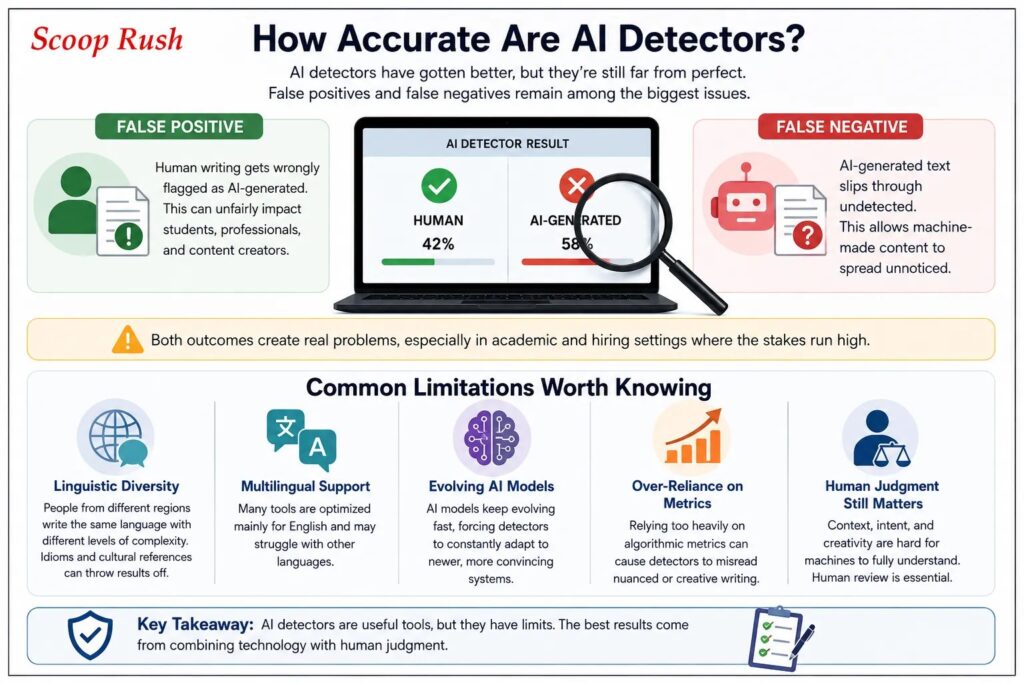
AI detectors have gotten better, but they’re still far from perfect. False positives and false negatives remain among the biggest issues.
A false positive happens when human writing gets wrongly flagged as AI-generated. A false negative happens when actual AI text slips through undetected. Both outcomes create real problems, especially in academic and hiring settings where the stakes run high, similar to concerns raised after private AI chat conversations were unexpectedly exposed through search indexing.
Common Limitations Worth Knowing
A few factors continue to limit accuracy across the board.
Linguistic diversity trips up many detectors, since people from different regions write the same language with different levels of complexity. Idioms and cultural references can throw results off.
Multilingual support is another weak point. Many tools are optimized mainly for English and may struggle with other languages, a gap that mirrors how AI adoption has moved slower in some countries like Japan compared to others.
AI models keep evolving fast too, forcing detectors to constantly adapt just to keep pace with newer, more convincing systems.
Finally, leaning too heavily on algorithmic metrics can cause detectors to misread nuanced or creative human writing. As a result, human judgment still matters in final calls.
What Sets Human Writing Apart
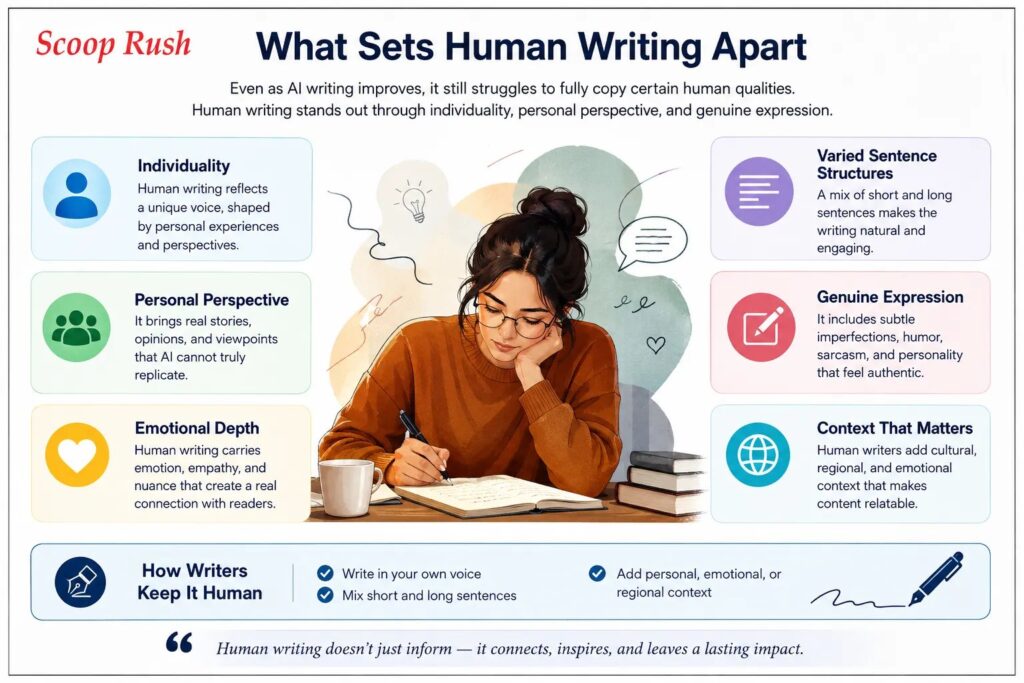
Even as AI writing improves, it still struggles to fully copy certain human qualities. Human writing tends to stand out through individuality, personal perspective, and genuine expression. It also carries varied sentence structures and emotional depth that create real connection with readers.
Writers aiming for an authentically human tone often focus on personal voice, mix short and long sentences together, and add emotional or regional context that feels distinctly their own.
Popular AI Detection Tools Today
A handful of tools have become well known in this space. OpenAI built its own AI Text Classifier to help identify content from its models. GPTZero is widely used in education and analyzes both perplexity and burstiness. Other platforms focus on wide language support, browser integration, or deep enterprise-level analysis for businesses and schools, not unlike how data intelligence platforms are ranked for business use each year.
Many of these tools now support dozens of languages and can flag content from multiple AI systems at once, not just one.
AI Image and Video Detection
Detection doesn’t stop at written text. AI image and video detectors examine subtle irregularities that reveal artificial generation.
For images, tools check lighting inconsistencies, unrealistic textures, and facial asymmetries, a concern that came up around Meta’s Muse image tool. For videos, detectors look at visual mismatches in movement and audio irregularities like out-of-sync sound. This kind of detection has become especially important in the fight against deepfakes, particularly following xAI’s lawsuit over a Grok user’s deepfake images.
Using AI Detectors the Right Way
Ethical use matters just as much as technical accuracy. AI detectors should never be used to unfairly accuse or punish someone without proper verification. Instead, they should support fairness and transparency rather than limit creativity.
Institutions relying on these tools should build clear policies, explain how detection works, and offer a path for appeal when results get disputed. Given how often false positives happen, this kind of safeguard matters a lot.
Where AI Detection Is Headed Next
The AI detection space is expected to keep expanding alongside advances in generative AI.
Real-time detection is spreading into live chats and emails, not just static documents. Multilingual accuracy keeps improving as developers close gaps for non-English content. Integration into word processors and learning platforms is becoming more common too, making detection a built-in step rather than a separate one, much like how AI tools are already being used to cut NHS waiting times in healthcare settings. Additionally, hybrid systems pairing human reviewers with AI tools are gaining ground, since human judgment still catches nuances algorithms sometimes miss.
Conclusion
As artificial intelligence becomes a bigger part of everyday writing, AI detectors have stepped in to help verify where content really comes from. These tools lean on linguistic analysis, predictability scoring, and pattern comparison to judge whether a human or a machine wrote something.
They’re useful across education, publishing, hiring, and journalism, but they’re not flawless. False positives, limited multilingual support, and fast-changing AI models remain real challenges. Therefore, human judgment still plays a key role alongside these tools.
Ultimately, an AI detector is one piece of a bigger push to keep digital content transparent and trustworthy, and its role will likely keep growing as generative AI keeps advancing.
FAQs
Can an AI detector tell if ChatGPT wrote something?
Yes, most modern AI detectors are trained to recognize patterns from ChatGPT and similar models, though accuracy can vary depending on how heavily the text was edited afterward.
Why do teachers use AI detectors on student essays?
Teachers use AI detectors to confirm that essays and assignments reflect a student’s own effort, since these tools help flag content that may have been generated rather than written by hand.
Is it possible to trick an AI detector?
Yes, heavily edited or paraphrased AI content can sometimes slip past detectors, which is one reason these tools are not treated as final proof on their own.
What happens if an AI detector flags my work by mistake?
A false positive can happen with any AI detector, so most reliable platforms and institutions recommend a human review process before any final decision gets made.
Do free AI detectors work as well as paid ones?
Free AI detectors can offer solid basic accuracy, but paid versions often include higher scan limits, broader language support, and more detailed analysis for professional or academic use.

