North Korea expands Russia support by sending fresh troops, including 400 drone operators. Ukrainian intelligence confirms this new deployment. Around 8,500 North Korean soldiers now serve inside Russia. Most of them stay in the Kursk region.
This move shows how the Russia-North Korea partnership keeps growing. It also raises fresh concerns for Ukraine and NATO. Drones now play a huge role in modern warfare. Therefore, this new support could shift battlefield dynamics further.
New Drone Operators Join Russian Forces
Major General Vadym Skibitskiy shared this update. He leads Ukraine’s Defense Intelligence agency. He said the newest group includes about 400 trained drone operators. These specialists could help Russia with reconnaissance near the front lines.
Many of these operators are not new to combat. Some gained experience during earlier tours in Russia. Others reportedly learned drone skills while recovering from injuries. This shows how deeply drone warfare now shapes military training on both sides.
Thousands of Troops Already Serve in Kursk
Ukrainian intelligence puts the total North Korean force in Russia at 8,500. Most of these troops remain stationed in the Kursk region. About 1,000 of them work as engineers and deminers. Their job is to clear dangerous areas and secure positions.
Officials do not expect these troops to fight on Ukrainian soil directly. Instead, they support Russian forces from the rear. This freed-up support could let more Russian soldiers move to the front. As a result, North Korea indirectly boosts Russia’s combat strength.
Russia Could Request 50,000 More Troops
North Korea first sent troops to Russia back in October 2024. Those units helped push back a Ukrainian incursion into Kursk. Since then, nearly 25,000 North Korean personnel have rotated through Russian positions, according to Skibitskiy. That number reflects both new deployments and troop replacements.
Ukrainian intelligence believes Russia may ask for even more soldiers soon. Moscow could request up to 50,000 additional troops. This request might come up during a planned September meeting. Russian President Vladimir Putin may meet North Korean leader Kim Jong Un there.
North Korea Denies Reports of Bigger Deployment
Despite these intelligence estimates, North Korea has pushed back hard. Kim Yo Jong dismissed the reports as a false and invented story. She holds a senior position in North Korea’s government. No public agreement currently confirms a deployment of 50,000 troops.
Still, the claim remains a serious intelligence assessment. Ukraine continues to track troop movements closely. The current focus stays on the 8,500 troops already inside Russia. Officials expect their impact to grow as drone operators settle in.
North Korea Also Supplies Ballistic Missiles
North Korea’s support goes beyond soldiers and engineers. The country has also sent missiles to Russia. Skibitskiy said North Korea delivered at least 150 KN-23 and KN-24 missiles. Another 120 missiles remain promised for future delivery.
These missiles now support Russia’s long-range strike operations. Ukrainian forces often struggle to intercept them. North Korea reportedly sent around 90 personnel to help with missile launches. Reports link this activity to a site near Voronezh in Russia.
North Korean Missiles Have Struck Ukraine
Ukrainian intelligence says these missiles already hit real targets. Some attacks caused serious civilian harm. Skibitskiy pointed to a July 30 strike on Radushne in Ukraine’s Dnipro region. He said two North Korean missiles likely hit that location.
At least four children from one family died in that attack. This tragedy highlights the real cost of the growing partnership. North Korea may also study this combat data. Such information could help Pyongyang improve its own weapons technology.
Ukraine Faces Growing Air Defense Pressure
This expanded support adds new pressure on Ukraine’s air defenses. Kyiv depends heavily on Patriot systems to stop ballistic missiles. However, officials have repeatedly warned about a shortage of interceptors. Russia can now combine drones and missiles more effectively during attacks.
More drone operators mean better reconnaissance for Russian forces. This could lead to more accurate and frequent strikes. Ukraine will likely need more resources to keep pace. Air defense gaps may widen if this cooperation keeps expanding.
Russia and North Korea Deepen Military Ties
Russia and North Korea signed a mutual defense pact back in 2024. Their military relationship has grown steadily since that agreement. North Korean troops now train and fight alongside Russian units. In return, Russia has reportedly shared military technology with Pyongyang.
Ukrainian officials say North Korea received a Pantsir-S1 air defense system. This exchange shows a two-way military relationship, not just one-sided support. North Korea gains modern equipment and battlefield experience. Russia gains manpower, missiles, and skilled drone operators.
NATO Watches the Growing Partnership
Western officials continue to monitor this developing alliance closely. NATO members worry about deeper ties between Moscow and Pyongyang. This partnership could increase pressure on Ukraine over time. It may also raise security concerns in Europe and East Asia.
Meanwhile, US President Donald Trump has sought renewed talks with Kim Jong Un. Washington has even discussed scaling back some drills with South Korea. This creates a complex situation for US strategy. The White House wants dialogue while still watching North Korea’s Russia ties.
Conclusion
North Korea expands Russia support through troops, engineers, and skilled drone operators. Around 8,500 North Korean soldiers currently serve inside Russia. The latest group includes roughly 400 drone specialists. Their skills could strengthen Russian reconnaissance and strike capability.
North Korea also continues supplying ballistic missiles and launch personnel. Russia may seek up to 50,000 more troops in future talks. However, North Korea denies any confirmed plan for that scale. Even so, this military partnership keeps growing stronger every month.
FAQs
1. How many North Korean troops are currently in Russia?
Ukrainian intelligence estimates about 8,500 North Korean troops are in Russia. Most of them stay in the Kursk region. This group includes drone operators, engineers, and deminers.
2. How many North Korean drone operators are part of this deployment?
The latest contingent reportedly includes around 400 drone operators. They could help Russia with reconnaissance and target identification. Many gained experience during earlier combat deployments.
3. Could Russia ask North Korea for more troops soon?
Yes, Ukrainian intelligence says Russia may request up to 50,000 more troops. This could come up during a possible September meeting. North Korea has denied any confirmed plan for this.
4. Is North Korea sending missiles to Russia too?
Yes, North Korea has supplied KN-23 and KN-24 ballistic missiles to Russia. Reports say at least 150 missiles have already been delivered. Another 120 missiles remain promised for the future.
5. Why do North Korean drone operators matter in this war?
Drone operators can provide real-time battlefield surveillance for Russian forces. They also help identify targets for missile and artillery strikes. Their added skill could make Russian attacks more precise.
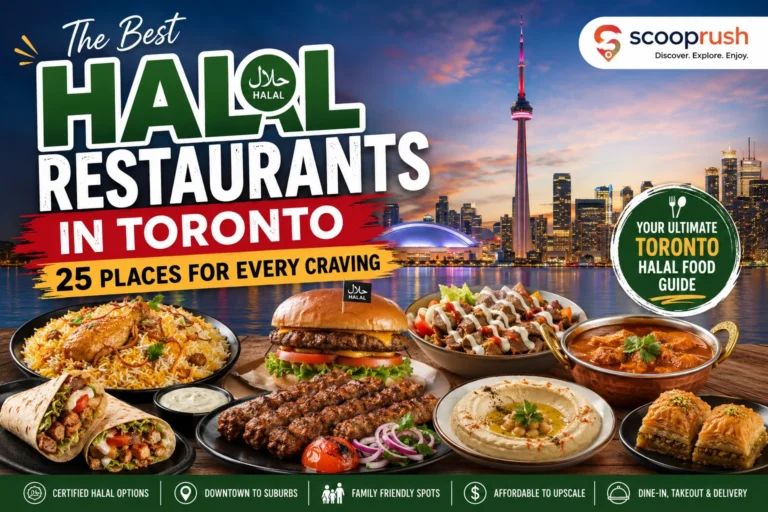
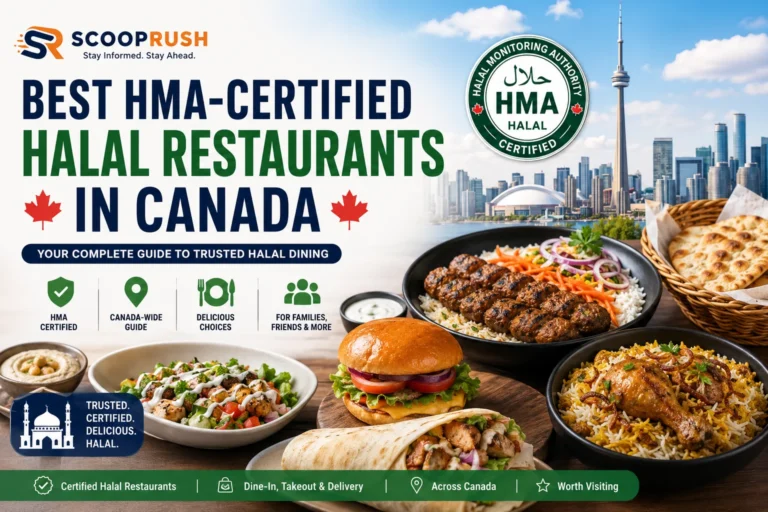
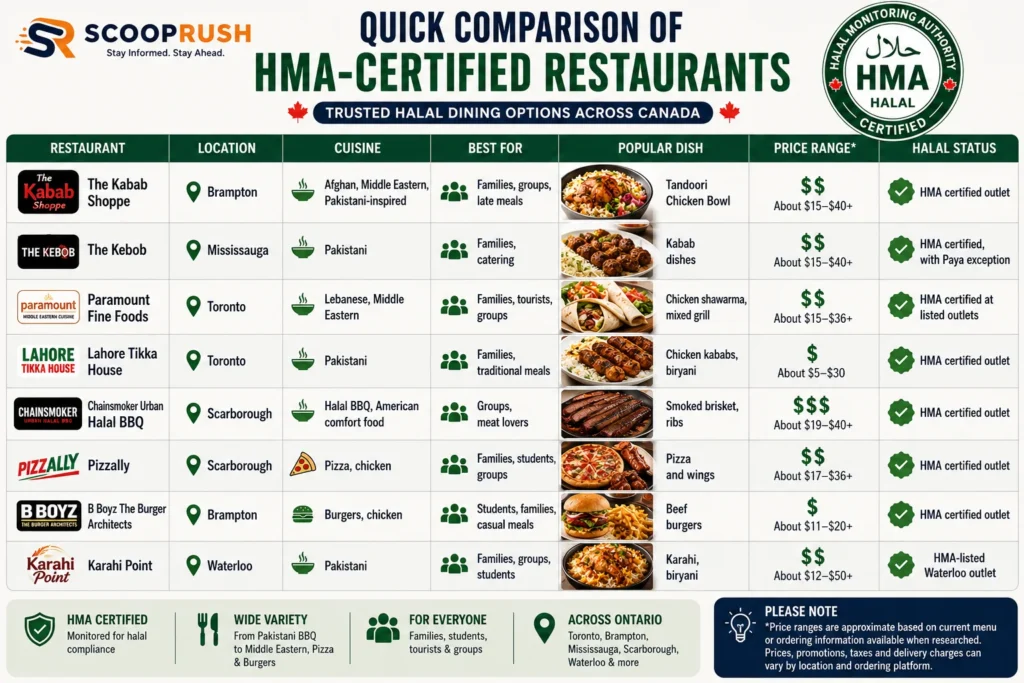
Toronto is one of Canada’s easiest cities for finding halal food, but choosing where to eat can still be difficult. The best halal restaurants Toronto diners can try range from Pakistani karahi and Afghan kabobs to Syrian shawarma, Turkish pide, biryani, burgers, fried chicken, pizza, and desserts. Current halal directories list hundreds of halal restaurants across Toronto, while HMA maintains a separate list of certified outlets.
This Toronto halal food guide brings together 25 restaurants and food spots that stand out for different cravings, budgets, neighbourhoods, and dining occasions. We have also separated HMA-certified restaurants from businesses that make their own halal statements or are listed as halal by established halal directories, so readers can make an informed choice.
Halal verification notice: Halal status, menus, prices, and opening hours may change. Contact the restaurant or check with its certification provider before visiting.
Quick Answer: What are the best halal restaurants in Toronto?
The best halal restaurants in Toronto depend on what you want to eat. For Pakistani food, Lahore Tikka House, Karahi Boys, and Karahi Point are strong choices. For Afghan food, Naan Kabob and Bamiyan Kabob are worth considering. Shawarma Royale and Shawarma Empire are options for Middle Eastern food, while Juicy Birds is a choice for halal Nashville hot chicken. HMA-certified options in Toronto include Lahore Tikka House and several Paramount Fine Foods and D Spot locations.
Toronto Halal Restaurant Comparison
Restaurant
Location
Cuisine
Best For
Popular Dish
Price Range
Halal Status
Karahi Boys
Queen St W
Pakistani
Groups
Chicken/goat karahi
$$-$$$
Halal restaurant
Naan Kabob
Downtown, Queen St W
Afghan
Families
Kabob platters
$$
All food halal
Paramount Fine Foods
Downtown
Lebanese
Families
Shawarma, falafel
$-$$
HMA at listed outlets
Lahore Tikka House
Gerrard St E
Pakistani/Indian
Family meals
Tikka, biryani
$$
HMA certified
Karahi Point
Downtown/North York
Pakistani
Late meals
Chicken karahi
$$
Halal-certified menu
Mangal Kebab House
Scarborough
Turkish
Grilled food
Kebabs
$$
Fully halal
Shawarma Empire
Scarborough
Middle Eastern
Quick meals
Shawarma
$-$$
Fully halal
Mustafa Turkish Pizza
North York
Turkish
Pide/pizza
Turkish pizza
$$
Fully halal
Xawaash
Etobicoke
Somali/Mediterranean
Groups
Grilled meats
$-$$
Fully halal
Pomegranate Persian Cuisine
College St
Persian
Dinner
Persian dishes
$$-$$$
Halal listed
Bamiyan Kabob
East York
Afghan
Affordable meals
Kabobs
$-$$
Halal listed
Kebaberie
Avenue Road
Middle Eastern
Lunch
Kebabs
$-$$
Fully halal
Shawarma Royale
Multiple Toronto areas
Syrian
Shawarma
Shawarma
$$
100% halal certified meats
Istanbul Kebab House
Eglinton
Turkish
Turkish food
Kebabs
$$
Fully halal
Pita Land
Scarborough/GTA
Middle Eastern
Budget meals
Shawarma/wraps
$-$$
Halal
Biryaniwalla
Yonge/Bloor
Indian
Biryani
Hyderabadi biryani
$$
Fully halal
Juicy Birds
Yonge/Scarborough
American
Fried chicken
Nashville hot chicken
$-$$
100% halal
Iqbal Kebab & Sweet Centre
Thorncliffe Park
Pakistani
Budget meals
Kebabs
$-$$
Halal menu
Hakka Garden
Thorncliffe Park
Indo-Chinese
Groups
Hakka dishes
$-$$
100% halal meat
Ajwa Pizza n Grill
Thorncliffe Park
Pizza/Middle Eastern
Groups
Halal pizza
$-$$
100% halal
Zezafoun
Manor Road
Syrian
Dinner
Syrian dishes
$$
Fully halal
Hero Certified Burgers
Multiple locations
American
Burgers
Angus burgers
$-$$
Halal beef/chicken
Habibz Corner
Queen St
Halal fast food
Late night
Fast-food plates
$-$$
Halal restaurant
D Spot Dessert Café
Downtown
Desserts
Sweet cravings
Waffles/desserts
$-$$
HMA certified at listed outlet
Karachi Kabab Wala
Queen St W
Pakistani
Late-night kababs
Kababs
$-$$
Halal restaurant
Price ranges are broad guides rather than fixed menu prices. Check the current menu before ordering.
1. Karahi Boys
Location: Queen Street West, Toronto Cuisine: Pakistani Best for: Families, groups, and karahi lovers
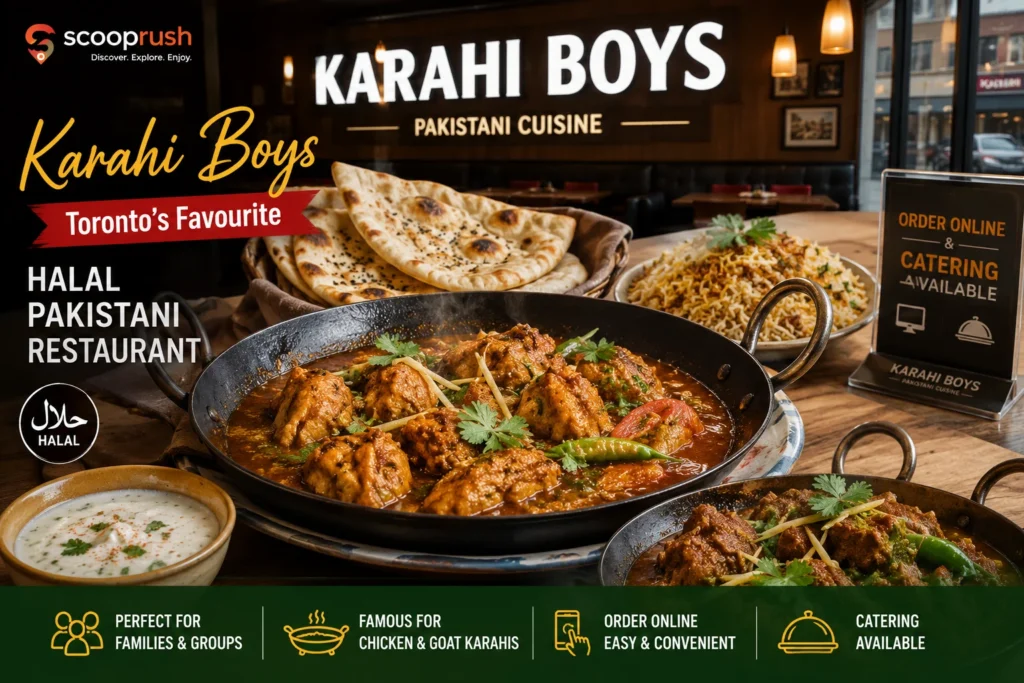
Karahi Boys is a strong pick when Pakistani food is the main craving. The restaurant describes itself as a halal Pakistani restaurant, with chicken and goat karahis as central menu categories. Its Toronto Queen Street West location also offers online ordering and catering.
Halal status: The brand states that it is a halal Pakistani restaurant. Dining: Casual and group-friendly. Why visit: The karahi-focused menu makes it a natural choice for people looking for Pakistani comfort food.
2. Naan Kabob
Location: Downtown Toronto, Queen Street West, and other Toronto locations Cuisine: Afghan Best for: Families and grilled-food lovers
Naan Kabob offers Afghan food with kabobs, rice, naan, wraps, and grilled dishes. Its official website states that all its food is halal and lists Toronto locations including 691 Yonge Street and 240 Queen Street West. Delivery and takeout are also available.
Halal status: Restaurant states that all food is halal. Price: Around the mid-range for casual dining. Why visit: It is a convenient choice for Afghan kabob platters in downtown Toronto.
3. Paramount Fine Foods
Location: Downtown Toronto and other GTA locations Cuisine: Lebanese/Middle Eastern Best for: Families, tourists, and groups
Paramount Fine Foods is useful for diners who want a broad Middle Eastern menu. Its downtown First Canadian Place outlet is listed by HMA, which states that all meals prepared at that outlet are HMA certified. Toronto Pearson also describes its Terminal 3 location as serving Ontario-certified halal meat.
Popular choices: Shawarma, falafel, tabbouleh, and baklava. Halal status: HMA certified at specific listed outlets. Why visit: It is especially practical for families and travellers who want a familiar Middle Eastern menu.
4. Lahore Tikka House
Location: Gerrard Street East Cuisine: Pakistani and North Indian Best for: Pakistani food and family dining
Lahore Tikka House is one of the clearest examples of an HMA-certified Pakistani restaurant in Toronto. HMA lists the Gerrard Street East outlet as certified, while the restaurant itself says it has been serving halal food since 1996. Its menu includes chicken tikka, kebabs, biryani, nihari, karahi, naan, and other Pakistani dishes.
Halal status: HMA certified. Dining: Family-style setting with catering and events. Why visit: It is a good choice for a traditional Pakistani meal in Toronto’s east end.
5. Karahi Point
Location: Downtown and North York, among other Toronto-area locations Cuisine: Pakistani Best for: Families and late dinners
Karahi Point focuses on Pakistani cuisine and highlights chicken karahi, biryani, butter chicken, garlic naan, and chicken tikka. The brand describes its menu as halal-certified and offers dine-in and takeout options.
Halal status: Brand states its menu is halal-certified. Why visit: It offers familiar Pakistani dishes in a format that works well for family meals.
Mangal Kebab House is a Scarborough option for Turkish food and grilled dishes. Current listings describe it as fully halal, with a menu centred on Turkish cuisine and kebabs.
Halal status: Fully halal according to current halal listings. Dining: Casual restaurant with seating and parking information listed. Why visit: It is a natural choice when Turkish kebabs are the craving.
7. Shawarma Empire
Location: Lawrence Avenue East, Scarborough Cuisine: Middle Eastern Best for: Quick, affordable meals
Shawarma Empire is a long-standing Scarborough option for shawarma and Middle Eastern fast food. Current halal listings report that the owners have confirmed the restaurant’s halal status and classify the food as fully halal.
Price: Budget-friendly. Best for: Takeout and casual meals. Why visit: It suits diners looking for a straightforward shawarma meal without a formal dining setting.
8. Mustafa Turkish Pizza
Location: Wilson Avenue, North York Cuisine: Turkish Best for: Pide and Turkish pizza
Mustafa Turkish Pizza serves Turkish pizza, shawarma, and other Turkish dishes. Current halal listings classify its food as fully halal, while current local listings show dine-in, takeout, and group-friendly features.
Halal status: Fully halal according to current halal listings. Why visit: It is an easy pick for Turkish pide and pizza-style dishes.
9. Xawaash
Location: Etobicoke, Queens Plate Drive Cuisine: Somali, East African, Mediterranean Best for: Grilled meat and shared meals
Xawaash brings Somali cooking together with Mediterranean and East African influences. Current halal listings state that the restaurant is fully halal, while its menu is described as including grilled meats, Somali rice, salads, and oven-baked pita.
Price: Budget to mid-range. Why visit: It gives halal diners a chance to explore Somali cuisine beyond the usual shawarma and kebab choices.
10. The Pomegranate Persian Cuisine
Location: College Street Cuisine: Persian Best for: Dinner and Persian food
The Pomegranate offers Persian and Middle Eastern cuisine in the College Street area. Current restaurant listings identify halal dining among its dietary options, along with vegetarian choices and dine-in and takeout service.
Price: Mid-range to higher mid-range. Halal status: Halal listed, but not presented here as HMA certified. Why visit: It is a good option when you want Persian flavours rather than standard fast-food halal.
11. Bamiyan Kabob
Location: East York Cuisine: Afghan Best for: Affordable kabobs
Bamiyan Kabob is an Afghan restaurant in East York with a relatively casual price range. It is included in current Toronto halal restaurant listings and is also featured among Toronto’s commonly listed halal dining choices.
Price: Generally budget to mid-range. Why visit: Kabobs and Afghan comfort food make it a practical choice for a casual halal meal.
12. Kebaberie
Location: Avenue Road Cuisine: Middle Eastern Best for: Lunch and kebabs
Kebaberie focuses on Middle Eastern cooking and from-scratch recipes. Its current halal listing states that all food is certified halal and describes the restaurant as using traditional recipes and old-world cooking methods.
Price: Budget to mid-range. Service: Takeout and delivery are listed. Why visit: It is a convenient option for Middle Eastern kebabs near central Toronto.
13. Shawarma Royale
Location: Multiple Toronto neighbourhoods Cuisine: Syrian/Middle Eastern Best for: Shawarma and late-night food
Shawarma Royale is one of the more widely available halal shawarma brands in the GTA. The company states that its chicken, beef, lamb, kabab, and shish tawooq are 100% halal certified. It has Toronto locations including Queen Street West, Yonge Street, Eglinton, and Danforth.
Halal status: Company states its meats are 100% halal certified. Service: Delivery, takeout, catering, and dine-in options vary by location. Why visit: Its multiple locations make it useful when searching for halal food near you.
14. Istanbul Kebab House
Location: Eglinton Avenue East Cuisine: Turkish Best for: Turkish kebabs
Istanbul Kebab House offers Turkish cuisine and is listed as fully halal by current halal restaurant sources. The restaurant is located near Eglinton Avenue East and offers dine-in service.
Halal status: Fully halal according to current halal listings. Price: Mid-range. Why visit: It is a convenient choice for Turkish grilled dishes in the Yonge-Eglinton area.
15. Pita Land
Location: Scarborough and other Toronto/GTA locations Cuisine: Middle Eastern Best for: Wraps and budget meals
Pita Land is a familiar Middle Eastern fast-food option in Toronto. Current halal listings identify its Scarborough location as fully halal, with shawarma, wraps, and other Middle Eastern dishes.
Price: Budget-friendly. Service: Takeout and delivery are available at listed locations. Why visit: It is practical for students, workers, and anyone wanting a quick halal meal.
16. Biryaniwalla
Location: Yonge Street and Bloor Street West Cuisine: Indian/Hyderabadi Best for: Biryani
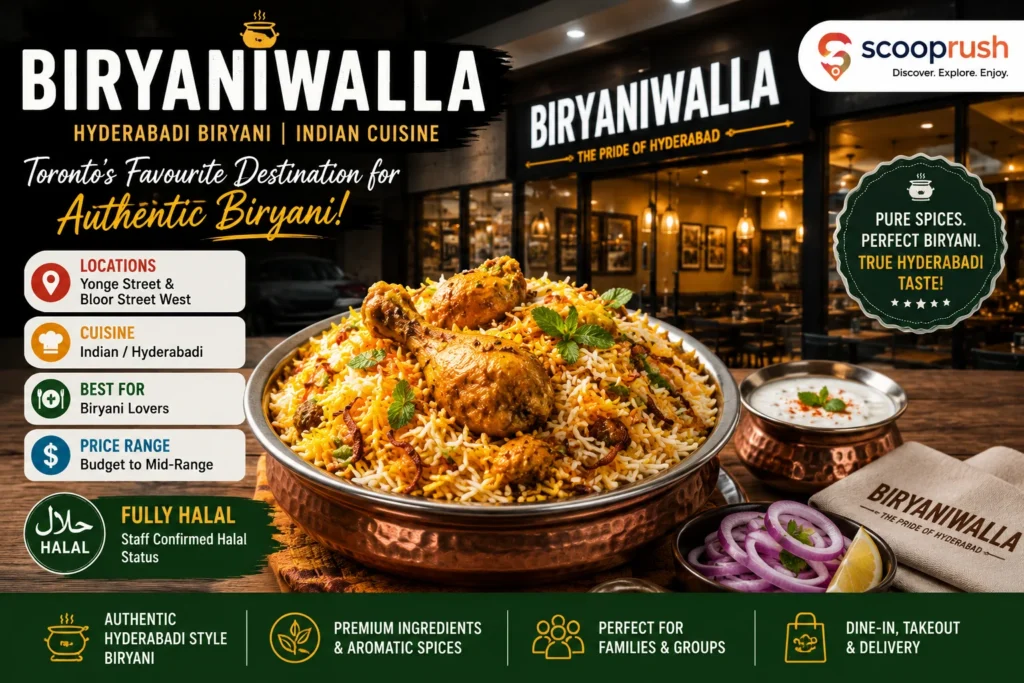
Biryaniwalla specializes in Hyderabadi-style biryani and South Asian food. Current halal listings report that staff have confirmed halal status and classify the Toronto restaurant as fully halal.
Price: Budget to mid-range. Why visit: This is one of the clearest choices for diners searching specifically for halal Indian biryani.
17. Juicy Birds
Location: Yonge Street, Pape Avenue, and Scarborough Cuisine: Nashville hot chicken Best for: Fried chicken
Juicy Birds is a strong choice for halal fried chicken. The company states that its chicken is 100% hand-slaughtered halal and lists Toronto locations on Yonge Street, Pape Avenue, and Lawrence Avenue East.
Popular dishes: Nashville hot chicken sandwiches, tenders, and wings. Halal status: Company states that the food is 100% halal. Why visit: It gives halal diners a Nashville hot chicken option with several Toronto locations.
18. Iqbal Kebab & Sweet Centre
Location: Thorncliffe Park Cuisine: Pakistani/Indian Best for: Affordable Pakistani food
Iqbal Kebab & Sweet Centre is a Thorncliffe Park option for Pakistani and Indian food. Current halal listings identify it as a halal restaurant, while local business information places it in the Parkway Forest/Thorncliffe area.
Price: Budget-friendly. Dining: Casual and counter-service oriented. Why visit: It is useful for diners looking for Pakistani food around Thorncliffe Park.
19. Hakka Garden
Location: Thorncliffe Park Cuisine: Indian/Pakistani-style Hakka Chinese Best for: Groups and Indo-Chinese food
Hakka Garden is a useful choice for diners who want something different from traditional Pakistani or Middle Eastern food. Its official website says it serves 100% halal meat, does not serve alcohol, and offers dine-in, takeout, and catering.
Popular dishes: Hakka-style Chinese dishes and Indian/Pakistani fusion options. Halal status: Restaurant states that its meat is 100% halal. Why visit: It combines Hakka Chinese flavours with South Asian cooking styles.
20. Ajwa Pizza n Grill
Location: Thorncliffe Park Cuisine: Halal pizza, wings, Middle Eastern-inspired fast food Best for: Families and groups
Ajwa Pizza n Grill is focused on halal pizza, wings, fish, chicken, and combination meals. The restaurant states that its food is halal and offers takeout, delivery, and catering from its Overlea Boulevard location.
Popular dishes: Tandoori, Butter Chicken, and Lahori pizzas, plus wings. Halal status: Restaurant states that it is 100% halal. Why visit: It is especially useful when a group wants pizza and wings with halal options.
21. Zezafoun Syrian Cuisine
Location: Manor Road East Cuisine: Syrian Best for: Sit-down Syrian meals
Zezafoun is a family-owned Syrian restaurant offering traditional Syrian dishes. Current halal listings state that its food is fully halal, while current local business information identifies the restaurant on Manor Road East.
Price: Mid-range. Atmosphere: More suitable for a sit-down meal than a quick counter-service stop. Why visit: It offers Syrian cuisine in a more traditional restaurant setting.
22. Hero Certified Burgers
Location: Multiple Toronto locations Cuisine: American Best for: Burgers
Hero Certified Burgers is useful for people searching for halal burgers in Toronto. The company’s current website states that its beef and chicken products are halal compliant, while individual restaurant listings can show differences in how halal is presented at specific outlets.
Halal status: Company states its beef and chicken products are halal compliant. Important: Confirm the status and preparation practices at your specific location. Why visit: It offers a familiar Canadian burger format for halal diners.
23. Habibz Corner
Location: Queen Street East/West Cuisine: Halal fast food Best for: Late-night meals
Habibz Corner is a current Toronto halal restaurant with Queen Street locations and late-night operating hours shown in local business data. It is particularly relevant for people searching for halal restaurants near downtown Toronto after regular dinner hours.
Price: Budget to mid-range. Service: Suitable for quick meals and late-night takeout. Why visit: Its late operating hours make it useful when many other restaurants have closed.
24. D Spot Dessert Café
Location: Downtown Toronto and other GTA locations Cuisine: Desserts and café food Best for: Sweet cravings and families
D Spot is a dessert-focused café with waffles, cakes, brownies, ice cream, milkshakes, crepes, sundaes, and savoury items. HMA lists its 828 Bay Street Toronto location as having HMA-certified menu items and identifies it as family-friendly with online ordering and catering.
Halal status: HMA certified at the listed Toronto outlet. Price: Budget to mid-range. Why visit: It is a good stop when your halal food search ends with dessert rather than dinner.
25. Karachi Kabab Wala
Location: Queen Street West Cuisine: Pakistani Best for: Kababs and late-night food
Karachi Kabab Wala is a current halal restaurant option on Queen Street West. Local business information shows late operating hours, making it relevant for people exploring downtown Toronto after dinner.
Price: Budget to mid-range. Dining: Casual and suitable for quick meals. Why visit: It adds another Pakistani kabab option to the busy Queen Street halal food scene.
Which halal restaurants are best for families?
For family dining, consider restaurants with broader menus, seating, and group-friendly service. Lahore Tikka House, Naan Kabob, Paramount Fine Foods, Karahi Boys, Karahi Point, Hakka Garden, and Ajwa Pizza n Grill are useful options for different family preferences. Lahore Tikka House and Paramount’s listed outlets also have specific family-friendly features in HMA information.
For families with children, a restaurant with several shared dishes can make ordering easier. Pakistani karahi, Afghan kabob platters, Middle Eastern family platters, and pizza-and-wings combinations are especially flexible.
Where can you find affordable halal food in Toronto?
Affordable halal food is easiest to find at shawarma shops, kebab counters, burger restaurants, fried chicken shops, and casual South Asian restaurants.
Good options to investigate include Shawarma Empire, Pita Land, Bamiyan Kabob, Biryaniwalla, Juicy Birds, Iqbal Kebab & Sweet Centre, Habibz Corner, and Ajwa Pizza n Grill. Current local listings place many of these in the budget or lower mid-range category.
Where can you find halal restaurants downtown Toronto?
Downtown Toronto has several halal choices around Queen Street West, Yonge Street, Bay Street, College Street, and the Financial District.
Naan Kabob, Paramount Fine Foods, Karahi Point, Biryaniwalla, Shawarma Royale, Habibz Corner, D Spot, and Karachi Kabab Wala are among the options to consider. Check the exact branch before visiting because halal status and menus can differ between locations.
Which halal restaurants are best for Pakistani food?
For Pakistani food, Lahore Tikka House, Karahi Boys, Karahi Point, Iqbal Kebab & Sweet Centre, and Karachi Kabab Wala are strong choices to research.
Lahore Tikka House is particularly clear about its certification because HMA lists its Toronto outlet as certified. Karahi Boys and Karahi Point focus heavily on Pakistani dishes such as karahi, while Iqbal Kebab offers Pakistani and Indian food in Thorncliffe Park.
Which halal restaurants are best for Indian food?
If you want Indian or South Asian flavours, Lahore Tikka House, Biryaniwalla, Karahi Point, and Iqbal Kebab & Sweet Centre are worth considering.
Biryaniwalla is especially relevant for Hyderabadi-style biryani, while Lahore Tikka House combines Pakistani and North Indian dishes. Always check the current menu if you are looking for a particular dish such as biryani, butter chicken, nihari, or tikka.
Where can you find halal Turkish food in Toronto?
For Turkish food, look at Mangal Kebab House, Mustafa Turkish Pizza, and Istanbul Kebab House.
Mangal Kebab House is in Scarborough, Mustafa Turkish Pizza is in North York, and Istanbul Kebab House is near Eglinton Avenue East. Current halal sources list all three as halal restaurants.
Are there halal burger restaurants in Toronto?
Yes. Toronto has several halal burger choices, including Hero Certified Burgers and other independent halal burger restaurants.
Hero’s current website states that its beef and chicken products are halal compliant. However, because halal preparation can be presented differently by location, confirm the specific branch before ordering if your requirements include separate preparation or certification.
Where can you find halal fried chicken?
Juicy Birds is one of the clearest choices for halal Nashville hot chicken. The company states that its chicken is 100% hand-slaughtered halal and lists several Toronto locations.
For a different style of chicken, halal restaurants across Scarborough, Thorncliffe Park, North York, and downtown Toronto also offer grilled chicken, shawarma, wings, and fried chicken.
Are there halal steakhouses in Toronto?
Toronto has halal beef restaurants and grilled-meat restaurants, but dedicated halal steakhouses are less common than shawarma, kebab, Pakistani, and burger restaurants.
If steak-style grilled meat is your priority, check restaurants offering halal beef, kebabs, beef tikka, and grilled platters. Always ask whether the specific steak or beef item is halal and whether the restaurant uses separate preparation if that matters to you.
Are these restaurants fully halal?
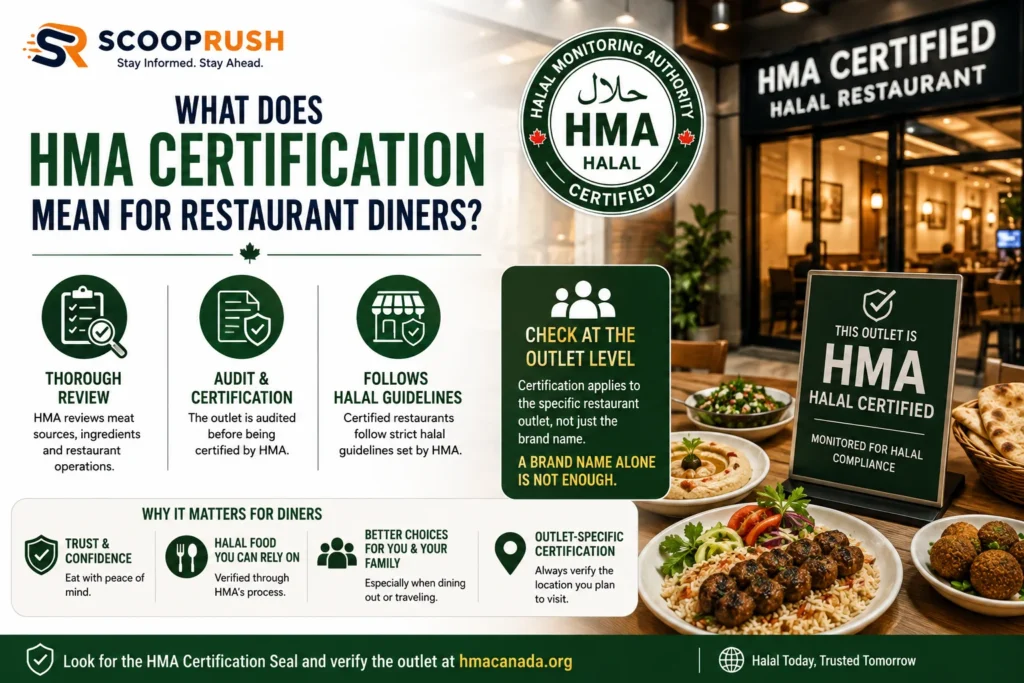
Not every restaurant on a halal food list should automatically be described as fully halal. Some restaurants have a restaurant-wide halal statement, some have halal-certified products, and others have only selected halal meat or items.
For example, HMA specifically lists Lahore Tikka House as certified and identifies particular Paramount Fine Foods and D Spot outlets as HMA-certified. Hero Certified Burgers states that its beef and chicken products are halal compliant, while individual listings may classify particular locations differently.
HMA-certified examples
Lahore Tikka House
Paramount Fine Foods at listed HMA-certified Toronto outlets
D Spot Dessert Café at listed HMA-certified Toronto outlets
HMA’s current directory should be checked for the exact outlet because certification is location-specific.
Restaurants that state they serve halal food
Examples include Naan Kabob, Karahi Boys, Shawarma Royale, Juicy Birds, Hakka Garden, and Ajwa Pizza n Grill. Their own websites make halal statements, although the type and scope of halal assurance differs from restaurant to restaurant.
Restaurants with selected or product-specific halal claims
Hero Certified Burgers is a useful example to check carefully. Its current corporate site states that beef and chicken products are halal compliant, but individual location listings may describe halal coverage differently. Confirm your specific location before dining.
What about The Kabab Shoppe in the Toronto area?
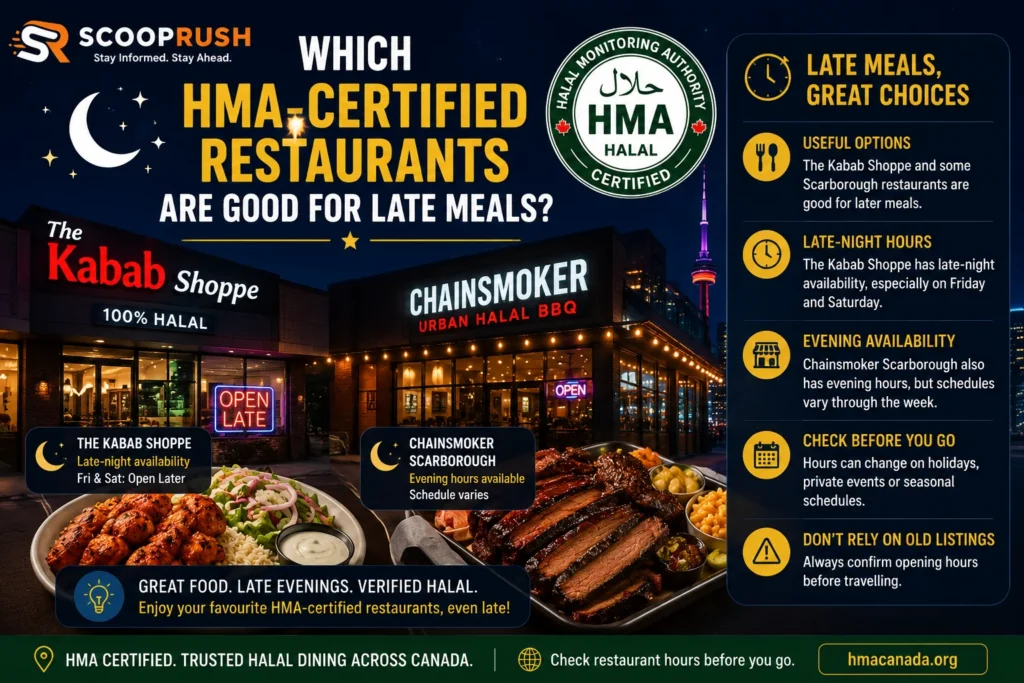
The Kabab Shoppe is worth mentioning for readers exploring halal grilled food across the GTA, although its current listed locations are in Pickering, Whitby, Oshawa, and Brampton, rather than Toronto proper. The restaurant states that all its meats are certified halal and offers grilled kababs, rotisserie meats, rice, salad, naan, online ordering, takeout, and catering.
For readers willing to travel outside Toronto for a GTA halal food trip, it can be a useful option for grilled food and catering.
Which halal restaurants are open late?
Late-night options vary by day and location, so checking the restaurant directly before travelling is important.
Current local listings show late hours for places such as Shawarma Royale, Juicy Birds, Biryaniwalla, Habibz Corner, and Karachi Kabab Wala.
Late-night halal food is especially easy to find around downtown Toronto, Queen Street, Yonge Street, and parts of Scarborough.
How We Selected These Halal Restaurants
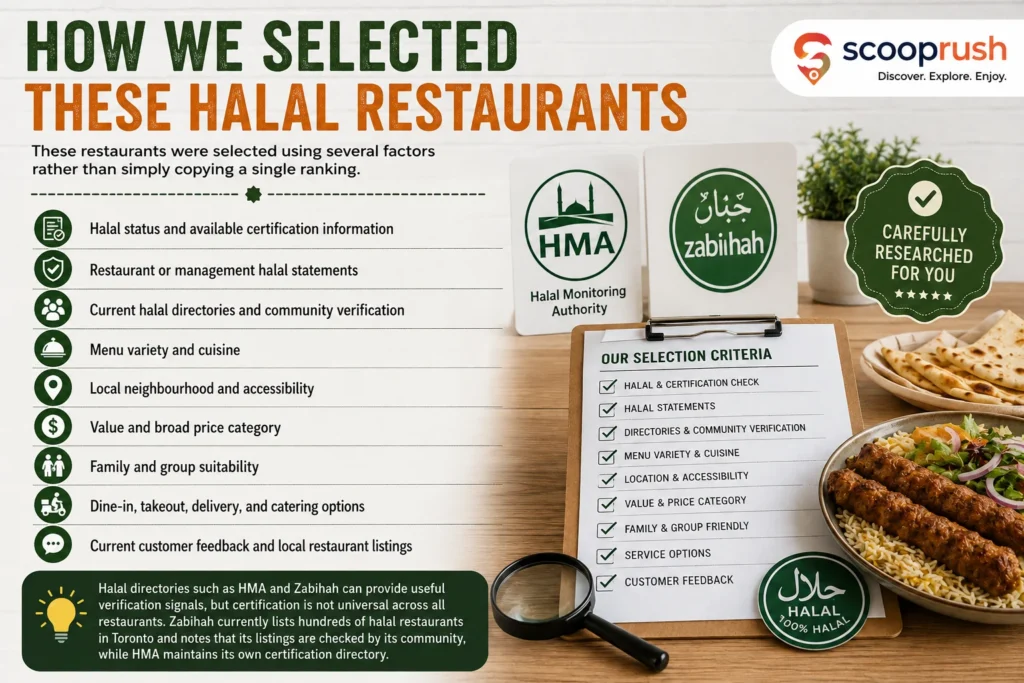
These restaurants were selected using several factors rather than simply copying a single ranking.
We considered:
Halal status and available certification information
Restaurant or management halal statements
Current halal directories and community verification
Menu variety and cuisine
Local neighbourhood and accessibility
Value and broad price category
Family and group suitability
Dine-in, takeout, delivery, and catering options
Current customer feedback and local restaurant listings
Halal directories such as HMA and Zabihah can provide useful verification signals, but certification is not universal across all restaurants. Zabihah currently lists hundreds of halal restaurants in Toronto and notes that its listings are checked by its community, while HMA maintains its own certification directory.
How can you verify a halal restaurant in Toronto?
Before visiting, check three things: who certifies the restaurant, what exactly is certified, and whether the certification applies to the location you plan to visit.
You can:
Look for the restaurant’s current halal statement.
Check the HMA directory if the restaurant claims HMA certification.
Ask staff whether all meat is halal or only selected items.
Ask which supplier provides the meat if you need more information.
Confirm whether the halal meat is prepared separately when cross-contact is a concern.
Recheck the information if you are visiting a different branch.
A restaurant can have halal meat without being HMA certified. Likewise, a chain may have different halal arrangements at different locations.
Final Thoughts
Toronto has a wide halal food scene, from Pakistani halal restaurants Toronto diners can visit for karahi and biryani to Turkish kebab houses, Afghan grills, Syrian shawarma shops, halal burger restaurants, fried chicken spots, pizza places, and dessert cafés.
The best halal restaurants Toronto has to offer will depend on your craving and how you want your halal food verified. If certification is important, start with HMA-listed outlets and check the current status of the exact location. If you are exploring cuisines, Toronto gives you plenty of choices across downtown, North York, Scarborough, Thorncliffe Park, East York, and Etobicoke.
Found a halal restaurant in Toronto that deserves to be on this list? Share your favourite with the Scooprush community, and explore more Canadian halal food guides for your next meal.
FAQs About Halal Restaurants in Toronto
What is the best halal restaurant in Toronto?
There is no single best halal restaurant for everyone. Lahore Tikka House is a strong choice for Pakistani food, Naan Kabob for Afghan dishes, Shawarma Royale for Syrian shawarma, and Juicy Birds for Nashville hot chicken. Your best choice depends on cuisine, budget, location, and how you prefer halal status to be verified.
Which Toronto halal restaurants are HMA certified?
HMA’s current Toronto listings include Lahore Tikka House, several Paramount Fine Foods outlets, and D Spot Dessert locations. HMA certification is outlet-specific, so check the current HMA directory for the exact restaurant and location before visiting. A restaurant being halal does not automatically mean it is HMA certified.
Where can I find cheap halal food in Toronto?
For affordable halal food, look at shawarma, kebab, biryani, burgers, fried chicken, and pizza restaurants. Pita Land, Shawarma Empire, Bamiyan Kabob, Biryaniwalla, Juicy Birds, Iqbal Kebab, and Ajwa Pizza n Grill offer casual formats that can work well for students and budget-conscious diners.
Which Toronto halal restaurants are good for families?
Families can consider Lahore Tikka House, Naan Kabob, Paramount Fine Foods, Karahi Boys, Karahi Point, Hakka Garden, and Ajwa Pizza n Grill. These restaurants offer menus that work well for sharing, including karahi, kabobs, Middle Eastern dishes, Hakka food, pizza, and chicken. Always confirm seating and current family facilities before visiting.
How do I know if a Toronto restaurant is really halal?
Start with the restaurant’s current halal statement, then check whether it has certification from an organization such as HMA. Ask whether the entire menu is halal or only certain meats or dishes. If certification matters to you, verify the exact location rather than relying only on a general chain-wide claim.
High in Kyrgyzstan’s Tian-Shan mountains, Saimaluu Tash hides one of Central Asia’s greatest treasures. This off-the-beaten-path destination holds nearly 90,000 ancient rock carvings. Artists etched these images into roughly 10,000 dark basalt stones. Many carvings date back almost 4,000 years, capturing scenes of hunting, farming, war, and worship.
For centuries, this hidden gem stayed largely unknown outside its mountain valley. Today, it ranks among Central Asia’s top bucket list destinations for adventure travelers. Reaching Saimaluu Tash still demands serious trekking and physical effort. Explorers must cross rugged terrain during a short summer window each year.
What Is Saimaluu Tash?
Saimaluu Tash means “Embroidered Stones” in the Kyrgyz language. The name perfectly describes the valley’s rock surfaces. Thousands of images cover the dark volcanic stones like intricate stitching. Ancient communities carved animals, hunters, warriors, and spiritual symbols across the landscape.
Researchers trace the earliest carvings to the Bronze Age. Later groups added images during the Iron Age. Early Turkic communities continued the tradition until around 900 CE. Together, these layers create a rare, continuous record of Central Asian history.
A Sacred Site in the Tian-Shan Mountains
Saimaluu Tash sits above 2,000 meters in the Tian-Shan range. A small sacred pond rests near the valley’s upper section. Ancient people likely used this space for rituals and worship. The combination of mountains, water, and sky held deep spiritual meaning.
Before Islam reached the region, Tengrism shaped many local beliefs. This tradition honored nature, spirits, and the power of the land. Saimaluu Tash still reflects these older customs today. The site also links the Ferghana Valley with the wider Tian-Shan mountains, connecting settled and nomadic worlds.
The Difficult Journey to Saimaluu Tash
Reaching the petroglyphs takes real effort and careful trip planning. Hikers must climb steep, rugged trails through the mountains. This challenging trekking route crosses rivers, icy patches, and unpredictable terrain. Higher elevations become more remote and physically demanding for trail runners and hikers alike.
Seasonal snow adds another layer of difficulty for adventure seekers. A temporary snow bridge forms a key part of the trail. Early visitors may find the carvings still buried in snow. Late arrivals risk unsafe crossings once the bridge melts. Most travelers plan their trip between July and September, the best time to visit for safer access.
Rediscovery After Centuries of Silence
Despite its importance, Saimaluu Tash faded from wider historical memory. Russian cartographer Nikolai Khludov rediscovered the site in 1902. Serious archaeological study did not begin until the late 1940s. Since then, researchers have worked steadily to understand its full significance.
The carvings span thousands of years and several distinct cultures. Bronze Age communities created the oldest images first. Iron Age groups later expanded the collection. Early Turkic artists added their own marks before the site fell quiet again.
How Isolation Protected the Ancient Carvings
Saimaluu Tash’s remote location made it hard to study for decades. That same isolation, however, protected the carvings from damage. Few visitors reach the valley compared to popular archaeological sites. This has limited vandalism and uncontrolled tourism over time.
Heavy winter snow also shields the basalt stones naturally. Snow cover reduces sudden temperature swings across the rock surfaces. This protection has helped preserve fine details for thousands of years. Better roads could soon bring more visitors, so authorities must manage growth carefully.
Stories Carved Into the Stones
The petroglyphs reveal what mattered most to ancient communities. Hunting scenes appear again and again across the valley. Ibex show up frequently among the carved animals. These images likely combined practical survival with spiritual meaning.
Other carvings depict warriors and organized groups in conflict. Farming scenes also appear throughout the collection. Solar symbols suggest ancient sun worship and ritual practices. Researchers still debate the exact meaning behind many individual carvings.
Modern Graffiti and the Need for Protection
Ancient carvings are not the only marks at Saimaluu Tash. Some visitors have scratched names and dates into the rocks. Archaeologists and local authorities treat these additions as vandalism. The contrast highlights how differently people use the same stones.
Ancient artists recorded survival, worship, and community life. Modern graffiti often records only a name or a date. Future generations deserve to see the site as it was. Visitors must avoid touching or marking the stones and always follow local guides.
An Adventure for Modern Travelers
Saimaluu Tash offers a true off-the-grid adventure travel experience. There are no crowds, resorts, or paved viewing paths. Instead, travelers pass through scenic grasslands, rivers, and traditional yurts. This unforgettable journey becomes part of the overall travel experience.
Along the way, backpackers often meet local shepherds and herders. These cultural encounters offer a glimpse into authentic Kyrgyz hospitality. However, this remote expedition demands strong physical stamina and preparation. Weather shifts quickly at high altitude, so proper hiking gear remains essential for any outdoor adventure.
How to Plan Your Visit
Tour operators in Bishkek and Osh can arrange full guided expeditions. Their travel packages often include guides, permits, horses, and camping gear. This support makes a challenging journey far more manageable. Travelers should book well ahead for this must-visit destination.
Independent, budget-friendly travelers can reach Kazarman using public transport first. From there, they need extra arrangements for the mountain trekking route. Horses often help travelers cross difficult trail sections. Always confirm snow and river conditions with local guides before starting your Kyrgyzstan travel itinerary.
Why Saimaluu Tash Still Matters
Saimaluu Tash preserves an extraordinary record of ancient Central Asian life. Its carvings span roughly four thousand years of human history. They document shifting beliefs, animals, conflicts, and daily routines. Few archaeological sites offer such a long, unbroken visual story.
The site also shows why remote heritage deserves careful protection. Isolation kept these carvings safe for millennia. Growing tourism could change that balance in coming years. Thoughtful management can help the valley stay both accessible and protected.
Conclusion
Saimaluu Tash remains one of Kyrgyzstan’s most rewarding hidden gems. It offers travelers a rare mix of history, culture, and rugged adventure. Few destinations let you walk through 4,000 years of human stories. This remote valley truly earns its place on any serious traveler’s bucket list.
Visiting Saimaluu Tash takes effort, but the reward matches the challenge. The journey brings you closer to nature, local culture, and ancient art. Careful planning and respect for the site ensure it stays intact for future generations. For anyone craving authentic, off-the-beaten-path travel, Saimaluu Tash delivers an unforgettable experience.
FAQs
1. What is Saimaluu Tash?
Saimaluu Tash is a major petroglyph site in Kyrgyzstan. It holds nearly 90,000 carvings across thousands of basalt stones. The oldest images date back around 4,000 years.
2. Where is Saimaluu Tash located?
The site sits in a remote valley in the Tian-Shan mountains. It lies above 2,000 meters in elevation. Kazarman serves as the main access point for travelers.
3. When is the best time to visit Saimaluu Tash?
Most travelers visit between July and September each year. Snow conditions determine when the route becomes safe. A temporary snow bridge forms a key part of the path.
4. What do the carvings at Saimaluu Tash show?
The images depict hunters, ibex, warriors, and farming communities. Some carvings suggest ancient sun worship and rituals. Researchers continue studying the exact meaning of many scenes.
5. How do travelers get to Saimaluu Tash?
Tour operators in Bishkek and Osh arrange guided trips with permits. Independent travelers can reach Kazarman by public transport first. Horses often help cross the more difficult trail sections.
Would you pay £75m for a player who made just seven Premier League starts last season? Tottenham did exactly that. Tottenham paid £75m for Savinho, and on paper, the numbers don’t add up. Yet Spurs are betting big, and there’s a clear reason behind it.
This deal is one of the most talked-about moves of the summer transfer window. It signals real intent from Tottenham. It also confirms a shift in their transfer strategy, and it raises fresh questions about Manchester City’s squad depth under Pep Guardiola. Here’s everything you need to know about why Tottenham paid £75m for Savinho, what the fee covers, and what it means for both clubs.
Savinho Transfer Fee: The Full Breakdown
Tottenham agreed a deal with Manchester City to sign winger Savinho for £75m, with a further £10m available in potential add-ons. The 22-year-old Brazilian will undergo a medical before he signs a long-term contract at Spurs.
This move took over a year to complete. Tottenham tried and failed to sign Savinho last summer. Back then, he chose to stay at the Etihad Stadium instead of making the switch to north London.
His season didn’t go to plan, though. Guardiola limited Savinho’s game time, and he started just seven Premier League matches all campaign. That drop in playing time opened the door for Tottenham to finally land their man.
Why Tottenham Moved for Savinho Now
Tottenham head coach Roberto de Zerbi has stayed busy in the transfer market this summer. He brought in midfielders Mateus Fernandes from West Ham and Sandro Tonali from Newcastle, spending a combined £185m on the pair. Now he’s turned his focus to the attack, and Savinho fits that plan well.
De Zerbi’s teams like to draw opponents forward before exploiting the space behind them. This tactic creates one-on-one situations for wide players, and that’s exactly where Savinho thrives.
Savinho Stats Explained: His Career Before Spurs
To understand why Spurs are paying such a large fee, you need to look back at where Savinho built his reputation.
He joined Manchester City in 2024 from sister club Troyes for £30.8m. Before that move, he spent a season on loan at Girona during the 2023-24 campaign. That loan spell turned him into one of La Liga’s most feared ball carriers.
Savinho featured in 37 league matches for Girona as the club secured Champions League qualification for the first time in its history. That season, he scored nine goals and provided eight assists across several attacking roles.
The Girona Numbers Behind the £75m Savinho Deal
His statistical output at Girona was exceptional. Savinho led La Liga that season in several key categories:
Successful take-ons: 104
Progressive carries: 181
Goal-creating actions: 25
Expected assists: 9.9
He also ranked second in the entire league for passes into the penalty area and for progressive carrying distance. These numbers explain why so many clubs, including Tottenham, noticed him early.
Most of his best performances came from the left side, where Girona used him in 27 matches. In that role, he scored five goals and set up six more. However, he also played centrally and on the right at times, which shows genuine versatility.
Savinho’s Man City Stats vs His Girona Form
Here’s where things get interesting. Since joining City, Savinho has made 84 appearances, scoring seven goals and providing 13 assists. In the Premier League specifically, he has scored only twice across two seasons.
At first glance, that record doesn’t scream £75m talent. However, those numbers only tell part of the story.
Competition for attacking places at City has been intense. Players like Phil Foden and Rayan Cherki often suited the central roles more, and that competition limited Savinho’s chances to show off the ball-carrying skills he displayed so clearly at Girona.
In other words, City’s system and squad depth masked his best attributes rather than diminishing them.
How Savinho’s Skillset Fits De Zerbi’s Tactics
Savinho’s acceleration and his willingness to take on defenders make him a natural fit for De Zerbi’s attacking style at Tottenham.
From the left flank, he can hold width and attack the outside of full-backs. From the right, he comfortably cuts inside onto his stronger left foot, which lets him combine with team-mates and create chances centrally.
His value goes beyond goals and assists too. At Girona, much of his threat came from carrying the ball over long distances and disrupting opponents’ defensive shape. This kind of movement could give Tottenham a more direct route through compact defenses, and it would open up space for their central forwards to exploit.
Ultimately, Tottenham are investing in the raw qualities Savinho showed at Girona: pace, ball-carrying ability, one-on-one skill, and chance creation from wide areas. At just 22, he still has plenty of room to grow into these attributes on a bigger stage.
What the Savinho Deal Means for Tottenham’s Summer Spending
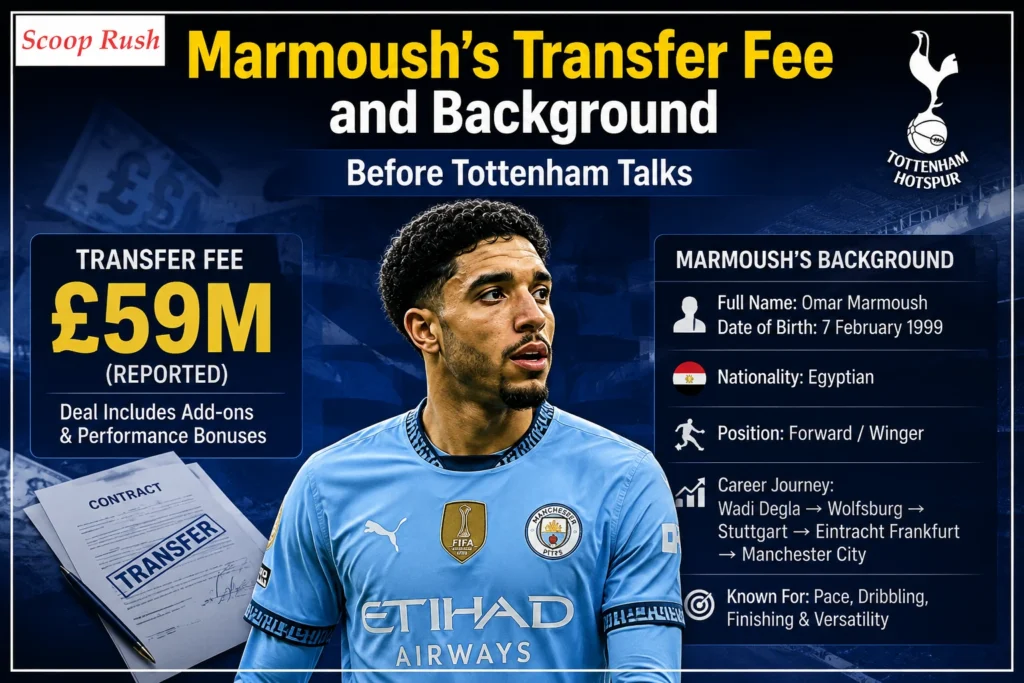
The Savinho deal is far from the end of Tottenham’s transfer business this summer. Sources have told BBC Sport that talks for Savinho’s City team-mate, Omar Marmoush, are progressing well.
Marmoush, an Egypt international, joined City from Eintracht Frankfurt in 2025 for £59m but fell down the pecking order last season. Tottenham clearly see a chance to add proven quality at reduced risk, given his recent lack of game time.
Spurs also remain interested in Liverpool forward Cody Gakpo. However, it’s unclear whether they can finance a deal for the Dutch attacker on top of moves for both Savinho and Marmoush.
Tottenham’s Total Summer Transfer Spend
Once Savinho’s transfer goes through, Tottenham’s spending this summer will surpass £300m. That’s a huge financial commitment for any club, even one with Champions League ambitions.
Fortunately, Spurs have offset some of that outlay through player sales. They’ve recouped roughly £140m from selling Cristian Romero, Djed Spence, and Luka Vuskovic. Therefore, while the gross spending figure looks eye-watering, the net investment looks more manageable.
What Happens Next for Tottenham and Man City
Timing matters here too. Tottenham kick off their Premier League campaign away at Brentford on Saturday at 17:30 BST. Meanwhile, Manchester City host Bournemouth on Sunday at 14:00 BST.
Savinho likely won’t feature in that opening fixture since his medical is still pending. However, Spurs fans will want to see him in action as soon as he’s eligible to play.
For City, losing Savinho continues a pattern of squad restructuring under Guardiola. The club must now manage a crowded attacking department full of younger, more centrally focused talent.
Final Thoughts:
The story of why Tottenham paid £75m for Savinho comes down to looking past surface-level stats. His Premier League output at City looked modest. However, his performances at Girona reveal exactly why Tottenham were ready to spend £75m, plus add-ons, to bring him to north London.
De Zerbi wants pace, directness, and creativity in his squad, and Savinho ticks every box. Combined with ongoing interest in Marmoush and Gakpo, this summer could mark a genuine turning point for Tottenham.
As a result, all eyes will watch how quickly Savinho adapts to life in the Premier League. Time will tell whether this signing becomes the bargain his Girona form suggests it could be.
Frequently Asked Questions
1. How much did Tottenham pay for Savinho?
Tottenham agreed a £75m deal for Savinho, with a further £10m available through potential add-ons.
2. Why did Manchester City sell Savinho?
Savinho’s game time was limited at City last season. Competition from players like Phil Foden and Rayan Cherki restricted him to just seven Premier League starts.
3. What position does Savinho play?
Savinho plays as a versatile winger. He has featured on both the left and right flanks, plus more central attacking roles.
4. Is Tottenham signing any other Manchester City players this summer?
Yes. Talks are reportedly progressing for Omar Marmoush, another Manchester City forward who fell down the pecking order last season.
5. How much has Tottenham spent this summer transfer window?
Once the Savinho deal closes, Tottenham’s summer spending will exceed £300m, although the club has recouped around £140m through player sales.
Change is rarely simple when a pet’s food bowl is doing double duty as medicine. So when Ann Arbor Animal Hospital announced it would move away from Royal Canin Veterinary Diets in favor of Purina Pro Plan Veterinary Diets starting March 1, 2025, plenty of pet owners had questions.
Why switch a diet that’s already working? What’s actually in the new food? And is a therapeutic diet from Purina held to the same standard as a prescription medication?
This article walks through the transition itself, how to switch a pet’s diet safely, and what’s actually inside the Purina Pro Plan Veterinary Diet lineup. It also covers what independent food-quality reviewers have said about these diets, plus the regulatory context behind the term “veterinary diet.”
The Announcement: What’s Changing and When
Beginning March 1, 2025, Ann Arbor Animal Hospital will transition all patients currently on Royal Canin Veterinary Diets to the equivalent Purina Pro Plan formula. The goal is to keep offering strong nutritional therapy for pets managing conditions like kidney disease, digestive disorders, obesity, and diabetes, while consolidating around a single veterinary diet partner.
In practice, that means owners whose pets currently eat a Royal Canin therapeutic formula will be guided toward a comparable Purina product. The clinic recommends buying the new food five to seven days before the current supply runs out, so the switch can happen gradually rather than all at once.
That gradual window matters. Sudden diet changes are one of the more common triggers of short-term digestive upset in dogs and cats.
Owners who’d rather stay on Royal Canin aren’t out of options. It remains available for home delivery through the hospital’s online ordering partner, or as a special order for in-clinic pickup with about a week’s notice.
Why Veterinary Practices Change Diet Brands
Clinics don’t usually make this kind of switch on a whim. The reasons tend to fall into a few categories: supply reliability, distribution relationships with manufacturers, formulary breadth, cost to the client, and whether the manufacturer stands behind the product with guarantees or return policies.
Part of the pitch here is Purina’s satisfaction guarantee. According to the hospital’s announcement, Purina foods purchased through the clinic are eligible for a full refund if that guarantee isn’t met. For owners cautious about switching a sick or aging pet’s diet, that kind of no-risk trial lowers the barrier to giving the new food a fair shot.
It also helps that Purina Pro Plan Veterinary Diets are backed by one of the largest pet food manufacturers on earth. Nestlé Purina PetCare a subsidiary of Nestlé reported annual pet care sales of roughly $19.4 billion in 2022. That scale generally means consistent manufacturing and reliable restocking, which matters for patients who depend on a specific therapeutic food.
A Brief History of Purina Pro Plan
Purina’s roots go back to the 1890s, when Ralston Purina started as an animal feed company. In 1898, it introduced Purina Chow widely credited as the first commercially produced pet food. Over the following decades, the company expanded internationally and built manufacturing facilities abroad.
The brand changed hands in 2001, when Nestlé acquired Ralston Purina for roughly $10.3 billion, folding it into what’s now Nestlé Purina PetCare. That put Purina under the same corporate umbrella as other familiar names like Fancy Feast and Alpo.
Today, Purina’s veterinary diet line sits within Pro Plan, split across six product lines: three dry formulas (EssentialCare, Naturals, and Therapeutics) totaling 23 recipes, and three canned lines totaling 9 recipes.
Understanding the Purina Pro Plan Veterinary Diet Lineup
Not every therapeutic diet does the same job. Each line is built around a specific clinical need. Your veterinarian matches the right formula to the right condition based on bloodwork, diagnosis, and your pet’s history this isn’t a category where “close enough” is a safe substitute.
Critical Nutrition (CN)
Supports dogs and cats recovering from illness, injury, or surgery. It’s formulated with elevated fat and protein to maintain body condition, plus added antioxidants. Its smooth, easily digestible texture suits syringe or tube feeding for pets with a reduced appetite.
NF
Built for cats with kidney disease, renal failure, or sodium restrictions. It’s lower in sodium, phosphorus, and protein to ease the kidneys’ workload, with added potassium, B-complex vitamins, and omega fatty acids.
EN (Gastroenteric)
Targets digestive and GI conditions in cats diarrhea, vomiting, gastritis, pancreatitis, and inflammatory bowel disease. It’s lower in carbohydrates, higher in protein, and includes added B vitamins and chelated minerals.
DM
Purina’s diabetes-management formula for cats. It’s low in carbohydrates and high in protein, which favors gluconeogenesis the body’s process of converting protein into glucose for steadier blood sugar. It also includes added antioxidants, taurine, and omega-3 and omega-6 fatty acids.
All Purina Pro Plan Veterinary Diets require prescription authorization from a veterinarian and are meant to be used under veterinary supervision, not selected independently.
How to Transition Your Pet’s Diet Safely
Whether you’re switching brands or moving to a new maintenance food, the same rule applies: go slow. A five-to-seven-day window gives the gut microbiome time to adjust instead of being overwhelmed all at once.
A Typical Gradual Transition Schedule
Days 1–2: Mix about 25% new food with 75% old food.
Days 3–4: Move to a 50/50 blend.
Days 5–6: Shift to roughly 75% new food, 25% old food.
Day 7 onward: Feed the new diet exclusively, watching for changes in stool quality, appetite, or energy.
Call the clinic if you notice vomiting, diarrhea that doesn’t resolve within a couple of days, refusal to eat, or unusual lethargy during the switch. Therapeutic diets are often doing real clinical work, and a poor transition can temporarily undercut that.
The Purina Guarantee and What It Actually Covers
Purina’s product guarantee is meant to soften this transition. According to the clinic, owners are entitled to a full refund on Purina foods purchased through the hospital if the pet doesn’t take to the new diet or the owner isn’t satisfied.
That’s a meaningful safety net. Therapeutic diets are formulated for a reason, and swapping between them isn’t something owners should do without veterinary input so a guarantee lowers the risk of trying.
If you’d rather not switch at all, that’s fine too. Royal Canin stays available through the clinic’s online delivery partner, or as a special order with about a week’s lead time.
What Independent Food-Quality Reviewers Say
Marketing copy aside, it’s fair to ask a more basic question: how do these foods stack up on ingredient quality? Independent reviewers who evaluate pet food by ingredient sourcing and processing separate from any therapeutic claims — have raised consistent concerns about Purina Pro Plan Veterinary Diet’s dry recipes.
Carbohydrate Content
The most cited issue is carbohydrate content. Dry-line recipes have been calculated in the roughly 34%–42% carbohydrate range, driven largely by grains and starches like rice, barley, peas, potato, and oatmeal. In several recipes, these outweigh named animal proteins by ingredient position.
Corn and soybean derivatives, some from genetically modified crops, also appear prominently in a number of formulas. Canned lines fare somewhat better, though even the more moderate wet recipes still run 23%–41% carbohydrates and skip whole fruits or vegetables entirely.
Ingredient Sourcing and Additives
Other concerns raised by reviewers include unnamed animal ingredients like “meat by-products” and “animal digest.” Purina describes animal digest as highly palatable and nutritionally valuable; critics call it a low-quality byproduct.
Reviewers also flag reliance on synthetic vitamin and mineral supplementation over whole-food nutrient sources, plus additives like menadione sodium bisulfite (a synthetic vitamin K some studies link to liver and allergic reactions at high doses) and TBHQ, a preservative the Environmental Working Group has flagged as a concern.
One more gap: like most major brands, Purina doesn’t publish the omega-6-to-omega-3 ratio for its recipes. That matters because AAFCO’s allowable range technically permits ratios as skewed as 30:1, which nutritionists generally consider pro-inflammatory.
What This Means for Your Pet
None of this means these diets can’t do their clinical job. Reducing phosphorus for a kidney patient or lowering carbohydrates for a diabetic cat are real, measurable formulation choices that matter more, short-term, than an overall quality score. But it’s a useful counterweight to purely promotional messaging ask your vet how ingredient quality is weighed against the specific clinical benefit your pet needs.
Why “Veterinary Diet” Doesn’t Mean FDA-Reviewed
One regulatory detail surprises a lot of owners: the FDA doesn’t independently verify health claims on prescription veterinary diets the way it might for a drug. The agency applies “enforcement discretion” here, generally declining to enforce standard labeling rules as long as the product is distributed through, or under the direction of, a veterinarian.
Non-prescription pet food sold on store shelves, by contrast, is subject to the FDA’s ordinary labeling and health-claim regulations.
That distinction exists because veterinary diets are meant to be used as part of a supervised treatment plan, not selected off a shelf. The assumption is that a licensed veterinarian is actively monitoring the pet’s response.
It also means “complete and balanced” claims on a veterinary diet aren’t independently confirmed by the FDA the way they would be for an over-the-counter food. Some veterinary diets intentionally deviate from standard AAFCO completeness profiles for a clinical reason a legitimate, common practice, but one reason these diets generally aren’t meant for indefinite long-term feeding outside veterinary guidance.
Talking to Your Veterinarian About the Switch
If your pet is on a Royal Canin Veterinary Diet, the most useful next step is a direct conversation with your veterinary team before buying anything. A few questions worth asking:
Which Purina Pro Plan formula is the direct clinical equivalent to what my pet eats now?
Are there carbohydrate, protein, or fat differences I should watch for?
How long should the transition period be for my pet’s specific condition?
What symptoms mean I should stop the transition and call the clinic?
Is my pet a candidate for wet food instead of dry, or vice versa?
These diets manage real medical conditions, not just preferences. A rushed or DIY substitution is one of the few places in pet nutrition where “close enough” genuinely isn’t good enough.
The Bottom Line
Diet transitions in veterinary medicine are rarely just about brand loyalty. They’re about keeping a treatment plan consistent while the logistics availability, cost, guarantees work for both clinic and client.
Ann Arbor Animal Hospital’s move to Purina Pro Plan Veterinary Diets comes with real support built in: a structured transition timeline, a satisfaction guarantee, and a fallback if Royal Canin remains the better fit.
Still, informed owners should feel comfortable asking about ingredient quality and formulation. Lean on your veterinary team — not the packaging to decide what’s actually right for your pet.
Why is Ann Arbor Animal Hospital switching from Royal Canin to Purina Pro Plan Veterinary Diets?
The clinic cites a goal of continuing strong nutritional therapy while consolidating its veterinary diet partnership, along with Purina’s product guarantee and refund policy.
When does the transition take effect?
March 1, 2025, for all patients currently on a Royal Canin Veterinary Diet.
Can I keep my pet on Royal Canin instead of switching?
Yes. It stays available through the clinic’s online delivery partner or as a special order, typically requiring about a week’s notice.
How long should I take to transition my pet to the new food?
Buy the new food five to seven days before the current supply runs out, then mix the two gradually over that window.
What happens if my pet doesn’t do well on the new diet?
Purina’s guarantee allows a full refund on Purina foods bought through the clinic if the pet doesn’t adapt well or the owner isn’t satisfied.
Are Purina Pro Plan Veterinary Diets available without a prescription?
No. Like other veterinary therapeutic diets, they require prescription authorization and veterinary supervision.
Is Purina Pro Plan Veterinary Diet nutritionally “worse” than Royal Canin?
There’s no single answer for every pet or condition. Independent reviewers have raised concerns about carbohydrate levels in some Purina dry recipes, but the diets target specific clinical goals like reduced phosphorus for kidney disease that matter more for a given patient than an overall quality score. Ask your vet to weigh both factors for your pet.
Do these diets contain grain or GMO ingredients?
Some do. Several dry formulas include corn, soy, and rice-based ingredients some from genetically modified crops positioned prominently in the ingredient list.
Six months of construction walls are finally coming down. The Big Top Souvenirs reopening at Magic Kingdom happens this week, and it brings nine brand-new treats that circus fans will not want to miss.
If you have walked past Storybook Circus lately, you already know the drill. Rolling planters and construction walls have blocked the entrance since February. Now, that wait is over. Walt Disney World confirmed the reopening date, and it arrived sooner than many guests expected.
This news matters for anyone planning a Magic Kingdom trip this fall. Storybook Circus is a small but beloved slice of Fantasyland. Getting the full shop and treat counter back means one less construction zone near Dumbo the Flying Elephant and the Barnstormer.
Big Top Souvenirs Reopening Date: What Guests Need to Know
Big Top Souvenirs officially reopens on August 21, 2026. That is a little over six months after it closed on February 20, 2026, for a refurbishment project. The original bulletin only promised a return “later this year,” so this confirmed date finally gives guests something solid to plan around.
The reopening covers the entire space. Both the Big Top Treats confectionery counter and the merchandise side of the shop welcome guests back at the same time. In other words, this Storybook Circus reopening brings shopping and snacking back under one roof, just like before the closure.
Signs of progress had been building for weeks. Crews removed the construction walls around the tent earlier in August. Disney also unveiled the refreshed Big Top Souvenirs sign. By the time the announcement came, only a few rolling planters stood between guests and the entrance.
The Refurbishment Behind the Big Top Souvenirs Reopening
The project centered on the fabric tents that give Storybook Circus its distinctive look. Crews had not touched these tents since 2021, when Disney applied protective coatings to help them handle Florida’s intense sun and weather.
Construction permits filed last October covered two addresses in Storybook Circus. One address matched the Big Top Souvenirs tent, and the other matched the Pete’s Silly Sideshow meet and greet. Those permits listed Birdair, Inc. as the contractor. This company builds tensile fabric structures, including custom roofing systems, canopies, and skylights, and it has done this work for 70 years. The permits expire on December 31, 2026, though crews appear to be wrapping up well ahead of that deadline.
New Big Top Treats Menu: 9 Items Debuting This Week
The bigger draw for many guests will be the new menu. Walt Disney World teased the lineup with a photo of Dumbo-shaped and Mickey Mouse candy apples alongside a spread of other circus-themed sweets. Here is the full list of new additions arriving with the reopening:
Mickey Churro Caramel Apple – A Granny Smith apple with marshmallow ears, dipped in Werther’s Original caramel, white chocolatey coating, and churro cinnamon sugar.
Dumbo Caramel Apple – A Granny Smith apple with sugar cookie ears, dipped in Werther’s Original caramel and chocolatey coating, finished with a red fondant collar and yellow chocolatey hat.
Mickey Snowcone Marshmallow Pop – A marshmallow coated in fruit-flavored chocolatey coating and topped with colorful sanding sugars.
Minnie Pink Lemonade Cupcake – A pink lemonade-flavored cupcake with buttercream frosting, white chocolatey ears, sprinkles, and a chocolatey bow.
Mickey Vanilla Celebration Cupcake – A vanilla cupcake with buttercream frosting, dark chocolatey ears, colorful chocolatey stars, and a sprinkle surprise baked inside.
Dumbo Sandwich Cookie – Two Dumbo-shaped sugar cookies filled with vanilla buttercream and sprinkles.
Mickey Circus Cookie – A Mickey-shaped sugar cookie with pink or white chocolatey coating and sprinkles.
Circus Chips – Corn chips coated in brown sugar and cinnamon.
Big Top Dippers – Animal crackers and apple slices served with vanilla buttercream, Werther’s Original caramel, and sprinkles for dipping.
This menu leans heavily into candy-forward flavors, and that makes sense given the location’s history. Big Top Treats has traditionally served guests who want something fun and sugary rather than a heavier dessert. This new lineup continues that tradition with several apple and cupcake options built around beloved characters.
Why This Menu Fits Big Top Treats’ Circus Theme
Every item on this list ties back to the circus setting in some way. The apples wear fondant collars and chocolatey hats. The cupcakes carry character ears and bows. Even the simple Circus Chips play into the playful, portable snack style that fits a walk-through land like Storybook Circus.
Why the Storybook Circus Reopening Matters for Your Visit
Big Top Souvenirs sits across from Dumbo the Flying Elephant and right next to Pete’s Silly Sideshow. That location makes it a central stop in Storybook Circus. The shop has long served as a quiet break from the crowds nearby. In fact, during the post-COVID phased reopening, it briefly operated as a Relaxation Station, and it offered guests indoor seating away from the busier parts of Fantasyland.
That indoor seating still seems to be an option today, though it is not a spot most guests specifically plan around. Even so, having the full shop open again removes one more obstacle for families navigating this part of the park.
Nearby, Pete’s Silly Sideshow reopened about a month before Big Top Souvenirs. Guests can meet Donald, Goofy, Daisy, and Minnie there in their circus outfits. The location currently runs with a reduced character roster during Mickey’s Not So Scary Halloween Party, since some characters moved to other spots in the park.
Pete’s Silly Sideshow: A Nearby Favorite Worth Visiting Too
Pete’s Silly Sideshow stands out as one of Magic Kingdom’s most underrated meet and greet locations. The indoor, air-conditioned setting and creative backdrops make it a comfortable stop, especially during the hotter months. It also doubles as flex space during seasonal events like Halloween and Christmas parties. Guests can grab automated PhotoPass photos there too, though results can vary.
Storybook Circus Decor Worth Seeing This Season
Storybook Circus still deserves a visit even if a meet and greet or attraction is not on your list. Over the past couple of years, the area has picked up circus-themed decor for both Halloween and Christmas. These touches extend the seasonal decorations already found throughout Fantasyland.
These additions are easy to miss if you have no other reason to walk through the area. However, they are worth seeking out, particularly since Walt Disney World has faced criticism in the past for scaling back holiday decorations elsewhere. The added decor around Storybook Circus, Seven Dwarfs Mine Train, and Many Adventures of Winnie the Pooh stands in contrast to those cutbacks. It adds genuine charm to the land.
Storybook Circus: A Land With a Long History
Storybook Circus has a longer history than most guests realize. The area began as Mickey’s Birthdayland in the late 1980s, and Disney originally meant it to be temporary. It later became Starland, then Toontown Fair, before transforming into today’s Storybook Circus. Each version added a bit more permanence to what started as a short-term installation.
Most fans consider Storybook Circus the strongest version of this space so far. Even so, it is now more than a decade old, and it remains one of the more modest lands in Magic Kingdom in terms of scale and attractions. As a result, fans continue debating whether the area deserves expansion or a larger overhaul down the road, though Disney has not announced anything along those lines yet.
What to Know Before You Go
For guests visiting Magic Kingdom in the coming weeks, here is what to expect from the Big Top Souvenirs reopening:
Both the merchandise shop and the Big Top Treats counter reopen together on August 21, 2026.
Nine new menu items debut, ranging from character-themed caramel apples to cupcakes and cookies.
The refurbishment focused on the tensile fabric tents, which had not seen service since 2021.
Pete’s Silly Sideshow next door is already open, currently with a modified character lineup for Halloween season.
Seasonal decor throughout Storybook Circus adds extra value to a visit, even for guests skipping the shop itself.
Final Thoughts
The Big Top Souvenirs reopening closes out a six-month refurbishment that kept one of Storybook Circus’s key buildings behind construction walls. With a confirmed date of August 21, 2026, guests can once again browse circus-themed merchandise and try nine new sweet treats, from Dumbo caramel apples to Mickey-shaped cookies.
Beyond the shop itself, this reopening signals that Storybook Circus is settling back into its full lineup after months of ongoing maintenance. Combined with the recent Pete’s Silly Sideshow reopening and the seasonal decor scattered throughout the area, there is more reason than ever to slow down and explore this often overlooked corner of Magic Kingdom.
Frequently Asked Questions
When did Big Top Souvenirs reopen at Magic Kingdom?
Big Top Souvenirs reopened on August 21, 2026, after closing for refurbishment on February 20, 2026.
What new menu items are available at Big Top Treats?
The new lineup includes a Mickey Churro Caramel Apple, Dumbo Caramel Apple, Mickey Snowcone Marshmallow Pop, Minnie Pink Lemonade Cupcake, Mickey Vanilla Celebration Cupcake, Dumbo Sandwich Cookie, Mickey Circus Cookie, Circus Chips, and Big Top Dippers.
Where are the Big Top Souvenirs located in the Magic Kingdom?
Big Top Souvenirs sits in Storybook Circus, across from Dumbo the Flying Elephant and next to Pete’s Silly Sideshow.
Why was Big Top Souvenirs closed for so long?
Crews needed time to refurbish the tensile fabric tents in Storybook Circus, which had not received maintenance since 2021. Birdair, Inc., a contractor specializing in fabric tent structures, handled the project.
Is Pete’s Silly Sideshow open near Big Top Souvenirs?
Yes. Pete’s Silly Sideshow reopened about a month before Big Top Souvenirs and currently offers character meet and greets with a modified lineup during Mickey’s Not So Scary Halloween Party.
What happens when a forward who scored a goal of the season struggles for minutes at the biggest club in England? He became one of the most talked about transfer targets in the Premier League. That is exactly the situation surrounding a potential Marmoush to Tottenham move this summer. The rumour has already split fans and pundits down the middle.
Tottenham are in talks with Manchester City over a deal for Omar Marmoush. Both clubs are progressing their conversations, though nothing has been agreed just yet. Still, the Egypt international could soon become the newest face in Roberto De Zerbi’s rebuilt squad.
This news matters because it lands at a pivotal moment for Tottenham. The north London club’s summer spending is already on track to pass £300m. Consequently, a Marmoush to Tottenham deal would add another significant name to an already busy window. For Spurs fans, it raises a simple question: does this move solve a real problem, or create a new one?
Why a Marmoush to Tottenham Deal Makes Sense
Spurs have not been shy about spending this summer. They have already committed £229.5m to centre-back Jan Paul van Hecke and midfielders Sandro Tonali and Mateus Fernandes. On top of that, they have agreed a £75m deal for Manchester City winger Savinho, which strengthens their attacking options even further.
The timing of the Marmoush pursuit is not a coincidence. Tottenham’s attack has struggled with inconsistency over the past year. Forward Dominic Solanke has battled injury problems throughout the last 18 months, and that has limited his availability. Meanwhile, teammate Richarlison has entered the final year of his contract, which adds uncertainty to that position going forward.
Against this backdrop, a fresh attacking option makes sense. Marmoush’s influence at Manchester City has clearly diminished over the past season. Still, the underlying numbers suggest Tottenham would gain a forward whose skill set genuinely differs from what they already have in the squad.
Marmoush’s Transfer Fee and Background Before Tottenham Talks
Marmoush originally joined Eintracht Frankfurt on a free transfer from Wolfsburg in May 2023, at 24 years old. His first season in Germany was outstanding, with 17 goals scored across all competitions.
That form continued into the first half of the 2024-25 campaign, when he netted 15 Bundesliga goals from an expected goals figure of 8.9. Nine assists in just 17 league appearances added to the tally. Across all competitions before he left Germany, Marmoush racked up 20 goals and 13 assists in only 26 games.
Set-piece ability was another standout part of his game during this period. He became the first player in Europe’s top five leagues since Lionel Messi in 2019 to score directly from a free-kick in three consecutive competitive matches. That kind of form convinced Manchester City to pay £59m for him in January 2025.
How Marmoush’s Man City Spell Shaped the Tottenham Interest
The early signs at City were genuinely promising. Marmoush scored his first career hat-trick against Newcastle. He then struck the winner in City’s FA Cup quarter-final win at Bournemouth. Later, he added a long-range strike against the same opponents in the Premier League, and pundits judged it the goal of the season.
However, difficult moments followed too. During the 2025 FA Cup final, with City trailing Crystal Palace, Erling Haaland handed Marmoush the ball for a penalty. Dean Henderson saved the effort, and City went on to lose at Wembley.
Former Manchester City defender Nedum Onuoha does not believe that single moment should define Marmoush’s time at the club. “When I see Marmoush, I don’t see the penalty miss,” Onuoha told BBC Sport. “I see the strength he has with some of the runs he makes in behind.”
Why His Role Shrank at City Before Tottenham Came Calling
Since arriving from Frankfurt, Marmoush has scored 16 goals in 62 appearances across all competitions for Manchester City. Eight of those goals came in 36 appearances during the 2025-26 season. However, his involvement in the Premier League fell considerably compared to the season before.
He started only eight league games and played around 700 minutes in total, fewer minutes than he managed after joining midway through the previous campaign. His league return of three goals and three assists actually matched expectations, since his expected goals figure of 3.53 sat close to his real output. In other words, finishing was never really the issue.
Instead, Marmoush found himself competing for minutes in a team built entirely around Haaland. Meanwhile, City continued adding more attacking depth throughout the season.
“All the positions Marmoush could play are being filled by people who are specialists in those roles,” Onuoha explained. “Haaland is essentially always going to be the number nine, while City also regularly play with number 10s, and Guardiola likes his wingers to stay wide.”
What Marmoush Would Bring to Tottenham’s Attack
Marmoush operates primarily as a number nine, but his career has rarely confined him to just one role. At Frankfurt, he mostly played through the middle, though he also featured as a second striker and from the left flank. The city used him in a similar way. They deployed him mainly as a central attacker while occasionally shifting him to the wing or into a role just behind another forward.
This kind of flexibility could suit De Zerbi perfectly. His teams have often relied on forwards who change positions, drop toward the ball, and then attack the space left behind when defenders are pulled out of position. Marmoush is comfortable doing exactly that.
Onuoha believes the Egyptian forward is at his most dangerous when threatening the space behind a defence. “As much as he is good at dropping the ball, I think he is better when he plays on the shoulder,” he said. “He needs to be in a team that will constantly play balls in behind and force the opposition to run back towards their own goal. That’s when you see a better version of Marmoush.”
The Stats Behind the Marmoush to Tottenham Hype
Opta’s Premier League data from last season paints a clear picture of what Marmoush offers. He averaged 11.46 runs per 90 minutes. That figure is almost identical to Solanke’s 11.61 and ahead of Richarlison’s 10.03. It alone suggests he would fit Tottenham’s existing attacking patterns without much adjustment.
However, Marmoush offers considerably more with the ball at his feet. He averaged 5.67 progressive carries per 90 minutes, compared with just 3.24 for Solanke and 2.48 for Richarlison. That is a significant gap, and it shows how much more comfortable he is driving forward with possession.
He also led both current Tottenham forwards in several key attacking metrics, recording 3.86 shots per 90 minutes compared to 2.81 for Richarlison and 1.80 for Solanke. Additionally, he created 1.55 chances per game against 0.92 for Richarlison and 0.54 for Solanke.
His combined goals and assists per game stood at 0.77, ahead of Richarlison’s 0.69 and well clear of Solanke’s 0.27. Of course, his limited league minutes at City shrink the sample size. Even so, the overall profile stays clear and consistent.
Marmoush is far more inclined to take on opponents and create shooting chances for himself than either of Tottenham’s current central forwards. That could prove particularly valuable when opponents sit deep and try to deny Spurs space in behind. As Onuoha put it, “Sometimes the fit can simply be better. Marmoush’s ability to run in behind and link the play could be huge assets for Spurs. They won’t be shy about playing those passes into him and forcing opponents on to the back foot.”
Could Marmoush and Solanke Play Together at Tottenham?
A Marmoush to Tottenham move would not necessarily mean replacing Solanke in the starting eleven. His experience playing alongside another central striker opens up the option of using both players together. Solanke could occupy central defenders while Marmoush drifts into wider areas or drops between the lines.
This combination could especially appeal to De Zerbi, since Marmoush can accelerate into spaces that open up when Tottenham break through an opposition press.
“Solanke is different from Marmoush. He’s got more of a physical presence,” Onuoha said. “I could see the goalkeeper playing a flat ball into Solanke, Marmoush coming underneath him to receive it, and that became the start of the attack. The two of them could complement each other. Playing in a front two might bring out more of Marmoush’s strengths.”
Final Verdict:
The Marmoush to Tottenham conversation ultimately comes down to fit rather than talent. Nobody questions his ability. His numbers at Frankfurt and his flashes of brilliance at City prove he can perform at the highest level. The real question is whether a fresh start under De Zerbi, in a system built to use his strengths, could unlock the version of Marmoush that lit up the Bundesliga.
Tottenham’s injury concerns around Solanke and the uncertainty surrounding Richarlison’s contract make a versatile, direct, and progressive forward look like a logical addition. Furthermore, the statistical comparison with Spurs’ current options suggests Marmoush would immediately raise the ceiling of the attack, even if he starts in a squad role.
As of now, talks between Tottenham and Manchester City are progressing, but no agreement has been reached. The deal is not yet confirmed.
2. How much did Manchester City pay for Marmoush?
Manchester City signed Marmoush from Eintracht Frankfurt in January 2025 for a fee of £59m (70m euros).
3. Why has Marmoush played fewer minutes at Manchester City?
His game time dropped mainly because City’s attack is built around Erling Haaland, who occupies the central striker role. City also strengthened their squad with more specialists in the wide and number 10 positions, reducing Marmoush’s opportunities.
4. Would Marmoush replace Dominic Solanke at Tottenham?
Not necessarily. Reports suggest Marmoush could play alongside Solanke in a front two, with Solanke holding up play centrally while Marmoush operates from wider areas or drops deeper to link play.
5. What makes Marmoush different from Tottenham’s current forwards?
Statistically, Marmoush offers more progressive carries, shots, and chances created per 90 minutes compared to Solanke and Richarlison. His ability to take on defenders and create his own chances sets him apart from Tottenham’s existing attacking options.nces sets him apart from Tottenham’s existing attacking options.
Imagine losing hours every week to tasks a simple tool could handle in minutes. Now imagine finally fixing that problem. That is the promise behind Sharpener Tech, and it is why more businesses are paying attention.
Introduction
What if the biggest reason your business feels stuck is not money or manpower, but the technology you have not adopted yet? That question is exactly why Sharpener Tech has become part of the conversation for business owners searching for smarter digital solutions. As companies race to keep up with a fast-changing digital world, Sharpener Tech represents the kind of technology-driven approach many are now exploring.
Technology today goes far beyond computers or a simple website. It covers artificial intelligence, cloud services, cybersecurity, automation, and data management, and all of these work together to make daily operations smoother. Businesses that understand this shift gain a real advantage, while those that ignore it often fall behind their competitors, and some are even asking whether AI will replace their jobs altogether.
This guide breaks down what Sharpener Tech means for beginners. It explains why it matters, how to put technology solutions to work step by step, and what to watch out for along the way. Whether you run a small business or are simply curious about digital transformation, this article walks you through it clearly.
What Is Sharpener Tech?
Sharpener Tech refers to a technology-focused brand or organization that helps businesses and individuals solve technical challenges through digital solutions. Depending on the specific service, this can include software development, website creation, cloud computing, IT consulting, cybersecurity, or broader digital transformation support.
Companies that follow this technology-focused model build systems that make daily operations easier and more productive. Instead of leaving businesses to figure out complicated tech decisions alone, they combine modern tools with hands-on expertise. As a result, clients can adopt digital solutions that genuinely support growth instead of adding unnecessary complexity.
For someone new to the technology space, working with a provider like this turns an overwhelming project into a manageable one. Professional guidance means businesses invest in tools that actually fit their goals, rather than spending money on software they do not need.
Why Beginners Should Pay Attention to Sharpener Tech
Many first-time business owners assume technology adoption is only for large corporations with big budgets. However, that assumption often costs them time and money later. Understanding the basics early makes it far easier to scale operations without a painful, expensive overhaul down the road.
Why Sharpener Tech Matters Right Now
Technology keeps evolving at a pace that is hard for most organizations to track on their own, as seen with newer models like Kimi K3 and Qwen3 entering the market regularly. Consequently, businesses that adopt modern digital tools tend to see real advantages, including stronger productivity, better internal communication, improved security, and happier customers.
Sharpener Tech reflects a growing demand for technology services that make digital transformation less intimidating. Today’s businesses need dependable software, secure infrastructure, and solutions that can scale as they grow, and that need is not slowing down anytime soon.
Technology providers also ease operational pressure by automating repetitive tasks, improving how data gets managed, and helping teams collaborate more effectively. As a result, organizations can spend more energy on innovation and customer service instead of getting buried in manual processes.
Step-by-Step Guide to Using Sharpener Tech Solutions
Adopting new technology can feel overwhelming without a clear plan. The following steps break the process into manageable pieces so beginners know exactly where to start.
Step 1: Identify Your Business Needs
Start by pinpointing the exact problem you want technology to solve. Are you trying to improve communication, boost efficiency, or tighten up security? Defining a clear objective first makes every technology investment that follows far more effective.
Step 2: Research Available Solutions
Once your goals are clear, explore the software platforms, cloud services, and digital tools that match them. Compare features, scalability, and long-term value carefully before settling on any single option.
Step 3: Consult Technology Professionals
Working with experienced experts helps you understand which solutions genuinely fit your organization, whether that means reviewing AI tools like Abacus AI or evaluating other platforms. Professional advice reduces costly guesswork and increases the odds of a smooth rollout.
Step 4: Develop an Implementation Plan
A structured plan should include realistic timelines, a budget, clear responsibilities, and expected outcomes. This kind of roadmap keeps disruptions to a minimum while new systems go live.
Step 5: Train Your Team
New technology only delivers value if people know how to use it. Training builds confidence, reduces errors, and ultimately drives better returns on the investment.
Step 6: Monitor Performance
After rollout, keep evaluating how the system performs and gather feedback from the people using it daily. Ongoing monitoring helps you catch problems early and ensures the technology keeps supporting your business goals over time.
Benefits of Choosing Sharpener Tech Solutions
Businesses that embrace this kind of technology-driven approach typically notice several advantages:
Improved operational efficiency
Stronger support for digital transformation
Higher overall productivity
More room for innovation
Better cybersecurity awareness
Automation of repetitive tasks
Improved collaboration across teams
Better customer experiences
Scalable solutions that grow with the business
A stronger foundation for long-term growth
Disadvantages and Challenges to Consider
No technology adoption comes without trade-offs, so it helps to go in with realistic expectations. Common challenges include:
Significant upfront implementation costs
Extra training time for employees
The fast pace of technology change, which can make tools feel outdated quickly
Many businesses jump into new technology without first identifying what they actually need. Unfortunately, this often means spending money on software that adds little real value. The smarter approach is to define clear goals first, then choose solutions that directly support them.
Ignoring employee training is another frequent misstep. Even the most advanced technology performs poorly if the people using it do not understand how it works. Proper onboarding, paired with continuous learning, helps businesses get the most out of every tool they adopt.
Finally, neglecting cybersecurity is a mistake that can be costly, especially as incidents like the Claude AI chats exposed through Google search show how quickly data can be compromised. Strong passwords, regular software updates, secure backups, and ongoing employee awareness training are all essential for protecting sensitive business information.
Expert Tips for Getting the Most Out of Sharpener Tech
Additionally, keep software updated, invest in cybersecurity awareness, and review technology performance on a regular basis. This kind of continuous improvement keeps systems efficient, secure, and aligned with changing needs.
Encouraging employees to embrace digital learning also pays off. Teams that understand new tools tend to adapt faster and contribute more meaningfully to the organization’s success, much like the mom who built a $10K-a-month Etsy side hustle by using the right digital tools early on.
Conclusion
Sharpener Tech reflects just how important modern technology has become in today’s digital economy. As more organizations adopt innovative tools, technology providers play a bigger role in improving efficiency, strengthening security, and supporting sustainable growth.
Whether the focus is software development, cloud computing, automation, or broader digital consulting, technology helps simplify complex challenges while opening up new opportunities. For beginners, understanding this value is the first real step toward making smarter decisions.
Successful digital transformation starts with clear goals, careful planning, professional guidance, and a willingness to keep learning. Businesses that invest thoughtfully in the right technology solutions often see improved productivity, lower operational costs, and better experiences for their customers.
Yes, challenges like training, maintenance, and security will come up along the way. However, the long-term benefits usually outweigh the initial investment. By staying informed and open to innovation, businesses and individuals alike can build a stronger foundation for the future with Sharpener Tech.
FAQs
Q1: What is Sharpener Tech?
A1: Sharpener Tech is a technology-focused organization or brand associated with digital solutions, software services, and modern technology designed to improve business and personal productivity.
Q2: Who can benefit from Sharpener Tech?
A2: Businesses, startups, entrepreneurs, professionals, and organizations looking for reliable technology solutions can all benefit from these modern digital services.
Q3: Why is technology important for businesses today?
A3: Technology improves efficiency, automates repetitive work, strengthens communication, supports better data management, and enhances the overall customer experience.
Q4: How do technology companies help organizations grow?
A4: They typically provide software development, IT consulting, cloud solutions, cybersecurity services, and digital transformation strategies tailored to each business’s specific needs.
Q5: Is digital transformation realistic for small businesses?
A5: Yes. Small businesses can absolutely benefit from digital tools that improve productivity, reduce costs, and support future growth, even on a limited budget, similar to how AI property search engines have helped small players compete in larger markets.
President Donald Trump has launched a new Trump Iran economic plan. He wants to cut off Tehran’s money supply. Trump calls it the “most crushing economic operation” ever aimed at a country.
This move shows a big shift in strategy. Washington is moving away from military pressure. Trump now hopes tighter finances can push Iran toward a deal. But many experts doubt it will work fast, since Iran has dodged sanctions for decades.
Trump Unveils a New Economic Offensive
Trump shared his plan on Truth Social. He described it as an “economic D-Day” against Iran. The message was blunt and direct.
He also warned other nations. Banks, businesses, airports, and governments that help Iran could face penalties. His administration wants to shut down oil smuggling, cash transfers, and shell companies. Talks with Tehran have stopped for now. Officials seem ready for a long economic fight instead.
The Plan Faces Big Obstacles
Sustained economic pressure could hurt Iran badly over time. But this kind of strategy needs months, sometimes years, to show results. Trump often prefers quick wins, which creates tension with this approach.
Iran also has practice handling sanctions. Tehran built alternative trade routes over many years. These networks help it sell oil quietly and move money around blocks. Washington needs strong international teamwork to close these gaps effectively.
The Strait of Hormuz Adds Fresh Risk
The Strait of Hormuz sits at the center of this standoff. A huge share of the world’s oil and gas passes through this narrow waterway. Iran has already disrupted traffic there before.
Any new disruption could send oil prices climbing fast. That would hit American drivers directly at the pump. Trump wants to weaken Iran without hurting his own voters. Balancing both goals will not be easy for his team.
China Complicates Washington’s Strategy
China buys a large share of Iran’s oil exports. This makes Beijing a major hurdle for Trump’s plan. The US already sanctioned several Chinese firms tied to Iranian oil.
China has pushed back hard against these moves. Officials in Beijing want diplomacy, not more pressure. Trump could add new penalties on Chinese banks. However, that risks a bigger fight with China right before Xi Jinping’s planned September visit.
Dubai Still Matters for Iran’s Money Flow
The UAE has long served as a financial hub for Iranian trade. Exchange houses and shell firms move money through Dubai easily. These channels make sanctions harder to enforce fully.
The UAE recently tightened its rules on Iran ties. This followed rising tension over Iranian missile threats. Still, Iran could shift to other financial hubs nearby. Gulf cooperation remains key for Washington’s success here.
Iran Has Survived Sanctions Before
Iran has lived under heavy sanctions for many years already. Its economy has suffered, and living standards have dropped sharply. Yet the government has not changed its core political path.
Iranian leaders often use sanctions to boost nationalist support at home. They frame US pressure as an attack on their sovereignty. Inflation and currency troubles keep hurting ordinary Iranians daily. Still, the regime shows real staying power against outside pressure.
Voters at Home Could Judge Trump’s Plan
The midterm elections in November raise the stakes for Trump. Voters will watch gas prices and grocery bills closely. Any spike tied to Iran tension could hurt him politically.
Democrats already criticize the economic fallout from this conflict. Representative James Walkinshaw warned about rising costs for families. If fuel prices stay high, this issue could shape election debates. Trump must convince voters the pressure campaign truly helps them.
Trump’s Negotiating Style Could Shift Things
Trump often uses economic threats to gain leverage in talks. He tends to apply maximum pressure before considering any deal. This pattern could easily repeat with Iran too.
Right now, talks with Tehran remain frozen completely. But conditions can change quickly in this kind of standoff. Rising oil prices might push Trump back toward negotiations. For now, his team seems committed to economic warfare instead.
A Full Blockade Needs Global Teamwork
A complete economic blockade would require broad international support. The US cannot control every financial route into Iran alone. Europe and Asia both play major roles here.
Gulf states could help by closing regional financial gaps further. However, Washington’s ties with several allies remain strained lately. Countries may back some pressure without agreeing to every US demand. This makes full cooperation harder for Trump to secure.
Iran Could Hit Back Through Shipping Routes
Iran holds real leverage near the Strait of Hormuz too. Tehran could disrupt shipping to shake global energy markets. This would raise both oil prices and insurance costs.
That scenario puts Trump in a tough spot. A military response risks widening the entire conflict further. Doing nothing could make him look weak instead. Iran may use this tension as a bargaining chip later.
Midterms Create a Tight Deadline
November elections leave Trump with limited time to prove results. Economic sanctions usually take months to show real impact. Voters, though, tend to expect quicker fixes than that.
If gas and food prices stay high, pressure on Trump will grow. Opponents could turn the Iran conflict into a campaign issue. Iran likely understands this political timeline as well. Tehran may simply wait out the pressure until after November.
Will the Plan Force Iran to Give In?
This plan could seriously damage Iran’s economy over time. Tighter sanctions may cut oil revenue and block international finance access. But history shows economic pain rarely forces quick political change.
Success depends heavily on strict global enforcement of these rules. China’s continued oil purchases could undercut the entire strategy. Gulf and European cooperation remains just as critical here. The Trump Iran economic plan faces a long and uncertain test ahead.
What Comes Next for Trump and Iran
Trump now faces a choice between patience and escalation. He could hold steady and wait for sanctions to bite. Or rising costs could push him back toward negotiations instead.
Iran faces tough choices too, with its economy already strained. Yet its leaders may value political survival over economic relief. The Strait of Hormuz will likely stay central to this story. The next few months will test both sides’ resolve fully.
Conclusion
Trump’s new economic strategy puts Iran under intense financial pressure. However, forcing Tehran to surrender will not happen quickly. Iran has survived decades of sanctions and continues to find ways around restrictions.
The biggest challenge may come from rising costs at home. Higher energy prices could increase pressure on American households before Iran changes course. China and other trading partners could also limit the plan’s effectiveness. For now, Trump has chosen economic pressure over another major military escalation. Whether he can maintain that approach will depend on Iran’s response, global energy markets, and the political pressure ahead of the US midterm elections.
FAQs
1. What is the Trump Iran economic plan?
It is a strategy to cut off Iran’s oil revenue and financial networks. Trump wants to block trade routes and punish countries that help Tehran evade sanctions.
2. Why is Trump focusing on economic pressure now?
Trump hopes financial pressure can force Iran toward a settlement. This avoids further military action while still pushing Tehran to negotiate.
3. Why does China matter so much in this plan?
China buys a large portion of Iran’s oil exports. Without Chinese cooperation, sanctions may lose much of their intended impact.
4. How could this plan affect gas prices in America?
Tension near the Strait of Hormuz could disrupt oil shipments. That disruption could push crude prices and gas prices higher for consumers.
5. Will Trump keep this economic pressure going long term?
It remains unclear if Trump will stay committed for months or years. Rising fuel prices before the midterms could change his approach quickly.
Some of the most interesting options include Pakistani, Middle Eastern, barbecue, pizza, burgers and dessert spots. This guide highlights selected HMA-certified restaurants and explains what each one is known for, who it suits, and what to check before visiting. Because certification and menus can change, always verify the specific location before you go.
Important: HMA certification is outlet-specific. A restaurant brand can have one certified location while another location is not certified. HMA itself advises consumers to check its website for the specific location.
Quick Answer: Where Can You Find HMA-Certified Restaurants in Canada?
The largest concentration of HMA-certified restaurants listed by HMA is currently in Ontario, particularly the Greater Toronto Area. HMA’s current directory includes certified outlets in Brampton, Mississauga, Toronto, Scarborough, Markham, Vaughan, Oakville, Waterloo, Ottawa, Niagara Falls, Windsor and several other Ontario communities.
For a broad mix of cuisines, some notable options include The Kabab Shoppe in Brampton, The Kebob in Mississauga, Paramount Fine Foods in Toronto, Lahore Tikka House in Toronto, Chainsmoker Urban Halal BBQ in Scarborough, Pizzally in Scarborough, B Boyz in Brampton and Karahi Point in Waterloo.
Quick Comparison of HMA-Certified Restaurants
Restaurant
Location
Cuisine
Best For
Popular Dish
Price Range*
Halal Status
The Kabab Shoppe
Brampton
Afghan, Middle Eastern, Pakistani-inspired
Families, groups, late meals
Tandoori Chicken Bowl
About $15-$40+
HMA certified outlet
The Kebob
Mississauga
Pakistani
Families, catering
Kabab dishes
About $15-$40+
HMA certified, with Paya exception
Paramount Fine Foods
Toronto
Lebanese, Middle Eastern
Families, tourists, groups
Chicken shawarma, mixed grill
About $15-$36+
HMA certified at listed outlets
Lahore Tikka House
Toronto
Pakistani
Families, traditional meals
Chicken kababs, biryani
About $5-$30
HMA certified outlet
Chainsmoker Urban Halal BBQ
Scarborough
Halal BBQ, American comfort food
Groups, meat lovers
Smoked brisket, ribs
About $19-$49+
HMA certified outlet
Pizzally
Scarborough
Pizza, chicken
Families, students, groups
Pizza and wings
About $17-$36+
HMA certified outlet
B Boyz The Burger Architects
Brampton
Burgers, chicken
Students, families, casual meals
Beef burgers
About $11-$20+
HMA certified outlet
Karahi Point
Waterloo
Pakistani
Families, groups, students
Karahi, biryani
About $12-$50+
HMA-listed Waterloo outlet
*Price ranges are approximate based on current menu or ordering information available when researched. Prices, promotions, taxes and delivery charges can vary by location and ordering platform.
What Are the Best HMA-Certified Halal Restaurants in Canada?
There is no single restaurant that is objectively “the best” for everyone. The right choice depends on your city, cuisine preference, budget and the type of meal you want.
The restaurants below are selected because they offer different halal dining experiences and are currently listed by HMA as certified outlets.
1. The Kabab Shoppe, Brampton
Best for: Pakistani-style grilled food, families, groups and catering
The Kabab Shoppe is one of the HMA-certified restaurant listings in Brampton. HMA’s current directory lists the Brampton outlet, and current ordering information identifies it at Unit 10-2880 Queen Street East.
The menu includes dishes such as tandoori chicken bowls, tandoori boxes, kabab combos, mixed grill, tandoori chicken wraps, butter chicken and Special Kabuli Palu. Current listed prices show many individual meals in the mid-teens to low-$20s, with larger platters costing more.
HMA lists the outlet as family friendly and offering catering, events and free parking.
Why visit? It is a practical choice if your group wants grilled meat, kababs, rice dishes and larger sharing options in one meal.
2. The Kebob, Mississauga
Best for: Pakistani food, family meals and catering
The Kebob is listed by HMA at 3417 Derry Road East in Mississauga. HMA states that all menu items prepared at this outlet are HMA certified, but it specifically notes that meals prepared with Paya are not HMA certified.
That distinction is important. It shows why checking the certification details for a particular restaurant can be more useful than simply looking for a halal sign.
HMA describes The Kebob as serving traditional Pakistani food and lists the outlet as family friendly, with catering, events and free parking.
Why visit? It is a useful Mississauga option for diners looking for Pakistani-style food in a family-oriented setting.
3. Paramount Fine Foods, Toronto
Best for: Lebanese and Middle Eastern food, families and visitors
Paramount Fine Foods has several HMA-certified Toronto outlets listed by HMA, including Downtown Toronto, First Canadian Place and Union Station. HMA states that all meals prepared at these listed outlets are HMA certified.
The restaurant’s menu includes chicken shawarma, beef shawarma, shish tawouk, kafta, falafel, hummus, fattoush and mixed grills. Its official menu also includes platters, wraps, manakeesh, pizza and desserts.
The Downtown Toronto location is at 253 Yonge Street, close to the Yonge-Dundas area.
Why visit? It is particularly convenient for tourists and downtown visitors who want Middle Eastern food near major Toronto attractions and transit connections.
4. Lahore Tikka House, Toronto
Best for: Pakistani cuisine and family-style dining
Located at 1365 Gerrard Street East, Lahore Tikka House is listed by HMA as a certified restaurant, with HMA stating that all menu items prepared at the outlet are HMA certified.
The restaurant’s own website says it has served halal food since 1996 and identifies itself as HMA certified. Its menu includes chicken and beef kababs, BBQ chicken tikka, butter chicken, nihari, chicken karahi, lamb biryani and chicken biryani.
Current online menu listings show dishes such as chicken kababs, biryani, naan and sizzler meals, with prices ranging from smaller bread and side items to larger main dishes.
The restaurant also highlights family-friendly features, catering and a children’s menu.
Why visit? It offers a broad Pakistani menu, making it suitable when different people in a group want different traditional dishes.
5. Chainsmoker Urban Halal BBQ, Scarborough
Best for: BBQ, brisket, ribs and groups
Chainsmoker is a strong choice for diners who want something different from the usual South Asian or Middle Eastern halal menu. HMA lists its Scarborough location at 1892 Lawrence Avenue East and states that all menu items prepared there are HMA certified.
The restaurant focuses on halal BBQ and American comfort food. Its menu includes smoked beef brisket, beef back ribs, burgers, BBQ chicken, wings, jerk chicken and mac and cheese.
Current online prices show individual mains commonly ranging from around $19 to $49, while larger platters cost considerably more.
HMA lists the Scarborough outlet as family friendly, with online ordering, events and free parking. Chainsmoker also offers BBQ catering for events and gatherings.
Why visit? It gives halal diners a chance to enjoy smoked brisket, ribs and American-style BBQ rather than a standard curry or shawarma meal.
6. Pizzally, Scarborough
Best for: halal pizza, wings, families and students
Pizzally is another Scarborough option listed in the HMA restaurant directory. HMA states that all menu items prepared at the listed Scarborough outlet are HMA certified.
The restaurant is located at 4383 Kingston Road and focuses on pizza, chicken wings, fried chicken and related fast-food options.
Its current website lists deals such as two large pizzas for $25.99, two extra-large pizzas for $35.99, and pizza-and-wing combinations. The restaurant also states that its meat products are HMA-certified hand-slaughtered halal.
HMA lists family-friendly dining, catering, events and free parking among the outlet features.
Why visit? Pizzally is a practical choice when your group wants pizza and wings rather than traditional restaurant food.
7. B Boyz The Burger Architects, Brampton
Best for: burgers, students and casual family meals
B Boyz is listed by HMA at 20 Dewside Drive, Unit 10, Brampton. HMA states that all menu items prepared at this outlet are HMA certified. The restaurant also states that all of its items are halal.
Its menu includes beef burgers, fried chicken burgers, grilled chicken burgers, nuggets, tenders, wings and kids’ meals. Current ordering information shows burger prices generally starting around the low teens, with larger specialty burgers costing more.
HMA lists the outlet as family friendly and notes catering and free parking.
Why visit? It is a straightforward choice for halal burgers and chicken when you want a casual meal rather than a full-service dinner.
8. Karahi Point, Waterloo
Best for: Pakistani food, students, families and large groups
HMA’s current directory lists Karahi Point in Waterloo as a certified restaurant. The restaurant’s official website gives the Waterloo location as 655 Parkside Drive and says it can seat more than 110 guests. It offers dine-in, takeout and catering.
Karahi Point’s menu covers Pakistani dishes such as chicken karahi, goat karahi, butter chicken, nihari, biryani, seekh kababs, naan and several vegetarian dishes. Its official menu currently lists items such as chicken pakora, butter chicken, nihari and chicken karahi at different price points.
The Waterloo location is open seven days a week, although hours can change, so checking before travelling is sensible.
Why visit? The large dining room, broad Pakistani menu and catering options make it useful for families, student groups and larger gatherings.
Which HMA-Certified Restaurants Are Best for Families?
Larger, family-friendly options include The Kabab Shoppe, The Kebob, Lahore Tikka House, Paramount Fine Foods, Chainsmoker, Pizzally, B Boyz and Karahi Point.
HMA specifically identifies several of these outlets as family friendly. Lahore Tikka House also highlights a family-style setting and children’s menu, while Karahi Point Waterloo says its large location can host more than 110 guests.
For a traditional family meal, Pakistani restaurants such as Lahore Tikka House or The Kabab Shoppe may be a natural fit. For a mixed group, Paramount Fine Foods offers a broad Middle Eastern menu with meat, vegetarian and vegan choices.
Where Can You Find Affordable HMA-Certified Halal Food?
B Boyz, Pizzally and some lunch or individual-meal options at Pakistani restaurants can be more budget-friendly than large sharing platters.
B Boyz’s current menu lists burgers starting around $11 to $12, while Pizzally has small pizza and meal deals. Karahi Point also lists weekday lunch specials, with some options currently around $10 to $14.
Prices can change, and delivery apps may show different prices from dine-in menus. Always check the restaurant’s current menu before ordering.
Which HMA-Certified Restaurants Are Good for Groups or Catering?
The Kabab Shoppe, The Kebob, Lahore Tikka House, Chainsmoker, Pizzally and Karahi Point are useful choices for group meals or catering.
HMA lists catering or events for several of these outlets. Chainsmoker also has a dedicated BBQ catering service with brisket, ribs, chicken and other group options. Karahi Point Waterloo specifically promotes catering and large-group dining.
For large gatherings, contact the restaurant directly and confirm the current catering menu, minimum order, delivery area and halal status of the food being supplied.
Which HMA-Certified Restaurants Are Good for Late Meals?
The Kabab Shoppe and some Scarborough restaurants can be useful for later meals, but opening hours vary and should be confirmed before travelling.
Current ordering information for The Kabab Shoppe shows late-night availability, with Friday and Saturday hours extending later than other days. Chainsmoker’s Scarborough location also has evening hours, although its schedule varies through the week.
Late-night availability can change for holidays, private events or seasonal schedules, so don’t rely on an old listing.
Are These Restaurants Fully Halal?
HMA certification provides a stronger verification point than simply seeing a halal sign, but consumers should still check the certification status of the specific outlet and any exceptions listed by HMA.
For example, HMA states that all menu items prepared at The Kebob are HMA certified but separately identifies Paya meals as not HMA certified.
For other listed outlets, HMA’s restaurant pages can specify that all menu items or all meals prepared at that particular outlet are HMA certified. Lahore Tikka House, B Boyz, Pizzally and Chainsmoker are examples of restaurants whose HMA pages make such statements.
The key point is location-specific verification.
How to Find HMA-Certified Restaurants Near You
The easiest way to find HMA certified restaurants near me is to use HMA Canada’s official certified-restaurant directory and search for your city or nearby area.
HMA’s directory currently groups restaurants by location, including Brampton, Mississauga, Scarborough, Toronto, Vaughan, Waterloo, Ottawa and other cities.
When searching:
Find your city in HMA’s certified restaurant directory.
Choose the specific restaurant.
Check the outlet address.
Read the HMA certification information.
Look for any items that HMA specifically excludes.
Check the restaurant’s current menu and hours.
Contact the restaurant if you still have questions.
This is especially important for restaurant chains. HMA’s FAQ tells consumers to check its website to confirm whether a particular location is certified.
How to Check HMA Halal Certification Before You Visit
To check HMA halal certification, confirm that the exact restaurant location appears in HMA’s current certified-restaurant directory and read the certification details for that outlet.
HMA explains that its certification process includes an evaluation of the restaurant’s operations, meat sources and menu ingredients, followed by a final audit before certification. Its certification application also covers restaurant and fast-food operations.
Don’t assume that buying HMA-certified meat automatically makes a restaurant HMA certified. HMA specifically explains that restaurant certification involves monitoring ingredients and the operation, not just the meat supplier.
How to Verify an HMA-Certified Restaurant
A simple verification process can save you from confusion.
1. Check the official HMA directory
Start with HMA Canada’s certified restaurant list rather than relying only on social media or an old blog post.
2. Confirm the exact location
Certification can apply to one outlet and not another. HMA specifically advises consumers to check individual locations.
3. Read the HMA outlet page
Look for statements about HMA-monitored and certified products. Some pages also identify specific products that are not certified.
4. Ask the restaurant if you are unsure
Ask whether the food you plan to order is covered by the restaurant’s current HMA certification.
5. Recheck before important trips
Certification lists, menus and restaurant operations can change. This is particularly useful if you are travelling from another city.
Halal verification notice: Halal status, menus, prices, and opening hours may change. Contact the restaurant or check with its certification provider before visiting.
What Does HMA Certification Mean for Restaurant Diners?
HMA certification means the restaurant outlet has gone through HMA’s certification and monitoring process rather than simply making an unverified halal claim.
HMA says its restaurant certification process includes reviewing meat sources, ingredients and restaurant operations, followed by an audit. HMA also describes its certified restaurants as outlets that follow its halal guidelines.
For diners, the most useful point is that certification should be checked at the outlet level. A brand name alone is not enough.
How We Selected These Halal Restaurants
The restaurants in this guide were selected from HMA Canada’s current certified restaurant directory and then compared using practical factors that matter to halal diners.
We considered:
Current HMA certification information
Menu variety
Cuisine and popular dishes
Location and accessibility
Family suitability
Group and catering options
Value and available menu prices
Current restaurant information
Available customer feedback
Whether the restaurant offers something different from other choices
This is not a ranking from number one to number eight. The restaurants serve different purposes, so the best choice depends on what you want to eat.
HMA-Certified Restaurants by Occasion
For Pakistani food
Consider Lahore Tikka House, The Kabab Shoppe, The Kebob and Karahi Point.
For Middle Eastern food
Paramount Fine Foods is a strong option, with shawarma, grilled meats, falafel, hummus, salads and other Middle Eastern dishes.
For BBQ
Chainsmoker Urban Halal BBQ stands out for smoked brisket, ribs, BBQ chicken and American-style comfort food.
For pizza
Pizzally offers pizza, wings, fried chicken and family-style combination deals.
For burgers
B Boyz The Burger Architects is a convenient Brampton option for halal burgers, chicken and casual meals.
For dessert
HMA’s directory includes multiple D Spot locations across Ontario, including Brampton, Mississauga, Toronto, Scarborough, Oakville, Ottawa and other communities. D Spot’s official menu includes waffles, crepes, cakes, milkshakes and other desserts, although item availability varies by location.
Final Thoughts
Finding HMA certified restaurants Canada listings can make halal dining easier, particularly in Ontario where HMA’s current directory contains a wide range of certified outlets. From Pakistani food at Lahore Tikka House and The Kabab Shoppe to Middle Eastern meals at Paramount Fine Foods, BBQ at Chainsmoker and pizza at Pizzally, there are plenty of different cuisines to explore.
The most important habit is to verify the specific restaurant location, not just the brand name. Check HMA’s current directory, read any certification notes and contact the restaurant if you have questions about a particular dish.
If you have a favourite HMA-certified halal restaurant in Canada, share it with other halal food lovers. You can also explore more Canadian halal food guides to discover restaurants by city, cuisine and budget.
Official verification: HMA’s current certified-restaurant directory is the best place to check the latest outlet-level certification information.
FAQs
1. How do I know if a restaurant is HMA certified?
Check the official HMA certified-restaurant directory and search for the exact restaurant and location. HMA advises consumers to verify individual outlets because certification can differ between locations of the same brand. If the restaurant is listed, read its outlet page for any certification notes or exceptions before ordering.
2. Are all HMA-certified restaurants in Toronto?
No. HMA’s current directory includes certified restaurants in many Ontario communities, including Toronto, Brampton, Mississauga, Scarborough, Vaughan, Waterloo, Ottawa, Niagara Falls, Windsor and others. The directory is not limited to Toronto, although the Greater Toronto Area has a large number of listed outlets.
3. Is HMA certification the same as a restaurant simply saying it is halal?
No. An HMA-certified outlet has gone through HMA’s certification and monitoring process. HMA says its process includes reviewing operations, meat sources and menu ingredients, followed by an audit. A restaurant’s own halal statement is different from appearing in an HMA-certified restaurant directory.
4. Can one restaurant location be HMA certified while another is not?
Yes. HMA specifically tells consumers to check its website to determine whether a particular location is certified. This matters for chains with many outlets. Never assume that every branch has the same certification simply because one branch appears in the HMA directory.
5. Should I check halal status again before visiting?
Yes. It is sensible to check before travelling, especially for a special family meal or a trip to another city. Restaurant menus, locations and certification details can change. HMA’s directory should be treated as the key reference, while the restaurant can answer questions about current menu items and availability.