

“Councils use AI to close a £37.6m hole. Two councils. One bold bet on artificial intelligence.”
As local budgets buckle under rising care costs, officials in Northamptonshire are betting that chatbots and transcription tools can help close the gap. But can software really fix a funding crisis this deep?
Introduction
Two councils are turning to artificial intelligence to close a combined £37.6m funding gap, and the story reveals just how deep the financial strain has become in local government. West Northamptonshire Council needs to save £24m by 2027/28. North Northamptonshire Council needs to find another £13.6m. Together, these numbers show how far local authorities are being pushed.
This matters far beyond Northamptonshire. Across the UK, 218 upper-tier councils must make a combined £3.2bn in cuts this year alone. That means fewer bin collections, higher parking charges, reduced grants, and in some cases, entire services disappearing. For residents, especially older and vulnerable people who rely on adult social care, these decisions hit close to home.
So why AI, and why now? Councils say the technology can save staff time, speed up assessments, and ease pressure on overstretched teams — part of a much wider shift as AI creeps into public sector roles, raising the same question workers everywhere are asking: will AI replace your job? However, charities and social work groups are raising serious concerns about accuracy, empathy, and where the line should be drawn. This article breaks down what is happening, why it matters, and what it could mean for the people who depend on these services.
Why Councils Use AI to Tackle the Funding Gap
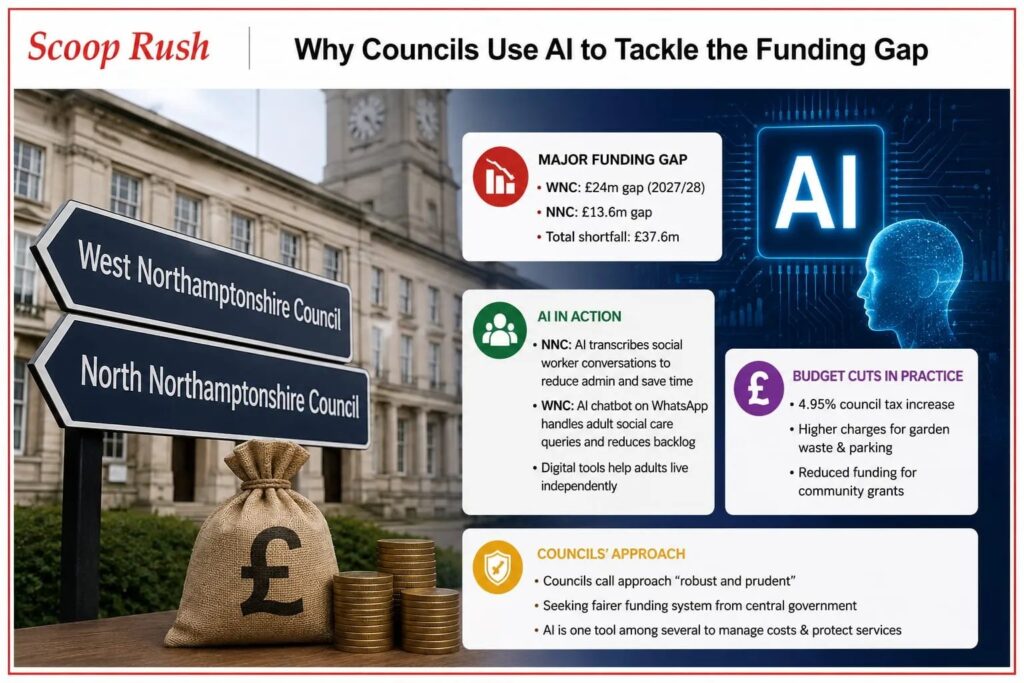
West Northamptonshire Council and North Northamptonshire Council, both controlled by Reform UK, have identified major budget shortfalls heading into the next financial year. WNC faces a £24m gap for 2027/28, while NNC needs to close a £13.6m shortfall. Together, these add up to the £37.6m figure driving this latest round of cost cutting.
Both councils already use artificial intelligence in adult social care, an area where spending has climbed sharply in recent years. Adult social care and children’s services now absorb a growing share of council budgets, leaving less room for everything else. As a result, both authorities see technology as one tool among several to manage costs.
At NNC, AI transcribes conversations between social workers and residents. The goal is simple: save staff time on admin so they can spend more of it supporting people directly, a strategy similar to how NHS AI tools are being used to cut waiting times. Meanwhile, WNC has trialled an AI chatbot on WhatsApp to handle adult social care questions, similar to how AI-powered social listening tools are helping organisations triage large volumes of queries. The chatbot screens initial requests for education, health and care plans, helping to reduce a growing backlog. WNC has also approved technology that helps adults live independently with digital support tools.
What the Budget Cuts Look Like in Practice
WNC’s savings measures go well beyond AI. The council’s 2026/27 budget includes a 4.95% increase in council tax, higher charges for garden waste collection and parking, and reduced funding for community grants. Residents notice these changes immediately, long before any AI tool changes service delivery.
A WNC spokesperson called the council’s approach “robust and prudent,” adding that officials continuously look for ways to cut costs while protecting services for residents “as far as possible.” Graham Cheatley, the council’s deputy leader and executive member for finance, efficiency and change, said the authority is also pressing central government for a funding system that better reflects the pressures local authorities face.
The National Picture: Councils Face a £4bn Black Hole
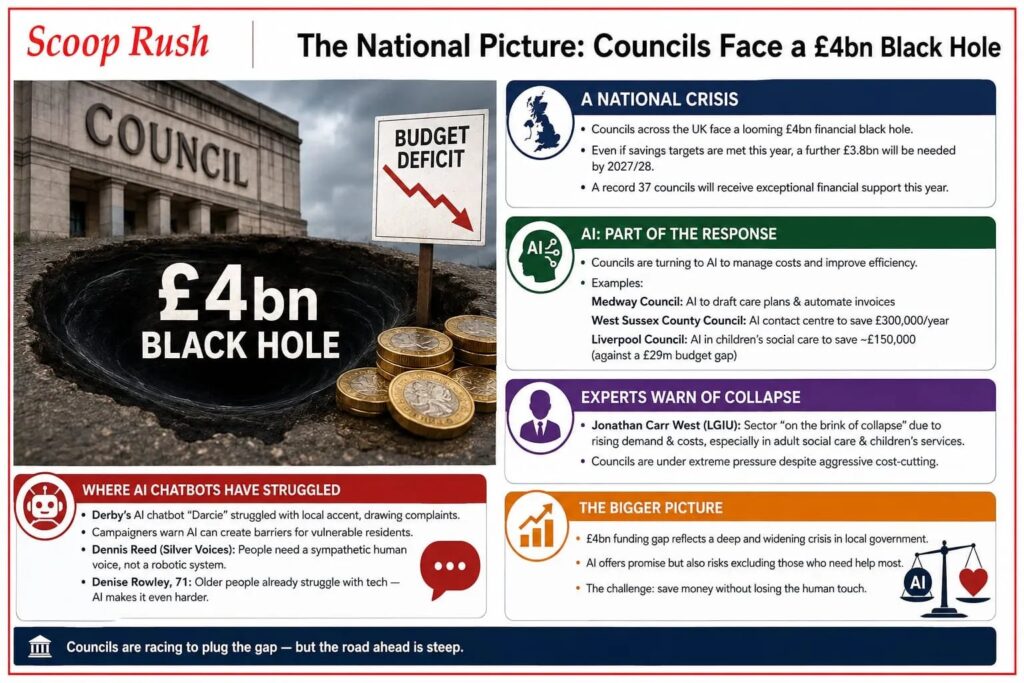
The Northamptonshire story is not an isolated case. It sits inside a much larger national trend, according to a study by the BBC Shared Data Unit. Councils across the UK collectively face a looming £4bn financial black hole, and many now turn to AI as part of their response.
Local government experts remain cautious, though. Jonathan Carr West, chief executive of the Local Government Information Unit, said the sector still struggles to keep pace with rising demand and cost, particularly in adult social care and children’s services. He described the sector as “on the brink of collapse.”
The scale of the challenge is stark. Even if councils hit their savings targets this year, they still expect to need a further £3.8bn by the end of the 2027-28 financial year just to balance their books. A record 37 councils will receive exceptional financial support this year, a clear sign of how widespread the strain has become.
Examples from elsewhere in the country show how councils are experimenting with AI tools. Medway Council plans to use AI to draft care plans and automate invoice processing, part of a broader wave of AI adoption across sectors that has even reshaped areas like AI-powered SOC solutions in enterprise security. West Sussex County Council hopes to save £300,000 a year by replacing nine call handlers with an AI contact centre. Liverpool expects to save around £150,000 through AI in children’s social care, a modest figure next to its total budget gap of more than £29m over the same period.
Where AI Chatbots Have Struggled
Not every rollout has gone smoothly. Derby’s AI chatbot, known as Darcie, received complaints after it struggled to understand the local accent, a limitation not unlike the trust gaps seen in AI CEO clones in the boardroom, where accuracy and tone matter just as much as speed. This stumble highlights a wider worry among campaigners: AI systems built for efficiency can end up creating new barriers, particularly for people who already find it hard to navigate council services.
Silver Voices campaign group for older people, He said people seeking social care support are often confused or in pain, and they are not used to dealing with automated systems on first contact. What they need, he argued, is a sympathetic human voice rather than a robotic answering machine.
Denise Rowley, 71, offered a personal example of this tension. A former IT teacher who suffered a stroke nearly a decade ago, she relies on Wakefield Council’s Carelink service for support. She said older people already struggle with everyday technology, and speaking to an AI system on top of that adds another layer of difficulty, especially when the underlying system was flawed from the start.
Concerns Over AI in Vulnerable Care Decisions
The use of AI in adult social care raises questions that go beyond simple convenience. Caroline Abrahams, charity director at Age UK, warned there is an “inevitable risk” of inaccuracy or misunderstanding when AI handles transcription, echoing broader worries about how sensitive data is handled once it passes through AI systems, similar to concerns raised when Claude AI chats were exposed via Google Search.”care for older or vulnerable adults”
Andrew Reece, strategic lead for the British Association of Social Workers, raised a sharper concern. He said members worry about AI drafting care assessments, the documents that determine what support someone receives. According to Reece, this steps into decision-making territory, and he does not believe AI belongs there. He drew a clear line between AI that assists a social worker, such as recording a conversation to help with notes, and AI that takes over the assessment process itself.
Derby City Council says its AI-drafted care assessments always go through a social worker’s review before finalisation. However, a report from the Ada Lovelace Institute found that AI tools made frequent errors in care assessments, and some of those errors made it into finalised reports despite human review — a pattern that mirrors wider fears about AI systems going rogue when oversight falls short. This finding adds weight to concerns that oversight alone may not catch every mistake.
Reece also pushed back against the idea that AI mainly saves money. He argued that any savings will likely come from cutting social work jobs, which would only add more pressure to a system that already struggles. Social workers, he said, frequently cannot complete their work within normal hours as it stands today.
The Government’s Position on AI in Local Services
The Ministry of Housing, Communities and Local Government has taken a hands-off stance on how councils use AI. A spokesperson said the government does not mandate the technology’s use but encourages it where it can help “alleviate pressures and free up staff to help deliver better public services.”
The government points to broader funding reforms as part of the solution, even as some sectors globally move cautiously — a pace comparable to Japan’s slow AI adoption among companies. It has introduced multi-year funding settlements, giving councils clearer visibility of their budgets several years in advance rather than year by year. It has also changed the funding formula to direct more money toward areas with higher need and less ability to raise income through council tax. A ministry spokesperson said £78bn is available to local authorities this year, and nine in ten councils in England will receive funding that matches their relative need by the end of 2028-29 — a scale of public spending scrutiny that echoes debates elsewhere, such as the $110bn in savings claimed in the DOGE GAO report.
Carr West acknowledged these reforms have had some effect. He said they have “slightly slowed down” the sector’s slide toward crisis, even if they have not changed its overall direction. Meanwhile, Prime Minister Andy Burnham has pledged to reform social care and, in July, announced plans to give city region mayors a share of income tax revenue as part of a wider push to shift power away from Westminster.
What Councils Using AI Means Going Forward
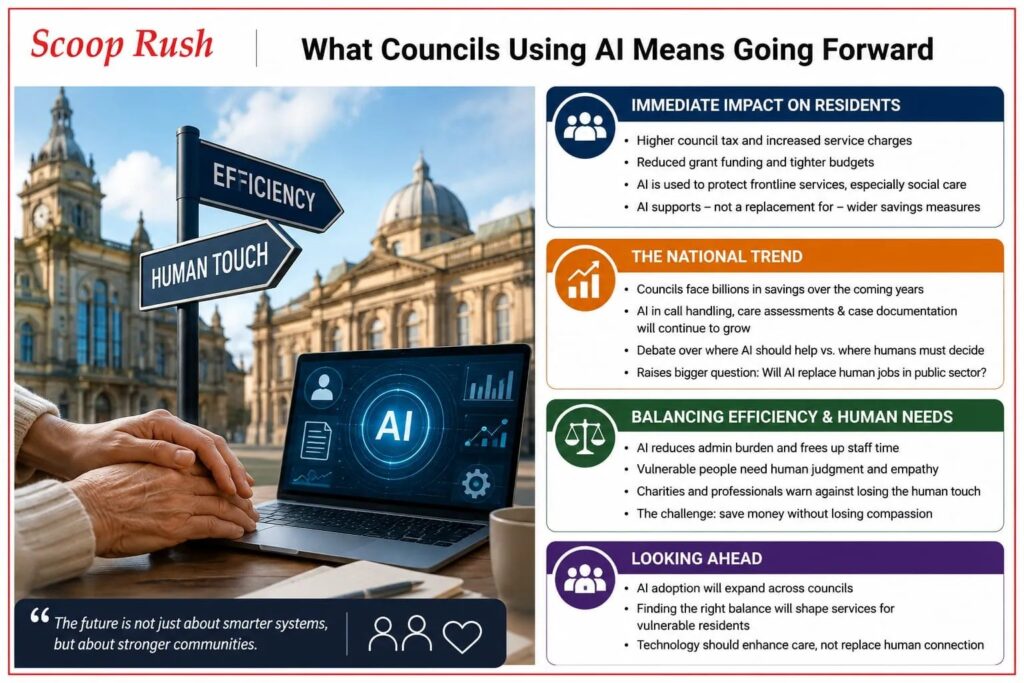
For residents in West Northamptonshire and North Northamptonshire, the immediate impact already shows up through higher council tax, increased service charges, and reduced grant funding. Officials position AI as a way to soften the blow on frontline services, particularly in social care, rather than as a replacement for these broader savings measures — and as public bodies lean further into automation, demand for skilled talent is rising too, much like the growing interest in how to become a data analyst in 2026.
The national picture suggests this pattern will continue. Councils need to find billions more in savings over the coming years, so AI adoption in call handling, care assessments, and case documentation will likely expand further. Consequently, the debate over where AI should assist versus where it should stay out of decision making will only grow louder, feeding directly into the bigger question of whether AI will replace human jobs across the public sector.
Ultimately, the tension is clear. Councils need to save money, and AI offers a genuine way to reduce administrative burden and free up staff time. At the same time, charities, campaigners, and social work professionals warn that vulnerable people need human judgment and human warmth built into their care, not just efficient systems. How councils balance these two pressures will shape daily life for some of the most vulnerable residents in the country over the next few years.
Conclusion
West Northamptonshire and North Northamptonshire councils use AI to help close a combined £37.6m budget gap, part of a much larger £4bn shortfall facing councils across the UK. AI already handles transcription, chatbot triage, and care plan drafting, and officials say it frees up staff time for more meaningful work with residents. However, campaigners and social work bodies warn that accuracy problems, accent recognition issues, and the risk of AI overstepping into care decisions remain real concerns. As councils continue cutting budgets and raising charges, the debate over how far AI should go in social care is only just beginning.
FAQs
Why do West Northamptonshire and North Northamptonshire councils use AI?
Both councils face major budget gaps, £24m and £13.6m respectively for 2027/28. They use AI to reduce administrative workload and improve efficiency, particularly in adult social care.
How much money do UK councils need to save overall?
A BBC Shared Data Unit study found that 218 upper-tier councils across the UK must make a combined £3.2bn in cuts this financial year. Councils expect to need a further £3.8bn by the end of 2027-28.
What tasks is AI handling in council social care services?
Councils use AI to transcribe conversations between social workers and residents, run chatbots that screen initial care requests, draft care plans, and automate invoice processing.
Are there risks when councils use AI in adult social care?
Yes. Age UK warns of an “inevitable risk” of inaccuracy in AI transcription, while the British Association of Social Workers raises concerns about AI drafting care assessments that determine support entitlements.
Does the government require councils to use AI?
No. The Ministry of Housing, Communities and Local Government says it does not mandate how councils use AI, but it encourages its use where it can help ease pressure and support staff.

