Home Blog Page 9

Does the Gelatin Trick for Weight Loss Really Work?

0

A cup of warm water, a spoonful of unflavored gelatin, and a few minutes of waiting that’s the entire “recipe” behind one of this year’s biggest diet trends. Across TikTok and Instagram, wellness creators (and, increasingly, AI-generated avatars) are promising that this simple drink can quiet your appetite, help you eat less, and jump-start weight loss, all without a prescription or a gym membership.

In a moment when GLP-1 drugs like Ozempic and Wegovy dominate the weight-loss conversation, a trick built from a grocery-store staple sounds almost too easy. But nutrition experts say the truth is more complicated and, in some cases, the hype outruns the science by a wide margin.

Here’s what the gelatin trick actually is, what happens in your body when you try it, what the research really shows, and whether it deserves a spot in your routine.

What Is the Gelatin Trick?
What Is the Gelatin Trick?|Scoop Rush

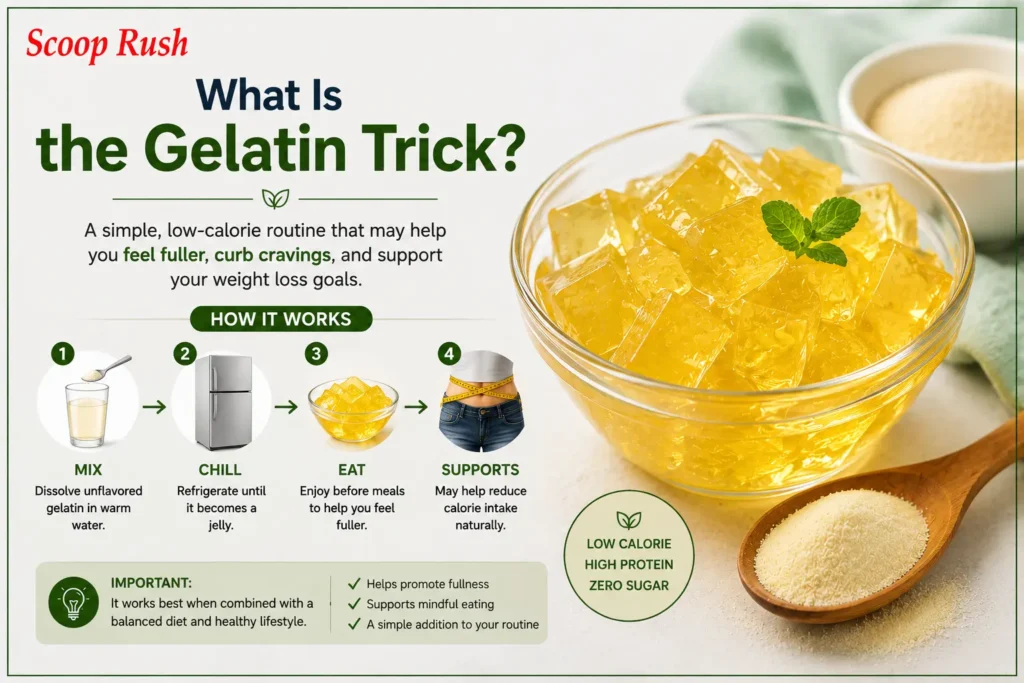
The gelatin trick involves dissolving a tablespoon or single packet of unflavored gelatin powder into a full glass of warm or cold water, then drinking it roughly 15 to 30 minutes before a meal. Some versions swap in green tea, apple cider vinegar, lemon, cranberry juice, or a pinch of salt, but the core idea stays the same: drink something thick and protein-containing before you eat, so you naturally eat less once the meal arrives.

Where the Trend Came From

The trend isn’t entirely new. Bone broth and gelatin-based pre-meal rituals have roots in culinary traditions across Northern Europe and East Asia, where people simply considered a warm, savory, protein-rich drink before dinner good practice for digestion not a weight-loss hack. What’s changed is the packaging. Short-form video has rebranded a centuries-old habit as a five-minute biohack, and algorithms amplify it by rewarding dramatic, easy-to-digest claims over nuanced ones.

Why It’s Spreading Right Now

Registered dietitians say the appeal makes sense given the current moment. A gelatin drink costs a few cents per serving, requires no doctor’s visit, no insurance approval, and no needle. It taps into genuine anxiety about the cost and accessibility of prescription weight-loss medications, many of which run several hundred dollars a month without coverage. For someone priced out of a GLP-1 prescription, a $6 tub of gelatin powder that promises even a fraction of the same effect can feel like a reasonable bet even if the comparison doesn’t hold up under scrutiny. It’s part of a long lineage of low-cost weight-loss shortcuts, from diet soda swaps to high-protein plans like the carnivore diet, that promise big results from a small, easy change.

There’s also a trust factor at play. Gelatin is a familiar kitchen ingredient, not a lab-made compound, and “food as medicine” framing tends to feel safer to people than pharmaceuticals, even when the actual evidence points in the opposite direction.

How the Gelatin Trick Is Supposed to Work
How the Gelatin Trick Is Supposed to Work|Scoop Rush

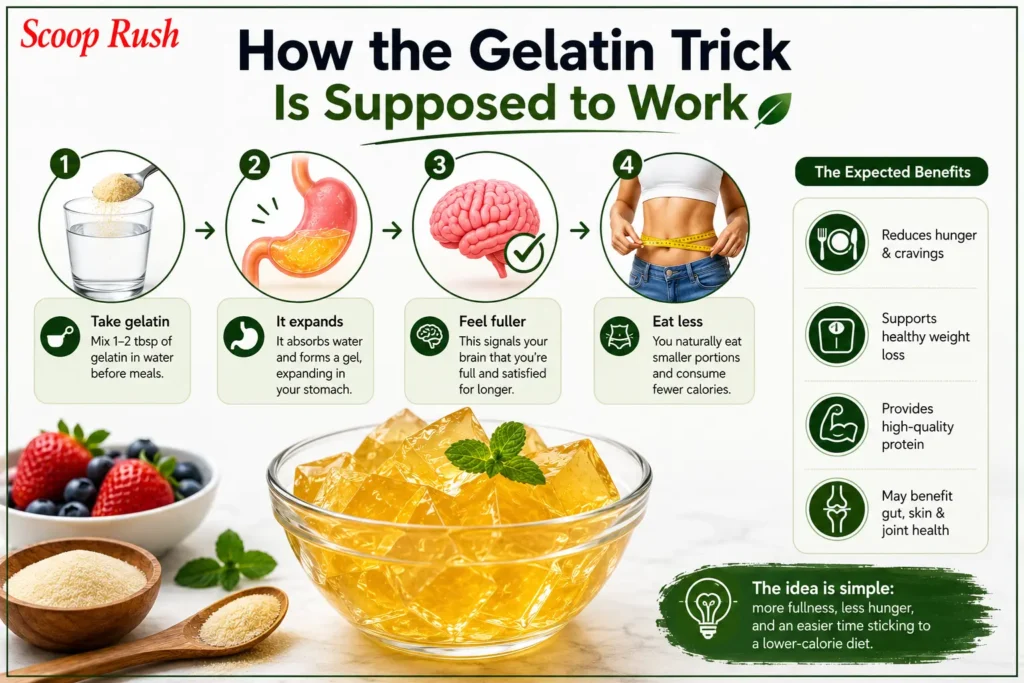
Believers in the trend point to two mechanisms:

  • Volume and viscosity. Gelatin thickens in the stomach, creating a temporary sense of fullness before food even arrives.
  • Protein content. Gelatin contains a modest amount of protein, and protein is well known to blunt hunger more effectively than carbohydrates or fat.

The GLP-1 Claim, Explained

Some newer explanations go further, claiming the drink triggers a release of the hormone GLP-1 the same hormone mimicked by drugs like Ozempic which slows digestion and signals fullness to the brain. There is early, limited research suggesting a hydrolyzed gelatin preload can raise GLP-1 and insulin markers in a lab setting. But dietitians caution against reading too much into that finding, since a short-term hormonal blip in a small study is a long way from a proven weight-loss strategy.

It helps to understand the scale of the difference. Prescription GLP-1 medications deliver a concentrated, engineered compound that keeps GLP-1 receptor activity elevated for days at a time, which is part of why they produce such dramatic and sustained appetite suppression. A gelatin drink, by contrast, may nudge the body’s own natural GLP-1 output slightly for perhaps an hour after you drink it. Comparing the two isn’t apples to apples — it’s closer to comparing a campfire to a furnace because both involve fire.

Gelatin Drink vs. Prescription GLP-1 Medication

Gelatin DrinkPrescription GLP-1 Medication
MechanismMild, natural, short-term hormone nudgeSustained receptor activation via engineered compound
Duration of effectRoughly 30–60 minutesDays, with weekly dosing
Typical weight lossNo reliable clinical data specific to gelatinOften 10–20% of body weight over a year in trials
CostA few cents to a few dollars per servingOften $300–$1,000+ per month without insurance
Medical oversightNone requiredPrescribed and monitored by a physician
Side-effect profileMinimal at normal dosesNausea, GI effects, and other documented side effects

The takeaway isn’t that one approach is “better” than the other in the abstract it’s that they aren’t solving the same problem at the same scale, and marketing that implies otherwise is misleading. It’s also worth knowing that prescription GLP-1 drugs come with their own trade-offs, including documented muscle loss risks with GLP-1 medications that a mild gelatin drink simply doesn’t carry.

The Gelatin Trick Recipe: Step by Step

If you want to try it, most versions follow the same basic structure.

StepWhat to Do
1Measure 1 tablespoon (about 7 grams) of unflavored, unsweetened gelatin powder
2Sprinkle it into 8 ounces of water — warm water dissolves standard gelatin more easily; hydrolyzed gelatin dissolves fine in cold water
3Let it sit for 1–2 minutes to fully dissolve or “bloom”
4Stir well until no clumps remain
5Optional: add a squeeze of lemon, a splash of green tea, or a pinch of salt for taste — if you want it sweeter, stick to a keto-friendly sweetener rather than sugar, so you don’t undercut the point of the drink
6Drink the full glass 15–30 minutes before your meal

Nutritionally, plain gelatin powder delivers roughly 2 to 4 grams of protein and 5 to 20 calories per serving. Hydrolyzed gelatin supplements  the kind sold as a powder for smoothies tend to pack more protein, closer to 8 to 12 grams per serving, similar to a standard collagen supplement. As an animal-based protein source, gelatin fits naturally into diets built around meat, bone, and connective-tissue nutrition, but it’s a poor fit for anyone eating primarily plant foods.

Gelatin Nutrition Facts at a Glance

NutrientStandard Unflavored GelatinHydrolyzed Gelatin/Collagen Powder
Protein2–4 g per serving8–12 g per serving
Calories5–20Slightly higher, varies by brand
Fiber0 g0 g
Fat0 g0 g
Amino acid profileIncomplete (lacks some essential amino acids)Incomplete
SourceCollagen from animal bones, skin, connective tissueSame, further broken down for solubility

That “incomplete protein” detail matters. Gelatin is missing several essential amino acids that the body can’t produce on its own, which means it doesn’t function nutritionally the same way a serving of chicken, fish, beans, or Greek yogurt would. Dietitians note that people online often overstate how much protein and how much genuine fullness a spoonful of gelatin can actually provide. It’s a good reminder that more supplementation isn’t automatically better; it’s worth understanding the broader risks of taking too many supplements before stacking gelatin on top of an already-crowded routine.

What Does the Science Actually Say?

What Does the Science Actually Say?|Scoop Rush

This is where the trend splits into two very different stories, depending on which body of research you’re looking at.

The Strong Evidence: Protein Preloading in General

Multiple controlled trials have found that eating or drinking a source of protein 15 to 30 minutes before a meal can modestly reduce the blood sugar spike that follows, and can nudge people toward eating somewhat less. This effect has been demonstrated with whey protein and other complete proteins in people with and without diabetes, and it’s one of the more consistently replicated findings in appetite research. It’s a legitimate, well-established strategy — it just isn’t specific to gelatin.

The Weaker Evidence: Gelatin Specifically

The evidence for gelatin on its own is considerably thinner. A handful of smaller, older studies have tested hydrolyzed gelatin as a pre-meal drink and found it can produce a similar, if less robust, hormonal response a short-term rise in satiety-related hormones. Sample sizes in this research tend to be small, follow-up periods short, and none of the available studies actually measured long-term weight change in people using a gelatin preload as their primary strategy. In other words, the mechanism is plausible; the outcome most people care about sustained weight loss has never actually been tested.

What the Dietitians Actually Say

Dietitians who spoke to reporters on the record about the trend were far more skeptical in practice than the lab data might suggest. Registered dietitian Natalie Rizzo, TODAY.com’s nutrition editor, has pointed out that any sense of fullness from the drink is likely to fade quickly, and that people are overestimating both the protein content and the staying power of the effect. Registered dietitian and author Frances Largeman-Roth has echoed that concern, noting that a temporary, low-calorie trick to suppress appetite isn’t a strategy she’s comfortable recommending, in part because it doesn’t address what actually keeps people full: fiber, healthy fats, and complete protein none of which gelatin provides in meaningful amounts.

Both experts agree on the bottom line: the gelatin trick will not burn fat, it is not a substitute for a balanced diet, and any appetite suppression is short-lived often less than an hour.

How the Gelatin Trick Went Viral: A Quick Timeline

Understanding how a trend like this spreads helps explain why the claims got bigger and less accurate over time.

  • Late 2024: Early versions of the trend appear on TikTok, framed modestly as a bone-broth-adjacent pre-meal ritual for digestion and mild fullness.
  • Early-to-mid 2025: The framing shifts toward weight loss specifically, with creators pairing gelatin drinks against the backdrop of rising GLP-1 medication searches. Claims about “GLP-1 release” begin appearing, often stripped of the nuance found in the original research.
  • Mid-2025: AI-generated wellness accounts begin producing high volumes of near-identical videos, repeating the same statistics and testimonials without attribution, making the claims feel more established simply through repetition.
  • Late 2025 into 2026: A parallel, riskier fad mixing Jell-O with baking soda and vinegar goes viral and draws media attention after a well-known figure says she tried it based on an AI deepfake video and experienced bloating and discomfort. That story puts a spotlight on the broader category of gelatin-based hacks, gelatin trick included, and prompts more dietitians to publicly weigh in with corrections.

This pattern a modest, plausible idea getting amplified into an overstated claim through repetition rather than evidence is common across viral wellness trends, not unique to gelatin.

The Rebound Problem

One risk that gets little attention in viral videos: what happens after the fullness wears off.

Why the Fullness Doesn’t Last

Because gelatin doesn’t provide fiber or a complete amino acid profile, the sense of satiety it creates tends to disappear faster than the fullness from a real meal or snack. Fiber, in particular, slows gastric emptying and keeps blood sugar more stable for hours gelatin has none. Dietitians warn this mismatch can set up a rebound effect: intense hunger a few hours later that leads to overeating, often of less nutritious foods, simply because the body is trying to catch up on both calories and nutrients it didn’t get earlier.

How This Plays Out at the Dinner Table

Eating while very hungry also tends to affect food choices and portion control. Decision fatigue and blood-sugar dips both make it harder to reach for a balanced plate and easier to reach for whatever’s fastest and most calorie-dense. That dynamic can quietly undercut the very goal — eating less overall that people are chasing when they start the trend in the first place. In practice, someone who ate a smaller dinner because of a gelatin drink may end up snacking more heavily later in the evening, which can cancel out any calorie savings entirely.

What People Are Actually Reporting

Beyond the lab research, it’s worth looking at the pattern of experiences people describe after trying the trend for themselves, since real-world use rarely matches a controlled study.

The Common Short-Term Report

Many people who try the gelatin trick for the first time describe a genuine — if brief — sense of fullness in the first meal or two. This tracks with the mechanism: a large volume of thick liquid does take up physical space in the stomach, at least temporarily. Some also report drinking less at the actual meal simply because they’re less thirsty, which can be mistaken for reduced hunger.

The Common Follow-Up Report

Fewer people report the same effect holding up after a week or two of consistent use. This lines up with what dietitians would predict: a habit built entirely around volume and mild protein, without addressing fiber or overall diet quality, tends to lose its novelty and its physiological impact once the body adjusts. It also explains why so many testimonial videos are filmed on “day one” rather than “day thirty.”

The Honest Read

None of this amounts to clinical proof either way — anecdotal reports aren’t controlled data, and social media testimonials in particular tend to overrepresent dramatic outcomes in both directions. But the pattern is at least consistent with the underlying science: a short-lived, modest effect rather than a sustained, meaningful one.

Who Should Avoid the Gelatin Trick

Who It’s Probably Fine For

Occasional, moderate use of a gelatin drink is generally considered low-risk for most healthy adults with no relevant medical conditions.

Who Should Be More Cautious

The following groups should either check with a doctor first or skip the trend altogether:

  • People with kidney disease or a history of kidney stones. Gelatin is almost entirely protein by dry weight, and a concentrated protein load can increase strain on kidney filtration.
  • Anyone on anticoagulant medication. Gelatin contains bioactive peptides that may interact with blood-clotting processes; check with a prescriber first.
  • Pregnant people. Not inherently dangerous, but pregnancy already comes with elevated protein needs that a gelatin ritual doesn’t meaningfully add to.
  • Children and teenagers. Gelatin as a food is fine, but building a daily “appetite suppression” habit isn’t appropriate for a still-developing relationship with food.
  • Anyone with a history of disordered eating. Pre-meal rituals designed to blunt hunger can, for some people, reinforce restrictive patterns. This is a case where speaking with a doctor or therapist first is the safer move.
  • Strict plant-based eaters. Gelatin is an animal product (typically derived from cow or pig collagen), so it’s not compatible with a plant-based diet.

Expert Opinions: Is It Worth Trying?

Dietitians interviewed about the trend are careful to separate two different claims: that gelatin “can create brief fullness” versus that it “causes weight loss.” The first is plausible and mild; the second isn’t supported by the evidence.

The Skeptical Camp

Rizzo has described the broader category trying to trick yourself into feeling full on something with almost no calories as an approach that doesn’t sit well with her as a long-term habit, a sentiment Largeman-Roth shares. Their concern isn’t that a glass of gelatin water is dangerous in isolation. It’s that hacks like this train people to look for shortcuts instead of building sustainable habits, and that repeated use can crowd out real food and the vitamin C, iron, potassium, and calcium that comes with it. Both dietitians frame the trend less as a health risk and more as a distraction from strategies that actually have a track record: adequate protein at meals, fiber intake, consistent sleep, and gradual, sustainable calorie management.

The Cautiously Supportive Camp

Obesity-medicine clinicians who study “satiety engineering” using pre-meal tools like broth or protein to reduce calorie intake without relying purely on willpower take a slightly more favorable view, framing gelatin as a low-cost entry point into that broader strategy. Even there, though, the caveat is consistent: it only works as one small piece of a bigger, calorie-conscious eating pattern, not as a standalone fix. This camp tends to see the gelatin trick less as a solution and more as a gateway habit something that might help a person notice how pre-meal protein affects their appetite, which could then lead them toward more substantial, food-based versions of the same strategy.

Where the Two Camps Agree

Despite the difference in tone, both groups land in roughly the same place: the gelatin trick is not dangerous for most healthy adults in moderation, it is not a proven weight-loss method on its own, and it should never replace medical guidance for someone pursuing significant weight loss.

A Note on the AI Hype Machine

Why So Many Videos Sound the Same

Part of what’s fueling the gelatin trick’s spread is a wave of AI-generated wellness content — auto-narrated videos that recycle the same unverified claims across dozens of accounts, often with near-identical scripts, statistics, and “expert” framing. This repetition can create a false sense of consensus: if the same claim appears in fifty different videos, it starts to feel established, even when all fifty are tracing back to the same unverified source.

A Cautionary Example

A related fad, involving Jell-O mixed with baking soda and vinegar, recently made headlines after a well-known figure said she tried it based on an AI deepfake video and ended up bloated and unwell. That episode is a useful reminder: virality is not the same as verification, and a trend spreading fast across social media is not evidence that it works. Before trying any viral health hack, it’s worth asking who’s actually behind the claim a licensed professional, or an anonymous account optimizing for watch time.

Healthier Ways to Curb Hunger Before a Meal

If the goal is simply to feel more satisfied and eat a bit less at dinner, dietitians say there are options with a better nutritional payoff than a glass of flavorless gelatin. Many of these overlap with staples of a low-carb diet, which tends to be naturally higher in protein and fat — two of the nutrients most linked to lasting fullness.

Quick, Grab-and-Go Options

  • A small handful of nuts or seeds
  • A serving of berries
  • A hard-boiled egg
  • A full glass of water, which adds volume and helps with hydration on its own

For a Heartier Pre-Meal Snack

  • Greek yogurt or cottage cheese
  • Beans or lentils in a small side dish
  • Bone broth, which offers some of the same collagen-derived compounds as gelatin, along with more flavor, minerals, and often a bit more protein per serving
  • A few keto-friendly snacks if you’re already watching carbs, such as cheese, olives, or avocado

These options bring fiber, healthy fats, and complete protein to the table the three things nutrition experts say actually drive lasting fullness, none of which unflavored gelatin can offer on its own.

The Bottom Line

The gelatin trick isn’t a scam, exactly, but it isn’t the fat-burning shortcut that viral videos claim, either.At best, it functions as a very mild, short-lived version of a well-documented strategy: eating a little protein before a meal to take the edge off your appetite. At worst, it sets people up for a hunger rebound a few hours later, displaces more nutritious food from the diet, and reinforces the idea that sustainable weight loss can come from a single trick rather than consistent habits.

If you enjoy the ritual and have no medical reason to avoid it, an occasional glass of gelatin water before dinner is unlikely to cause harm. Just don’t expect it to replace a balanced plate  or to do the work that fiber, protein-rich whole foods, sleep, and movement do over time. If you’re looking for changes that actually move the needle, small, consistent healthy habits in your 20s and 30s like taking a 5-minute walk every hour  tend to outperform any single pre-meal trick.

FAQs

Does the gelatin trick actually help you lose weight?

Not on its own. It may create brief fullness that leads to a slightly smaller meal, but there’s no strong evidence it burns fat or produces meaningful weight loss by itself. Any results depend on the overall diet around it.

How much gelatin should I use?

Most versions call for about 1 tablespoon (roughly 7 grams) of unflavored gelatin powder dissolved in a full 8-ounce glass of water, consumed 15 to 30 minutes before eating.

Is gelatin the same as collagen?

They’re closely related. Connective tissue contains collagen, the raw protein; cooking breaks that collagen down into gelatin. Manufacturers process hydrolyzed collagen powders even further so they dissolve more easily.

Can I use flavored Jell-O instead of plain gelatin?

No — flavored gelatin desserts are mostly sugar and don’t offer the same protein-to-calorie ratio. If you want to try the trend, unflavored, unsweetened gelatin powder is the version being discussed. (Flavored gelatin does have its place elsewhere, though it’s a staple of the clear liquid diet used before certain medical procedures.)

Is the gelatin trick safe for everyone?

Not necessarily. People with kidney disease, those on blood-thinning medication, pregnant people, children, and anyone with a history of disordered eating should talk to a doctor before trying it or avoid it altogether.

What should I do instead if I want to curb hunger before meals?

Reach for whole foods that combine protein, fiber, and healthy fats nuts, Greek yogurt, beans, berries, or a hard-boiled egg paired with a glass of water. These provide more complete nutrition and longer-lasting fullness than gelatin alone.

Why is this trend going viral right now?

It’s spreading partly because it’s cheap and easy compared with prescription weight-loss medications, and partly because of a wave of wellness content including AI-generated videos that repeats the same unverified claims across social platforms.

Does the gelatin trick really trigger GLP-1 like Ozempic does?

There’s early, small-scale research suggesting a mild, short-lived rise in the body’s own GLP-1 output after a gelatin preload. That’s a real but limited effect nothing close to the sustained receptor activation produced by a prescription GLP-1 medication, which works continuously for days rather than roughly an hour.

Can I take it with coffee?

Yes, mix the gelatin into water and have your coffee on the side rather than dissolving it directly into a hot cup. If you’re curious about the broader effects of caffeine before eating, it’s worth reading up on drinking coffee on an empty stomach as well.

Can I drink gelatin water every day long-term?

Occasional use is generally considered low-risk for healthy adults, but dietitians caution against relying on it daily as a substitute for real food. Doing so consistently can crowd out nutrients like fiber, vitamin C, iron, and calcium that a gelatin drink simply doesn’t provide.


Supreme Court Backs Trump Mail Voting Restrictions Before Midterms

0

The Supreme Court handed President Donald Trump a temporary win on Monday. The ruling backs Trump’s mail voting restrictions and lets parts of his plan move forward. Democratic-led states still hope separate lawsuits can block the policy before November.

The justices did not rule on whether Trump’s executive order is legal. Instead, they focused on timing. The court said Democratic-led states filed their challenge too early, before the harm became clear.

Supreme Court Gives Trump an Interim Win

Supreme-Court-Gives-Trump-an-Interim-Win

The Supreme Court issued an unsigned order on Monday. The vote split 6-3 along ideological lines, with all three liberal justices dissenting. The conservative majority did not examine whether Trump’s order violates the Constitution.

Instead, the majority questioned whether states faced immediate legal harm. The justices said states sued before the policy’s effects became concrete. That reasoning let the court lift a lower court injunction covering 23 states and Washington, D.C. The ruling also granted a similar request tied to Alabama and 11 other states.

What Trump’s Executive Order Requires

Trump signed the order in March 2026. It hands the Postal Service and the Department of Homeland Security new roles in election administration. The White House says the changes will boost election security.

The order tells states to submit lists of eligible mail voters. The Postal Service would then check ballots against those lists before delivery. Homeland Security would separately build its own citizen eligibility lists. Officials could use those lists during investigations tied to alleged voting violations.

Postal Service Faces New Ballot Rules

The Postal Service plays a central role in Trump’s plan. Under the order, states must hand over voter eligibility data. The agency would use that data before processing certain mail ballots.

USPS also issued a final rule on Friday. The rule sets new design standards for ballot envelopes. It requires tracking barcodes and a new online portal for states to submit voter information. Critics say the tight timeline creates a heavy burden for an already strained agency.

Massachusetts Injunction Still Blocks USPS

A separate legal fight still limits Trump’s plan. U.S. District Judge Indira Talwani issued a nationwide injunction in a different case in June. That order came from a lawsuit filed by voting rights groups, not the 23 states.

Monday’s Supreme Court ruling did not lift that injunction. So USPS still cannot enforce every part of the new rule nationwide. Voting rights groups filed an emergency motion over the weekend, arguing USPS violated Talwani’s order by posting Friday’s rule. The administration must respond by Tuesday morning.

Democratic States Push Back

Democratic-States-Push-Back

Twenty-three Democratic-led states challenged Trump’s order, along with Washington, D.C. They argue the Constitution gives states, not the president, authority over election procedures. They warn the changes could disrupt voting before the midterms.

Their lawsuit focused on the pressure the order already created. States said they faced real burdens preparing for federal demands. The Supreme Court disagreed on timing, not the merits. The justices said states can still sue once USPS or DHS finalizes specific actions.

Liberal Justices Warn of Election Chaos

The court’s three liberal justices strongly criticized the ruling. Justice Sonia Sotomayor, joined by Justice Elena Kagan, wrote that lower courts already had authority to rule for the states. She stressed the decision settles nothing about Trump’s legal authority.

Justice Ketanji Brown Jackson wrote a separate, lengthy dissent. She said the ruling “needlessly injects chaos and uncertainty” into the midterms. Jackson called the court’s shifting timing rules a “Kafkaesque nightmare” for election plaintiffs. She argued the case was “not a close call.”

White House Calls It a Major Win

White-House-Calls-It-a-Major-Win

The White House celebrated Monday’s decision. Spokeswoman Lauren Bis called it a major win for election security. She said the administration wants stronger safeguards around mail ballots.

Trump has repeatedly raised concerns about noncitizen voting. Federal courts have not found evidence of widespread fraud supporting those claims. The administration insists federal agencies must act lawfully going forward. Still, the Supreme Court warned that future implementation steps could face fresh legal challenges.

A Tight Timeline Before the Midterms

Time pressure looms over this entire fight. North Carolina is set to send the nation’s first midterm mail ballots within days. Officials in several states must prepare mailing systems soon after.

That schedule leaves little room for drawn-out litigation. Election administrators may need to adjust procedures while courts keep reviewing the rules. Legal experts say more court battles are likely before Election Day. One law professor described the fight as only the first inning of a long game.

What Happens Next in the Legal Fight

The next major ruling could come from Judge Talwani in Massachusetts. Her nationwide injunction still blocks core USPS requirements. Voting rights groups want her to act quickly against Friday’s new rule.

The Trump administration could ask an appeals court to step in. It could also return to the Supreme Court for another emergency ruling. Meanwhile, Democratic states remain free to challenge specific actions as they happen. The legal battle over Trump’s mail voting restrictions is far from over.

Why This Ruling Matters

Mail voting affects millions of Americans every election cycle. Any last-minute rule change creates real risks for voters and election workers alike. The approaching midterms make this timing especially critical.

The case also raises bigger questions about federal power over elections. States argue this authority belongs to them and Congress, not federal agencies. Monday’s ruling does not resolve that debate. Voters and election officials must now wait for the next court decision.

Conclusion

The Supreme Court’s ruling gives Trump a temporary victory on mail voting. However, it does not settle the legality of his executive order. Further court challenges could still block key parts of the plan before November.

For now, the biggest issue remains timing. States must prepare for mail voting while courts continue reviewing the rules. Therefore, Trump’s mail voting restrictions could face more legal battles before the 2026 midterm elections.

FAQs

1. Did the Supreme Court approve Trump’s entire mail voting order? 

No. The Supreme Court only ruled that states sued too early. It did not decide whether the executive order itself is lawful. Courts will keep reviewing specific parts of the plan.

2. Can USPS immediately enforce Trump’s new ballot rules? 

Not fully. A separate nationwide injunction from a Massachusetts judge still blocks key USPS actions. That case involves voting rights groups, not the 23 states in Monday’s ruling.

3. What does Trump’s order require from states? 

States must submit lists of eligible mail voters to the federal government. Ballot envelopes need new tracking barcodes under USPS rules. Homeland Security will also build separate voter eligibility lists.

4. Why did Democratic-led states sue over the order? 

States argue the Constitution gives them, not the president, control over elections. They fear confusion and delays before the midterms. They also worry about federal pressure on local election officials.

5. Will the Supreme Court hear this case again? 

Very likely. Several legal questions remain unresolved after Monday’s ruling. New lawsuits over specific USPS or DHS actions could reach the justices again before November.

Best Halal Fine-Dining Restaurants in Toronto for Date Night: Where Should You Celebrate?

0

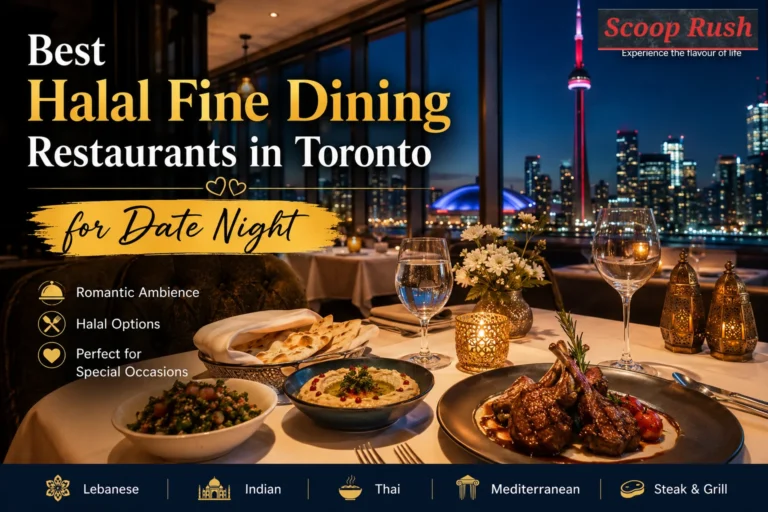
Planning an anniversary, birthday, engagement, or simply a special night out? Halal fine dining Toronto options have grown far beyond casual shawarma shops. Toronto now has elegant Lebanese, Indian, Thai, Middle Eastern, and steak-focused restaurants where Muslim diners can enjoy a more polished dinner experience. Some restaurants are fully halal, while others offer halal meat or selected halal dishes, so checking the restaurant’s current policy is important before making a reservation. For a romantic dinner, Amal, Aroma Fine Indian Cuisine, Khazana Toronto, and Affy’s Premium Grill are among the options worth considering, while Byblos Downtown can work for couples who are comfortable ordering specific halal dishes. This guide compares the options by location, cuisine, atmosphere, price, and halal status so you can choose the right restaurant for your celebration.

Quick Answer: What Are the Best Halal Fine-Dining Restaurants in Toronto?

For a special date night, Amal is one of the strongest choices for modern Lebanese dining because its full menu is halal certified. Aroma Fine Indian Cuisine offers an elegant downtown setting and an extensive Indian menu, while Khazana Toronto combines modern Indian cooking with tasting-menu options and a convenient Yonge Street location. Affy’s Premium Grill is a practical choice if steak and grilled dishes are the priority.

For diners who are comfortable with restaurants that have selected halal dishes, Byblos Downtown offers an upscale Eastern Mediterranean setting, while The Bombay provides Indian dining in downtown Toronto with halal food available on request. SukhoTHAI is another downtown option with halal meat and Thai dishes, although its atmosphere is more relaxed than traditional fine dining.

Halal Fine Dining Toronto: Restaurant Comparison

RestaurantLocationCuisineBest ForPopular DishPrice RangeHalal Status
Amal TorontoBloor Street WestLebaneseAnniversary, romantic dinnerMezze, skewers, kanafeh$$$Full menu halal certified
Aroma Fine Indian CuisineKing Street WestIndianCouples, celebrations, pre-theatre dinnerIndian mains and tandoori dishes
-$
Reported fully halal, verify directly
KHAZANA TorontoIndian Kitchen by Chef Sanjeev KapoorYonge StreetModern IndianAnniversary, tasting menu$$$Halal options, verify dishes
SukhoTHAIWellington Street EastThaiCasual date nightThai curries and noodles$$Halal meat/all meat reported halal
AFFY’S PREMIUM GRILLScarboroughSteak, grill, North AmericanSteak dinner, family celebrationFilet mignon, ribeye, lamb chops
-$
Restaurant identifies itself as halal
The BombayQueen Street WestIndianLate dinner, couplesDum-Pukht biryani, curries
-$
Halal food available on request
Byblos DowntownDuncan StreetEastern MediterraneanUpscale date nightHalal meat selections, shared plates$$$Selected halal items, verify when ordering

Price ranges are general guides based on current menu information and listings, not fixed per-person costs. Prices can change.

Which Halal Fine-Dining Restaurants Are Best for an Anniversary in Toronto?

For a classic anniversary dinner, Amal, Aroma, and Khazana are among the strongest options because they combine a polished setting with full-service dining and menus suited to a longer meal.

1. Amal Toronto: A Strong Choice for a Romantic Lebanese Dinner

Located at 131 Bloor Street West, Amal brings modern Lebanese cooking to Yorkville. The restaurant has a stylish setting and is listed by the Michelin Guide as a Lebanese restaurant with a halal menu. More importantly for diners looking for clear halal information, Amal’s own website states that its full menu is halal certified.

The menu focuses on shareable Lebanese dishes, which works particularly well for couples. Options include hummus, baba ghanoush, spinach fatayer, skewers, grilled octopus, and kanafeh.

Atmosphere: Stylish, lively, and modern.

Best for: Anniversaries, birthdays, romantic dinners, and special celebrations.

Price: $$$. OpenTable currently lists Amal in the CA31toCA50 range, before taxes, drinks, and other charges.

Dining options: Dine-in and reservations are available, with private and large-party bookings also offered. The restaurant’s official contact page also confirms underground parking at the Colonnade Parkade.

Why visit: The combination of a polished Yorkville setting and a full halal-certified menu makes Amal particularly suitable for a special Muslim-friendly date night.

Where Can You Find Halal Fine Dining Downtown Toronto?

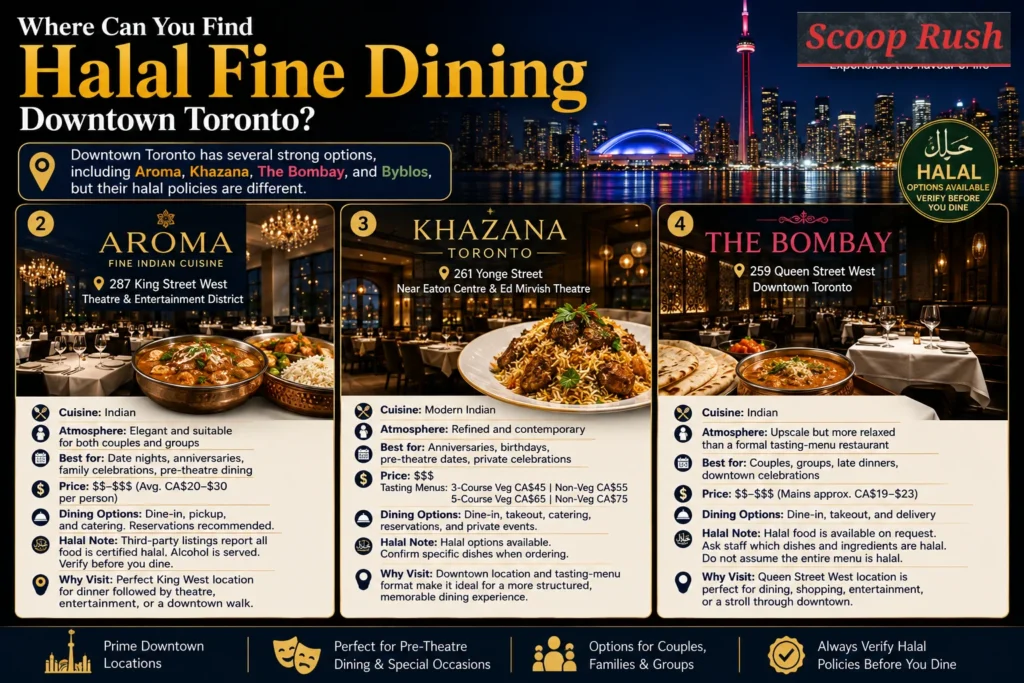
Downtown Toronto has several strong options, including Aroma, Khazana, The Bombay, and Byblos, but their halal policies are different.

2. Aroma Fine Indian Cuisine: Indian Fine Dining Near King Street West

Aroma is located at 287 King Street West, in Toronto’s Theatre and Entertainment District. Its official website describes the restaurant as fine Indian dining and highlights its elegant setting, intimate dining, private events, takeout, and catering.

The menu features a broad selection of Indian dishes, including meat and vegetarian choices. Third-party halal listings report that all food is certified halal, although the same listing notes that alcohol is served. Because halal certification information can change, diners with strict requirements should confirm directly with the restaurant before visiting.

Atmosphere: Elegant and suitable for both couples and groups.

Best for: Date nights, anniversaries, family celebrations, and pre-theatre dining.

Price:

–

.CurrentbusinesslistingsplacetypicaldiningaroundCA20 to CA$30, while the full dinner cost depends on what you order.

Dining options: Dine-in, pickup, and catering are offered. Aroma also recommends reservations, particularly for busy dinner and pre-theatre periods.

Why visit: Its King Street West location makes it convenient for a dinner followed by a theatre, entertainment, or downtown walk.

3. Khazana Toronto: Modern Indian Dining Near Yonge-Dundas

Khazana Toronto is at 261 Yonge Street, near the Eaton Centre and Ed Mirvish Theatre. The restaurant describes itself as an elevated modern Indian dining experience and offers private events for groups.


Its menu includes Indian appetizers, vegetarian and non-vegetarian mains, biryani, breads, and desserts. Current menu listings also show three-course and five-course tasting menus, making it one of the more natural choices for a longer anniversary dinner.

Halal information should be confirmed before ordering because available sources identify halal options rather than clearly establishing that every item is halal. Earlier Toronto dining guides have also described Khazana as offering halal options.

Atmosphere: Refined and contemporary.

Best for: Anniversaries, birthdays, pre-theatre dates, and private celebrations.

Price: $$.Currenttasting-menupriceslistedonlineincludeapproximatelyCA45 for three-course vegetarian, CA55forthree-coursenon-vegetarian,CA65 for five-course vegetarian, and CA$75 for five-course non-vegetarian menus.

Dining options: Dine-in, takeout, catering, reservations, and private events.

Why visit: Its downtown location and tasting-menu format make it a useful option when you want an occasion to feel more structured than a casual dinner.

4. The Bombay: Downtown Indian Dining With Halal Available on Request

The Bombay is located at 259 Queen Street West. It describes itself as an upscale Indian restaurant in downtown Toronto and offers dine-in, takeout, and delivery.

Current menu information includes dishes such as Dum-Pukht Biryani, Kadhai Chicken or Lamb, Rogan Josh, Chicken Tikka Masala, and vegetarian dishes. The restaurant’s menu specifically states that halal food is available on request.

Atmosphere: Upscale but more relaxed than a formal tasting-menu restaurant.

Best for: Couples, groups, late dinners, and downtown celebrations.

Price:

–

.CurrentonlinemenulistingsshowmanymainsinroughlytheCA19 to CA$23 range.

Dining options: Dine-in, takeout, and delivery.

Halal note: Ask staff which dishes and ingredients are halal when ordering. Do not assume the entire kitchen or menu is halal simply because halal food is available on request.

Why visit: Its Queen Street West location is convenient for a date combined with shopping, entertainment, or a walk through the downtown core.

Are There Halal Restaurants in Toronto for a More Relaxed Date Night?

Yes. Not every good date-night restaurant needs to be formal. SukhoTHAI offers halal Thai dining in the downtown core and can work well for couples who prefer a relaxed dinner.

5. SukhoTHAI: A Downtown Thai Option

SukhoTHAI is at 52 Wellington Street East, close to Toronto’s downtown financial district. It serves Thai food and is reported by halal dining sources to serve halal meat, with one listing stating that all meat is halal.

The restaurant is a better match for a relaxed dinner than traditional luxury fine dining. It can still work for a couple looking for something different from Indian or Middle Eastern food.

Popular choices: Thai curries, noodles, and other Thai specialties.

Atmosphere: Casual and comfortable.

Best for: Couples, friends, and relaxed date nights.

Price: $,withcurrentlocallistingsputtingmealsaroundCA20 to CA$30.

Dining options: Dine-in, takeout, and delivery options are listed by halal dining sources.

Halal note: Available halal information indicates halal meat, but diners with strict requirements should confirm the current policy and preparation practices.

Why visit: It gives couples a chance to enjoy Thai cuisine rather than the more common halal Indian, Pakistani, or Middle Eastern choices.

Which Halal Restaurant Is Best for a Steak Dinner?

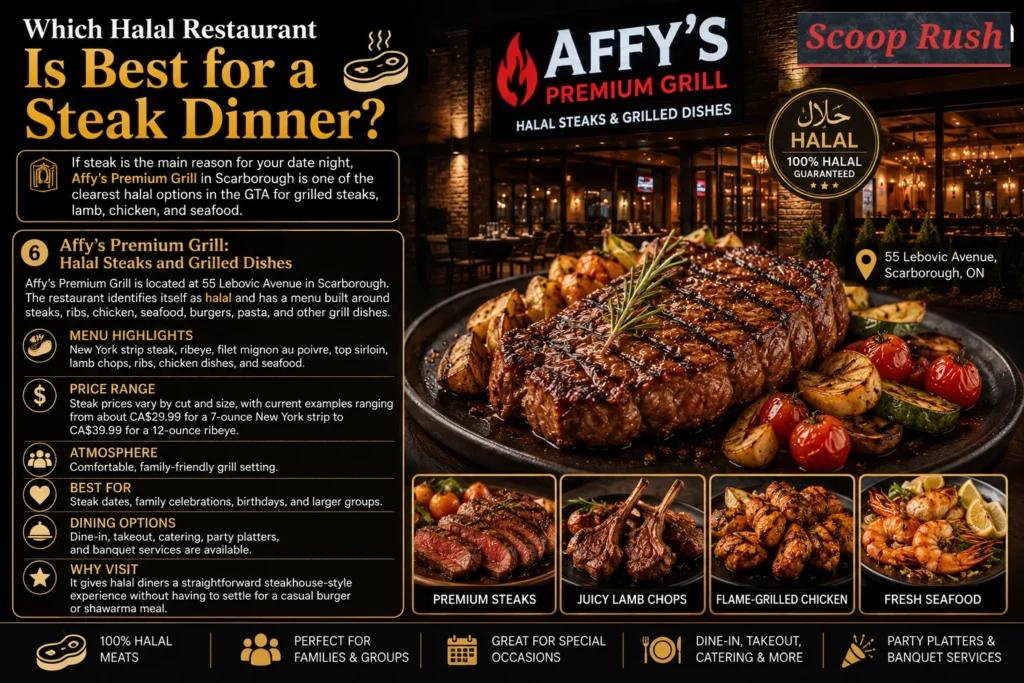
If steak is the main reason for your date night, Affy’s Premium Grill in Scarborough is one of the clearest halal options in the GTA for grilled steaks, lamb, chicken, and seafood.

6. Affy’s Premium Grill: Halal Steaks and Grilled Dishes

Affy’s Premium Grill is located at 55 Lebovic Avenue in Scarborough. The restaurant identifies itself as halal and has a menu built around steaks, ribs, chicken, seafood, burgers, pasta, and other grill dishes.

Current menu information lists New York strip steak, ribeye, filet mignon au poivre, top sirloin, lamb chops, ribs, chicken dishes, and seafood. Steak prices vary by cut and size, with current menu examples ranging from about CA29.99fora7-ounceNewYorkstriptoCA39.99 for a 12-ounce ribeye at the Scarborough location.

Atmosphere: Comfortable, family-friendly grill setting.

Best for: Steak dates, family celebrations, birthdays, and larger groups.

Price:

–

$.

Dining options: Dine-in, takeout, catering, party platters, and banquet services are available.

Why visit: It gives halal diners a straightforward steakhouse-style experience without having to settle for a casual burger or shawarma meal.

Can You Have an Upscale Halal Dinner at Byblos?

Yes, but Byblos Downtown should be treated as a restaurant with selected halal options, not as a fully halal restaurant.

7. Byblos Downtown: Eastern Mediterranean Dining

Byblos Downtown is located at 11 Duncan Street in Toronto’s Entertainment District. It is a two-storey Eastern Mediterranean restaurant with an upscale setting and a menu designed around shareable dishes.

Halal dining sources and restaurant information indicate that some meat dishes are halal. Reports specifically identify selected lamb, pide, and soujouk options, but the entire menu should not be assumed to be halal.

Atmosphere: Upscale, stylish, and well suited to date nights.

Best for: Couples who want an Eastern Mediterranean dining experience and are comfortable ordering confirmed halal items.

Price: $$$.

Dining options: Dine-in and reservations.

Halal note: Ask your server which meat and dishes are halal on the day of your visit. This is especially important because the restaurant also serves alcohol.

Why visit: The restaurant offers a more sophisticated Eastern Mediterranean setting for couples who want a special evening but do not require the entire restaurant to be halal.

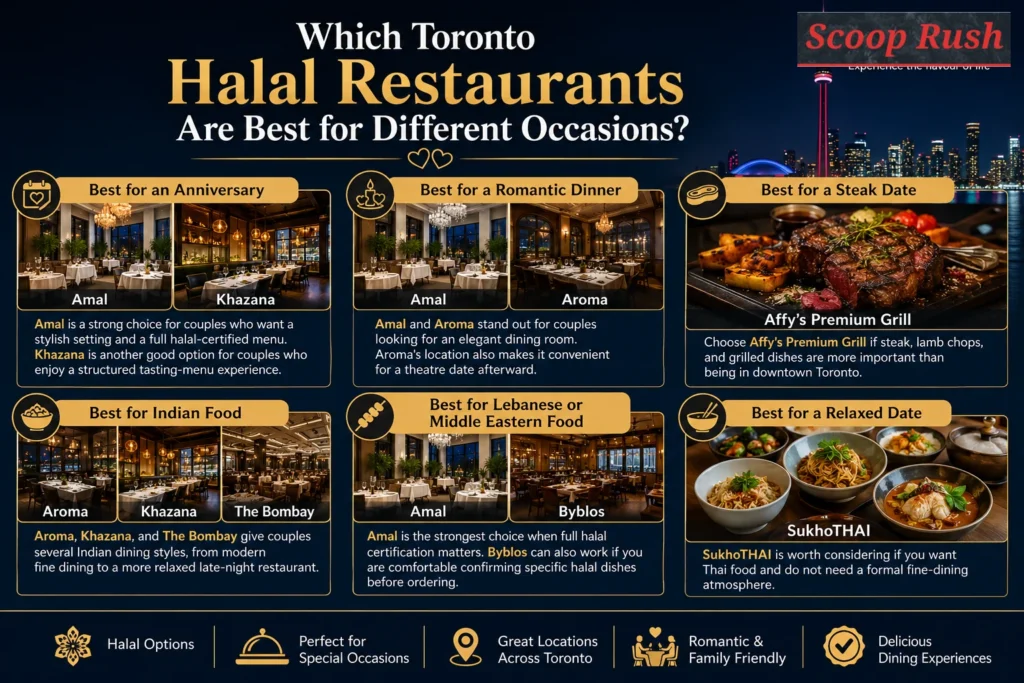
Which Toronto Halal Restaurants Are Best for Different Occasions?

Best for an Anniversary

Amal is a strong choice for couples who want a stylish setting and a full halal-certified menu. Khazana is another good option for couples who enjoy a structured tasting-menu experience.

Best for a Romantic Dinner

Amal and Aroma stand out for couples looking for an elegant dining room. Aroma’s location also makes it convenient for a theatre date afterward.

Best for a Steak Date

Choose Affy’s Premium Grill if steak, lamb chops, and grilled dishes are more important than being in downtown Toronto.

Best for Indian Food

Aroma, Khazana, and The Bombay give couples several Indian dining styles, from modern fine dining to a more relaxed late-night restaurant.

Best for Lebanese or Middle Eastern Food

Amal is the strongest choice when full halal certification matters. Byblos can also work if you are comfortable confirming specific halal dishes before ordering.

Best for a Relaxed Date

SukhoTHAI is worth considering if you want Thai food and do not need a formal fine-dining atmosphere.

What Are the Best Halal Fine-Dining Restaurants in Toronto by Budget?

$$: Moderate Special-Occasion Dining

For a more manageable dinner bill, consider SukhoTHAI, The Bombay, or Aroma. Menu prices vary based on appetizers, mains, desserts, drinks, and group size.

$$$: Upscale Date Night

Amal, Khazana, and Byblos are better suited to couples planning a more polished evening. Amal and Khazana offer particularly strong options for celebrations where the meal itself is part of the occasion.

$$: Steak and Larger Celebrations

Affy’s Premium Grill offers premium steak cuts and larger sharing options. It also provides banquet and catering services, making it useful for family celebrations beyond a dinner for two.

Is The Kabab Shoppe a Good Option for a Halal Celebration?

The Kabab Shoppe is better suited to casual group dining, catering, and grilled-food occasions than traditional downtown fine dining.

The restaurant has locations in the GTA, including Pickering, Whitby, and Oshawa, rather than the Toronto downtown core. Its official website states that all its meats are 100% certified halal and highlights grilled and rotisserie meats served with rice, salad, or naan.

The Pickering location, for example, offers dine-in and ordering options, and its official ordering page lists late service on some days.

For a large family celebration or halal catering outside the downtown core, it can be a useful GTA alternative. For a quiet anniversary dinner in downtown Toronto, however, Amal, Aroma, or Khazana are more closely aligned with the fine-dining purpose of this guide.

How We Selected These Halal Restaurants

Restaurants in this guide were considered using several factors:

  • Current halal statements or traceable halal information
  • Menu variety and cuisine
  • Suitability for dates and special occasions
  • Location within Toronto or the GTA
  • Dining atmosphere
  • Family and group suitability
  • Current menu and price information
  • Available customer and restaurant information
  • Dine-in, takeout, delivery, catering, or private-event options

We also separated restaurants based on their halal status rather than treating every restaurant with a halal dish as fully halal.

Fully halal or clearly halal-certified menu: Amal is the clearest example in this guide because its own website states that the full menu is halal certified.

Restaurant or third-party sources report fully halal: Aroma and SukhoTHAI have current third-party halal listings reporting all food or meat as halal, but diners with strict requirements should still confirm directly.

Halal available on request: The Bombay’s current menu specifically says halal food is available on request.

Selected halal dishes: Byblos has halal meat options, but the entire restaurant should not be treated as halal.

Halal options requiring confirmation: Khazana has been listed as offering halal options, but available current information does not establish that every item on the menu is halal.

Halal restaurant: Affy’s Premium Grill identifies itself as halal and labels halal dishes on its current menu.

How Can You Verify Halal Status Before Your Date?

Halal policies can change, especially when restaurants change suppliers, menus, or kitchen practices. Before making a reservation, ask a few simple questions:

  1. Is the meat halal?
  2. Is the entire menu halal or only selected dishes?
  3. Which halal certification body certifies the restaurant, if applicable?
  4. Are halal and non-halal meats prepared separately?
  5. Are sauces, marinades, stocks, and desserts halal?
  6. Does the restaurant serve alcohol?
  7. Can the kitchen accommodate your specific halal requirements?

A restaurant saying “halal available” does not necessarily mean that every item is halal. If your requirements are strict, ask for confirmation before ordering.

Halal status, menus, prices, and opening hours may change. Contact the restaurant or check with its certification provider before visiting.

What Should You Consider When Choosing a Halal Date-Night Restaurant?

Think about the experience you want rather than choosing only by price.

For an anniversary, a restaurant with reservations, a quieter dining area, and a full halal menu may be more comfortable.

For a birthday, look for restaurants that accept groups or private events.

For a first date, a relaxed restaurant such as SukhoTHAI may feel less formal.

For a food-focused date, Amal, Aroma, or Khazana offer more room to explore different dishes and share several courses.

Location matters too. Downtown restaurants near Yonge Street, King Street, Queen Street, Bloor Street, and the Entertainment District can be paired with shopping, theatre, museums, or a walk through central Toronto.

Final Thoughts: Where Should You Go for Halal Fine Dining Toronto?

Toronto has more choices for a special halal dinner than many visitors expect. If you want the clearest full-menu halal position, Amal is an excellent place to start. For Indian food, Aroma and Khazana offer refined downtown settings, while Affy’s Premium Grill is a practical pick for steak lovers.

If you are comfortable with selected halal dishes, Byblos Downtown can add an upscale Eastern Mediterranean option to your date-night list. The Bombay and SukhoTHAI provide additional downtown choices for Indian and Thai food.

The most important step is to verify halal status before your reservation, especially if your requirements include separate preparation, certification, or avoiding alcohol. Toronto’s restaurant scene changes quickly, so checking the restaurant’s current menu and halal policy can save you from surprises on an important night.

Planning your next celebration? Save this guide, share it with someone planning a Toronto date, and explore more Canadian halal food guides for your next trip.

FAQs About Halal Fine Dining in Toronto

What is the best halal fine-dining restaurant in Toronto for an anniversary?

Amal is one of the strongest choices because its official website states that its full menu is halal certified, while the restaurant offers a polished Lebanese dining experience in Yorkville. Khazana and Aroma are also worth considering for couples who prefer Indian cuisine. Always confirm current halal policies before visiting.

Are all fine-dining restaurants in Toronto halal?

No. Toronto has halal fine-dining restaurants, restaurants with halal menus, and restaurants offering only selected halal dishes. For example, Amal states that its full menu is halal certified, while Byblos has selected halal meat options. Never assume an upscale restaurant is halal simply because it appears on a halal dining list.

Where can couples find halal Indian fine dining in Toronto?

Aroma Fine Indian Cuisine, Khazana Toronto, and The Bombay are three downtown options to consider. Aroma is on King Street West, Khazana is near Yonge-Dundas, and The Bombay is on Queen Street West. Their halal policies differ, so check the current status before ordering.

What is a good halal restaurant for a steak date in Toronto?

Affy’s Premium Grill in Scarborough is a strong choice for halal steak and grilled food. Its current menu includes New York strip, ribeye, filet mignon, top sirloin, lamb chops, ribs, chicken, and seafood. It also provides catering and banquet services, making it a convenient choice for larger celebrations and group events.

Can I find halal restaurants near Toronto attractions?

Yes. Several options are close to major downtown attractions. Aroma is near Toronto’s Theatre District and TIFF Lightbox, Khazana is near the Eaton Centre and Ed Mirvish Theatre, and Byblos is in the Entertainment District. Before visiting, confirm the halal status of specific dishes, especially at restaurants that offer only selected halal options.

Spain Tourism Could Overtake France as World’s Top Destination by 2040

0

Spain tourism is on track to overtake France within the next fourteen years. A new study from Deloitte and Google predicts a major shift in global travel rankings. Spain could welcome 110 million international visitors annually by 2040. France may reach only 105 million visitors in that same year.

The forecast marks a turning point for Europe’s two biggest tourism rivals. France has led global tourism for decades. However, Spain keeps closing the distance every year. Recent visitor numbers already show how close the race has become.

Spain’s Rapid Tourism Growth

Spain-Tourism-Growth

Spain tourism hit a new milestone in 2025. The country welcomed about 96.8 million international visitors. This marked a 3.2 percent rise from 2024. That year, Spain had recorded around 94 million foreign visitors.

Foreign tourists also spent heavily during their trips. Spending reached roughly €134.7 billion in 2025. This was a 6.8 percent jump from the previous year. These numbers show tourism now drives a huge share of Spain’s economy.

France Still Holds the Lead

France remained the world’s top destination throughout 2025. The country welcomed 102 million international tourists that year. This set a new national visitor record for France. It also kept France ahead of Spain by about 5.2 million visitors.

France’s appeal comes from its varied attractions. Paris draws millions of visitors every year on its own. Travelers also flock to French beaches, vineyards and historic towns. European tourists make up most of France’s foreign holidaymakers.

Why Experts Predict Spain Will Take the Lead

Deloitte and Google expect Spain’s gap with France to disappear by 2040. Their study points to Spain’s strong infrastructure and transport links. Spain’s airports connect the country to major global markets. Its mild climate also supports travel throughout most of the year.

These advantages could help Spain attract visitors beyond the busy summer months. Tourism officials also want to promote regions outside the usual hotspots. Northern Spain and inland cities could see much stronger growth. This shift could help Spain sustain its momentum toward 2040.

Global Tourism Set for Major Expansion

Global-Tourism-Set-for-Major-Expansion

The Deloitte and Google study forecasts huge growth in worldwide travel. International trips could reach 2.4 billion by 2040. Global arrivals stood at nearly 1.5 billion back in 2019. That was before the Covid-19 pandemic disrupted travel worldwide.

Europe will likely remain the top tourism region overall. The study expects Europe to capture 38 percent of new international trips. That could add more than 362 million visitors between 2019 and 2040. Asia-Pacific should also see strong growth, gaining over 278 million new visitors.

Spain’s Overtourism Challenge

Spain’s tourism boom has brought real problems for local communities. Several popular destinations already struggle with overcrowding. Residents have staged protests against rising visitor numbers in recent years. Housing costs and strained public services remain major concerns for many Spaniards.

Barcelona faces some of the strongest pressure from tourism. The city plans to phase out tourist apartment licences by 2028. Officials hope this move returns thousands of homes to local residents. The Balearic Islands and Canary Islands have also introduced new rules to manage visitor behavior.

Spain’s Push for Sustainable Tourism

Spanish authorities now focus more on tourism quality than raw numbers. Officials want visitors to explore areas beyond the busiest cities. Gastronomy, nature trips and inland travel could support this new approach. Smaller cities may benefit greatly from this shift in focus.

Spain also plans to strengthen its existing infrastructure. More visitors will increase demand on housing and public transport. Water supplies and natural areas could also face added strain. Careful planning will be essential if Spain wants to manage this growth well.

Global Rankings Could Shift by 2040

Global-Rankings-Could-Shift-by-2040

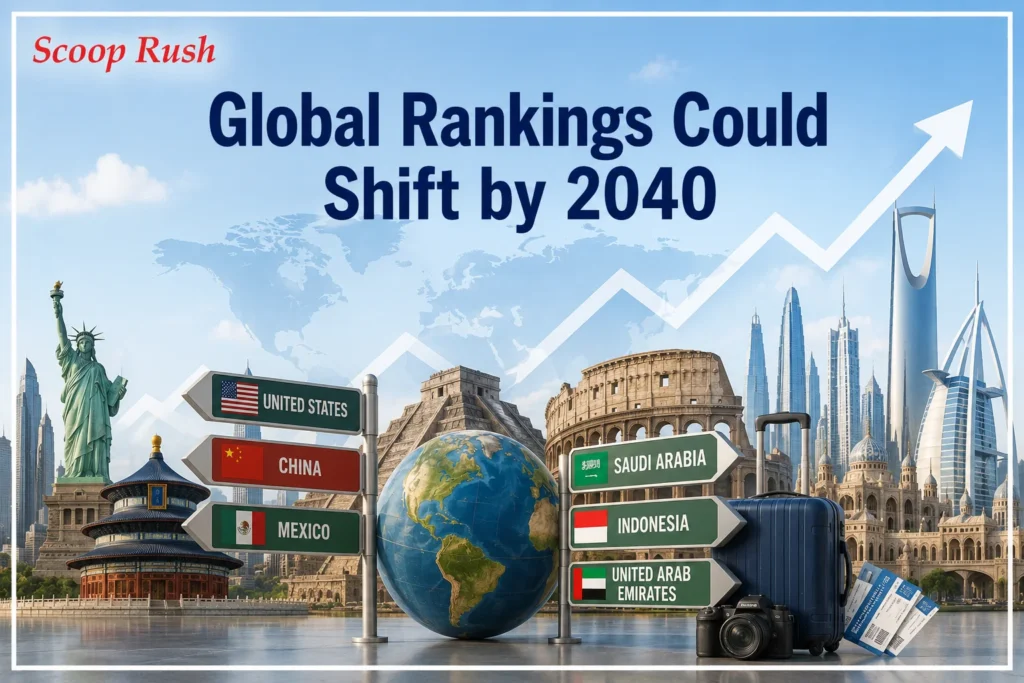
Spain and France are not the only countries facing change. The United States and China should stay among the top destinations. Mexico could rise to fifth place in the global rankings. Italy, meanwhile, could slip down to sixth place.

Other nations may also break into the top fifteen destinations. Saudi Arabia, Indonesia and the United Arab Emirates are investing heavily in tourism. These countries are building new infrastructure to attract international travelers. Their rise could make global tourism more diverse than ever before.

What This Means for Travelers

Spain’s rise offers new opportunities for travelers seeking fresh destinations. Visitors may find better deals and smaller crowds in emerging regions. Northern Spain and its inland cities could become popular alternatives. Off-season travel could also become more appealing as Spain spreads out demand.

The shift also signals a broader change in how people travel. Global tourism is becoming less centered on a handful of famous cities. New markets are opening up as infrastructure improves worldwide. This could reshape how millions of people plan their future trips.

The Road Ahead for Spain and France

The-Road-Ahead-for-Spain-and-France

Spain still needs to maintain its current pace of growth. The country must also solve the problems tied to overtourism. Housing, transport and water resources all need urgent attention. Success will depend on how well Spain balances growth with local needs.

France, meanwhile, is not standing still either. The country continues to invest in its diverse tourism offerings. Both nations will likely see steady visitor growth through 2040. The real question is which one manages that growth more effectively.

Conclusion

Spain tourism is moving closer to the top of the global travel rankings. Current growth already puts Spain within reach of France. The 2040 forecast suggests Spain could welcome 110 million international visitors annually. France could follow with around 105 million visitors.

However, becoming the world’s most visited country brings major responsibilities. Spain must manage overcrowding, housing pressure and environmental concerns. It also needs to spread visitors across more regions and seasons. If Spain balances growth with sustainability, its tourism future looks exceptionally strong.

FAQs

1. Will Spain really become the world’s most visited country? 

According to Deloitte and Google, Spain could lead global tourism by 2040. The study forecasts 110 million visitors for Spain that year. France is expected to trail slightly behind at 105 million.

2. How many tourists visited Spain in 2025? 

Spain welcomed about 96.8 million international visitors in 2025. This was a 3.2 percent increase over 2024. Tourism spending in Spain reached roughly €134.7 billion.

3. How many tourists visited France in 2025? 

France welcomed 102 million international tourists in 2025, a new record. This kept France as the world’s leading tourist destination. France also recorded 743 million international overnight stays that year.

4. Why is Spain becoming more popular with international travelers? 

Spain offers beaches, historic cities and strong cultural attractions. Its mild climate supports travel throughout most of the year. Excellent transport links also make Spain easy to reach.

5. Could overtourism hurt Spain’s chances of overtaking France? 

Yes, overtourism already causes problems in several Spanish cities. Housing costs and overcrowding remain serious concerns for residents. Spain must manage this growth carefully to protect local communities.

Haunted Mansion Facade Restoration: Disney World Brings Back the 1971 Look

0

What if the “new” version of a classic ride was actually a trip back in time? That is exactly what the Haunted Mansion facade restoration delivers at Magic Kingdom. It is turning heads for all the right reasons.

Disney World has unveiled a restored Haunted Mansion exterior after months of scaffolding and speculation. The restoration leans directly on the ride’s original 1971 design. Fans and casual visitors alike are calling it one of the best updates in years. This matters because it signals something bigger happening across the resort. Disney is renewing its focus on craftsmanship, historical accuracy, and small details.

If you are planning a Walt Disney World trip, this project matters. It shows how Disney is reinvesting in its most iconic attractions. Here is everything worth knowing about the Haunted Mansion facade restoration, plus what it hints at for the ride’s future.

Why the Haunted Mansion Facade Restoration Fits a Bigger Trend

Why the Haunted Mansion Facade Restoration Fits a Bigger Trend

The Haunted Mansion facade restoration did not happen in isolation. It belongs to a broader wave of repainting and refurbishment projects sweeping through Walt Disney World over the past couple of years.

The most talked-about example so far is the Cinderella Castle makeover. That project replaced the pink “50th anniversary” color scheme with a restored classic look. Strong planning met flawless execution, and many fans now call it the best version of the castle ever unveiled. The added contrast between the deeper roofline and the lighter facade gives the structure noticeable depth. It looks almost like an upgraded, high-definition version of itself.

Castle aside, similar facade work has quietly rolled out across Tomorrowland, Animation Courtyard, Crescent Lake, and several monorail loop resorts. Crews recently finished projects at the Hurly Burly Bar near BoardWalk and at Tower of Terror in Disney’s Hollywood Studios. Consequently, longtime visitors are starting to notice a pattern rather than a coincidence.

What’s Driving Disney World’s Repainting and Restoration Push?

This uptick in quality follows a rough stretch for Walt Disney World’s maintenance and design standards. Furloughs and layoffs after 2020 caused a significant loss of institutional knowledge across maintenance departments and Walt Disney Imagineering. Fewer experienced staff meant more downtime, more broken effects, and lower show quality throughout the parks.

Imagineering felt this loss hard. The department needed veteran talent to lead ambitious projects, yet many experienced staffers had already left. However, the situation has steadily improved. Bruce Vaughn’s return to lead Imagineering brought back several former Imagineers as consultants who now mentor newer staff. Joe Rohde stands out as the most visible example of this mentorship push, but he is far from alone.

As a result, that extra experience and guidance now shows up everywhere. It appears in ambitious new lands under construction, and in something as simple as a fresh coat of paint done the right way.

What Changed in the Haunted Mansion Facade Restoration

Construction permits for Haunted Mansion first appeared late last year, and scaffolding went up around the attraction by January. By February, construction walls surrounded the entire facade. As of August, crews have finished the exterior work, and the payoff is significant.

The Haunted Mansion facade restoration draws heavily from the ride’s original 1971 appearance. Some details may also nod to Tokyo Disneyland’s version of the ride, which still keeps its original 1983 look today. The overall effect gives the mansion far more depth and dimension than before.

Key Details in the Restored Haunted Mansion Exterior

Key Details in the Restored Haunted Mansion Exterior

Several specific changes stand out in the refreshed facade:

  • Darker brick tones. The exterior now features a deeper reddish-brown brick color, replacing the lighter, more uniform beige tone used previously.
  • Gray cornerstone trim. The trim now creates sharper contrast against the walls instead of blending into the brickwork.
  • A green cupola dome. The dome previously had a gold or bronze finish. It now matches the green shade from 1971, and from Tokyo Disneyland today, making it far more eye-catching.
  • Refreshed roof details. The wrought-iron roof cresting and the bat weathervane both look renewed. The black roofing also shows less weathering from Florida’s harsh sun.
  • Updated downspouts. New black detailing gives these fixtures a weathered, historically appropriate look.
  • Deeper green ironwork. The conservatory’s wrought iron framing now carries a slightly darker green shade, adding to the overall contrast.

Together, these changes create a facade with noticeably more depth. The previous look was not bad by any measure. Still, the difference becomes obvious once you compare before and after photos side by side.

Importantly, the restoration avoids looking too pristine. Disney has occasionally drawn criticism for refurbishments that look artificially new next to their surroundings. That is not the case here. The Haunted Mansion facade restoration keeps a level of intentional weathering. It fits the mood of Liberty Square and the attraction’s gothic aesthetic.

Inside the Ride: Small Fixes With a Big Impact

The exterior overhaul was not the only improvement at Haunted Mansion recently. Inside the attraction, the Stretching Room has also received some maintenance attention.

For a while, guests struggled to see the hanging corpse effect in the Stretching Room, and complaints spread quickly online. Disney responded by cleaning the scrims and adjusting the lighting, which restored the effect to a much more visible state. This serves as a good reminder: public feedback, even informal social media chatter, can prompt real maintenance action. Still, that kind of pressure only goes so far, and it should not become the primary way Disney addresses issues.

Beyond the Stretching Room, the rest of the ride’s interior remains untouched for now. Even so, the improvement to this key scene has already made a noticeable difference in the overall guest experience.

What Comes Next After the Haunted Mansion Restoration

What Comes Next After the Haunted Mansion Restoration

Even though the exterior project is finished, work around Haunted Mansion is far from over. The attraction sits on the edge of the upcoming Piston Peak National Park and Villains Land expansion. Construction activity nearby remains active.

Crews have already demolished the old landing area once used for the Mike Fink Keel Boats. Piston Peak will likely absorb that footprint. Meanwhile, workers are expanding a building along the path that once served as a covered overflow queue. That same building briefly housed FastPass distribution.

Could Haunted Mansion’s Queue and Entrance Change Next?

A new pathway will soon connect Big Thunder Mountain Railroad and Haunted Mansion. Industrial engineers may be anticipating a jump in foot traffic once Piston Peak opens. That would explain the added queue space now under construction.

Even during slower periods like the August offseason, Haunted Mansion’s extended queue commonly spills out into Liberty Square. Therefore, expanding queue capacity looks like a logical next step, much like how Disneyland recently addressed its own overflow queue problems.

Disney may also reconsider the layout of the entrance itself down the road. One possibility involves removing the green entrance canopy and shifting the marquee. That would open up the courtyard in front of the attraction. That said, Disney could achieve the same goal through less drastic solutions, without touching the entrance at all.

Will Disney Remove the Interactive Queue?

Will Disney Remove the Interactive Queue?

This restoration follows the original 1971 design closely. Some fans now wonder whether Disney’s NextGen-era interactive queue could eventually get reworked or removed. The interactive elements have stayed somewhat controversial since their debut. They now feel a bit dated next to the freshly restored exterior.

Any changes here remain speculative for now. However, removing or updating the queue would align with Disney’s broader effort to modernize and restore classic elements throughout Magic Kingdom.

New Restrooms Arrive, Not a New Bar (Yet)

Recent land clearing behind Haunted Mansion sparked speculation about a possible expansion. Fans floated the idea of a “Haunted Mansion Parlor,” similar to the popular lounge aboard the Disney Treasure cruise ship. Disney has now confirmed that this new structure will simply house restrooms.

That does not rule out a Haunted Mansion-themed bar or lounge elsewhere in Liberty Square or within the Villains Land footprint. Disney has a growing interest in themed bars and new revenue streams. With unused expansion space nearby, something like this could eventually reach Magic Kingdom.

Final Takeaways 

The Haunted Mansion facade restoration stands out as one of the strongest examples yet. It shows Walt Disney World’s improving maintenance and design standards. From the darker brick tones to the newly green cupola dome, every detail adds depth without feeling overdone or out of place.

This project also fits a larger pattern. Between the Cinderella Castle makeover, ongoing resort refurbishments, and now Haunted Mansion, the pattern is clear. Walt Disney World is investing in restoring its classics. Much of this progress traces back to rebuilding institutional knowledge at Imagineering, with veteran consultants mentoring the next generation of talent.

As Piston Peak and Villains Land construction continues nearby, more changes to Haunted Mansion’s queue and surrounding pathways seem likely. For now, though, guests can enjoy an exterior that looks more authentic and more atmospheric. It is truer to its 1971 roots than it has been in decades.

Frequently Asked Questions

1. What changed in the Haunted Mansion facade restoration? 

The restoration brought darker reddish-brown brick, gray cornerstone trim, and a green cupola dome. It also added refreshed roof cresting, weathervane details, updated black downspouts, and a slightly darker green tone on the conservatory’s wrought iron framing.

2. Why does the Haunted Mansion cupola look green now? 

The green finish matches the attraction’s original 1971 color scheme. It also mirrors the current look of Haunted Mansion at Tokyo Disneyland, which retains its 1983 design.

3. Is the interior of the Haunted Mansion also getting renovated? 

Disney has only updated the Stretching Room so far. Crews cleaned the scrims and adjusted the lighting to restore the visibility of the hanging corpse effect. The rest of the ride’s interior remains unchanged for now.

4. What is Disney building behind the Haunted Mansion queue? 

Disney has confirmed the structure under construction behind the queue as new restrooms, not an extended queue or a themed lounge.

5. Will the Haunted Mansion’s queue or entrance change because of Piston Peak? 

It is possible. A new pathway will soon connect Big Thunder Mountain Railroad and Haunted Mansion. Additional queue space or entrance adjustments may follow, since the Piston Peak National Park and Villains Land expansion should bring more foot traffic.

Infantino Must Remember He Is European, Says Ceferin

0

Gianni Infantino is facing growing criticism from within European football, with UEFA president Aleksander Ceferin delivering one of his strongest attacks yet. Ceferin says Infantino must remember that he is European after FIFA’s abandoned plan to sell part of the commercial rights to its competitions triggered major opposition.

The dispute has raised serious questions about FIFA’s proposed Fifa Forward Enterprise, the relationship between FIFA and UEFA, and Infantino’s leadership ahead of the FIFA presidential election in March 2027.

Ceferin described the abandoned proposal as being even worse than the European Super League. He also criticised Infantino over the handling of Folarin Balogun’s red-card suspension during this summer’s World Cup.

For European football, the disagreement is more than a personal clash. It reflects a wider dispute over who should control football’s commercial future and how decisions involving the sport’s biggest competitions should be made.

Infantino Must Remember He Is European, Says Ceferin

Aleksander Ceferin has directly challenged FIFA president Gianni Infantino over his approach to European football.

Speaking on the Rest is Politics podcast, Ceferin said Infantino should remember his European background. The UEFA president also pointed out that Infantino previously worked for UEFA for 16 years.

Infantino spent nine years as UEFA’s general secretary before becoming FIFA president. According to Ceferin, UEFA supported Infantino in the past, but the relationship between the two organisations has now become increasingly strained.

Ceferin said FIFA had presented the issue in terms of Europe opposing plans that could benefit smaller and poorer football nations.

However, he rejected that argument. He said Europe should not be portrayed simply as a wealthy region standing in the way of development.

Ceferin Says FIFA’s Plan Is Worse Than the Super League

One of Ceferin’s strongest criticisms concerned FIFA Forward Enterprise, known as FFE.

Earlier this month, FIFA abandoned Infantino’s proposal to create a new company that would manage the commercial and ticketing rights of FIFA competitions. The proposal included selling a 21% stake to a private investment company.

The idea faced strong resistance from UEFA and European football associations.

Ceferin said the proposal was worse than the European Super League, which collapsed shortly after its launch in April 2021 following widespread criticism.

The difference, according to Ceferin, is that the Super League involved clubs attempting to create their own competition. FIFA’s proposed structure, in his view, would have involved selling part of the sport itself.

“I’m absolutely sure that the plan is dead,” Ceferin said.

He also questioned why anyone would want to sell an asset that he believes belongs to football as a whole.

Why UEFA Opposed FIFA Forward Enterprise

The FIFA Forward Enterprise proposal became a major source of tension between FIFA and UEFA.

Under the plan, FFE would have taken responsibility for commercial and ticketing rights across FIFA competitions. A 21% stake would then have been sold to a private investment company.

UEFA led opposition to the proposal.

European football’s governing body said it had not been consulted before the plan emerged. Ceferin said he discovered the proposal through the media while he was on holiday with his family.

That lack of communication appears to have further damaged the relationship between UEFA and FIFA.

European football associations subsequently took a stronger position. UEFA members voted to boycott World Cups unless the proposal was scrapped.

The proposal was eventually abandoned. Nevertheless, the dispute has continued.

UEFA has since said it has lost confidence in Infantino. Meanwhile, the football associations of all four home nations have withdrawn their support for the FIFA president.

As a result, the disagreement has developed into a broader challenge to Infantino’s leadership.

Ceferin Says FIFA and UEFA Relationship Has Changed

The relationship between Infantino and Ceferin has become particularly significant because both men have strong positions within international football.

Infantino previously worked at UEFA, where he spent 16 years and eventually became general secretary. He later became FIFA president.

Ceferin, meanwhile, has led UEFA and has emerged as one of the most outspoken critics of Infantino’s recent decisions.

According to Ceferin, Infantino has not contacted him since the dispute over FFE emerged.

That is important because FIFA and UEFA work within the same global football structure, despite representing different levels of the game.

UEFA oversees European football, while FIFA governs football internationally. Therefore, disagreements between their leadership can have consequences well beyond the two organisations.

Ceferin’s comments suggest that trust between the two sides has been badly affected.

Infantino Travels to Build International Support

While UEFA has opposed Infantino’s plan, the FIFA president has continued meeting football figures around the world.

Infantino recently met members of the Caribbean Football Union in the Dominican Republic.

The following day, he attended the E-Sports World Cup in Paris.

The event also attracted French President Emmanuel Macron, Saudi Crown Prince Mohammed bin Salman and Portugal forward Cristiano Ronaldo.

These appearances come as Infantino faces increasing pressure from European football.

The situation means the FIFA president is attempting to maintain international relationships while facing opposition from UEFA and several European football associations.

The political and footballing dimensions of the dispute have therefore become increasingly connected.

Ceferin Will Not Challenge Infantino for FIFA Presidency

Ceferin Will Not Challenge Infantino for FIFA Presidency

Despite his criticism of Infantino, Ceferin has confirmed that he will not stand against him in the FIFA presidential election in March 2027.

Infantino is expected to seek a fourth term as FIFA president.

Ceferin said he was not interested in taking the position for two reasons.

First, he said he loves UEFA and enjoys working there. He also suggested that he believes there comes a point when it is important to enjoy life.

Second, Ceferin argued that staying outside the FIFA presidential race gives him greater credibility.

This means the current dispute should not be interpreted as the beginning of a personal campaign by Ceferin to replace Infantino.

Instead, his comments appear focused on challenging FIFA’s decisions and defending UEFA’s position.

Ceferin Criticises the Balogun Red-Card Decision

The FIFA Forward Enterprise dispute is not the only issue that has caused tension.

Ceferin also criticised the decision to overturn a red-card suspension for United States striker Folarin Balogun during the 2026 World Cup.

The suspension was overturned, allowing Balogun to play in the United States’ last-16 defeat by Belgium.

The controversy intensified after United States President Donald Trump said he had personally called Infantino to request that the sanction be lifted.

Trump later described removing Infantino as FIFA president as a “terrible mistake”.

Ceferin strongly objected to the handling of the disciplinary matter.

Ceferin Says Football Rules Must Be Respected

For Ceferin, the key issue was not simply the individual player or match.

Instead, he focused on the importance of football’s rules.

He described the situation as shocking and argued that the game loses meaning if its own rules are not respected.

Ceferin also questioned the contrast between Trump’s public comments and FIFA’s explanation that the decision was independent.

According to Ceferin, the incident shocked many people within football, even though not everyone was willing to speak publicly about it.

The comments add another layer to the criticism surrounding Infantino’s leadership.

The European Super League Comparison

Ceferin’s comparison between FIFA Forward Enterprise and the European Super League is particularly significant because UEFA fought strongly against the breakaway competition.

The European Super League was proposed as a rival to UEFA’s Champions League.

Twenty major European clubs were involved in the original proposal. However, the project collapsed only days after it was announced in April 2021 following widespread criticism.

Ceferin now argues that FIFA’s abandoned commercial plan was even more concerning.

His reasoning is based on ownership and control.

The Super League involved major clubs seeking to establish their own competition. In contrast, Ceferin believes the FIFA proposal would have involved selling part of football’s commercial rights to private investment.

For him, that distinction makes the FFE proposal especially serious.

What Happens Next for FIFA and UEFA?

The FIFA Forward Enterprise proposal has been abandoned, but the disagreement between FIFA and UEFA is not necessarily over.

UEFA has already said it has lost confidence in Infantino.

The home nations have also withdrawn their support for the FIFA president.

Meanwhile, Infantino continues to seek support internationally.

The next major political moment will come at the FIFA Congress in March 2027, when Infantino is expected to pursue a fourth term.

Ceferin will not be his opponent, but his criticism could remain an important part of the debate around FIFA’s leadership.

The dispute also highlights the importance of communication between football’s governing organisations.

UEFA’s opposition showed that major decisions involving international football can quickly become controversial when European football’s leadership believes it has not been adequately consulted.

Why the Infantino and Ceferin Dispute Matters

The disagreement matters because FIFA and UEFA have enormous influence over the international and European game.

Commercial rights, competition structures and disciplinary decisions all affect clubs, national teams, players and supporters.

For fans, these issues may sometimes appear to be administrative matters. However, decisions made by football’s governing bodies can influence how competitions operate and how the sport is managed.

The FIFA Forward Enterprise proposal demonstrated how quickly a commercial decision could become a major political issue within football.

At the same time, the Balogun controversy showed how disciplinary decisions can raise questions about consistency and the authority of football’s rules.

Ceferin’s criticism therefore covers two different areas: the commercial direction of FIFA and the governance of football’s rules.

Key Takeaways From Ceferin’s Comments

Several points stand out from the latest dispute.

First, Ceferin strongly opposes the abandoned FIFA Forward Enterprise proposal.

Second, he believes the proposal was more concerning than the European Super League because it involved selling part of FIFA’s commercial rights.

Third, UEFA says it lost confidence in Infantino following the dispute.

Fourth, the football associations of the home nations have withdrawn their support for the FIFA president.

Fifth, Ceferin has no intention of challenging Infantino for the FIFA presidency in 2027.

Finally, Ceferin has criticised FIFA’s handling of Balogun’s overturned suspension and questioned whether football’s rules were properly respected.

Conclusion

The dispute between Gianni Infantino and Aleksander Ceferin has become one of the most significant leadership disagreements in international football.

Ceferin’s message is clear. He believes FIFA’s abandoned commercial plan went too far and says Infantino must remember his European roots and his previous relationship with UEFA.

The FIFA Forward Enterprise proposal may now be dead, as Ceferin confidently stated. However, the damage to relations between FIFA and UEFA appears to remain.

Meanwhile, Infantino continues to build international support ahead of the 2027 FIFA presidential election.

Ceferin will not challenge him for the position. Nevertheless, his criticism ensures that questions about FIFA’s leadership, commercial strategy and decision-making are likely to remain part of football’s wider debate.

For supporters, the central issue is ultimately about how the world’s most popular sport should be governed. As FIFA and UEFA continue to navigate their differences, their decisions will remain closely watched by football associations, players, clubs and fans around the world.

FAQs

1. What did Aleksander Ceferin say about Gianni Infantino?

Aleksander Ceferin said Gianni Infantino must remember that he is European. He also criticised Infantino’s abandoned FIFA Forward Enterprise proposal and compared it unfavourably with the European Super League.

2. What was FIFA Forward Enterprise?

FIFA Forward Enterprise was a proposed new company that would manage the commercial and ticketing rights of FIFA competitions. The proposal included selling a 21% stake to a private investment company.

3. Why did UEFA oppose FIFA Forward Enterprise?

UEFA led opposition to the proposal because it said it had not been informed about the plan in advance. UEFA members voted to boycott World Cups unless the proposal was scrapped.

4. Will Aleksander Ceferin run for FIFA president in 2027?

No. Ceferin confirmed that he will not run for FIFA president at the FIFA Congress in March 2027. Infantino is expected to seek a fourth term.

5. Why did Ceferin criticise the Balogun red-card decision?

Ceferin criticised the decision to overturn Folarin Balogun’s red-card suspension during the 2026 World Cup. He said football’s rules must be respected and described the circumstances surrounding the decision as shocking.

What Are the Best Keto Sweeteners to Use?

0

Giving up sugar is often the hardest part of starting a keto diet. The good news is that you don’t have to give up sweetness altogether.

Dozens of sugar substitutes now line grocery store shelves, and not all of them are created equal. Some keep your blood sugar flat and your ketosis intact. Others sneak in hidden carbs or trigger digestive chaos.

This guide breaks down the best keto sweeteners, the ones worth avoiding, and how to tell the difference when you’re standing in the baking aisle wondering which bag to grab.

What Makes a Sweetener “Keto-Friendly”?

What Makes a Sweetener "Keto-Friendly"?|Scoop Rush

A sweetener earns keto approval when it has little to no effect on blood sugar and insulin levels. That’s the whole point of the diet: keeping insulin low enough that your body keeps burning fat for fuel instead of glucose.

Carbs matter too. Even a “sugar-free” label doesn’t guarantee zero carbs, since many products are padded with fillers like dextrose or maltodextrin.

Taste and texture matter for day-to-day use, but they’re secondary. A sweetener that spikes your blood sugar isn’t keto-friendly no matter how good it tastes in your coffee.

If you’re still weighing whether the eating style is right for you at all, it helps to first understand the broader benefits and risks of a low-carb diet before worrying about which sweetener to pick.

The Top Keto-Approved Sweeteners

The Top Keto-Approved Sweeteners|Scoop Rush

If you want a short list to remember at the store, these are the ones dietitians and low-carb communities consistently recommend.

Stevia

Stevia comes from the leaves of a South American plant, and it’s one of the most widely used natural sweeteners on the market. You’ll recognize it under brand names like Truvia and PureVia.

It contains zero calories and zero carbs, and it won’t raise your blood sugar. The U.S. Food and Drug Administration classifies refined stevia extract as generally recognized as safe.

The catch is taste. Stevia is intensely sweet roughly 200 to 400 times sweeter than table sugar but many people notice a bitter, licorice-like aftertaste, especially in larger amounts.

It also behaves differently than sugar in baking, so it doesn’t always swap in evenly for recipes that rely on sugar’s bulk and browning properties.

Best for: sweetening coffee, tea, and drinks in small doses.

Monk Fruit

Monk fruit, also called luo han guo, has a long history in Chinese herbal medicine. Its sweetness doesn’t come from sugar at all, but from antioxidant compounds called mogrosides.

Like stevia, monk fruit has zero calories and won’t spike blood sugar or insulin. It’s roughly 100 to 400 times sweeter than sugar, depending on the extract’s concentration.

Most people find monk fruit has a cleaner taste than stevia, with less of a lingering aftertaste. That’s why it’s often blended with stevia or erythritol to smooth out both products.

Watch out for “proprietary blends,” since some products use very little actual monk fruit extract alongside cheaper fillers.

Best for: drinks, salad dressings, and baked goods.

Erythritol

Erythritol is a sugar alcohol that occurs naturally in small amounts in foods like pears, grapes, and mushrooms. Commercially, it’s usually made by fermenting corn.

Your body absorbs very little of it, and what is absorbed passes into urine unused. That means it has a negligible effect on blood sugar, calories, and carbs.

It measures about 70% as sweet as table sugar and works well in baking, which is why it shows up in so many keto dessert recipes. It also appears to be gentler on digestion than other sugar alcohols.

The main downside is a cooling sensation on the tongue, which some people love and others find distracting. A small 2023 study also raised questions about a possible link between erythritol and cardiovascular risk, though the data was weak and more research is needed.

Best for: baking, since it measures and behaves closest to real sugar.

Allulose

Allulose is a newer entrant, approved for public sale in 2015. It’s classified as a “rare sugar” because it naturally occurs in only a few foods, including figs, raisins, and wheat.

Structurally, it’s almost identical to fructose, but your body can’t metabolize it. Nearly all of it passes through unused, contributing negligible calories and carbs.

What sets allulose apart is how closely it mimics real sugar in cooking. It dissolves, browns, and caramelizes the way sugar does, which sugar alcohols like erythritol typically can’t do.

It’s about 70% as sweet as sugar, and it’s pricier and less widely available than older sweeteners. Large amounts may cause stomach upset in some people.

Best for: recipes where you need real caramelizing or browning, like sauces and baked goods.

Xylitol

Xylitol is the sweetener behind most sugar-free gum and mints. It’s a sugar alcohol extracted from corn cobs or birch trees.

It tastes almost exactly like sugar and can typically replace it one for one in recipes, with about half the calories. It has a low glycemic index and a mild effect on blood sugar in small amounts.

The tradeoff is digestive. Since your body only absorbs about half of what you eat, the rest ferments in your gut, which can cause gas, bloating, or diarrhea if you overdo it.

One serious warning: xylitol is highly toxic to dogs. Even a small amount can cause a life-threatening reaction, so keep xylitol-sweetened products well away from pets.

Best for: recipes that need a true sugar-like taste, and foods that need to stay soft when frozen, like homemade ice cream.

Sweeteners That Deserve a Closer Look

Sweeteners That Deserve a Closer Look|Scoop Rush

Not every “low-carb” sweetener is a clear yes. These fall into a gray zone  technically usable, but with real drawbacks.

Maltitol

Maltitol shows up constantly in “sugar-free” candy and chocolate because it behaves so much like real sugar in manufacturing. That’s exactly why it’s a poor keto choice.

Research shows maltitol can raise both blood sugar and insulin levels, which works against the entire point of a ketogenic diet. It also carries about three-quarters of the calories of sugar.

Roughly half of what you eat ferments in the colon, which often leads to noticeable bloating and digestive discomfort, especially with regular use.

Yacon Syrup

Yacon syrup comes from a South American root plant and has a flavor similar to molasses. Part of its content is indigestible fiber, which gives it a lower glycemic index than sugar.

Despite that, it still contains meaningful digestible carbs. A couple of tablespoons can add up quickly, making it a poor fit for strict keto macros.

Inulin

Inulin is a plant fiber, most commonly sourced from chicory root, and it’s often blended into low-carb sweeteners as a bulking agent rather than used alone.

Because it isn’t digested, it contributes minimal usable carbs and has GRAS status from the FDA. But it ferments rapidly in the gut, which frequently causes gas and bloating, especially in larger servings.

Isomalto-Oligosaccharide (IMO)

IMO is a corn-derived carbohydrate added to many “keto” protein bars and low-carb syrups. It’s often listed as fiber on nutrition labels, which can be misleading.

Studies show IMO is actually partially digested and absorbed, and it can cause meaningful spikes in blood sugar and insulin. Products relying heavily on IMO often contain more usable carbs than the label suggests.

Artificial Sweeteners: Where They Stand on Keto

Artificial, or synthetic, sweeteners are lab-made and typically calorie-free. They technically won’t knock you out of ketosis, but they come with their own considerations.

Sucralose

Sucralose is the sweetener in Splenda, made by chemically modifying sugar so it’s no longer digestible. It’s about 600 times sweeter than table sugar.

Most research shows it doesn’t affect blood sugar on its own, though some studies suggest it may behave differently when eaten alongside carbohydrates. One trial linked it to increased appetite in some groups.

Aspartame

Aspartame is best known under the brand name Equal, and it remains one of the most debated sweeteners in circulation. Pure aspartame has no calories or carbs and doesn’t appear to raise blood sugar in most research.

The FDA considers it safe in moderation, though some people report headaches or other symptoms after consuming it, and researchers continue to study its long-term effects.

Saccharin

Saccharin, sold as Sweet’N Low, is the oldest synthetic sweetener still in use, dating back to 1878. It’s roughly 300 times sweeter than sugar and known for a bitter aftertaste.

Early rodent studies once linked it to bladder cancer, an association never confirmed in humans. Current research on its broader health effects remains mixed.

Acesulfame K

Acesulfame K, often labeled Ace-K, is common in flavored waters and diet drinks. It has no calories or carbs and generally doesn’t affect blood sugar, though a small number of studies suggest it might in some individuals.

Sweeteners to Avoid Completely on Keto

Some sweeteners are simply off the table if you’re aiming to stay in ketosis, regardless of how “natural” they’re marketed as.

Table sugar in any form white, brown, coconut, date, or maple syrup is close to 100% carbohydrate and will interfere with ketosis.

High-fructose sweeteners deserve special caution. Honey, agave syrup, molasses, and high-fructose corn syrup are loaded with fructose, which research links to fatty liver, insulin resistance, and unhealthy cholesterol patterns over time.

Agave syrup is particularly deceptive. It’s often marketed as “low glycemic,” but its very high fructose content more than 60% may make it worse for long-term metabolic health than plain sugar.

The “Zero Calorie” Label Trap

Here’s something most people don’t realize: many packets labeled “zero calories” aren’t actually calorie-free.

The FDA allows any product with less than 4 calories and less than 1 gram of carbs per serving to be labeled “zero calorie.” That leaves room for manufacturers to sneak in nearly a gram of carbs from dextrose or maltodextrin per packet.

Popular brands like Splenda, Equal, Sweet’N Low, and Stevia in the Raw packets often fall into this category. Individually, it seems negligible. Consumed multiple times a day, it adds up.

The lesson: always check the ingredient list, not just the front-of-package label.

Do Sweeteners Trigger Sugar Cravings?

This is one of the more overlooked issues with keto sweeteners. Even zero-calorie options can keep your brain wired to crave sweet flavors.

Sweeteners are typically used to recreate foods keto eliminates sodas, cookies, candy, and pastries. Reaching for a “keto-friendly” version of these treats regularly may prevent your palate from adjusting to less sweet, whole foods.

For some people, occasional indulgence works fine, similar to having a glass of wine with dinner. For others, sweet-tasting foods of any kind can trigger overeating or a slide back into old habits.

The encouraging part: many people find their sweet cravings naturally fade the longer they stay on a low-carb diet.

What About Diet Soda on Keto?

Diet soda technically won’t kick you out of ketosis, since it’s sweetened with zero-calorie options. But that doesn’t mean it’s a smart daily habit.

Some research suggests regular diet soda consumption may make weight loss harder, possibly through effects on hormones, appetite signals, or gut bacteria. A number of industry-funded studies claiming otherwise have also been criticized for bias.

If you’re serious about long-term keto success, water, sparkling water, unsweetened tea, and black coffee remain the safer default choices.

If you’re trying to decide between specific diet drinks, it’s worth comparing Diet Coke vs. Coke Zero side by side, since their sweetener blends and flavor profiles aren’t identical even though both are sugar-free.

It’s also worth digging deeper into whether diet soda actually helps or hurts weight loss before making it a daily habit, since the research is more mixed than most soda marketing suggests.

How Do Keto Sweeteners Fit Into Other Low-Carb Diets?

Keto isn’t the only eating style built around cutting carbs, and sweetener rules can shift depending on which plan you’re following.

If you’re curious how ketogenic eating stacks up against other approaches, it helps to look at the wider benefits and risks of low-carb diets as a category, since sweetener tolerance often depends on your overall carb ceiling.

Some people eventually transition from keto into stricter plans like the carnivore diet, which eliminates plant-based sweeteners entirely, or an animal-based diet that limits processed ingredients of any kind, including most sugar substitutes.

If you’re simply looking for practical snack ideas that use these sweeteners the right way, a list of keto-friendly snacks is a useful next stop.

Do Sweeteners Interact With Weight-Loss Medications?

More people on keto today are also using GLP-1 medications for weight management, which raises a fair question: do sugar substitutes interfere with these drugs?

There’s no strong evidence that keto-approved sweeteners like stevia, monk fruit, or erythritol interact directly with GLP-1 medications. That said, appetite changes from these drugs can shift how your body handles sweet tastes and cravings.

If you’re on a GLP-1 and trying to preserve muscle while losing weight, it’s worth reading up on the connection between GLP-1 use and muscle loss, since adequate protein intake matters more than which sweetener you choose.

Should You Be Careful Mixing Sweeteners With Supplements?

Many keto dieters also take supplements to fill nutritional gaps, from electrolytes to vitamin D. It’s worth knowing that more isn’t always better.

Overdoing certain vitamins and minerals, especially fat-soluble ones, can cause its own set of problems. Before stacking supplements on top of a sweetener-heavy keto routine, it’s worth understanding the risks of taking too many vitamins.

Building Sustainable Habits Beyond Sweeteners

Sweeteners are a tool, not a strategy. Long-term success on keto  or any eating style usually comes down to consistent, boring habits rather than finding the perfect sugar substitute.

Simple changes like better sleep, regular movement, and steady meal timing tend to matter more over months and years than which brand of monk fruit you buy. For a broader look at habits worth building in your 20s and 30s that support metabolic health long after your keto phase ends, see this guide to healthy habits for your 20s and 30s.

How to Choose the Right Sweetener for You

There’s no single “best” answer here it depends on what you’re using it for.

  • For coffee or tea: stevia or monk fruit drops work well in small doses.
  • For baking: erythritol or allulose hold up best under heat.
  • For a true sugar-like texture and taste: xylitol is closest, but keep it far away from pets.
  • For caramelizing or browning: allulose is the standout option.
  • For sensitive digestion: start with small amounts of any sugar alcohol, since tolerance varies widely from person to person.

If you have diabetes or take blood sugar medication, it’s worth testing your glucose levels the first few times you try a new sweetener, even one considered “keto-approved.”

FAQs

Which keto sweetener tastes the most like real sugar?

Allulose and xylitol both come closest to sugar’s actual taste and texture. Allulose has the added benefit of browning and caramelizing like sugar, which most other substitutes can’t do.

Can keto sweeteners stall weight loss?

For some people, yes. Sweet-tasting foods, even calorie-free ones, can keep cravings alive and make it harder to reduce overall intake. Others tolerate them with no issue at all. Tracking how your own body responds over a few weeks is the most reliable way to know.

Is it better to avoid sweeteners entirely on keto?

Not necessarily. Some people do best cutting sweet flavors out completely, while others find that moderate use of a keto-approved sweetener makes the diet easier to sustain long-term. Neither approach is objectively “more keto” than the other.

Are natural sweeteners always better than artificial ones?

Not automatically. “Natural” just describes the source, not the health impact. Stevia and monk fruit happen to be both natural and low-impact on blood sugar, but plenty of natural sweeteners, like honey and agave, are worse for keto than some artificial options.

Do sugar alcohols count toward net carbs?

Most sugar alcohols are typically subtracted from total carbs when calculating net carbs, since they’re only partially absorbed. Erythritol is usually treated as having zero net carb impact, while others like maltitol should be counted more conservatively since more of it gets absorbed.

The Bottom Line

Stevia, monk fruit, erythritol, and allulose currently stand out as the most reliable keto sweeteners, offering sweetness with minimal impact on blood sugar, insulin, or ketosis.

Sugar alcohols like maltitol, along with fructose-heavy syrups like agave and honey, are best avoided entirely on a strict ketogenic diet.

Ultimately, deciding whether to use sweeteners at all is a personal call. Some people do best cutting sweet flavors out completely and letting their taste buds reset. Others find that a little keto-friendly sweetness makes the lifestyle sustainable for the long haul.

Whichever path you choose, reading ingredient labels carefully not just front-of-package claims will serve you better than any chart alone.

Tesla Recalls Nearly 3 Million Vehicles in China: Why Hidden Door Handles Are Under Fire

0

Imagine being trapped inside a burning car because you cannot find the handle to open the door. This nightmare scenario is exactly why the Tesla recall China door handles saga is dominating headlines, as Tesla and ten other automakers now recall more than 4.3 million vehicles across China. It marks the country’s largest automotive recall on record, and it centers on a design feature many drivers barely think about: the door handle.

Tesla alone is recalling nearly 3 million vehicles. The issue involves the emergency mechanical door releases hidden inside many modern EVs. Regulators say these releases are hard to locate during a crash, especially when the car’s electrical system fails. For anyone who owns an EV or is thinking about buying one, this story matters. It raises real questions about how far automakers should go in prioritizing sleek design over simple, reliable safety, a debate that echoes recent scrutiny over Elon Musk’s other ventures and business decisions.

What Triggered the Massive Tesla Recall in China

What Triggered the Massive Tesla Recall in China

China’s State Administration for Market Regulation confirmed the recall on Friday. The Tesla recall China door handles action is the largest among eleven automakers involved, but Tesla’s share is by far the largest. The recall covers 2.98 million Tesla vehicles, including both imported and China-made Model 3, Model Y, Model S, and Model X cars.

The core problem is straightforward. Many modern EVs use electronic door latches that respond to a key fob, smartphone, or touch panel. These systems look clean and modern. However, they depend on electrical power to function. If a severe collision knocks out the vehicle’s electrical system, the doors may not open through the usual method.

To handle this, most EVs include a backup mechanical release. Unfortunately, these manual handles are often tucked away in places that are not obvious, especially during the chaos of an emergency. Regulators found that occupants and rescuers alike could struggle to locate them quickly enough.

According to the regulator’s statement, Tesla’s mechanical emergency door-release handles may become difficult to identify following a serious crash. This could delay occupants from escaping or block rescuers trying to reach them from outside. As a result, Tesla will begin the recall process from September 25.

How Tesla Plans to Fix the Problem

Tesla’s remedy comes in two parts. First, the company will install warning labels to clearly mark the location of the emergency handles. Second, it will roll out a software update delivered remotely. This update will automatically lower the vehicle’s windows after a collision, giving occupants another way to escape even if the doors remain difficult to open.

Notably, this fix does not require owners to visit a service center. Since the software update happens over the air, the process should be relatively fast and low-cost. Industry analyst Sam Fiorani, vice president at AutoForecast Solutions, pointed out that modern over-the-air updates significantly reduce the cost and downtime typically associated with major recalls.

Other Automakers Caught in the Same Safety Sweep

Other Automakers Caught in the Same Safety Sweep

Tesla is not alone in this recall. Xiaomi, the Beijing-based tech giant that recently entered the EV market, is recalling about 390,000 vehicles. Leapmotor is recalling roughly 371,000 cars, while Xpeng is recalling around 264,000. Geely Holding also announced its largest recall on record. Several smaller automakers filed similar but much smaller recalls with regulators.

Leapmotor stated it remains committed to safety. The company clarified that its fix only involves a warning label and a software upgrade for the power-window control system. It added that it was managing the recall responsibly for the benefit of its users.

Meanwhile, Geely and Xpeng declined to comment on the situation. Xiaomi confirmed it had no additional details beyond what regulators had already released.

Why the Timing of This Recall Matters

This recall does not happen in isolation. Chinese state media reported that a driver died in October after a crash involving a Xiaomi SU7 sedan. In that incident, a fire broke out, and passersby were unable to open the doors in time to help the trapped driver. This tragic case intensified public scrutiny around hidden and electronic door handles across the entire EV industry.

Consequently, Chinese regulators have ramped up oversight of EV safety throughout the year, similar to how UK regulators have pressured big tech companies over safety standards in a different sector. As automakers compete fiercely on pricing and rush new technology to market, safety standards have become a growing point of concern for both regulators and consumers.

China’s Broader Crackdown on Hidden Door Handles

The Tesla recall China door handles issue connects to a larger regulatory shift already underway in China.Earlier this year, authorities announced that hidden, or flush, exterior door handles would be banned starting in 2027. Under the new rules, vehicles sold in China must include a mechanical release on both the inside and outside of every door.

This design, popularized by Tesla and widely copied by Chinese EV makers, was originally seen as a symbol of futuristic, minimalist styling. Retractable handles tuck neatly into the door panel and extend only when the driver approaches. While visually appealing, critics argue the design sacrifices practicality for aesthetics.

What Industry Experts Are Saying

Cui Dongshu, head of the China Passenger Car Association, described the recall as an inevitable step in the evolution of the EV industry. He explained that automakers were being responsible by shifting toward a more reliable, safety-first approach. According to Cui, this moment reflects both the growing pains of a fast-moving industry and a policy-driven push toward stronger safety standards.

A report from People’s Daily echoed this sentiment. It stated that the large-scale recall represents a unified safety upgrade ahead of the 2027 ban. The report emphasized that competition among EV makers should not be defined only by innovation speed, but also by high safety standards.

Global Scrutiny Is Growing Too

China is not the only country paying closer attention to this issue. In the United States, the National Highway Traffic Safety Administration said last month it would consider new safety standards addressing occupant entrapment risks during electrical failures.

However, NHTSA confirmed on Friday that no automaker has yet notified the agency of plans for a similar recall in the U.S. market. This creates an interesting gap. While Chinese regulators are taking aggressive action, American regulators are still in the early stages of evaluating the issue.

Tesla has previously faced scrutiny in the U.S. as well. Reports emerged of children becoming trapped in vehicles after door handles unexpectedly stopped working, prompting a formal investigation. Additionally, other automakers such as Rivian have faced criticism over hard-to-locate manual releases, and Ford briefly paused sales of its Mustang Mach-E in 2025 due to a similar door-latch concern.

What This Means for EV Owners and Buyers

What This Means for EV Owners and Buyers

For everyday drivers, this recall serves as an important reminder. Electric vehicles bring exciting technology, but that innovation must go hand in hand with practical safety. If you own one of the affected Tesla models, you can expect a warning label and an automatic software update rather than a lengthy repair process.

For future EV buyers, this story highlights a valuable lesson. Sleek, hidden door handles may look impressive, but they are not purely cosmetic. Understanding how to manually open your vehicle’s doors, especially during an emergency, could genuinely save a life. It is worth remembering that as EVs become more software-driven, their reliability increasingly depends on getting both hardware and code right, a challenge that mirrors ongoing debates about whether AI and automation will reshape jobs across industries.

Conclusion

The Tesla recall China door handles story marks a turning point for the EV industry. What began as a design trend focused on minimalism and technology is now being reevaluated through the lens of real-world safety. With China banning hidden door handles by 2027 and the U.S. beginning its own regulatory review, automakers worldwide may soon be forced to rethink how drivers and passengers get in and out of their vehicles during emergencies.

Ultimately, this recall shows that even small design choices can have major safety implications. As the EV industry continues to grow, balancing innovative design with dependable safety features will remain essential.

FAQs

1. Why is Tesla recalling nearly 3 million vehicles in China?

Tesla is recalling these vehicles because their emergency mechanical door-release handles may be difficult to identify during a severe crash, especially if the car’s electrical system fails.

2. Which Tesla models are affected by the recall?

The recall covers Tesla Model 3, Model Y, Model S, and Model X vehicles, including both imported and China-made units.

3. How will Tesla fix the door handle issue?

Tesla will install warning labels near the emergency handles and roll out a software update that automatically lowers the vehicle’s windows after a collision.

4. Are other car brands involved in this recall?

Yes. Xiaomi, Leapmotor, Xpeng, Geely, and several other automakers are also recalling vehicles for similar door-handle safety concerns.

5. Will hidden door handles be banned in the future?

Yes. China has announced that hidden exterior door handles will be banned starting in 2027, requiring vehicles to include accessible mechanical releases on both the inside and outside of every door.

Black August in Russia Deepens Putin’s Summer Crisis

0

Black August in Russia has returned as the country battles growing economic strain. Fuel shortages have hit several regions this month. Ukrainian strikes have also disrupted key infrastructure and supply routes. Meanwhile, the ruble is under pressure and prices keep climbing.

President Vladimir Putin still projects confidence despite these troubles. He admits Ukrainian attacks have caused some damage. However, he denies the country faces a serious crisis. The Kremlin calls the problems temporary and manageable.

What Does Black August Mean in Russia?

Black August describes a pattern of major crises hitting Russia in August. Russian journalists often use the phrase for painful historical events. It has become part of the country’s political vocabulary. Still, many analysts see the pattern as mere coincidence.

Several events over the decades built this reputation. The failed August 1991 coup shook Soviet politics badly. The August 1998 financial crisis then wrecked Russia’s economy. Both moments remain vivid memories for many Russians today.

Why August Has Become a Troubling Month

Why-August-Has-Become-a-Troubling-Month

The 1991 coup saw communist hardliners turn against Mikhail Gorbachev. Their plot collapsed within days of starting. Yet it sped up forces that ended the Soviet Union. The state fully collapsed before that year ended.

August 1998 delivered another painful blow to Russia. Moscow defaulted on its domestic debt that month. The ruble also crashed dramatically soon after. Later events only added weight to the August curse idea.

Putin Has Faced His Own August Crises

Putin has lived through major August crises himself. In August 2000, the submarine Kursk sank in the Barents Sea. All 118 sailors aboard died in the disaster. It became one of his earliest major tests as leader.

Eight years later, Russia went to war with Georgia. That conflict began in August 2008. It showed Putin’s growing willingness to use force abroad. August therefore earned another dark chapter in Russian history.

Russia Faces Fresh Pressure in August 2026

Russia now confronts another difficult August. Its forces have gained only limited ground in Ukraine. Meanwhile, Ukraine has expanded strikes deep inside Russian territory. Those attacks target facilities that support Russia’s economy and war effort.

Ukrainian strikes have hit oil depots and distribution hubs. Some attacks damaged major warehouse operations too. These strikes disrupt supply chains and pressure local businesses. They also bring the war closer to ordinary Russian citizens.

Fuel Shortages Create New Problems

Fuel-Shortages-Create-New-Problems

Fuel shortages have become a clear sign of strain. Long queues have reportedly formed at some Russian gas stations. Drivers now worry about both availability and rising prices. Such shortages quickly affect transport costs and household budgets.

This problem carries wider consequences for the economy. Fuel shortages raise transportation costs across many industries. Higher transport costs then push consumer prices upward. The effects spread well beyond the pumps themselves.

Ukrainian Strikes Hit Russian Supply Networks

Ukraine keeps targeting infrastructure tied to Russia’s domestic economy. Oil refineries remain key targets since they fuel production. Warehouses and logistics hubs have also come under fire. These strikes disrupt the movement of goods nationwide.

Wildberries warehouses offer a notable example of this trend. Ukrainian attacks reportedly damaged facilities linked to the online retailer. Such strikes cause economic harm beyond physical destruction alone. They also delay deliveries and hurt businesses that depend on them.

The Kremlin Downplays the Damage

Putin acknowledges that Ukrainian attacks cause real economic damage. Still, he rejects claims that they threaten Russia’s stability. He calls the consequences harmful yet fully manageable. The Kremlin has also promised support for rebuilding damaged sites.

This strategy helps Putin maintain his image of control. Admitting a deeper crisis could spark public anxiety. Officials therefore keep stressing resilience and recovery. The Kremlin wants citizens to see these disruptions as temporary.

Economic Pressure Is Growing

Economic-Pressure-Is-Growing

Russia’s economic troubles extend past infrastructure damage alone. The ruble has weakened further during the summer months. Prices keep rising across several everyday categories. These trends squeeze household budgets and fuel public frustration.

Russian economists have voiced growing concern too. Some warn of deeper structural risks facing the economy. They point to technological competition with rival nations. They also question whether Russia can sustain a long war.

Russia’s War Economy Faces Difficult Choices

The war places heavy demands on Russia’s economy. Military spending consumes large sums of money and resources. Civilian industries still need investment at the same time. Balancing both priorities grows harder as pressure builds.

Russia also faces limits on Western technology access. These restrictions complicate industrial growth and modernization plans. Over time, such limits could hurt productivity nationwide. They may also deepen reliance on alternative foreign suppliers.

Political Pressure Adds Another Layer

Russia’s political calendar adds another worry for the Kremlin. Parliamentary elections are set for this September. Officials have strong reasons to keep public confidence high. Economic troubles could become awkward just before voters go to the polls.

The Kremlin also faces whispers about a new mobilization wave. Rumors have spread among Russian families and businesses alike. Such talk raises anxiety even without confirmation. Speculation alone does not guarantee another mobilization will happen.

Putin Turns Attention Toward Ukraine

Putin has also spotlighted political turmoil inside Ukraine. Former Defense Minister Mykhailo Fedorov recently called for wartime elections. His remarks created a fresh political headache for President Volodymyr Zelensky. Putin has long questioned Zelensky’s legitimacy as leader.

Developments inside Ukraine give Moscow useful political ammunition. The Kremlin can highlight Ukraine’s internal disputes publicly. This messaging helps shift focus away from Russia’s own troubles. It also feeds Kremlin narratives aimed at domestic audiences.

Ukraine Faces Political Challenges Too

Ukraine also deals with serious pressures during the ongoing war. Martial law has blocked normal national elections throughout the conflict. Political disputes continue despite these wartime restrictions. Government reshuffles and public protests show political life remains active.

This contrast matters between the two nations. Ukraine still allows open political disagreement during wartime. Russia, meanwhile, has tightened control since the invasion began. The Kremlin restricts opposition groups and independent voices harshly.

Russian Opposition Faces Heavy Restrictions

Russia’s opposition has suffered severe pressure since the war started. Authorities have jailed or prosecuted many prominent government critics. Opposition groups also face barriers to elections and organizing. These restrictions have grown tighter over recent years.

Opposition politician Lev Shlosberg’s case shows this pressure clearly. A Russian court recently sentenced him to 11 years. His anti-war stance played a central role in that ruling. Russia’s Supreme Court also barred his party from the coming elections.

Navalny’s Death Remains a Major Political Symbol

The crackdown on dissent intensified after Alexey Navalny’s death. Navalny died in an Arctic prison colony in February 2024. His supporters blame Russian authorities for his declining health. The Kremlin denies any deliberate role in his death.

Navalny’s story also holds an August connection worth noting. He fell seriously ill after a poisoning attack in August 2020. He had been returning to Moscow from a trip through Siberia. His later imprisonment became a powerful symbol of Russia’s crackdown.

Is This Really Another Black August?

The current situation clearly echoes earlier periods of instability. Still, history does not prove August itself causes crises. Many August events stemmed from wider political conditions at the time. The term works better as a label than a prediction.

Even so, the timing has stirred real public unease. Fuel shortages and rising prices hit households directly. Ukrainian strikes have also made the war more visible at home. These pressures make Black August feel especially relevant this year.

Putin Wants to Project Stability

Putin has built his political brand around strength and control. Admitting a major domestic crisis would weaken that image badly. His public statements therefore stress recovery and resilience. The Kremlin also highlights rebuilding work after each Ukrainian strike.

This approach can work if disruptions stay limited in scope. However, prolonged shortages could change that calculation quickly. Russians may tolerate short-term problems more easily than lasting ones. Extended economic pressure could eventually test public patience.

The Crisis Could Become Harder to Hide

Russia’s vast geography offers some protection from local disruptions. Problems in one region may not spread nationwide immediately. However, repeated strikes could create broader logistical headaches over time. Fuel shortages may also worsen if attacks keep occurring.

Combined economic problems tend to compound each other. A weaker ruble raises the cost of imports. Higher fuel prices then raise transportation expenses further. Supply disruptions make everyday goods more expensive as a result.

What Could Happen Next?

The coming weeks will show whether these problems stay manageable. Russian authorities will likely keep supporting damaged infrastructure sites. They may also roll out steps to stabilize fuel supplies. Military developments will help determine future economic pressure levels.

Ukraine will likely keep striking Russian infrastructure targets. Moscow will probably strengthen defenses around key strategic facilities. Both sides face difficult choices as the war drags on. Russia’s domestic consequences could grow more important going forward.

Why Black August Matters for Putin

Black August matters because Russians remember past periods of sudden upheaval. This historical memory can deepen fears during hard times. Current economic troubles therefore carry a psychological weight too. People naturally compare today’s problems with earlier national crises.

Putin’s response will prove crucial in the months ahead. He must maintain stability while continuing the war effort. He must also protect public confidence before the September elections. If pressure keeps building, controlling the narrative will grow harder.

Russia’s Summer Crisis Is Not Over

The current situation does not yet match the 1998 collapse. Russia’s government still holds significant financial and political resources. The state can also direct funds toward strategic industries. Comparisons with past disasters therefore require real caution.

Still, several warning signs have appeared together this summer. Fuel shortages, infrastructure strikes, inflation, and currency pressure form a tough mix. Political repression adds yet another layer of tension. For Putin, keeping these problems contained may only grow harder.

FAQs

1. What is Black August in Russia? 

Black August refers to Russia’s history of major crises striking in August. It covers several political, military, and economic disasters. The term does not mean every August brings a national crisis.

2. Why is August 2026 important for Russia? 

August 2026 has combined several pressures inside Russia at once. Fuel shortages and Ukrainian strikes have disrupted parts of the economy. The weakening ruble and rising prices add further strain.

3. Why is Putin downplaying Russia’s current problems? 

Putin wants Russians to trust the government’s ability to manage crises. Admitting serious systemic trouble could spark public anxiety fast. It could also create political risk before the September elections.

4. Are Russia’s fuel shortages linked to the Ukraine war? 

The war has clearly contributed to Russia’s fuel infrastructure pressure. Ukrainian strikes have targeted refineries and related facilities directly. Other factors can also affect regional fuel availability separately.

5. Could Russia face another major economic crisis? 

Current problems do not confirm another financial collapse is coming. Russia still controls substantial economic and state resources today. However, prolong

Most Beautiful Castles in the World to Explore

0

The most beautiful castles pull travelers in with grand design and rich history. They mix strong architecture with stories of kings, wars, and daily royal life. Some sit on cliffs. Others rise beside lakes or guard old cities. Each one shows a different side of human creativity and ambition.

This guide looks at some of the world’s finest castles. It covers their design, location, and history. Readers will also learn why these landmarks still draw millions of visitors every year.

Neuschwanstein Castle, Germany

Neuschwanstein Castle stands as one of Bavaria’s most famous landmarks. King Ludwig II built it in the late 1800s. He wanted a romantic design based on medieval fantasy and Wagner’s operas. The result feels more like a fairytale than a real fortress.

The castle sits against a dramatic Alpine backdrop. Snow-capped peaks and green valleys surround its tall towers. Filmmakers have used its striking look in several movies, including Chitty Chitty Bang Bang. This exposure helped turn Neuschwanstein into a global icon.

Pena Palace, Portugal

Pena-Palace-Portugal

Pena Palace sits high above the town of Sintra. King Ferdinand II built it on the site of an old monastery. The design blends Gothic, Moorish, and Renaissance styles in one striking structure. Bold red and yellow walls make it instantly recognizable.

The palace reflects the Romantic style popular in 19th-century Europe. Its bright colors create a playful contrast with older stone fortresses. Visitors can walk through several historic rooms inside the palace. The surrounding hills and gardens add even more charm to the site.

Himeji Castle, Japan

Himeji Castle represents Japan’s finest surviving feudal architecture. People call it the White Heron Castle because of its pale walls. Its shape resembles a bird about to take flight. UNESCO has listed it as a World Heritage Site.

Builders completed most of the current structure in the early 1600s. The castle sits close to both Osaka and Kobe. Visitors can join guided tours in Japanese or English. Himeji blends stunning design with deep cultural meaning.

Amber Fort, India

Amber-Fort-India

Amber Fort crowns a hill near Jaipur in Rajasthan. Its walls look out over the calm waters of Maota Lake. The complex holds several courtyards and richly decorated halls. These include the Maharaja’s private apartments and the Diwan-i-Am.

The fort shows classic Rajput architectural style. Its hilltop position creates sweeping views across the landscape below. Visitors can walk through the complex at their own pace. Four-wheel-drive taxis now carry guests up the steep approach road.

Château de Chambord, France

Château de Chambord stands in France’s scenic Loire Valley. King François I ordered its construction in the early 1500s. He first planned it as a simple hunting lodge. Builders worked on the project for 28 years.

The château marks a shift toward Renaissance palace design. Its moat, towers, and central keep form a classic castle outline. These features now serve mainly a decorative purpose. The famous double-helix staircase remains its most talked-about detail.

Edinburgh Castle, Scotland

Edinburgh-Castle-Scotland

Edinburgh Castle rules the Scottish skyline from an old volcanic rock. It sits at the top of the Royal Mile. Records show the castle faced at least 26 major attacks over 1,100 years. This history makes it one of the most fought-over sites in Britain.

The castle links visitors to key figures in Scottish history. Mary Queen of Scots remains one of its most famous residents. The Honours of Scotland, the country’s crown jewels, stay housed inside. The site also hosts concerts, festivals, and military shows throughout the year.

Alcázar of Segovia, Spain

The Alcázar of Segovia rises above a narrow rocky ridge. It overlooks the wide plains of Old Castile below. Builders first raised a fort here during Roman times. Over the centuries, the site grew into a full medieval castle.

The fortress features tall towers, a deep moat, and a working drawbridge. Richly decorated royal chambers sit inside its solid stone walls. Queen Isabella and King Philip II both had close ties to the site. The Alcázar mixes military strength with royal comfort in equal measure.

Predjama Castle, Slovenia

Predjama-Castle-Slovenia

Predjama Castle holds one of Europe’s strangest locations. Builders placed it directly across the mouth of a cave. A natural rock arch wraps around much of the cliffside setting. This unusual position made the castle very hard to attack.

The structure dates back to the 13th century. A hidden passage once let defenders slip past any siege outside. That secret tunnel still exists inside the castle today. Each July, the grounds host the lively Erasmus Knight’s Tournament.

Trakai Island Castle, Lithuania

Trakai Island Castle sits in the middle of scenic Lake GalvÄ—. Builders raised this red-brick fortress in the 14th century. Its Gothic style stands out sharply against the blue water around it. Green forests complete the castle’s postcard-perfect setting.

The site represents an important part of Lithuania’s medieval past. Visitors can tour preserved rooms and historical exhibits inside. Several viewpoints around the lake offer excellent photo opportunities. Together, the water, stone, and trees create a true fairytale scene.

Eltz Castle, Germany

Eltz-Castle-Germany

Eltz Castle offers another fairytale image found in Germany. The same family has owned it for many generations. This long, unbroken history adds a personal layer to its architecture. The wooded valley setting adds even more atmosphere for visitors.

Travelers usually reach the castle from the nearby city of Koblenz. A pleasant walking trail leads from the parking area to the site. Guests need a guided tour to see the interior rooms. This deep family history makes Eltz a favorite among castle lovers.

Malbork Castle, Poland

Malbork Castle stands as one of Europe’s largest Gothic structures. Its thick brick walls create a bold and imposing outline. Detailed Gothic touches appear throughout the massive complex. The sheer scale makes it one of the continent’s most striking medieval sites.

The castle sits within easy reach of the city of Gdańsk. Travelers often add it to a wider trip through northern Poland. Its mix of size, design, and history draws steady crowds each year. The complex offers strong visual appeal both inside and outside its walls.

Castles That Combine Beauty and History

Castles-That-Combine-Beauty-and-History

The charm of the most beautiful castles goes beyond their looks. Their walls hold stories about rulers, wars, families, and shifting power. Many also show how builders adapted design to meet defensive needs. Castles once protected people, yet they also served as comfortable homes.

Today, most of these sites work as cultural attractions and living museums. Visitors can join tours, view exhibits, and watch historical demonstrations. Some castles also host films, concerts, and public festivals throughout the year. These events help link modern travelers with centuries of history.

Why These Castles Continue to Attract Visitors

Location plays a huge role in each castle’s lasting appeal. Neuschwanstein uses the Alps as a dramatic natural backdrop. Trakai rises gracefully from the calm waters of a lake. Predjama blends solid stone architecture with a towering cliff and cave.

Architecture also draws steady streams of curious travelers each year. Pena Palace uses bold colors and mixes several historic styles together. Himeji presents elegant white walls paired with traditional Japanese design. Chambord adds Renaissance grandeur through its scale and famous spiral staircase.

Final Thoughts

The most beautiful castles offer far more than great photos. They connect architecture with landscapes, history, and lasting cultural identity. Some look like fairytale palaces, while others still show strong defensive features. Each site reflects the people and periods that shaped it.

From Japan’s Himeji Castle to Portugal’s Pena Palace, variety defines this list. Germany’s Neuschwanstein brings romance to the foot of the Alps. India’s Amber Fort adds a distinct South Asian architectural style. Together, these landmarks show why castles remain timeless travel destinations.

FAQs

1. What are the most beautiful castles in the world? 

Neuschwanstein, Pena Palace, Himeji, and Chambord rank among the top picks. Each castle offers a unique architectural style and setting. Together, they represent centuries of design across different cultures.

2. Which castle looks like a fairytale castle? 

Neuschwanstein Castle has the strongest fairytale look of any site. Its towers rise dramatically against the Bavarian Alps. King Ludwig II designed it around romantic medieval ideals.

3. Which castle has the most unusual location? 

Predjama Castle holds one of the most unusual settings in Europe. Builders placed it directly across the mouth of a cave. This cliffside position also gave it strong natural defenses.

4. Which castle is famous for its colorful design? 

Pena Palace stands out for its bold red and yellow walls. Its design mixes Gothic, Moorish, and Renaissance influences together. This colorful style reflects the Romantic movement of its era.

5. Why do people still visit historic castles today? 

Castles combine architecture, history, scenery, and cultural experiences in one place. Many now offer guided tours, exhibits, and seasonal events. Visitors can explore the past while enjoying beautiful surroundings.