
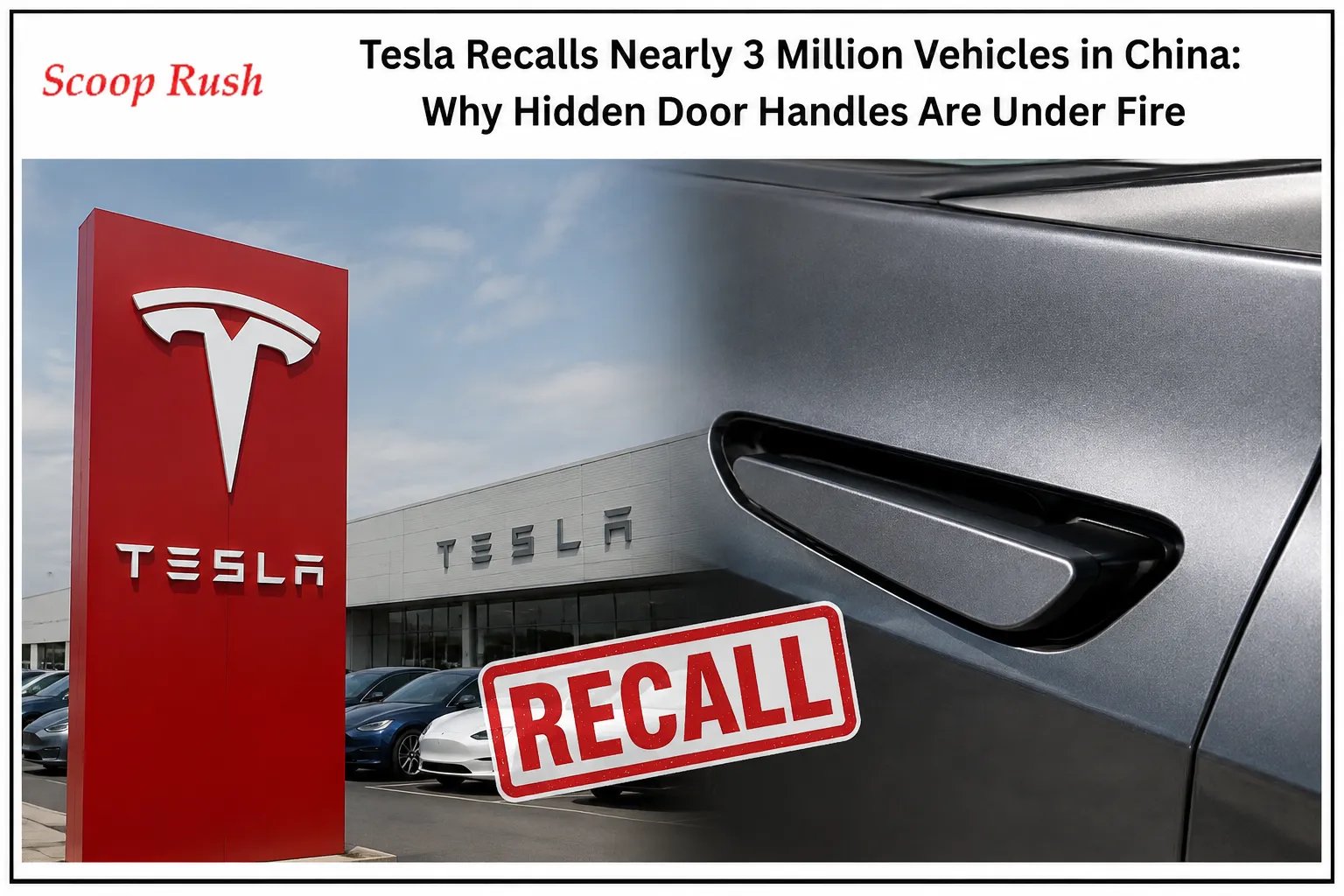
Imagine being trapped inside a burning car because you cannot find the handle to open the door. This nightmare scenario is exactly why the Tesla recall China door handles saga is dominating headlines, as Tesla and ten other automakers now recall more than 4.3 million vehicles across China. It marks the country’s largest automotive recall on record, and it centers on a design feature many drivers barely think about: the door handle.
Tesla alone is recalling nearly 3 million vehicles. The issue involves the emergency mechanical door releases hidden inside many modern EVs. Regulators say these releases are hard to locate during a crash, especially when the car’s electrical system fails. For anyone who owns an EV or is thinking about buying one, this story matters. It raises real questions about how far automakers should go in prioritizing sleek design over simple, reliable safety, a debate that echoes recent scrutiny over Elon Musk’s other ventures and business decisions.
What Triggered the Massive Tesla Recall in China
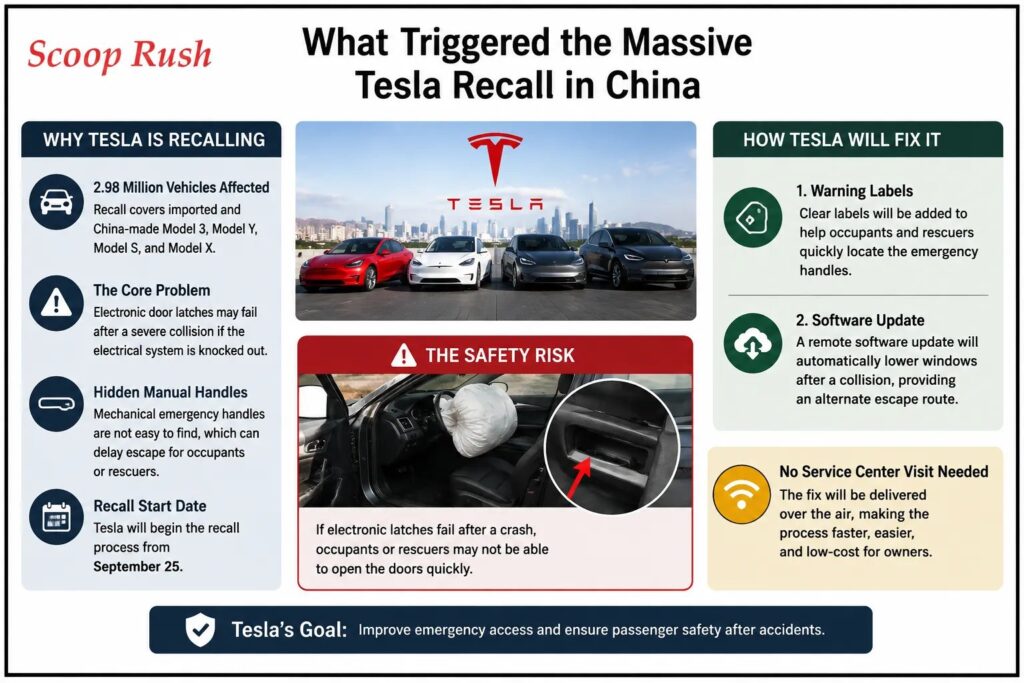
China’s State Administration for Market Regulation confirmed the recall on Friday. The Tesla recall China door handles action is the largest among eleven automakers involved, but Tesla’s share is by far the largest. The recall covers 2.98 million Tesla vehicles, including both imported and China-made Model 3, Model Y, Model S, and Model X cars.
The core problem is straightforward. Many modern EVs use electronic door latches that respond to a key fob, smartphone, or touch panel. These systems look clean and modern. However, they depend on electrical power to function. If a severe collision knocks out the vehicle’s electrical system, the doors may not open through the usual method.
To handle this, most EVs include a backup mechanical release. Unfortunately, these manual handles are often tucked away in places that are not obvious, especially during the chaos of an emergency. Regulators found that occupants and rescuers alike could struggle to locate them quickly enough.
According to the regulator’s statement, Tesla’s mechanical emergency door-release handles may become difficult to identify following a serious crash. This could delay occupants from escaping or block rescuers trying to reach them from outside. As a result, Tesla will begin the recall process from September 25.
How Tesla Plans to Fix the Problem
Tesla’s remedy comes in two parts. First, the company will install warning labels to clearly mark the location of the emergency handles. Second, it will roll out a software update delivered remotely. This update will automatically lower the vehicle’s windows after a collision, giving occupants another way to escape even if the doors remain difficult to open.
Notably, this fix does not require owners to visit a service center. Since the software update happens over the air, the process should be relatively fast and low-cost. Industry analyst Sam Fiorani, vice president at AutoForecast Solutions, pointed out that modern over-the-air updates significantly reduce the cost and downtime typically associated with major recalls.
Other Automakers Caught in the Same Safety Sweep
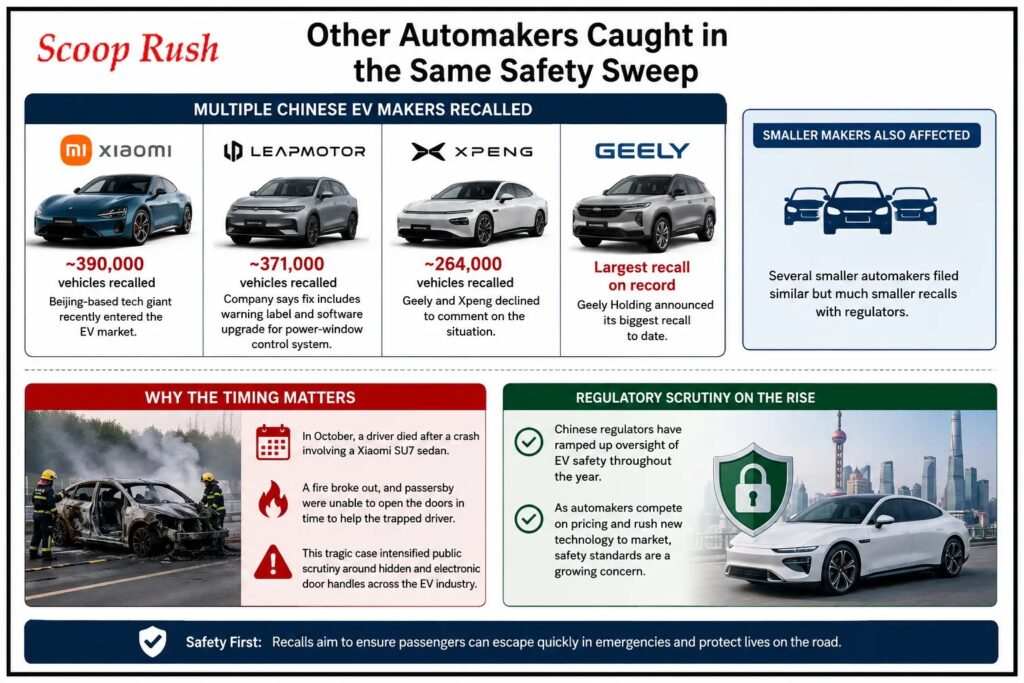
Tesla is not alone in this recall. Xiaomi, the Beijing-based tech giant that recently entered the EV market, is recalling about 390,000 vehicles. Leapmotor is recalling roughly 371,000 cars, while Xpeng is recalling around 264,000. Geely Holding also announced its largest recall on record. Several smaller automakers filed similar but much smaller recalls with regulators.
Leapmotor stated it remains committed to safety. The company clarified that its fix only involves a warning label and a software upgrade for the power-window control system. It added that it was managing the recall responsibly for the benefit of its users.
Meanwhile, Geely and Xpeng declined to comment on the situation. Xiaomi confirmed it had no additional details beyond what regulators had already released.
Why the Timing of This Recall Matters
This recall does not happen in isolation. Chinese state media reported that a driver died in October after a crash involving a Xiaomi SU7 sedan. In that incident, a fire broke out, and passersby were unable to open the doors in time to help the trapped driver. This tragic case intensified public scrutiny around hidden and electronic door handles across the entire EV industry.
Consequently, Chinese regulators have ramped up oversight of EV safety throughout the year, similar to how UK regulators have pressured big tech companies over safety standards in a different sector. As automakers compete fiercely on pricing and rush new technology to market, safety standards have become a growing point of concern for both regulators and consumers.
China’s Broader Crackdown on Hidden Door Handles
The Tesla recall China door handles issue connects to a larger regulatory shift already underway in China.Earlier this year, authorities announced that hidden, or flush, exterior door handles would be banned starting in 2027. Under the new rules, vehicles sold in China must include a mechanical release on both the inside and outside of every door.
This design, popularized by Tesla and widely copied by Chinese EV makers, was originally seen as a symbol of futuristic, minimalist styling. Retractable handles tuck neatly into the door panel and extend only when the driver approaches. While visually appealing, critics argue the design sacrifices practicality for aesthetics.
What Industry Experts Are Saying
Cui Dongshu, head of the China Passenger Car Association, described the recall as an inevitable step in the evolution of the EV industry. He explained that automakers were being responsible by shifting toward a more reliable, safety-first approach. According to Cui, this moment reflects both the growing pains of a fast-moving industry and a policy-driven push toward stronger safety standards.
A report from People’s Daily echoed this sentiment. It stated that the large-scale recall represents a unified safety upgrade ahead of the 2027 ban. The report emphasized that competition among EV makers should not be defined only by innovation speed, but also by high safety standards.
Global Scrutiny Is Growing Too
China is not the only country paying closer attention to this issue. In the United States, the National Highway Traffic Safety Administration said last month it would consider new safety standards addressing occupant entrapment risks during electrical failures.
However, NHTSA confirmed on Friday that no automaker has yet notified the agency of plans for a similar recall in the U.S. market. This creates an interesting gap. While Chinese regulators are taking aggressive action, American regulators are still in the early stages of evaluating the issue.
Tesla has previously faced scrutiny in the U.S. as well. Reports emerged of children becoming trapped in vehicles after door handles unexpectedly stopped working, prompting a formal investigation. Additionally, other automakers such as Rivian have faced criticism over hard-to-locate manual releases, and Ford briefly paused sales of its Mustang Mach-E in 2025 due to a similar door-latch concern.
What This Means for EV Owners and Buyers
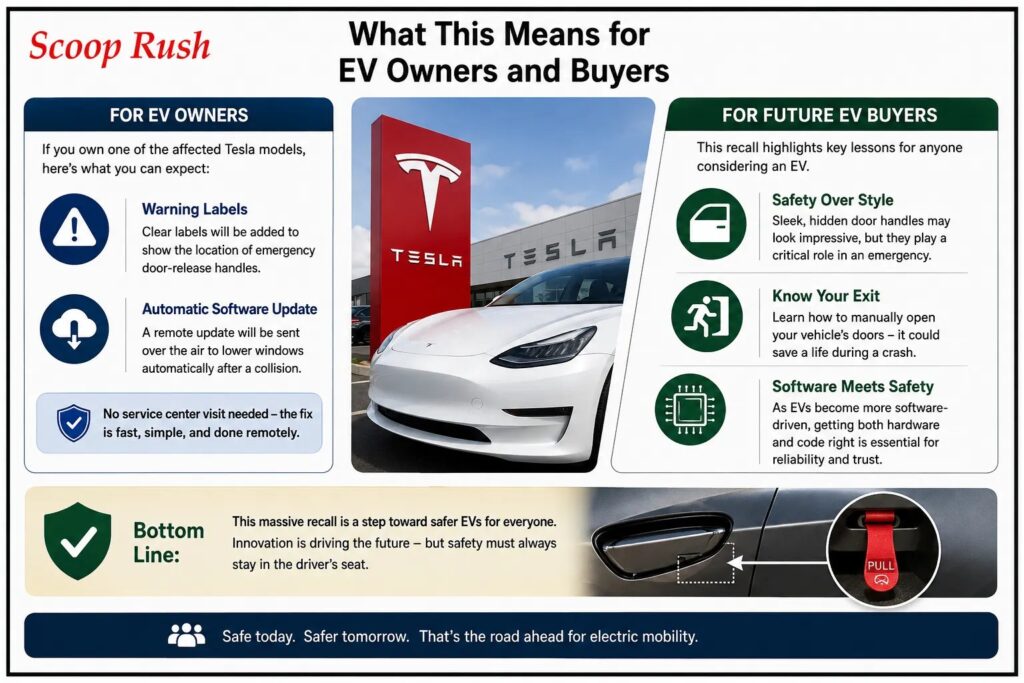
For everyday drivers, this recall serves as an important reminder. Electric vehicles bring exciting technology, but that innovation must go hand in hand with practical safety. If you own one of the affected Tesla models, you can expect a warning label and an automatic software update rather than a lengthy repair process.
For future EV buyers, this story highlights a valuable lesson. Sleek, hidden door handles may look impressive, but they are not purely cosmetic. Understanding how to manually open your vehicle’s doors, especially during an emergency, could genuinely save a life. It is worth remembering that as EVs become more software-driven, their reliability increasingly depends on getting both hardware and code right, a challenge that mirrors ongoing debates about whether AI and automation will reshape jobs across industries.
Conclusion
The Tesla recall China door handles story marks a turning point for the EV industry. What began as a design trend focused on minimalism and technology is now being reevaluated through the lens of real-world safety. With China banning hidden door handles by 2027 and the U.S. beginning its own regulatory review, automakers worldwide may soon be forced to rethink how drivers and passengers get in and out of their vehicles during emergencies.
Ultimately, this recall shows that even small design choices can have major safety implications. As the EV industry continues to grow, balancing innovative design with dependable safety features will remain essential.
FAQs
1. Why is Tesla recalling nearly 3 million vehicles in China?
Tesla is recalling these vehicles because their emergency mechanical door-release handles may be difficult to identify during a severe crash, especially if the car’s electrical system fails.
2. Which Tesla models are affected by the recall?
The recall covers Tesla Model 3, Model Y, Model S, and Model X vehicles, including both imported and China-made units.
3. How will Tesla fix the door handle issue?
Tesla will install warning labels near the emergency handles and roll out a software update that automatically lowers the vehicle’s windows after a collision.
4. Are other car brands involved in this recall?
Yes. Xiaomi, Leapmotor, Xpeng, Geely, and several other automakers are also recalling vehicles for similar door-handle safety concerns.
5. Will hidden door handles be banned in the future?
Yes. China has announced that hidden exterior door handles will be banned starting in 2027, requiring vehicles to include accessible mechanical releases on both the inside and outside of every door.

