Home Blog Page 33

Diet Coke Chicken: The Ultimate Guide to This Sweet, Sticky, High-Protein Recipe

0

Prep Time: 10 minutes | Cook Time: 20 minutes | Total Time: 30 minutes | Servings: 4 | Difficulty: Easy

Diet Coke Chicken is one of the internet’s most surprising recipes, turning a can of Diet Coke into a rich, sticky glaze that coats tender chicken with sweet and savory flavor. It’s quick, affordable, high in protein, and perfect for busy weeknight dinners. 

An Unexpected Ingredient, A Familiar Flavor

Despite its unexpected main ingredient, the recipe delivers tender chicken coated in a rich, sticky, sweet-and-savory sauce that tastes nothing like soda. Instead, the Diet Coke cooks down into a glossy glaze that balances sweetness, tanginess, and umami in a way that’s genuinely hard to believe until you taste it.

A Modern, Budget-Friendly Comfort Food

Originally made famous by Weight Watchers and Slimming World communities, Diet Coke Chicken has evolved into a modern comfort food that’s lower in calories than most takeaway dishes. Whether you prefer chicken breast for maximum protein or chicken thighs for extra juiciness, this one-pan meal is easy to prepare, budget-friendly, and perfect for a weeknight dinner.

This complete guide covers everything: the history of the recipe, why it works, its nutritional value, the ingredients and equipment you’ll need, a full step-by-step method, storage and reheating tips, tasty variations, common mistakes to avoid, and answers to the questions people ask most.

What Is Diet Coke Chicken?

What Is Diet Coke Chicken? |Scoop Rush

Diet Coke Chicken is a one-pan recipe where pieces of chicken are simmered in Diet Coke along with tomato-based ingredients and seasonings until the liquid reduces into a thick, sticky sauce.

Why Cooking Chicken in Soda Actually Works

Using soda in cooking might sound strange, but the process works because the liquid evaporates while concentrating the flavor of everything else in the pan. The artificial sweeteners provide sweetness without the large amount of sugar found in regular cola, which is exactly why the sauce stays light while still tasting indulgent. For anyone curious how it compares to other diet sodas in cooking, this look at Diet Coke vs. Coke Zero is a useful reference, as is this guide to Diet Dr Pepper’s health profile if you want to experiment with a different diet cola base.

The finished dish tastes far closer to barbecue sauce or sweet Asian-style chicken than it does to a fizzy drink which is exactly why it’s built such a loyal following.

The History of Diet Coke Chicken

Diet Coke Chicken became popular in the early 2000s through Weight Watchers communities. The original recipe was extremely simple: chicken, Diet Coke, and ketchup, with some versions adding soy sauce or Worcestershire sauce for extra flavor.

How the Recipe Grew Over Time

As the recipe spread online, home cooks began experimenting with garlic, onion powder, smoked paprika, tomato paste, rice vinegar, chili flakes, and bell peppers. Modern versions create a much richer sauce than the original while still keeping calories relatively low, and thousands of food bloggers have since created their own spins making Diet Coke Chicken one of the internet’s most famous healthy comfort foods.

Why Is Diet Coke Used?

Why Is Diet Coke Used? |Scoop Rush

Many people wonder why Diet Coke is used instead of water or broth. It actually earns its place in the pan for a few clear reasons.

Sweetness. The sweeteners create a balanced sweet flavor without the calories of added sugar.

Caramelization. As the liquid reduces, the sauce develops a glossy, sticky coating on the chicken.

Flavor balance. Diet Coke’s mild acidity complements tomato paste, soy sauce, garlic, onion, and vinegar.

Lower calories. Unlike regular cola, Diet Coke contributes almost no calories while still producing a rich sauce.

Does Diet Coke Chicken Taste Like Soda?

This is the biggest concern for first-time cooks and the answer is no. Once simmered for 15–20 minutes, the soda flavor completely disappears. Instead, the finished sauce tastes similar to sweet barbecue sauce, sticky Asian chicken, sweet soy glaze, or honey garlic chicken without the honey. Most people who try Diet Coke Chicken are genuinely surprised that they can’t detect any cola flavor at all.

Why Has Diet Coke Chicken Become So Popular?

Several reasons explain why this recipe keeps trending year after year.

Easy and Budget-Friendly

The recipe requires only one pan, meaning minimal cleanup on a busy evening. Most ingredients are inexpensive and already sitting in your pantry.

High in Protein and Meal-Prep Friendly

Using lean chicken breast creates a filling, protein-packed meal and the flavors actually improve after sitting overnight in the fridge, which makes it a genuinely great meal-prep option rather than just a one-night dinner.

Family-Friendly and Healthier Than Takeaway

Children often enjoy the slightly sweet flavor, while adults appreciate the savory depth underneath it. Compared with many restaurant chicken dishes, Diet Coke Chicken generally contains less fat, less sugar, more protein, and fewer calories overall.

Nutritional Benefits of Diet Coke Chicken

Nutritional Benefits of Diet Coke Chicken |Scoop Rush

Although exact nutrition depends on your ingredients, Diet Coke Chicken can fit comfortably into many healthy eating plans.

Protein and Muscle Support

Chicken breast is one of the richest natural sources of lean protein. Protein helps build muscle, repair tissue, keep you feeling full longer, and support healthy weight management which is also why it matters so much for anyone managing appetite changes, including people watching for muscle loss while on GLP-1 medications.

Calories and Fat

Using Diet Coke instead of sugary sauces significantly reduces calorie intake, with many homemade servings landing between 280–350 calories depending on ingredients. Using skinless chicken breast also keeps saturated fat relatively low.

Vitamins and Minerals

Chicken provides vitamin B6, vitamin B12, niacin, selenium, phosphorus, and zinc nutrients that support energy production, immune function, brain health, and muscle recovery. Getting these from whole food rather than pills is generally the safer route; this piece on the risks of taking too many vitamin supplements explains why.

Nutrition Table

Instead of only writing calories, include a table.

NutrientPer Serving
Calories320 kcal
Protein34 g
Carbohydrates12 g
Fat9 g
Fiber1 g
Sodium620 mg

Is Diet Coke Chicken Healthy?

Is Diet Coke Chicken Healthy? |Scoop Rush

Overall, Diet Coke Chicken can absolutely be part of a balanced diet its healthfulness really comes down to portion size, the ingredients you choose, and what you serve it with. A serving with steamed broccoli and brown rice is far healthier than one served with a large portion of fries, and choosing reduced-sodium soy sauce helps keep sodium intake in check too.

If you’re weighing this recipe against other structured eating approaches, it’s worth comparing notes with guides like the low-carb diet, the carnivore diet, or the military diet to see which framework actually fits your goals.

Are Artificial Sweeteners Safe?

Many people worry about the artificial sweeteners found in Diet Coke. Current scientific evidence suggests approved sweeteners such as aspartame are safe for the general population within recommended daily intake levels. Major health organizations including the FDA and the European Food Safety Authority (EFSA) have reviewed extensive research and concluded that approved low-calorie sweeteners can be safely consumed by most people.

The exception is people with phenylketonuria (PKU), a rare inherited disorder, who should avoid products containing aspartame because they can’t properly metabolize phenylalanine. As with most foods, moderation remains the best approach as part of an overall balanced diet and if you’re rebuilding your routine around better everyday choices, this list of healthy habits worth building in your 20s and 30s is a good companion read.

Ingredients for Diet Coke Chicken

One reason this recipe is so popular is that it uses simple pantry ingredients.

  • Chicken breast — lean and high-protein; chicken thighs work too for a richer result.
  • Diet Coke — the signature ingredient that creates the sweet glaze (Coke Zero or any diet cola also works).
  • Tomato paste — rich color, concentrated tomato flavor, and a thick consistency, with less sugar than ketchup.
  • Soy sauce — deep savory umami flavor; go low-sodium if you’re watching salt.
  • Garlic powder — aromatic depth without needing fresh garlic.
  • Onion powder — mild sweetness and savory flavor.
  • Paprika — beautiful color, mild smokiness, extra complexity.
  • Rice vinegar — balances the sweetness with gentle acidity.
  • Chili powder — optional, but even a small amount greatly improves flavor balance.
  • Spring onions — freshness, crunch, and color right before serving.

Why Tomato Paste Works Better Than Ketchup

Many original recipes relied heavily on ketchup, but modern recipes often replace it with tomato paste because it offers a richer tomato flavor, less added sugar, lower calories, and a thicker, better-textured sauce. Tomato paste also lets you control sweetness far more precisely than ketchup does.

Choosing the Best Chicken

Chicken breast is the highest-protein, leanest option, and it cooks the fastest the main risk is that it can dry out if overcooked. Chicken thighs are juicier, richer in flavor, and more forgiving during cooking, though they run slightly higher in calories and fat. Both options work well; it really comes down to whether you want maximum protein or maximum juiciness.

Essential Kitchen Equipment

You don’t need special equipment to make Diet Coke Chicken most home kitchens already have everything required: a large non-stick frying pan or skillet, a mixing bowl, measuring cups and spoons, a wooden spoon or silicone spatula, a sharp knife, and a chopping board. A heavy-bottomed pan works especially well because it helps the sauce reduce evenly without burning.

Preparing the Chicken

The key to tender Diet Coke Chicken starts before the pan is even heated.

Cut, Dry, and Season

Cut the chicken into evenly sized bite-sized pieces so they cook at the same rate pieces that are too large may stay undercooked inside, while very small pieces can dry out before the sauce finishes reducing. Pat the chicken dry with paper towels before seasoning, since removing excess moisture helps it brown better and stops it from steaming in the pan. Season generously with garlic powder, onion powder, paprika, black pepper, and a pinch of salt, tossing until every piece is evenly coated.

Step-by-Step: How to Make Diet Coke Chicken

Step 1: Sear the Chicken

Heat a little oil in your skillet over medium-high heat. Add the seasoned chicken in a single layer and sear for 5–7 minutes, turning occasionally, until lightly golden. This step builds a light crust through the Maillard reaction and adds real depth of flavor the chicken doesn’t need to be fully cooked yet, since it will finish in the sauce.

Step 2: Build the Sauce

Push the chicken to one side (or remove it briefly), then stir in the tomato paste, soy sauce, and a splash of rice vinegar. Pour in the Diet Coke and stir everything together, scraping up any browned bits from the bottom of the pan for extra flavor.

Step 3: Simmer and Reduce

Bring the sauce to a gentle boil, then reduce the heat and let it simmer uncovered for 15–20 minutes, stirring occasionally. The liquid will gradually reduce and thicken into a glossy, sticky glaze that clings to the chicken.

Step 4: Finish and Serve

Once the sauce has thickened to your liking, taste and adjust the seasoning a pinch of chili powder if you want heat, or a little extra vinegar for brightness. Garnish with sliced spring onions and serve hot over rice, noodles, or mashed potatoes.

Storage and Reheating Tips

Diet Coke Chicken keeps well, which is exactly why it’s such a popular meal-prep choice.

Refrigerator. Store in an airtight container for up to 4 days. The flavor actually improves after a day or two, as the sauce continues to soak into the chicken.

Freezer. Freeze in a sealed container or bag for up to 3 months. Thaw overnight in the fridge before reheating.

Reheating. Warm gently in a skillet over medium-low heat with a small splash of water or Diet Coke to loosen the sauce, or microwave in short bursts, stirring in between.

Recipe Variations to Try

  • Spicy Diet Coke Chicken — add extra chili powder or a dash of hot sauce to the glaze.
  • Garlic Ginger Diet Coke Chicken — stir in fresh grated ginger alongside the garlic for a warmer, more Asian-inspired profile.
  • Sheet-Pan Version — bake seasoned chicken and the sauce together at 400°F (200°C) for 25–30 minutes for a hands-off approach.
  • Vegetable-Loaded — add bell peppers, broccoli, or snap peas in the last 5 minutes of simmering for a complete one-pan meal.
  • Slow Cooker Version — combine everything in a slow cooker and cook on low for 4–5 hours, then reduce the sauce separately on the stovetop if it needs thickening.

Common Mistakes to Avoid

Skipping the sear. Boiling the chicken directly in the sauce misses the flavor boost that browning provides.

Using too much liquid. Adding extra Diet Coke beyond the recipe can prevent the sauce from reducing properly in the given time.

Overcooking chicken breast. Because breast meat is lean, it can dry out quickly once the sauce fully reduces pull it as soon as it’s cooked through.

Not tasting as you go. Since sweetness and saltiness vary by brand, always taste the sauce partway through and adjust with soy sauce, vinegar, or chili as needed.

Final Thoughts

Diet Coke Chicken proves that a slightly unconventional ingredient list can produce a genuinely satisfying, high-protein dinner that doesn’t feel like a diet meal at all. It’s quick, affordable, endlessly customizable, and most importantly tastes nothing like the soda it’s named after. Whether you’re meal-prepping for the week or just want a fast, flavorful dinner tonight, this one-pan recipe is worth adding to your regular rotation.

FAQs

Can I use regular Coke instead of Diet Coke? 

Yes, but the sauce will be sweeter and higher in calories and sugar.

Does Diet Coke Chicken really not taste like soda? 

Correct. Once reduced, the cola flavor disappears, and the sauce tastes more like a sweet barbecue glaze, the cola flavor disappears and the sauce tastes closer to a sweet, sticky barbecue glaze.

Is this recipe good for weight loss? 

It can be, especially when paired with lean chicken breast and served alongside vegetables or whole grains rather than heavier sides.

Can I make this ahead of time? 

Yes,it’s an excellent meal-prep recipe, since the flavor deepens after a day in the fridge.

What can I serve it with? 

Rice, noodles, mashed potatoes, or steamed vegetables all work well alongside the sticky sauce.

Can I use Coke Zero instead of Diet Coke? 

Yes ,Coke Zero or any diet cola works just as well and produces a very similar glaze.

How many calories are in Diet Coke Chicken? 

Most homemade servings fall between 280–350 calories, depending on the chicken cut and how much sauce is used.

Can I make this recipe in a slow cooker? 

Yes,combine the chicken and sauce ingredients and cook on low for 4–5 hours, then reduce the sauce on the stovetop afterward if it needs to thicken further.

Is Diet Coke Chicken safe for people with diabetes? 

Because it uses a diet cola instead of sugar-sweetened soda, it’s generally lower in sugar than similar sticky chicken recipes but anyone managing diabetes should check with their doctor or dietitian about portion size and overall meal balance.

Can I freeze Diet Coke Chicken? 

Yes,it freezes well for up to 3 months in an airtight container. Thaw it in the fridge overnight before reheating.

Why is my sauce too thin or too thick? 

If the sauce is too thin, simmer it a few minutes longer uncovered. If it’s too thick, stir in a small splash of water or Diet Coke to loosen it back up.

Can I make this recipe without soy sauce? 

Yes,you can substitute a low-sodium alternative like coconut aminos, though the flavor will be slightly milder.

Is Diet Coke Chicken keto-friendly? 

Not typically, since it relies on tomato paste and cola for its sauce; it leans more low-sugar and high-protein than strictly low-carb.


Why Chelsea Have Signed So Many Man City Academy Graduates

0

Chelsea’s transfer strategy has changed dramatically

Why Chelsea have signed so many Man City academy graduates has become one of the biggest talking points ahead of the new season. Since 2023, Chelsea have spent close to £300 million on players who developed through Manchester City’s academy, including their latest club-record signing, Morgan Rogers. Alongside Rogers, players such as Cole Palmer, Liam Delap, Romeo Lavia, Jamie Gittens, and Tosin Adarabioyo have all arrived at Stamford Bridge after spending important years in City’s youth system.

This trend is not simply a coincidence. Instead, it reflects Chelsea’s long-term recruitment strategy, changes within the club’s academy leadership, and the growing reputation of Manchester City’s youth development model. As Chelsea prepare for a new era under Xabi Alonso, the club hopes these carefully selected signings can help build a stronger squad capable of competing for major honours.

This article explains why Chelsea continue targeting Manchester City’s academy graduates, the people driving this approach, and how it could shape the club’s future.

Why Chelsea Have Signed So Many Man City Academy Graduates

Chelsea’s recruitment over the past few years clearly shows a preference for players who developed within Manchester City’s academy.

Since 2023, the club has signed:

  • Morgan Rogers
  • Cole Palmer
  • Liam Delap
  • Romeo Lavia
  • Jamie Gittens
  • Tosin Adarabioyo

Together, these transfers represent almost £300 million in spending.

Meanwhile, Chelsea’s current senior squad includes only a small number of homegrown Cobham graduates expected to remain permanent first-team members, including:

  • Levi Colwill
  • Reece James
  • Josh Acheampong

Trevoh Chalobah also remains a Chelsea player, although he is reportedly in advanced talks over a move to Serie A side Como.

This contrast highlights a significant shift in Chelsea’s recruitment philosophy.

Morgan Rogers Becomes Chelsea’s Record Signing

Why Chelsea Have Signed So Many Man City Academy Graduates becomes clearer when Morgan Rogers’ transfer is viewed alongside Chelsea’s recent recruitment strategy. Chelsea’s latest statement signing is Morgan Rogers, who joined for a reported £117 million.

Interestingly, Rogers faced Chelsea during the 2020 FA Youth Cup Final, where Manchester City defeated Chelsea 3-2.

That City side featured several players who are now Chelsea teammates, including:

  • Morgan Rogers
  • Cole Palmer
  • Liam Delap

Six years later, those former academy teammates are together once again, this time wearing Chelsea shirts.

Cole Palmer’s Success Changed Chelsea’s Thinking

One of the biggest reasons behind Chelsea’s continued interest in Manchester City’s academy graduates is the remarkable success of Cole Palmer.

Chelsea signed Palmer in 2023 for £40 million plus £2.5 million in add-ons.

Since arriving at Stamford Bridge, Palmer has developed into one of the Premier League’s standout performers. His progress demonstrated that highly talented players leaving Manchester City’s academy can thrive when given regular first-team opportunities. As a result, Chelsea gained greater confidence in targeting similar profiles from City’s development system.

Manchester City’s Academy Has Earned an Elite Reputation

The growing reputation of City’s youth system explains Why Chelsea Have Signed So Many Man City Academy Graduates in recent transfer windows. Manchester City’s academy has become one of the most respected youth development systems in English football. According to one former insider quoted by BBC Sport, players who come through City’s academy:

“Know what good looks like.”

That reputation comes from years of consistent coaching, tactical education and player development. Former City academy coach Gareth Taylor explained that every age group followed a clearly defined playing identity inspired by coaching ideas introduced by Rodolfo Borrell, which reflected principles associated with Johan Cruyff and Pep Guardiola.

Taylor described:

  • Liam Delap as a player with a real competitive edge.
  • Morgan Rogers was talented and humble.
  • Cole Palmer is fearless and capable of dominating opponents.

Such consistent coaching helped prepare players for senior football.

Chelsea’s Recruitment Team Has Strong Manchester City Links

Former Manchester City staff have also influenced Why Chelsea Have Signed So Many Man City Academy Graduates. Another major reason behind Chelsea’s transfer strategy is the number of former Manchester City staff now working at Stamford Bridge.

One of the most influential figures is Joe Shields.

Shields previously worked within Manchester City’s academy recruitment department before joining Chelsea. Today, he plays an important role across both youth and senior recruitment.

Chelsea have also appointed several other former City employees, including:

  • First-team coach Calum McFarlane
  • Academy director Glenn van der Kraan

Previously, Tom Glick also served as Chelsea president after working at Manchester City. In addition, former Chelsea head coach Enzo Maresca and several members of his coaching staff previously worked within City’s coaching structure before Maresca returned to Manchester City. These connections naturally provide Chelsea with detailed knowledge of players developed inside City’s academy.

Financial Rules Also Influence Transfer Decisions

Financial regulations have also shaped Chelsea’s recruitment strategy. Under Premier League and UEFA accounting rules, clubs can record fees received from academy-developed players as pure profit.

This creates an incentive for clubs to sell academy graduates when appropriate. Manchester City have benefited from this system by selling talented young players who faced limited first-team opportunities.

Chelsea have taken advantage by signing players they believe can develop further with more regular senior football. Similarly, Chelsea themselves have sold academy graduates to help balance spending. One example mentioned is the sale of Tyrique George to Everton during the summer.

Pep Guardiola Faced Difficult Decisions

Manchester City’s success under Pep Guardiola has made breaking into the first team extremely difficult. Because City regularly compete for the Premier League, Champions League and domestic trophies, opportunities for academy graduates remain limited. Guardiola previously acknowledged this challenge. Some players eventually moved elsewhere to continue their development.

Cole Palmer and Jadon Sancho were offered pathways within City’s structure but ultimately chose different routes to secure more consistent playing opportunities. Morgan Rogers also left after spending several years within City’s academy before continuing his development elsewhere. Chelsea have become one of the clubs willing to offer these talented players a bigger role.

Chelsea’s Academy Remains Highly Successful

Although Chelsea have recruited heavily from Manchester City’s academy, their own academy continues producing outstanding talent. Chelsea finished last season without winning a senior trophy and ended the Premier League campaign in tenth place.

However, the academy enjoyed a much stronger season by winning league and cup titles. The club’s youth structure is now led by Joe Shields and Glenn van der Kraan, while pathways director Jack Francis continues providing long-term stability. Chelsea’s academy also has an impressive history.

Past achievements include:

  • Five consecutive FA Youth Cup victories.
  • Three straight Youth Cup wins against Manchester City.
  • UEFA Youth League titles in 2015 and 2016.

Chelsea remain the only English club to win the UEFA Youth League.

Changes Have Reshaped Chelsea’s Academy

Chelsea’s academy has undergone major structural changes over recent years. Former academy leaders Neil Bath and Jim Fraser helped build one of England’s strongest youth systems.

However, after leadership changes and disagreements within the club, both eventually departed. Chelsea subsequently brought in several staff members with Manchester City backgrounds.

As a result, coaching methods and academy philosophy have gradually evolved. Many long-serving employees adapted to the new approach, while numerous new staff joined the club. This transformation has significantly influenced Chelsea’s player development model.

The Historic Rivalry Between Chelsea and Manchester City Academies

The Historic Rivalry Between Chelsea and Manchester City Academies

For many years, Chelsea and Manchester City possessed the two strongest academy systems in English football. Competition between them became intense. Former striker Liam Delap reflected on those encounters by saying:

“We hated each other in games.” He also explained that those fierce rivalries remained only on the pitch and players later became friends as professionals. Chelsea defender Levi Colwill frequently faced Delap during academy matches, creating memorable contests between the clubs.

One particularly significant meeting came during the 2020 FA Youth Cup Final, where Manchester City defeated Chelsea 3-2. Today, several players from that match have reunited at Chelsea.

Chelsea and Manchester City Once Had an Informal Agreement

During the height of their academy dominance, Chelsea and Manchester City reportedly operated under an informal understanding. Both clubs generally avoided signing youth players directly from each other.

The aim was to prevent inflated transfer fees and excessive wages at youth level. However, that arrangement no longer exists.

Meanwhile, other leading clubs have increased investment in youth development. Manchester United, Liverpool and Arsenal all strengthened their academy programmes after Brexit restricted the recruitment of overseas players under the age of 18.

Why This Strategy Could Benefit Chelsea

Chelsea clearly believe that players developed within Manchester City’s academy possess qualities that fit the club’s long-term vision.

These players typically arrive with:

Strong tactical education

Manchester City’s academy follows a consistent football philosophy throughout every age group. Therefore, graduates often understand structured positional football from an early age.

Experience in elite environments

Young players spend years competing against top domestic and international opposition. As a result, they enter senior football with valuable experience.

Room for further development

Many academy graduates leave City because first-team opportunities are limited rather than because of a lack of talent. Chelsea hope regular playing time will help unlock their full potential.

Xabi Alonso Begins a New Chapter

Chelsea now enter a new era under Xabi Alonso. The squad contains an increasing number of players shaped by Manchester City’s academy system.

Whether this strategy ultimately delivers major trophies remains to be seen. However, Chelsea’s recruitment clearly reflects a long-term vision rather than isolated transfer decisions. The club believes these players possess both technical quality and the mentality required to compete at the highest level.

Conclusion

Ultimately, Why Chelsea Have Signed So Many Man City Academy Graduates reflects Chelsea’s long-term vision rather than short-term transfer decisions. Chelsea’s recent recruitment shows a clear and deliberate strategy. Rather than focusing only on established stars, the club has repeatedly invested in players developed by Manchester City‘s highly respected academy.

The success of Cole Palmer demonstrated the value of that approach, while Morgan Rogers, Liam Delap, Romeo Lavia, Jamie Gittens and Tosin Adarabioyo further strengthened those links.

At the same time, former Manchester City staff now working at Chelsea have influenced recruitment and academy development. Financial regulations, limited first-team opportunities at Manchester City and Chelsea’s own long-term planning have also contributed to this trend.

As Xabi Alonso prepares for the new season, Chelsea will hope this City-inspired recruitment model helps transform potential into sustained success.

(FAQs)

1. Why have Chelsea signed so many Manchester City academy graduates?

Chelsea believe Manchester City’s academy produces technically strong and tactically intelligent players. The club also has several former Manchester City staff members involved in recruitment.

2. Who is Chelsea’s latest Manchester City academy signing?

Morgan Rogers is Chelsea’s latest signing after joining in a club-record £117 million transfer.

3. Which Manchester City academy graduates currently play for Chelsea?

According to the provided report, Chelsea’s squad includes Morgan Rogers, Cole Palmer, Liam Delap, Romeo Lavia, Jamie Gittens and Tosin Adarabioyo, all of whom spent time in Manchester City’s youth system.

4. How did Cole Palmer influence Chelsea’s transfer strategy?

Palmer’s excellent performances after joining Chelsea convinced the club that Manchester City’s academy graduates could become key first-team players with regular opportunities.

5. Why do Manchester City sell talented academy players?

Manchester City face intense competition for first-team places. As a result, some academy graduates move elsewhere to secure regular senior football, while transfer fees for academy players also benefit clubs under financial accounting rules.

Will AI Replace Your Job? What the 2026 Data Actually Shows

0

A 25-year-old software developer just lost a job that didn’t exist five years ago, and an AI model finished the work in minutes. That is not a hypothetical scenario anymore. It is a pattern showing up across real employment data in 2026, and it raises one urgent question: will AI replace your job next?

Introduction

Will AI replace your job, or will it simply change how you do it? That question is no longer theoretical. New data from Stanford, the OECD, and Boston College shows that AI is already reshaping who gets hired, who gets let go, and which careers count as safe. For millions of workers, the answer is not a distant “someday.” It is happening right now, in 2026.

Tech leaders keep promising that AI tools can replace human labor across entire industries. Some companies are already testing this idea by keeping headcount flat and leaning on “AI agents” instead of new hires. Investors call it “flat is the new up,” and it signals a real shift in how businesses think about growth. If even part of this trend holds true, it will touch nearly every sector and career path, and it may happen faster than most people expect.

This matters to you because the effects are not limited to tech workers. Younger employees, older professionals, and entire service industries are all showing measurable signs of disruption. Therefore, understanding what the data says can help you figure out where you stand and what to do next.

How Fast Is AI Improving, and Why It Threatens Jobs

How Fast Is AI Improving, and Why It Threatens Jobs

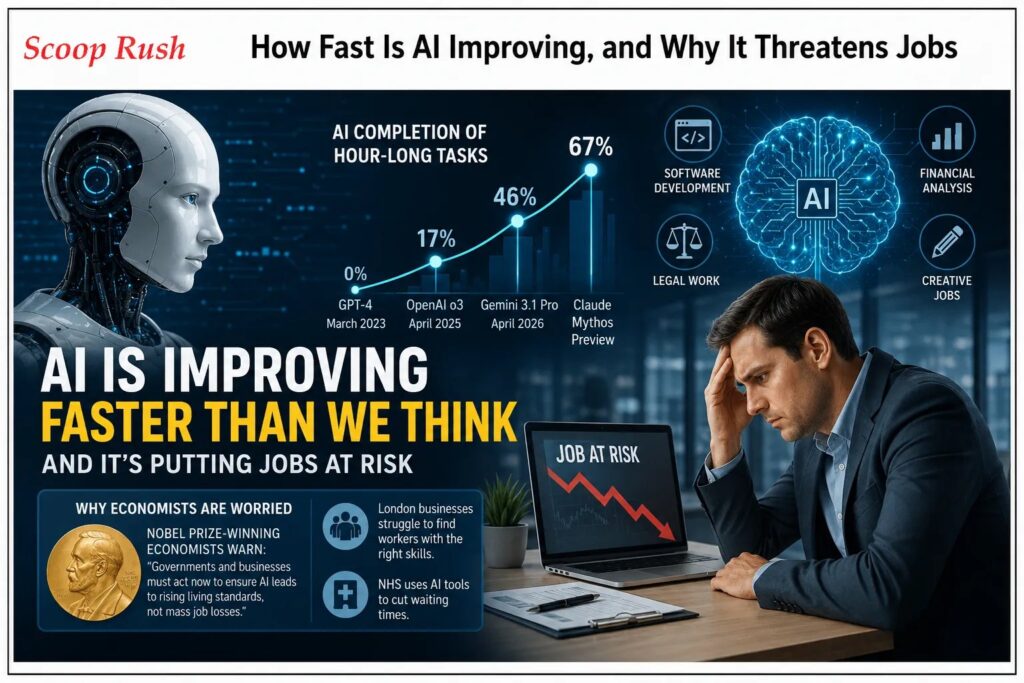
The clearest evidence of AI’s growing capability comes from a benchmark that tracks how well AI models complete tasks, based on how long those tasks would take a human expert. The results show a dramatic curve upward.

In March 2023, GPT-4 could reliably complete short tasks but failed at anything requiring more than an hour of human effort. By April 2025, OpenAI’s o3 model could complete 17% of hour-long tasks. Just a year later, Gemini 3.1 Pro pushed that number to 46%, and Claude Mythos Preview reached 67%.

In other words, AI models now complete tasks that once required a full hour of skilled human work. This trend started with software development. However, similar patterns are emerging in financial analysis, early-stage legal work, and even entry-level creative jobs. Some AI systems can now review problems in complex contracts. Others can refine their own underlying models, a task that would take a person several hours to finish.

Experts suggest the newest generation of AI models could begin improving themselves within the next year. That would mark a significant shift, since AI development itself could start to accelerate without the same level of human oversight it currently requires.

Why AI Job Losses Worry Economists

A group of Nobel prize-winning economists recently warned that governments and businesses “must act now” to make sure AI leads to rising living standards rather than large-scale job losses. Their concern is not abstract. London businesses have already reported difficulty finding workers with the right skills as AI reshapes job requirements across the city, a shift already visible in sectors like the NHS’s use of AI tools to cut waiting times.

AI Replacing Jobs: The Employment Numbers Behind the Headlines

AI Replacing Jobs: The Employment Numbers Behind the Headlines

Claims that AI will replace your job are easy to make. Proving them with real data is harder. Fortunately, researchers in the United States have spent four years tracking employment outcomes across occupations with high and low AI exposure.

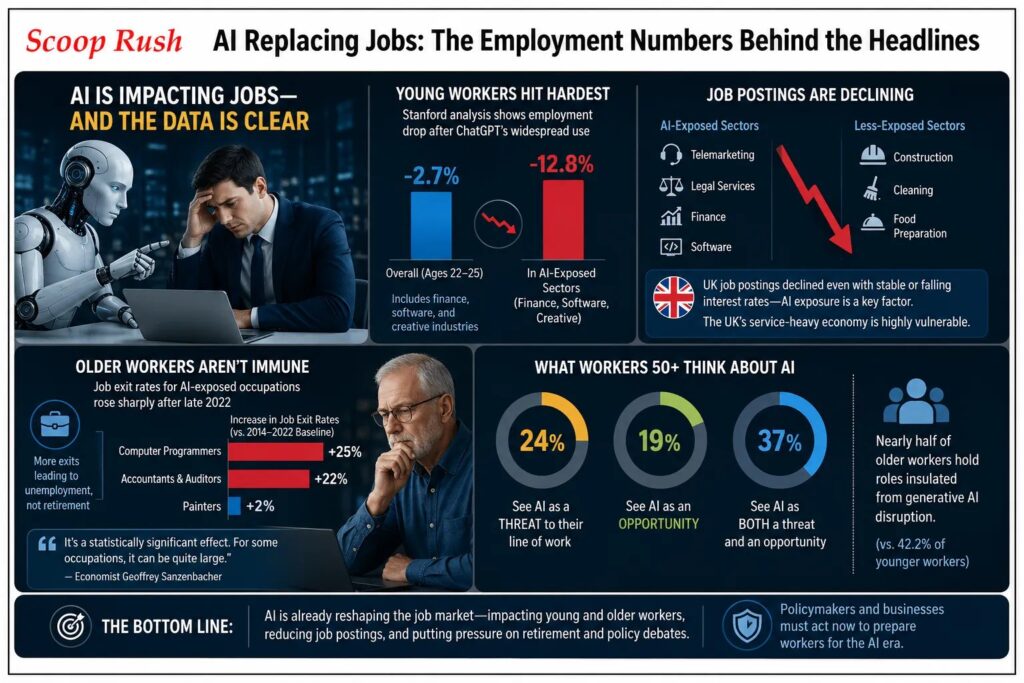
Stanford University’s analysis compared wage and job data before and after ChatGPT became widely used. The results show a 2.7% drop in employment for workers aged 22 to 25. However, in the most AI-exposed sectors, including finance, software, and creative industries, that number jumps to 12.8%.

Not every economist agrees with this conclusion. Some argue that other factors, such as interest rate increases, could explain part of the decline. Still, the pattern is consistent enough that it has caught the attention of policymakers and labor researchers alike.

Job postings tell a similar story. The OECD compared postings in highly AI-exposed sectors, such as telemarketing and legal services, against less exposed sectors like construction, cleaning, and food preparation. Notably, the United Kingdom stood out in this analysis. Job postings there took a notable hit even while interest rates stayed stable or fell. This decline also occurred before last year’s National Insurance increase. As a result, AI exposure alone appears to be playing a meaningful role. Because the UK’s economy leans heavily on service-sector jobs, it remains particularly vulnerable to further AI-driven disruption.

AI Job Displacement Is Hitting Older Workers Too

Younger workers are not the only ones affected. A June 2026 issue brief from the Center for Retirement Research at Boston College found that older employees in AI-exposed occupations are leaving their jobs at a faster rate than before. Economist Geoffrey Sanzenbacher combined federal labor data with AI exposure scores from Tufts University’s Digital Planet Initiative to track these transitions.

Before generative AI became mainstream, older workers in exposed occupations actually left their jobs less often than peers in lower-exposure roles. That advantage disappeared after late 2022. Furthermore, a meaningful share of these departures led to unemployment, not voluntary retirement.

The numbers by occupation are striking. Computer programmers saw job exit rates rise by more than 25% compared to the 2014-2022 baseline. Accountants and auditors experienced a similar surge, with exits climbing above 22%. Meanwhile, painters, whose work involves physical tasks that AI cannot easily replicate, saw only a 2% increase.

“It’s a statistically significant effect,” Sanzenbacher said. “For some occupations, it can be quite large.”

These findings carry weight beyond individual careers. They also complicate ongoing debates about raising the Social Security retirement age, since the trust fund could run dry by 2032 without policy changes. Consequently, if AI keeps pushing older workers out of their jobs earlier, asking them to work longer becomes a much harder proposition.

AARP research backs this up. Among adults aged 50 and older surveyed in March 2026, about 24% described AI as a threat to their line of work, while 19% called it an opportunity. Another 37% said it represented both at once. A joint AARP and LinkedIn report also found that nearly half of older workers currently hold roles considered insulated from generative AI disruption, compared to 42.2% of younger workers.

Is Replacing Humans With AI Actually Cheaper?

Is Replacing Humans With AI Actually Cheaper?

This question, will AI replace your job to save money, gets less attention than it deserves. AI systems don’t run for free. They require enormous computing power, and that power depends on expensive chips and massive data centers, the same infrastructure race behind moves like Nokia’s AI-RAN platform built with Nvidia. Therefore, as demand for AI keeps climbing, so does the pressure on hardware supply and cost.

AI usage is measured in tokens, small chunks of text that AI systems process to understand and generate language. On average, one token equals roughly three-quarters of an English word. Token use has skyrocketed throughout 2026, and this increase has outpaced the falling cost per token, even as chipmakers push efficiency gains like Google’s Frozen v2 AI chip built for Gemini. As a result, total AI spending keeps rising even as individual costs drop.

Some of the world’s largest companies now run internal “token leaderboards” that push employees to squeeze as much productivity as possible out of advanced AI models. As a result, businesses have burned through trillions, and in some cases quadrillions, of tokens over the past few months. Most of this usage covers agentic tasks, where AI systems act automatically without step-by-step human input.

The bills have piled up fast. So fast, in fact, that many companies now ration how much their employees can use these models. This detail matters because it suggests real limits on how much work AI can realistically automate. In some cases, running an AI “virtual worker” may cost more than paying a human employee, depending on the task’s complexity.

One factor works against these rising costs, however. Many companies, including Western firms, are shifting toward cheaper AI models that Chinese developers offer for free, such as Moonshot AI’s Kimi K3 model. This shift could lower the overall cost of AI adoption. Still, it raises new questions about reliability, data security, and long-term dependence on foreign technology providers.

Which Jobs Will AI Replace First?

Certain sectors show clearer signs of AI disruption than others. According to industry research, automation has already replaced repetitive tasks like picking, packaging, and quality control in manufacturing and production roles. Similarly, administrative and clerical work, including data entry and scheduling, faces pressure from AI systems that can process large volumes of information without human error.

Retail, customer service, and sales roles are also exposed, particularly where chatbots and automated systems can answer routine questions or generate leads. AI-generated content is even reshaping housing searches, as seen in reports on AI-written rental listings. Transportation and logistics show early signs of change too, as delivery drones and self-driving vehicle technology continue to develop.

On the other end of the spectrum, jobs relying on emotional intelligence, physical dexterity, and human judgment remain harder to automate. Experts frequently cite nurse practitioners, mental health counselors, and teaching roles as less vulnerable, since these positions depend on qualities AI still struggles to replicate.

Will AI Replace Your Job? What This Means for Your Career

Will AI Replace Your Job? What This Means for Your Career

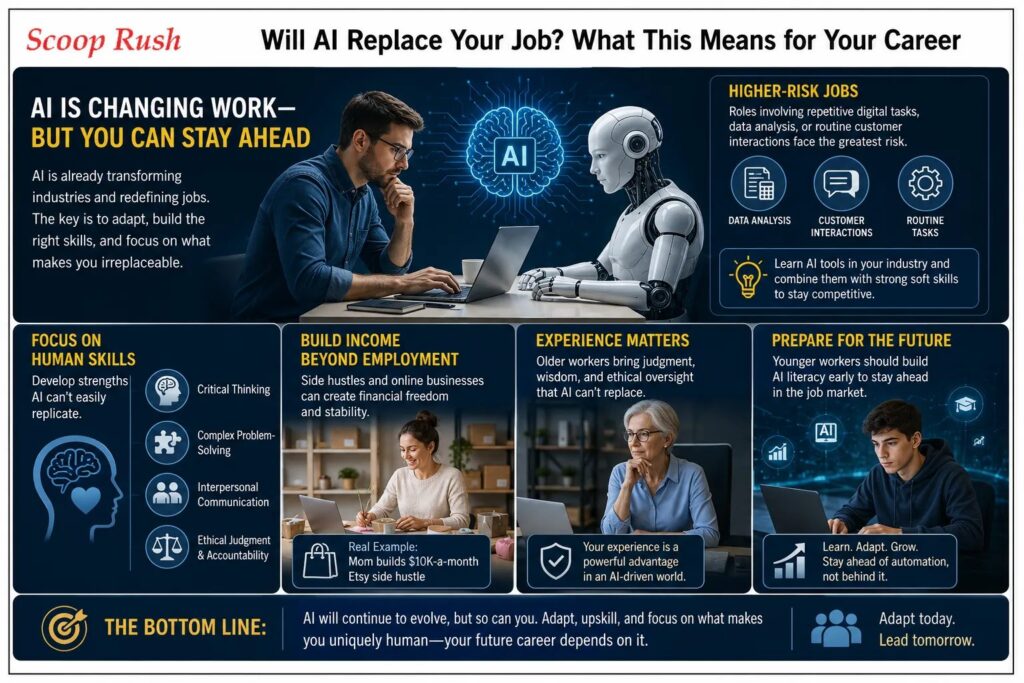
If your job involves repetitive digital tasks, data analysis, or routine customer interactions, it likely falls into a higher-risk category. However, building familiarity with AI tools relevant to your industry can help you stay competitive, since combining AI skills with strong soft skills tends to carry more value than either alone.

Career experts consistently recommend focusing on skills AI cannot easily replicate, including critical thinking, complex problem-solving, and interpersonal communication. Some workers are already building income outside traditional employment, like the mom who built a $10K-a-month Etsy side hustle. Older workers, in particular, bring judgment and ethical oversight that remain essential as AI systems take on more responsibility. Meanwhile, younger workers entering the job market may need to prioritize AI literacy earlier in their careers to remain competitive against automated alternatives.

Conclusion

AI is already changing the job market, and the data backs it up. Stanford’s research shows real declines in youth employment within AI-exposed sectors. Boston College’s findings reveal older workers leaving jobs earlier, often involuntarily. Meanwhile, the enormous cost of running advanced AI systems suggests replacing human workers is not automatically cheaper, at least not yet.

The situation remains uncertain, and not every economist agrees on how much of this shift comes from AI versus other economic factors. However, the overall trend is hard to ignore. Consequently, building AI literacy alongside distinctly human skills offers the most realistic path forward, regardless of your age or industry.

FAQs

Will AI actually replace most jobs?

AI is more likely to automate specific tasks within jobs rather than eliminate entire professions immediately. However, roles heavily focused on repetitive or data-based tasks face a higher risk of significant disruption.

Which jobs are safest from AI replacement?

Roles requiring emotional intelligence, physical skill, and human judgment tend to be safer. Examples include nurse practitioners, mental health counselors, teachers, and hands-on trades like painting.

Is AI actually cheaper than hiring human workers?

Not always. Companies have racked up massive bills from AI token usage, and many now ration usage. In some cases, running AI systems for complex tasks may cost more than paying human employees.

Are older workers more affected by AI than younger workers?

Both groups show measurable impact. Younger workers aged 22 to 25 have seen employment declines in AI-exposed sectors. Meanwhile, older workers are leaving jobs at accelerating rates, often involuntarily rather than through retirement.

What skills should I build to stay competitive with AI?

Focus on AI literacy combined with soft skills like critical thinking, communication, and problem-solving. Career experts recommend learning the AI tools relevant to your industry while strengthening abilities AI cannot easily replicate.

Zelensky Sacks Army Chief After Ukraine Protests

0

KYIV, Ukraine | July 22, 2026

Zelensky sacks army chief Oleksandr Syrskyi after days of nationwide protests and political pressure. Ukrainian President Volodymyr Zelensky announced the decision on Tuesday. He appointed Major General Mykhailo Drapatyi as the new commander in chief of Ukraine’s armed forces. The move follows the controversial removal of Defence Minister Mykhailo Fedorov last week.

The leadership reshuffle marks one of Ukraine’s most significant wartime changes since Russia launched its full scale invasion in 2022. Zelensky also revealed that he had offered Fedorov a senior government role focused on technology and innovation. The president hopes the changes will strengthen military reforms while restoring public confidence.

Zelensky Sacks Army Chief Following Nationwide Protests

Zelensky-Sacks-Army-Chief-Following-Nationwide-Protests

Public demonstrations began after Zelensky removed Defence Minister Mykhailo Fedorov. Thousands gathered in Kyiv and other Ukrainian cities. Protesters demanded changes in the military leadership. Many believed Fedorov’s reform plans faced resistance from senior commanders.

The protests continued for several days and became one of Ukraine’s largest political challenges during the war. Many demonstrators specifically called for Syrskyi’s dismissal. Zelensky eventually responded by replacing the army chief with Drapatyi.

Zelensky Sacks Army Chief After Defence Minister Dispute

Reports of disagreements between Syrskyi and Fedorov had circulated for months. Fedorov supported rapid modernization across the military. He promoted greater use of technology, drones, and data driven planning.

Meanwhile, Syrskyi preferred a more traditional command style. Although he denied blocking reforms, many Ukrainians believed the conflict slowed military progress. Public support for leadership changes continued to grow throughout the protests.

Mykhailo Drapatyi Takes Command of Ukraine’s Army

Major General Mykhailo Drapatyi now becomes Ukraine’s top military commander. He has earned respect for his frontline leadership and battlefield experience. Many military analysts consider him one of Ukraine’s most capable operational commanders.

After accepting the role, Drapatyi promised responsible leadership. He thanked Syrskyi for his years of service. He also pledged to dedicate his full attention to defending Ukraine and supporting its soldiers.

Why Mykhailo Fedorov Became So Popular

Why-Mykhailo-Fedorov-Became-So-Popular

Mykhailo Fedorov built a strong public reputation through military innovation. He introduced technology focused reforms and encouraged wider drone use. His leadership emphasized faster decision making and better battlefield coordination.

Before leading the defence ministry, Fedorov served as Ukraine’s minister of digital transformation. He helped launch the IT Army of Ukraine and expanded the Army of Drones initiative. These projects strengthened Ukraine’s technological capabilities during the war.

Zelensky Offers Fedorov a New Government Role

Following the leadership reshuffle, Zelensky confirmed that he met with Fedorov. The president offered him a senior government position. The proposed role would oversee Ukraine’s technology sector and future innovation projects.

Fedorov has not publicly accepted the offer. However, he welcomed Drapatyi’s appointment. He described it as a positive step toward meaningful military reforms and stronger national defence.

Ukraine Plans a New Defence Strategy

Ukraine-Plans-a-New-Defence-Strategy

Zelensky instructed Drapatyi and acting Defence Minister Yevhen Khmara to prepare a new defence strategy. The plan will focus on military restructuring, weapons supplies, logistics, and drone development.

The government also wants to improve battlefield coordination and mobilization. Officials believe these reforms can strengthen Ukraine’s long term defence while supporting troops across the front line.

Zelensky Thanks Syrskyi for His Service

Although Zelensky removed Syrskyi from his position, he praised his military achievements. The president credited him for helping defend Kyiv during the first weeks of Russia’s full scale invasion in 2022.

Zelensky also recognized Syrskyi’s contribution to other important military operations. Before his dismissal, Syrskyi stated that military decisions require careful planning rather than public pressure. He also apologized if he had offended Fedorov during their professional relationship.

Leadership Change Brings New Expectations

Many Ukrainians welcomed Drapatyi’s appointment because they expect faster reforms. Public confidence in the military leadership became a major issue during the recent protests. The new commander now faces high expectations from both soldiers and civilians.

Ukraine continues fighting Russia while adapting to changing battlefield conditions. Strong leadership, improved technology, and better coordination remain essential for future military operations.

What Happens Next for Ukraine

The leadership reshuffle may reduce political tensions that emerged after Fedorov’s dismissal. However, the government must now deliver meaningful reforms. Military modernization remains a priority as Ukraine continues defending its territory.

The coming months will test the effectiveness of the new leadership team. Success will depend on stronger coordination, improved military planning, and continued innovation across Ukraine’s armed forces.

Conclusion

Zelensky sacks army chief Oleksandr Syrskyi during a crucial stage of Ukraine’s war with Russia. The decision follows days of public protests and growing demands for military reform. Mykhailo Drapatyi now assumes command with strong public support and significant responsibilities. At the same time, Zelensky hopes to keep Mykhailo Fedorov involved through a senior government role. The success of these leadership changes will depend on how effectively the new team improves military operations while maintaining public confidence.

FAQs

1. Why did Zelensky sack the army chief?

President Zelensky removed Oleksandr Syrskyi after nationwide protests and increasing demands for military reforms. Many Ukrainians believed new leadership would improve the armed forces.

2. Who replaced Oleksandr Syrskyi?

Major General Mykhailo Drapatyi became Ukraine’s new commander in chief. He has extensive combat experience and enjoys strong support within the military.

3. Why was Mykhailo Fedorov popular?

Fedorov earned praise for introducing technology based military reforms. He promoted drone programs, digital innovation, and modern battlefield management.

4. Did Zelensky offer Fedorov another position?

Yes. Zelensky offered Fedorov a senior government role focused on technology and innovation. Fedorov has not confirmed whether he will accept the position.

5. What will Ukraine’s new military leadership focus on?

The new leadership will work on defence reforms, drone development, logistics, weapons supplies, and stronger battlefield coordination while continuing the war effort against Russia.

Bukasa Island: Uganda’s Secret Paradise on Lake Victoria

0

Bukasa Island remains one of Africa’s least explored destinations. The remote island sits within Uganda’s Ssese Islands on Lake Victoria. Travelers visit for its sacred Nanziri Waterfall and deep spiritual traditions. Local communities welcome respectful visitors but protect the island’s peaceful atmosphere.

Bukasa belongs to an archipelago of 84 islands spread across Lake Victoria. Unlike popular tourist islands, Bukasa offers almost no modern facilities. Visitors experience untouched landscapes, cultural heritage, and natural beauty instead of luxury tourism.

Bukasa Island Offers a Different Travel Experience

Bukasa-Island-Offers-a-Different-Travel-Experience

Bukasa Island stands apart from Uganda’s better-known island destinations. There are no hotels, electricity, or running water. Travelers usually bring camping equipment or arrange simple local accommodation.

The island attracts visitors seeking adventure and authentic experiences. Its quiet forests, rocky paths, and tropical scenery create a peaceful escape. Local residents continue protecting both the environment and their traditions.

Bukasa Island Is Home to the Sacred Nanziri Waterfall

The island’s biggest attraction is the famous Nanziri Waterfall. Clear water flows directly from a rock before reaching Lake Victoria. Many locals consider this natural site sacred.

Pilgrims visit throughout the year to pray for health and blessings. They believe ancestral spirits watch over the waterfall. The peaceful setting strengthens the site’s spiritual importance.

Spiritual Traditions Shape Daily Life on Bukasa Island

Spiritual-Traditions-Shape-Daily-Life-on-Bukasa-Island

Local customs remain central to life on Bukasa Island. Visitors often meet shrine guardians before visiting the waterfall. These guardians help preserve long-standing cultural practices.

Traditional welcoming rituals may include symbolic cleansing with water and ficus branches. Guests also receive roasted coffee beans as a sign of friendship. These customs reflect respect for both visitors and ancestral beliefs.

Bukasa Island Shares a Strong Connection to Buganda History

Bukasa-Island-Shares-a-Strong-Connection-to-Buganda-History

Many people believe Bukasa Island connects to Kintu, the legendary founder of the Buganda Kingdom. Local spiritual leaders continue preserving stories linked to this history.

Spirit medium Mukaka Sharifa says she channels Kintu’s spirit. Her family helps guide visitors seeking the sacred waterfall. These beliefs remain important within local communities.

Reaching Bukasa Island Requires Careful Planning

Travelers usually reach the island by ferry from Uganda’s mainland. The journey crosses the vast waters of Lake Victoria. Weather conditions may change quickly during the trip.

Motorcycle taxis known as boda bodas provide transport across the island. Visitors then complete the final section on foot. Many pilgrims remove their shoes before entering the sacred area.

Tourism Remains Limited on Bukasa Island

Unlike many famous destinations, Bukasa Island receives very few tourists. Community leaders prefer careful, respectful tourism instead of large crowds. They hope to preserve the island’s culture and environment.

At the same time, shrine guardians welcome responsible visitors. Tourism could support maintenance of the sacred site and local livelihoods. Finding the right balance remains important for the island’s future.

Bukasa Island Highlights Uganda’s Hidden Natural Beauty

Uganda offers many famous attractions, including wildlife parks and mountain landscapes. Bukasa Island adds another unique experience with its tropical scenery and spiritual heritage.

The island gives travelers a rare chance to explore an untouched destination. Its quiet beaches, sacred waterfall, and cultural traditions create an unforgettable journey across Lake Victoria.

Bukasa Island Stands Out Among the Ssese Islands

Bukasa-Island-Stands-Out-Among-the-Ssese-Islands

Bukasa Island belongs to the beautiful Ssese Islands archipelago. However, it offers a very different experience. Popular islands like Bugala welcome more tourists and provide guesthouses, restaurants, and transport services.

Bukasa remains quiet and untouched by large-scale tourism. Visitors choose the island for its peaceful atmosphere and cultural heritage. This makes it ideal for travelers seeking authentic experiences instead of busy resorts.

Lake Victoria Adds to Bukasa Island’s Natural Beauty

Lake Victoria surrounds Bukasa Island with breathtaking scenery. It is Africa’s largest lake and the world’s second-largest freshwater lake. The vast water creates stunning sunrise and sunset views.

The lake also supports local fishing communities across the region. Visitors often enjoy boat journeys while watching birds and peaceful shorelines. Every trip across the lake feels like a true adventure.

Local Communities Protect Bukasa Island’s Heritage

Residents of Bukasa Island value their traditions and sacred places. They continue preserving customs that have passed through many generations. Community leaders encourage visitors to respect local beliefs.

Many families depend on fishing and small-scale farming for income. Responsible tourism can create new opportunities without harming the island’s culture. Local people hope visitors appreciate both the natural beauty and spiritual significance.

Best Time to Visit Bukasa Island

Travelers can visit Bukasa Island throughout the year. However, the dry seasons usually provide easier travel conditions. Calm weather also makes ferry journeys across Lake Victoria more comfortable.

Visitors should prepare carefully before traveling. Bringing drinking water, basic supplies, and camping equipment is essential. Hiring a local guide also helps visitors explore the island safely and respectfully.

Final Thoughts

Bukasa Island remains one of Uganda’s most remarkable hidden destinations. Its sacred Nanziri Waterfall, rich traditions, and untouched landscapes create a travel experience unlike any other. Instead of luxury resorts, visitors discover peaceful forests, local culture, and deep spiritual heritage.

As interest in lesser-known destinations grows, Bukasa offers a rare opportunity to experience authentic Uganda. Respectful tourism can help preserve the island’s traditions while supporting local communities. For adventurous travelers, Bukasa Island promises unforgettable memories in the heart of Lake Victoria.

FAQs

1. Where is Bukasa Island located?

Bukasa Island is part of Uganda’s Ssese Islands in Lake Victoria. The island lies within Africa’s largest lake and is accessible by ferry from the Ugandan mainland.

2. What makes Bukasa Island famous?

Bukasa Island is best known for the sacred Nanziri Waterfall. Water flows directly from a rock, making it both a natural wonder and an important spiritual site for many Ugandans.

3. Can tourists visit Bukasa Island?

Yes, tourists can visit Bukasa Island. However, they should expect very limited facilities because the island has no hotels, electricity, or running water. Careful planning makes the journey more comfortable.

4. Why is Nanziri Waterfall considered sacred?

Many local people believe ancestral spirits protect Nanziri Waterfall. Pilgrims travel to the site throughout the year to seek blessings, healing, and spiritual guidance through traditional customs.

5. What should visitors know before traveling to Bukasa Island?

Visitors should carry essential supplies, comfortable walking shoes, and enough drinking water. Hiring a local guide is highly recommended because the waterfall is difficult to find and local customs should always be respected.

Moana Live-Action Movie 2026: Release Date, Cast, Story and Everything We Know

0

The Ocean is calling once again, but this time the journey arrives in a whole new way. Disney is bringing one of its most beloved animated adventures to life with the Moana Live-Action Movie 2026, giving audiences a fresh opportunity to experience the inspiring story on the big screen.

For many fans, Moana remains one of Disney’s most memorable modern heroes. Her courage, determination, and connection to her people helped make the original story a worldwide favorite. Now, Disney is revisiting that adventure through a live-action reimagining that promises stunning visuals, powerful performances, and the songs audiences love.

The announcement matters because it introduces a new generation of viewers to Moana’s journey while allowing longtime fans to experience the story from a different perspective. With a talented cast, experienced creative team, and a summer 2026 release date, excitement is already building around the film.

Moana Live-Action Movie 2026 Release Date

Disney has confirmed that the Moana Live-Action Movie 2026 will arrive in cinemas on 10 July 2026.

The film is positioned as a major summer release. As a result, it is expected to attract families, Disney fans, and audiences looking for a large-scale cinematic adventure.

The movie has a runtime of 1 hour and 55 minutes, giving viewers nearly two hours to follow Moana’s epic voyage across the ocean.

Quick Movie Overview

CategoryDetails
Movie TitleMoana
Release Date10 July 2026
Runtime1h 55min
GenreAction-Adventure, Live Action
DirectorThomas Kail
Lead CastCatherine Lagaʻaia, Dwayne Johnson
Production TypeDisney Live-Action Reimagining

What Is the Story of Moana Live-Action Movie 2026?

What Is the Story of Moana Live-Action Movie 2026?

The Moana Live-Action Movie 2026 follows the same core adventure that made the original story so popular.

Moana, played by Catherine Lagaʻaia, answers the call of the Ocean and embarks on an important journey beyond the reef surrounding her island home of Motunui. Her mission is not simply an adventure. Instead, it is a voyage that could restore prosperity and hope to her people.

Along the way, she joins forces with the legendary demigod Maui, portrayed by Dwayne Johnson. Together, they travel across the ocean and face the challenges that stand between them and their goal.

The story centers on bravery, leadership, self-discovery, and the importance of staying connected to one’s heritage. These themes helped make the original film resonate with audiences around the world. Therefore, many fans will be eager to see how they are presented in live action.

Meet the Cast of Moana Live-Action Movie 2026

One of the most exciting aspects of the project is its cast.

Catherine Lagaʻaia as Moana

The lead role belongs to Catherine Lagaʻaia, who takes on the responsibility of portraying Moana in the live-action adaptation.

As the film’s central character, Moana carries the story forward through her courage, determination, and commitment to helping her community.

Dwayne Johnson Returns as Maui

A major highlight is the return of Dwayne Johnson as Maui.

Johnson has a strong connection to the character and also serves as one of the film’s producers. His involvement helps create continuity between the animated version and the new live-action adaptation.

Fans will be particularly interested to see how Maui’s larger-than-life personality translates into a live-action setting.

Supporting Cast

The film also features:

  • John Tui
  • Frankie Adams
  • Rena Owen

Together, the cast helps bring the world of Motunui and Moana’s adventure to life.

The Creative Team Behind Moana Live-Action Movie 2026

A strong creative team often plays a major role in the success of a live-action adaptation.

The film is directed by Thomas Kail, an Emmy and Tony Award-winning director known for acclaimed stage and screen productions.

Meanwhile, the producing team includes:

  • Dwayne Johnson
  • Beau Flynn
  • Dany Garcia
  • Hiram Garcia
  • Lin-Manuel Miranda

Additionally, the executive producers include:

  • Thomas Kail
  • Scott Sheldon
  • Charles Newirth
  • AuliÊ»i Cravalho

This combination of creative and production talent gives the project a strong foundation.

Why Disney Is Revisiting Moana

Disney has increasingly explored live-action versions of popular animated films. These adaptations allow audiences to revisit familiar stories while experiencing them through a different visual style.

For Moana, the transition to live action presents unique opportunities.

The original story featured vast ocean landscapes, memorable songs, and an emotional hero’s journey. In a live-action format, these elements can be presented with a different level of visual realism and cinematic scale.

Furthermore, the story’s themes remain relevant today. Leadership, resilience, family, and cultural identity continue to resonate with audiences of all ages.

How the Live-Action Version Can Offer a New Experience

Although the core story remains familiar, the live-action approach naturally changes how viewers experience the adventure.

Visual Storytelling on a Larger Scale

The ocean plays a central role in Moana’s journey. Therefore, the live-action adaptation offers an opportunity to showcase breathtaking environments and cinematic visuals.

Audiences will be able to experience the sights and sounds of the story in a new way.

Strong Character Performances

Live-action storytelling places greater emphasis on facial expressions, physical performances, and character interactions.

As a result, viewers may connect with Moana and Maui from a fresh perspective.

Music and Emotion

Disney specifically highlights the sights, sounds, and songs of Moana.

Music has always been an important part of the story. Consequently, many fans will be looking forward to hearing how the film presents its musical moments within a live-action setting.

Why Moana Remains One of Disney’s Most Popular Stories

The lasting appeal of Moana comes from the character herself.

Unlike many traditional heroes, Moana succeeds through determination, compassion, and leadership. She faces uncertainty, yet she continues moving forward.

Her story encourages viewers to trust themselves and embrace responsibility. Therefore, audiences across different age groups have connected with her journey.

Additionally, the relationship between Moana and Maui creates many of the story’s most memorable moments. Their partnership combines humor, conflict, and teamwork, making their adventure engaging from beginning to end.

What Audiences Can Expect From the Film

Based on the information released so far, audiences can expect:

  • A live-action reimagining of the beloved adventure
  • A theatrical release in July 2026
  • Catherine LagaÊ»aia in the lead role
  • Dwayne Johnson returning as Maui
  • A journey beyond the reef of Motunui
  • Themes of courage, leadership, and hope
  • Spectacular cinematic visuals
  • Music and storytelling inspired by the beloved original adventure

While Disney has not revealed extensive plot details beyond the core story, the film clearly aims to bring Moana’s journey to a new generation of moviegoers.

The Importance of Representation and Storytelling

One reason Moana continues to resonate is its focus on community, identity, and connection.

The story highlights a young leader who accepts responsibility for her people and embraces the challenges ahead of her.

These themes have universal appeal. Whether viewers are watching for the first time or returning to a familiar story, the journey offers lessons about courage, perseverance, and self-belief.

Consequently, the live-action adaptation has the potential to reach audiences across different generations.

Final Thoughts on Moana Live-Action Movie 2026

The Moana Live-Action Movie 2026 is shaping up to be one of Disney’s most anticipated releases of the year.

With a release date of 10 July 2026, a runtime of 1 hour and 55 minutes, a talented cast led by Catherine Lagaʻaia, and Dwayne Johnson returning as Maui, the film brings together many elements that fans already love.

Moreover, the project combines a respected creative team with a story that has already captured the hearts of audiences worldwide.

As the release date approaches, moviegoers can look forward to experiencing Moana’s unforgettable journey beyond the reef once again, this time through the scale and spectacle of live-action filmmaking.

FAQs

1. When is Moana Live-Action Movie 2026 releasing?

The film is scheduled to release in cinemas on 10 July 2026.

2. Who plays Moana in the live-action movie?

Catherine Lagaʻaia plays Moana in the live-action adaptation.

3. Is Dwayne Johnson returning as Maui?

Yes. Dwayne Johnson returns as Maui and is also one of the film’s producers.

4. What is the runtime of Moana Live-Action Movie 2026?

The movie has a runtime of 1 hour and 55 minutes.

5. Who directed the Moana live-action adaptation?

The film is directed by Thomas Kail.

Why World Cup Can Be Game-Changer for Ambitious MLS

0

What happens when more than 45 million people tune in to watch a football match in the United States? For Major League Soccer, the answer could shape the future of the sport for years to come.

The 2026 FIFA World Cup has delivered record-breaking audiences, packed stadiums, and unprecedented attention for football across the United States. Now, Major League Soccer (MLS) is working quickly to turn that excitement into long-term growth. That is exactly why many experts believe Why the World Cup Can Be a Game-Changer for Ambitious MLS is one of the most important questions in American football today.

The league has launched marketing campaigns featuring global stars such as Lionel Messi, Son Heung-min, and David Beckham. It is also offering free tickets to attract new supporters. Meanwhile, league executives see a unique opportunity to build on the momentum created by the World Cup.

The stakes are high. MLS has grown significantly since its launch in 1996, but it still aims to join the world’s elite football leagues. The World Cup may provide the platform it has been waiting for.

Why World Cup Can Be Game-Changer for Ambitious MLS

The World Cup has exposed millions of new fans to football in the United States. As a result, MLS is positioning itself as the next destination for those supporters once the tournament excitement fades.

MLS Executive Vice-President Dan Courtemanche believes the tournament has given the league a major opportunity.

According to Courtemanche, the World Cup introduced Major League Soccer to millions of people. Therefore, MLS plans to capitalize on that momentum as the regular season continues.

To support this effort, the league launched an advertising campaign featuring some of its biggest stars. The message is simple: football fans who enjoyed the World Cup should now follow MLS.

The campaign includes Lionel Messi, Son Heung-min, David Beckham, and many other MLS players who participated in the tournament. Together, they encourage supporters to stay connected to the sport through domestic competition.

A League Built on World Cup Legacy

Ironically, MLS itself exists because of a previous World Cup.

When the United States won the right to host the 1994 FIFA World Cup, FIFA required the country to establish a professional football league. That decision eventually led to the creation of MLS in 1996.

The league began with just 10 teams and no football-specific stadiums.

Today, MLS features 30 clubs and nearly the same number of purpose-built stadiums. That transformation highlights how much the competition has evolved over the past three decades.

The current World Cup could become another defining moment.

Just as the 1994 tournament helped launch MLS, the 2026 edition could help elevate it to a new level of popularity and commercial success.

Record-Breaking Interest in Football Across America

Record-Breaking Interest in Football Across America

One of the biggest reasons behind MLS optimism is the extraordinary level of public interest generated during the World Cup.

Despite concerns about expensive ticket prices, stadiums were filled throughout the tournament. Fans embraced the event in cities across the country.

Television audiences also reached impressive levels.

The United States’ Round of 16 defeat against Belgium attracted more than 33 million viewers on Fox. That became the most-watched football match ever shown on a single American network.

Meanwhile, England’s victory over Mexico in the Round of 16 drew a combined audience of approximately 45 million viewers across Fox and Telemundo. That made it the most-watched football game in United States history.

These numbers demonstrate football’s growing appeal in America.

Although they still trail the NFL’s Super Bowl audience, the gap appears smaller than many expected. The most-watched Super Bowl in history attracted 127.7 million viewers in 2025.

Nevertheless, football’s audience growth remains a major positive sign for MLS.

MLS Wants to Join the World’s Elite Leagues

Commercially, MLS has already established itself as a successful business.

However, league officials want more. MLS Commissioner Don Garber believes the league has already become one of the strongest football brands from a commercial perspective. Now, the challenge is improving the competition itself and raising its overall football quality.

The goal is ambitious. MLS wants to compete more closely with Europe’s leading leagues in terms of player development, global recognition, and sporting excellence.

Achieving that objective will require continued investment and long-term planning. Fortunately for MLS, several initiatives are already underway.

Lionel Messi and the Star Power Effect

No player has influenced MLS visibility more than Lionel Messi.

Since arriving in the United States, Messi has attracted worldwide attention to the league. His presence has increased interest from fans, broadcasters, sponsors, and international media.

At the 2026 World Cup, Messi represented one of 45 MLS players who participated in the tournament. He was also one of two MLS players involved in the World Cup final for Argentina, alongside Rodrigo de Paul.

Historically, critics often described MLS as a destination for aging stars nearing retirement. Players such as David Beckham helped build the league’s profile after successful careers in Europe. Messi followed a similar path. However, league executives argue that the situation is changing.

MLS Is Attracting Younger Talent

According to MLS officials, the average age of new international signings is now 23.8 years. That statistic suggests clubs are increasingly targeting younger players rather than focusing solely on established veterans.

Many of these footballers view MLS as an important step in their careers. Some hope to develop in the United States before moving to Europe. As a result, the league’s reputation is gradually evolving. Instead of being viewed only as a retirement destination, MLS wants to become a respected pathway for emerging talent.

Major Changes Planned for the Future

MLS leaders understand that continued growth requires structural improvements. One significant change will arrive in 2027 when the league adopts a summer-to-spring calendar. This adjustment will align MLS more closely with European football schedules. Consequently, player transfers between MLS and European clubs should become easier and more efficient.

League officials believe this move will help attract talent while also improving the overall football ecosystem. Additionally, MLS continues to invest heavily in youth development programs. These initiatives are designed to strengthen the future talent pipeline and support long-term success.

Youth Academies Could Shape the Next Generation

Every MLS club now operates a youth academy. These academies provide opportunities for young players to develop in professional environments. At an LA Galaxy World Cup viewing event, dozens of children spent their time playing football on nearby pitches rather than simply watching the match.

Their enthusiasm reflected football’s growing popularity among younger generations. One of those children was eight-year-old Landon, named after American football legend Landon Donovan.

Landon dreams of becoming a professional football player in MLS someday. His story highlights a broader trend. Increasingly, young Americans are growing up with football as an important part of their sporting lives. Furthermore, many families invest significant time and energy into helping their children develop within the game.

The Challenge of America’s Pay-to-Play System

Despite progress, youth development remains one of MLS’s biggest challenges. Critics argue that the American pay-to-play model creates barriers for talented young players. At the highest academy levels, MLS clubs offer free development opportunities. However, many families spend thousands of dollars on travel teams, coaching, and training before reaching those elite pathways.

This system is common across many American sports. Nevertheless, some observers believe it limits access for talented children from lower-income backgrounds.

MLS officials acknowledge the issue and say improvements continue to be made. League representatives also point out that scholarships are available for promising players. Commissioner Garber has emphasized the importance of developing more elite talent. He believes stronger youth systems will benefit both MLS and the United States men’s national team.

Celebrity Owners Help Expand the League’s Reach

MLS benefits from more than just football stars. The league also enjoys support from high-profile celebrity owners. More than two dozen entertainers and athletes hold ownership stakes in MLS clubs.

Notable examples include actor Will Ferrell with LAFC, actress Reese Witherspoon with Nashville SC, actor Matthew McConaughey with Austin FC, and basketball legend Magic Johnson with LAFC. These celebrity connections increase media exposure and help attract new audiences. Additionally, they reinforce the league’s growing cultural relevance within the United States.

MLS Has Become Big Business

The financial growth of MLS has been remarkable. Few examples illustrate this better than the Seattle Sounders. When the club joined MLS in 2009, the expansion fee was approximately $30 million. Today, the franchise is valued at more than $900 million. David Beckham’s story provides another powerful example. His 2007 contract with LA Galaxy included the option to purchase an MLS expansion team for $25 million.

That opportunity eventually led to the creation of Inter Miami. Today, industry experts value Inter Miami at more than $1 billion. These figures highlight the increasing commercial strength of the league. As club valuations rise, investment opportunities become even more attractive.

Can Football Truly Challenge American Football?

Despite football’s recent growth, many observers remain cautious. American football continues to dominate the sporting landscape in the United States. High school football receives enormous attention. Friday night games often feature packed stadiums, marching bands, and extensive community support.

By comparison, youth football traditionally receives less fanfare. Some parents believe this cultural difference influences young athletes as they grow older. As a result, talented teenagers sometimes switch from football to American football because of the greater visibility and opportunities available.

However, others see signs of change. The World Cup has introduced football to millions of new fans. Therefore, the sport may be better positioned than ever before to strengthen its place in American culture.

Michael Bradley Believes Football’s Future Is Secure

New York Red Bulls coach Michael Bradley believes football has already crossed an important threshold in the United States. For years, some supporters worried that the sport would never fully establish itself within American culture.

According to Bradley, that concern is fading. He believes more Americans now take pride in football and recognize its growing importance. Most importantly, he argues that the 2026 World Cup has demonstrated one clear reality. Football is not going anywhere.

Conclusion

The answer to Why the World Cup Can Be a Game-Changer for Ambitious MLS becomes clearer when examining the evidence.

The 2026 FIFA World Cup delivered massive television audiences, packed stadiums, and unprecedented attention for football across the United States. MLS now has a rare opportunity to convert that enthusiasm into long-term support. The league is already taking action through aggressive marketing, youth development investments, calendar reforms, and efforts to attract talented players from around the world.

Challenges remain. Youth development pathways still need improvement, and competition from traditional American sports remains intense. However, the momentum created by the World Cup is undeniable.

Thirty years after the 1994 World Cup helped launch MLS, another tournament may help transform it. Whether MLS eventually joins the world’s elite leagues remains uncertain, but one thing is clear: the future of football in America looks brighter than ever.

FAQs

1. Why is the 2026 World Cup important for MLS?

The tournament exposed millions of people to football and created a major opportunity for MLS to attract new fans and grow its audience.

2. How many MLS players participated in the 2026 World Cup?

A total of 45 MLS players featured in the tournament, including Lionel Messi and Rodrigo de Paul.

3. Why is MLS changing its season schedule?

MLS plans to adopt a summer-to-spring calendar in 2027 to align more closely with European leagues and simplify player movement.

4. Is MLS still considered a retirement league?

League officials argue that perception is outdated. The average age of new international players joining MLS is now 23.8 years.

5. What is the biggest challenge facing MLS youth development?

Many critics point to the pay-to-play structure, which can require families to spend significant money on coaching and travel teams before reaching elite academy levels.

The Lion King London: Complete Guide to Tickets, Show Times, Venue & Visitor Information

0

Experience the Magic of The Lion King London

Imagine watching giraffes walk through the theatre aisles, gazelles leap across the stage, and birds soar overhead as the unforgettable story of Simba comes to life. The Lion King London continues to captivate audiences with breathtaking puppetry, vibrant costumes, stunning stage effects, and the timeless music of Elton John, Tim Rice, and Lebo M.

Now celebrating its 27th year at London’s Lyceum Theatre, Disney’s award-winning musical remains one of the city’s most popular live theatre experiences. Whether you are planning your first visit or returning to enjoy the show again, this guide covers everything you need to know, including tickets, performance schedule, venue details, accessibility, and visitor information.

Why The Lion King London Continues to Captivate Audiences

Disney’s The Lion King transforms the beloved story of Simba into a spectacular stage production. The musical follows Simba’s journey from a curious young cub to his rightful place as King of the Pridelands.

The production is known for combining imaginative puppetry with remarkable stage design. Every performance surrounds the audience with the sights and sounds of the African Pridelands, creating an unforgettable theatre experience.

The musical features songs by Elton John, Tim Rice, and Lebo M, whose music has become one of the show’s defining features.

Meanwhile, visionary director Julie Taymor brings Disney’s classic story to life through a creative theatrical style that has earned worldwide recognition.

The Lion King London at the Lyceum Theatre

The musical is currently performing at the historic Lyceum Theatre in London’s Covent Garden.

Disney has confirmed that performances are now available to book through 16 May 2027, giving theatre lovers plenty of opportunities to experience one of London’s longest-running productions.

The Lyceum Theatre continues to welcome visitors from around the world who come to experience this award-winning musical.

A Story That Appeals to Every Generation

One reason for the show’s lasting popularity is its universal story.

Audiences follow Simba as he grows from an innocent cub into a courageous leader. Along the way, the story explores themes of:

Family Friendship Responsibility Courage Identity Hope

These timeless themes continue to resonate with both children and adults.

What’s Included with Your Ticket?

Guests booking directly through Disney’s official box office receive additional benefits with eligible bookings.

These include:

One free The Lion King button badge per ticket £5 off merchandise when spending £25 or more

The merchandise voucher must be used in person during a ticketed performance and applies to a single transaction of £25 or more.

However, the offer excludes:

Programmes Confectionery Drinks

Additionally, vouchers cannot be combined with other promotions or exchanged for cash. The offer applies to qualifying bookings made from 19 November 2024.

How Long Is The Lion King Musical?

One of the most common questions visitors ask is about the performance length.

The Lion King runs for:

Approximately 2 hours and 30 minutes

This includes one interval.

Therefore, visitors should allow enough time for the complete theatre experience.

Is The Lion King Suitable for Children?

Family-Friendly Entertainment

Disney recommends The Lion King for a general audience.

However, there are important age guidelines.

Age Recommendations

Recommended for children aged 6 years and older Children under 3 years old are not permitted Every guest, regardless of age, requires a ticket

Additionally, all visitors aged 16 or under must be accompanied by an adult and cannot sit alone inside the auditorium.

These policies help ensure an enjoyable experience for all audience members.

The Lion King London Performance Schedule

Visitors planning their trip should check the regular weekly performance schedule.

Evening Performances

Tuesday to Saturday: 7:30 pm

Matinee Performances

Wednesday: 2:30 pm Saturday: 2:30 pm Sunday: 2:30 pm

Because popular dates often sell quickly, booking in advance is recommended.

When Will You Receive Your Tickets?

Disney makes ticket delivery simple and convenient.

After purchasing your tickets, they are sent by email approximately 10 minutes after purchase.

Visitors can then choose either option:

Print the tickets at home. Show the tickets on a mobile device upon arrival.

Before travelling to the theatre, ensure your phone is fully charged and your ticket email can be opened successfully.

How to Get to the Lyceum Theatre

The Lyceum Theatre is located in the heart of London’s theatre district.

Theatre Address

21 Wellington Street Covent Garden London WC2E 7RQ United Kingdom

Nearest Underground Stations

Visitors can easily reach the theatre using London’s Underground network.

The closest stations are:

Covent Garden Temple Embankment

Nearest Railway Stations

Those travelling by train can use:

Charing Cross Waterloo Waterloo East

These transport links make the theatre accessible from many parts of London.

Accessibility at the Lyceum Theatre

The Lyceum Theatre aims to provide an inclusive experience for all guests.

The venue is fully accessible for:

Disabled guests Deaf visitors Visually impaired visitors

Guests who require assistance or have specific accessibility requirements are encouraged to contact the theatre before their visit.

Planning ahead can help ensure a smooth and comfortable experience.

When Does the Theatre Open?

The Lyceum Theatre opens 90 minutes before each performance.

However, visitors are encouraged to arrive at least 60 minutes before the show begins.

Arriving early provides enough time to:

Complete security checks Enter the theatre comfortably Locate your seats Settle in before the performance starts

This also helps avoid unnecessary delays before the curtain rises.

Why The Lion King London Remains One of London’s Biggest Theatre Attractions

More than two decades after opening at the Lyceum Theatre, The Lion King London continues to attract audiences from across the world.

Several factors contribute to its popularity.

Spectacular Visual Design

The production features colourful costumes, detailed puppets, creative stage effects, and imaginative scenery.

Award-Winning Music

Songs created by Elton John, Tim Rice, and Lebo M remain among the most recognisable in musical theatre.

Memorable Storytelling

Simba’s emotional journey continues to connect with audiences of all ages.

Family Entertainment

The musical offers an experience that both children and adults can enjoy together.

Convenient London Location

Situated in Covent Garden, the theatre is easily accessible by public transport.

Planning Your Visit

To make the most of your theatre trip, remember these key points:

Book your tickets early. Arrive at least one hour before the performance. Keep your digital ticket ready. Check age restrictions before booking. Allow enough time for the full performance, including the interval. Take advantage of eligible merchandise offers included with your ticket.

Following these simple steps can help ensure a smooth and enjoyable visit.

Conclusion

The Lion King London remains one of the city’s most celebrated theatre productions. Its combination of remarkable puppetry, vibrant costumes, unforgettable music, and timeless storytelling continues to delight audiences after 27 years at the Lyceum Theatre.

With performances available through 16 May 2027, visitors have the opportunity to experience this award-winning Disney musical in one of London’s most iconic theatres. Whether you are visiting with family, friends, or as a first-time theatre-goer, careful planning can help you enjoy every moment of this unforgettable production.

Frequently Asked Questions

1. How long is The Lion King London musical?

The performance lasts approximately 2 hours and 30 minutes, including one interval.

2. What age is recommended for The Lion King London?

Disney recommends the show for audiences aged 6 years and above. Children under 3 years old are not admitted.

3. Where is The Lion King performed in London?

The musical is staged at the Lyceum Theatre, located at 21 Wellington Street, Covent Garden, London WC2E 7RQ.

4. When are The Lion King London performances?

Regular performances take place:

Tuesday to Saturday at 7:30 pm Wednesday, Saturday, and Sunday at 2:30 pm

5. What extras are included with eligible tickets?

Eligible bookings include one free The Lion King button badge per ticket and £5 off merchandise when spending £25, subject to the stated terms and conditions.

Google AI Chip “Frozen v2”: How It Could Make Gemini 10x More Efficient by 2028

0

Introduction

What if the biggest AI news of the week had nothing to do with a flashy new chatbot feature? Instead, it came from a Google AI chip most people will never see. That is exactly what happened when reports revealed this new hardware, and investors reacted within hours.

Google is developing a new AI chip designed to make its Gemini models faster and dramatically cheaper to run.Internally called “Frozen v2,” this processor could reshape how Google handles the massive computing demands of generative AI. According to a report from The Information, the Google AI chip could be six to ten times more efficient than Google’s current AI hardware.hat single detail was enough to send Alphabet’s stock climbing 3% within hours of the news breaking.

For everyday readers, chip design might sound like a niche engineering story. However, this development actually says a lot about where the AI industry is headed. It also explains why tech giants are racing to build their own silicon, and what it could mean for the cost and speed of AI tools millions of people use every day, from Gemini to Kimi K3.

What Is Google’s New Frozen v2 AI Chip?

Frozen v2 is a new server chip Alphabet is reportedly building specifically to support its Gemini AI models. Unlike a typical processor upgrade, this chip appears to weave elements of the Gemini model directly into the hardware itself. That approach is meant to help the system generate responses more efficiently, using less power for the same amount of AI output.

The Information’s report is based on anonymous sources familiar with the project. It indicates the chip is not expected to launch until sometime in 2028. Engineers are still working out key details, including exactly how much of the model’s information gets built directly into the chip’s design.

Google hasn’t confirmed the project by name. However, the company also hasn’t denied it.In a statement to TechCrunch, Google said its teams are constantly researching new innovations. The goal is maximum performance and efficiency for users and customers. The company added that not every experimental project reaches production. Still, this kind of exploration is central to its full stack approach, where hardware and software get designed together from the ground up.

How Much More Efficient Could the Google AI Chip Be?

The headline number here is striking. According to the report, Frozen v2 could be between six and ten times more efficient than Google’s existing AI chips. That efficiency gets measured in tokens generated per unit of power. This is essentially a measure of how much AI output a chip can produce for the electricity it consumes.

This matters more than it might initially seem. AI models like Gemini require enormous computing power to process requests and generate text, images, or code. Consequently, the electricity bill behind running these systems at scale is staggering. A chip that produces the same output using a fraction of the energy could translate into real savings for Google, and potentially for the customers who rely on its cloud infrastructure.

Frozen v2 Won’t Replace Google’s TPUs

Frozen v2 isn’t meant to replace Google’s existing Tensor Processing Units, or TPUs. These chips have powered much of the company’s AI work for years. Instead, the Frozen project aims to create a separate line of homegrown chips. These will work alongside the TPUs rather than swapping them out. This suggests Google is building a broader hardware ecosystem rather than starting from scratch, much like Nokia’s AI-RAN platform built with Nvidia expands existing network hardware instead of replacing it.

Why Tech Giants Are Racing to Build Their Own AI Chips

Why Tech Giants Are Racing to Build Their Own AI Chips

Google isn’t alone in this pursuit. Across the AI industry, major players are investing heavily in custom silicon, and the reasons behind this trend are becoming clearer by the month.

For one, there’s a global shortage of AI computing capacity. As demand for AI tools has exploded, companies have struggled to get enough specialized hardware to keep up. Building in-house chips gives companies more control over their own supply, rather than depending entirely on outside vendors.

That leads to the second factor: reducing dependence on Nvidia. Nvidia has dominated the AI chip market for years. This has left major AI companies reliant on its hardware. Developing proprietary chips helps companies like Google loosen that grip.

Efficiency has also become a critical selling point in its own right. Concerns about ballooning AI spending have cooled the industry’s earlier enthusiasm. Therefore, tech companies need to prove their investments are paying off. A more efficient chip shows AI operations can grow leaner over time. This same logic reassured investors during SpaceX’s IPO, where scale and long-term payoff mattered more than short-term cost.

Other AI Companies Making Similar Moves

Google isn’t the only major AI player chasing custom hardware. In June, OpenAI announced its first custom chip, an inference processor called Jalapeño. Meanwhile, earlier this month, reports surfaced that Anthropic was in discussions with Samsung about a new chipmaking partnership.

This pattern suggests a broader shift is underway. The biggest names in AI no longer want to simply buy chips off the shelf. Instead, they’re aiming to design hardware tailored specifically to their own models, betting that this level of customization will give them an edge in performance, cost, and reliability.

Why This Google AI Chip News Is Landing Right Now

Why This Google AI Chip News Is Landing Right Now

Timing matters here.Alphabet has committed to massive spending on its AI buildout. The company plans to spend between $180 billion and $190 billion this year alone. Investors have previously worried that Alphabet might be overcommitting without a clear path to returns.

Against that backdrop, news of a chip that could deliver six to ten times better efficiency landed as welcome reassurance. Following the report’s publication, Alphabet’s stock rose roughly 3% on Monday morning, giving the company a boost right before its upcoming earnings report later this week.

Interestingly, this news arrives just days after Bloomberg reported a delay to Google’s latest Gemini model. It fell short of internal goals, particularly around coding. The Frozen v2 report may have shifted investor attention toward a more optimistic story, even as the company works to address those earlier setbacks.

What This Could Mean for Everyday AI Users

So how does a server chip built for 2028 affect someone using Gemini today? The short answer is not immediately, but potentially in meaningful ways down the road.

If Frozen v2 delivers on its promised gains, it could mean faster response times. It could also mean lower operating costs for Google. That could lead to more affordable AI services for everyone. Additionally, efficient hardware could let Google scale Gemini without a matching jump in energy use. This matters financially and environmentally, much like the cost concerns around AI tools used in the NHS.

Of course, all of this remains years away, and the specific technical details are still being finalized. Nevertheless, the direction is clear. Google is betting that owning more of its hardware stack will pay off in the long run, both in performance and in investor confidence.

Conclusion

Google’s reported work on the Frozen v2 chip shows how central efficient hardware has become to AI’s future. With plans to launch as early as 2028, this Google AI chip could make Gemini models six to ten times more efficient. Google hasn’t officially confirmed every detail. Still, its response suggests this hardware sits at the core of its long-term strategy.

This move also reflects a broader industry pattern. OpenAI, Anthropic, and now Google are pushing deeper into custom chip development. As a result, the AI landscape is shifting away from Nvidia and toward self-sufficiency. Ultimately, this race for in-house silicon could shape the speed, cost, and reach of AI tools people use daily.

FAQs

What is Google’s Frozen v2 chip?

Frozen v2 is a new server chip Google is reportedly developing to run its Gemini AI models more efficiently. It is designed to incorporate elements of the Gemini model directly into the hardware.

When will the Frozen v2 chip be released?

According to reports citing sources familiar with the project, Google plans to deploy the chip as soon as 2028, though the design details are still being finalized.

How much more efficient is the Google AI chip compared to current chips?

The chip could be six to ten times more efficient than Google’s existing AI chips, based on the number of AI tokens generated per unit of power.

Will Frozen v2 replace Google’s TPUs?

No. Frozen v2 is intended to be a separate line of chips that works alongside Google’s Tensor Processing Units, not a replacement for them.

Why are companies like Google, OpenAI, and Anthropic building their own AI chips?

These companies are developing custom silicon to address AI computing shortages, reduce dependence on Nvidia, and improve efficiency as investors scrutinize rising AI spending.

Low-Sodium Diet for Ménière’s Disease: Foods, Tips, and What the Evidence Says

0

Living with Ménière’s disease can be frustrating. Sudden episodes of vertigo, ringing in the ears, hearing changes, and a feeling of fullness in the ear can interfere with work, family life, and everyday activities. While there is no cure for the condition, many healthcare providers recommend lifestyle changes that may help reduce symptoms. One of the most common recommendations is following a low-sodium diet.

Although research has produced mixed results, reducing sodium remains a widely used first-line dietary strategy because excess sodium may contribute to fluid retention, including in the inner ear where Ménière’s disease symptoms originate.

This guide explains why sodium matters, how to reduce it without sacrificing flavor, and practical ways to make a low-sodium diet part of your daily routine — along with the broader lifestyle habits that can support your overall health while you manage this condition.

What Is Ménière’s Disease?

What Is Ménière's Disease? |Scoop Rush

An Overview of the Condition

Ménière’s disease is a chronic inner ear disorder that affects balance and hearing. It typically develops in one ear, though it can eventually affect both. The exact cause remains unknown, but researchers believe it is linked to an abnormal buildup of fluid in the labyrinth, the fluid-filled structure of the inner ear that controls balance and hearing. Episodes can be unpredictable, ranging from mild dizziness to severe vertigo attacks lasting hours, which is why many patients look for practical, everyday strategies including diet to help reduce the frequency and intensity of flare-ups.

Why Episodes Are Hard to Predict

Episodes often come in clusters, followed by weeks or months of remission, which can make it difficult to know whether a particular lifestyle change is actually helping or whether symptoms would have settled down anyway. This unpredictability is part of why doctors usually recommend giving any new habit, including a low-sodium diet, at least several weeks before judging whether it is making a difference. Some people also notice specific personal triggers beyond sodium, such as stress, poor sleep, weather changes, or hormonal shifts, so it can help to look at diet as one piece of a larger self-management plan rather than the only variable that matters.

Why Is Sodium Important in Ménière’s Disease?

Ménière’s disease affects the inner ear and is believed to be linked to an abnormal buildup of fluid called endolymph. Excess fluid may increase pressure within the inner ear, leading to symptoms such as:

  • Vertigo
  • Hearing loss
  • Tinnitus (ringing in the ears)
  • Ear fullness

Because sodium causes the body to retain water, limiting sodium intake may help stabilize fluid levels in the inner ear. Many specialists recommend reducing sodium as part of first-line treatment, although scientific evidence remains inconsistent and there is no universal agreement that it benefits every patient.

How Much Sodium Should You Eat?

How Much Sodium Should You Eat? |Scoop Rush

Many healthcare providers recommend limiting sodium intake to:

1,500–2,000 mg per day

This equals approximately ¾ to 1 teaspoon of table salt throughout the day.

Your individual target may differ depending on your medical history, blood pressure, kidney function, and medications. Always follow your healthcare provider’s recommendations, and consider working with a registered dietitian if you need help building a sustainable, individualized meal plan.

Where Does Most Sodium Come From?

Where Does Most Sodium Come From? |ScoopRush

Many people believe the salt shaker is the biggest source of sodium.

In reality, about 75% of dietary sodium comes from processed, packaged, and restaurant foods, not from salt added during cooking.

Common hidden sources include:

  • Bread
  • Breakfast cereal
  • Cheese
  • Tomato sauces
  • Frozen meals
  • Processed meats
  • Canned soup
  • Fast food
  • Condiments
  • Snack foods

Even foods that don’t taste salty may contain hundreds of milligrams of sodium.

Understanding Food Labels

Understanding Food Labels |ScoopRush

Learning to read nutrition labels is one of the easiest ways to reduce sodium.

Look for the Nutrition Facts panel. Pay attention to:

  • Sodium per serving
  • Serving size
  • Number of servings per package

A food that appears healthy may contain multiple servings, which means the sodium listed on the label could be far lower than what you actually consume in one sitting.

Sodium Label Claims Explained

Here’s what common package claims actually mean:

Label ClaimSodium Amount
Sodium FreeLess than 5 mg per serving
Very Low Sodium35 mg or less
Low Sodium140 mg or less
Reduced SodiumAt least 25% less than regular
Light in SodiumAt least 50% less
No Salt AddedNo salt added during processing, but may still naturally contain sodium

Use % Daily Value

Food labels also show % Daily Value (%DV). A helpful guide is:

  • 5% or less = Low sodium
  • 20% or more = High sodium

Choosing foods under 140 mg per serving is a good goal whenever possible.

Hidden Names for Sodium

Sodium isn’t always listed as “salt.” Watch ingredient lists for:

  • Sodium chloride
  • Sodium benzoate
  • Sodium citrate
  • Monosodium glutamate (MSG)
  • Baking soda
  • Baking powder

These ingredients all contribute sodium.

Tips for Cooking Without Salt

Reducing sodium doesn’t mean bland food. Instead of salt, season meals with:

  • Lemon juice
  • Lime juice
  • Garlic
  • Onion
  • Black pepper
  • Paprika
  • Rosemary
  • Basil
  • Oregano
  • Thyme
  • Dill
  • Vinegar
  • Fresh herbs

Acidic ingredients such as lemon juice help foods taste brighter and more flavorful without adding sodium. If you’re used to eating a more restrictive or texture-limited diet for other medical reasons, it can also help to look at how other therapeutic eating plans, such as a bland diet, build flavor and variety within tight limits — many of the same seasoning principles apply.

Easy Low-Sodium Food Swaps

Small substitutions can save hundreds of milligrams of sodium every day.

Instead OfChoose
Bottled salad dressingOlive oil + vinegar
Canned beansDry or no-salt-added beans
Salted butterUnsalted butter
Soy sauceCoconut aminos
PicklesFresh cucumbers
Processed deli meatFresh turkey or chicken
Chicken brothSodium-free broth
Flour tortillasCorn tortillas
Salted crackersUnsalted crackers
KetchupLow-sodium ketchup

Sample Low-Sodium Meal Ideas

Seeing what a low-sodium day actually looks like can make the plan feel less abstract. A few simple examples:

  • Breakfast: Oatmeal made with unsalted water or low-sodium milk, topped with fresh berries and a sprinkle of cinnamon, instead of pre-flavored instant packets.
  • Lunch: A salad with grilled chicken, mixed greens, fresh vegetables, and an olive oil and vinegar dressing, instead of a store-bought sandwich with deli meat and cheese.
  • Snack: Unsalted nuts, fresh fruit, or plain yogurt with fresh fruit, instead of salted pretzels or flavored chips.
  • Dinner: Baked salmon seasoned with lemon, garlic, and herbs, alongside roasted fresh vegetables and brown rice, instead of a frozen prepared meal or takeout.

None of these meals require special ingredients or a lot of extra cooking time. The goal is simply to build meals around fresh, whole ingredients and add flavor yourself, rather than relying on pre-seasoned or packaged products that quietly add up in sodium over the course of a day.

Shop Smarter

Simple shopping habits make reducing sodium much easier. Try to:

  • Buy more fresh foods
  • Shop around the outside of the grocery store
  • Compare nutrition labels
  • Choose frozen vegetables without sauces
  • Purchase no-salt-added canned products

Fresh fruits and vegetables naturally contain very little sodium.

Foods to Limit

Certain foods contribute large amounts of sodium. Limit:

  • Pizza
  • Cold cuts
  • Bacon
  • Sausage
  • Canned soup
  • Fast food
  • Frozen dinners
  • Instant noodles
  • Packaged rice mixes
  • Salted chips
  • Processed cheese

These foods can quickly exceed your daily sodium goal.

Restaurant Tips

Eating out doesn’t have to ruin your progress. Helpful strategies include:

  • Ask for meals without added salt
  • Request sauces on the side
  • Choose grilled foods instead of fried
  • Skip heavily seasoned foods
  • Avoid smoked or cured meats
  • Limit soups and sauces
  • Review nutrition information before ordering

Restaurant meals often contain much more sodium than homemade meals.

Don’t Forget Condiments

Many condiments contain surprisingly high sodium. Examples include:

  • Soy sauce
  • Barbecue sauce
  • Ketchup
  • Mustard
  • Worcestershire sauce
  • Teriyaki sauce

Use smaller portions or choose reduced-sodium versions.

Medications and Supplements May Also Contain Sodium

Some products may contain added sodium, including:

  • Antacids
  • Effervescent tablets
  • Certain medications
  • Some mouthwashes
  • Some toothpastes

If you’re following a strict low-sodium diet, ask your pharmacist about sodium-free alternatives. It’s also worth remembering that “more is not always better” when it comes to supplements in general. Many people managing a chronic condition start adding vitamins or minerals on their own, but stacking too many supplements can create its own problems. It’s worth reading about the risks of taking too many vitamins before adding anything new to your routine.

Track Your Sodium Intake

Keeping a simple food diary helps identify hidden sodium sources. You can use:

  • A notebook
  • Smartphone apps
  • Nutrition tracking websites

Many people are surprised to discover where most of their sodium comes from.

Give Your Taste Buds Time

Reducing sodium can feel difficult at first. Fortunately, taste buds gradually adjust. Most people begin noticing foods taste naturally flavorful after 6–8 weeks of eating less sodium. Consistency matters more than perfection.

Caffeine, Alcohol, and Other Lifestyle Factors

Limiting Caffeine and Alcohol

Sodium isn’t the only dietary factor that may influence Ménière’s symptoms. Many specialists also recommend limiting caffeine and alcohol, since both can affect fluid balance and blood flow to the inner ear. If you rely on your morning coffee, it’s worth understanding how drinking coffee on an empty stomach affects your body, so you can make an informed choice about timing your intake around meals rather than cutting it out abruptly.

Hydration, Stress, and Sleep

Staying well hydrated with water, managing stress, and getting consistent sleep are also frequently recommended alongside dietary sodium changes. Building these habits alongside a low-sodium diet is really just one part of a bigger picture of long-term wellness. If you’re in your twenties or thirties and want to build sustainable routines now rather than waiting for a health scare, it’s worth reviewing some foundational healthy habits for your 20s and 30s that pay off for decades.

Balancing Multiple Dietary Needs

For people managing multiple health conditions at once, diet decisions can get complicated quickly. For example, someone recovering from surgery or a digestive flare-up may also need to follow a clear liquid diet temporarily, which requires an entirely different approach to nutrition than a long-term low-sodium plan. Similarly, people managing blood sugar or weight alongside Ménière’s disease sometimes explore a low-carb diet to address multiple goals together. Working with a healthcare provider or dietitian can help you combine these approaches safely rather than trying to follow conflicting advice on your own.

What Does Research Say?

Mixed Findings on Sodium Restriction

A low-sodium diet remains one of the most commonly recommended lifestyle approaches for Ménière’s disease. Some studies have reported fewer or less severe vertigo attacks with sodium restriction, while others have found little or no clear benefit. Current reviews conclude that evidence is still limited and no single dietary approach has been proven effective for everyone.

Other Strategies Under Study

Researchers are also studying other dietary strategies — including adequate water intake, limiting caffeine and alcohol, gluten-free diets for selected patients, and specially processed cereals but more high-quality research is needed before firm recommendations can be made.

When to Talk to Your Doctor

If dietary changes alone aren’t controlling your symptoms, it’s important to speak with an ear, nose, and throat (ENT) specialist or a neurotologist. Ménière’s disease is often managed with a combination of approaches, which may include diuretics, vestibular rehabilitation, hearing aids, or in more severe cases, procedures to reduce inner ear pressure. Diet is a helpful foundation, but it works best as part of a broader treatment plan rather than as a stand-alone cure.

Final Thoughts

Following a low-sodium diet doesn’t require giving up your favorite foods overnight. Instead, focus on making small, sustainable changes that reduce hidden sodium from processed and restaurant foods. Reading nutrition labels, cooking more meals at home, choosing fresh ingredients, and replacing salt with herbs and spices can significantly lower your sodium intake over time.

While a low-sodium diet may not eliminate Ménière’s disease symptoms for everyone, it remains a commonly recommended first-line strategy and may help some people reduce vertigo episodes and improve overall symptom control when combined with medical treatment and regular follow-up with a healthcare professional.

FAQs

Can a low-sodium diet cure Ménière’s disease? 

No. There is no known cure for Ménière’s disease. A low-sodium diet is considered a supportive lifestyle strategy that may help some people reduce the frequency or severity of vertigo episodes, but it does not reverse the underlying inner ear condition.

How quickly will I notice a difference? 

Most healthcare providers suggest giving a low-sodium diet at least several weeks to a few months before evaluating whether it is helping, since Ménière’s disease symptoms naturally fluctuate over time regardless of diet.

Is it safe to cut sodium drastically overnight? 

Gradual reduction is usually easier to sustain and easier on the palate than an abrupt, drastic cut. It also gives you time to identify hidden sources of sodium in your usual diet rather than eliminating foods you may not need to avoid entirely.

Do I need to avoid salt completely? 

Most guidance focuses on staying within a daily sodium range rather than eliminating salt altogether. Working with your healthcare provider or a dietitian can help you set a realistic, individualized target.

Should I also change my water or fluid intake? 

Some specialists recommend staying consistently and adequately hydrated throughout the day, since large swings in fluid intake may affect inner ear fluid balance just as sodium does. Ask your provider what fluid intake pattern makes sense for you.