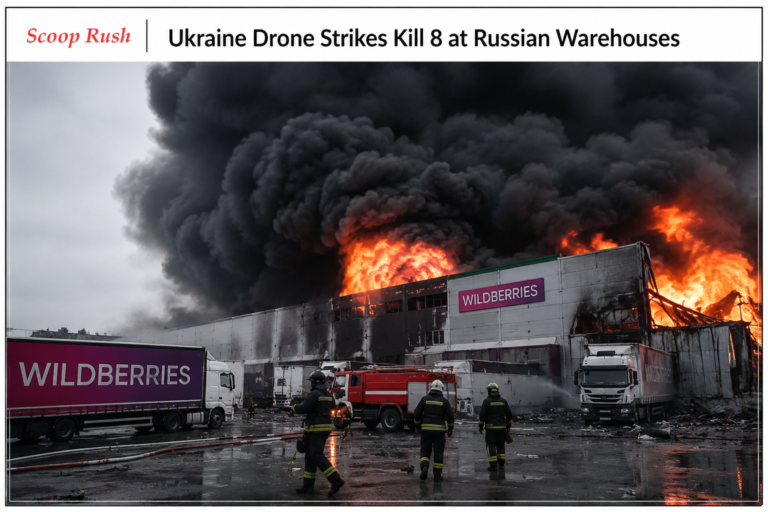
Ukraine drone strikes killed eight people after hitting Russian logistics centers and an oil facility on Saturday. The attacks targeted Russia’s Moscow and Tambov regions. Ukrainian officials said the facilities supported Russia’s drone production and military logistics. Russian authorities confirmed the deaths and reported dozens of injuries after one of the largest drone attacks of the war.
The overnight operation marked one of Ukraine’s biggest long range drone campaigns. Russia claimed its air defenses intercepted hundreds of drones across multiple regions. Despite those interceptions, several drones reached their targets and caused major fires, heavy smoke, and widespread disruption.
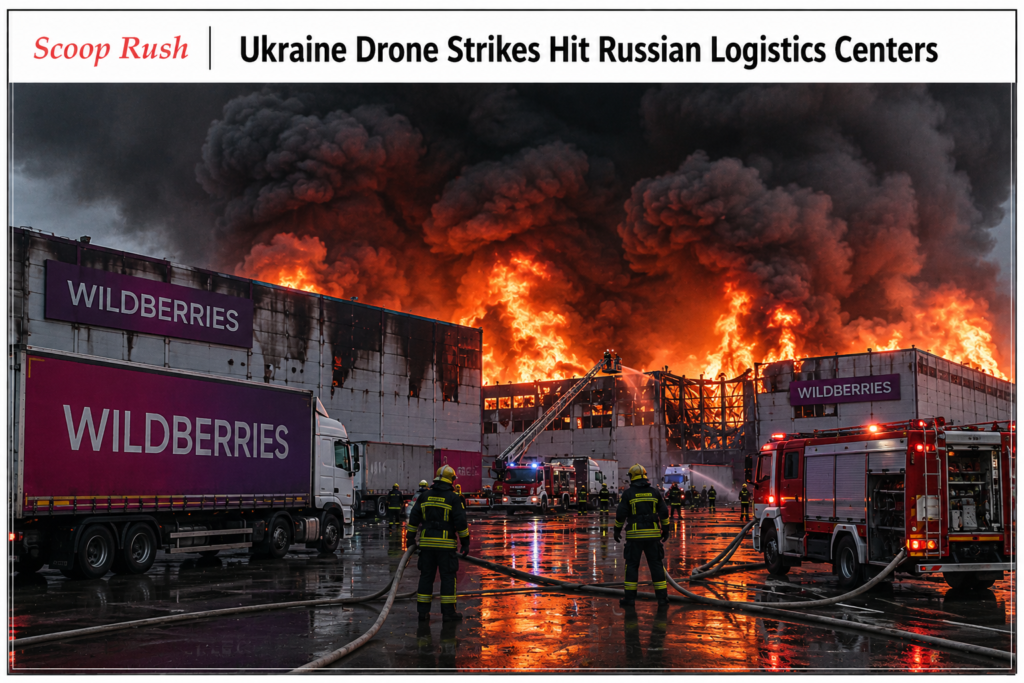
Ukraine Drone Strikes Hit Russian Logistics Centers
Ukraine drone strikes targeted two large Wildberries logistics warehouses in the Tambov and Moscow regions. Ukrainian President Volodymyr Zelensky said the facilities supplied sanctioned drone components and navigation equipment. Kyiv described the operation as part of its long range campaign against Russia’s military infrastructure.
The warehouse in Kotovsk suffered the worst damage. Seven night shift workers lost their lives there. Another worker later died after injuries at a warehouse in Elektrostal near Moscow. Huge fires destroyed large parts of both logistics centers.
Ukraine Drone Strikes Leave Dozens Injured
Russian officials said nearly 60 people needed hospital treatment after the attacks. Several victims remained in critical condition. Emergency teams continued rescue operations while firefighters battled the remaining flames.
Authorities also reported damage beyond the warehouses. Drone debris ignited fires at nearby buildings and damaged an oil depot. Officials evacuated a maternity hospital and nearby residential areas as a safety measure.
Ukraine Says Military Supply Chain Was the Target
Ukrainian leaders defended the operation as a military strike. Zelensky said the warehouses stored equipment that supported Russian drone production. Kyiv called the attacks a response to repeated Russian strikes on Ukrainian cities and civilian infrastructure.
Ukraine has increased deep strikes inside Russia during recent months. The campaign focuses on logistics hubs, fuel facilities, military factories, and transport networks. Ukrainian officials believe these operations reduce Russia’s ability to sustain military operations.
Russia Reports Massive Drone Attack
Russia’s Defense Ministry said air defense units intercepted 379 Ukrainian drones overnight. Officials claimed the drones approached from several directions across 19 Russian regions. Moscow authorities described it as one of the largest drone attacks since the war began.
The Moscow region experienced significant disruption despite the interceptions. Thick smoke covered parts of Elektrostal for several hours. Emergency crews worked throughout the day to contain fires and secure damaged areas.
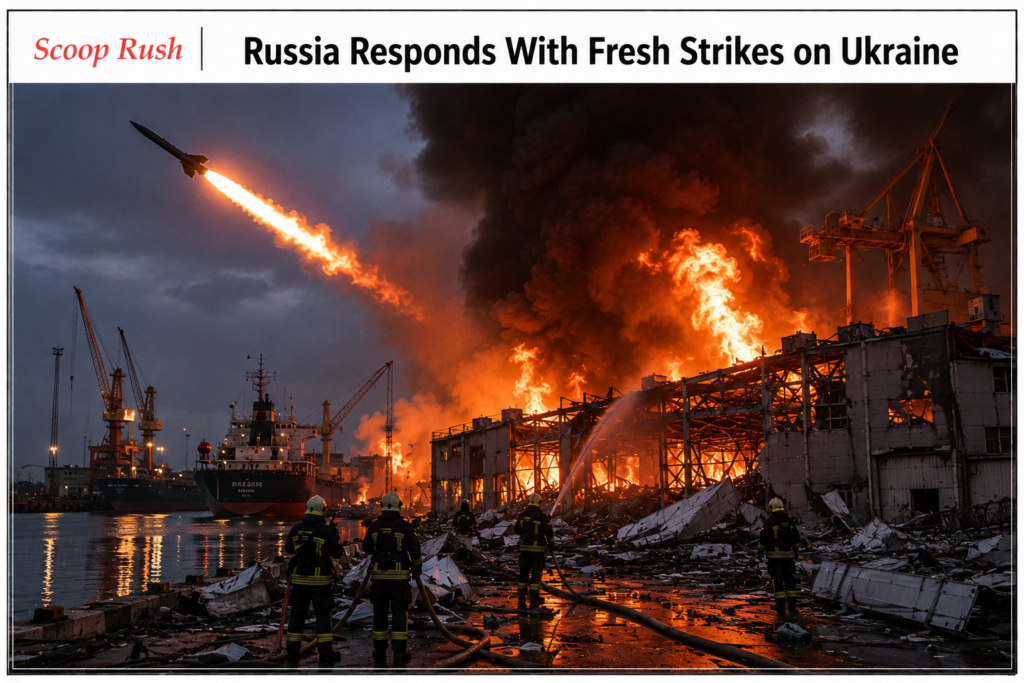
Russia Responds With Fresh Strikes on Ukraine
Russia launched new missile and drone attacks against Ukraine after the warehouse strikes. Officials in Ukraine said Russian attacks damaged port infrastructure in Odesa. Several buildings, warehouses, and storage facilities suffered heavy damage.
The attacks also caused civilian casualties. Ukrainian officials reported deaths and injuries during the overnight bombardment. Russia said it targeted military related infrastructure near Ukrainian ports.
Ukraine Expands Long Range Drone Campaign
Ukraine continues expanding its long range drone strategy against Russia. Recent operations have targeted oil depots, military facilities, rail infrastructure, and vessels operating in the Black Sea and the Sea of Azov.
Military analysts believe these operations increase pressure on Russia’s logistics network. Although front line fighting continues, both sides now rely heavily on drones to strike strategic targets far behind enemy lines.
What Happens Next?
The latest attacks highlight the growing reach of Ukraine’s drone capabilities. Both countries continue expanding long range operations while diplomatic efforts remain stalled.
Military experts expect similar strikes in the coming months. Ukraine aims to disrupt Russia’s supply chains. Russia will likely strengthen air defenses while continuing missile attacks against Ukrainian infrastructure.
Conclusion
The latest Ukraine drone strikes mark a significant escalation in the ongoing war. Kyiv continues targeting Russian logistics, energy, and military infrastructure far from the front line. Russia, meanwhile, responds with large missile and drone attacks against Ukrainian cities and ports.
As both sides expand their long range capabilities, the conflict shows no signs of slowing. Military pressure continues to grow while diplomatic efforts remain stalled. The latest exchange highlights how drone warfare has become a central part of the conflict, with strategic infrastructure now facing constant threats on both sides.
FAQs
1. What did Ukraine target during the latest drone strikes?
Ukraine targeted two major Wildberries logistics warehouses in the Tambov and Moscow regions. It also struck an oil facility and other strategic sites. Ukrainian officials said these locations supported Russia’s military supply chain and drone production.
2. How many people died and were injured in the attacks?
Russian authorities confirmed that eight people died during the warehouse strikes. Dozens more suffered injuries, with several remaining in critical condition. Emergency crews continued rescue and firefighting operations after the attacks.
3. Why did Ukraine attack the Wildberries warehouses?
Ukraine said the warehouses stored sanctioned components used for Russian drone production and navigation systems. Kyiv described the operation as a military strike aimed at weakening Russia’s logistics network rather than targeting civilians.
4. How large was the Ukrainian drone attack?
Russia’s Defense Ministry reported intercepting 379 Ukrainian drones across 19 regions overnight. Even with those interceptions, several drones reached their targets and caused major fires and widespread damage.
5. How did Russia respond after the strikes?
Russia launched fresh missile and drone attacks against Ukraine following the operation. Ukrainian officials reported damage to port infrastructure in Odesa along with civilian casualties, showing that both sides continue to intensify long range attacks.
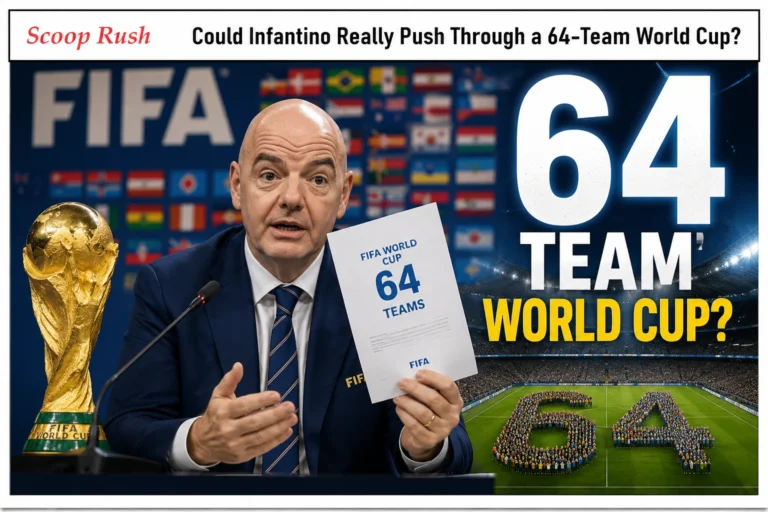
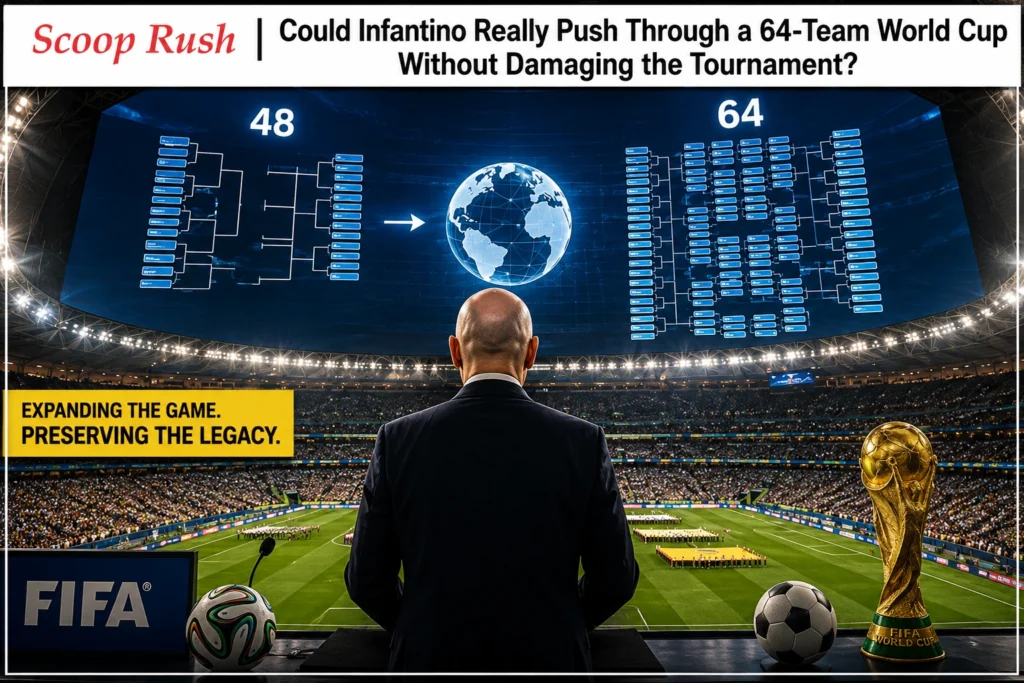
The idea of a 64-team FIFA World Cup once sounded impossible. Now, it is a serious topic of discussion at the highest level of world football. As FIFA continues to expand its competitions, many fans, players, and football officials are asking the same question: Could Infantino really push through a 64-team World Cup?
That question has become even more important after recent comments from FIFA president Gianni Infantino and growing debate around the future of the tournament. While supporters argue that expansion creates more opportunities for developing football nations, critics believe it could weaken the quality and prestige of the World Cup.
This debate is about much more than adding teams. It touches on competition standards, global development, scheduling challenges, hosting demands, and the financial future of football’s biggest event.
Why the 64-Team World Cup Debate Has Returned
The discussion gained momentum ahead of the 2030 FIFA World Cup, which will celebrate 100 years since the first World Cup was played in Uruguay.
The 2030 tournament will mainly be hosted by Morocco, Portugal, and Spain. However, the opening matches will also take place in Uruguay, Argentina, and Paraguay as part of the centenary celebrations.
During discussions about the future of the competition, South America’s governing body, CONMEBOL, proposed a one-time expansion to 64 teams for the 2030 edition.
CONMEBOL president Alejandro Dominguez argued that a larger tournament would allow more countries to participate in the celebration. According to him, it would ensure that more nations are included in football’s biggest global event.
Meanwhile, FIFA president Gianni Infantino has spoken positively about giving smaller nations greater opportunities to reach the World Cup. As a result, the proposal has moved from a theoretical idea to a real topic within football governance.
How Gianni Infantino Has Changed FIFA Competitions
To understand why people believe expansion is possible, it is important to look at Infantino’s track record. Since becoming FIFA president, he has consistently supported larger competitions and increased participation.
His leadership has seen: Expansion of the FIFA World Cup Creation of the new Club World Cup format More matches across FIFA tournaments Increased commercial opportunities Greater financial distributions to member associations
Infantino’s philosophy has often been based on the idea that more participation creates more opportunities and more revenue. Therefore, many observers believe he could support another World Cup expansion if enough support exists within FIFA’s governing structures.
Could Infantino Really Push Through a 64-Team World Cup?
The short answer is yes, it is possible.
However, approval is far from guaranteed.
The final decision would be made by the FIFA Council, which consists of 37 members. While FIFA’s president holds significant influence, support from council members would still be required.
Importantly, several major football leaders have already expressed concerns about further expansion.
Opposition From Other Football Confederations
The proposal has not received widespread support across world football. UEFA president Aleksander Ceferin described the idea as a bad one for both the tournament and the qualification process. Victor Montagliani, president of CONCACAF, warned that further expansion could harm the wider football ecosystem.
Similarly, Asian Football Confederation president Sheikh Salman bin Ibrahim Al Khalifa suggested that continued expansion could create chaos. These comments highlight that resistance exists among some of football’s most influential organizations. Nevertheless, opposition alone does not eliminate the possibility of change.
The Main Argument in Favor of Expansion
Supporters of expansion focus on one key principle: opportunity. They argue that more places would allow emerging football nations to experience the World Cup and accelerate development within their countries.
Infantino has emphasized this point repeatedly. According to this view, participation at the World Cup provides exposure, investment opportunities, and motivation for players, coaches, and football associations.
Cape Verde’s Success Story
One of the strongest arguments used by supporters comes from the performances of Cape Verde. Before the tournament, critics questioned whether newly qualified teams could compete at the highest level.
Their performances demonstrated that emerging nations can compete against traditional football powers. As a result, advocates argue that more countries deserve similar opportunities.
This is where the debate becomes more complicated. While some smaller nations impressed, others struggled significantly. Teams including Haiti, Iraq, Jordan, Panama, Tunisia, and Uzbekistan failed to earn a single point during the group stage.
Therefore, critics argue that expansion may create more mismatched contests and fewer genuinely competitive games. The World Cup has traditionally been viewed as an elite tournament featuring the best teams in the world. If too many places become available, some believe qualification itself could lose much of its value.
Fewer Chances for Major Upsets
One concern involves the group stage.
Historically, strong nations have occasionally suffered shocking early exits.
These surprises are part of what makes the World Cup special.
However, adding even more teams could make it easier for top nations to progress into the knockout rounds.
Consequently, group-stage drama might become less intense.
Which Teams Would Benefit Most?
One of the biggest questions involves the distribution of additional places. Based on recent qualification outcomes, several countries that narrowly missed qualification could have reached a 64-team tournament.
Potential additional qualifiers included:
Asia (AFC)
Indonesia
Oman
United Arab Emirates
Europe (UEFA)
Denmark
Italy
Poland
North and Central America (CONCACAF)
Honduras
Jamaica
Suriname
South America (CONMEBOL)
Bolivia
Venezuela
Oceania (OFC)
New Caledonia
Africa (CAF)
Burkina Faso
Cameroon
Gabon
Nigeria
Notably, six of these nations were ranked inside FIFA’s top 50.
This creates an interesting debate.
On one hand, expansion would bring strong football countries such as Italy, Denmark, Nigeria, and Cameroon into the tournament more often. On the other hand, additional places would also go to lower-ranked nations from regions where football standards vary significantly.
The Challenge of Balancing Global Representation and Quality
The World Cup serves two purposes.
First, it identifies the world’s best football team.
Second, it promotes football development across every continent.
Sometimes those goals align. At other times, they compete with one another.
For example, African teams performed strongly, with nine of ten nations progressing beyond the group stage.
By contrast, only two of nine Asian teams advanced.
Similarly, only half of the participating CONCACAF nations reached the knockout rounds.
These results raise important questions about allocation.
Should places be awarded based on competitive strength?
Or should FIFA prioritize global inclusion?
There is no simple answer.
However, this issue sits at the center of the 64-team debate.
Could Infantino Really Push Through a 64-Team World Cup Without Damaging the Tournament?
Supporters and critics agree on one thing.
Any expansion must protect the World Cup’s reputation.
Would the Group Stage Become Another Qualification Round?
Some football observers worry that a 64-team format could transform the group stage into a second qualifying competition. Nearly one-third of FIFA’s 211 member nations would participate.
As a result, the gap between the strongest and weakest teams could become more noticeable. Critics argue that too many predictable matches may reduce excitement during the opening phase of the tournament. Furthermore, top nations could face less pressure early in the competition.
Supporters disagree. They believe every nation deserves a pathway to football’s biggest stage and that surprises often emerge when opportunities increase.
Major Scheduling and Logistical Challenges
Competition quality is only one part of the discussion. A larger World Cup would also create significant logistical problems. A 64-team tournament would add four extra groups and 24 additional matches. That increase would require more time within an already crowded football calendar.
The most recent tournament lasted 39 days. Adding 24 more matches would likely require approximately five additional days. Although that may not sound substantial, tournament scheduling is already extremely complex.
Stadium Requirements
A larger competition would need: More host cities More high-capacity stadiums More training facilities More accommodation options More transportation infrastructure
Recent tournaments have relied on multiple host cities and major investments. Therefore, expanding further would place even greater demands on future hosts.
Climate Concerns
Climate conditions are becoming another major factor. Recent heatwaves have highlighted the challenges of playing football during hot summer periods.
Some venues have indoor or covered stadiums that help reduce weather-related issues. However, not every future host nation will have that advantage. Consequently, FIFA may face increasingly difficult decisions regarding scheduling and tournament timing.
Can One Country Still Host the World Cup Alone?
The scale of modern World Cups continues to grow. Historically, most tournaments were hosted by a single nation. However, hosting requirements are becoming larger with every expansion. As a result, joint bids may become increasingly common.
Future tournaments could require cooperation between multiple neighboring countries to meet stadium, transportation, and accommodation demands. This reality raises additional questions for football nations with limited infrastructure budgets. The financial burden of hosting such a massive event could become difficult for many countries to manage independently.
Is Money Driving the Expansion?
Financial considerations cannot be ignored. FIFA generates much of its revenue through the World Cup. Those funds are then distributed across football development programs worldwide.
Under Infantino’s leadership, FIFA has expanded financial support for member associations and confederations. Every football association now has access to significant development funding over a four-year cycle.
Confederations also receive substantial support for organizing and promoting football. Naturally, these programs require revenue.
Why More Matches Mean More Income
A larger World Cup creates additional opportunities for: Television broadcasting deals Sponsorship agreements Ticket sales Commercial partnerships
FIFA previously projected billions of dollars in revenue from expanded tournament formats. Therefore, a 64-team competition would likely generate even greater commercial returns. Supporters argue that these revenues help grow football globally.
Critics counter that expansion should not be driven primarily by financial incentives. The debate ultimately comes down to whether growth and quality can remain balanced.
What Happens Next?
At present, the proposal remains a subject of discussion rather than a confirmed change. Several influential football leaders remain opposed. At the same time, FIFA’s recent history shows a willingness to expand competitions when leaders believe broader participation is beneficial.
Therefore, the possibility cannot be dismissed. Much will depend on future discussions within FIFA and whether enough support emerges among decision-makers. For now, football remains divided on whether a 64-team World Cup would strengthen or weaken the sport’s most prestigious tournament.
Conclusion
The question, Could Infantino really push through a 64-team World Cup, has become one of the biggest issues facing international football. Supporters see expansion as an opportunity to bring more nations into the game and accelerate football development worldwide. Cape Verde’s impressive performances have strengthened that argument.
However, critics worry about competitive balance, tournament quality, scheduling difficulties, infrastructure demands, and the growing influence of commercial interests. The proposal has supporters and opponents across the football world. While approval is far from certain, FIFA’s recent history shows that major changes are possible.
Ultimately, the debate is not simply about adding more teams. It is about defining what the World Cup should represent in the future: an exclusive competition for the very best nations, a truly global celebration of football, or perhaps a balance between both.
FAQs
1. What is the proposed 64-team World Cup format?
The proposal would expand the tournament to 64 teams, creating 16 groups of four teams each. The top two teams from every group would advance to the knockout stage.
2. Who proposed expanding the World Cup to 64 teams?
CONMEBOL, South America’s football confederation, proposed a one-time expansion for the 2030 FIFA World Cup during the centenary celebration.
3. Does Gianni Infantino support a 64-team World Cup?
Infantino has spoken positively about giving smaller nations more opportunities to participate, although no final decision has been made.
4. Why are some football leaders against expansion?
Critics believe a larger tournament could reduce competitiveness, create scheduling challenges, increase hosting costs, and weaken the importance of qualification.
5. Would a 64-team World Cup generate more revenue?
Yes. More matches could increase income from broadcasting rights, sponsorships, commercial partnerships, and ticket sales, creating additional revenue for FIFA.
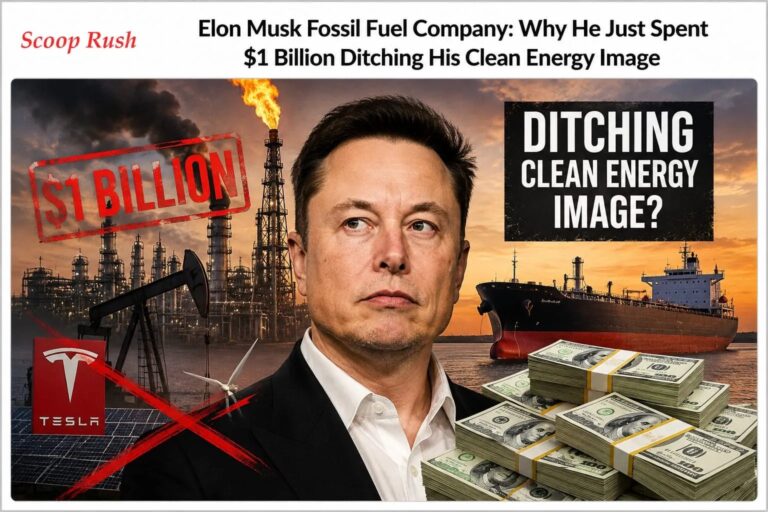
Elon Musk built his entire empire on clean energy. So why did the Elon Musk fossil fuel company deal just quietly close for $1 billion in gas turbines?
Introduction
Elon Musk fossil fuel company news just broke, and it’s a big deal. Elon Musk fossil fuel company APR Energy is the name behind his newest billion-dollar bet. The man who built his reputation on clean energy just spent nearly $1 billion on gas turbines. Solar roofs, electric cars, and battery storage were supposed to free us from fossil fuels. So when news broke that this deal had gone through, it stopped a lot of people in their tracks.
This deal did not come with a press release or a triumphant tweet. Instead, it surfaced quietly through a routine government filing. However, the implications are massive, both for Musk’s AI ambitions and for the environmental image he has built for years, an image that has only grown more complicated since SpaceX’s IPO pushed Musk toward trillionaire status.
What Is the Elon Musk Fossil Fuel Company He Just Bought?
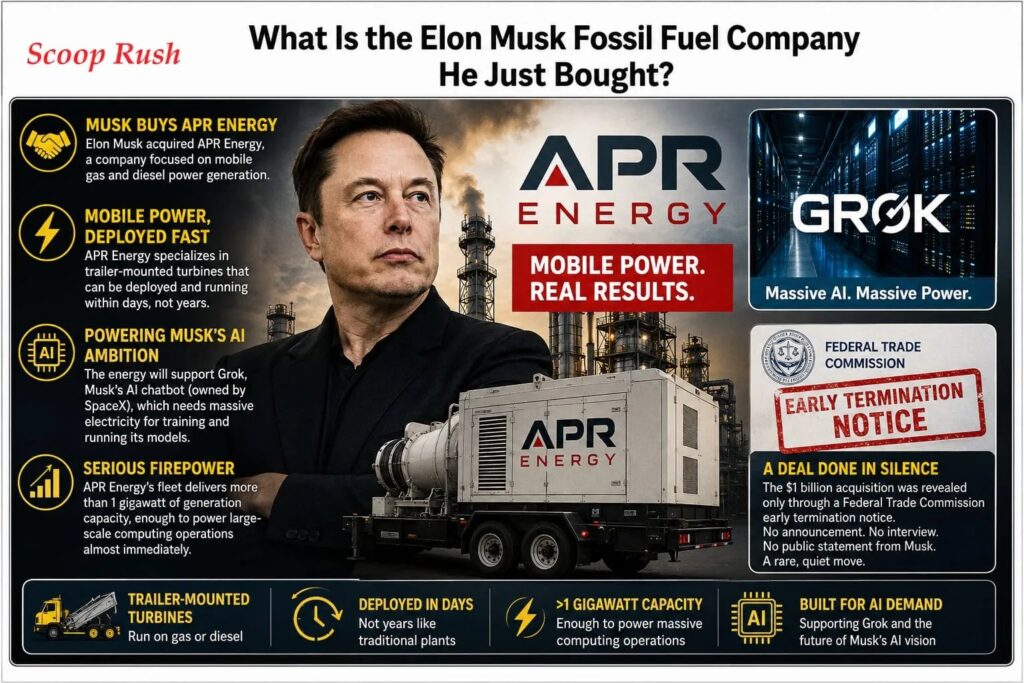
Musk acquired APR Energy, a company built entirely around mobile gas and diesel power generation. Unlike traditional power plants that take years to construct, APR Energy specializes in trailer-mounted turbines that can be deployed and running within days.
This speed is exactly why Musk wanted it. His AI chatbot Grok, owned by the now publicly traded SpaceX, needs enormous amounts of electricity to keep training and running its models. Traditional power infrastructure simply cannot keep pace with that demand.
APR Energy brings serious firepower to the table. Additionally, the company’s fleet delivers more than 1 gigawatt of generation capacity, according to reporting from Electrek. That is enough energy to make a real difference for large-scale computing operations almost immediately after installation.
How the Fossil Fuel Deal Was Structured
The acquisition did not follow the usual playbook for a billion-dollar business move. There was no announcement, no interview, and no public statement from Musk or his companies. Instead, the deal only became public knowledge through a Federal Trade Commission early termination notice, a routine regulatory filing that revealed the transaction had already closed.
This quiet approach stands out. Musk is typically vocal about his acquisitions and business decisions. However, this particular deal seemed designed to avoid the spotlight, likely because it directly contradicts the clean energy narrative he has promoted for years.
Why Musk Chose Gas Over Solar for His AI Power Needs
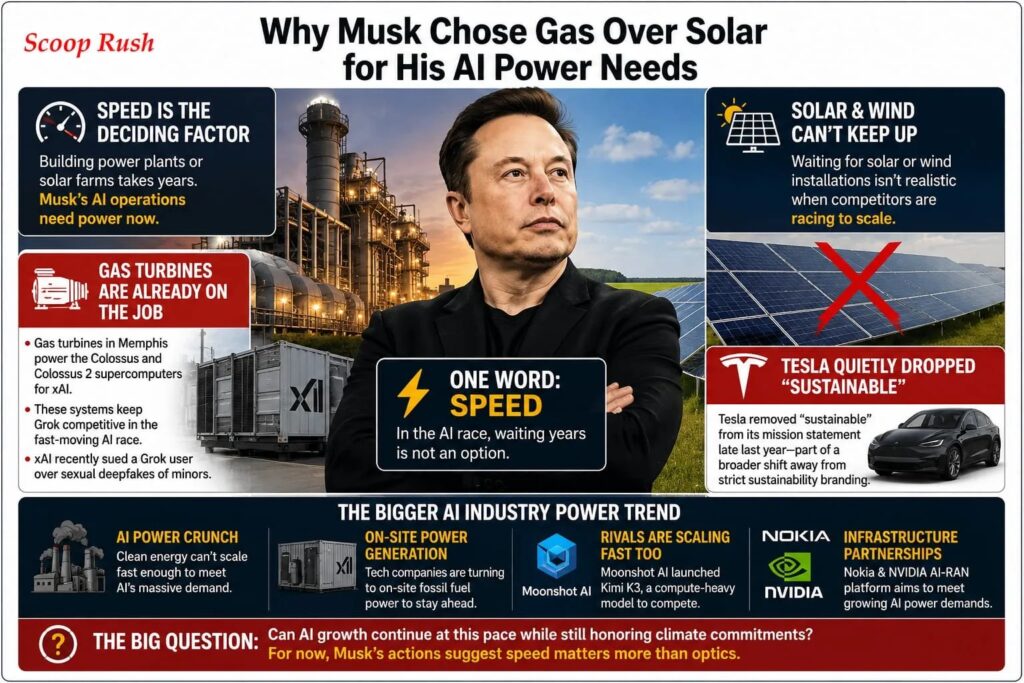
The answer comes down to one word: speed. Building a traditional power plant, even a green one, takes years of planning, permitting, and construction. Musk does not have years to wait, since his AI operations need power now.
In Memphis, gas turbines are already running the Colossus and Colossus 2 supercomputers that power xAI’s operations. These systems are central to keeping Grok competitive in an AI race that moves faster every month, a race that has already landed xAI in legal trouble after the company sued a Grok user over sexual deepfakes of minors. Meanwhile, waiting for a solar farm or wind installation to come online simply is not realistic when competitors are racing to scale their own AI infrastructure.
Additionally, this is not the first sign that Musk’s companies are quietly stepping back from strict sustainability branding. Tesla, the company most associated with Musk’s clean energy reputation, dropped the word “sustainable” from its mission statement late last year. That change did not receive much attention at the time, but it now looks like part of a broader pattern.
The Bigger AI Industry Power Trend
Musk is not alone in this shift. The entire AI industry is grappling with a power crunch that clean energy sources cannot solve fast enough. As a result, tech companies across the board are exploring on-site power generation, including fossil fuel options, just to keep their AI systems running. Rivals like Moonshot AI are pushing their own compute-heavy models forward too, as seen with the recent Kimi K3 model launch, while telecom players are betting on infrastructure partnerships such as the Nokia and NVIDIA AI-RAN platform to keep pace with demand.
This trend raises an uncomfortable question for the industry. Can AI growth continue at its current pace while still honoring the climate commitments many companies have made publicly? For now, Musk’s actions suggest that speed matters more than optics.
What This Elon Musk Fossil Fuel Company Deal Means for His Clean Energy Legacy
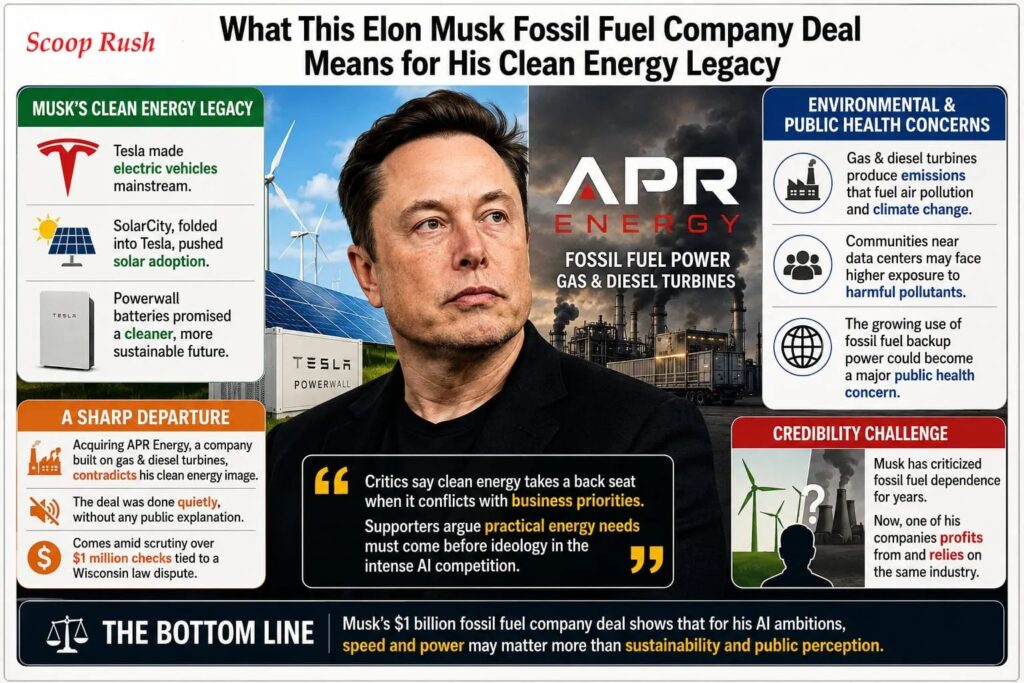
Musk has spent years positioning himself as a champion of renewable energy. Tesla popularized electric vehicles for mainstream buyers. SolarCity, later folded into Tesla, pushed solar adoption. Powerwall batteries promised a future less dependent on fossil fuels.
This latest acquisition complicates that legacy. Buying a company whose entire business model depends on gas and diesel turbines marks a significant departure from that image. Furthermore, doing so quietly, without any public explanation, suggests Musk himself may recognize the tension between this move and his brand, especially at a time when he has also faced scrutiny over $1 million checks tied to a Wisconsin law dispute.
Critics will likely point to this as evidence that clean energy commitments take a back seat when they conflict with business priorities. Supporters, on the other hand, may argue that practical energy needs must come before ideology, especially when AI competition is this intense. Either way, the optics are difficult to ignore.
Environmental and Public Health Concerns
Fossil fuel power generation carries real environmental consequences. Gas and diesel turbines produce emissions that contribute to air pollution and climate change, the very issues Musk’s other companies claim to fight against.
Communities near data centers powered by these temporary turbines may also face increased exposure to pollutants. As AI data centers multiply across the country, therefore, the cumulative environmental impact of fossil fuel backup power could become a significant public health concern, not unlike the scrutiny AI systems are already facing elsewhere, including the NHS’s use of AI tools to cut waiting times and the debate around AI-generated rental listings under NYC’s Rental Ripoff Report.
Moreover, this creates a credibility challenge for Musk personally. He has criticized fossil fuel dependence publicly for years. Now, one of his own companies is directly profiting from and relying on that same industry to fuel its AI ambitions.
What Comes Next for Musk’s AI Power Strategy
It remains unclear whether this acquisition represents a permanent shift or a temporary bridge solution. AI infrastructure needs are evolving rapidly, and today’s urgent power crunch could ease as new technologies and energy sources come online, even as SpaceX continues facing its own setbacks, including the aborted Starship flight 13 launch.
For now, though, the message is clear. When faced with a choice between waiting years for clean energy infrastructure or buying immediate fossil fuel capacity, Musk chose speed. Consequently, this decision will likely influence how other tech leaders approach similar power shortages in their own AI operations.
As a result, the tech industry may see more companies following this same path, prioritizing rapid deployment over environmental branding. If that happens, the broader conversation around AI’s environmental footprint will only grow louder in the coming months.
Conclusion
Elon Musk’s decision to acquire a fossil fuel company marks a significant turning point in his public identity. The man who built his reputation on solar power and electric vehicles is now betting on gas turbines to keep his AI ambitions alive. This Elon Musk fossil fuel company deal shows just how urgently AI infrastructure needs power, even if that means stepping back from long-held environmental commitments.
The quiet nature of the acquisition suggests Musk understands the contradiction it creates. Ultimately, whether this becomes a lasting shift or a short-term fix, one thing is certain: the race for AI dominance is reshaping energy priorities across the entire tech industry, and clean energy promises may not survive that race unchanged.
FAQs
What fossil fuel company did Elon Musk buy?
Musk acquired APR Energy, a company that specializes in mobile gas and diesel turbine power generation, in a deal estimated at $1 billion.
Why did Elon Musk buy a fossil fuel company?
Musk needed fast, reliable power for his AI operations, particularly the Grok chatbot and xAI’s supercomputers. Fossil fuel turbines can be installed in days, unlike traditional power plants that take years to build.
How much power capacity does APR Energy provide?
APR Energy’s fleet of trailer-mounted turbines delivers more than 1 gigawatt of generation capacity.
Did Elon Musk announce this acquisition publicly?
No. The deal became public through a Federal Trade Commission early termination notice rather than an official announcement from Musk or his companies.
Has Tesla also moved away from its clean energy messaging?
Yes. Tesla quietly removed the word “sustainable” from its mission statement late last year, which some see as part of a broader shift in priorities.
Competition: FIFA World Cup 2026 Final Venue: New Jersey, United States Result: Spain defeated Argentina after extra time Winning Goal: Ferran Torres (Extra Time) Spain Possession: 65% Spain Shots: 20 Spain Shots on Target: 11 Spain Expected Goals (xG): 1.94 Argentina Passes: 464 Spain Passes: 852
Spain Beat Argentina to Win World Cup 2026 in a Final That Rewarded Attacking Football
When Ferran Torres finally found the breakthrough in extra time, the 2026 FIFA World Cup final had its defining moment. Spain’s relentless pressure, possession, and attacking intent were rewarded as they defeated Argentina and lifted the biggest trophy in world football.
The result was more than a World Cup victory. For many observers, it was a triumph for a team that stayed committed to playing positive football from start to finish. Spain dominated possession, created the better chances, and controlled the rhythm of the game for long periods.
Ultimately, their efforts paid off when Torres scored the winning goal and captain Rodri lifted the trophy in New Jersey. The fact that Spain beat Argentina to win World Cup 2026 will be remembered as the crowning achievement of a team that has become the benchmark of international football. They arrived as European champions and Olympic champions. They left as world champions too.
Why This World Cup Final Mattered
World Cup finals are often decided by a single moment. However, this match told a larger story. Spain entered the final as one of the most consistent teams in international football. Their style focused on possession, intelligent movement, and technical quality. Argentina, meanwhile, arrived as defending champions hoping to retain their crown. The clash therefore carried enormous significance. It was not only a battle for the trophy but also a contest between two footballing teams. Throughout the match, Spain looked determined to impose themselves. They controlled possession, pushed forward, and repeatedly tested Argentina’s defense. Meanwhile, Argentina struggled to establish the same level of attacking threat. As a result, many analysts felt the final outcome reflected what happened on the pitch over the course of 120 minutes.
How Spain Controlled the Final
From the opening whistle, Spain looked comfortable in possession. Their midfield dictated the tempo and ensured Argentina spent long periods without the ball. Spain circulated possession patiently before accelerating attacks into dangerous areas. The numbers highlight the extent of their dominance. Spain finished with 65 percent possession and completed nearly twice as many passes as Argentina. They also generated far more opportunities in front of goal.
Additionally, Spain recorded 20 shots and forced Argentina goalkeeper Emiliano Martinez into repeated action. Martinez made 11 saves, the most ever recorded by a goalkeeper in a World Cup final. Without those interventions, the match could have been decided much earlier. Former England captain Alan Shearer summed up the contest by saying Spain controlled possession, looked to create chances, and consistently tried to get behind Argentina’s defense.
Spain Beat Argentina to Win World Cup 2026 Through Patience and Persistence
One of the most impressive aspects of Spain’s performance was their patience. Many teams become frustrated when chances do not immediately lead to goals. Spain did the opposite. They continued playing their game and trusted their approach.
Time after time they moved the ball across the pitch, searching for openings. Argentina defended deeply and attempted to disrupt Spain’s rhythm. Nevertheless, Spain continued pressing forward. Eventually, their persistence produced the decisive moment.
Ferran Torres Delivers the Winning Goal
As extra time progressed, Spain maintained their attacking pressure. The breakthrough finally arrived when Ferran Torres scored the winning goal. After more than 100 minutes of intense football, Spain had the lead they deserved.
The goal sparked celebrations among Spanish players and supporters. More importantly, it confirmed Spain’s place at the top of world football. For Torres, it was the biggest goal of his international career. For Spain, it was the moment that completed an extraordinary journey.
Rodri Leads Spain to Global Glory
Every championship-winning team needs leadership. Spain found leadership in captain Rodri. His influence extended far beyond lifting the trophy at the end of the match. Throughout the tournament, Rodri provided composure, control, and tactical intelligence.
His performance in the final reflected those qualities. Rodri completed 101 passes during the match, highlighting his importance to Spain’s possession-based system. He constantly offered passing options and helped Spain maintain control during key moments. When the final whistle arrived, it was fitting that he became the player to raise the World Cup trophy.
Spain’s Defensive Excellence Defined the Tournament
While Spain’s attacking football attracted attention, their defensive record was equally remarkable. Goalkeeper Unai Simón enjoyed a tournament to remember. He kept seven clean sheets in eight matches and received the Golden Glove award as the competition’s best goalkeeper.
Even more impressive, Spain conceded only one goal throughout the entire tournament. That achievement represents one of the strongest defensive performances ever produced by a World Cup-winning side. Great teams combine attack and defense. Spain demonstrated both qualities throughout the competition.
The Rise of a New Generation
One reason Spain’s success feels especially significant is the age profile of several key players. The squad contains a number of young stars who could remain at the highest level for many years.
Pau Cubarsi’s Breakthrough Tournament
Defender Pau Cubarsí emerged as one of the standout performers of the World Cup. At just 19 years old, he was named the tournament’s best young player. His contribution in the final was remarkable. Cubarsi completed 121 passes, one of the highest totals ever recorded in a World Cup final. His composure under pressure reflected maturity far beyond his years.
Lamine Yamal Continues Making History
Meanwhile, Lamine Yamal added another milestone to his growing list of achievements. At 19 years and six days old, he became one of the youngest players ever to appear in a World Cup final. Now he is also one of the youngest players ever to win the tournament. His influence throughout Spain’s campaign highlighted why he is regarded as one of football’s brightest talents.
Spain’s Incredible Unbeaten Run
World Cup victories rarely happen by accident. Spain’s triumph was the latest chapter in a period of sustained excellence. They are now world champions, European champions, and Olympic champions. Furthermore, Spain’s men’s team has extended its unbeaten run to 38 matches in all competitions.
That streak represents the longest unbeaten run by a European national team. Interestingly, Spain’s campaign did not begin perfectly. They opened the tournament with a goalless draw against Cape Verde. However, they improved as the competition progressed. By the time the final arrived, they looked like the strongest team remaining.
Argentina’s Difficult Night
Argentina entered the final hoping to defend the title they had won four years earlier. Instead, they found themselves under pressure for much of the contest. Spain’s control of possession limited Argentina’s opportunities to attack. In fact, Argentina failed to register a shot during normal time.
Their first attempt arrived only in the 117th minute when Lionel Messi finally tested the Spanish defense. That statistic illustrates the extent of Spain’s dominance. Argentina also completed only 464 passes compared to Spain’s 852. While they managed to force extra time, they struggled to create meaningful attacking moments throughout the match.
Late Drama and Controversy
The closing stages of the final featured several controversial moments. Argentina midfielder Enzo Fernández received a yellow card for dissent before being shown a second yellow card for a late challenge on Pau Cubarsi. The dismissal left Argentina with ten players during a crucial period of the match. Following the final whistle, tensions continued to rise.
Several confrontations occurred between players from both teams. Reports from the match described arguments and scuffles involving multiple individuals. The scenes contrasted sharply with Spain’s celebrations and added another dramatic chapter to an already emotional final.
What Argentina Manager Lionel Scaloni Said
Argentina coach Lionel Scaloni acknowledged Spain’s superiority after the match. While disappointed by the result, he admitted Spain deserved the victory. Scaloni noted that Spain had been outplaying Argentina for much of the game.
He also reflected on how difficult the contest became after the red card. His comments echoed the opinion of many observers who believed Spain had been the better team throughout the final.
Why Many Viewed It as a Victory for Football
The phrase “victory for football” is often overused. However, many analysts applied it to this final because Spain consistently focused on attacking play, ball retention, and chance creation. Spain attempted to win through football rather than simply preventing their opponents from playing. Their statistics support that view.
They dominated possession, completed more passes, created more chances, and recorded significantly more shots. As a result, many neutral fans felt the final outcome reflected the balance of play. Whether everyone agrees with that assessment or not, few can argue that Spain were the superior team on the night.
What This Means for Spain’s Future
The most exciting aspect of Spain’s success may be what comes next. Several key players remain very young. Rodri provides leadership in midfield, while stars such as Lamine Yamal and Pau Cubarsi appear capable of becoming central figures for years to come.
Consequently, Spain could remain among football’s dominant forces well beyond this World Cup triumph. Their combination of youth, experience, technical quality, and tactical discipline gives them a strong foundation for future tournaments.
Meanwhile, Argentina struggled to impose themselves and finished the match with ten men after Enzo Fernandez’s dismissal. In the end, Spain’s victory reflected their superiority across almost every major statistic. More importantly, it confirmed their status as the leading force in international football. From European champions to world champions, Spain’s golden era continues.
If you’ve ever had a kidney stone, you don’t need anyone to tell you how much it hurts you just want to make sure it never happens again. For most people with calcium oxalate stones (the most common kind by far), the single most effective thing you can do isn’t a miracle supplement or an expensive procedure. It’s food.
This guide walks you through what oxalate actually is, why your body sometimes turns it into stones, and most importantly exactly what to eat, what to limit, and how to build a week of meals around it without feeling like you’re on a diet of cardboard and regret.
What Is Oxalate, Really?
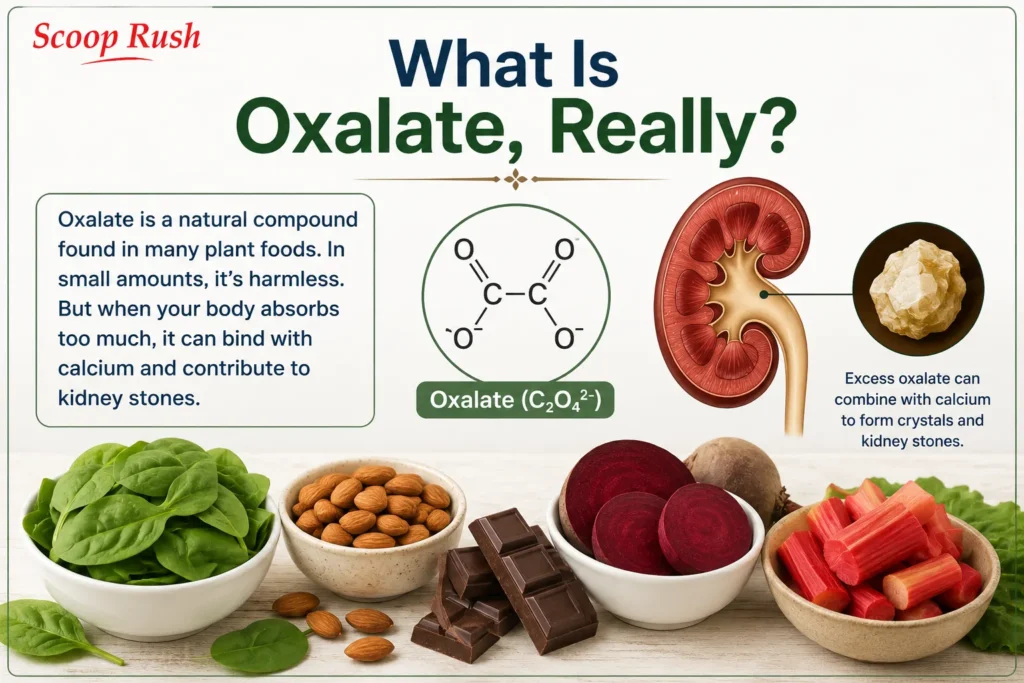
Oxalate (also called oxalic acid) is a natural compound found in tons of plant foods vegetables, fruits, nuts, seeds, grains, legumes, even chocolate and tea. Your liver also produces a small amount on its own as a byproduct of normal metabolism, so even a theoretically “oxalate-free” diet wouldn’t bring your levels to zero.
Normally, oxalate just passes through you, exiting via stool or urine without incident. The trouble starts when too much of it gets absorbed into your bloodstream, travels to your kidneys, and links up with calcium there. That pairing forms tiny crystals and over time, those crystals can grow into the kind of stone that lands people in the ER doubled over in pain.
Left unchecked, these crystals can:
Grow larger and stick together
Block urine flow
Trigger infections
Damage kidney tissue over time
It helps to think of oxalate and calcium like two puzzle pieces that shouldn’t be allowed to meet in the wrong place. In your gut, calcium can safely “catch” oxalate and carry it out with your stool. In your kidneys, that same pairing turns into a problem. The entire strategy behind this diet is about controlling where that meeting happens.
The Calcium Plot Twist
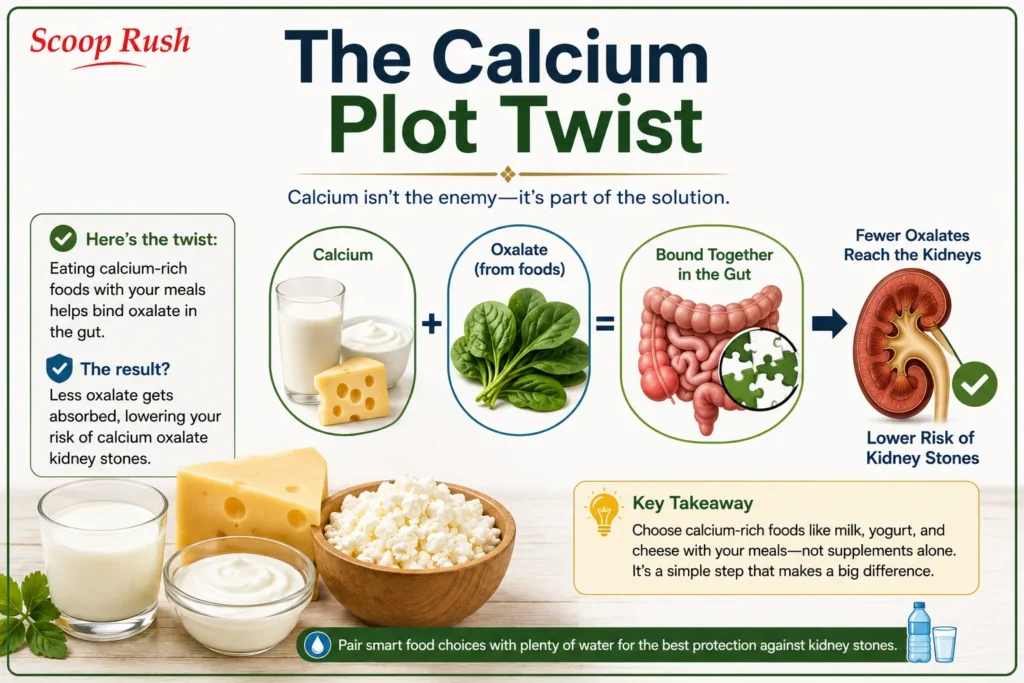
Here’s the part that surprises almost everyone: if you’ve had calcium oxalate stones, cutting calcium is usually the wrong move.
Eaten with meals, calcium binds to oxalate right in your intestines before it ever reaches your bloodstream and the pair simply leaves your body together through stool. Skip the calcium, and there’s nothing to catch the oxalate before it heads for your kidneys instead. This is why low-calcium diets have actually been linked to a higher rate of stone formation in some patients, not a lower one.
Good calcium sources to eat alongside meals:
Milk
Yogurt
Cheese
Calcium-fortified foods and beverages
Most providers recommend getting this calcium from food rather than supplements taken between meals. If you do take a calcium supplement, timing matters — taking it with a meal (rather than on an empty stomach at bedtime, say) is what allows it to actually do its binding job. Always confirm dosing and timing with your provider, since needs vary a lot from person to person, and keep in mind that megadosing on any single nutrient carries its own risks more isn’t automatically better.
Who Actually Needs This Diet?
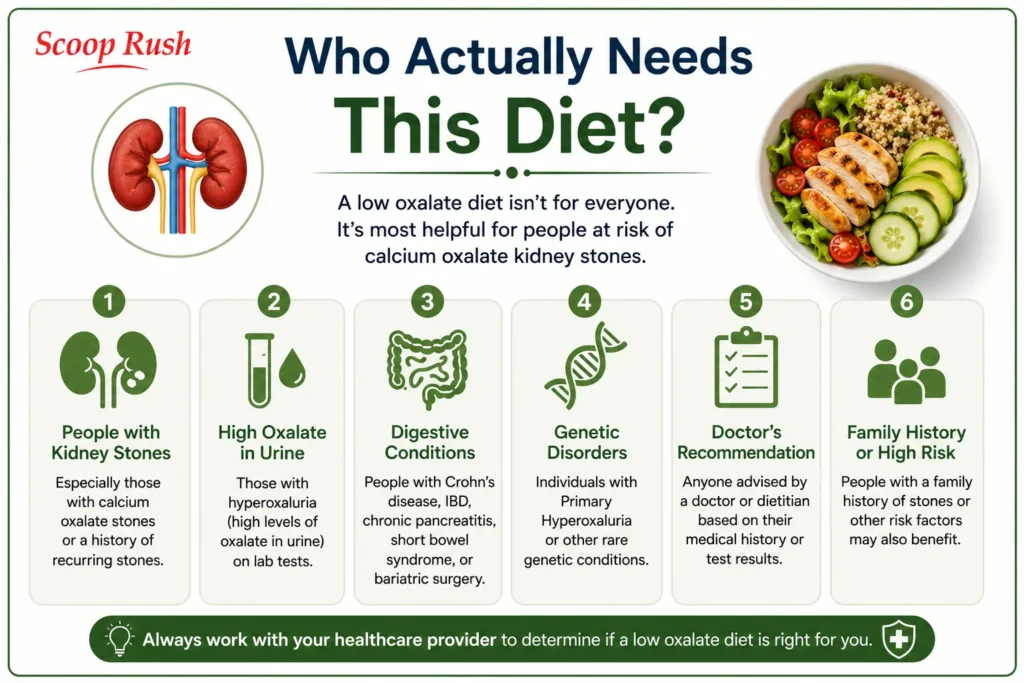
A low oxalate diet isn’t for everyone it’s typically recommended if you have:
Recurrent calcium oxalate kidney stones
Hyperoxaluria (elevated urinary oxalate), primary or enteric
Crohn’s disease or inflammatory bowel disease (IBD)
Chronic pancreatitis
Short bowel syndrome
A history of bariatric surgery
Elevated oxalate found on a 24-hour urine test
If you’ve never had a stone and your labs are normal, restricting oxalate for the sake of it isn’t generally necessary and cutting out too many high-oxalate plant foods without reason can mean missing out on fiber, antioxidants, and other nutrients those foods provide. If your oxalate issues stem from a digestive condition like Crohn’s or chronic pancreatitis, it’s also worth talking to your provider about how this diet might need to work alongside other eating approaches, such as a bland diet during flare-ups, rather than in isolation.
One important exception: Primary Hyperoxaluria (PH) is a genetic liver condition that causes the body to overproduce oxalate internally, regardless of diet. Because the problem originates inside the body rather than from food, diet alone can’t fully correct it. People with PH usually need specialized medical treatment sometimes including targeted medications or, in severe cases, liver-related interventions alongside any dietary changes.
How Much Oxalate Is “Low”?
Daily Target
Who It’s For
Under 100 mg/day
General kidney stone prevention
Under 50 mg/day
High-risk patients, under medical supervision
Your doctor or dietitian will fine-tune this number based on your urine test results, stone history, and overall health it’s a starting point, not a universal rule. Many people find it useful to track oxalate intake for a week or two using a food diary or app just to get a feel for how quickly foods like spinach or almonds can eat up their daily “budget,” even in small servings.
Two Habits That Matter Almost as Much as the Food
Hydrate like it’s your job. Diluted urine means oxalate and calcium are less likely to bump into each other and crystallize. Most kidney specialists suggest aiming to produce at least 2.5 liters of urine a day which for most people means drinking noticeably more than that in fluids, since some of what you drink is lost through sweat, breathing, and other functions. Good options: water, lemon water, milk, buttermilk, and select herbal teas. Lemon water deserves a special mention the citrate in lemon juice actually helps prevent calcium from binding with oxalate in the first place, making it one of the more genuinely useful beverage choices on this list, not just a flavor add-in.
Watch your sodium. Excess salt makes your kidneys dump more calcium into your urine which, ironically, raises stone risk even if your oxalate intake is perfect. Cook at home more often, check labels, and go easy on processed and salty snacks. A useful rule of thumb: if a food comes in a box, can, or bag and has a long ingredient list, assume it’s a sodium contributor until the label proves otherwise. Sodium restriction shows up as a cornerstone of several other condition-specific eating plans too for example, a low-sodium approach is also central to managing Meniere’s disease, which shows just how many parts of the body benefit when you dial back salt.
Foods to Eat and Enjoy
Low oxalate vegetables:
cauliflower, cabbage, Brussels sprouts, mushrooms, onions, white potatoes, radishes, fresh green peas, avocado
Moderate (fine in reasonable portions):
broccoli, carrots, asparagus, corn, lettuce, lima beans, tomatoes, turnips, parsnips
white bread, white rice, pasta, macaroni, noodles, cornflakes and most breakfast cereals
Dairy:
milk, yogurt, cheese, cottage cheese, buttermilk — your best friends on this diet, since they cover both the “low oxalate” and “high calcium” boxes at once
spinach (especially cooked one of the biggest offenders, since cooking concentrates it as water evaporates), Swiss chard, beet greens, beets, sweet potatoes, okra, kale, parsley, leeks, mustard greens, watercress, summer squash
peanut butter, tofu, baked beans, soy products (if you’re vegetarian, loop in a dietitian to keep protein adequate while managing oxalate this is one of the trickier parts of the diet to navigate without professional guidance)
Grain products to limit:
wheat bran, wheat germ, soy crackers, amaranth, fruit cake, white corn grits
Nuts and seeds:
almonds, cashews, walnuts, pecans, peanuts, sesame seeds, nut butters — nutritious, but among the highest-oxalate foods around, so even a small handful can use up a large chunk of a daily limit
Drinks to limit:
cocoa, hot chocolate, chocolate milk, black tea, dark beer, and coffee in moderation. If coffee is a non-negotiable part of your morning, it’s also worth knowing what drinking it on an empty stomach does to your body, separate from its oxalate content.
A quick note on cooking method: boiling high-oxalate vegetables and discarding the cooking water can reduce their oxalate content noticeably, since oxalate is water-soluble and leaches out during boiling. This won’t turn spinach into a low-oxalate food, but it can make an occasional moderate portion more reasonable than eating it raw or sautéed.
7-Day Sample Menu
Day 1
Breakfast: Scrambled eggs with mushrooms, white toast, milk, and a banana. Lunch: Enjoy grilled chicken with white rice, steamed cauliflower, and lemon water. Dinner: Finish the day with baked salmon, roasted cabbage, and a dinner roll.
Day 2
Breakfast: Cornflakes served with milk, a boiled egg, and honeydew melon. Lunch: A turkey sandwich on white bread with lettuce and cucumber pairs well with a side of yogurt. Dinner: Lean beef, mashed white potatoes, and green peas make a satisfying evening meal.
Day 3
Breakfast: Start your morning with oatmeal prepared in milk and topped with sliced banana. Lunch: A tuna salad sandwich served with an apple offers a balanced midday meal. Dinner: Roasted chicken, white rice, and steamed broccoli complete the day.
Day 4
Breakfast: A vegetable omelet with mushrooms and onions, white toast, and milk provides a nutritious start. Lunch: Grilled pork loin served alongside cauliflower and white rice is a filling option. Dinner: Baked cod, fresh cabbage slaw, and a dinner roll make an easy evening meal.
Day 5
Breakfast: Pancakes topped with maple syrup, served with milk and a banana, offer a hearty breakfast. Lunch: Chicken salad on white bread with crisp lettuce is a light yet satisfying choice. Dinner: Roast turkey, mashed potatoes, and Brussels sprouts round out the day’s menu.
Day 6
Breakfast: Boiled eggs, toast, and honeydew melon create a simple morning meal. Lunch: For lunch, try a beef stir-fry with mushrooms, onions, and white rice. Dinner: Baked tilapia with cauliflower and green peas provides a healthy finish to the day.
Day 7
Breakfast: Yogurt with sliced banana and toast makes a quick, nutritious breakfast. Lunch: A turkey wrap filled with lettuce and cucumber is a fresh and flavorful option. Dinner: End the week with grilled chicken, white pasta, and steamed cabbage.
Snacks throughout the week can rotate through apple slices with cheese, plain yogurt, grapes, melon, and cottage cheese all low-oxalate and calcium-friendly. Notice the pattern repeating across the week: a protein + a low-oxalate starch + a low- or moderate-oxalate vegetable + a dairy source somewhere in the meal. Once that structure clicks, you don’t need a rigid printed plan you can build new combinations on the fly using whatever’s in your fridge.
Kitchen Habits Worth Building
Put dairy on the table at every meal — it’s doing real work catching oxalate before it’s absorbed.
Sip water all day, not just a big glass at dinner.
Check labels — cocoa, soy, and nuts hide in more packaged foods than you’d expect, from granola bars to veggie burgers.
Cook at home more often to control both sodium and oxalate simultaneously.
Don’t panic-cut all plant foods — plenty of vegetables and fruits are naturally low in oxalate and worth keeping in heavy rotation for fiber and overall nutrition.
Boil, don’t just sauté, when cooking moderate-oxalate vegetables, and discard the water afterward.
Batch-plan your week around the protein-starch-vegetable-dairy formula so decision fatigue doesn’t push you toward convenience foods with hidden oxalate or sodium.
Move regularly, not just at the gym — general kidney and metabolic health benefits from simple daily movement, and something as small as taking a 5-minute walk every hour can support circulation and overall wellbeing alongside your dietary changes.
Common Myths, Debunked
“I should avoid all dairy and calcium since my stones contain calcium.” This is probably the most common and most counterproductive misconception. As covered above, dietary calcium is protective, not harmful, when eaten with meals.
“If a food is healthy, it must be low in oxalate.” Not necessarily. Spinach, almonds, and sweet potatoes are all nutrient-dense foods that also happen to be high in oxalate. “Healthy” and “low-oxalate” are separate categories that sometimes overlap and sometimes don’t.
“Going low-oxalate means I can eat unlimited meat and cheese.” Oxalate restriction doesn’t cancel out other health considerations. Portion sizes and overall balance still matter, particularly for sodium, saturated fat, and total calorie intake.
“Once I’ve had one stone, I’ll definitely get another.” Not guaranteed but the recurrence risk is high enough that most doctors recommend prevention strategies like this diet, especially if a 24-hour urine test shows elevated oxalate.
The Bottom Line
A low oxalate diet isn’t about stripping your plate down to white rice and chicken breast forever it’s about swapping high-oxalate foods for lower-oxalate alternatives, pairing meals with calcium, drinking enough water to keep your kidneys happy, and dialing back sodium. Do those four things consistently, and you’re covering most of what actually moves the needle on stone recurrence. It’s a diet built on addition as much as subtraction: more water, more calcium-paired meals, more home cooking with a handful of high-oxalate foods dialed back rather than eliminated wholesale.
If you’re in your 20s or 30s and dealing with your first stone, this is also a good moment to zoom out and look at broader healthy habits worth building now kidney stone prevention tends to fit naturally alongside the same hydration, movement, and nutrition basics that protect long-term health more generally.
FAQs
Can I ever eat high-oxalate foods again?
Often, yes in small portions, as long as your overall daily intake stays within your target. Anyone on a strict medical protocol should stick to their provider’s specific guidance.
Is this the same as a low-carb diet?
No. Low oxalate targets a specific compound in plant foods; low-carb targets carbohydrates. There’s some overlap, but they’re not interchangeable, and following one doesn’t automatically mean you’re following the other if you’re curious how a carb-focused approach compares, this breakdown of low-carb diet benefits and risks is a useful side-by-side.
Will this prevent every kidney stone?
No it specifically targets calcium oxalate stones, the most common type. Other stone types, like uric acid, struvite, or cystine stones, form through different mechanisms and call for different dietary strategies entirely.
Do I have to do this forever?
Depends on why your oxalate is elevated and your stone history. Some people need this long-term; others adjust after retesting shows their urinary oxalate has stabilized. Your doctor is the one to make that call, typically based on repeat 24-hour urine testing.
Does vitamin C intake matter?
High-dose vitamin C supplements can be converted into oxalate in the body, so some providers recommend keeping supplemental vitamin C intake moderate if you’re prone to calcium oxalate stones. This is worth discussing directly with your provider rather than assuming it applies to you.
What about oxalate and gut bacteria?
Certain gut bacteria, including a species called Oxalobacter formigenes, can break down oxalate before it’s absorbed. Some research suggests that antibiotic use and other factors that disrupt gut bacteria may play a role in oxalate absorption, though this is still an evolving area of study rather than settled clinical guidance.
Competition: FIFA World Cup 2026™ Round: Final Full-Time Result: Spain 0-0 Argentina After Extra Time: Spain 1-0 Argentina Venue: New York New Jersey Stadium, East Rutherford,
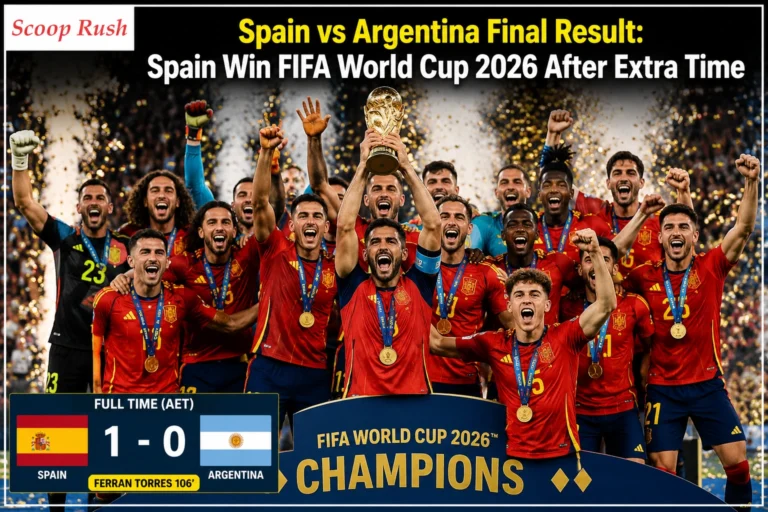
The Spain vs Argentina Final Result saw Spain defeat Argentina 1-0 after extra time to win the FIFA World Cup 2026. The final became one of the biggest stories of FIFA World Cup 2026. Spain defeated Argentina 1-0 after extra time to lift the trophy. The Spain vs Argentina Final Result will be remembered as one of the most dramatic moments of FIFA World Cup 2026. After 90 tense minutes without a goal, Spain finally found the breakthrough in extra time and defeated Argentina 1-0 to lift the biggest prize in world football.
Ferran Torres became the hero of the final with a decisive goal in the 106th minute. Meanwhile, Argentina’s challenge became even harder after Enzo Fernández was sent off deep into extra time. As a result, Spain held firm and celebrated a historic World Cup triumph.
For football fans around the world, this final delivered tension, emotion, tactical battles, and a memorable finish. It also crowned a Spanish side that controlled large parts of the match and ultimately found the winning moment when it mattered most.
Match Overview
Winning Goal: Ferran Torres (106′)
Red Card: Enzo Fernández (Argentina) 90+3′ ET
Spain vs Argentina Final Result: How the Match Was Won
The final started cautiously as both teams understood the enormous stakes. Spain attempted to dominate possession from the opening whistle, while Argentina focused on defensive organization and quick transitions.
Throughout the first half, Spain looked the more dangerous side. Their midfield controlled the tempo, and they regularly pushed Argentina back into their own half. However, despite creating opportunities, Spain could not find a way past Argentina’s defensive structure.
Argentina struggled to create clear chances. In fact, they failed to register a shot on target throughout the match. Nevertheless, they remained disciplined and forced Spain to work hard for every opening.
As the second half progressed, Spain continued to apply pressure. Their passing combinations stretched the Argentine defense, yet the breakthrough still refused to arrive.
Therefore, the match entered extra time with the score locked at 0-0.
Ferran Torres Delivers the Defining Moment
Ferran Torres Scores in the 106th Minute
The turning point finally arrived in the second period of extra time.
Ferran Torres found space and produced the decisive finish in the 106th minute. The goal immediately changed the atmosphere inside the stadium. Spanish players and supporters erupted in celebration, knowing they were just minutes away from World Cup glory.
After dominating much of the contest, Spain finally had the reward their performance deserved.
The goal also highlighted Spain’s persistence. They continued attacking despite repeated frustration and eventually broke through when it mattered most.
Argentina’s Difficult Night
Argentina entered the final with hopes of lifting the trophy, but the match proved extremely challenging. Spain’s dominance in possession limited Argentina’s opportunities to attack. As a result, Argentina spent long periods defending deep inside their own half.
The situation became even worse when Enzo Fernández received a red card during extra time. Down to ten players and trailing by a goal, Argentina faced an almost impossible task. Although they fought until the final whistle, they could not find an equalizer.
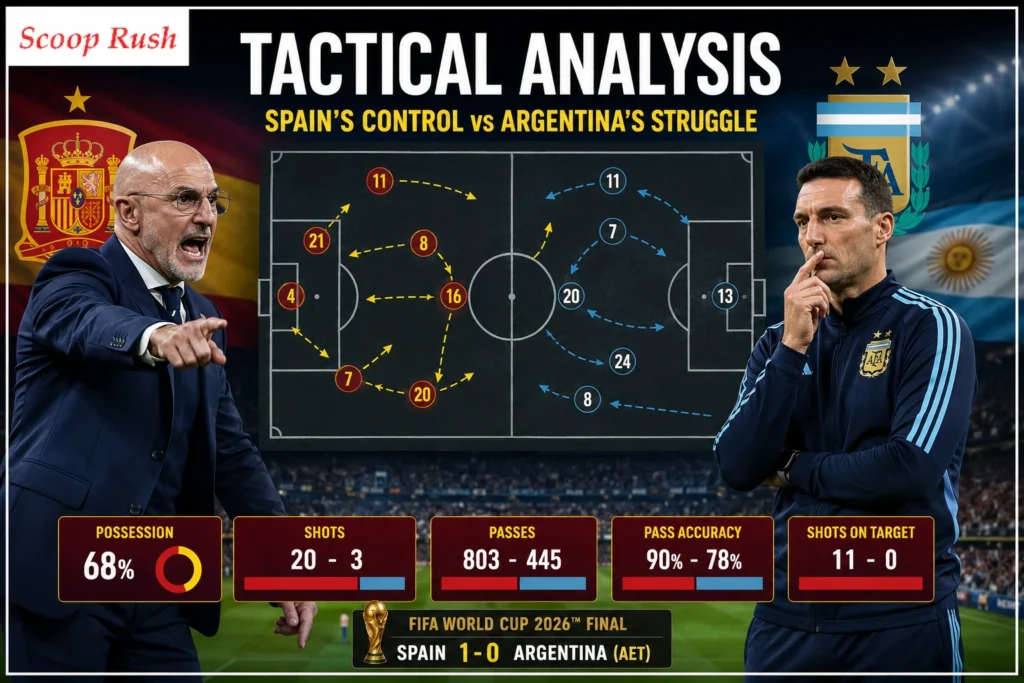
Key Match Statistics
The statistics reveal just how much control Spain had during the final.
Stat
Spain
Argentina
Shots
20
3
Shots on Target
11
0
Possession
68%
32%
Passes
803
445
Pass Accuracy
90%
78%
Fouls
21
24
Yellow Cards
0
5
Red Cards
0
1
Offsides
4
1
Corners
9
4
These numbers tell a clear story.
Spain dominated possession, created significantly more chances, and controlled the flow of the game. Meanwhile, Argentina struggled to establish sustained attacking pressure.
Most notably, Argentina finished the final without a single shot on target. Consequently, Spain’s defense enjoyed one of its most comfortable performances of the tournament.
Tactical Analysis
Spain’s Possession-Based Approach Worked Perfectly
Spain relied on their traditional strengths throughout the final. They controlled possession, circulated the ball quickly, and constantly searched for openings between Argentina’s defensive lines. Their 68 percent possession figure reflects how effectively they dictated play.
Additionally, Spain completed more than 800 passes with an impressive 90 percent accuracy rate. That level of control allowed them to remain patient and avoid unnecessary risks. Even when the breakthrough did not come during normal time, Spain remained committed to their game plan. Eventually, that patience paid off.
Argentina Could Not Create Enough Chances
Argentina’s strategy focused on defensive organization and counterattacks. While that approach helped keep the match level for long periods, it came at a cost. The team struggled to move forward consistently and rarely threatened the Spanish goal.
Only three total shots and zero shots on target demonstrate how difficult the evening was for Argentina’s attack. Furthermore, the five yellow cards and eventual red card highlighted the pressure Spain’s constant possession created.
The Road to Glory Ends With a Trophy
Winning a World Cup requires quality, resilience, and composure under pressure. Spain displayed all three qualities in the final. First, they controlled possession and territory. Second, they remained patient despite repeated setbacks in front of goal. Finally, they delivered in the crucial moment through Ferran Torres.
Many finals are decided by a single moment, and this match followed that pattern. Torres’ extra-time strike ultimately separated the two teams and secured Spain’s place at the top of world football.
Key Performers in the Final
Ferran Torres
There is no question about the standout performer.
His goal in the 106th minute decided the final and delivered the World Cup trophy. Beyond the goal itself, he remained active throughout the match and constantly searched for opportunities in dangerous areas.
Spain’s Midfield Unit
Spain’s midfield played a major role in the victory.
The team completed 803 passes and maintained 68 percent possession. Those numbers reflect a midfield performance that controlled the rhythm of the game from start to finish.
Spain’s Defense
Although Argentina struggled offensively, Spain’s defense still deserves significant credit.
The back line remained organized and prevented Argentina from registering a shot on target. That defensive discipline laid the foundation for the eventual victory.
What This Result Means
The Spain vs Argentina Final Result will become an important chapter in World Cup history.
For Spain, it represents the reward for a disciplined and dominant performance. The team controlled the final statistically and tactically before finally finding the winning goal in extra time.
For Argentina, the defeat will be painful. They defended bravely for long stretches but could not create enough attacking opportunities to challenge Spain consistently. Nevertheless, reaching the final remains a significant achievement.
A Final Defined by Patience and Precision
Not every World Cup final becomes a high-scoring spectacle. Sometimes the greatest matches are decided by discipline, concentration, and one decisive moment.
This final perfectly illustrated that idea. Spain remained patient for more than 100 minutes before Ferran Torres delivered the breakthrough. Argentina resisted for as long as possible but eventually ran out of answers. The result was a narrow scoreline, yet it reflected Spain’s overall superiority across the match.
Conclusion
The Spain vs Argentina Final Result saw Spain defeat Argentina 1-0 after extra time to win the FIFA World Cup 2026 title. Ferran Torres scored the only goal of the match in the 106th minute, while Argentina’s challenge was complicated by the red card shown to Enzo Fernández during extra time.
Spain dominated the statistics, controlled possession, and created far more chances. Ultimately, their persistence was rewarded with football’s most prestigious trophy. After a tense and hard-fought final, Spain emerged as world champions, while Argentina were left wondering what might have been.
FAQs
1. What was the Spain vs Argentina Final Result?
Spain defeated Argentina 1-0 after extra time in the FIFA World Cup 2026 Final.
2. Who scored the winning goal for Spain?
Ferran Torres scored the winning goal in the 106th minute.
3. Was the World Cup final decided in extra time?
Yes. The match was goalless after 90 minutes and was decided during extra time.
4. Did Argentina receive a red card in the final?
Yes. Enzo Fernández was sent off during extra time.
5. How dominant was Spain statistically?
Spain had 20 shots, 11 shots on target, 68% possession, and completed 803 passes compared to Argentina’s 445.
The Best Countries to Retire in 2026 offer affordable living, quality healthcare, and welcoming communities. Many retirees now choose overseas destinations for a better lifestyle and lower expenses. Several countries also provide retirement visas and attractive tax benefits.
Experts evaluated countries based on healthcare, living costs, residency options, safety, climate, and quality of life. Europe, Latin America, and Southeast Asia dominate this year’s rankings. Each destination offers unique advantages for different retirement goals.
Why the Best Countries to Retire in 2026 Stand Out
Retirement abroad has become easier than ever. Many governments now welcome foreign retirees through dedicated residency programs. Several countries also offer lower taxes on foreign pensions.
Healthcare remains another major advantage. Many retirement destinations provide affordable medical care with modern hospitals. Strong public transport, friendly communities, and pleasant climates also improve daily life.
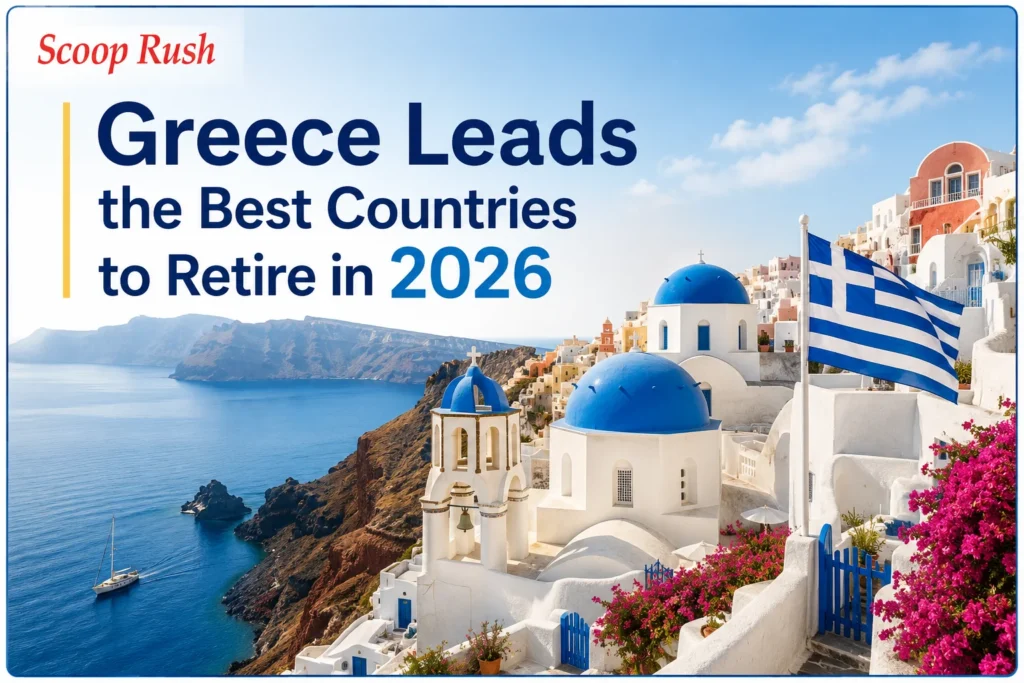
Greece Leads the Best Countries to Retire in 2026
Greece claims the top position in many retirement rankings for 2026. It combines Mediterranean living, affordable housing, and attractive tax policies. Retirees can enjoy more than 300 sunny days each year.
The country offers a flat 7% tax on eligible foreign income for up to 15 years. Property investors can also qualify for residency through the Golden Visa program. Monthly living costs usually range between $2,000 and $2,700 for couples.
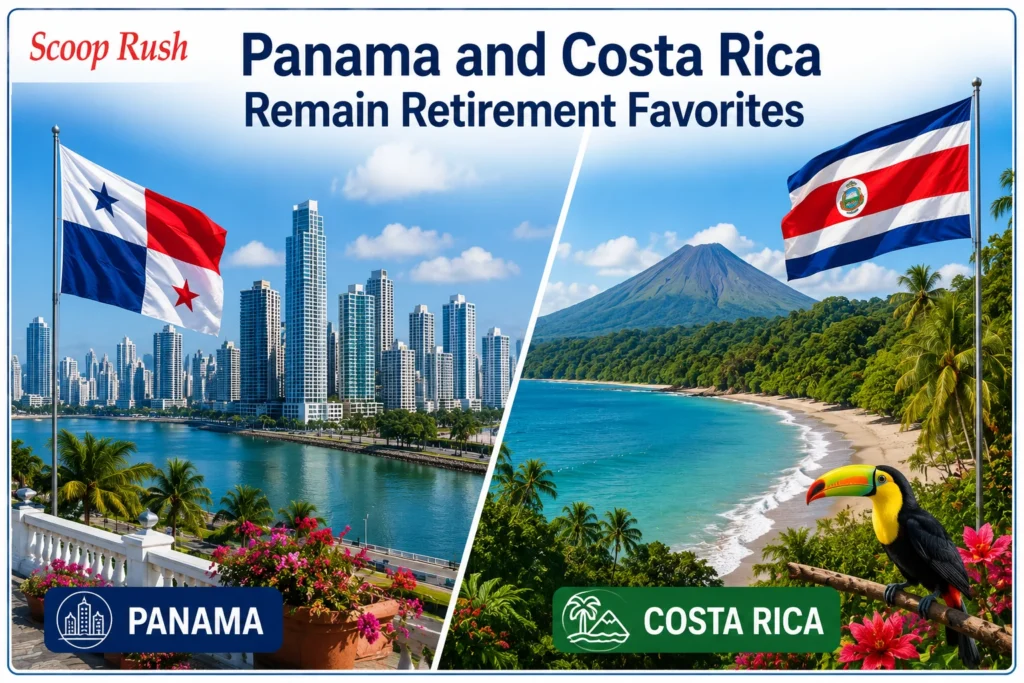
Panama and Costa Rica Remain Retirement Favorites
Panama continues attracting retirees with its Pensionado Visa. Applicants only need a qualifying monthly pension to apply. Foreign pension income also remains tax free.
Costa Rica follows closely because of its peaceful lifestyle and natural beauty. The Pensionado Visa requires a monthly pension of about $1,000. Many retirees appreciate the country’s affordable healthcare and friendly communities.
Portugal and Spain Offer European Comfort
Portugal remains one of Europe’s strongest retirement destinations. The D7 Visa supports retirees with passive income. Public healthcare and beautiful coastal regions attract thousands of expats each year.
Spain also delivers excellent healthcare and a relaxed Mediterranean lifestyle. The Non-Lucrative Visa allows retirees to settle without local employment. Couples generally spend between $2,300 and $3,000 monthly.
Italy and France Combine Culture with Quality Healthcare
Italy attracts retirees through its history, food, and scenic landscapes. Southern regions offer lower housing costs than major cities. The Elective Residency Visa supports retirees with stable passive income.
France continues to rank highly because of its healthcare system. Residents receive access to affordable medical services after meeting residency requirements. Rural regions also provide lower living costs than Paris.
Mexico Offers Affordable Living Close to North America
Mexico remains a practical option for retirees from the United States and Canada. Lower living costs allow many couples to enjoy comfortable lifestyles. Coastal towns and colonial cities continue attracting expats.
Private hospitals in major cities provide modern healthcare. Temporary Resident Visas remain available for retirees who meet income requirements. Many newcomers also appreciate the country’s vibrant culture and warm climate.
Thailand and Malaysia Deliver Outstanding Value
Thailand remains one of the world’s most affordable retirement destinations. Couples can live comfortably on $1,500 to $2,500 each month. Private hospitals also offer excellent care at reasonable prices.
Malaysia combines modern infrastructure with low living costs. Foreign passive income remains tax free in many situations. English also sees wide use, making daily life easier for international retirees.
Healthcare Plays a Major Role in Retirement Planning
Healthcare remains one of the most important retirement considerations. Most retirement visas require proof of private health insurance before approval. This requirement protects retirees during their transition.
Many countries later allow access to public healthcare systems. However, waiting periods often apply after arrival. International health insurance helps cover medical expenses during that time.
Key Factors Before Choosing a Retirement Destination
Every retiree has different priorities. Some prefer lower taxes, while others value healthcare or climate. Cost of living should always match your retirement income.
Research residency rules before making a final decision. Visit your preferred destination whenever possible. Spending time there helps confirm whether it fits your lifestyle and long-term plans.
Before relocating, compare visa rules, taxes, healthcare, and daily expenses carefully. Good planning helps retirees enjoy a secure and rewarding life abroad.
FAQs
1. Which is the best country to retire in 2026?
Greece ranks among the best retirement destinations for 2026. It offers a relaxed Mediterranean lifestyle, attractive tax benefits, affordable living, and several residency options for foreign retirees.
2. What is the cheapest country to retire in 2026?
Thailand is one of the most affordable places to retire. Couples can enjoy a comfortable lifestyle with low housing costs, inexpensive healthcare, and affordable daily expenses.
3. Which country offers the best healthcare for retirees?
France and Spain both provide excellent healthcare systems. They offer high-quality medical services, modern hospitals, and affordable treatment for legal residents.
4. Do I need private health insurance to retire abroad?
Yes. Most countries require private health insurance when applying for a retirement visa. It also helps cover medical expenses before you become eligible for public healthcare.
5. What should I consider before retiring to another country?
Compare the cost of living, visa requirements, healthcare, taxes, climate, and safety before making a decision. Visiting your preferred destination first can also help you decide if it matches your lifestyle and retirement goals.
Your Period App Might Be Sharing More Than You Think
What if the app tracking your cramps is also telling advertisers about your birth control, your moods, and your pregnancy status? For millions of women, period tracking apps feel like a private space. However, new research shows that period tracker privacy varies wildly between apps. Some of your most intimate health details may be traveling further than you’d expect.
The Mozilla Foundation investigated six popular period trackers: Flo, Clue, Stardust, Spot On, Period Calendar and Euki. Their findings reveal a mixed picture. Some apps protect your data carefully, while others share it in ways that might genuinely disturb you, in an era where child safety features and data protection are under increasing scrutiny across tech platforms.
This matters more than ever. Since the US Supreme Court overturned federal abortion protections in 2022, experts worry that period tracker data could show up in criminal cases. Additionally, police have already used other kinds of tech data to help prosecute women. Therefore, understanding period tracker privacy isn’t just a nice-to-have. It’s essential.
Let’s walk through what Mozilla found about period tracker data privacy, and how you can protect yourself.
Period Tracker Privacy: Who Actually Sees Your Health Data?
Mozilla’s research uncovered several concerning practices around period tracker data sharing. However, Stardust stood out as the only app sharing detailed reproductive health data with an outside company.
According to the report, Stardust sends user health information to a data management company called RudderStack. This includes pregnancy status, birth control use, moods, alcohol consumption, and specific symptoms like tender breasts and stomach cramps. Notably, RudderStack isn’t even named in Stardust’s privacy policy.
There’s nothing illegal about this practice. Companies frequently share data with outside services to process information and analyze user behavior, much like how AI systems such as Meta’s Muse Image tool rely on backend data pipelines to function. Still, experts say it’s inherently risky when health data spreads to more places. Each new destination creates another opportunity for a security breach or a legal request for information.
A Stardust spokesperson told the BBC that RudderStack is only used as a technical pipeline to route data into the company’s own systems. Nothing shared could identify a user’s name or contact details, the spokesperson added. The company also said RudderStack is contractually barred from selling the data or using it for its own purposes.
Shoshana Wodinsky, the privacy research analyst who conducted Mozilla’s tests, put it simply: people deserve better. At minimum, she says, users should know what’s happening with their information.
The Spot On App and Planned Parenthood’s Privacy Complication
Spot On, made by Planned Parenthood, presents a more nuanced case for menstrual health app privacy. The app itself doesn’t share data with other companies or track users directly, according to Mozilla. However, certain features, like the Roo AI chatbot and a healthcare provider search tool, open Planned Parenthood’s website inside a browser. That website, Mozilla found, is less secure.
The most concerning example involves Planned Parenthood’s website sharing information about what kind of healthcare you’re searching for with an analytics company called AB Tasty. This includes whether someone is looking into HIV testing or gender-affirming care. Wodinsky noted that this could likely be fixed quickly, saying someone could probably solve the issue in an afternoon.
This isn’t Planned Parenthood’s first brush with privacy criticism either. Similar concerns were raised about the organization years earlier.
Does Your Period Tracker App Reveal That You’re Using It at All?
Beyond specific health details, there’s another layer of exposure to consider when it comes to period tracking app security. Mozilla found that most apps in the report don’t share detailed health information. Yet many still send basic user data to advertising and analytics platforms run by Google, Meta, Microsoft, and TikTok, the same companies that faced backlash after the recent WhatsApp, Facebook and Instagram outage exposed how much daily life depends on their infrastructure.
Typically, this data includes an ID number or identifier used to track you, often for targeted advertising or cross-platform tracking. Users technically consent to this by accepting the apps’ privacy policies, though few people read them closely.
Even without specific symptoms attached, simply revealing that you use a reproductive health app can carry consequences. Sara Geoghegan, director of the Consumer Privacy Program at the Electronic Privacy Information Center, explained that this kind of data can become part of a larger surveillance picture. Consequently, it could signal to law enforcement that a trove of health data exists somewhere, ready to be requested.
For example, Period Calendar sent ID numbers and device information to Google and the advertising company InMobi, with no way for users to opt out, according to Mozilla’s findings. Meanwhile, Stardust shared similar data with Facebook and AppsFlyer, though users can block this through their phone’s privacy settings. Similarly, accessing Planned Parenthood’s website through Spot On shares comparable information with Google, Microsoft, TikTok, and Pinterest, and Mozilla says there’s no way to prevent it.
A Stardust spokesperson clarified that the company doesn’t share health data with advertising platforms. AppsFlyer and Meta are used only to measure and optimize ad campaigns, the spokesperson said.
Why Advertising Data Still Matters for Reproductive Privacy
Even seemingly harmless advertising IDs can build a profile that reveals reproductive health status over time. As a result, privacy experts recommend checking your phone’s ad tracking settings regardless of which period app you use, a concern that echoes broader debates around AI models like Kimi K3 and how much personal data trains modern platforms.
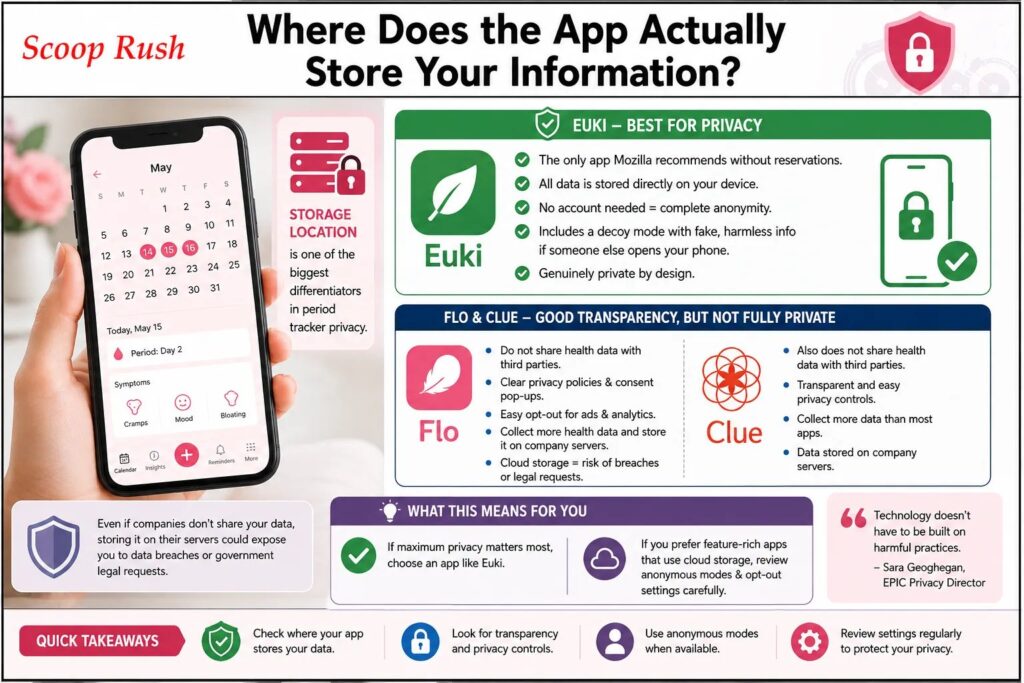
Where Does the App Actually Store Your Information?
Storage location turns out to be one of the biggest differentiators in period tracker privacy. Euki was the only app Mozilla recommended without reservations. Wodinsky described Euki as genuinely special among the group tested.
Unlike every other app in the study, Euki keeps all health information stored directly on your device rather than sending it to company servers. Users don’t even need to create an account, allowing for complete anonymity. Additionally, the app includes a decoy feature that displays fake, harmless information if someone else picks up your phone.
Geoghegan sees this as proof that better options exist. Technology doesn’t have to be built on harmful practices, she noted.
Flo and Clue weren’t as tightly locked down as Euki, but they scored reasonably well thanks to genuine transparency and detailed privacy controls. As far as Mozilla could determine, neither app shares health information with third parties under any circumstances. Both inform advertising and analytics partners when someone uses the app, clearly disclosed in privacy policies and consent pop-ups, though users can disable this easily.
However, Mozilla criticized Flo and Clue for collecting far more health data than other apps and storing it on company servers rather than locally. Even if these companies never share the information, keeping a copy at all could expose users to data breaches or government legal requests, Wodinsky explained. That’s a genuine trade-off worth considering.
Spokespeople for Flo and Clue pushed back against this framing. Both companies maintain that cloud storage is necessary for their services and that adequate safeguards protect the data. Flo spokeswoman Samantha Wannemacher pointed to the app’s Anonymous Mode, which she says ensures no one, including Flo itself, holds a user’s identity and health data simultaneously. She added that Flo has never received a subpoena for user data and would fight one if it happened.
Both Clue and Flo are based in Europe, which could make US legal requests more difficult to enforce. Clue’s chief executive Rhiannon White stated the company has never disclosed private health data to any authority and never will.
What This Means for Your Own Period Tracker Choice
Ultimately, the right period tracker depends on your personal risk tolerance. If keeping data off company servers entirely matters most to you, an app like Euki offers stronger guarantees. On the other hand, if you value features that require cloud storage, look closely at anonymous modes and opt-out settings.
Period Tracker Track Record: Past Privacy Scandals Worth Knowing
Current practices only tell part of the story. Mozilla suggests examining each app’s history too, since past behavior often predicts future risk.
Flo, for instance, settled a case with the US Federal Trade Commission in 2021 over allegations that it shared sensitive user information with Meta, Google, and others after promising to keep the data private. Mozilla noted that Flo’s practices improved significantly afterward. Still, the company’s privacy policy later expanded to include new advertising partnerships with Google, Meta, and other platforms, though users retain the ability to disable this.
A Flo spokesperson responded that the FTC settlement involved practices that ended five years ago, and the company did not admit wrongdoing. Flo maintains that its current privacy and transparency practices exceed industry standards.
Other apps have faced their own scrutiny. A 2022 investigation found lists of individual devices using Clue, Period Calendar, and other trackers for sale online. White responded that this data originated from the broader mobile advertising ecosystem rather than Clue’s app directly, adding that Clue has never sold and will never sell user data to third parties.
Stardust faced a separate credibility issue. The app initially appeared to promise end-to-end encryption, a strong security feature that makes data particularly difficult to access. However, the company later removed these references from its website after reporters asked questions about them. Stardust’s spokesperson didn’t address this specific point.
As Geoghegan put it, people are rightfully concerned because society has combined widespread surveillance with the criminalization of abortion in some states. She argues this highlights the need for stronger privacy regulation in the US, where, unlike Europe, no comprehensive national privacy law currently exists, a gap that has also fueled controversy in unrelated cases like Elon Musk’s Wisconsin legal dispute over data and disclosure rules.
Beyond legal risk, privacy problems create real emotional costs too. Ongoing concerns can cause fear and anxiety that discourage people from using tools designed to improve their health in the first place, much the way patients have raised trust concerns around new NHS AI tools handling sensitive medical information.
Key Takeaways on Period Tracker Privacy
Choosing a period tracker isn’t just about convenience anymore. Here’s what to remember:
Euki stands out for keeping all data on your device, making it the most private option among those tested. Flo and Clue offer solid transparency and granular controls, though they store more data on company servers. Stardust raised the most serious concerns, sharing detailed health information with an unnamed third party. Spot On’s core app is fairly secure, but its in-app browser exposes sensitive search behavior. Finally, track record matters just as much as current policy, so check an app’s history before trusting it with your most personal information.
As Wodinsky says, people deserve to know what’s happening with their data. Reading the privacy policy, checking opt-out settings, and understanding where your information actually lives can help you make a genuinely informed choice.
FAQs
Which period tracker app is the most private?
Euki is currently considered the most private option, according to Mozilla’s research. It stores all health data directly on the user’s device rather than company servers and doesn’t require an account, allowing for anonymous use.
Do period tracking apps share data with police?
Apps generally state they haven’t shared health data with law enforcement without proper legal process. However, experts warn that any data stored on company servers could potentially be obtained through legal requests. This is why storage location matters so much.
Is Flo safe to use after its FTC settlement?
Flo settled with the FTC in 2021 over data-sharing allegations and says its practices have since improved significantly. The company points to features like Anonymous Mode as evidence of stronger current protections, though it still stores health data on its servers.
What does Anonymous Mode do in period tracker apps?
Anonymous Mode, offered by apps like Flo, is designed to ensure that no one, including the company itself, can connect a user’s identity to their health data at the same time. This feature adds a layer of protection against data requests.
Why does period tracker privacy matter after Roe v. Wade was overturned?
Since federal abortion protections ended in 2022, experts worry that data from period trackers could be used in criminal investigations or prosecutions related to pregnancy outcomes. As a result, data privacy has become a more urgent concern for users.
What if one of football’s greatest stories is about to reach its final chapter? Messi on the Brink of History has become the biggest talking point as Argentina reach the FIFA World Cup 2026 final. Will this be his last match on football’s biggest stage?
That is the question millions of fans are asking ahead of the FIFA World Cup 2026 final, as Messi on the Brink of History continues to dominate the headlines. Argentina is only one victory away from winning back-to-back World Cups, a feat achieved by only two nations before.
At the center of this historic moment stands Lionel Messi. At 39 years old, he continues to deliver on the biggest stage. His performances throughout the tournament have helped Argentina reach another World Cup final and have added even more records to his extraordinary career.
The final against Spain is not just about a trophy. It is also about legacy, history, and perhaps a farewell. While nobody knows for certain whether this will be Messi’s final World Cup appearance, the possibility has added even more emotion to an already monumental occasion.
Why This World Cup Final Matters So Much
Argentina entered the final with a chance to achieve something very few teams have managed in football history.
If they defeat Spain, Argentina will become only the third nation to win consecutive World Cups. Previously, only Italy and Brazil accomplished that feat.
Therefore, the stakes could hardly be higher.
For Messi, the match offers another opportunity to strengthen an already unmatched international legacy. A victory would make him the first captain in football history to lift the World Cup trophy twice.
Meanwhile, Argentina manager Lionel Scaloni has repeatedly praised his captain’s impact on the team. According to Scaloni, Messi’s ability to perform at the highest level at the age of 39 is something football fans should appreciate while they still can.
Messi’s Incredible World Cup 2026 Campaign
The 2026 World Cup has showcased why Messi remains one of football’s elite players.
As a result, Messi continues to influence games in multiple ways.
His goal tally also keeps him close to the tournament’s top scorers. Additionally, he sits only one goal behind Kylian Mbappé in the race to become the World Cup’s all-time leading scorer.
Perhaps even more remarkable is the timing of his success.
Fifteen of Messi’s 21 World Cup goals have come during the 2022 and 2026 tournaments. That means most of his World Cup scoring record has been built after turning 35. Such longevity is almost unheard of in international football.
Messi on the Brink of History and Another World Cup Record
The phrase Messi on the Brink of History perfectly captures what is at stake in the final.
Throughout his career, Messi has broken record after record. Yet the World Cup final presents another chance to add something unique to his collection.
If Argentina win, Messi would become the first captain to lift two World Cup trophies. Furthermore, he is already among the most decorated players in tournament history.
His World Cup achievements include:
Most World Cup appearances with 33 One of only two players to appear in six men’s World Cups Two Golden Ball awards in 2014 and 2022 The only player to score in every knockout stage round during a successful World Cup campaign Record holder for most World Cup assists with 12 Goals or assists in 11 consecutive World Cup appearances Goals in nine consecutive World Cup matches A third World Cup final appearance, matching an elite group of players
These records highlight why many consider him one of the greatest footballers ever.
Could This Really Be Messi’s Last World Cup?
The biggest question surrounding the final is whether fans are about to witness Messi’s final World Cup appearance. Interestingly, this is not the first time such a discussion has taken place.
Back in 2016, Messi announced his retirement from international football. However, he later reversed that decision and returned to represent Argentina. Similarly, before the 2022 World Cup final, Messi suggested that the tournament would likely be his last.
At the time, he spoke about finishing his World Cup journey in a final and expressed doubt that he could reach another tournament. Yet he proved everyone wrong.
Now, four years later, he is preparing for another World Cup final. That history makes predictions difficult. Neither Messi nor Scaloni has publicly confirmed any decision regarding retirement after the final. Therefore, the football world remains uncertain about what comes next.
Why Some Believe Messi Could Continue Until 2030
Several factors suggest Messi may not be finished with international football. First, he continues to perform at an elite level. His physical condition has allowed him to compete against much younger players throughout the tournament. Second, his passion for representing Argentina appears as strong as ever.
Spanish football journalist Guillem Balagué believes Messi still enjoys playing for his country and may not be ready to walk away. According to Balague, Messi’s love for international football could keep him involved with Argentina beyond 2026. Additionally, the 2030 World Cup presents a unique opportunity.
The Special Attraction of the 2030 World Cup
The 2030 World Cup will have six host nations. While most matches will be played in Spain, Portugal, and Morocco, special centenary matches are planned in Argentina, Uruguay, and Paraguay. For Messi, that could create a powerful emotional incentive.
The possibility of playing a World Cup match in front of Argentine supporters on home soil would be difficult to ignore. If he remains part of the national team until then, he would be 43 years old.
Such an achievement would make him the oldest outfield player ever to appear in a World Cup. Although that challenge is enormous, Messi has repeatedly shown an ability to defy expectations. Consequently, many observers are reluctant to rule out another remarkable chapter.
The Evolution of Messi’s World Cup Career
Messi’s World Cup story has evolved dramatically over time. Earlier tournaments often brought questions about whether he could match the international success of Argentine legend Diego Maradona.
However, the narrative changed significantly in 2022. That tournament delivered the World Cup title that many believed was missing from his resume. Since then, he has continued to build on that success.
The current tournament has reinforced his ability to adapt. Rather than relying solely on speed or athleticism, Messi controls matches through intelligence, movement, vision, and technical quality. As a result, he remains one of the most influential players in world football despite approaching his forties.
The Assist Record That Shows Messi’s Complete Influence
Goals often dominate headlines, but Messi’s creative contribution deserves equal attention. His two assists against England increased his World Cup assist total to 12.
No other player has reached that number. Even more impressive, 10 of those assists have come in knockout matches. That statistic demonstrates his ability to perform when pressure is highest. While goals win matches, creativity often decides tournaments.
Therefore, Messi’s record highlights a different side of his greatness. He does not simply score decisive goals. He also creates opportunities for teammates on football’s biggest stage.
Comparing Messi’s World Cup Legacy
Football fans frequently debate where Messi ranks among the greatest players in history. Those discussions may never produce a universal answer. However, his World Cup record speaks for itself. Few players have combined longevity, consistency, individual awards, goals, assists, and team success at such a high level.
Furthermore, his achievements span multiple generations of football. From his early World Cup appearances to the current tournament, Messi has remained a central figure in global football for nearly two decades. That level of sustained excellence is exceptionally rare. Consequently, every additional record strengthens his place in football history.
What Argentina Need From Messi in the Final
Argentina have relied heavily on Messi throughout the tournament. His goals, assists, leadership, and experience have helped guide the team through difficult moments.
Against Spain, those qualities will be crucial once again. The final will likely be decided by small margins. Therefore, Argentina will need their captain to deliver another influential performance.
Whether that involves scoring, creating chances, or simply controlling key moments, Messi’s presence could be decisive. The pressure will be enormous. Yet pressure has defined many of the greatest moments of his career.
Conclusion
The story of Messi on the Brink of History is about much more than records and statistics. It is about a player who continues to redefine what is possible at the highest level of football. As Argentina prepares to face Spain in the FIFA World Cup 2026 final, Messi stands one victory away from another historic achievement. A second World Cup title as captain would place him in a category entirely his own.
At the same time, uncertainty surrounds his future. Will this be the final World Cup match of his extraordinary career? Or will the football world see him again in 2030? For now, nobody knows the answer. What is certain is that football fans around the world are preparing to witness another chapter in one of the sport’s greatest stories. And if history has taught us anything, it is never wise to doubt Lionel Messi.
FAQs
1. Why is Lionel Messi on the brink of history?
Messi is one win away from becoming the first captain to lift the FIFA World Cup trophy twice, which would be a historic achievement.
2. How many goals has Messi scored at World Cups?
According to the information provided, Messi has scored 21 World Cup goals, with 15 coming during the 2022 and 2026 tournaments.
3. Is the 2026 World Cup final Messi’s last World Cup match?
There has been no official confirmation. Messi and Argentina coach Lionel Scaloni have not announced any retirement decision.
4. Could Messi play in the 2030 World Cup?
It remains possible. The 2030 tournament will include matches in Argentina, and some observers believe Messi could continue if he remains motivated and fit.
5. What World Cup records does Messi currently hold?
Messi holds several records, including most World Cup appearances, most World Cup assists, and being the only player to score or assist in 11 consecutive World Cup appearances.
Competition: FIFA World Cup 2026 Final Match: Spain vs Argentina Date: July 19, 2026 Venue: New York New Jersey Stadium (MetLife Stadium), New Jersey, United States
The World Cup Final promises more than a battle between Spain and Argentina. It will also bring together two of America’s most talked-about political figures. President Donald Trump and New York City Mayor Zohran Mamdani will attend the championship match, adding another layer of attention to football’s biggest stage.
While both leaders will watch from the same stadium, they have no plans to meet. Instead, the spotlight will remain on the players chasing football’s greatest prize. Meanwhile, security agencies have prepared for one of the largest international gatherings ever held in the United States.
World Cup Final Draws Global Leaders to New Jersey
The World Cup Final has attracted presidents, governors, diplomats, and football officials from around the world. Their presence highlights the tournament’s growing importance beyond sport.
FIFA President Gianni Infantino will attend alongside President Trump. New York Governor Kathy Hochul and New Jersey Governor Mikie Sherrill are also expected at the stadium. Their attendance reflects the global significance of the championship.
World Cup Final Gets Unprecedented Security
Security will remain one of the biggest stories surrounding the World Cup Final. Federal authorities assigned the match a Level 1 Special Event Assessment Rating, the highest security classification for major public events.
Officials have deployed intelligence teams, aerial surveillance, explosive detection dogs, and additional law enforcement officers. Road closures and heavy traffic are also expected around the stadium throughout matchday.
Trump Makes His First World Cup Appearance
Although the United States co-hosted the tournament, Trump skipped every previous match. His attendance at the World Cup Final marks his first appearance during the competition. The final gives him an opportunity to take part in one of the world’s biggest sporting events.
Trump also attended a FIFA reception before the final alongside FIFA President Gianni Infantino. After the match, both will present the World Cup trophy to the champions. The ceremony will close the month-long tournament in front of a global audience.
Mamdani Says Football Comes Before Politics
Mayor Zohran Mamdani has embraced the tournament since its opening week. He attended several matches and supported football events across New York City. His administration also encouraged community watch parties and activities for fans.
When reporters asked about Trump, Mamdani avoided political comments. Instead, he said his focus would remain on the match itself. His office also confirmed that no meeting with Trump has been scheduled during the final.
A Familiar Scene Returns One Month Later
This is the second time in just over a month that Trump and Mamdani have attended the same major sporting event. They also watched Game 3 of the NBA Finals at Madison Square Garden, where both kept a low profile despite their public visibility.
That night, both watched separately while fans focused on the game. A similar situation is expected during Sunday’s World Cup Final, with each leader following separate schedules and attending in different areas of the stadium.
FIFA Decision Earlier Sparked Tournament Debate
Trump drew attention earlier in the tournament after seeking a review of U.S. striker Folarin Balogun’s suspension. FIFA later lifted the suspension before the Belgium match, allowing the forward to play.
Despite the decision, the United States failed to advance after losing to Belgium. The incident sparked debate among supporters and analysts, with many discussing whether political involvement should influence sporting decisions.
World Cup Final Celebrates Football’s Global Reach
While politics surrounds the event, football remains the main attraction. Spain and Argentina have earned their places after impressive performances throughout the tournament. Both teams now stand one victory away from lifting the famous trophy.
Millions of supporters will watch from stadium seats, fan zones, and television screens across the world. The final also highlights football’s ability to bring together people from different cultures through a shared passion for the game.
All Eyes Turn to Spain and Argentina
Beyond the political headlines, the World Cup Final will decide the 2026 FIFA World Cup champion. Spain and Argentina enter the match with talented squads, experienced coaches, and strong support from fans around the world.
Supporters expect an exciting contest between two football powerhouses. Once the referee blows the opening whistle, the attention will shift fully to the action on the pitch as both teams chase a place in World Cup history.
Conclusion
The World Cup Final combines world-class football with global political attention. Donald Trump and Zohran Mamdani will attend the championship match without holding a meeting, while world leaders gather under enhanced security. Even so, the focus will ultimately remain on Spain and Argentina as they compete for football’s biggest prize. With millions watching around the world, the final promises to deliver a memorable ending to the FIFA World Cup 2026.
FAQs
1. Why are Donald Trump and Zohran Mamdani attending the World Cup Final?
Both will attend as official guests at the FIFA World Cup final. Their presence reflects the event’s international importance and high-profile status.
2. Will Trump and Mamdani meet during the final?
No. Officials confirmed that neither leader has scheduled a meeting. They will attend the match separately.
3. Why does the World Cup Final have such heavy security?
Authorities expect several heads of state and senior officials to attend. Therefore, federal agencies have implemented the highest level of security to protect players, guests, and supporters.
4. What role will Donald Trump have after the match?
Trump will join FIFA President Gianni Infantino during the trophy presentation. Together, they will present the FIFA World Cup trophy to the winning team.
5. Why has this World Cup Final attracted worldwide attention?
The match combines a historic football final with the attendance of political leaders from around the world. This unique combination has made the event one of the most closely watched sporting occasions of 2026.