Home Blog Page 35

Best England Team for a Long Time? Declan Rice Says England Are Closer Than Ever

0

England’s dramatic 6-4 victory over France in the FIFA World Cup third-place play-off delivered more than just a bronze medal. It also sparked a strong statement from captain-for-the-night Declan Rice, who believes this is the best England team for a long time and one that is edging closer to major tournament glory.

After years of near misses, painful exits, and unanswered questions, England once again fell short of reaching a World Cup final. However, their thrilling response against France showed the quality, character, and belief that still exists within the squad. While disappointment remains over the semi-final defeat to Argentina, the players and coaching staff are convinced that success is within reach.

For England supporters, the debate now centers on whether this talented generation can finally turn promise into silverware.

Why Declan Rice Believes This Is the Best England Team for a Long Time

Speaking after England’s 6-4 win over France, Rice made his feelings clear.

According to the midfielder, this squad deserves recognition for what it has achieved over several tournaments. England secured third place at the World Cup, their highest finish since winning the tournament in 1966.

Rice said no one can take away the fact that this is the best England group for a very long time. His comments reflected both pride and frustration.

On one hand, England ended the tournament with a memorable victory and a bronze medal. On the other hand, the squad remains disappointed because their main objective was to reach the final and lift the trophy.

Rice acknowledged that England are tired of celebrating semi-final and quarter-final appearances. Instead, the players want to win major tournaments.

However, he also stressed that England are extremely close to taking that final step.

The midfielder pointed to the fine margins that often decide major matches. England’s semi-final loss to Argentina was a painful example of how quickly fortunes can change in knockout football.

England’s World Cup Journey Ends With Mixed Emotions

England’s World Cup campaign was full of highs and lows.

The tournament ended on a positive note as they defeated France in one of the most entertaining matches of the competition. Ten goals were scored in a remarkable encounter that gave supporters plenty to celebrate. Yet the joy of victory could not completely erase the disappointment of missing out on a place in the final.

The squad had entered the tournament with ambitions of becoming world champions. Therefore, settling for third place naturally left many players wondering what might have been.

Despite that frustration, England’s achievement remains significant. A third-place finish represents their strongest World Cup performance in six decades. Furthermore, it provides evidence that the current group can consistently compete with the world’s leading football nations.

The Emotional Response Inside the England Camp

One of the most striking moments came from assistant manager Anthony Barry. During a half-time interview while England led France 4-0, Barry struggled to hide his emotions. Rather than speaking about tactics or strategy, he focused on the players’ mental resilience following the semi-final defeat.

Barry described the squad as a group of players with “broken hearts” who were still able to produce an outstanding performance.

His comments offered a rare glimpse into the emotional impact of tournament football. For several days after the loss to Argentina, disappointment reportedly dominated the camp. However, the players responded with professionalism and pride when they returned to the field.

Barry also praised the team spirit that developed during the seven-week campaign. According to him, watching the bond within the group was a privilege. Those remarks support Rice’s belief that this England squad possesses qualities beyond technical ability.

Best England Team for a Long Time and the Search for Major Success

The biggest question facing England is simple. If this truly is the best England team for a long time, what must happen for them to finally win a major tournament?

The talent is clearly available. Experienced leaders, world-class attackers, and top-level professionals give England a strong foundation. However, success at international tournaments often depends on small details. 

England have repeatedly reached the latter stages of competitions. They have appeared in finals, semi-finals, and quarter-finals during recent years. Nevertheless, the final breakthrough remains elusive.

Rice believes the difference between success and failure can be measured in moments rather than overall quality. Many people inside the England setup share that view. The challenge now is finding a way to turn competitive performances into championship-winning results.

The Fine Margins That Separate Champions From Contenders

Tournament football often comes down to key decisions, crucial substitutions, and individual moments. England experienced that reality against Argentina.

The defeat left players, coaches, and supporters questioning what could have been done differently. Yet Rice insists that England are not far away.

His confidence comes from the fact that the squad consistently reaches the latter stages of major competitions. Teams that regularly compete for trophies eventually give themselves opportunities to win them. Therefore, England’s recent record provides reasons for optimism despite the disappointment.

Thomas Tuchel Faces Questions but Retains Belief

Manager Thomas Tuchel remains at the center of discussions following the World Cup. His tactical decisions during the semi-final defeat to Argentina received significant criticism.

Many observers questioned England’s approach during crucial periods of that match. Some believed the team became too passive and allowed Argentina to take control. However, Tuchel continues to defend his decisions.

The England manager admitted that the defeat remains painful. He described it as a scar that will stay with the team. At the same time, he rejected suggestions that he has lost the trust of his players.

Tuchel emphasized that difficult moments are part of elite sport. He also stressed that England remained highly ambitious and determined to challenge for major honors. Importantly, he believes the gap between England and the world’s top teams can be closed.

Using France as an example, Tuchel noted how sustained success requires patience and consistency. His message was clear: England must continue progressing rather than abandoning their long-term vision after one setback.

Harry Kane Praises the Squad Spirit

England captain Harry Kane echoed many of Rice’s sentiments. The striker described the current squad as one of the best England groups he has ever experienced.

According to Kane, the atmosphere within the camp played a major role throughout the tournament. He highlighted the relationships built between players at the hotel, training ground, and in the dressing room.

That unity helped England navigate the pressures that accompany a World Cup campaign. Kane also offered support for Tuchel.

The captain pointed out that this was the manager’s first major tournament with England. As a result, Tuchel gained valuable experience regarding tournament football, travel schedules, squad management, and handling intense expectations. Kane’s backing suggests that the leadership group remains firmly behind the manager.

Bukayo Saka Delivers a Powerful Response

Few players attracted more attention after the semi-final than Bukayo Saka. The Arsenal winger did not feature against Argentina despite being available on the bench.

That decision became a major talking point after England’s elimination. Against France, Saka responded in the best possible way.

He scored a hat-trick in England’s thrilling victory and reminded everyone of his importance to the team. After the match, Saka confirmed that he was fit.

Although he admitted he would have liked to play more during the tournament, he preferred to focus on his performance rather than revisit past decisions. His attitude reflected the professionalism that England’s coaching staff frequently praise.

Furthermore, his display against France demonstrated the attacking threat England can possess when their most dangerous players are involved.

Pundits Split on Tuchel’s Future

Not everyone shares the optimism expressed by Rice, Kane, and other members of the squad. Former England midfielder Danny Murphy argued that Tuchel has failed because England missed out on a World Cup final.

Murphy believed England’s talented attacking players were not fully utilized during the defeat to Argentina. He also suggested the creativity and forward-thinking football displayed against France should have appeared earlier in the tournament.

Meanwhile, former defender Stephen Warnock expressed disappointment that England retreated too quickly against Argentina.

Warnock highlighted the importance of pace in modern football and pointed to the impact of players such as Saka and Marcus Rashford. Former England defender Martin Keown made a similar observation.

He suggested Argentina would have been relieved not to face Saka and Rashford for longer periods because their speed can cause problems for any defense. These opinions underline the debate surrounding England’s tactical approach.

What England Can Take From This Tournament

Despite the disappointment, England left the World Cup with several positives. First, they achieved their best finish since 1966. Key players also proved they can perform under pressure. In addition, the squad showed remarkable resilience after the semi-final defeat. The strong bond within the group provides a solid foundation for future tournaments. 

England also gained valuable experience competing deep into another major competition. Such experience can prove crucial when similar situations arise in the future. Most importantly, players and coaches continue to believe that success is possible. 

Looking Ahead to the Future

The focus will now shift to England’s next challenges. Expectations will remain high because the current squad contains many players entering or already in their prime years.

Supporters will hope lessons from this World Cup can be used to improve future performances. For Tuchel, the task is clear.

He must find a way to help England overcome the final hurdle against elite opposition. For the players, the challenge is maintaining belief while continuing to develop.

Rice’s comments show that confidence inside the squad remains strong. The midfielder does not see a team that failed. Instead, he sees a team that is getting closer.

Whether that belief eventually leads to silverware remains to be seen. However, England’s World Cup campaign has certainly reinforced the idea that this generation remains capable of achieving something special.

Conclusion

England’s World Cup ended with both pride and disappointment. The thrilling 6-4 victory over France delivered a bronze medal in the third-place play-off and a memorable farewell to one of the greatest World Cup tournaments in recent memory. However, the pain of missing the final still lingers.

Declan Rice’s declaration that this is the best England team for a long time reflects the confidence shared throughout the squad. Players believe they are close to achieving major success, even if the ultimate prize slipped away this time.

The tournament showcased England’s talent, resilience, and team spirit. Furthermore, it highlighted areas where improvement is still needed.

For now, England can celebrate a historic third-place finish. More importantly, they can look ahead knowing that the dream of winning a major tournament remains very much alive.

FAQs

1. Why did Declan Rice call this the best England team for a long time?

Rice believes the squad’s consistent performances in major tournaments and third-place World Cup finish prove its quality and potential.

2. What was England’s final position at the World Cup?

England finished third after defeating France 6-4 in the third-place play-off match.

3. What did Thomas Tuchel say after England’s World Cup campaign?

Tuchel said the semi-final defeat remains painful but insisted England can close the gap to the world’s top teams.

4. How did Bukayo Saka perform against France?

Saka scored a hat-trick in England’s 6-4 victory and later confirmed that he was fit.

5. Does Harry Kane believe in the current England squad?

Yes. Kane described it as one of the best England groups he has ever been part of and praised the strong team spirit within the camp.


U.S. Worldwide Travel Alert Urges Americans to Exercise Caution

0

The U.S. Worldwide Travel Alert warns Americans abroad to stay vigilant amid rising global security concerns. The U.S. Department of State issued the caution because of growing tensions in the Middle East. Officials warned that terrorist attacks, demonstrations, and violent actions could target Americans or U.S. interests. Travelers should monitor local conditions and prepare for unexpected disruptions.

The advisory also highlights possible flight cancellations and temporary airspace closures. The State Department urged travelers to review country-specific advisories before making international travel plans. Americans already overseas should remain informed and follow guidance from local authorities.

U.S. Worldwide Travel Alert Highlights Growing Security Risks

U.S.-Worldwide-Travel-Alert-Highlights-Growing-Security-Risks

The State Department said the global security environment remains unpredictable. Officials believe regional tensions could trigger sudden security incidents. Americans should remain alert in every country they visit.

The advisory noted that U.S. diplomatic facilities have faced threats before. Groups supporting Iran could target locations connected to the United States. Authorities encouraged travelers to avoid unnecessary risks and stay aware of changing conditions.

U.S. Worldwide Travel Alert Includes Israel Travel Advisory

The U.S. Embassy in Jerusalem issued a separate security alert on July 17, 2026. Officials said the situation in Israel and nearby areas remains complex. They warned that conditions could change without notice.

The embassy advised Americans to avoid travel to Gaza, northern Israel, and the Egyptian border, except the Taba crossing. Travelers should also reconsider nonessential travel across the wider Middle East. Embassy officials confirmed that routine and emergency consular services remain available in Jerusalem and Tel Aviv.

Travelers Should Prepare Before Leaving Home

Travelers-Should-Prepare-Before-Leaving-Home

The State Department encouraged Americans to enroll in the Smart Traveler Enrollment Program, also known as STEP. The free service sends security updates and helps U.S. embassies contact travelers during emergencies.

Officials also advised travelers to monitor local news and airline updates. Flight schedules may change because of regional security concerns. Travelers should keep emergency supplies and know the nearest safe shelter if staying in affected areas.

Safety Advice for Americans Abroad

Officials urged Americans to avoid demonstrations and large public gatherings. Travelers should stay away from areas with heavy police activity whenever possible. They should also maintain a low profile in public places.

The advisory recommends following instructions from local authorities at all times. Travelers should stay aware of their surroundings and review local emergency procedures. Those visiting Israel can also use official alert applications for real time security notifications.

Why the Worldwide Alert Matters

Why-the-Worldwide-Alert-Matters

The latest advisory reflects growing concerns about regional instability. Officials stressed that security conditions may change quickly. Travelers should stay flexible and prepare for sudden travel disruptions.

The State Department continues to monitor global developments closely. Americans should regularly check official travel advisories before and during international trips. Staying informed can help travelers respond quickly if conditions change.

U.S. Worldwide Travel Alert Encourages Travelers to Review Emergency Plans

The State Department urged Americans to review their emergency plans before traveling abroad. Travelers should know local emergency numbers and identify safe locations near their accommodation. Preparing ahead can reduce confusion during unexpected situations.

Officials also recommended carrying essential items, including medications, identification, and emergency contacts. Travelers should keep mobile devices charged and maintain access to important travel documents. A simple plan can improve safety during emergencies.

U.S. Worldwide Travel Alert Warns About Flight Disruptions

U.S.-Worldwide-Travel-Alert-Warns-About-Flight-Disruptions

The advisory noted that regional tensions may affect commercial air travel. Airlines could cancel, delay, or reroute flights because of security concerns. Travelers should confirm their flight status before leaving for the airport.

Officials encouraged travelers to stay in contact with their airlines throughout their journey. Flexible travel plans can help reduce stress if schedules suddenly change. Travelers should also prepare for temporary airport closures or airspace restrictions.

U.S. Worldwide Travel Alert Stresses Following Local Authorities

The State Department reminded Americans to respect instructions from local authorities. Emergency responders understand local conditions and can provide the safest guidance during security incidents. Ignoring official advice may increase personal risk.

Travelers should also monitor trusted local news sources for updates. Security conditions can change within minutes during periods of heightened tension. Staying informed helps travelers make safer decisions throughout their trip.
Conclusion

The U.S. Worldwide Travel Alert highlights the importance of staying prepared while traveling overseas. Growing geopolitical tensions have increased security concerns in several regions, particularly across the Middle East. Although many destinations remain open to visitors, conditions can change without warning.

Americans planning international travel should review official advisories before departure and continue monitoring updates throughout their trip. Enrolling in the STEP program, avoiding high-risk areas, and following local authorities can improve personal safety. Careful planning and timely information remain the best tools for reducing travel risks during uncertain times.

FAQs

1. What is the U.S. Worldwide Travel Alert?

The U.S. Worldwide Travel Alert is a security advisory issued by the U.S. Department of State. It informs Americans about increased global security risks and encourages extra caution while traveling or living abroad. The alert also provides practical safety guidance during periods of heightened international tensions.

2. Why did the U.S. issue a worldwide travel alert?

The State Department issued the alert because of escalating geopolitical tensions, especially in the Middle East. Officials warned that terrorist attacks, violent incidents, and demonstrations could target Americans or U.S. interests. The advisory also reflects concerns about travel disruptions and changing security conditions.

3. What is the Smart Traveler Enrollment Program (STEP)?

The Smart Traveler Enrollment Program, known as STEP, is a free service for U.S. citizens traveling overseas. It sends important security updates from nearby U.S. embassies and consulates. STEP also helps officials contact travelers quickly during emergencies or natural disasters.

4. Which areas should Americans avoid under the latest advisory?

The U.S. Embassy advises Americans not to travel to Gaza, northern Israel, and the Egyptian border area except for the Taba crossing. Travelers should also reconsider nonessential travel across parts of the Middle East because security conditions may change rapidly.

5. How can travelers stay safe during the U.S. Worldwide Travel Alert?

Travelers should monitor local news, follow instructions from local authorities, and avoid demonstrations or crowded gatherings. They should check airline updates regularly, keep emergency supplies available, and stay enrolled in STEP for official alerts. Remaining aware of surroundings and having a backup travel plan can further improve personal safety.

France vs England Third Place Play-Off Result: England Secure Third Place in 6-4 Classic

0

Competition: FIFA World Cup 2026â„¢
Round: Third Place Play-Off
Venue: Miami Stadium, Miami Gardens
Full-Time Result: France 4-6 England

Football fans expected an entertaining match, but few could have predicted a 10-goal spectacle. The France vs England Third Place Play-Off Result delivered one of the most dramatic games of the FIFA World Cup 2026, with England defeating France 6-4 in a remarkable battle at Miami Stadium. England raced into an early lead, France fought back repeatedly, and both teams attacked with freedom throughout the contest. Ultimately, Jude Bellingham’s late goal sealed victory for the Three Lions and secured third place in the tournament.

This match mattered because it allowed both nations to finish their World Cup campaign on a positive note. While neither side reached the final, they produced a memorable encounter that showcased attacking quality, resilience, and determination.

Match Overview 

Goalscorers

France

  • Kylian Mbappé (48′, 86′)
  • Bradley Barcola (54′)
  • Ousmane Dembélé (90+6′)

England

  • Declan Rice (3′)
  • Ezri Konsa (18′)
  • Bukayo Saka (37′, 45+1′, 87′)
  • Jude Bellingham (90+8′)

France vs England Third Place Play-Off Result: A Match Full of Drama

The third place play-off often produces open football because the pressure is lower than in a final. However, this encounter exceeded expectations. England started aggressively and immediately put France under pressure. Their fast start paid off when Declan Rice opened the scoring after just three minutes. The early goal gave England confidence and forced France to chase the game.

England continued to push forward and doubled their advantage in the 18th minute through Ezri Konsa. At 2-0, England looked in complete control. France struggled to contain England’s movement and attacking combinations. Meanwhile, the Three Lions maintained their intensity and created several dangerous situations.

As the first half progressed, Bukayo Saka became increasingly influential. The winger scored in the 37th minute before adding another goal in first-half stoppage time. At halftime, England held a commanding 4-0 lead and appeared to be cruising toward victory.

England’s Ruthless First-Half Performance

England’s first-half display was one of their most effective attacking performances of the tournament.

Early Pressure Pays Off

Declan Rice’s third-minute goal immediately shifted momentum in England’s favor. France had little time to settle before finding themselves behind.

Furthermore, England continued to dominate key areas of the pitch. Their pressing disrupted France’s buildup play, while quick transitions created opportunities in dangerous positions.

Ezri Konsa’s goal in the 18th minute further strengthened England’s grip on the match. The defender’s strike rewarded England’s positive approach and left France facing a difficult challenge.

Bukayo Saka Takes Center Stage

Saka was England’s standout performer during the opening period. His first goal arrived in the 37th minute, giving England a three-goal cushion. Then, just before halftime, he struck again to make it 4-0.

Those goals reflected England’s efficiency in front of goal. Although France enjoyed periods of possession, England converted their chances at crucial moments. As a result, the Three Lions entered the break with a huge advantage.

France Refuse to Give Up

Many teams would have collapsed after trailing 4-0 at halftime. France, however, responded with remarkable character. The French side emerged from the break with greater urgency and immediately looked more dangerous.

Kylian Mbappé reduced the deficit in the 48th minute, giving France hope. His goal energized both teammates and supporters. Only six minutes later, Bradley Barcola added another goal. Suddenly, the score was 4-2 and the momentum had completely changed. England, who had looked comfortable before halftime, now faced a determined French comeback.

Kylian Mbappé Leads the Fightback

When France needed inspiration, Mbappé delivered.

A World-Class Response

Mbappé’s first goal came shortly after halftime and helped transform the atmosphere of the match.

His pace, movement, and finishing ability created problems for England’s defense throughout the second half.

Moreover, his influence extended beyond goals. He constantly stretched the defense and opened spaces for teammates to exploit.

Keeping France Alive

As the game entered its final stages, Mbappé scored again in the 86th minute. That strike reduced the deficit and ensured France remained within touching distance.

At that point, England’s comfortable lead had disappeared. Every attack carried significance, and the match became increasingly chaotic.

Bukayo Saka Completes a Brilliant Hat-Trick

While France mounted their comeback, England still possessed a major attacking threat. That threat was Bukayo Saka. After scoring twice in the first half, Saka completed his hat-trick in the 87th minute.

The goal arrived at a crucial moment. France had been building momentum, and England needed a response. Saka’s third goal restored England’s breathing space and highlighted his outstanding performance.

Scoring three times in a World Cup play-off match is a remarkable achievement. Furthermore, his contribution proved decisive in helping England secure victory.

Saka’s Impact on the Match

Saka finished with: 3 goals Constant attacking threat Clinical finishing Key influence in England’s attacking play His display will undoubtedly be remembered as one of the standout individual performances of the tournament.

Jude Bellingham Delivers the Final Blow

Jude Bellingham Delivers the Final Blow

Even after Saka’s hat-trick goal, the drama was not over. France continued attacking and found another goal through Ousmane Dembélé in stoppage time.

That made the score 5-4 and ensured a tense finish. However, England had one final response. Jude Bellingham scored in the 90+8th minute to make it 6-4 and effectively end the contest.

The goal capped a thrilling encounter and confirmed England’s place as the tournament’s third-ranked team. Bellingham’s contribution reflected his importance throughout England’s World Cup campaign. Once again, he stepped up in a key moment.

Match Statistics

The statistics show just how competitive the contest was despite England’s early dominance.

StatisticFranceEngland
Shots1818
Shots on Target910
Possession45%55%
Passes414475
Pass Accuracy92%92%
Fouls137
Yellow Cards00
Red Cards00
Offsides33
Corners34

What the Numbers Reveal 

Both teams recorded 18 shots, highlighting the attacking nature of the game. England had a slight edge in possession and completed more passes. They also managed one additional shot on target.

Meanwhile, both sides maintained an impressive 92% pass accuracy. The statistics confirm that this was not a one-sided match despite England’s four-goal halftime lead. Instead, it evolved into an open contest filled with attacking football.

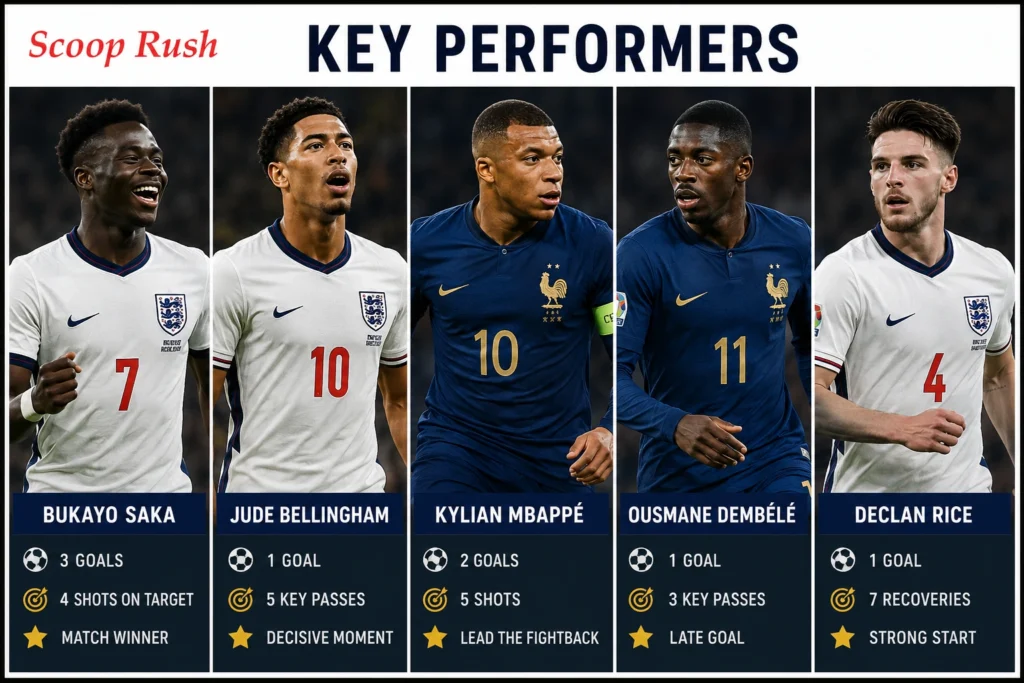
Key Performers 

Key Performers

Bukayo Saka (England)

Saka was the star of the match. His hat-trick played a decisive role in England’s victory and demonstrated his finishing quality.

Jude Bellingham (England)

Bellingham scored the final goal and once again showed his ability to influence important matches.

Declan Rice (England)

Rice set the tone with an early goal and helped England establish control.

Kylian Mbappé (France)

Mbappé scored twice and led France’s comeback efforts. His performance ensured the match remained competitive until the final whistle.

Bradley Barcola (France)

Barcola’s goal helped ignite France’s second-half resurgence and increased pressure on England.

What This Result Means

The France vs England Third Place Play-Off Result ensures England leave the FIFA World Cup 2026 with a positive ending. Finishing third represents a significant achievement in a tournament featuring the world’s strongest national teams.

For France, the defeat is disappointing. Nevertheless, their second-half fightback demonstrated resilience and attacking quality, echoing the run that saw them reach the semi-finals.

Both teams showed why they progressed deep into the competition. Additionally, the match provided fans with one of the most entertaining spectacles of the entire tournament.

Conclusion

The France vs England Third Place Play-Off Result will be remembered for its extraordinary scoreline and relentless drama. England defeated France 6-4 in a match that featured 10 goals, momentum swings, and standout individual performances.

England’s explosive first half laid the foundation for victory, while France’s spirited comeback ensured the contest remained alive until the final moments. Bukayo Saka’s hat-trick, Jude Bellingham’s late goal, and Kylian Mbappé’s brace all contributed to a memorable World Cup encounter. Ultimately, England claimed third place, but both teams delivered a match that fans will remember long after FIFA World Cup 2026 concludes.

FAQs

1. What was the France vs England Third Place Play-Off Result?

England defeated France 6-4 in the FIFA World Cup 2026 third place play-off.

2. Who scored for England against France?

Declan Rice, Ezri Konsa, Bukayo Saka (three goals), and Jude Bellingham scored for England.

3. Who scored for France against England?

Kylian Mbappé scored twice, while Bradley Barcola and Ousmane Dembélé added one goal each.

4. Where was the France vs England third place play-off played?

The match was played at Miami Stadium in Miami Gardens.

5. Who was the standout player in the match?

Bukayo Saka was arguably the standout performer after scoring a hat-trick in England’s 6-4 victory.

Wildberries Warehouse Strike Kills Nine After Ukrainian Drone Attack

0

A Wildberries Warehouse Strike left nine people dead and 62 injured after Ukrainian drones targeted two major logistics centers in Russia. The attacks also damaged an oil depot near Moscow. Ukraine said the operation focused on facilities linked to Russia’s military logistics.

The strikes happened overnight in the Tambov and Moscow regions. Large fires broke out at both warehouse sites. Russian authorities launched emergency rescue operations while Ukraine described the attacks as a response to continued Russian strikes on Ukrainian cities.

Wildberries Warehouse Strike Leaves Nine Dead

Wildberries-Warehouse-Strike-Leaves-Nine-Dead

The first drone attack hit a Wildberries warehouse in Kotovsk, Tambov Region. Seven employees working the night shift died at the scene. Another 25 workers suffered injuries, with several remaining in serious condition.

A second warehouse in Elektrostal, east of Moscow, also came under attack. Thirty seven people were injured during the strike. One victim later died in hospital, raising the total death toll to nine. Emergency crews worked throughout the day to secure both locations.

Ukraine Explains Why It Targeted the Warehouses

Ukrainian President Volodymyr Zelensky confirmed the operation after the attacks. He said the warehouses supplied sanctioned electronic components used in Russian drone production and navigation systems. According to Kyiv, these facilities supported Russia’s military operations.

Ukraine also announced strikes against targets in the Sea of Azov, the Black Sea, and Russian occupied Crimea. Zelensky said the latest operation responded to repeated Russian attacks on Ukraine’s civilian infrastructure and residential areas.

Wildberries Faces Major Business Losses

Wildberries-Faces-Major-Business-Losses

Wildberries is Russia’s largest online retailer and one of the country’s biggest logistics companies. The company operates an extensive warehouse network that supports millions of daily orders. The latest attacks damaged two important distribution centers.

Early reports estimated losses at more than 50 billion rubles. The fires destroyed thousands of consumer products and disrupted warehouse operations. The company now faces significant challenges as it restores damaged facilities and resumes normal deliveries.

Oil Depot Fire Expands the Overnight Damage

Drone debris also caused a fire at an oil storage facility in Noginsk near Moscow. Authorities quickly evacuated nearby buildings, including a maternity hospital, to protect residents. Firefighters later brought the blaze under control.

Russian officials also reported damage in several other regions during the overnight drone campaign. Air defense systems intercepted hundreds of drones. However, several aircraft reached their intended targets and caused damage to infrastructure.

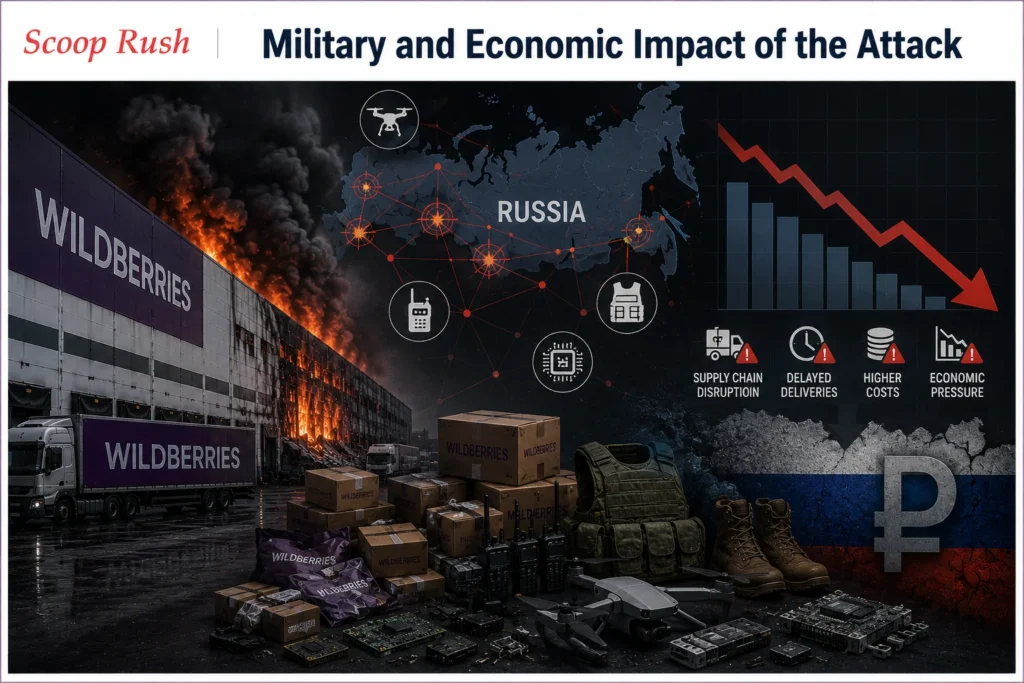
Military and Economic Impact of the Attack

Military-and-Economic-Impact-of-the-Attack

Ukrainian security officials argued the warehouses played an important role in Russia’s logistics network. Analysts said Russian volunteers used the platform to purchase communication devices, protective equipment, and drone components for military purposes.

The attacks may also increase pressure on Russia’s supply chains. Damaged warehouses can delay deliveries and increase operating costs. At the same time, repeated strikes on logistics facilities may create broader economic challenges.

Independent Sellers Could Lose Millions

Wildberries Chief Executive Tatyana Kim described the attacks as a tragic event for the company. She expressed condolences to the victims’ families and thanked emergency workers responding to the disaster.

The company recently updated its seller agreement alongside competitor Ozon. The revised policy excludes compensation for inventory destroyed during military action. As a result, many independent businesses may bear the financial losses themselves.

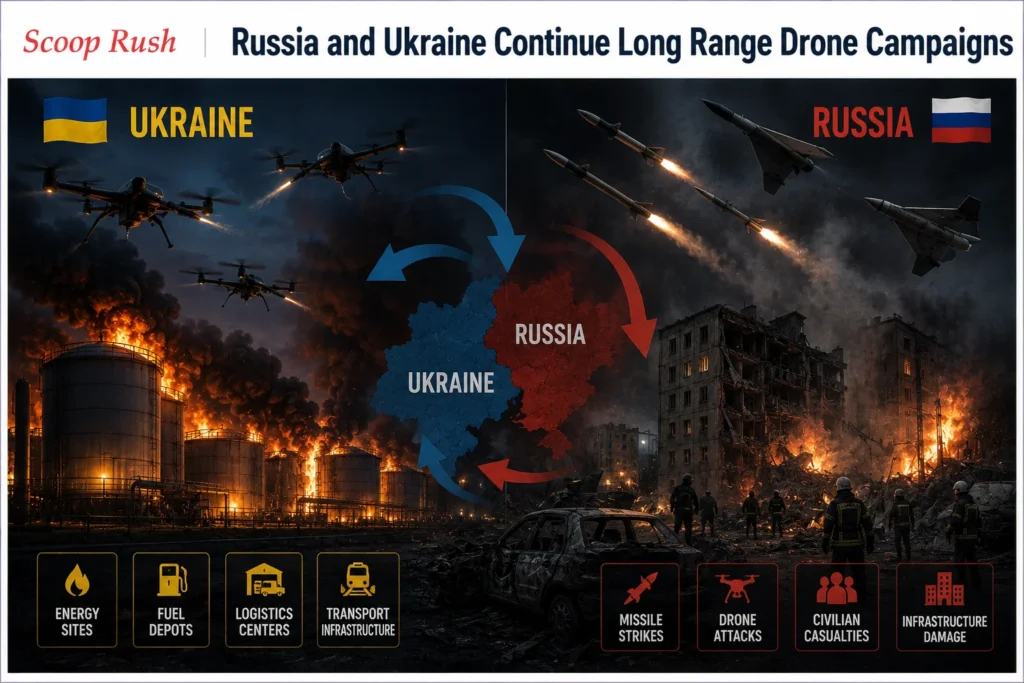
Russia and Ukraine Continue Long Range Drone Campaigns

Russia-and-Ukraine-Continue-Long-Range-Drone-Campaigns

Ukraine has increased long range drone attacks against Russian energy sites, fuel depots, and logistics centers. Kyiv says these operations aim to weaken Russia’s ability to sustain its military campaign. Recent strikes have targeted oil facilities and transport infrastructure.

Meanwhile, Russia continues launching missile and drone attacks across Ukraine. Ukrainian officials reported fresh civilian casualties following overnight strikes. Both sides have expanded attacks beyond front line battlefields in recent months.

What Happens Next After the Wildberries Warehouse Strike

Russian authorities have opened investigations into the attacks and continue assessing the damage. Cleanup operations remain underway while emergency crews inspect the affected warehouses. Businesses also face delays as logistics networks recover.

The Wildberries Warehouse Strike highlights how the conflict increasingly affects commercial infrastructure. As both countries continue long range attacks, businesses, workers, and civilians face growing risks far from the battlefield.

Conclusion

The Wildberries Warehouse Strike marks another major escalation in the Russia Ukraine conflict. The attacks caused heavy casualties, disrupted one of Russia’s largest retail companies, and damaged energy infrastructure. Ukraine says the operation targeted facilities supporting Russia’s military logistics.

The latest developments also show how economic infrastructure has become part of modern warfare. With both sides expanding long range drone operations, the conflict continues to affect businesses, supply chains, and civilian communities across the region.

FAQs

1. What happened during the Wildberries warehouse strike?

Ukrainian drones struck two Wildberries logistics centers in Russia. The attacks killed nine people, injured 62 others, and caused major fires that damaged warehouses and inventory.

2. Why did Ukraine target the Wildberries warehouses?

Ukraine said the warehouses stored sanctioned electronic components and other dual use goods linked to Russia’s military logistics and drone production network.

3. Where did the Wildberries warehouse strike take place?

The attacks hit Wildberries facilities in Kotovsk, Tambov Region, and Elektrostal in the Moscow Region. Both sites suffered extensive damage and disrupted operations.

4. Did the attacks damage any other facilities?

Yes. Drone debris ignited a fire at an oil depot in Noginsk near Moscow. Authorities also evacuated nearby buildings as a precaution while emergency teams controlled the fire.

5. Will Wildberries compensate sellers for destroyed goods?

Wildberries’ updated seller policy excludes compensation for inventory destroyed during military action. Many independent sellers could therefore face significant financial losses.

World Cup Third Place Play-Off: Why FIFA Still Keeps the Bronze Final

0

The FIFA World Cup final attracts global attention, but one match often divides opinion more than any other. The World Cup Third Place Play-Off, also known as the Bronze Final, has existed for decades. Yet many players, coaches, and fans continue to question whether it should remain part of football’s biggest tournament.

As England and France prepare to meet in the Bronze Final of the FIFA World Cup 2026, the debate has returned. Is it an unwanted fixture that nobody wants to play, or does winning a bronze medal still carry real value?

Why the World Cup Third Place Play-Off Matters

The World Cup Third Place Play-Off is one of the longest-running traditions in World Cup history. While the tournament’s main focus is always the final, FIFA continues to stage this match to determine who finishes third and who finishes fourth.

This year’s game features England and France after both nations suffered painful semi-final defeats. England lost to Argentina, while France missed out on a place in the final as well.

Many players would rather be preparing for the final than playing one more match. However, the fixture remains important for several reasons, including official rankings, prize money, player records, and the awarding of bronze medals.

As a result, the match continues to spark debate every time a World Cup reaches its final weekend.

The Mixed Feelings Surrounding the Bronze Final

Players and Coaches Often Struggle to Embrace It

The emotional challenge of the third-place match is obvious.

France coach Didier Deschamps openly admitted that both teams would probably prefer the game not to exist. England manager Thomas Tuchel expressed similar thoughts immediately after England’s semi-final defeat.

According to Tuchel, neither England’s players nor France’s players truly wanted to play the match.

That reaction is understandable. After coming so close to reaching the World Cup final, teams must quickly recover from disappointment and prepare for another high-pressure game. However, Tuchel later highlighted a more positive perspective.

He pointed out that victory would give England their best World Cup result in 60 years. Therefore, despite the disappointment of missing the final, there is still something meaningful to achieve.

A Chance for Squad Players

Another reason the fixture remains useful is the opportunity it creates for players who have not featured heavily during the tournament. Managers often rotate their squads for the Bronze Final. As a result, younger players and substitutes can gain valuable World Cup experience.

For England, players such as Kobbie Mainoo could receive their first World Cup minutes. Goalkeeper James Trafford could also get an opportunity on football’s biggest stage.

Similarly, France may choose to give playing time to squad members who have spent most of the tournament on the bench. Therefore, the match can become an important development opportunity for future international stars.

Not Everyone Enjoys the Occasion

Despite those opportunities, many players still find it difficult to embrace the game.

France defender Ibrahima Konate summed up the feeling when he admitted that none of the players wanted to participate in a third-place match. However, he also acknowledged that the teams have no choice.

That honesty reflects a common view among footballers. After dreaming of lifting the World Cup trophy, competing for third place can feel like a consolation prize rather than a reward.

History of the World Cup Third Place Play-Off

History of the World Cup Third Place Play-Off

When Did It Begin?

The World Cup Third Place Play-Off first appeared at the 1934 FIFA World Cup. Later, it became a permanent feature of the tournament from 1954 onward. Since then, it has been played at every World Cup.

Over the decades, the fixture has produced memorable moments, dramatic goals, and emotional celebrations. However, it has also generated criticism from players and coaches who believe the match lacks significance.

England’s Previous Experiences

England have played in the third-place match twice since winning the World Cup in 1966.

Their first appearance came in 1990, when they lost to Italy. The second occurred at the 2018 World Cup in Russia, where Belgium defeated them.

Now England have another opportunity to claim a bronze medal and achieve one of their strongest World Cup finishes in modern history.

Why FIFA Continues to Keep the Bronze Final

Official Rankings and Historical Records

One of FIFA’s main reasons for maintaining the fixture is the need to determine final tournament positions. Without the match, two teams would finish as losing semi-finalists without a clear distinction between third and fourth place.

The result also became part of World Cup history. Furthermore, it affects player records, team statistics, and tournament archives. For an event with such a rich history, FIFA places significant importance on maintaining a definitive final ranking.

Prize Money Matters

The game also has a financial impact.

According to the information surrounding the tournament, there is approximately a $2 million difference in prize money between third and fourth place.

While that amount may not be the primary motivation for players, it remains significant for national football associations. Consequently, there is a practical incentive to win the match.

Value for Broadcasters and Fans

FIFA also benefits from an additional high-profile fixture.

The Bronze Final provides another World Cup event for broadcasters, sponsors, and supporters. Fans who travel long distances and purchase tickets still get the chance to watch elite international football.

Meanwhile, television audiences around the world continue to follow the tournament until its final weekend. For FIFA and its commercial partners, the match remains an attractive part of the competition schedule.

The Sporting Case for the World Cup Third Place Play-Off

A Match That Often Produces Goals

One argument in favor of the fixture is entertainment.

Historically, third-place matches have often produced open and attacking football. Since 1974, only one such match has failed to produce at least two goals. Additionally, most of those games have featured more than three goals.

The reason is simple. Teams usually play with less pressure than in knockout rounds. As a result, matches often become more open and enjoyable for spectators.

The Golden Boot Connection

The World Cup Third Place Play-Off has also played a role in determining Golden Boot winners. Several players scored crucial goals in these matches on their way to becoming the tournament’s top scorer.

Notable examples include:

Thomas Muller of Germany in 2010 Davor Suker of Croatia in 1998 Salvatore Schillaci of Italy in 1990 Leonidas of Brazil in 1938 Grzegorz Lato of Poland in 1974 Eusebio of Portugal in 1966 Just Fontaine of France in 1958

In several cases, the goals scored in the third-place match directly helped secure the Golden Boot award. Therefore, the fixture can still influence individual achievements even after a team’s title hopes have ended.

Croatia’s Bronze Medal and the ‘Golden Layer’

A Different Perspective

Not every nation views the Bronze Final negatively. Croatia provided one of the best recent examples at the 2022 FIFA World Cup. After finishing runners-up in 2018, Croatia defeated Morocco 2-1 in the third-place match to claim the bronze medal.

Coach Zlatko Dalic described the achievement in memorable terms.

He said the bronze medal carried a “golden layer” and felt almost as meaningful as winning gold. For Croatia, the result represented another remarkable achievement on the world stage.

A Career-Defining Moment

The winning goal against Morocco came from Mislav Orsic. After the match, Orsic described it as the most important goal of his career. His reaction highlighted something often overlooked in discussions about the Bronze Final.

For players from smaller football nations, winning a World Cup medal can become one of the greatest moments of their lives. Therefore, the value of the match often depends on perspective.

Why Critics Want the Match Removed

The Emotional Cost

Despite its history, criticism of the fixture remains strong. Former Netherlands manager Louis van Gaal has been one of its most vocal opponents.

Before the Netherlands faced Brazil in the 2014 third-place match, he argued that the game should not exist.

His main concern centered on fairness. Teams already suffer the disappointment of losing a semi-final. According to Van Gaal, forcing them to play another match creates the possibility of ending the tournament with two consecutive defeats.

As a result, a team that performed brilliantly throughout the competition may leave feeling like a loser.

A Similar View from England

Former England manager Gareth Southgate shared a comparable opinion before England’s third-place match in 2018. Southgate acknowledged that no team truly wants to participate in the fixture.

His comments reflected the emotional reality faced by players who come within one match of the World Cup final. Therefore, opponents argue that the Bronze Final adds unnecessary disappointment to an already painful situation.

England vs France: Another Chapter in the Debate

The latest edition of the World Cup Third Place Play-Off will feature two football powers with ambitions of lifting the trophy.

Both England and France entered the tournament hoping to reach the final. Instead, they now face each other in a match that many participants would prefer not to play.

However, there is still plenty at stake.

A bronze medal remains an achievement. Young players may receive opportunities. National associations can earn additional prize money. Furthermore, fans will have one more chance to watch world-class football.

For England, victory would secure their strongest World Cup finish in six decades. For France, it would provide a positive ending to a tournament that fell just short of the ultimate goal.

Will the World Cup Third Place Play-Off Survive in the Future?

The debate is unlikely to disappear.

As the World Cup continues to expand, questions about tournament scheduling will only become louder. The 2026 edition already features a record number of matches.

Some critics wonder whether future tournaments should continue dedicating space to a game that many players dislike. However, FIFA currently shows no sign of removing the fixture.

The match provides a clear final ranking, determines medal positions, affects prize money, and remains part of World Cup tradition. As long as those factors remain important, the Bronze Final is likely to survive.

Conclusion

The World Cup Third Place Play-Off remains one of football’s most debated fixtures. Critics see it as an unnecessary consolation match played by disappointed teams. Supporters view it as an opportunity to win a World Cup medal, improve tournament rankings, and create lasting memories.

England and France may have preferred to be playing in the final, but their Bronze Final still carries significance. Whether fans consider it a “booby prize” or a medal with a “golden layer,” the match continues to occupy a unique place in World Cup history.

For now, FIFA remains committed to the tradition. As a result, the debate over the value of third place is likely to continue long after the final whistle.

FAQs

1. What is the World Cup Third Place Play-Off?

The World Cup Third Place Play-Off is a match between the two losing semi-finalists to determine who finishes third and who finishes fourth in the tournament.

2. Why does FIFA still organize the Bronze Final?

FIFA uses the match to determine final rankings, award bronze medals, separate prize money payments, and complete official tournament records.

3. Does the third-place match count for the Golden Boot race?

Yes. Goals scored in the third-place match count toward the Golden Boot competition and can influence the final top-scorer standings.

4. Has England won a World Cup third-place match before?

England have played in third-place matches before but lost to Italy in 1990 and Belgium in 2018.

5. Why do some coaches want the match removed?

Many coaches believe the fixture forces disappointed teams to play another game immediately after losing a semi-final and missing the chance to compete for the World Cup title.

Kimi K3 Explained: Moonshot AI’s Model That’s Challenging OpenAI and Anthropic

0

Can a Chinese startup really build an AI model big enough to rattle Silicon Valley in a single day? That is exactly what happened this week. Moonshot AI released Kimi K3, and the tech world has not stopped talking about it since.

The Beijing-based company says its new model closes the gap with the world’s leading AI systems. Kimi K3 still trails behind Anthropic’s Claude Fable 5 and OpenAI’s GPT 5.6 Sol on overall performance. However, it beat several other major models, including Claude Opus 4.8 and GPT 5.5, on key benchmarks like coding and general agent tasks. This matters because it signals a shift in how fast Chinese AI tools are catching up, despite ongoing hardware restrictions from the United States.

For anyone following the AI industry, whether you are a developer, investor, or casual tech reader, this release raises real questions. How did a company work around chip export controls to build something this massive? What does it mean for the future of open-source AI? Furthermore, should American AI companies be worried?

What Is Kimi K3 and Why the Kimi K3 Model Matters

What Is Kimi K3 and Why the Kimi K3 Model Matters

Kimi K3 is Moonshot AI’s newest flagship model, and it is being called China’s largest AI model to date. It contains 2.8 trillion parameters, which refers to the size of its neural network. This roughly indicates how much information the model can process and learn from. Moonshot describes Kimi K3 as the world’s first open 3-trillion-parameter-class system and the largest open-weight AI model ever released.

Open-weight models differ from proprietary ones like ChatGPT or Claude. Developers can download, run, and customize open-weight models freely. This openness is a big part of why the Kimi K3 model is generating so much buzz. Instead of keeping its technology locked away, Moonshot lets outside developers dig into the system directly, similar to how Meta’s Muse Image feature opened up new creative tools for everyday users.

The model also comes with a 1 million token context window and native vision capabilities. In simpler terms, Kimi K3 can process huge amounts of text at once and work with images too. According to Moonshot, the system activates only 16 of its 896 experts per token, roughly 1.8% of the total pool. This selective activation helps the model run efficiently despite its enormous size.

Kimi K3 Benchmark Results That Turned Heads

Independent testing is where things get interesting. Arena ranked Kimi K3 first in its Frontend Code evaluation, scoring 1,679 points and landing ahead of Claude Fable 5 in blind developer testing. Meanwhile, Arena’s broader text ranking showed K3 outperforming the standard version of Claude Opus 4.8 and tying with GPT 5.6 Sol.

These results do not mean Kimi K3 is the best model overall. Moonshot itself admits that Fable 5 and Sol still lead on general performance. Still, beating Opus 4.8 and GPT 5.5 across coding and agentic tasks is a meaningful achievement. Bank of America analysts, led by Alex Liu, noted that despite persistent hardware and compute constraints in China, K3 demonstrates that large-scale pretraining paired with architectural innovation can still deliver major gains for flagship Chinese models.

How Moonshot Built the Kimi K3 Model Under Export Restrictions

How Moonshot Built the Kimi K3 Model Under Export Restrictions

One of the biggest questions surrounding Kimi K3 is how Moonshot managed to train such a large model while facing U.S. export controls on advanced AI chips. The company’s technical disclosures point to a mix of export-approved Nvidia hardware and an unnamed alternative GPU vendor, a workaround not unlike the chip strategies discussed around Nokia’s AI-RAN platform with Nvidia.

Moonshot’s kernel optimization benchmarks ran on Nvidia’s H200 chips, as well as what its blog only describes as a “GPGPU from an alternative vendor.” The company did not name this second supplier. Additionally, Moonshot built its own compiler called MiniTriton, which it tested against the standard Triton compiler using Nvidia’s L20 chip, a scaled-down card sold specifically into the Chinese market under U.S. export rules.

Moonshot claims roughly a 2.5x improvement in scaling efficiency compared to its earlier Kimi K2 model. The company attributes this to two architectural innovations: Kimi Delta Attention, a hybrid linear attention system, and Attention Residuals, which change how information flows between layers of the model. Quantization-aware training was also used starting at the supervised fine-tuning stage, relying on MXFP4 weights and MXFP8 activations for broader hardware compatibility.

Kimi K3 Pricing and Access Details

Kimi K3’s API pricing sits at $0.30 per million cache-hit input tokens, $3 per million tokens on cache misses, and $15 per million output tokens. For comparison, Kimi K2 launched about a year ago at $0.60 per million input tokens. Therefore, uncached input costs for K3 are five times higher than its predecessor.

Full model weights are expected to be released publicly on July 27. Until then, every benchmark and performance claim comes either from Moonshot itself or from limited API access, so independent verification is still pending.

Market Reaction to the Kimi K3 Release

Market Reaction to the Kimi K3 Release

The Kimi K3 release sent shockwaves through Chinese AI stocks almost immediately. Z.ai, which released its own model to considerable attention in June, saw its shares plummet 28% on the day of the announcement. MiniMax Group, another Chinese AI competitor, dropped 16%. Analysts pointed out that K3 raises the bar for Chinese AI models overall, shifting pressure onto other domestic labs to prove they can keep up. This kind of sudden market swing echoes how SpaceX’s Nasdaq debut reshaped valuations overnight in a different sector.

Alibaba, which backs Moonshot alongside Tencent, also felt ripple effects. The company’s stock had recently climbed on news of a partnership with Apple in China, but shares fell 4% following the Kimi K3 announcement. Analysts noted that while Alibaba benefits broadly from AI-driven demand for its cloud services, the release could pressure Alibaba’s own Qwen models and its positioning as an open-source leader.

Is Kimi K3 Another DeepSeek Moment?

Comparisons to DeepSeek’s R1 model release in 2025 have come up frequently. That earlier release generated massive attention for being unusually cost-efficient compared to proprietary alternatives. Similarly, Patrick Moorhead, CEO and chief analyst at Moor Insights and Strategy, described the market’s reaction to Kimi K3 as an over-reaction resembling the DeepSeek panic. He argued that despite genuine technical advances, the industry remains far from anything resembling superintelligence.

Moorhead also pointed to politics as part of the story. He noted there is an ongoing debate in Washington about whether U.S. companies should use Chinese open-source models, and whether American firms should even help Chinese developers improve their own systems.

Meanwhile, Lu Zhang, founder and managing partner of Fusion Fund, offered a more grounded perspective. She said that most developers using models like Kimi K3 come from the startup ecosystem rather than large corporations. These developers often swap AI models in and out depending on cost, efficiency, and availability, rather than sticking loyally to one system. Additionally, Zhang pointed out that U.S. companies like Thinking Machines and DeepReinforce are increasingly releasing their own open-weight models, showing that this is not purely a U.S. versus China story.

The Bigger Picture for AI Development

The Bigger Picture for AI Development

This release arrives at a particularly sensitive moment for the global AI industry. It comes just weeks after the U.S. government temporarily forced Anthropic to withdraw its Fable and Mythos models due to export control concerns, before restoring access once those controls were lifted. That episode highlighted how seriously Washington now treats frontier AI systems as matters of national security, a concern that mirrors broader regulatory pressure seen in cases like the UK’s child safety demands on big tech and the xAI Grok deepfake lawsuit.

Despite these restrictions, Kimi K3’s rapid arrival suggests Chinese firms continue to advance quickly. Simon Koser, chief product officer at AI startup Tzafon, said Kimi K3 is legitimately impressive, particularly in coding performance, and that developers at major AI Anthropic has also raised concerns about how some Chinese AI companies train their systems. The company accused Moonshot in February of using millions of Claude exchanges to train its models through a technique known as distillation. Notably, K3 now scores within a few points of the very models named in that complaint, adding another layer of scrutiny to its rapid riselabs could find it genuinely compelling. At the same time, he cautioned that shifts in developer preference may not be as dramatic in practice as the initial hype suggests, since models often behave differently in production settings compared to benchmark tests.

.

Conclusion

Kimi K3 represents a significant moment in the ongoing competition between American and Chinese AI development. Moonshot AI built a 2.8 trillion parameter model that, while not surpassing the very best systems from Anthropic and OpenAI, outperformed several other leading models on important benchmarks. The company managed this despite ongoing hardware restrictions, using architectural innovations and alternative hardware sourcing to close the gap.

However, questions remain. The full weights will not be public until July 27, so independent verification of Moonshot’s claims is still pending. Additionally, market reactions have varied widely, from panic among Chinese competitors to measured skepticism from industry analysts who caution against overreacting to any single model release. As a result, the true impact of Kimi K3 on the broader AI landscape will likely become clearer in the weeks ahead.

FAQs

What is Kimi K3?

Kimi K3 is a 2.8 trillion parameter open-weight AI model released by Chinese startup Moonshot AI. It is described as the largest open-weight AI model released so far, with capabilities in coding, reasoning, and general agent tasks.

Does Kimi K3 outperform Claude and GPT models?

Kimi K3 trails Anthropic’s Claude Fable 5 and OpenAI’s GPT 5.6 Sol on overall performance. However, it outperformed other tested models, including Claude Opus 4.8 and GPT 5.5, on certain benchmarks like coding and agentic tasks.

When will Kimi K3’s full weights be released?

Moonshot AI plans to release the full model weights on July 27. This will allow independent developers to inspect and verify its performance claims directly.

How much does Kimi K3 cost to use?

API pricing is $0.30 per million cache-hit input tokens, $3 per million tokens on cache misses, and $15 per million output tokens. This is higher than its predecessor Kimi K2.

Why did Chinese AI stocks drop after the Kimi K3 release?

Competitors like Z.ai and MiniMax saw sharp stock declines because Kimi K3 raised the performance bar for Chinese AI models. As a result, rival companies now face pressure to prove they can match its capabilities.

UAE Passenger Rail Network Launches With Desert Express

0

The UAE Passenger Rail Network has officially launched, opening a new chapter in the country’s transportation system. Etihad Rail introduced its first national passenger service, known as the Desert Express, on June 30, 2026. The inaugural train carried passengers from Fujairah to Mohammed Bin Zayed City Station in Abu Dhabi.

The first journey covered around 250 kilometers in just 1 hour and 45 minutes. Thousands of travelers showed interest before the launch, with more than 10,000 tickets sold during the introductory booking period. The new railway gives residents and visitors a faster and more comfortable travel option.

UAE Passenger Rail Network Begins Operations

UAE-Passenger-Rail-Network-Begins-Operations

The UAE Passenger Rail Network started with the Abu Dhabi and Fujairah route. The train departs from Fujairah on the Gulf of Oman and arrives at Mohammed Bin Zayed City Station in Abu Dhabi. The service forms the first stage of a much larger national railway project.

Etihad Rail launched six passenger services on the first operating day. The company expects demand to grow as more travelers discover the convenience of rail transport. The new service also offers an alternative to long road journeys between the two emirates.

UAE Passenger Rail Network Offers Comfortable Travel

UAE-Passenger-Rail-Network-Offers-Comfortable

Passengers can choose between Comfort Class and Premium Class. Every train includes air conditioning, onboard Wi-Fi, charging ports, reserved seating, and spacious cabins. These features create a pleasant travel experience for daily commuters and tourists.

The passenger fleet currently consists of 13 modern trains built for desert conditions. Each train travels at speeds of up to 200 km/h and accommodates nearly 400 passengers. Advanced cooling systems help maintain comfort during the UAE’s extreme summer temperatures.

UAE Passenger Rail Network Will Continue Expanding

UAE-Passenger-Rail-Network-Will-Continue-Expanding

The UAE Passenger Rail Network will expand in several phases over the coming months. Dubai and Al Dhaid stations are scheduled to open on September 30, 2026. Al Dhafra will join the network later in December.

The final stage of the initial project will arrive in March 2027 with the opening of the Sharjah station. Once complete, the railway will connect 11 cities through a network stretching about 900 kilometers across the United Arab Emirates.

UAE Passenger Rail Network Supports Sustainable Transport

UAE-Passenger-Rail-Network-Supports-Sustainable-Transport

The railway forms an important part of the UAE’s long-term sustainability plans. Officials want more people to use public transportation instead of relying on private vehicles. This shift will help reduce road congestion and lower carbon emissions.

Authorities have also connected train stations with buses, taxis, and other local transport services. These connections make it easier for passengers to complete their journeys without needing a personal car. The integrated system improves overall accessibility across the country.

UAE Passenger Rail Network Boosts Tourism and Economy

UAE-Passenger-Rail-Network-Boosts-Tourism-and-Economy

The new railway strengthens connections between major cities and popular destinations. Easier travel can encourage more domestic and international tourism while supporting business activity throughout the country. Better transport links also improve access to commercial centers.

Government leaders believe the railway will support future economic growth. The project creates new opportunities for investment, urban development, and regional connectivity. It also reflects the UAE’s commitment to building a modern transport network.

Conclusion

The launch of the UAE’s first national passenger railway marks a major milestone for public transportation. The Desert Express provides a fast, reliable, and comfortable way to travel between Abu Dhabi and Fujairah while introducing a new travel option for residents and visitors.

As the railway expands to more cities, it will play an even greater role in everyday travel across the country. The project supports sustainable transport, strengthens regional connections, and helps shape the future of mobility in the United Arab Emirates.

FAQs

1. What is the UAE Passenger Rail Network?

The UAE Passenger Rail Network is the country’s first national passenger railway operated by Etihad Rail. It will eventually connect 11 cities across the seven emirates through a modern rail system.

2. Which route opened first?

The first passenger service connects Fujairah and Mohammed Bin Zayed City Station in Abu Dhabi. The journey covers approximately 250 kilometers in about 1 hour and 45 minutes.

3. What facilities are available on the trains?

Passengers can enjoy air conditioning, free Wi-Fi, charging ports, reserved seating, and spacious cabins. Premium Class also offers additional comfort for travelers seeking an upgraded experience.

4. How much do tickets cost?

Ticket prices begin at AED 55 for Comfort Class and AED 120 for Premium Class. Travelers can purchase tickets through the Etihad Rail website or mobile application.

5. When will the full railway network be completed?

The passenger railway will expand in stages through 2026 and early 2027. Etihad Rail expects the initial national network to be completed with the opening of Sharjah Station in March 2027.

CIA Says AI Drones Cut Russian Troops’ Survival to 30 Minutes

0

Russia’s war against Ukraine continues to evolve as advanced technology reshapes the battlefield. New comments from the CIA suggest artificial intelligence has become a major factor in Ukraine’s defense strategy. CIA Says AI Drones Cut Russian Troops’ Survival after CIA Director John Ratcliffe claimed newly deployed Russian recruits survive only 20 to 30 minutes on the front line. His remarks also highlighted rising Russian casualties and the growing impact of AI-powered drones in modern warfare. 

CIA Says AI Drones Cut Russian Troops’ Survival to 30 Minutes

CIA Says AI Drones Cut Russian Troops’ Survival has drawn global attention after new remarks from CIA Director John Ratcliffe. He said Russian recruits survive only 20 to 30 minutes after reaching the battlefield in Ukraine. Ratcliffe shared the estimate during the Pennsylvania Defense and Innovation Summit. He added that AI-powered drones have changed modern warfare through fast and precise attacks.

According to US intelligence estimates, Russia now loses around 7,000 troops every week. These figures include soldiers killed and wounded during combat. However, neither Russia nor Ukraine regularly publishes official casualty numbers.

CIA Links Heavy Russian Losses to AI Drone Warfare

CIA-Links-Heavy-Russian-Losses-to-AI-Drone-Warfare

Ratcliffe said AI-powered drones have become low-cost but highly effective battlefield weapons. He explained that these systems locate and strike targets with remarkable speed. As a result, Russian troops face greater risks immediately after deployment.

Ukrainian President Volodymyr Zelensky has also highlighted the growing role of drones. He recently said drones destroy more than 80 percent of Russian battlefield targets. Military experts believe drone technology now shapes almost every major frontline operation.

Russian Advances Slow as Ukraine Expands Drone Operations

Russia still holds a manpower advantage over Ukraine. Even so, Ukrainian drone units continue slowing Russian advances across the front line. Several Western officials believe this technology has reduced Moscow’s battlefield momentum.

Fighting remains intense in eastern Ukraine, especially around Kostiantynivka in the Donetsk region. Russian forces continue attacking defensive positions. Meanwhile, Ukraine relies on drones to disrupt assaults and reduce enemy movements.

Ukraine Targets Russian Energy Infrastructure

Ukraine-Targets-Russian-Energy-Infrastructure

Ukraine has also expanded long-range drone attacks inside Russian territory. Recent strikes targeted oil refineries, fuel terminals, and energy facilities linked to Russia’s war economy. These operations aim to reduce resources supporting military operations.

Several major refineries reportedly suspended operations after drone attacks caused damage. Analysts believe repeated strikes have increased pressure on Russia’s energy sector. Energy exports remain a major source of government revenue.

Russia Faces Recruitment Challenges

Western officials estimate Russia loses nearly 40,000 troops every month. At the same time, recruitment reportedly reaches only about 35,000 new soldiers monthly. This gap creates pressure on military planners.

Reports also claim recruiters increasingly target poorer regions and vulnerable communities. Some reports mention prisoners and economically disadvantaged men joining military service. Independent verification of every recruitment claim remains limited.

NATO and Western Allies Watch Battlefield Changes

NATO-and-Western-Allies-Watch-Battlefield-Changes

NATO officials recently said Russia still pursues its military objectives despite heavy losses. However, alliance officials also noted that Russia’s rate of advance slowed compared with last year. Drone warfare continues changing battlefield tactics for both sides.

Meanwhile, the United States and its allies discuss additional support for Ukraine’s drone programs. They also seek greater cooperation on artificial intelligence technologies used in modern defense systems.

How AI Drones Have Changed Modern Warfare

Artificial intelligence has transformed drone operations in Ukraine. Modern drones identify targets faster and improve strike accuracy. Many systems also operate at a lower cost than traditional weapons.

As a result, both sides continue investing in drone technology. Military experts believe AI-guided drones will shape future conflicts beyond Ukraine.

Why Ukraine Depends on Drone Technology

Why-Ukraine-Depends-on-Drone-Technology

Ukraine uses drones to offset Russia’s larger military force. Drone units conduct surveillance, strike armored vehicles, and disrupt supply routes. This strategy reduces direct risks for Ukrainian troops.

Furthermore, locally developed drone programs continue expanding. Western allies also support Ukraine with funding and technology for advanced drone systems.

What the Weekly Russian Casualty Estimates Mean

US officials estimate Russia loses around 7,000 troops every week. These figures include soldiers killed and wounded during combat. If this pace continues, Russia could face hundreds of thousands of additional casualties each year.

However, military casualty estimates vary between governments and independent analysts. Since neither side releases complete official data, exact numbers remain difficult to verify.

International Support for Ukraine’s Drone Programs

International-Support-for-Ukraines-Drone-Programs

The United States and several allies continue discussing additional support for Ukraine’s drone industry. Officials believe advanced AI systems can strengthen Ukraine’s battlefield capabilities without requiring large troop deployments.

At the same time, Western governments want to learn from Ukraine’s battlefield innovations. Many defense experts consider Ukraine a leader in practical drone warfare.

Conclusion

CIA Says AI Drones Cut Russian Troops’ Survival highlights how rapidly battlefield technology continues evolving in the Russia-Ukraine war. According to CIA Director John Ratcliffe, AI-powered drones have significantly increased the dangers facing newly deployed Russian soldiers. At the same time, Ukraine continues expanding its drone operations while targeting military positions and strategic infrastructure.

Although casualty estimates differ across intelligence agencies and independent researchers, experts widely agree that drones now play a central role in the conflict. As both sides invest in more advanced technology, AI-guided systems will likely remain one of the most important factors shaping future military operations.

FAQs

1. What did the CIA director say about Russian troops?

CIA Director John Ratcliffe said new Russian recruits survive an average of 20 to 30 minutes after arriving on the battlefield. He linked this estimate to Ukraine’s growing use of AI-powered attack drones.

2. Why are AI drones so effective in Ukraine?

AI drones detect targets quickly and improve strike accuracy. They also cost much less than many traditional weapons, making them highly effective during frontline operations.

3. How many Russian troops does the US estimate Russia loses each week?

According to US officials, Russia loses about 7,000 troops every week. This estimate includes both soldiers killed and those wounded during combat.

4. Why is Ukraine targeting Russian oil and energy facilities?

Ukraine aims to weaken Russia’s ability to finance and support its military campaign. Drone strikes on refineries and fuel infrastructure increase pressure on Russia’s war economy.

5. Has Russia confirmed these casualty figures?

No. Russia does not regularly publish official military casualty figures. Ukraine also limits public reporting, so independent verification remains difficult.

6. How important are drones in the Russia-Ukraine war?

Drones have become one of the most important weapons in the conflict. They support reconnaissance, precision strikes, and battlefield surveillance while reducing risks for ground forces.

7. Will AI drones influence future wars?

Many defense experts believe AI-powered drones will become standard military tools. Lessons from Ukraine are already shaping defense planning in several countries.

Carnivore Diet: Complete Guide to Foods, Benefits, Risks, Meal Plan, and More

0

Introduction

Picture your grocery cart with zero produce in it. No bananas rolling around, no bag of spinach wilting in the crisper drawer, no bread. Just meat, eggs, and maybe a block of cheese. For a growing number of people, that’s not a hypothetical it’s Tuesday.

The carnivore diet has become one of the most talked-about eating plans in recent years, and it’s easy to see why. In a world of confusing nutrition advice, contradictory headlines, and diets that require a spreadsheet just to plan dinner, the carnivore diet offers something almost rebellious in its simplicity: eat animals, skip everything else, and see what happens.

Unlike traditional diets that encourage a balance of carbohydrates, proteins, and healthy fats, the carnivore diet takes a completely different approach. It focuses exclusively on animal-based foods while eliminating all plant foods, including vegetables, fruits, grains, legumes, nuts, and seeds.

Supporters believe this way of eating can simplify nutrition, promote weight loss, improve blood sugar control, reduce inflammation, and increase mental clarity. Others argue that removing entire food groups may increase the risk of nutrient deficiencies and may not be suitable for everyone.

So which is it a nutritional shortcut worth exploring, or a fad riding a wave of social media hype? The honest answer is: it depends on the person, and the science is still catching up to the popularity.

If you’re curious about the carnivore diet, it’s important to understand both its potential benefits and its limitations before making any dietary changes.

This complete guide explains everything you need to know, including what foods you can eat, foods to avoid, possible health benefits, potential risks, a beginner-friendly meal plan, and practical tips to help you make informed decisions.

What Is the Carnivore Diet?

The carnivore diet is an eating pattern that consists entirely of animal-derived foods. Unlike low-carb diets that still allow vegetables and certain fruits, the carnivore diet eliminates all plant-based foods.

The goal is simple: consume foods that come from animals while avoiding carbohydrates almost completely.

People following this diet usually eat:

  • Beef
  • Lamb
  • Pork
  • Chicken
  • Turkey
  • Fish
  • Seafood
  • Eggs
  • Animal fats
  • Butter
  • Ghee
  • Certain dairy products (depending on individual preference)

Foods such as bread, rice, pasta, beans, vegetables, fruits, cereals, sugar, and vegetable oils are excluded.

Because carbohydrates are almost completely removed, the body gradually shifts from using glucose as its primary energy source to burning fat for fuel. This metabolic state is similar to ketosis, although the carnivore diet differs from the ketogenic diet because it focuses exclusively on animal foods rather than allowing low-carbohydrate vegetables. If you want to compare the two approaches side by side, this guide to low-carb diet benefits, risks, and foods breaks down how a more flexible low-carb pattern stacks up against carnivore’s stricter rules.

Think of it as keto’s stricter older sibling same general metabolic playbook, far fewer exceptions.

Why Has the Carnivore Diet Become Popular?

Interest in the carnivore diet has grown rapidly due to social media, podcasts, personal success stories, and online communities. Scroll through enough fitness content and you’ll eventually find someone holding up a “before” photo next to a steak dinner, swearing this is the thing that finally worked after years of failed attempts.

Many people report improvements in:

  • Weight management
  • Reduced hunger
  • Better focus
  • Stable energy levels
  • Simpler meal planning
  • Reduced cravings

However, it’s important to remember that many of these experiences are based on personal reports rather than large, long-term clinical studies. Scientific research on the long-term effects of the carnivore diet remains limited.

There’s also a psychological pull worth naming honestly: decision fatigue is real, and a diet with only one rule (“if it didn’t come from an animal, don’t eat it”) removes an enormous amount of daily mental friction. That alone can feel like relief, even before any physical changes show up.

How Does the Carnivore Diet Work?

Under normal circumstances, carbohydrates provide the body’s primary source of energy.

Foods like bread, rice, potatoes, fruit, and sugar are broken down into glucose, which supplies fuel for the brain, muscles, and organs.

When carbohydrate intake becomes extremely low, the body begins using stored fat for energy.

The liver converts fatty acids into ketones, which become an alternative fuel source for many tissues.

Because the carnivore diet contains almost no carbohydrates, many people experience:

  • Lower insulin levels
  • Reduced appetite
  • Increased fat burning
  • Less fluctuation in blood sugar
  • More consistent energy throughout the day

Protein also helps increase feelings of fullness, making it easier for some individuals to reduce overall calorie intake naturally.

Foods You Can Eat on the Carnivore Diet

Foods You Can Eat on the Carnivore Diet |scooprush

The carnivore diet revolves entirely around animal products. While the list may seem limited at first, there is actually considerable variety when choosing different types of meat, seafood, eggs, and animal fats. In fact, many newcomers are surprised at how many distinct meals they can build once they stop thinking in terms of “meat and vegetables” and start thinking in terms of “cuts and preparations.”

Beef

Beef is considered the foundation of many carnivore diets because it provides high-quality protein, healthy fats, iron, zinc, and vitamin B12.

Popular choices include:

  • Ribeye steak
  • New York strip
  • T-bone steak
  • Ground beef
  • Chuck roast
  • Brisket
  • Short ribs
  • Beef ribs
  • Sirloin
  • Flank steak

Fatty cuts are generally preferred because dietary fat becomes an important energy source when carbohydrates are removed.

Organ Meats

Organ meats are among the most nutrient-dense animal foods available. They provide vitamins and minerals that are often found in smaller amounts in muscle meat.

Examples include:

  • Beef liver
  • Heart
  • Kidney
  • Tongue
  • Bone marrow
  • Oxtail

Liver is especially rich in vitamin A, vitamin B12, folate, iron, and copper. Many experienced carnivore followers include organ meats once or twice each week rather than eating them daily. If the taste feels intense at first, some people find that mixing finely chopped liver into ground beef makes it far more approachable.

Pork

Pork offers excellent variety and can easily fit into the carnivore diet.

Common options include:

  • Pork chops
  • Pork belly
  • Bacon
  • Pork shoulder
  • Ham
  • Pork ribs

Choose minimally processed products whenever possible to reduce added sugars and preservatives.

Lamb

Lamb provides another nutrient-rich protein source.

Popular cuts include:

  • Lamb chops
  • Leg of lamb
  • Ground lamb
  • Lamb shoulder
  • Lamb shanks

Lamb naturally contains healthy fats and offers excellent flavor for those wanting variety.

Poultry

Chicken and turkey are leaner than beef but still fit well within the carnivore diet.

Popular choices include:

  • Chicken thighs
  • Chicken wings
  • Drumsticks
  • Chicken breast
  • Turkey legs
  • Turkey thighs

Cooking lean meats with butter, ghee, or beef tallow helps increase fat intake.

Fish

Fatty fish provide important omega-3 fatty acids.

Excellent choices include:

  • Salmon
  • Sardines
  • Mackerel
  • Trout
  • Herring

Including fish two or three times each week may help improve dietary fat quality.

Seafood

Seafood adds valuable minerals and variety.

Options include:

  • Shrimp
  • Lobster
  • Crab
  • Mussels
  • Clams
  • Oysters
  • Scallops

Many shellfish are naturally rich in zinc, selenium, iodine, and vitamin B12.

Eggs

Eggs are one of the most versatile foods on the carnivore diet.

They contain:

  • Complete protein
  • Healthy fats
  • Choline
  • Vitamin D
  • Vitamin B12
  • Selenium

Many people enjoy eggs fried in butter, scrambled, boiled, or poached.

Animal Fats

Dietary fat plays an important role because carbohydrates are nearly eliminated.

Common cooking fats include:

  • Butter
  • Ghee
  • Beef tallow
  • Lard
  • Duck fat

These fats help improve satiety and provide energy throughout the day.

Dairy (Optional)

Some carnivore followers include dairy products, while others avoid them due to lactose intolerance or personal preference.

Common dairy choices include:

  • Butter
  • Ghee
  • Heavy cream
  • Hard cheeses
  • Cottage cheese
  • Greek yogurt (less commonly)

If dairy causes bloating or digestive discomfort, limiting or avoiding it may be beneficial.

Foods to Avoid on the Carnivore Diet

Foods to Avoid on the Carnivore Diet |scooprush

The carnivore diet excludes all plant-based foods.

Foods to avoid include:

Vegetables

  • Broccoli
  • Spinach
  • Carrots
  • Kale
  • Lettuce
  • Tomatoes
  • Peppers
  • Cucumbers

Fruits

  • Apples
  • Bananas
  • Oranges
  • Grapes
  • Berries
  • Mangoes
  • Pineapple

Grains

  • Rice
  • Wheat
  • Oats
  • Corn
  • Barley
  • Quinoa

Legumes

  • Beans
  • Lentils
  • Chickpeas
  • Soybeans
  • Peanuts

Nuts and Seeds

  • Almonds
  • Walnuts
  • Cashews
  • Chia seeds
  • Flaxseeds
  • Pumpkin seeds

Processed Foods

  • Chips
  • Cookies
  • Cakes
  • Candy
  • Breakfast cereals
  • Sugary drinks
  • Fast food

Plant Oils

  • Soybean oil
  • Corn oil
  • Sunflower oil
  • Canola oil

Common Myths About the Carnivore Diet

Because the carnivore diet is so unconventional, it tends to attract strong opinions — and a fair number of myths on both sides.

Myth: “You’ll instantly get scurvy without fruit.” In reality, meat, particularly organ meats and fresh cuts, contains small amounts of vitamin C, and the body’s requirement for it may be lower when carbohydrate intake is minimal. That said, this is still a genuine area of nutritional debate, not a settled fact.

Myth: “All that protein will destroy your kidneys.” For people with healthy kidney function, higher protein intake hasn’t been shown to cause damage. However, anyone with existing kidney disease should absolutely avoid this diet without medical guidance, since impaired kidneys process protein differently.

Myth: “It’s basically keto, just with a new name.” Keto allows low-carb vegetables, nuts, and even some fruit. Carnivore is far more restrictive, cutting out every plant food entirely. The two overlap in mechanism but not in practice.

Myth: “Everyone feels amazing on it.” Some people report dramatic improvements. Others feel sluggish, constipated, or simply don’t enjoy eating this way long-term. Individual response varies enormously, and that’s worth taking seriously rather than dismissing.

Potential Benefits of the Carnivore Diet

The carnivore diet has gained attention because many people report improvements in their health after switching to an animal-based eating pattern. While some benefits are supported by research on high-protein or low-carbohydrate diets, many claims about the carnivore diet itself still require more scientific evidence. Understanding both the potential advantages and current limitations can help you make an informed decision.

1. May Support Weight Loss

Weight loss is one of the most common reasons people try the carnivore diet.

Several factors may contribute to this:

  • High-protein foods increase feelings of fullness.
  • Fat-rich meals may reduce hunger between meals.
  • Eliminating sugary snacks and processed carbohydrates often lowers overall calorie intake.
  • Stable blood sugar levels may reduce cravings.

Many people naturally eat fewer calories without intentionally restricting portions because protein and fat are highly satisfying.

However, sustainable weight loss still depends on total calorie intake, activity level, sleep quality, and long-term eating habits.

2. May Reduce Hunger and Cravings

One of the biggest challenges with many diets is constant hunger.

Animal proteins digest more slowly than refined carbohydrates, helping you stay full for longer periods.

People often report:

  • Less snacking
  • Fewer sugar cravings
  • Better appetite control
  • Longer periods between meals

This makes meal planning simpler for some individuals.

3. May Improve Blood Sugar Stability

Since the carnivore diet contains almost no carbohydrates, it produces minimal increases in blood glucose after meals.

Some people with insulin resistance notice:

  • More stable blood sugar
  • Fewer energy crashes
  • Less frequent hunger

However, individuals with diabetes should never begin this diet without medical supervision because medication doses may need adjustment.

4. Simple Meal Planning

Unlike many diets that require counting carbohydrates, tracking points, or measuring ingredients, the carnivore diet is relatively straightforward.

Meals usually consist of:

  • A protein source
  • Animal fat
  • Optional eggs or dairy

This simplicity appeals to people who prefer uncomplicated meal preparation.

5. High in Quality Protein

Protein supports many essential functions throughout the body.

Adequate protein intake helps maintain:

  • Muscle mass
  • Bone health
  • Immune function
  • Tissue repair
  • Hormone production

Animal protein contains all nine essential amino acids, making it a complete protein source. Keeping protein intake high is also worth paying attention to if you’re managing weight with newer tools for context, this piece on GLP-1 medications and muscle loss explains why adequate protein matters so much during any period of rapid weight change.

6. Rich in Several Important Nutrients

Animal foods provide nutrients that are easily absorbed by the body.

Examples include:

  • Vitamin B12
  • Iron
  • Zinc
  • Selenium
  • Choline
  • Phosphorus

Organ meats such as liver also provide vitamin A and folate in high amounts.

Potential Risks and Side Effects

Although some people feel better on the carnivore diet, it also has potential drawbacks.

Potential Risks and Side Effects |scooprush

Removing entire food groups may reduce dietary variety and limit important nutrients.

1. Low Fiber Intake

The carnivore diet contains virtually no dietary fiber.

Fiber supports:

  • Healthy digestion
  • Regular bowel movements
  • Beneficial gut bacteria
  • Colon health

Some individuals experience constipation during the transition. Others report diarrhea while adapting to higher fat intake. Responses vary from person to person. If constipation or digestive discomfort becomes a persistent issue, this diet guide for managing hemorrhoids offers practical strategies that can help even when fiber intake is naturally low.

2. Nutrient Gaps

While animal foods are nutrient-dense, they contain little or none of certain nutrients found primarily in plant foods.

Potential concerns include:

  • Vitamin C
  • Magnesium
  • Potassium
  • Folate (if organ meats are not consumed)
  • Certain antioxidants

Eating a variety of animal foods, including seafood and organ meats, may help reduce these concerns but may not completely eliminate them. If you’re considering supplements to fill any gaps, it’s worth reading about the risks of taking too many vitamins before reaching for a multivitamin as a quick fix.

3. High Saturated Fat Intake

Many carnivore meals contain large amounts of saturated fat.

Current research on saturated fat continues to evolve. Some individuals experience increased LDL cholesterol after following the diet. People with existing heart disease or high cholesterol should discuss dietary changes with their healthcare provider.

4. Digestive Changes

The body often needs time to adjust to significant dietary changes.

Temporary side effects may include:

  • Constipation
  • Diarrhea
  • Bloating
  • Nausea
  • Fatigue

These symptoms often improve during the first few weeks as the digestive system adapts.

5. Limited Scientific Research

The carnivore diet remains one of the least studied dietary patterns.

Although thousands of personal success stories exist online, long-term clinical trials are still limited.

More research is needed to understand:

  • Long-term safety
  • Cardiovascular effects
  • Gut health
  • Kidney health
  • Overall disease risk

The Social Side of Eating Only Meat

One thing rarely mentioned in carnivore diet guides is how it changes your social life. Dinner invitations, work lunches, birthday parties, holiday meals — most social eating revolves around shared plates of pasta, bread, dessert, and sides that carnivore eaters simply skip.

A few practical strategies help:

  • Eat beforehand when unsure of the menu, so you’re not stuck with only bread and salad.
  • Scan the menu for protein-forward dishes at restaurants — steakhouses, seafood spots, and Brazilian-style grills tend to be the easiest options.
  • Communicate simply. “I’m doing a meat-and-eggs kind of diet right now” tends to get an easier reaction than a long explanation.
  • Bring your own dish to gatherings when it’s appropriate, so you always have something to eat.

Social friction is one of the most common reasons people abandon restrictive diets, not lack of willpower. Planning for it in advance makes a real difference in how sustainable the diet feels.

Cost and Sustainability Considerations

A carnivore diet isn’t automatically expensive, but it can be if you build every meal around ribeye and salmon. Ground beef, chicken thighs, eggs, and canned sardines are some of the most budget-friendly animal proteins available, and buying larger cuts to portion and freeze yourself often costs less than pre-cut, individually packaged meat.

It’s also worth acknowledging that an all-animal diet raises questions for some people around environmental impact and food sourcing. If this matters to you, look into local farms, pasture-raised options, or bulk-buying from butchers, which can address both cost and sourcing concerns at once.

Exercise and the Carnivore Diet

Exercise and the Carnivore Diet |scooprush

People who train regularly often ask whether performance suffers without carbohydrates. The answer depends heavily on the type of training:

  • Strength and resistance training tend to adapt reasonably well, since the body can rely more on fat and protein for sustained effort.
  • High-intensity or endurance activities that depend heavily on quick glucose availability may feel harder, at least until the body adjusts, and sometimes permanently for very glycolytic sports.
  • Recovery may benefit from the high protein intake, which supports muscle repair.

Anyone training seriously for competition should think carefully and likely consult a sports dietitian before combining intense training with a zero-carbohydrate approach.

Even without formal workouts, movement still matters on any diet. Simple habits like taking a 5-minute walk every hour can support digestion and energy levels, which is especially useful during the adjustment period when the body is learning to run on a new fuel source.

Who Should Avoid the Carnivore Diet?

The carnivore diet may not be appropriate for everyone.

People who should seek medical advice before trying it include:

  • Pregnant women
  • Breastfeeding mothers
  • Children
  • Individuals with chronic kidney disease
  • People with advanced liver disease
  • Those with certain metabolic disorders
  • Individuals recovering from eating disorders

Anyone taking medications for diabetes or blood pressure should consult a healthcare professional before making major dietary changes.

How to Start the Carnivore Diet

If you decide to try the carnivore diet, a gradual transition may be easier than making dramatic overnight changes.

Step 1: Remove Processed Foods

Begin by eliminating:

  • Sugary drinks
  • Candy
  • Cakes
  • Chips
  • Fast food

Step 2: Reduce Carbohydrates

Gradually reduce foods such as:

  • Bread
  • Rice
  • Pasta
  • Breakfast cereals
  • Potatoes

Step 3: Focus on Animal Foods

Build meals around:

  • Beef
  • Eggs
  • Fish
  • Chicken
  • Lamb
  • Pork

Step 4: Eat Enough Fat

Since carbohydrates are removed, dietary fat becomes an important energy source.

Choose naturally fatty cuts of meat and cook with butter, ghee, or beef tallow when appropriate.

Step 5: Stay Hydrated

Drink enough water throughout the day.

Many people also increase sodium intake during the first few weeks because low-carbohydrate diets can increase fluid and electrolyte loss.

Getting Through “Carnivore Flu”

Many people experience a rough patch during the first one to two weeks, sometimes nicknamed “carnivore flu” or “keto flu.” Symptoms can include headaches, fatigue, irritability, and brain fog as the body shifts its primary fuel source.

A few things tend to help:

  • Increase salt intake, since sodium loss is common in the early low-carb transition.
  • Drink enough water and consider bone broth for added electrolytes.
  • Avoid restricting calories too aggressively during this adjustment window this isn’t the time to also try to eat less overall.
  • Give it at least two to three weeks before judging how you feel, since early symptoms often resolve on their own.

If symptoms are severe or don’t improve, that’s a signal to check in with a healthcare provider rather than pushing through.

7-Day Carnivore Diet Meal Plan

Day 1

Breakfast: Scrambled eggs cooked in butter, bacon Lunch: Beef burger patties Dinner: Ribeye steak

Day 2

Breakfast: Fried eggs Lunch: Chicken thighs Dinner: Salmon with butter

Day 3

Breakfast: Omelet with cheese (optional) Lunch: Pork chops Dinner: Ground beef

Day 4

Breakfast: Bacon and eggs Lunch: Roast beef Dinner: Lamb chops

Day 5

Breakfast: Hard-boiled eggs Lunch: Sardines Dinner: Beef brisket

Day 6

Breakfast: Steak and eggs Lunch: Turkey thighs Dinner: Ribeye steak

Day 7

Breakfast: Eggs cooked in butter Lunch: Chicken wings Dinner: Slow-cooked beef roast

Carnivore Diet Shopping List

Meat

  • Ribeye
  • Ground beef
  • Chuck roast
  • Brisket
  • Lamb
  • Pork chops
  • Bacon

Poultry

  • Chicken thighs
  • Drumsticks
  • Turkey

Seafood

  • Salmon
  • Sardines
  • Shrimp
  • Oysters

Dairy (Optional)

  • Butter
  • Ghee
  • Heavy cream
  • Cheese

Other

  • Eggs
  • Salt
  • Bone broth

Common Beginner Mistakes

Avoid these common errors:

  • Eating only lean meat
  • Not drinking enough water
  • Ignoring electrolyte intake
  • Expecting immediate results
  • Avoiding organ meats completely
  • Eating too little overall

How to Know If the Carnivore Diet Is Working for You

Instead of relying purely on the scale, it helps to track a broader set of signals over the first month:

  • Energy levels throughout the day, not just right after meals
  • Sleep quality and how rested you feel in the morning
  • Digestion, including regularity and comfort
  • Mood and mental clarity
  • Strength and performance in workouts, if you train
  • Bloodwork, ideally checked before starting and again after a few months, especially cholesterol markers

Weight loss alone doesn’t tell the whole story. Some people lose weight but feel worse overall; others maintain their weight but report better focus and fewer cravings. Paying attention to more than one metric gives a fuller, more honest picture of whether this way of eating actually suits you.

FAQs

Can I drink coffee on the carnivore diet? 

Strict versions exclude coffee because it comes from plants, but many people continue drinking black coffee. If you go this route, it’s worth knowing how coffee on an empty stomach can affect digestion, especially during the first few weeks of adjusting to a low-carb way of eating.

Can I eat cheese? 

Many people include hard cheeses, although some prefer to avoid dairy.

Can I eat eggs every day? 

Yes. Eggs are a common part of the carnivore diet for most people.

Is the carnivore diet expensive? 

It can be, but choosing ground beef, eggs, chicken thighs, and seasonal sales can help reduce costs.

How long should I follow the carnivore diet? 

There is no universally recommended duration. If you choose to try it, regular checkups with your healthcare provider are advisable.

Can I ever add plant foods back in? 

Many people use carnivore as a short-term reset or elimination protocol, then slowly reintroduce specific plant foods one at a time to see how their body responds. This can also be a useful way to identify personal food sensitivities.

How does carnivore compare to other restrictive diets? 

Carnivore isn’t the only structured eating plan built around strict rules. If you’re curious how it stacks up against another short-term, rules-based approach, this military diet guide covers a very different style of restriction worth understanding for comparison.

Conclusion

The carnivore diet is one of the most restrictive eating patterns available, focusing entirely on animal-based foods while eliminating all plant foods. Some people report benefits such as weight loss, improved appetite control, and stable energy levels, but scientific evidence supporting many of these claims remains limited.

Because the diet excludes several food groups, it may increase the risk of nutrient gaps and may not be suitable for everyone. Before making significant dietary changes, especially if you have an underlying health condition, consult a qualified healthcare professional or registered dietitian.

Ultimately, the best diet is one that provides balanced nutrition, supports your health goals, fits your lifestyle, and can be maintained over the long term. Whether the carnivore diet becomes a long-term lifestyle, a short-term experiment, or simply an interesting chapter in your relationship with food, the most important step is making the decision with clear eyes not just enthusiasm.

Elon Musk’s SpaceX Starship Launch Abort Halts Flight 13 Just Seconds Before Liftoff

0

One second. That is all that stood between Elon Musk’s SpaceX Starship and its 13th test flight on Thursday. The engines lit. Then, almost instantly, they cut off. A sudden Starship launch abort stopped the massive rocket from leaving the pad, and now the world is waiting to see what happens next.

For space fans, engineers, and investors alike, this moment mattered. Musk had built enormous anticipation around Flight 13, and a last-second stop is never just a footnote. It raises real questions about engine reliability, mission timing, and what it means for SpaceX’s ambitious Starship program moving forward. Musk himself confirmed the issue publicly soon after, explaining what went wrong and when the next launch attempt might happen.

In this article, we break down exactly what happened during the Starship launch abort, why it happened, and what comes next for SpaceX and its Starship rocket.

What Happened During the Starship Launch Attempt

What Happened During the Starship Launch Attempt

On Thursday, July 16, 2026, SpaceX prepared to launch Starship on its 13th flight test from Starbase, its facility in south Texas. The launch window was set for 5:45 p.m. CT (2245 GMT).

Everything appeared to be moving forward as planned. However, less than a second before liftoff, the automatic abort system kicked in. The rocket’s engines ignited briefly and then shut down almost immediately.

SpaceX spokesperson Dan Huot confirmed the issue during the company’s live stream. He explained that the booster triggered a hold right as the Raptor engines were starting to light. In other words, the system did exactly what it was designed to do, and it caught a problem before the rocket could leave the ground.

Why Some Raptor Engines Failed to Start

Starship’s Super Heavy booster relies on 33 engines working together in perfect coordination. According to Elon Musk, some of those engines simply did not start, and this mismatch triggered the automatic abort before the rocket could lift off.

Musk did not specify exactly how many engines failed to ignite. Still, he was direct about the fix. Two Raptor engines will be removed and replaced before the next attempt. This kind of hardware swap is common in rocket development, especially for a vehicle as complex as Starship.

Musk also shared a likely new timeline. He stated that the most probable launch window is now early next week, giving SpaceX teams time to inspect, replace, and retest the affected engines.

How SpaceX Stock Reacted to the Scrubbed Launch

How SpaceX Stock Reacted to the Scrubbed Launch

Rocket launches do not just capture public attention. They also move markets, and this one was no exception.

SpaceX shares fell about 3% in aftermarket trading following the scrubbed launch. The stock closed at $131.11 on Thursday. That price fell below the company’s IPO price of $135, marking the first time shares had dropped under that level since SpaceX made history on Nasdaq last month.

This detail matters for investors tracking SpaceX’s performance as a newly public company. A test flight delay is a normal part of rocket development. Therefore, market reactions like this highlight just how closely investors are watching every milestone, especially early in a stock’s trading history.

What the Stock Dip Means for a Newly Public Company

Going public brings a new layer of scrutiny. Every technical hiccup, including a routine engine issue, can influence investor sentiment. Consequently, SpaceX now faces the challenge of balancing ambitious testing schedules with the expectations of public shareholders.

This does not mean the setback is a major crisis. Launch aborts happen across the industry, and safety systems exist precisely to prevent bigger failures. Still, the stock dip shows how tightly linked SpaceX’s public image now is to real-time technical outcomes, especially after its record-setting SPCX Nasdaq debut pushed Musk toward trillionaire status.

Why This Starship Test Flight Matters

Why This Starship Test Flight Matters

Flight 13 represents another step in SpaceX’s long-term Starship testing campaign. Starship is central to the company’s future plans, including deep space missions and reusable rocket technology at a massive scale.

Each test flight, successful or not, provides critical data. Engineers use that information to refine engine performance, booster design, and launch procedures. As a result, even an aborted launch serves a purpose, since it reveals weaknesses before they become larger problems during an actual flight.

This is especially true for a vehicle using 33 engines simultaneously. Coordinating that many engines requires extremely precise timing. When something doesn’t align, the safest move is always to stop the launch rather than risk a failure once the rocket is airborne.

SpaceX’s Rapid Testing Approach

SpaceX has built its reputation on rapid iteration. Instead of waiting for a flawless launch every time, the company tests, adjusts, and tests again. This approach has led to major breakthroughs in reusable rocket technology over the years.

Thursday’s abort fits neatly into that pattern. Rather than treating the scrubbed launch as a failure, SpaceX is treating it as expected troubleshooting. Two engines will be swapped, and the team will attempt again soon. This mindset has helped the company move faster than many traditional aerospace competitors.

Elon Musk’s Growing List of Headlines Beyond Starship

This launch abort is only the latest chapter in what has been a busy stretch for Musk across his companies. Separately, he recently made headlines after offering $1 million checks tied to a Wisconsin legal matter, drawing significant public attention. Musk’s other venture, xAI, has also been in the news after suing a user over sexual deepfakes involving minors created using Grok.

While these stories are unrelated to Starship’s engineering, they reflect just how frequently Musk and his companies dominate the news cycle right now. Meanwhile, the Starship program remains his most closely watched long-term project.

What Comes Next for Starship’s 13th Flight Test

According to Musk, the next launch attempt is most likely early next week. Before that happens, SpaceX teams will need to complete several important steps.

First, engineers must remove the two Raptor engines that failed to start. Then, they will install replacement engines and run additional checks to confirm everything is functioning correctly. Finally, SpaceX will need to reconfirm launch conditions, including weather and safety clearances, before setting a new date.

Meanwhile, all eyes remain on Starbase. Any additional test flight from this location tends to draw major public interest, partly due to the scale of the rocket and partly due to its importance to SpaceX’s broader mission goals.

Key Takeaways on the Starship Launch Abort

The Starship launch abort on Thursday was not a catastrophic failure. Instead, it was a safety system functioning exactly as intended. Some engines in the 33-engine Super Heavy booster failed to ignite, triggering an automatic abort in the final second before liftoff.

As a result, SpaceX shares dipped nearly 3%, falling below their IPO price for the first time. However, the company remains confident. Two Raptor engines will be replaced, and Musk says another launch attempt is likely early next week.

Ultimately, this event highlights both the complexity of Starship’s engineering and the high stakes of operating as a newly public company. Every test, delay, and fix now plays out under a much bigger spotlight.

FAQs

Q1. Why did SpaceX’s Starship launch abort before liftoff?

Some of the Super Heavy booster’s 33 engines failed to start, which triggered an automatic launch abort less than a second before liftoff.

Q2. How many engines failed to ignite during the Starship launch attempt?

Elon Musk did not specify the exact number of engines that failed to start. However, he confirmed that two Raptor engines would be removed and replaced.

Q3. When will SpaceX attempt Starship’s 13th flight test again?

According to Musk, the most probable launch timing is early next week, pending engine replacement and system checks.

Q4. How did SpaceX’s stock react to the scrubbed launch?

SpaceX shares fell about 3% in aftermarket trading, closing at $131.11, which is below the company’s IPO price of $135.

Q5. Where did the Starship launch attempt take place?

The launch attempt took place at Starbase, SpaceX’s facility in south Texas, during a launch window set for 5:45 p.m. CT.