Home Blog Page 26

Animal-Based Diet Trend Grows as More People Ditch Processed Food for Whole Animal Foods

0

A new wave of eaters is turning away from packaged meals and calorie counting in favor of a simpler idea: eat foods that are close to their natural state. The animal-based diet, built around meat, eggs, dairy, and fruit, is gaining traction among people who want fewer ingredients on their plate and more nutrients in every bite.

Followers of the diet say it has helped them feel more energetic, digest food more easily, and cut back on ultra-processed snacks. Nutrition experts note the approach is still fairly new, and while some benefits are backed by what we know about nutrient density, other claims remain based on personal experience rather than large-scale research.

Interest in the diet has grown alongside a broader shift toward whole-food eating patterns. It shares some overlap with other popular approaches, including the carnivore diet and low-carb diets, but it is not identical to either. Here is what the animal-based diet actually involves, what foods are included and excluded, and what health professionals want people to know before trying it.

What Is the Animal-Based Diet
What Is the Animal-Based Diet|Scoop Rush

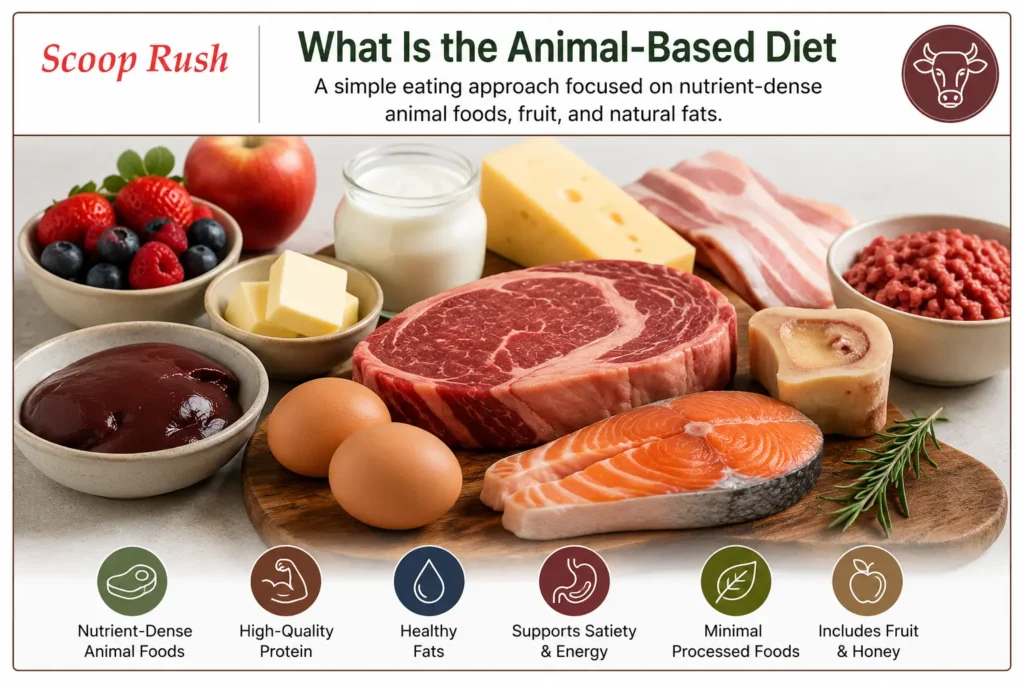
The animal-based diet centers meals around animal foods such as red meat, organ meats, eggs, dairy, and animal fats, while still allowing fruit, raw honey, and occasionally maple syrup. That last part is what sets it apart from the carnivore diet, which cuts out plant foods almost entirely.

The core idea is simple:

  • Choose foods that are naturally high in protein, healthy fats, vitamins, and minerals
  • Cut back on anything heavily processed
  • Favor grass-fed, pasture-raised, or wild-caught sources when possible
  • Keep plant foods limited mostly to fruit
  • Avoid grains, legumes, most vegetables, and refined sugar

Unlike diets that require tracking calories or macronutrient ratios, the animal-based approach relies mostly on food selection. There is no strict counting involved, which is part of why some people find it easier to stick with than more rigid eating plans.

How the Diet Took Hold

The animal-based diet grew out of communities that were already experimenting with carnivore and low-carb eating. Many people who tried a strict carnivore diet found it difficult to sustain long term and began reintroducing fruit and natural sweeteners while keeping meat and animal products as the foundation of their meals. This middle ground became what is now commonly referred to as the animal-based diet.

Social media has played a large role in its spread, with home cooks and wellness influencers sharing meal ideas centered on organ meats, raw dairy, and simple combinations like steak and fruit. The visual appeal of the food, combined with personal testimonials about energy and digestion, has helped the diet reach a wider audience beyond strict carnivore circles.

Why Supporters Say Animal Foods Come First

People who follow this eating style point to nutrients that are naturally abundant in animal products and easier for the body to absorb from these sources.

NutrientFound InMain Role in the Body
Vitamin B12Liver, beef, eggsNerve function, red blood cell formation
Heme ironRed meat, liverOxygen transport, energy
ZincBeef, oysters, organ meatsImmune function, wound healing
CholineEggs, liverBrain and liver health
CreatineRed meat, fishMuscle energy and strength
Complete proteinMeat, eggs, dairyMuscle repair and growth
Vitamin ALiverVision, immune health
Vitamin K2Dairy, egg yolksBone and heart health
DHA and EPAFatty fishBrain and heart health

Because animal proteins contain all nine essential amino acids, supporters argue that building meals around them naturally covers the body’s protein needs without extra planning. This focus on preserving muscle through adequate protein has also become part of a wider conversation around GLP-1 medications and muscle loss, where doctors increasingly stress protein intake alongside treatment to help patients maintain lean mass while losing weight.

Supporters also argue that focusing on nutrient density, rather than simply counting calories, leads to better food choices overall. A plate built around liver, eggs, and grass-fed beef delivers a much higher concentration of vitamins and minerals than the same number of calories from refined carbohydrates.

What People Eat on This Diet

What People Eat on This Diet|Scoop Rush

Organ Meats

Organ meats are considered the cornerstone of the diet because of how concentrated their nutrient content is compared to muscle meat.

  • Liver: Rich in vitamin A, B12, folate, iron, and copper
  • Heart: A strong source of CoQ10, iron, zinc, and protein, with a texture similar to steak
  • Kidney: Provides selenium, B vitamins, and high-quality protein
  • Tongue: Contains healthy fats, zinc, iron, and collagen-rich connective tissue
  • Bone marrow: Valued for its fat content, collagen, and rich flavor

Beginners often ease into organ meats gradually rather than eating them plain. Common strategies include mixing finely chopped liver into ground beef, adding small portions to burgers, or cooking liver in butter to soften the taste. Some people also use freeze-dried organ supplements when fresh organ meat is not practical, though it’s worth understanding the risks of taking too many vitamins before relying heavily on any concentrated supplement.

Muscle Meat

For most followers, muscle meat provides the bulk of daily calories and protein. Ruminant animals are favored because they convert grass into nutrient-dense meat.

  • Beef
  • Bison
  • Lamb
  • Goat
  • Venison
  • Elk

These meats supply complete protein, iron, zinc, vitamin B12, creatine, and carnitine. Poultry and pork are also allowed, though many followers eat them less frequently and look for pasture-raised, soy-free, or corn-free options to improve the fat quality of the meat.

Eggs

Eggs are widely viewed as one of the most complete foods available, offering high-quality protein alongside choline, vitamin D, vitamin A, vitamin E, vitamin B12, and selenium. Within the diet, people generally rank egg quality in this order:

  1. Pasture-raised eggs, valued for the hens’ natural diet and outdoor access
  2. Organic eggs, produced without routine antibiotics or synthetic pesticides
  3. Omega-3 enriched eggs, from hens fed a diet designed to boost fatty acid content
  4. Local farm eggs, prized for freshness and minimal processing

For people who eat eggs daily but want variety, it can help to browse a few gluten-free breakfast ideas that fit within a grain-free approach.

Dairy

Dairy is optional and largely depends on individual tolerance. Common choices include raw milk, gently pasteurized milk, A2 dairy, butter, ghee, yogurt, kefir, cheese, and sour cream. Fermented dairy products are popular because they naturally contain beneficial bacteria that support digestion. Some followers who struggle with conventional dairy report better tolerance with A2 products, though individual responses vary widely.

Animal Fats

Rather than cooking with seed oils, most followers use traditional animal fats such as beef tallow, butter, ghee, lard, suet, and bone marrow. These fats are used for frying, roasting, sautéing, and adding flavor to meals, and are viewed by supporters as part of a more traditional, ancestral approach to cooking.

Fruit

Fruit is the primary plant food in the diet and is often eaten around exercise for quick, easily digestible energy. Common choices include apples, bananas, strawberries, blueberries, mangoes, papayas, pineapple, watermelon, oranges, grapes, peaches, and pears. Some followers also include foods that are botanically fruits but commonly treated as vegetables, such as avocados, olives, cucumbers, and squash.

A smaller number of followers avoid large seeds when eating fruit, based on the belief that they are harder to digest, though this is a personal preference rather than an established guideline. People managing kidney stone risk may also want to review a low-oxalate diet guide, since certain fruit and plant choices can affect oxalate levels.

Natural Sweeteners

Raw honey and, occasionally, pure maple syrup are used in place of refined sugar. Honey is often eaten before or after exercise, mixed into yogurt, or paired with raw milk. Supporters argue that consuming natural sweeteners alongside nutrient-dense whole foods is different from eating refined sugar on its own, though moderation still matters, particularly for people managing blood sugar.

Beverages

Hydration choices include filtered water, mineral water, coconut water, bone broth, raw milk, A2 milk, and electrolyte drinks free of artificial additives. Bone broth is especially popular because it provides collagen, gelatin, amino acids, and minerals in an easy-to-drink form.

Foods to Eat vs. Foods to Avoid

EatAvoid
Red meat and organ meatsWheat, rice, oats, corn, barley, rye
EggsBread, pasta, cereal, baked goods
Full-fat dairy (if tolerated)Beans, lentils, chickpeas, peanuts
Animal fats (butter, tallow, ghee)Nuts and seeds
FruitSeed oils (canola, soybean, corn, sunflower)
Raw honey and maple syrupChips, candy, fast food, frozen dinners
Bone brothArtificial sweeteners
Wild-caught seafoodMost leafy greens, cruciferous and root vegetables

The vegetable restriction is one of the more debated parts of the diet. Supporters believe some plants contain naturally occurring defense compounds that may not be well tolerated by everyone. This claim is not broadly supported by mainstream nutrition science for the general population, and most dietitians continue to recommend vegetables as part of a balanced diet.

Ultra-processed foods are discouraged across the board, in keeping with the diet’s larger focus on whole foods. For readers looking for whole-food swaps to replace packaged snacks, a list of keto diet-friendly snacks offers overlapping ideas, even for people not following keto specifically.

Coffee and Tea: Where They Fit In
Coffee and Tea: Where They Fit In|Scoop Rush

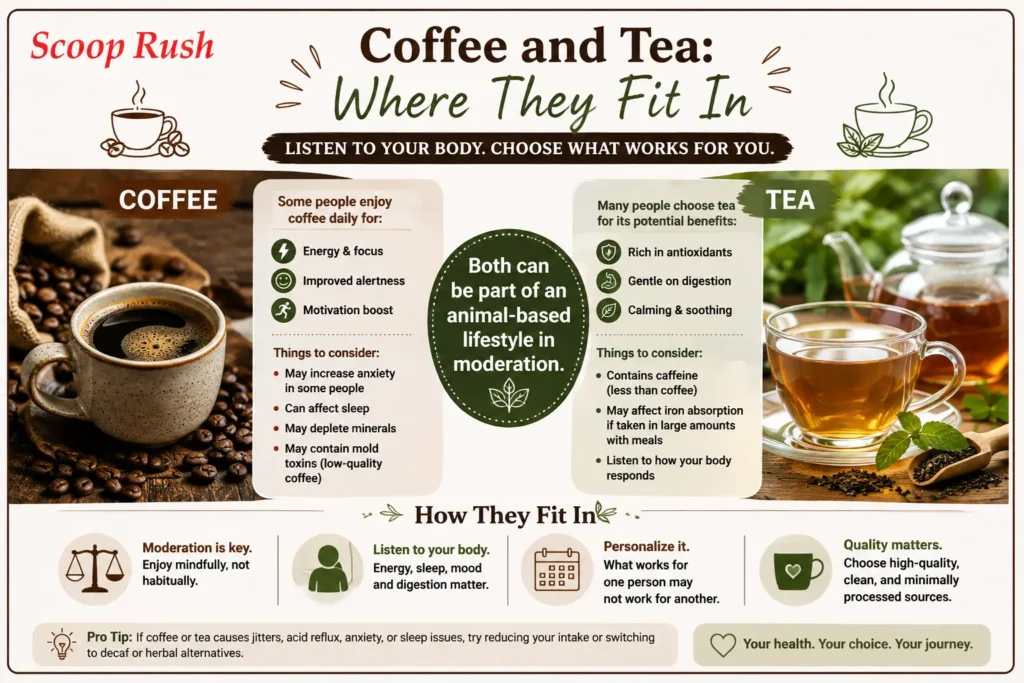
Coffee and tea occupy a gray area within the animal-based community. Some people drink coffee daily without any issues, while others cut it out entirely over concerns that it may contribute to anxiety, disrupted sleep, elevated stress hormones, or mineral depletion in sensitive individuals.

Timing is also a consideration for some followers, who weigh the pros and cons of drinking coffee on an empty stomach before their first meal of the day. The general guidance within the community is to pay attention to how coffee and tea affect your own body rather than follow a universal rule, since tolerance varies significantly from person to person.

What Followers Say About the Results

Commonly reported benefits include:

  • More steady energy throughout the day
  • Better fullness after meals, leading to less snacking
  • Improved digestion, according to many personal accounts
  • Lower intake of added sugar and processed ingredients
  • Easier meal planning due to fewer food choices
  • Reported improvements in skin appearance and dental health among some long-term followers

One case highlighted in discussions around the diet involved a woman who switched from a plant-based diet to an animal-based one for 30 days after struggling with ongoing health issues. Her meals centered on pasture-finished beef, butter, raw milk, and fruit, with salt and maple syrup used sparingly. By day 28, she reported more consistent energy, clearer thinking, better digestion, healthier looking skin, stronger teeth, and reduced throat discomfort. She said she planned to continue eating this way beyond the initial 30 days because of how she felt.

Stories like hers are common in online communities built around the diet, but doctors caution that individual results are not proof of how the diet works for everyone. Personal experience is not a substitute for controlled research, which remains limited for this specific eating pattern. Most of what is currently known comes from anecdotal reports rather than peer-reviewed clinical trials.

Benefits and Risks at a Glance

Potential BenefitsPotential Risks
High-quality, complete proteinLower fiber intake
Greater fullness and satietyReduced plant food variety
Fewer ultra-processed foodsHigher grocery costs
Nutrient-dense food choicesHarder to manage while traveling or eating out
Simpler meal planningLimited long-term research
Traditional cooking fats over refined oilsPossible social friction at gatherings

The Downsides Doctors Want People to Know

  • Less plant variety: Cutting out most vegetables, grains, legumes, nuts, and seeds can lower intake of certain nutrients and fiber for some people, even though animal foods cover many of the basics.
  • Lower fiber intake: Some people adjust fine without much fiber, while others deal with constipation or bloating, especially in the first few weeks of the transition.
  • Higher grocery bills: Grass-fed beef, pasture-raised eggs, wild-caught fish, and raw dairy tend to cost more than conventional options. Ground beef, canned sardines, frozen fish, and beef liver are more budget-friendly ways to stay on plan.
  • Social friction: Restaurant dining, family gatherings, holidays, and travel can all be harder to navigate on a restrictive diet. Planning meals ahead of time tends to make it more manageable.
  • Thin research base: Most of what is known about this specific diet comes from personal accounts rather than clinical studies, so its long-term effects are still not well understood.

Doctors generally recommend talking to a physician or registered dietitian before making major dietary changes, particularly for anyone with chronic kidney disease, liver disease, diabetes, or digestive disorders, or who is pregnant or breastfeeding. This caution extends to people managing broader metabolic conditions. For those following or at risk of type 1 diabetes, for example, it’s also worth staying informed on emerging treatments such as teplizumab, a separate but related area of ongoing medical research. Children and teens have different nutritional needs and should not follow restrictive adult diets without medical guidance.

How It Compares to Other Popular Diets

The animal-based diet is often mentioned alongside other eating patterns that limit carbohydrates or processed foods, but the details differ in important ways.

DietPlant Foods AllowedMain Focus
Animal-basedFruit, honey, some maple syrupNutrient-dense animal foods first
CarnivoreNone or very minimalAnimal foods only
Low-carbNon-starchy vegetables, some fruitReduced carbohydrate intake overall
KetoVery low-carb vegetables, healthy fatsHigh fat, very low carbohydrate
PaleoVegetables, fruit, nuts, seedsWhole foods, no grains or dairy

People curious about the broader category of reduced-carbohydrate eating may also want to read more about the general benefits and risks of a low-carb diet, since many of the same principles around blood sugar and satiety apply across these approaches.

Who Tends to Try It, and Who Should Be Careful

People often drawn to this diet want to:

  • Eat less processed food
  • Increase protein intake
  • Build muscle
  • Simplify meal planning
  • Improve satiety and reduce snacking
  • Try ancestral or traditional eating patterns

For many, the diet becomes part of a broader effort to build sustainable healthy habits in their 20s and 30s, rather than a standalone fix for a specific health problem.

Extra caution is advised for people with:

  • Chronic kidney or liver disease
  • Diabetes requiring medication adjustments
  • Digestive disorders
  • A history of disordered eating
  • Pregnancy or breastfeeding

Tips for Getting Started

  • Ease in gradually instead of switching overnight
  • Start with simple meals like steak and eggs, salmon with butter, or Greek yogurt with berries
  • Choose higher quality meat and dairy when the budget allows, but don’t let cost stop you from starting
  • Stay hydrated, since lower carbohydrate intake can affect electrolyte balance
  • Rotate between different meats, seafood, and organ meats to avoid repetition and add variety
  • Track energy, digestion, sleep, and mood over the first few weeks to judge how the diet is working
  • Pair dietary changes with light daily movement, such as a 5-minute walk every hour, which some people layer on top of their eating pattern for added benefit

Sample One-Day Meal Plan

MealFoods
BreakfastThree pasture-raised eggs cooked in butter, Greek yogurt, fresh blueberries, filtered water
Mid-morning snackApple, cheese
LunchGrilled grass-fed beef steak, bone broth, fresh mango slices
Afternoon snackCottage cheese with raw honey, fresh strawberries
DinnerWild-caught salmon cooked in butter, bone marrow, avocado
Evening snack (optional)Kefir, small serving of berries

This is only one example. Meals can be adjusted based on personal taste, budget, and how the body responds to different foods.

Conclusion

The animal-based diet reflects a broader shift back toward simple, whole foods at a time when many people are looking to cut back on processed eating. Its focus on nutrient-dense meat, organ meats, eggs, dairy, and fruit appeals to those who want fewer ultra-processed ingredients and a more straightforward way to eat.

At the same time, the diet is not without trade-offs. Cutting out most vegetables, grains, legumes, nuts, and seeds means lower fiber intake and less plant food variety for some people, and long-term research on this specific eating pattern is still limited. Cost and social convenience can also be real hurdles for households trying to follow it consistently.

Whether the animal-based diet is worth trying comes down to individual health goals, budget, and medical history. Anyone with an existing health condition, or anyone considering a major dietary shift, should speak with a doctor or registered dietitian first. For healthy adults simply looking to reduce processed food intake, starting with small changes such as swapping packaged snacks for whole foods may offer many of the same benefits without requiring a full overhaul.

FAQs

Is the animal-based diet the same as the carnivore diet? 

No. The carnivore diet cuts out nearly all plant foods, while the animal-based diet still includes fruit, honey, and sometimes maple syrup alongside meat, eggs, and dairy. The carnivore diet is more restrictive, while the animal-based diet allows a bit more flexibility with natural carbohydrates.

Do I need to eat organ meats to follow this diet? 

Not strictly, but many followers consider them important because of their concentrated vitamin and mineral content. People who don’t enjoy the taste sometimes mix small amounts into ground meat, cook liver in butter to soften the flavor, or use freeze-dried organ supplements instead.

Can this diet help with weight loss? 

It can for some people, mainly because protein and fat are more filling, which can lead to eating less overall without deliberate calorie counting. Results still depend on total calorie intake, activity level, sleep, and other lifestyle factors, so weight loss is not guaranteed for everyone who tries it.

Is dairy required on an animal-based diet? 

No. Dairy is optional and mainly recommended for people who tolerate it well. Those with lactose intolerance or a dairy allergy can follow the diet without it and still get adequate protein and fat from meat, eggs, and fish.

Is it safe to try this diet long term? 

It can work for some people, but the limited plant food variety means it is worth monitoring fiber and micronutrient intake over time. Anyone with an existing health condition, or anyone considering the diet for a child or during pregnancy, should check with a doctor or registered dietitian before committing to it long term.


FIFA President Gianni Infantino in Crisis: Will He Be Replaced?

0

Just days after lifting the World Cup trophy with Donald Trump, FIFA president Gianni Infantino is facing the biggest crisis of his career. Could this really be the end of his reign?

FIFA president Gianni Infantino was on top of the football world just two weeks ago. It sounds almost unbelievable now. On 19 July 2026, FIFA president Gianni Infantino handed the World Cup trophy to Spain alongside the US President. The tournament had just wrapped up across three nations, and everything looked perfect.

Then, in less than two weeks, everything changed.

The trigger was simple. FIFA president Gianni Infantino proposed a plan to sell stakes in Fifa competitions to private investors. He scrapped it under pressure. But the damage was already done. Uefa threatened to boycott Fifa competitions altogether. Concacaf and the AFC quickly backed that stance. Even FIFA’s own chief operating officer admitted the organisation’s administration had been kept in the dark.

So here’s the real question: is Gianni Infantino’s time as Fifa president coming to an end? And if so, who takes over?

This article breaks it all down. You’ll learn exactly what happened, why it matters, and who the top candidates are to replace him.

Why This Fifa Crisis Matters to Football Fans

Fifa runs the World Cup. That makes it the most powerful organisation in world football, and it is exactly why the Fifa president Gianni Infantino controversy carries so much weight. Therefore, whoever leads Fifa shapes decisions that touch every league, every club, and every fan on the planet.

When the man at the top loses the trust of major confederations, the ripple effects spread fast. Here’s why this moment feels so serious:

  • Uefa, Concacaf, and the AFC together represent the vast majority of the football world. When all three raise concerns at once, it is not a small internal dispute.
  • Trust has clearly broken down. These confederations rarely unite so publicly against a sitting Fifa president.
  • Carlos Cordeiro resigned. He served as a special advisor to Infantino and was also appointed by Trump to the White House Task Force on the 2026 World Cup. His exit suggests even close allies are stepping back.

As a result, this is no longer just a controversy. It is a genuine test of Infantino’s grip on power.

What Actually Happened With Infantino’s Investment Plan

The controversy centres on one proposal from Fifa president Gianni Infantino: selling off stakes in Fifa competitions to private investment firms. Football’s governing bodies did not welcome the idea, and the backlash was swift.

UK Prime Minister Andy Burnham publicly condemned the plan. Fans were equally critical. Many saw it as a step too far in the commercialisation of the sport. Under mounting pressure, Infantino scrapped the plan entirely.

However, cancelling the proposal did not stop the fallout. Uefa responded with a threat to boycott Fifa competitions, and both Concacaf and the AFC reinforced that stance. This is a rare escalation. Confederations almost never unite so openly against the man running world football.

The AFC did not hold back either. In its own words, the controversy exposed deeper problems with how Fifa consults its members and makes decisions. Meanwhile, sources close to Concacaf say most of its member associations are either losing faith in Infantino’s leadership or have lost it completely.

Adding to the pressure, Fifa’s chief operating officer Kevin Lamour told Associated Press that Fifa’s own administration was misled about the investment project. When a top executive says he was deceived, it raises serious questions about transparency at the very top.

Fifa’s Response So Far

BBC Sport has approached Fifa for comment. So far, the organisation has not offered a detailed public rebuttal. That silence has only fuelled more speculation about Infantino’s next move.

Could Gianni Infantino Actually Lose His Job?

Despite the scale of the backlash, experienced football administrators urge caution before writing off Fifa president Gianni Infantino. Fifa does not operate like a normal organisation, and its politics rarely follow predictable patterns.

Former Football Association chairman David Bernstein explained it well. In a typical organisation, a leader forced to back down over something this big would likely be shown the door. Fifa, however, works differently. If Infantino retains support from enough national associations, he can simply continue.

Former Fifa vice-president Jim Boyce shares that view. He believes Infantino still has enough backing to be re-elected. Still, he admits that continued pressure could shift the picture. In fact, Boyce said that if he were a betting man, he would still expect Infantino to secure his final four-year term.

This matters because Fifa’s presidency is not decided by public opinion. It is decided by votes from national football associations, many of which have long, close ties to Infantino’s administration.

Infantino’s Background and Rise to Power

Understanding why Infantino might survive this storm means looking at his history. He has served as Fifa president since 2016. Before that, he spent seven years as secretary general of Uefa. Few people understand football politics better than he does.

Now 56, Infantino won the presidency by defeating Asian Football Confederation president Sheikh Salman al-Khalifa, 115 votes to 88. His task at the time was to rebuild an organisation battered by corruption scandals after the resignation of his predecessor, Sepp Blatter. Blatter, notably, was cleared of corruption charges last year.

Since his election, Infantino has been re-elected unopposed twice. That pattern is not unusual in Fifa’s history. Blatter himself ran unopposed in both 2007 and 2011.

In fact, unseating a sitting Fifa president through an election is extremely rare. The last time it happened was in 1974, when Brazilian Joao Havelange defeated Sir Stanley Rous. Havelange then went unchallenged for five straight terms before finally resigning in 1998, aged 82. That history shows just how hard it is to remove a Fifa president once they are entrenched.

Even so, cracks are beginning to show. National associations had already submitted letters of support backing Infantino’s re-election. BBC Sport understands that at least one Uefa member has now withdrawn its letter as this week’s drama has unfolded. Whether more follows could prove decisive.

Who Might Replace Gianni Infantino as Fifa President?

If Fifa president Gianni Infantino does eventually step aside, several names are already in the conversation. Each candidate brings a different background, and each would steer Fifa in a different direction.

Victor Montagliani (Concacaf President)

Victor Montagliani is widely seen as one of the strongest potential candidates. Like Infantino, he was elected in 2016 on a platform of governance reform. As a former president of Canada Soccer, he played a major role as co-chair in delivering the 2026 World Cup, the first tournament ever hosted across three nations.

He is fluent in French, Italian, and Spanish, in addition to English. This gives him broad appeal across football’s different regions. Speaking about his rise to the Concacaf presidency, Montagliani described campaigning at his own expense for three months, visiting all 41 member countries.

He also led Concacaf through an expanded Copa America in 2024, though he has pushed back on making that permanent. Politically, he is known for building consensus. For example, he helped ease tensions around Arsene Wenger’s push for a World Cup every two years. He has also never fully supported expanding the tournament to 64 teams.

At the Leaders conference in 2025, Montagliani argued that football is bigger than any single leader and will always survive shifts in global power, even when those shifts cause short-term pain.

Sheikh Salman bin Ebrahim Al-Khalifa (AFC President)

Sheikh Salman has led the AFC since 2013 and was re-elected unopposed for a fourth term running through 2027. Under his leadership, Asian football has grown fast, with the launch of the Champions League Elite, Champions League Two, the Challenge League, and the Women’s Champions League in 2024-25. The Asian Cup itself has expanded to 24 teams.

Notably, Sheikh Salman personally signed off on the AFC’s critical statement about how Fifa is being run under Infantino. He carries the backing of a 46-member confederation, many of whom know exactly how large Infantino’s scrapped investment plan was compared to their own football budgets.

Nasser Al-Khelaifi (PSG President and Chair of European Football Clubs)

Nasser Al-Khelaifi (PSG President and Chair of European Football Clubs)

Nasser Al-Khelaifi’s name comes up often, largely due to his influence rather than any stated ambition. He took over as chairman of what was then the European Clubs’ Association after the failed European Super League project collapsed within 48 hours in 2021.

Under his leadership, the group rebranded as European Football Clubs and grew to more than 800 member clubs. Notably, Real Madrid remains the only major European club still outside it.

In theory, Al-Khelaifi’s influence and connections would make him a serious contender. However, a source close to the 52-year-old Qatari executive made it clear he genuinely does not want the job. As a result, he is unlikely to enter the race even if Infantino steps down.

Mattias Grafstrom (Fifa Secretary General)

Mattias Grafstrom, appointed Fifa secretary general in May 2024, is a rising figure inside Fifa’s corridors of power. He became Infantino’s chief of staff shortly after his 2016 election and has remained close to him ever since.

Multi-lingual and highly visible throughout the recent World Cup, Grafstrom has the experience to lead Fifa. However, his close ties to Infantino could work against him. There is also a broader feeling in football politics that Fifa’s next president should come from outside Europe, which could limit his chances further.

What Happens Next in the Fifa Presidential Race

Fifa’s next president, whether Infantino or a successor, will be officially confirmed at the organisation’s 77th Congress in Morocco next March. Any candidate hoping to challenge for the role must submit their name by 18 November.

Until then, the football world will watch closely. Will more national associations follow Uefa’s lead and withdraw support? Or will Infantino steady the ship in time for the vote?

Key Takeaways

Gianni Infantino’s position as FIFA president is facing its most serious test since he took office in 2016. A scrapped plan to sell stakes in FIFA competitions to private investors triggered fierce backlash from UEFA, Concacaf, and the AFC. A key advisor resigned, and even FIFA’s own chief operating officer criticised the process.

Still, Fifa’s political structure means Infantino could survive if he keeps support from enough national associations. Meanwhile, names like Victor Montagliani and Sheikh Salman bin Ebrahim Al-Khalifa are already being discussed as possible successors, while others like Nasser Al-Khelaifi appear uninterested in the role. The final decision arrives at Fifa’s Congress in Morocco next March, and football fans everywhere will be watching.

Frequently Asked Questions

1. Why is Fifa president Gianni Infantino facing criticism right now? 

Fifa president Gianni Infantino proposed selling stakes in Fifa competitions to private investors. The plan was widely condemned. Although he scrapped it, Uefa, Concacaf, and the AFC have since criticised his overall leadership.

2. Has Gianni Infantino resigned as Fifa president? 

No. Infantino has not resigned. He remains Fifa president, though his position has become far more uncertain since the backlash began.

3. Who could replace Gianni Infantino as Fifa president? 

Names in the conversation include Concacaf president Victor Montagliani, AFC president Sheikh Salman bin Ebrahim Al-Khalifa, PSG president Nasser Al-Khelaifi, and Fifa secretary general Mattias Grafstrom. However, Al-Khelaifi has reportedly ruled himself out.

4. When will Fifa’s next president be decided? 

Fifa’s next presidential decision will be confirmed at the organisation’s 77th Congress in Morocco next March. Candidates must submit their names by 18 November.

5. Has any Fifa president ever been voted out of office? 

Rarely. The last time a sitting Fifa president lost an election was in 1974, when Joao Havelange defeated Sir Stanley Rous. Since then, incumbents have typically run unopposed.

Will Money Really Become Useless by 2036? Elon Musk’s Claim Sparks a Bigger Warning

0

“Would you still worry about your salary if robots could give you everything you need for free? That is the question behind Elon Musk’s claim that money won’t matter by 2036, and his answer has split Silicon Valley right down the middle.”

Introduction

Elon Musk recently claimed that money won’t matter by 2036 because AI and robots will produce more goods and services than humans could ever consume. At first, the idea sounds like a dream. However, fellow tech billionaire Vinod Khosla looked at the same prediction and saw a warning most people missed. According to Khosla, this future depends entirely on one thing: politics.

This disagreement between two major AI investors matters to everyday readers, especially anyone wondering will AI replace your job in the years ahead. If abundance really is coming, the next question is who actually gets to benefit from it. Musk describes a smooth, effortless future, but Khosla suggests the road there could be far bumpier, and possibly unfair.

What Elon Musk Said About Money Becoming Irrelevant by 2036

What Elon Musk Said About Money Becoming Irrelevant by 2036

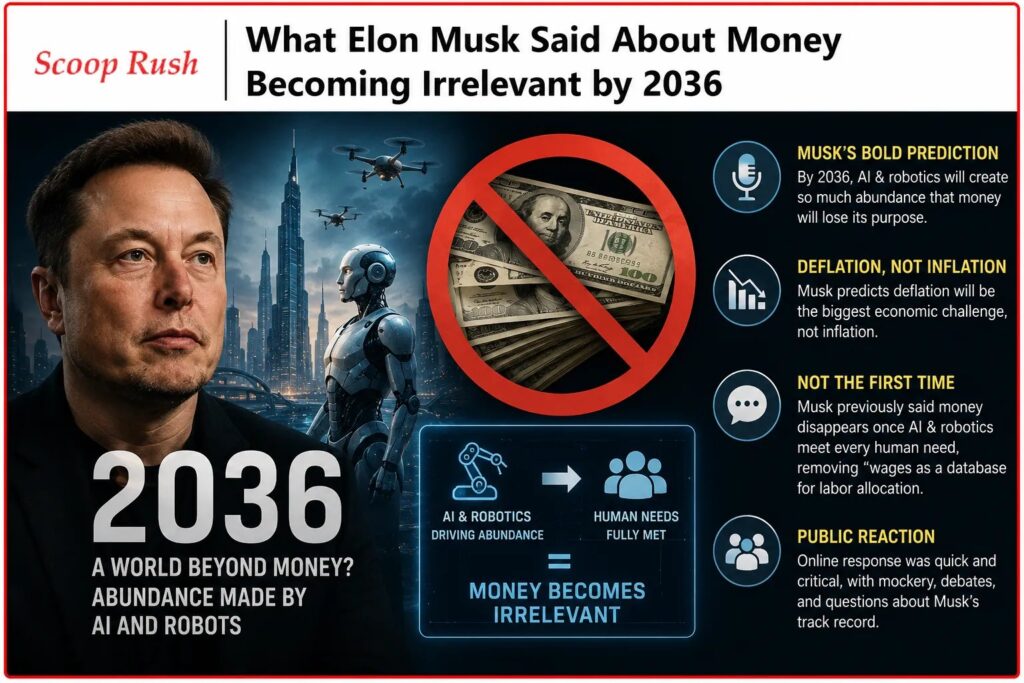
Musk shared his boldest prediction yet during an interview with The Economist’s editor-in-chief, Zanny Minton Beddoes. He argued that AI and robotics will create so much abundance by 2036 that money will simply lose its purpose.

His logic was straightforward. People want money mainly for goods and services. Therefore, once AI and robots can produce far more than any person could use, money no longer serves a real function.

Musk also predicted something unexpected: deflation, not inflation, will become the biggest economic challenge of that era. This stands out because most conversations about the future economy focus on rising prices, not falling ones.

Interestingly, Musk had floated this idea before. He made similar comments months earlier on the People by WTF podcast, saying money disappears as a concept once AI and robotics meet every human need, removing wages as what he called “a database for labor allocation.” This is not the only bold financial claim Musk has made recently either, since he also pushed forward $1 million checks under a Wisconsin law earlier this year.

Online Reaction Turns Into Mockery

The public response to Musk’s Economist interview was quick and largely critical. Gizmodo described Musk as melting down over ordinary questions and called several of his answers incoherent. Meanwhile, a widely upvoted Reddit thread triggered heated debate over Musk’s prediction record and the future of capitalism itself.

Eventually, though, one investor chose a different path than mockery, and his response reshaped the entire conversation.

Vinod Khosla’s Warning Hidden Inside His Agreement

Vinod Khosla, founder of Khosla Ventures, did not join the criticism. Instead, he posted on X that he would “modify” Musk’s prediction with one important condition. Money won’t matter in 2036, Khosla said, only if politics permits this great abundance.

That single condition changes everything about the prediction. Khosla was not fully endorsing Musk’s timeline. Rather, he used it as a starting point to make a separate argument: technology creating abundance and politics distributing that abundance fairly are two completely different problems. Solving one does not guarantee solving the other.

Khosla linked his post to an essay he published in 2024 titled “AI: Dystopia or Utopia?” That essay explains exactly why this distinction concerns him so much.

Why Khosla Believes AI Is Different From Past Technology

According to Khosla’s essay, AI could create a world where a small elite thrives while everyone else faces serious economic instability. This risk grows larger, he warns, in a democracy that drifts without active policy intervention.

Khosla argues that AI is fundamentally different from earlier innovations like the microprocessor or the internet. Those tools amplified what humans could already do with existing brainpower. AI, however, actually substitutes for brainpower itself, a shift already visible in how NHS AI tools are being used to cut waiting times and how models like Kimi K3 from Moonshot AI are advancing fast.

This difference is exactly what makes mass abundance technically possible, in Khosla’s view. AI could eventually replace most jobs in health care, law, retail, and beyond. As a result, productivity gains could theoretically support comfortable living standards for everyone, not just a wealthy few.

Khosla Has Warned About AI Inequality for Over a Decade

What Elon Musk Said About Money Becoming Irrelevant by 2036

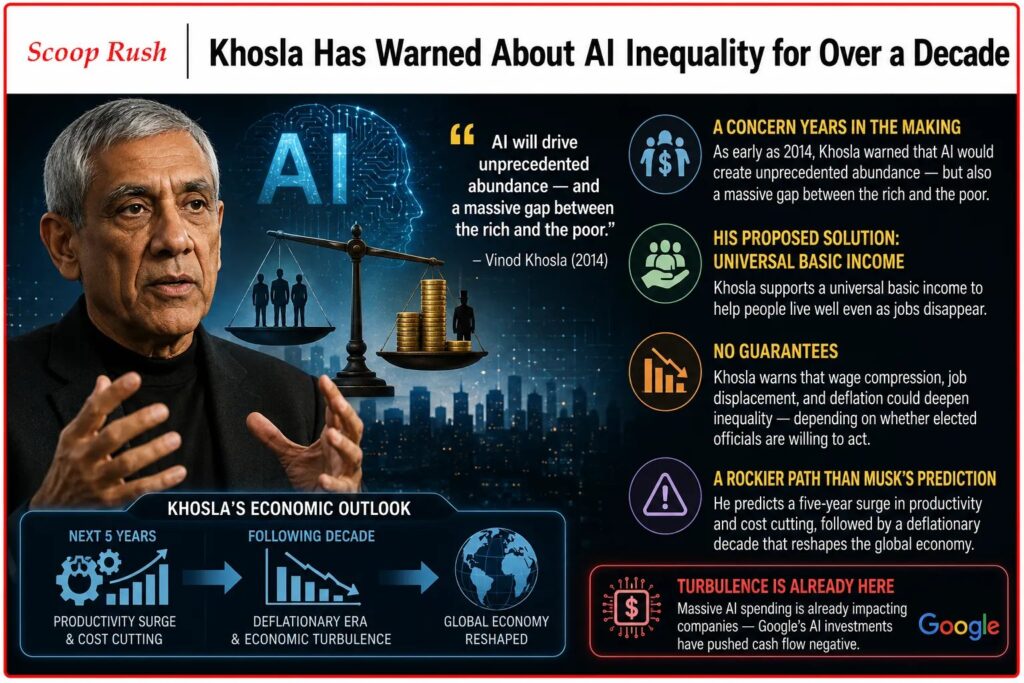
This concern is not new for Khosla. As early as 2014, he warned that AI would drive unprecedented abundance alongside a massive gap between the rich and the poor, according to a Substack analysis of his writing.

His proposed solution has stayed consistent over the years. Khosla supports a universal basic income to help people live well even as jobs disappear, based on earlier Fortune coverage.

However, Khosla’s essay stops well short of promising that governments will actually adopt these fixes. He warns that wage compression, job displacement, and deflation could just as easily deepen inequality as eliminate it. The real outcome, he says, depends on the willingness of elected officials to tackle the severe redistribution problem that pure capitalism may create.

A Rockier Path Than Musk’s Smooth Prediction

Khosla also gave a more near-term warning at a Stanford FIS event. He described a five-year burst of productivity and cost cutting, followed by a deflationary decade that reshapes the global economy. This picture is far rockier than the smooth abundance story Musk presents publicly.

This detail matters because even Khosla, who believes deeply in AI’s potential, expects real economic turbulence before ordinary people see any benefit. That turbulence is already showing up in tech spending patterns, as seen in reports that Google’s AI spending has pushed cash flow negative.

Why This Musk vs Khosla Debate Matters to Everyday People

Why This Musk vs Khosla Debate Matters to Everyday People

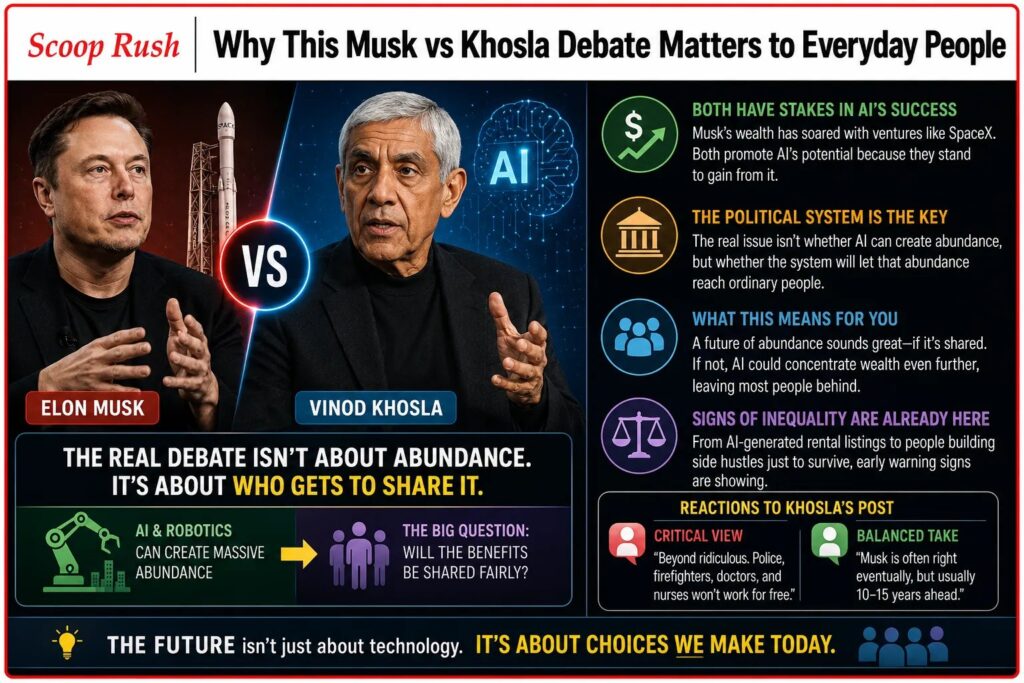
Both Musk and Khosla have significant financial stakes in AI’s success, so neither lacks incentive to promote its potential. Musk’s own fortune has grown alongside ventures like the SpaceX IPO, which pushed him toward trillionaire status. Despite that shared interest, their disagreement highlights something important for regular readers.

The real debate isn’t whether AI can produce abundance. Instead, it’s whether the political system will let that abundance reach people beyond those who already own the robots and companies building them.

This distinction changes how ordinary people should think about the AI conversation. A future filled with abundant goods sounds appealing, but only if the benefits are shared fairly. Otherwise, the same technology could concentrate wealth even further, leaving most people worse off. Some early signs of this imbalance are already visible, from AI-generated rental listings raising fairness concerns to ordinary people trying to build their own income streams, such as one mom who built a $10K-a-month Etsy side hustle.

Reaction to Khosla’s post reflected this exact tension. One reply called the entire abundance idea “beyond ridiculous,” pointing out that police, firefighters, doctors, and nurses will not simply work for free. Another commenter offered a more balanced take, noting that Musk is often right eventually, though usually about ten to fifteen years ahead of schedule.

Conclusion

Elon Musk’s claim that money won’t matter by 2036 sounds like a bold promise of comfort and abundance. However, Vinod Khosla’s response reminds readers that technology alone cannot guarantee that outcome. Abundance only matters if everyone gets to share in it, not just the people who control the machines producing it.

Khosla’s decade-long warning about AI creating both prosperity and inequality deserves just as much attention as Musk’s optimistic timeline. As AI reshapes jobs, wages, and entire industries, the real question isn’t when abundance arrives. It’s whether political systems choose to share it fairly once it does.

FAQs

What did Elon Musk say about money becoming irrelevant by 2036?

Musk told The Economist that AI and robotics will produce more goods and services than any human could consume by 2036, making money irrelevant. He also predicted deflation, rather than inflation, would become the era’s biggest economic challenge.

What is Vinod Khosla’s response to Musk’s money prediction?

Khosla agreed that money could become irrelevant only if politics permits the great abundance AI might create. He warned that the technology enabling abundance and the political will to distribute it fairly are two separate problems.

Why does Khosla believe AI is different from past technologies like the internet?

Khosla argues that past technologies amplified human brainpower, while AI actually substitutes for it. This distinction makes AI capable of replacing jobs across health care, law, and retail on a much larger scale.

Has Vinod Khosla warned about AI inequality before?

Yes, Khosla has raised this concern since at least 2014, warning that AI could drive both unprecedented abundance and a massive gap between the rich and the poor.

What solution does Khosla propose for AI-driven job losses?

Khosla has consistently supported a universal basic income as a way to ensure people can maintain a good standard of living even as AI displaces traditional jobs.

FIFA World Cup Investment Plan Scrapped: Why Infantino Backed Down

0

The Investment Plan Collapses in Just Five Days

What happens when the most powerful man in football tries to sell a piece of the World Cup? Almost the entire sport says no. That is exactly what unfolded this week. The FIFA World Cup investment plan, once pushed hard by FIFA president Gianni Infantino, has officially been scrapped. It took less than a week of backlash to bring it down.

This story matters far beyond boardrooms and financial spreadsheets. It touches the future of the world’s most watched sporting event. It also touches the trust between football’s governing body and its 211 member nations. Additionally, it puts the leadership of a man who once looked set for an unopposed fourth term under real pressure. If you follow football, or simply care about how major tournaments are run, this development is one you’ll want to understand fully.

Let’s break down what happened, why the World Cup stake sale collapsed so fast, and what it means going forward.

What Was the FIFA World Cup Investment Plan?

At its core, the plan involved creating a new commercial subsidiary called FIFA Forward Enterprise, or FFE. The idea was simple on paper. FIFA would invite outside investors to buy minority, non-controlling stakes in this new entity. That entity would then run FIFA’s major competitions, including the men’s and women’s World Cups.

To sweeten the deal, Infantino offered every one of FIFA’s 211 member associations $40 million, roughly £30 million, if they backed the proposal. There was a catch, though. Associations needed to accept the terms by 19 September to unlock an initial $20 million, about £15 million.

A 25-page document prepared by investment bank JP Morgan outlined ambitious numbers. It projected that FIFA’s tournaments could expand enough to deliver an estimated 24 million euros, around £20.5 million, per member association during the 2035-2039 cycle. The document described the World Cup as the most widely viewed sporting event in the world. Yet, it also claimed FIFA itself remained under-monetised. Interestingly, the women’s game was not mentioned anywhere in the FIFA stake sale proposal.

According to FIFA, the American venture capital firm Thrive Eternal was expected to lead the investor group behind FFE. Thrive was founded by Joshua Kushner, brother of Jared Kushner, who is married to Donald Trump’s daughter. That connection added another layer of scrutiny, especially given the close relationship Trump and Infantino have built since Trump returned to office in 2025. Trump addressed the plan publicly for the first time on Friday and said he had not personally discussed it with Infantino.

Why the Proposal Sparked Immediate Backlash

Football’s governing bodies did not stay quiet for long. Within days, opposition grew from a whisper into a roar against FIFA’s private investment plan.

UEFA Fires the First Shot at FIFA’s Stake Sale Plan

UEFA, representing 55 European member associations, was the first major body to speak out. Their message was blunt. Football was “not FIFA’s to sell.” As the week progressed, UEFA sharpened its tone even further. It accused FIFA of trying to enrich itself and its friends at the sport’s expense.

Then came the decisive move. On Thursday, all 55 UEFA member associations voted to boycott future World Cups if Infantino’s plan went ahead. That is not a symbolic gesture. It is a direct threat to the tournament’s global credibility, since Europe has consistently produced some of the strongest teams and biggest fan bases in the competition.

Concacaf and the AFC Join the Resistance to the World Cup Stake Sale

UEFA was not alone for long. Concacaf, which governs football across North America, Central America, and the Caribbean, announced that its 41 member associations had rejected the proposal outright. This carried extra weight given that Concacaf co-hosted this summer’s World Cup. As a result, the region has direct, recent experience with how FIFA’s flagship tournament actually operates.

Sources indicated that a majority of Concacaf’s member associations were losing faith, or had already lost faith, in Infantino’s leadership altogether.

The Asian Football Confederation added even more pressure by declaring solidarity with UEFA and Concacaf. While the AFC stopped short of a full rejection, its stance still signaled deep unease among Asian football nations regarding the FIFA investment proposal.

Meanwhile, South America’s governing body, Conmebol, did not reject the plan outright. Instead, it requested additional information regarding its scope, structure, governance, and possible effects. Africa’s CAF and Oceania’s OFC said they planned to discuss the proposal in August, though the plan collapsed before those conversations took place.

The Numbers That Sealed the Plan’s Fate

FIFA operates under a system where major decisions require backing from a majority of its 211 member associations. That means Infantino needed at least 106 votes in favor.

However, once you added up the opposition, the math simply did not work in his favor. UEFA alone controls 55 votes. Concacaf brings 35 more. Asia, through the AFC, adds another 46. If every member association followed the position taken by their regional confederation, that would total 136 votes against the plan. That number alone exceeded the majority Infantino needed to push the World Cup stake sale through.

As a result, even before Saturday’s announcement, the writing was already on the wall.

Resignation From Within FIFA Over the Proposal

Perhaps the most damaging blow came from inside FIFA’s own leadership.

Carlos Cordeiro, Infantino’s senior adviser on global strategy and governance, resigned over the matter. Cordeiro had also represented FIFA on the White House taskforce for the 2026 World Cup, making his departure especially notable. In a lengthy statement, he said he “unequivocally” opposed the plan. He also rejected the idea that FIFA needed outside investors to unlock greater value, and clarified that he had no involvement in shaping the proposal.

FIFA’s chief operating officer, Kevin Lamour, went even further. He stated that FIFA’s own administration had been “deceived” about the project, calling it “the project of one person.” Lamour argued that a president’s job is to bring people together and inspire unity. He added that this plan achieved the opposite. He also said that if his comments cost him his job, he would accept that outcome and still sleep well at night.

These are not minor internal disagreements. When a chief operating officer and a senior adviser both publicly break ranks, it signals a serious breakdown of trust at the highest levels of the organization.

How Infantino Responded to the Backlash

Even as opposition mounted, FIFA initially stood firm. On Friday, the organization declared that “nobody is selling football” and vowed to press ahead with the plan despite the growing wall of rejection.

That resistance did not last long, though. Early Saturday morning, at around 00:30 BST, Infantino released a statement confirming the FIFA World Cup investment plan would not proceed. He explained that the project had “created divisions” that no longer served its original purpose, adding that the proposal “will not proceed.”

Infantino defended his original intentions. He said the plan was designed to strengthen member associations, particularly in countries where support is most needed. He reiterated that FIFA’s purpose has always been, and always will be, to unite and improve football. He also said he now intends to bring all interested parties back together in a spirit of shared interest.

Reaction to the withdrawal was swift. Shaikh Salman bin Ebrahim Al Khalifa, president of the Asian Football Confederation, welcomed the decision. He stressed that the future of global football must be shaped through proper consultation, collective dialogue, and respect for established governance structures.

What This U-Turn Means for Infantino’s Future

This episode has left Infantino, 56, in a genuinely precarious position. He is currently seeking re-election for a fourth term as FIFA president, with the vote scheduled to take place at the FIFA Congress in Morocco next March. Candidates have until 18 November to officially enter the race.

Before this controversy erupted, it was widely expected that Infantino would be re-elected unopposed. Numerous associations across the world, including several in Europe, had already confirmed their intention to support him.

Now, that outcome looks far less certain. It remains to be seen whether the backlash from this week triggers a broader loss of support among member nations. UK Prime Minister Andy Burnham even went as far as saying Infantino was “the wrong man” to lead FIFA, a striking comment from a sitting political leader.

Interestingly, this is not Infantino’s first brush with public controversy this month. Just days before the investment plan story broke, he posted a 15-slide message on his personal Instagram account. In it, he urged critics to “meditate, pray or watch a football match” rather than spread what he called hate and false rumors about his leadership. In hindsight, that message looks like an early sign of the turbulence to come.

A Quick Timeline of the FIFA World Cup Investment Plan Saga

  • Monday, 27 July: Infantino posts a 15-slide Instagram message dismissing critics.
  • Tuesday, 28 July: The Times and Financial Times report on the investment plan. UEFA issues its first statement, saying football is “not FIFA’s to sell.” FIFA confirms the plan is real.
  • Wednesday, 29 July: Infantino writes to all 211 member associations, offering $40 million each in exchange for support by 19 September.
  • Thursday, 30 July: UEFA’s 55 members vote to boycott World Cups if the plan proceeds. Concacaf rejects the proposal.
  • Friday, 31 July: FIFA vows to continue despite opposition. The AFC expresses solidarity with UEFA and Concacaf. Carlos Cordeiro resigns. Andy Burnham criticizes Infantino. Kevin Lamour says FIFA’s administration was deceived.
  • Saturday, 1 August: Infantino announces the plan will not proceed.

Final Thoughts: What the Fallout Reveals

This story is about more than one scrapped business deal. It exposes real cracks in how FIFA’s leadership operates. It also shows how much power still rests in the hands of its member confederations.

Ultimately, the swift and unified rejection from UEFA, Concacaf, and the AFC proved impossible for Infantino to ignore. Combined with resignations and public criticism from within FIFA’s own administration, the pressure became too great to withstand.

For now, the FIFA World Cup investment plan is dead. However, the bigger question still lingers. Can Infantino repair the trust he has lost among member associations before the presidential vote in March? The football world will be watching closely.

Frequently Asked Questions

1. What was the FIFA World Cup investment plan? 

It was a proposal to create a commercial subsidiary, FIFA Forward Enterprise, allowing outside investors to buy minority stakes in FIFA’s major tournaments, including the men’s and women’s World Cups.

2. Why did FIFA scrap the World Cup investment plan? 

FIFA scrapped the plan after widespread opposition from UEFA, Concacaf, and the Asian Football Confederation. Combined with internal resignations and criticism, it became clear the proposal could not secure majority support.

3. Who opposed FIFA’s investment plan the most? 

UEFA led the opposition, with all 55 member associations voting to boycott World Cups if the plan proceeded. Concacaf and the AFC also opposed or expressed solidarity against the proposal.

4. Who resigned from FIFA over the investment plan? 

Carlos Cordeiro, Infantino’s senior adviser on global strategy and governance, resigned. He stated he unequivocally opposed the plan and had no involvement in creating it.

5. Will Gianni Infantino remain FIFA president after the investment plan controversy? 

Infantino is seeking re-election for a fourth term at the FIFA Congress in Morocco next March. While he was previously expected to run unopposed, this controversy has raised uncertainty about his continued support among member associations.

Peak District National Park at 75: The Walk That Changed Britain

0

The Peak District National Park celebrates its 75th anniversary in 2026. Visitors can now follow the famous Kinder Scout Mass Trespass route. The historic walk changed public access to the countryside. It also inspired Britain’s national park movement. Today, the trail reminds visitors how ordinary people helped protect outdoor spaces for everyone.

The anniversary highlights one of the most important moments in Britain’s outdoor history. Guided walks, exhibitions, and special events allow visitors to explore the park’s remarkable past. The Peak District continues welcoming millions of visitors each year. Its stunning landscapes and rich heritage make it one of the country’s most popular travel destinations.

Peak District National Park celebrates 75 years

The Peak District National Park became Britain’s first national park on 17 April 1951. It followed years of public campaigns for countryside access. Today, it welcomes more than 13 million visitors every year.

The park covers around 550 square miles across Derbyshire and nearby counties. Visitors enjoy hiking, cycling, climbing, wildlife watching, and scenic villages. Its landscapes include moorlands, limestone valleys, rivers, and dramatic rock formations.

Peak District National Park honors the Kinder Scout Mass Trespass

Peak-District-National-Park-honors-the-Kinder-Scout-Mass-Trespass

The famous Kinder Scout Mass Trespass took place on 24 April 1932. Around 400 working-class walkers joined the protest. Most came from Manchester, Sheffield, and nearby industrial towns.

The land belonged to the Duke of Devonshire. Landowners reserved it mainly for grouse shooting. Benny Rothman led the demonstration. Protesters challenged restrictions on public access. They believed everyone deserved countryside freedom.

Kinder Scout protest changed public access forever

The walkers gathered at Bowden Bridge before climbing Kinder Scout. Gamekeepers confronted them during the ascent. Small clashes followed, but the group reached the plateau.

Authorities arrested five protesters after the event. Courts sentenced them to prison terms between two and six months. Public support quickly grew. The protest became a powerful symbol of equal countryside access.

Peak District National Park inspired national reform

Peak-District-National-Park-inspired-national-reform

The Kinder Scout protest increased pressure for legal reforms. Campaign groups continued demanding public access throughout the 1930s and 1940s. Their efforts gained wider political support after World War Two.

Parliament passed the National Parks and Access to the Countryside Act in 1949. This law created Britain’s national park system. Two years later, the Peak District received official national park status.

Peak District National Park opened the way for future parks

The Peak District became the first protected national park in Britain. Soon after, the government designated the Lake District, Snowdonia, and Dartmoor. More national parks followed during the 1950s.

The new system protected beautiful landscapes while encouraging responsible recreation. It also improved public enjoyment of nature. National parks became important places for conservation and outdoor activities.

Peak District National Park still shapes right to roam campaigns

Peak-District-National-Park-still-shapes-right-to-roam-campaigns

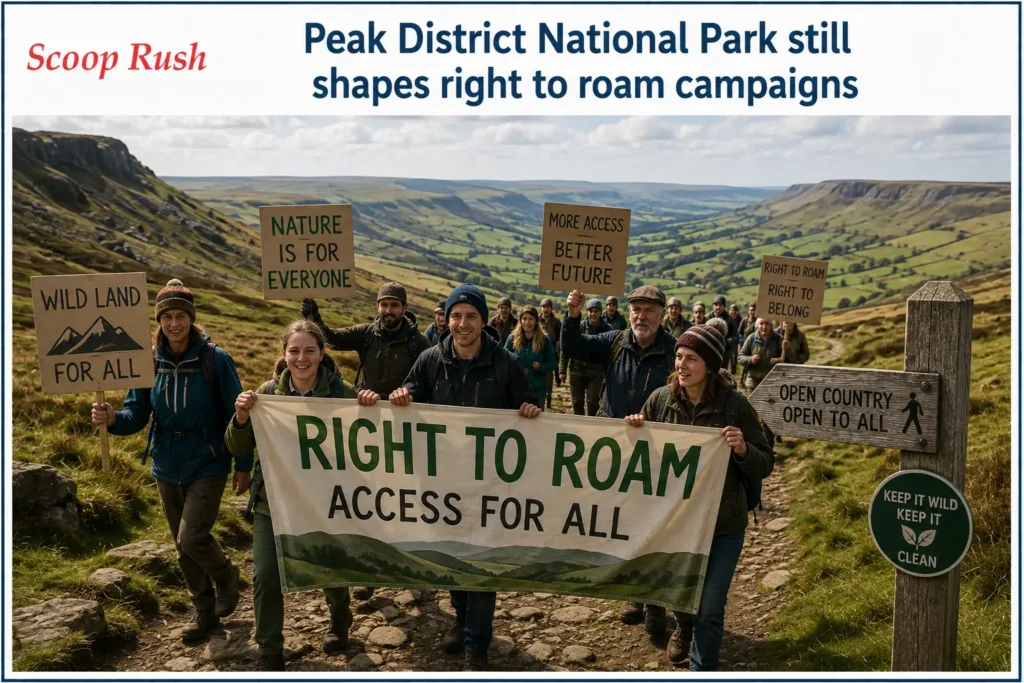
Campaigners believe countryside access still needs improvement. Only a small percentage of England allows open public access. Many protected areas remain difficult to reach.

Groups such as Right to Roam continue peaceful campaigns today. They seek wider access similar to Scotland’s outdoor rights. They also encourage responsible enjoyment and environmental protection.

Peak District National Park offers visitors a historic walking route

Visitors can retrace the original Kinder Scout route from Bowden Bridge. The trail measures about eight miles. It passes Kinder Reservoir, William Clough, and Snake Path before reaching the plateau.

The route offers spectacular views across the Dark Peak. Walkers also discover the history behind Britain’s access movement. Guided anniversary walks and exhibitions make 2026 an excellent year to visit.

Peak District National Park protects nature for future generations

The National Trust now manages Kinder Scout. The area also holds National Nature Reserve status. Conservation teams protect wildlife, fragile habitats, and historic landscapes.

Visitors play an important role in protecting the park. Authorities ban campfires and disposable barbecues because of wildfire risks. Responsible tourism helps preserve the landscape for future generations.

Why Peak District National Park remains important today

The Peak District represents more than beautiful scenery. It also represents fairness, public access, and shared national heritage. The events of 1932 continue inspiring outdoor campaigns across Britain.

Seventy-five years after becoming Britain’s first national park, its story remains powerful. Every visitor walking Kinder Scout follows a route that changed British history forever.

Conclusion

The Peak District National Park stands as one of Britain’s greatest conservation success stories. Its creation followed decades of determination from campaigners who believed everyone deserved access to nature. The Kinder Scout Mass Trespass remains a landmark event that transformed public attitudes toward the countryside.

Today, millions of visitors enjoy the landscapes once closed to ordinary people. The park continues balancing conservation with recreation while inspiring future generations. Its history reminds everyone that protecting nature and expanding responsible public access can work together.

FAQs

1. Why is the Peak District National Park historically important?

The Peak District became Britain’s first national park on 17 April 1951. Its creation marked a major step in protecting natural landscapes while giving more people access to the countryside for recreation.

2. What was the Kinder Scout Mass Trespass?

The Kinder Scout Mass Trespass took place on 24 April 1932. Around 400 walkers entered privately owned land to protest restricted access. The event became a turning point in Britain’s right to roam movement.

3. Who led the Kinder Scout protest?

Benny Rothman, a 20-year-old activist from Manchester, led the protest. His leadership helped bring national attention to public access rights and inspired future countryside reforms.

4. Can visitors still walk the original Kinder Scout route?

Yes. Visitors can follow the historic eight-mile trail from Bowden Bridge to Kinder Scout. The route passes important locations linked to the 1932 protest while offering stunning Peak District scenery.

5. Why does the right to roam campaign continue today?

Campaigners believe many parts of England remain difficult to access. They continue promoting wider countryside access while encouraging responsible walking, conservation, and respect for nature.

Ceuta Migrant Crisis Pushes Spain Into Emergency Response

0

The Ceuta migrant crisis has forced Spain into emergency action after tens of thousands of migrants crossed from Morocco within one day. Spanish Prime Minister Pedro Sánchez traveled to Ceuta after authorities reported an unprecedented surge. Officials estimated between 50,000 and 60,000 arrivals. The influx became the largest mass migration event ever recorded in the Spanish enclave.

The sudden arrivals overwhelmed local services and border security. Authorities confirmed that at least 43 people died during the dangerous journey. Many drowned while trying to reach Spanish territory by sea. Spain quickly deployed additional security forces and emergency teams to restore order and support rescue operations.

Ceuta Migrant Crisis Overwhelms Border Security

Ceuta-Migrant-Crisis-Overwhelms-Border-Security

The Ceuta migrant crisis placed enormous pressure on the small Spanish territory. Ceuta has a population of about 85,000 people. Tens of thousands of migrants arrived within hours by swimming around breakwaters or climbing border fences. Local authorities struggled to manage the unexpected surge.

Emergency services focused on rescue efforts and humanitarian support. Thousands of migrants remained without proper shelter. Medical teams treated injured people while security officers tried to restore public order. Local leaders described the situation as a serious humanitarian emergency.

Ceuta Migrant Crisis Prompts Strong Government Response

Prime Minister Pedro Sánchez visited Ceuta shortly after the crisis began. He called the mass crossing a violation of Spain’s territorial integrity. He also promised to use every available state resource to protect residents and strengthen security.

The Spanish government blamed organized human trafficking networks for encouraging the crossings. Officials said traffickers spread misleading information after Spain’s Supreme Court ruling regarding migrants intercepted at sea. Authorities believe the false claims triggered the massive movement toward Ceuta.

Ceuta Migrant Crisis Leads To Military Deployment

Ceuta-Migrant-Crisis-Leads-To-Military-Deployment

Spain reinforced security across Ceuta after the sudden influx. The government deployed armed forces, additional Guardia Civil officers, and specialist units to support local authorities. Security teams also increased patrols along coastal areas.

Officials announced plans to strengthen border protection further. The government also proposed installing a floating barrier near Tarajal Beach. The measure aims to improve border visibility while respecting legal requirements.

Ceuta Migrant Crisis Triggers Returns To Morocco

Spain and Morocco quickly coordinated efforts after the crossings. Thousands of migrants voluntarily returned to Morocco after facing difficult conditions inside Ceuta. Limited food, shelter, and services encouraged many to leave.

Spanish officials reported that around 25,000 migrants had already crossed back into Morocco. Authorities continue processing new arrivals while reviewing each case under Spanish immigration law.

Ceuta Migrant Crisis Sparks European Political Debate

The Ceuta migrant crisis quickly became a European political issue. Several leaders called for stronger protection of the European Union’s external borders. Italy urged tougher measures, while France increased checks at its border with Spain.

The European Commission expressed concern over the situation. However, officials clarified that Ceuta follows special Schengen rules. Travelers still face border checks before entering mainland Europe.

Human Traffickers Remain At The Center Of The Crisis

Human-Traffickers-Remain-At-The-Center-Of-The-Crisis

Spanish officials believe criminal trafficking groups organized much of the migration surge. They allegedly spread false information about Spain’s migration rules through illegal networks and social media.

Authorities continue working with Morocco to stop trafficking operations. Both countries hope stronger cooperation will prevent future mass crossings and reduce the influence of organized criminal groups.

Ceuta Migrant Crisis Highlights Humanitarian Challenges

The Ceuta migrant crisis created immediate humanitarian concerns across the territory. Thousands of migrants arrived without enough food, water, or shelter. Emergency workers rushed to provide medical care and other essential services. Many women and children also required urgent support.

Rescue teams continued searching coastal waters after several migrants disappeared during the crossing. Local authorities warned that hospitals and public services faced intense pressure. Aid organizations also urged officials to protect vulnerable people while restoring security.

Ceuta Migrant Crisis Revives Spain And Morocco Cooperation

The Ceuta migrant crisis encouraged Spain and Morocco to strengthen their cooperation. Officials from both countries coordinated efforts to manage the emergency and reduce additional crossings. They also worked together to support voluntary returns.

Spanish leaders thanked Morocco for its cooperation during the crisis. Both governments pledged to continue fighting human trafficking networks. They also plan to improve intelligence sharing and border coordination.

Ceuta Migrant Crisis Raises Questions About Future EU Migration Policy

The Ceuta migrant crisis has renewed debate over Europe’s migration strategy. Several governments demanded stronger protection of the EU’s external borders. Others called for closer cooperation with neighboring countries to prevent future emergencies.

European leaders also discussed long-term migration reforms. Many believe better border management and stronger action against trafficking networks remain essential. The events in Ceuta may shape future migration policies across Europe.

Conclusion

The Ceuta migrant crisis has become one of Spain’s biggest migration emergencies in recent history. The unprecedented number of arrivals overwhelmed local resources within hours and created serious humanitarian and security challenges.

Spain has responded by strengthening border security and working closely with Morocco. European leaders continue discussing migration policy while authorities focus on restoring order, protecting lives, and preventing future mass crossings.

FAQs

1. What is the Ceuta migrant crisis?

The Ceuta migrant crisis began after between 50,000 and 60,000 migrants crossed from Morocco into Ceuta within about one day. The sudden influx overwhelmed local authorities and created a major humanitarian and security emergency.

2. How many people died during the Ceuta migrant crisis?

Spanish authorities confirmed that at least 43 people lost their lives during the crossings. Many victims drowned while attempting to swim into Spanish territory from Morocco.

3. Why did so many migrants cross into Ceuta?

Spanish officials believe human trafficking networks spread misleading information after a recent Supreme Court ruling. Many migrants reportedly believed they could enter Spain more easily because of those false claims.

4. How did Spain respond to the Ceuta migrant crisis?

Spain deployed military personnel, police officers, and emergency teams to Ceuta. The government also strengthened border security and worked with Morocco to return thousands of migrants voluntarily.

5. Why is Ceuta important in European migration?

Ceuta is a Spanish territory located on the northern coast of Africa. It forms one of the European Union’s only land borders with Africa. Because of its location, it remains an important route for migrants trying to reach Europe.

What Are the Best Gluten-Free Breakfast Ideas for a Healthy Morning?

0

Breakfast sets the tone for the entire day, but for people avoiding gluten, mornings can feel limited. Regular bread, cereals, pancakes and pastries are usually off the table, which leaves many wondering what a satisfying gluten-free breakfast actually looks like. This guide answers that question with practical ideas, food lists and simple tips anyone can use.

Why Gluten-Free Mornings Feel Limiting at First

Why Gluten-Free Mornings Feel Limiting at First |Scoop Rush

For most people, breakfast habits are built around wheat-based staples such as toast, cereal or pastries. When gluten is removed from the picture, it can initially feel like there is very little left to choose from. This is usually more about habit than actual food availability. Once someone starts looking beyond the bread aisle, the options open up quickly.

Plenty of Variety Is Still Possible

The truth is that going gluten-free does not mean giving up taste or variety. Eggs, fruits, vegetables, yogurt, nuts, seeds, quinoa and certified gluten-free oats can be combined into dozens of quick, healthy meals. Whether someone prefers a sweet start with fruit and yogurt or a savory plate built around eggs and vegetables, there is a gluten-free option to match almost any taste or schedule.

Balance Matters More Than the Gluten-Free Label

Beyond simply avoiding gluten, the real goal of a good breakfast is balance. The right mix of protein, fiber, healthy fats and complex carbohydrates keeps blood sugar steady, curbs mid-morning cravings and supports focus at work, school or the gym. Relying only on packaged gluten-free products, many of which are high in refined starch and added sugar, can actually work against these goals. Choosing whole, minimally processed ingredients makes a much bigger difference than the gluten-free label alone.

What This Guide Covers

This guide breaks down what makes a breakfast truly gluten-free, who actually needs to follow this way of eating, and which foods to choose or avoid, along with more than 20 practical breakfast ideas for busy weekdays and relaxed weekends. In addition, it covers meal prep tips, options for kids, weight-loss-friendly choices, common mistakes people make, and answers to the most frequently asked questions on the topic.

What Does Gluten-Free Breakfast Mean?

What Does Gluten-Free Breakfast Mean?|Scoop Rush

A gluten-free breakfast is any morning meal made without gluten, the protein found in wheat, barley and rye. Instead of these grains, people rely on naturally gluten-free foods or products that are certified gluten-free.

Naturally gluten-free staples include fresh fruits, vegetables, eggs, plain dairy, nuts, seeds, quinoa, millet, buckwheat and certified gluten-free oats.

Gluten-free alternatives such as gluten-free bread, pancake mixes, tortillas and granola let people recreate familiar breakfast dishes. When shopping, it is important to check labels and look for products marked “Certified Gluten-Free,” especially for anyone with celiac disease.

Who Actually Needs a Gluten-Free Breakfast?

Who Actually Needs a Gluten-Free Breakfast?|Scoop Rush

Gluten-free eating has become trendy in recent years, appearing on restaurant menus and grocery shelves everywhere, but it is medically necessary only for specific groups. Understanding these differences can help clear up confusion about who really benefits from cutting gluten out of their morning routine.

  • Celiac disease: An autoimmune condition where gluten damages the small intestine, leading to poor nutrient absorption, fatigue and digestive issues. A strict gluten-free diet is the only known treatment.
  • Non-celiac gluten sensitivity: People feel bloated, tired or foggy after eating gluten, even without testing positive for celiac disease. Many report improvement after cutting gluten under medical guidance.
  • Wheat allergy: An allergic reaction to wheat proteins, ranging from mild skin irritation to severe reactions. Unlike celiac disease, some people with a wheat allergy can still tolerate other gluten grains.

For people without any of these conditions, going gluten-free is not automatically healthier, and cutting out whole grains without a medical reason can sometimes mean missing out on fiber and B vitamins. That said, many gluten-free breakfasts are naturally rich in whole foods, so they can still be a nutritious choice for almost anyone when built around real ingredients like eggs, fruit and vegetables instead of processed substitutes marketed simply as “gluten-free.”

Why Breakfast Matters on a Gluten-Free Diet

Why Breakfast Matters on a Gluten-Free Diet|Scoop Rush

After hours of overnight fasting, the body needs fuel to restore energy and prepare for the day. A balanced gluten-free breakfast can:

For people with celiac disease, choosing safe ingredients at breakfast is especially important, since accidental gluten exposure can trigger uncomfortable symptoms.

Building a Balanced Gluten-Free Plate

A healthy breakfast is not just about removing gluten. It should combine protein, complex carbohydrates, healthy fats and fiber to keep energy steady through the morning.

NutrientWhy It MattersGluten-Free Sources
ProteinKeeps you full, supports musclesEggs, Greek yogurt, cottage cheese, tofu, smoked salmon
Complex carbsProvide steady energyCertified gluten-free oats, quinoa, sweet potatoes, buckwheat
Healthy fatsSupport heart and brain healthAvocado, nuts, seeds, nut butters
FiberAids digestion, promotes fullnessFruits, vegetables, chia seeds, flaxseeds
Vitamins and mineralsSupport overall healthFresh fruits, leafy greens, dairy

A simple formula: pick one protein, one gluten-free carbohydrate, a source of healthy fat, and finish with fruit or vegetables.

Foods You Can Eat

  • Protein: eggs, Greek yogurt, cottage cheese, tofu, smoked salmon, certified gluten-free turkey sausage, lean chicken
  • Fruits: bananas, apples, blueberries, strawberries, oranges, kiwi, mango, grapes, pineapple
  • Vegetables: spinach, tomatoes, mushrooms, bell peppers, onions, kale, avocado, sweet potatoes
  • Grains: certified gluten-free oats, quinoa, buckwheat, millet, brown rice, sorghum, amaranth
  • Healthy fats: almonds, walnuts, pistachios, pumpkin seeds, chia seeds, flaxseeds, peanut butter, almond butter
  • Dairy and alternatives: milk, cheese, almond milk, certified gluten-free oat milk, soy milk

Foods to Avoid

FoodWhy It’s a Problem
Regular breadMade with wheat flour
BagelsContain wheat
Traditional cerealsOften made with wheat or barley
Regular pancakes and wafflesUsually made with wheat flour
Pastries and muffinsWheat-based recipes
BiscuitsUsually contain wheat flour
Malted cerealsMalt comes from barley
Breakfast sandwichesOften served on regular bread

Gluten can also hide in unexpected places, including some granolas, flavored oatmeal, breakfast bars, pancake mixes, sausage seasonings, soy sauce, gravy mixes and certain protein powders. Always check the label and look for a certified gluten-free mark.

What Are the Best Gluten-Free Breakfast Ideas?

Choosing a healthy gluten-free breakfast doesn’t have to be complicated. Whether you enjoy sweet, savory, or high-protein meals, there are plenty of delicious options that fit a gluten-free lifestyle. The ideas below use naturally gluten-free ingredients or certified gluten-free products, making them suitable for most people who avoid gluten.

Greek Yogurt Parfait

A Greek yogurt parfait is one of the easiest gluten-free breakfasts you can make. It requires no cooking and takes only a few minutes to prepare. Simply layer Greek yogurt with fresh berries and certified gluten-free granola for a breakfast that’s rich in protein, calcium, and probiotics. This combination supports gut health while helping you stay full throughout the morning.

Overnight Gluten-Free Oats

Overnight oats are perfect for busy mornings because they can be prepared the night before. Combine certified gluten-free oats with your favorite milk, chia seeds, and a natural sweetener, then refrigerate overnight. By morning, you’ll have a creamy, ready-to-eat breakfast that provides fiber, protein, and long-lasting energy.

Vegetable Omelet

If you prefer a savory breakfast, a vegetable omelet is an excellent choice. Fill it with spinach, mushrooms, tomatoes, onions, or bell peppers for extra vitamins and minerals. Eggs provide high-quality protein that helps keep you satisfied while supporting muscle health and energy levels.

Quick and no-cook options

  • Greek yogurt parfait with berries and gluten-free granola
  • Overnight gluten-free oats with chia seeds and fruit
  • Chia seed pudding topped with strawberries or mango
  • Cottage cheese bowl with fruit and nuts
  • Smoothie bowl with banana, berries and gluten-free granola
  • Breakfast smoothie with spinach, fruit and protein
  • Fresh fruit and yogurt bowl
  • Peanut butter banana wrap using a certified gluten-free tortilla
  • Breakfast trail mix made with gluten-free cereal, nuts and dried fruit

Warm and savory options

  • Vegetable omelet with spinach, mushrooms and tomatoes
  • Sweet potato breakfast hash with eggs and peppers
  • Smoked salmon and eggs with avocado
  • Gluten-free breakfast burrito with eggs, beans and cheese
  • Tofu scramble seasoned with turmeric and vegetables
  • Baked eggs with tomatoes, spinach and cheese
  • Breakfast rice bowl with eggs, avocado and roasted vegetables
  • Gluten-free breakfast sandwich on certified gluten-free bread

Grain-based bowls

  • Quinoa breakfast bowl with almond milk, apple and cinnamon
  • Apple cinnamon gluten-free oatmeal with pecans
  • Buckwheat porridge with banana and honey
  • Brown rice breakfast bowl with roasted vegetables

Quinoa deserves special mention here. It is not just a lunch or dinner grain. As a naturally gluten-free seed that also happens to be a complete protein, it contains all nine essential amino acids, which makes a warm quinoa bowl a genuinely filling way to start the day rather than just a trendy swap for oatmeal.

Baked and batch-cooked favorites

  • Egg muffins with vegetables and cheese, great for meal prep
  • Gluten-free pancakes or buckwheat pancakes
  • Gluten-free waffles, made ahead and frozen
  • Homemade gluten-free granola or muesli
  • Peanut butter energy bites for grab-and-go mornings
  • Gluten-free breakfast cookies made with oats and banana

These batch-cooked options are especially useful for households with more than one person to feed, since a single session in the kitchen can supply several days worth of breakfasts. Egg muffins, for example, keep well in the refrigerator for up to four days and can be frozen for as long as two months, which makes them one of the most practical options on this list.

Quick Comparison

BreakfastPrep TimeHigh ProteinMeal Prep Friendly
Greek Yogurt Parfait5 minYesYes
Overnight Oats5 min (night before)ModerateYes
Vegetable Omelet10 minYesNo
Egg Muffins30 min (batch)YesYes
Quinoa Breakfast Bowl15 minYesYes
Smoked Salmon & Eggs15 minYesNo
Breakfast Burrito15 minYesYes
Tofu Scramble15 minYesYes
Homemade Granola30 minModerateYes
Gluten-Free Waffles25 minModerateYes

Best Breakfasts for Weight Loss

For anyone focused on weight management, the goal is meals that are high in protein and fiber while keeping added sugar low. This combination increases fullness and reduces the urge to snack before lunch.

  • Greek yogurt with berries
  • Vegetable omelet
  • Chia seed pudding
  • Overnight oats
  • Cottage cheese bowl
  • Quinoa breakfast bowl
  • Egg muffins
  • Avocado toast with a boiled egg
  • Tofu scramble

A few practical tips: choose whole foods over heavily processed gluten-free products, include protein in every meal, add fruit instead of sugary toppings, drink water alongside breakfast, and watch portions of calorie-dense foods like nuts and nut butters. It is worth remembering that simply buying gluten-free versions of chips, cookies or cereal does not automatically support weight loss. What actually helps is the overall pattern of eating whole, nutrient-dense foods at a portion size that matches your activity level.

High-Protein Options at a Glance

BreakfastMain Protein Source
Greek Yogurt ParfaitGreek yogurt
Cottage Cheese BowlCottage cheese
Egg MuffinsEggs
Vegetable OmeletEggs
Smoked Salmon & EggsSalmon and eggs
Breakfast BurritoEggs and beans
Tofu ScrambleTofu
Quinoa BowlQuinoa
Breakfast SandwichEggs and turkey bacon

Breakfast Ideas for Kids

Children need balanced meals to support growth and concentration at school. Good gluten-free options include mini egg muffins, banana pancakes, fruit and yogurt parfaits, homemade breakfast cookies, peanut butter banana wraps, gluten-free waffles, smoothies, and apple slices with nut butter.

Parents can make mornings easier by letting kids choose their own fruit toppings, prepping breakfast the night before, and introducing new foods gradually alongside familiar favorites.

Meal Prep Tips for Busy Mornings

Preparing breakfast in advance is one of the easiest ways to stay consistent with a gluten-free diet, especially on hectic weekdays when there is no time to cook from scratch. Spending 30 to 45 minutes on prep over the weekend can save real time during the week and helps avoid the temptation of grabbing a less nutritious option on the way out the door.

  • Prepare overnight oats a few nights in advance
  • Bake a batch of egg muffins for the whole week
  • Freeze pancakes and waffles in individual portions
  • Wash and chop fruit ahead of time
  • Keep boiled eggs ready in the fridge
  • Cook quinoa or brown rice in advance for bowls
  • Make smoothie freezer packs with fruit and greens
FoodFreezer Storage Time
Egg MuffinsUp to 2 months
Gluten-Free PancakesUp to 3 months
Gluten-Free WafflesUp to 3 months
Breakfast BurritosUp to 2 months
Breakfast CookiesUp to 3 months
Homemade Granola1-2 months, airtight container

Common Mistakes to Avoid

  1. Assuming gluten-free means healthy. Many packaged gluten-free products are high in added sugar and refined starch. Compare labels and choose whole-food ingredients.
  2. Skipping protein. A breakfast of only fruit or gluten-free toast will not keep hunger away. Add eggs, yogurt, cottage cheese, tofu or nuts.
  3. Not getting enough fiber. Boost fiber with fresh fruit, vegetables, chia seeds, flaxseeds, gluten-free oats and quinoa.
  4. Ignoring labels. Gluten can hide in malt flavoring, some modified food starches, soy sauce, seasoning mixes, certain cereals and protein bars.
  5. Overlooking cross-contamination. Use a separate toaster for gluten-free bread, store gluten-free foods separately, and clean shared utensils and cutting boards before use. Avoid shared butter or jam jars where breadcrumbs from regular bread may have been left behind, and keep gluten-free flours and grains in clearly labeled, sealed containers away from wheat-based products.

Being mindful of these small details matters most for people with celiac disease, since even trace amounts of gluten can trigger a reaction. For those simply reducing gluten by choice, occasional cross-contact is far less of a concern, but building good habits early still makes daily cooking easier.

Final Thoughts

Following a gluten-free diet does not mean mornings have to be repetitive or restrictive. With so many naturally gluten-free ingredients available, from eggs and yogurt to quinoa and fresh fruit, it is easy to create breakfasts that are both nutritious and enjoyable. Choosing whole, minimally processed foods, reading labels carefully, and planning meals ahead of time can make gluten-free eating much simpler while supporting your overall health.

Whether you’re managing celiac disease, non-celiac gluten sensitivity, supporting your weight-loss goals, or simply looking for healthier breakfast options, the ideas in this guide can help you build satisfying meals that fit your lifestyle. Mix and match recipes based on your preferences, prepare a few breakfasts in advance, and keep your kitchen stocked with gluten-free staples. With a little preparation and consistency, a healthy gluten-free breakfast can become one of the easiest and most enjoyable parts of your daily routine.

FAQs

1. Can I eat oats on a gluten-free diet? 

Yes, but only certified gluten-free oats. Regular oats are often processed in facilities that also handle wheat, barley or rye, which raises the risk of cross-contamination.

2. Is peanut butter gluten-free? 

Most natural peanut butter is gluten-free, but flavored or processed varieties may contain additives. Always check the label before buying.

3. Are eggs naturally gluten-free? 

Yes. Eggs are naturally gluten-free and offer high-quality protein, vitamins and healthy fats, making them one of the best breakfast choices.

4. What is the best gluten-free breakfast for busy mornings? 

Greek yogurt parfaits, overnight oats, smoothies, egg muffins, peanut butter banana wraps and breakfast trail mix are all quick options that can be prepared in minutes or made ahead of time.

5. Can children eat a gluten-free breakfast every day? 

Yes. If a child has celiac disease, a wheat allergy, or gluten sensitivity, a balanced gluten-free breakfast with fruits, vegetables, protein, and gluten-free whole grains can indeed fully support their growth and daily energy needs.

Apple Supply Constraints: Why iPhone, iPad, and Mac Shortages Are About to Get Worse?

0

Introduction

Apple released its latest quarterly earnings on Thursday, and on the surface, the numbers looked great. However, iPhone, iPad, and Mac shortages are now expected to get worse in the coming months. Revenue jumped 16% to $109 billion, while profits climbed 26% to $29 billion. Despite these strong results, Apple’s stock fell more than 7% in after-hours trading. The drop came right after outgoing CEO Tim Cook warned that these shortages are set to worsen significantly.

This is important news for anyone planning to buy Apple products soon. If you’re eyeing a new iPhone, a Mac upgrade, or an iPad this fall, Apple’s own leadership is signaling that delays are coming. Understanding why these supply constraints are happening, and how they connect to the upcoming iPhone 18 Pro leaks, can help you plan your next purchase more wisely. Understanding the reasons behind iPhone, iPad, and Mac shortages can help buyers prepare for possible delays and make better purchasing decisions.

Why Is Apple Facing Supply Constraints?

Why Is Apple Facing Supply Constraints?

Cook was upfront about what’s really going on. He explained that this isn’t a typical supply chain breakdown caused by factory issues or supplier failures. Instead, it comes down to demand that simply outpaced Apple’s own forecasts. The growing iPhone, iPad, and Mac shortages are not caused by factory shutdowns but by demand that exceeded Apple’s expectations.

“We’re seeing some very significant constraints currently with limited flexibility in the supply chain to remedy it,” Cook said during the earnings call.

He went a step further to clarify the situation for investors and customers. “This is not a regular supply issue, it’s a demand forecast issue to be candid. We’ve got a quarter ahead where we’ll be scrambling on the supply side.”

In other words, more people are buying iPhones and Macs than Apple planned for. Sales of those two product lines grew 22% and 25% respectively during the June quarter. That kind of growth is impressive. However, it also means Apple underestimated how popular its latest devices would become.

The Chip Shortage Fueling Apple’s Supply Constraints

A big part of the issue traces back to semiconductors. Apple’s devices rely on microprocessors built using “advanced nodes,” a term for cutting-edge chip technology that makes devices faster and more efficient.

Most of these advanced chips come from TSMC, a Taiwan-based manufacturer that supplies processors to Apple and many other tech giants. When demand for iPhones and Macs spikes unexpectedly, it puts extra strain on an already tight chip supply chain. As a result, Apple has limited room to quickly scale up production to match current demand. This kind of chip crunch echoes wider industry pressure, similar to how Google has been racing to build more efficient AI chips to keep pace with demand.

Earlier this year, Apple already confirmed that the iPhone 17 launch was the biggest in company history. That early surge appears to have carried into this quarter. Now Apple is bracing for the ripple effects across its entire lineup. These chip constraints are becoming one of the biggest reasons behind the ongoing iPhone, iPad, and Mac shortages.

Rising Memory Costs Add to Apple’s Supply Chain Pressure

Rising Memory Costs Add to Apple's Supply Chain Pressure

On top of chip shortages, Apple is also dealing with rising memory prices. Cook noted that Apple paid more for memory components in the June quarter compared to the March quarter. Looking ahead, he expects memory costs to climb even higher in the September quarter.

According to Cook, Apple can partially offset these rising costs in two ways. First, the company still has some benefit from inventory it purchased earlier at lower prices. However, that cushion is expected to shrink over time. Second, Apple anticipates savings on certain non-memory components, which could help balance things out.

Still, Cook didn’t sugarcoat the bigger picture. Beyond September, market pricing for memory is expected to keep rising, and that will likely keep affecting Apple’s costs. He also pointed to a structural problem within the memory industry itself.

“The DRAM market has three suppliers,” Cook explained. “Obviously, if there were more suppliers, that would be good, and it would help us on the supply side and perhaps the pricing side.”

With so few major players making DRAM memory chips worldwide, Apple has limited room to negotiate better pricing. Consequently, the company says it is “evaluating all options” to manage the ongoing challenge.

How Apple’s Supply Constraints Could Affect the iPhone 18 Launch

The current iPhone, iPad, and Mac shortages could also impact the availability of Apple’s upcoming devices, especially during launch week.Apple is preparing to release its next generation of iPhones in September, including the iPhone 18 Pro, iPhone 18 Pro Max, and the company’s first-ever foldable iPhone. This lineup is one of Apple’s most ambitious launches in years, and excitement is already building among fans and tech watchers.

However, the timing of Apple’s supply warning raises real concerns about availability. If Apple is already struggling to meet demand for existing products, a brand-new foldable device could be even harder to get during launch week. Buyers hoping to grab the foldable iPhone right away may need to act fast or prepare for delays.

Tariff Refunds and Domestic Manufacturing

Apple’s earnings call also touched on tariffs. The company reported that its gross margin was 2% higher than it otherwise would have been over the past three months, thanks to tariff refunds. Based on BBC calculations, that works out to roughly $1.1 billion in refunds.

Cook confirmed that Apple plans to reinvest these tariff refunds into the United States. This fits with the company’s earlier pledge to invest $600 billion in domestic manufacturing over the next four years. Currently, China remains the largest manufacturer of Apple’s products, though the company appears to be shifting more production toward the U.S. over time.

Siri’s AI Relaunch Moves Forward

Siri's AI Relaunch Moves Forward

Alongside the supply chain discussion, Cook also spoke about Apple’s upcoming public relaunch of Siri. The voice assistant has struggled to keep up with competitors in the fast-moving AI chatbot race, a space where models like Kimi K3 from Moonshot AI have also been drawing attention. Nevertheless, Apple seems determined to close the gap.

The new version of Siri is currently in public beta, meaning it’s still being tested before a wider release. Cook called this “an enormous opportunity for Apple going forward in AI.” He specifically pointed to Apple’s strategy of running AI directly on devices instead of depending entirely on the cloud, a move that also raises fresh conversations about data privacy in AI-powered apps.

“The ability to run on device is also very strategic, and sort of a competitive weapon, if you will,” Cook said.

Meanwhile, Apple is continuing talks with regulators in the European Union. The goal is to release the updated Siri to everyone, everywhere, at the same time, instead of rolling it out region by region.

Amazon Tells a Very Different Story

Amazon Tells a Very Different Story

While Apple’s earnings rattled investors, Amazon had the opposite reaction on the same day. Despite reporting negative free cash flow of $7.6 billion due to heavy AI spending, Amazon’s stock jumped 10% in after-hours trading. Amazon isn’t alone in that pattern either; Google has also reported negative cash flow tied to aggressive AI investment in recent quarters.

Free cash flow measures how much money is left after a company covers its operating costs and investments. In Amazon’s case, the company has spent significantly more than it brought in over the past year. However, investors weren’t worried, thanks largely to strong performance across Amazon’s core businesses.

CEO Andy Jassy highlighted 37% growth in Amazon Web Services, the company’s cloud computing division. He called it the segment’s best performance in four years, simply stating, “AWS is booming.”

Overall, Amazon’s sales grew 20% year over year, reaching $200 billion. Profits more than doubled during the same period, hitting $63 billion. Forrester analyst Tracy Woo praised the results, noting that Amazon’s infrastructure investments appear to be matching real market demand rather than outpacing it.

Still, Woo raised a note of caution about Amazon’s spending path. The company now expects to spend $220 billion this year on AI, up from a previous estimate of $200 billion just three months earlier. “The bigger question is whether long-term commitments, capacity, power, leases, and guarantees will continue to be a source of economic exposure when capacity comes online in 2027 and 2028,” Woo said.

Conclusion

Apple’s latest earnings paint a picture of a company caught between strong success and mounting strain. High demand for the iPhone and Mac pushed revenue and profits well above expectations. However, that same demand is now driving supply constraints that Cook says will worsen significantly in the months ahead.

Chip shortages tied to advanced manufacturing, combined with rising memory costs from a limited pool of DRAM suppliers, are squeezing Apple’s ability to keep pace. As the company prepares to launch the iPhone 18 Pro, iPhone 18 Pro Max, and its first foldable iPhone this September, buyers should brace for possible delays and limited stock.

Meanwhile, Apple continues moving forward on other fronts, including reinvesting tariff refunds into U.S. manufacturing and rolling out its redesigned Siri assistant in public beta. Ultimately, whether Apple can manage these supply challenges smoothly will shape its performance for the rest of the year.

FAQs

Why is Apple running out of iPhones, iPads, and Macs?

Apple says the shortage comes from unexpectedly high demand, not supplier problems. Chip shortages tied to advanced manufacturing nodes and rising memory costs are making it harder to keep up with sales.

Will the new iPhone 18 be hard to find at launch?

It’s possible. Apple is launching the iPhone 18 Pro, iPhone 18 Pro Max, and its first foldable iPhone in September, right as supply constraints are expected to worsen. Early buyers may face limited availability.

Why did Apple’s stock drop after a strong earnings report?

Even though Apple reported a 16% revenue increase and 26% profit growth, investors reacted negatively to Tim Cook’s warning about worsening supply constraints in the next quarter.

Why are Apple’s memory chip costs going up?

Apple says the DRAM memory market has only three major suppliers, which limits pricing flexibility. Costs rose from the March quarter to the June quarter and are expected to climb further in the September quarter.

What is Apple doing with its tariff refund money?

Apple reported around $1.1 billion in tariff refunds during the past quarter and plans to reinvest that money into U.S.-based manufacturing as part of its broader $600 billion domestic investment plan.

Disney Believe Ship: New Details Coming October 7 What D23 2026 Could Reveal First

0

The Disney Believe ship finally has a reveal date. But here’s the twist nobody saw coming. Disney is unveiling it after D23 2026, not during it. So what does that mean for fans hoping for news at the big August event?

Disney Cruise Line has confirmed a special livestream event for the Disney Believe ship, the newest vessel joining its growing fleet. That livestream lands on October 7, 2026. It comes after the massive D23 Expo, which usually serves as the go-to stage for major Disney announcements. So the real question fans are asking is simple: what will Disney reveal about the Believe at D23 2026, and what will it save for the big night in October?

This timing gap matters. It changes how information will roll out. As a result, fans get two separate moments to get excited about instead of one. Below, we break down the confirmed details, the background on this ship, and several informed predictions about what D23 attendees might see before the official reveal.

Why the Disney Believe Ship Reveal Timing Is a Big Deal

Disney Cruise Line first announced the name of its ninth fleet ship back in March. The name: Disney Believe. That announcement came from Disney CEO Josh D’Amaro during his very first day in the role, at the company’s annual shareholder meeting. Along with the name, Disney shared a teaser trailer. However, details remained vague at the time. Naturally, that vagueness sparked months of fan speculation about which Disney stories and characters would appear onboard.

Now Disney Cruise Line has locked in October 7, 2026, as the date for the full showcase. This event should cover everything guests want to know. Think the rotational dining concepts, Walt Disney Theatre stage productions, lounge themes, and pool areas. It should also include stateroom and suite designs, the ship’s signature Grand Hall, and additional entertainment offerings.

This is not the first time Disney has used a livestream format to unveil a new ship. The company took a similar approach before launching the Disney Wish in 2021, delivering a rapid rundown of nearly every onboard feature at once. The Disney Treasure reveal followed a comparable pattern, though with slightly less volume. Meanwhile, Disney staggered the Disney Destiny and Disney Adventure reveals a bit more. Still, none of these previous rollouts matched the slower, gradual announcement style Disney typically uses for Walt Disney World or Disneyland news.

What Happens During the Livestream Event

Fans at home can watch the reveal remotely. However, the actual event takes place onboard the Disney Wish. Guests sailing on the October 5 through 9, 2026 Disney Wish itinerary will experience the celebration firsthand. Disney has already shared some of the special extras it planned for that sailing.

These extras include a one-night-only stage performance celebrating the new experiences coming to the Disney Believe. Disney bills it as part of the Broadway Star Series. The show will feature Disney Legend Susan Egan alongside other Broadway performers, bringing the spirit of the new ship to life through music and storytelling. Additionally, every stateroom on that sailing will receive a commemorative item marking the occasion.

The Disney Believe itself is expected to debut in late 2027. Disney has not announced booking dates yet. However, industry watchers widely expect that information to arrive around the same time as the October reveal.

D23 Expo Predictions for Disney Cruise Line

Since the Disney Believe reveal happens after D23 Expo in mid-August, fans are left wondering what Disney Cruise Line news, if any, will surface during the event’s Parks and Experiences Panel.

For context, last year’s D23 Expo delivered a major surprise. Then-Parks Chairman Josh D’Amaro announced that four new ships would join the Disney Cruise Line fleet between 2027 and 2031. That would eventually grow the total fleet size to 13 ships. That same presentation revealed that Disney Destiny’s signature stage production would draw on “Hercules.” It also included new concept art and details for a “Moana” stage show featuring a towering 15-foot puppet of the villain Te Kā.

Given how far out those future ship dates already stretch, it seems unlikely Disney will announce further fleet expansion this year. After all, there are likely still two more D23 Expo events scheduled before the last of those previously announced ships even sets sail. This mirrors the pattern expected for Walt Disney World and Disneyland as well. There, Disney is expected to focus more on backfilling details of existing projects rather than revealing brand-new ones.

The Most Likely D23 Announcements

Given this pattern, the most probable Disney Cruise Line news at D23 Expo will center on details for the Believe itself. A smart marketing move would involve teasing one or two standout features before the October reveal. That would generate excitement without giving everything away.

The most logical candidates include the ship’s signature stage show and its Grand Hall theme, each potentially paired with new concept art. Another possibility involves a fresh entertainment-driven rotational dining concept. There is also a chance Disney leans into a smaller, niche theme that resonates strongly with a specific fan segment, even if it lacks mainstream appeal. For example, something inspired by “Atlantis: The Lost Empire” or Disney Afternoon properties could fit that mold for a secondary lounge space.

Nostalgia-driven reveals also fit the pattern seen at past D23 Expos. Disney has leaned into “The Emperor’s New Groove” in recent years, making it a strong candidate for a stage or entertainment announcement. It could potentially come with an appearance from Kronk actor Patrick Warburton. Other nostalgia-friendly options include an “A Goofy Movie” tribute. Another option: leaning further into a year-round Halloween theme built around “Hocus Pocus.”

There is also a reasonable chance Disney reveals a new flagship lounge, especially if it resonates with the Anaheim-based D23 audience. Overall, expectations point toward four to five major Disney Believe announcements total. Two or three would arrive at D23 Expo, while Disney saves the rest for the October livestream. This approach spreads the excitement across both events instead of overwhelming fans all at once.

Other Possible Cruise Line News at D23

Beyond ship-specific reveals, Disney Cruise Line often shares new homeport agreements, similar to its recent San Diego partnership. Texas and New York are both considered strong candidates for future homeport deals. However, these announcements typically emphasize local economic impact messaging, which does not usually fit the flashy tone of a D23 Expo presentation. As a result, this type of news is more likely to arrive separately.

Similarly, updates about the upcoming Oriental Land Company cruise ship heading to Japan are unlikely to appear at this particular D23 Expo. That announcement falls under OLC’s control. The timing will likely align with a Japan-focused audience, possibly through the 2027 D23 Expo Asia or a standalone press release.

A brand-new private island announcement also seems premature at this stage. Still, it remains a long-term possibility for Disney Cruise Line’s future.

Background on the Disney Believe Ship

The Disney Believe is the fourth ship in Disney Cruise Line’s Triton class. It joins the enchantment-themed Disney Wish, the adventure-themed Disney Treasure, and the heroes-and-villains-themed Disney Destiny. According to Disney, the Believe carries its own unique storytelling concept centered on promise and possibility.

Disney has confirmed the ship will feature stories built around characters who believe in themselves and their dreams. Confirmed thematic elements include the magical worlds of “Encanto” and “Frozen.” Also on the list: the wishing well imagery tied to “Snow White and the Seven Dwarfs,” plus undersea adventures inspired by “Moana” and “The Little Mermaid.”

Earlier teaser artwork also hinted at additional franchises that could appear onboard. These include “Tangled,” “Inside Out,” Iron Man, “Monsters Inc.,” “Zootopia,” “Fantasia,” Star Wars, “Toy Story,” “The Nightmare Before Christmas,” and Guardians of the Galaxy. However, these remain speculative rather than confirmed. Teaser artwork does not always translate directly into finalized ship features.

Fleet Expansion and Ship Specifications

The Disney Believe marks the final ship in the Wish-class lineup for Disney’s core fleet. This is distinct from the additional Oriental Land Company ship Disney is building for the Japan market. Construction officially began in August 2025 during a steel-cutting ceremony at the Meyer Werft shipyard in Papenburg, Germany. The ceremony featured Disney and Meyer Werft representatives. Captain Mickey Mouse took part in the symbolic first cut of steel.

All Wish-class ships run on liquefied natural gas. They weigh approximately 144,000 gross tons, making them slightly larger than the Disney Dream and Disney Fantasy. Like its sister ships, the Disney Believe is expected to measure 1,119 feet in length. It will accommodate up to 4,000 passengers across 1,254 staterooms, with a crew of around 1,555 aboard.

Structurally, the Believe follows the same physical layout as the Wish, Treasure, and Destiny. This means the biggest differences will come down to theming and thematic execution rather than layout changes. Industry observers have noted that while these newer ships shine in entertainment programming, some fans have voiced concerns about repetitive layouts across the class, especially as the fleet continues expanding.

Final Thoughts on the Disney Believe Ship Reveal

The wait for full details on the Disney Believe is almost over. However, the path getting there is unusually structured. Rather than a single overwhelming announcement, Disney appears poised to spread the excitement across two major moments: D23 Expo in August and the dedicated livestream event on October 7, 2026.

This staggered approach benefits fans in a meaningful way. Instead of a flood of information that can bury the most exciting details, Disney gets to build anticipation gradually. Meanwhile, it still delivers a major spectacle at each stage. Confirmed details already give fans plenty to look forward to, including beloved franchises like “Frozen,” “Moana,” “Encanto,” and “The Little Mermaid.”

As the Disney Believe’s late 2027 debut approaches, more concrete details should continue to emerge. For now, fans can mark their calendars for D23 Expo in mid-August and the October 7 livestream reveal. Both promise to shape expectations for Disney Cruise Line’s next major vessel.

Frequently Asked Questions

When will Disney reveal full details about the Disney Believe? 

Disney Cruise Line has confirmed a livestream reveal event on October 7, 2026. It will showcase full onboard details for the Disney Believe ship.

When does the Disney Believe set sail? 

The Disney Believe is expected to debut in late 2027. Disney has not yet announced exact booking dates.

What Disney movies will be featured on the Disney Believe? 

Confirmed themes include “Encanto,” “Frozen,” “Snow White and the Seven Dwarfs,” “Moana,” and “The Little Mermaid.” Additional franchises have appeared in teaser artwork, but they remain unconfirmed.

Will Disney announce Disney Believe details at D23 Expo? 

It is likely. Disney Cruise Line may share partial details, such as concept art for a stage show or the Grand Hall theme, during D23 Expo ahead of the full October reveal.

How big is the Disney Believe ship? 

The Disney Believe is expected to measure 1,119 feet in length and weigh approximately 144,000 gross tons. It will accommodate up to 4,000 passengers across 1,254 staterooms.

xAI Data Center Pollution: Why Is Congress Demanding Answers From Musk?

0

Fifty-nine gas turbines. Zero federal permits. One angry lawmaker. That is the blunt reality behind the xAI data center pollution controversy shaking the AI industry this year.

Introduction

The xAI data center pollution controversy just escalated in a major way. On July 29, 2026, U.S. Representative Frank Pallone, the top Democrat on the House Energy and Commerce Committee, sent a formal letter to Elon Musk demanding documents and answers about the environmental impact of his Colossus AI data centers in Tennessee and Mississippi.

This is not a minor procedural request. It is a direct challenge to one of the most powerful men in tech, and it follows earlier Reuters reporting that found unpermitted turbines pumping emissions into communities that never signed up for it. For anyone following the collision between the AI boom and environmental regulation, this story matters. It shows what happens when massive computing ambitions run into public health concerns. Additionally, it raises questions every reader should care about: who gets protected when a trillion-dollar industry needs more power, and who pays the price when corners get cut.Here is everything we know so far about the xAI data center pollution controversy, broken down clearly.

What Pallone Is Actually Asking Musk About xAI Pollution

What Pallone Is Actually Asking Musk About xAI Pollution

Pallone’s letter is detailed and pointed. He is not asking for a vague explanation. Instead, he wants specifics.

The New Jersey Democrat requested information on the turbines used at both the Colossus 1 and Colossus 2 facilities. He also asked for emissions data, permitting records, and copies of communications between xAI and government officials. Additionally, he requested analyses covering the sites’ emissions, power consumption, and water usage. On top of that, Pallone asked to arrange an in-person visit to the facilities with committee staff.

In short, this letter covers nearly every angle of the operation. It touches on what machines are running, how much pollution they produce, whether the company followed the rules, and what conversations happened behind closed doors with regulators.

Why the xAI Congressional Inquiry Escalated

According to Pallone, this letter is not the opening move. It follows a meeting last month between committee staff and representatives from SpaceX, which owns xAI and recently made headlines with its historic IPO on Nasdaq. Pallone said the company was unwilling to provide sufficient information during that meeting.

That refusal appears to be what pushed the situation from a quiet inquiry to a public demand. Pallone did not hold back in his criticism. He accused the company of showing “disregard for the health and well-being of local communities.” This is a strong accusation from a senior lawmaker, and it signals the issue is not going away quietly.

SpaceX did not immediately respond to a request for comment. This is not the first time xAI has faced legal and regulatory pressure this year either, following a lawsuit xAI filed against a Grok user over sexual deepfakes of minors, which put the company’s accountability practices in the spotlight.

The Reuters Investigation Behind the xAI Turbine Permits Story

The Reuters Investigation Behind the xAI Turbine Permits Story

To understand why Pallone is pushing so hard, the backstory matters. Earlier this month, Reuters reported that xAI had installed 59 natural gas turbines for its Colossus 2 project without securing federal clean-air permits. This finding came from communications between regulators and company representatives, not from anonymous tips or speculation.

The investigation uncovered something else that raised even more concern. The turbines sat near predominantly Black communities. Furthermore, the potential emissions from these turbines exceeded thresholds that would typically require federal permits. This detail matters because it means the scale of pollution potentially crossed a legal line, not just an ethical one.

For readers unfamiliar with how this works, natural gas turbines that power data centers can emit pollutants like nitrogen oxides and particulate matter. When a project of this size skips the permitting process, it also skips the environmental review meant to catch problems like this before they affect nearby residents.

Why Community Location Matters in the xAI Emissions Case

The detail about predominantly Black communities living closest to the turbines is not incidental. It fits a well-documented pattern known as environmental justice, where industrial pollution sources sit disproportionately near lower-income and minority communities. Researchers and advocacy groups have tracked this pattern for decades across many industries, from chemical plants to highways.

Consequently, when a story like this involves a high-profile company and a booming new industry like AI infrastructure, it draws attention not just from environmental regulators but also from civil rights advocates and lawmakers focused on equity. That likely explains why this issue reached the House Energy and Commerce Committee so quickly.

Why AI Data Centers Face Growing Environmental Scrutiny

Why AI Data Centers Face Growing Environmental Scrutiny

This xAI data center pollution controversy does not exist in isolation. It fits into a much bigger and rapidly growing story about the environmental cost of artificial intelligence.

AI models like the ones xAI develops require enormous computing power. That power has to come from somewhere, and data centers running around the clock consume massive amounts of electricity. As a result, tech companies are racing to secure energy sources fast, sometimes faster than local power grids or permitting systems can keep pace. Musk’s own energy interests extend beyond xAI too, including his involvement in the fossil fuel company APR Energy, which underscores how closely his ventures are tied to power generation.

Colossus 2, nicknamed “Macrohard,” stands as one of the most visible examples of this race. Reuters described the facility as sprawling, and satellite imagery from earlier reporting showed a data center campus of extraordinary scale in Southaven, Mississippi. Meanwhile, similar expansion continues in Tennessee, where xAI runs its other Colossus operations.

This tension drives headlines across the industry right now. Companies want to move fast and deploy massive computing capacity to stay competitive, a race that has also left rivals like Google facing questions over AI spending and cash flow turning negative as infrastructure costs climb. However, environmental permitting exists precisely to slow things down enough to check for harm before it happens. When a company skips that step, it creates exactly the kind of controversy now playing out in Congress.

The Bigger Political Picture Around AI Infrastructure

This is not the first time AI infrastructure has drawn scrutiny from lawmakers, and it will not be the last. As data centers multiply across the country to support AI development, more communities are asking questions about air quality, water usage, and noise. Similarly, more state and federal officials now treat AI infrastructure the way they treat any other major industrial development, with oversight and accountability expectations attached.

Pallone’s letter signals that this scrutiny is intensifying rather than fading. If xAI fails to respond adequately, this could become a larger flashpoint in the ongoing debate over how fast AI infrastructure should grow without stronger environmental guardrails. This kind of legal and political scrutiny is becoming a recurring theme for Musk, echoing earlier controversy over his $1 million checks tied to a Wisconsin law dispute.

What Happens Next in the xAI Data Center Pollution Dispute

What Happens Next in the xAI Data Center Pollution Dispute

For now, the ball sits in xAI and SpaceX’s court over the data center pollution dispute. Pallone laid out specific requests: turbine details, emissions data, permitting records, government communications, and a site visit.

If SpaceX continues to withhold information, expect further pressure from the committee, possibly including hearings or additional formal requests. If the company provides the requested documents, the findings could either ease concerns or add fuel to an already heated controversy.

Either way, this story sits at the intersection of three major forces reshaping the country right now: the AI boom, energy demand, and environmental justice. That combination guarantees more headlines on this topic are coming.

Conclusion

The xAI data center pollution controversy has moved from a local environmental concern into a full congressional inquiry. Representative Pallone wants clear answers on turbines, emissions, permits, and communications tied to the Colossus data centers in Tennessee and Mississippi. The underlying Reuters investigation, which found unpermitted turbines near predominantly Black communities, adds real weight to the demand. As AI companies continue racing to expand computing power, this case will likely shape how much environmental oversight the industry faces going forward. Readers should expect this story to keep developing as SpaceX decides how, or whether, to respond.

Key Takeaways

  • Representative Frank Pallone has formally demanded documents and answers from Elon Musk regarding environmental and public health impacts at xAI’s Colossus data centers in Tennessee and Mississippi.
  • The request covers turbine details, emissions data, permitting records, government communications, and a proposed site visit.
  • Pallone says SpaceX, which owns xAI, was uncooperative during a meeting with committee staff last month.
  • Reuters previously reported that xAI installed 59 natural gas turbines for Colossus 2 without securing required federal clean-air permits.
  • The turbines were found near predominantly Black communities, with potential emissions exceeding thresholds that typically trigger federal permitting requirements.
  • SpaceX has not yet responded publicly to the allegations or the new congressional letter.

FAQs

What did Representative Frank Pallone ask Elon Musk for?

Pallone requested documents and information about turbines used at the Colossus 1 and Colossus 2 data centers, along with emissions data, permitting records, and communications with government officials. He also asked to visit the sites with committee staff.

Why is xAI’s Colossus data center facing scrutiny?

Reuters reported that xAI installed 59 natural gas turbines for its Colossus 2 project without obtaining required federal clean-air permits. The turbines sat near predominantly Black communities, with emissions potentially exceeding legal thresholds.

Where are xAI’s Colossus data centers located?

The Colossus data centers are located in Tennessee and Mississippi. Colossus 2, also called “Macrohard,” is based in Southaven, Mississippi.

Has SpaceX or Elon Musk responded to the pollution allegations?

As of this report, SpaceX did not immediately respond to a request for comment regarding the letter or the underlying pollution allegations.

Why do AI data centers use natural gas turbines?

AI data centers require massive amounts of electricity to run continuously. Some companies turn to on-site natural gas turbines to secure power quickly, especially when local electrical grids cannot supply enough capacity fast enough to match AI development timelines