Home Blog Page 45

Benjamin Santer Climate Report: Scientist Challenges DOE Climate Claims

0

Introduction

When one of the world’s most respected climate scientists says a government report got the science wrong, people pay attention. The Benjamin Santer Climate Report debate has sparked fresh discussion about climate science after Santer and three leading researchers published a peer-reviewed paper challenging conclusions made in a recent U.S. Department of Energy (DOE) report. The scientists argue that decades of satellite observations continue to show clear evidence that human activities are warming Earth and that the government report misrepresented established climate research. Their response comes as climate science plays an increasingly important role in shaping environmental policy and public health decisions, much like the concerns raised around. NASA’s super El Niño warning based on satellite imagery.

Why the Benjamin Santer Climate Report Is Making Headlines

Why the Benjamin Santer Climate Report Is Making Headlines

A leading climate scientist has challenged a U.S. government report that cited his own research while reaching what he describes as the opposite scientific conclusion.

Benjamin Santer, an Honorary Professor at the University of East Anglia, is one of the researchers who first identified the atmospheric “fingerprint” of human-caused climate change. His work helped shape the 1995 Intergovernmental Panel on Climate Change (IPCC) assessment, which concluded there was clear evidence that human activity was influencing Earth’s climate.

However, in July 2025, the U.S. Department of Energy (DOE) released a climate science report that referenced Santer’s research while arguing against that long-standing conclusion.

According to Santer, the report contains significant scientific errors and should not be used when making climate policy decisions.

What Is the DOE Climate Report?

The DOE report was released on the same day the U.S. Environmental Protection Agency (EPA) proposed overturning the 2009 Endangerment Finding.

The Endangerment Finding provides the legal authority for regulating greenhouse gas emissions from vehicles, power plants, and other industrial sources.

Earlier this year, the Trump administration moved forward with revoking the finding. That decision raised concerns among scientists about possible impacts on public health and future efforts to reduce greenhouse gas emissions — concerns that echo warnings tied to rising extreme weather patterns expected with El Niño in 2027.

Santer and his co-authors argue that because the DOE report contains factual scientific mistakes, it should not be used to support legal or regulatory decisions.

New Research Responds to the DOE Report

New Research Responds to the DOE Report

To address those claims, Benjamin Santer joined three internationally recognized climate scientists to publish a peer-reviewed paper in AGU Advances.

The research team includes:

  • Benjamin Santer
  • Susan Solomon
  • David Thompson
  • Qiang Fu

Their study re-examined decades of satellite temperature observations alongside modern climate model simulations.

According to the researchers, both independent observations and advanced climate models reach the same conclusion: human activities continue to drive global warming.

The authors say their analysis directly rebuts claims made in the DOE report.

Understanding the Climate Fingerprint
Understanding the Climate Fingerprint

What Is the Atmospheric Fingerprint?

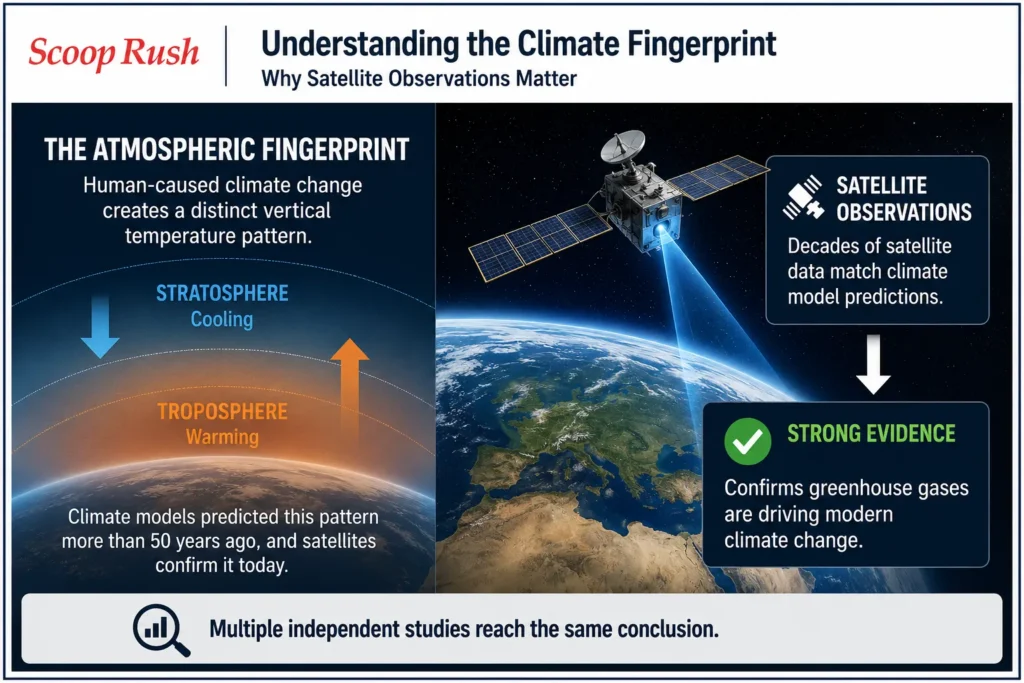
One of the strongest scientific indicators of human-caused climate change is the atmosphere’s vertical temperature pattern.

Scientists describe this pattern as the atmospheric fingerprint.

Instead of warming uniformly, greenhouse gases create a distinct structure throughout the atmosphere.

Researchers say this fingerprint includes:

  • Warming of the troposphere, the lowest atmospheric layer.
  • Cooling of the stratosphere above it.

Climate models predicted this pattern more than 50 years ago.

Today, satellite observations continue to detect exactly the same fingerprint — a reminder that Earth’s environmental systems are deeply interconnected, not unlike how scientists are still working to understand why algae blooms collapse.

According to Santer, this agreement between observations and climate models provides strong evidence that greenhouse gases are driving modern climate change.

Why Satellite Observations Matter

Satellite records allow scientists to measure atmospheric temperatures across the globe over several decades.

The new peer-reviewed study states that these observations closely match predictions made by climate models.

However, the DOE report claimed otherwise.

Santer says that conclusion is factually incorrect because satellite data consistently shows the expected atmospheric fingerprint associated with greenhouse gas emissions.

The researchers add that multiple independent scientific studies have reached the same conclusion, much like the growing body of peer-reviewed work behind other recent discoveries, including NASA’s evidence pointing to ancient life on Mars.

Scientists Say Accuracy Is Essential

The research team believes correcting scientific errors is particularly important when government reports influence public policy.

According to the authors, peer-reviewed research remains the most reliable source of scientific evidence.

They say publishing their response helps ensure that policymakers, courts, and the public have access to accurate climate information.

Other Concerns Raised About the DOE Report

The authors also note that additional scientists have questioned other sections of the DOE report, including its treatment of climate detection and attribution.

The report was cited 16 times in the EPA proposal concerning the Endangerment Finding.

Later, after a lawsuit alleged that required Federal Advisory Committee procedures had not been followed, the team responsible for producing the DOE report was dissolved.

However, the report itself remains available and has not been withdrawn or corrected.

Santer continues to argue that it should not be considered a reliable scientific source.

What This Means for Climate Science

The latest peer-reviewed paper reinforces decades of climate research rather than introducing a new theory.

According to the authors, satellite observations, atmospheric measurements, and modern climate models all continue to support the conclusion that human activities are warming Earth.

The researchers stress that scientific accuracy remains essential because climate evidence influences environmental regulations, public health policies, and future planning around the world — a principle that also applies to public health research, such as recent findings on a hidden DNA factor that could reduce Ozempic’s effectiveness and studies on omega-3 fish oil supplements and brain health.

Conclusion

“As climate policy evolves, the researchers say accurate scientific evidence should remain the foundation of future decisions. They add that careful, data-driven research remains essential across all areas of science.”

Their latest study reaffirms that the atmospheric fingerprint predicted by climate models remains visible today. As climate policy continues to evolve, the researchers say accurate scientific evidence should remain the foundation of future decisions — a pattern of careful, data-driven discovery seen across science, from the discovery of a new beetle species by Kyushu University to research on how neurons break DNA to build the brain.

FAQs

What is the Benjamin Santer Climate Report?

It refers to the debate surrounding Benjamin Santer’s response to a U.S. Department of Energy report that cited his research while reaching different conclusions about climate change.

Why did Benjamin Santer criticize the DOE report?

He says the report contains factual scientific errors and misrepresents decades of peer-reviewed climate research.

What is the atmospheric fingerprint?

It is the pattern of warming in the troposphere and cooling in the stratosphere that scientists associate with increasing greenhouse gas emissions.

What does the new study conclude?

The researchers conclude that satellite observations and climate models consistently support human-caused global warming.

Why is this debate important?

The DOE report has been used in discussions surrounding U.S. climate regulations, making scientific accuracy important for future environmental policy.

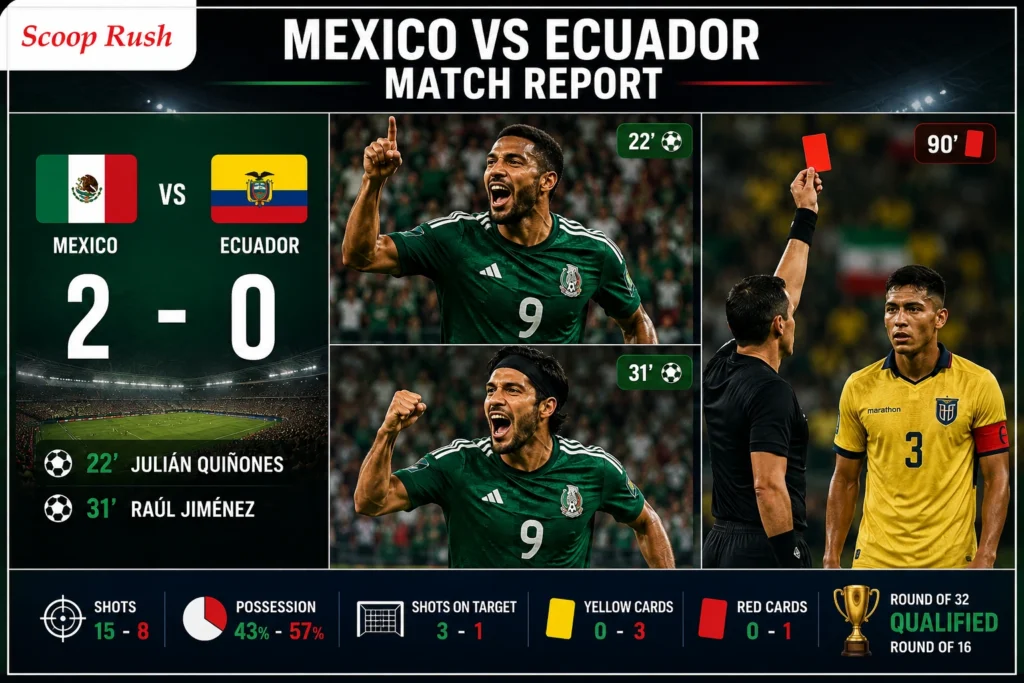
Mexico vs Ecuador: Mexico Advance to FIFA World Cup 2026 Round of 16 With 2-0 Victory

0

Competition: FIFA World Cup 2026
Round: Round of 32
Full Time: Mexico 2-0 Ecuador
Venue: Mexico City Stadium, Mexico City
Date: 1 July 2026

Mexico vs Ecuador ended with Mexico securing a convincing 2-0 victory in the FIFA World Cup 2026 Round of 32. First-half goals from Julián Quiñones and Raúl Jiménez sealed qualification for the Round of 16. Although Ecuador dominated possession, they struggled to create meaningful chances against a disciplined Mexican defence.

Mexico vs Ecuador Match Report

Mexico-vs-Ecuador-Match-Report

Mexico made an energetic start and opened the scoring in the 22nd minute. Julián Quiñones found the net after a well-worked attacking move, giving the home side an early advantage.

The lead doubled just nine minutes later. Raúl Jiménez finished calmly in the 31st minute to put Mexico firmly in control before halftime.

Ecuador enjoyed more of the ball after the break but failed to trouble Mexico’s defence. Their night ended on a disappointing note when Piero Hincapié received a straight red card in the 90th minute. Mexico comfortably protected their lead to book a place in the next round.

Goalscorers Mexico vs Ecuador

  • 22′ Julián Quiñones (Mexico)
  • 31′ Raúl Jiménez (Mexico)

Match Statistics Mexico vs Ecuador

Despite seeing less of the ball, Mexico were far more efficient in front of goal and defended with discipline throughout the contest.

StatisticMexicoEcuador
Score20
Shots158
Shots on Target31
Possession43%57%
Passes306416
Pass Accuracy83%84%
Fouls1014
Yellow Cards03
Red Cards01
Offsides01
Corners38

Mexico vs Ecuador Tactical Analysis

Mexico delivered a disciplined tactical display. They defended in a compact shape, pressed effectively in key areas, and capitalised on their best opportunities during the first half. Once ahead by two goals, they controlled the tempo and limited Ecuador to very few clear openings.

Meanwhile, Ecuador enjoyed longer spells of possession but lacked creativity in the final third. They recorded only one shot on target despite completing more passes than Mexico. The late dismissal of Piero Hincapié added to an already frustrating evening.

Mexico Starting XI

Mexico-starting-XI

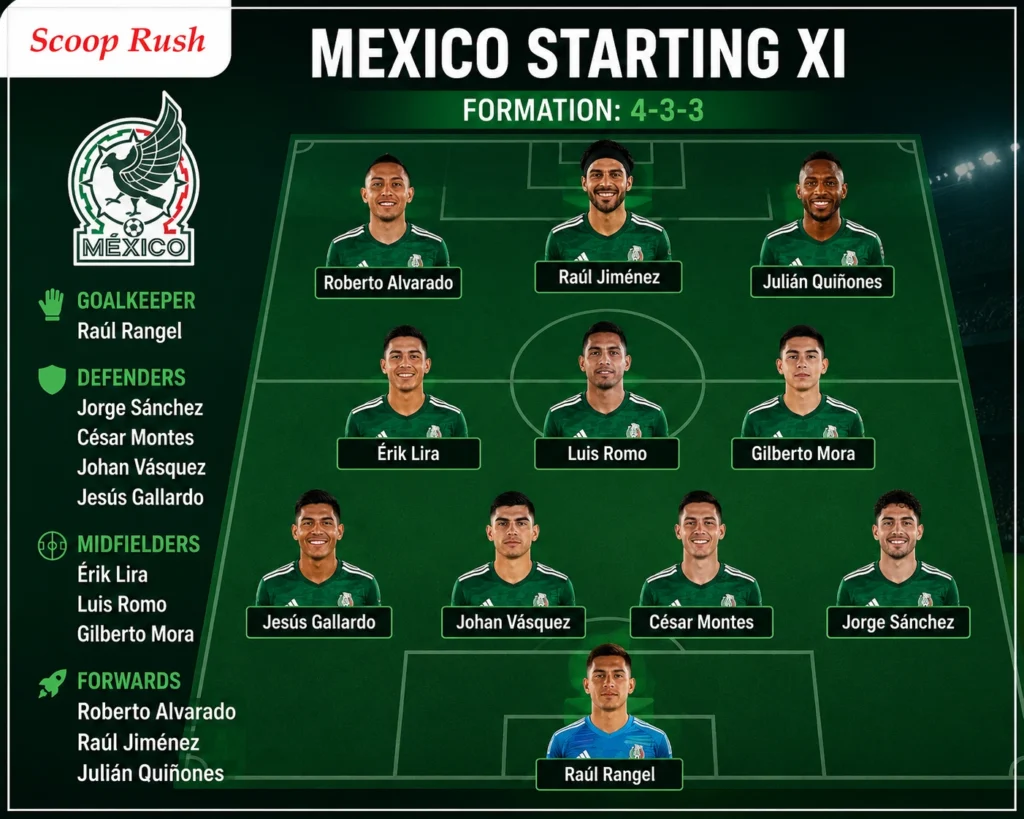
Mexico lined up in a 4-3-3 formation.

  • Goalkeeper: Raúl Rangel
  • Defenders: Jorge Sánchez, César Montes, Johan Vásquez, Jesús Gallardo
  • Midfielders: Érik Lira, Luis Romo, Gilberto Mora
  • Forwards: Roberto Alvarado, Raúl Jiménez, Julián Quiñones

Ecuador Starting XI

Ecuador-Starting-XI

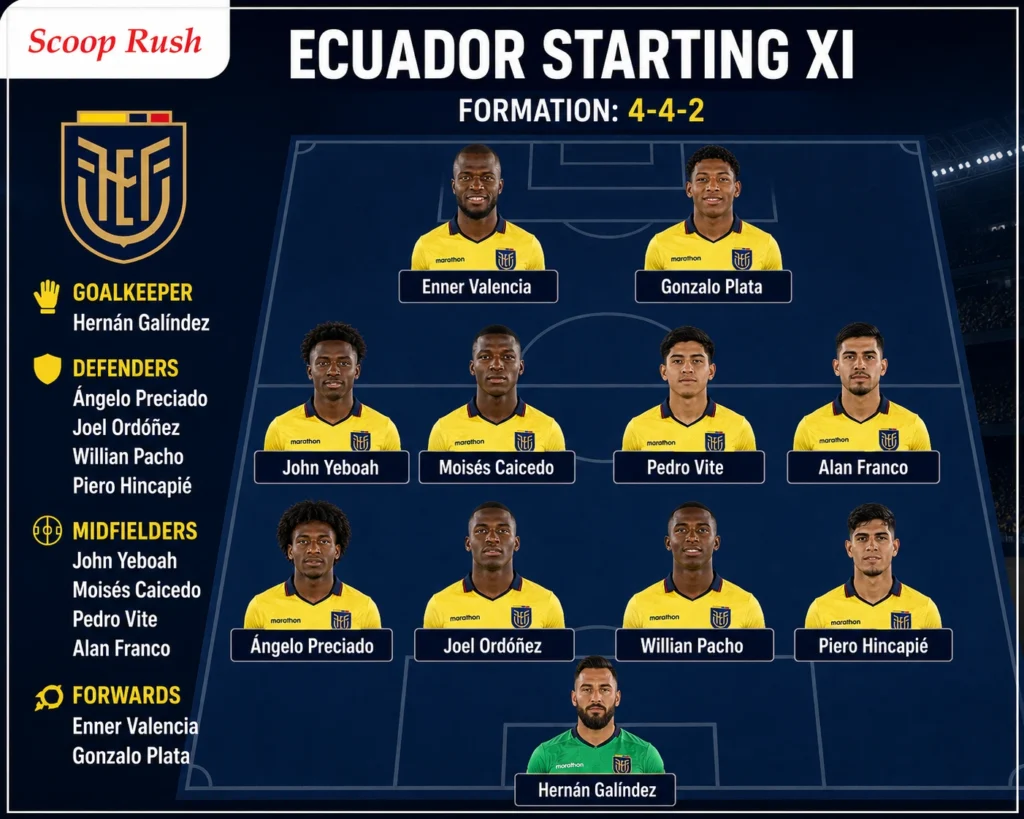
Ecuador started in a 4-4-2 formation.

  • Goalkeeper: Hernán Galíndez
  • Defenders: Ángelo Preciado, Joel Ordóñez, Willian Pacho, Piero Hincapié
  • Midfielders: John Yeboah, Moisés Caicedo, Pedro Vite, Alan Franco
  • Forwards: Enner Valencia, Gonzalo Plata

What the Result Means

Mexico progressed to the FIFA World Cup 2026 Round of 16 with another composed and efficient performance. Their clinical finishing in the opening half laid the foundation for victory, while their organised defence prevented Ecuador from mounting a comeback.

In contrast, Ecuador exited the tournament after failing to convert their possession into clear scoring opportunities. Despite controlling the ball for much of the match, they managed only one shot on target and could not break through Mexico’s resilient back line.

Conclusion

Mexico vs Ecuador demonstrated that efficiency often matters more than possession in knockout football. Mexico took their chances early, defended with confidence, and comfortably saw out the match. The result sends El Tri into the Round of 16 with growing momentum, while Ecuador bow out after an underwhelming attacking display.

How to Stay Safe During a Heat Dome: Expert Tips to Prevent Heat Exhaustion and Heat Stroke

0

What Is a Heat Dome?

A heat dome is a weather pattern where high pressure traps hot air over a region, keeping temperatures unusually high for several days. Warm nights that don’t cool down much make it harder for the body to recover from daytime heat, which raises the risk of dehydration, heat exhaustion, and heat stroke  especially for older adults, young children, and people with chronic health conditions.

What Happens to Your Body During Extreme Heat?

Your body cools itself by sweating and sending more blood flow to the skin. When temperatures climb  especially with high humidity  those cooling systems become far less effective.

As body temperature rises, dehydration develops faster than most people expect. Without intervention, mild symptoms can progress into heat exhaustion and then heat stroke, a life-threatening emergency, sometimes within minutes. Recognizing early symptoms is what makes the difference.

Stay Hydrated Before You Feel Thirsty

Drink water regularly throughout the day don’t wait until you’re thirsty, because by then your body may already be dehydrated.

Plain water is enough for most healthy adults. Sports drinks and electrolyte beverages are usually unnecessary unless a doctor recommends them or you’ve been sweating heavily for a prolonged period and it’s worth knowing the supplement risks of taking too many vitamins if you’re leaning on extra electrolyte or vitamin products to get through the heat.

Signs you may not be drinking enough:

  • Dark yellow urine
  • Dry mouth
  • Feeling thirsty
  • Fatigue
  • Lightheadedness

Water-rich fruits and vegetables can help too: watermelon, strawberries, oranges, grapes, cucumbers, and celery.

Limit alcohol during extreme heat it speeds up dehydration and can mask warning signs of heat illness. If you have a condition like heart failure, follow your doctor’s specific guidance on fluid intake.

Plan Outdoor Activities Carefully

Schedule outdoor activities for early morning or evening, when temperatures are lower. The hottest window is typically late morning through late afternoon.

If you must be outside:

  • Take frequent breaks in the shade
  • Drink water often
  • Avoid strenuous exercise
  • Wear loose-fitting, light-colored, breathable clothing like cotton or linen
  • Wear a wide-brimmed hat if you have one

Dark clothing absorbs more heat, while breathable natural fabrics help your body cool more efficiently. If you’re trying to stay active despite the heat, something like a 5-minute walk every hour during cooler parts of the day is a safer way to keep moving than a single long outdoor workout.

Keep Your Home Cool

Air conditioning is one of the best defenses against dangerous heat. If you have it, spend as much time indoors as possible during peak heat hours.

If you don’t have AC, a few home cooling tips for hot weather can make a real difference: keep curtains or sheets over sun-facing windows during the day, open windows during cooler nighttime hours, use fans to improve air circulation, and apply cool water or a damp cloth to your skin, forehead, or neck.

Many communities also open cooling centers during extreme heat. Libraries, malls, and other public buildings can offer relief if you need it.

Recognize the Early Signs of Heat Illness

Heat illness progresses in stages, and knowing the symptoms can help you catch it before it becomes an emergency.

Early Warning Sign: Heat Edema

Swelling in the hands, feet, or ankles is often one of the first signs of prolonged heat exposure. It usually improves once you move into a cool space and elevate the affected limbs.

Heat Exhaustion

A moderate but serious heat illness. Common symptoms:

  • Heavy sweating
  • Weakness
  • Fatigue
  • Dizziness
  • Fainting
  • Muscle cramps
  • Nausea
  • Vomiting
  • Pale or clammy skin
  • Fast heartbeat

If these appear:

  1. Move to a cool place immediately
  2. Drink water if the person is alert
  3. Rest
  4. Take a cool shower if possible
  5. Apply cool, wet towels to the body

Acting quickly can often stop the progression to something more serious.

Heat Stroke Is a Medical Emergency

The most severe heat illness, and it can be fatal if treatment is delayed.

Signs of heat stroke:

  • Body temperature of 103°F (39.4°C) or higher
  • Hot, red skin dry or damp
  • Severe headache
  • Confusion
  • Difficulty walking
  • Slurred speech
  • Rapid heartbeat
  • Rapid breathing
  • Seizures
  • Loss of consciousness

A change in mental status confusion, disorientation, trouble responding normally — is a key red flag.

If heat stroke is suspected:

  1. Call emergency services immediately
  2. Move the person to a cooler location
  3. Cool the body with cold cloths or a cool bath if possible
  4. Do not give fluids to someone who is unconscious or can’t swallow safely

Emergency departments typically begin aggressive cooling right away, since lowering body temperature quickly is the most effective treatment.

Who Faces the Highest Risk?

  • Older adults
  • Infants and young children
  • Pregnant women
  • People with heart disease
  • People with lung disease
  • People with kidney disease
  • People living with diabetes
  • People with certain mental health conditions

Young children can’t always describe how they feel, so unusual crying, sleepiness, irritability, or lethargy in hot weather shouldn’t be ignored. Older adults face particular heat and humidity risks since they can become dehydrated without realizing it  regular check-ins matter. People managing conditions like type 1 diabetes should also be extra cautious, since blood sugar management and heat stress can compound each other.

Some Medications Can Increase Heat Risk

Certain medications interfere with the body’s natural cooling ability, including:

  • Some blood pressure medications
  • Certain antihistamines
  • Some decongestants
  • Certain antidepressants
  • Some antipsychotic medications
  • Thyroid hormone replacement medicines
  • Prescription stimulants

These can reduce sweating or affect how the body regulates temperature. Never stop a prescribed medication without talking to your doctor first  instead, ask whether you need extra heat precautions if you’re on any long-term medication.

Alcohol and Recreational Drugs Increase the Danger

Alcohol raises dehydration risk and impairs judgment, making it harder to notice you’re overheating. Stimulant drugs such as methamphetamine and cocaine substantially raise the risk of dangerous heat illness by increasing body temperature, heart rate, and metabolic activity. Avoiding these during extreme heat lowers your risk of a medical emergency.

Protect Children During Outdoor Events

  • Encourage frequent water breaks
  • Schedule regular cooling breaks
  • Avoid prolonged vigorous play during peak heat hours
  • Watch for unusual tiredness or irritability
  • Move kids indoors right away if they seem overheated

Children heat up faster than adults, so early action matters more with them.

Check on Older Adults and Neighbors

Many heat deaths happen among older adults living alone. Small actions help: call elderly relatives, visit neighbors, help with outdoor chores, deliver meals or groceries, and confirm they have access to a cool space.

Don’t Forget Your Pets

  • Keep pets indoors when possible
  • Provide continuous fresh water
  • Ensure shaded outdoor areas
  • Don’t leave pets outside for long stretches
  • Watch for excessive panting
  • Watch for vomiting, diarrhea, or unusual tiredness

Get a pet to a vet promptly if you notice signs of overheating.

Practical Heat Safety Checklist

  • Drink plenty of water
  • Check the weather forecast
  • Wear lightweight clothing
  • Use sunscreen
  • Plan regular breaks
  • Avoid alcohol
  • Know where air-conditioned spaces are located
  • Watch children and older adults closely
  • Monitor pets carefully

Final Thoughts

Extreme heat can turn dangerous faster than many people realize. Staying hydrated, avoiding peak heat hours, recognizing early warning signs, and checking on vulnerable family members, neighbors, and pets can help keep everyone safe. Building a few consistent healthy habits in your 20s and 30s  like regular hydration and paced activity also makes it easier to handle heat stress as extreme weather becomes more common.

FAQs

1. What is a heat dome?

 A weather pattern where high atmospheric pressure traps hot air over a region, keeping temperatures unusually high for days.

2. What’s the difference between heat exhaustion and heat stroke?

 Heat exhaustion brings heavy sweating, dizziness, nausea, weakness, and cramps. Heat stroke is far more serious confusion, a body temperature of 103°F or higher, hot skin, and possible unconsciousness. It’s a medical emergency.

3. How much water should I drink during a heat wave?

 Drink regularly throughout the day rather than waiting to feel thirsty. Needs vary by age, activity level, and health conditions.

4. Who’s most at risk during extreme heat? 

Older adults, infants, young children, pregnant women, and people with heart, kidney, or lung disease, diabetes, or certain mental health conditions.

5. What should I do if someone shows signs of heat stroke?

 Call emergency services immediately, move them somewhere cool, begin cooling with cool water or cold cloths, and don’t give fluids if they’re unconscious or can’t swallow safely.

Medical Disclaimer:

This article is for informational purposes only and should not replace professional medical advice. Consult a healthcare provider if you experience symptoms of heat-related illness.

France vs Sweden Result: France Beat Sweden 3-0 to Reach FIFA World Cup 2026 Last 16

0

Competition: FIFA World Cup 2026
Round: Round of 32
Date: 01 July 2026
Venue: New York New Jersey Stadium, East Rutherford
Full-Time Result: France 3-0 Sweden

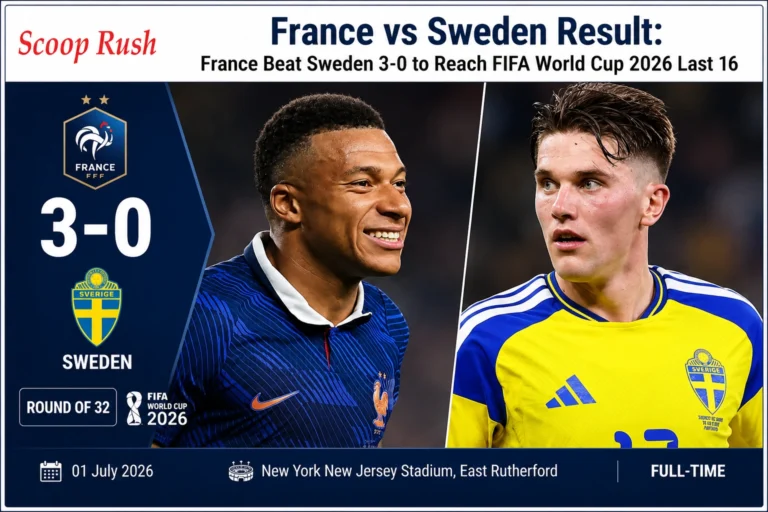
A clinical display, a dominant performance, and another memorable night for Kylian Mbappé. The France vs Sweden Result saw France secure a convincing 3-0 victory over Sweden in the FIFA World Cup 2026 Round of 32, booking their place in the next stage of the tournament.

From the opening whistle, France controlled the tempo and created chances with confidence. Sweden fought hard defensively but struggled to match France’s attacking quality. As a result, the former world champions moved comfortably into the Round of 16 with another impressive World Cup performance.

Why This Victory Matters

The knockout rounds leave no room for mistakes. Every match is an opportunity to continue the dream of lifting the FIFA World Cup trophy.

France entered this Round of 32 fixture knowing that a disciplined and professional performance would be required. They delivered exactly that. Their attacking efficiency, midfield control, and defensive organization proved too much for Sweden throughout the contest.

Meanwhile, Sweden aimed to frustrate France and create opportunities on the counterattack. However, France dominated possession and consistently forced Sweden onto the back foot.

Match Summary

Goals

  • Kylian Mbappé – 45′
  • Bradley Barcola – 53′
  • Kylian Mbappé – 74′

France entered halftime with a deserved lead after Mbappé found the breakthrough just before the interval. Shortly after the restart, Bradley Barcola doubled France’s advantage, giving Sweden an even bigger challenge.

Later in the second half, Mbappé struck once again to complete the scoring and secure a comfortable victory.

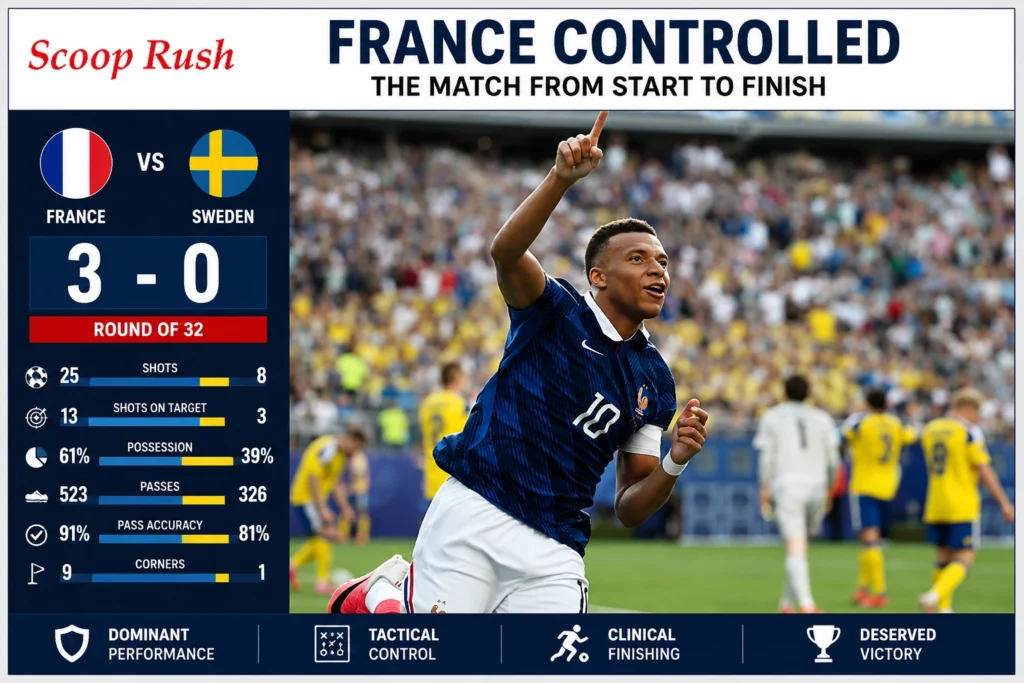
France Controlled the Match from Start to Finish

France Controlled the Match from Start to Finish

France dictated play throughout the game.

They moved the ball quickly, pressed aggressively, and rarely allowed Sweden to settle into possession. Every attacking move looked dangerous, while the midfield controlled both tempo and space.

Sweden defended with determination but found it difficult to create sustained pressure in the final third.

As the match progressed, France’s quality became increasingly evident.

Kylian Mbappé Delivered Another Match-Winning Performance

Once again, Kylian Mbappé proved why he remains one of football’s biggest stars.

His opening goal arrived at a crucial moment just before halftime, giving France momentum heading into the break. After Barcola extended the lead early in the second half, Mbappé added his second goal in the 74th minute to complete an outstanding individual display.

Beyond scoring twice, Mbappé remained a constant threat with his movement, pace, and intelligent positioning.

Bradley Barcola Added the Perfect Second Goal

While Mbappé grabbed the headlines, Bradley Barcola also played an important role.

His goal in the 53rd minute gave France breathing space and forced Sweden to push forward in search of a comeback. That created even more space for France’s attack to exploit.

Barcola’s finish reflected France’s confidence and attacking quality throughout the evening.

France Dominated the Team Statistics

The numbers underline France’s superiority.

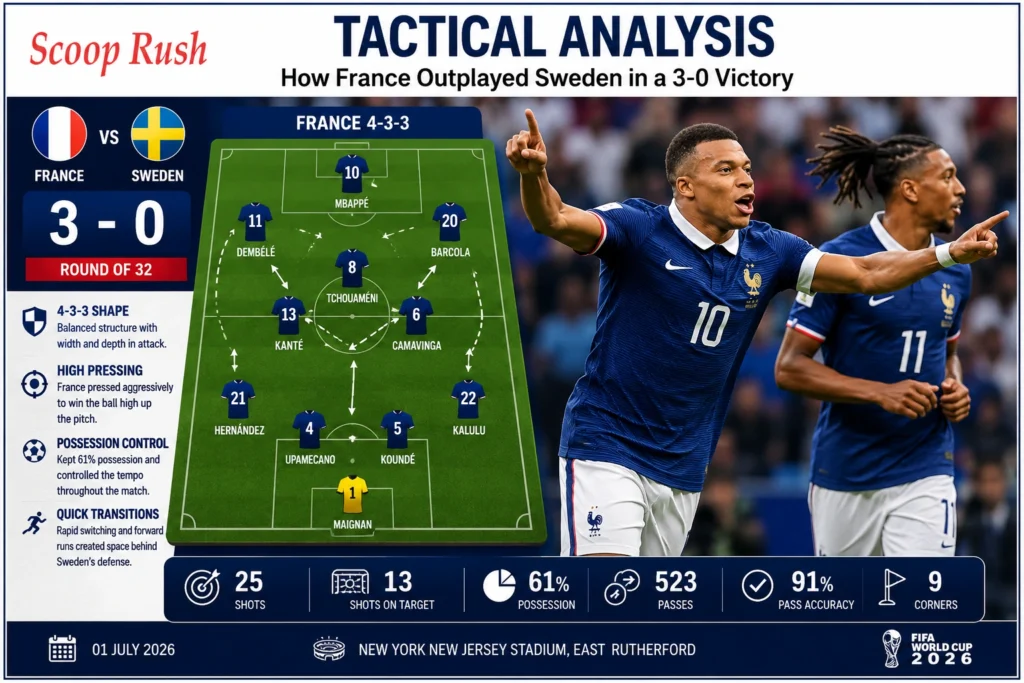
Team Stats

StatisticFranceSweden
Shots258
Shots on Target133
Possession61%39%
Passes523326
Pass Accuracy91%81%
Fouls1410
Yellow Cards00
Red Cards00
Offsides31
Corners91

France created more than three times as many shots on target as Sweden. Additionally, they completed nearly 200 more passes while maintaining outstanding passing accuracy.

The nine corner kicks also highlighted France’s sustained attacking pressure.

Sweden Found Few Opportunities

Sweden entered the knockout fixture hoping to produce an upset.

However, France’s organized defensive structure prevented Sweden from creating consistent scoring opportunities.

Although Sweden managed eight shots overall, only three tested the French goalkeeper. Furthermore, limited possession meant Sweden spent long periods defending deep inside their own half.

Despite their effort, they could not recover after conceding the opening goal.

France’s Midfield Controlled Every Phase

France’s midfield played a crucial role in the victory.

The players recycled possession effectively, won second balls, and launched attacks with precision. Consequently, Sweden struggled to build any meaningful rhythm.

Every transition favored France, allowing the attacking players to receive the ball in dangerous positions.

This control became one of the defining features of the match.

Defensive Stability Made the Difference

France not only attacked well but also defended with discipline.

The defensive line remained compact throughout the contest, limiting Sweden’s space between the lines.

Moreover, France avoided unnecessary mistakes and finished the game without receiving a yellow or red card.

Their organization allowed the attacking players to focus on creating chances.

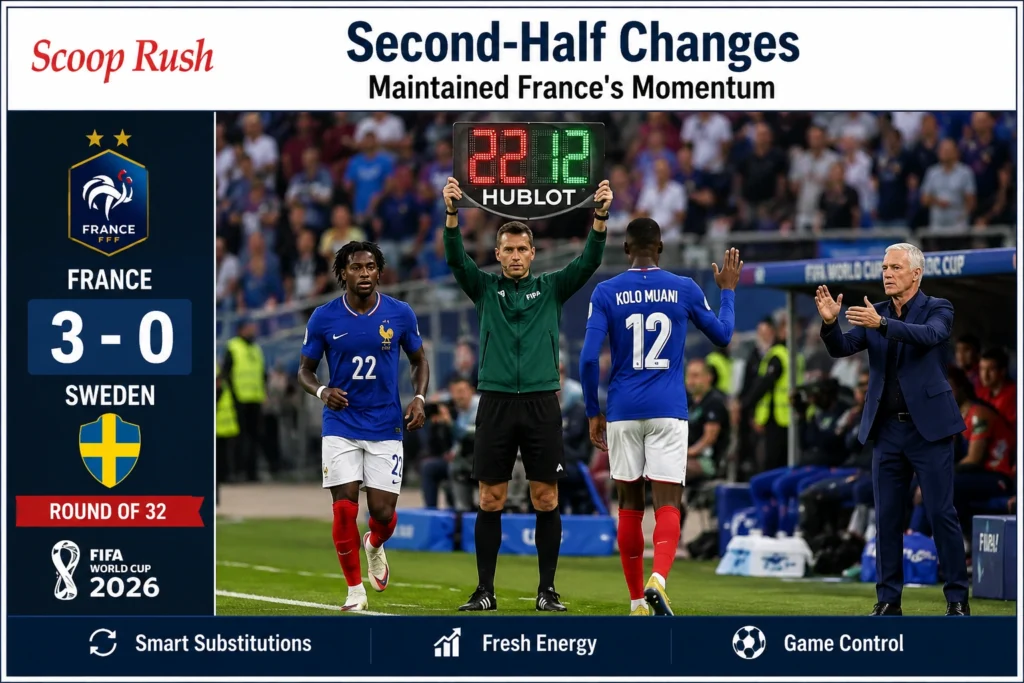
Second-Half Changes Maintained France’s Momentum

Second-Half Changes Maintained France's Momentum

As the match progressed, France introduced fresh players from the bench.

These substitutions helped maintain the team’s intensity while protecting key players for the next knockout round.

Sweden also made several substitutions in an attempt to change the game. Nevertheless, France continued to dominate possession and comfortably managed the remaining minutes.

Key Performers

Kylian Mbappé

  • Two goals
  • Opened the scoring before halftime
  • Added another after the hour mark
  • Constant attacking threat

Bradley Barcola

  • Scored France’s second goal
  • Linked play effectively
  • Helped stretch Sweden’s defense

France Midfield

  • Controlled possession
  • Maintained a 91% passing accuracy
  • Dictated the tempo throughout the match

Tactical Analysis

Tactical Analysis

France’s tactical approach combined patient possession with quick attacking transitions.

Instead of forcing attacks, France waited for openings before accelerating into dangerous areas. Consequently, Sweden struggled to keep their defensive shape intact.

Meanwhile, Sweden attempted to remain compact and defend in numbers. However, France’s movement between the lines consistently created space.

The result was a balanced yet highly effective attacking performance from the French side.

What This Result Means

France advanced to the next stage of the FIFA World Cup 2026 after a commanding Round of 32 victory.

Their performance demonstrated why they remain among the strongest contenders in the tournament.

For Sweden, the defeat brings their World Cup campaign to an end despite their determined effort against one of football’s elite nations.

France will now look ahead with confidence as they prepare for an even tougher challenge in the knockout rounds.

Conclusion

The France vs Sweden Result reflected France’s quality across every area of the pitch. Kylian Mbappé’s two goals, Bradley Barcola’s strike, and an excellent team performance secured a convincing 3-0 victory in the FIFA World Cup 2026 Round of 32.

France dominated possession, created significantly more chances, and defended with discipline throughout the match. As a result, they deservedly progressed to the next round with growing confidence.

If they continue performing at this level, France will remain one of the strongest contenders for the FIFA World Cup 2026 title.

FAQs

1. What was the France vs Sweden Result?

France defeated Sweden 3-0 in the FIFA World Cup 2026 Round of 32.

2. Who scored for France against Sweden?

Kylian Mbappé scored twice, while Bradley Barcola added the third goal.

3. Where was France vs Sweden played?

The match took place at New York New Jersey Stadium, East Rutherford.

4. How did France perform statistically?

France dominated with 25 shots, 13 shots on target, 61% possession, 523 passes, 91% pass accuracy, and nine corners.

5. What does this result mean for France?

The victory sends France into the Round of 16 of the FIFA World Cup 2026, where they will continue their knockout-stage campaign.

Swift Telescope Rescue: Robotic Mission to Save NASA Observatory From Falling Into Earth’s Atmosphere

0

Introduction: Swift Telescope Rescue Mission Could Change the Future of Space Operations

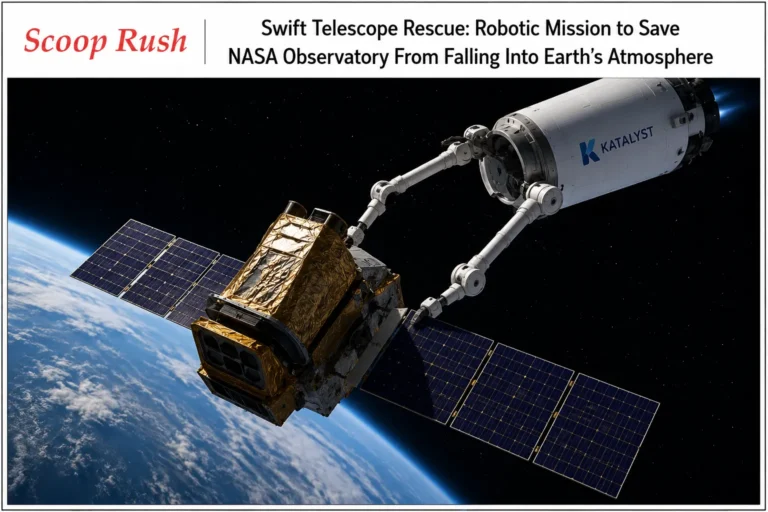
A NASA space telescope is slowly losing altitude and moving closer to its possible destruction, but a groundbreaking robotic mission could give it a second life. The Swift telescope rescue mission is attempting something never done before by sending a robotic spacecraft to capture and move an aging observatory back into a safer orbit.

The Neil Gehrels Swift Observatory has spent more than two decades studying some of the universe’s most powerful events, including gamma-ray bursts. However, increased atmospheric drag caused by stronger solar activity has accelerated the telescope’s fall toward Earth.

Now, NASA and private space company Katalyst are preparing a historic solution. A robotic spacecraft called LINK will attempt to connect with Swift and raise its orbit, protecting the telescope from burning up in Earth’s atmosphere.

The mission could become a major milestone in space technology because it may prove that satellites can be repaired, repositioned, and extended instead of simply being abandoned — a shift not unlike other recent NASA discoveries reshaping how we think about space exploration.

What Is the Swift Telescope Rescue Mission?

What Is the Swift Telescope Rescue Mission?

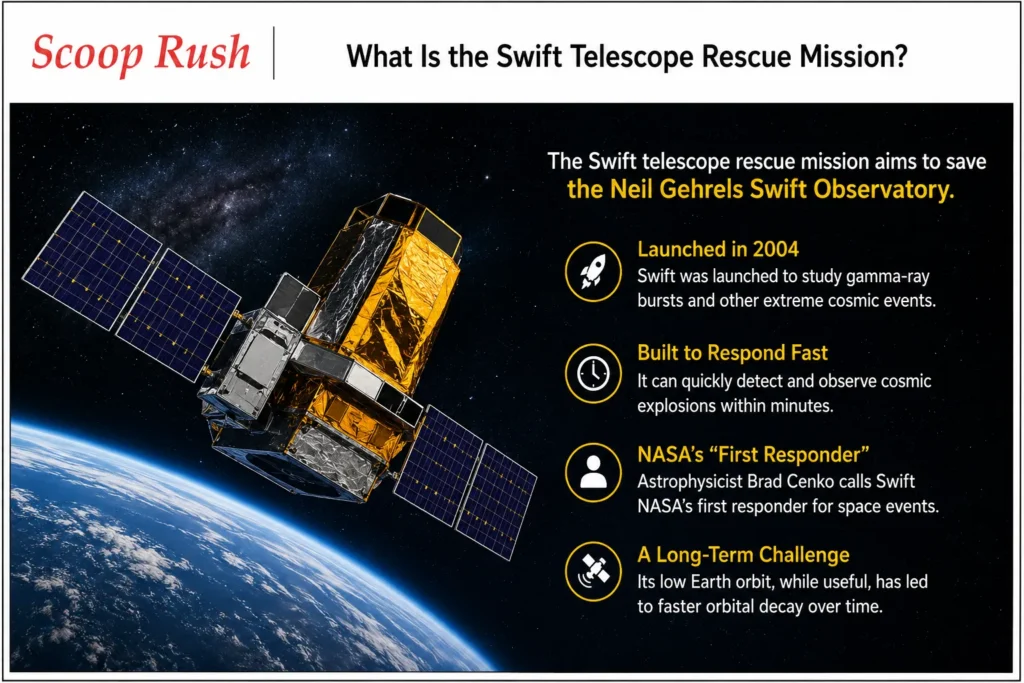
The Swift telescope rescue mission focuses on saving the Neil Gehrels Swift Observatory, which launched in 2004 to study gamma-ray bursts and other extreme cosmic events.

When Swift first entered orbit, scientists expected it to operate for only about two years. However, the telescope continued working for decades and became one of NASA’s most successful space observatories.

Swift is unique because it can quickly respond to sudden events in space. When a powerful cosmic explosion occurs, the telescope can move and begin observing within minutes.

Astrophysicist Brad Cenko described Swift as NASA’s “first responder” because of its ability to react quickly to unexpected discoveries.

However, the same low Earth orbit that allowed Swift to communicate effectively with scientists also created a long-term challenge.

Why Is NASA’s Swift Telescope Falling Toward Earth?

Why Is NASA's Swift Telescope Falling Toward Earth?

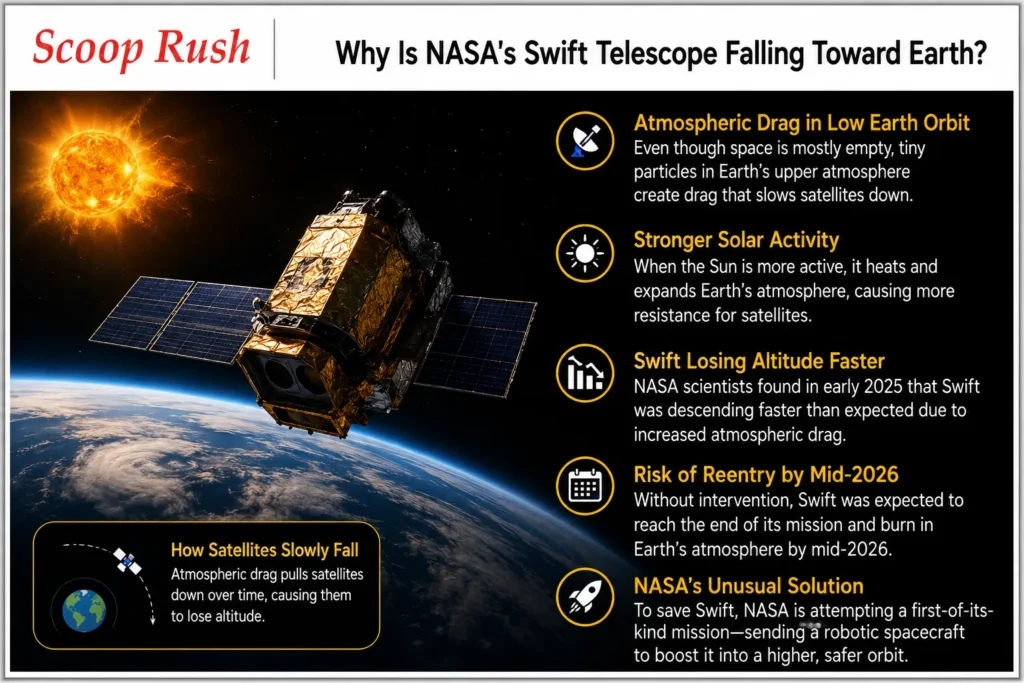
Satellites in low Earth orbit experience atmospheric drag. Although space is extremely thin, small particles in Earth’s upper atmosphere can slowly reduce a spacecraft’s altitude.

During stronger solar activity, the Sun releases additional energy that heats and expands Earth’s atmosphere. As a result, satellites experience more resistance — a dynamic that also plays into broader climate patterns tracked by NASA satellite imagery.

NASA scientists discovered in early 2025 that Swift was losing altitude faster than expected. The increased drag meant the telescope could eventually return to Earth’s atmosphere and burn apart.

Without action, Swift was expected to reach the end of its mission in mid-2026.

Therefore, NASA decided to attempt an unusual solution: sending another spacecraft to physically move the telescope into a higher orbit.

How Will the Swift Telescope Rescue Work?

How Will the Swift Telescope Rescue Work

LINK Robotic Spacecraft Will Attempt a Historic Satellite Save

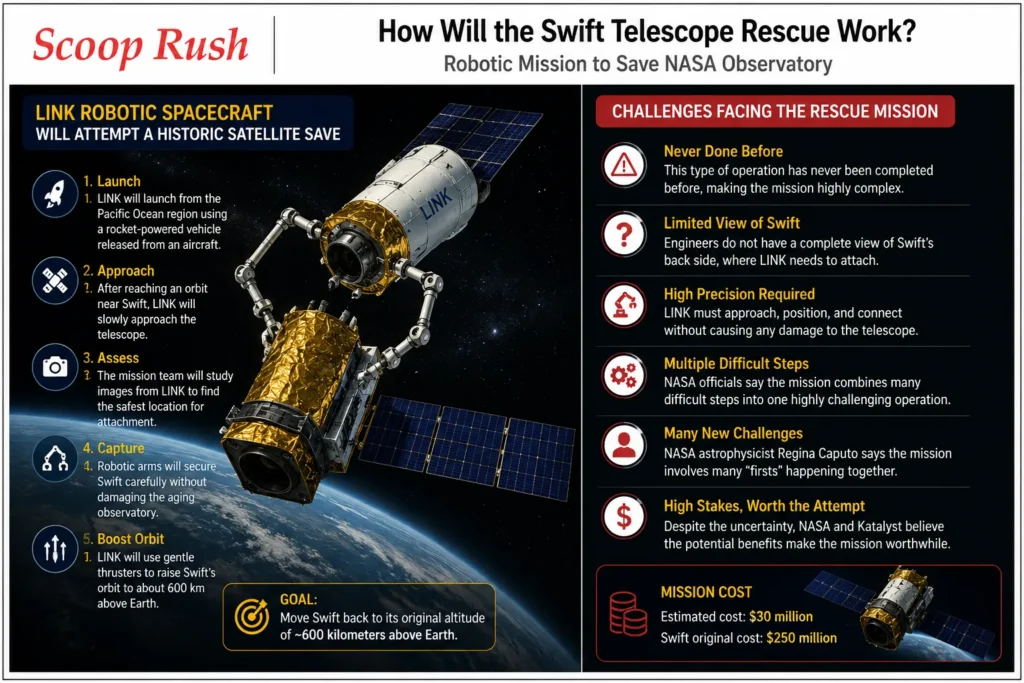
The rescue mission depends on LINK, a robotic spacecraft designed to approach, capture, and move the Swift Observatory.

The spacecraft will launch from the Pacific Ocean region using a rocket-powered launch vehicle. Unlike traditional launches, the vehicle will be released from an aircraft instead of launching directly from a ground platform.

After reaching an orbit near Swift, LINK will slowly approach the telescope.

The mission team will study images from LINK to identify the safest location for attachment.

Once the robotic arms secure Swift, the spacecraft will use gentle thrusters to raise the telescope’s orbit.

The goal is to move Swift back toward its original altitude of about 600 kilometers above Earth.

Challenges Facing the Swift Telescope Rescue Mission

The Swift telescope rescue attempt involves several difficult challenges because this type of operation has never been completed before.

One major problem is that engineers do not have a complete view of Swift’s back side, which is where LINK needs to attach.

The robotic spacecraft must carefully approach the telescope, identify the correct position, and connect without damaging the aging observatory.

NASA officials have explained that the mission combines multiple difficult steps into one operation.

According to NASA astrophysicist Regina Caputo, the mission involves many new challenges happening together.

Despite the uncertainty, NASA and Katalyst believe the possible benefits make the attempt worthwhile.

The mission is expected to cost around $30 million, while Swift originally cost about $250 million.

Why Saving Swift Matters for Science

The Swift Observatory remains extremely valuable because it provides scientists with unique observations.

The telescope studies gamma-ray bursts, which are among the most energetic events in the universe. These events happen very quickly, so scientists need instruments that can respond immediately — much like the rapid-response research behind discoveries such as the cannibal supergiant microbe Euplotes gigatrox, where timing and observation were critical to the finding.

Replacing Swift would take years of planning and development. Therefore, extending its operational life could protect decades of scientific work.

Additionally, the rescue mission could influence future satellite operations.

If successful, similar robotic systems could help maintain other spacecraft, including older space telescopes.

Could the Swift Telescope Rescue Technology Help Other Satellites?

The Swift telescope rescue mission could introduce a new way of managing spacecraft in orbit.

Traditionally, satellites have limited lifespans. When they lose altitude, run out of resources, or develop problems, they are often left behind.

However, robotic servicing missions could change the future of space exploration, echoing how scientists are also finding new ways to extend the life of everyday materials, such as turning ocean plastic into recycled asphalt roads in Hawaii.

Future spacecraft may be repaired, upgraded, repositioned, or given additional years of operation.

Katalyst believes this type of technology could support a new model of satellite maintenance, including repairing and upgrading spacecraft that were not originally designed for rescue missions.

What Happens After the Rescue Attempt?

Before the mission begins, Swift’s operations team has already adjusted the telescope’s activities to reduce drag and slow its descent.

Currently, Swift is not collecting scientific data.

If LINK successfully moves the telescope into a safer orbit, Swift will need a system restart. Scientists expect returning to normal operations could take a month or more.

After recovery, the telescope could continue studying the universe for many additional years.

The Future Impact of the Swift Telescope Rescue Mission

The Swift telescope rescue mission represents more than saving one spacecraft.

For decades, space missions have focused mainly on launching new technology. However, this operation highlights a new possibility: protecting and extending the technology already operating in space.

Swift has already provided important discoveries about the universe. A successful rescue could allow it to continue contributing to science, joining a growing list of breakthroughs — from new beetle species discovered by Kyushu University to research on how neurons break DNA to build the brain — that show how much is still being uncovered about our world and beyond.

Although the mission faces major risks, it could become an important step toward a future where satellites receive repairs instead of reaching the end of their lives.

Conclusion

The Swift telescope rescue mission is a historic attempt to save NASA’s Neil Gehrels Swift Observatory from falling into Earth’s atmosphere.

A robotic spacecraft called LINK will try to capture the telescope and move it into a safer orbit.

If successful, the mission could change how scientists manage satellites by proving that spacecraft can be repaired, repositioned, and extended.

The result of the mission remains uncertain, but its goal represents a major advancement in space technology.

FAQs

1. Why does the Swift telescope need rescue?

The Swift telescope is losing altitude because increased solar activity expanded Earth’s atmosphere, creating more drag on the spacecraft.

2. What is the Swift telescope rescue mission?

The mission uses a robotic spacecraft called LINK to capture Swift and move it into a higher orbit.

3. When was the Swift Observatory launched?

The Neil Gehrels Swift Observatory launched in 2004 to study gamma-ray bursts and cosmic events.

4. What happens if the rescue mission fails?

Without intervention, Swift may eventually reenter Earth’s atmosphere and burn apart.

5. Could this technology save other satellites?

Yes, successful results could help develop future missions that repair and extend the lives of other spacecraft.

Côte d’Ivoire vs Norway: Haaland Sends Norway Into the FIFA World Cup Last 16

0

Competition: FIFA World Cup 2026
Round: Round of 32
Date: 30 Jun 2026
Venue: Dallas Stadium, Arlington
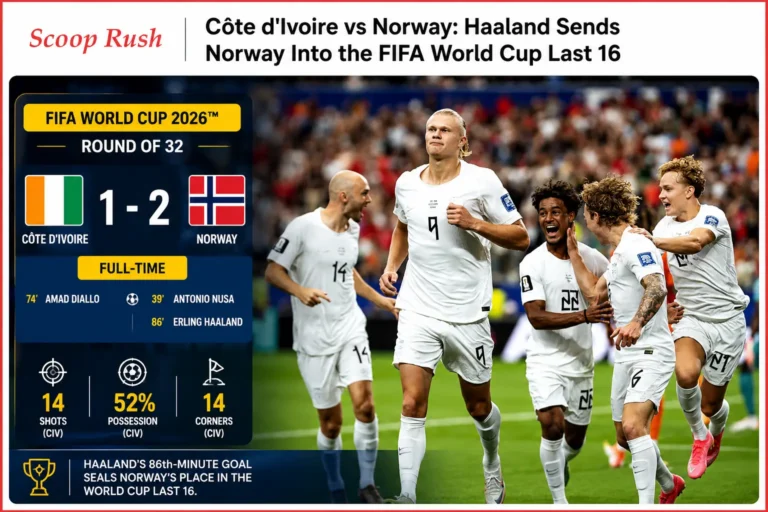
Full-Time Result: Côte d’Ivoire 1-2 Norway

Football’s knockout stages often produce moments that define tournaments, and the Côte d’Ivoire vs Norway Round of 32 clash delivered exactly that. After a tightly contested encounter at Dallas Stadium in Arlington, Norway emerged with a 2-1 victory thanks to a decisive late goal from Erling Haaland.

Côte d’Ivoire showed resilience, controlled large portions of possession, and created more chances throughout the match. However, Norway’s clinical finishing proved to be the difference. Antonio Nusa opened the scoring before Amad Diallo brought the Ivorians level. Just when extra time appeared likely, Haaland struck in the closing stages to send Norway through and end Côte d’Ivoire’s World Cup campaign.

For fans, this match was a reminder that knockout football is not always decided by who creates the most chances. Efficiency in front of goal often matters most, and Norway demonstrated that perfectly.

Match Overview: Côte d’Ivoire vs Norway Ends 2-1

The Round of 32 fixture featured two teams determined to secure a place in the next stage of the FIFA World Cup 2026.


Goalscorers

Norway

  • Antonio Nusa (39′)
  • Erling Haaland (86′)

Côte d’Ivoire

  • Amad Diallo (74′)

The scoreline reflected a closely fought battle. Côte d’Ivoire pushed hard for long periods, but Norway capitalized on key moments to secure progression.

Côte d’Ivoire vs Norway First Half Analysis

Côte d'Ivoire vs Norway First Half Analysis

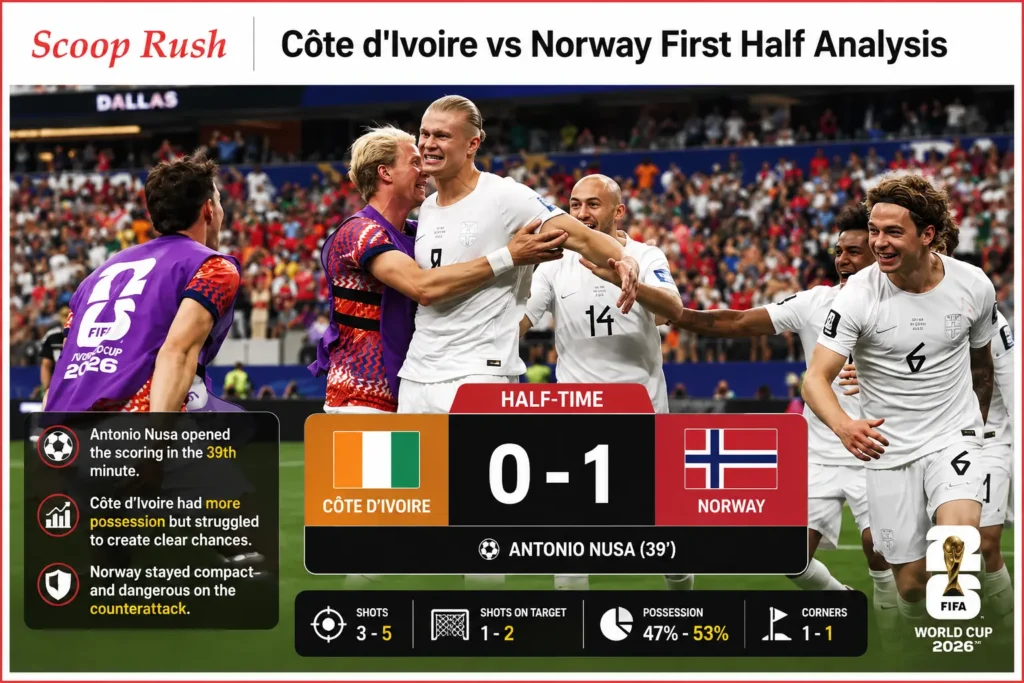
The opening stages were competitive, with both teams looking to establish control. Côte d’Ivoire enjoyed slightly more possession and attempted to build attacks through patient passing combinations.

Despite that territorial advantage, Norway remained dangerous whenever they moved forward. Their ability to transition quickly allowed them to threaten the Ivorian defense.

The breakthrough came in the 39th minute.

Antonio Nusa Gives Norway the Lead

Norway found the opening goal through Antonio Nusa, who finished a crucial attacking move to put his side ahead before halftime.

The goal altered the complexion of the match. Côte d’Ivoire suddenly faced the challenge of chasing the game, while Norway could focus on protecting their advantage and exploiting spaces on the counterattack.

Heading into the break, Norway held a valuable 1-0 lead despite Côte d’Ivoire seeing plenty of the ball.

Côte d’Ivoire Respond After the Break

Trailing by one goal in a knockout match, Côte d’Ivoire returned for the second half with greater urgency.

The African side increased the pressure and continued to create opportunities. Their attacking intent was reflected in the statistics, as they generated more shots than Norway over the course of the game.

The persistence eventually paid off.

Amad Diallo Brings Côte d’Ivoire Back Into the Match

In the 74th minute, Amad Diallo delivered the equalizer that Côte d’Ivoire had been searching for.

The goal energized the team and their supporters. With the score tied at 1-1 and momentum seemingly shifting, the match appeared destined for a tense finish.

Diallo’s strike rewarded Côte d’Ivoire for their sustained attacking efforts and set up a fascinating final phase.

Erling Haaland Delivers the Decisive Blow

As the match entered its closing minutes, both sides understood the significance of every attack.

Norway once again demonstrated why efficiency can outweigh volume.

In the 86th minute, Erling Haaland produced the decisive moment of the contest. His goal restored Norway’s lead and left Côte d’Ivoire with little time to respond.

The late strike proved to be the winner.

For Norway, it was a classic knockout-stage performance. They absorbed pressure, remained composed, and took advantage of their opportunities when they mattered most.

For Côte d’Ivoire, the goal was heartbreaking given the effort they had invested throughout the match.

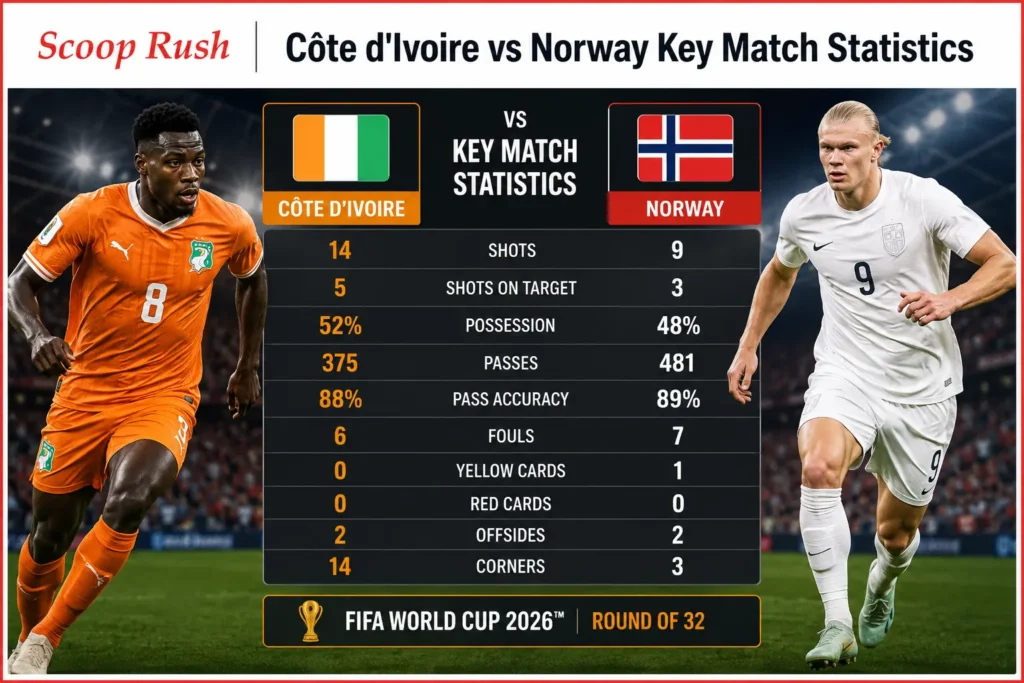
Côte d’Ivoire vs Norway Key Match Statistics

Côte d'Ivoire vs Norway Key Match Statistics

The numbers reveal just how competitive the contest was.

Match Stats

StatisticCôte d’IvoireNorway
Shots149
Shots on Target53
Possession52%48%
Passes375481
Pass Accuracy88%89%
Fouls67
Yellow Cards01
Red Cards00
Offsides22
Corners143

Several figures stand out immediately.

Côte d’Ivoire recorded more shots than Norway. Furthermore, they produced more shots on target. Additionally, they earned 14 corners, while Norway managed only three. However, Norway made better use of their chances. Their 14 corners compared to Norway’s 3 suggest that much of the attacking pressure came from the Ivorian side.

Norway, meanwhile, completed more passes and maintained slightly better passing accuracy. Most importantly, they converted their chances more effectively.

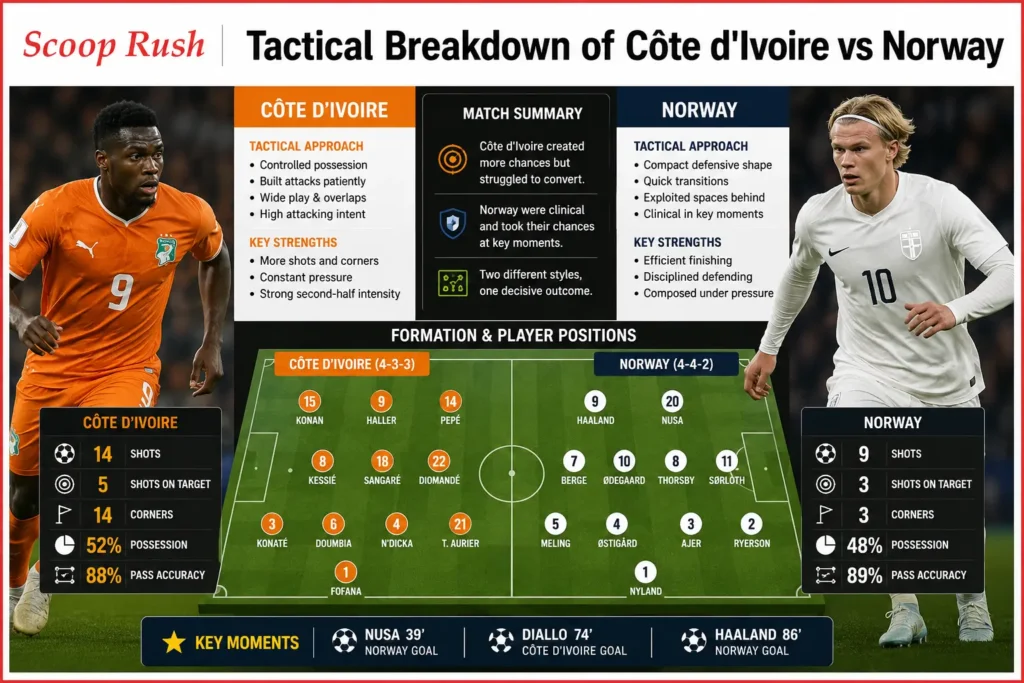
Tactical Breakdown of Côte d’Ivoire vs Norway

Tactical Breakdown of Côte d'Ivoire vs Norway

Côte d’Ivoire’s Approach

Côte d’Ivoire attempted to control the game through possession and sustained attacking pressure.

Their statistical edge in shots and corners indicates a team willing to push numbers forward and create opportunities from wide areas and set-piece situations.

The equalizing goal from Amad Diallo highlighted their determination and attacking quality.

However, despite creating more opportunities, they struggled to turn that advantage into multiple goals.

Norway’s Approach

Norway’s performance was built around discipline and efficiency.

They did not dominate possession or generate a high number of chances, but they made key moments count.

Antonio Nusa’s first-half opener gave Norway a platform, while Haaland’s late winner showcased their ability to capitalize under pressure.

Their defensive organization also played an important role in limiting the damage despite facing numerous corners and attacking sequences.

Important Substitutions

Both teams made changes during the second half in an effort to influence the outcome.

Côte d’Ivoire Changes

  • Ibrahima Touré replaced Christian Konan
  • Oumar Diakité replaced Nicolas Pépé

Norway Changes

  • Evan Guessand replaced Yan Diomande

These substitutions reflected the intensity of the contest as both coaches searched for fresh energy and tactical adjustments.

While several players entered the match during the closing stages, it was Haaland’s decisive finish that ultimately shaped the result.

Players Who Influenced the Match

Erling Haaland The Norwegian striker once again demonstrated his value in knockout football. His 86th-minute goal settled the contest and ensured Norway’s progression. In tight matches, elite forwards are often judged by their ability to deliver decisive moments, and Haaland did exactly that.

Antonio Nusa Nusa’s first-half goal provided Norway with the early advantage. Scoring before halftime gave Norway confidence and forced Côte d’Ivoire into a more aggressive second-half approach.

Amad Diallo Diallo was Côte d’Ivoire’s standout attacking contributor. His equalizer in the 74th minute brought his team back into the match and briefly shifted momentum in their favor.

Why Norway Advanced

Several factors contributed to Norway’s success.

Clinical Finishing Norway scored twice from only three shots on target. Their ability to convert opportunities proved decisive.

Defensive Resilience Facing 14 corners and multiple attacking waves is never easy. Norway managed to withstand significant pressure throughout the match.

Composure in Crucial Moments The winning goal arrived late, but Norway remained patient and focused. Their composure allowed them to seize the defining moment when it arrived.

What the Result Means

For Norway, the victory represents a significant achievement and secures their place in the next phase of the tournament.

Winning knockout matches often requires balancing defensive discipline with attacking quality. Norway managed both effectively and now moves forward with confidence.

For Côte d’Ivoire, the defeat is a disappointing end to their World Cup journey. Despite creating more opportunities and controlling important stretches of the game, they were unable to overcome Norway’s efficiency.

Their performance nevertheless demonstrated competitiveness and determination against a strong opponent.

Conclusion

The Côte d’Ivoire vs Norway Round of 32 encounter showcased everything that makes knockout football compelling. Côte d’Ivoire generated more chances, earned more corners, and fought back through Amad Diallo’s equalizer. Yet Norway displayed the quality that often decides major tournament matches.

Antonio Nusa’s first-half strike established the platform, while Erling Haaland’s 86th-minute winner delivered the decisive moment. The 2-1 victory sends Norway into the next round and leaves Côte d’Ivoire wondering what might have been after an otherwise strong performance.

In the end, Norway’s clinical finishing and composure under pressure proved stronger than Côte d’Ivoire’s attacking volume, securing their place in the next stage of the FIFA World Cup 2026.

FAQs

1. What was the final score between Côte d’Ivoire and Norway?

Norway defeated Côte d’Ivoire 2-1 in the FIFA World Cup 2026 Round of 32.

2. Who scored for Norway against Côte d’Ivoire?

Antonio Nusa scored in the 39th minute, and Erling Haaland scored the winning goal in the 86th minute.

3. Who scored Côte d’Ivoire’s goal?

Amad Diallo scored Côte d’Ivoire’s only goal in the 74th minute.

4. Which team had more shots in the match?

Côte d’Ivoire recorded 14 shots compared to Norway’s 9.

5. Why did Norway win the match?

Norway won because they were more clinical with their chances, scoring two goals from three shots on target while maintaining defensive discipline throughout the match.

Netherlands vs Morocco: Morocco Beat Netherlands on Penalties to Reach FIFA World Cup 2026 Round of 16

0

Competition: FIFA World Cup 2026
Round: Round of 32
Date: 29 June 2026
Venue: Estadio Monterrey, Guadalupe, Mexico
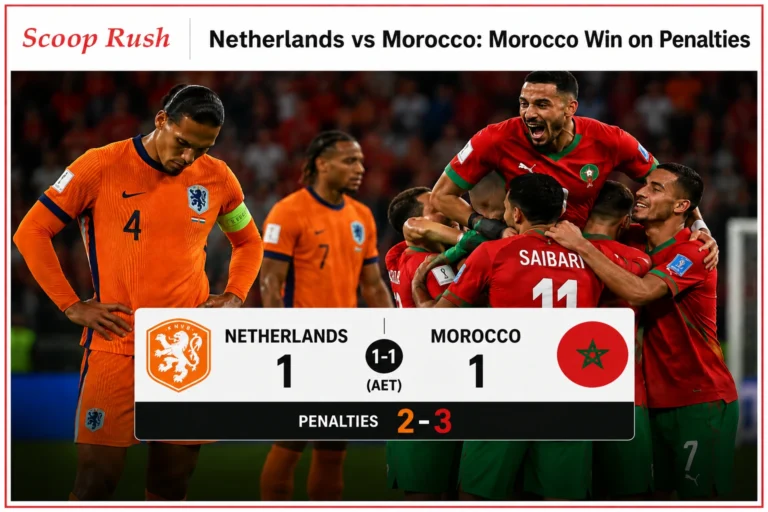
Full Time: Netherlands 1-1 Morocco (After Extra Time)
Penalty Shootout: Netherlands 2-3 Morocco

Netherlands vs Morocco: Match Report

Morocco secured a memorable place in the FIFA World Cup 2026 Round of 16 after defeating the Netherlands 3-2 on penalties following a 1-1 draw after extra time. The Netherlands vs Morocco encounter featured late drama, resilient defending, and a tense shootout that ended with the Atlas Lions celebrating a famous victory.

The Netherlands threatened early with quick attacks, while Morocco focused on controlling possession through patient build-up play. As the match progressed, Morocco dictated the tempo and created the better chances, although the Dutch remained dangerous on the counterattack.

Netherlands vs Morocco: Goalscorers

Netherlands-vs-Morocco-Goalscores

Netherlands: Cody Gakpo 72′ Morocco: Issa Diop 90+1′

The breakthrough arrived in the 72nd minute when Cody Gakpo finished confidently after being set up by Crysencio Summerville.

The Netherlands looked set to progress, but Morocco produced a dramatic response in second-half stoppage time. Substitute Chemsdine Talbi delivered a dangerous cross that defender Issa Diop headed into the net in the 90+1st minute, sending the match into extra time.

Neither side managed to score during the additional 30 minutes, leaving the Round of 32 contest to be decided by penalties.

Netherlands vs Morocco: Penalty Shootout

The shootout proved every bit as dramatic as the match itself.

Morocco missed penalties through Achraf Hakimi and Neil El Aynaoui. However, goalkeeper Yassine Bounou produced a decisive save to keep his side in control.

The Netherlands failed to convert through Quinten Timber, Justin Kluivert, and Crysencio Summerville. Finally, Ismael Saibari calmly scored the winning penalty to send Morocco into the Round of 16 a shootout swing reminiscent of Paraguay’s penalty win over Germany earlier in the knockout stage.

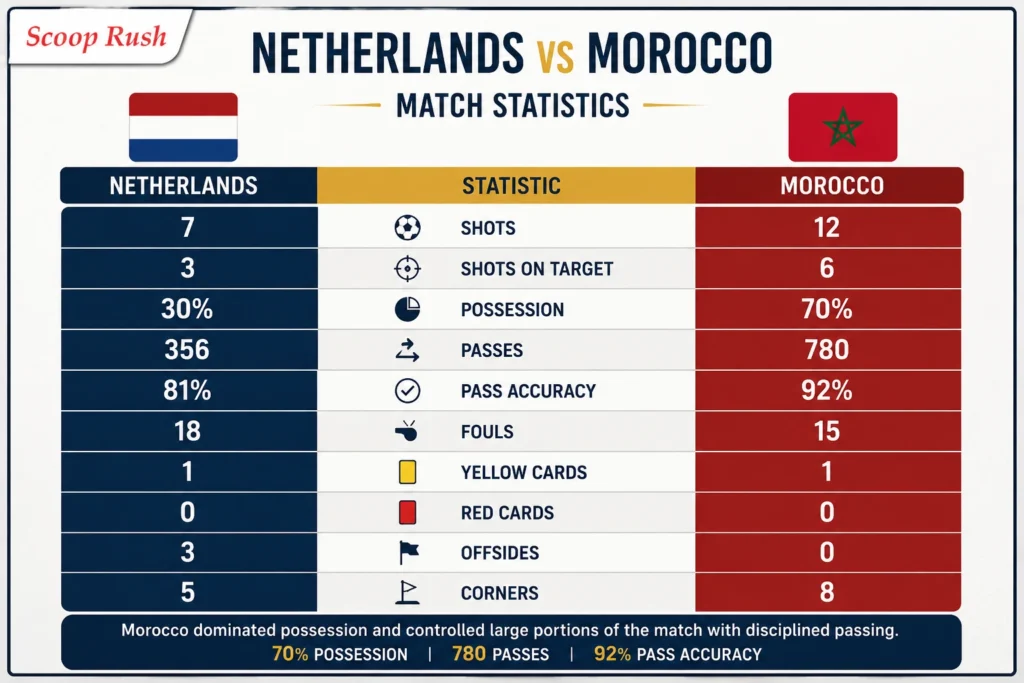
Netherlands vs Morocco: Match Statistics

Netherlands-vs-Morocco-Match-Statistics

Morocco dominated possession and controlled large portions of the match with disciplined passing.

StatisticNetherlandsMorocco
Shots712
Shots on Target36
Possession30%70%
Passes356780
Pass Accuracy81%92%
Fouls1815
Yellow Cards11
Red Cards00
Offsides30
Corners58

Morocco finished with 70 percent possession and completed 780 passes with 92 percent accuracy. Meanwhile, the Netherlands relied on direct attacks and defensive organisation before eventually falling in the shootout.

Netherlands vs Morocco: Tactical Analysis

Morocco controlled midfield by circulating possession and patiently building attacks from the back. Their movement stretched the Dutch defence, while the introduction of Chemsdine Talbi added fresh energy during the closing stages.

The Netherlands remained compact and looked to break quickly through their front three. Crysencio Summerville created the opening goal with an excellent assist for Cody Gakpo. Nevertheless, Morocco’s late tactical adjustments paid off as Talbi’s delivery allowed Issa Diop to equalise before the Atlas Lions completed the comeback in the shootout much like Ecuador’s stunning comeback against Germany earlier in the tournament.

Netherlands vs Morocco: Starting Lineups

Netherlands (5-2-3) Bart Verbruggen (GK) Denzel Dumfries Jan Paul van Hecke Virgil van Dijk Nathan Aké Micky van de Ven Ryan Gravenberch Frenkie de Jong Crysencio Summerville Brian Brobbey Cody Gakpo

Morocco (4-2-3-1) Yassine Bounou (GK) Achraf Hakimi Issa Diop Chadi Riad Noussair Mazraoui Neil El Aynaoui Ayyoub Bouaddi Brahim Díaz Azzedine Ounahi Bilal El Khannouss Ismael Saibari

What the Result Means

Morocco progressed to the FIFA World Cup 2026 Round of 16 after producing one of the tournament’s biggest upsets. Their persistence, tactical changes, and composure during the penalty shootout earned a deserved victory.

Meanwhile, the Netherlands bowed out despite taking the lead in the second half. A late equaliser followed by three missed penalties ended their FIFA World Cup 2026 campaign in heartbreaking fashion.

Related World Cup 2026 Coverage

Brazil vs Japan Result: Brazil Beat Japan 2-1 to Reach FIFA World Cup 2026 Quarterfinals

0

Competition: FIFA World Cup 2026
Round: Round of 32
Venue: Houston Stadium, Houston
Full-Time Result: Brazil 2-1 Japan

Brazil vs Japan Result: A Late Winner Sends Brazil Through

Just when extra time seemed inevitable, Brazil found the breakthrough they desperately needed. Gabriel Martinelli struck deep into stoppage time to seal a dramatic 2-1 victory over Japan in the FIFA World Cup 2026 Round of 32. After an intense contest filled with disciplined defending, tactical adjustments, and late drama, Brazil booked their place in the quarterfinals.

The Brazil vs Japan Result once again showed how unpredictable knockout football can be. Japan challenged one of the tournament favorites for the entire match, but Brazil’s quality and persistence eventually made the difference. With control of possession, more attacking chances, and a decisive late goal, Brazil advanced while Japan exited the competition after an impressive performance.

Brazil vs Japan Result: Match Summary

Brazil entered the knockout stage carrying the expectations that always follow one of football’s most successful nations. Meanwhile, Japan arrived with confidence after securing their place in the Round of 32 through disciplined performances.

The match quickly developed into an intriguing tactical battle. Brazil enjoyed more possession and looked to stretch Japan through patient passing and attacks from wide areas. In contrast, Japan stayed compact and waited for opportunities to launch quick counterattacks.

During the opening stages, Brazil controlled the ball for long periods. However, Japan defended with discipline and limited clear-cut chances. As a result, Brazil found it difficult to break through despite their attacking pressure.

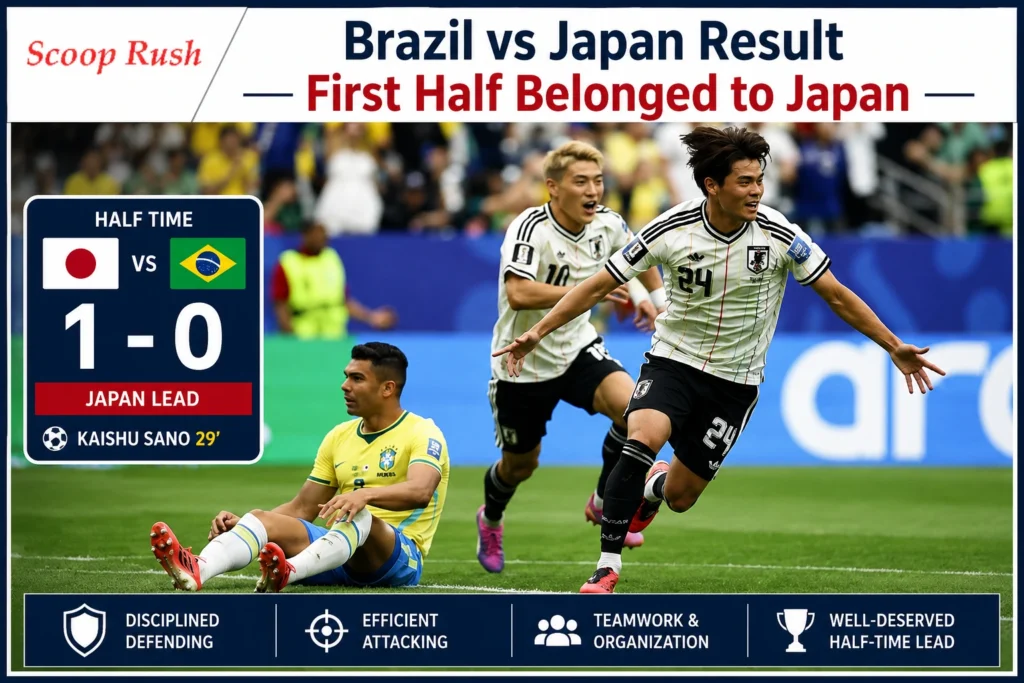
Japan made their opportunity count in the 29th minute. Kaishu Sano scored to give his side a surprising 1-0 lead before halftime.

Brazil remained calm after conceding. Instead of changing their approach, they continued to build attacks patiently. Their persistence paid off in the 56th minute when Casemiro scored the equalizer, restoring balance and shifting the momentum toward the South American side.

As the match moved into stoppage time, extra time looked increasingly likely. However, Brazil produced one final attack. Gabriel Martinelli scored in the 90+6th minute to complete the comeback and secure Brazil’s place in the FIFA World Cup 2026 quarterfinals.

Brazil vs Japan Result First Half Belonged to Japan

Brazil vs Japan Result First Half Belonged to Japan

Japan produced one of their most disciplined first-half displays of the tournament.

Although Brazil controlled possession, Japan defended deep, remained organized, and limited clear-cut opportunities. Every player worked collectively, closing passing lanes and frustrating Brazil’s attacking rhythm.

Kaishu Sano Gives Japan the Lead

Japan made their opportunity count.


A well-executed attacking move resulted in Kaishu Sano finding the net in the 29th minute. The goal rewarded Japan’s efficiency, as they converted one of their few attacking opportunities.

Brazil continued pressing for an equalizer before halftime, but Japan’s defensive organization ensured they carried a one-goal advantage into the break.

Brazil Responded Like Tournament Favorites

The second half demonstrated Brazil’s experience in knockout football.

Instead of rushing attacks, Brazil increased the tempo while maintaining control of possession. Their midfield dictated play and continuously pushed Japan deeper into their own half.

Casemiro eventually found the equalizer in the 56th minute after Brazil sustained heavy pressure around Japan’s penalty area.

The goal completely changed the momentum of the match.

From that point onward, Brazil attacked with confidence while Japan concentrated on protecting the draw and forcing extra time.

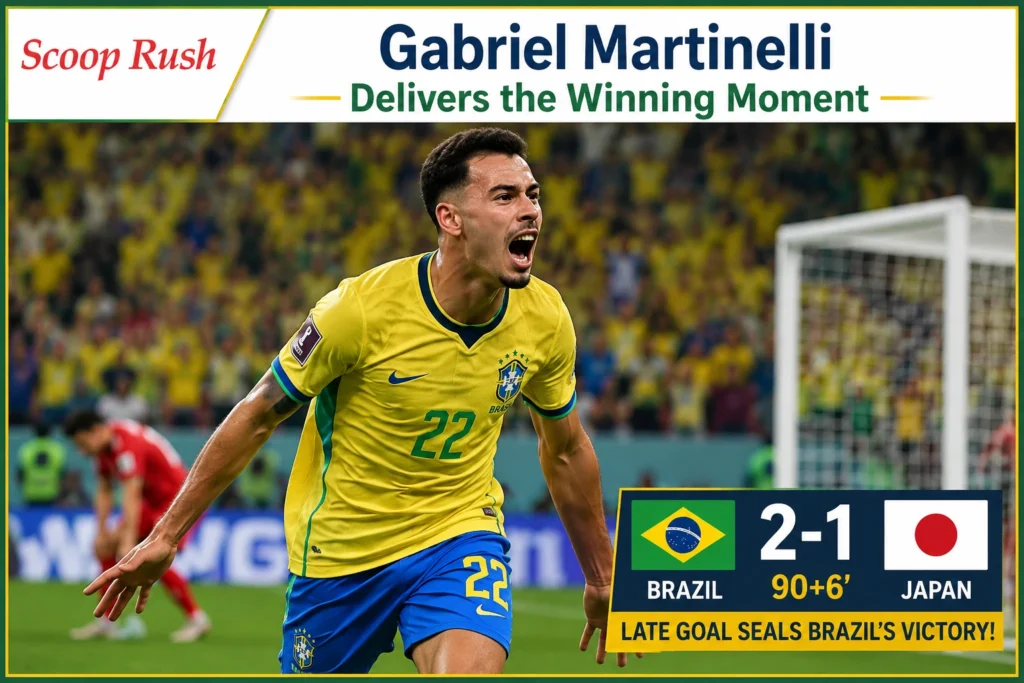
Gabriel Martinelli Delivers the Winning Moment

Gabriel Martinelli Delivers the Winning Moment

Football often produces unforgettable moments in stoppage time, and this match was no exception.

As the clock approached the final whistle, Brazil launched one final attack.

Gabriel Martinelli remained calm inside the penalty area and scored in the sixth minute of added time.

The late strike sparked celebrations among Brazil’s players and supporters while ending Japan’s hopes of extending the contest.

Martinelli’s goal ultimately became the defining moment of the match.

Match Statistics

The numbers reflected Brazil’s overall control throughout the contest.

StatisticBrazilJapan
Shots205
Shots on Target72
Possession60%40%
Passes679300
Pass Accuracy92%86%
Fouls413
Yellow Cards23
Red Cards00
Offsides10
Corners62

Brazil dominated nearly every major statistical category.

Brazil attempted four times as many shots as Japan. They also completed more than twice as many passes. Additionally, their 92% pass accuracy helped them control possession for long periods.

Meanwhile, Japan defended bravely and remained competitive despite spending much of the match without the ball.

Brazil vs Japan Result Tactical Analysis

Brazil relied on patient possession and consistent attacking pressure.

Rather than forcing risky passes, they gradually wore down Japan’s defensive block. Their midfield circulated possession effectively while the full-backs provided additional width.

Japan adopted a disciplined defensive shape that limited Brazil for much of the game. They stayed compact and looked for quick transitions whenever possession was regained.

However, Brazil’s sustained pressure eventually created enough opportunities to overturn the deficit.

The tactical discipline displayed by both teams made this one of the most competitive Round of 32 matches.

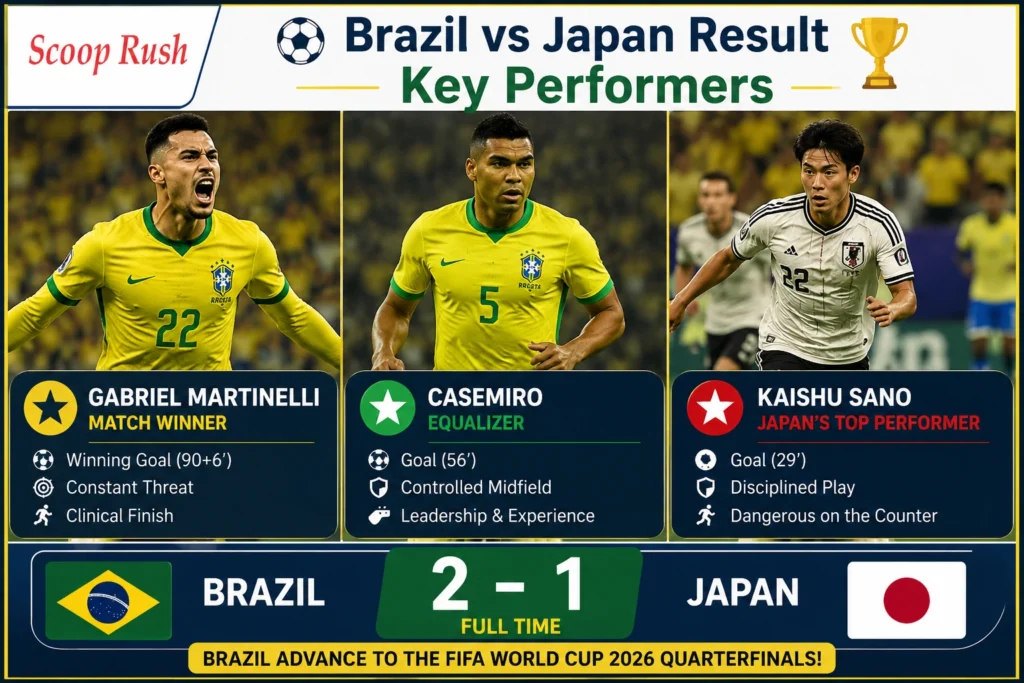
Brazil vs Japan Result Key Performers

Brazil vs Japan Result Key Performers

Gabriel Martinelli

Martinelli scored the decisive winning goal in stoppage time and became Brazil’s match hero.

His composure under pressure ensured Brazil avoided extra time.

Casemiro

Casemiro’s equalizer completely shifted the momentum.

His goal gave Brazil renewed confidence and kept their tournament hopes alive.

Kaishu Sano

Sano produced Japan’s standout moment by opening the scoring.

His first-half goal rewarded Japan’s disciplined performance and placed Brazil under significant pressure.

Brazil’s Road Continues

Brazil’s victory means they progress to the FIFA World Cup 2026 quarterfinals with growing confidence.

Although the performance required a dramatic finish, overcoming adversity can strengthen a team’s belief during the knockout stages.

Brazil will also be encouraged by their ability to remain patient after falling behind.

Japan Leave with Pride

Despite elimination, Japan delivered another highly competitive World Cup performance.

Their defensive organization frustrated Brazil for long periods, while their disciplined approach nearly forced extra time.

Although the result ended their tournament, Japan once again demonstrated why they continue to challenge football’s biggest nations on the world stage.

Conclusion

The Brazil vs Japan Result produced one of the most dramatic knockout matches of the FIFA World Cup 2026. Japan stunned Brazil with an early lead through Kaishu Sano and defended courageously throughout the contest.

However, Brazil responded with determination. Casemiro equalized after halftime, and Gabriel Martinelli scored the dramatic stoppage-time winner. Supported by superior possession, passing accuracy, and attacking pressure, Brazil earned a hard-fought 2-1 victory and secured their place in the quarterfinals.

For Japan, the defeat marked a heartbreaking end to an impressive campaign. For Brazil, it was another reminder that championship teams often find a way to win, even in the most difficult moments.

FAQs

1. What was the Brazil vs Japan Result in the FIFA World Cup 2026?

Brazil defeated Japan 2-1 in the FIFA World Cup 2026 Round of 32.

2. Who scored in Brazil’s 2-1 win over Japan?

Casemiro scored in the 56th minute, while Gabriel Martinelli netted the winning goal in the 90+6th minute.

3. Who scored Japan’s goal?

Kaishu Sano gave Japan the lead by scoring in the 29th minute.

4. Where was the Brazil vs Japan match played?

The match took place at Houston Stadium, Houston.

5. What were the key match statistics?

Brazil finished with 20 shots, 60% possession, 679 passes, 92% pass accuracy, and six corners, while Japan recorded five shots, 40% possession, 300 passes, and two corners.

Cannibal Supergiant Microbe: Euplotes gigatrox Turns Into a Giant Predator

0

Introduction

A microscopic organism has surprised scientists by revealing a behavior that was once thought to be limited to more complex forms of life. The newly discovered Euplotes gigatrox can transform into a giant version of itself, develop a larger mouth, and begin hunting and consuming members of its own species. A microscopic organism called Cannibal supergiant microbe Euplotes gigatrox has surprised scientists by revealing a behavior that was once thought to be limited to more complex forms of life.

This unusual cannibal supergiant microbe behavior has changed how researchers understand single-celled organisms. Instead of only feeding on bacteria, this tiny ciliate can completely change its body structure, movement, and feeding strategy when conditions around it shift.

Scientists say this discovery offers new insights into how individual cells control their development and adapt to environmental challenges. It also provides a new way to study how complex behaviors may have developed in simple organisms.

What Scientists Discovered About Euplotes gigatrox

Euplotes gigatrox is a single-celled organism known as a protist. It belongs to a group called ciliates, which use tiny hair-like structures called cilia to move and collect food.

Researchers discovered this microorganism from samples collected inside a seawater filtration system in Curaçao. After bringing the samples to the laboratory, scientists grew the organisms in artificial seawater with nutrients and bacteria.

At first, the cells behaved normally. They moved through the water and fed on tiny organisms around them.

However, after some time, scientists noticed something unusual. A small number of cells began increasing dramatically in size.

Normal Euplotes gigatrox cells measure around 54 micrometers long, while the transformed supergiant cells can reach about 140 micrometers.

The transformation was not only a physical change. The larger cells developed a completely different lifestyle.

Instead of filtering bacteria, they became predators that hunted smaller members of their own species.

How the Transformation Creates a Giant Predator

The change from a normal cell into a supergiant happens in stages.

Researchers found that the first major sign of transformation is the development of a much larger mouth structure. The cell becomes more active and begins moving differently.

At this stage, the organism is not yet an efficient hunter. However, after capturing another Euplotes gigatrox cell, the transformation continues.

The cell’s body structure changes completely.

It becomes larger and develops the ability to capture and consume other cells. Scientists describe this as a major biological transformation because a simple feeder becomes an active predator.

This behavior is especially surprising because advanced hunting strategies are usually linked with animals rather than single-celled organisms.

A Single Cell Showing Complex Behavior

A Single Cell Showing Complex Behavior

The discovery of Euplotes gigatrox surprised researchers because it demonstrates advanced behavior in a single cell.

Most microorganisms are expected to perform basic functions such as movement, feeding, and reproduction.

However, the supergiant form shows several major differences:

The body becomes much larger.
The mouth structure expands.
Feeding habits change completely.
Movement patterns are altered.
Gene activity changes inside the cell.

Researcher Ben Larson from Rensselaer Polytechnic Institute explained that this organism is performing something usually associated with animal development.

The discovery shows that even individual cells can respond to their environment in highly complex ways.

The Hunting Behavior of the Supergiant Form

The most unusual feature of Euplotes gigatrox is its cannibalistic feeding behavior.

In its normal state, the microorganism feeds on bacteria and other tiny organisms by filtering food from its surroundings.

After transforming into the supergiant form, however, it begins capturing smaller Euplotes gigatrox cells.

Researchers observed that these giant cells can hunt and consume another cell approximately every 10 minutes.

The hunting method is different from normal feeding. The supergiant moves over its target and pushes the smaller cell into its enlarged mouth area.

As a result, the same species can exist in two completely different forms.

Normal cells act as filter feeders, while supergiant cells behave like predators.

Why Does the Microbe Change Its Form?

Why Does the Microbe Change Its Form?

Scientists are still studying the exact reason behind this transformation.

However, researchers found that supergiant cells usually appear after a population grows rapidly and reaches a more stable stage.

The transformation does not occur when bacteria are extremely abundant.

Instead, the giant form appears under changing conditions where the organism may benefit from hunting different food sources.

Only a small percentage of the population becomes supergiant. Researchers found that these giant cells never made up more than 5 percent of the total population.

Scientists believe this limited transformation may help the species survive changing environments.

The Benefits and Costs of Becoming Larger

The supergiant form gives Euplotes gigatrox a major advantage because it allows the organism to hunt larger prey.

However, the transformation also creates disadvantages.

Normal cells can swim efficiently through water using their cilia and move with smooth spiral movements.

Supergiant cells are too large to move in the same way. Instead, they travel across surfaces in circular patterns while searching for prey.

When removed from a surface, they struggle to swim normally.

Therefore, becoming larger creates a tradeoff. The organism becomes a stronger hunter but loses some movement abilities.

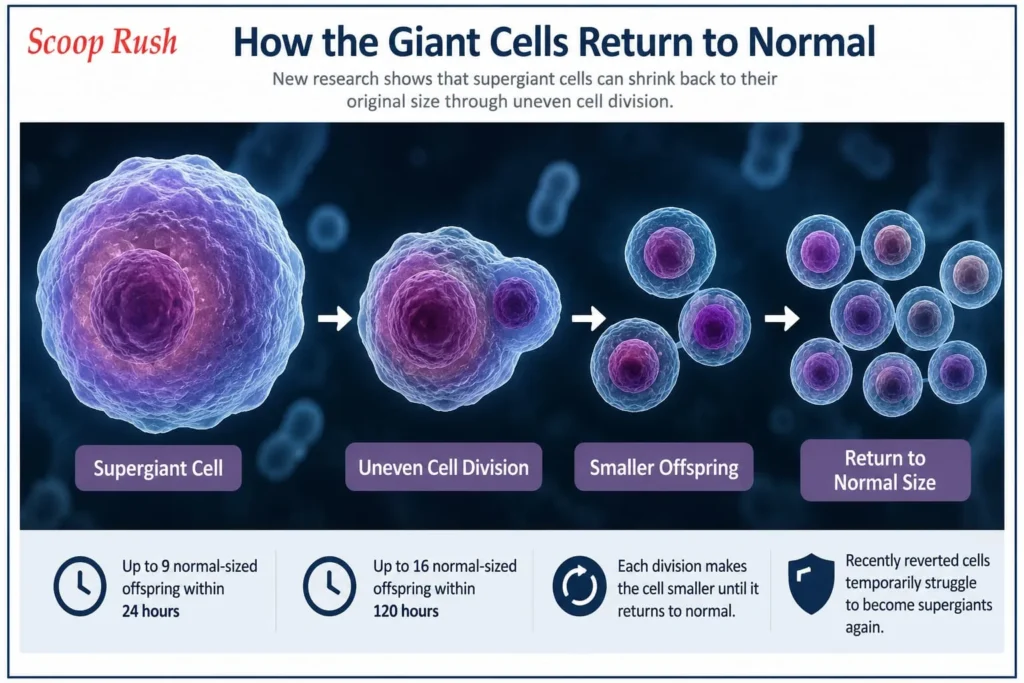
How the Giant Cells Return to Normal

The supergiant stage is not permanent.

How the Giant Cells Return to Normal

Scientists discovered that these giant cells can return to their original size through a process involving uneven cell division.

During this process, the large cell produces smaller normal-sized offspring.

A supergiant can produce up to nine normal-sized offspring within 24 hours and up to 16 within 120 hours.

With each division, the cell becomes smaller until it returns to its original form and behavior.

Researchers also found that recently reverted cells temporarily have difficulty becoming supergiants again.

Genetic Changes Behind the Transformation

To understand this unusual process, scientists studied gene activity in normal cells, supergiant cells, and recently reverted cells.

They discovered that many genes change their activity during the transformation.

Around 42 percent of the organism’s genes are involved in moving between normal and supergiant stages.

These genetic changes help explain how a single cell can completely alter its structure and behavior.

Why This Discovery Matters

The discovery of Euplotes gigatrox gives scientists a new opportunity to study how cells develop complex abilities.

For many years, developmental biology focused mainly on multicellular organisms such as animals.

However, this microorganism shows that even a single cell can perform advanced transformations.

The research may help scientists better understand how cells control their shape, behavior, and survival strategies.

Conclusion: A Discovery That Changes How We View Microbes

The discovery of the cannibal supergiant microbe Euplotes gigatrox has revealed a surprising side of microscopic life. The discovery of Euplotes gigatrox microbe shows that even tiny organisms can develop complex survival strategies and unexpected behaviors.

This tiny organism can transform from a normal bacteria-eating cell into a giant predator that hunts members of its own species.

Although researchers are still studying the exact reasons behind the transformation, the discovery proves that single-celled organisms can display highly complex behaviors.

Euplotes gigatrox shows that even the smallest forms of life can develop remarkable survival strategies.

FAQs

1. What is Euplotes gigatrox?

The Euplotes gigatrox microbe is important because it reveals how single-celled organisms can adapt and transform their behavior.

2. Why does Euplotes gigatrox become a supergiant?

Scientists believe the transformation helps the organism adapt to changing conditions by allowing it to hunt different types of food.

3. How large can the supergiant form become?

The supergiant form can grow to around 140 micrometers, while normal cells are about 54 micrometers long.

4. Does the supergiant stage last forever?

No. The giant cells can return to their normal size through uneven cell division.

5. Why is this discovery important?

It shows that single-celled organisms can develop complex behaviors that were previously associated mainly with larger organisms.

South Africa vs Canada: Stephen Eustáquio’s Late Goal Secures Dramatic 1-0 Victory

0

Competition: FIFA World Cup 2026 (Round of 32)
Date: 29 June 2026
Venue: Los Angeles Stadium, Inglewood
Full-Time Result: South Africa 0-1 Canada

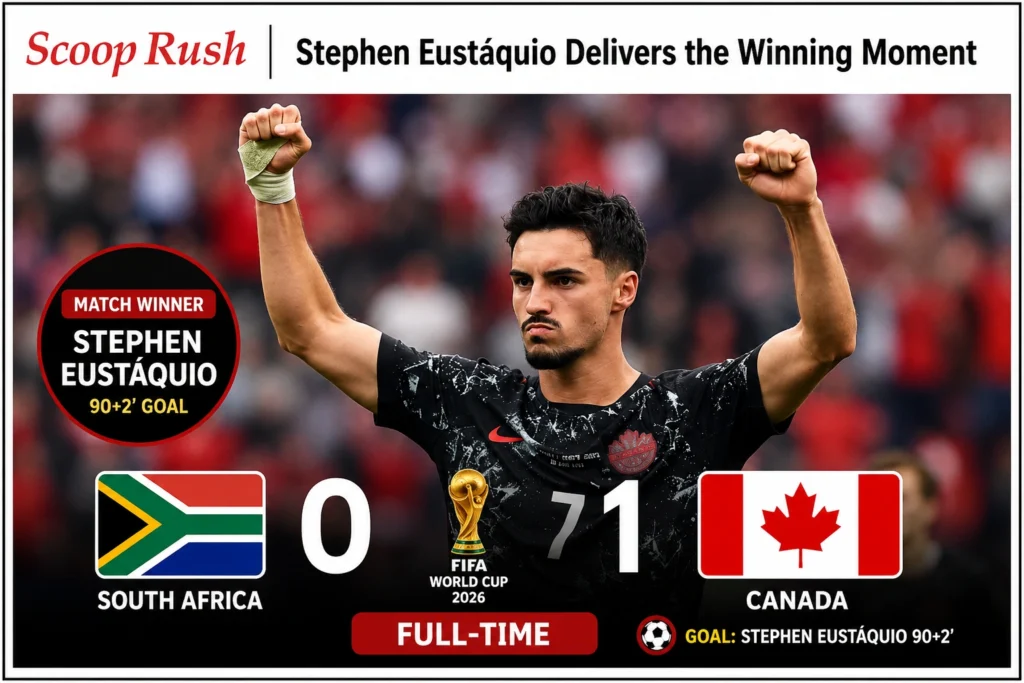
A FIFA World Cup knockout match can change in a single moment, and that is exactly what happened in South Africa vs Canada. After more than 90 minutes of intense competition, disciplined defending, and missed opportunities, Canada finally found the breakthrough when Stephen Eustáquio scored deep into stoppage time to secure a dramatic 1-0 win.

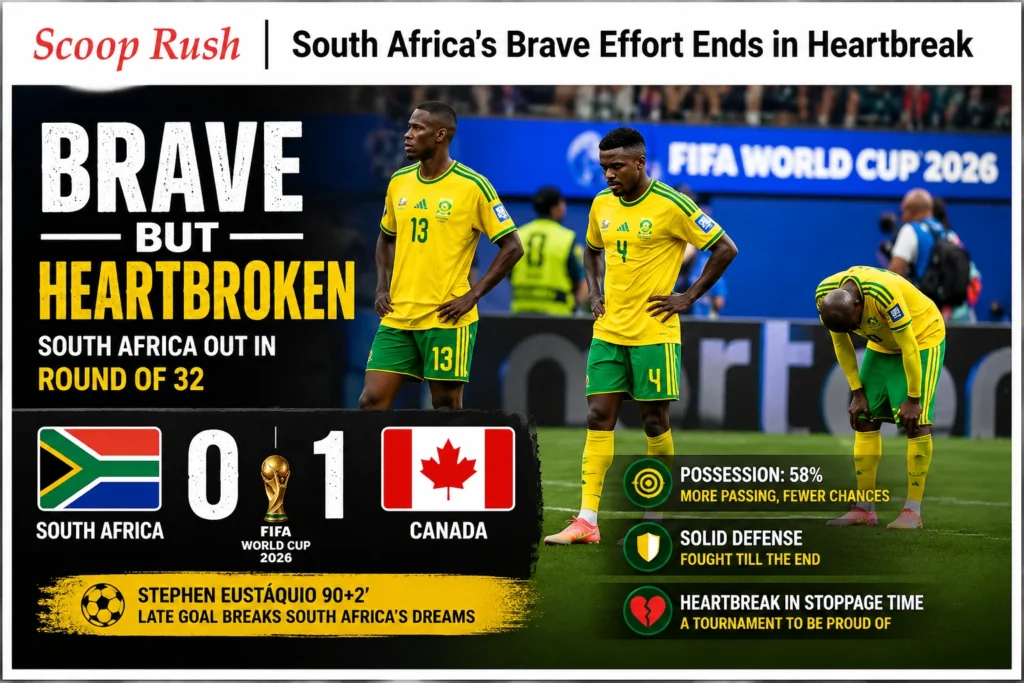
The result ended South Africa’s World Cup journey and sent Canada into the Round of 16 after a hard-fought encounter at Los Angeles Stadium in Inglewood. While South Africa controlled possession for long periods, Canada made their chances count when it mattered most.

This match highlighted the fine margins that often decide knockout football. One late goal was enough to separate two determined teams battling for a place in the next round.

South Africa vs Canada: Match Overview

The Round of 32 clash between South Africa and Canada was closely contested from start to finish. Both teams entered the match knowing that a single mistake could prove costly.

South Africa attempted to dictate play through possession and passing accuracy. Meanwhile, Canada focused on creating more attacking opportunities and applying pressure in key moments.

Despite several chances throughout the match, neither side managed to break the deadlock during regular time. The contest appeared to be heading toward extra time before Canada produced a decisive moment in stoppage time.

Final Score:

South Africa 0-1 Canada Competition: FIFA World Cup 2026 Round of 32 Venue: Los Angeles Stadium, Inglewood Winning Goal: Stephen Eustáquio (90+2′)

How the Match Unfolded

The game followed a familiar knockout-stage pattern. South Africa enjoyed more of the ball and attempted to control the tempo. Canada, however, looked dangerous whenever they transitioned into attack.

During the opening stages, both teams remained organized defensively. Clear-cut chances were limited as each side worked hard to avoid making costly errors.

As the match progressed, Canada gradually increased their attacking intent. South Africa continued to circulate possession effectively but struggled to convert that control into meaningful scoring opportunities.

The deadlock remained intact for most of the contest. Consequently, the possibility of extra time became increasingly likely.

However, football often delivers drama when least expected.

In the second minute of added time, Canada finally found the breakthrough that changed everything.

Stephen Eustáquio Delivers the Winning Moment

Stephen Eustáquio Delivers the Winning Moment

The Goal That Decided South Africa vs Canada

The defining moment arrived in the 92nd minute when Stephen Eustáquio scored the match-winning goal for Canada.

After a tense and balanced contest, the late strike provided the breakthrough Canadian supporters had been waiting for. The goal instantly shifted the mood of the match and left South Africa with almost no time to respond.

Scoring in stoppage time is one of football’s most dramatic moments. For Canada, Eustáquio’s goal ensured progression to the next round. For South Africa, it marked a heartbreaking end after a resilient defensive effort.

The timing of the goal made it particularly significant. South Africa had successfully resisted Canadian attacks throughout most of the match, only to concede when the finish line was in sight.

Match Statistics Breakdown

The statistics reveal an interesting contrast between the two teams.

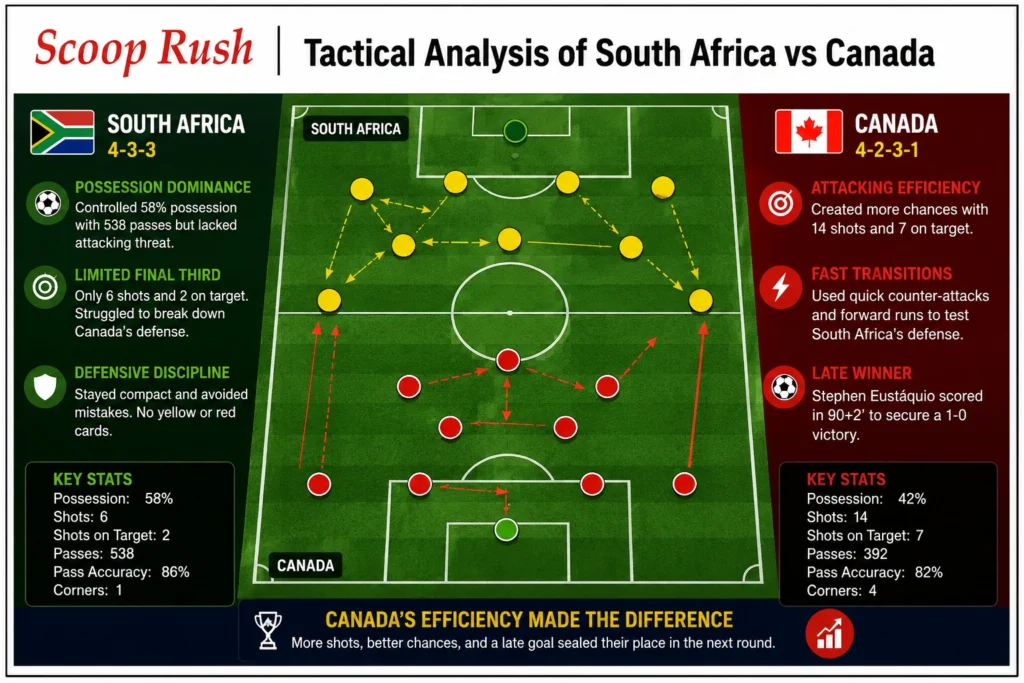
South Africa Statistics Shots: 6 Shots on Target: 2 Possession: 58% Passes: 538 Pass Accuracy: 86% Fouls: 10 Yellow Cards: 0 Red Cards: 0 Offsides: 1 Corners: 1

Canada Statistics Shots: 14 Shots on Target: 7 Possession: 42% Passes: 392 Pass Accuracy: 82% Fouls: 15 Yellow Cards: 2 Red Cards: 0 Offsides: 0 Corners: 4

These numbers illustrate two different approaches to the game.

South Africa dominated possession and completed significantly more passes. Additionally, they recorded a higher passing accuracy rate. However, possession alone did not translate into enough attacking threat.

Canada, on the other hand, generated more than twice as many shots and registered seven efforts on target. As a result, they consistently tested South Africa’s defense and goalkeeper.

The shot totals ultimately proved more influential than possession statistics.

Stephen Eustáquio Delivers the Winning Moment

Stephen Eustáquio Delivers the Winning Moment

South Africa Controlled the Ball

South Africa’s strategy centered on controlling possession and building attacks patiently.

Their 58% share of possession and 538 completed passes demonstrate their commitment to maintaining control. Furthermore, an 86% pass accuracy rate reflects strong ball retention throughout the match.

The midfield worked effectively to circulate possession and limit Canada’s time on the ball. However, the final third proved challenging.

Although South Africa moved the ball well, they managed only six total shots and two on target. Therefore, their territorial advantage did not translate into enough clear scoring opportunities.

Canada Prioritized Efficiency

Canada adopted a more direct and efficient approach.

Despite having only 42% possession, they produced 14 shots and seven shots on target. This indicates a team focused on maximizing attacking opportunities whenever they gained possession.

Canada also earned four corners compared to South Africa’s one, showing their ability to sustain pressure in dangerous areas.

While they committed more fouls and received two yellow cards, their aggressive approach ultimately paid off. The decisive goal arrived late, but it reflected the pressure Canada had been applying throughout the contest.

Key Performers for Canada

Stephen Eustáquio will naturally receive most of the attention because of his winning goal.

His composure in a crucial moment helped Canada avoid extra time and secure advancement to the next stage of the tournament.

Canada also benefited from a collective defensive performance. South Africa’s possession-heavy approach rarely created serious danger, which highlights Canada’s organization without the ball.

The team maintained discipline, absorbed pressure, and remained patient until the winning opportunity arrived.

South Africa’s Brave Effort Ends in Heartbreak

South Africa's Brave Effort Ends in Heartbreak

For South Africa, the result will be difficult to accept.

The team controlled possession, completed more passes, and maintained defensive discipline for almost the entire match. They avoided bookings and generally executed their game plan effectively. This continued a tournament in which South Africa had earlier beaten South Korea 1-0 in the group stage, showing they were capable of grinding out results — but this time the late goal went against them.

Nevertheless, knockout football is often decided by moments rather than overall control.

South Africa’s inability to create enough chances proved costly. Although they enjoyed extended periods of possession, they rarely threatened Canada’s goal consistently.

Conceding in stoppage time transformed what looked like a potential extra-time battle into an immediate elimination.

Despite the defeat, South Africa demonstrated organization, composure, and resilience throughout the contest.

Canada Advance to the Next Round

Canada’s victory represents an important achievement in their FIFA World Cup 2026 campaign.

Winning knockout matches requires patience, concentration, and belief. Canada displayed all three qualities against South Africa.

Rather than becoming frustrated by South Africa’s possession dominance, they remained focused on creating chances and staying compact defensively.

The statistics show that Canada generated the better opportunities over the course of the match. Consequently, the late winner felt like a reward for their persistence.

Advancing to the Round of 16 keeps Canada’s World Cup hopes alive and provides momentum heading into the next challenge.

What Decided South Africa vs Canada?

Several factors ultimately determined the outcome:

  • Canada’s superior chance creation with 14 shots compared to South Africa’s six.
  • Greater accuracy in front of goal, registering seven shots on target.
  • Consistent attacking pressure, reflected by four corners and multiple dangerous attacks.
  • Stephen Eustáquio’s decisive stoppage-time finish.
  • South Africa’s lack of attacking output despite controlling possession.

Possession can help control a match, but creating and converting chances remains the most important factor. Canada executed that aspect of the game more effectively.

Conclusion

The South Africa vs Canada Round of 32 clash delivered a dramatic ending that will be remembered by supporters of both teams. South Africa controlled possession and dictated much of the game’s rhythm, yet Canada proved more dangerous in attack.

With 14 shots and seven efforts on target, Canada consistently searched for a breakthrough. Their persistence finally paid off when Stephen Eustáquio scored in the 92nd minute to secure a 1-0 victory.

For South Africa, the defeat is a painful reminder of how unforgiving knockout football can be. For Canada, it is a memorable win that keeps their FIFA World Cup 2026 journey alive.

One moment of quality made all the difference, and that moment belonged to Stephen Eustáquio.

FAQs

1. What was the final score in South Africa vs Canada?

Canada defeated South Africa 1-0 in the FIFA World Cup 2026 Round of 32.

2. Who scored the winning goal for Canada?

Stephen Eustáquio scored the match-winning goal in the 90+2 minute.

3. How much possession did South Africa have?

South Africa finished with 58% possession compared to Canada’s 42%.

4. How many shots did Canada register?

Canada recorded 14 shots, including seven on target.

5. What stage of the tournament was South Africa vs Canada?

The match was played in the Round of 32 of the FIFA World Cup 2026.