
Introduction: Swift Telescope Rescue Mission Could Change the Future of Space Operations
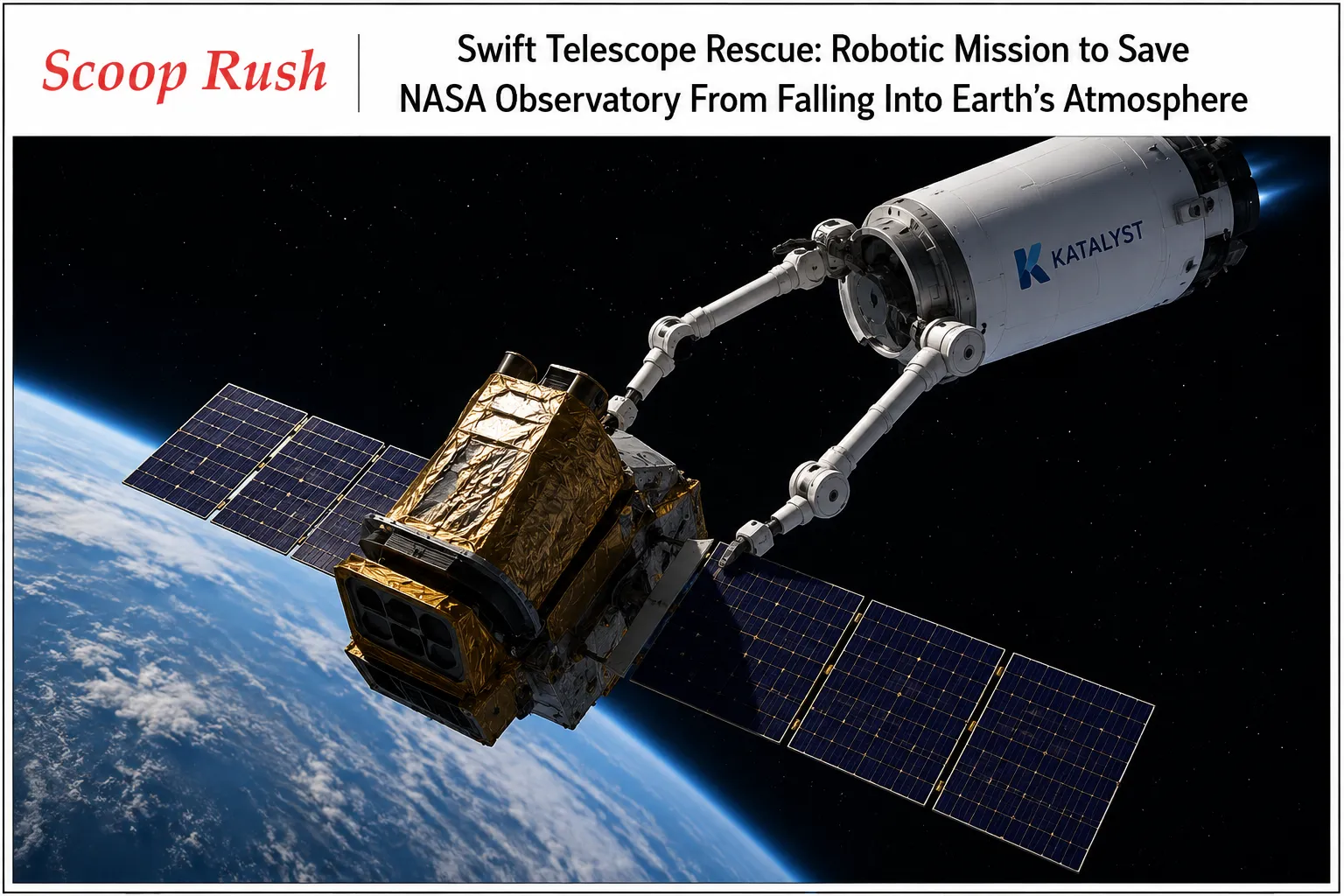
A NASA space telescope is slowly losing altitude and moving closer to its possible destruction, but a groundbreaking robotic mission could give it a second life. The Swift telescope rescue mission is attempting something never done before by sending a robotic spacecraft to capture and move an aging observatory back into a safer orbit.
The Neil Gehrels Swift Observatory has spent more than two decades studying some of the universe’s most powerful events, including gamma-ray bursts. However, increased atmospheric drag caused by stronger solar activity has accelerated the telescope’s fall toward Earth.
Now, NASA and private space company Katalyst are preparing a historic solution. A robotic spacecraft called LINK will attempt to connect with Swift and raise its orbit, protecting the telescope from burning up in Earth’s atmosphere.
The mission could become a major milestone in space technology because it may prove that satellites can be repaired, repositioned, and extended instead of simply being abandoned — a shift not unlike other recent NASA discoveries reshaping how we think about space exploration.
What Is the Swift Telescope Rescue Mission?
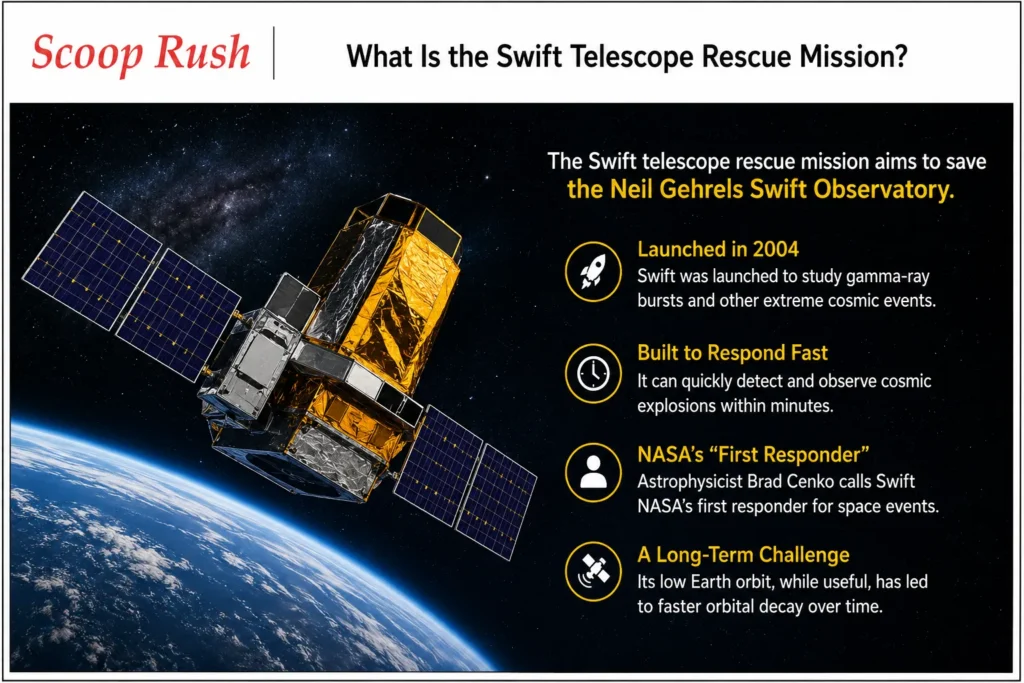
The Swift telescope rescue mission focuses on saving the Neil Gehrels Swift Observatory, which launched in 2004 to study gamma-ray bursts and other extreme cosmic events.
When Swift first entered orbit, scientists expected it to operate for only about two years. However, the telescope continued working for decades and became one of NASA’s most successful space observatories.
Swift is unique because it can quickly respond to sudden events in space. When a powerful cosmic explosion occurs, the telescope can move and begin observing within minutes.
Astrophysicist Brad Cenko described Swift as NASA’s “first responder” because of its ability to react quickly to unexpected discoveries.
However, the same low Earth orbit that allowed Swift to communicate effectively with scientists also created a long-term challenge.
Why Is NASA’s Swift Telescope Falling Toward Earth?
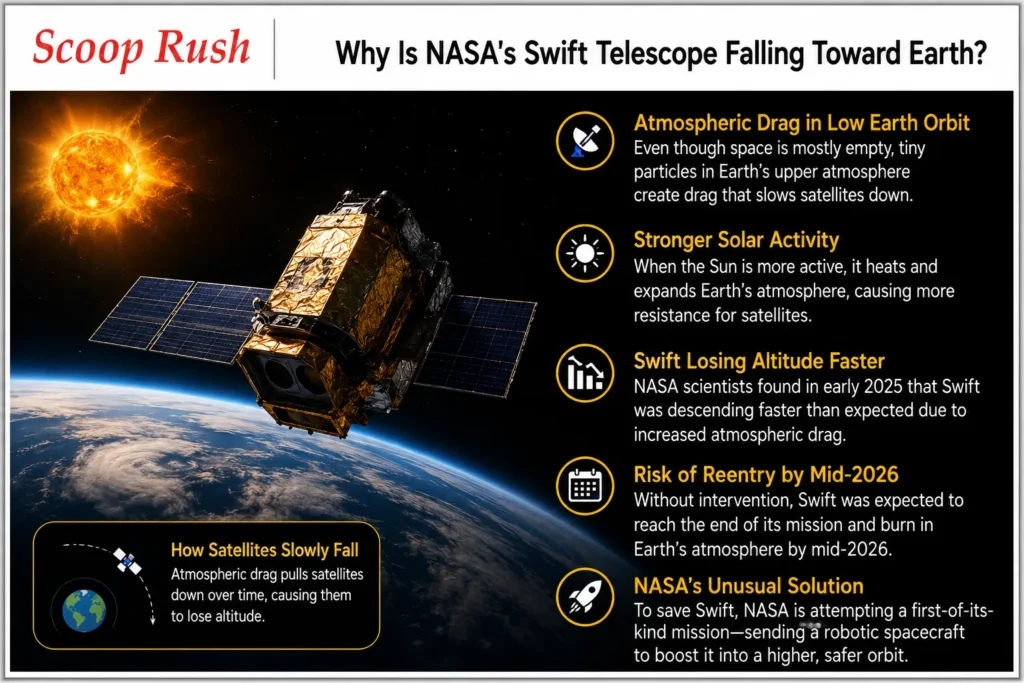
Satellites in low Earth orbit experience atmospheric drag. Although space is extremely thin, small particles in Earth’s upper atmosphere can slowly reduce a spacecraft’s altitude.
During stronger solar activity, the Sun releases additional energy that heats and expands Earth’s atmosphere. As a result, satellites experience more resistance — a dynamic that also plays into broader climate patterns tracked by NASA satellite imagery.
NASA scientists discovered in early 2025 that Swift was losing altitude faster than expected. The increased drag meant the telescope could eventually return to Earth’s atmosphere and burn apart.
Without action, Swift was expected to reach the end of its mission in mid-2026.
Therefore, NASA decided to attempt an unusual solution: sending another spacecraft to physically move the telescope into a higher orbit.
How Will the Swift Telescope Rescue Work?
LINK Robotic Spacecraft Will Attempt a Historic Satellite Save
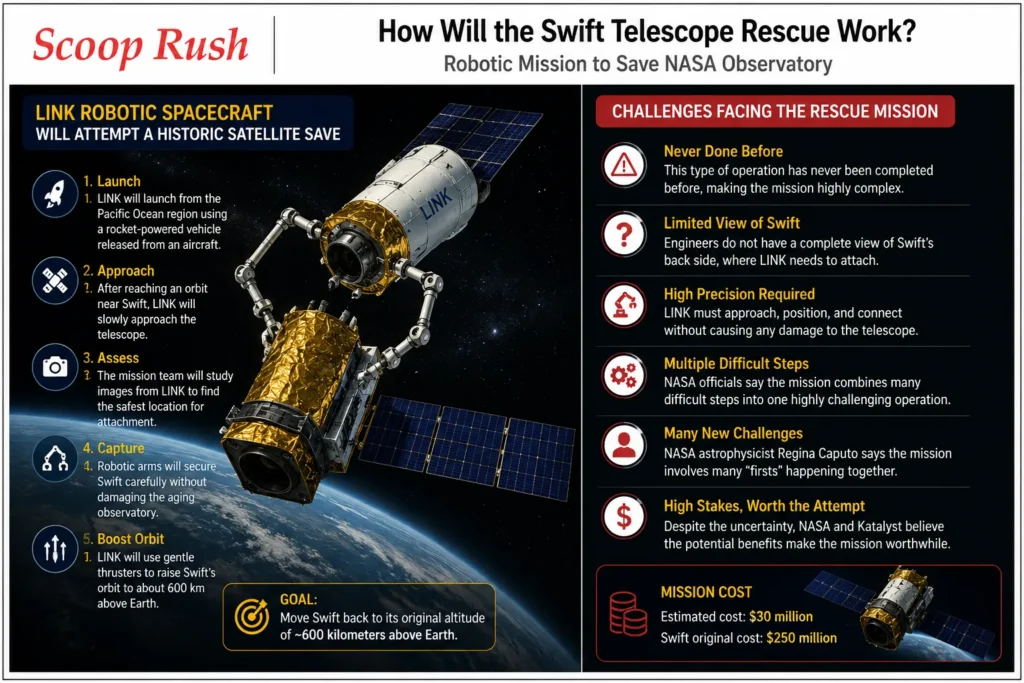
The rescue mission depends on LINK, a robotic spacecraft designed to approach, capture, and move the Swift Observatory.
The spacecraft will launch from the Pacific Ocean region using a rocket-powered launch vehicle. Unlike traditional launches, the vehicle will be released from an aircraft instead of launching directly from a ground platform.
After reaching an orbit near Swift, LINK will slowly approach the telescope.
The mission team will study images from LINK to identify the safest location for attachment.
Once the robotic arms secure Swift, the spacecraft will use gentle thrusters to raise the telescope’s orbit.
The goal is to move Swift back toward its original altitude of about 600 kilometers above Earth.
Challenges Facing the Swift Telescope Rescue Mission
The Swift telescope rescue attempt involves several difficult challenges because this type of operation has never been completed before.
One major problem is that engineers do not have a complete view of Swift’s back side, which is where LINK needs to attach.
The robotic spacecraft must carefully approach the telescope, identify the correct position, and connect without damaging the aging observatory.
NASA officials have explained that the mission combines multiple difficult steps into one operation.
According to NASA astrophysicist Regina Caputo, the mission involves many new challenges happening together.
Despite the uncertainty, NASA and Katalyst believe the possible benefits make the attempt worthwhile.
The mission is expected to cost around $30 million, while Swift originally cost about $250 million.
Why Saving Swift Matters for Science
The Swift Observatory remains extremely valuable because it provides scientists with unique observations.
The telescope studies gamma-ray bursts, which are among the most energetic events in the universe. These events happen very quickly, so scientists need instruments that can respond immediately — much like the rapid-response research behind discoveries such as the cannibal supergiant microbe Euplotes gigatrox, where timing and observation were critical to the finding.
Replacing Swift would take years of planning and development. Therefore, extending its operational life could protect decades of scientific work.
Additionally, the rescue mission could influence future satellite operations.
If successful, similar robotic systems could help maintain other spacecraft, including older space telescopes.
Could the Swift Telescope Rescue Technology Help Other Satellites?
The Swift telescope rescue mission could introduce a new way of managing spacecraft in orbit.
Traditionally, satellites have limited lifespans. When they lose altitude, run out of resources, or develop problems, they are often left behind.
However, robotic servicing missions could change the future of space exploration, echoing how scientists are also finding new ways to extend the life of everyday materials, such as turning ocean plastic into recycled asphalt roads in Hawaii.
Future spacecraft may be repaired, upgraded, repositioned, or given additional years of operation.
Katalyst believes this type of technology could support a new model of satellite maintenance, including repairing and upgrading spacecraft that were not originally designed for rescue missions.
What Happens After the Rescue Attempt?
Before the mission begins, Swift’s operations team has already adjusted the telescope’s activities to reduce drag and slow its descent.
Currently, Swift is not collecting scientific data.
If LINK successfully moves the telescope into a safer orbit, Swift will need a system restart. Scientists expect returning to normal operations could take a month or more.
After recovery, the telescope could continue studying the universe for many additional years.
The Future Impact of the Swift Telescope Rescue Mission
The Swift telescope rescue mission represents more than saving one spacecraft.
For decades, space missions have focused mainly on launching new technology. However, this operation highlights a new possibility: protecting and extending the technology already operating in space.
Swift has already provided important discoveries about the universe. A successful rescue could allow it to continue contributing to science, joining a growing list of breakthroughs — from new beetle species discovered by Kyushu University to research on how neurons break DNA to build the brain — that show how much is still being uncovered about our world and beyond.
Although the mission faces major risks, it could become an important step toward a future where satellites receive repairs instead of reaching the end of their lives.
Conclusion
The Swift telescope rescue mission is a historic attempt to save NASA’s Neil Gehrels Swift Observatory from falling into Earth’s atmosphere.
A robotic spacecraft called LINK will try to capture the telescope and move it into a safer orbit.
If successful, the mission could change how scientists manage satellites by proving that spacecraft can be repaired, repositioned, and extended.
The result of the mission remains uncertain, but its goal represents a major advancement in space technology.
FAQs
1. Why does the Swift telescope need rescue?
The Swift telescope is losing altitude because increased solar activity expanded Earth’s atmosphere, creating more drag on the spacecraft.
2. What is the Swift telescope rescue mission?
The mission uses a robotic spacecraft called LINK to capture Swift and move it into a higher orbit.
3. When was the Swift Observatory launched?
The Neil Gehrels Swift Observatory launched in 2004 to study gamma-ray bursts and cosmic events.
4. What happens if the rescue mission fails?
Without intervention, Swift may eventually reenter Earth’s atmosphere and burn apart.
5. Could this technology save other satellites?
Yes, successful results could help develop future missions that repair and extend the lives of other spacecraft.

