

What if Mars once had life billions of years ago? NASA’s Perseverance rover has discovered new evidence that brings scientists closer to answering this question. The rover detected complex carbon molecules inside ancient Martian rocks, creating fresh interest in the search for past life on the Red Planet.
NASA finds possible signs of ancient life on Mars after Perseverance studied mudstone rocks from the Bright Angel outcrop in Jezero crater. The area was once connected to a river system that carried water billions of years ago.
However, scientists say this discovery is not confirmed proof of life. The carbon materials could have formed through ancient biological activity, but they could also come from natural geological processes.
The discovery gives researchers another important clue about whether Mars once had the right conditions for microbial life.
n is a key element found in all known life on Earth.
However, carbon can also form without life. Because of this, scientists are studying the discovery carefully before making conclusions.
NASA Finds Possible Signs of Ancient Life on Mars Through Perseverance Rover Discovery
NASA’s Perseverance rover has been exploring Jezero crater since landing on Mars in 2021. Scientists selected this location because it may preserve evidence from Mars’ ancient past. Billions of years ago, this area contained conditions that could help researchers understand the planet’s history.
NASA’s Perseverance rover has been exploring Jezero crater since landing on Mars in 2021. Scientists selected this location because they believed it could preserve evidence from Mars’ ancient past.
Billions of years ago, Jezero crater may have contained a lake connected to rivers. Therefore, rocks in this area could hold information about the planet’s environment when water was present.
During its journey through Neretva Vallis, an ancient river valley, Perseverance examined mudstone rocks from the Bright Angel outcrop.
Using its SHERLOC instrument, the rover detected macromolecular carbon, also called MMC. This type of carbon is important because carbo
How NASA’s Perseverance Rover Found Possible Signs of Ancient Life on Mars
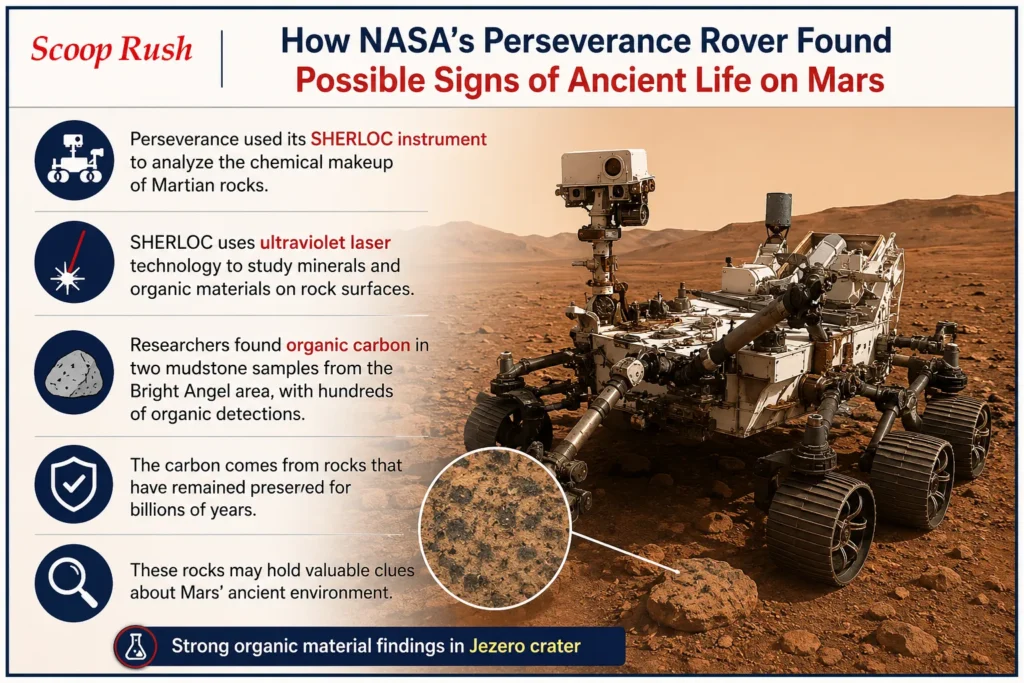
The Perseverance rover used its SHERLOC instrument to analyze the chemical makeup of Martian rocks.
The instrument uses ultraviolet laser technology to study minerals and organic materials on the surface of rocks.
Researchers found organic carbon in two mudstone samples from the Bright Angel area. The team reported hundreds of organic detections, making it one of the strongest organic material findings in Jezero crater.
Additionally, the carbon was found in rocks that had remained preserved for billions of years.
Scientists believe these rocks may provide valuable information about Mars’ ancient environment.
Complex Carbon Discovery Raises Questions About Ancient Life on Mars
The discovery of complex carbon has increased interest in the possibility that ancient microbial life may have existed on Mars.
On Earth, similar carbon materials can be found in ancient biological remains, including fossilized organic matter.
However, scientists explain that there are other possible explanations.
The carbon could have formed through chemical reactions between rocks and water. It could also have arrived from space through meteorites.
Therefore, researchers cannot confirm that the carbon came from living organisms.
Why NASA Scientists Are Studying Mars Organic Carbon Evidence

Scientists are studying this organic carbon because it may reveal how Mars changed over time.
The discovery is important because NASA’s Curiosity rover previously found organic materials in Gale crater.
These two locations are thousands of kilometers apart. As a result, researchers believe organic materials may have existed across different areas of Mars billions of years ago.
Furthermore, the findings suggest that ancient Mars may have had environments where complex chemistry could happen.
Perseverance Rover Finds Organic Carbon in Ancient Mars Rocks
One of the most interesting rocks studied by Perseverance is called Cheyava Falls.
Earlier observations of this rock revealed unusual surface patterns known as “leopard spots.”
These markings attracted attention because similar patterns on Earth can sometimes be connected with microbial activity.
However, scientists also know that non-biological processes can create similar features.
The new carbon discovery adds more information, but researchers still need more evidence.
Could Organic Carbon Reveal Signs of Microbial Life on Mars?
The biggest question is whether ancient microbes created the carbon found by Perseverance.
Scientists say this possibility cannot be ruled out.
Macromolecular carbon can be linked with ancient biological materials on Earth, which makes the discovery exciting.
However, the rover does not have the ability to completely identify whether the carbon came from life or from natural processes.
Therefore, scientists believe the best way to solve this mystery is by studying Mars samples in laboratories on Earth.
Why NASA Wants Mars Samples Returned to Earth
Earth laboratories have more advanced equipment than the instruments currently available on Perseverance.
By studying Martian samples directly, scientists could examine the carbon structures in much greater detail.
Perseverance has already collected and stored rock samples for a possible future return mission.
However, bringing these samples back has faced challenges, and future plans are still being developed.
Conclusion: NASA Finds Possible Signs of Ancient Life on Mars, But the Mystery Continues
NASA’s Perseverance rover has provided one of the most exciting discoveries in the search for ancient life beyond Earth. The detection of complex carbon molecules in Martian rocks shows that Mars once had environments where important chemical ingredients existed.
However, scientists are still careful because these findings do not confirm that life existed on Mars. The carbon detected by Perseverance could have formed from ancient microbial activity, but it could also have developed through natural geological processes.
The discovery from the Bright Angel outcrop adds another important chapter to Mars exploration. Furthermore, future studies of collected Martian samples could help scientists finally understand whether these carbon materials are connected to ancient life or simply reveal the planet’s complex history.
Until then, Perseverance continues searching the Red Planet for more clues about its mysterious past.
FAQs
1. Did NASA find life on Mars?
No. NASA has not confirmed that life existed on Mars. The Perseverance rover found carbon materials that could be connected to ancient life, but more testing is needed.
2. What did Perseverance discover on Mars?
Perseverance detected complex carbon molecules inside mudstone rocks from the Bright Angel area of Jezero crater.
3. Why is carbon important for finding life on Mars?
Carbon is important because all known life on Earth is based on carbon chemistry. However, carbon can also exist without biological activity.
4. Could the Mars carbon come from microbes?
Scientists say it is possible, but they cannot confirm it yet. The carbon may also have formed through non-biological processes.
5. Will NASA study Mars rocks on Earth?
NASA hopes future missions can return collected Mars samples to Earth, where scientists can perform deeper analysis.

