
Introduction
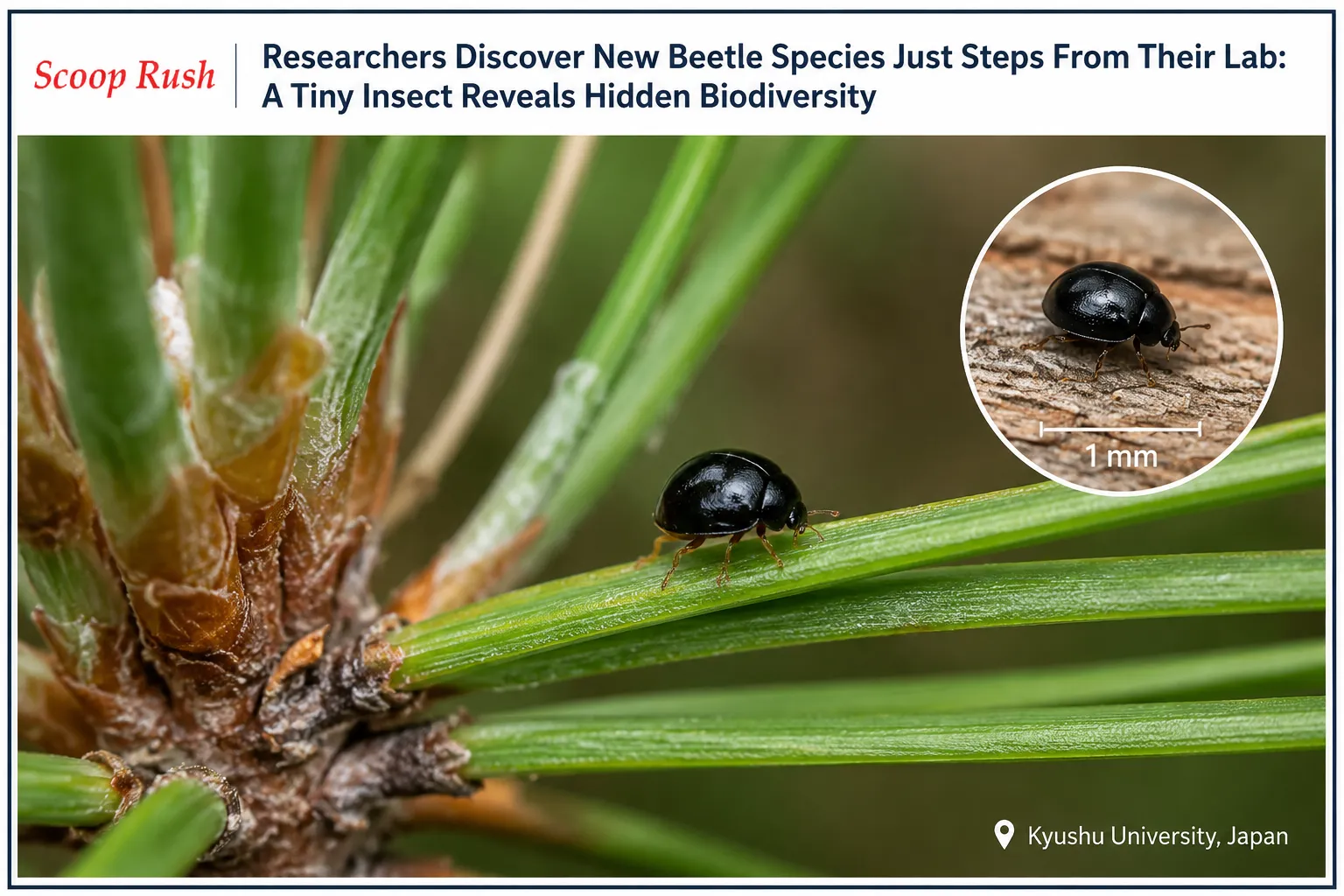
A new beetle species discovery at Kyushu University in Japan has surprised scientists after researchers found a tiny ladybird beetle living just steps away from their laboratory. The discovery of the new beetle species, named Parastethorus pinicola, shows that even familiar places like university campuses can still hide unknown wildlife.
The discovery of the new beetle species, named Parastethorus pinicola, shows that even familiar places like cities and university grounds can still contain wildlife that science has not yet documented. The tiny ladybird beetle, measuring just over one millimeter, remained unnoticed for years because of its small size and difficult identification process.
The finding came from a major research project studying tiny ladybird beetles called Stethorini, which feed on spider mites. Researchers examined around 1,700 beetle specimens and uncovered not only one new species but also another previously unknown beetle from Japan.
This discovery highlights an important message: biodiversity is not only found in remote forests or unexplored areas. Sometimes, new scientific discoveries can happen right outside our daily surroundings.
New Beetle Species Found on Kyushu University Campus
The newly identified new beetle species Parastethorus pinicola was discovered on Japanese black pine trees at Kyushu University’s Hakozaki Satellite campus in Japan.
The research was conducted as part of a three-year study focused on improving the classification of Stethorini, a group of extremely small ladybird beetles. The study was published in Acta Entomologica Musei Nationalis Pragae and became the first major review of this beetle group in Japan in more than five decades.
Researchers found that the tiny insect had been overlooked because scientists and collectors often paid less attention to pine trees where these beetles live.
How Researchers Located the Beetle
Ryōta Seki, a PhD student at the Entomological Laboratory, Graduate School of Bioresource and Bioenvironment Sciences, led the study. He explained that these beetles often live on pine trees, which helped guide the search.
Because Japanese black pines were growing at the university’s Hakozaki Satellite, researchers decided to investigate the area. Surprisingly, they discovered a species that had remained hidden in plain sight.
Why the Tiny Beetle Was Difficult to Identify
The discovery of the new beetle species was challenging because these insects are extremely small and look almost identical to related species.
According to researchers, small black ladybird beetles are difficult to study because physical differences between species are often impossible to see without detailed examination.
The beetles are barely larger than a grain of sand. Therefore, scientists must carefully analyze their bodies under microscopes and examine specific reproductive structures to accurately identify each species.
In the past, these difficulties caused several beetles to be incorrectly classified. As a result, scientists needed a detailed review to understand which species were truly different and which were actually the same.
Scientists Reexamine 1,700 Beetle Specimens

To solve long-standing classification problems, the research team studied approximately 1,700 specimens of Stethorini beetles.
The examination revealed that a beetle previously known in Japan as Stethorus japonicus was actually the same species as Stethorus siphonulus. This species is found across a wide region, including areas from China to Southeast Asia.
This correction helped scientists create a clearer understanding of beetle diversity in Asia.
Furthermore, the research showed why accurate species identification matters. Correct names allow scientists from different countries to share research data and better understand how species are distributed.
A Second New Beetle Species Discovered in Japan

The study produced another important discovery. Researchers identified a second previously unknown species from Hokkaido, Japan.
They named this beetle Stethorus takakoae.
The Story Behind the Beetle’s Name
Ryōta Seki selected the name to honor his grandmother, Takako Ōtsuki, who supported his interest in insect research from childhood.
According to Seki, improving beetle classification helps researchers communicate more effectively. Additionally, accurate naming allows scientists to understand relationships between species across different regions.
Hidden Biodiversity Exists in Everyday Places
The discovery of the new beetle species at a university campus sends a powerful message about biodiversity.
Many people imagine new species discoveries happening only in distant jungles, mountains, or isolated islands. However, researchers continue to find unknown organisms in places that humans visit every day.
Associate Professor Munetoshi Maruyama from the Kyushu University Museum supervised the research. He explained that small insects are often ignored, even though they play important roles in ecosystems.
These tiny beetles may not attract much attention because of their size. However, studying them helps scientists understand the natural world and the connections between different organisms.
The discovery also reminds researchers that many species may still remain undocumented, even in areas surrounded by human activity.
Why Small Insects Matter to Science
Although the newly discovered beetle is extremely small, its scientific value is significant.
Insects contribute to ecosystems in many ways. Researchers study them to understand biodiversity, species relationships, and environmental changes.
The study of Stethorini beetles also provides better knowledge about insects that interact with plants and other small organisms.
Furthermore, discoveries like Parastethorus pinicola help create stronger scientific records. These records allow future researchers to compare species and track biodiversity more accurately.
Another Major Beetle Discovery From Indonesia
While researchers at Kyushu University discovered a new ladybird beetle species, another important beetle discovery was recently reported from Indonesia.
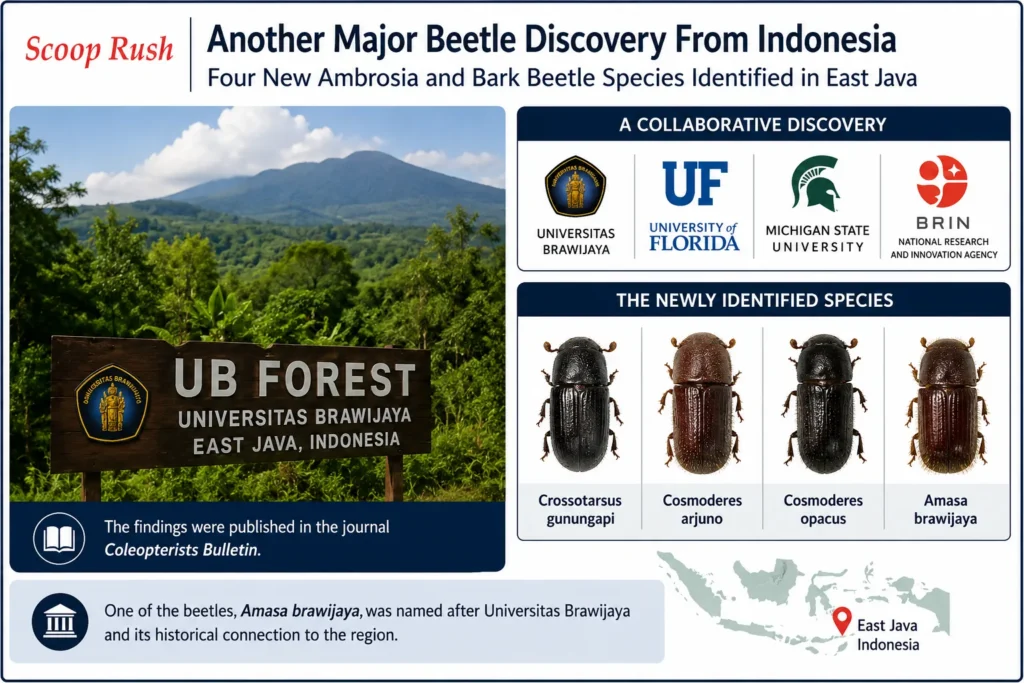
A research team from Universitas Brawijaya, together with researchers from the University of Florida, Michigan State University, and the National Research and Innovation Agency (BRIN), discovered four new species of ambrosia and bark beetles in UB Forest, East Java.
The findings were published in the journal Coleopterists Bulletin.
The Newly Identified Species
The newly identified species included:
- Crossotarsus gunungapi
- Cosmoderes arjuno
- Cosmoderes opacus
- Amasa brawijaya
One of the beetles, Amasa brawijaya, was named after Universitas Brawijaya and its historical connection to the region.
How Researchers Identify New Beetle Species
Scientists use different methods to confirm whether an insect represents a new species.
In the Indonesian research, scientists used both physical examination and DNA analysis.
Researchers compared beetle features with specimens stored in insect museums around the world. Additionally, they analyzed DNA sequences to identify genetic differences.
Similarly, the Kyushu University researchers used detailed scientific examination to separate closely related beetle species.
These methods help scientists avoid mistakes and create accurate records of Earth’s biodiversity.
What the New Beetle Species Discovery Means for Science
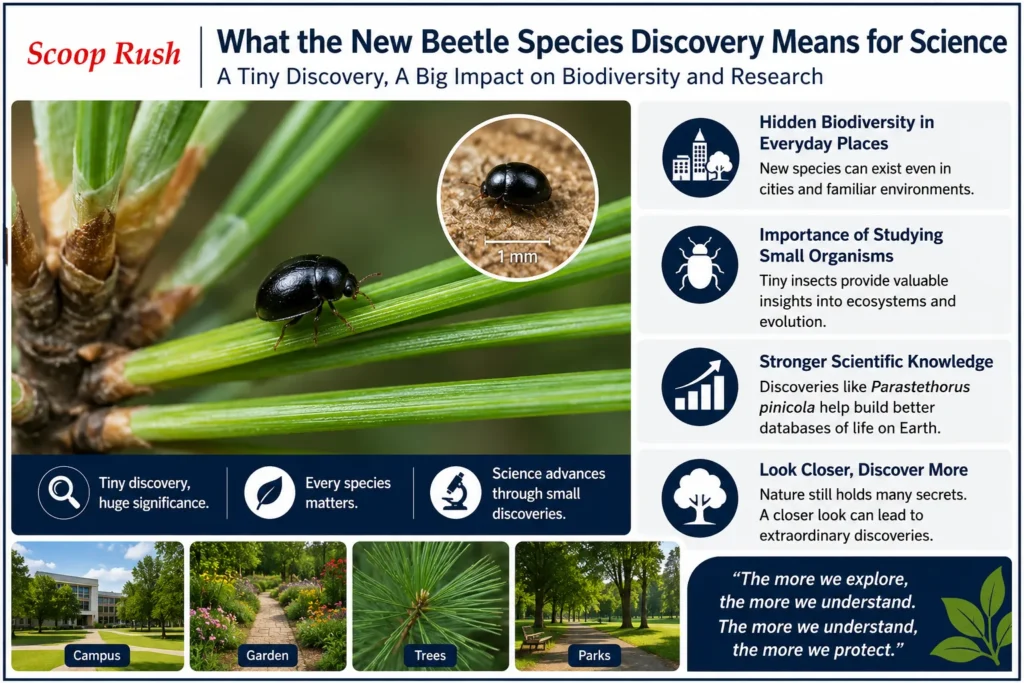
The discovery of Parastethorus pinicola demonstrates that nature still holds many surprises.
Even in developed areas, unknown species can exist unnoticed. Therefore, scientists continue to explore familiar environments because they may contain valuable discoveries.
The research also shows the importance of studying small organisms. Tiny insects often receive less attention, but they provide important information about ecosystems and evolution.
Ultimately, the discovery encourages people to look closer at the natural world around them. A simple tree, garden, or campus area may contain species that scientists have never documented before.
Conclusion: A Tiny Beetle With a Big Scientific Impact
The discovery of the new beetle species Parastethorus pinicola at Kyushu University proves that important scientific discoveries can happen in unexpected places.
Researchers found the tiny beetle on a campus pine tree, showing that hidden biodiversity exists even in everyday environments. The study also corrected previous beetle classifications and introduced another new species from Japan.
Meanwhile, discoveries in Indonesia further demonstrate that beetle diversity remains rich and largely unexplored.
Although these insects are small, their importance is enormous. Every new species discovery helps scientists better understand life on Earth and the ecosystems that support it.
FAQs
1. What is the new beetle species discovered at Kyushu University?
The newly discovered beetle species is called Parastethorus pinicola. It was found on Japanese black pine trees at Kyushu University’s Hakozaki Satellite campus.
2. How big is the new beetle species?
The beetle is extremely small, measuring just over one millimeter in length.
3. Why was the beetle not discovered earlier?
The beetle was difficult to identify because it is tiny, looks similar to other species, and requires microscopic examination for accurate classification.
4. What do Stethorini beetles eat?
Stethorini beetles are known as ladybird beetles that feed on spider mites.
5. Can new species still be discovered in cities?
Yes. The discovery at Kyushu University shows that unknown species can exist even in urban environments and familiar places.

