

Millions of people have turned to weight loss drugs like Ozempic, Wegovy, and Mounjaro hoping to lose weight and improve their health. While many users have reported impressive results, others have seen little to no change. Now, scientists believe they may have discovered the hidden reason why these medications do not work equally well for everyone.
Researchers at Stanford Medicine have identified a genetic factor that could make some people less responsive to GLP-1 medications, the class of drugs that includes Ozempic and Wegovy. Their findings suggest that a person’s DNA may play an important role in determining how effective these popular treatments are.
Stanford Scientists Investigate Why Some Patients Respond Differently

The research, published in Genome Medicine in April 2026, was the result of nearly a decade of scientific investigation. The study included experiments involving both humans and mice, along with an analysis of diabetes drug trial data.
Scientists wanted to understand why some patients experience significant improvements while others do not get the expected benefits from GLP-1 medications.
Their findings point to specific genetic variations that may interfere with the body’s ability to respond properly to these drugs.
The Genetic Variants Behind GLP-1 Resistance
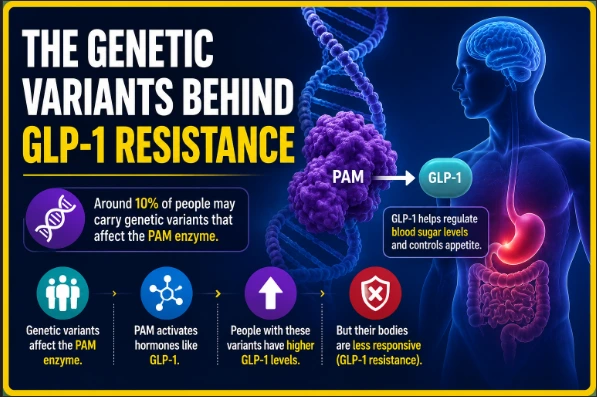
According to the researchers, around 10 percent of the population may carry certain genetic variants that affect a key enzyme called PAM (Peptidyl-glycine Alpha-amidating Monooxygenase).
This enzyme helps activate several important hormones in the body, including GLP-1, a hormone responsible for regulating blood sugar levels and controlling appetite.
Scientists discovered that people carrying these genetic variants develop what researchers call “GLP-1 resistance.”
This means their bodies produce higher levels of the GLP-1 hormone, but the hormone is less effective at performing its normal functions.
What Is GLP-1 Resistance?
GLP-1 resistance occurs when the body does not respond properly to the GLP-1 hormone, even when plenty of it is present.
Researchers found that individuals with the genetic variant had increased GLP-1 levels in their bloodstream. However, despite having more of the hormone, their blood sugar levels did not improve faster than those without the variant.
In simple terms, their bodies needed more GLP-1 to achieve the same biological effect.
Professor Anna Gloyn, one of the lead researchers, explained that this result was unexpected.
The team initially believed that problems with the PAM enzyme would reduce GLP-1 levels. Instead, they found the opposite. Patients had more GLP-1, but it was not working as efficiently.
How Researchers Conducted the Study
To test their theory, scientists recruited adults who either carried or did not carry a PAM genetic variant known as p.S539W.
Participants consumed a sugary drink, and researchers monitored their blood samples every five minutes over a four-hour period.
The results consistently showed that people with the genetic variant had higher circulating levels of GLP-1 but no corresponding improvement in blood sugar control.
Additional analyses and clinical trial data further supported the idea that this resistance is specifically linked to medications that work through GLP-1 receptors.
Does This Affect Weight Loss Results?
While the study clearly demonstrated an impact on blood sugar regulation, researchers say it is still unclear whether these genetic variants directly reduce weight loss from medications such as Ozempic and Wegovy.
The reason for this uncertainty is that weight loss treatments typically use higher doses than those prescribed for diabetes management.
Scientists believe more research is needed to determine whether GLP-1 resistance also explains why some people lose less weight than expected while taking these medications.
Why This Discovery Matters
As the popularity of weight loss medications continues to grow worldwide, understanding why patients respond differently has become increasingly important.
This discovery could eventually help doctors identify which patients are most likely to benefit from GLP-1 drugs and which individuals may require alternative treatments.
Researchers hope that future studies will uncover the exact biological mechanism behind GLP-1 resistance and improve personalized treatment options for obesity and diabetes.
For now, experts say genetics may be one important piece of the puzzle when it comes to explaining why Ozempic and similar medications do not work the same way for everyone.
FAQs
1. Why doesn’t Ozempic work for some people?
Researchers believe certain genetic variants may cause GLP-1 resistance, making the body less responsive to the medication’s effects.
2. What is GLP-1 resistance?
GLP-1 resistance occurs when the body does not respond effectively to the GLP-1 hormone, even when hormone levels are high.
3. How common are these genetic variants?
Scientists estimate that around 10 percent of people may carry the genetic variants linked to GLP-1 resistance.
4. Does this mean Ozempic cannot help people with these genes?
Not necessarily. The study showed reduced biological response, but researchers are still investigating how much this affects weight loss outcomes.
5. Can genetic testing determine whether Ozempic will work for me?
Currently, genetic testing is not routinely used to predict Ozempic effectiveness. More research is needed before such testing becomes part of standard treatment decisions.

