Home Blog Page 44

iPhone 18 Pro Leak: Tata Data Breach Exposes Apple’s Supplier List

0

📱 iPhone 18 Pro supply chain leak — key facts inside

A ransomware breach at one of Apple’s most important manufacturing partners has put unreleased iPhone 18 Pro details on the dark web, and the timing could not be worse for Apple. Component lists, supplier names, and even drop-test photos of the upcoming phone are reportedly circulating online, months before the device is expected to launch. Here is what actually happened, why it matters, and what it signals about Apple’s shifting supply chain.

What Got Leaked in the iPhone 18 Pro Data Breach

Component and Supplier Maps Exposed

Tata Electronics, Apple’s Indian assembly and components partner, was hit by a ransomware group that calls itself World Leaks. Files reportedly stolen in the attack include documents that connect specific iPhone 18 Pro components, things like main board chips, battery parts, and camera modules, to the exact companies that supply them. This kind of supplier mapping is information Apple deliberately keeps out of its public disclosures, which makes the leak more sensitive than a typical data breach.

Leaked Item What It Reveals
Component-to-supplier files (6+) Which vendor makes which iPhone 18 Pro part
Main board chip data Processor and chipset sourcing details
Battery part records Battery vendor and design specifics
Camera module documents Camera hardware supplier breakdown
Drop-test photos Early look at the unreleased device design

Drop-Test Photos of the Unreleased Device

Photos said to be part of the same leak show a grey, slab-shaped handset with a three-camera rear setup, reportedly photographed during drop testing at a Tata facility earlier this year. The images have not been independently confirmed as the iPhone 18 Pro, but sourcing close to the matter has linked them to that generation.

Why the Apple Supply Chain Leak Matters

Why the Apple supply chain leak matters

Apple’s Vendor Leverage Is Exposed

Apple runs one of the most tightly controlled supplier networks in tech. Contracts, part sourcing, and manufacturing relationships are closely guarded because they reveal where Apple has leverage and where it depends on just one or two vendors. A leak like this can hand competitors and counterfeiters a shortcut to information that took Apple years to negotiate and protect.

Bad Timing Ahead of iPhone Price Hikes

It also lands at an awkward moment. Apple has already raised prices on iPads and MacBooks due to rising memory and storage costs, and industry watchers expect iPhone prices to follow. A supply chain story breaking right before a major launch adds pressure Apple did not need.

Tata’s Growing Role in iPhone Manufacturing

India’s Rising Share of Global iPhone Production

This breach is notable because of who it happened to. Tata has become central to Apple’s push to build iPhones outside China, both assembling finished devices and supplying components. That shift lines up with a broader push to grow electronics manufacturing in India. Industry estimates suggest India could account for roughly a quarter of global iPhone production this year, a sharp jump from just a few years ago.

India’s Share of Global iPhone Production

6%

~2022

26%

2026 (est.)

Source: Counterpoint Research estimates, cited by Reuters

Tata’s Response to the Breach

Tata has said it is restricting internal access to sensitive systems while it investigates, and has brought in outside forensic experts to trace how the breach happened. Apple is reportedly working with Tata directly on longer-term security fixes.

Not the First Time: World Leaks’ History of Breaches

A Bigger Leak That’s Still Surfacing

This is actually a continuation of an earlier story. World Leaks previously dumped a large batch of files, more than 200,000 in total, that reportedly included older Apple component documents, some Tesla material, and files tied to chipmakers TSMC and Qualcomm. The new iPhone 18 Pro documents appear to be part of the same original haul, just now surfacing publicly.

Other Companies Hit by the Same Group

The group has also claimed responsibility for a separate break-in at Nike, suggesting this is a pattern of targeting large global brands rather than a one-off incident aimed at Apple. For more stories like this, check out our full Technology coverage.

What Happens Next for Apple and Tata

No Sign of a Delay to the September Launch

Apple has not confirmed the leak publicly, and neither Apple nor Tata responded to requests for comment on the reporting. The iPhone 18 Pro and Pro Max are still expected to launch around September, and it is unlikely a supplier leak alone would delay that.

The Bigger Long-Term Question

The bigger question is what this means longer term, whether Apple tightens its vendor agreements further, and whether this becomes a recurring risk as more of its manufacturing moves into new regions and new hands. Follow our News section for updates as this story develops.

FAQs

What was leaked in the Tata Electronics breach?

Files reportedly include supplier and component maps for the iPhone 18 Pro, along with photos said to show the device during drop testing.

Who is responsible for the leak?

A ransomware group known as World Leaks has claimed involvement in the Tata breach and a separate incident at Nike.

Does this delay the iPhone 18 Pro launch?

There is no indication of a delay. The phone is still expected to launch around September as planned.

Why is Tata important to Apple?

Tata assembles iPhones and supplies components, and is a key part of Apple’s effort to build more devices outside China, particularly in India.

Has Apple confirmed the leak?

Apple has not issued a public statement, though it is reported to be investigating and working with Tata on next steps.

Final Thoughts

Supply chain leaks like this rarely change a launch date, but they say a lot about how fragile even the most controlled manufacturing networks can be. As Apple leans harder on partners like Tata to diversify away from China, security incidents at those partners become Apple’s problem too. Expect tighter vendor security requirements industry-wide as more device makers face the same exposure.

Related Categories

Latest News  |  Technology

Source: Reuters, “Apple iPhone 18 Pro supplier list, parts and photos exposed in Tata data leak,” June 29, 2026.
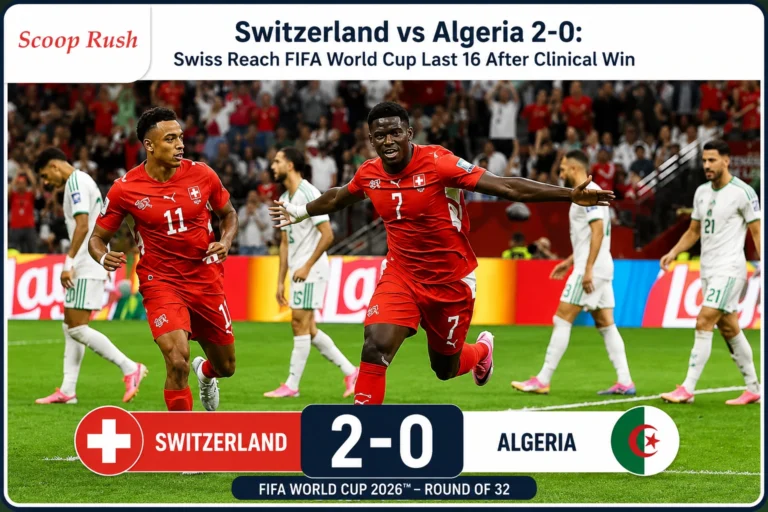
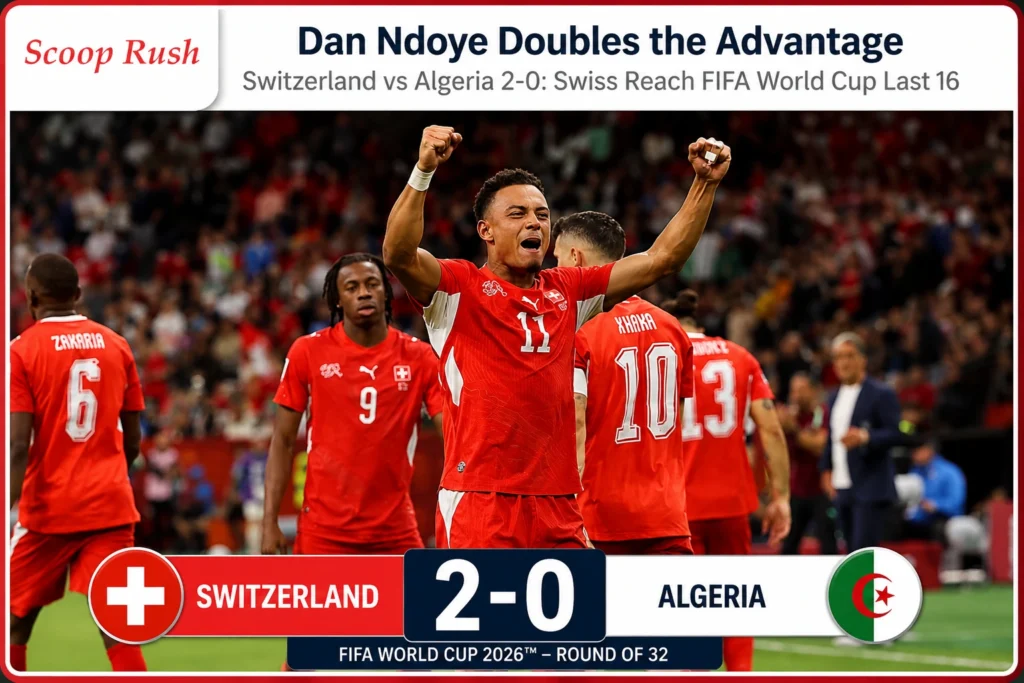
Switzerland vs Algeria 2-0: Swiss Reach FIFA World Cup Last 16 After Clinical Win

0

Competition: FIFA World Cup 2026™

Round: Round of 32

Venue: BC Place, Vancouver

Full-Time Result: Switzerland 2-0 Algeria

A fast start, disciplined defending, and efficient finishing helped Switzerland overcome Algeria 2-0 in the FIFA World Cup Round of 32. With goals in each half and a composed team performance, the Swiss side booked their place in the last 16 while ending Algeria’s tournament journey.

The match showcased Switzerland’s ability to make the most of their opportunities. Although Algeria enjoyed more possession and completed more passes, Switzerland proved far more dangerous in front of goal. Their clinical approach ultimately made the difference in a knockout contest where margins were small but decisive.

Switzerland Take Early Control with First-Half Goal

The Swiss side wasted little time making an impact. Breel Embolo opened the scoring in the 10th minute, giving his side an early advantage and forcing Algeria to chase the game.

The goal immediately changed the rhythm of the match. Murat Yakin’s men stayed compact, protected their lead, and looked to exploit counterattacks. Meanwhile, Algeria attempted to respond by controlling possession and building attacks through patient passing sequences.

Despite Algeria seeing more of the ball during long periods of the first half, the European team remained organized and limited clear-cut opportunities. Their defensive structure prevented Algeria from converting possession into meaningful chances.

As a result, Switzerland carried a valuable 1-0 lead into halftime.

Dan Ndoye Doubles the Advantage

Dan Ndoye Doubles the Advantage

The second half followed a similar pattern. Algeria continued to push forward in search of an equalizer, but Switzerland remained disciplined and dangerous whenever they moved into attacking areas.

Their persistence paid off in the 46th minute when Dan Ndoye found the net to double Switzerland’s lead. The goal arrived at a crucial moment, immediately after the restart, and significantly increased the challenge facing Algeria.

With a two-goal cushion, Switzerland gained even greater control over the match situation. They could afford to defend deeper while waiting for opportunities to exploit spaces left by an advancing Algerian side.

For Algeria, the second goal was a major setback. However, they continued to compete and looked for a route back into the contest.

Switzerland vs Algeria 2-0 Match Statistics

One of the most interesting aspects of the game was the contrast between possession and productivity.

Algeria controlled 55% of possession compared to Switzerland’s 45%. They also completed 513 passes, significantly more than Switzerland’s 398.

However, football matches are decided by chances and goals rather than possession alone.

The Swiss side registered 11 shots and six shots on target. Algeria managed eight shots with only two efforts on target. This difference in attacking efficiency reflected the final scoreline.

Key Match Statistics

StatSwitzerlandAlgeria
Goals20
Shots118
Shots on Target62
Possession45%55%
Passes398513
Pass Accuracy85%88%
Fouls1012
Yellow Cards02
Red Cards00
Offsides02
Corners42

These numbers underline Switzerland’s effectiveness. Even though Algeria circulated the ball well and recorded a higher pass accuracy, The European team created better chances and converted them when it mattered most.

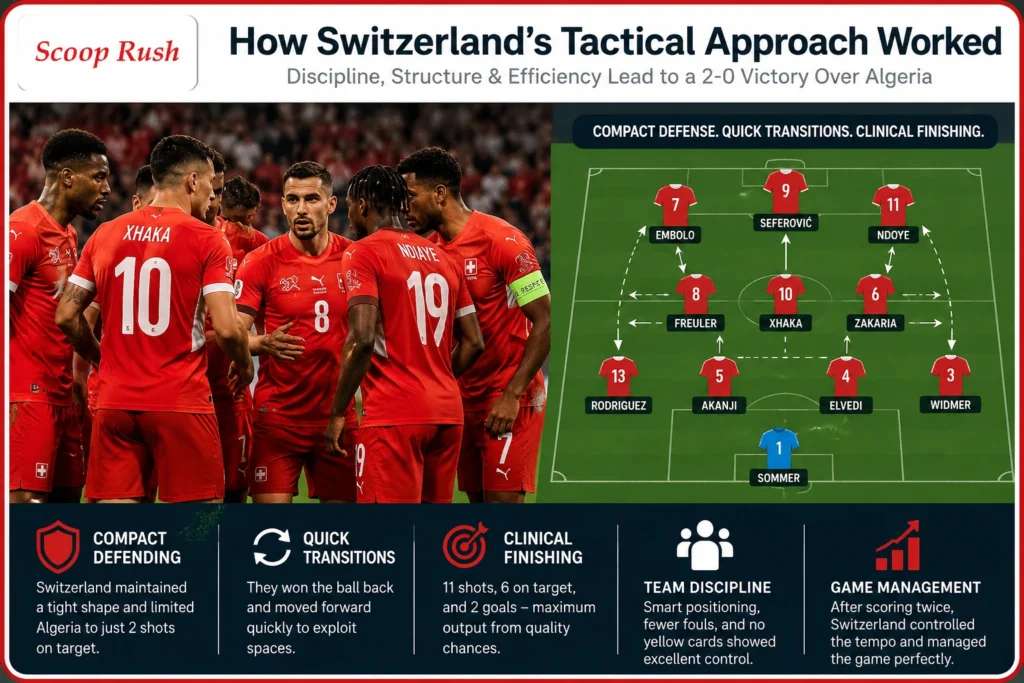
How Switzerland’s Tactical Approach Worked

How Switzerland's Tactical Approach Worked

The Swiss side’s game plan appeared clear from the opening stages. Rather than dominating possession, they focused on defensive organization and direct attacking transitions.

The early goal allowed them to settle into a structure that frustrated Algeria. Whenever possession changed hands, Murat Yakin’s men moved the ball forward quickly and looked to exploit gaps.

This strategy proved highly effective. Their attacking players consistently found dangerous positions, leading to more shots and significantly more attempts on target.

Furthermore, the European side maintained discipline throughout the match. They committed fewer fouls and avoided yellow cards, demonstrating excellent game management under knockout-stage pressure.

Defensive Discipline Makes the Difference

A major reason behind Switzerland’s success was their defensive performance.

Algeria spent considerable periods in possession but struggled to break through the Swiss defensive lines. Switzerland restricted their opponents to only two shots on target across the entire match.

Strong positioning, compact defensive spacing, and intelligent pressing prevented Algeria from creating the type of chances needed to mount a comeback.

As a result, Switzerland recorded an important clean sheet in a high-pressure World Cup fixture.

Algeria’s Possession Could Not Produce Goals

Algeria will be disappointed with the outcome because several aspects of their performance were positive.

They controlled possession, completed more passes, and maintained an impressive 88% pass accuracy. These numbers suggest they were comfortable in possession and capable of progressing the ball through midfield.

However, the final third proved problematic.

Too often, Algeria’s attacks lacked the cutting edge required to break down Switzerland’s organized defense. Despite controlling the ball for much of the game, they struggled to create clear opportunities.

The statistics tell the story clearly. Eight total shots and only two on target were not enough against a disciplined Swiss side.

Additionally, Algeria received two yellow cards and committed 12 fouls, slightly disrupting their momentum during important phases of the contest.

Important Substitutions During the Match

Both teams made several changes as the game progressed.

For Switzerland, substitutions helped maintain energy levels and defensive stability. The lineup changes ensured the team remained organized while protecting its lead.

Algeria also turned to their bench in an effort to change the course of the match. Fresh players were introduced to add creativity and attacking threat. However, Switzerland’s defensive shape continued to hold firm.

The substitutions reflected the tactical battle unfolding on the pitch. Switzerland sought control and balance, while Algeria searched for attacking solutions.

Standout Performers for Switzerland

Several Swiss players played crucial roles in securing victory.

Breel Embolo

Embolo’s early goal provided the foundation for the win. Scoring in the 10th minute gave Switzerland confidence and immediately placed Algeria under pressure.

His movement and attacking presence caused problems throughout the match.

Dan Ndoye

Ndoye delivered the decisive second goal shortly after halftime. His finish effectively put Switzerland in command and allowed the team to manage the game from a position of strength.

Swiss Defensive Unit

While the goals will attract headlines, the defensive performance deserves equal recognition.

Keeping Algeria to only two shots on target required concentration, communication, and tactical discipline from start to finish.

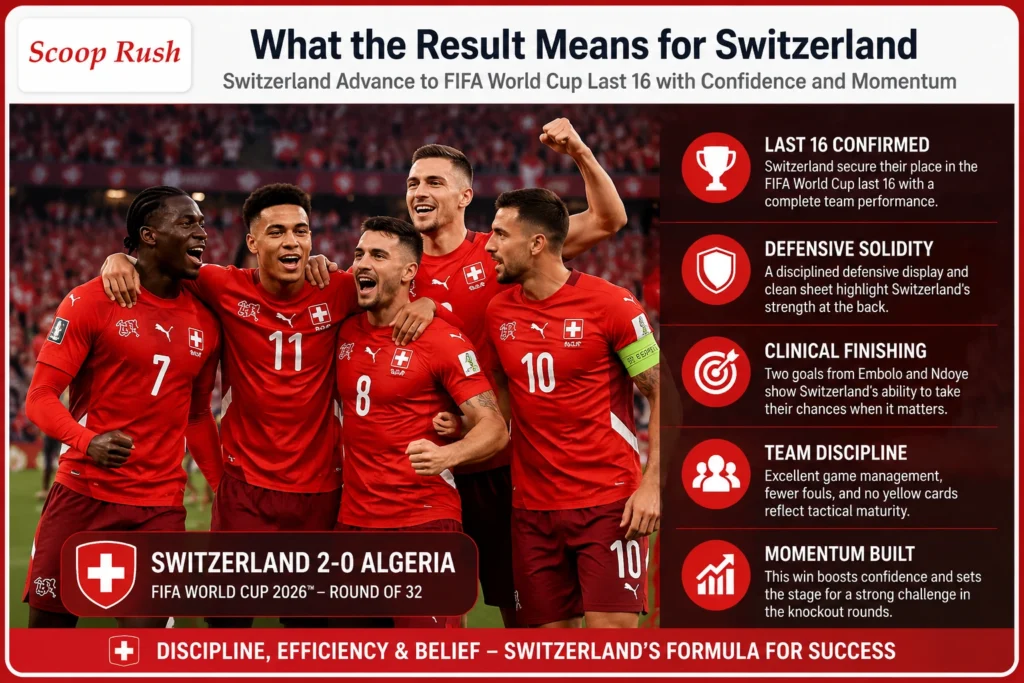
What the Result Means for Switzerland

What the Result Means for Switzerland

This victory sends Switzerland into the FIFA World Cup last 16 and reinforces their reputation as a well-organized tournament team.

Knockout football often rewards teams that remain disciplined, take their chances, and avoid mistakes. Switzerland demonstrated all three qualities in this match.

The result also provides momentum heading into the next stage of the competition. Confidence will be high after another professional performance. Switzerland combined defensive solidity with clinical finishing throughout the match.

Most importantly, Switzerland showed they can win matches even without dominating possession, a valuable trait in tournament football.

What Algeria Can Take from the Tournament

Although Algeria’s World Cup campaign ends in the Round of 32, there are still positives to reflect upon.

Their ability to control possession and maintain strong passing accuracy highlights technical quality within the squad. Against many opponents, those strengths could have produced a different result.

However, this match also demonstrated the importance of turning possession into genuine scoring opportunities. Improving efficiency in the final third will be a key lesson moving forward.

Ultimately, Algeria competed with determination but could not find a way past a highly organized Swiss team.

Conclusion

The Switzerland vs Algeria 2-0 result was a perfect example of efficiency overcoming possession dominance. Switzerland struck early through Breel Embolo and added a second goal from Dan Ndoye immediately after halftime to secure a comfortable victory.

While Algeria controlled more of the ball and completed more passes, Switzerland created the better chances and delivered when opportunities appeared. Their disciplined defensive display ensured Algeria never found a route back into the match.

As a result, Switzerland advanced to the FIFA World Cup last 16 with confidence and momentum. Meanwhile, Algeria exited the tournament knowing that possession alone was not enough without the clinical finishing required to succeed in knockout football.

FAQs

1. What was the final score between Switzerland and Algeria?

Switzerland defeated Algeria 2-0 in the FIFA World Cup Round of 32.

2. Who scored for Switzerland against Algeria?

Breel Embolo scored in the 10th minute, while Dan Ndoye added the second goal in the 46th minute.

3. Did Algeria have more possession than Switzerland?

Yes. Algeria finished with 55% possession, while Switzerland had 45%.

4. How many shots on target did each team record?

Switzerland registered six shots on target, while Algeria managed two.

5. What does this result mean for Switzerland?

The victory sends Switzerland into the FIFA World Cup last 16, where they will continue their knockout-stage campaign.

Argentina vs Cape Verde: Argentina Edge Cape Verde 3-2 After Extra Time to Reach FIFA World Cup 2026 Round of 16

0

Competition: FIFA World Cup 2026 (Round of 32)
Full Time (90 Minutes): Argentina 1-1 Cape Verde
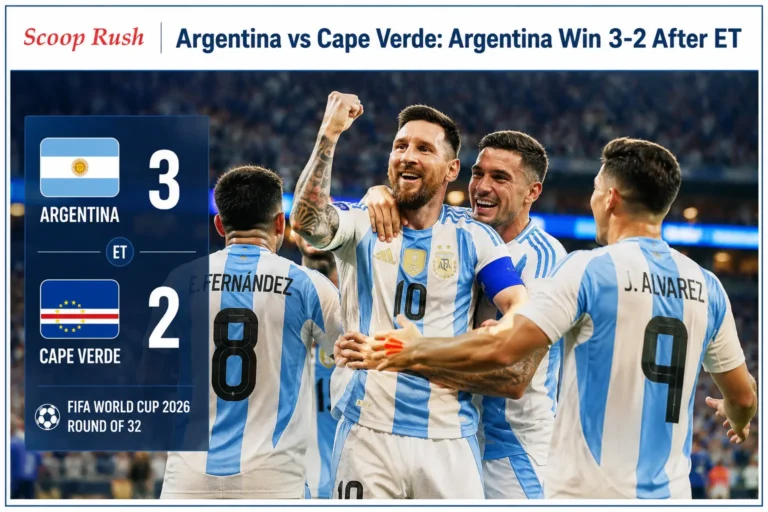
After Extra Time: Argentina 3-2 Cape Verde
Venue: Miami Stadium, Florida
Date: 3 July 2026

Defending champions Argentina secured a dramatic victory in the Argentina vs Cape Verde clash, defeating the African debutants 3-2 after extra time in the FIFA World Cup 2026 Round of 32. Lionel Messi opened the scoring before Cape Verde fought back to force extra time. Nevertheless, Argentina found a late winner through an own goal to book their place in the Round of 16.

Argentina vs Cape Verde Match Summary

Argentina made a bright start and controlled possession throughout the opening stages. Their pressure paid off in the 29th minute when Lionel Messi calmly finished to give the reigning champions a deserved lead.

Cape Verde remained organized in defense despite spending long spells without the ball. Goalkeeper Vozinha produced seven important saves to frustrate Argentina and keep his team in the contest a resilience the side also showed in their earlier draw against Uruguay in the group stage. The African side eventually found its breakthrough in the 59th minute when Deroy Duarte scored a well-taken equalizer, sending the match into extra time.

The contest became even more dramatic after the additional period began. Lisandro Martínez pushed forward from defense and restored Argentina’s lead in the 92nd minute with a clinical finish.

However, Cape Verde refused to give in. Sidny Lopes Cabral produced a magnificent curling strike in the 103rd minute to level the score at 2-2 and bring the match within touching distance of a penalty shootout.

Argentina finally found the decisive moment in the 111th minute. Lionel Messi swung in a dangerous corner, Cristian Romero rose highest to meet it with a powerful header, and the ball deflected off defender Diney into his own net. The unfortunate own goal sealed a dramatic 3-2 victory for Argentina and secured their place in the Round of 16.

Argentina vs Cape Verde Goalscorers

Argentina

  • Lionel Messi (29′)
  • Lisandro Martínez (92′)
  • Diney (Own Goal, 111′)

Cape Verde

  • Deroy Duarte (59′)
  • Sidny Lopes Cabral (103′)

Argentina vs Cape Verde Match Stats

Argentina dominated the match statistically, although Cape Verde made every opportunity count.

  • Shots: Argentina 21, Cape Verde 15
  • Shots on Target: Argentina 10, Cape Verde 5
  • Possession: Argentina 64%, Cape Verde 36%
  • Passes: Argentina 822, Cape Verde 444
  • Pass Accuracy: Argentina 92%, Cape Verde 87%
  • Fouls: Argentina 13, Cape Verde 12
  • Yellow Cards: Argentina 1, Cape Verde 1
  • Red Cards: None
  • Offsides: Argentina 3, Cape Verde 2
  • Corners: Argentina 8, Cape Verde 8

Although Argentina controlled possession and completed more than 800 passes, Cape Verde remained dangerous on the counterattack and pushed the defending champions to the very end.

Argentina vs Cape Verde Starting Lineups

Argentina (4-1-2-3)

Emiliano Martínez; Nahuel Molina, Cristian Romero, Lisandro Martínez, Facundo Medina; Alexis Mac Allister, Rodrigo De Paul, Enzo Fernández; Lionel Messi, Lautaro Martínez, Thiago Almada.

Substitutes used: Julián Álvarez, Nicolás González, Leandro Paredes, Nicolás Tagliafico, Gonzalo Montiel.

Cape Verde (4-1-4-1)

Vozinha; Steven Moreira, Roberto Lopes, Diney, Sidny Lopes Cabral; Kevin Pina; Ryan Mendes, Laros Duarte, Deroy Duarte, Jovane Cabral; Nuno da Costa.

Substitutes used: Jamiro Monteiro, Dailon Livramento, Willy Semedo, Hélio Varela, Yannick Semedo, Gilson Benchimol.

Argentina vs Cape Verde Key Performers

Lionel Messi once again led Argentina with an influential display. He opened the scoring, created several chances, and delivered the corner that resulted in the winning own goal continuing a tournament run that has already seen him break a World Cup record. Lisandro Martínez also made a decisive contribution by scoring early in extra time, while Cristian Romero’s commanding presence in the air created the match-winning opportunity.

Cape Verde earned widespread admiration for a fearless performance. Goalkeeper Vozinha made seven excellent saves to keep his side in contention, Deroy Duarte scored the vital equalizer in normal time, and Sidny Lopes Cabral produced one of the standout goals of the tournament with his brilliant extra-time strike a display that echoed their earlier group-stage grit against Spain and Saudi Arabia.

What This Result Means

The Argentina vs Cape Verde result sends Argentina into the FIFA World Cup 2026 Round of 16 after surviving one of the toughest tests of their title defense, following an earlier group-stage win against Jordan. Although Argentina dominated possession and created more chances, Cape Verde matched them with determination and resilience throughout an unforgettable contest.

Argentina will now face Egypt in the Round of 16, a side that has impressed after their comeback win over New Zealand and a hard-fought draw with Iran earlier in the tournament. Cape Verde leave the tournament with their reputation greatly enhanced after producing one of the most courageous performances of the FIFA World Cup 2026.

Portugal vs Croatia: Portugal Pull Off Dramatic 2-1 Comeback to Reach FIFA World Cup 2026 Round of 16

0

Competition: FIFA World Cup 2026™
Round: Round of 32
Full Time: Portugal 2-1 Croatia
Venue: Toronto Stadium, Toronto
Date: 3 July 2026

Portugal vs Croatia: Portugal Complete Stunning Comeback

Portugal came from behind to beat Croatia 2-1 in a dramatic FIFA World Cup 2026 Round of 32 clash at Toronto Stadium on 3 July 2026. The Portuguese side dominated possession and controlled much of the play, while Croatia remained dangerous with disciplined defending and quick counter-attacks.

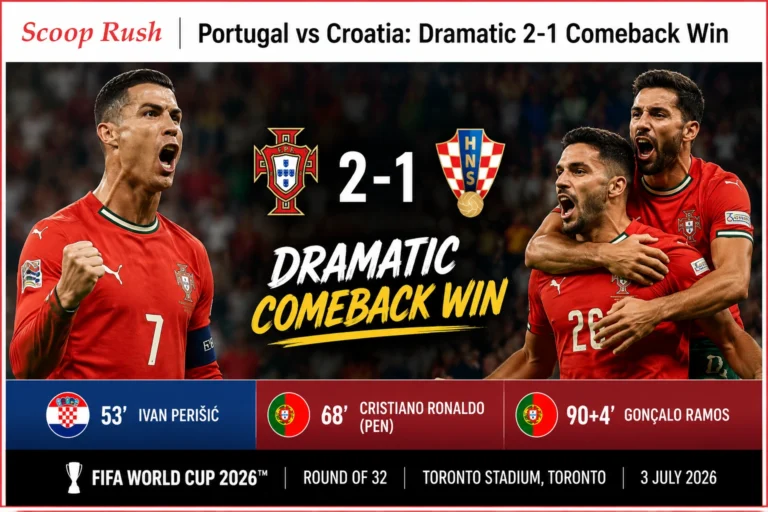
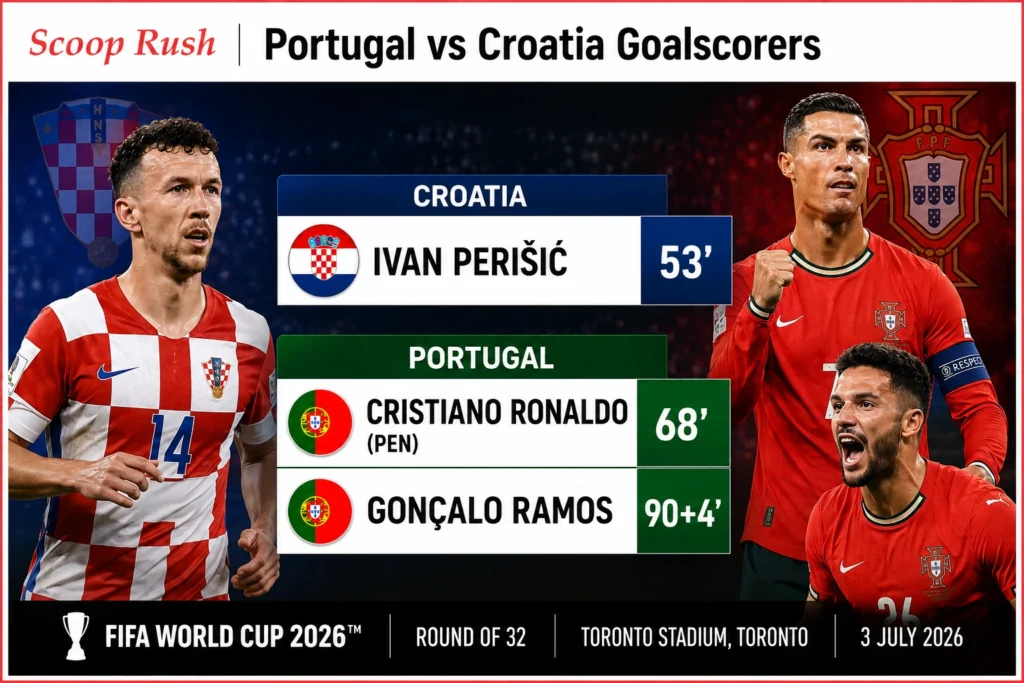
Croatia broke the deadlock early in the second half when Ivan Perišić found the back of the net. Roberto Martínez responded by introducing fresh attacking players, a move that changed the momentum of the match. Cristiano Ronaldo calmly converted a penalty to level the score before substitute Gonçalo Ramos headed home a dramatic stoppage-time winner to send Portugal into the Round of 16.

Portugal vs Croatia Goalscorers

Portugal-vs-Croatia-Goalscorers

Croatia Ivan Perišić (53′)

Portugal Cristiano Ronaldo (68′ PEN) Gonçalo Ramos (90+4′)

Portugal vs Croatia Match Summary

The first half ended goalless despite Portugal enjoying most of the possession. Croatia remained compact defensively and looked dangerous whenever they attacked on the break.

The breakthrough arrived in the 53rd minute when Ivan Perišić finished clinically to give Croatia a surprise lead. Portugal immediately increased the pressure, and Roberto Martínez responded with a quadruple substitution in the 62nd minute, introducing Bernardo Silva and Gonçalo Ramos among the changes.

The substitutions transformed Portugal’s attack. Six minutes later, Portugal won a penalty, and Cristiano Ronaldo calmly converted in the 68th minute to score his first-ever FIFA World Cup knockout-stage goal.

As extra time approached, Portugal completed the turnaround. Gonçalo Ramos, who had come off the bench, rose highest in the 94th minute to head home the winning goal and spark wild celebrations.

The drama was not over. In the 103rd minute (90+13′), Joško Gvardiol appeared to equalise for Croatia with the final touch of the match. However, following a lengthy VAR review, the goal was ruled out for offside, confirming Portugal’s place in the next round.

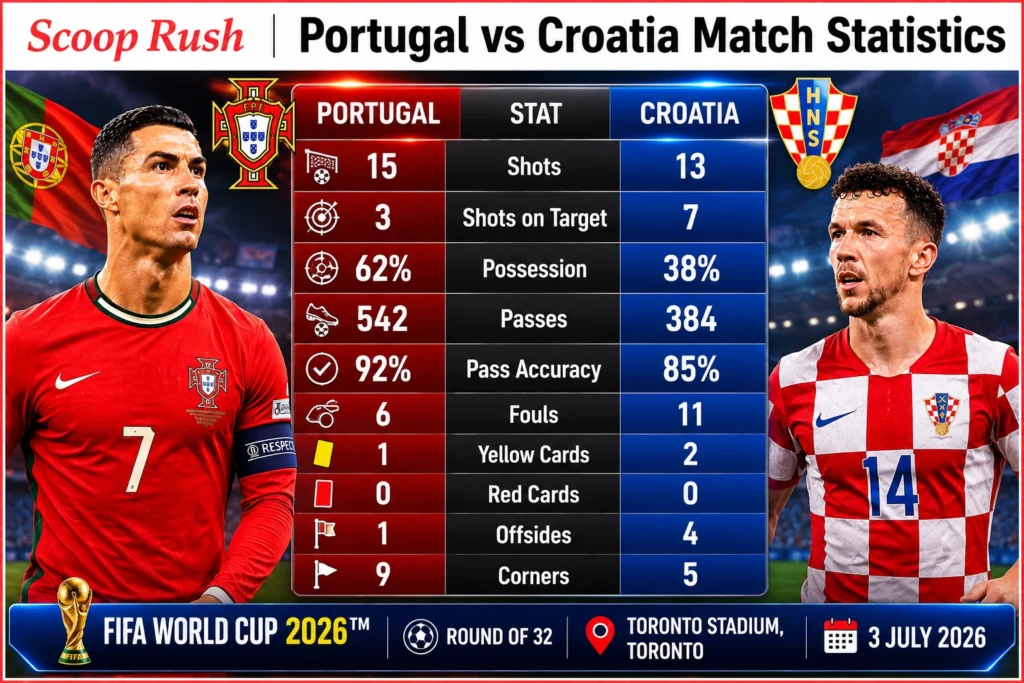
Portugal vs Croatia Match Statistics

Portugal-vs-Croatia-Match-Statistics

Although Croatia registered more shots on target, Portugal controlled possession, completed significantly more passes, and dictated the overall tempo of the match.

StatPortugalCroatia
Shots1513
Shots on Target37
Possession62%38%
Passes542384
Pass Accuracy92%85%
Fouls611
Yellow Cards12
Red Cards00
Offsides14
Corners95

Portugal’s dominance in possession reflected their patient approach, while Croatia remained highly efficient on the counter-attack and forced Diogo Costa into several important saves.

Portugal vs Croatia Confirmed Starting Lineups

Portugal XI Diogo Costa; João Cancelo, Rúben Dias, Renato Veiga, Nuno Mendes; João Neves, Vitinha; Pedro Neto, Bruno Fernandes, Rafael Leão; Cristiano Ronaldo.

Croatia XI Dominik Livaković; Josip Stanišić, Josip Šutalo, Marin Pongračić, Ivan Perišić; Mateo Kovačić, Luka Modrić, Nikola Vlašić; Petar Sučić, Martin Baturina; Ante Budimir.

Portugal vs Croatia Key Performers

Cristiano Ronaldo once again delivered on the biggest stage. His composed penalty restored parity and marked his first-ever goal in a FIFA World Cup knockout match.

Substitute Gonçalo Ramos changed the game after coming on in the second half. His stoppage-time header completed Portugal’s comeback and proved to be the decisive moment of the match.

Diogo Costa also played a crucial role by making several outstanding saves to keep Portugal in the contest, especially during Croatia’s dangerous spells on the counter.

For Croatia, Ivan Perišić produced another impressive performance, opening the scoring and providing a constant attacking threat. Luka Modrić controlled possession whenever Croatia had the ball and led his side with typical composure.

Portugal vs Croatia Tactical Analysis

Portugal controlled the match through possession and patient build-up play but initially struggled to break down Croatia’s disciplined defensive shape. Croatia allowed Portugal to dominate the ball before launching quick counter-attacks, a strategy that produced the opening goal.

Roberto Martínez’s substitutions changed the momentum. The introduction of Bernardo Silva and Gonçalo Ramos added creativity and movement in the final third. Portugal became more direct, won the decisive penalty, and eventually found the late winner.

Even after conceding in stoppage time, Croatia nearly forced extra time. However, VAR correctly ruled out Joško Gvardiol’s goal for offside, ending one of the most dramatic matches of the tournament.

What This Result Means

Portugal advance to the FIFA World Cup 2026 Round of 16 after producing a memorable comeback. They will now face Spain in a highly anticipated Iberian derby in Dallas.

Croatia exit the tournament in heartbreaking fashion after seeing a last-second equaliser disallowed by VAR. The defeat could also mark Luka Modrić’s final appearance at a FIFA World Cup, bringing an end to one of international football’s greatest careers.

Portugal’s route to this stage included a group-stage draw covered in Colombia vs Portugal, and their record-breaking win recapped in Portugal vs Uzbekistan.

Old Muscle Stem Cells Can Act Young Again but There’s a Catch: Scientists Discover a Hidden Survival Switch

0

Introduction

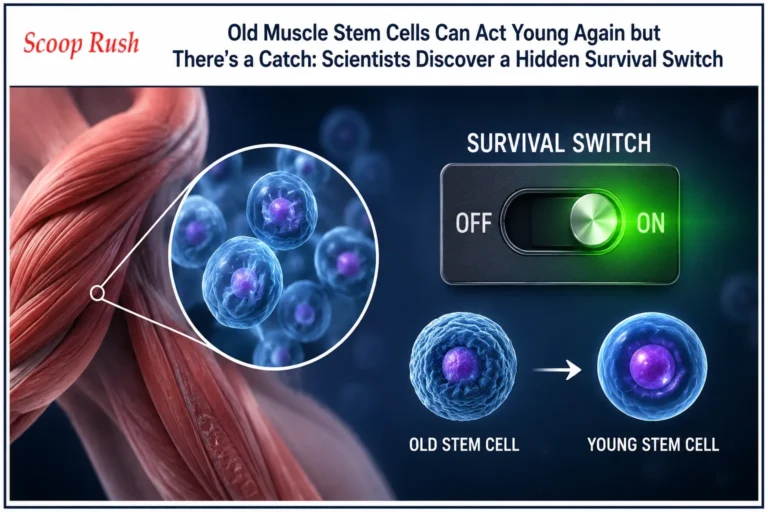
Growing older often means recovering more slowly from muscle injuries, but scientists may have finally discovered why. A new study from the University of California, Los Angeles (UCLA) reveals that aging muscle stem cells are not simply becoming weaker over time. Instead, they adopt a survival strategy that helps them withstand the stresses of aging while reducing their ability to repair damaged muscle quickly.

Researchers found that a protein called NDRG1 builds up inside older muscle stem cells and acts like a brake, slowing their activation after injury. Surprisingly, the same protein also protects these cells from the harsh conditions associated with aging, allowing them to survive longer. This discovery suggests that slower muscle healing may not be a sign of failure but a biological trade-off between faster repair and long-term survival. The findings could reshape future research on healthy aging and regenerative medicine by helping scientists develop treatments that improve muscle repair without exhausting the body’s stem cell reserves.

Why Aging Muscles Heal More Slowly

Why Aging Muscles Heal More Slowly

As people grow older, recovering from muscle injuries becomes increasingly difficult. Cuts, strains, surgeries, and exercise-related injuries often require more time to heal than they do in younger individuals.

Scientists have known this for years, but the biological reason has remained unclear.

To investigate the problem, UCLA researchers focused on muscle stem cells, also known as satellite cells. These specialized cells remain inactive until muscle tissue becomes damaged. Once injury occurs, they quickly activate, multiply, and create new muscle fibers that repair the injured tissue.

Young muscle stem cells perform this process efficiently. However, older stem cells respond much more slowly, delaying muscle regeneration.

The new study explains why this happens.

Scientists Identify NDRG1 as the Hidden Brake

Researchers compared muscle stem cells collected from young and old mice. One difference immediately stood out.

Older stem cells contained much higher levels of a protein called NDRG1. In fact, NDRG1 levels were about 3.5 times higher than those found in younger stem cells.

The researchers discovered that NDRG1 acts like an internal brake.

Instead of allowing muscle stem cells to activate immediately after injury, the protein suppresses an important growth pathway called mTOR. This pathway normally tells stem cells to leave their resting state and begin repairing damaged muscle.

When NDRG1 levels increase, the repair process slows significantly.

Although muscle healing becomes slower, the stem cells themselves become better equipped to survive the stressful conditions associated with aging.

Blocking NDRG1 Makes Old Stem Cells Behave Like Young Ones

To test whether NDRG1 was responsible for slower muscle repair, the research team studied naturally aged mice roughly equivalent to 75-year-old humans.

Instead of replacing aging stem cells, scientists temporarily blocked the activity of NDRG1.

The results were remarkable.

The older stem cells rapidly regained youthful behavior.

They activated faster after injury.

They divided more efficiently.

They repaired damaged muscle much more effectively.

These findings showed that older stem cells had not completely lost their regenerative ability. Instead, NDRG1 had been limiting their performance.

This discovery raises the possibility that some age-related muscle decline may be reversible by adjusting the molecular signals that control stem cell behavior.

The Catch Behind Faster Muscle Repair

The Catch Behind Faster Muscle Repair

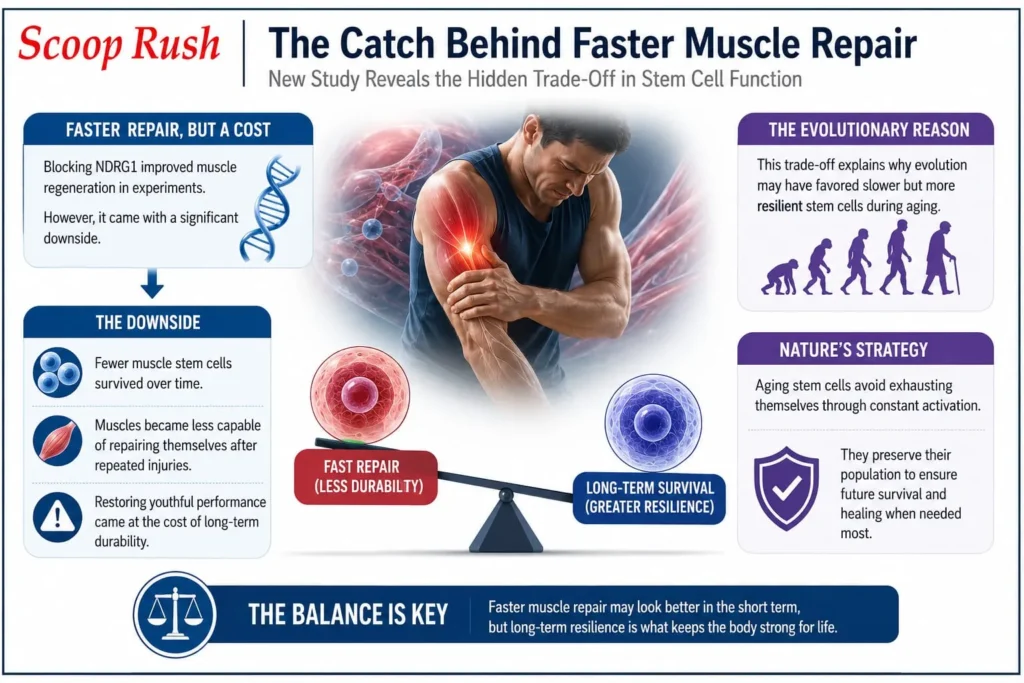
Although blocking NDRG1 improved muscle regeneration, researchers discovered an important downside.

Without the protective effects of NDRG1, fewer muscle stem cells survived over time.

As a result, muscles became less capable of repairing themselves after repeated injuries.

In other words, restoring youthful performance came at the cost of long-term durability.

This trade-off explains why evolution may have favored slower but more resilient stem cells during aging.

Instead of exhausting themselves through constant activation, aging stem cells appear to preserve their population for future survival.

Survival Versus Performance

Senior author Dr. Thomas Rando described the difference using a simple comparison.

Young muscle stem cells behave like sprinters.

They react quickly.

They repair tissue efficiently.

However, they may struggle to survive over the long term.

Older stem cells resemble marathon runners.

They respond more slowly after injury.

However, they are much better equipped to survive the stresses of aging.

According to the researchers, this balance between speed and endurance represents a natural survival strategy rather than a simple failure of aging cells.

Understanding Cellular Survivorship Bias

One of the study’s most interesting ideas is what researchers call cellular survivorship bias.

Over time, muscle stem cells with lower levels of NDRG1 are less likely to survive the harsh environment found in aging tissue.

Eventually, the remaining population consists mainly of stem cells with higher NDRG1 levels.

These cells survive better but repair muscle more slowly.

The researchers believe this process explains why aging tissues gradually lose regenerative capacity even though stem cells are still present.

Rather than selecting the fastest cells, aging appears to favor the toughest ones.

A New Way of Thinking About Aging

For decades, many scientists viewed aging as a gradual breakdown of cellular function.

This study suggests something different.

Some changes associated with aging may actually protect stem cells from disappearing altogether.

According to Dr. Thomas Rando, slower tissue repair may represent a necessary compromise that prevents complete depletion of the body’s stem cell supply.

The researchers compare this process to survival strategies seen throughout nature.

During droughts, famine, or harsh winters, many animals shift their energy away from reproduction and toward survival.

Muscle stem cells may follow a similar strategy.

Instead of focusing on producing new cells as quickly as possible, they prioritize staying alive in an increasingly stressful environment.

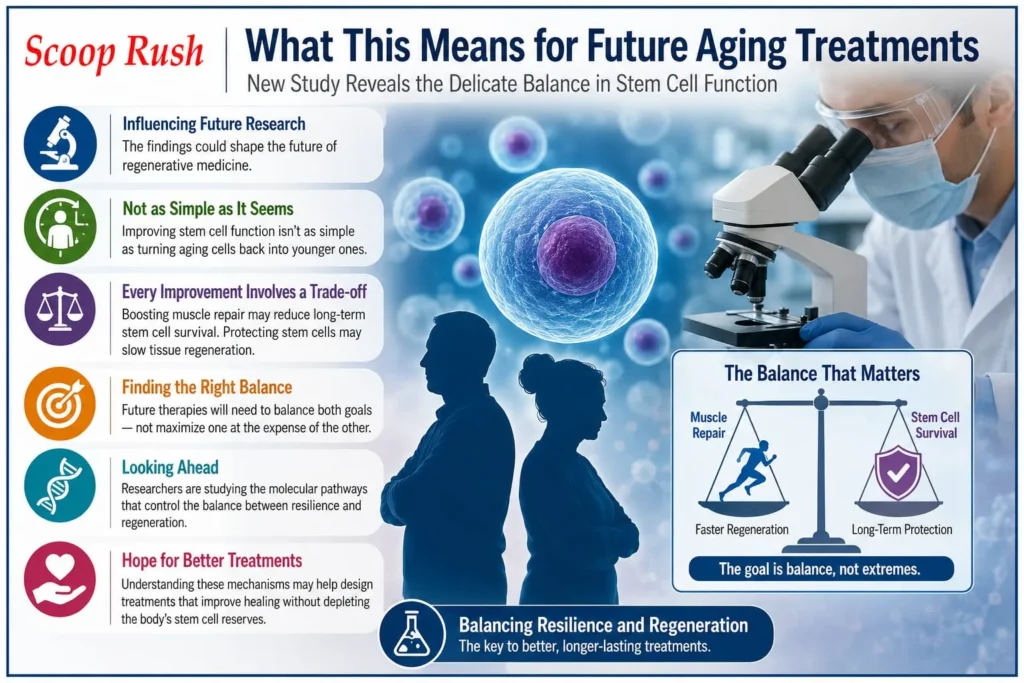
What This Means for Future Aging Treatments

What This Means for Future Aging Treatments

The findings could influence future regenerative medicine research.

Scientists have long searched for ways to restore youthful tissue repair in older adults.

However, this study suggests that improving stem cell function is not as simple as turning aging cells back into younger ones.

Every improvement may involve a trade-off.

Enhancing muscle repair could reduce long-term stem cell survival.

Protecting stem cells could slow tissue regeneration.

Future therapies will likely need to balance both goals rather than maximizing one at the expense of the other.

Researchers also plan to continue studying the molecular pathways that control this balance between resilience and regeneration.

Understanding these mechanisms may eventually help scientists design treatments that improve healing without exhausting the body’s stem cell reserves.

Why This Discovery Matters

Although this research was conducted in mice, it changes how scientists think about aging itself.

Instead of viewing older stem cells as damaged versions of younger cells, researchers now see them as cells that have adapted to survive under difficult conditions.

That perspective could reshape future studies on healthy aging, regenerative medicine, and muscle recovery.

The discovery also highlights an important lesson about biology.

Sometimes what appears to be a weakness is actually a survival strategy.

Slower muscle repair may be frustrating, but it could also help preserve the body’s ability to regenerate tissue over a much longer period.

Conclusion

The UCLA study provides valuable insight into why muscle healing slows with age. Researchers discovered that the protein NDRG1 acts as both a protector and a brake inside aging muscle stem cells. While it slows their ability to repair damaged tissue, it also helps them survive the stresses of aging.

Blocking NDRG1 allowed older stem cells to behave like younger ones and repair muscle more efficiently. However, this benefit came with a significant cost because fewer stem cells survived over time.

These findings suggest that aging is not simply a process of decline. Instead, it involves carefully balanced biological trade-offs that help preserve stem cells for the future while reducing their immediate performance. As scientists continue exploring these mechanisms, the research may eventually guide safer therapies that improve muscle repair without compromising long-term stem cell health.

FAQs

1. What are muscle stem cells?

Muscle stem cells, also called satellite cells, are specialized cells that repair damaged muscle tissue after injury.

2. What is NDRG1?

NDRG1 is a protein that increases in aging muscle stem cells. It slows muscle repair while helping the cells survive longer.

3. Why do older muscles heal more slowly?

According to the study, aging muscle stem cells contain higher levels of NDRG1, which delays their activation after injury.

4. Did scientists reverse muscle aging?

Not completely. Researchers temporarily restored youthful behavior in aged muscle stem cells by blocking NDRG1 in mice, but this also reduced long-term stem cell survival.

5. Could this research lead to anti-aging treatments?

The findings may help scientists develop future therapies that improve muscle repair. However, researchers say any treatment must carefully balance faster healing with preserving stem cell health.

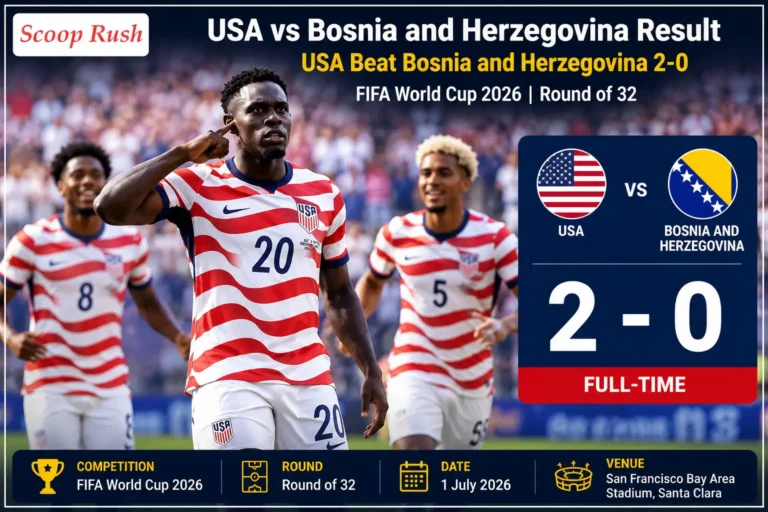
USA vs Bosnia and Herzegovina Result: USA Beat Bosnia and Herzegovina 2-0 in FIFA World Cup 2026 Round of 32

0

Competition: FIFA World Cup 2026
Full-Time Result: USA 2-0 Bosnia and Herzegovina
Venue: San Francisco Bay Area Stadium, Santa Clara
Round: Round of 32

USA Advance with a Professional Performance

The USA vs Bosnia and Herzegovina Result delivered exactly what American supporters hoped for. The United States produced a disciplined display to defeat Bosnia and Herzegovina 2-0 in the FIFA World Cup 2026 Round of 32 and secure a place in the Round of 16.

Folarin Balogun opened the scoring before halftime, and Malik Tillman sealed the victory late in the second half [U.S. Soccer]. The USA remained remarkably organized throughout the match, managing to protect their lead despite finishing with ten men after Balogun received a red card midway through the second half.

The victory highlights the USA’s ability to stay composed in high-pressure knockout football and continue their World Cup journey.

Match Overview

The United States entered the knockout stage knowing every mistake could end their tournament. Therefore, the team focused on controlling key moments instead of chasing possession.

Bosnia and Herzegovina enjoyed slightly more of the ball during the match. However, the USA made their opportunities count and defended effectively whenever they came under pressure.

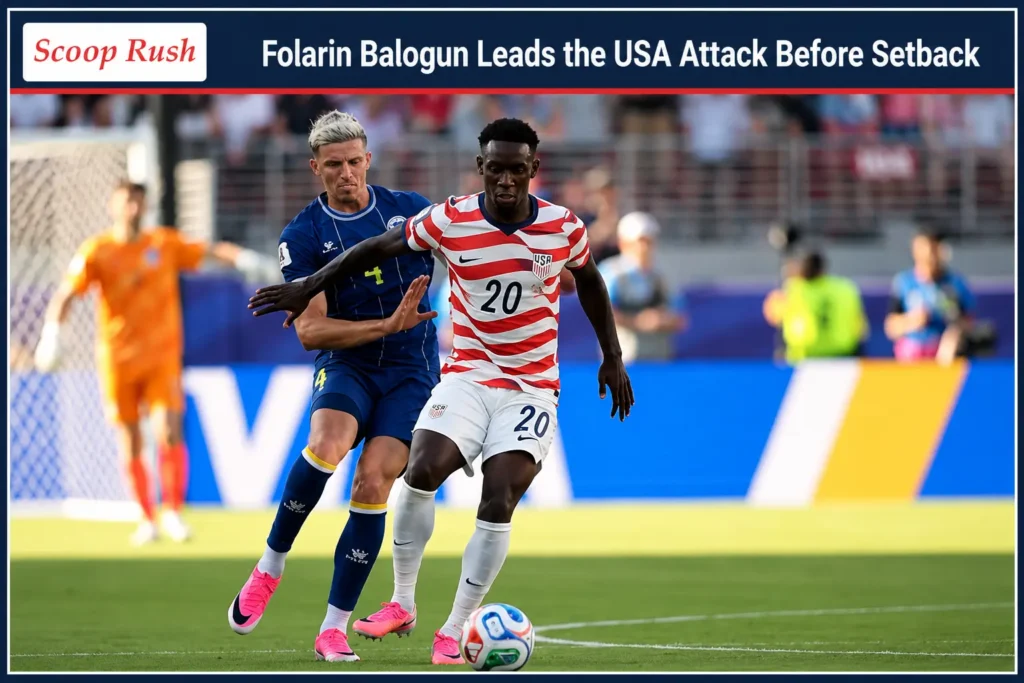
Folarin Balogun Leads the USA Attack Before Setback

Folarin Balogun Leads the USA Attack Before Setback

The opening story from the USA vs Bosnia and Herzegovina Result was the impact of Folarin Balogun in the final third.

Balogun opened the scoring in the 45th minute, giving the United States an important advantage just before halftime. The goal shifted momentum toward the Americans and forced Bosnia and Herzegovina to chase the game after the break.

However, Balogun’s night took a dramatic turn in the 64th minute when he received a straight red card following a VAR review. Despite leaving the pitch early, his crucial first-half strike provided the foundation for the American victory.

Balogun’s Match Contributions

  • Goal (45′)
  • Direct attacking threat
  • Clinical first-half finishing
  • Red card (64′)

His opening goal ultimately set the tone for the United States’ progression.

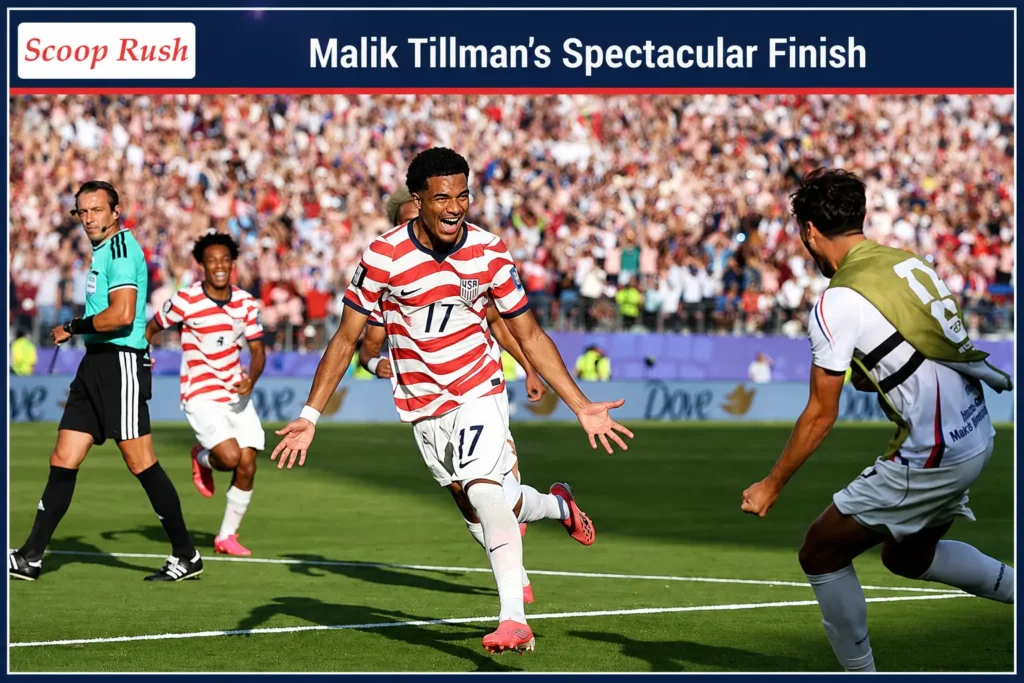
Malik Tillman’s Spectacular Finish

Malik Tillman's Spectacular Finish

While the red card put the USA under immense pressure, midfielder Malik Tillman stepped up to secure the result [U.S. Soccer].

After providing excellent work in midfield all evening, Tillman scored a brilliant goal in the 82nd minute. He curled a spectacular 20-yard direct free kick into the back of the net [U.S. Soccer], providing the USA with a comfortable two-goal cushion and completely killing off the match.

Despite playing with a numerical disadvantage for nearly 30 minutes, the USA stayed organized defensively and prevented Bosnia and Herzegovina from mounting a comeback.

The team’s discipline during the final minutes demonstrated its maturity in managing knockout football.

USA vs Bosnia and Herzegovina Result: Match Statistics

Although the final score favored the United States, the statistics tell the story of a competitive contest.

Team Statistics

StatisticUSABosnia and Herzegovina
Goals20
Shots911
Shots on Target24
Possession48%52%
Passes399430
Pass Accuracy87%85%
Fouls713
Yellow Cards01
Red Cards10
Offsides30
Corners43

These numbers show Bosnia and Herzegovina enjoyed more possession and attempted more shots.

However, football is decided by goals rather than possession. The USA converted both of their shots on target into goals while defending effectively throughout the match.

First Half Analysis

The opening half was closely contested.

Bosnia and Herzegovina controlled slightly more possession and attempted to build attacks patiently. Meanwhile, the USA remained compact and looked dangerous whenever they transitioned forward.

The breakthrough finally arrived just before halftime.

Folarin Balogun found the net in the 45th minute, giving the Americans a crucial lead heading into the dressing room.

That goal changed the complexion of the match.

Second Half Analysis

The United States returned with defensive confidence after the break, but their plans were tested when Balogun was sent off in the 64th minute.

Bosnia and Herzegovina immediately pushed forward searching for a way back into the game, capitalizing on the extra man. However, the USA defense stayed compact and limited clear scoring opportunities.

The decisive moment came in the 82nd minute when Malik Tillman executed his perfect free kick to double the lead [U.S. Soccer].

Even under late pressure, the American defense stayed organized and protected the clean sheet until the final whistle.

Bosnia and Herzegovina Showed Determination

Despite the defeat, Bosnia and Herzegovina produced a competitive performance.

They recorded:

  • More possession
  • More shots
  • More shots on target
  • More completed passes

Nevertheless, they were unable to convert their chances into goals.

Knockout football often rewards efficiency, and the USA demonstrated that quality perfectly.

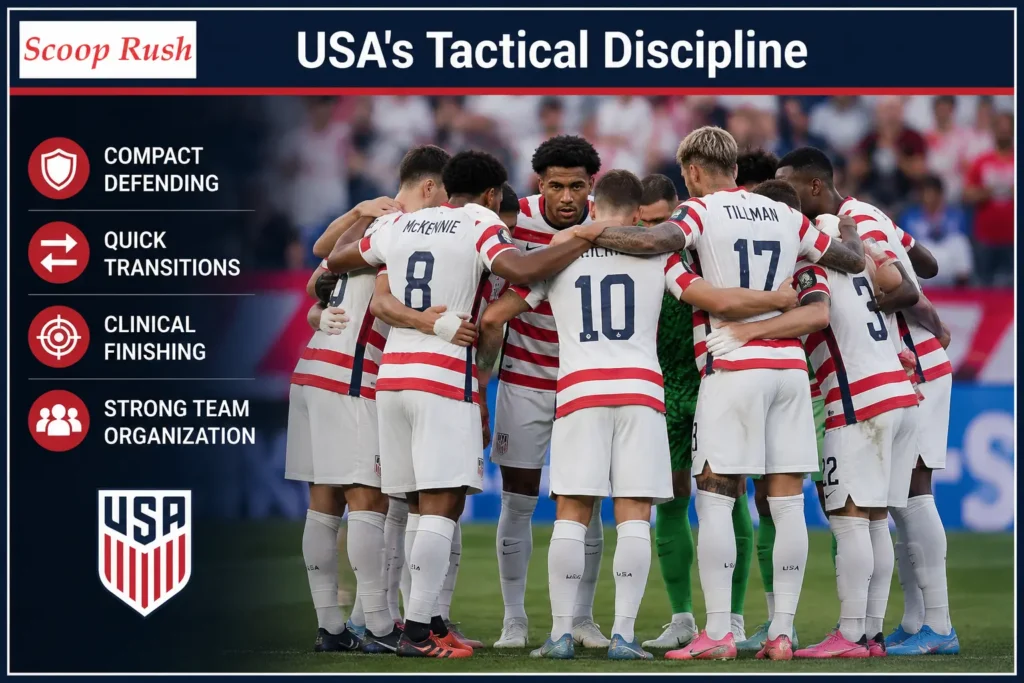
USA’s Tactical Discipline

USA's Tactical Discipline

One of the biggest positives for the United States was their tactical organization under adversity.

Rather than dominating possession, they focused on:

  • Compact defending
  • Quick attacking transitions
  • Clinical finishing on set pieces
  • Strong game management with 10 men

Additionally, the defensive unit remained entirely composed after the mid-half red card.

That resilience helped preserve the clean sheet.

Key Moments

  • 45′ Goal — Folarin Balogun scored to give the USA a 1-0 lead before halftime.
  • 64′ Red Card — Folarin Balogun received a red card, leaving the USA with ten players.
  • 82′ Goal — Malik Tillman scored a brilliant free kick to double the American advantage [U.S. Soccer].
  • Full Time — USA 2-0 Bosnia and Herzegovina.

What This Victory Means

Winning knockout matches is all about taking chances and staying focused.

The United States accomplished both objectives under tough circumstances.

Although Bosnia and Herzegovina controlled more possession, the Americans showed excellent efficiency inside both penalty areas.

As a result, they advanced to the Round of 16 stage of the FIFA World Cup 2026.

Player Performances

Folarin Balogun

The striker delivered the vital opening goal but left his team in a tough spot after his 64th-minute dismissal.

Malik Tillman

The standout midfielder stepped up when it mattered most, scoring the match-sealing free kick in the 82nd minute [U.S. Soccer].

USA Defense

The defensive line handled Bosnia and Herzegovina’s attacks flawlessly, especially after the team was reduced to ten men.

Conclusion

The USA vs Bosnia and Herzegovina Result highlighted how elite tactical efficiency outvalues raw possession in major knockout tournaments. While Bosnia and Herzegovina held a 52 percent possession advantage and registered more total shots, their lack of a killer instinct in the final third ultimately cost them their tournament run.

The United States executed a masterclass in bend-but-don’t-break football. They converted both of their total shots on target into critical goals and showed immense psychological resilience to protect a clean sheet while playing down a man for the final 30 minutes. This statement victory gives the host nation immense tactical confidence as they advance to face elite opposition in the next round.

FAQs

1. What was the final score of the USA vs Bosnia and Herzegovina match?

The United States defeated Bosnia and Herzegovina 2-0 in their Round of 32 knockout match.

2. Who scored the goals for the USA?

Folarin Balogun scored the opening goal in the 45th minute, and Malik Tillman scored the second goal via a direct free kick in the 82nd minute [U.S. Soccer].

3. Which player received a red card during the match?

Forward Folarin Balogun was shown a straight red card in the 64th minute following a VAR review, forcing the USA to finish the game with 10 men.

4. Where was this World Cup Round of 32 match played?

The match took place at the San Francisco Bay Area Stadium located in Santa Clara, California.

5. Who does the USA play next in the FIFA World Cup 2026?

By winning this match, the USA officially advanced to the Round of 16, where they will face Belgium on July 6.

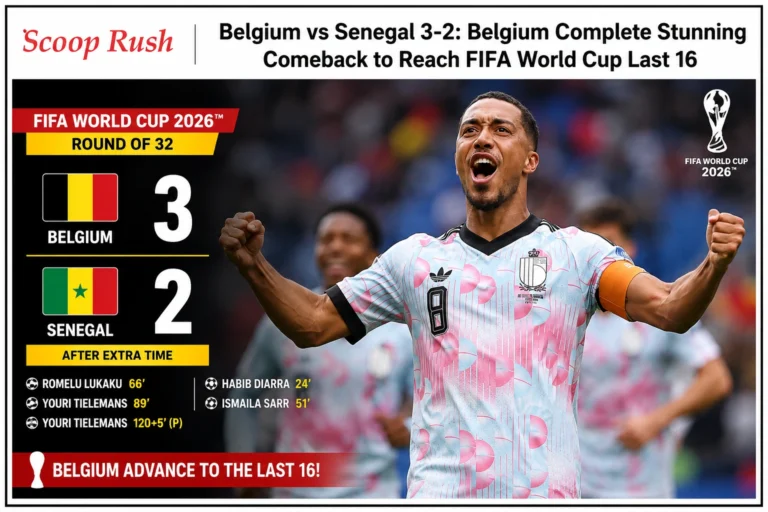
Belgium vs Senegal 3-2: Belgium Complete Stunning Comeback to Reach FIFA World Cup Last 16

0

Competition: FIFA World Cup 2026 Round of 32

Final Score: Belgium 3-2 Senegal (After Extra Time)

Venue: Seattle Stadium, Seattle


Belgium vs Senegal Match Report

Few FIFA World Cup matches deliver the drama, tension, and emotion that football fans crave. The Belgium vs Senegal Round of 32 clash produced exactly that, with Belgium surviving a fierce challenge from Senegal to secure a thrilling 3-2 victory after extra time.

For long periods, the contest remained finely balanced. Senegal showed resilience, attacking intent, and determination against one of Europe’s strongest sides. However, Belgium ultimately found the decisive moments when they mattered most, booking their place in the last 16 after an exhausting 120-minute battle.

The result highlighted Belgium’s ability to respond under pressure while also showcasing Senegal’s fighting spirit on the global stage. With five goals, extra-time drama, and standout performances from key players, this encounter became one of the most entertaining knockout matches of the tournament so far.


Belgium vs Senegal Ends in Extra-Time Drama as Belgium Advance

Belgium vs Senegal Ends in Extra-Time Drama as Belgium Advance

The Round of 32 meeting between Belgium and Senegal delivered everything expected from a World Cup knockout fixture.

Belgium emerged victorious by a 3-2 scoreline after extra time, but the result was far from straightforward. Senegal repeatedly found ways back into the match and pushed Belgium until the final moments.

The game remained competitive from start to finish, with both teams creating chances and demonstrating contrasting styles. Belgium enjoyed slightly more possession and completed more passes, while Senegal remained dangerous whenever they attacked.

Ultimately, Belgium’s extra-time breakthrough proved decisive.

Match Overview

Goalscorers

Belgium

  • Romelu Lukaku (66′)
  • Youri Tielemans (89′)
  • Youri Tielemans (120+5′ Penalty)

Senegal

  • Habib Diarra (24′)
  • Ismaila Sarr (51′)

The scoring sequence perfectly reflected the twists and turns of the contest.

Senegal struck first through Habib Diarra before extending their advantage shortly after halftime through Ismaila Sarr. At 2-0 down, Belgium appeared to be heading toward elimination.

However, the European side mounted a remarkable comeback.

Romelu Lukaku reduced the deficit midway through the second half before Youri Tielemans leveled the score late in regulation time. The match then headed into extra time, where Belgium finally completed the turnaround through Tielemans’ penalty deep into stoppage time.

How Senegal Took Control Early

Senegal began the match with confidence and purpose.

Their attacking approach paid off in the 24th minute when Habib Diarra opened the scoring. The goal rewarded Senegal’s positive start and gave them an important advantage against a talented Belgian side.

Belgium struggled to convert possession into clear opportunities during the opening stages. Meanwhile, Senegal looked organized defensively and dangerous on the counterattack.

The African side carried their momentum into the second half.

Just six minutes after the restart, Ismaila Sarr doubled Senegal’s lead. At 2-0, Senegal found themselves in a commanding position and within touching distance of a famous World Cup victory.

The pressure was now firmly on Belgium.

Belgium’s Remarkable Comeback

World Cup knockout football often comes down to experience and composure under pressure.

Belgium demonstrated both qualities when their tournament hopes appeared to be fading.

Romelu Lukaku Sparks the Revival

Romelu Lukaku delivered the goal Belgium desperately needed in the 66th minute.

His strike reduced Senegal’s lead to 2-1 and immediately shifted momentum. Belgium grew in confidence, while Senegal suddenly found themselves defending a narrow advantage.

Lukaku’s goal also energized Belgium’s attack. The team increased its intensity and committed more players forward in search of an equalizer.

The pressure continued to build as time ticked away.

Tielemans Delivers Late Drama

Belgium’s persistence paid off in the 89th minute.

Youri Tielemans found the net to level the score at 2-2 and rescue Belgium from the brink of elimination. The late equalizer ensured the match would continue into extra time.

For Senegal, the goal represented a heartbreaking setback after holding a two-goal advantage.

For Belgium, it was a lifeline.

The momentum had completely shifted heading into the additional 30 minutes.

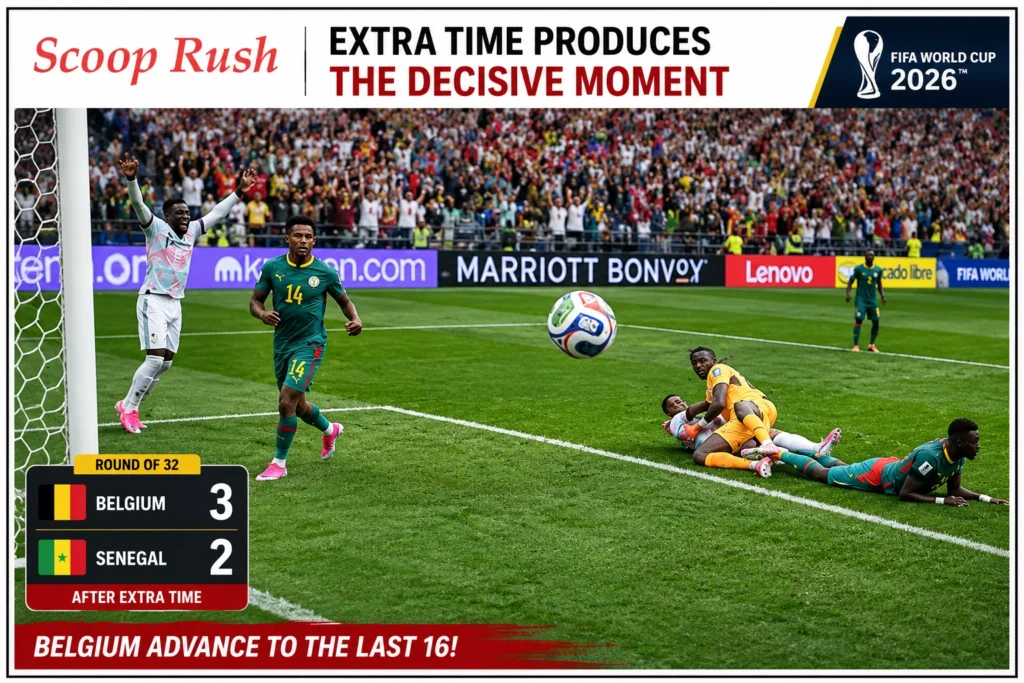
Extra Time Produces the Decisive Moment

Extra Time Produces the Decisive Moment

Extra time often tests both physical fitness and mental strength.

Both teams continued to battle despite the demands of a high-intensity knockout match. Chances remained limited as fatigue began to influence decision-making and execution.

Just when penalties seemed increasingly likely, Belgium found the breakthrough.

Deep into extra-time stoppage time, Belgium earned a penalty opportunity. Youri Tielemans stepped up and converted from the spot in the 120+5th minute.

The goal completed Belgium’s comeback and secured a dramatic 3-2 victory.

Senegal had fought bravely throughout the contest, but Belgium had produced the final decisive moment.

Belgium vs Senegal Match Statistics

The numbers reveal how closely contested the game was.

StatisticBelgiumSenegal
Shots2119
Shots on Target55
Possession53%47%
Passes629553
Pass Accuracy89%86%
Fouls2211
Yellow Cards11
Red Cards00
Offsides22
Corners42

Belgium enjoyed slightly more possession and completed more passes. Their 89% passing accuracy also reflected strong ball retention throughout the match.

However, Senegal matched Belgium’s threat in front of goal. Both teams recorded five shots on target, demonstrating how evenly balanced the contest remained.

The shot totals further underline the attacking nature of the game. Belgium registered 21 attempts compared to Senegal’s 19.

Tactical Analysis of Belgium vs Senegal

Belgium’s Possession-Based Approach

Belgium sought to control the game through possession and structured build-up play.

Their 53% share of possession allowed them to dictate many phases of the match. Additionally, their passing volume and accuracy indicate a team comfortable circulating the ball while searching for openings.

As the match progressed, Belgium increasingly pushed players forward. This attacking commitment eventually helped generate the comeback.

Their ability to maintain pressure became a key factor in wearing down Senegal’s resistance.

Senegal’s Direct and Efficient Attacking Threat

Senegal demonstrated why they remain a dangerous tournament opponent.

Despite seeing less of the ball, they consistently threatened Belgium’s defense. Their early goals showcased efficient finishing and intelligent attacking movement.

Senegal also defended effectively for large portions of the game. Nevertheless, the sustained pressure from Belgium eventually created cracks that led to the equalizer and late winning goal.

The performance showed both quality and resilience, even if the result ultimately ended in disappointment.

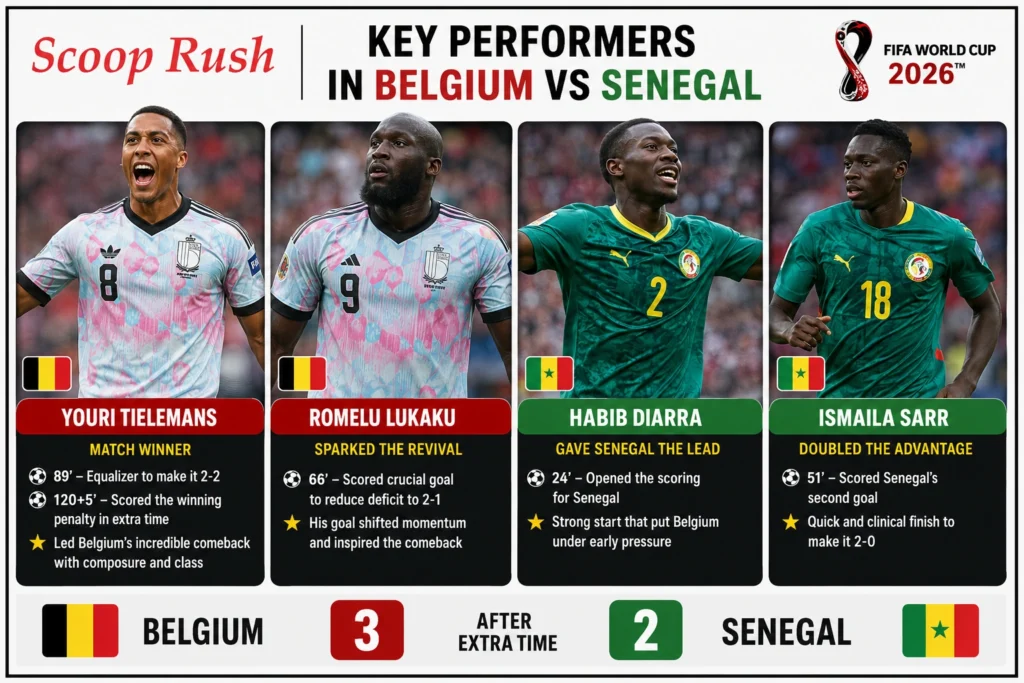
Key Performers in Belgium vs Senegal

Key Performers in Belgium vs Senegal

Youri Tielemans

Tielemans emerged as the match winner.

His late equalizer in the 89th minute transformed Belgium’s prospects, while his penalty in the 120+5th minute completed the comeback.

Scoring twice in a knockout match demonstrates both composure and leadership under immense pressure.

Romelu Lukaku

Lukaku’s 66th-minute goal reignited Belgium’s challenge.

The striker delivered when his team needed inspiration, helping spark the turnaround that ultimately led to victory.

Habib Diarra

Diarra gave Senegal the perfect start with the opening goal in the 24th minute.

His contribution played a major role in putting Belgium under pressure for much of the match.

Ismaila Sarr

Sarr’s second goal for Senegal extended the lead to 2-0 and appeared to place the African side firmly in control.

His performance highlighted Senegal’s attacking quality throughout the encounter.

What the Result Means

Belgium’s victory sends them into the FIFA World Cup Round of 16 after surviving one of the toughest tests of the knockout stage.

Coming from two goals behind demonstrates resilience, belief, and mental strength. These qualities often prove vital in deep tournament runs.

For Senegal, elimination will be difficult to accept considering their strong position during the match. Nevertheless, they leave the tournament after pushing Belgium to the limit and producing one of the most competitive knockout performances of the round.

The match will be remembered as a showcase of determination from both sides.

Conclusion

The Belgium vs Senegal Round of 32 encounter delivered everything fans expect from World Cup knockout football. Senegal established a two-goal lead through Habib Diarra and Ismaila Sarr, putting Belgium in serious trouble.

However, Belgium responded brilliantly. Romelu Lukaku sparked the comeback before Youri Tielemans scored twice, including a dramatic penalty deep into extra-time stoppage time.

Statistically, the game remained closely contested throughout, reflecting the quality displayed by both teams. Belgium ultimately advanced with a 3-2 victory after extra time, while Senegal exited after a courageous performance.

For neutral fans, it was one of the tournament’s most entertaining and memorable matches.

FAQs

1. What was the final score in Belgium vs Senegal?

Belgium defeated Senegal 3-2 after extra time in the FIFA World Cup 2026 Round of 32.

2. Who scored for Belgium against Senegal?

Romelu Lukaku scored once, while Youri Tielemans scored twice, including the winning penalty.

3. Who scored Senegal’s goals?

Habib Diarra scored the opening goal, and Ismaila Sarr added Senegal’s second goal.

4. Did Belgium come from behind to win?

Yes. Belgium trailed 2-0 before staging a comeback to win 3-2 after extra time.

5. Where was the Belgium vs Senegal match played?

The match was played at Seattle Stadium in Seattle.

Spain vs Austria: Spain Beat Austria 3-0 to Reach FIFA World Cup 2026 Round of 16

0

Competition: FIFA World Cup 2026
Round: Round of 32
Date: Thursday, July 2, 2026
Venue: Los Angeles Stadium, Inglewood
Full Time: Spain 3-0 Austria

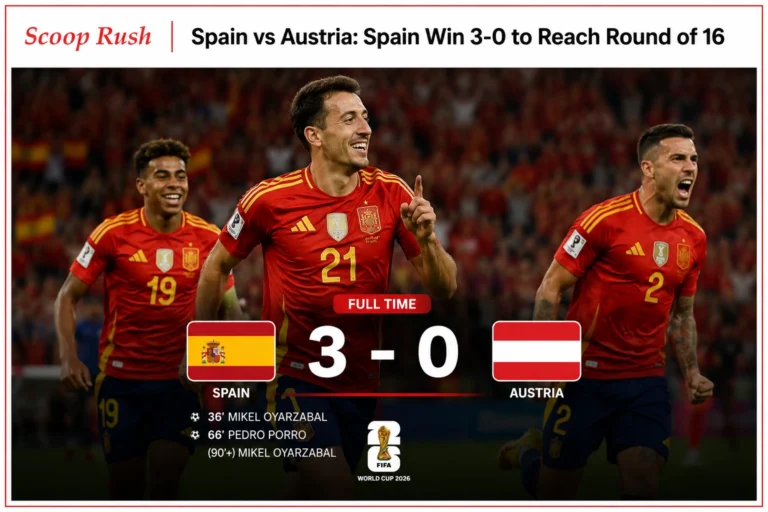
Spain vs Austria ended in a dominant 3-0 victory as Spain secured their place in the FIFA World Cup 2026 Round of 16. Mikel Oyarzabal scored twice, while Pedro Porro added another goal in a one-sided knockout clash. Spain controlled possession from start to finish and never allowed Austria to threaten.

Oyarzabal Leads Spain to Comfortable Victory

Spain took control early with their trademark passing football. Austria defended deep but struggled to stop Spain’s attacking movement.

The breakthrough arrived in the 36th minute when Mikel Oyarzabal found the net after sustained Spanish pressure. Although Austria tried to respond after the break, Spain continued to dictate the tempo.

Pedro Porro doubled Spain’s advantage in the 66th minute with a well-taken finish. Later, Oyarzabal completed his brace to seal an impressive 3-0 victory and send Spain safely into the next round.

Goalscorers

  • 36′ Mikel Oyarzabal (Spain)
  • 66′ Pedro Porro (Spain)
  • Late Second Half Mikel Oyarzabal (Spain)

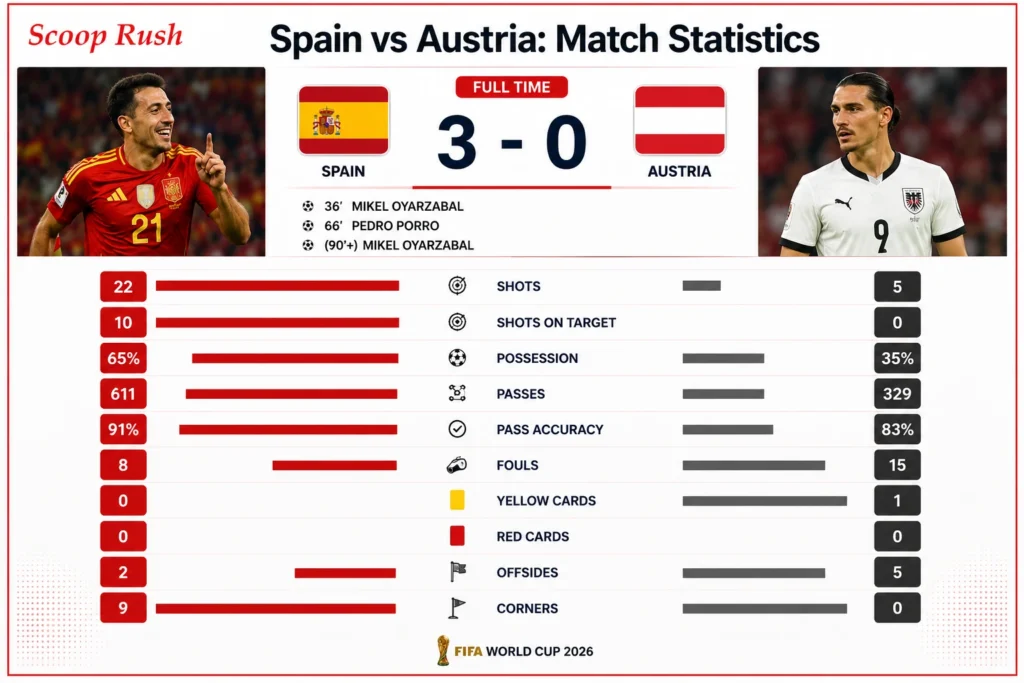
Spain vs Austria: Match Statistics

Spain-vs-Austria-Match-Statistics

Spain dominated every key area of the contest.

  • Shots: Spain 22, Austria 5
  • Shots on Target: Spain 10, Austria 0
  • Possession: Spain 65%, Austria 35%
  • Passes: Spain 611, Austria 329
  • Pass Accuracy: Spain 91%, Austria 83%
  • Fouls: Spain 8, Austria 15
  • Yellow Cards: Spain 0, Austria 1
  • Red Cards: None
  • Offsides: Spain 2, Austria 5
  • Corners: Spain 9, Austria 0

Austria failed to register a single shot on target throughout the match. Meanwhile, Spain’s midfield controlled possession with quick passing and intelligent movement.

Spain vs Austria: Starting Lineups

Spain (4-3-3)

Goalkeeper: Unai Simón
Defenders: Pedro Porro, Pau Cubarsí, Aymeric Laporte, Marc Cucurella
Midfielders: Martín Zubimendi, Pedri, Fabián Ruiz
Forwards: Lamine Yamal, Mikel Oyarzabal, Nico Williams

Austria (4-2-3-1)

Goalkeeper: Alexander Schlager
Defenders: Stefan Posch, Kevin Danso, David Alaba, Phillipp Mwene
Midfielders: Nicolas Seiwald, Konrad Laimer, Patrick Wimmer, Christoph Baumgartner, Romano Schmid
Forward: Michael Gregoritsch

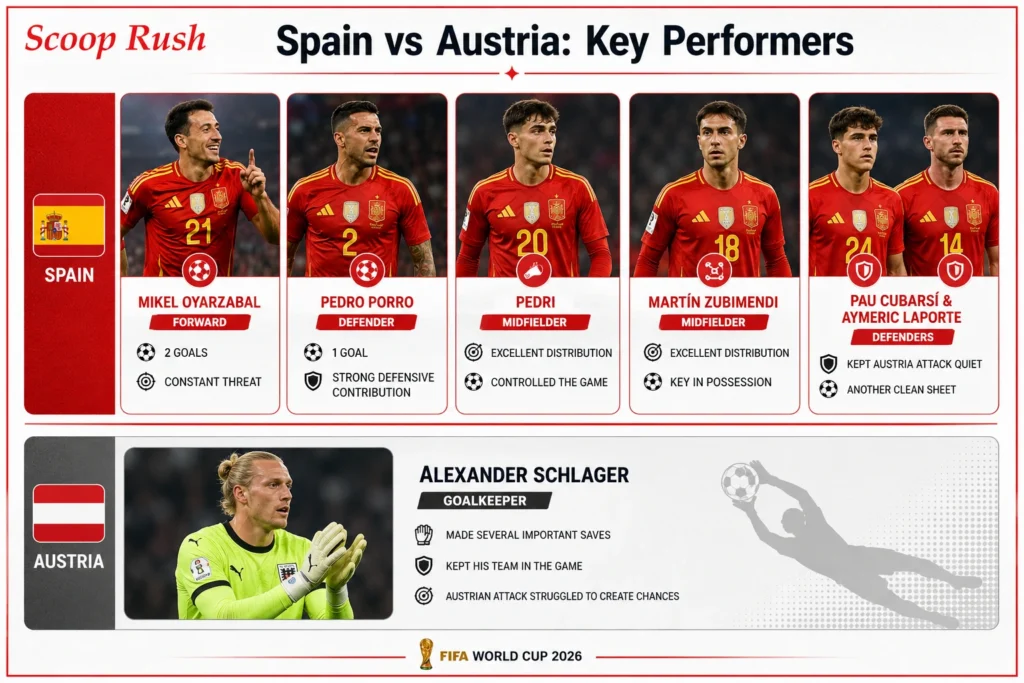
Spain vs Austria: Key Performers

Spain-vs-AustriaKey-Performers

Mikel Oyarzabal produced an outstanding performance by scoring twice and constantly troubling Austria’s defense. Pedro Porro was equally influential, scoring Spain’s second goal while also contributing at both ends of the pitch.

Pedri and Martín Zubimendi controlled midfield with excellent distribution, allowing Spain to maintain long spells of possession. At the back, Pau Cubarsí and Aymeric Laporte kept Austria’s attack quiet and helped Spain record another clean sheet.

For Austria, goalkeeper Alexander Schlager made several important saves despite the defeat. However, the Austrian attack struggled to create meaningful chances against Spain’s disciplined defense.

Spain vs Austria: Spain Set Up Portugal Clash

With this victory, Spain advance to the FIFA World Cup 2026 Round of 16, where they will face Portugal on July 6, 2026 in one of the tournament’s most anticipated knockout matches.

Austria’s World Cup campaign comes to an end after a difficult evening against one of the competition’s strongest teams. Spain, meanwhile, continue to impress with their balance, depth, and attacking quality as they aim to lift another World Cup trophy.

Conclusion

Spain vs Austria showcased a complete performance from Luis de la Fuente’s side. Clinical finishing, dominant possession, and a solid defensive display ensured a comfortable 3-0 win. With confidence growing and a blockbuster meeting against Portugal next, Spain look well prepared for the challenges ahead in the FIFA World Cup 2026.

Jackass Crew Bullied Danger Ehren? Steve-O Opens Up About When It Went Too Far

0

Introduction

For more than two decades, the Jackass crew has entertained audiences with painful stunts, fearless pranks, and outrageous comedy. Recently, Danger Ehren bullying became a major topic after Steve-O openly discussed how Ehren was treated during filming. Their honest conversation has sparked fresh debate about whether some on-set jokes crossed the line. Danger Ehren bullying has become one of the biggest talking points among Jackass fans following Steve-O’s recent comments.

For more than two decades, the Jackass crew has entertained audiences with painful stunts, fearless pranks, and an unbreakable sense of camaraderie. However, behind the laughs, some fans have long questioned whether Danger Ehren McGhehey was treated differently from the rest of the cast.

That conversation gained fresh attention after Ehren appeared on Steve-O’s Wild Ride podcast. During their discussion, both men reflected on the group’s dynamic, with Steve-O admitting Ehren often became the “whipping boy” of the team. Meanwhile, Ehren explained that although he understood the role he played for entertainment, there were moments when the constant jokes and ridicule became emotionally exhausting.

The discussion has sparked renewed interest as Jackass: Best and Last reaches theaters, leading fans to revisit the long-running debate over whether the comedy sometimes went too far.

Jackass Crew Bullied Danger Ehren: Why Fans Are Talking Again

Jackass Crew Bullied Danger Ehren: Why Fans Are Talking Again

The debate surrounding whether the Jackass crew bullied Danger Ehren is not new. Fans have discussed it for years across social media, especially after watching some of the franchise’s most painful and humiliating stunts.

Ahead of the release of Jackass: Best and Last, one fan questioned online whether Ehren would finally be given a break. Another fan responded that he was still receiving harsh treatment, pointing to a scene where Ehren repeatedly receives electric shocks.

As a result, many viewers began discussing whether the recurring jokes had shifted from harmless comedy to something more personal.

Steve-O Says Ehren Became the Group’s “Whipping Boy”

During an episode of Steve-O’s Wild Ride podcast, Steve-O directly addressed the issue.

He explained that although the Jackass brand has always centered on friendship and brotherhood, Ehren frequently became the group’s primary target.

Steve-O described Ehren as the team’s “whipping boy” and openly referred to parts of the behavior as bullying. He also made it clear that he wanted to stand up for his longtime friend because he believes Ehren deserves more respect.

His comments added weight to a conversation that fans have debated for years.

Danger Ehren Agreed the Bullying Was Real

Rather than dismissing Steve-O’s comments, Ehren agreed with the description.

He explained that constantly being singled out and targeted eventually became emotionally draining. While many people viewed the jokes as harmless fun, he said repeatedly being the target wore him down over time.

According to Ehren, the situation was unique because enduring that treatment became part of his job while filming Jackass.

He explained that he would not normally accept that kind of behavior in everyday life. However, while filming, he tolerated it because it served the show’s format and group dynamic.

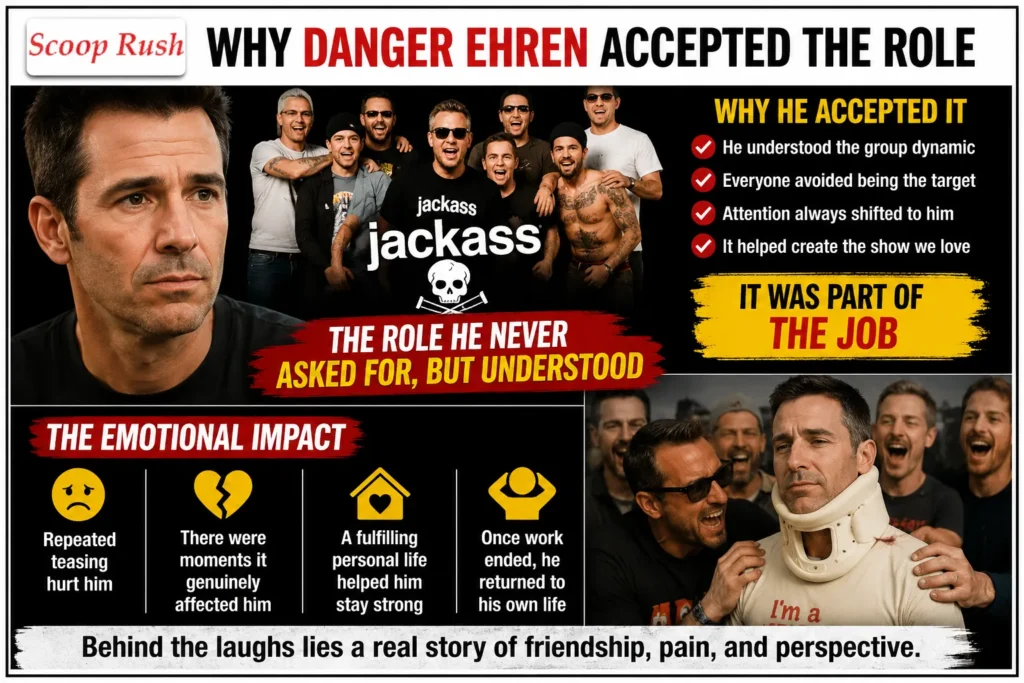
Why Danger Ehren Accepted the Role

Why Danger Ehren Accepted the Role

Ehren admitted he understood why someone like him was needed within the cast.

According to him, every member naturally wanted to avoid becoming the focus of the jokes. Therefore, attention often shifted toward one person, and that person was frequently Ehren.

He suggested the group dynamic encouraged everyone to redirect pranks and teasing toward another cast member whenever possible.

Although he recognized this role helped create entertaining television, he also admitted the experience sometimes became difficult to handle emotionally.

The Emotional Impact Behind the Comedy

Ehren acknowledged that repeated teasing eventually affected him.

Even though he usually moved past it, he admitted there were moments when it genuinely hurt.

At the same time, he said having a fulfilling personal life helped him maintain perspective outside of filming.

He explained that once work ended, he could return to his own life instead of dwelling on what happened during production.

That balance, he suggested, made the experience easier to manage despite the emotional challenges.

A Career Built on Extreme Risk

Danger Ehren has never avoided dangerous situations.

He joined the original Jackass television series after Johnny Knoxville helped bring the crew together. One early video reportedly showed Ehren performing an extremely risky stunt involving shooting himself in the chest while wearing protective equipment, demonstrating the fearless attitude that eventually defined his career.

Before television, Ehren also worked as a professional skateboarder.

Over the years, however, his commitment to Jackass came at an enormous physical cost.

His injuries reportedly include:

Those incidents reinforced his reputation as one of the franchise’s most fearless performers.

Jackass Has Always Pushed the Limits

The Jackass franchise has never hidden its commitment to extreme comedy.

Whether performing painful physical challenges, dangerous animal encounters, or deliberately disgusting stunts, the cast built its success by constantly trying to outdo previous films.

Recent examples mentioned alongside the new movie include:

  • A Twister challenge involving laxatives that has been described as one of the most disgusting stunts filmed.
  • A shark stunt involving Poopies that nearly ended in serious injury.

These moments demonstrate the culture that has defined Jackass since its earliest days.

However, they also explain why conversations about personal boundaries continue to emerge.

Friendship and Family Complicated the Situation

Friendship and Family Complicated the Situation

Despite acknowledging the emotional toll, Ehren never suggested that the cast disliked him.

Instead, he repeatedly described the group as family.

He explained that siblings often tease one another despite caring deeply for each other.

However, he also admitted that love alone does not automatically justify hurtful behavior.

According to Ehren, many people become more self-aware as they grow older and eventually apologize for immature actions.

The Jackass crew, however, built their careers around refusing to grow up. As Ehren joked, maturity has never been part of the Jackass brand.

That honesty resonated with many longtime fans.

Steve-O Publicly Defended His Friend

One notable part of the podcast was Steve-O’s willingness to defend Ehren.

Rather than ignoring the criticism, he acknowledged that Ehren had endured years of difficult treatment. Steve-O acknowledged that Danger Ehren bullying sometimes went beyond friendly jokes and deserved honest discussion.

Steve-O praised Ehren as a genuinely good person and said he deserved better than some of the jokes directed at him.

His support demonstrated that the cast is capable of reflecting on past behavior while still maintaining the close friendships that helped build the franchise.

Fans Continue Debating the Jackass Dynamic

The podcast has reignited online discussion about how viewers interpret Jackass.

Some fans argue that everyone involved willingly accepted the risks and knew exactly what they were signing up for.

Others believe repeated targeting of one cast member eventually became uncomfortable to watch.

The release of Jackass: Best and Last has only intensified those conversations, especially after viewers noticed Ehren once again receiving some of the harshest punishment during several scenes.

Although opinions remain divided, many agree that Steve-O and Ehren’s candid discussion offered valuable insight into the realities behind the comedy.

Conclusion

The conversation surrounding whether the Jackass crew bullied Danger Ehren highlights the complicated balance between entertainment, friendship, and personal boundaries. The debate over Danger Ehren bullying continues as fans discuss where comedy ends and personal boundaries begin.

Steve-O’s comments and Ehren’s honest reflections show that even within a close-knit group, repeated jokes can have lasting emotional effects.

At the same time, Ehren emphasized that he genuinely considers the Jackass cast his family and believes they care about one another despite their flaws.

FAQs

1. Did Steve-O say Danger Ehren was bullied?

Yes. During his Wild Ride podcast, Steve-O said Ehren often became the group’s “whipping boy” and described parts of the treatment as bullying.

2. Did Danger Ehren agree with Steve-O?

Yes. Ehren said he often felt outcast and bullied during filming, although he accepted it as part of his role within Jackass.

3. Why was Danger Ehren often targeted?

Ehren explained that every group member preferred not to become the center of jokes, so attention frequently shifted toward him during filming.

4. Does Danger Ehren still consider the Jackass crew family?

Yes. Despite acknowledging the emotional impact, Ehren said he loves the cast members and considers them family.

5. What injuries has Danger Ehren suffered?

According to the discussion, Ehren has suffered serious injuries during his Jackass career, including a broken orbital bone and two broken necks while filming Jackass 3D.

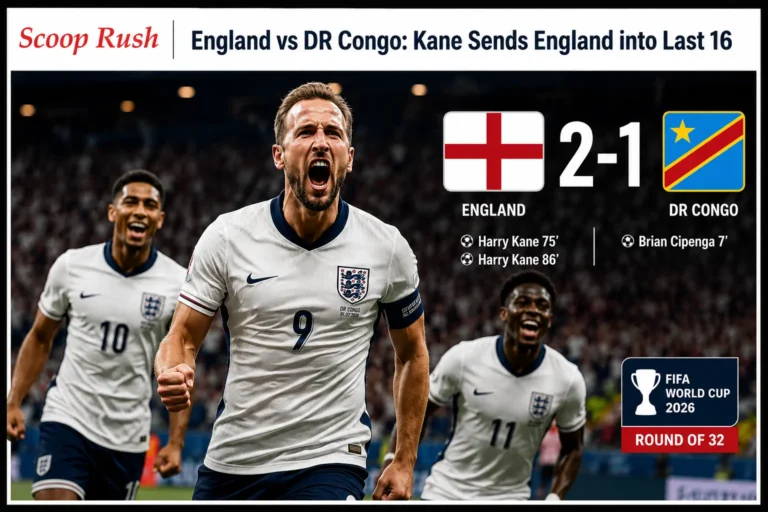
England vs DR Congo: Harry Kane’s Late Double Completes England Comeback in FIFA World Cup 2026

0

Competition: FIFA World Cup 2026
Stage: Round of 32
Full Time: England 2-1 DR Congo
Venue: Atlanta Stadium, Atlanta
Date: Wednesday, July 1, 2026

England vs DR Congo delivered one of the most dramatic matches of the FIFA World Cup 2026 Round of 32. England recovered from an early setback to defeat DR Congo 2-1 at Atlanta Stadium. Brian Cipenga gave DR Congo a surprise lead before captain Harry Kane scored twice in the second half to complete a memorable comeback and book England’s place in the Round of 16.

England vs DR Congo Match Summary

DR Congo made the perfect start by taking the lead in the seventh minute. Brian Cipenga found space inside the penalty area and fired a low finish past Jordan Pickford to silence the England supporters.

England struggled to break down a well-organised DR Congo side during the first half. The African nation defended with discipline and continued to threaten on quick counter-attacks, leaving England searching for answers.

After the interval, England gradually increased the pressure. Thomas Tuchel introduced fresh legs from the bench, and Anthony Gordon changed the tempo of the game with his pace and creativity.

The equaliser arrived in the 75th minute when Gordon delivered an accurate cross for Harry Kane, who calmly finished from close range. England continued to push forward. As a result, Kane scored again in the 86th minute with a composed finish to complete the comeback and secure a 2-1 victory.

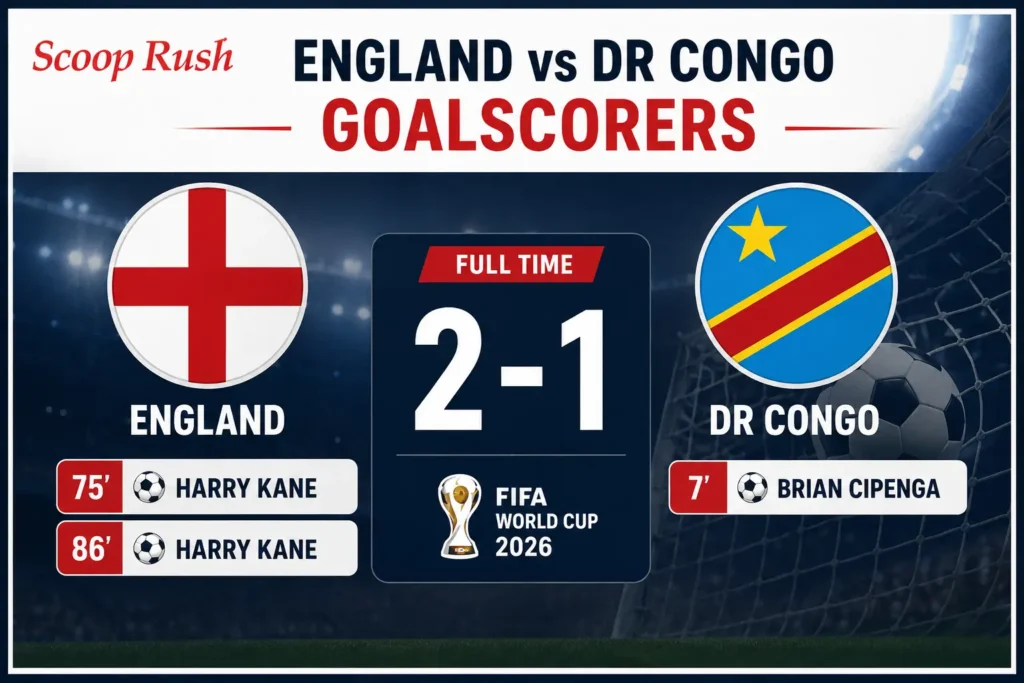
England vs DR Congo Goalscorers

England-vs-DR-Congo-Kane-Sends-England-into-Last-16

England

  • Harry Kane 75′
  • Harry Kane 86′

DR Congo

  • Brian Cipenga 7′

England vs DR Congo Match Stats

  • Shots: England 15, DR Congo 7
  • Shots on Target: England 8, DR Congo 2
  • Possession: England 60%, DR Congo 40%
  • Passes: England 493, DR Congo 346
  • Pass Accuracy: England 92%, DR Congo 84%
  • Fouls: England 10, DR Congo 12
  • Yellow Cards: England 1, DR Congo 1
  • Red Cards: None
  • Offsides: England 0, DR Congo 4
  • Corners: England 5, DR Congo 3

England controlled possession and produced more attempts on goal. However, DR Congo remained a constant threat on the counter and kept England under pressure until the closing stages.

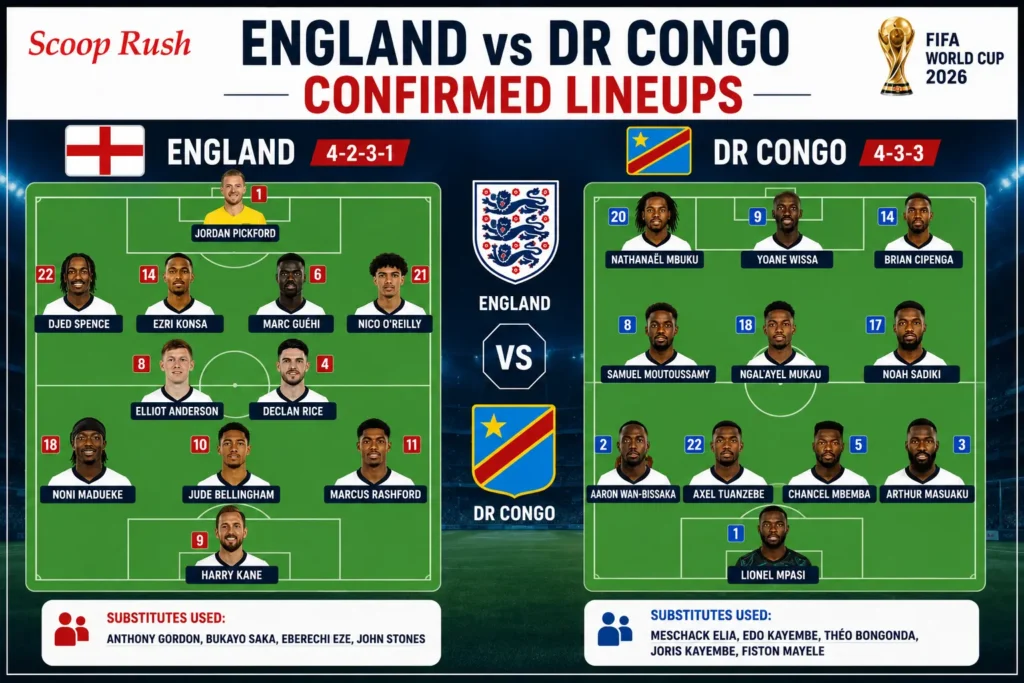
England vs DR Congo Confirmed Lineups

England-vs-DR-Congo-Confirmed-Lineups

England (4-2-3-1)

Jordan Pickford; Djed Spence, Ezri Konsa, Marc Guéhi, Nico O’Reilly; Elliot Anderson, Declan Rice; Noni Madueke, Jude Bellingham, Marcus Rashford; Harry Kane.
Substitutes used: Anthony Gordon, Bukayo Saka, Eberechi Eze, John Stones.

DR Congo (4-3-3)

Lionel Mpasi; Aaron Wan-Bissaka, Axel Tuanzebe, Chancel Mbemba, Arthur Masuaku; Samuel Moutoussamy, Ngal’ayel Mukau, Noah Sadiki; Nathanaël Mbuku, Yoane Wissa, Brian Cipenga.
Substitutes used: Meschack Elia, Edo Kayembe, Théo Bongonda, Joris Kayembe, Fiston Mayele.

England vs DR Congo Tactical Analysis

DR Congo executed an effective game plan by defending in a compact shape and attacking quickly after winning possession. Their early goal gave them confidence, while the midfield disrupted England’s rhythm for long periods.

England improved significantly after the substitutions. Anthony Gordon added pace and creativity on the left and provided both assists for Harry Kane. Meanwhile, Jude Bellingham became more influential between the lines as England increased the intensity. Consequently, sustained pressure created the openings that allowed Kane to score twice and complete the turnaround.

What the Result Means

England progressed to the FIFA World Cup 2026 Round of 16 after overcoming one of the toughest tests of their campaign. The comeback once again highlighted Harry Kane’s importance in knockout football and the impact of Thomas Tuchel’s tactical changes.

Meanwhile, DR Congo exited the tournament with plenty of credit despite the defeat. Their disciplined performance and dangerous counter-attacks pushed one of the tournament favourites to the limit.

England will now face Mexico in the FIFA World Cup 2026 Round of 16 at Azteca Stadium on Sunday, July 5, 2026, with a place in the quarter-finals on the line.