
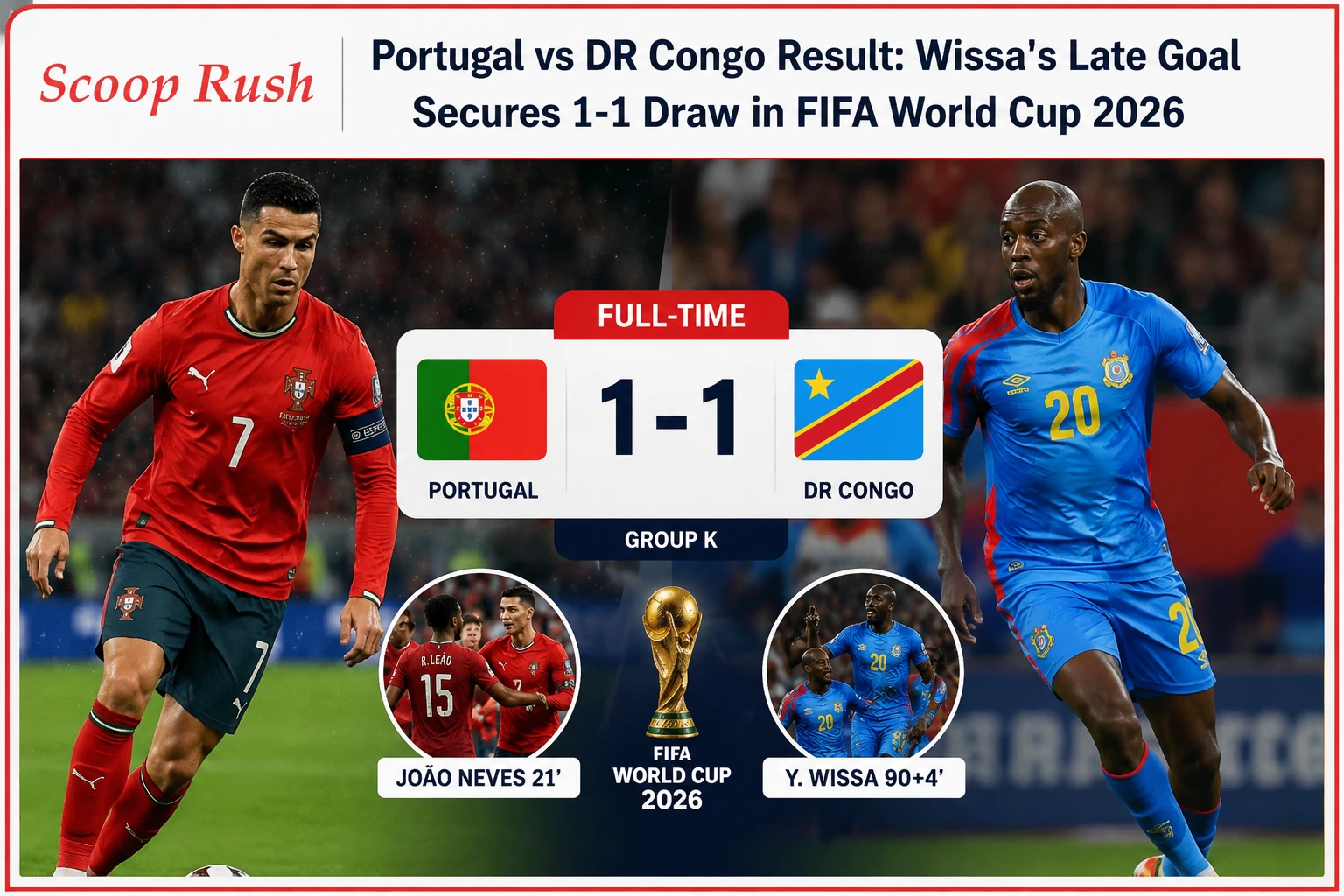
FIFA World Cup 2026™ – Group K
Full-Time: Portugal 1–1 DR Congo
Date: Wednesday, 17 June
Venue: NRG Stadium, Houston
The FIFA World Cup 2026 Group K encounter between Portugal and DR Congo ended in a hard-fought 1–1 draw, with both teams producing moments of quality and resilience in a match that remained competitive until the final whistle. Portugal appeared on course to take an edge into the break after taking an early lead through João Neves, but DR Congo showed remarkable determination and earned a dramatic equalizer through Yoane Wissa deep into first-half stoppage time.
The result leaves Group K finely balanced after the opening round of matches. While Portugal controlled much of the game through possession and passing accuracy, DR Congo demonstrated efficiency, defensive organization, and an ability to capitalize on limited opportunities.
Match Overview
Heading into the match, Portugal were expected to dominate possession and dictate the tempo, while DR Congo aimed to remain compact defensively and exploit counterattacking opportunities whenever possible.
From the opening stages, Portugal settled into their familiar possession-based approach. Their midfield controlled the ball effectively, and the team consistently pushed forward in search of openings. DR Congo, meanwhile, remained disciplined and patient, allowing Portugal to have more of the ball while focusing on maintaining defensive structure.
The contest evolved into a fascinating tactical battle. Portugal enjoyed long spells of possession and territory, but DR Congo’s organized defense made it difficult for the Europeans to create a large number of clear-cut chances.
Ultimately, the match produced a dramatic ending that reflected the competitive nature of both sides.
Starting Lineups and Tactical Setup
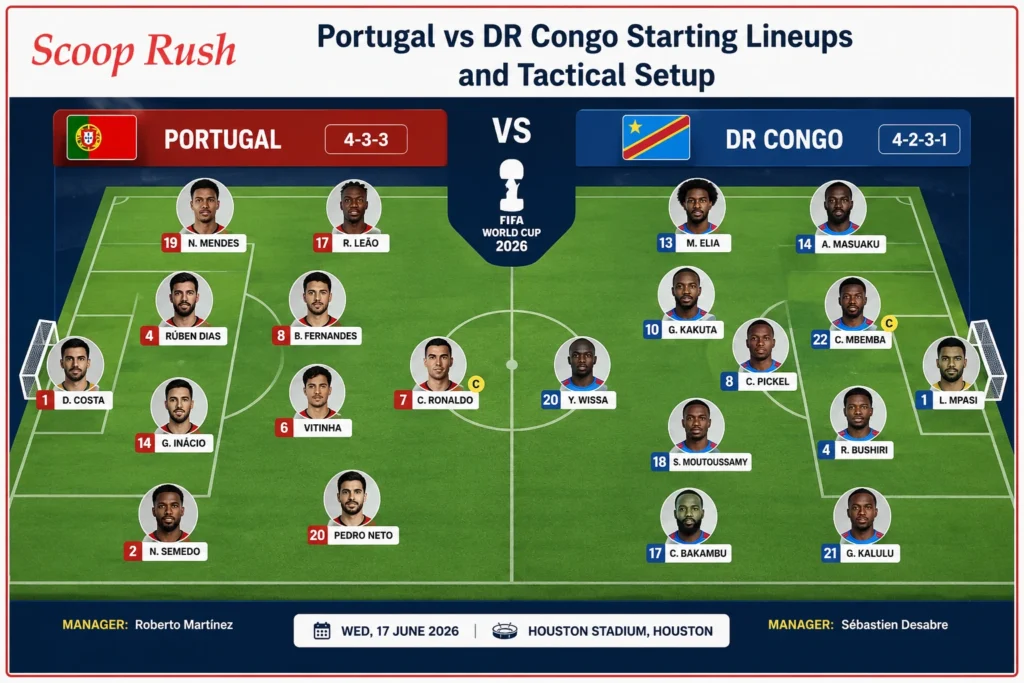
Portugal lined up in a 4-3-3 formation.
Portugal XI
- Diogo Costa (Goalkeeper)
- Nélson Semedo
- Gonçalo Inácio
- Rúben Dias
- Nuno Mendes
- João Neves
- Vitinha
- Bruno Fernandes
- Pedro Neto
- Rafael Leão
- Cristiano Ronaldo
Portugal’s setup emphasized technical quality, ball retention, and attacking width. Bruno Fernandes and Vitinha played key roles in linking midfield and attack, while Rafael Leão and Pedro Neto sought to stretch DR Congo’s defensive line from wide positions.
Cristiano Ronaldo operated as the central attacking figure, looking to convert chances created by the midfield and wide players.
DR Congo XI
- Lionel Mpasi (Goalkeeper)
- Arthur Masuaku
- Chancel Mbemba
- Rocky Bushiri
- Gédéon Kalulu
- Samuel Moutoussamy
- Meschack Elia
- Charles Pickel
- Gaël Kakuta
- Yoane Wissa
- Cédric Bakambu
DR Congo adopted a balanced shape designed to frustrate Portugal’s attack while remaining dangerous in transition. The back line stayed compact, and the midfield worked tirelessly to limit space between the lines.
The strategy required discipline and patience, particularly against a Portuguese side capable of controlling possession for long periods.
First Half: Portugal Take Control
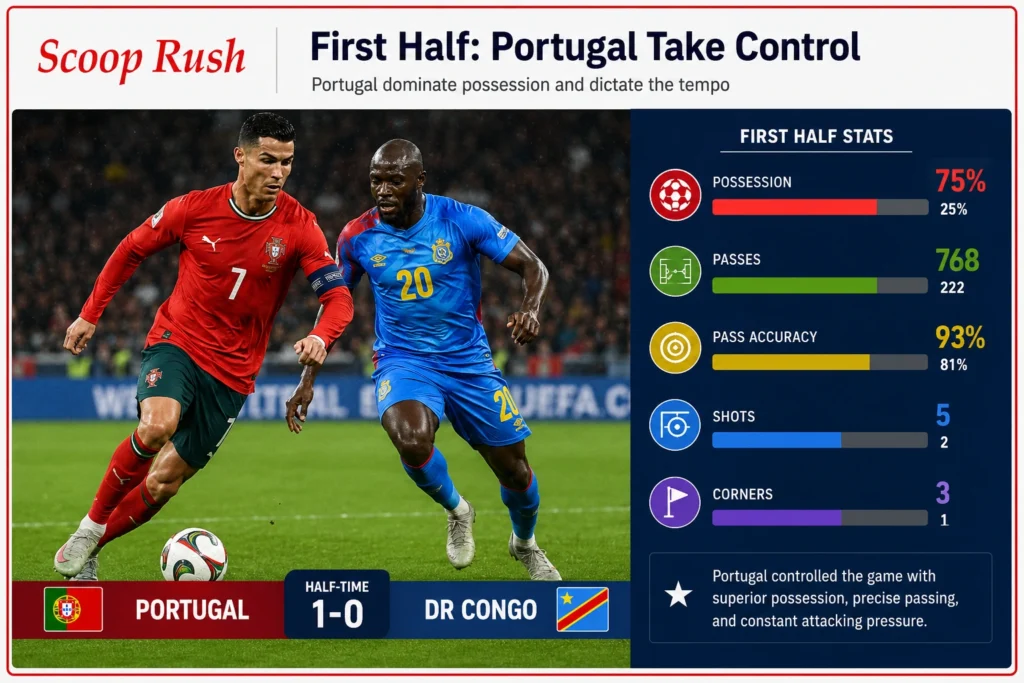
Portugal quickly established control of the game through superior possession and passing. Their midfield trio circulated the ball efficiently, forcing DR Congo to spend extended periods defending in their own half.
The statistics reflected Portugal’s dominance:
- 75% possession
- 768 completed passes
- 93% pass accuracy
These numbers highlighted Portugal’s ability to dictate the rhythm of the contest. DR Congo struggled to keep the ball for long spells, completing 222 passes with 81% accuracy. Portugal consistently probed down both flanks, using overlapping runs from the full-backs and movement from their attacking players to create openings.
João Neves Breaks the Deadlock
Portugal found the breakthrough through João Neves, who finished a well-worked move early in the match to put his side ahead. The goal rewarded Portugal’s dominance and seemed to confirm the momentum they had built. Neves, one of the standout performers in midfield, not only contributed defensively but also made an important impact in the attacking phase.
After taking the lead, Portugal continued to control possession rather than retreating into a defensive posture. At this stage of the match, Portugal appeared comfortable and in command.
DR Congo Refuse to Give In and Equalize
Although Portugal controlled the majority of possession, DR Congo never abandoned their game plan. The African side remained organized defensively and continued looking for opportunities on the counterattack.
One of the most impressive aspects of DR Congo’s performance was their composure. Despite spending much of the match without the ball, they remained focused and disciplined. Their determination was rewarded in dramatic fashion just before the break. Deep into first-half stoppage time (45+5′), Yoane Wissa capitalised on a lapse in the Portuguese defense to score a stunning equalizer, sending the teams into the locker rooms level at 1–1 .
Second Half: A Stubborn Tactical Stalemate
As the second half progressed, Portugal tried to re-establish their lead and create pressure, finishing the game with 9 shots and 3 shots on target. However, despite dominating possession and completing significantly more passes, Portugal were unable to find a second breakthrough.
DR Congo’s organized defense made it incredibly difficult for the Europeans to create clear-cut chances. In football, controlling possession does not always guarantee victory. Matches often hinge on efficiency in front of goal, and Portugal’s inability to convert their territorial dominance into additional goals became increasingly frustrating as the second-half clock ran down.
Key Substitutions and Defensive Gridlock
Both managers used their benches in an attempt to influence the outcome. Portugal introduced fresh legs, including Francisco Conceição, to inject attacking intensity. DR Congo also turned to their bench in search of renewed energy to preserve the draw.
DR Congo’s defenders deserve significant credit for their second-half performance. Facing a Portugal side packed with technical quality and attacking talent is never easy, yet the defensive unit remained perfectly disciplined and limited Portugal to just a single shot on target all match.
Statistical Analysis
The match statistics reveal an interesting contrast between control and efficiency:
| Statistic | Portugal | DR Congo |
| Shots | 9 | 8 |
| Shots on Target | 3 | 2 |
| Possession | 75% | 25% |
| Passes | 768 | 222 |
| Pass Accuracy | 93% | 81% |
| Fouls | 9 | 9 |
| Yellow Cards | 3 | 1 |
| Red Cards | 0 | 0 |
| Offsides | 3 | 2 |
| Corners | 5 | 4 |
Portugal dominated possession and passing metrics, but the shot totals remained relatively close. This suggests that DR Congo defended effectively and prevented Portugal from turning their possession advantage into clear opportunities.
Standings Impact
Following the draw, Group K remains tightly contested. The standings after the opening matches show:
- Colombia – 3 points
- DR Congo – 1 point
- Portugal – 1 point
- Uzbekistan – 0 points
Although Portugal may be disappointed after failing to capitalize on their dominant first-half control, the tournament remains in its early stages . For DR Congo, earning a historic first-ever World Cup point against one of the tournament favorites represents a massive result and provides momentum moving forward .
Player Performances
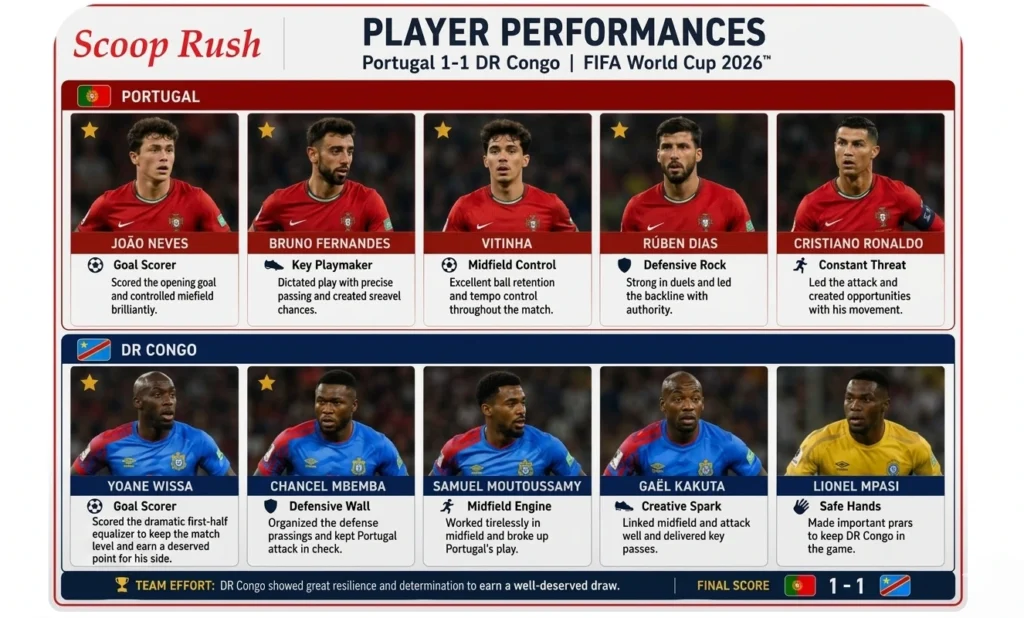
João Neves:The Portuguese midfielder delivered an influential performance and scored Portugal’s only goal . He was active in possession and helped control the midfield battle throughout the match.
Bruno Fernandes & Vitinha: Both played a central role in Portugal’s attacking build-up and were heavily involved in the team’s high-volume passing sequences.
Chancel Mbemba: The DR Congo defender anchored a disciplined back line that absorbed sustained pressure and kept his team in contention.
Yoane Wissa: Wissa emerged as the hero for DR Congo . His first-half stoppage-time equalizer transformed the match and secured a valuable point .
What the Result Means
This match illustrated two different approaches to football. Portugal relied on possession, technical quality, and patient buildup . DR Congo relied on discipline, resilience, and efficiency .
Portugal demonstrated their ability to control games but will be frustrated by their inability to break down a stubborn defense after their early dominance . DR Congo proved they can compete against elite opposition and capitalize on opportunities when they arise . Portugal must now seek greater attacking efficiency, while DR Congo will take massive confidence into the rest of the group stage.
Final Thoughts
Portugal and DR Congo delivered a compelling Group K encounter that ended with honors even at 1–1. João Neves’ goal looked set to hand Portugal a halftime lead , but Yoane Wissa’s dramatic first-half stoppage-time equalizer ensured DR Congo went into the break level and ultimately left Houston with a valuable draw .
The match highlighted Portugal’s technical superiority in possession and DR Congo’s resilience under pressure . While Portugal controlled much of the play, DR Congo demonstrated that persistence and organization can be just as important as possession statistics .
With the group stage still in its early phase, both nations remain firmly in contention. Portugal will look to turn dominance into victories in upcoming matches, while DR Congo will hope this spirited result becomes the foundation for a successful World Cup campaign .

